Lucas GC: First 40 Shares Became One — Four Months Later There Were 40 Million New Ones
Lucas GC calls itself an AI-driven platform company and places staff in China. But the filings it submits to the U.S. securities regulator, the SEC, tell a capital story above all. On October 13, 2025, the company merged 40 shares into one because the price had traded below a dollar for 30 business days. Six weeks later an extraordinary general meeting raised authorized capital tenfold, to 2.5 billion shares. And on February 10, 2026, it sold 40,000,000 new shares at $1.00 each to a handful of investors — the count jumped from 2,790,404 to 42,790,404. Five days after that, a subsidiary committed RMB 280 million to an investment partnership, almost exactly the proceeds of the placement. The stock surfaced on Reddit on July 25, 2026, with 2 mentions. No recommendation — just the arithmetic that is printed in the prospectus.
 Thomas Mücke
Founder & Publisher
Thomas Mücke
Founder & Publisher
Chart
Interactive price chart (TradingView).
Note: pure fact-based analysis, not investment advice and not a solicitation to buy or sell. All figures without guarantee.
There is an investing trap that has nothing to do with greed and still works reliably — call it the share-count lure. It goes like this. You have $500 to put to work and you look at two stocks. One trades at $250, so you get two shares. The other trades at $1.40, so you get three hundred and fifty. Rationally you know the count means nothing; what matters is the slice of the company you own, not the number of certificates. Emotionally, though, the second position feels like something that can move. And if somebody online adds that the company does “something with AI,” the story is complete before you have read a single number.
Lucas GC Limited (Nasdaq: LGCL) is a company where that reflex can get expensive. It is incorporated in the Cayman Islands, operates out of Beijing, places staff in China and runs outsourced human-resources and IT processes for corporate clients. It describes itself as an AI-driven platform business. And over the past twelve months it has done something you rarely see in such concentrated form: on October 13, 2025, it merged 40 shares into one. On December 5, 2025, an extraordinary general meeting raised authorized capital tenfold. On February 10, 2026, it issued 40,000,000 new shares at $1.00 each. What had been 2,790,404 shares became 42,790,404.
So let us make a deal. Before the low sticker price does the thinking for you, we will read together what Lucas GC itself filed with the U.S. securities regulator, the SEC — the annual report (Form 20-F) for 2025, filed April 20, 2026, the interim reports (Form 6-K) from February, June and July 2026, and three prospectus supplements from three weeks in June 2026. These documents are honest under penalty of law. They describe a business that has almost entirely swapped itself out in two years, a profit that has shrunk by 87 percent, controls the company itself considers ineffective — and where the $40 million of fresh money actually went. You get to draw your own conclusion at the end.
What Lucas GC actually does — and what quietly shifted
At its core Lucas GC is a staffing company. In everyday terms: it is the agency that finds a company its people — and in many cases goes on to run the whole department that would otherwise have to look after them. The annual report (Form 20-F) for 2025 distinguishes three revenue lines: recruitment services, both for flexible and for permanent employment; outsourcing services, where Lucas GC takes over entire processes for clients; and other services such as information technology and training. On top of it all sits a platform that matches jobs and candidates with algorithms. As of December 31, 2025, the company had 311 employees, all of them in China — 110 in research and development, 124 in operations, 60 in sales and marketing, 17 in general administration. Two years earlier there had been 361.
It gets interesting when you place those three revenue lines side by side over time. Then you see that the Lucas GC of 2025 was a different company from the Lucas GC of 2023 — without the name ever changing:
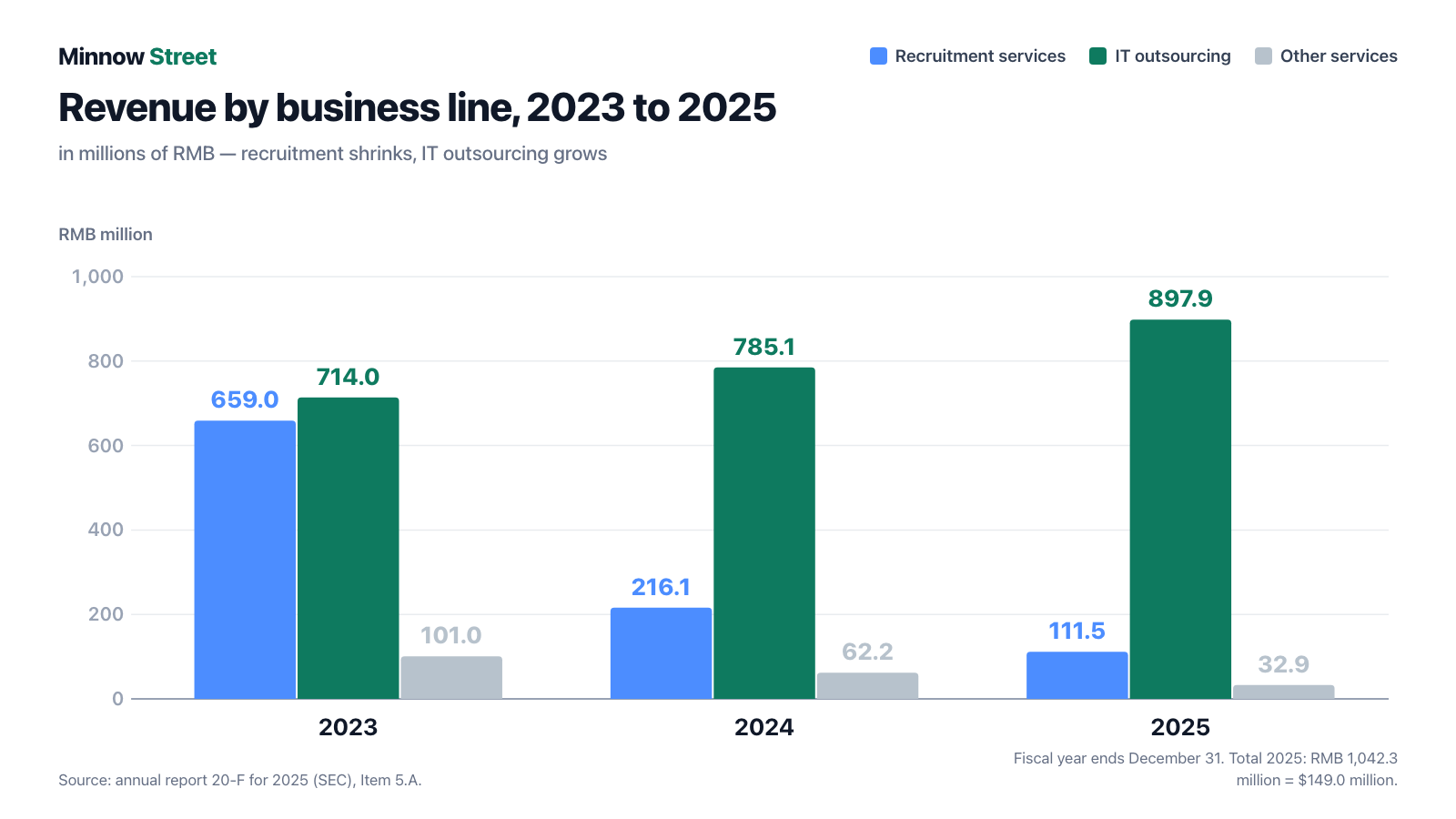
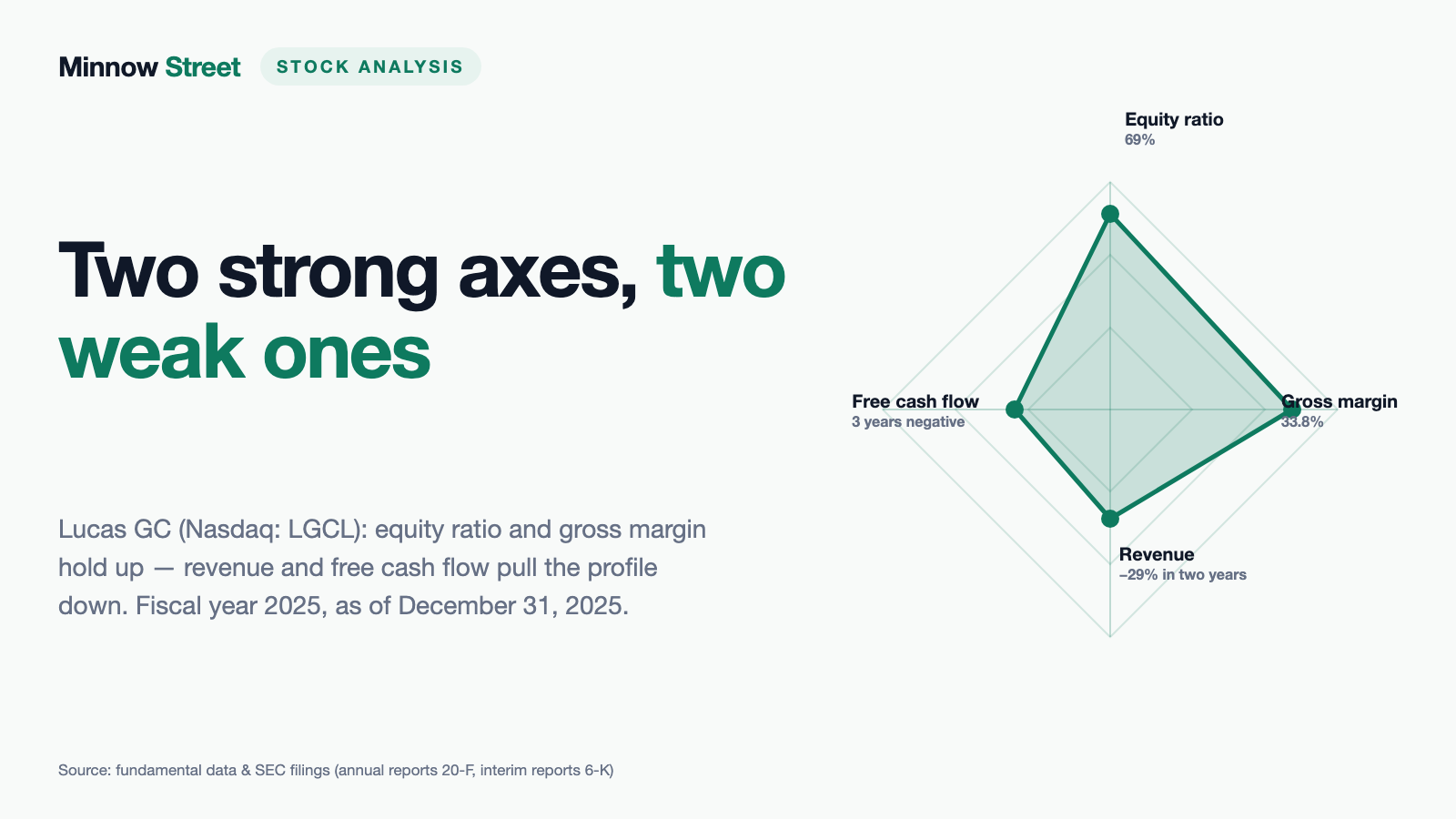
Classic recruitment, once the largest pillar, has melted down to RMB 111.5 million — one sixth of its 2023 level. Outsourcing grew over the same period from RMB 714.0 million to RMB 897.9 million. Other services fell from RMB 101.0 million through RMB 62.2 million to RMB 32.9 million. Net of it all, revenue shrank from RMB 1,474.0 million to RMB 1,042.3 million ($149.0 million), down 29 percent in two years. The growth in outsourcing did not offset the collapse in recruitment; it only slowed it.
That names the central tension of this analysis, and it runs through every chapter that follows: the operating business is shrinking and depends ever more heavily on precisely the service that the company, in its own risk factors, describes as threatened by artificial intelligence — while on the capital side the wheels keep turning faster. Anyone who has watched how far a platform narrative can drift from the actual billing will recognise the pattern from our analysis of Nextdoor: the technology is real; the question is always who pays for it.
How this stock landed on our desk
Honesty first: Lucas GC did not come from one of our screens. The prompt was a sentiment signal. Our daily Reddit mention scan flagged the stock for the first time on July 25, 2026 — with all of 2 mentions and a market value of $58.2 million at the time of the scan. That was the smallest of the three values on the list that day. Not a storm, then; more of a throat-clearing.
And one more thing belongs to the origin story, because it says more about this stock than any ratio: until July 25, 2026, LGCL was missing from our stock universe entirely. There was not a single row for this company in our data — it had never surfaced through a quality filter, through momentum or through a valuation screen, simply because it was not covered. This analysis is what brings it in. So our in-house stock scanner did not find this company; a mood reading from a forum did. That is a distinction worth knowing before you read any numbers: with a scanner hit, the starting point is a criterion the company met. Here the starting point is only that two people on the internet said the name.
Because our screens are recalculated daily, that picture can change — the statement refers explicitly to the state of play on July 25, 2026. What it means for today is clear either way: everything that follows has to come from the primary documents. So let us open them.
The numbers over the years — given their due
Start with what speaks for Lucas GC, because there is some. The company reported a profit in every one of the three reporting years — 2023, 2024 and 2025. Among small caps of this size that is far from a given; plenty of comparable companies post losses and explain why next year will be better. Second, the gross margin has risen, and clearly so: from 28.4 percent in 2023 to 33.6 percent in 2024 and 33.8 percent in 2025. In absolute terms that is a gross profit of RMB 352.0 million ($50.3 million) in 2025. The business has not been dragged into a price war — more sticks per assignment today than two years ago.
Third, the balance sheet. As of December 31, 2025, total assets of RMB 453.8 million ($64.9 million) were matched by RMB 314.1 million of equity ($44.9 million). That is an equity ratio of 69 percent. Put plainly: of every dollar tied up in the company, 69 cents belong to shareholders and only 31 cents to creditors. For comparison, plenty of solid mid-sized businesses sit at 30 to 40 percent. That is a genuine asset, and it deserves to be said before the uncomfortable parts arrive.
And fourth: operations did produce cash in 2025. RMB 35.5 million ($5.1 million) came in from operating activities, after RMB 20.2 million in 2024. Two years earlier, in 2023, that figure had still been negative at minus RMB 36.4 million. The direction, then, is right. It is simply not enough — and the second chart shows why:
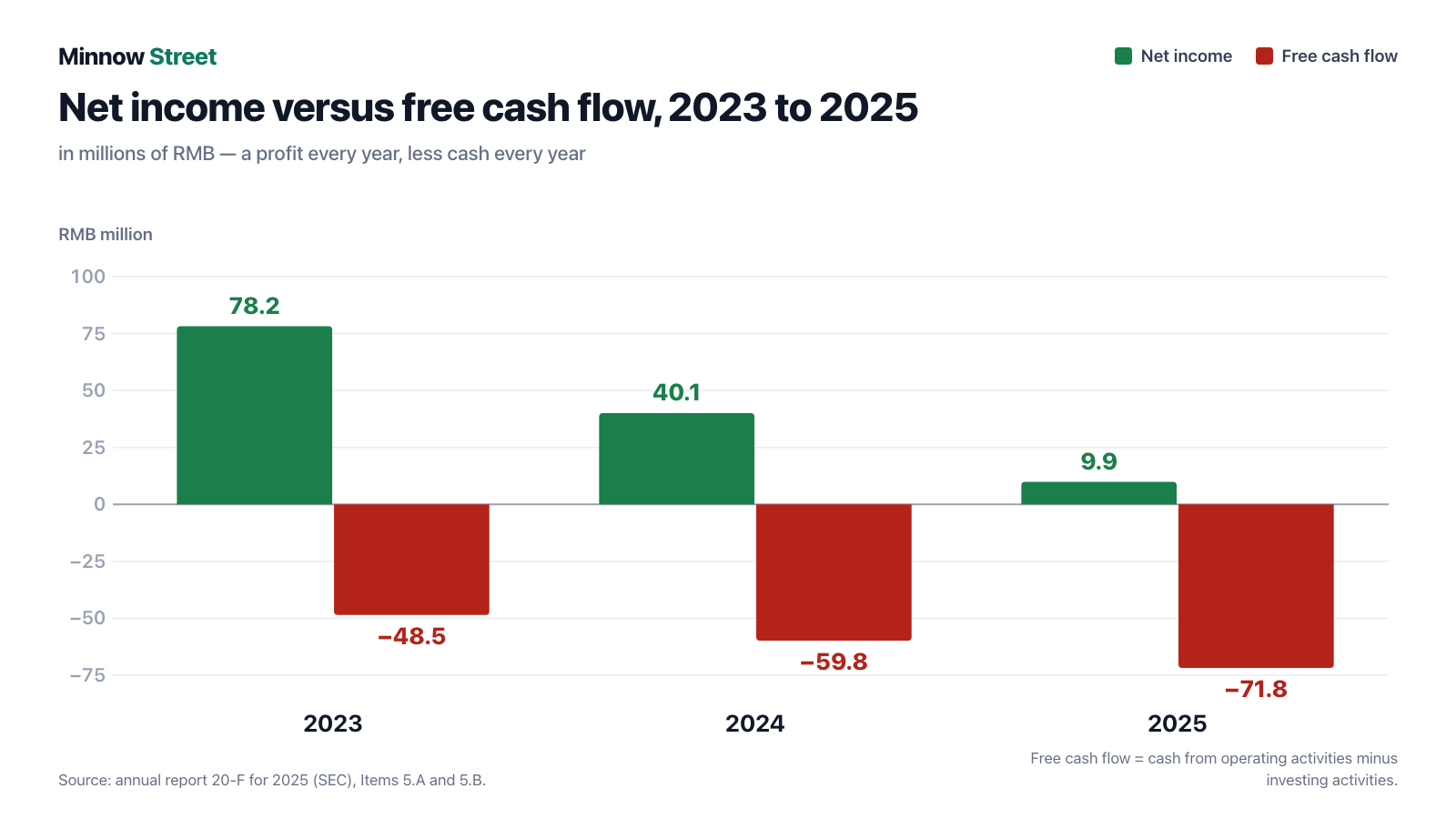
Two lines drifting apart. Profit fell from RMB 78.2 million (2023) through RMB 40.1 million (2024) to RMB 9.9 million — down 87 percent in two years. Free cash flow was negative in all three years and got worse each time: minus RMB 48.5 million, minus RMB 59.8 million and minus RMB 71.8 million. Free cash flow sounds technical but means something very simple: the money left at the end of the year once every running bill has been paid and every investment made. At Lucas GC nothing was left three years in a row — and the shortfall grew each year.
Where does it go? The annual report itemises 2025. Against the RMB 35.5 million from operations stood RMB 107.3 million ($15.3 million) of investing outflows — three times as much. The largest item in it is the purchase of software and equipment: RMB 83.2 million ($11.9 million). And that number has a history: RMB 12.1 million was spent on it in 2023, RMB 44.7 million in 2024, RMB 83.2 million in 2025. Spending on purchased software has almost sevenfolded in two years — while revenue fell 29 percent and profit fell 87 percent. That single line is more than eight times the entire annual profit.
Here is the sentence worth keeping: profit is an opinion, cash is a fact. Purchased software does not hit the income statement at once; it is written down over years. The money, however, is gone immediately. That is exactly how a company can report a profit year after year and still lose cash year after year.
The consequence sits in the same balance sheet. Cash as of December 31, 2025, was just RMB 30.3 million ($4.3 million) — practically unchanged from RMB 30.4 million a year earlier, even though the business had been working in between. That level was not held under its own steam: in 2025 Lucas GC drew short-term borrowings of RMB 105.2 million ($15.0 million). And in February 2026 another $40.0 million arrived from a share placement. Both are money from outside. Which brings us to the uncomfortable parts.
What the filings say — four uncomfortable truths
Uncomfortable truth no. 1: the business depends on a service the company itself sees threatened by AI
We saw above that outsourcing is the growth area. The annual report (Form 20-F) for 2025 says how large that dependence has become — and it says so under the heading “Risk Factors,” not “Opportunities”:
“In 2023, 2024 and 2025, approximately 48.4%, 73.8% and 86.1% of the services we offer relate to outsourcing services, respectively.”
— Lucas GC Limited, Form 20-F for fiscal 2025, Item 3.D Risk Factors (SEC EDGAR)
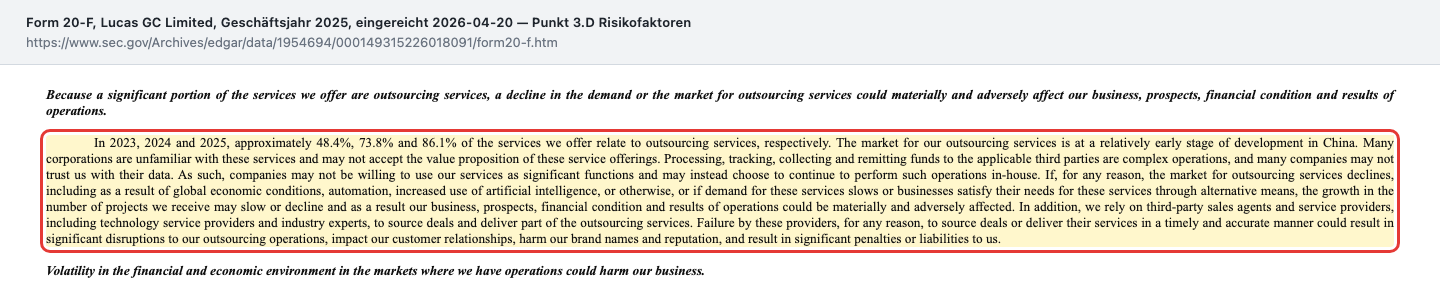
From 48.4 to 86.1 percent in two years: nearly nine of every ten services are outsourcing today. In the same paragraph the company calls the market for it “at a relatively early stage of development in China” and lists what could shrink it: the global economy, automation and the increased use of artificial intelligence. That is the real punchline of this company. A business that presents itself to investors as an AI platform names artificial intelligence, in its own risk factors, as a danger to the service it derives 86 percent of its work from. Both can be true at once — but anyone reading only the marketing side knows half the story.
Uncomfortable truth no. 2: the company considers its own controls ineffective
Every company listed on a U.S. exchange has to state in its annual report whether its disclosure controls work. Those are the internal routines meant to ensure that everything material lands in the filings on time, completely and correctly — the control system behind the numbers. At Lucas GC, the answer for 2025 reads:
“Based on the material weakness(es) described below, our chief executive officer and chief financial officer have concluded that, as of December 31, 2025, our disclosure controls and procedures were not effective.”
— Lucas GC Limited, Form 20-F for fiscal 2025, Item 15 Controls and Procedures (SEC EDGAR)
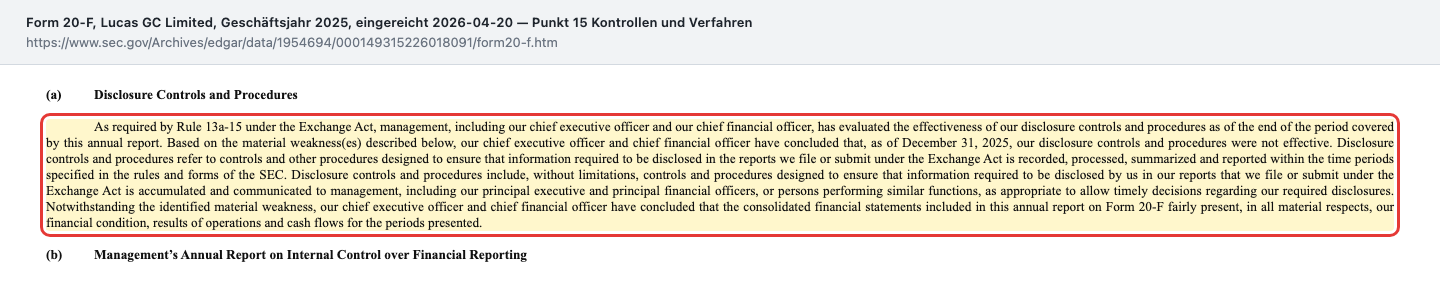
Fairness requires the second half of the same paragraph: the chief executive officer and chief financial officer explicitly conclude that, notwithstanding the identified weakness, the consolidated financial statements “fairly present, in all material respects” the company's position. So nobody is suggesting the numbers are wrong. What is on the table is something else: the system that produces those numbers is, by the company's own account, not working. Among small foreign issuers this finding is common — it is rarely trivial. It means an error would not necessarily be caught before it reached the filing.
Uncomfortable truth no. 3: in four months the share count was first divided, then multiplied
Now to the heart of it. The sequence below is documented in full in the primary filings, and it spans exactly four months.
October 13, 2025 — 40 become 1. Lucas GC merged 40 shares into one, “issued and unissued” alike. The trigger is in the annual report: the stock had closed below $1.00 for 30 consecutive business days, breaching the Nasdaq minimum bid price. A consolidation like this does not change the value of your stake — 4,000 shares at $0.10 become 100 shares at $4.00. It changes the optics, and it saves the listing. On November 3, 2025, Nasdaq confirmed compliance had been regained. The same day a single class of shares became a dual-class structure of Class A and Class B.
December 5, 2025 — authorized capital raised tenfold. An extraordinary general meeting lifted the ceiling within which the board may issue new shares from 250,000,000 to 2,500,000,000 shares — 2,475,000,000 of them Class A and 25,000,000 Class B. Authorized capital works like a credit line for equity: it need not be used, but it is there, and drawing on it requires no further shareholder approval. The same meeting also authorized the board to carry out further consolidations at its own discretion over the following two years — up to an aggregate ratio of 5000-to-1.
February 9 and 10, 2026 — 40,000,000 new shares at $1.00 each. In a private placement to selected investors, Lucas GC issued 40 million new Class A shares, raising gross proceeds of roughly $40.0 million. The share count rose from 2,790,404 to 42,790,404. That is 15.3 times as many. An everyday image belongs here: dilution means your slice of the pie gets thinner because the pie is cut into more pieces. Anyone who owned one percent of the company before February 10, 2026, owned 0.065 percent after it. All prior shareholders together hold 6.5 percent of the capital.
And the pool is nowhere near exhausted: 42,790,404 issued shares sit against 2,475,000,000 authorized Class A shares. That is 1.7 percent. On the arithmetic alone, today's share count could be increased another 57-fold without shareholders being asked again. Whether that happens, nobody knows — that it is possible is written into the articles.
Four months later came the second act — and it ran its course in three weeks. On June 3, 2026, Lucas GC signed an agreement with the investment bank Maxim Group for an at-the-market program, selling shares directly into the market: up to $20.0 million, at the company's sole discretion, for a 3.0 percent commission. On June 4, 2026, a prospectus supplement followed for an additional public offering of shares and warrants — instruments granting the right to buy further shares later at a fixed price, which is future dilution held in reserve. On June 5, 2026, came the supplement for the at-the-market program, and on June 22, 2026, another one for the public offering. Three prospectus supplements in three weeks.
Then, on July 2, 2026, all of it was called off:
“After further evaluating current market conditions, its capital structure and expected financing costs, the Company has decided to terminate the ATM Offering Program and discontinue the Proposed Public Offering. No securities have been issued or sold under, or in connection with, either the ATM Offering Program or the Proposed Public Offering.”
— Lucas GC Limited, Form 6-K of July 2, 2026, Exhibit 99.1 (SEC EDGAR)

How you read that depends on where you stand. Charitably: the company declined the money on those terms and spared shareholders further dilution — the release explicitly cites “expected financing costs.” Critically: a company that announces two financings within three weeks and then withdraws both, without placing a single security, either misjudged the market or could not find enough takers. For investors, one thing matters most: both programs are withdrawn, and the authorized pool of 2.475 billion shares stands untouched.
Uncomfortable truth no. 4: the $40 million went into a fund, not into the business
That leaves the question every capital raise invites: what for? The answer is in the notes to the annual report, and it is remarkably precise. Five days after the placement closed, on February 15, 2026, Lucas GC signed an investment agreement with Shanghai Kesheng Investment Management Co., Ltd. Together with nine other investors it is establishing a limited partnership whose purpose the report gives as “asset management and investment consulting services.” Total committed capital is RMB 4,000 million. Kesheng subscribes RMB 1,200 million as general partner, or 30 percent; Lucas GC subscribes RMB 280 million for 7.0 percent as limited partner. The initial term is five years, extendable by two. Profits are distributed only when individual investments are exited — and the general partner takes 30.0 percent of them first.
The company itself connects that to the capital raise, in a single sentence:
“The Company paid the capital contribution following the receipt of proceeds from a private placement completed by the Company.”
— Lucas GC Limited, Form 20-F for fiscal 2025, notes, events after the balance sheet date (SEC EDGAR)
Do the arithmetic: at the conversion rate used in the annual report, RMB 280 million is roughly $40 million — practically to the dollar the gross proceeds of the placement. Money that investors handed to a staffing and outsourcing business now sits as a limited partnership interest in an investment vehicle with a five-year initial term. For scale: net income in 2025 was RMB 9.9 million. The commitment is 28 times the annual profit. If you want to see what it looks like when a company puts its capital consistently to work in its own core operations, the counterexample is in our analysis of PROG Holdings.
And it is not the only item of its kind. Half a year earlier, on June 15, 2025, Lucas GC had entered a partnership agreement with APEX Management Limited to build a new business in the emerging market of Vietnam. The agreed contribution was US$2,820 thousand (RMB 19,721 thousand) for a 47 percent interest. The money was transferred. Only the entity it was meant to buy into did not exist at the balance sheet date:
“As of December 31, 2025, the partnership entity has yet to be incorporated. The contribution sum was transferred from the Company to APEX Management Limited and presented as ‘Deposit for investment in a partnership entity in the consolidated balance sheet’.”
— Lucas GC Limited, Form 20-F for fiscal 2025, notes, deposit for investment in a partnership entity (SEC EDGAR)

Put that number in proportion. Cash on the same date was $4.3 million. $2.8 million of it — nearly two thirds of the liquidity — sat as a deposit with a counterparty, for a company that did not yet exist. This need not end badly; lead times like that do occur. But it shows how this company handles money: it flows readily into stakes far from the core business, from Vietnam to asset management in Shanghai.
What the company costs — valuation in orders of magnitude
One caveat matters more here than usual: for a company whose share count has fifteenfolded in four months, any valuation ratio is only as good as the share count it was built on. So we use only figures printed in the documents themselves: 42,790,404 Class A shares per the prospectus supplement of June 22, 2026, together with the closing prices disclosed there — $2.10 on June 2, 2026 and $1.78 on June 18, 2026. That puts the market value in the order of $76 million to $90 million, depending on which date you take.
On that basis the valuation looks cheap at first. Against 2025 revenue of $149.0 million it is a price-to-sales ratio of about 0.5 — the market pays roughly 50 cents for every dollar of annual revenue. Single-digit multiples are common for platform and technology companies, and anything below one counts as low. The asset view seems friendly too: against the market value stands equity of $44.9 million as of December 31, 2025, plus, arithmetically, the $40.0 million from the February placement — about $85 million together, more than the exchange assigns to the whole company. (That calculation deliberately ignores whatever the business has done since the balance sheet date.)
The other yardstick flips the picture. Net income in 2025 was RMB 9.9 million, roughly $1.4 million. At a market value of $76.2 million you are paying about 54 times annual earnings — a multiple normally attached to growth companies whose profit is rising. Here it fell 87 percent in two years. And a price-to-earnings ratio resting on a single seven-figure sum tips over at the slightest change in profit.
A note on method: our Reddit scan of July 25, 2026, showed a market value of $58.2 million for LGCL. That figure comes from a market data feed with its own reference date and sits roughly a quarter below the anchor we calculate from the prospectus. So we report it for what it is — a dated scan reading — and derive no valuation ratio from it. Every multiple above rests on the closing price documented in the prospectus for June 18, 2026. Remember: when a company's share count moves, the reference date is part of the ratio.
Opportunities and risks at a glance
Both lists are meant equally seriously. Reading only one of them means the conclusion was drawn beforehand.
What speaks for Lucas GC
- Solid balance sheet structure: RMB 314.1 million of equity against RMB 453.8 million of total assets — an equity ratio of 69 percent as of December 31, 2025. That is a long way from over-indebtedness.
- Rising gross margin: 28.4 percent (2023), 33.6 percent (2024), 33.8 percent (2025). The business has not been pulled into a price war.
- Operations generate cash again: plus RMB 20.2 million (2024) and plus RMB 35.5 million (2025) after minus RMB 36.4 million in 2023.
- Fresh capital is on hand: gross proceeds of $40.0 million from the placement of February 10, 2026 — more than nine times the cash held at the prior balance sheet date.
- The growth area really is growing: outsourcing rose from RMB 714.0 million (2023) to RMB 897.9 million (2025), and the company describes that market in China as still early in its development.
- No immediate further dilution: both financings announced in June 2026 were withdrawn on July 2, 2026, without a security being issued.
- Low on a revenue basis: a price-to-sales ratio of about 0.5 using the closing price of June 18, 2026.
What speaks against Lucas GC
- Concentration risk disclosed in its own risk section: 86.1 percent of services are outsourcing (2023: 48.4 percent) — and the annual report names the increased use of artificial intelligence as a possible reason for that market to decline.
- Earnings are eroding: revenue down 29 percent and net income down 87 percent in two years, to RMB 9.9 million.
- Three years of negative free cash flow: minus RMB 48.5 million, minus RMB 59.8 million and minus RMB 71.8 million. The gap was closed with borrowings of RMB 105.2 million and a share placement.
- Control system not effective as of December 31, 2025, by the company's own account, because of a material weakness in internal control.
- The dilution pool stays open: 42,790,404 issued shares against 2,475,000,000 authorized Class A shares; on top of that the board may resolve further consolidations of up to 5000-to-1 in aggregate through December 2027.
- Capital leaves the core business: an RMB 280 million commitment to an investment partnership, plus a $2.82 million deposit for a Vietnam stake whose entity had not been incorporated at the balance sheet date.
- Listing history: the stock traded below a dollar for 30 business days, and Nasdaq compliance was only restored on November 3, 2025 — through the consolidation, not through the business.
- Thin reporting: as a foreign private issuer, Lucas GC files no quarterly report (10-Q), only the annual report (20-F) and informal interim reports (6-K).
- Change at the top of technology: the chief technology officer stepped down effective July 30, 2026, moving into an advisory role — for personal reasons and, per the filing, without any disagreement.
- Chinese regulatory framework: the entire business and all 311 employees sit in China, and operations require licences and permits on an ongoing basis.
A human conclusion
Remember the share-count lure from the opening? The feeling that 350 shares are more than two? Lucas GC is the textbook case for why that feeling misleads. Because here the number of shares is not a fixed quantity but a moving one. In October 2025, forty became one. In December the ceiling for new shares was raised tenfold. In February 2026 another 40 million arrived, and the stake of everyone who had been there before shrank to 6.5 percent. Counting shares here means measuring with a ruler that changes its own length.
And still — honesty demands it — Lucas GC is not an empty shell. There is a business with RMB 1,042.3 million in revenue, 311 employees, a gross margin of 33.8 percent and an equity ratio of 69 percent. Operations even generated RMB 35.5 million of cash in 2025. There are worse starting points. It is just that every movement around that business points the same way: profit has been falling steeply for two years, money leaves faster than it comes in, the company's own controls are considered ineffective, and the fresh capital went not into the platform but into a limited partnership for asset management.
So the decisive question is not whether the stock looks cheap at $1.78. It is this: do you believe that $40 million of fresh money in the hands of this management will achieve more than the three years before it did? If yes, that is a defensible bet, with a solid balance sheet underneath it. If no, then the low sticker price is not an argument but merely a number on a screen. We have laid open the documents where both sides are written down. The decision is yours. And that is exactly as it should be.
Sources
- Lucas GC Limited, annual report on Form 20-F for fiscal year 2025 (filed April 20, 2026) — Item 3.D Risk Factors, Items 5.A and 5.B Operating and Financial Review, Item 6.D Employees, Item 15 Controls and Procedures, and the notes covering events after the balance sheet date
- Form 6-K of February 10, 2026 — private placement of 40,000,000 Class A shares at $1.00 each
- Form 6-K of June 4, 2026 — at-the-market offering agreement for up to $20.0 million
- Form 6-K of July 2, 2026, Exhibit 99.1 — termination of the offering program and discontinuation of the proposed public offering
- Prospectus supplements on Form 424B5 of June 4, June 5 and June 22, 2026 — share count, capitalization and the documented closing prices of June 2 and June 18, 2026
- All SEC filings by Lucas GC Limited (CIK 1954694) — including the Form 6-K of July 10, 2026, on the chief technology officer stepping down effective July 30, 2026
- Source: fundamental data & SEC filings (annual reports 20-F, interim reports 6-K) — ratios and comparison figures, data as of July 26, 2026
- Trigger: the editorial team's daily Reddit mention scan, as of July 25, 2026
This article is journalistic analysis of publicly available company filings and is expressly not investment advice and not a solicitation to buy or sell securities. Shares of small companies can be highly volatile; a total loss of the capital invested is possible. All figures come from the primary documents named above and carry the reference date stated with them; later developments are not reflected. The author holds no position in the stock discussed at the time of publication.
Our Bottom Line at a Glance
- A business quietly swapped out negative
- Revenue fell from RMB 1,474.0 million (2023) to RMB 1,042.3 million (2025), a drop of 29 percent. Behind it lies a complete exchange of the business: recruitment collapsed from RMB 659.0 million to RMB 111.5 million while outsourcing grew from RMB 714.0 million to RMB 897.9 million. The annual report 20-F for 2025 puts outsourcing at 86.1 percent of services, up from 48.4 percent in 2023 — and in the same risk factor names the increased use of artificial intelligence as a reason that market could shrink.
- Earnings power is eroding negative
- Net income fell from RMB 78.2 million (2023) to RMB 40.1 million (2024) and RMB 9.9 million (2025) — down 87 percent in two years. The gross margin actually held up slightly better at 33.8 percent (2024: 33.6 percent), so the decline is not the result of price pressure in the core service but of volume and the cost base underneath. As of December 31, 2025.
- Solid balance sheet, thin cash neutral
- As of December 31, 2025, equity of RMB 314.1 million ($44.9 million) stood against total assets of RMB 453.8 million — an equity ratio of 69 percent that many larger companies do not reach. Cash on the same date, however, was only RMB 30.3 million ($4.3 million), while short-term borrowings of RMB 105.2 million were drawn during 2025. The February 2026 placement of $40.0 million gross closed that gap from the outside, not from the business.
- Capital structure and dilution negative
- Within four months the company merged 40 shares into one (October 13, 2025), raised authorized capital tenfold to 2,475,000,000 Class A shares (December 5, 2025) and issued 40,000,000 new shares at $1.00 each (February 10, 2026). Holders from before are left with 6.5 percent of the capital. Only 1.7 percent of the authorized pool is used, and the same meeting authorized the board to carry out further consolidations of up to 5000-to-1 in aggregate.
- Controls and reliability of the filings negative
- The chief executive officer and chief financial officer state in the annual report 20-F for 2025 that disclosure controls were not effective as of December 31, 2025, because of a material weakness in internal control. They also conclude that the financial statements fairly present the company's position. For investors that means the numbers are audited while the system producing them is, by the company's own account, not working as intended.
- Valuation neutral
- With 42,790,404 shares and the closing price of $1.78 on June 18, 2026, documented in the prospectus, the market value comes to roughly $76.2 million. Measured against 2025 revenue of $149.0 million that is a price-to-sales ratio of about 0.5 — low on its own terms. Measured against net income of RMB 9.9 million (roughly $1.4 million) it is about 54 times annual earnings. Cheap depends entirely on the yardstick.
Lucas GC is neither a fraud nor an empty shell: there is a real business with RMB 1,042.3 million in revenue ($149.0 million), 311 employees and a gross margin of 33.8 percent, and in 2025 operations even threw off RMB 35.5 million in cash. But everything happening around it points the same way: profit is down 87 percent in two years, free cash flow has been negative for three years running, the company considers its own controls ineffective, and the share count has more than fifteenfolded within four months. Buying in here is not buying a growth story; it is a bet that $40 million of fresh money will do more than the three years before it did. Not investment advice.
What Our Rating Means
Substance risk
We found at least one documented issue that threatens the company itself — regardless of how the stock is currently valued.
The red light here is about substance, not about the share price. Three documented findings come together: disclosure controls were, by the company's own statement, not effective as of December 31, 2025. Free cash flow was negative in 2023, 2024 and 2025 (minus RMB 48.5 million, minus RMB 59.8 million, minus RMB 71.8 million) against cash of just RMB 30.3 million — a gap closed with debt and a share sale rather than by the business. And after the tenfold increase of authorized capital, the structure allows the share count to be multiplied again without asking shareholders. The operating business can work, and the equity ratio of 69 percent is a genuine asset; where the evidence sits between two levels, though, the more cautious one applies. The decision is yours.
A journalistic assessment by our editorial team at the time of the deep dive, based on public sources — not investment advice and not a solicitation to buy or sell. Your personal circumstances (investment goals, risk capacity, taxes) cannot be taken into account. What our levels mean, how verdicts are formed, and what conflicts of interest exist →
Worth Noting
- This analysis was triggered by our daily Reddit mention scan of July 25, 2026 — 2 mentions, the smallest of the values reported that day. It was not a scanner hit: until that date LGCL was not in our stock universe at all.
- Data basis: annual report 20-F for 2025, filed April 20, 2026 (balance sheet date December 31, 2025); capital and price data from the prospectus supplements 424B5 of June 4, June 5 and June 22, 2026, and the interim reports 6-K of February 10, June 4, July 2 and July 10, 2026.
- All operating figures are reported in renminbi (RMB); the U.S. dollar amounts are the company's own conversions in the annual report. Mixing renminbi and dollar figures produces entirely different orders of magnitude.
- Lucas GC is a foreign private issuer: there is no quarterly report 10-Q, only the annual report 20-F and informal interim reports on Form 6-K. Between two annual reports the data can therefore be sparse for months.
Frequently Asked Questions
Lucas GC places staff in China and runs outsourced human-resources and IT processes for corporate clients. In 2025, RMB 897.9 million of its RMB 1,042.3 million in revenue came from outsourcing and only RMB 111.5 million from classic recruitment. The company describes itself as an AI-driven platform business, but what it bills for are services, not software licenses.
The U.S. securities regulator, the SEC, treats Lucas GC as a foreign private issuer. Such companies file one annual report a year on Form 20-F and disclose interim news informally on Form 6-K. There is no quarterly report 10-Q of the kind U.S. issuers file. Anyone looking for first-half numbers may simply not find them.
Every 40 old shares became one new share. A holder of 4,000 shares was left with 100 — the value of the stake did not change, only the price per share rose accordingly. The reason is in the annual report: the stock had closed below $1.00 for 30 consecutive business days, breaching the Nasdaq minimum bid price. Compliance was confirmed on November 3, 2025.
There were 2,790,404 Class A shares as of December 31, 2025. On February 10, 2026, 40,000,000 new shares were sold at $1.00 each, lifting the count to 42,790,404. The stake of everyone who held shares before fell to 6.5 percent of the capital. Dilution means your slice of the pie gets thinner even though the pie has not grown to match.
On paper yes, in cash barely. Net income was RMB 9.9 million in 2025, after RMB 40.1 million in 2024 and RMB 78.2 million in 2023. Operations produced RMB 35.5 million of cash in 2025, but RMB 107.3 million flowed out through investing activities. That left minus RMB 71.8 million — the third negative year running.
On February 15, 2026, five days after the placement closed, a Chinese subsidiary agreed to contribute RMB 280 million to a new investment partnership — 7.0 percent of a total committed capital of RMB 4,000 million. Its stated purpose is asset management and investment consulting. Converted, the commitment is almost exactly the $40.0 million in gross proceeds from the share sale.
It uses AI but does not sell it. The annual report traces revenue to three service lines — recruitment, outsourcing and other services — and describes AI as the technology behind the platform on which its core functionality depends. No separately billed AI product, such as a license or a subscription, is disclosed in the filings.
On July 2, 2026, Lucas GC said it would terminate its at-the-market program of up to $20.0 million and discontinue a proposed public offering. The release cites market conditions, the company's capital structure and expected financing costs. Not a single security had been issued under either program — both simply ran into the void.
Found an error?
Did you spot a factual error, an outdated number, or a typo in this deep dive? Let us know briefly — your report goes straight to the editorial team.