Live Ventures: One Holding Company, One Owner — and a Profit That Does Not Come From the Business
This Las Vegas holding company buys American middle-market firms: video game stores, flooring, tool steel. Revenue of $444.9 million, 1,366 employees — and a market value of roughly $28 million. In fiscal 2025 it reported $22.7 million of profit. $27.5 million of that came from paper gains without a single dollar of cash moving. After interest, operations leave a shortfall. Meanwhile a civil lawsuit by the U.S. securities regulator against the company and its chief executive has been running since August 2021 — and in February 2026 the court cleared the way to trial. We read the annual and quarterly reports and work out what is actually earned here. What you get at the end is not a price verdict but an arithmetic you can check yourself.
 Thomas Mücke
Founder & Publisher
Thomas Mücke
Founder & Publisher

Chart
Interactive price chart (TradingView).
Note: pure fact-based analysis, not investment advice and not a solicitation to buy or sell. All figures without guarantee.
There is a thinking trap that snaps shut especially reliably on small stocks, because the arithmetic looks so seductively simple: the too-cheap trap. A company does $444.9 million of revenue, earns $22.7 million and costs roughly $28 million on the market. Your head runs the numbers: a bit more than one times annual profit, one sixteenth of revenue, a third of book value. That has to be too cheap.
So let us make a deal. Before we talk about the stock, we read together what Live Ventures Incorporated (NASDAQ: LIVE) itself filed with the U.S. securities regulator — the annual report (10-K) for fiscal 2025 of December 17, 2025 and the quarterly report (10-Q) for March 31, 2026 of May 14, 2026. Those documents are honest under penalty of law. And in three steps they explain why that arithmetic does not work.
One note first, without which every figure in this piece is read wrongly: Live Ventures\' fiscal year ends on September 30, not December 31. "Fiscal 2025" here means October 2024 through September 2025. The latest quarterly report, for March 31, 2026, is therefore the second quarter of the current fiscal year.
What this analysis covers
- What Live Ventures actually does
- Where the stock landed on our desk
- The numbers over the years — and where the profit comes from
- What the filings say — four uncomfortable truths
- Valuation — what the market pays for this holding company
- Opportunities and risks at a glance
- A human conclusion
- Sources
What Live Ventures actually does
Live Ventures buys American middle-market companies and keeps them. It describes itself as industry agnostic, hunting for "well-run, closely held businesses with a demonstrated track record". The company was founded in 1968 and later refocused under today\'s chief executive Jon Isaac. What came out of that is a bundle of four very different businesses and 1,366 employees:
- Entertainment retail — Vintage Stock sells new and pre-owned movies, video games and music, plus books, comics, toys and collectibles. Fiscal 2025 revenue: $77.5 million.
- Flooring retail — Flooring Liquidators runs 28 warehouse-format stores and a design centre across four states, selling and installing flooring, carpet and countertops for consumers, builders and contractors in California and Nevada. Revenue: $122.3 million.
- Flooring manufacturing — Marquis makes carpet and hard-surface flooring for residential, niche commercial and hospitality markets. Revenue: $121.6 million.
- Steel fabrication — Precision Marshall supplies over 500 steel distributors with tool steel and precision ground flat stock; Kinetic makes industrial knives; PMW does metal forming; Central Steel builds cable racks, framing and network bays, mostly for data centres. Combined revenue: $132.6 million.
A note for anyone looking for the older holdings: there is no auto parts or tire segment in the current filings. The four businesses above are the complete reportable set under the U.S. segment standard; everything else sits in "Corporate and Other" and does not clear the reporting threshold.
That frames the central tension of this analysis: on paper Live Ventures is a profitable conglomerate at a bargain price. In the filings it is a company whose interest burden eats its operating profit, whose reported annual profit comes from bookkeeping entries, and which is controlled by a single man the securities regulator is suing.
Where the stock landed on our desk
We run roughly 3,200 stocks through our scanners every day. LIVE reached the research list through our in-house K/FCF ranking — a list that sorts strictly by market value divided by trailing four-quarter free cash flow, cheapest first. On July 27, 2026 the U.S. selection held 545 hits. LIVE sat in place 25 with a K/FCF of 1.4 — identical on both brands, and exactly the last place the detail page shows at all. Slip one rank, and the name disappears from the list. Anyone still wanting to find it then uses not the scanner but the screener, setting the P/FCF filter to its lowest band. These lists are recomputed daily.
The number behind it is real and not manufactured: in fiscal 2025 the company took in $28.7 million from operations; after $7.7 million of capital expenditure, $21.0 million of free cash flow remains. Against a market value of roughly $28 million that produces the 1.4.
Two qualifications belong with it immediately, and both matter more than the ratio itself.
First: a good part of that inflow comes from shrinking. Of the $28.7 million, $12.4 million came from running down receivables ($7.2 million) and inventories ($5.2 million). When revenue falls — and it fell from $472.8 million to $444.9 million — the business ties up less capital, and that capital is released. It is real money, but it is a one-time release, not earning power. Strip out all working capital movements and operating cash flow drops to $19.9 million, or roughly $12.2 million after investment — which makes the K/FCF about 2.3 rather than 1.4.
Second: free cash flow is not a shareholder profit if it belongs to the lenders. As of March 31, 2026, equity of $92.9 million faced $299.6 million of liabilities. Financial debt alone came to roughly $122.4 million, with a further $42.9 million of finance leases. Interest expense in fiscal 2025 was $15.6 million — more than the entire operating income of $14.6 million.
One more figure from our data set that needs correct framing: the Altman Z-score of 5.33. On the Z" scale we use, 1.1 marks the distress zone and 2.6 the safe band; 5.33 sits well above. Unlike at a bank, the formula is in principle applicable to a retail and manufacturing group. It simply rests here on earnings largely composed of paper gains — and it measures neither legal risk nor the question of who owns the company. The score says: no arithmetic insolvency signal. It says nothing about whether this company makes money.
The numbers over the years — and where the profit comes from
Revenue is falling: $472.8 million in fiscal 2024, $444.9 million in fiscal 2025, and in the first half of the current year $211.4 million against $218.5 million a year earlier. Gross margin holds up at 32.7 percent, and administrative costs were cut from $118.0 million to $113.7 million.
Earnings, by contrast, swing wildly: −$26.7 million (fiscal 2024), +$22.7 million (fiscal 2025), −$2.5 million (first half of fiscal 2026). The 2024 loss came from an $18.1 million goodwill write-off at Flooring Liquidators. And the 2025 profit? It is built like this:
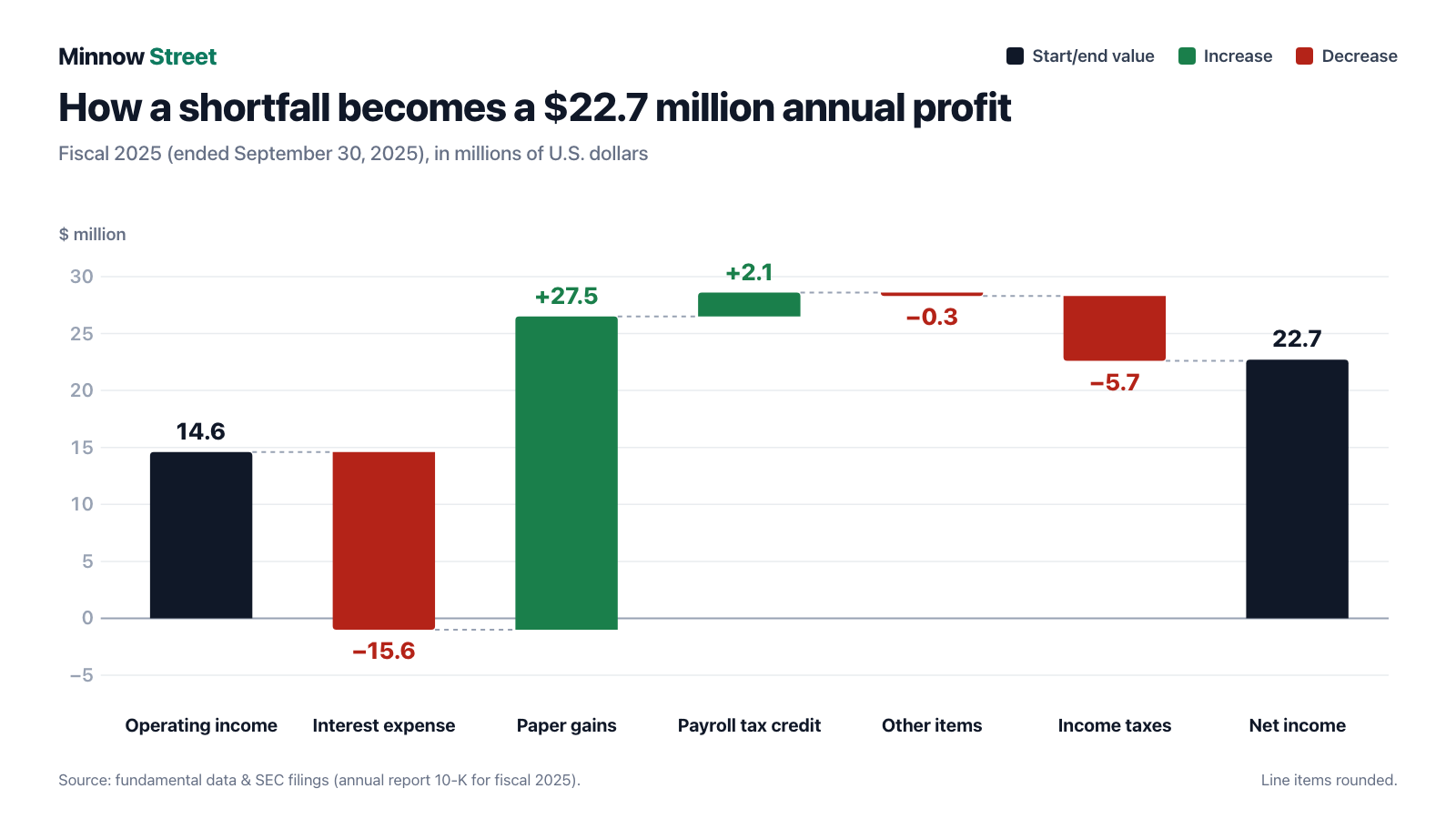
The four paper gains in detail: $22.8 million from modifying an acquisition seller note, $2.8 million from settling an earn-out owed to a seller, $1.2 million from settling a withheld portion of a purchase price and $0.7 million from a debt extinguishment. In none of these four cases did money enter the company; what changed were liabilities. The cash flow statement is unforgiving about it: all four amounts are deducted from net income there, because none of them were cash.
One common misunderstanding deserves clearing up. Live Ventures is known for buying companies below book value, and such purchases produce accounting gains called "bargain purchase" income. In the two current filings, however, that line item does not appear at all. Fiscal 2025\'s paper gains all come from restructuring acquisition debt — from renegotiating what is still owed to sellers, not from the buying itself.
What the filings say — four uncomfortable truths
No. 1: One business carries all the others
The segment tables in the annual report answer the most important question at any holding company — which part actually earns money? The answer is unambiguous once interest expense is allocated where it arises:
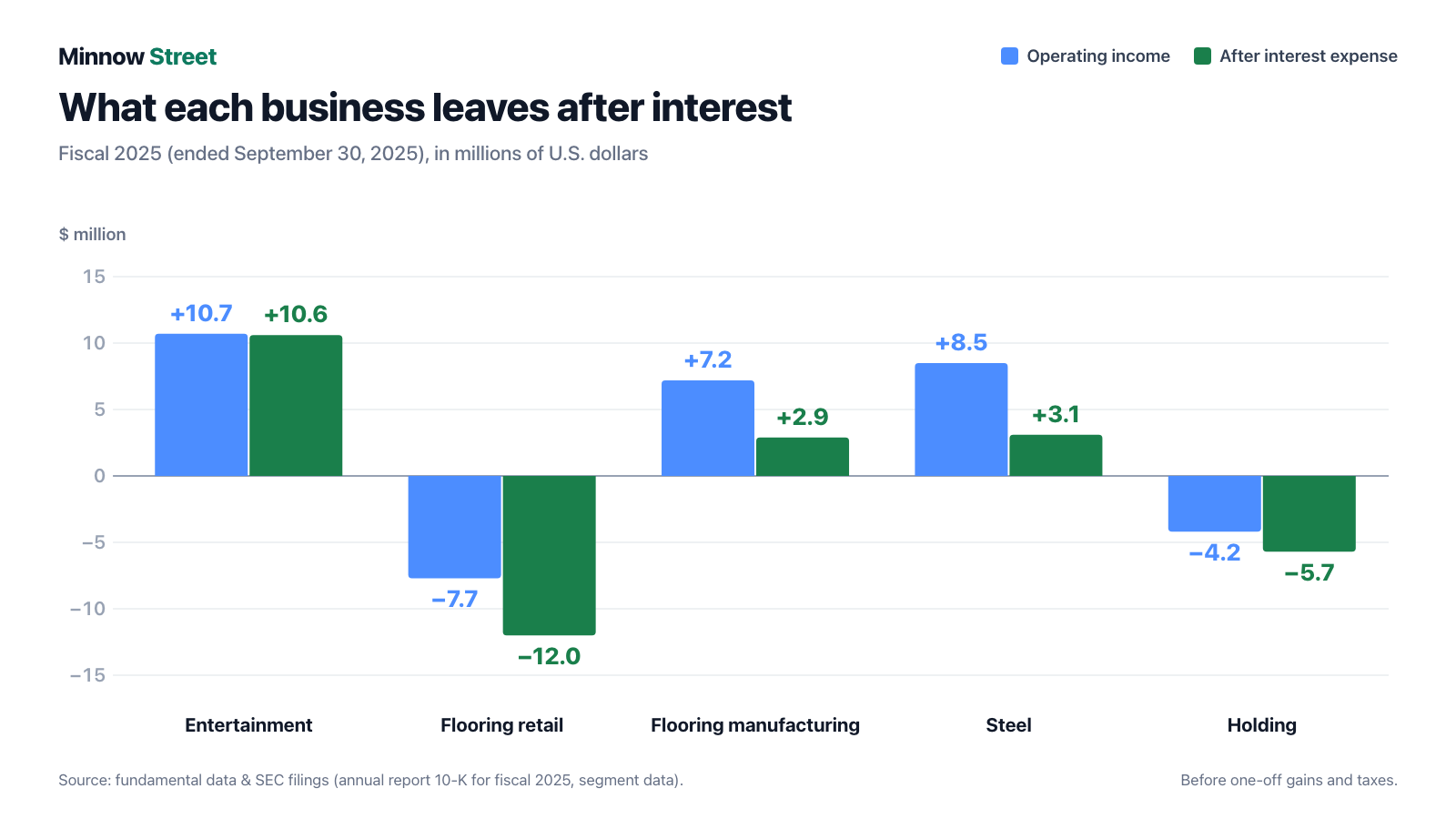
Vintage Stock is the engine: $77.5 million of revenue, a 57.9 percent gross margin, $10.7 million of operating income — and practically no interest burden, because little debt sits on that business. Pre-owned video games and movies are a high-margin trade, and this one segment carries the whole group.
Flooring Liquidators is the opposite: $122.3 million of revenue, but −$7.7 million operationally and −$12.0 million after interest. This is the business where $18.1 million of goodwill was already written off in 2024. In the second quarter of the current fiscal year its revenue had shrunk to $20.2 million for the quarter, with an operating loss of $4.6 million.
And the current trend shows the problem spreading: in the quarter to March 31, 2026 Live Ventures wrote off $4.0 million of goodwill in the steel business. That segment swung from profit to a pre-tax loss of $3.3 million. Group-wide the quarter showed a loss of $2.4 million.
No. 2: One man holds two thirds of the votes — and is also the lender
The annual report says it in its own risk factors, plainly enough to need no interpretation:

"As of December 5, 2025, Isaac Capital Group LLC (“ICG”), together with Jon Isaac, our President and CEO and the President and sole member of ICG, control approximately 67.4% of the outstanding voting power of our company (assuming the exercise of all outstanding and exercisable warrants held by them). Jon Isaac has the sole power to vote the shares of our common stock owned by ICG."
— Live Ventures Incorporated, SEC annual report 10-K for fiscal 2025, Item 1A
A widespread misunderstanding deserves clearing up here too: this control does not come from a preferred share with super voting rights. The outstanding Series E preferred consists of 47,840 shares with a liquidation preference of $0.30 each and a 5 percent dividend on that — roughly $720 of annual distribution in total. No special voting right is attributed to it anywhere in the filings. The 67.4 percent is made up of common stock (Jon Isaac personally 217,177, ICG 1,357,306) plus a conversion right. The board may, however, freely set the terms of future preferred series, including their voting rights.
More interesting than the control itself is the dual role. Through ICG, Jon Isaac is also a lender to his own company:
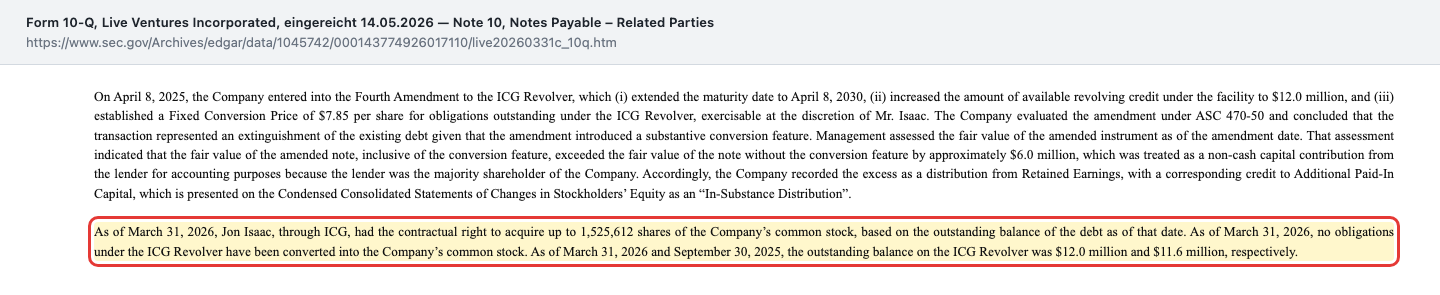
The credit line started in 2020 at $1.0 million. The fourth amendment of April 8, 2025 raised it to $12.0 million and set a fixed conversion price of $7.85 per share, exercisable at Mr. Isaac\'s discretion. As of March 31, 2026 that equalled a right to up to 1,525,612 shares — against 3,071,656 outstanding, roughly half the current count. At a price of $9.70 that conversion right is in the money. A second ICG loan to the flooring subsidiary carries 12.0 percent interest; when it was amended in February 2026, accrued interest including default-rate interest was rolled into principal.
No. 3: The securities regulator is suing — and trial is coming
This is the point where the analysis stops being a valuation question. An SEC civil lawsuit has been running since August 2, 2021:

"The SEC Complaint alleges various financial, disclosure, and reporting violations related to income and earnings per share data, purported undisclosed stock promotion and trading, purported inaccurate disclosure regarding beneficial ownership of common stock, and undisclosed executive compensation from 2016 through 2018. […] The SEC seeks permanent injunctions against the Company Defendants, permanent officer-and-director bars, disgorgement of profits, and civil penalties."
— Live Ventures Incorporated, SEC quarterly report 10-Q for March 31, 2026, Note 16
What matters is the procedural stage, and it moved recently:

In plain terms: on February 10, 2026 the court denied both sides\' motions for a judgment without a trial. That means neither that the SEC is right nor that the company is right — it means the matter stays contested and will be fought out in court. The parties are preparing for trial; no date has been set. The origin lies far back: an SEC subpoena of February 21, 2018 concerning the restatement of three quarterly reports from 2016 and 2017, then four Wells Notices in 2020, then the 2021 complaint. A parallel investor class action with similar allegations has been running since August 2021; the court denied its dismissal on September 30, 2025 and discovery is under way.
In fairness: the company has denied the allegations since its answer of October 11, 2022. And the allegations concern events from 2016 to 2018 — not today\'s numbers. But they concern the man who runs the company today and holds two thirds of its votes.
No. 4: The stock is so small that ratios become accidents
There are 3,071,656 shares. Not millions — units. Roughly 2.2 million of them sit with insiders. The market value of shares held by non-affiliates named in the June 18, 2026 registration statement was approximately $8.9 million as of May 27, 2026. Daily trading volume runs at around $0.1 million.
That has three practical consequences. First, a single larger order moves the price. Second, there is effectively no analyst coverage, which is why we quote no price target here — the values in data sets are not reliable for a name this size. And third, the dilution question is large: alongside the conversion right over 1,525,612 shares, the company in June 2026 registered a programme to issue securities of up to $50.0 million — nearly twice the entire market value and roughly five times what the public float is worth. That is a stock of ammunition, not an announcement. But it is on the shelf.
Valuation — what the market pays for this holding company
First: these are dated anchors, not buy arguments. Price $9.70 (as of July 24, 2026), market value per fundamental data roughly $28 million, share count 3,071,656 (balance sheet at March 31, 2026).
At first glance everything is cheap: the price equals roughly 0.34 times book value, 0.06 times annual revenue and 1.4 times free cash flow. A price-to-earnings ratio cannot sensibly be formed, because the current fiscal year shows a first-half loss — and because last year\'s profit, as shown, came from bookkeeping.
At second glance the reason appears. For a company this leveraged, the right reference is not market value but enterprise value: market value plus net financial debt. Against roughly $122.4 million of financial debt and $42.9 million of finance leases stands $15.2 million of cash. Buying the stock therefore means buying the equity remainder of a structure whose value belongs overwhelmingly to lenders — and whose operating profit is not enough to service their interest. The ratio of enterprise value to earnings before interest, taxes, depreciation and amortisation stands at roughly 6.4 in our data, which is no longer bargain territory.
What must be credited: the company is reducing debt. In fiscal 2025 it repaid a net $11.5 million under its revolving lines and $7.0 million on notes and leases, and bought back $0.5 million of its own shares. And Vintage Stock delivers genuine, recurring cash.
The share price tells the other half: it sits roughly 99 percent below its all-time high and roughly 59 percent below its twelve-month high, with relative strength against the broad market at 16 out of 100. Our trend scanners place the stock in a downtrend phase. For how differently the market prices second-hand goods, see our piece in this series on a used-car retailer, the analysis of America\'s Car-Mart. And for what a group looks like that also appears cheap while its debt load defines the picture, see the analysis of Xerox.
Opportunities and risks at a glance
What speaks for Live Ventures:
- One strong business in the bundle. In fiscal 2025 Vintage Stock produced a 57.9 percent gross margin and $10.7 million of operating income on $77.5 million of revenue — almost unburdened by interest.
- Real cash generation. $28.7 million from operations in fiscal 2025, $21.0 million after capital expenditure — against a market value of roughly $28 million.
- Debt reduction instead of acquisitions. In fiscal 2025 a net $11.5 million was repaid under the revolving lines and no companies were bought; the year before there were three acquisitions for roughly $13.0 million combined.
- Balance sheet substance. Inventories of $121.6 million and property and equipment of $75.4 million (March 31, 2026) against a market value of roughly $28 million; the arithmetic insolvency indicator shows no acute signal.
- An alignment of interest that is rare. The chief executive holds roughly two thirds of the votes and has his own money in the company — he loses more than anyone else in a setback.
What speaks against it:
- The reported profit was not earned. Of $22.7 million of net income, $27.5 million came from non-cash paper gains; after interest, operations leave a shortfall of $0.9 million. The first half of the current year shows a loss of $2.5 million.
- Interest eats the profit. $15.6 million of interest expense in fiscal 2025 against $14.6 million of operating income; liabilities of $299.6 million against $92.9 million of equity (March 31, 2026).
- A civil lawsuit by the securities regulator against company and chief executive. On February 10, 2026 the court denied both motions for judgment without trial; the parties are preparing for trial. The SEC seeks permanent officer-and-director bars among other relief. A parallel investor class action also continues.
- Flooring retail loses money and is shrinking. −$7.7 million operationally in fiscal 2025 and −$12.0 million after interest; $18.1 million of goodwill was already written off there in 2024. In the quarter to March 31, 2026 a further $4.0 million write-off hit the steel business.
- Dilution is built in. A conversion right for the chief executive over up to 1,525,612 shares at $7.85 against 3,071,656 shares outstanding, plus a programme of up to $50.0 million registered in June 2026.
- Barely tradable. Market value of shares held by non-affiliates roughly $8.9 million (May 27, 2026), daily volume around $0.1 million. The price sits roughly 99 percent below its all-time high.
A human conclusion
Back to the too-cheap trap. Yes, Live Ventures costs a third of its book value and a bit more than one times its free cash flow. And yes, Vintage Stock is a tidy little business that reliably earns money at a 57.9 percent gross margin. Read only those two sentences and the stock looks like a bargain.
The filings tell a different story. After interest, this holding company earns nothing from operations. Its reported annual profit arises because debts owed to the sellers of acquired companies were renegotiated — an accounting gain, economically not one dollar. Its largest lender is the chief executive, who also holds two thirds of the votes and whose credit line can turn into half the share count. And against that same chief executive the U.S. securities regulator has been litigating for five years, in a case a court expressly cleared for trial in February 2026.
That is no longer a valuation question. Buying here does not mean buying a low price; it means buying trust in a single person, inside a structure where minority holders have no way to change anything. The annual report says so itself, in the heading of one of its own risk factors: because of the concentrated ownership, public stockholders may have no effective voice in management.
Three numbers to measure the next chapter against: an operating result that has to exceed $15.6 million of interest expense; a flooring retail business that has to climb out of a $12.0 million annual loss after interest; and a trial date the court has not yet set.
What you make of that is your decision. And that is exactly as it should be.
Sources
- SEC annual report 10-K for fiscal 2025, Live Ventures Incorporated, filed December 17, 2025 (CIK 0001045742)
- SEC quarterly report 10-Q for March 31, 2026, filed May 14, 2026
- SEC quarterly report 10-Q for December 31, 2025, filed February 12, 2026
- SEC annual report 10-K for fiscal 2024, filed December 19, 2024
- SEC registration statement Form S-3 for $50.0 million, filed June 18, 2026
- Fundamental data (ratios, price and valuation data; as of July 27, 2026, last price July 24, 2026)
- Our in-house stock scanner "K/FCF ranking", U.S. selection, measured July 27, 2026 on both brands
This analysis is journalistic commentary and expressly not investment advice, not a recommendation to buy or sell, and not a solicitation to buy or sell securities. All figures come from the original sources listed above and carry the dates stated; numbers change with every new filing. The proceedings described are not concluded; the allegations have not been decided by any court, the company denies them, and the presumption of innocence applies. Stocks can fluctuate substantially and a total loss of invested capital is possible. The author holds no position in the security discussed at the time of publication.
Our Bottom Line at a Glance
- Earnings quality negative
- Of fiscal 2025 net income of $22.7 million, $27.5 million came from non-cash paper gains, plus a one-off payroll tax credit of $2.1 million. Operating income of $14.6 million is consumed by $15.6 million of interest expense. The first half of fiscal 2026 shows a loss of $2.5 million.
- Control and related-party dealings negative
- Isaac Capital Group LLC and chief executive Jon Isaac control roughly 67.4 percent of the voting power (December 5, 2025). The same circle is a lender: a $12.0 million credit line convertible at $7.85 into up to 1,525,612 shares against 3,071,656 outstanding, plus two loans at 12.0 percent interest. The roughly $6.0 million of added value from the conversion feature was booked as a distribution from retained earnings.
- Legal position negative
- A civil lawsuit by the U.S. securities regulator against the company, the sitting chief executive and the former chief financial officer has been running since August 2, 2021 over accounting and disclosure violations from 2016 to 2018; the relief sought includes permanent officer-and-director bars. On February 10, 2026 the court denied both sides' motions for judgment without trial. A parallel investor class action also continues. The company denies the allegations.
- Business mix neutral
- Vintage Stock is a solid business: $77.5 million of revenue, a 57.9 percent gross margin and $10.7 million of operating income with no meaningful interest burden (fiscal 2025). Flooring retail by contrast lost $7.7 million operationally and $12.0 million after interest; $18.1 million of goodwill was written off there in 2024. In the quarter to March 31, 2026 a further $4.0 million write-off hit the steel business.
- Cash generation neutral
- Fiscal 2025 brought $28.7 million of operating cash flow, $21.0 million after capital expenditure — against a market value of roughly $28 million. But $12.4 million of that came from running down receivables and inventories as revenue fell; without that release, roughly $12.2 million remains.
- Tradability and dilution negative
- There are only 3,071,656 shares, roughly 2.2 million of them held by affiliates; the market value of shares held by non-affiliates was about $8.9 million on May 27, 2026, with daily turnover around $0.1 million. On June 18, 2026 a programme to issue securities of up to $50.0 million was registered.
Live Ventures is a Las Vegas holding company with $444.9 million of revenue and a market value of roughly $28 million — at first glance a bargain at 0.34 times book value. The filings show something else: of fiscal 2025 net income of $22.7 million, $27.5 million is paper gains from renegotiated acquisition debt; after interest the group earns nothing from operations. Only one business carries the load, entertainment retailer Vintage Stock; flooring retail loses $12.0 million a year after interest. On top sits a structure in which one man holds roughly 67.4 percent of the votes and is simultaneously the largest lender — with a conversion right over roughly half the share count. And against that same man and the company, the U.S. securities regulator has been litigating since 2021 in a case a court cleared for trial in February 2026. The allegations are undecided and the company denies them. Not investment advice.
What Our Rating Means
Substance risk
We found at least one documented issue that threatens the company itself — regardless of how the stock is currently valued.
This light rates the company, not the share price. Red here stands for three documented findings that together bear on the reliability of reported earning power. First, earnings quality: of fiscal 2025 net income of $22.7 million, $27.5 million came from non-cash paper gains ($22.8 million from modifying an acquisition seller note, $2.8 million from settling an earn-out, $1.2 million from settling a purchase price holdback, $0.7 million from a debt extinguishment), plus a $2.1 million one-off payroll tax credit; operating income of $14.6 million is entirely consumed by $15.6 million of interest expense, and the first half of fiscal 2026 shows a loss of $2.5 million. Second, the balance sheet: $299.6 million of liabilities against $92.9 million of equity (March 31, 2026), with goodwill write-offs of $18.1 million in fiscal 2024 and $4.0 million in the quarter to March 31, 2026. Third, the legal position: a civil lawsuit by the U.S. securities regulator pending since August 2, 2021 against the company, the sitting chief executive and the former chief financial officer over accounting and disclosure violations from 2016 to 2018, seeking permanent officer-and-director bars and disgorgement; on February 10, 2026 the court denied both sides' motions for summary judgment, trial preparation is under way and no date has been set. A parallel investor class action is also pending. The allegations have not been decided by any court, the company denies them, and the presumption of innocence applies — this colour rates not the outcome but the documented uncertainty around a load-bearing figure. Expressly excluded from this colour are price, valuation, float and volatility. Also excluded is the Altman-Z of 5.33: on the Z" scale (thresholds 1.1 and 2.6) it sits in the safe band and shows no arithmetic insolvency signal, but it rests on earnings with a high paper-gain share and measures neither legal risk nor control structure. The decision is yours.
A journalistic assessment by our editorial team at the time of the deep dive, based on public sources — not investment advice and not a solicitation to buy or sell. Your personal circumstances (investment goals, risk capacity, taxes) cannot be taken into account. What our levels mean, how verdicts are formed, and what conflicts of interest exist →
Worth Noting
- Live Ventures reached the research list through our in-house stock scanner "K/FCF ranking" (U.S. selection), measured July 27, 2026 on both brands: 545 U.S. hits, LIVE at a K/FCF of 1.393 in place 25 — identical on boersenlotse.de and minnowstreet.com. That is exactly the last place the detail page shows; slip one rank and the name is no longer visible there. No tie (neighbouring values 1.386 and 1.4225). Anyone still wanting to find it then uses the screener and sets the P/FCF filter to its lowest band. These lists are recomputed daily.
- The ratio needs qualifying twice for this name and is therefore recomputed in the piece. First, of the $28.7 million of fiscal 2025 operating cash flow, roughly $12.4 million came from running down receivables ($7.2 million) and inventories ($5.2 million) as revenue fell — a one-time release, not earning power; excluding all working capital movements, roughly $19.9 million remains operationally and roughly $12.2 million after capital expenditure, which makes the K/FCF about 2.3 rather than 1.4. Second, that cash flow belongs overwhelmingly to lenders: financial debt of roughly $122.4 million plus $42.9 million of finance leases against $15.2 million of cash (March 31, 2026), with interest expense of $15.6 million in fiscal 2025.
- The Altman-Z of 5.33 is quoted but not used as an all-clear. On the Z" scale used here the thresholds are 1.1 (distress zone) and 2.6 (safe band); unlike at a bank, the formula is in principle applicable to a retail and manufacturing group. It rests here, however, on earnings largely composed of paper gains, and it measures neither legal risk nor control structure. The Piotroski score of 3 out of 9 and two balance-sheet warning flags in the same data set paint a considerably more cautious picture.
- Identity checked strictly, because the LIVE ticker is ambiguous and the company has changed its name five times: the SEC ticker registry maps LIVE to CIK 0001045742, and the cover page of the quarterly report for March 31, 2026 reads "Live Ventures Incorporated", Nevada, Commission File Number 001-33937, trading symbol LIVE on the Nasdaq Capital Market. Former names per SEC entity data: LiveDeal Inc (2007–2015), YP Corp (2004–2007), YP Net Inc (1999–2004), RIGL Corp (1998–1999) and Renaissance International Group Ltd (1998).
- Two widespread assumptions are expressly corrected in the piece. First: neither current filing contains any "bargain purchase" gain — the term appears nowhere in the fiscal 2025 annual report or the March 31, 2026 quarterly report; the paper gains come from restructuring acquisition debt. Second: the Series E preferred carries no documented special or super voting right; it comprises 47,840 shares with a $0.30 liquidation preference and a 5 percent dividend on it. The 67.4 percent of voting control arises from common stock (217,177 personally, 1,357,306 through ICG) plus the conversion right on the ICG revolver. The board may, however, freely set the terms of future preferred series, including their voting rights. Also clarified: there is no auto parts or tire segment in the current filings.
- Price and valuation figures are dated anchors, not buy arguments: price $9.70 as of July 24, 2026, ratio data as of July 27, 2026, market value roughly $28 million from fundamental data. The share count of 3,071,656 comes from the quarterly report cover page (as of May 8, 2026). No analyst price target is quoted deliberately: with a public float value of roughly $8.9 million and daily turnover around $0.1 million, the values in data sets are not reliable.
- The most recent periodic report is the quarterly report 10-Q for March 31, 2026 (filed May 14, 2026); it covers the second quarter of the fiscal year ending September 30, 2026. The third-quarter report (June 30, 2026) was not yet due at the data date of July 27, 2026 — a non-accelerated filer has until August 14, 2026. Filed after May 14, 2026: the Form S-3 registration statement for $50.0 million of June 18, 2026 and the current report 8-K of June 25, 2026 (Item 5.07, annual meeting results). Both are evaluated. The fiscal 2025 annual report was filed on time on December 17, 2025; no late-filing notification (NT 10-K) exists for that year, though there were ten historically — the most recent in 2020.
Frequently Asked Questions
Live Ventures is a Las Vegas holding company that buys and runs American middle-market firms. Four businesses are reported: entertainment retail (Vintage Stock, pre-owned movies and video games), flooring retail (Flooring Liquidators, 28 stores), flooring manufacturing (Marquis) and steel fabrication (Precision Marshall, Kinetic, PMW, Central Steel). In fiscal 2025 the group produced $444.9 million of revenue and employed 1,366 people.
On September 30. That matters for every figure: "fiscal 2025" means October 2024 through September 2025. The latest quarterly report, for March 31, 2026, is therefore the second quarter of fiscal 2026. The third-quarter report (June 30, 2026) was not yet due at the data date of July 27, 2026; the deadline runs to August 14, 2026.
Because $27.5 million of it is paper gains: $22.8 million from modifying an acquisition seller note, $2.8 million from settling an earn-out, $1.2 million from settling a purchase price holdback and $0.7 million from a debt extinguishment. In no case did cash move. Operationally the group earned $14.6 million and paid $15.6 million of interest — a shortfall of $0.9 million on the bottom line.
Yes. On August 2, 2021 the SEC filed a civil lawsuit against the company, sitting chief executive Jon Isaac and the former chief financial officer. The alleged violations concern income and per-share data, undisclosed stock promotion, inaccurate beneficial ownership disclosure and undisclosed executive compensation from 2016 through 2018; the relief sought includes permanent officer-and-director bars. On February 10, 2026 the court denied both sides' motions for judgment without trial; the parties are preparing for trial and no date has been set. The company denies the allegations.
Isaac Capital Group LLC and Jon Isaac, chief executive and sole member of that entity, control roughly 67.4 percent of the voting power (as of December 5, 2025). That majority does not come from a preferred share with super voting rights but from common stock (217,177 held personally, 1,357,306 through the entity) plus a conversion right on a loan. The annual report itself warns that, because of this concentration, public stockholders may have no effective voice in management.
In fiscal 2025, mainly entertainment retail: Vintage Stock produced a 57.9 percent gross margin and $10.7 million of operating income on $77.5 million of revenue, with virtually no interest burden. Flooring manufacturing (+$2.9 million after interest) and steel (+$3.1 million) contribute little, while flooring retail lost $12.0 million after interest and the holding itself $5.7 million.
Substantial. There are only 3,071,656 shares. Through his entity, the chief executive has the right to convert a $12.0 million credit line at a fixed $7.85 into up to 1,525,612 shares — roughly half the current count. In addition, on June 18, 2026 Live Ventures registered a programme to issue securities of up to $50.0 million, against a market value of roughly $28 million.
On the Z" scale used here, 1.1 marks the distress zone and 2.6 the safe band; 5.33 sits well above and therefore shows no arithmetic insolvency signal. The score does, however, rest on earnings largely composed of paper gains, and the formula measures neither legal risk nor control structure. The Piotroski score of 3 out of 9 and two balance-sheet warning flags in the same data set paint a considerably more cautious picture.
Found an error?
Did you spot a factual error, an outdated number, or a typo in this deep dive? Let us know briefly — your report goes straight to the editorial team.