America’s Car-Mart: Rank 9 in our K/FCF ranking — and the cash inflow exists because the company is shrinking
A price-to-free-cash-flow ratio of 0.5 looks like a typo: the whole company costs less on the market than a single year of its free cash inflow. The statement of cash flows in the annual report (10-K) for fiscal 2026 explains why. The $65.0 million appeared because the used-vehicle retailer wrote $122.6 million fewer customer loans and drew its vehicle inventory down by $180.3 million — against a net loss of $139.1 million. The same report carries a going-concern paragraph from the auditor, and the lenders have waived the broken covenants only through September 7, 2026. We read what this cash inflow actually lives on and who ends up paying for it.
 Thomas Mücke
Founder & Publisher
Thomas Mücke
Founder & Publisher
Chart
Interactive price chart (TradingView).
Note: pure fact-based analysis, not investment advice and not a solicitation to buy or sell. All figures without guarantee.
There is an investor trap that catches the thrifty in particular — because it feels like discipline: the bargain trap. It works like this. A single metric falls so far outside the normal range that it reads like proof. A price-to-free-cash-flow ratio of 0.5, for instance. Translated: the entire company costs less on the market than one year of the money it took in during the last fiscal year. The mind fills in the rest instantly — "something this cheap can only be misunderstood, so I understand it better than the market does." And the thesis is built before a single line of the balance sheet has been read. America’s Car-Mart, Inc. (NASDAQ: CRMT) of Rogers, Arkansas sits at rank 9 of our U.S. selection with exactly that number. So let us make a deal: before you take "cheap" for "good value," we read together what the company itself told the U.S. securities regulator, the SEC — the annual report (10-K) for fiscal 2026, filed July 14, 2026, and the current reports (8-K) of the months before. An SEC filing is honest under threat of penalty. And this one tells of a cash inflow produced in reverse gear, an auditor raising doubt about the company’s survival, and a deadline that expires on September 7, 2026. What you make of it is your call.
What America’s Car-Mart actually does — a dealership and a lender in one building
The U.S. industry calls the model "buy here, pay here." Picture a used-car dealer in a small town who does not just sell you the vehicle but also writes the loan for it — and who collects the payment himself, week after week, when the customer stops by on payday. That is Car-Mart. The annual report describes the customer base plainly: many have "limited financial resources" and would not qualify for conventional financing because their credit histories are thin or damaged. The average retail sales price in fiscal 2026 was $20,064 including ancillary products, the weighted average contract term 49.0 months, and the average yield on the receivables portfolio 17.3 percent.
That gives Car-Mart two businesses under one roof: the retail side (buy vehicles, recondition them, sell them — gross profit of $7,442 per retail unit in fiscal 2026) and the lending side (write loans, collect interest, absorb the losses). Retail is seasonal and capital hungry; lending is a bet on the ability to pay of people with very little margin for error. The fiscal year ends April 30, so fiscal 2026 covers roughly May 2025 through April 2026. As of April 30, 2026 the company ran 94 dealerships with about 1,500 full-time associates; a year earlier there were 154. That names the central tension of this analysis, and it runs through every chapter: the same company looks dirt cheap through the cash-flow lens and looks like a restructuring case through the balance-sheet lens — and both pictures come from the same report.

Where the stock landed on our desk — rank 9 in the K/FCF ranking
America’s Car-Mart reached our research list through our in-house K/FCF ranking: rank 9 of the U.S. selection at a K/FCF of 0.5, measured on the scanner page on July 26, 2026. On that day the list showed 25 U.S. hits; 544 stocks met the criteria in total. To repeat it yourself: set the market filter to the United States and leave the sort on K/FCF ascending — Car-Mart then sits in the top handful. One caveat matters: these lists are recomputed daily, so the placement is a dated snapshot, not a permanent state.
What does the ranking measure? The filter looks for stocks with positive free cash inflow and a price-to-free-cash-flow ratio of at most 10, then sorts the cheapest to the top. Free cash inflow is, put simply, the money left after all running costs and after capital spending — what an owner could in theory take out. A K/FCF of 0.5 therefore claims the company earns back its whole market value in six months. For most businesses that would be a strong signal.
For a retailer that finances its own customers it explicitly is not automatically one. Such a company has a peculiar property: it generates cash precisely when it lets its loan book shrink. Write fewer new loans while still collecting the old ones, and the cash balance rises — the statement of cash flows looks splendid while the business gets smaller. That is exactly the case here, and the next chapters show it number by number. Remember the sentence from the start: at a company that lends money, a suddenly positive cash flow is a question, not an answer.
The numbers over the years — honestly credited
First what genuinely speaks for Car-Mart, which is more than the share price suggests. This is not a startup without revenue: fiscal 2026 total revenues were $1,281.5 million (fiscal 2025: $1,390.9 million; fiscal 2024: $1,393.9 million). Of that, $1,027.8 million was vehicle sales and $253.7 million interest and other income — and that interest line actually rose by $9.0 million even though the receivables portfolio shrank, because newer contracts carry higher rates (average yield 17.3 percent, up from 16.6 percent).
The retail side works too. Gross profit per retail unit rose by $74 in fiscal 2026 to $7,442, and annualized inventory turns improved from 6.6 to 8.0. The balance sheet shows stockholders’ equity of $445.6 million at April 30, 2026 — against 8,305,520 shares outstanding, roughly $53.65 of book value per share. And the material weakness in internal control identified in fiscal 2025 was, according to Item 9A of the annual report, remediated as of April 30, 2026, with the auditor attesting to the effectiveness of internal control. That is not nothing, and fairness requires saying so.
Now the number everything turns on — the bridge from net loss to cash inflow:
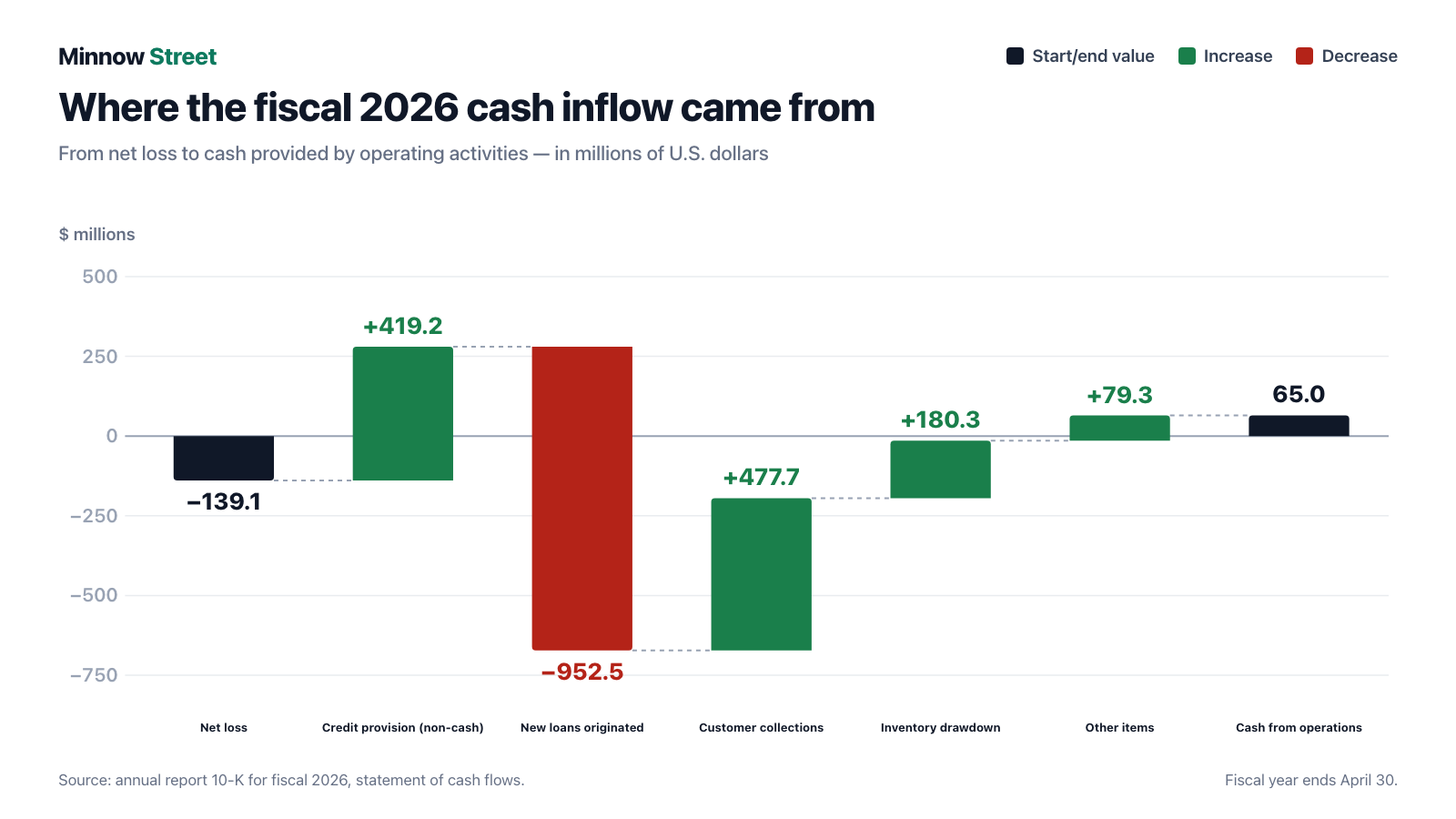
One detail is easy to miss in that chart and still decisive: the "credit provision (non-cash)" bar of +419.2 is not money. It is a reversal. The net loss contains expected credit losses, and because those have not yet cost cash they are added back in the statement of cash flows. The actual losses sit elsewhere: in net charge-offs running at 27.6 percent of average finance receivables, which cap what those $477.7 million of customer collections can ever be. Which brings us to the uncomfortable truths.
What the filings say — the uncomfortable truths
Uncomfortable truth no. 1: the cash inflow is the receipt for shrinking
The $65.0 million of cash from operating activities in fiscal 2026 stands against negative $48.8 million in fiscal 2025 and negative $73.9 million in fiscal 2024. A swing of more than $110 million in one year — with no improvement in the business. The statement of cash flows names the two reasons: loan originations fell from $1,075.1 million to $952.5 million, and inventory was drawn down by $180.3 million (prior year: $114.6 million). The annual report writes it out plainly, citing "a reduction in finance receivable originations, which deployed less cash into new loans" and "a drawdown of inventory, which preserved cash as inventory was not replenished."
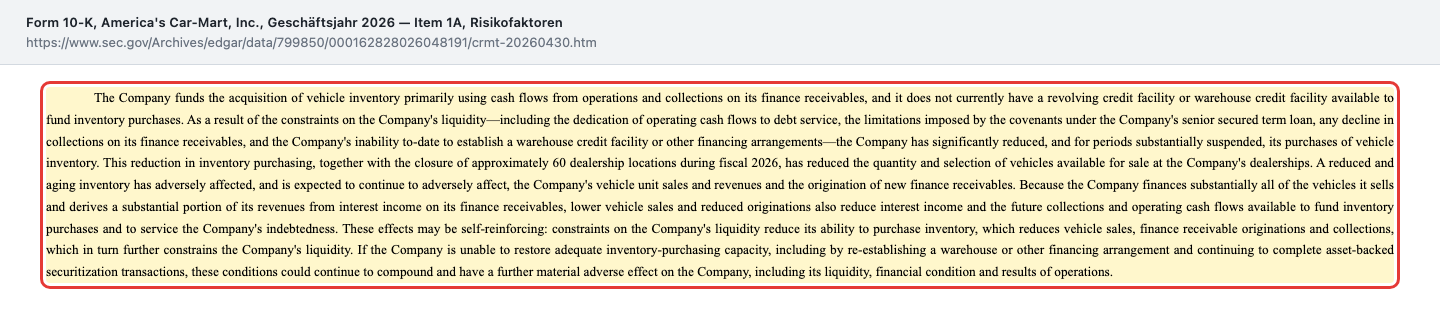
The arithmetic checks out: inventory fell from $112.2 million to $54.1 million, or 51.8 percent, and net finance receivables dropped by $101.5 million to $1,079.2 million. Picture a baker who runs down his flour stocks and buys none: at month end his till looks unusually full. That is not earnings, that is substance converted into cash — and next time the shelf is bare. The annual report warns of precisely that in its risk factors:
„These effects may be self-reinforcing: constraints on the Company’s liquidity reduce its ability to purchase inventory, which reduces vehicle sales, finance receivable originations and collections, which in turn further constrains the Company’s liquidity.“
— America’s Car-Mart, Inc., SEC annual report 10-K for fiscal 2026, Item 1A Risk Factors
There is a second reason this cash inflow does little for a stockholder: it barely reaches the company. A large share of customer collections goes straight to the securitization trusts, because Car-Mart has pledged its receivables in asset-backed transactions — simplified, it hands packages of customer loans to special-purpose vehicles that issue notes against them. Under the accelerated amortization structure applying to most of those securitizations, the annual report says, "a significant amount of those collections is paid directly to the trusts to retire outstanding non-recourse notes." The numbers back it up: in fiscal 2026 the company repaid $663.0 million of non-recourse notes while issuing only $549.2 million of new ones. Financing activities used $56.3 million on balance. Of the $63.1 million of arithmetic free cash inflow ($65.0 million from operations less $1.8 million of capital spending), the company ended the year with a cash increase of $7.1 million.
Uncomfortable truth no. 2: the auditor raises doubt about the company’s survival
Anyone who only scans metrics misses the most important paragraph of the annual report. It sits in the audit opinion and is simply headed "Going concern." A set of financial statements is normally prepared on the assumption that the company will still exist next year. When the auditor explicitly questions that assumption, it is the loudest warning an audit report can issue.
„The Company’s ability to achieve the foregoing elements of its business, which may be necessary to permit the realization of assets and satisfaction of liabilities in the ordinary course of business, is uncertain and raises substantial doubt about its ability to continue as a going concern.“
— America’s Car-Mart, Inc., SEC annual report 10-K for fiscal 2026, report of the independent registered public accounting firm
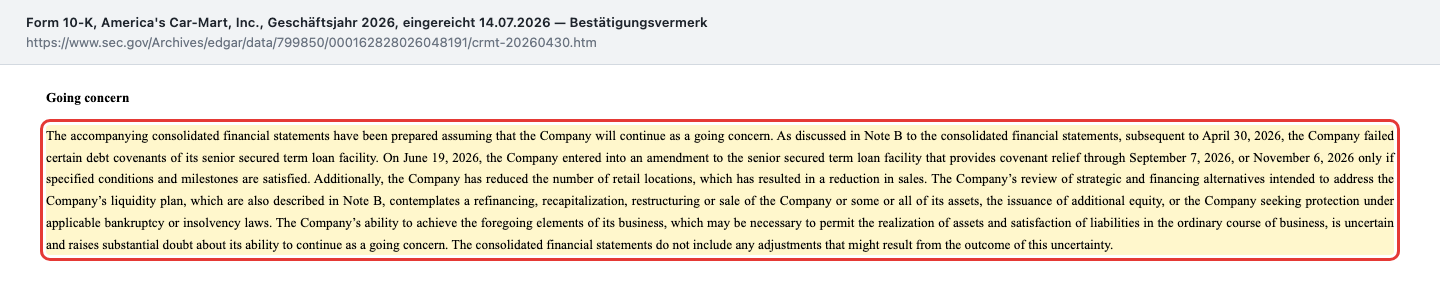
One nuance matters for the record: the annual report states the company was in compliance with the covenants at the April 30, 2026 balance sheet date. The breaches came afterwards — minimum liquidity and minimum collateral coverage. And management writes that its remediation plans are not fully implemented and therefore do not alleviate the doubt. Remember the distinction: a balance sheet can be clean on the reporting date and no longer hold six weeks later. Anyone reading only fiscal year-end figures never sees that break.
Uncomfortable truth no. 3: the company’s own customers are paying worse — and that is its most expensive line
At a "buy here, pay here" retailer the provision for credit losses is not one line item among many but the largest cost block after buying the vehicles. In fiscal 2026 it came to $419.2 million, or 40.8 percent of sales. For comparison: total gross profit on vehicles sold was $363.8 million. Put differently: expected credit losses in fiscal 2026 exceeded the entire retail gross margin.
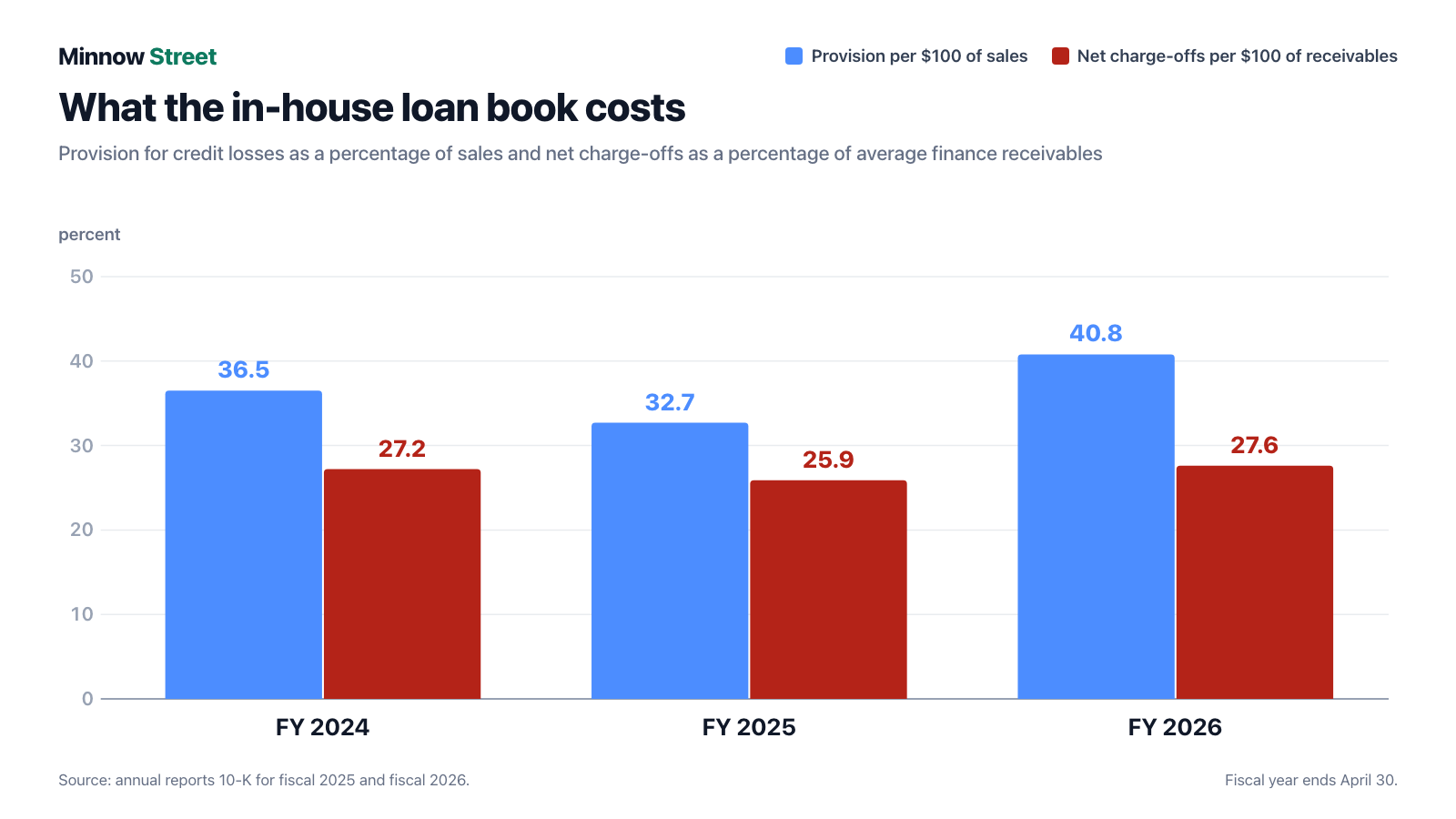
The balance sheet reserve was raised too: the allowance for credit losses rose to $329.9 million, or 25.15 percent of the portfolio (23.25 percent a year earlier). The company blames "changes in macroeconomic conditions affecting the Company’s customer base, including persistent inflation in essential goods and services" — sustained price pressure on things nobody can skip: childcare, insurance, groceries, fuel. Translated: when nothing is left at month end, the car payment goes first. At Car-Mart that risk is not outsourced but sits entirely in house, unlike dealers who pass financing on to a bank. For how volatile such a spread can be in small-ticket consumer lending, compare our analysis of Consumer Portfolio Services, a pure auto-loan securitizer without dealerships of its own.
Uncomfortable truth no. 4: 42 of 136 dealerships closed in a single day — at the order of the balance sheet
On April 7, 2026 the board resolved to close 42 of the then 136 dealerships and cut the associated support staff. It is the single most drastic act of the fiscal year — and the reasoning in the filing is remarkably open. It does not say the locations performed badly. It says talks about a revolving warehouse credit facility — simplified, a line a financier uses to fund new customer loans until they can be bundled and placed in the capital markets — had taken longer than expected, and that the cost structure therefore had to be aligned with "current capital constraints."
„On April 7, 2026, the Board of Directors of America’s Car-Mart, Inc. (the „Company“) approved the closure of 42 of the Company’s 136 dealership locations and a reduction of associated support staff.“
— America’s Car-Mart, Inc., SEC current report 8-K dated April 7, 2026, Item 2.05

Across all of fiscal 2026, 60 locations were consolidated and the dealership count fell from 154 to 94. The bill shows up in the income statement: $11.0 million of impairment expense ($7.6 million on property and equipment, $3.4 million on right-of-use assets) and a jump in selling, general and administrative expenses from 16.5 to 20.2 percent of sales — partly because of professional and advisory fees for the strategic review. Retail units sold fell 14.3 percent to 48,891. Notably, the report insists the decline is not due to weaker demand but to a lack of capital for inventory and originations.
Uncomfortable truth no. 5: the covenants are broken — waived only through September 7, 2026
On October 30, 2025 Car-Mart repaid and terminated its old $350 million revolving line and instead drew a $300.0 million senior secured term loan from funds managed by Silver Point Capital, maturing October 30, 2030, at a margin of 7.50 percentage points over the benchmark rate and with no periodic amortization. The lenders also received warrants on 937,487 shares at $22.63 — against the 8,327,329 shares outstanding on July 14, 2026 that would be roughly 11 percent of additional stock, should the price ever climb back above the strike. Net proceeds were $261.9 million, of which $162.9 million went straight into repaying the old line.
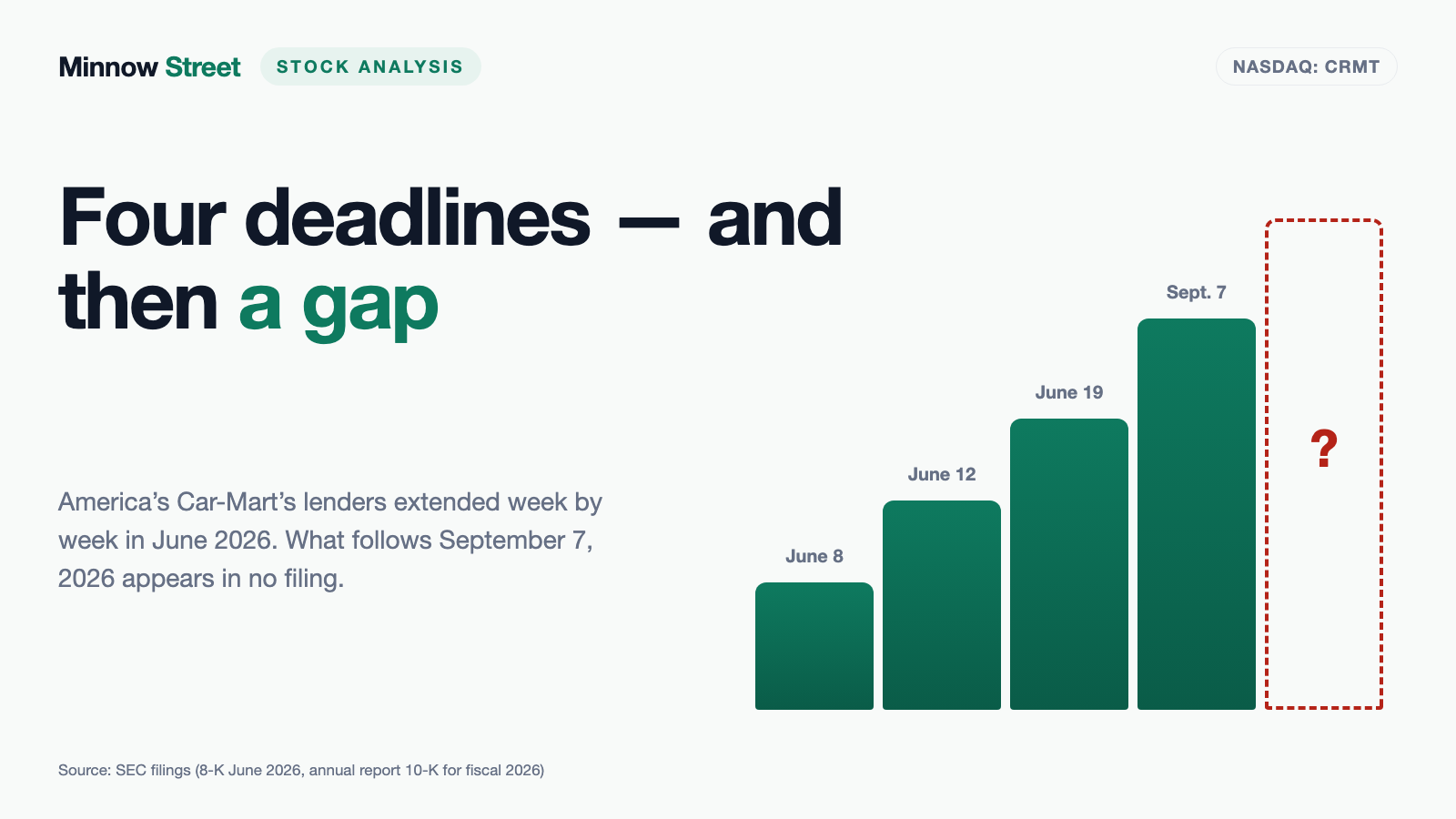
The catch: the new loan does not replace a revolving facility. It is a term loan — money that arrives once and then sits there. Since then there has been no bridge financing for new customer loans. From spring 2026 onward the company broke covenant after covenant. The chain of standstill letters and their extensions — June 8, June 12, June 19 — is the subject of this analysis’s title image. On June 19, 2026 came the formal amendment, with a list of what the lenders expressly forgive:
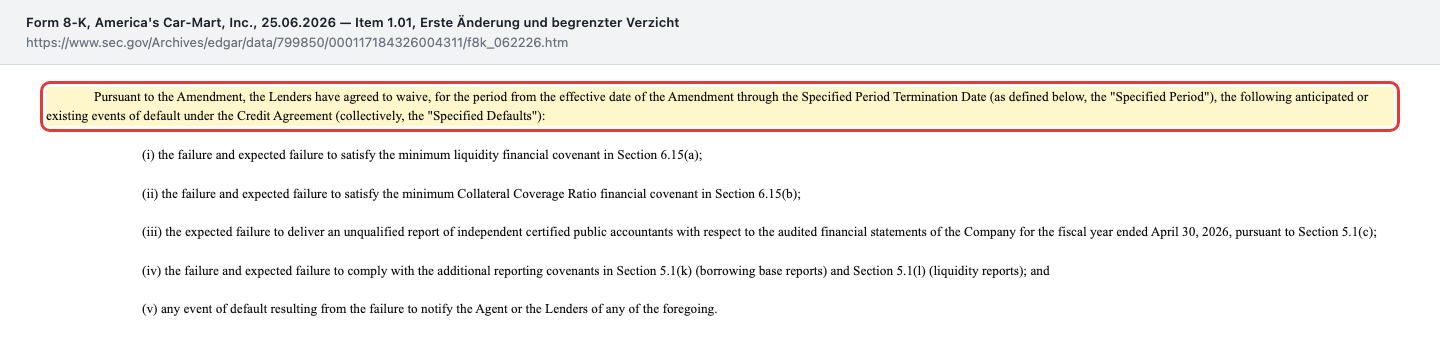
The relief period runs through September 7, 2026 and extends automatically to September 21 or November 6, 2026 only if specified conditions are satisfied. During that window tighter covenants apply: at least $7.0 million of liquidity every Friday and $5.0 million on all other days, a collateral coverage ratio of 1.25 to 1.00 as of June 30, 2026 and 1.20 to 1.00 at each month end thereafter, weekly forecasts and a rolling 13-week cash flow budget. On top of that come milestones — among them a marketing process for financing, recapitalization, restructuring or other strategic transactions. For that consent Car-Mart pays fees of up to $18.0 million, which the notes say were added to the outstanding principal balance. And the annual report is explicit about what happens if the deadline passes without a solution: the lenders may accelerate — and "the Company would not have sufficient liquidity to repay such indebtedness if it were accelerated."
Uncomfortable truth no. 6: a sale process is running — and stockholders stand last in line
On May 22, 2026 the board retained the investment bank Houlihan Lokey as financial advisor, formed a special committee and added an independent director to chair it — Adam Paul, a specialist in capital structure solutions. The board grew from nine to ten members.
„America’s Car-Mart, Inc. („Car-Mart“ or the „Company“) today announced that its Board of Directors (the „Board“) has retained Houlihan Lokey Capital, Inc. („Houlihan Lokey“), a leading global investment bank with significant experience in the consumer finance and financial services sectors, to serve as its financial advisor as the Company continues to evaluate and pursue strategic alternatives, including potential financing, recapitalization, mergers and acquisitions and other transactions.“
— America’s Car-Mart, Inc., SEC current report 8-K dated May 29, 2026, introductory note and Item 8.01
What matters just as much is what is not there: there is no signed acquisition agreement, no offer, no price. Through July 26, 2026 the company had filed neither a merger proxy (DEFM14A) nor a solicitation/recommendation statement (SC 14D9) — verifiable in the EDGAR filing history. What exists is a process the lenders demand as a condition. And the annual report names the possible outcomes for stockholders without varnish: a refinancing, a recapitalization, a restructuring, a sale of the company or some of its assets, the issuance of additional equity that would materially dilute existing holders — or bankruptcy proceedings in which stockholders may suffer "a significant or complete loss of value." Remember the order of priority: in a restructuring the secured lenders are paid first, then the noteholders, then the suppliers — stockholders are last.
Valuation — why the metrics point in two directions here
Start with what is documented. The last share price recorded in an SEC filing comes from the prospectus supplement dated June 5, 2026: $7.85 per share on June 4, 2026. Seven months earlier, on October 31, 2025, the cover page of the annual report still showed a closing price of $22.24 and a public float value of $156.7 million. As of the July 26, 2026 data snapshot the closing price was $3.04 (July 24, 2026) and the market value roughly $25 million. All three figures carry their own date — and their spread shows how fast the market changes its mind here.
From that follow two readings of the same company. Reading one, the bargain reading: with $445.6 million of equity and roughly $53.65 of book value per share, the July 26, 2026 snapshot means paying about six percent of book. Price-to-sales sits near 0.02 — for $1,281.5 million of annual revenue. And the $63.1 million of free cash inflow in fiscal 2026 would be two and a half times the market value.
Reading two, the balance-sheet reading: that book value consists almost entirely of receivables owed by people who are paying worse than a year ago — $1,079.2 million net, after an allowance of $329.9 million has already been deducted. Against it stand $722.4 million of debt, including $458.7 million of notes served first and foremost from exactly those receivables. If charge-offs keep rising — 27.6 percent of average receivables in fiscal 2026 — equity melts from the top. The market is plainly pricing that in: a share price at six percent of book is not an overlooked opportunity but a verdict on the collectability of those receivables. The professionals broadly agree: the mean analyst price target in the July 26, 2026 snapshot was $7.50 — well above the price, but far below book value. Roughly 26 percent of the float was sold short.
Which brings us back to the hook. A K/FCF of 0.5 measures no earning power here; it measures a liquidation in slow motion. The numerator is a market value the market has crushed out of fear of a total loss; the denominator is a cash inflow that exists because the loan book and the inventory are shrinking. Both numbers are real — their ratio simply means something other than the filter suggests. For the same mechanism in a healthy setting, see our analysis of World Acceptance, where a shrinking loan book also produces cash inflow — but without a going-concern paragraph.
Opportunities and risks at a glance
What speaks for America’s Car-Mart:
- A real business dating back to 1981, with $1,281.5 million of fiscal 2026 revenue and roughly 1,500 associates — not a story without substance.
- Interest and other income rose in fiscal 2026 by $9.0 million to $253.7 million despite a smaller receivables portfolio; the average yield climbed from 16.6 to 17.3 percent.
- The retail side delivers: gross profit per unit of $7,442 (up $74) and inventory turns improved from 6.6 to 8.0.
- The securitization market opened three times in fiscal 2026 — $216.0 million in May 2025, $172.0 million in August 2025 and $161.3 million in December 2025.
- The material weakness in internal control identified in fiscal 2025 was remediated as of April 30, 2026.
- If the current process ends in a recapitalization and the receivables collect better than priced, there is a lot of room between $3.04 per share and $53.65 of book value per share.
What speaks against it:
- The fiscal 2026 audit report carries a going-concern paragraph, and management itself says its plans do not alleviate the doubt.
- The covenant relief expires on September 7, 2026 (extendable to September 21 or November 6, 2026) and depends on milestones the company controls only in part.
- On acceleration the company says outright it would not have enough liquidity to repay; cross-default clauses could drag the securitizations in.
- There is still no revolving warehouse facility — the engine for new business is missing, and inventory has melted to $54.1 million.
- Net charge-offs rose in fiscal 2026 to 27.6 percent of average receivables and the provision to 40.8 percent of sales.
- The report expressly warns of dilution from new equity and of the risk of failing Nasdaq listing standards; 937,487 warrants at $22.63 are outstanding on top.
- The $139.1 million fiscal 2026 loss includes $31.1 million of income tax expense despite the loss — partly because of a $53.0 million valuation allowance against deferred tax assets.
A human conclusion
The bargain trap from the opening works so well because it runs on a real number. The $65.0 million cash inflow is not invented, the roughly $25 million market value is not invented, and the ratio of 0.5 computes correctly. What is wrong is only the story the mind attaches to it — the tale of an overlooked money machine. At America’s Car-Mart the metric describes something else: a company taking in cash because it is getting smaller, whose future hangs on a date written into a loan agreement.
That does not make the stock uninteresting. Distressed situations are a craft of their own, and someone who can read indentures, collateral rank and negotiating leverage occasionally finds real opportunity there. It only makes this something entirely different from a cheap cash-flow stock. Whoever buys here is not buying a valuation gap but a bet on the outcome of a negotiation they are not sitting in. So check the date rather than the ratio: September 7, 2026 — and what the company has filed by then. What you make of that is your decision. And that is exactly as it should be.
Sources
Every original document used in this analysis, for you to read yourself:
- America’s Car-Mart, Inc. — SEC annual report 10-K for fiscal 2026, period ended April 30, 2026 (filed July 14, 2026)
- America’s Car-Mart, Inc. — SEC annual report 10-K for fiscal 2025 (filed August 8, 2025)
- America’s Car-Mart, Inc. — SEC quarterly report 10-Q for the period ended January 31, 2026 (filed March 12, 2026)
- America’s Car-Mart, Inc. — SEC current report 8-K dated April 7, 2026 (dealership closures, impairment)
- America’s Car-Mart, Inc. — SEC current report 8-K dated May 29, 2026 (Houlihan Lokey, special committee)
- America’s Car-Mart, Inc. — SEC current report 8-K dated June 5, 2026 (lender forbearance, retention program)
- America’s Car-Mart, Inc. — SEC current report 8-K dated June 12, 2026 (forbearance extended)
- America’s Car-Mart, Inc. — SEC current report 8-K dated June 25, 2026 (first amendment and limited waiver)
- America’s Car-Mart, Inc. — SEC prospectus supplement 424B3 dated June 5, 2026 (share price as of June 4, 2026)
- Complete SEC filing history of America’s Car-Mart, Inc.: EDGAR overview (sec.gov)
- Fundamental data (metrics, prices, analyst estimates; as of July 26, 2026), reconciled with the SEC filings.
- Placement in our in-house K/FCF ranking (U.S. selection, rank 9 of 25 displayed hits, as of July 26, 2026); the lists are recomputed daily.
Transparency & disclaimer: this analysis is journalistic commentary on publicly available information. It is not investment advice, not a regulated financial analysis and not a solicitation to buy or sell securities. Equity investments carry substantial risk up to total loss; at a company carrying a going-concern paragraph that is especially true. All information without warranty; the data cut-off is noted in the text. The author holds no position in America’s Car-Mart shares at the time of publication.
Our Bottom Line at a Glance
- Survival & financing negative
- The audit report for fiscal 2026 (filed July 14, 2026) carries a going-concern explanatory paragraph. After the April 30, 2026 balance sheet date the minimum liquidity and minimum collateral coverage covenants of the $300 million term loan were breached; the waiver runs only through September 7, 2026 (extendable to September 21 or November 6). The company itself states it could not repay the debt if it were accelerated.
- Source of the cash inflow negative
- The $65.0 million of fiscal 2026 operating cash inflow (prior year −$48.8 million) came from $122.6 million fewer loan originations and a $180.3 million inventory drawdown, not from earnings. Of $663.0 million of non-recourse notes repaid, only $549.2 million was reissued; financing activities used $56.3 million. The low K/FCF measures shrinkage here, not earning power.
- Credit quality negative
- The provision for credit losses rose in fiscal 2026 to $419.2 million, or 40.8 % of sales (prior year 32.7 %), exceeding the entire $363.8 million retail gross margin. Net charge-offs reached 27.6 % of average receivables (prior year 25.9 %) and the allowance ratio 25.15 % (prior year 23.25 %).
- Operating business neutral
- The underlying business still works: $1,281.5 million of fiscal 2026 revenue, gross profit per unit of $7,442 (up $74), interest and other income up $9.0 million to $253.7 million despite a smaller book, average yield 17.3 %. The 14.3 % drop in units sold is attributed in the report to a lack of purchasing capital, not to weaker demand.
- Balance sheet & dilution negative
- Equity of $445.6 million at April 30, 2026 (prior year $569.4 million) against $722.4 million of debt. Book value consists almost entirely of receivables owed by borrowers whose charge-off rate is rising. On top, 937,487 warrants at $22.63 are outstanding, and the report expressly warns of material dilution from new equity and of the risk of failing Nasdaq listing standards.
- Process & governance neutral
- Since May 22, 2026 a special committee chaired by independent director Adam Paul has been reviewing financing, recapitalization and M&A with Houlihan Lokey — as a lender condition. No signed transaction existed through July 26, 2026 (neither DEFM14A nor SC 14D9 on file with the SEC). The material weakness identified in fiscal 2025 was remediated as of April 30, 2026.
America’s Car-Mart is a real business with $1,281.5 million of revenue — and at the same time a restructuring case. The $65.0 million cash inflow that puts the stock at rank 9 of the U.S. selection in our K/FCF ranking (as of July 26, 2026) came from $122.6 million fewer loan originations and a $180.3 million inventory drawdown, not from profit: the bottom line was a $139.1 million loss. The fiscal 2026 audit report carries a going-concern paragraph, the covenants of the $300 million term loan are broken and waived only through September 7, 2026, and a lender-mandated marketing process is running. Between a $3.04 share price and $53.65 of book value per share lies no overlooked value but a market verdict on the collectability of $1,079.2 million of receivables. Not investment advice.
What Our Rating Means
Substance risk
We found at least one documented issue that threatens the company itself — regardless of how the stock is currently valued.
Red — and not because of the share price, but because of documented substance findings. The auditor states substantial doubt about the company’s ability to continue in the fiscal 2026 audit report; management expressly declares its own remediation plans insufficient; the financial covenants of the $300 million term loan are broken and waived only through September 7, 2026; and the company writes that it would not have enough liquidity to repay if the debt were accelerated. Add $47.0 million of cash against $722.4 million of debt and a loan book whose charge-off rate is climbing again. The operating business itself is intact — interest income and gross profit per unit both improved — but the quality signal rates the company as a whole, and this company’s survival currently hangs on a deadline and a negotiation. The decision is yours.
A journalistic assessment by our editorial team at the time of the deep dive, based on public sources — not investment advice and not a solicitation to buy or sell. Your personal circumstances (investment goals, risk capacity, taxes) cannot be taken into account. What our levels mean, how verdicts are formed, and what conflicts of interest exist →
Worth Noting
- CRMT reached our research list through our in-house K/FCF ranking: rank 9 of the U.S. selection at a K/FCF of 0.5, measured on the scanner page on July 26, 2026; the list showed 25 U.S. hits that day, with 544 stocks meeting the criteria overall. These lists are recomputed daily — the placement is a dated snapshot.
- Mind the calendar: America’s Car-Mart’s fiscal year ends April 30. Fiscal 2026 covers roughly May 2025 through April 2026, and the most recent periodic report is the annual report 10-K filed July 14, 2026, not a quarterly report.
- Price and valuation figures carry their own dates: $22.24 on October 31, 2025 (annual report cover page), $7.85 on June 4, 2026 (prospectus supplement 424B3) and a $3.04 closing price on July 24, 2026 from fundamental data (as of July 26, 2026). Analyses are evergreen; daily prices are not a buy argument.
- Watch for confusion: the SEC record for CIK 0000799850 lists former names Crown Casino Corp. (until 1997) and Crown Group Inc. (until 2002) — the same registrant, not a different company.
Frequently Asked Questions
America’s Car-Mart, Inc. (NASDAQ: CRMT) of Rogers, Arkansas sells older used vehicles and finances them itself — the U.S. industry calls the model "buy here, pay here." According to the annual report most customers have thin or damaged credit histories and would not qualify for financing elsewhere. As of April 30, 2026 the company operated 94 dealerships in smaller cities across the southern and central United States with about 1,500 full-time associates.
Because the cash inflow comes from dismantling the business. In fiscal 2026 the company wrote only $952.5 million of new customer loans instead of $1,075.1 million a year earlier and drew its vehicle inventory down by $180.3 million. Because the existing loans kept amortizing ($477.7 million of customer collections), that left $65.0 million of cash from operations — against a net loss of $139.1 million.
It means the auditor has substantial doubt about whether the company will survive the next twelve months. The trigger is the covenant breaches after April 30, 2026 on the $300 million term loan — minimum liquidity and minimum collateral coverage. Management expressly states that its remediation plans do not alleviate that doubt. Such a paragraph is not a bankruptcy filing, but it is the loudest warning an audit report can carry.
Through September 7, 2026. On June 19, 2026 America’s Car-Mart agreed an amendment to its credit agreement with the Silver Point funds that waives five specified defaults for a limited period. It extends automatically to September 21 or November 6, 2026, but only if specified conditions and milestones are met — among them an ongoing marketing process for financing, recapitalization or a sale.
A process is running; a contract is not. On May 22, 2026 the board retained the investment bank Houlihan Lokey and formed a special committee chaired by independent director Adam Paul to review financing, recapitalization and mergers and acquisitions. Through July 26, 2026 no merger proxy (DEFM14A) and no solicitation/recommendation statement (SC 14D9) had been filed with the SEC.
That is historical at America’s Car-Mart and is registered that way with the SEC (fiscal year end 04/30). In practice it means fiscal 2026 covers roughly May 2025 through April 2026. Anyone comparing quarters has to carry that offset: the first quarter of fiscal 2027 ended on July 31, 2026.
In fiscal 2026 net charge-offs ran at 27.6 percent of average finance receivables, after 25.9 percent in fiscal 2025 and 27.2 percent in fiscal 2024. The provision for credit losses in the income statement rose to $419.2 million, or 40.8 percent of sales. The balance sheet allowance stood at $329.9 million, or 25.15 percent of the receivables portfolio.
A warehouse facility is a revolving credit line a financier uses to fund newly written customer loans until they can be bundled and placed in the capital markets. America’s Car-Mart repaid and terminated its old $350 million revolver on October 30, 2025 and replaced it with a term loan. Talks about a new warehouse line dragged on, according to the April 7, 2026 filing — and remain unconcluded.
Found an error?
Did you spot a factual error, an outdated number, or a typo in this deep dive? Let us know briefly — your report goes straight to the editorial team.