LifeStance stock: the first profit since the IPO — and a control weakness that has been in the filings since 2019
LifeStance treats mental illness at industrial scale: 8,040 employed therapists and psychiatrists, 572 centers, roughly 9.0 million visits in 2025. After four years of losses, the books showed a profit for the first time in 2025 — $9.7 million — and the first quarter of 2026 added $14.2 million. The same quarterly report also carries a sentence that has refused to disappear since fiscal 2019: internal control over financial reporting is deficient. We read both sentences — the good one and the uncomfortable one — in the original.
 Thomas Mücke
Founder & Publisher
Thomas Mücke
Founder & Publisher
Chart
Interactive price chart (TradingView).
Note: pure fact-based analysis, not investment advice and not a solicitation to buy or sell. All figures without guarantee.
There is an investor trap that springs shut exactly when the news finally turns good: the recovery trap. We treat someone who has been ill for a long time more gently the moment they smile again. In stocks that means: a company burns cash for four years, suddenly posts black numbers, and the brain switches from "check" to "celebrate." LifeStance Health Group, Inc. (NASDAQ: LFST) of Scottsdale, Arizona is the test case. It runs outpatient mental healthcare at industrial scale: 8,040 employed clinicians across 33 states, 572 centers, roughly 9.0 million visits in 2025. And 2025 was the first profitable year since the IPO. Let us make a deal anyway: we will give the turnaround its due, and then read together the two sentences that sit in the same quarterly report. Keep one principle for the rest of this analysis: good numbers are worth only as much as the system that produces them.
What this analysis covers
- What LifeStance actually does
- How the stock landed on our desk
- The numbers over the years — given their due
- What the filings say — the uncomfortable truths
- What the stock costs
- Opportunities and risks at a glance
- A human conclusion
- Sources
What LifeStance actually does
LifeStance is not a software house and not an app. It is an employer. The company puts psychiatrists, psychologists, therapists and advanced practice nurses on the payroll, leases space, signs contracts with health insurers — and bills every single visit. As of December 31, 2025 the annual report counts 8,040 clinicians across 33 states and 572 centers, 392 of them run as supported practices: the medical services formally belong to a physician-owned entity, while LifeStance owns the non-medical assets and provides all management services. That is the standard U.S. structure, because many states bar corporations from practicing medicine.
The business model is refreshingly unglamorous: revenue per visit times number of visits. In the first quarter of 2026 clinicians delivered 2.5 million visits, up 0.4 million or 18 percent year over year, while the clinician count grew by a net 814. Commercial insurers pay for almost all of it: 88 percent of first-quarter 2026 revenue came from commercial payors, 6 percent from government programs, 5 percent from self-pay patients and 1 percent from non-patient services. Readers who want to see how another U.S. healthcare operator runs the same arithmetic on the inpatient side will find it in our Encompass Health analysis.
In plain language: LifeStance makes money when two things hold at once. First, enough therapists must be on staff with full calendars — the industry word is productivity, which simply means appointments per head. Second, the insurer has to pay enough per appointment; the company calls that figure total revenue per visit. If one of the two slips, the other does not save you.
How the stock landed on our desk
We run about 3,500 stocks through our scanners every day. LifeStance came up in the "Turnaround Candidates" list: rank 16 of 62 U.S. hits, turnaround check 7 of 8, as of July 25, 2026. To reproduce it: open the scanner, set the country filter to "US," sort by the "turnaround check" column. One honest caveat: these lists are recalculated every day. Rank 16 is a dated snapshot, not a standing state — anyone checking today may find the stock somewhere else or not at all.
The scanner works in two stages. First come two mandatory pillars, and any candidate can fail them. Pillar one, the crash: the stock has to trade at least 50 percent below its all-time high; without a real crash there is no turnaround, only an ordinary growth stock. Pillar two, survival: the Altman Z-score, a bankruptcy early-warning figure built from several balance sheet ratios, has to sit outside the distress zone, which begins below 1.1, the balance sheet may show at most one warning flag, and equity must be positive. LifeStance clears both comfortably: as of July 26, 2026 the Altman Z-score is 3.91 and the equity ratio 69 percent. Only then does the actual turnaround check apply — eight points, four from the quarterly numbers (revenue direction, net margin, operating cash flow, balance sheet healing) and four from market behavior (price above the 50-day line, relative strength, insider buying, institutional accumulation). Anything from 6 of 8 upward is displayed; 7 of 8 means that in seven of those eight tests the stock points the right way.
A second lens agrees: the Piotroski F-score, a nine-point test for the direction of the balance sheet, stands at 8 of 9 as of July 26, 2026. That is a strong reading — 6 would be okay, robust health starts at 8. Another hit from the same list that we have already taken apart is Bio-Techne, where the trail led somewhere else entirely. Because a scanner measures the direction of the numbers. It does not measure how reliably they come about. That is what the next section is for.
The numbers over the years — given their due
Start with what genuinely impresses. Revenue more than doubled in four years: from $667.5 million in 2021 through $859.5 million (2022), $1,055.7 million (2023) and $1,251.0 million (2024) to $1,424.3 million in 2025. And the bottom line turned — not in a jump but in four clean steps: a loss of $307.2 million (2021), $215.6 million (2022), $186.3 million (2023), $57.4 million (2024), then a profit of $9.7 million (2025). The first black year since the IPO.
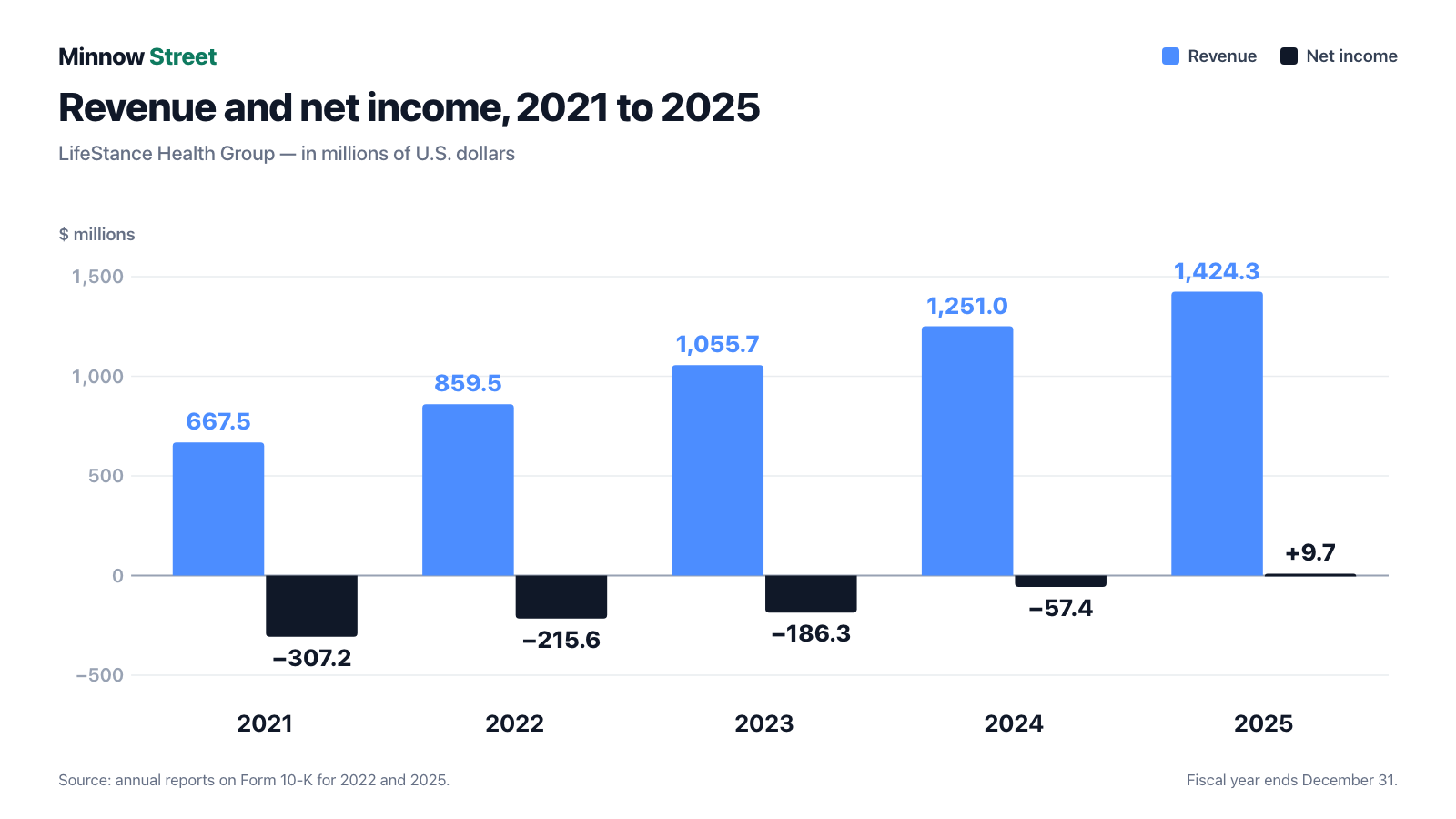
2026 has picked up speed again. In the first quarter of 2026 revenue rose 21 percent to $403.5 million from $333.0 million a year earlier. Income from operations climbed from $1.6 million to $22.3 million, and $14.2 million, or $0.04 per diluted share, remained at the bottom, against $0.7 million in the prior-year quarter. A word of caution on extrapolation: the first quarter is not LifeStance’s seasonal peak — in 2025 it came in at $333.0 million, below all three following quarters. Turning $14.2 million into a $57 million annual profit gets the seasonality backwards.
Cash has become more honest too. Operating cash flow rose from $9.4 million (2021) through $52.8 million (2022), minus $16.9 million (2023) and $107.3 million (2024) to $146.2 million (2025); after $36.1 million of capital expenditure, roughly $110.0 million of free cash flow remained. In the first quarter of 2026 operations generated $33.1 million, against minus $3.1 million a year earlier. That is the kind of progress nobody can argue away.
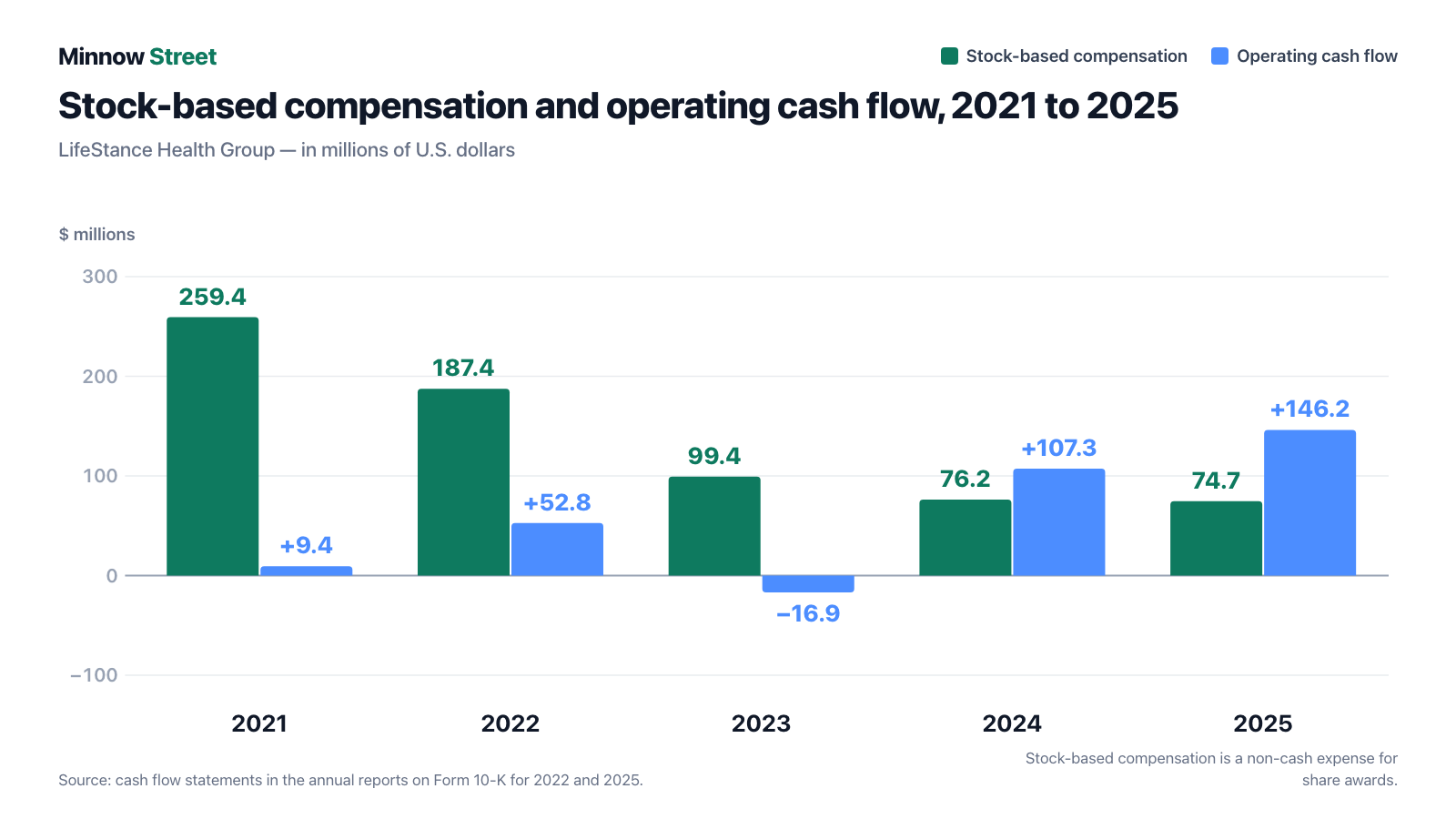
A note on the second series in that chart. Stock-based compensation is pay handed out in share awards instead of cash — it costs nothing out of the till, but it spreads the company across more heads. In the IPO year 2021 it ran to $259.4 million, more than a third of that year’s revenue; then $187.4 million (2022), $99.4 million (2023) and $76.2 million (2024). By 2025 it is $74.7 million. The decline is genuine progress. It does not change the fact that those $74.7 million are still seven and a half times the annual profit.
What the filings say — the uncomfortable truths
Uncomfortable truth no. 1: internal control has not worked since 2019
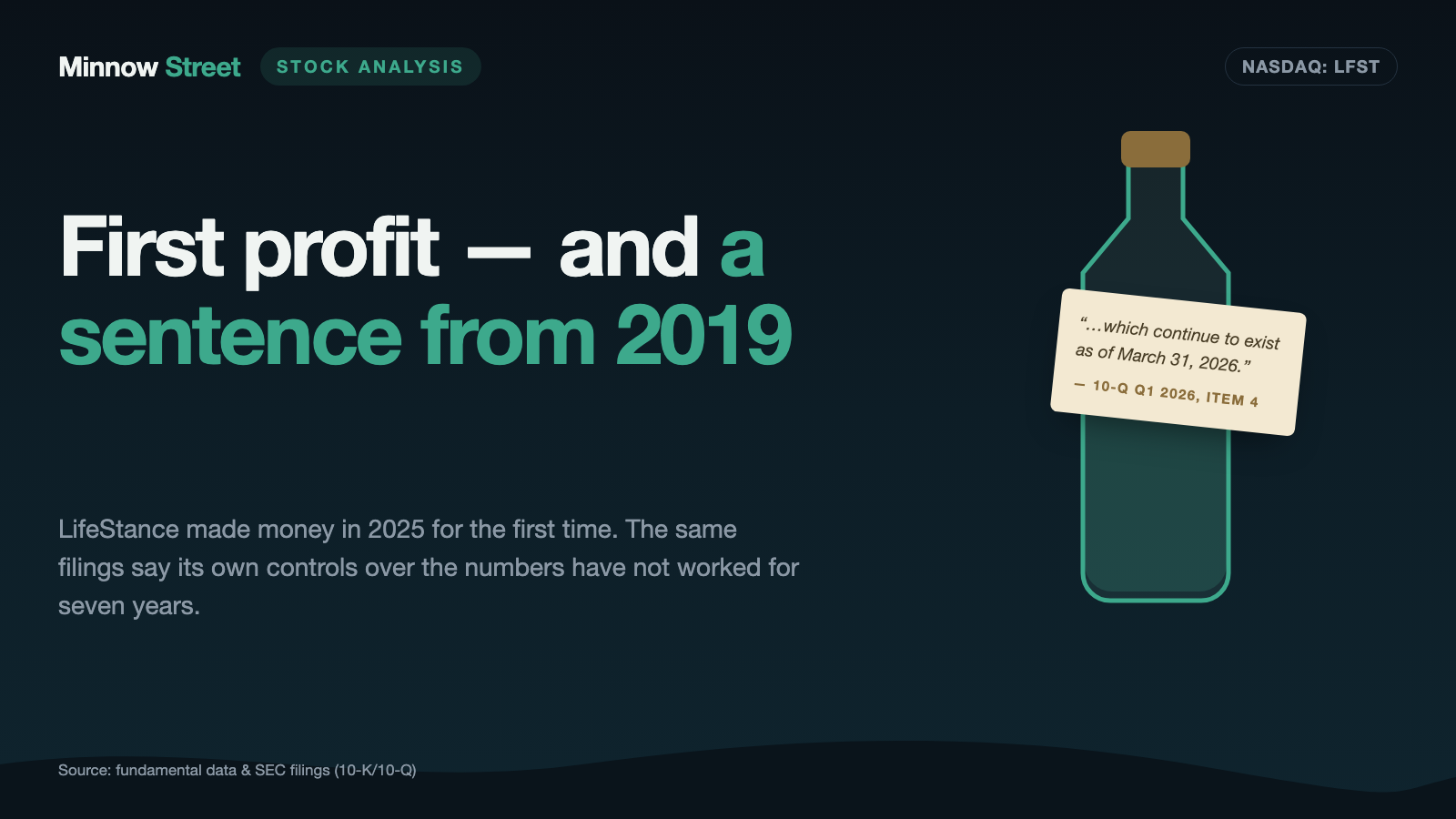
Every U.S. listed company signs twice: once for the numbers, and once for the machinery that produces those numbers. LifeStance withholds the second signature from itself. In the 10-Q for the quarter ended March 31, 2026 the chief executive officer and the chief financial officer expressly conclude that disclosure controls were not effective. The reason sits right below:
"A material weakness is a deficiency, or a combination of deficiencies, in internal control over financial reporting, such that there is a reasonable possibility that a material misstatement of our annual or interim consolidated financial statements will not be prevented or detected on a timely basis. As previously reported in the Annual Report on Form 10-K for the year ended December 31, 2025, in connection with the preparation of our consolidated financial statements as of and for the year ended December 31, 2019, we identified material weaknesses in our internal control over financial reporting, which continue to exist as of March 31, 2026."
— LifeStance Health Group, Form 10-Q for the quarter ended March 31, 2026, Item 4

The filing spells out what that means: an insufficient complement of resources in accounting, finance and IT, no formal accounting policies, gaps in account reconciliations, segregation of duties and journal entry review, plus missing IT general controls over program changes, user access, computer operations and software development approvals. And it did not stay theoretical: those weaknesses already forced a restatement of the published 2018 and 2019 annual financial statements, triggered by misidentified intangible assets acquired in business combinations. The auditor, PricewaterhouseCoopers LLP, audited internal control as of December 31, 2025; the result is in the annual report.
Be fair about it: this is not an allegation of fraud, and it is not evidence of falsified numbers. The company reports six completed remediation steps for the first quarter of 2026, including tighter controls over business combinations, accounts payable, payroll and access rights. But the order matters: reliability of the numbers comes first, beauty second. Anyone celebrating the 2025 profit is celebrating a figure produced by a system its own auditors have not yet signed off.
Uncomfortable truth no. 2: 60 percent of the balance sheet is goodwill — made of people
LifeStance grew by acquisition: hundreds of small practices bought up and folded into one brand. Whoever pays more than the tangible value of what they buy has to book the difference as goodwill. Think of it as a price tag on expectations. As of March 31, 2026 that line reads $1,297.0 million against total assets of $2,145.9 million. That is 60 percent of the entire balance sheet. Another $175.1 million sits in other intangible assets, mostly trade names and non-competition agreements.
Work it through: stockholders’ equity is $1,477.4 million. Subtract goodwill and intangibles and roughly $5.3 million remains — at a company with more than $1.4 billion of annual revenue. Tangible substance is effectively nil. And what is the goodwill made of? The notes say it themselves:
"Goodwill is primarily attributable to the assembled workforce, customer and payor relationships and anticipated synergies and economies of scale expected from the integration of the businesses."
— LifeStance Health Group, Form 10-Q for the quarter ended March 31, 2026, Note 7

"Assembled workforce" is the decisive phrase. The largest asset on this balance sheet consists, at its core, of therapists who can resign at any time. As long as LifeStance adds clinicians on a net basis — 814 more in the first quarter of 2026 — the carrying value holds. If the direction flips, a balance sheet line turns into an impairment question very fast. There has been no goodwill impairment so far, and nothing currently suggests one. You should simply know where the value sits and what it rests on.
Uncomfortable truth no. 3: the profit is smaller than the stock compensation
In 2025 LifeStance earned $9.7 million. In the same year it booked $74.7 million of stock-based compensation expense. That is no scandal — it is normal in this industry, and the trend has pointed down clearly since 2021. But it puts the profit jump in perspective: the 2025 surplus equals roughly 13 percent of what the workforce received in share awards that year.
What follows for the share count is more surprising. As of December 31, 2021 there were 374.255 million shares outstanding; as of March 31, 2026 there are 387.813 million. That is about 3.6 percent more across four-plus years — remarkably little dilution. The reason is not restraint on awards but offsetting: the company buys back roughly what it hands out. That cycle costs real money. In the first quarter of 2026 alone $23.936 million in cash left the company purely to settle taxes on vested shares, against $8.162 million a year earlier. And the pool refills itself: on January 1, 2026 the shares reserved under the equity plan grew by 19.416 million, about 5 percent of all shares outstanding, with no new resolution required. Unrecognized compensation expense as of March 31, 2026: $128.521 million, spread over a weighted-average 2.3 years.
Uncomfortable truth no. 4: two insurers account for 28 percent of revenue
The quarterly report calls them only "Payor A" and "Payor B." In the first quarter of 2026 one stood for 13 percent and the other for 15 percent of consolidated revenue — 28 percent together. Across the years the series runs: 19 percent and 13 percent in 2023, 17 and 15 in 2024, 14 and 15 in 2025. Dependence on the larger of the two has eased; the second sits stubbornly at 15 percent.
Why that is more than a footnote: prices here are not set by a market but at a negotiating table. The annual report states outright that reimbursement rates agreed with larger payors have had and may continue to have significant impacts on total revenue per visit and cash flows — and in 2024, according to the same report, a single payor rate decrease pulled down the average revenue per visit. One contract, one signature, and the arithmetic from the top — revenue per visit times number of visits — shifts for a sixth of the business. As a counterweight LifeStance is building out government-funded work: it grew to $25.6 million, or 6 percent, in the first quarter of 2026, from $17.1 million and 5 percent a year earlier.
Uncomfortable truth no. 5: the buyback serves the sponsor’s exit
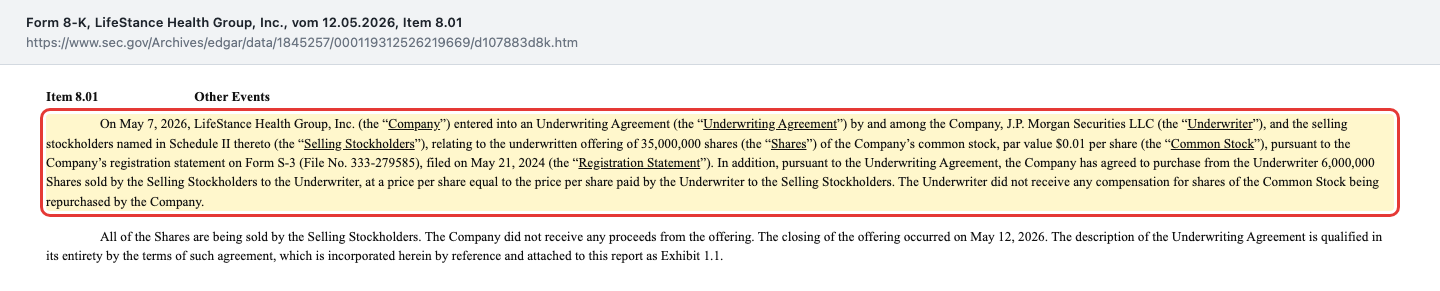
On May 7, 2026 the selling stockholders placed 35.0 million shares at $8.15, a deal worth $285.25 million. The company itself received none of it — it was not selling. It was buying. Out of that same offering LifeStance took 6.0 million shares at the price the underwriter had paid the sellers, $48.12 million in total, funded with cash on hand.
"In addition, pursuant to the Underwriting Agreement, the Company has agreed to purchase from the Underwriter 6,000,000 Shares sold by the Selling Stockholders to the Underwriter, at a price per share equal to the price per share paid by the Underwriter to the Selling Stockholders."
— LifeStance Health Group, Form 8-K filed May 12, 2026, Item 8.01
The prospectus supplement adds two details worth knowing. First: the purchase ran under the $100.0 million repurchase program authorized on February 24, 2026 — together with the $49.107 million spent in the first quarter, $97.2 million of it is used up. Second: the terms "were reviewed and approved by a committee consisting of disinterested members of our Board of Directors." That sentence gets written only when buyer and seller are close to one another. The largest seller was private equity firm TPG, which stepped back from 36.1 percent to 29.3 percent; Summit Partners fell from 7.5 percent to 6.1 percent. On July 2, 2026 director Jeffrey Rhodes then resigned from the board, expressly without any disagreement, and three new directors were appointed — one of them through the designation right in the stockholders agreement dated June 9, 2021.
You can read this positively: a repurchase at market price that takes the overhang out of the market. You can also read it plainly: the company committed nearly its entire authorized buyback to smoothing its sponsor’s exit — on a schedule set by the seller, not the buyer.
Uncomfortable truth no. 6: since the 2025 report, AI sits in the risk factors
In the annual report for 2024 the term does not appear once. In the report for 2025 it shows up — not as an opportunity but as a threat to the company’s own model:
"If patients elect to rely on AI for a portion of their mental health care, the number of patients seeking care from licensed clinicians may decline, negatively impacting our business."
— LifeStance Health Group, Form 10-K for 2025, Item 1A Risk Factors
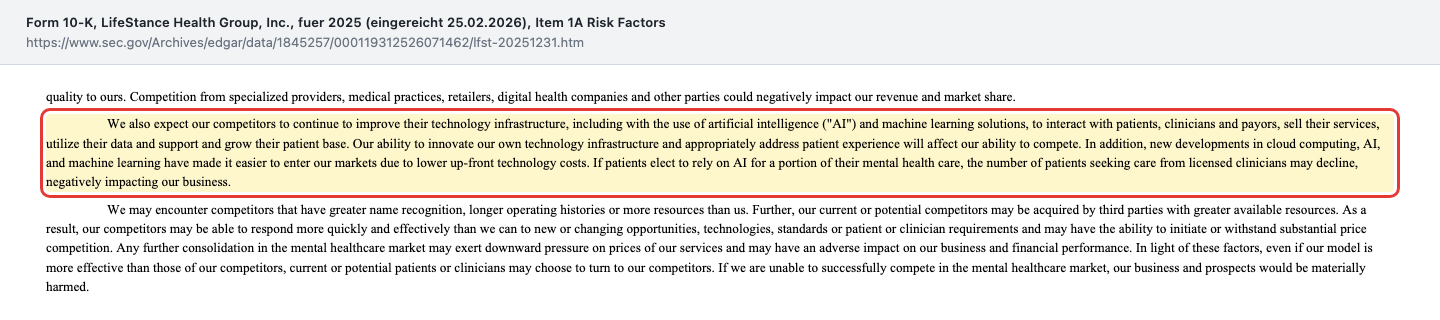
For a company whose entire revenue hangs on the number of human visits, and whose largest balance sheet item is made of its workforce, that paragraph is more than boilerplate. Two sentences later comes the other half of the thought: new developments in cloud computing, AI and machine learning have made it easier to enter these markets because up-front technology costs have fallen. Does LifeStance sell AI services itself? Nothing in the filings we reviewed says so.
What the stock costs
Orders of magnitude, not daily prices. As of July 26, 2026 market value stands at roughly $4.2 billion. We cross-checked it: 381.8 million shares — 387,834,432 per the quarterly report cover page as of April 29, 2026, less the 6.0 million retired on May 12, 2026 — times $10.13 per share, the price documented in a Rule 144 notice of proposed sale filed June 26, 2026, gives roughly $3.9 billion. The gap of about 7 percent is within tolerance, so the order of magnitude holds.
From that follows: the market pays roughly 2.8 times trailing twelve-month revenue of $1.49 billion. The price-to-earnings ratio is a three-digit 180 — no surprise on $0.06 of trailing earnings per share, and not very informative for a company in its first profitable year. More useful is enterprise value against adjusted earnings before interest, taxes, depreciation and amortization: roughly 28 times ($4.42 billion against $157.7 million for 2025). That is not a bargain price; it is a price that assumes the turnaround keeps going.
What the professionals think: 8 estimates are on file — 5 at the highest buy rating, 2 buy, 1 hold, none sell. The average price target is $11.70, as of July 26, 2026. Eight estimates is thin cover for a company this size; they describe an expectation, not a finding.
Opportunities and risks at a glance
What speaks for LifeStance:
- The turnaround is documented and not a one-off: four years of shrinking losses, the first profit in 2025 ($9.7 million), and a first quarter of 2026 with $14.2 million of income on 21 percent revenue growth.
- The cash is real: $146.2 million of operating cash flow in 2025 after minus $16.9 million in 2023, with roughly $110.0 million of free cash flow.
- The balance sheet carries: 69 percent equity ratio, Altman Z-score 3.91, a $100.0 million revolving credit facility completely undrawn, and net interest expense of only $1.8 million in the first quarter of 2026.
- The market is fragmented and growing: bolt-on acquisitions of small practices remain available, and government-funded work is expanding (Q1 2026: $25.6 million against $17.1 million).
- Stock-based compensation has fallen sharply since 2021 — from $259.4 million to $74.7 million.
What speaks against it:
- Internal control over financial reporting has been deficient since the fiscal 2019 audit and remained so as of March 31, 2026; disclosure controls are called not effective.
- 60 percent of the balance sheet is goodwill; after deducting all intangibles, roughly $5.3 million of tangible substance remains inside equity.
- Two health insurers account for 28 percent of revenue, and prices are set at a negotiating table rather than in a market.
- The sponsor is selling: TPG from 36.1 percent to 29.3 percent, with the company committing nearly its whole buyback authorization to keep pace.
- At $9.7 million, the profit is thin against $74.7 million of stock compensation, and a valuation near 28 times adjusted EBITDA assumes further progress.
- Since the 2025 report the company itself names artificial intelligence as a risk to the number of patients who seek out human clinicians.
A human conclusion
Back to the recovery trap. LifeStance looks like someone smiling for the first time after a long illness — and the smile is real. Revenue more than doubled, losses shrank four years running, 2025 finally put a profit in the books, and the cash builds under its own power. That is not accounting cosmetics; that is work that paid off.
And still, the same filings carry the sentence that the machinery producing those numbers has not worked as it should since fiscal 2019. Not an outside accusation — the company’s own finding, signed by the chief executive and the chief financial officer, audited by the outside firm, repeated in every quarterly report through March 31, 2026. Add a balance sheet that is three-fifths expectations about assembled workforces, and a sponsor heading for the exit while the company pushes back with almost its entire buyback authorization.
What follows depends on the question you ask. Ask "is a turnaround under way here?" and the documented answer is yes. Ask "can I trust the numbers that show the turnaround?" and the documented answer is that the company itself has been saying for seven years that it cannot yet vouch for them. Both sentences sit in the same document, and both are true. What you make of that is your decision. And that is exactly as it should be.
Sources
- Form 10-Q for the quarter ended March 31, 2026 (filed May 7, 2026) — balance sheet, statements of operations and cash flows, Note 3 (payor mix), Note 6 (goodwill), Note 7 (business combinations), Note 9 (long-term debt), Note 10 (stock-based compensation and repurchases), Note 13 (earnings per share), Item 4 (controls)
- Form 10-K for 2025 (filed February 25, 2026) — business model, clinician and center counts, key metrics 2023 through 2025, Item 1A risk factors, Item 9A internal control
- Form 10-K for 2022 (filed March 9, 2023) — revenue, net loss, cash flow statement and share count for 2021 and 2022
- Form 8-K filed May 12, 2026, Item 8.01 — underwriting agreement and repurchase of 6,000,000 shares
- Prospectus supplement 424B7 filed May 8, 2026 — offering price of $8.15, sponsor holdings before and after, terms of the share repurchase
- Form 8-K filed July 7, 2026, Item 5.02 — board resignation and new appointments
- Form 144 filed June 26, 2026 — the $10.13 per share anchor used for the market value cross-check
- Ratios, quarterly series and analyst estimates: fundamental data, as of July 26, 2026
- Hook: our in-house stock scanner, "Turnaround Candidates" list (U.S. selection), rank 16 of 62 hits, turnaround check 7 of 8, as of July 25, 2026 — the lists are recalculated daily
Journalistic analysis, not investment advice and not a solicitation to buy or sell securities. Stocks can lose their entire value at any time. All figures come from the primary documents linked above and carry the as-of date stated there; valuation ratios are as of July 26, 2026. At the time of publication the author holds no position in LifeStance Health Group, Inc.
Our Bottom Line at a Glance
- Operating turnaround positive
- Four years of shrinking losses, then the flip: minus $307.2 million (2021), minus $215.6 million (2022), minus $186.3 million (2023), minus $57.4 million (2024), plus $9.7 million (2025). In the first quarter of 2026 revenue rose 21 percent to $403.5 million and net income reached $14.2 million. The clinician count grew by a net 814 and visits by 18 percent to 2.5 million per quarter.
- Balance sheet and funding positive
- Equity ratio of 69 percent, Altman Z-score 3.91 and a Piotroski F-score of 8 of 9 as of July 26, 2026. Debt stands at $282.8 million principal, $232.0 million of it not due until 2029; the $100.0 million revolving facility was fully undrawn as of March 31, 2026, and net interest expense for the quarter was $1.8 million. Cash sits at $194.8 million with positive free cash flow.
- Internal control negative
- The material weaknesses in internal control over financial reporting identified in connection with the fiscal 2019 audit still existed as of March 31, 2026 according to the quarterly report; the chief executive officer and the chief financial officer conclude that disclosure controls were not effective. The same weaknesses already forced a restatement of the 2018 and 2019 financial statements. Remediation is under way but not complete.
- Balance sheet quality negative
- Of $2,145.9 million in total assets as of March 31, 2026, $1,297.0 million is goodwill and $175.1 million other intangibles. Deduct both from equity of $1,477.4 million and roughly $5.3 million of tangible substance remains. Note 7 attributes the goodwill primarily to the assembled workforce — to people who can resign.
- Payor concentration neutral
- Two commercial payors accounted for 13 percent and 15 percent of revenue in the first quarter of 2026, 28 percent combined, and 88 percent of revenue comes from commercial insurers. Dependence on the larger of the two has fallen since 2023, when it was 19 percent, and government-funded work has grown to 6 percent. The concentration is not existential, but it does set prices.
- Ownership and capital allocation neutral
- TPG cut its stake from 36.1 percent to 29.3 percent in the offering that closed on May 12, 2026, and Summit Partners from 7.5 percent to 6.1 percent. The company itself absorbed 6.0 million shares for $48.12 million; together with $49.1 million spent in the first quarter, $97.2 million of the authorized $100.0 million is gone. The purchase was approved by a committee of disinterested directors — the standard safeguard for related-party dealings.
LifeStance delivered what a turnaround is supposed to deliver: revenue rose from $667.5 million (2021) to $1,424.3 million (2025), a $307.2 million loss became a $9.7 million profit, operating cash flow climbed to $146.2 million, and the first quarter of 2026 followed up with 21 percent revenue growth and $14.2 million of income. The balance sheet carries: a 69 percent equity ratio, an undrawn revolver, debt not due until 2029. The other side is equally documented: internal control over financial reporting has been deficient since the fiscal 2019 audit and remained so as of March 31, 2026, 60 percent of the balance sheet is goodwill built on assembled workforces, and the sponsor is selling while the company pushes back with nearly its whole buyback authorization. Not investment advice.
What Our Rating Means
Substance risk
We found at least one documented issue that threatens the company itself — regardless of how the stock is currently valued.
Red here is expressly not about the numbers — they are good and getting better. Red is about a documented governance finding: internal control over financial reporting has been deficient since the fiscal 2019 audit, the quarterly report says it remained deficient as of March 31, 2026, the chief executive officer and the chief financial officer themselves call disclosure controls not effective, and the same weaknesses already forced a restatement of the 2018 and 2019 annual financial statements — over intangible assets acquired in business combinations, the very line item that today carries $1,297.0 million of goodwill, or 60 percent of the balance sheet. A control system its own auditors have not cleared in seven years is exactly the kind of substance finding this level exists for. Against that sits a great deal of good: a genuine earnings turnaround, $146.2 million of operating cash flow, a 69 percent equity ratio, no liquidity problem and no going-concern language. That does not make the company bad — it makes it a company whose good numbers come out of a system it does not yet vouch for. In case of doubt the more cautious level applies. The decision is yours.
A journalistic assessment by our editorial team at the time of the deep dive, based on public sources — not investment advice and not a solicitation to buy or sell. Your personal circumstances (investment goals, risk capacity, taxes) cannot be taken into account. What our levels mean, how verdicts are formed, and what conflicts of interest exist →
Worth Noting
- LifeStance reached our research list through our in-house stock scanner: rank 16 of 62 U.S. hits in the "Turnaround Candidates" list, turnaround check 7 of 8, as of July 25, 2026. The list is recalculated every day — the rank is a dated snapshot, not a standing state. Two mandatory pillars decide admission: at least 50 percent below the all-time high, and secured survival (Altman Z-score of 1.1 or better, at most one balance sheet warning flag, positive equity). Miss either one and the stock leaves the list no matter how good the turnaround check looks.
- Every figure carries its own as-of date: annual data from the Form 10-K for 2025 (filed February 25, 2026) and for 2022 (filed March 9, 2023), quarterly data from the 10-Q for the quarter ended March 31, 2026 (filed May 7, 2026), buyback and ownership data from the 8-K filed May 12, 2026 and the 424B7 filed May 8, 2026, board changes from the 8-K filed July 7, 2026. Valuation ratios are as of July 26, 2026 — meant to be evergreen, with no daily price used as a buy argument. Market value was cross-checked against 381.8 million shares times $10.13 from the Form 144 filed June 26, 2026; the gap is about 7 percent.
- Avoid confusion: the ticker LFST belongs to LifeStance Health Group, Inc. of Scottsdale (CIK 0001845257). The SEC registration lists no former names. The company should not be confused with purely virtual mental health providers — LifeStance explicitly treats in person as well, across 572 of its own centers. Through July 26, 2026 no SEC filing disclosed an acquisition, a going-private transaction or a merger.
Frequently Asked Questions
LifeStance runs outpatient mental healthcare across the United States. It employs psychiatrists, psychologists and therapists, operates centers and bills every visit to health insurers. As of December 31, 2025 that meant 8,040 clinicians across 33 states and 572 centers; during 2025 it treated more than 1.0 million patients across roughly 9.0 million visits.
Yes. LifeStance reported net income of $9.7 million for 2025, its first since the June 2021 IPO. Four loss years came before it: $307.2 million (2021), $215.6 million (2022), $186.3 million (2023) and $57.4 million (2024). The first quarter of 2026 added $14.2 million of net income on $403.5 million of revenue.
A material weakness in internal control means there is a reasonable possibility that a material misstatement will not be prevented or detected on a timely basis. LifeStance first identified such weaknesses with its fiscal 2019 financial statements; the quarterly report says they continued to exist as of March 31, 2026. They already caused a restatement of the 2018 and 2019 financial statements.
LifeStance grew by acquiring hundreds of small practices. Whoever pays more than tangible value must record the difference as goodwill. As of March 31, 2026 that is $1,297.0 million out of $2,145.9 million in total assets. The notes attribute it mainly to the assembled workforce and to customer and payor relationships.
In the first quarter of 2026 two commercial payors accounted for 13 percent and 15 percent of consolidated revenue, 28 percent combined. Overall, 88 percent of revenue came from commercial insurers, 6 percent from government programs and 5 percent from self-pay patients. Rates are negotiated; a single payor rate decrease pushed down revenue per visit in 2024.
On February 24, 2026 the board authorized a $100.0 million program. During the first quarter 7.0 million shares were bought for $49.1 million, and on May 12, 2026 another 6.0 million for $48.12 million — straight out of the selling stockholders offering. That leaves $97.2 million of the $100.0 million used on paper.
No. Through July 26, 2026 the filings with the U.S. securities regulator, the SEC, contain no merger agreement, no tender offer, no Form 15 deregistration, no Form 25 delisting and no going-private disclosure. The stock continues to trade on the Nasdaq Global Select Market.
As of July 26, 2026 market value is roughly $4.2 billion, or about 2.8 times trailing twelve-month revenue of $1.49 billion. Enterprise value equals roughly 28 times adjusted earnings before interest, taxes, depreciation and amortization for 2025 ($157.7 million). Eight analysts carry an average price target of $11.70.
Found an error?
Did you spot a factual error, an outdated number, or a typo in this deep dive? Let us know briefly — your report goes straight to the editorial team.