Fractyl Health Stock: The Data Says the Weight Stays Off — the Annual Report Says the Company Might Not
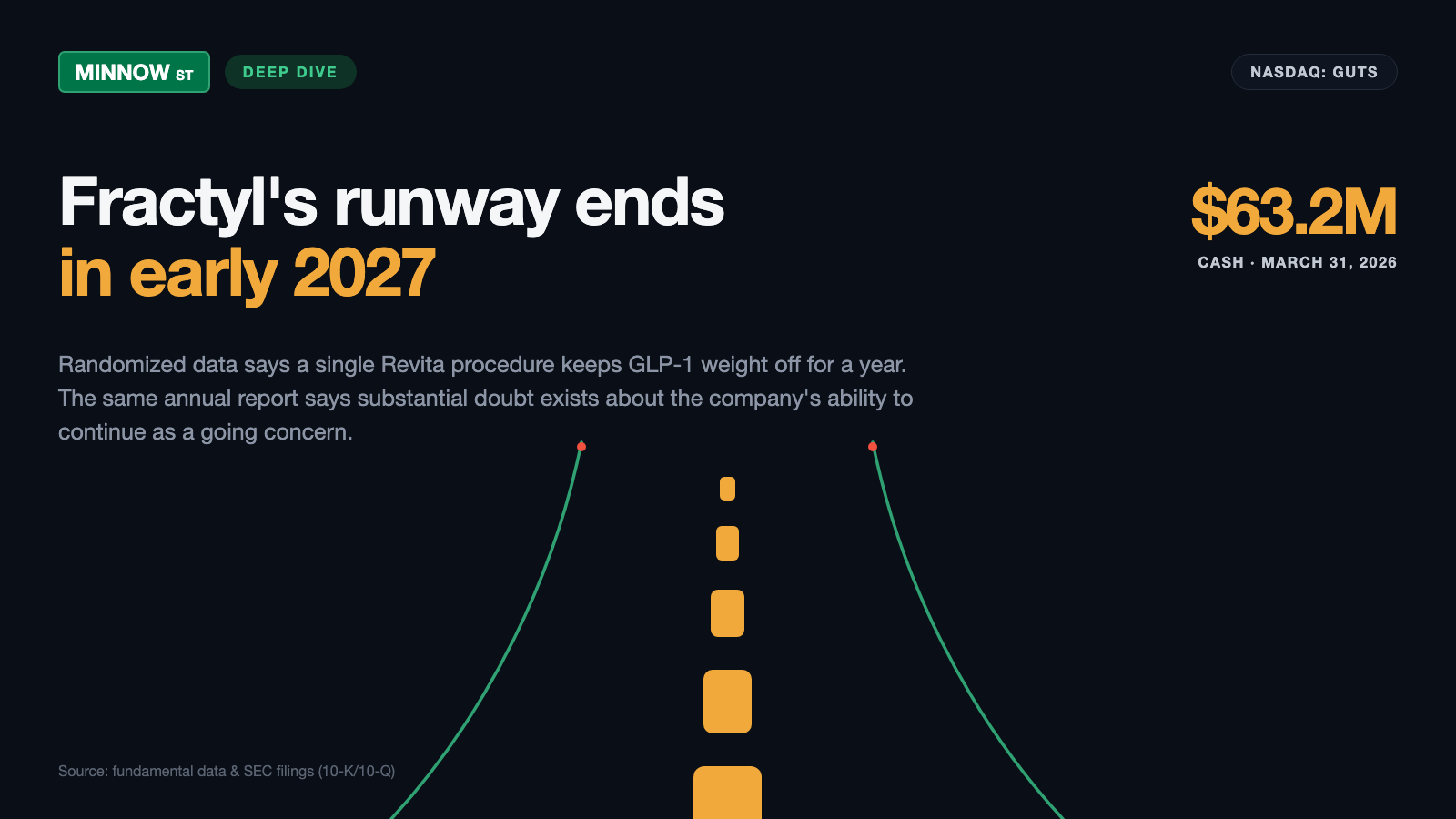
Fractyl Health has something most clinical-stage companies can only promise: randomized, sham-controlled evidence that a single 45-minute procedure keeps GLP-1 weight off for a year (REMAIN-1 Midpoint, reported July 15, 2026). It also has something they rarely admit so plainly: a sentence in its own annual report concluding that substantial doubt exists about its ability to continue as a going concern. We read the 10-K for 2025 and the quarterly report as of March 31, 2026 side by side: revenue of zero, a share count that tripled in twelve months, a quarterly "profit" that exists only because the stock collapsed, and cash that management expects to last into early 2027. Not investment advice — just what happens when the science and the balance sheet are running on two different clocks.
 Thomas Mücke
Founder & Publisher
Thomas Mücke
Founder & Publisher
Chart
Interactive price chart (TradingView).
Note: pure fact-based analysis, not investment advice and not a solicitation to buy or sell. All figures without guarantee.
Read this sentence and watch your own brain work: "84 percent of GLP-1 weight loss maintained at one year." What did you just store? The 84. What you almost certainly did not store is the part that came with it — that the number describes ten patients against eight, in an exploratory subgroup the company itself labels "not powered for formal inference". Psychologists call this anchoring; on the stock market it works like a bright headline in a dark room, and the eye adjusts to the light instead of the room. Nobody invites this reflex more politely than a clinical-stage company with genuinely good data — because the data are good, and that is precisely what makes the rest of the page so easy to skip. So let us make a deal: we drop the press releases and read only what Fractyl Health, Inc. (Nasdaq: GUTS) filed with the U.S. securities regulator, the SEC — and a filing to the SEC is honest under penalty of law. Our material: the annual report (10-K) for 2025, the quarterly report (10-Q) as of March 31, 2026, and the current reports (8-K) carrying the study results of June 4 and July 15, 2026. The ticker reached our desk through our Reddit hype scanner — 3 mentions in 24 hours (ApeWisdom, as of July 16, 2026), which is not a drumbeat but a whisper. At the end you get findings, not a verdict on your money. What you make of them is your decision.
What Fractyl actually does — a 45-minute procedure against the thing that comes back
Start with the problem, because it is the whole company. Millions of people lose serious weight on GLP-1 medications — the Ozempic and Wegovy class — and then stop, because of cost, side effects or simply fatigue. And then the weight comes back. Fractyl, founded in Delaware and headquartered in Burlington, Massachusetts, sells a bet on that specific moment. Its product candidate Revita is not a pill but a procedure: an outpatient endoscopic treatment in which a catheter with a small balloon is guided into the duodenum — the first stretch of small intestine, right after the stomach — where it lifts the mucous lining away from the muscle underneath and ablates it with heat, so the lining regrows. The company calls it duodenal mucosal resurfacing (DMR). The everyday image the filings gesture at: metabolic signalling in that stretch of gut has been miscalibrated by years of overeating, and the procedure is meant to strip the miscalibrated surface and let a fresh one grow back. One session, done through the mouth, no incision.
Here is the strategic pivot that defines the investment case, and it is a real one. Fractyl was founded to treat type 2 diabetes with Revita — that was the original story, and the German pilot launch of 2023 belonged to it. On January 31, 2025, management paused the entire diabetes track and pointed everything at a narrower, newer target: weight maintenance after GLP-1 discontinuation. Read the market logic and it is clever rather than defensive: Revita does not fight Ozempic, it waits downstream of it. The bigger the GLP-1 wave, the bigger the pool of people falling off it — and Fractyl proposes to be there when they do. Revita carries FDA Breakthrough Device designation in exactly that indication, and the company anticipates submitting a De Novo marketing application in the late fourth quarter of 2026. (A De Novo is the FDA route for a device that is genuinely new but low-enough risk that it does not need the full, brutal PMA process — the agency has already acknowledged that Revita's safety profile, on data from over 300 procedures, is consistent with a Class II device.) Behind Revita sits a second, earlier-stage platform, Rejuva, a gene therapy programme with lead candidate RJVA-001 aimed at the same metabolic diseases.
Which brings us to the central tension of this analysis, and it runs through every chapter: Fractyl's science is arriving roughly on schedule — its money is not. The clinical evidence gets stronger with each readout, and to reach the next readout the company has had to sell an ever-larger share of itself, at an ever-lower price. How a clinical-stage biotech looks once it finally crosses into the market — and how little that guarantees — is something we took apart at Iovance. Fractyl has not reached that gate yet. It is still paying to get there.
Where the stock shows up in our scanner — nowhere, and that is the finding
Honesty first, because the empty result is more useful than a forced one. Fractyl has a row in our company database — you can open its company profile — but as of the July 10, 2026 metrics cut-off it appears in none of our 153 fundamental stock scanners. Not one. That is not a snub; it is arithmetic. Our screens are built to interrogate businesses: they ask about earnings quality, revenue growth, margins, book value, interest coverage. Fractyl had revenue of $0 in 2025. There is no price-to-earnings ratio because there are no earnings; no price-to-sales ratio because there are no sales; the Piotroski score, a nine-point test of balance-sheet health, has nothing to count. The filters find no handhold because there is no business yet — only a bet on one. Remember that as the yardstick for everything below: with a company like this, the scanner cannot help you. The original documents are all you have. What the metric sheet does record are the market's own verdicts, and they are unsparing: the stock sits about 94.8 percent below its all-time high and is down roughly 52 percent over twelve months — while gaining about 77 percent over the last three months as the study data landed (all metrics as of July 10, 2026). Both facts are true at once, and the rest of this piece is about why.
The numbers over the years — honestly appraised
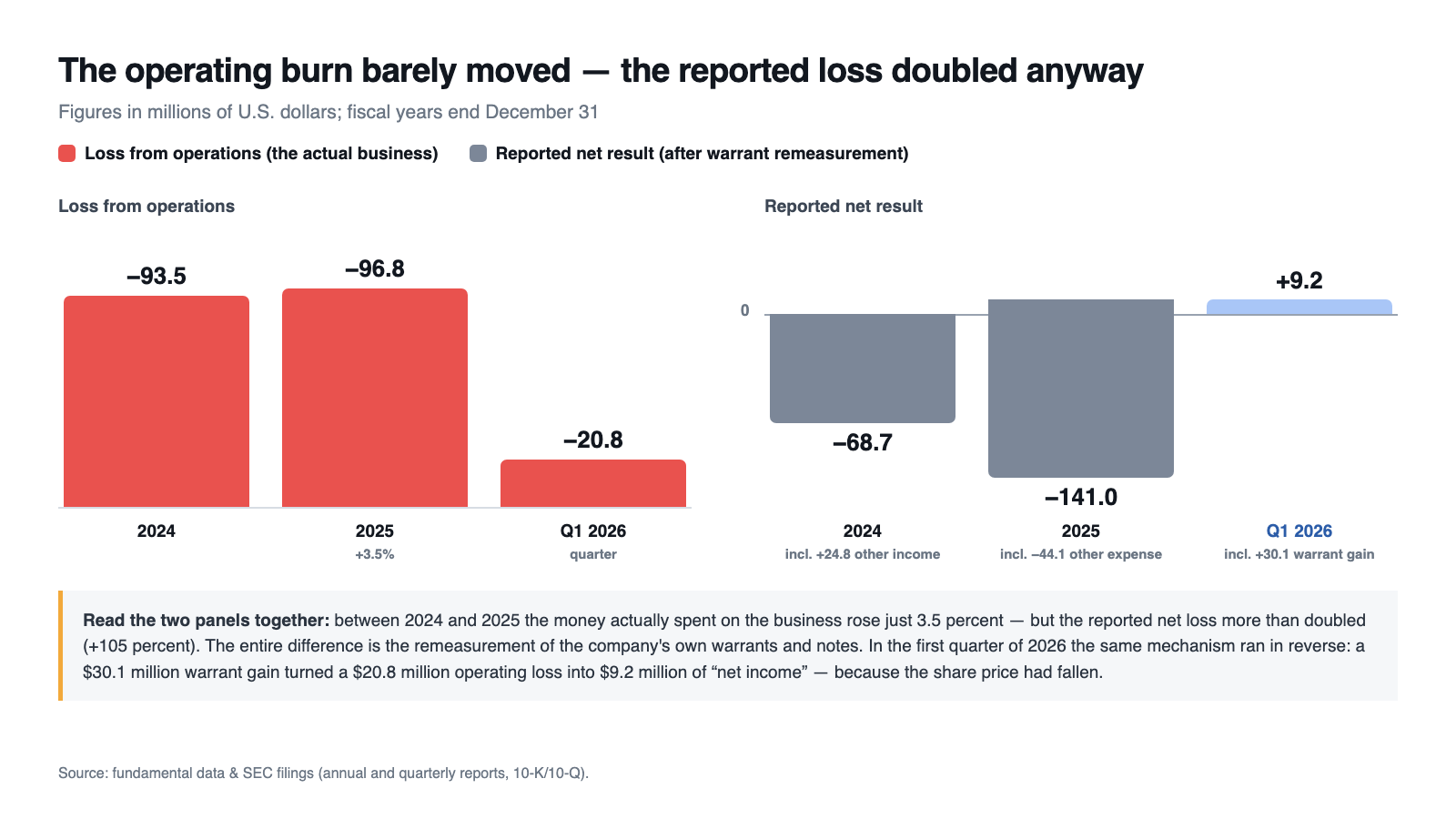
Let us start with the number everyone quotes, and then take it apart — because here the headline is unfairer to the company than the truth. For fiscal year 2025 (ended December 31, 2025), Fractyl reported a net loss of $141.0 million against $68.7 million in 2024. Read as a headline: the losses doubled, the burn is out of control. Read in the income statement, it is nothing of the kind. The money actually spent running the company — the loss from operations — went from $93.5 million (2024) to $96.8 million (2025). That is an increase of 3.5 percent. Research and development rose 5.8 percent to $74.5 million, selling, general and administrative costs fell 3.6 percent to $22.3 million. The operating company barely moved.
The entire difference between "up 3.5 percent" and "up 105 percent" sits in one line: other income (expense), net, which swung from plus $24.8 million (2024) to minus $44.1 million (2025) — a $69.0 million reversal driven mainly by a $40.9 million loss from the change in fair value of warrant liabilities. No cash left the building. It is bookkeeping on the company's own paper, and we will meet the same mechanism running in reverse in a moment. To be fair to Fractyl: management did cut where cutting was possible. The Strategic Reprioritization of January 31, 2025 came with a workforce reduction of 22 employees, about 17 percent, and by March 1, 2026 the company was down to 100 full-time employees — 73 of them in research and development, 14 holding doctorates. This is a lean outfit spending nearly three quarters of its money on science. The first quarter of 2026 shows the same shape: operating expenses of $20.8 million, down from $24.8 million a year earlier, of which R&D was $15.6 million.
And now the part that actually impresses, because it deserves to be said before the uncomfortable truths: the clinical evidence is real, randomized and improving. On June 4, 2026, Fractyl reported one-year results from the open-label REVEAL-1 Cohort: patients who had lost roughly 24 percent of their body weight on a GLP-1 and then stopped kept about 78 percent of that loss a year after a single Revita procedure, with 33 percent still losing weight. Open-label studies flatter themselves, so the number that matters came on July 15, 2026, from the REMAIN-1 Midpoint Cohort (n=45) — randomized, double-blind and sham-controlled, meaning the comparison group underwent a convincing fake procedure. In the full analysis population, Revita cut weight regain by about 40 percent versus sham at one year (7.8 percent of body weight regained versus 13.0 percent). Among patients who received a complete duodenal ablation (more than 14 cm treated), about 81 percent of the GLP-1 weight loss was still there at one year, against 48 percent with sham. Tolerability was unremarkable in the best sense: no device- or procedure-related serious adverse events, and side-effect rates that were essentially the same in both arms (24 percent Revita versus 25 percent sham). One new case of type 2 diabetes appeared — in the sham group. Next up: topline six-month randomized data from the REMAIN-1 Pivotal Cohort (n=315) in early Q4 2026, then the De Novo submission. Now flip the page over.
What the filings say — the uncomfortable truths
Uncomfortable truth no. 1: the company itself concludes there is substantial doubt it survives the year
This is not an interpretation, an analyst's worry or a subheading someone skimmed. It is a conclusion, written by management, in the annual report, in the flattest language the accounting rules allow:
"Given the inherent risk and uncertainty of future cash flow estimates as well as the minimum liquidity covenant requirement, we have concluded that substantial doubt exists about our ability to continue as a going concern for at least 12 months from the issuance date of this Annual Report on Form 10-K."
— Fractyl Health, Inc., SEC annual report 10-K 2025, Item 7 "Liquidity and Capital Resources — Funding Requirements and Going Concern"

"Going concern" is accounting's way of asking a blunt question: can this company keep the lights on for another twelve months without something new happening? When the answer is "we are not sure", the words substantial doubt must appear — and they did, in the 10-K of March 24, 2026 and again in the quarterly report of May 12, 2026. Here are the numbers behind the sentence. Cash was $81.5 million on December 31, 2025, plus $4.1 million from warrant exercises in January 2026; by March 31, 2026 it was $63.2 million. The company burned roughly $18 million of cash in that single quarter and expects the remainder to last into early 2027. Against that stands an accumulated deficit of $547.0 million (March 31, 2026) — the sum of everything ever lost here — and a second trigger most readers miss: the 2023 Notes carry a minimum liquidity covenant requiring $10.0 million of cash. Fractyl complied at year-end 2025, but the filing warns that "without additional financing, we may not be able to comply with the minimum liquidity covenant related to our 2023 Notes by the end of 2026". Read the mechanism, because it is the one that bites first: the company does not have to run out of money to be in trouble — it only has to fall below $10 million, and the lenders' covenant does the rest. To be fair: a going-concern conclusion is common in clinical-stage medtech and is not a bankruptcy forecast. It is a statement about dependence — and this company's dependence is total.
Uncomfortable truth no. 2: revenue is zero, and everything now rides on one procedure
Fractyl abandoned the indication it was founded for. That is not a euphemism; it is in the MD&A, with the consequence attached:
"On January 31, 2025, we approved a Strategic Reprioritization, in which we have paused investment in our Revita programs for T2D, which consists of the REVITALIZE-1 study and the Germany Real World Registry study. As a result, we have not generated any revenue in 2025."
— Fractyl Health, Inc., SEC annual report 10-K 2025, Item 7 MD&A "Revenue and Cost of Goods Sold"

Add up the whole commercial history and it is smaller than a rounding error: $120 thousand of revenue in 2023, $93 thousand in 2024, zero in 2025. Roughly $213,000, ever — against $74.5 million spent on research in 2025 alone. Everything therefore depends on one procedure reaching one market, and the risk factors say so without a cushion: "We are substantially dependent on the success of our lead product candidate, Revita, and our lead gene therapy product candidate, RJVA-001, in the Rejuva platform." Concentration risk usually means a baker whose rolls go to three big buyers. Here there is one roll, one oven and no buyers yet. And the regulatory gate is genuinely a gate: the De Novo submission is anticipated in late Q4 2026, the FDA has given favourable feedback but not a decision, and the pivotal readout that must support it is still ahead. To be fair, the pivot has a defensible logic — the diabetes market is where GLP-1s are strongest, and stepping out of their way to catch what they leave behind is a smaller, sharper target. But remember what was traded: focus was bought with the loss of the only revenue line and of a second debt tranche the company chose not to qualify for.
Uncomfortable truth no. 3: the share count tripled in a year — and each new share was cheaper
Every readout in this analysis was financed by selling pieces of the company, and the receipts are unusually stark. Shares outstanding went from 48,755,451 (December 31, 2024) to 153,372,044 (December 31, 2025) and 158,648,963 (March 31, 2026). That is plus 215 percent in twelve months: if you held Fractyl stock at the start of 2025 and did nothing wrong, your slice of the company shrank to roughly a third. The prices tell the rest. The IPO of February 6, 2024 sold 7,333,333 shares at $15.00 for $98.9 million net. Then: an at-the-market programme selling 4,701,960 shares at an average of $1.53; the August 2025 offering at a combined $1.05 per share with warrants attached ($22.6 million net); and the big one — the September 2025 offering: 60,000,000 shares at $1.00, closing September 29, 2025, for $56.0 million net.
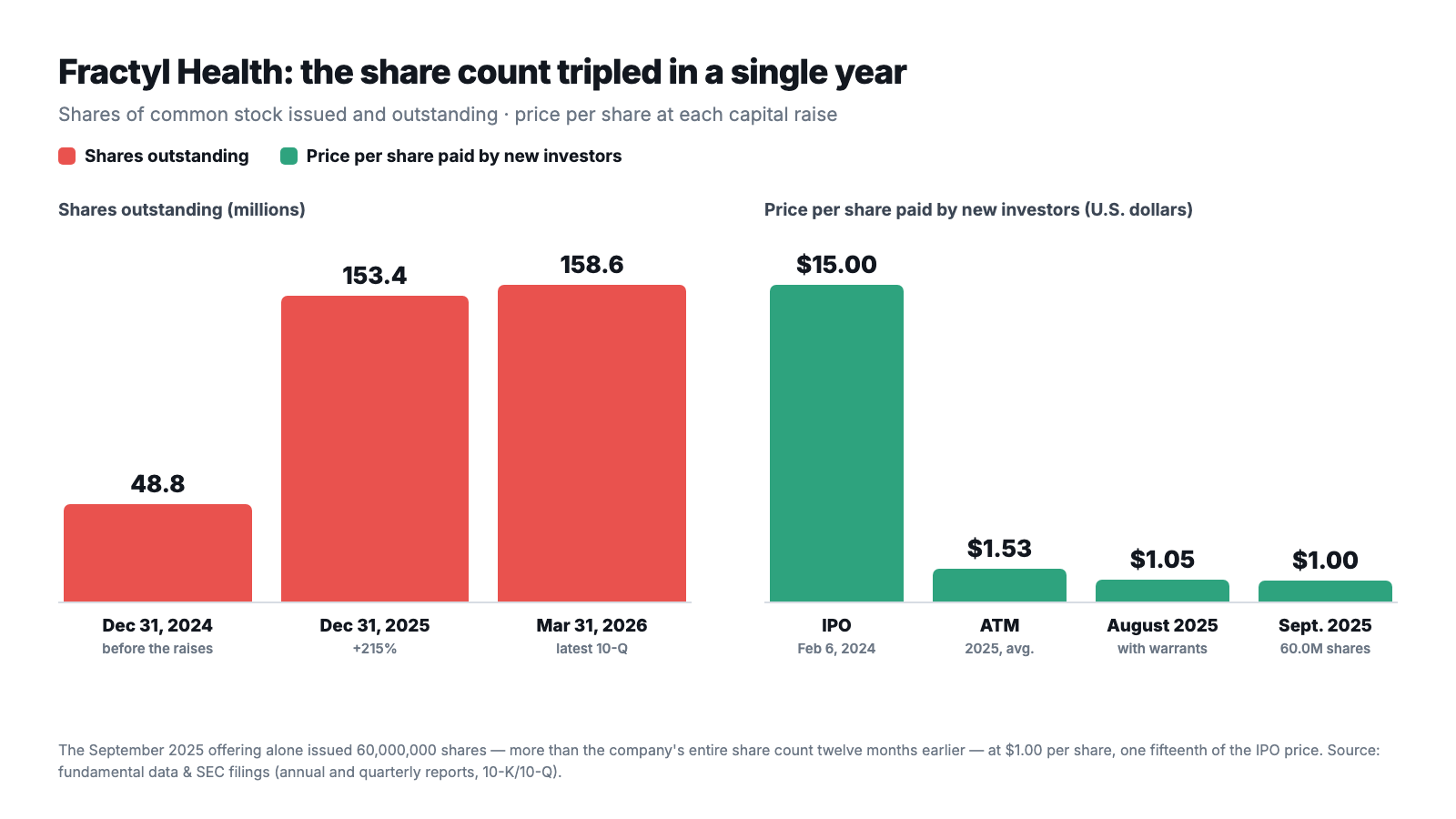
Sit with that middle number for a second: a single offering issued more shares than the whole company had a year before, at one fifteenth of the IPO price. On top came the warrants attached to the August deal — Tranche A alone was exercised into 21,904,261 further shares for $23.0 million. None of this is hidden or improper; it is what a pre-revenue company with a going-concern conclusion must do to buy its next twelve months, and $105.0 million of financing in 2025 is why the science reached its readouts at all. But the arithmetic is merciless, and it is the arithmetic every future holder inherits: the cash to reach the next milestone is bought with shares, and the worse the stock does, the more shares each milestone costs. One small sign of how tight that corner has become: on March 23, 2026 Fractyl terminated its at-the-market sales agreement — the most convenient tap it had — effective April 6, 2026. When the shares are worth a dollar, selling them stops being financing and starts being erosion.
Uncomfortable truth no. 4: the one profitable quarter arrived because the stock collapsed — and the listing is now at stake
In the first quarter of 2026, Fractyl reported net income of $9.2 million — its first "profit" ever, on an operating loss of $20.8 million. The quarterly report explains where it came from, and the mechanics are worth genuinely understanding:
"Other income, net, of $30.0 million during the three months ended March 31, 2026 was primarily attributable to a $30.1 million gain from the change in fair value of our warrant liabilities and $0.6 million of net interest income, partially offset by a $0.6 million loss from the change in fair value of the 2023 Notes. [...] Change in fair value of warrant liabilities was mainly a result of the fluctuation of the value of the underlying shares of our common stock."
— Fractyl Health, Inc., SEC quarterly report 10-Q as of March 31, 2026, Item 2 MD&A "Other Income (Expense), Net"

Read it twice, because it inverts your instincts. The warrants Fractyl handed out in the August 2025 financing sit on the balance sheet as a liability — a promise to deliver shares cheaply — and that promise is re-priced every quarter, with the difference booked straight through the income statement. When the share price falls, the promise gets cheaper, the liability shrinks, and the company books a gain. You can watch it happen on the balance sheet: warrant liabilities fell from $36.4 million (December 31, 2025) to $6.4 million (March 31, 2026) — a $30.1 million drop that became $30.1 million of "income". In 2025 the identical mechanism ran the other way and cost $40.9 million. The exact same seesaw turns up at The RealReal, where quarterly profits appear precisely when the stock falls; it is not a Fractyl quirk but a rule of accounting. Remember the image: a profit made of your own falling share price is a mirror, not a milestone.
And that falling share price now has a second consequence, which is why this truth has two halves:
"On March 13, 2026, the Company received a letter from Nasdaq Stock Market LLC ("Nasdaq") notifying the Company that it was not in compliance with the minimum bid price requirement of Nasdaq Listing Rule 5450(a)(1) because the closing bid price of the Company's common stock had been below $1.00 per share for 30 consecutive business days. The Company has 180 calendar days, or until September 9, 2026, to regain compliance with the minimum bid price requirement."
— Fractyl Health, Inc., SEC annual report 10-K 2025, Notes to the consolidated financial statements, "Subsequent Events"

Nasdaq requires a closing bid of at least a dollar; below it for 30 straight sessions and the letter arrives, as it did on March 13, 2026. The notice changes nothing immediately — the stock keeps trading — but it starts a 180-day clock that expires on September 9, 2026. The usual escape hatches are a sustained recovery above $1.00 for ten straight sessions, a move to the Nasdaq Capital Market with a further 180 days, or the blunt instrument every small cap knows: a reverse stock split, which changes the price without changing the company. Note the timing, because the calendar is doing something almost theatrical here: the compliance deadline (September 9, 2026) falls before the pivotal readout (early Q4 2026) and the De Novo submission (late Q4 2026). The listing clock runs out just ahead of the two events that could justify the listing.
Valuation: about $145 million for a bet with a deadline
Conventional valuation does not apply here, and pretending otherwise would be the fourth lie of this piece. There is no price-to-earnings ratio — there are no earnings. There is no meaningful price-to-sales ratio — 2025 revenue was zero, and any ratio built on the $93 thousand of 2024 is a joke with decimals. What can be said is this: in mid-July 2026 the stock traded around $0.91, giving Fractyl a market value of roughly $145 million (data as of July 15, 2026). Set the balance sheet against it: $63.2 million of cash (March 31, 2026) minus $30.1 million of notes payable leaves about $33 million of net cash. In other words, the market is pricing Revita, Rejuva, the patents, the Breakthrough designation and every scrap of the clinical evidence at roughly $110 million — a fifth of what has been spent getting here ($547.0 million of accumulated deficit). That is either an obvious mispricing or an accurate discount for the chance the company must sell itself again before the data pay off. Both readings fit the same number, which is precisely what makes this a bet rather than a calculation.
The professionals' view is dramatically more generous — and, unusually, dramatically more concentrated. Just four analysts cover the stock; the consensus is a near-uniform buy (three strong buy, one buy) with an average price target around $5.03 (data as of July 15, 2026), roughly five and a half times the recent price. Treat that as what it is: a small huddle of specialists modelling the approval case, not a market verdict. When four people agree about a company whose own filing says substantial doubt, the agreement is a hypothesis, not a second opinion. The market itself has voted differently — the stock is down about 94.8 percent from its all-time high and roughly 52 percent over twelve months, even after gaining about 77 percent in three months as the data landed (metrics as of July 10, 2026). Put plainly: the price has already discounted the company's failure; the analysts are pricing its approval. The two events are still ahead of you, not behind.
Opportunities and risks at a glance
What speaks for Fractyl Health:
- Randomized, sham-controlled evidence — the hardest kind to argue with: in the REMAIN-1 Midpoint Cohort (n=45), patients with a complete duodenal ablation kept about 81 percent of their GLP-1 weight loss at one year versus 48 percent with sham; weight regain was cut roughly 40 percent versus sham across the full population (results reported July 15, 2026).
- A clean safety profile so far: no device- or procedure-related serious adverse events, side-effect rates of 24 percent (Revita) versus 25 percent (sham) through one year — the FDA has acknowledged that Revita's profile, on more than 300 procedures, is consistent with a Class II device.
- A regulatory path that is open and short by medtech standards: FDA Breakthrough Device designation in post-GLP-1 weight maintenance, favourable feedback on the De Novo classification request, and a De Novo marketing application anticipated in late Q4 2026 — not the full PMA gauntlet.
- A market position downstream of the GLP-1 wave rather than against it: Revita addresses what happens when people stop the drugs, and the bigger the GLP-1 cohort grows, the larger that pool becomes.
- A lean, science-heavy cost base: 100 full-time employees (March 1, 2026), 73 of them in research and development; operating expenses of $96.8 million in 2025 rose just 3.5 percent, and the first quarter of 2026 spent $20.8 million against $24.8 million a year earlier. A second shot on goal exists in the Rejuva gene therapy platform (RJVA-001).
What speaks against it:
- The annual report concludes that substantial doubt exists about the company's ability to continue as a going concern; cash of $63.2 million (March 31, 2026) is expected to last only into early 2027, and the 2023 Notes' $10.0 million minimum liquidity covenant may be breached by the end of 2026 without new financing.
- Revenue is zero (2025), lifetime revenue is roughly $213,000, and the company is "substantially dependent" on a single product candidate — the January 31, 2025 Strategic Reprioritization paused the diabetes programmes that the company was founded to pursue.
- Dilution on a scale that redefines ownership: shares outstanding up 215 percent to 153.4 million in 2025, the September 2025 offering alone selling 60,000,000 shares at $1.00 against a $15.00 IPO price, plus 21,904,261 shares from Tranche A warrant exercises; the at-the-market programme was terminated effective April 6, 2026.
- The reported profit is an artifact: Q1 2026 net income of $9.2 million came entirely from a $30.1 million warrant remeasurement gain caused by the falling share price, against a $20.8 million operating loss; the same mechanism cost $40.9 million in 2025.
- The listing itself is on a clock: out of compliance with Nasdaq's $1.00 minimum bid rule since March 13, 2026, with a September 9, 2026 deadline that falls before both the pivotal readout and the De Novo submission — and the lenders hold a lien on substantially all assets, including the intellectual property.
A human conclusion
Back to the reflex from the opening — the one that stored "84 percent" and dropped everything after it. Here is what the full sentence holds. Finding one: the science is real. Randomized, sham-controlled, one-year data showing that a single outpatient procedure keeps most of the GLP-1 weight off is not a press release; it is the hard currency of medicine, and Fractyl has earned it. Finding two: the numbers behind the headline are small. The 84 percent figure describes ten patients against eight in an exploratory subgroup the company itself calls "not powered for formal inference"; the honest headline is the 81-versus-48 percent from the complete-ablation group, out of a 45-patient study — encouraging, and still a long way from the 315-patient pivotal cohort that has to confirm it. Finding three: the money is on a shorter clock than the science. Cash into early 2027, a going-concern conclusion in the company's own hand, a covenant that bites at $10 million, a listing deadline on September 9, 2026 — and a share count that tripled in a year buying the runway to get this far.
That is the whole case, and it resolves into one uncomfortable symmetry. Fractyl sells a treatment for what happens after you stop — and its own central risk is what happens after the money stops. The company is not failing; it is racing. The pivotal data land in early Q4 2026, the De Novo goes in late Q4 2026, and the cash reaches into early 2027 — the schedule works, with nothing to spare, provided nothing slips. Whoever buys today is not buying a business, because there isn't one yet: they are buying a position in that race, at a price that assumes it is lost, and accepting that the next financing will likely take another bite of their stake regardless of whether the data are good. Whoever waits for approval will pay a very different price for a very different certainty. If Revita works and reaches the market, the stock at a dollar will look absurd in hindsight. If the financing arrives before the approval — and something has to — today's shares will be a smaller slice of that vindication than they look. Both of those sentences are true at once. What you make of them is your decision. And that is exactly as it should be.
Sources
All original documents used in this analysis — to read for yourself:
- Fractyl Health, Inc. — SEC annual report 10-K for 2025 (filed March 24, 2026)
- Fractyl Health, Inc. — SEC annual report 10-K for 2024 (filed March 3, 2025)
- Fractyl Health, Inc. — SEC quarterly report 10-Q as of March 31, 2026 (filed May 12, 2026)
- Fractyl Health, Inc. — SEC quarterly report 10-Q as of September 30, 2025 (filed November 12, 2025)
- Fractyl Health, Inc. — SEC current report 8-K of July 15, 2026, Exhibit 99.1: one-year results of the REMAIN-1 Midpoint Cohort
- Fractyl Health, Inc. — SEC current report 8-K of June 4, 2026: one-year results of the REVEAL-1 Cohort
- Fractyl Health, Inc.'s complete SEC filing history: EDGAR overview (sec.gov)
- Fundamental data (metrics, quarterly series, valuation; data as of July 15, 2026), reconciled with the SEC filings.
- Screener and rating data: in-house stock scanner (metrics as of July 10, 2026); Reddit mentions: ApeWisdom (as of July 16, 2026).
Transparency & disclaimer: This analysis is a journalistic contextualization of publicly available information and is not investment advice, not a financial analysis in the regulatory sense, and not a solicitation to buy or sell securities. Stock investments carry substantial risks up to total loss. All information without guarantee; the data cut-off is noted in the text in each case. The author holds no position in Fractyl Health stock at the time of publication.
Our Bottom Line at a Glance
- Clinical evidence positive
- Randomized and sham-controlled, which is the hardest standard to fake: in the REMAIN-1 Midpoint Cohort (n=45, one-year data of July 15, 2026), complete duodenal ablation retained about 81 percent of GLP-1-induced weight loss versus 48 percent with sham, cutting weight regain roughly 40 percent across the full population, with no device- or procedure-related serious adverse events. The caveat belongs in the same breath: the widely quoted 84 percent describes an exploratory subgroup of 10 versus 8 patients that the company itself calls "not powered for formal inference".
- Strategy & market position neutral
- Positioning Revita downstream of the GLP-1 wave — as the answer to what happens when people stop the drugs — is coherent and gives Fractyl a growing pool rather than a fight it cannot win; FDA Breakthrough Device designation and an open De Novo route (application anticipated late Q4 2026) support it. But the same January 31, 2025 pivot paused the type 2 diabetes programmes the company was founded for, switched off its only revenue and forfeited a second debt tranche.
- Financial condition & going concern negative
- The 10-K for 2025 concludes that substantial doubt exists about the ability to continue as a going concern; cash of $63.2 million (March 31, 2026) is expected to fund operations only into early 2027 against roughly $18 million of quarterly cash burn, and the 2023 Notes' $10.0 million minimum liquidity covenant may be breached by the end of 2026 without new financing. Revenue is $0 (2025), lifetime revenue about $213,000, and the lenders hold a lien on substantially all assets including the intellectual property.
- Dilution & reported results negative
- Shares outstanding rose 215 percent to 153.4 million in 2025 and 158.6 million by March 31, 2026; the September 2025 offering alone sold 60,000,000 shares at $1.00 against a $15.00 IPO price, and Tranche A warrants added 21,904,261 more. The first-ever quarterly profit (Q1 2026: +$9.2 million) is an artifact of a $30.1 million warrant remeasurement gain caused by the falling share price, on a $20.8 million operating loss; the same mechanism cost $40.9 million in 2025.
- Listing & valuation negative
- Out of compliance with Nasdaq's $1.00 minimum bid rule since March 13, 2026, with a September 9, 2026 deadline that falls before both the pivotal readout (early Q4 2026) and the De Novo submission (late Q4 2026) — a reverse split is the usual remedy. At a market value of roughly $145 million against about $33 million of net cash (price as of July 15, 2026), the market prices the entire pipeline near $110 million after $547.0 million of accumulated spending, while four analysts model an average target of about $5.03. No P/E and no meaningful P/S exist; the stock appears in none of our 153 fundamental scanners (metrics as of July 10, 2026).
Fractyl Health is a genuine race between two clocks. The science clock is running well: randomized, sham-controlled one-year data (REMAIN-1 Midpoint, July 15, 2026) show a single outpatient procedure keeping about 81 percent of GLP-1 weight loss off versus 48 percent with sham, with Breakthrough Device designation and a De Novo submission anticipated in late Q4 2026. The money clock is running out: revenue of $0, a net loss of $141.0 million in 2025, cash into early 2027, a share count that tripled to 153.4 million in twelve months, a covenant that bites at $10 million, a Nasdaq deadline of September 9, 2026 — and an annual report that concludes, in the company's own words, that substantial doubt exists about its ability to continue as a going concern. Not investment advice.
What Our Rating Means
- If you don't own the stock
- In our view, the documented risks clearly outweigh — we see no basis for an entry.
- If you hold it in your portfolio
- In our view, the findings carry enough weight to warrant a critical look at your own position.
A journalistic assessment by our editorial team at the time of the deep dive, based on public sources — not investment advice and not a solicitation to buy or sell. Your personal circumstances (investment goals, risk capacity, taxes) cannot be taken into account. What our categories mean, how verdicts are formed, and what conflicts of interest exist →
Worth Noting
- GUTS reached our research list via the Reddit hype scanner (ApeWisdom, 3 mentions in 24 hours, as of July 16, 2026) — a whisper, not a drumbeat, in the days when the REMAIN-1 Midpoint one-year data were published (July 15, 2026). The stock appears in none of our 153 fundamental scanners: with revenue of $0 and no earnings, the metric filters find no handhold — a documented negative finding, not an omission.
- The going-concern statement is quoted here as what it is: an explicit conclusion by management in the 10-K for 2025 and the 10-Q as of March 31, 2026 — not a section heading and not our inference. A going-concern conclusion is common in clinical-stage medtech and is not a bankruptcy forecast; it is a statement about dependence on new capital.
- Price and valuation figures are dated to July 15, 2026 (about $0.91, market value roughly $145 million); scanner metrics carry a July 10, 2026 cut-off. Analyses are evergreen, daily prices are not a buy argument.
Frequently Asked Questions
Fractyl Health (Nasdaq: GUTS) develops Revita, an outpatient endoscopic procedure that ablates and renews the lining of the duodenum — the first stretch of small intestine — to keep weight off after GLP-1 medications such as Ozempic or Wegovy are discontinued. It is a clinical-stage company: revenue was $0 in 2025, and its second programme, the Rejuva gene therapy platform with candidate RJVA-001, is earlier still.
Yes, as an explicit conclusion. The annual report 10-K for 2025 (filed March 24, 2026) states: "we have concluded that substantial doubt exists about our ability to continue as a going concern for at least 12 months from the issuance date of this Annual Report on Form 10-K." The quarterly report as of March 31, 2026 repeats it. Cash stood at $63.2 million on March 31, 2026 and is expected to last into early 2027.
Genuinely good, and smaller than the headlines. In the randomized, sham-controlled REMAIN-1 Midpoint Cohort (n=45, one-year data reported July 15, 2026), patients with a complete duodenal ablation kept about 81 percent of their GLP-1 weight loss versus 48 percent with sham, with no device-related serious adverse events. The widely quoted 84 percent comes from an exploratory subgroup of 10 versus 8 patients that the company itself labels "not powered for formal inference". The 315-patient pivotal cohort reports in early Q4 2026.
By design, an opportunity — that is the whole strategy. Fractyl paused its type 2 diabetes programmes on January 31, 2025 and repositioned Revita downstream of the GLP-1 wave: as a treatment for people who have lost weight on Ozempic or Wegovy and then stop, when the weight typically returns. The larger the GLP-1 market grows, the larger that pool becomes. Revita holds FDA Breakthrough Device designation in exactly that indication.
Severely. Shares outstanding rose from 48,755,451 (December 31, 2024) to 153,372,044 (December 31, 2025) — plus 215 percent — and 158,648,963 by March 31, 2026. The September 2025 offering alone sold 60,000,000 shares at $1.00, more than the entire company had outstanding a year earlier and one fifteenth of the $15.00 IPO price of February 2024. Tranche A warrant exercises added a further 21,904,261 shares.
Because its share price fell. The $9.2 million of net income in the first quarter of 2026 came from a $30.1 million gain on remeasuring the company's own warrant liabilities, which shrink in value when the stock declines — visible on the balance sheet as warrant liabilities falling from $36.4 million to $6.4 million. Underneath, the quarter showed an operating loss of $20.8 million. In 2025 the same mechanism cost $40.9 million.
Not automatically, but a clock is running. On March 13, 2026 Nasdaq notified the company that its closing bid price had been below $1.00 for 30 consecutive business days, breaching Listing Rule 5450(a)(1). Fractyl has 180 calendar days — until September 9, 2026 — to regain compliance, typically by trading above $1.00 for ten straight sessions, transferring to the Nasdaq Capital Market for a further 180 days, or executing a reverse stock split.
Sooner than the runway suggests. Management expects cash of $63.2 million (March 31, 2026) to fund operations into early 2027, but the 2023 Notes carry a minimum liquidity covenant requiring a $10.0 million cash balance, and the 10-K warns that "without additional financing, we may not be able to comply with the minimum liquidity covenant related to our 2023 Notes by the end of 2026". The covenant, not the empty account, is the binding constraint.
Found an error?
Did you spot a factual error, an outdated number, or a typo in this deep dive? Let us know briefly — your report goes straight to the editorial team.