Lantheus Stock: Textbook Quality in the Scanner — and a $989 Million Product Losing Its Shield
Lantheus (Nasdaq: LNTH) makes cancer visible in PET scanners — and ranks no. 3 in our Terry Smith Quality scanner (U.S. selection, as of July 18, 2026): return on equity around 23 percent, operating margin above 21 percent, top balance-sheet scores. We read the annual report (10-K) for 2025 and the latest quarterly report (10-Q) — and they tell the other half of the story: roughly 64 percent of revenue hangs on the prostate cancer imaging agent PYLARIFY, whose extra Medicare payment expired at the end of 2024, whose price is already falling, and whose statutory exclusivity ended in May 2026. Not investment advice — just a reminder that a seal of quality is not a moat.
 Thomas Mücke
Founder & Publisher
Thomas Mücke
Founder & Publisher
Chart
Interactive price chart (TradingView).
Note: pure fact-based analysis, not investment advice and not a solicitation to buy or sell. All figures without guarantee.
There is an investor trap that catches the diligent in particular: the seal-of-quality trap. It works exactly like the supermarket — the moment a certification badge sits on the package, your brain stops checking. In the stock market the badges are called "quality stock", "moat" or, in our case: a hit in a quality scanner carrying a famous name. Lantheus Holdings (Nasdaq: LNTH) wears such a badge right now: rank 3 in our in-house Terry Smith Quality scanner (U.S. selection, as of July 18, 2026) — return on equity around 23 percent, operating margin above 21 percent, hardly any debt, top balance-sheet scores. Exactly the stuff that "buy it and never look again" feelings are made of. So let's make a deal: before you trust the badge, we read together what Lantheus itself reported, under penalty of law, to the U.S. securities regulator, the SEC — the annual report (10-K) for fiscal year 2025 and the latest quarterly report (10-Q) as of March 31, 2026. And next to the quality story, those filings tell a second one: the story of a blockbuster losing its shield. At the end, you decide.
What Lantheus actually does — making cancer visible, against the clock
Lantheus earns its money by making disease visible. Its most important product is PYLARIFY: a mildly radioactive imaging agent that attaches itself specifically to prostate cancer cells (via the surface marker PSMA) and makes them light up in a PET scanner — for the physician, it works like a highlighter that marks tumors and metastases inside the body. In fiscal year 2025 (ended December 31, 2025), PYLARIFY generated $989.1 million — roughly 64 percent of total revenue of $1.54 billion. Number two is DEFINITY ($330.2 million): microscopic gas bubbles that serve as a contrast booster in cardiac ultrasound. Since July 2025 there is also Neuraceq, a diagnostic that makes beta-amyloid deposits in the brain visible — the very target of the new Alzheimer's therapies. The company from Bedford, Massachusetts (1,193 employees as of December 31, 2025) rebuilt itself aggressively in 2025: it paid $268.9 million net for the contract manufacturer Evergreen Theragnostics, $306.7 million net for the Neuraceq maker Life Molecular Imaging — and on January 1, 2026 it sold its legacy SPECT business (including the technetium generator TechneLite) to SHINE Technologies.
One peculiarity you must know, because it shapes the whole business model: PYLARIFY is based on the isotope fluorine-18, which has a half-life of 110 minutes. The product spoils faster than fresh bread — it has to be produced practically just-in-time in a nationwide network of manufacturing sites with particle accelerators (cyclotrons) and delivered to the patient within hours. That logistics machine is Lantheus' real masterpiece and has been a protective wall for years — no attacker rebuilds it overnight. Which brings us to the central tension of this analysis, running through every chapter: The metrics report textbook quality — but nearly two-thirds of revenue hangs on a single product whose extra reimbursement has expired, whose price is already falling, and whose statutory exclusivity ended in May 2026. How peculiar the radioisotope business can be is something we recently dissected at the enrichment specialist ASP Isotopes — there a story stock with barely any revenue, here a billion-dollar franchise facing headwinds.
Where the stock shows up in our scanner
Every day we run roughly 3,500 stocks through our scanners. Lantheus landed on the research list via the Terry Smith Quality scanner — rank 3 of the U.S. selection, as of July 18, 2026. The filter translates the published criteria of Fundsmith founder Terry Smith ("Buy good companies, don't overpay, do nothing") into hard numbers: return on equity of at least 15 percent, operating margin of at least 20 percent, genuine cash conversion of profit, debt-to-equity of at most 1, interest coverage of at least 10. Lantheus clears all five: return on equity around 23 percent, operating margin around 22 percent, debt-to-equity of 0.6, interest coverage around 20 (data as of July 18, 2026). The confluence with our balance-sheet checks fits: a Piotroski F-Score of 7 of 9 — a nine-point test of the health of the books, where 7 is solid —, an Altman Z-Score above 8 (the higher, the further from distress) and zero distress flags. The analyst consensus of 13 firms sits at an average grade around 1.1 — on a scale where 1 means "strong buy", that is near-unanimous applause.
But here comes the sentence many readers skip: the scanner deliberately works without a valuation threshold and without a moat check — it finds good numbers, not good businesses. Whether yesterday's quality is also the day after tomorrow's is for you to judge. That is exactly what separates a metric from a verdict: a quality scanner measures a company's past — but what you will pay for is its future. How differently such scanner hits can play out is something our analysis of the insurer Globe Life shows — another find from this very filter. For valuation context: in mid-2026 the market priced Lantheus at roughly $7.1 billion — a price-to-earnings ratio around 26, a price-to-sales ratio around 4.6 and about 19 times free cash flow (data as of July 18, 2026). That is the "proven quality" price bracket, not a bargain bin — and quality premiums are most vulnerable exactly when someone shakes the foundation.
The numbers over the years — honestly appraised
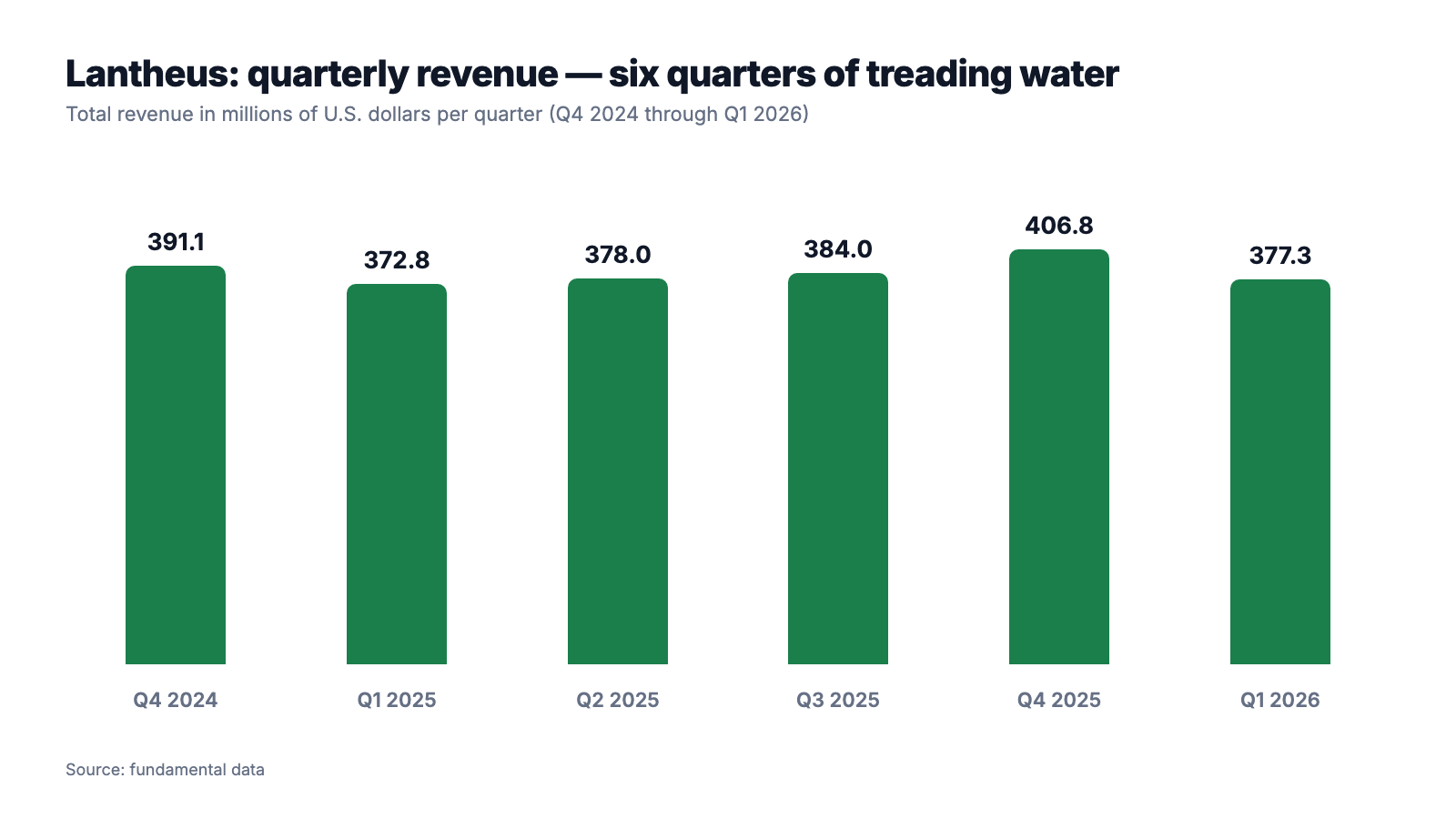
First, what genuinely impresses. With PYLARIFY, Lantheus pulled off one of the most successful product launches radiodiagnostics has seen: from $851.3 million of revenue in 2023 to more than a billion in 2024 ($1,057.8 million) — a blockbuster in the literal sense. Total revenue rose from $1.30 billion (2023) through $1.53 billion (2024) to $1.54 billion (2025). And the earnings quality behind it is real: $390.1 million of operating cash flow in fiscal year 2025 against just $36.1 million of capital expenditures — profit actually arrives as cash, exactly what the Terry Smith filter wants to see. The balance sheet as of December 31, 2025: $359.1 million in cash, $1.09 billion of equity, and as the only sizable financial debt a $575 million convertible note at a modest 2.625 percent, due December 2027. No customer accounts for more than 10 percent of revenue. Read only these lines and the scanner rank explains itself.
Now the other reading direction. Net income has been running backwards for two years: $326.7 million (2023), $312.4 million (2024), $233.6 million (2025) — per diluted share from $4.65 through $4.36 to $3.41. Revenue in 2025 was essentially flat versus 2024 (up 0.5 percent), and even that only because two acquisitions (Neuraceq, contract manufacturing) and milestone payments papered over the PYLARIFY dent. Operating cash flow also fell, from $544.8 million (2024) to $390.1 million (2025). Remember this pattern: when metric quality stays high while profit and cash flow decline, the scanner is measuring the harvest of the old years — not the seed of the new ones. Where the dent comes from is spelled out in the filings. Which brings us to the uncomfortable truths.
What the filings say — the uncomfortable truths
Uncomfortable truth no. 1: The extra payment is gone — and the PYLARIFY price is falling
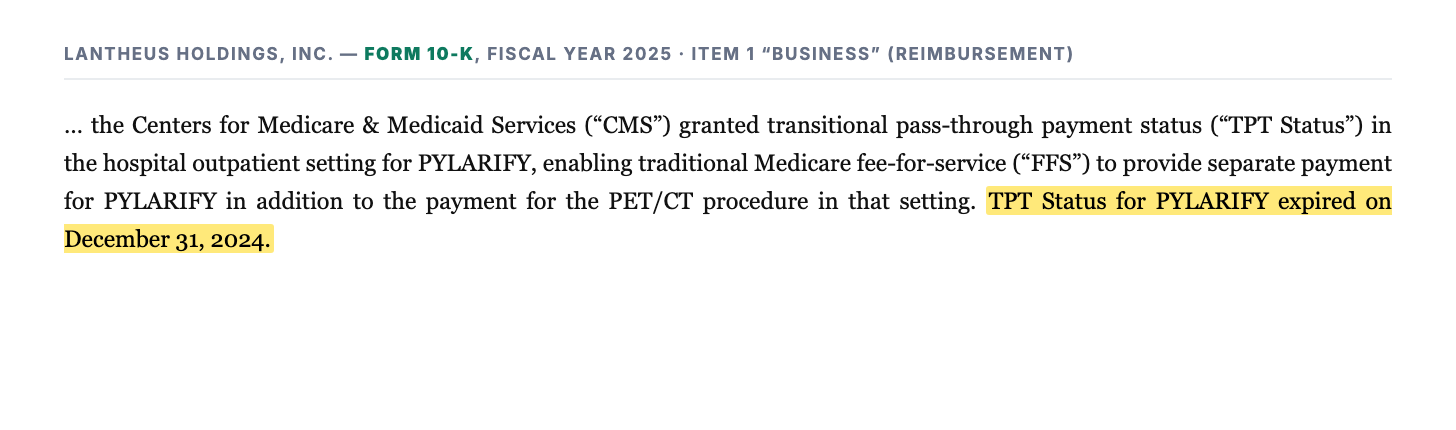
Roughly 64 percent of revenue from one product — that alone would be a concentration risk. More serious is what is happening to that product right now: PYLARIFY shrank 6.5 percent in 2025 to $989.1 million, and another 6.5 percent in the first quarter of 2026 to $240.9 million — per the filings explicitly because of a lower net sales price, on rising volume. The background is a reimbursement detail with real explosive power: for years, the U.S. Medicare agency CMS granted PYLARIFY an extra payment in the hospital outpatient setting — so-called TPT Status, a transitional rule that guarantees new diagnostics a separate payment on top of the procedure fee. The annual report names the expiry date drily:
"… the Centers for Medicare & Medicaid Services ('CMS') granted transitional pass-through payment status ('TPT Status') in the hospital outpatient setting for PYLARIFY, enabling traditional Medicare fee-for-service ('FFS') to provide separate payment for PYLARIFY in addition to the payment for the PET/CT procedure in that setting. TPT Status for PYLARIFY expired on December 31, 2024."
— Lantheus Holdings, Inc., SEC annual report 10-K for fiscal year 2025, Item 1 "Business" (Reimbursement)
Since 2025, a new CMS rule still grants expensive diagnostics above a $630-per-day threshold a separate payment — but based on mean unit cost, no longer on the manufacturer's price. Translated: the government keeps paying, but it now negotiates like a bulk buyer. For a company whose scanner fame rests on high margins, that is no footnote: the price of the most important product is no longer set by the seller, but by the reimbursement logic of an agency. Lantheus is working on an answer — a new PYLARIFY formulation for which it intends to apply for another three years of TPT Status. Whether that bet pays off will be decided by regulators, not by balance sheets.
Uncomfortable truth no. 2: The puppy protection ended in May 2026 — and the competition is already on the shelf
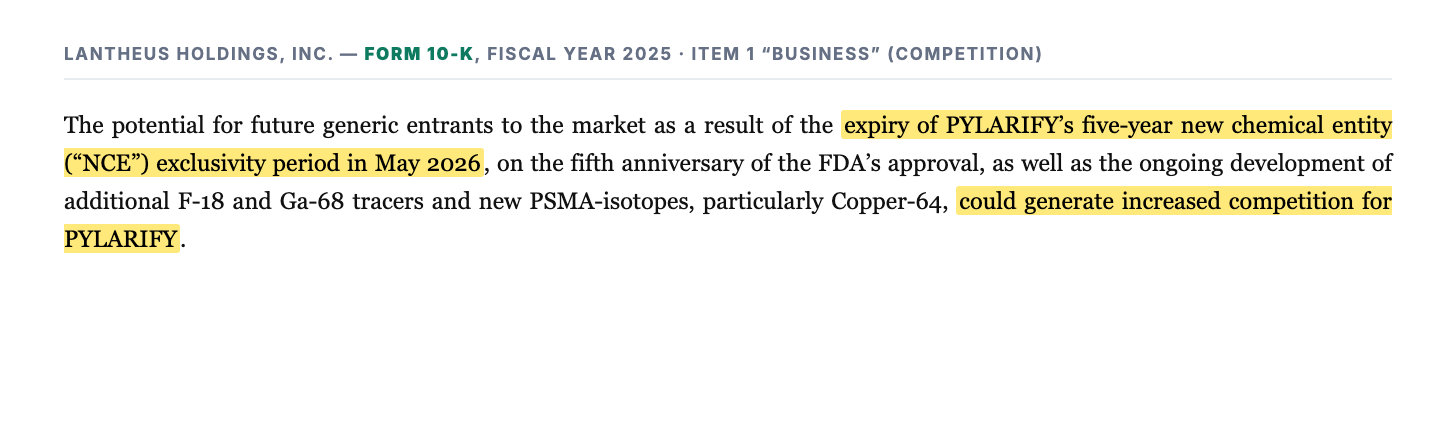
New drug substances enjoy five years of "new chemical entity" exclusivity in the United States — a kind of statutory puppy protection during which the FDA waves no copycat applications through. For PYLARIFY, that clock started with the approval in May 2021. Do the math yourself:
"The potential for future generic entrants to the market as a result of the expiry of PYLARIFY's five-year new chemical entity ('NCE') exclusivity period in May 2026, on the fifth anniversary of the FDA's approval, as well as the ongoing development of additional F-18 and Ga-68 tracers and new PSMA-isotopes, particularly Copper-64, could generate increased competition for PYLARIFY."
— Lantheus Holdings, Inc., SEC annual report 10-K for fiscal year 2025, Item 1 "Business" (Competition)
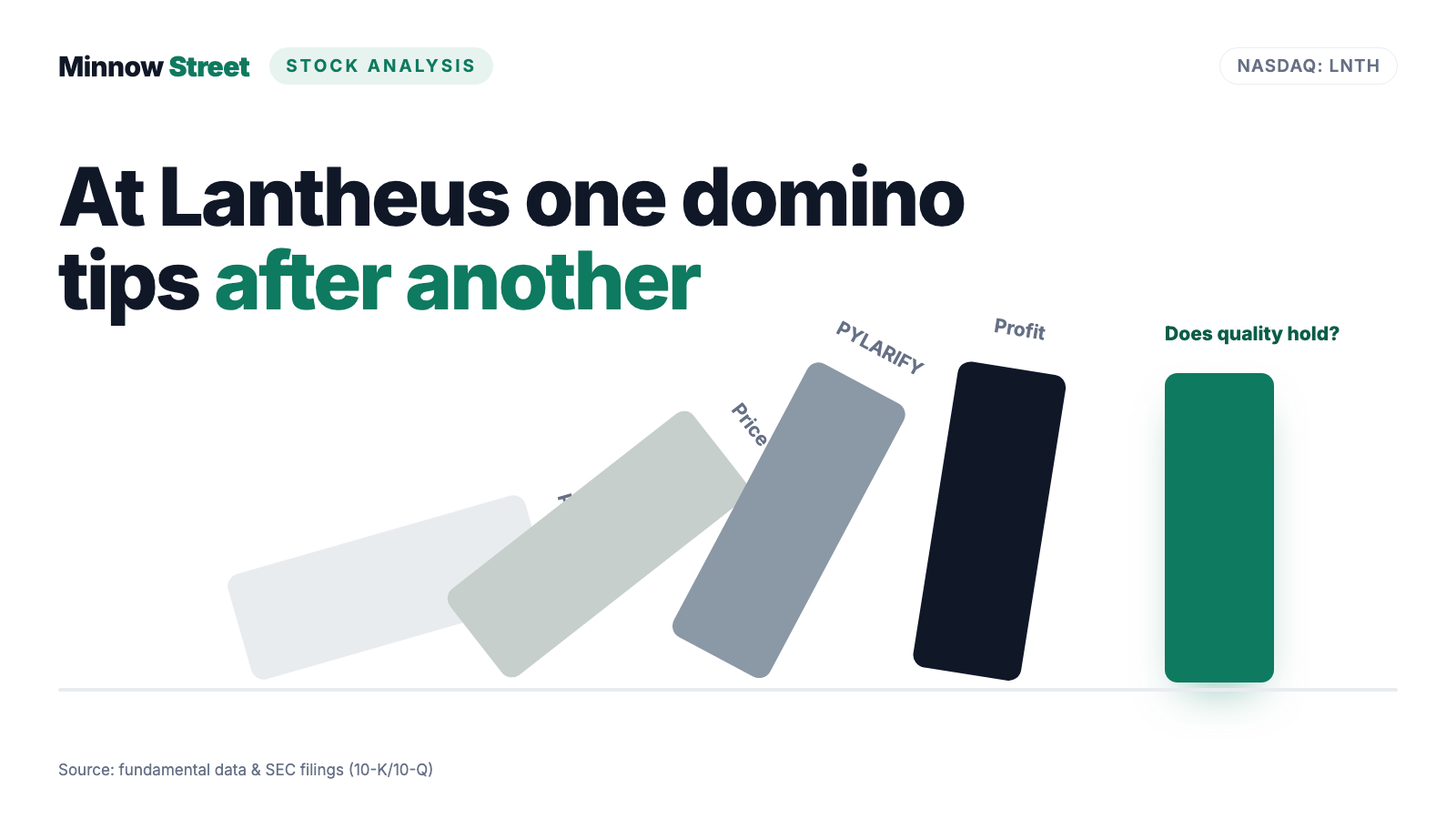
Mind you: even before the exclusivity lapsed, the annual report counted three gallium-68-based PSMA agents and another F-18 agent pushing into the same market. Fairness requires the other side too: Lantheus holds patents on PYLARIFY, owns the cyclotron network as a delivery advantage, the established customer base and the sales machine — a generic first has to replicate the 110-minute logistics. But the mechanism is the same as in every pharma patent cliff: the price a competitor has to undercut is now openly negotiable — and the falling net sales price of 2025 was only the opening round of that negotiation. Remember the sequence, because it is the domino chain of this analysis: first the extra payment fell, then the price, then the product's revenue, then net income. The fifth stone is the quality rank itself — and whether it stays standing will be decided by the coming quarters.
Uncomfortable truth no. 3: Of all times, the CEO chair is a placeholder right now
A transition year with price pressure, a patent countdown and two freshly swallowed acquisitions would be demanding even with a settled leadership team. At Lantheus it turned out differently — the annual report describes the situation itself, in the risk factors:
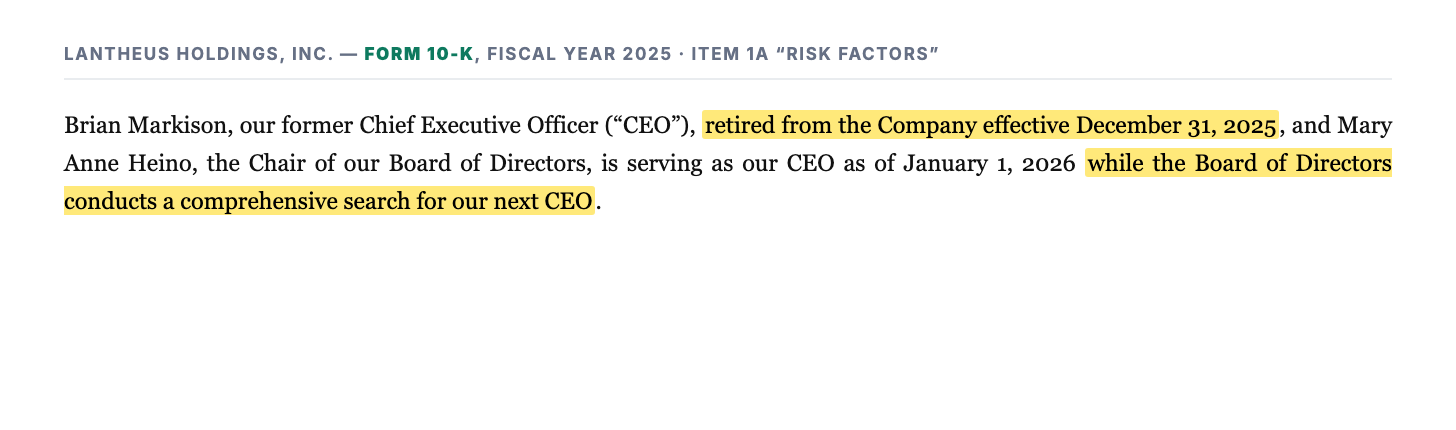
"Brian Markison, our former Chief Executive Officer ('CEO'), retired from the Company effective December 31, 2025, and Mary Anne Heino, the Chair of our Board of Directors, is serving as our CEO as of January 1, 2026 while the Board of Directors conducts a comprehensive search for our next CEO."
— Lantheus Holdings, Inc., SEC annual report 10-K for fiscal year 2025, Item 1A "Risk Factors"
And it does not stop at one name: President Paul Blanchfield left the company in November 2025 for another employer, and back in 2024 Lantheus had already cut roughly 75 positions in a corporate reorganization. The report itself warns that its success is "substantially dependent" on the performance and expertise of its leadership team. Take that seriously without dramatizing it: an experienced board chair as a bridge is not chaos. But the question of who owns the post-PYLARIFY strategy — more Alzheimer's, more acquisitions, more buybacks? — is currently answered by a placeholder. Whoever buys the stock buys a strategy whose architect has not been named yet.
Valuation: a $7.1 billion market value — and a quarterly profit with a false bottom
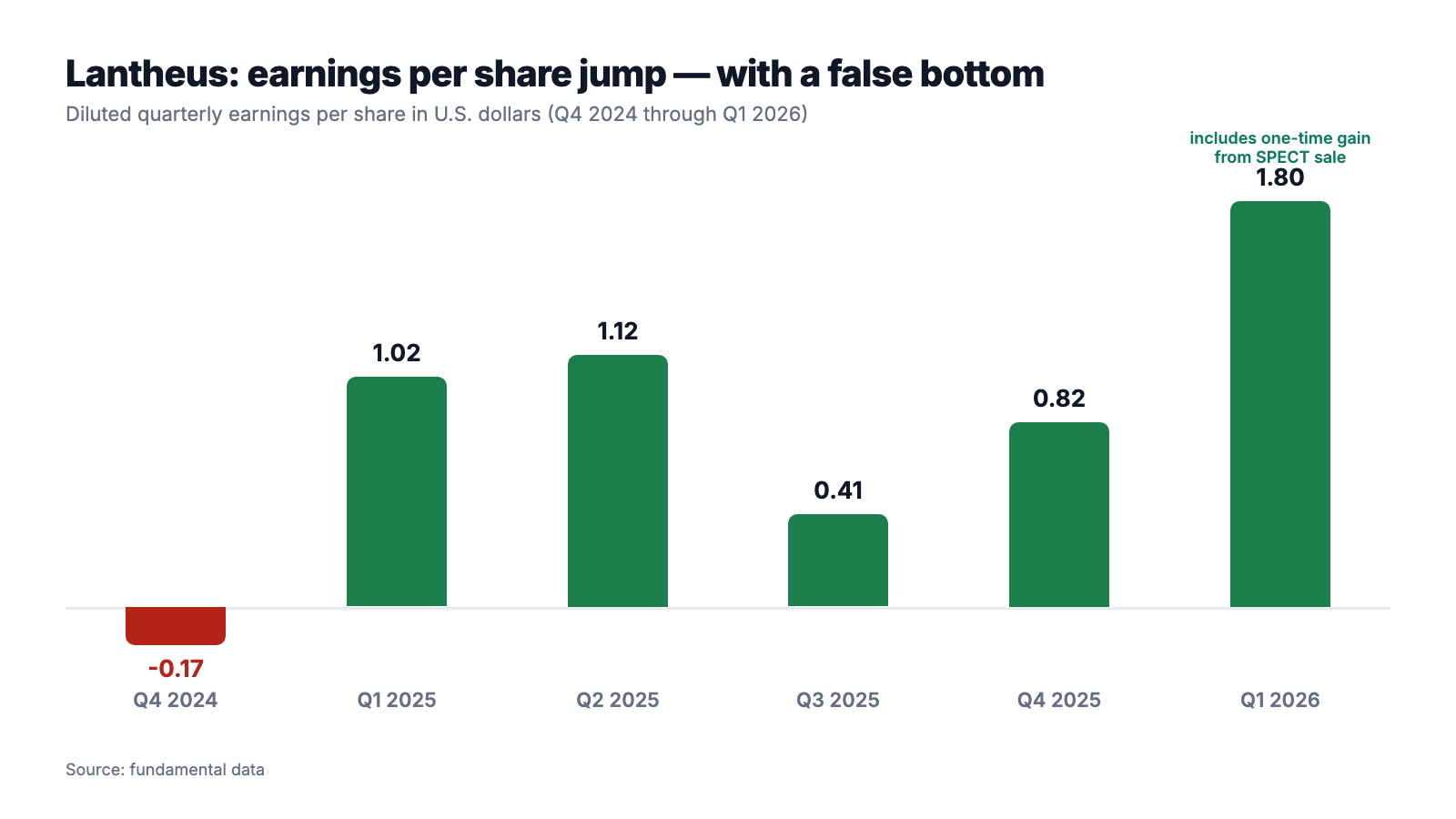
In mid-2026 the market weighed Lantheus at roughly $7.1 billion (data as of July 18, 2026) — after a share price surge of almost 60 percent since the start of the year, which itself followed a brutal slide in 2025. Measured against earnings that is a price-to-earnings ratio around 26, against revenue about 4.6 times, against free cash flow about 19 times (data as of July 18, 2026). That is the "proven quality" price bracket, not a cyclical bargain — and it tolerates no disappointments from the core product. Which is exactly why the latest quarter, the one fueling the optimism, deserves a second look: in the first quarter of 2026, earnings jumped to $1.80 per diluted share, from $1.02 a year earlier — up 76 percent. Except: the quarterly report discloses where much of the jump came from.
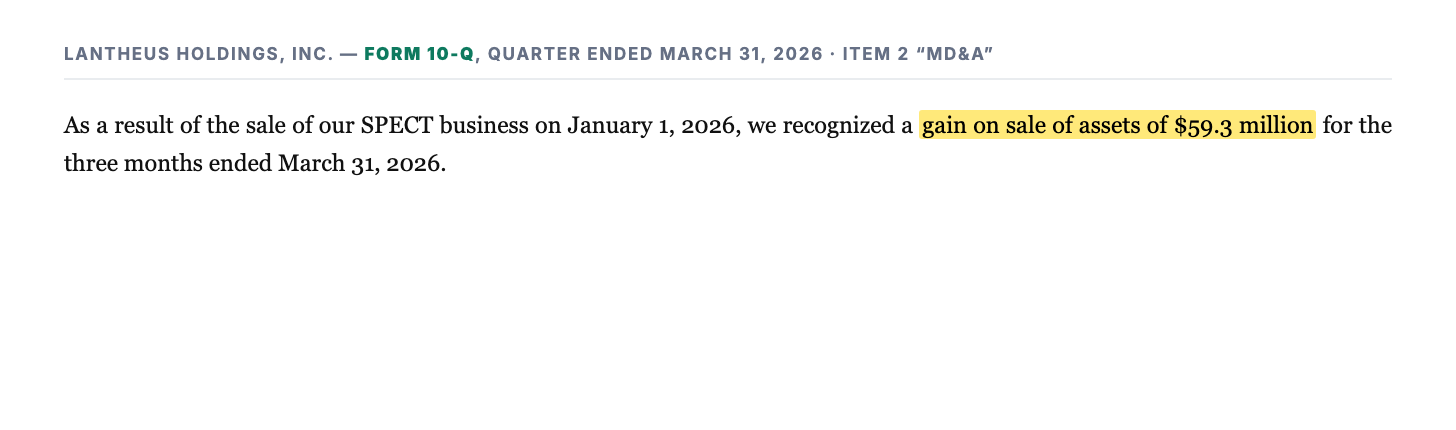
"As a result of the sale of our SPECT business on January 1, 2026, we recognized a gain on sale of assets of $59.3 million for the three months ended March 31, 2026."
— Lantheus Holdings, Inc., SEC quarterly report 10-Q as of March 31, 2026, Item 2 "Management's Discussion and Analysis"
Strip out that one-off and the quarter looks sober: operating income fell from $102.1 million to $81.3 million, revenue grew a meager 1.2 percent — and only thanks to $35.4 million of Neuraceq revenue that did not exist a year earlier. On the plus side stand the growth options Lantheus bought itself at a steep price: with Neuraceq and the pipeline candidates MK-6240 and NAV-4694, the company is positioning itself as the diagnostics outfitter of the new Alzheimer's therapies — if anti-amyloid drugs become standard of care, every patient needs exactly these scans first. Add licensing royal roads such as the Curium partnership in Europe and a milestone payment from GE HealthCare. Capital returns run exclusively through buybacks (no dividend): in 2025 Lantheus repurchased roughly $300 million of its own shares, with another $200 million open under the $400 million program running through the end of 2027. Cash shrank from $912.8 million to $359.1 million within a year to pay for all of it — the balance sheet remains solid, but the cushion for the next big acquisition has become noticeably thinner.
Opportunities and risks at a glance
What speaks for Lantheus:
- Textbook quality metrics: return on equity around 23 percent, operating margin around 22 percent, debt-to-equity of 0.6, interest coverage around 20, Piotroski F-Score of 7 of 9 (data as of July 18, 2026) — rank 3 in the Terry Smith Quality scanner (U.S. selection).
- A genuine cash machine: $390.1 million of operating cash flow in 2025 against just $36.1 million of capital expenditures; balance sheet with $1.09 billion of equity, $359.1 million in cash and a cheap 2.625 percent convertible note ($575 million, due December 2027).
- Market leadership with a logistics edge: PYLARIFY is an established PSMA PET standard with a nationwide cyclotron network for the 110-minute isotope F-18 — infrastructure imitators would first have to build; no customer above 10 percent of revenue.
- A second leg under construction: Neuraceq ($35.4 million of revenue in Q1 2026 alone) plus the Alzheimer's pipeline MK-6240/NAV-4694 dock onto the anti-amyloid boom; add contract manufacturing (Evergreen), Curium royalties and FDA-cleared AI software (PYLARIFY AI).
- Shareholder-friendly capital allocation: roughly $300 million of buybacks in 2025, another $200 million open under the program through the end of 2027; analyst consensus of 13 firms near "strong buy" (data as of July 18, 2026).
What speaks against it:
- Concentration risk with a falling price: roughly 64 percent of revenue from PYLARIFY, which shrank 6.5 percent in 2025 and another 6.5 percent in Q1 2026 — per 10-K/10-Q driven by a lower net sales price after TPT Status expired on December 31, 2024.
- Exclusivity expired: PYLARIFY's five-year NCE exclusivity ended in May 2026; three Ga-68 competitors and another F-18 agent are on the market, copper-64 tracers in development — generics are possible, per the annual report.
- Profit in reverse: net income fell from $326.7 million through $312.4 million to $233.6 million (2023–2025); the Q1 2026 EPS jump was fed half by the $59.3 million one-time gain from the SPECT sale, while operating income fell 20 percent.
- A leadership placeholder in a year of upheaval: the CEO retired (December 31, 2025), the president left in November 2025, the board chair leads on an interim basis, the CEO search is running — while two acquisitions need integrating.
- A quality premium without a safety net: a P/E around 26 and 4.6 times revenue (data as of July 18, 2026) price in sustained quality — while reimbursement rules (the CMS mean-unit-cost logic) and regulators, not Lantheus, will set the core product's price going forward.
A human conclusion
Back to the seal-of-quality trap from the opening. Its core is not that badges lie — the Lantheus numbers in the Terry Smith filter are real: high returns, genuine cash conversion, a clean balance sheet, a world-class delivery network for a product that makes radiation therapy more precise for millions of men. Its core is that a badge ends your inspection exactly where it should begin. Terry Smith's rule has three parts, and the scanner only tests the first: "Buy good companies" can be measured — whether the company is still good the day after tomorrow is written in the fine print. And in Lantheus' fine print stands a row of dominoes: extra payment fallen, price fallen, product revenue fallen, net income fallen. The fifth stone — the quality rank itself — still stands. So the honest question for you is not "Is Lantheus a good company?" (the numbers say yes), but: do you believe Neuraceq, the Alzheimer's pipeline and the new PYLARIFY formulation will grow faster than price pressure and fresh competition eat at the core product — and do you trust that bet to a leadership team that is still being recruited? If you have a reasoned answer, you will find rare quality here at a fair, not cheap, price. If you do not, you are buying a certification badge — and hoping nobody flips the label over. What you make of it is your decision. And that is exactly as it should be.
Sources
All original documents used in this analysis — for your own reading:
- Lantheus Holdings, Inc. — SEC annual report 10-K for fiscal year 2025 (ended December 31, 2025; filed February 26, 2026)
- Lantheus Holdings, Inc. — SEC annual report 10-K for fiscal year 2024 (ended December 31, 2024; filed February 26, 2025)
- Lantheus Holdings, Inc. — SEC quarterly report 10-Q as of March 31, 2026 (filed May 7, 2026)
- Lantheus Holdings, Inc. — SEC quarterly report 10-Q as of September 30, 2025 (filed November 6, 2025)
- Complete SEC filing history of Lantheus Holdings, Inc.: EDGAR overview (sec.gov)
- Fundamental data (metrics, quarterly series, valuation; data as of July 18, 2026), reconciled with the SEC filings.
- Screener and rating data: in-house stock scanner, Terry Smith Quality scanner (U.S. selection, rank 3, as of July 18, 2026).
Transparency & disclaimer: This analysis is a journalistic contextualization of publicly available information and is not investment advice, not a financial analysis in the regulatory sense and not a solicitation to buy or sell securities. Stock investments carry substantial risks up to and including total loss. All information without guarantee; the data cut-off is noted in the text. The author holds no position in Lantheus shares at the time of publication.
Our Bottom Line at a Glance
- Quality metrics & cash conversion positive
- Return on equity around 23 percent, operating margin around 22 percent, debt-to-equity of 0.6, interest coverage around 20, Piotroski 7 of 9 — and $390.1 million of operating cash flow against $36.1 million of capital expenditures in fiscal year 2025 (10-K FY 2025; scanner data as of July 18, 2026).
- Product concentration & price pressure negative
- Roughly 64 percent of revenue comes from PYLARIFY, which shrank 6.5 percent in 2025 and another 6.5 percent in Q1 2026 — per 10-K/10-Q because of a lower net sales price after TPT Status expired on December 31, 2024; CMS now reimburses on a mean-unit-cost basis.
- Exclusivity & competition negative
- PYLARIFY's five-year NCE exclusivity ended in May 2026; three Ga-68 competitors and another F-18 agent are on the market, copper-64 tracers in development, generics possible per the 10-K. Against that stand patents and the hard-to-copy cyclotron delivery network for the 110-minute isotope F-18.
- Balance sheet & capital allocation neutral
- A solid balance sheet ($1.09 billion of equity, Altman Z above 8), but cash fell from $912.8 million to $359.1 million within a year — $575.6 million net for the Evergreen and Life Molecular acquisitions plus roughly $300 million of buybacks; the $575 million convertible note also comes due in 2027 (10-K FY 2025).
- Repositioning & Alzheimer's pipeline neutral
- Neuraceq already contributed $35.4 million of revenue in Q1 2026; MK-6240 and NAV-4694 dock onto the anti-amyloid boom, and the legacy SPECT business was sold. The bet is strategically coherent but young — and its architect has not been named: CEO search since January 1, 2026, interim leadership by the board chair, the president gone since November 2025 (10-K FY 2025, Item 1A).
Lantheus delivers Terry Smith numbers straight from the textbook — high returns, genuine cash conversion, a clean balance sheet — and deservedly ranks no. 3 in our Quality scanner (U.S. selection, July 18, 2026). But the scanner measures the past: roughly 64 percent of revenue hangs on PYLARIFY, whose extra Medicare payment expired at the end of 2024, whose net sales price is falling and whose NCE exclusivity ended in May 2026; net income fell from $326.7 million to $233.6 million (2023–2025), and half of the Q1 2026 EPS jump was the one-time SPECT gain. Whoever invests here buys a race between a young Alzheimer's diagnostics franchise and an eroding blockbuster. Not investment advice.
What Our Rating Means
- If you don't own the stock
- As long as the question raised in the bottom line stays open, we see no basis for an entry.
- If you hold it in your portfolio
- Our findings offer no acute reason to sell — the checkpoints named remain decisive.
A journalistic assessment by our editorial team at the time of the deep dive, based on public sources — not investment advice and not a solicitation to buy or sell. Your personal circumstances (investment goals, risk capacity, taxes) cannot be taken into account. What our categories mean, how verdicts are formed, and what conflicts of interest exist →
Worth Noting
- LNTH landed on the research list via the in-house Terry Smith Quality scanner (U.S. selection, rank 3, as of July 18, 2026). The filter replicates the published Fundsmith criteria (ROE ≥ 15%, EBIT margin ≥ 20%, cash conversion, debt-to-equity ≤ 1, interest coverage ≥ 10) — deliberately without a valuation threshold and without a moat check.
- Scanner metrics (P/E, P/S, P/FCF, ROE) are computed on trailing or estimated figures; after exclusivity and TPT Status expired, the earnings base can change faster than trailing metrics reflect — the order of magnitude matters more than the decimal.
- Price and valuation figures dated July 18, 2026 (market value roughly $7.1 billion); analyses are evergreen, daily prices are not a buy argument. Identity verified via EDGAR submissions (CIK 1521036, domestic filer 10-K/10-Q, only former name "Lantheus MI Holdings, Inc." pre-IPO 2014/2015).
Frequently Asked Questions
Lantheus Holdings, Inc. (Nasdaq: LNTH) of Bedford, Massachusetts, develops and sells diagnostics for medical imaging: the prostate cancer PET agent PYLARIFY ($989.1 million of revenue in 2025), the ultrasound enhancing agent DEFINITY ($330.2 million) and, since July 2025, the Alzheimer's diagnostic Neuraceq. Total revenue in fiscal year 2025 (ended December 31, 2025): $1.54 billion, net income $233.6 million.
As of July 18, 2026, Lantheus ranked no. 3 in our Terry Smith Quality scanner (U.S. selection), which replicates the published Fundsmith criteria: return on equity around 23 percent, operating margin around 22 percent, debt-to-equity of 0.6, interest coverage around 20, plus a Piotroski F-Score of 7 of 9 and $390.1 million of operating cash flow in 2025. The scanner deliberately checks neither valuation nor moat — it measures the past, not the future.
Very: PYLARIFY generated $989.1 million in fiscal year 2025 — roughly 64 percent of total revenue of $1,541.6 million. The product shrank 6.5 percent in 2025 and another 6.5 percent in the first quarter of 2026 (to $240.9 million), per the annual report (10-K) and quarterly report (10-Q) mainly because of a lower net sales price on rising volume.
With the FDA approval in May 2021, the PYLARIFY substance received five years of "new chemical entity" exclusivity; per the annual report (10-K) it ended in May 2026. Generic applications have been possible since. Even before that, three gallium-68-based PSMA agents and another F-18 agent competed in the market; copper-64 tracers are in development. Lantheus counters with patents, its cyclotron delivery network for the 110-minute isotope F-18, and a new formulation for which it plans to apply for another round of TPT reimbursement status.
Net income fell from $326.7 million (2023) through $312.4 million (2024) to $233.6 million (2025), because the extra Medicare payment for PYLARIFY (TPT Status) expired on December 31, 2024 and the net sales price has been falling since. The jump to $1.80 per diluted share in the first quarter of 2026 contains a $59.3 million one-time gain from the sale of the SPECT business to SHINE; operating income fell from $102.1 million to $81.3 million at the same time.
Lantheus pays no dividend; capital returns run through share buybacks (roughly $300 million in 2025, with another $200 million open under the $400 million program authorized through the end of 2027). The balance sheet as of December 31, 2025: $359.1 million in cash (down from $912.8 million a year earlier — the decline stems from the Evergreen and Life Molecular acquisitions plus buybacks), $1.09 billion of equity and a 2.625 percent convertible note of $575 million due in December 2027.
Found an error?
Did you spot a factual error, an outdated number, or a typo in this deep dive? Let us know briefly — your report goes straight to the editorial team.