ASP Isotopes Stock: Five Future Stories, a $290 Million War Chest — and Not One Dollar of Enriched-Isotope Revenue Yet
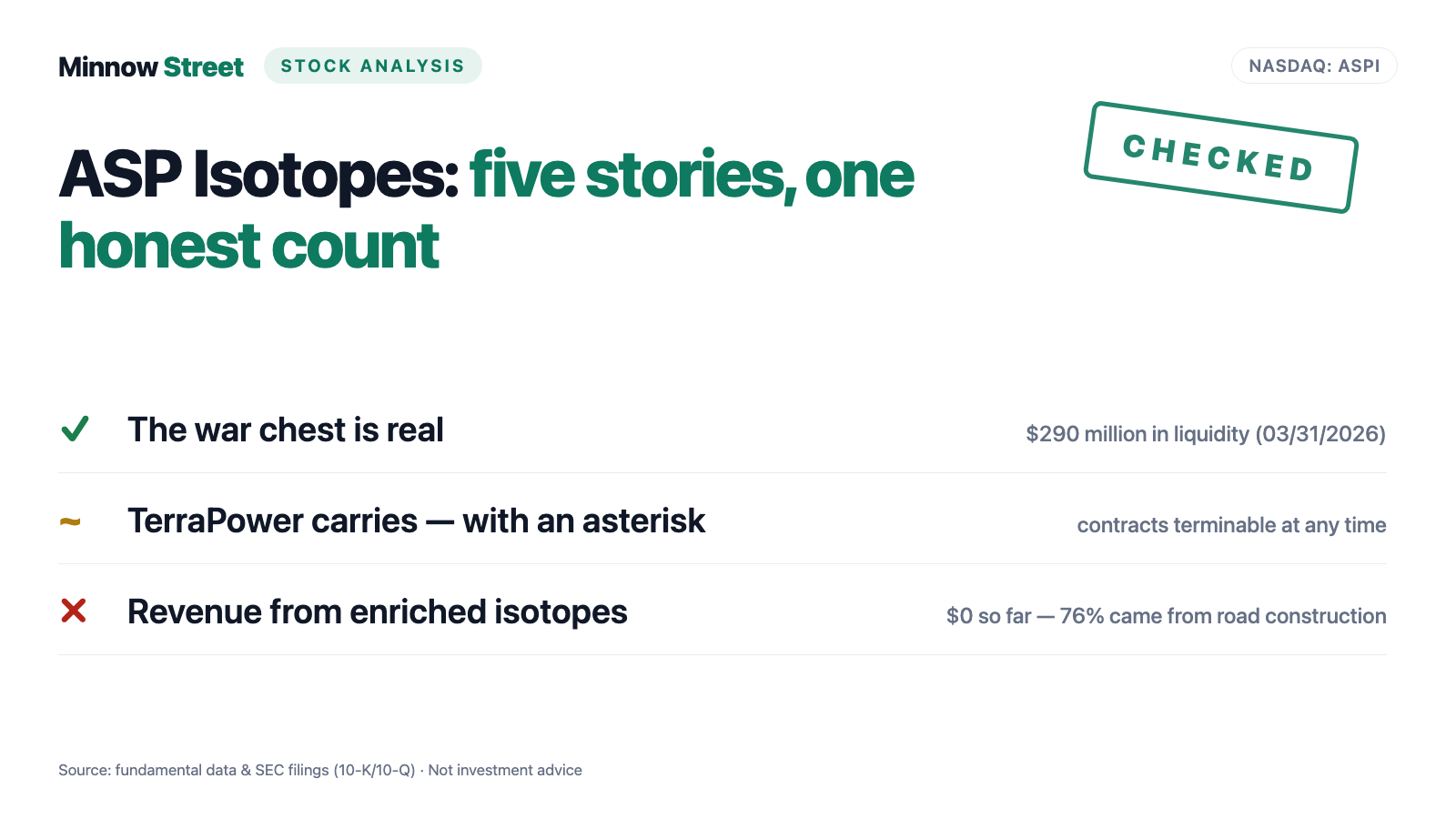
ASP Isotopes offers several megatrends at once: nuclear medicine, silicon-28 for quantum computers, HALEU nuclear fuel for TerraPower, plus helium from South Africa. On Reddit the stock just jumped from rank 785 to 233 of the most-discussed tickers — on a modest 2 mentions in 24 hours (ApeWisdom, as of July 17, 2026). We read the annual reports (10-K) for 2024 and 2025, the quarterly report (10-Q) as of March 31, 2026, and the June 2026 merger filings: zero revenue from enriched isotopes, 76 percent of 2025 revenue from a Hong Kong road-construction side business, a $159.8 million net loss, a share count that has more than doubled since the end of 2023 — and a genuinely full war chest. Not investment advice — just an inventory of which of the five stories actually earns money yet.
 Thomas Mücke
Founder & Publisher
Thomas Mücke
Founder & Publisher
Chart
Interactive price chart (TradingView).
Note: pure fact-based analysis, not investment advice and not a solicitation to buy or sell. All figures without guarantee.
There is an investor trap that catches the curious ones in particular: the sticker-album trap. It works like this: a stock offers not one future story but five at once — cancer medicine! quantum computers! the nuclear renaissance! a helium shortage! — and instead of rigorously checking a single one, your mind pastes all five into the album and feels five times as safe. The opposite is true: five promises are five times the homework. Hardly any small cap fills that album in the summer of 2026 as impressively as ASP Isotopes Inc. (Nasdaq: ASPI) of Dallas: an enricher of rare isotopes with plants in South Africa, whose customer list features TerraPower — the nuclear company backed by Bill Gates. On Reddit, the stock just jumped from rank 785 to rank 233 of the most-discussed tickers, albeit on a modest 2 mentions in 24 hours (ApeWisdom, as of July 17, 2026) — a whisper getting louder. So let’s make a deal: before you fill the album, we read together what the company itself reported, under penalty of law, to the U.S. securities regulator, the SEC — the annual reports (10-K) for 2024 and 2025, the quarterly report (10-Q) as of March 31, 2026, and the merger filings from June 2026. And these filings contain one sentence that turns the whole album upside down: the company has not yet earned a single dollar from enriched isotopes. In the end, you decide for yourself.
What ASP Isotopes actually does — and what it doesn’t
Isotopes are atoms of the same element with different weights — carbon is not just carbon. Many high-tech applications need one particular variety in extreme purity, and that is exactly what ASP Isotopes is aiming at: the company builds sorting machines for atoms. The technology — the Aerodynamic Separation Process ("ASP") and the Quantum Enrichment ("QE") technology — came with the acquisition of assets from the South African firm Klydon; two enrichment plants in Pretoria commenced commercial production in the first half of 2025, per the annual report (10-K) for 2025. With them, the company wants to serve three markets at once: nuclear medicine (carbon-14 for drug research, ytterbium-176 as the feedstock for the cancer therapeutic lutetium-177 — plus a growing network of its own radiopharmacies in South Africa and the U.S., including the 51 percent stake in PET Labs), semiconductors (silicon-28, regarded as the ideal host material for quantum computers; three purchase agreements are signed) and nuclear fuels: subsidiary Quantum Leap Energy ("QLE") is to produce HALEU — higher-enriched uranium for the next generation of small reactors — and lithium-6, with TerraPower as its first contracted customer and a standalone listing as the declared plan. Since January 2026 the group has also included South African helium and LNG producer Renergen (Virginia Gas Project) — which, however, is already on its way back out; more on that below. Sounds like a peddler’s tray? In parts it is — in 2025 the group even included a Hong Kong road builder. Which brings us to the central tension of this analysis, running through every chapter: ASP Isotopes has real plants, real contracts and a real war chest — but the core business the market is paying for has no revenue yet, and the group rebuilds itself faster than an annual report can portray it. How quickly big narratives turn into dilution is something we dissected at Eos Energy — and what it looks like when a capital-hungry buildout is paid for in fresh shares, at Amprius.
Where the stock shows up in our scanner — and where it doesn’t
We run roughly 3,500 stocks through our scanners every day. ASP Isotopes reached the research list via the Reddit hype run — and delivers a remarkable pattern there: just 2 mentions in 24 hours, but a jump from rank 785 to rank 233 (ApeWisdom, as of July 17, 2026). Attention building, no noise yet. In the ranking filters of our in-house stock scanner, by contrast, the stock does not appear at all (data as of July 10, 2026) — not in the quality rankings, not in the value rankings, not in the trend rankings. The stock page’s metrics explain why: the Piotroski F-Score — a nine-point test of the direction of the books — stands at a meager 2 of 9, the price-to-sales ratio sits around 30, and a P/E ratio does not exist for lack of profits. The Altman Z-Score (an early-warning gauge for financial distress) sits around 4 thanks to the full cash box — above the danger zone — and the fundamental grade of B owes more to the balance-sheet cushion and growth pace than to earning power. Two more things stand out (both data as of July 10, 2026): institutional investors added on balance (10 buyers versus 5 reducers, roughly $16 million net) — while the insider data shows 19 sales and not a single purchase, including sales by the CEO. Remember the pattern: when a stock appears in no quality ranking but wants to be on everyone’s lips, the story is carrying the valuation — not the books.
The numbers over the years — honestly appraised
First, what genuinely impresses — and here that is not revenue, but the ability to raise capital and put plants on the ground. In 2025 alone, ASP Isotopes took in $371.6 million from financing activities, including an October 2025 stock offering that raised roughly $199.3 million net at $12.25 per share. The result: $285.6 million in cash plus $47.7 million in short-term investments as of December 31, 2025 (as of March 31, 2026: $207.3 million plus $83.2 million — about $290 million combined). Both Pretoria plants commenced commercial production in the first half of 2025, per the annual report; first commercial shipments of enriched C-14 are targeted for mid-2026 and of Si-28 for the second quarter of 2026 — and the C-14 offtake agreement with a Canadian customer carries a take-or-pay clause of roughly $2.5 million per year. Reported revenue jumped too: from $4.1 million (2024) to $23.8 million (2025), and continuing operations generated $4.2 million in the first quarter of 2026, nearly four times the prior-year quarter ($1.1 million) — carried by the radiopharmacy acquisitions and, for the first time, helium/LNG from Renergen. Read only this paragraph and you see a growth company on the verge of a breakout. Now look at what that revenue was made of:
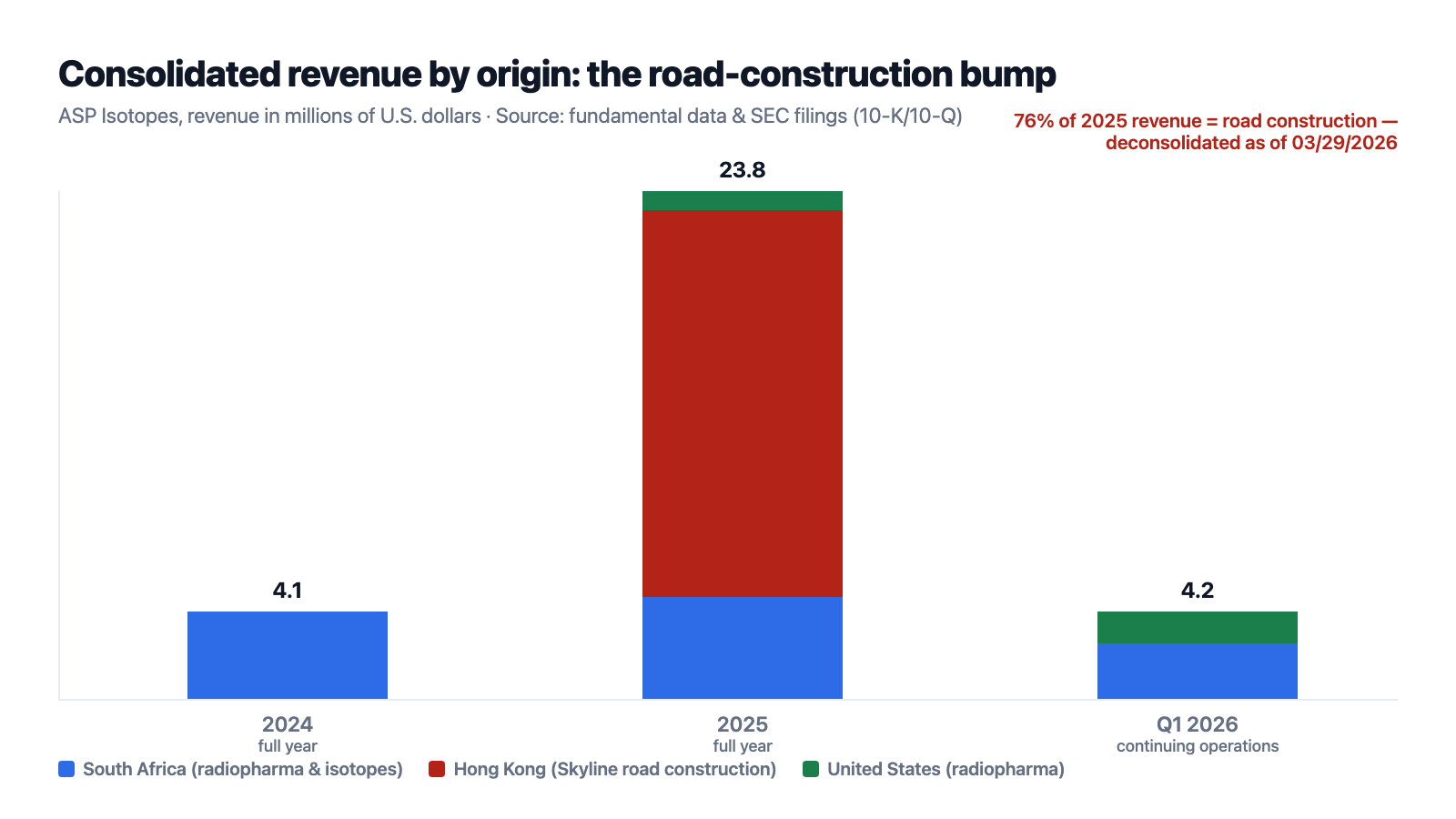
And the bottom line? The company lost $32.4 million in 2024, then $159.8 million in 2025 — on $23.8 million of revenue. Selling, general and administrative expenses alone nearly doubled to $48.2 million, plus $12.4 million of research and development. And even those figures tell only half the story, because the largest loss item was not an operating one at all — more on that in a moment. Remember the rhythm: at ASP Isotopes, three things have grown reliably so far — the cash pile, the cost base and the share count. Which brings us to the uncomfortable truths.
What the filings say — the uncomfortable truths
Uncomfortable truth no. 1: The core business has not earned a dollar yet — three quarters of 2025 revenue was road construction
The most important line of the entire annual report sits inconspicuously in the liquidity discussion — and it clarifies what ASP Isotopes, despite production being under way, is not yet: a seller of isotopes.
"We have not generated any revenue from the sale of our enriched isotopes, and our ability to generate product revenue from the sale of enriched isotopes sufficient to achieve profitability on a consolidated basis will depend on the continued successful development and commercialization of our current or future enriched isotopes."
— ASP Isotopes Inc., SEC annual report 10-K for 2025, Item 7 "Management’s Discussion and Analysis"

So where did the $23.8 million come from? $5.7 million from the product business — essentially nuclear medical doses sold by the radiopharmacy subsidiaries in South Africa and the U.S. And $18.2 million from Hong Kong: in August 2025, nuclear-fuels subsidiary QLE had acquired a 79 percent voting interest in builder Skyline Builders (Nasdaq: SKBL), which performs road and drainage works. The concentrations footnote makes the consequence official: "Revenues from two customers in our construction services segment represent approximately 32.2% ($7.7 million) and 13.7% ($3.3 million), respectively, of our consolidated revenues for the year ended December 31, 2025" (10-K 2025, Note 7). Nearly half the consolidated revenue of a nuclear technology company thus hung on two construction customers in Hong Kong in 2025 — and since March 29, 2026, Skyline has been deconsolidated again (retained stake roughly 8.6 percent, book gain $20.8 million). In fairness: the continuing business is genuinely growing — nearly quadrupled to $4.2 million in the first quarter of 2026 — and the targeted C-14 and Si-28 shipments from mid-2026 could bring the first real isotope revenue. But as of the filings we read, this holds: the five stories in the album have together produced less revenue than a single road site in Hong Kong.
Uncomfortable truth no. 2: A $159.8 million loss — the largest item comes from the company’s own convertible notes
At first glance the 2025 net loss is a shock number: almost five times the prior year, more than six times revenue. The annual report states it plainly:
"For the years ended December 31, 2025 and 2024, we reported a net loss of $159.8 million and $32.4 million, respectively. As of December 31, 2025, we had an accumulated deficit of $231.3 million."
— ASP Isotopes Inc., SEC annual report 10-K for 2025, Item 1A "Risk Factors"

What matters is the anatomy of that loss. The operating loss was $59.9 million — a lot, but not exotic for a company in plant buildout. The largest single item sits below it: a $123.7 million fair-value loss on the company’s own convertible notes ("change in fair value of convertible notes payable"). In an everyday image: subsidiary QLE borrowed money through notes that will later convert into shares — and because the market value of those conversion rights rose along with the hopes priced into the stock, the group has to mark its own debt up and book the difference as a loss. That costs no cash, but it is no accounting blemish either: as of December 31, 2025, these notes stood at $199.3 million on the balance sheet, and they get settled in equity — future shareholders pay that bill in the currency of dilution. Even the company’s own adjusted measure (the "headline loss," a South African reporting tradition) came to a $69.2 million loss for 2025. And the operating cash outflow was real: $37.8 million (2024: $11.4 million; $17.8 million in the first quarter of 2026 alone). Remember the distinction: a loss from fair-value marks spares the cash box — but it is the price tag of growth being paid for with future shares.
Uncomfortable truth no. 3: The share count has more than doubled since the end of 2023
Which brings us to the currency in which ASP Isotopes actually pays for its growth: its own stock. The series from the equity statements reads like a time-lapse:
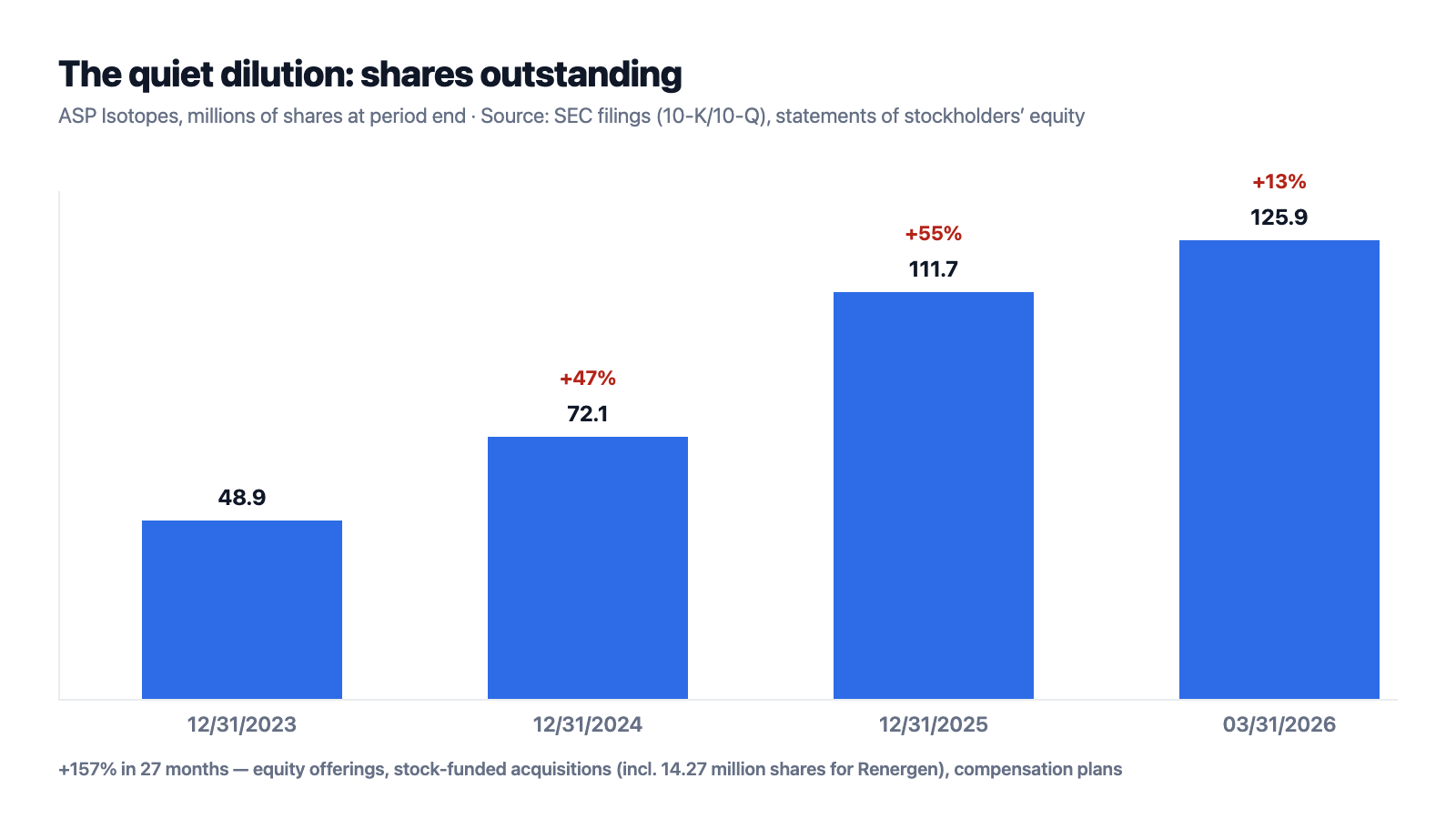
From December 31, 2023 (48.9 million shares) through December 31, 2024 (72.1 million) and December 31, 2025 (111.7 million) to March 31, 2026 (125,903,447 shares), the count has more than doubled — up 157 percent in 27 months. Your slice of the cake shrinks when new slices keep being cut: whoever owned one percent of the company at the end of 2023 owns roughly 0.4 percent today. The loss per share was $2.11 in 2025 (2024: $0.63) — against a share price most recently around $6.40 (data as of July 10, 2026). Fairness requires adding: a pre-revenue company must finance itself with equity, and ASP Isotopes has done so at partly strong terms — the October 2025 offering raised $199.3 million net at $12.25 per share, nearly double the July 2026 price level. From the company’s perspective, that was smart timing. You should simply know which side of that trade you are on as a buyer: growth paid for with fresh shares is never entirely free — here it has lately been paid for on a quarterly rhythm.
Uncomfortable truth no. 4: Star customer TerraPower may cancel at any time, without cause
The strongest card in the album is nuclear fuel: TerraPower — the reactor company co-founded by Bill Gates — has signed two supply agreements with ASP Isotopes for HALEU (higher-enriched uranium, the fuel of the next reactor generation) and in May 2025 committed a loan of up to $22 million toward building a uranium enrichment facility in South Africa (10 percent interest, maturing May 2032; the company plans first drawdowns from the third quarter of 2026). That is a genuine vote of confidence — a customer helping finance its supplier’s factory. But the risk section of the same annual report hangs a price tag on that vote of confidence:
"The HALEU supply agreements with TerraPower are terminable, for convenience, at TerraPower’s sole election; accordingly, QLE may never realize any revenue or profit as a result of these agreements."
— ASP Isotopes Inc., SEC annual report 10-K for 2025, Item 1A "Risk Factors" (Quantum Leap Energy)

Add the location question the report itself raises: the enrichment is to happen in South Africa — producing HALEU there requires licenses, permits and political goodwill on several continents, and TerraPower’s loan disbursements are expressly tied to such conditions. None of this makes the agreements worthless; the take-or-pay clause in the C-14 business and the co-financed factory suggest the partners are serious. But a contract the customer can end at any time without consequences is not a backlog — it is a signed statement of intent. Here the album pastes in a promise, not a result.
Uncomfortable truth no. 5: Late filings, a control weakness and a class action
How reliable are the numbers themselves? The annual report for 2025 arrived only after a deadline extension (NT 10-K) on April 10, 2026 — and had to be amended by a 10-K/A on April 30; the quarterly report as of March 31, 2026, was likewise filed only after an extension (NT 10-Q) on May 20. Management itself attests a material weakness in its own reporting apparatus:
"The material weakness identified relates to the lack of formal control documentation and consistent execution of control procedures, and the lack of a sufficient complement of personnel within the finance and accounting function with an appropriate degree of knowledge, experience and training."
— ASP Isotopes Inc., SEC annual report 10-K for 2025, Item 9A "Controls and Procedures"

Then there is legal history: in November 2024, a short-seller report about the company was published and the stock fell — and on December 4, 2024, a shareholder filed a putative securities class action in the U.S. District Court for the Southern District of New York (Corredor v. ASP Isotopes Inc., Case No. 1:24-cv-09253), alleging materially misleading statements by the company, its CEO and its CFO between October 30 and November 26, 2024; the company disputes the allegations and the outcome is open. And finally the governance detail we expand on in our side-finds: CEO Paul Mann personally invested $2.5 million in August 2025 in the very Hong Kong construction group Skyline that group subsidiary QLE was acquiring in parallel — disclosed and legal, but a double role that fits the picture of unusually high complexity. None of this is a verdict on its own. Taken together, though, it means: the group whose structure rotates fastest is running on a reporting function it has itself certified as weak.
Valuation: $825 million of market value for five options and $290 million of cash
In mid-July 2026, ASP Isotopes weighed in at roughly $825 million of market value (share price around $6.40, data as of July 10, 2026). Classic metrics only help so much here: a P/E ratio does not exist (losses), the price-to-sales ratio — on continuing revenue — sits around 30, price-to-book around 2.7. Let’s count differently: subtract the roughly $290 million of cash and short-term investments (March 31, 2026) and the market is paying a good $535 million for the operating package — that is, for five options: the radiopharmacy business (the only one with running revenue), the first C-14 and Si-28 shipments from mid-2026, the HALEU project with TerraPower including the planned QLE listing, the residual Renergen value after the announced Noble Africa spin-out (ASP Isotopes is to hold 55.5 million Class B units of the new NOBA; in parallel, Noble is raising roughly $50 million from investors at $6.57 per unit), and the 8.6 percent remainder of Skyline. Each of these options may prove valuable; none of them demonstrably is today — analyst coverage of such a young conglomerate is accordingly thin, and estimates broadly assume a multiplication of revenue over the coming twelve months (data as of July 10, 2026). Above it all hangs the dilution mechanism from truth no. 3: the $199.3 million of QLE convertible notes want to be exchanged into equity someday. Whoever buys today buys a well-filled war chest plus a bundle of bets — at about 30 times continuing revenue.
Opportunities and risks at a glance
What speaks for ASP Isotopes:
- A war chest that buys time: $207.3 million in cash plus $83.2 million in short-term investments (March 31, 2026) after $371.6 million of financing inflows in 2025; the company itself expects funding for well over twelve months (10-K 2025).
- Real plants instead of paper plans: both ASP enrichment facilities in Pretoria commenced commercial production in the first half of 2025 per the annual report; first shipments of C-14 (mid-2026) and Si-28 (second quarter of 2026) are scheduled, three Si-28 purchase agreements and a C-14 contract with a take-or-pay clause (~$2.5 million per year) are signed.
- A customer co-financing the factory: TerraPower signed two HALEU supply agreements and a loan of up to $22 million (May 2025) for the planned uranium enrichment facility — plus the option of listing subsidiary Quantum Leap Energy separately.
- The continuing business is growing fast: $4.2 million of revenue in the first quarter of 2026 after $1.1 million in the prior-year quarter — carried by the radiopharmacy network in South Africa and the U.S. plus, for the first time, helium/LNG; the Noble Africa deal could make the Renergen value visible (ASPI receives 55.5 million NOBA Class B units).
- Institutional interest is building: roughly $16 million of net institutional buying (10 buyers, 5 reducers) and strong six-month price momentum (data as of July 10, 2026).
What speaks against it:
- The core business has no revenue yet: not one dollar from enriched isotopes (10-K 2025); 76 percent of 2025 revenue came from the since-deconsolidated Hong Kong construction business, with nearly half of consolidated revenue hanging on two construction customers.
- A loss and dilution machine: a $159.8 million net loss in 2025 (including $123.7 million of fair-value losses on its own convertible notes; "headline loss" $69.2 million; operating cash outflow $37.8 million), share count up from 48.9 million to 125.9 million in 27 months (+157 percent), $199.3 million of convertible notes awaiting conversion.
- The most important contract is one-sidedly terminable: TerraPower may end both HALEU agreements at any time without cause — "QLE may never realize any revenue or profit as a result of these agreements" (10-K 2025).
- Governance baggage: a material weakness in internal controls, late filings (NT 10-K, NT 10-Q, 10-K/A), a securities class action following a short-seller report (S.D.N.Y., since December 2024), the CEO’s $2.5 million private investment in acquisition target Skyline, and 19 insider sales without a single purchase (data as of July 10, 2026).
- Permanent rebuild instead of comparability: Skyline bought (August 2025) and deconsolidated (March 2026), Renergen bought (January 2026) and slated for spin-out (June 2026) — plus location, permitting and currency risks in South Africa; Piotroski F-Score 2 of 9, price-to-sales around 30 (data as of July 10, 2026).
A human conclusion
Back to the sticker-album trap from the beginning. Its trick is not that the pictures are fake — Pretoria is producing, TerraPower has signed, the helium in South Africa is real. Its trick is that abundance itself feels like proof: five stories can’t all fail. They can’t — but they don’t all have to succeed either, and today you are paying for all five. The inventory from the filings is more sober: one business earns money in a small way (radiopharmacy), one was bought and sorted out again within seven months (road construction), one has been bought and is already on its way back out (helium), and the two big ones — Si-28 and HALEU — are approaching their first real test, with scheduled first shipments and a contract partner who may exit at any time. Add a reporting function with a certified weakness and a share count that has more than doubled in a good two years. Our honest translation: this is not an investment album, it is a betting slip with five fields — funded by a war chest that can keep the game going for a long time. If the first C-14 and Si-28 shipments are actually invoiced in mid-2026, the album gets its first redeemed sticker, and this analysis will deserve an update. Until then: check each story one at a time, the way the filings do — not as a bundle, the way the prospectus does. What you make of it is your decision. And that is exactly as it should be.
Sources
All original documents used in this analysis — for your own reading:
- ASP Isotopes Inc. — SEC annual report 10-K for 2025 (filed April 10, 2026, after an NT 10-K extension; amended by the 10-K/A of April 30, 2026)
- ASP Isotopes Inc. — SEC annual report 10-K for 2024 (filed March 31, 2025)
- ASP Isotopes Inc. — SEC quarterly report 10-Q as of 03/31/2026 (filed May 20, 2026, after an NT 10-Q extension)
- ASP Isotopes Inc. — SEC quarterly report 10-Q as of 09/30/2025 (filed November 19, 2025)
- ASP Isotopes Inc. — SEC quarterly report 10-Q as of 06/30/2025 (filed August 14, 2025)
- ASP Isotopes Inc. — 8-K of June 25, 2026: Agreement and Plan of Merger (Noble Africa / ENDRA Life Sciences)
- ASP Isotopes Inc. — Form 425 of July 17, 2026 (investor webinar on the Noble Africa spin-out)
- Complete SEC filing history of ASP Isotopes Inc.: EDGAR overview (sec.gov)
- Fundamental data (metrics, quarterly series, valuation; data as of July 10, 2026), reconciled against the SEC filings.
- Screener and rating data: in-house stock scanner (data as of July 10, 2026); Reddit mentions: ApeWisdom (as of July 17, 2026).
Transparency & disclaimer: This analysis is a journalistic contextualization of publicly available information and is not investment advice, not a financial analysis in the regulatory sense, and not a solicitation to buy or sell securities. Stock investments involve substantial risks up to and including total loss. All information without guarantee; the data cut-off is noted in the text for each figure. The author holds no position in ASP Isotopes shares at the time of publication.
Our Bottom Line at a Glance
- Liquidity & access to capital positive
- $207.3 million in cash plus $83.2 million in short-term investments (March 31, 2026) after $371.6 million of financing inflows in 2025 — including a stock offering that raised $199.3 million net at $12.25 per share (October 2025). Per the 10-K, the war chest funds the buildout for well over twelve months.
- Core business & commercialization neutral
- Both Pretoria plants have been in commercial production since the first half of 2025, and three Si-28 purchase agreements plus a C-14 contract with a take-or-pay clause are signed — but there is no enriched-isotope revenue yet; the scheduled first shipments (C-14 mid-2026, Si-28 Q2 2026) are the real litmus test.
- Revenue quality & group rebuild negative
- 76 percent of 2025 revenue came from Hong Kong construction acquisition Skyline (bought August 2025, deconsolidated March 29, 2026); Renergen was acquired in January 2026 and slated for spin-out as NOBA in June 2026. A group that rotates faster than its filings makes comparability nearly impossible (10-K 2025; 10-Q as of 03/31/2026; 8-K of 06/25/2026).
- Losses & dilution negative
- Net loss of $159.8 million in 2025 (including $123.7 million of fair-value losses on its own convertible notes; operating cash outflow $37.8 million); share count up from 48.9 million to 125.9 million in 27 months (+157 percent), with another $199.3 million of QLE convertible notes awaiting conversion into equity.
- Governance & reporting quality negative
- A material weakness in internal controls (10-K 2025, Item 9A), 10-K and 10-Q filed only after deadline extensions, a securities class action following a short-seller report (S.D.N.Y., since 12/04/2024), the CEO's $2.5 million private investment in acquisition target Skyline, and 19 insider sales without a single purchase (data as of July 10, 2026).
- Valuation & burden of expectations neutral
- Roughly $825 million of market value (data as of July 10, 2026) for a good $535 million of operating package net of cash — at about 30 times continuing revenue. The TerraPower agreements (terminable at any time), the QLE listing and the NOBA spin-out could make value visible; none of it is proven today.
ASP Isotopes is a betting slip with five fields and a genuine war chest: roughly $290 million of liquidity, producing plants in Pretoria and TerraPower as a well-funded contract partner stand against zero revenue from the core business, 76 percent of 2025 revenue from an already-divested road builder, a $159.8 million loss, a share count that has more than doubled since the end of 2023, a certified control weakness and a pending class action. The scheduled first shipments of C-14 and Si-28 from mid-2026 are the first real day of proof. Not investment advice.
What Our Rating Means
- If you don't own the stock
- In our view, the documented risks clearly outweigh — we see no basis for an entry.
- If you hold it in your portfolio
- In our view, the findings carry enough weight to warrant a critical look at your own position.
A journalistic assessment by our editorial team at the time of the deep dive, based on public sources — not investment advice and not a solicitation to buy or sell. Your personal circumstances (investment goals, risk capacity, taxes) cannot be taken into account. What our categories mean, how verdicts are formed, and what conflicts of interest exist →
Worth Noting
- ASPI reached the research list via the Reddit hype scanner: just 2 mentions in 24 hours, but a jump from rank 785 to rank 233 of the most-discussed stocks (ApeWisdom, as of July 17, 2026) — attention building, no noise yet. In our in-house stock scanner, the stock appears in no ranking filter (data as of July 10, 2026).
- Scanner metrics (P/S, Piotroski, Altman Z, fundamental grade) are computed on trailing twelve-month figures; the Skyline revenue (consolidated August 2025 through March 2026) is partly baked in, while the announced first shipments and the NOBA spin-out naturally are not.
- Price and valuation figures are dated July 10, 2026 (around $6.40 per share, roughly $825 million market value); analyses are evergreen, daily prices are not a buy argument. The Noble Africa/ENDRA merger (agreement of June 25, 2026) was still subject to approvals and closing conditions as of this writing.
Frequently Asked Questions
ASP Isotopes Inc. (Nasdaq: ASPI, headquartered in Dallas) is building a platform for enriching rare isotopes, with plants in Pretoria, South Africa (ASP and QE technology). Target markets are nuclear medicine (C-14, Yb-176), semiconductors and quantum computing (Si-28), and nuclear fuels (HALEU, Li-6) via its subsidiary Quantum Leap Energy. Running revenue so far comes mainly from the radiopharmacy business in South Africa and the U.S.; consolidated 2025 revenue was $23.8 million.
The two enrichment plants in Pretoria only commenced commercial production in the first half of 2025, per the annual report (10-K) for 2025; first commercial shipments of C-14 are targeted for mid-2026 and of Si-28 for the second quarter of 2026. As of the report date, the filing states verbatim: "We have not generated any revenue from the sale of our enriched isotopes" — the core of the investment story has produced no revenue yet.
Consolidated revenue rose from $4.1 million to $23.8 million in 2025 — of which $18.2 million (76 percent) came from the road and drainage construction business of Skyline Builders (Nasdaq: SKBL), a Hong Kong builder acquired in August 2025 and deconsolidated again effective March 29, 2026. Continuing operations (radiopharmacy, plus helium/LNG from January 2026) generated $4.2 million in the first quarter of 2026 after $1.1 million in the prior-year quarter.
TerraPower — the reactor company co-founded by Bill Gates — has signed two supply agreements for HALEU (higher-enriched uranium) with ASP Isotopes and in May 2025 committed a loan of up to $22 million toward a uranium enrichment facility in South Africa (10 percent interest, maturing 2032). Important per the 10-K 2025: both supply agreements are terminable by TerraPower at any time, for convenience — so they do not constitute a guaranteed backlog.
ASP Isotopes acquired South African helium and LNG producer Renergen (Virginia Gas Project) on January 6, 2026, for 14.27 million of its own shares worth roughly $92.9 million. On June 25, 2026, it signed a merger agreement under which Renergen, via the holding company "Noble Africa," merges with ENDRA Life Sciences and is expected to trade on Nasdaq as a standalone helium company under the ticker NOBA; ASP Isotopes is to receive 55.5 million Class B units, while Noble raises roughly $50 million at $6.57 per unit (as of July 17, 2026).
Liquid, at least: $207.3 million in cash plus $83.2 million in short-term investments (March 31, 2026), after $371.6 million of financing inflows in 2025. Against that stand $199.3 million of convertible notes at subsidiary QLE (fair value, December 31, 2025), a $159.8 million net loss for 2025 and a $37.8 million operating cash outflow. The share count grew from 48.9 million (end of 2023) to 125.9 million (March 31, 2026).
After a short-seller report in November 2024, a shareholder filed a putative securities class action in the U.S. District Court for the Southern District of New York on December 4, 2024 (Corredor v. ASP Isotopes Inc., Case No. 1:24-cv-09253), alleging misleading statements by the company, its CEO and CFO between October 30 and November 26, 2024; the company disputes this. In addition, the 10-K 2025 attests a material weakness in internal controls, and both the 10-K 2025 and the 10-Q as of March 31, 2026, were filed only after deadline extensions.
Not by classic yardsticks: roughly $825 million of market value (data as of July 10, 2026) stands against about $4.2 million of continuing quarterly revenue and ongoing losses — price-to-sales is around 30 and a P/E ratio does not exist. Net of the roughly $290 million in cash and investments, the market pays a good $535 million for a bundle of still-unproven options (Si-28, HALEU, the QLE listing, NOBA units). The valuation is a bet on the first shipments from mid-2026, not on today's numbers.
Found an error?
Did you spot a factual error, an outdated number, or a typo in this deep dive? Let us know briefly — your report goes straight to the editorial team.