Jabil Stock: Selling Shovels in the AI Gold Rush — at a Nine Percent Margin and 45 Times Earnings
Jabil builds the servers, racks and cooling gear of the AI boom on behalf of others — and shows up in our in-house "Joshua" growth scanner (data as of July 17, 2026). We read the annual reports (10-K) for fiscal years 2024 and 2025 and the quarterly reports (10-Q) through May 31, 2026: an AI segment whose share of revenue climbed from 32 to 47 percent, a gross margin around 9 percent, a single customer at 16 percent of revenue inside that very AI segment, an equity base of just $1.3 billion against $23.8 billion in total assets — and a stock that has roughly tripled since early 2025. Not investment advice — just the question of whether the shovel is worth the price of the gold vein.
 Thomas Mücke
Founder & Publisher
Thomas Mücke
Founder & Publisher
Chart
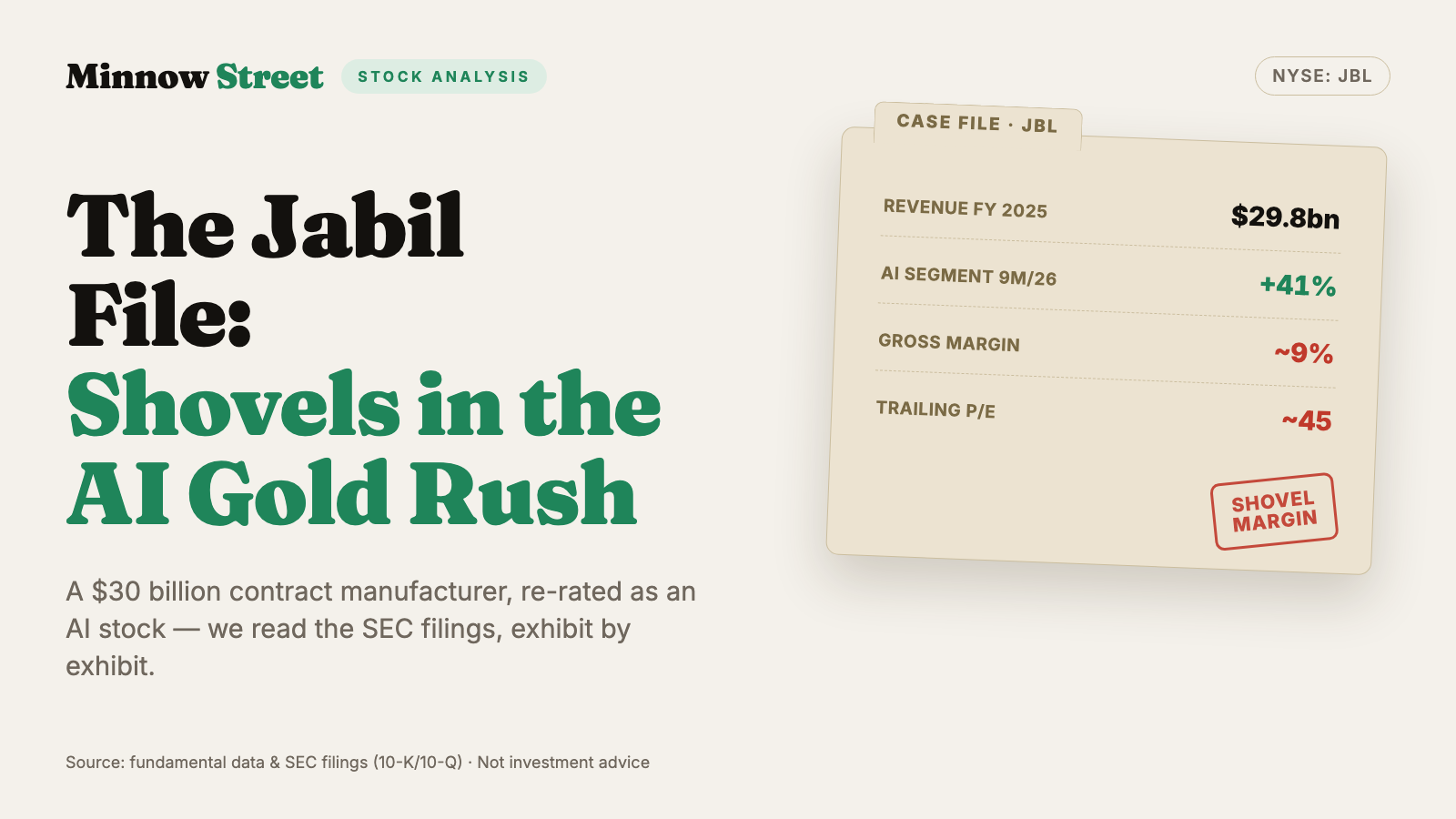
Interactive price chart (TradingView).
Note: pure fact-based analysis, not investment advice and not a solicitation to buy or sell. All figures without guarantee.
There is a piece of investor wisdom that keeps circulating in every gold rush: "Don't sell the gold — sell the shovels." Whoever supplies the tools earns reliably, whether the individual prospector strikes it rich or goes bust. Sounds smart. Except the wisdom has a flip side that gets told less often — call it the shovel trap: when a toolmaker suddenly becomes the symbol of the gold rush, the market starts valuing it like a gold vein. That is exactly what is happening in the summer of 2026 to Jabil Inc. (NYSE: JBL), one of the world's largest contract manufacturers. Jabil digs not a single gram of AI itself — the company builds, on behalf of others, the servers, racks and cooling gear that fill the data centers of Nvidia, hyperscalers and cloud providers. A rock-solid shovel business. And yet the stock has roughly tripled since early 2025. It reached our research list through the growth scanner "Joshua" (data as of July 17, 2026). So let's make a deal: before you follow the AI label, we read together what Jabil itself reported, under penalty of law, to the U.S. securities regulator, the SEC — the annual reports (10-K) for fiscal years 2024 and 2025 and the quarterly reports (10-Q) through May 31, 2026. And these filings tell the story of a real AI boom — and a margin that stays, all the same, that of a shovel seller. In the end, you decide for yourself.
What Jabil actually does — and for whom
Jabil is a contract manufacturer, in industry jargon an "electronics manufacturing services" (EMS) provider. Translated: other firms design a product and print their name on it — Jabil builds it. Roughly 135,000 employees across about 100 locations in 30 countries (Asia 71,000, the Americas 49,000, Europe 15,000) assemble, solder, mold and test for customers in the automotive, medical, industrial and data-center sectors. It is a business of big numbers and small percentages: lots of revenue, little margin. As of September 2024, Jabil reorganized into three segments, as the annual report puts it, "to focus on speed, precision, and solutions": Regulated Industries (automotive, healthcare/packaging, renewables — about 40 percent of revenue), Connected Living and Digital Commerce (digitalization, warehouse automation, robotics — about 19 percent) and, the star of the story, Intelligent Infrastructure. That segment, per the report, covers the "modern digital ecosystem including artificial intelligence infrastructure": customers in capital equipment, cloud and data-center infrastructure, and networking. One quirk belongs right at the start because it trips up every casual reader of the numbers: Jabil's fiscal year ends on August 31. So "fiscal year 2025" means September 2024 through August 2025, and the "third quarter of fiscal year 2026" covers March through May 2026. And one more footnote on identity: the company's official name at the SEC has been simply "Jabil Inc." since June 5, 2017 — the "Circuit" from the old name "Jabil Circuit" was dropped as the circuit-board assembler grew into a broad solutions provider. Which brings us to the central tension of this analysis, and it runs through every chapter: AI demand is real and accelerating — but Jabil earns from it at a contract manufacturer's margin, while the stock carries the price of an AI winner. How quickly "revenue" does not automatically become "value" is something we dissected at the materials group Materion — and why an EMS peer stays chained to its margin despite full order books, at electronics services provider Plexus.
Where the stock shows up in our scanner
Every day we run about 3,500 stocks through our scanners. Jabil reached the list through the growth scanner "Joshua" (data as of July 17, 2026) — and it is not there alone: the stock sits in a total of 13 trend and quality filters at once. It is in a Stan Weinstein stage-2 uptrend, trades above the 50- and 200-day averages, meets Mark Minervini's trend criteria, shows up in Gary Antonacci's dual momentum, in Ted Zhang's super-stock universe and in Richard Moglen's top performers. Behind that stand plus 43 percent in three months, plus 59 percent in six and roughly plus 79 percent over twelve (fundamental data, data as of July 17, 2026). So much for the trend lens — it tells of a stock in peak form. The fundamental lens of the same scanner translates the identical company into sober metrics: a trailing price-to-earnings ratio around 45, a price-to-book ratio around 29 (more on that shortly — the number is a fingerprint of the business model), and an operating (EBIT) margin around 5 percent. Remember this contrast, it is the connecting thread: the trend celebrates the AI growth; the margin reminds you that a contract manufacturer is at work here. And because the Joshua scanner is a growth filter, the hit says one thing above all: the market has classified Jabil as a growth stock. Whether it is paying the right price for it is another question — one the numbers answer.
The numbers over the years — honestly appraised
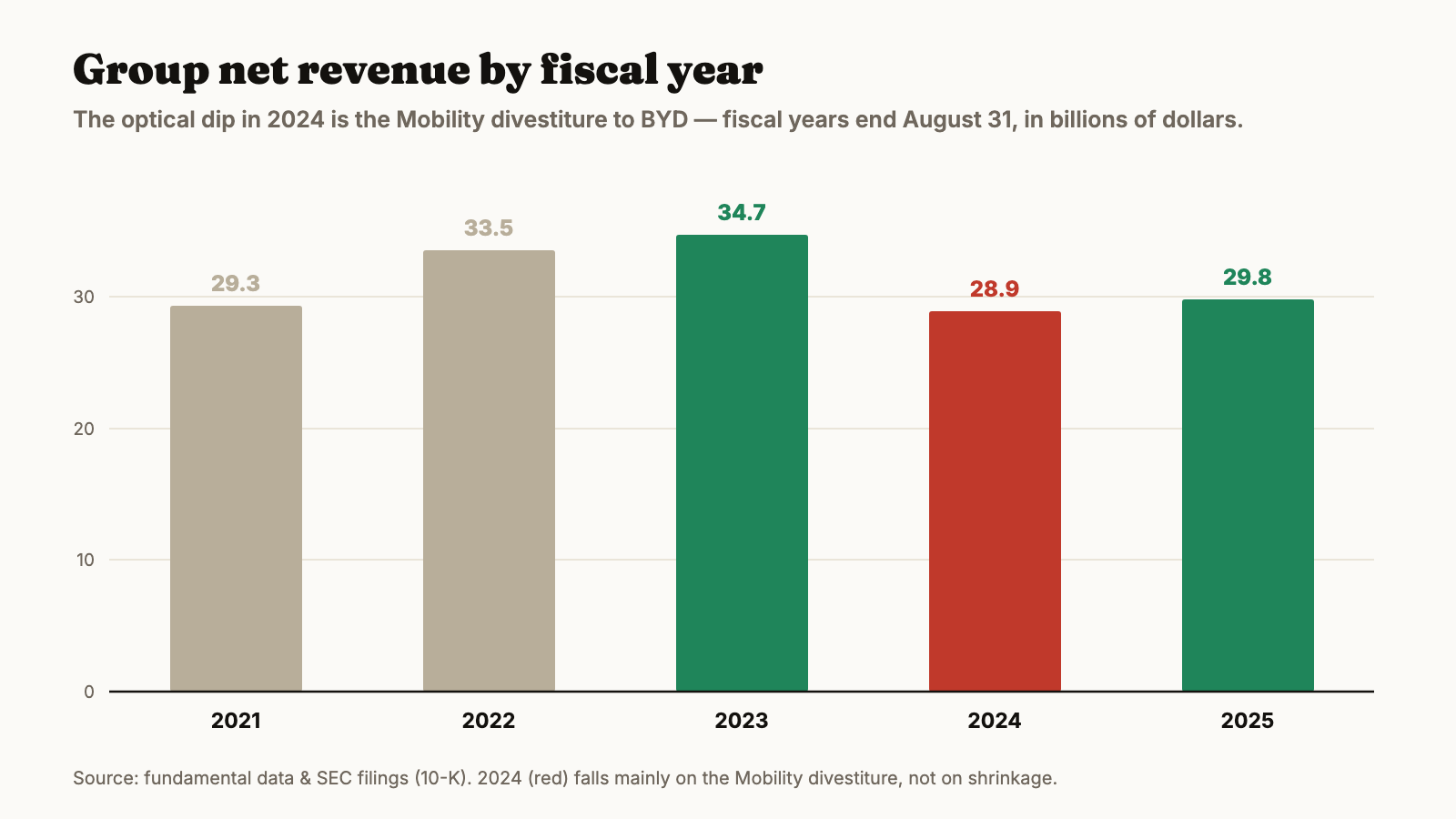
First, what genuinely impresses. At the group level, Jabil looks like a quiet giant: net revenue has hovered around $30 billion for years — $33.5 billion in fiscal year 2022, $34.7 billion in 2023, then $28.9 billion in 2024 and $29.8 billion in 2025 (plus 3 percent). The optical decline in 2024 is deceptive: it came not from shrinkage but from the sale of the low-margin Mobility business (more on that below).
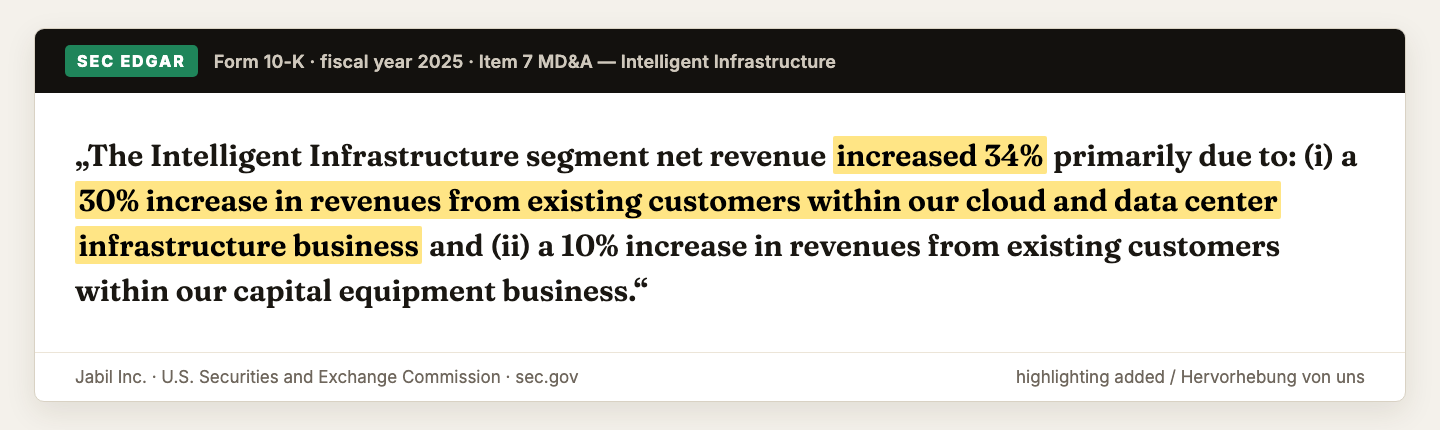
The genuinely impressive part hides beneath that quiet surface. Because while two of the three segments stagnate or shrink, the third ignites: the AI segment Intelligent Infrastructure grew 34 percent in fiscal year 2025 — driven, in the report's own words, by a "30% increase in revenues from existing customers within our cloud and data center infrastructure business." In the first nine months of fiscal year 2026 it added another 41 percent (cloud/data center: +31 percent). The result: the AI segment has overtaken the others.
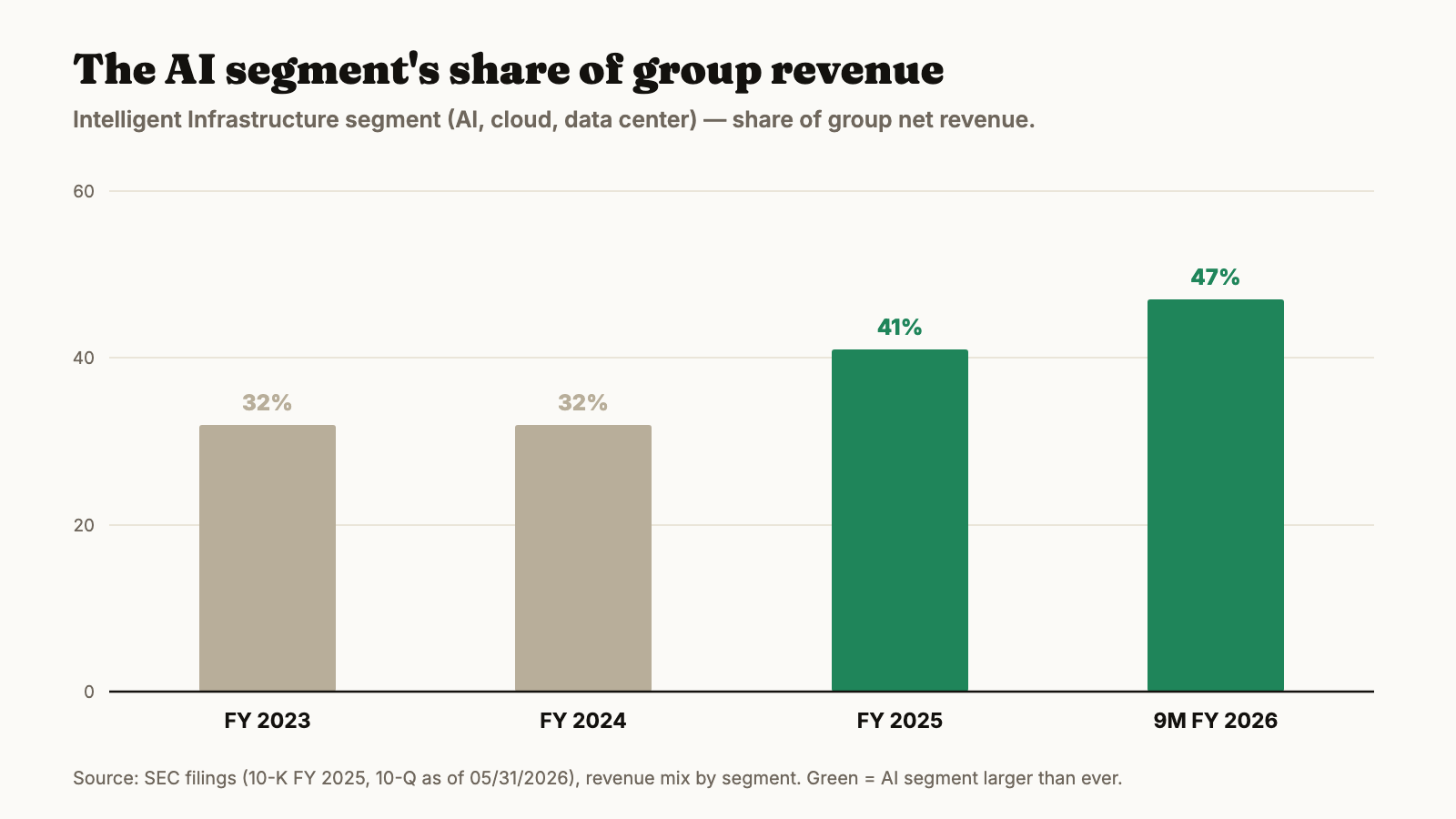
How sharply the weight has shifted shows in the revenue mix: the AI segment's share of group revenue climbed from 32 percent (fiscal year 2024) through 41 percent (2025) to 47 percent in the first nine months of fiscal year 2026. A supporting act has become the lead — almost every second revenue dollar now hangs on AI, cloud and data-center customers.
This is an honest growth story, not marketing haze: real demand, real orders, growing substance (the assets tied up in the AI segment jumped from $3.7 to $8.8 billion within nine months). If you read only this chapter, you understand why the stock is running. But now come the paragraphs the report adds right after — the ones the trend lens misses.
What the filings say — the uncomfortable truths
Uncomfortable truth no. 1: The AI growth comes at a shovel margin — and even depresses it
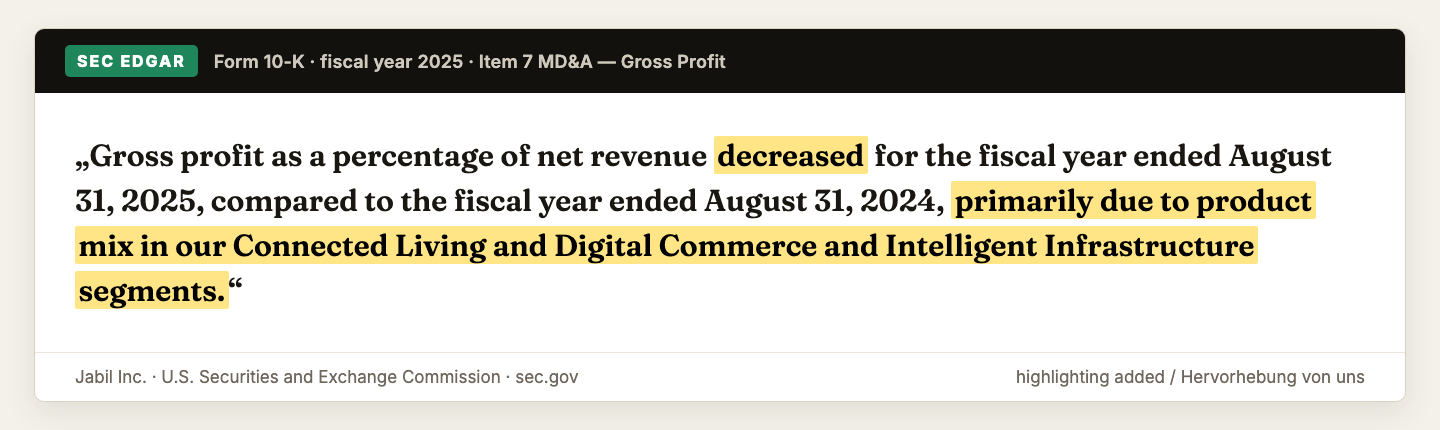
Here is the number that puts all the euphoria in perspective: of every $100 of revenue, Jabil keeps only about $8.90 of gross profit in fiscal year 2025 (gross margin 8.9 percent); after operating costs it is roughly $5 operating, and a little over $2 net at the bottom. This is not an anomaly but the essence of contract manufacturing: the manufacturer carries the materials, the factory and the people — the brand and the margin stay with the customer. Picture Jabil as a giant workbench: enormously busy, but every motion is thinly paid. The surprising — and, for the AI story, uncomfortable — part is in the annual report: of all things, the booming AI segment lowers the group gross margin rather than lifting it:
"Gross profit as a percentage of net revenue decreased for the fiscal year ended August 31, 2025, compared to the fiscal year ended August 31, 2024, primarily due to product mix in our Connected Living and Digital Commerce and Intelligent Infrastructure segments."
— Jabil Inc., SEC annual report 10-K for fiscal year 2025, Item 7 "Management's Discussion and Analysis"
Remember this mechanism, because it is the heart of the shovel trap: not all growth is worth the same. When a contract manufacturer assembles large AI racks, the volume is gigantic — but the value-add Jabil contributes to such "system integration" jobs is often lower than on a fiddly medical device. Revenue grows faster than profit. Analyst estimates confirm it indirectly: they see revenue rising about 21 percent in the coming year (fundamental data, data as of July 17, 2026) — a strong figure, but volume growth at thin percentages. In fairness: Jabil is visibly investing in higher-value AI manufacturing (liquid cooling, silicon photonics, proprietary test processes), and over time the mix can improve. But whoever buys the stock today buys the shovel margin first — not the margin of a chip designer.
Uncomfortable truth no. 2: A single customer accounts for 16 percent of revenue — inside the AI segment, of all places
Concentration is routine at contract manufacturers, but the concrete numbers in the annual report deserve a second read:
"In fiscal year 2025, our five largest customers accounted for approximately 36% of our net revenue and 87 customers accounted for approximately 90% of our net revenue."
— Jabil Inc., SEC annual report 10-K for fiscal year 2025, Item 1A "Risk Factors" and Note 14 "Concentration of Risk and Segment Data"
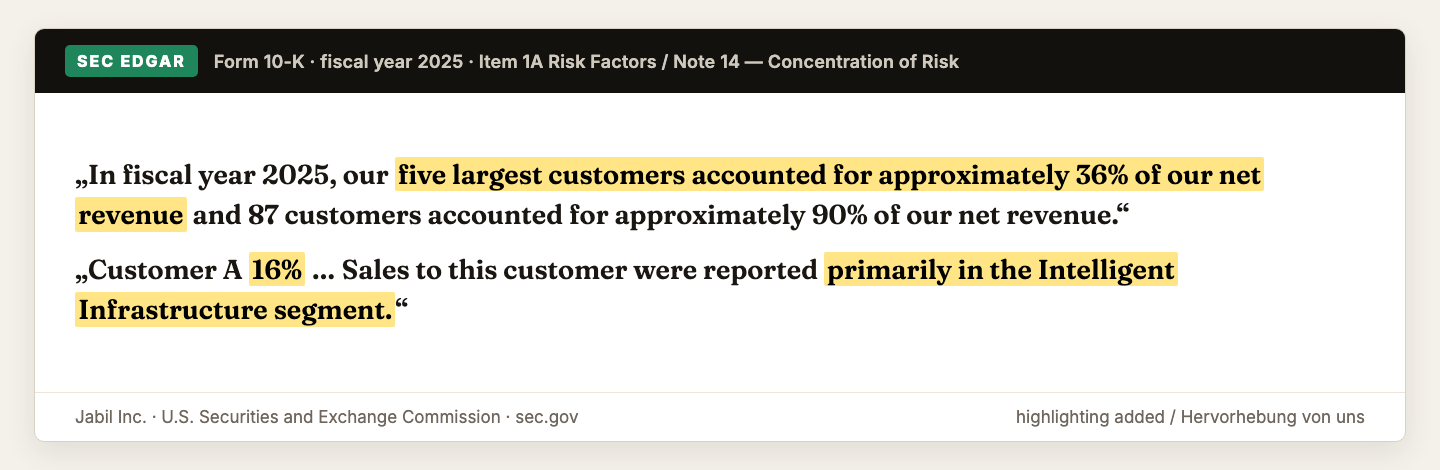
The real punch line is in the concentration table: an anonymized major customer ("Customer A") alone accounted for 16 percent of total group revenue in fiscal year 2025 — and that revenue, per the report, was reported "primarily in the Intelligent Infrastructure segment." In plain terms: the AI growth engine carrying the stock hangs, to a substantial degree, on one customer relationship. Picture a toolmaker whose shiny new business depends almost entirely on a single prospector — as long as he keeps ordering, all is well; if he changes his plans, it is not one supply line that wobbles but the whole story. The annual report says it itself in dry words: "a reduction in business from one or more of our largest customers could have a material adverse effect on our results of operations." In fairness: Jabil stresses that it is broadening its customer base "across industries and geographies," and 87 customers for 90 percent of revenue is not extreme concentration for an EMS giant. But the 16 percent figure in the hottest segment is the price of an AI business that, in its early phase, lives on a few big deals.
Uncomfortable truth no. 3: The dazzling return on equity is an optical illusion — the equity cushion is wafer-thin
Jabil reports a return on equity (ROE) around 66 percent (fundamental data, data as of July 17, 2026) — a number that normally makes quality hunters' hearts sing. Except here it does not come from outstanding profitability but from the denominator: as of May 31, 2026, total assets of $23.8 billion sat against equity of just $1.3 billion. Divide a normal profit by a tiny equity base and you get a spectacular return — and a price-to-book ratio around 29 that looks absurd for a manufacturer. Why is the cushion so thin? Because for years Jabil has returned more capital to shareholders than it earns and retains: through share buyback programs (2025: $1.0 billion authorized; July 2025 a new one for another $1.0 billion), the share count fell from 113.7 million (August 2024) to 104.8 million (May 2026). That is shareholder-friendly and lifts earnings per share — but it eats into equity and works with leverage: net debt sits at roughly three times equity. Remember the rule: a very high return on equity on a very low equity base measures not the strength of the business but the thinness of the cushion. As long as the plants are busy and the interest is bearable, the model runs smoothly. In a downturn, though, a thin cushion carries less far — and the number that looks like quality in the boom then looks like risk.
Uncomfortable truth no. 4: The record 2024 profit was half a one-time effect
A casual glance at the profit series invites a fallacy. Net income jumped to $1.39 billion in fiscal year 2024 (earnings per share $11.17) — after $818 million the year before — and fell back to $657 million ($5.92 per share) in fiscal year 2025. Whoever sees only the peak takes 2025 for a crash. In fact, 2024 was the exception: that year Jabil sold its low-margin Mobility business (the manufacture of consumer electronics in Chengdu and Wuxi) to BYD Electronic for roughly $2.2 billion — and booked a pre-tax gain of $942 million (plus a $54 million top-up in fiscal year 2025). Strip out that one-time effect and the 2024 operating result was far lower — and 2025 was no slump at all but rather normality. The same sale explains the optical revenue decline from $34.7 to $28.9 billion: Jabil did not shrink, it handed over an entire line of business. That is commercially clean — low-margin volume out, focus on higher-value segments. But it is a caution for reading the numbers: a record profit that comes from a sale is no proof of the earnings power of the ongoing business. And that ongoing earnings power is exactly the shovel margin from truth no. 1.
Valuation: a manufacturer's margin, a growth star's price
Put the pieces together and the valuation question turns concrete. The trailing price-to-earnings ratio sits around 45, price-to-book around 29 (fundamental data, data as of July 17, 2026) — for a contract manufacturer with a roughly 5 percent operating margin, these are historically very high multiples. Market value is on the order of $38 billion. How much the valuation has inflated only recently shows in a gratifyingly sober figure from the annual report's cover: as of February 28, 2025, Jabil put the market value of shares held by non-affiliates at roughly $14.4 billion — a good year later the company stands at roughly two-and-a-half to three times that. The stock has roughly tripled since early 2025 and risen more than 550 percent over the past five years (fundamental data, data as of July 17, 2026). What justifies it? The bet is: the AI segment keeps growing at 30 to 40 percent, the product mix improves, and over the years the volume turns into real margin. Analysts back the hope — they see earnings per share rising about 31 percent in the coming year (fundamental data, data as of July 17, 2026). The counterargument: even if that succeeds, Jabil remains a manufacturer with a single-digit margin; a price-to-earnings ratio around 45 assumes the AI boom runs long and unbroken and that Jabil earns more from it than before. The capital return cushions this a little: alongside the buybacks, Jabil pays a — admittedly symbolic — quarterly dividend of $0.08 per share (yield around 0.1 percent); the music plays in the buybacks, not the dividend.
Opportunities and risks at a glance
What speaks for Jabil:
- A real AI growth engine: the Intelligent Infrastructure segment grew 34 percent in fiscal year 2025 and 41 percent in the first nine months of fiscal year 2026 (cloud/data center: +31 percent); its revenue share rose from 32 to 47 percent, the tied-up assets from $3.7 to $8.8 billion (10-K FY 2025, 10-Q as of 05/31/2026).
- Breadth and scale: roughly 135,000 employees, about 100 locations in 30 countries, three segments from automotive to medical to data center — Jabil is a diversified "picks-and-shovels" supplier of the AI build-out with real, growing orders.
- Shareholder-friendly capital policy: share count cut from 113.7 to 104.8 million (August 2024 to May 2026), two buyback programs of $1.0 billion each (2025 and 2026), plus a small dividend.
- Focus after the Mobility sale: the low-margin consumer business was handed to BYD in 2024 for roughly $2.2 billion; acquisitions strengthen higher-value areas (liquid cooling for the AI segment, drug delivery in Regulated Industries).
- Strong technicals: a hit in the "Joshua" growth scanner and twelve further filters, a stage-2 uptrend, plus 43 percent in three months (fundamental data, data as of July 17, 2026).
What speaks against it:
- Shovel margin meets growth-star price: gross margin around 9 percent, operating margin around 5 percent, net margin around 2 percent — against a trailing price-to-earnings ratio around 45 and a price-to-book around 29 (fundamental data, data as of July 17, 2026).
- The AI growth dilutes the margin: per the annual report, gross margin fell in 2025 "primarily due to product mix," including in the Intelligent Infrastructure segment — more revenue, but less profit per dollar.
- Concentration in the hottest segment: a single customer accounted for 16 percent of group revenue, reported primarily in the AI segment; the five largest for 36 percent (10-K FY 2025, Note 14).
- A wafer-thin equity cushion and leverage: $1.3 billion of equity against $23.8 billion in total assets, net debt roughly three times equity; the 66 percent return on equity is mostly a denominator effect.
- Cyclicality and one-time effects: the record 2024 profit ($1.39 billion) contained a $942 million one-time gain from the Mobility sale; the operating business is cyclical and hinges on plant utilization.
A human conclusion
Back to the shovel trap from the opening. Its core is not that the shovel seller is a bad business — on the contrary, Jabil earns real money and grows where the music plays. Its core is that, in the euphoria, the market forgets the difference between the shovel and the gold vein and demands the same price for both. Jabil is an excellently run contract manufacturer that has cleverly positioned itself at the front of the AI build-out. But it remains a manufacturer: of every AI rack that passes through its halls, a single-digit margin is left, and a good part of the hot growth hangs on a single customer and on a balance sheet whose equity cushion you have to hunt for with a magnifying glass. So the honest question for you is not "Is the AI build-out coming?" (it is, and Jabil is building it), but: are you paying for the shovel at the price of the gold vein? At 45 times earnings and 29 times book, you are paying for a lot of future in advance — a future that can come but need not, and that even in the best case is earned at single-digit percentages. If the AI segment holds its pace and the mix moves upmarket, the shovel seller can turn into a very profitable supplier. Until then: the trend is a friend, but the margin is the truth. What you make of it is your decision. And that is exactly as it should be.
Sources
All original documents used in this analysis — to read for yourself:
- Jabil Inc. — SEC annual report 10-K for fiscal year 2025 (ended August 31, 2025; filed October 17, 2025)
- Jabil Inc. — SEC annual report 10-K for fiscal year 2024 (ended August 31, 2024; filed October 28, 2024)
- Jabil Inc. — SEC quarterly report 10-Q as of May 31, 2026 (third quarter of fiscal year 2026; filed June 30, 2026)
- Jabil Inc. — SEC quarterly report 10-Q as of February 28, 2026 (second quarter of fiscal year 2026)
- Jabil Inc. — SEC quarterly report 10-Q as of November 30, 2025 (first quarter of fiscal year 2026)
- Jabil Inc.'s complete SEC filing history: EDGAR overview (sec.gov)
- Fundamental data (metrics, quarterly series, valuation; data as of July 17, 2026), reconciled with the SEC filings.
- Screener and rating data: in-house stock scanner "Joshua" and twelve further filters (data as of July 17, 2026).
Transparency & disclaimer: This analysis is a journalistic contextualization of publicly available information and is not investment advice, not a financial analysis in the regulatory sense, and not a solicitation to buy or sell securities. Stock investments carry substantial risks up to total loss. All information without guarantee; the data cut-off is noted in the text in each case. The author holds no position in Jabil stock at the time of publication.
Our Bottom Line at a Glance
- AI growth & demand positive
- The Intelligent Infrastructure segment grew 34 percent in fiscal year 2025 and 41 percent in the first nine months of fiscal year 2026 (cloud/data center: +31 percent); its revenue share rose from 32 to 47 percent, the tied-up assets from $3.7 to $8.8 billion — a real, documented AI boom (10-K FY 2025, 10-Q as of 05/31/2026).
- Margin & value-add negative
- Gross margin around 8.9 percent, operating margin around 5 percent, net margin around 2 percent — and per the annual report it was precisely the product mix in the AI segment that lowered the 2025 gross margin. The growth is high-volume but thin-margin: Jabil carries the materials, the factory and the people, the margin stays with the customer.
- Customer concentration negative
- A single customer ("Customer A") accounted for 16 percent of group revenue in fiscal year 2025 — reported primarily in the AI segment; the five largest for 36 percent (10-K FY 2025, Note 14). The hottest part of the growth hangs on a few big deals.
- Balance sheet & capital policy neutral
- Only $1.3 billion of equity against $23.8 billion in total assets (05/31/2026); the 66 percent return on equity is mostly a denominator effect of the thin cushion. Buybacks (113.7 → 104.8 million shares) are shareholder-friendly but work with leverage (net debt roughly 3x equity).
- Valuation negative
- A trailing price-to-earnings ratio around 45, price-to-book around 29 (fundamental data, data as of July 17, 2026), market value roughly $38 billion after a rough tripling since early 2025 — for a manufacturer with a single-digit margin, a growth-star price that takes a lot of future in advance.
Jabil is an excellently run contract manufacturer that has cleverly positioned itself at the front of the AI build-out: the AI segment grows at 30 to 40 percent and now makes up nearly half of revenue. But Jabil remains a manufacturer — of every AI rack a single-digit margin is left, the hot growth even dilutes the gross margin, a single customer accounts for 16 percent of revenue, and the equity cushion is wafer-thin. At 45 times earnings the market is paying, for the shovel, the price of the gold vein. Not investment advice.
What Our Rating Means
- If you don't own the stock
- In our view, the documented risks clearly outweigh — we see no basis for an entry.
- If you hold it in your portfolio
- In our view, the findings carry enough weight to warrant a critical look at your own position.
A journalistic assessment by our editorial team at the time of the deep dive, based on public sources — not investment advice and not a solicitation to buy or sell. Your personal circumstances (investment goals, risk capacity, taxes) cannot be taken into account. What our categories mean, how verdicts are formed, and what conflicts of interest exist →
Worth Noting
- JBL reached our research list via the "Joshua" growth scanner and twelve further trend/quality filters in our in-house stock scanner (data as of July 17, 2026); the Joshua filter classifies the stock as a growth name — what the market currently pays, not what the business earns.
- Scanner metrics (P/E, P/B, ROE, EBIT margin) are computed from trailing twelve-month figures; the Mobility one-time gain (FY 2024) has by now rolled out of the trailing numbers, while the thin equity base and the single-digit margins are baked in.
- Valuation figures are dated to July 17, 2026 (market value on the order of $38 billion); analyses are evergreen, daily prices are not a buy argument. Jabil's fiscal year ends August 31 — all quarterly references carry that fiscal-year offset.
Frequently Asked Questions
Jabil Inc. (NYSE: JBL) of St. Petersburg, Florida, is one of the world's largest contract manufacturers (electronics manufacturing services). It builds electronics and finished products on behalf of its customers — from automotive control units to medical devices to AI server racks. Since September 2024 Jabil reports in three segments: Regulated Industries, Intelligent Infrastructure (AI/cloud/data center) and Connected Living and Digital Commerce. Revenue in fiscal year 2025 (ended August 31, 2025): $29.8 billion.
The official name at the U.S. securities regulator, the SEC, has been "Jabil Inc." since June 5, 2017. Before that the company was "Jabil Circuit Inc."; the "Circuit" was dropped as the circuit-board assembler grew into a broad manufacturing and solutions provider. Some databases still carry the old name — the correct name today is "Jabil Inc."
Jabil's fiscal year ends August 31. "Fiscal year 2025" therefore covers September 2024 through August 2025, and the "third quarter of fiscal year 2026" means March through May 2026. Anyone comparing Jabil figures with calendar-year numbers of other companies should keep that offset in mind.
Considerably, but thin-margin. The AI segment Intelligent Infrastructure grew 34 percent in fiscal year 2025 and 41 percent in the first nine months of fiscal year 2026 (cloud/data center: +31 percent); its revenue share rose from 32 to 47 percent. However, per the annual report, it was precisely the product mix in the AI segment that lowered the gross margin — Jabil builds the AI hardware on behalf of others and earns a contract-manufacturer margin around 9 percent gross.
Because 2024 contained a one-time effect: Jabil sold its Mobility business (consumer-electronics manufacturing in China) to BYD Electronic for roughly $2.2 billion and booked a pre-tax gain of $942 million. That is why net income jumped to $1.39 billion in 2024 ($11.17 per share) and normalized to $657 million in 2025 ($5.92 per share). The record was not the ongoing earnings power.
By classic yardsticks, no: the trailing price-to-earnings ratio sits around 45 and price-to-book around 29 (fundamental data, data as of July 17, 2026) — very high for a contract manufacturer with a single-digit margin. Market value is on the order of $38 billion; as of February 28, 2025, Jabil put the non-affiliate market value at roughly $14.4 billion. The valuation assumes the AI growth lasts a long time and that Jabil earns more from it in future.
Found an error?
Did you spot a factual error, an outdated number, or a typo in this deep dive? Let us know briefly — your report goes straight to the editorial team.