IRSA: A Revaluation of 489 Billion Pesos Turned a Good Year Into a Loss — and Not One Peso Moved
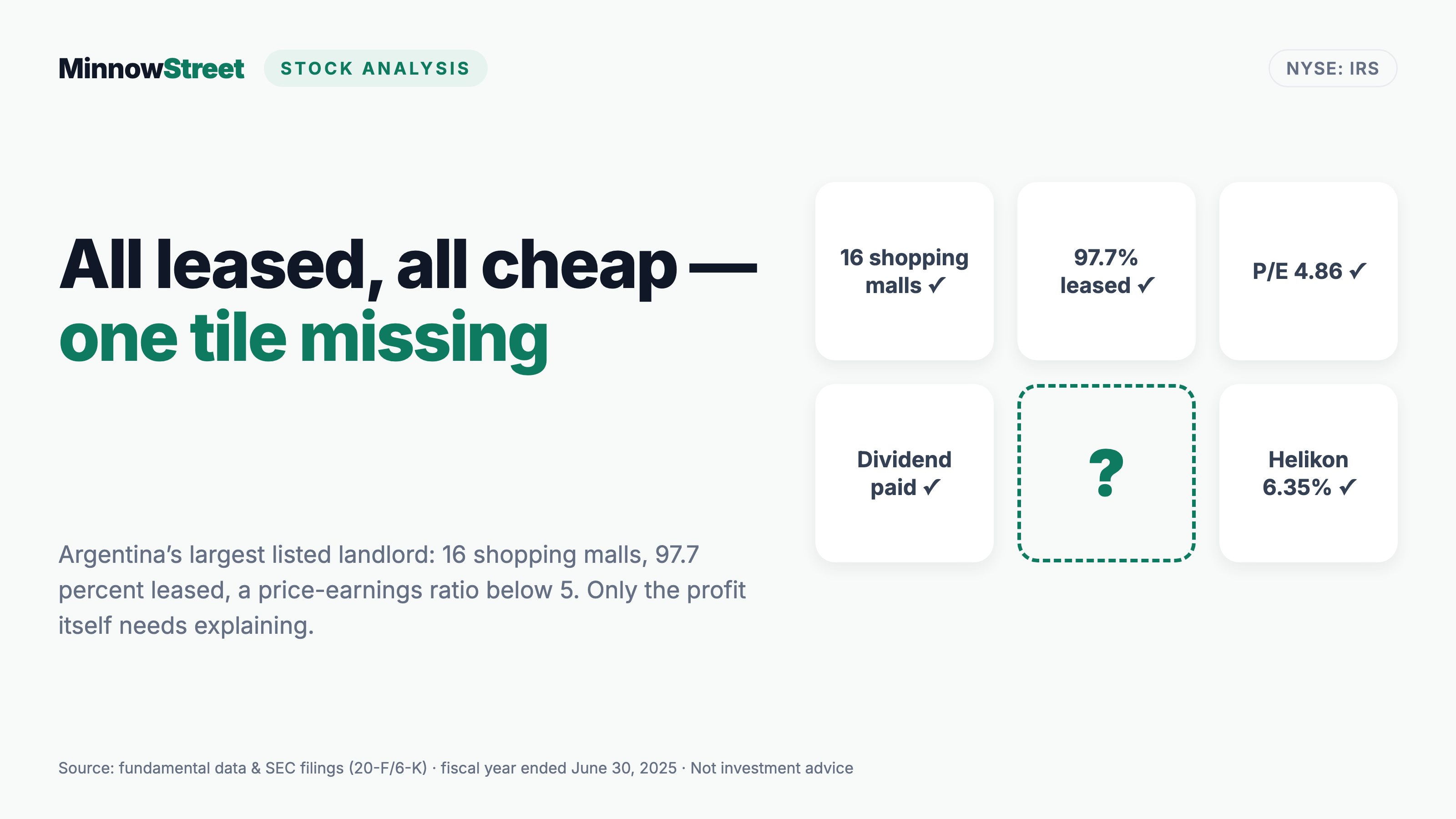
IRSA is Argentina’s largest listed real estate company: 16 self-operated shopping malls, 97.7 percent leased, plus office buildings, three hotels and land reserves in the middle of Buenos Aires. On paper the stock looks cheap, with a price-earnings ratio below five. But what decides between profit and loss is a line in which no money moves: the revaluation of the company’s own properties. In fiscal 2024 it tore ARS 488,794 million out of the result — more than the entire year’s revenue — and pushed the year into the red; a year later it stood at almost zero, and the same business produced a profit of ARS 196,118 million. Add peso figures that are recomputed in every filing under hyperinflation rules, and $658 million of debt against rents collected in pesos. London fund Helikon Investments has lifted its stake to 6.35 percent. Not investment advice — just the question of what a profit figure is worth when nobody can withdraw it.
 Thomas Mücke
Founder & Publisher
Thomas Mücke
Founder & Publisher
Chart
Interactive price chart (TradingView).
Note: pure fact-based analysis, not investment advice and not a solicitation to buy or sell. All figures without guarantee.
You know the letter that lands in the mailbox once a year: "Based on our assessment, your home is now worth $40,000 more." You read it twice. You mention it at the barbecue. You feel richer — and then you fill up the car with exactly the same money as before. Call it the appraisal-letter trap: we book a paper gain as if it were cash, even though not one cent has touched the account. That trap sits right inside the profit line of IRSA Inversiones y Representaciones S.A. (NYSE: IRS), Argentina’s largest listed real estate company — 16 self-operated shopping malls, office buildings, three hotels, land reserves in the middle of Buenos Aires. Except IRSA does not write that letter to itself; it writes it straight into the income statement. In fiscal 2024 the revaluation of its own properties tore ARS 488,794 million out of the result — more than the entire year’s revenue — and turned an operationally decent year into a loss. A year later the same line was near zero, and the same business produced a profit of ARS 196,118 million. So let’s make a deal: before you read "price-earnings ratio below five" and think bargain, we look together at what the company itself reported to the U.S. securities regulator, the SEC — the 20-F annual report for the fiscal year ended June 30, 2025 and the interim financial statements as of March 31, 2026. A filing to the SEC is honest under penalty of law. And this one tells of full shopping malls, of a profit nobody can withdraw, and of peso figures you must not read without the fine print. In the end you decide for yourself.
What IRSA actually does — landlord, hotelier and landowner in one
IRSA was founded in 1943 and describes itself as the only Argentine real estate company whose shares are listed both in Buenos Aires (ByMA, ticker IRSA) and in New York. What trades in New York, though, is not the share itself but a depositary receipt: one GDS, or ADR, under the ticker IRS has represented ten common shares since 1994, with the Bank of New York Mellon as depositary. Remember that ten — it is the reason any conversion between a peso balance sheet and a dollar quote can go wrong twice.
The business has five parts. The core is shopping malls: as of June 30, 2025 sixteen properties in Argentina, six of them in the City of Buenos Aires (among them Abasto, Alto Palermo, Patio Bullrich and Dot Baires), together 371,242 square meters of leasable area, 1,561 stores and a 97.7 percent occupancy rate. They produced ARS 270,531 million of revenue in fiscal 2025 — 58 percent of the group — and account for 53.4 percent of operating assets. In September 2025 the company added "Al Oeste", a mall it plans to convert into an outlet center; the portfolio has comprised 17 properties with roughly 390,000 square meters since. On top come office buildings (58,074 square meters, 96.2 percent leased, ARS 20,065 million of revenue), three hotels — the Intercontinental and the Libertador in Buenos Aires and the Llao Llao luxury resort in Bariloche, together 718 rooms at 60.9 percent occupancy — the land reserves and development segment, and an "others" bucket holding stakes in Banco Hipotecario and the exhibition company La Rural, among others.
Translated into an everyday image: IRSA is not a developer that puts up buildings and sells them, but a landlord with land in the basement. The recurring cash comes from rent and turnover-linked payments from mall tenants; the bulk of the remaining assets sits in plots that will be built on or sold at some point. And that names the central tension of this analysis: the operating business is real, full and collects rent — but the number the market measures it by is dominated by two entries in which no money moves.
How the stock reached our desk
Not through a hit in our in-house stock scanner, but through a mandatory form. On May 8, 2026 London-based Helikon Investments Ltd filed its 13F-HR as of March 31, 2026 — the form larger U.S. asset managers must use to disclose their holdings. IRSA appears in it with 4,428,706 ADRs worth $71,789,324. What stands out is not the size but the direction. Across four quarters the position reads: 2,367,181 shares (June 30, 2025) → 3,423,977 (September 30) → 4,142,489 (December 31) → 4,428,706 (March 31, 2026). It is the only one of the 17 positions increased four quarters in a row, almost a doubling in total. In the same quarter the fund sold Pampa Energía outright ($50.0 million) — another Argentine name. The whole portfolio holds 17 positions worth $2,648,555,113, with a striking Argentine block: besides IRSA also Transportadora de Gas del Sur and Edenor.
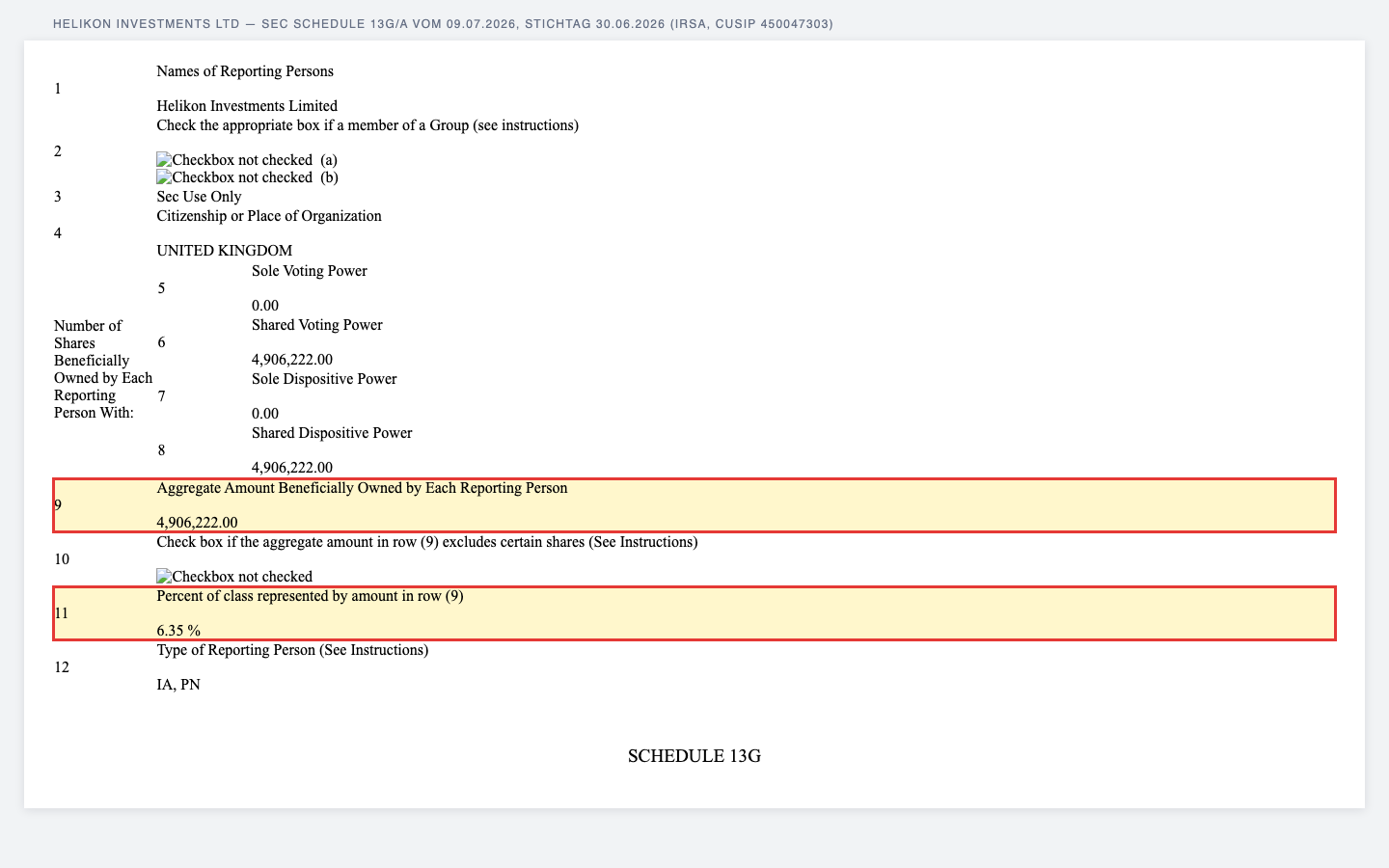
There is a second source, and it is fresher than the 13F. Anyone crossing five percent of a U.S.-registered class must file a Schedule 13G. Helikon did so on January 21, 2026 for the December 31, 2025 date: 4,134,480 ADRs, 5.25 percent. And on July 9, 2026 came the amendment for June 30, 2026: 4,906,222 ADRs, 6.35 percent. So the fund kept buying after the 13F date. The shares are held by the Helikon Long Short Equity Fund Master ICAV, managed by Helikon Investments Limited in London; the form names Federico Riggio as the second reporting person.
Before this turns into a buy idea, the limits of the form belong here: a 13F shows only U.S.-listed long positions, it appears with a 35 to 45 day delay, and it contains no short sales, no derivatives apart from reported options and no European holdings. It is a rear-view mirror, not a road map. And honesty also requires saying what our scanner does deliver on IRSA — and what it does not. The Piotroski F-Score, a nine-point test for the health of the books, stands at 3 of 9. That is weak; a genuinely healthy company sits at 8 or 9. The equity ratio is 0.462 and the price-earnings ratio 4.86 (data as of July 24, 2026). Altman Z, NCAV and the cash position are deliberately missing — and that is not an oversight: the balance sheet is in Argentine pesos, the listing is in U.S. dollars. Metrics that combine balance-sheet items with market value would mix two currencies in one formula and produce a result off by a factor of 1,373. Better a gap than a wrong number.
The numbers over the years — honestly appraised
First what genuinely counts. The operating business works. The shopping malls were 97.7 percent leased as of June 30, 2025 — nine properties stood at 98 percent or above, three of them at a flat 100 percent. The offices reached 96.2 percent. Gross profit in the mall segment came to 92.4 percent of segment revenue; of 100 pesos of rent, a good 92 remain before administration and selling costs. And unlike many asset-heavy stocks, IRSA pays out: the most recent cash dividend was distributed on November 4, 2025; the shareholders’ meeting of October 30, 2025 had considered a result for the year of ARS 195,677,675,452.86 and approved a distribution of up to ARS 164 billion. Cash dividends were also paid in October 2023, May 2024 and November 2024.
And now the line where the story turns. Look at what revenue did over three years — and what the bottom line did.
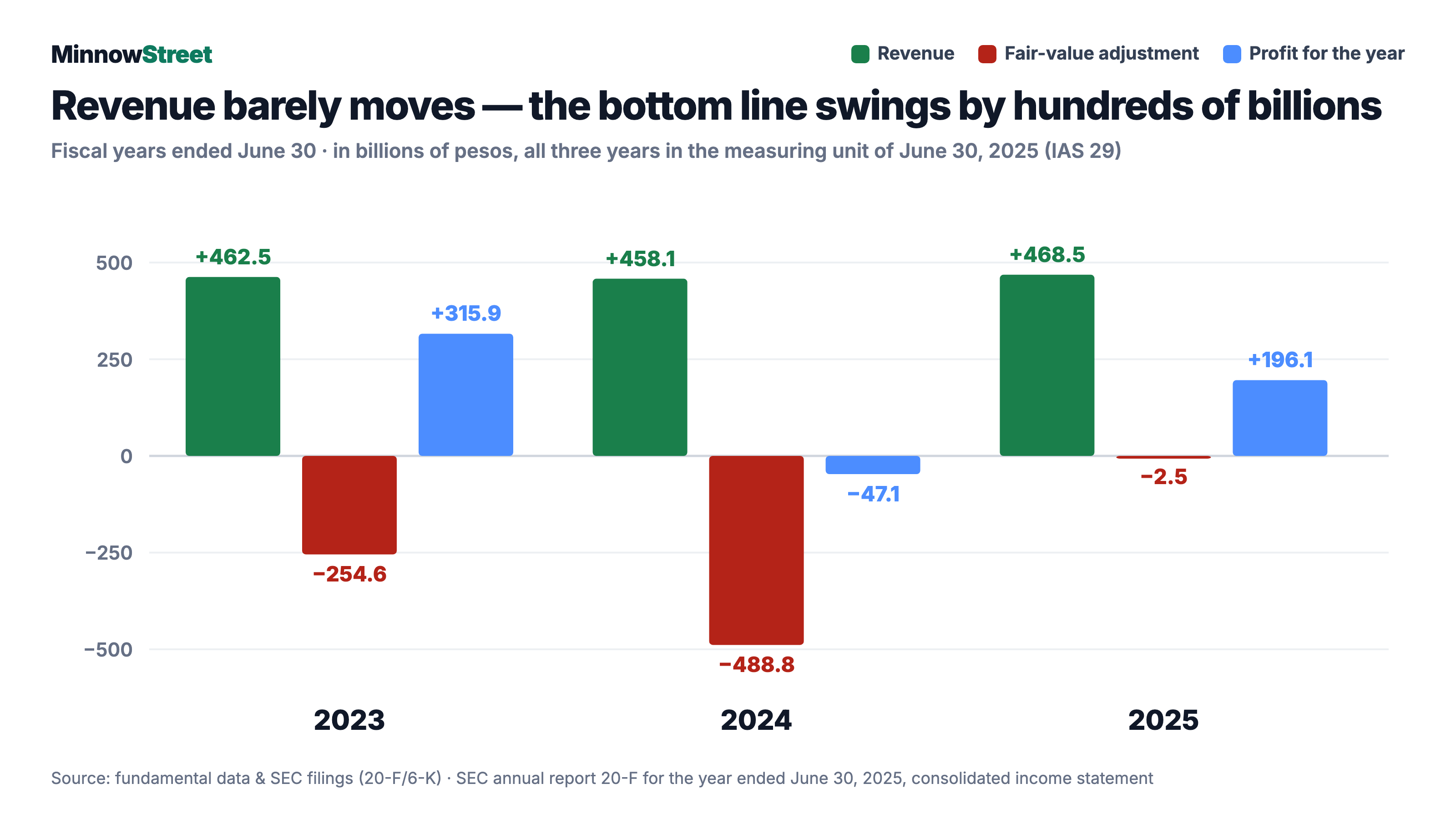
Revenue was ARS 462,486 million (fiscal 2023), 458,059 (2024) and 468,526 (2025) — all three in the same measuring unit, so comparable in real terms. That is a straight line: plus 1.3 percent in two years. The bottom line, by contrast: +315,903, then −47,127, then +196,118 million pesos. Anyone reading those three numbers as business development is confusing the appraisal letter with the till. The same holds for tenant sales in the malls, also inflation-adjusted: ARS 1,385,564 million (fiscal 2021), 2,843,425 (2022), 3,298,765 (2023), 3,151,757 (2024), 3,062,900 (2025) — after the post-pandemic recovery, two consecutive years of slight decline. The stores are full, but in real terms the tills hold a little less than in 2023. Which brings us to the uncomfortable truths.
What the filings say — the uncomfortable truths
Uncomfortable truth no. 1: a large part of the profit is not money
IRSA does not carry its properties at cost but at fair value — at what appraisers currently assign to them. If the appraised value rises, a gain appears in the income statement; if it falls, a loss. Not a cent changes hands. Translated into an everyday image: if a broker tells you your house is worth $30,000 more than last year, you have "earned" $30,000 — but you cannot buy gas with it.
At IRSA the magnitude is not a side note; it dominates the result. In fiscal 2024 this single line tore ARS 488,794 million out of the accounts — more than the full year’s revenue of 458,059 million — and turned an operationally solid year into a loss. A year later the same line stood at −2,500 million, essentially zero, and the year closed with a profit of 196,118 million. Even that zero is deceptive: at segment level the shopping malls were written up by 443,974 million while offices (−148,941) and land reserves (−294,436) lost almost exactly as much. Two moves of roughly half a trillion pesos each cancel out — and the consolidated line shows an unremarkable zero.
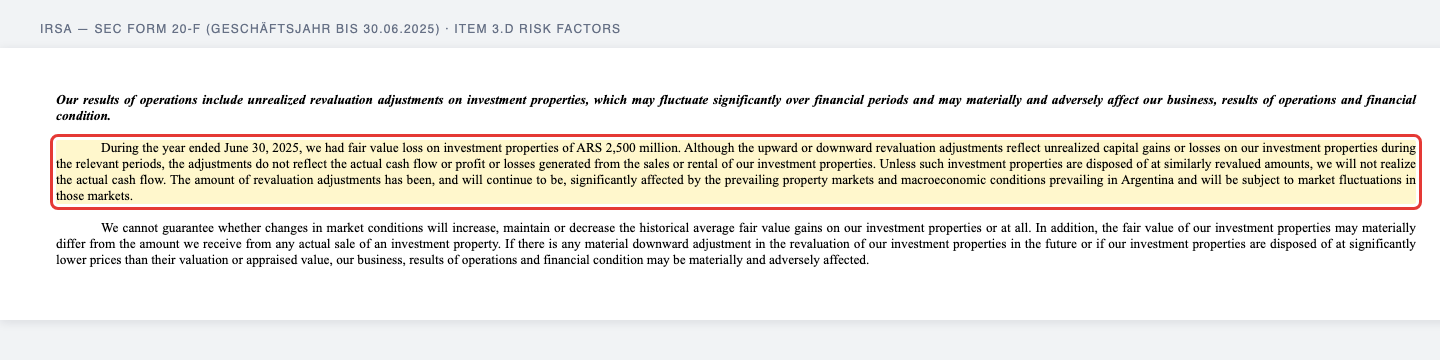
None of this requires interpretation; the company puts it in its own risk factors:
"During the year ended June 30, 2025, we had fair value loss on investment properties of ARS 2,500 million. Although the upward or downward revaluation adjustments reflect unrealized capital gains or losses on our investment properties during the relevant periods, the adjustments do not reflect the actual cash flow or profit or losses generated from the sales or rental of our investment properties. Unless such investment properties are disposed of at similarly revalued amounts, we will not realize the actual cash flow."
— IRSA Inversiones y Representaciones S.A., SEC annual report 20-F for the year ended June 30, 2025, Item 3.D "Risk Factors"
How those values come about was declared a critical audit matter by the auditor, Price Waterhouse & Co. S.R.L. — the single most difficult, most subjective judgment in the whole audit. Roughly 61 percent of investment properties worth ARS 2,344,667 million are valued with a discounted cash flow model using assumptions about the cost of capital, inflation, exchange rates and gross domestic product. The report names two reasons for the write-up of the malls in fiscal 2025: more favorable assumptions about the real exchange rate, and a country risk premium roughly 400 basis points lower than the year before. Remember that mechanism: a good part of the 2025 profit came from Argentina being judged a less risky country.

That this is no theory is on display in the current fiscal year: in the nine months to March 31, 2026 the line stood at +ARS 30,231 million — but in the third quarter alone at −173,016 million. That single quarter turned a gross profit of 91,501 million into an operating loss of 113,056 million and the period into a net loss of 32,568 million. Nine-month profit: 239,741 million. Quarterly result: negative. Both in the same table, both correct.
Uncomfortable truth no. 2: the measuring unit moves — IAS 29 does the math
Now the fine print. Argentina has qualified as a hyperinflationary economy since July 1, 2018, because cumulative three-year inflation exceeded 100 percent. IRSA therefore reports under IAS 29: all peso amounts are restated with a general price index into the measuring unit of the reporting date — including prior-year figures. Translated into an everyday image: it is like rewriting an old price tag in today’s money. "Grandpa bought the house in 1975 for $30,000" becomes "roughly $180,000 in today’s purchasing power" — same house, same year, a different number. That is sensible, because it makes values comparable inside one filing. But it has a side effect almost nobody has on the radar: the same figure taken from two different filings is not the same figure.
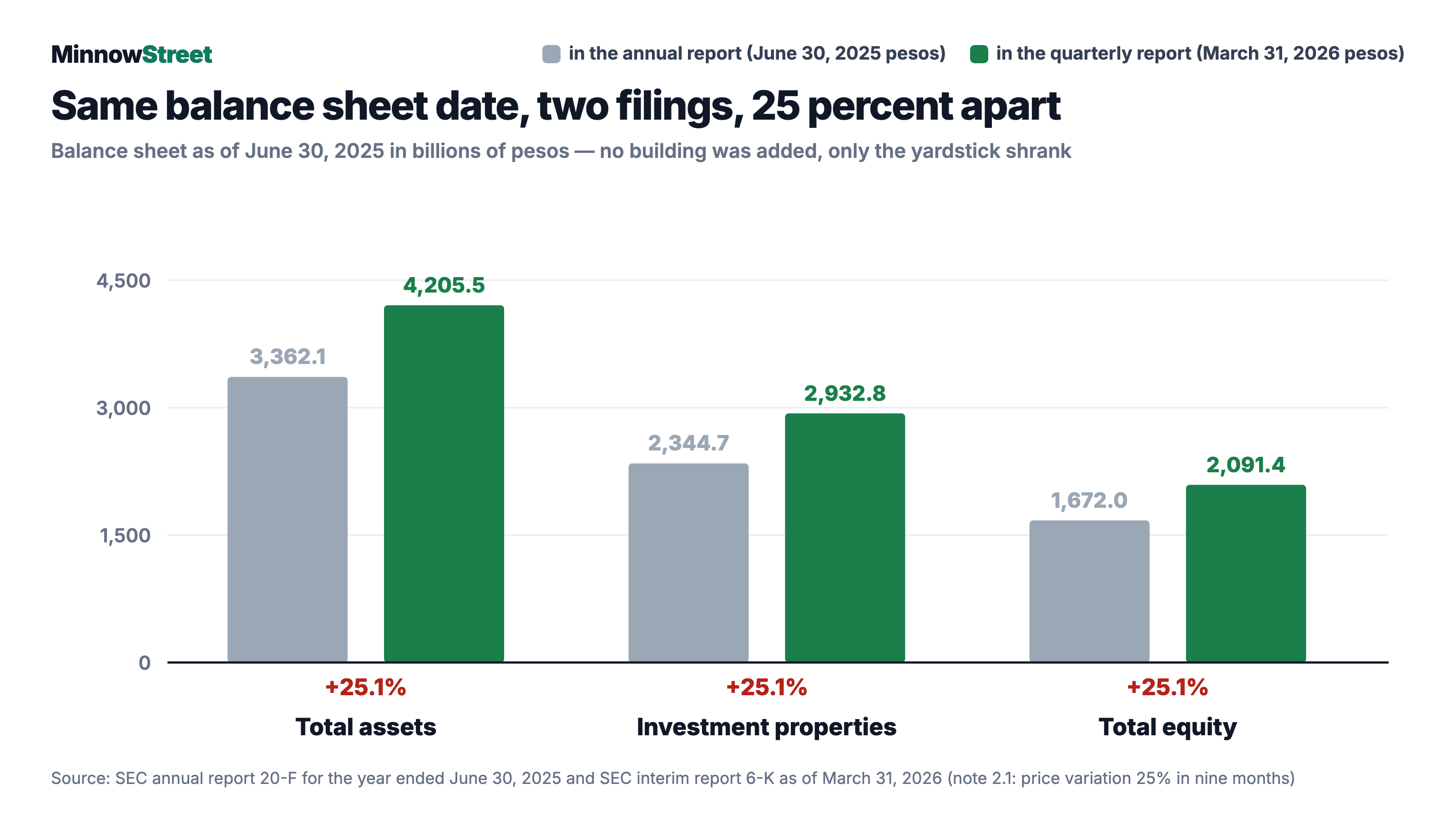
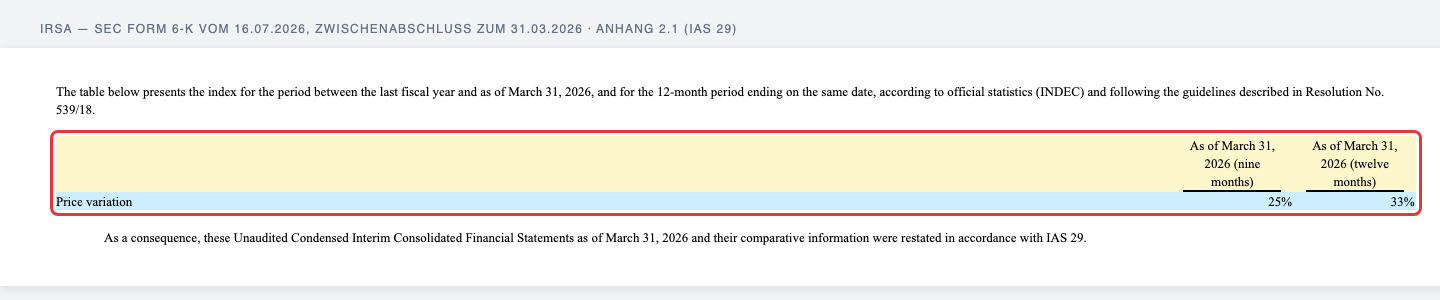
The balance sheet as of June 30, 2025 shows total assets of ARS 3,362,069 million in the annual report, equity of 1,671,967 million and investment properties of 2,344,667 million. In the interim report as of March 31, 2026 the same date shows 4,205,471, 2,091,396 and 2,932,846 million. All exactly 25.1 percent higher. No building was added, no tenant moved in. The filing itself explains where the difference comes from:
"The table below presents the index for the period between the last fiscal year and as of March 31, 2026, and for the 12-month period ending on the same date … Price variation: 25% (nine months), 33% (twelve months). As a consequence, these Unaudited Condensed Interim Consolidated Financial Statements as of March 31, 2026 and their comparative information were restated in accordance with IAS 29."
— IRSA Inversiones y Representaciones S.A., SEC interim report 6-K of May 26, 2026, note 2.1 to the financial statements as of March 31, 2026
Two very practical rules follow for you as an investor. First: never compare a peso figure from one annual report with a peso figure from another filing without checking which measuring date it carries — otherwise you will read inflation as growth. Second: inside one filing the series are clean, because all years there are restated to the same date. That is exactly why our chart above says "measuring unit of June 30, 2025" — those three years are comparable with each other, and with the next annual report they will no longer be. Inflation also shows up directly in the income statement: the line "inflation adjustment" — the gain or loss from holding monetary assets and liabilities while money loses value — contributed +ARS 11,342 million in fiscal 2025, −434 million the year before and +74,193 million in fiscal 2023.
Uncomfortable truth no. 3: the books are in pesos, the debt is in dollars
Here accounting becomes a tangible risk. IRSA collects rent mostly in pesos but has borrowed mostly in U.S. dollars. As of March 31, 2026 the books carried $657.95 million of financial liabilities against foreign-currency assets worth roughly $188 million. The largest pieces: a $300 million note with an 8.00 percent coupon due 2035 (issued March 31, 2025), an 8.75 percent note maturing in 2028 and smaller series at 6.00 to 7.25 percent. If the peso depreciates, the peso value of that debt rises without anything changing in the business. The annual report gives this its own heading:
"As of June 30, 2025, the majority of our liabilities, such as our Series XIV, XVI …, XVII, XVIII, XX, XXII, XXIII and XXIV Notes, were denominated in U.S. dollars while the Company’s revenues are mainly denominated in Pesos. […] Any depreciation of the Peso against the U.S. dollar increases the nominal amount of our debt in Pesos, which further adversely affects the results of our operations and financial conditions."
— IRSA Inversiones y Representaciones S.A., SEC annual report 20-F for the year ended June 30, 2025, Item 3.D "Risk Factors" ("Due to the currency mismatches between our assets and liabilities, we have high currency exposure")

How fast the ground moves is visible in the conversion rates the filings themselves use: 912 pesos per dollar at the start of fiscal 2025, 1,205 on June 30, 2025, 1,484.50 on October 22, 2025 and 1,373 on March 31, 2026. And one more trap for investors: because one ADR equals ten shares, any conversion has to divide correctly twice — once by the exchange rate, once by ten. Get that wrong and your valuation is off by a factor of 10 or by a factor of 1,373. Which is precisely why we would rather leave whole metrics blank on IRSA than fill them incorrectly.
Uncomfortable truth no. 4: almost a third of the assets earns almost nothing
The fiscal 2025 segment figures are unusually lopsided. The shopping malls hold 53.4 percent of operating assets and deliver ARS 270,531 million of revenue. The land reserves and development segment holds 29.2 percent of operating assets — and delivers ARS 12,761 million, or 2.7 percent of group revenue, with a negative gross result of −5,168 million. The largest single item is "Ramblas del Plata", the former Costa Urbana site by the river: 70 hectares, approved construction capacity of roughly 866,806 square meters of which 693,446 are saleable, carried at ARS 419,278 million — more than any single shopping mall. Such a plot is a genuine option on the future of Buenos Aires; it is also an item that pays no rent, whose value rests entirely on appraisals, and which turns into cash only in small steps — in fiscal 2025 across 13 plots for roughly $81.1 million.
The hotel business belongs in this chapter too. Its revenue fell 24.8 percent in fiscal 2025 to ARS 64,596 million (prior year: 85,840), and its margin from 53.2 to 33.6 percent. The reason is in the report: a stronger peso made the country expensive for foreign guests. With three properties and 718 rooms that is no group-level risk — but it shows how directly the exchange rate reaches the till.
Uncomfortable truth no. 5: almost 98 million new shares in 15 months
Dilution means your slice of the cake gets smaller because new slices keep being cut. At IRSA that process ran quietly in the background until recently. A May 2021 capital increase came with 80 million warrants that holders could exchange for new shares. Before the February 2025 exercise the company had 748,297,907 shares; after the final exercise on May 12, 2026 it had 846,115,922. That is 97,818,015 new shares, or 13.1 percent, in a little over fifteen months. The final tranche alone covered 35,318,802 shares — and brought the company $459,146, because shareholders had approved an exercise without cash payment. The remaining 149,100 warrants expired; the New York Stock Exchange removed the class from listing with Form 25-NSE dated May 12, 2026.
The good news: the dilution is finished — no warrants remain outstanding. The bad news: every per-share figure in the annual report still uses the old count. Earnings per share of ARS 261.29 for fiscal 2025 rest on a weighted average of 747 million shares; on a diluted basis it was ARS 238.90 on 817 million. Against the 846 million shares outstanding today, even the diluted figure is still calculated on too few. Remember the rule: growth paid for with fresh shares is never entirely free.
Valuation: why a P/E below five is not an answer here
We do not need a daily price for a dated valuation anchor. Helikon’s 13F reports a market value of $71,789,324 for 4,428,706 ADRs as of March 31, 2026 — roughly $16.21 per ADR and therefore $1.62 per common share. Applied to the 810,797,120 shares outstanding on that date, that is a market capitalization of about $1.31 billion; after the May 2026 warrant exercise the same value spreads across 846,115,922 shares.
Now the context, and it is unusual. Book value sits above the price. Equity attributable to owners of the parent was ARS 1,922,365 million as of March 31, 2026; divided by 810,797,120 shares and converted at the closing rate of 1,373 pesos per dollar, that is roughly $17.27 per ADR. The anchor price is therefore about six percent below it. For the price-earnings ratio, everything depends on which profit you take: on fiscal 2025 (ARS 261.29 per share, converted at 1,205) you get roughly 7.5; annualizing the nine-month figures of the current year (ARS 297.05 in nine months, rate 1,373) lands at roughly 5.6. Our scanner shows 4.86. Three numbers, three routes — and all three measure the same profit, which to a large extent comes from appraisals and from the tax line.
So the honest answer to "is IRSA cheap?" is this: a low price-earnings ratio here is not a price tag, it is a question. The sturdier measures are rental income (ARS 268,855 million from the malls), occupancy (97.7 percent), real tenant sales (ARS 3,062,900 million, down slightly two years running) and book value per share — each with a date and a measuring unit attached. How far hyperinflation accounting can shift an entire valuation was on display recently at another Argentine name from the same portfolio: in our analysis of Corporación América Airports, where the financial result swung by $354 million in a single year without anything changing in the flight business. And how the same fund handled an infrastructure holding is in our analysis of Helios Towers. More cases in which the accounting outshines the business are collected in our research.
Opportunities and risks at a glance
What speaks for IRSA:
- A real, full core business: 16 self-operated shopping malls with 371,242 square meters of space, 1,561 stores and 97.7 percent occupancy as of June 30, 2025; the offices were 96.2 percent leased. The mall segment earned a gross profit of 92.4 percent of its revenue.
- Price below book: equity attributable to owners corresponded to roughly $17.27 per ADR as of March 31, 2026, against a valuation anchor of $16.21 from the 13F for the same date.
- Distributions actually happen: cash dividends in October 2023, May 2024, November 2024 and most recently on November 4, 2025; the shareholders’ meeting of October 30, 2025 approved a distribution of up to ARS 164 billion.
- The dilution is over: the last warrants from the 2021 capital increase were exercised or expired on May 12, 2026, and the New York Stock Exchange removed the class from listing. No further dilution comes from that program.
- An option on the future of Buenos Aires: "Ramblas del Plata" covers 70 hectares on the Río de la Plata with roughly 866,806 square meters of approved construction capacity, of which 693,446 are saleable; in fiscal 2025 the company sold or bartered 13 plots for about $81.1 million.
What speaks against it:
- A large part of the reported profit is not money: the revaluation of investment properties tore ARS 488,794 million out of the fiscal 2024 result — more than the year’s revenue — and stood at −2,500 million a year later. In the third quarter of fiscal 2026 it alone cost 173,016 million and pushed the quarter into a loss.
- The series are not comparable across filings: under IAS 29 the same balance sheet as of June 30, 2025 grows from ARS 3,362,069 to 4,205,471 million simply because the interim report restates it into a measuring unit nine months younger (price variation 25 percent).
- A currency gap: $657.95 million of financial debt as of March 31, 2026 against foreign-currency assets of roughly $188 million, with rents collected mostly in pesos. The exchange rate moved from 912 through 1,484.50 to 1,373 pesos per dollar within 21 months.
- Almost a third of operating assets (29.2 percent) sits in the land reserves and development segment, which contributed 2.7 percent of revenue and a negative gross result, including a write-down of trading properties of ARS 19,125 million. Hotel revenue fell 24.8 percent.
- Control and metrics: farming group CRESUD held roughly 54.1 percent of the shares as of June 30, 2025, and Eduardo S. Elsztain beneficially 57.4 percent — minority holders ride along but do not vote along. The Piotroski F-Score stands at 3 of 9; Altman Z, NCAV and the cash position are missing because the reporting currency and the listing currency differ.
A human conclusion
Back to the letter from the broker. Its problem is not that it lies — IRSA values its assets exactly as international rules require and writes every caveat into the filing itself. The problem is our own head: we read a valuation and feel money. "Price-earnings ratio 4.86" looks like a price tag, yet it is a fraction whose numerator consists largely of appraisals and a tax line — measured in a currency whose purchasing power shifts every three months. At the same time the business behind it is real: sixteen shopping malls, 97.7 percent leased, 1,561 stores where people shop and rent gets paid, and a dividend that actually flows. Both are true at once. So the honest question for you is not "is the stock cheap?" but: do you want to own a full shopping mall in Buenos Aires — and are you willing to accept that no single profit figure can tell you how good the year really was? Whoever has a documented answer has a thesis. Whoever does not has a letter from a broker. What you make of it is your decision. And that is exactly as it should be.
Sources
Every original document used in this analysis — for you to read yourself:
- IRSA Inversiones y Representaciones S.A. — SEC annual report 20-F for the fiscal year ended June 30, 2025 (filed October 24, 2025)
- IRSA Inversiones y Representaciones S.A. — Interim financial statements as of March 31, 2026, 6-K of May 26, 2026
- IRSA Inversiones y Representaciones S.A. — Result of the final warrant exercise on May 11/12, 2026, 6-K of May 19, 2026
- IRSA Inversiones y Representaciones S.A. — Notice of the final exercise window and the cashless exercise alternative, 6-K of April 28, 2026
- IRSA Inversiones y Representaciones S.A. — Warrant exercise of September 2025, 6-K of September 30, 2025
- New York Stock Exchange LLC — Form 25-NSE of May 12, 2026: removal of the warrants from listing
- Helikon Investments Ltd — Schedule 13G/A of July 9, 2026 as of June 30, 2026 (6.35 percent)
- Helikon Investments Ltd — 13F-HR as of March 31, 2026, filed May 8, 2026 (EDGAR overview, sec.gov)
- Full SEC filing history: EDGAR overview for IRSA Inversiones y Representaciones S.A. (sec.gov)
- Fundamental data (metrics and valuation; data as of July 24, 2026), reconciled with the SEC filings.
Transparency & disclaimer: this analysis is a journalistic contextualization of publicly available information and is not investment advice, not a financial analysis in the regulatory sense and not a solicitation to buy or sell securities. Equity investments carry substantial risks up to total loss. All information without warranty; the data cut-off is noted in the text. The author holds no position in shares of IRSA Inversiones y Representaciones S.A. at the time of publication.
Our Bottom Line at a Glance
- Operating business positive
- The 16 shopping malls were 97.7 percent leased as of June 30, 2025 and the offices 96.2 percent; the mall segment earned a gross profit of 92.4 percent of its revenue on ARS 270,531 million. Group revenue was ARS 468,526 million, and ARS 464,366 million in the nine months to March 31, 2026.
- Meaning of the profit negative
- The reported profit is driven by entries without cash flow. The revaluation of investment properties cost ARS 488,794 million in fiscal 2024 — more than the year's revenue — and stood at −2,500 million in 2025; in the third quarter of fiscal 2026 it alone tore 173,016 million out of the result. The company itself writes that these adjustments do not reflect actual cash flow.
- Comparability of the series negative
- Under IAS 29 all peso figures are lifted into the measuring unit of the respective reporting date. That is why the same balance sheet as of June 30, 2025 shows ARS 3,362,069 million in the annual report and ARS 4,205,471 million in the interim report as of March 31, 2026; the filing puts the price variation of those nine months at 25 percent. Inside one filing the series are clean, across two filings they are not.
- Currency & leverage negative
- As of March 31, 2026, $657.95 million of financial debt stood against foreign-currency assets of roughly $188 million, while rents come in mostly in pesos. The exchange rate moved from 912 (July 2024) through 1,205 (June 2025) and 1,484.50 (October 2025) to 1,373 pesos per dollar (March 2026). The annual report explicitly calls this high currency exposure.
- Asset structure neutral
- The shopping malls carry 53.4 percent of operating assets and the bulk of revenue. The land reserves and development segment, by contrast, holds 29.2 percent of assets on 2.7 percent of revenue with a negative gross result; "Ramblas del Plata" alone sits in the books at ARS 419,278 million. That is a genuine option on Buenos Aires — and an item that pays no rent for now.
- Shareholders & distributions neutral
- CRESUD held roughly 54.1 percent as of June 30, 2025 and Eduardo S. Elsztain beneficially 57.4 percent — minority holders have no influence. In exchange, money is distributed: most recently a cash dividend on November 4, 2025, approved at up to ARS 164 billion. Dilution from the 2021 warrant program ended on May 12, 2026, but it raised the share count by 97,818,015 shares, or 13.1 percent.
IRSA is a real, fully leased property business in a country whose accounting makes the results unreadable: 16 shopping malls at 97.7 percent occupancy, a price below book value and a dividend that actually flows on one side — on the other a profit that a revaluation of ARS 488,794 million pushed into a loss in fiscal 2024 and that the same line, near zero, lifted back to a gain of ARS 196,118 million in 2025, while revenue rose 1.3 percent over three years. Add a measuring unit that keeps shifting (the same balance sheet plus 25.1 percent in nine months) and $657.95 million of debt against peso rents. Whoever buys here buys square meters and leases, not a profit figure. Not investment advice.
What Our Rating Means
Open questions
The business works in principle, but one material question is open. As long as it stays open, our findings do not carry a quality verdict.
The caution applies not to the business but to the yardstick. Whoever buys today is betting that the malls stay full and real tenant sales start rising again (they have slipped two years running), that the peso does not make the $657.95 million of dollar debt more expensive, and that the land reserves holding almost a third of assets eventually turn into cash. Above all, they are betting on reading a valuation metric correctly whose numerator consists largely of appraisals and of the tax line — a price-earnings ratio below five is not a price tag here. Whoever waits checks three things in every filing: how are occupancy and real tenant sales developing? How large is the fair-value adjustment relative to revenue? And how much dollar debt stands against how much dollar-denominated assets? The unreadability of the profit figure is the dominant risk and the reason for caution. The decision is yours.
A journalistic assessment by our editorial team at the time of the deep dive, based on public sources — not investment advice and not a solicitation to buy or sell. Your personal circumstances (investment goals, risk capacity, taxes) cannot be taken into account. What our levels mean, how verdicts are formed, and what conflicts of interest exist →
Worth Noting
- IRSA reached our research list through the 13F-HR of London-based Helikon Investments Ltd as of March 31, 2026 (filed May 8, 2026): 4,428,706 ADRs worth $71,789,324 — the only one of the 17 positions increased four quarters in a row (from 2,367,181 shares). In the Schedule 13G/A of July 9, 2026 the fund reports 4,906,222 ADRs and 6.35 percent, up from 5.25 percent as of December 31, 2025. A 13F shows only U.S.-listed long positions, appears with a 35 to 45 day delay and contains no short sales or derivatives — a rear-view mirror, not a road map.
- IRSA is a foreign private issuer: there is no 10-K and no 10-Q, and the fiscal year ends June 30. The evidence chain of this analysis is the 20-F annual report for the year ended June 30, 2025 (filed October 24, 2025) plus the interim reports and notices filed as 6-K (statements as of March 31, 2026 filed May 26, 2026; warrant notices of September 30, 2025, December 4, 2025, April 28, 2026 and May 19, 2026) and the NYSE Form 25-NSE of May 12, 2026.
- A note on metrics: our in-house stock scanner shows a Piotroski F-Score of 3 of 9, an equity ratio of 0.462 and a P/E of 4.86 for IRSA (data as of July 24, 2026). Altman Z, NCAV and the cash position are deliberately left blank because the balance sheet is in Argentine pesos while the listing is in U.S. dollars — such metrics would mix two currencies in one formula. Likewise, peso figures from different filings are not directly comparable because of IAS 29; occupancy, leasable area, real tenant sales and foreign-currency debt are the sturdier measures. The valuation anchor of $16.21 per ADR comes from the market value of the Helikon position in the 13F as of March 31, 2026 and is not a daily price.
Stock Watch
This analysis is as of July 23, 2026. Stock Watch will tell you what's changed at IRS since then.
Later $1 a month per stock — signing up is free, and you'll be the first to know when it launches.
Frequently Asked Questions
IRSA (NYSE: IRS, ByMA: IRSA) is Argentina's largest listed real estate company, founded in Buenos Aires in 1943. As of June 30, 2025 it operated 16 shopping malls with 371,242 square meters of leasable area, office buildings covering 58,074 square meters, three hotels with 718 rooms and large land reserves. Group revenue in fiscal 2025 was ARS 468,526 million.
On June 30. That is why the 20-F annual report only appears in October — the one for fiscal 2025 was filed with the SEC on October 24, 2025. Interim figures come as 6-K filings; the statements as of March 31, 2026 were filed on May 26, 2026. As a foreign private issuer, IRSA publishes neither a 10-K nor a 10-Q.
Ten. The depositary receipt traded on the New York Stock Exchange under the ticker IRS (a GDS, or ADR) has represented ten common shares since 1994, with the Bank of New York Mellon as depositary. Anyone converting peso per-share figures into dollars per ADR therefore has to convert twice: by the exchange rate and times ten.
Because the properties are carried at fair value and every change in the appraisals goes straight into the income statement. In fiscal 2024 that line tore ARS 488,794 million out of the result — more than the year's revenue — and turned the year into a loss of 47,127 million. In fiscal 2025 it stood at −2,500 million and the result at +196,118 million.
Argentina has qualified as a hyperinflationary economy since July 1, 2018. Under IAS 29 all peso amounts are restated into the measuring unit of the reporting date, including prior-year figures. The result: the same balance sheet as of June 30, 2025 shows ARS 3,362,069 million in the annual report and ARS 4,205,471 million in the interim report as of March 31, 2026 — the filing puts the price variation of those nine months at 25 percent.
Yes. The most recent cash dividend was distributed on November 4, 2025. The shareholders' meeting of October 30, 2025 considered a result for the year of ARS 195,677,675,452.86 and approved a distribution of up to ARS 164 billion. Cash dividends were also paid in October 2023, May 2024 and November 2024. Transfers abroad require central bank approval.
As of June 30, 2025 the Argentine farming group CRESUD held 412,158,780 common shares, roughly 54.1 percent excluding treasury shares. The largest beneficial owner is Eduardo S. Elsztain with about 57.4 percent; he also chairs IRSA. The largest known free-float holder is London-based Helikon Investments Ltd, which reported a 6.35 percent stake on July 9, 2026.
846,115,922 common shares. The final exercise on May 11 and 12, 2026 created 35,318,802 new shares, for which the company received $459,146; 149,100 warrants expired. Compared with 748,297,907 shares before the February 2025 exercise, that is 97,818,015 more, or 13.1 percent, in a little over fifteen months.
Found an error?
Did you spot a factual error, an outdated number, or a typo in this deep dive? Let us know briefly — your report goes straight to the editorial team.