Innoviva: $271 Million in Profit — and Roughly Half of It Nobody Paid
Innoviva collects royalties on two GSK asthma and COPD medicines and sells five hospital products of its own. That business generated $411.3 million in revenue and $196.9 million in operating cash flow in 2025. Reported net income, however, was $271.2 million — $161.6 million of it from fair-value marks on investments, mainly the share price of Armata Pharmaceuticals. In the first quarter of 2026, $191.2 million of $234.6 million in pre-tax income came from the same line. And Armata is funded by Innoviva itself: most recently on May 12, 2026, with another $25.0 million loan. Not investment advice — just the question of which line in this income statement you actually believe.
 Thomas Mücke
Founder & Publisher
Thomas Mücke
Founder & Publisher
Chart
Interactive price chart (TradingView).
Note: pure fact-based analysis, not investment advice and not a solicitation to buy or sell. All figures without guarantee.
There is a sentence we all learned at some point and have never questioned since: "What counts is the bottom line." The last line of an income statement is treated as the most honest one — audited, signed off, filed with the U.S. securities regulator, the SEC, under penalty of law. Call it the bottom-line trap: we believe the last line because it is last.
At Innoviva, Inc. (Nasdaq: INVA), that line happens to be the least reliable number in the whole statement. In 2025 it read $271.2 million in profit. A year earlier, running an almost identical business, it read $23.4 million. The business barely changed in those twelve months — operating income actually slipped, from $166.9 million to $163.7 million. So let us make a deal: before you believe that profit, we read together where it came from. The material is the annual report (10-K) for 2025 filed February 25, 2026, the quarterly report (10-Q) as of March 31, 2026 filed May 6, 2026, and two filings that came after. What you make of it is your decision.
What Innoviva actually does — three floors in one building
Innoviva sits in Burlingame, just south of San Francisco, and employed exactly 159 people as of December 31, 2025. For a company with $411.3 million in annual revenue that is remarkably few — and the first clue to how it is built. There are three floors.
Floor one: the rent check. Innoviva owns rights to two respiratory medicines that the British pharmaceutical group GSK develops, manufactures and sells: RELVAR/BREO ELLIPTA and ANORO ELLIPTA, once-daily inhalers for the lung disease COPD and for asthma. Innoviva makes nothing and sells nothing. It takes a cut of the sales — picture it this way: it owns the land, not the bakery on it. The rates are written into the contract: 15 percent on the first $3.0 billion in annual global net sales of RELVAR/BREO ELLIPTA, 5 percent above that, and upward-tiering 6.5 to 10 percent on ANORO ELLIPTA. In 2025 that produced $250.3 million gross. The income statement shows $236.5 million of it, because $13.8 million in old milestone fees is amortized every year — Innoviva paid GSK a one-time $220.0 million back in 2014 and has been spreading that cost ever since.
Floor two: the operating business. For several years Innoviva has been acquiring and selling on its own account, under the name Innoviva Specialty Therapeutics, with five approved hospital medicines: GIAPREZA (raises blood pressure in septic shock), XACDURO and XERAVA (antibiotics against hard-to-treat pathogens), ZEVTERA (in the market since the third quarter of 2025) and NUZOLVENCE, approved by the FDA on December 12, 2025 for uncomplicated urogenital gonorrhea and slated for launch in the second half of 2026. This floor is growing fast: $172.1 million in net product sales in 2025 after $97.5 million in 2024, up 77 percent. How a specialty pharma platform builds itself out of acquired marketed drugs is something we took apart in our Collegium analysis.
Floor three: the portfolio. Innoviva holds stakes in other healthcare companies — carried at $773.3 million as of March 31, 2026. That is more than the entire balance sheet of many listed mid-caps, and roughly half of what all of Innoviva costs on the stock market. And this is where the story of this analysis begins.
That names the central tension, and it runs through every chapter: Innoviva earns real, cash-generating money on floors one and two — but the reported profit is produced mostly on floor three, where it measures the share price of a company that Innoviva itself keeps alive.
Where the stock showed up in our scanner
The prompt came from our in-house stock scanner. Innoviva sits in the U.S. selection of the list "Fundamental Rank (A / A+)" — a ranking that sorts companies by the quality of their fundamental data. On July 26, 2026, that list counted 38 U.S. hits, of which the page displays at most 25. One caveat matters: these lists are recalculated daily; what holds today can look different in a week.
The interesting part is the confluence. On the same day INVA appeared in 15 lists at once, and the mix already tells half the story. There are the trend lists, which describe nothing but price behavior: Stan Weinstein: Stage 2 (the phase after a base in which an uptrend begins), Power Trend, Above 50- and 200-day SMA, 21-day EMA trend, Tight & Near High. There are the cheapness lists: the price-to-cash-flow and price-to-free-cash-flow rankings. And there are the quality lists: EBIT margin ranking, Levermann, "Professionals 80%" and Fundamental Rank itself.
On paper that is the dream combination: cheap, profitable, trending. Two metrics from the data sheet (data as of July 24, 2026) deserve to be held against each other, though. The Piotroski F-Score, a nine-point test for the health of the books, stands at 6 of 9 — that is decent, not good; a genuinely healthy company scores 8 or 9. And the net margin is 119.9 percent. Read that again: the company earns more than it sells. Arithmetically that is only possible if a large share of the profit does not come from revenue at all. Remember that number — it is the fingerprint of this entire story. How dramatically a single stake can dominate a holding company is something we examined in our Acacia Research analysis.
The numbers over the years — honestly appraised
First what genuinely speaks for Innoviva, and that is quite a lot. Revenue has risen three years running: $310.5 million (2023), $358.7 million (2024) and $411.3 million (2025) — up 15 percent in the last year. The growth no longer comes from royalties but from the company's own product business: it grew from $60.6 million to $97.5 million to $172.1 million, nearly tripling in two years. The start of 2026 continues the trend: $98.0 million in first-quarter revenue after $88.6 million a year earlier, $41.4 million of it from its own products, up 37 percent.
More important than profit at this company is operating cash flow — the money the running business actually puts in the till. It came to $196.9 million in 2025, after $188.7 million (2024) and $141.1 million (2023). That series has no jumps and no revaluations. It is the most honest set of numbers the company produces, and it looks good.
The balance sheet is equally sound. As of March 31, 2026, cash stood at $603.1 million. Against it sits a single financial liability: convertible notes with a $261.0 million principal, carrying a nearly free 2.125 percent coupon and not maturing until March 2028. The equity ratio was 73.05 percent and the Altman Z-score — a distance-to-bankruptcy measure where anything above 3 counts as safe — stood at 11.75 (data as of July 24, 2026). Nobody is shaking this company loose.
What the filings say — the uncomfortable truths
Uncomfortable truth no. 1: half the profit measures a share price
Now we unpack the bottom-line trap. Between operating income and net income, Innoviva reports two lines that hardly anyone reads at most companies: "Changes in fair values of equity method investments" and "Changes in fair values of equity and long-term investments." In plain terms: the accountant checks what the investments would be worth today and writes the difference into the income statement. Not a single dollar moves.
The chart below puts three series side by side: operating income, those fair-value marks, and net income.
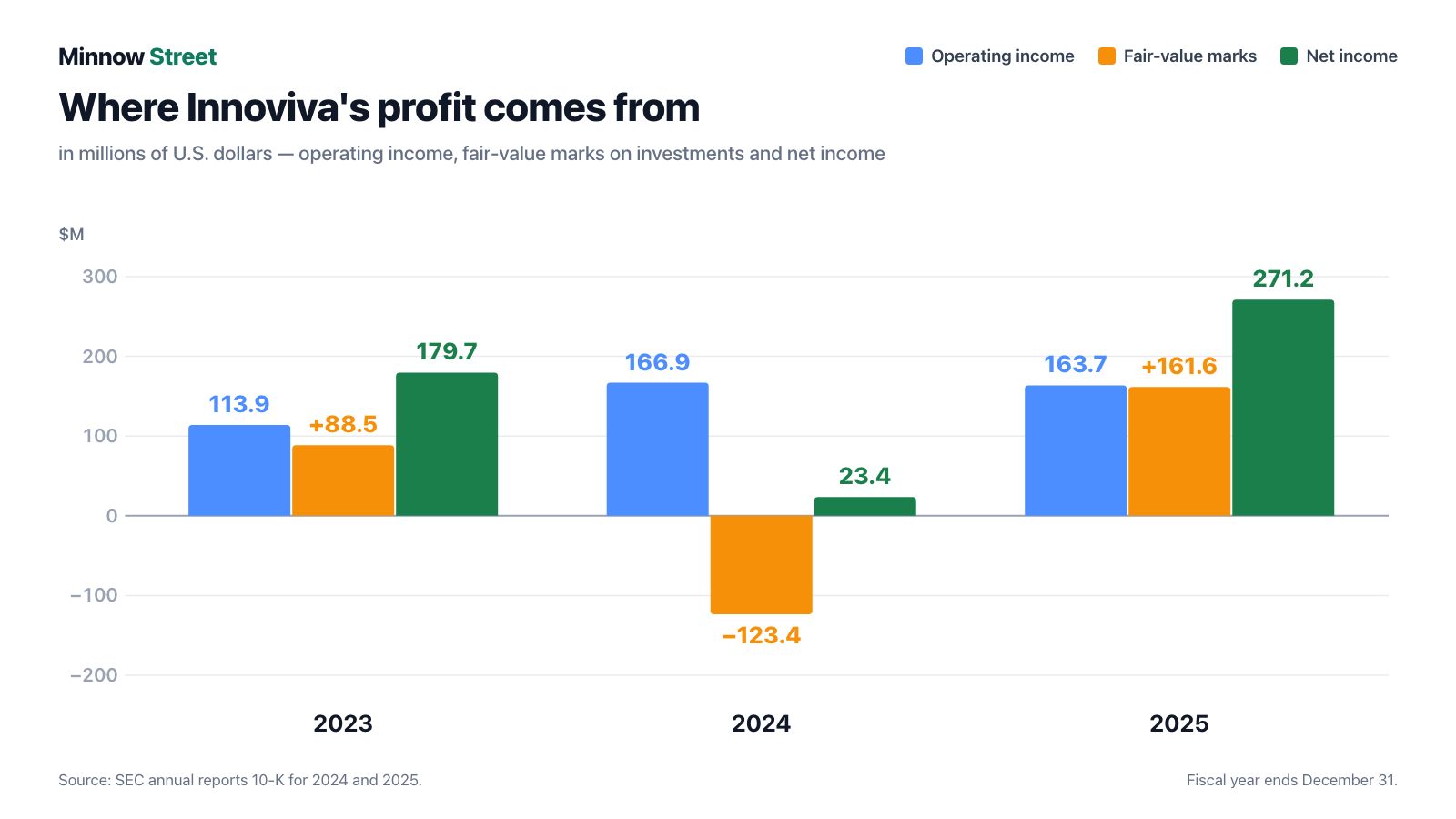
The numbers are unambiguous. In 2025 the marks contributed plus $161.6 million to $326.9 million in pre-tax income — just under half. In 2024 they pulled the other way at minus $123.4 million, cutting $166.9 million of operating income down to $23.4 million at the bottom. In 2023 they helped by $88.5 million.
The current year makes it starker still. In the first quarter of 2026, Innoviva produced $38.2 million in operating income — and reported net income of $186.6 million, or $2.52 per basic share. Of $234.6 million in pre-tax income, $191.2 million came from fair-value marks. In the prior-year quarter the same mechanism ran backwards: $41.4 million in operating income, marks of minus $78.8 million, and a net loss of $46.6 million, or $0.74 per share. Two quarters, essentially the same business, a difference of more than $233 million in the final line.
The company names the risk in its annual report with striking candor:
"Once an investment is made, we may fail to value it accurately, properly account for it in our consolidated financial statements, or successfully divest it or otherwise realize the value which we originally invested or have subsequently reflected in our consolidated financial statements."
— Innoviva, Inc., SEC annual report 10-K for 2025, Item 1A "Risk Factors"
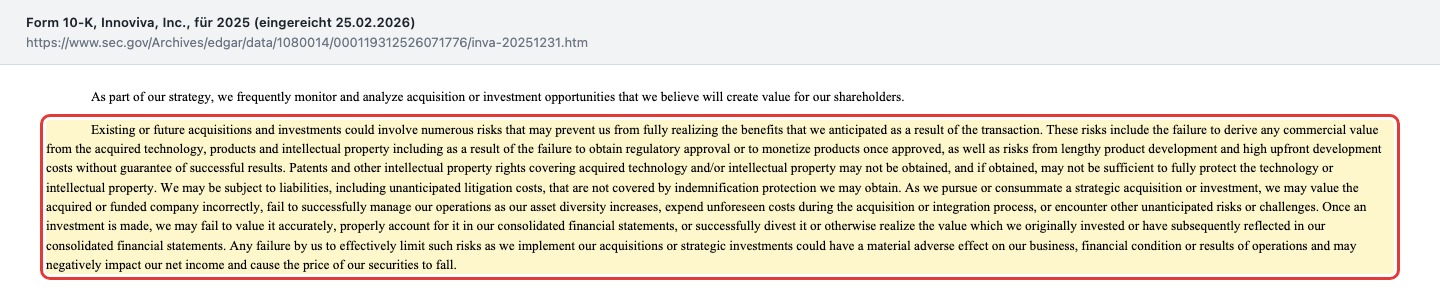
Remember the mechanism: a profit produced by a valuation is a promise, not a receipt.
Uncomfortable truth no. 2: the marked-up company lives off the one marking it up
So whose share price is it? The filings name it openly. It is Armata Pharmaceuticals, a clinical-stage biotech developing bacteriophages — viruses that attack bacteria selectively and are meant to help against antibiotic-resistant infections.
Innoviva is not simply a shareholder there. It is large shareholder and principal creditor in one. The quarterly report lists the positions as of March 31, 2026 item by item:

Add it up: 25,076,769 shares at a fair value of $256.8 million, 10,653,847 warrants ($94.6 million), a convertible note with a $30.1 million principal carried at $148.3 million, and term loans of $85.1 million principal at 14 percent interest, carried at $103.7 million. Together: $603.4 million. Ownership on the same date was 68.4 percent. Fifteen months earlier, on December 31, 2024, those same positions were carried at $163.9 million. The value has nearly quadrupled without Innoviva selling a single share.
And how is Armata doing? Innoviva reports its investee's figures on a one-quarter lag. For the quarter ended December 31, 2025, it shows Armata with $1.1 million in revenue and a net loss of $124.3 million. As of September 30, 2025, Armata's current assets of $16.9 million faced current liabilities of $140.0 million. Most of those liabilities are owed to — Innoviva.
Picture it this way: you lend your neighbor money so he can keep building his house. Because construction advances, the appraised value of the house rises. You book that higher appraisal as profit — and lend him the next installment out of it. That is exactly what happened most recently on May 12, 2026, after the last quarterly report:

The same filing puts beneficial ownership, including warrants and conversion rights, at 55,467,459 shares, or 82.7 percent, based on 36,695,155 Armata shares outstanding as of April 17, 2026. To be fair: Innoviva states expressly in its annual report that it has significant influence over Armata but not control, which is why Armata is not consolidated. The structure is disclosed, audited and lawful. It is simply not an ordinary shareholding — and anyone extrapolating Innoviva's profit is extrapolating Armata's share price.
How closely investments and governance are woven together at Innoviva shows in a second filing from the same month. On May 12, 2026, two members of the board resigned to focus on Syndeio BioSciences — a company into which Innoviva has itself put $30.0 million in convertible notes and which, according to the Form 8-K filed May 18, 2026, it "anticipates continuing to support." The filing states expressly that the resignations did not relate to any disagreement; on May 18, 2026, Josephine Linden joined the board, previously a partner at Goldman Sachs after more than 25 years with the firm. None of this is unusual for an investment holding. But it describes rather well what Innoviva has become alongside the royalty business.
Uncomfortable truth no. 3: the most reliable income is no longer growing
Back to floor one. The GSK royalties are the company's steadiest income — and they are slipping. $250.3 million gross in 2025 after $255.6 million in 2024. In the first quarter of 2026 the figure was $58.6 million against $61.3 million a year earlier. All of the revenue growth now comes from the company's own products.
That would matter less if Innoviva had any influence. It does not, and it says so:
"Currently, we derive the majority of our revenues from GSK and our near-term success depends in large part on GSK's ability to successfully develop and commercialize the products in the respiratory programs partnered with GSK."
— Innoviva, Inc., SEC annual report 10-K for 2025, Item 1A "Risk Factors"

Competition adds to it: the filing notes that the FDA published draft guidance for generic versions of both active-ingredient combinations back in 2016 and 2020. Floor two has a concentration of its own — the three largest customers accounted for 24, 22 and 22 percent of net product sales in 2025. These are specialty distributors through which hospitals buy; Innoviva considers the loss of any one of them manageable, because volumes would move to the others. But it is still three names for two-thirds of a business.
Uncomfortable truth no. 4: the denominator grows faster than the numerator
Earnings per share have two components, and the second rarely gets attention. As of December 31, 2024, there were 62,665,000 Innoviva shares. A year later there were 74,636,000 — up roughly 19 percent in twelve months. The cause was the 2025 convertible note, which matured in August 2025 and was settled largely in stock. Picture it: the cake is the same size; more slices were simply cut from it.
The next round is already in the filing. The 2028 convertible notes, with a $261.0 million principal, convert at 38.1432 shares per $1,000 — roughly 9.96 million additional shares, more than 13 percent on top of the 73,808,749 outstanding on April 30, 2026. The initial conversion price is about $26.22. The quarterly report already shows the math openly: 84,849,000 diluted shares against 74,160,000 basic in the first quarter of 2026. That is why $2.52 in basic earnings per share appears next to $2.22 on a diluted basis.
Working against that is a repurchase program of up to $125.0 million authorized by the board on November 3, 2025. Through March 31, 2026, it had bought back 1,198,921 shares for $25.0 million, of which 971,066 shares for $20.4 million in the first quarter of 2026 alone. That is a genuine counterweight — but a smaller one than the increase the notes can bring.
Valuation — which profit do you believe?
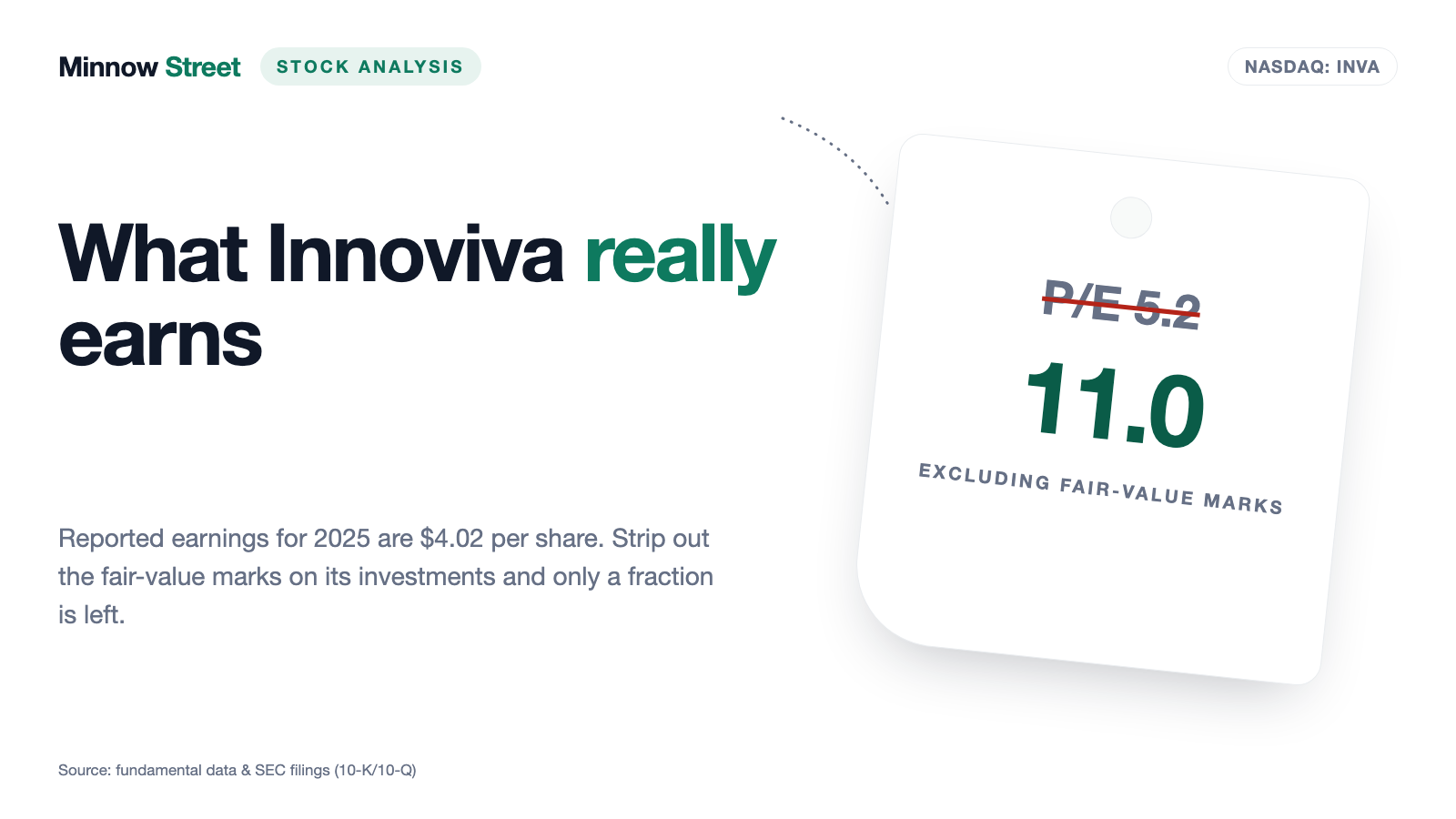
At Innoviva, valuation is not an arithmetic question but a decision. Use the reported 2025 earnings of $4.02 per share and the stock is dirt cheap. Use what the business earns without the fair-value marks and it is normally valued.
Because daily prices say nothing about the worth of a company, we take a dated anchor from a mandatory filing: Innoviva repurchased 971,066 of its own shares for $20.4 million in the first quarter of 2026 — an average of $21.06 per share, as stated in the filing. Against reported earnings of $4.02, that is a price-to-earnings ratio of 5.2. Against the 2026 analyst estimate of $1.91 per share (data as of July 24, 2026), it is 11.0. Both figures are correct; they simply answer different questions.
The estimate itself is telling. It sits far below what was actually reported for 2025 — because it models only the business and leaves the marks out. The professionals' view of this stock therefore says essentially what this analysis says. One has to add how narrow that view is: according to fundamental data there is exactly one analyst estimate on file (price target $35.50, data as of July 24, 2026). A consensus of one voice is not a consensus; it is an opinion.
There is a third route, and for this company it is the most revealing: break the market value into its parts. Innoviva owns cash and an investment portfolio whose values are on the balance sheet. Subtract both, add back the debt, and what remains is the price the market pays for the operating business.
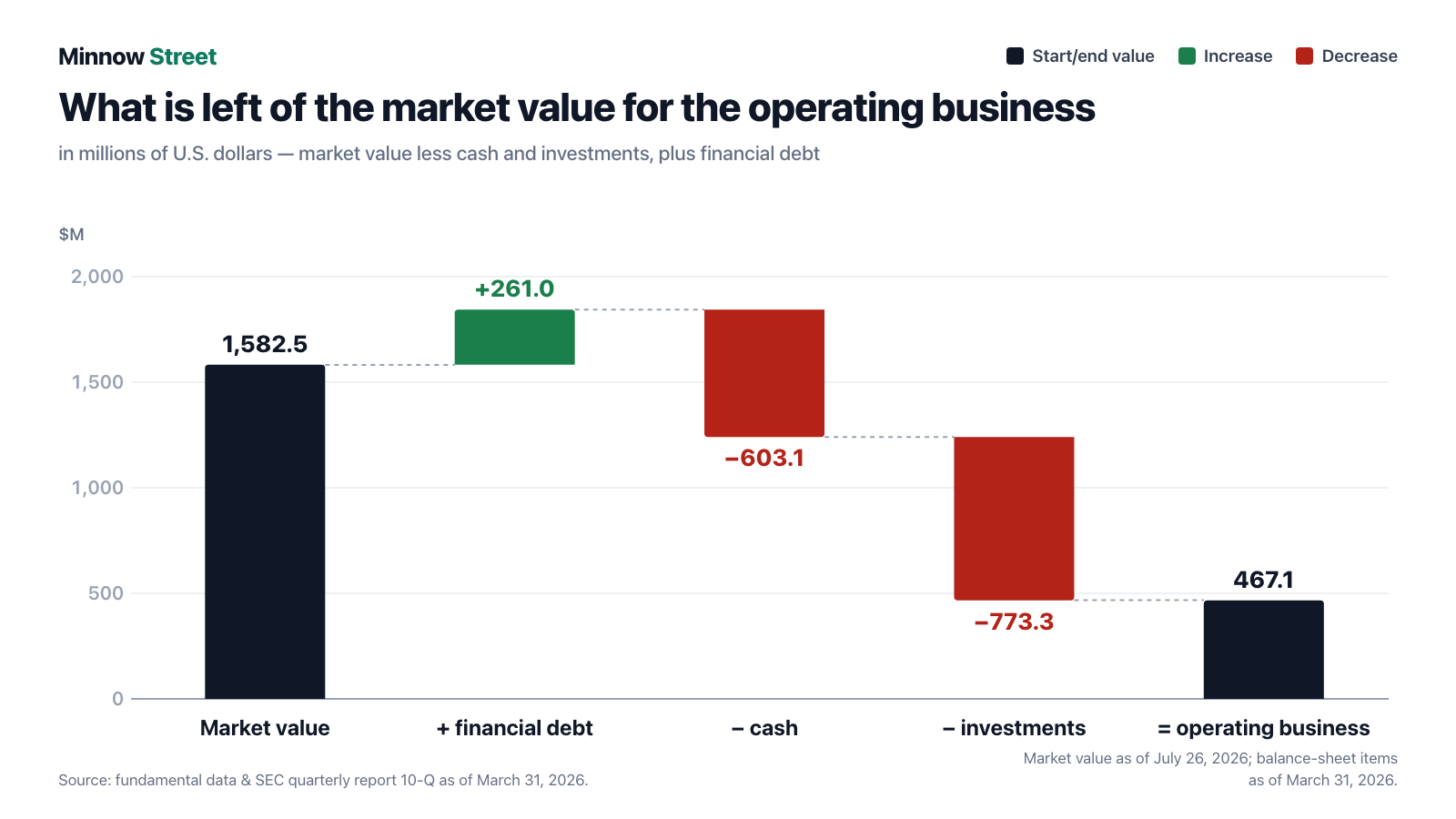
The result is striking: roughly $467 million for a business that produced $163.7 million in operating income in 2025 — just under three times operating income. That sounds very cheap, and it is cheap, but it carries an assumption: that the $773.3 million of investments really is worth $773.3 million. If Armata's share price falls, that number falls with it — and the apparently cheap price for the business is suddenly an ordinary one. That is precisely what the fine print quoted above warns about.
One final caution: metrics built on profit are systematically distorted at this company. Not only the 119.9 percent net margin, but also return on equity (50.7 percent) and the price-to-earnings ratio include the marks. At Innoviva, only revenue, operating income, operating cash flow and the balance sheet are dependable.
Opportunities and risks at a glance
What speaks for Innoviva:
- A royalty business with no costs of its own: $250.3 million gross from GSK in 2025, with 159 employees group-wide and a gross margin of 74.1 percent (data as of July 24, 2026).
- The company's own product business is growing fast: $172.1 million in net product sales in 2025 after $97.5 million (2024) and $60.6 million (2023); another 37 percent growth to $41.4 million in the first quarter of 2026.
- Real cash rather than book profit in the running business: $196.9 million in operating cash flow in 2025, after $188.7 million and $141.1 million — a series without swings.
- A balance sheet that is hard to attack: $603.1 million in cash as of March 31, 2026, a single financial liability of $261.0 million in convertible notes at 2.125 percent maturing only in March 2028, an equity ratio of 73.05 percent and an Altman Z-score of 11.75.
- New products moving into commercialization: ZEVTERA in the market since the third quarter of 2025, NUZOLVENCE approved on December 12, 2025 and announced for the second half of 2026.
- Capital return has begun: a $125.0 million repurchase program since November 3, 2025, of which $25.0 million had been used by the end of March 2026.
What speaks against it:
- Reported profit largely measures prices: $161.6 million of $326.9 million in 2025 pre-tax income and $191.2 million of $234.6 million in the first quarter of 2026 came from marks that move no cash.
- A concentration of $603.4 million in a single name (as of March 31, 2026), at 68.4 percent ownership of a company that reported a $124.3 million loss on $1.1 million of revenue in the quarter ended December 31, 2025.
- Innoviva is both creditor and owner there: a $30.1 million convertible note and $85.1 million in loans at 14 percent, plus another $25.0 million on May 12, 2026 — the markup and the funding come from the same hand.
- The steadiest income is no longer growing: gross royalty revenue of $250.3 million in 2025 after $255.6 million in 2024; $58.6 million in the first quarter of 2026 after $61.3 million. Innoviva has no influence over marketing or sales.
- Dilution: the share count rose about 19 percent in 2025; the 2028 convertible notes can add another 9.96 million shares, more than 13 percent above the April 30, 2026 count.
- Customer concentration in the product business: the three largest customers accounted for 24, 22 and 22 percent of net product sales in 2025.
- Short interest stood at 12.05 percent of the float (data as of July 24, 2026) — part of the market is explicitly betting against this construction.
A human conclusion
Back to the bottom-line trap. Its problem is not that the last line lies — it does not. Innoviva's statements are audited, the valuations are disclosed, the risk is named in the filing, and the Armata structure appears in every report. The problem with the trap is that it answers a question we never asked. "What was left over?" is not the same as "What did the company earn?" At Innoviva those two questions diverge further than at almost any other company of this size.
And then there is the other half, which nearly disappears in the excitement about book profits: Innoviva is a thoroughly decent business. $411.3 million in revenue, $163.7 million in operating income, $196.9 million in real cash flow, $603.1 million in the bank, $261.0 million in cheap debt — and 159 people carrying all of it. Whoever sees only the marks overlooks this company just as badly as whoever sees only the profit overrates it.
So the honest question is not "Is a price-to-earnings ratio of 5.2 cheap?" but this: do you want to own a licensor, a hospital pharma business and a venture investor all at once — and do you trust the venture investor to turn $603.4 million of carrying value into actual money one day? If yes, you have a thesis, and the filings give you four clean checkpoints: product revenue, gross royalty revenue, diluted share count and the fair-value line. If no, what you had was a pretty last line. What you make of it is your decision. And that is exactly as it should be.
Sources
Every original document used in this analysis, so you can read it yourself:
- Innoviva, Inc. — SEC quarterly report 10-Q as of March 31, 2026 (filed May 6, 2026)
- Innoviva, Inc. — SEC annual report 10-K for 2025 (filed February 25, 2026)
- Innoviva, Inc. — SEC Schedule 13D/A no. 15 on Armata Pharmaceuticals (filed May 13, 2026)
- Innoviva, Inc. — SEC Form 8-K filed May 18, 2026: resignation of two directors effective May 12, 2026 and the election of Josephine Linden to the board.
- Innoviva, Inc. — SEC annual report 10-K for 2024 and all other filings: EDGAR overview for CIK 0001080014 (sec.gov)
- Fundamental data (metrics, valuation, analyst estimate; data as of July 24 and 26, 2026), reconciled with the SEC filings.
- Scanner lists: our in-house stock scanner, as of July 26, 2026; the lists are recalculated daily.
Transparency & disclaimer: this analysis is a journalistic contextualization of publicly available information. It is not investment advice, not a financial analysis in the regulatory sense and not a solicitation to buy or sell securities. Stock investments carry substantial risk up to and including total loss. All information without warranty; the data cut-off is noted in the text. At the time of publication the author holds no position in Innoviva shares.
Our Bottom Line at a Glance
- Royalty business positive
- The GSK royalties are a business without a factory: Innoviva carries neither selling nor manufacturing costs and collects 15 percent on the first $3.0 billion in annual net sales of RELVAR/BREO ELLIPTA plus 6.5 to 10 percent on ANORO ELLIPTA. That produced $236.5 million net of amortization in 2025. Group gross margin was 74.1 percent and the operating margin 40.1 percent (data as of July 24, 2026).
- Quality of earnings negative
- Reported profit largely measures share prices, not operations. In 2025, $161.6 million of $326.9 million in pre-tax income came from fair-value marks; in the first quarter of 2026 it was $191.2 million of $234.6 million. In the prior-year quarter the same line turned negative at minus $78.8 million and converted $41.4 million of operating income into a net loss of $46.6 million. Extrapolating earnings per share here means extrapolating a share price.
- Armata concentration negative
- As of March 31, 2026, $603.4 million of $773.3 million in carried investments sat in a single name, at an ownership stake of 68.4 percent. Armata itself reported $1.1 million in revenue and a $124.3 million net loss for the quarter ended December 31, 2025. Innoviva is also its principal creditor and advanced a further $25.0 million on May 12, 2026, lifting beneficial ownership to 82.7 percent.
- Dependence on GSK negative
- The 2025 annual report says it outright: the majority of revenue comes from GSK, and near-term success depends largely on GSK's commercialization. Innoviva has no influence over marketing or sales. Gross royalty revenue slipped to $250.3 million in 2025 (2024: $255.6 million) and to $58.6 million in the first quarter of 2026 from $61.3 million a year earlier — all recent growth came from the company's own product business.
- Balance sheet and liquidity positive
- As of March 31, 2026, $603.1 million in cash faced a single financial liability: the 2028 convertible notes with a $261.0 million principal at 2.125 percent interest, maturing only in March 2028. Equity stood at $1,341.7 million, the equity ratio at 73.05 percent and the Altman Z-score at 11.75 (data as of July 24, 2026). Operating cash flow was $196.9 million in 2025.
- Valuation neutral
- Against reported 2025 earnings of $4.02 per share, the average buyback price of $21.06 documented in the quarterly report implies a price-to-earnings ratio of 5.2 — against the single available analyst estimate of $1.91 for 2026 it is 11.0. Subtract cash and investments from the market value of about $1,582.5 million (data as of July 26, 2026) and add back the debt, and roughly $467 million is left for an operating business that produced $163.7 million in operating income in 2025.
Innoviva is two companies in one shell: a highly profitable royalty and medicines business with $411.3 million in revenue, $163.7 million in operating income and $196.9 million in operating cash flow in 2025 — and an investment vehicle whose largest position is $603.4 million in a clinical-stage biotech company that Innoviva itself funds. The first company delivers cash; the second delivers the headline: $161.6 million of $326.9 million in 2025 pre-tax income and $191.2 million of $234.6 million in the first quarter of 2026 came from fair-value marks. The balance sheet, with $603.1 million in cash against only $261.0 million in convertible notes, is beyond question. Whoever buys here has to decide which of the two companies is being valued. Not investment advice.
What Our Rating Means
Open questions
The business works in principle, but one material question is open. As long as it stays open, our findings do not carry a quality verdict.
The operating business clearly works: royalty income without selling costs, a 74.1 percent gross margin, $196.9 million in operating cash flow in 2025 and a balance sheet carrying $603.1 million in cash against $261.0 million in convertible notes — this is not a fragile company. Yet one material operating question remains open, and it is unusually large: the reported result is generated mostly outside the business. In 2025, $161.6 million of $326.9 million in pre-tax income came from fair-value changes; in the first quarter of 2026 it was $191.2 million of $234.6 million, and the driver is Armata — a company that reported a $124.3 million loss on $1.1 million of revenue in the quarter ended December 31, 2025 and whose loans Innoviva itself provides. That is not an existential issue for Innoviva; cash covers the single bond more than twice over. But it makes earning power hard to measure. Hence yellow: demonstrated operating strength, unprovable repeatability of the reported profit. The decision is yours.
A journalistic assessment by our editorial team at the time of the deep dive, based on public sources — not investment advice and not a solicitation to buy or sell. Your personal circumstances (investment goals, risk capacity, taxes) cannot be taken into account. What our levels mean, how verdicts are formed, and what conflicts of interest exist →
Worth Noting
- Innoviva reached our research list through our in-house stock scanner: the stock appears in the U.S. selection of the list "Fundamental Rank (A / A+)", which counted 38 U.S. hits on July 26, 2026 and displays at most 25 of them. On the same day INVA appeared in 15 scanner lists, among them "Stan Weinstein: Stage 2", "Power Trend", "Above 50- and 200-day SMA" and the EBIT margin ranking. These lists are recalculated daily.
- Risk of confusion: Innoviva, Inc. (CIK 1080014) was named Theravance, Inc. until January 2016 and Advanced Medicine, Inc. before that. It is not the same company as Theravance Biopharma, a separate entity spun out in 2014 with its own SEC file number. The metrics also need care: because fair-value marks sit inside profit, the net margin stood at 119.9 percent as of July 24, 2026 — an arithmetic side effect, not a business achievement.
- Valuation figures are dated and evergreen: the $21.06 anchor is not a daily price but the average price of share repurchases in the first quarter of 2026 as stated in the quarterly report (971,066 shares for $20.4 million). The cover page of the annual report supplies a second anchor: the market value of common equity held by non-affiliates on June 30, 2025 was $1.26 billion. Analyses are evergreen; daily prices are not a buy argument.
Frequently Asked Questions
Innoviva, Inc. (Nasdaq: INVA) has three sources of income. First, royalties from GSK on the respiratory medicines RELVAR/BREO ELLIPTA and ANORO ELLIPTA: $236.5 million net of amortization in 2025. Second, sales of its own hospital medicines such as GIAPREZA, XACDURO and XERAVA: $172.1 million in net product sales in 2025. Third, a portfolio of healthcare stakes carried at fair value.
Because of two lines below it that are not cash. Operating income was $163.7 million in 2025. On top came $161.6 million from marking investments to fair value — mostly the higher share price of Armata Pharmaceuticals. After tax, net income was $271.2 million. In the prior year the very same line worked in reverse, at minus $123.4 million.
It is both large shareholder and principal creditor. As of March 31, 2026, Innoviva held 68.4 percent of Armata's shares; the combined positions in stock, warrants, a convertible note and term loans were carried at $603.4 million. On May 12, 2026, a Schedule 13D/A filing disclosed a further $25.0 million loan. Beneficial ownership now stands at 82.7 percent.
Very. The 2025 annual report states plainly that the majority of revenue comes from GSK and that near-term success depends largely on how well GSK commercializes the partnered products. The royalty rates are fixed: 15 percent on the first $3.0 billion in annual global net sales of RELVAR/BREO ELLIPTA, 5 percent above that, and 6.5 to 10 percent on ANORO ELLIPTA. Innoviva has no influence over marketing or sales.
No. According to fundamental data, the last distribution was in September 2015 (data as of July 7, 2026). Capital is returned through buybacks instead: on November 3, 2025, the board authorized a program of up to $125.0 million. Through March 31, 2026, 1,198,921 shares had been repurchased for $25.0 million, of which 971,066 shares for $20.4 million in the first quarter of 2026 alone.
The 2028 convertible notes, with a $261.0 million principal, convert at 38.1432 shares per $1,000, or roughly 9.96 million shares — more than 13 percent on top of the 73,808,749 shares outstanding on April 30, 2026. The quarterly report already shows the math: 84,849,000 diluted shares against 74,160,000 basic in the first quarter of 2026.
Yes, twice. According to the 2025 annual report, the company was incorporated in Delaware in November 1996, began operations in May 1997 as Advanced Medicine, Inc., was renamed Theravance, Inc. in April 2002 and Innoviva, Inc. in January 2016. Its file number with the U.S. securities regulator, the SEC, never changed: CIK 1080014. Innoviva should not be confused with Theravance Biopharma, a separate company spun out in 2014.
That depends on which profit you use. Against reported 2025 earnings of $4.02 per share, the average buyback price of $21.06 documented in the quarterly report implies a price-to-earnings ratio of 5.2. Against the single available analyst estimate of $1.91 for 2026, it is 11.0. Market value was about $1.58 billion (data as of July 26, 2026).
Found an error?
Did you spot a factual error, an outdated number, or a typo in this deep dive? Let us know briefly — your report goes straight to the editorial team.