Acacia Research: $307 Million in the Vault - and One Shareholder Holding the Key
At first glance Acacia Research looks like a bargain: $307.5 million in cash as of March 31, 2026, a book value of $5.47 per share - and a share price below it. The filings with the U.S. securities regulator, the SEC, tell the other half of the story. In 2025 a single licensee delivered 88 percent of patent revenue; in the first quarter of 2026 that segment booked $0.7 million, down from $69.9 million a year earlier. The four operating businesses earned $31.1 million in 2025 while the head office cost $24.7 million. And above all of it sits Starboard Value with 63.4 percent of the stock. Let us read what the vault actually holds - and who decides about it.
 Thomas Mücke
Founder & Publisher
Thomas Mücke
Founder & Publisher
Chart
Interactive price chart (TradingView).
Note: pure fact-based analysis, not investment advice and not a solicitation to buy or sell. All figures without guarantee.
The vault trap: why a full safe is not yet a good stock
There is an image that clicks into place instantly: a vault, wide open, filled to the top. When a company costs less on the stock market than its own books say it is worth, that feels like a safety net - as if you could no longer fall through the floor. Call it the vault trap. It works so well because it is not wrong, merely incomplete: the vault is real. It just does not answer two questions - who holds the key, and what does the guard cost?
Acacia Research Corporation (Nasdaq: ACTG) is a textbook case. As of March 31, 2026 the balance sheet held $307.5 million in cash, equity stood at $528.5 million and book value at $5.47 per share. The market value was roughly $450 million (data as of July 25, 2026). In other words: cheaper than its own balance sheet.
Before that image blocks the view, let us make a deal. We will read the original documents filed with the U.S. securities regulator, the SEC: the annual report (10-K) for 2025 filed on March 12, 2026, the quarterly report (10-Q) for the period ended March 31, 2026 filed on May 7, 2026, and the current reports (8-K) through the end of July 2026. They show where the 2025 profit came from, what the head office costs and who owns the company. Keep one sentence in mind along the way: substance is not earnings. A vault is only worth as much as access to it.
What Acacia Research actually does - four businesses under one roof
For decades Acacia Research was what the industry politely calls a patent licensing house and less politely a patent troll: a company that buys or controls patents, sues alleged infringers and turns settlements into license fees. That business still exists, but today it is only one of four segments. The annual report now describes the company as a "disciplined value-oriented acquirer and operator of businesses". In plain language: a parent company that manufactures almost nothing itself but owns other businesses and collects their profits.
As of March 31, 2026 there are four businesses under that roof:
- Patent licensing (Acacia Research Group): the legacy core. Revenue in the first quarter of 2026: $0.7 million. Seven full-time employees as of December 31, 2025.
- Industrial printers (Printronix): line matrix printers - rugged impact printers for factory floors, hospitals and logistics centers, plus inked ribbons as consumables. Revenue in the first quarter of 2026: $7.2 million. 128 employees.
- Oil and gas (Benchmark Energy): production in the Anadarko Basin in Oklahoma and Texas, following the acquisition of Revolution Resources in April 2024. Revenue in the first quarter of 2026: $18.7 million. 45 employees.
- Plastics manufacturing (Deflecto, acquired in October 2024): literature holders, office supplies, air vents, vinyl floor mats, bicycle reflectors, warning triangles and mud flaps for heavy trucks. Revenue in the first quarter of 2026: $27.7 million. 793 employees - by far the largest segment by headcount.
In total the group employed 986 full-time staff and 76 contractors as of December 31, 2025. Thirteen of them work at the New York head office. Those 13 matter - we will come back to them.
And there is a fifth participant who appears in no segment table: Starboard Value LP, an activist hedge fund based in New York. Starboard owns 61,123,595 shares, roughly 63.4 percent of the common stock (as of March 9, 2026). The annual report explicitly calls the fund the "controlling shareholder" and describes the relationship as strategic: Starboard supplies contacts, industry experts and help sourcing acquisition targets - formalized since December 2023 in a services agreement under which Starboard is reimbursed for expenses and charges no fee.
That frames the central tension of this analysis, and it runs through every chapter: the vault is real - but the earnings meant to fill it hung on a single contract in 2025, and the key is controlled by a shareholder holding two thirds of the votes.
How the stock landed on our desk
We run several thousand stocks through our scanners every day. As of July 25, 2026 Acacia Research ranks 46th among the 81 U.S. hits in our Big Earnings Surprise screen, with a relative strength rating of 63 - meaning the stock outperformed 63 percent of all stocks we track over the past twelve months. To repeat it yourself: open the scanner, set the country filter to U.S. and work through the list. These lists are recalculated daily; a rank is a dated snapshot, not a property of the company.
What the filter looks for: companies whose reported earnings per share came in well above the analyst estimate - repeatedly. The idea comes from momentum research: whoever surprises once often surprises again, because estimates lag the business.
For Acacia the run of recently reported quarters reads as follows (fundamental data, as of July 25, 2026): plus 22.2 percent for the quarter ended March 31, 2026 (reported on May 7, 2026), plus 121.4 percent for the fourth quarter of 2025 (March 12, 2026) and plus 40.0 percent for the third quarter of 2025 (November 5, 2025). Honesty requires the rest: the quarter before that, ended June 30, 2025, came in 20 percent below the estimate. So the streak is not a spotless success story but a run with a hole in it - a good reason to look at the numbers instead of trusting the rank.
Because here is the point at which a surprise measures something other than most people assume. For the first quarter of 2026 analysts had expected -$0.09 per share; the reported figure was -$0.07, hence the 22.2 percent. Except those -$0.07 are an adjusted number. Under U.S. accounting rules (GAAP) the books showed a loss of $0.16 per share. The current report filed on May 7, 2026 lists both figures side by side:

This is not an accusation - adjusted metrics are permitted and common, and Acacia presents the reconciliation properly. But it changes what the scanner hit means. Remember the principle: an earnings surprise measures the distance to an expectation, not the distance to the balance sheet. We took the same mechanism apart in our analysis of Encore Capital, another hit from the same screen.
The numbers over the years - what genuinely impresses
Let us start with what is good, because there is a fair amount of it. 2025 was the best year in a long time. Revenue rose from $122.3 million to $285.2 million, pre-tax income swung from minus $38.1 million to plus $31.3 million, and the bottom line showed $21.7 million of profit after a $36.1 million loss the year before.
More important than the profit is the cash, because cash is harder to dress up: operations generated $75.2 million in 2025, and after $16.7 million of investment $58.5 million of free cash flow remained. Cash grew from $273.9 million to $306.7 million - and further to $307.5 million by March 31, 2026. A company that earns money and actually collects it: that is the foundation the vault rests on.
The balance sheet is solid too. As of March 31, 2026: total assets of $755.9 million, liabilities of $188.6 million, shareholders' equity of $528.5 million (plus $38.7 million of noncontrolling interests). Debt is modest and sits where it belongs - at the subsidiaries: $59.5 million drawn on Benchmark Energy's credit facility and $31.0 million at Deflecto. The Benchmark facility carries a $150 million commitment, cost a weighted average of 7 percent as of March 31, 2026 and, after an amendment on November 3, 2025, runs until April 17, 2029. No maturity pressure, then, and no refinancing risk next year.
And the operating businesses? Each delivers a solid small amount. Their 2025 operating income: patents $19.4 million, energy $10.2 million, industrial $1.2 million and manufacturing $0.3 million. Together $31.1 million. Hold on to that figure - it is the yardstick for everything that follows.
What the filings say - four uncomfortable truths
Uncomfortable truth No. 1: the 2025 profit came from a single licensee
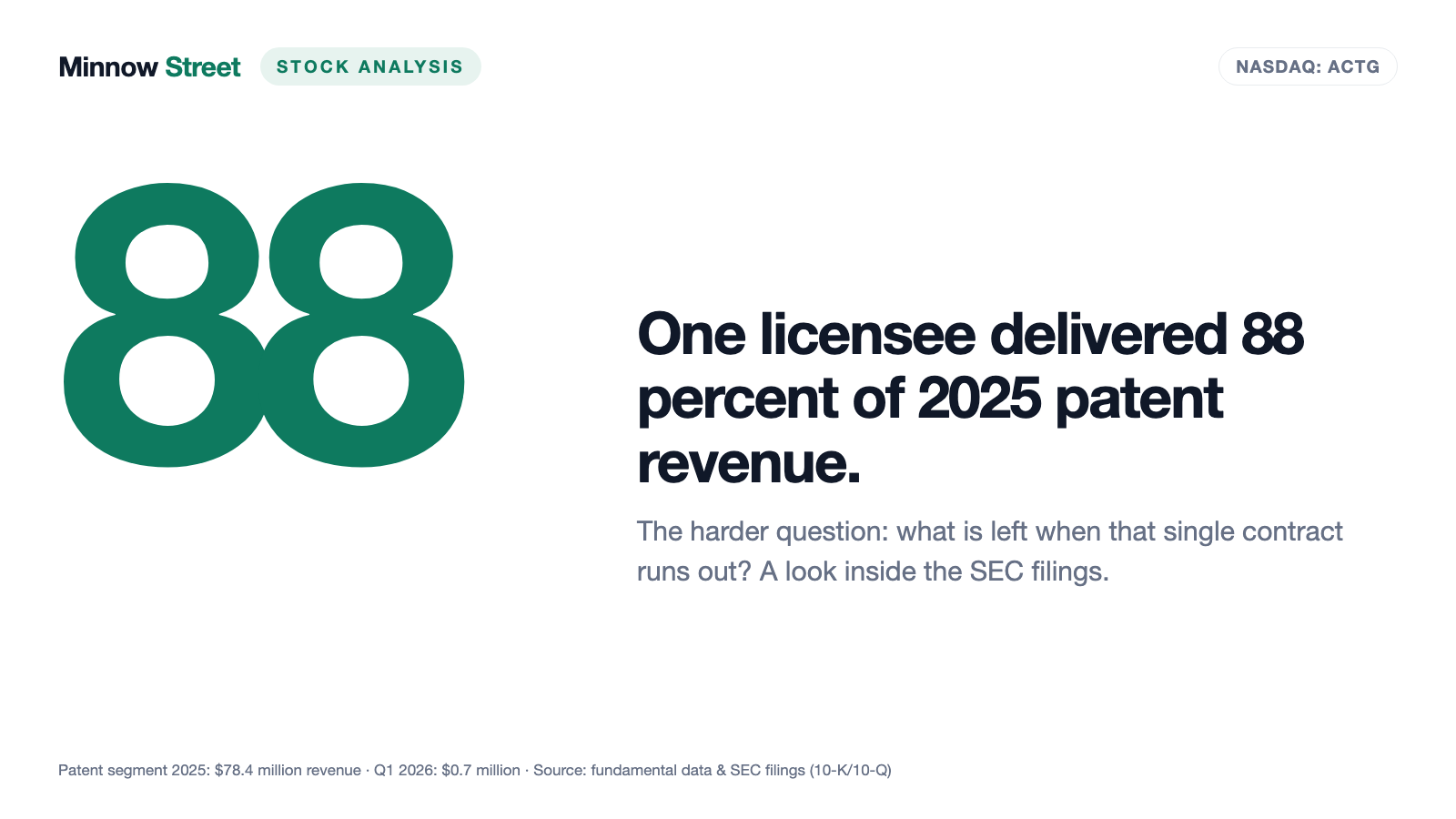
The patent segment was by far the biggest profit contributor in 2025: $78.4 million of revenue after $19.5 million the year before, up 301 percent. Of that, $76.9 million came from one-time, paid-up license agreements - the classic settlement in which a company pays once and is left alone afterwards. Six new license agreements were signed in total (2024: nine).
How those six agreements are distributed appears in the notes, and the figure is as short as it is unambiguous:
"One licensee individually accounted for 88% of revenues recognized during the year ended December 31, 2025. Three licensees individually accounted for 35%, 17% and 10% of revenues recognized during the year ended December 31, 2024."
- Acacia Research Corporation, Form 10-K for 2025, notes, Note 2 (Concentrations)

And because $69.9 million of the $78.4 million was already booked in the first quarter of 2025, the conclusion follows: the entire 2025 profit sits inside a single quarter, and that quarter sits inside a single contract. Year-end receivables show the same pattern - three licensees accounted for 74, 15 and 11 percent.
Fairness requires this: it is the nature of the business, and Acacia says so. Patent revenue "historically have fluctuated quarterly, and can vary significantly period to period", the filing notes. The problem is not the fluctuation but what it does to valuation: a year with $78 million of patent revenue and a year with $19 million are two entirely different companies - and nobody can predict which one you are buying.
Uncomfortable truth No. 2: the head office costs 79 percent of what the businesses earn
Back to the $31.1 million of segment operating income for 2025. Directly below it in the segment table sits a single line: "Parent general and administrative expenses" - the holding company's own overhead. It came to $24.7 million.
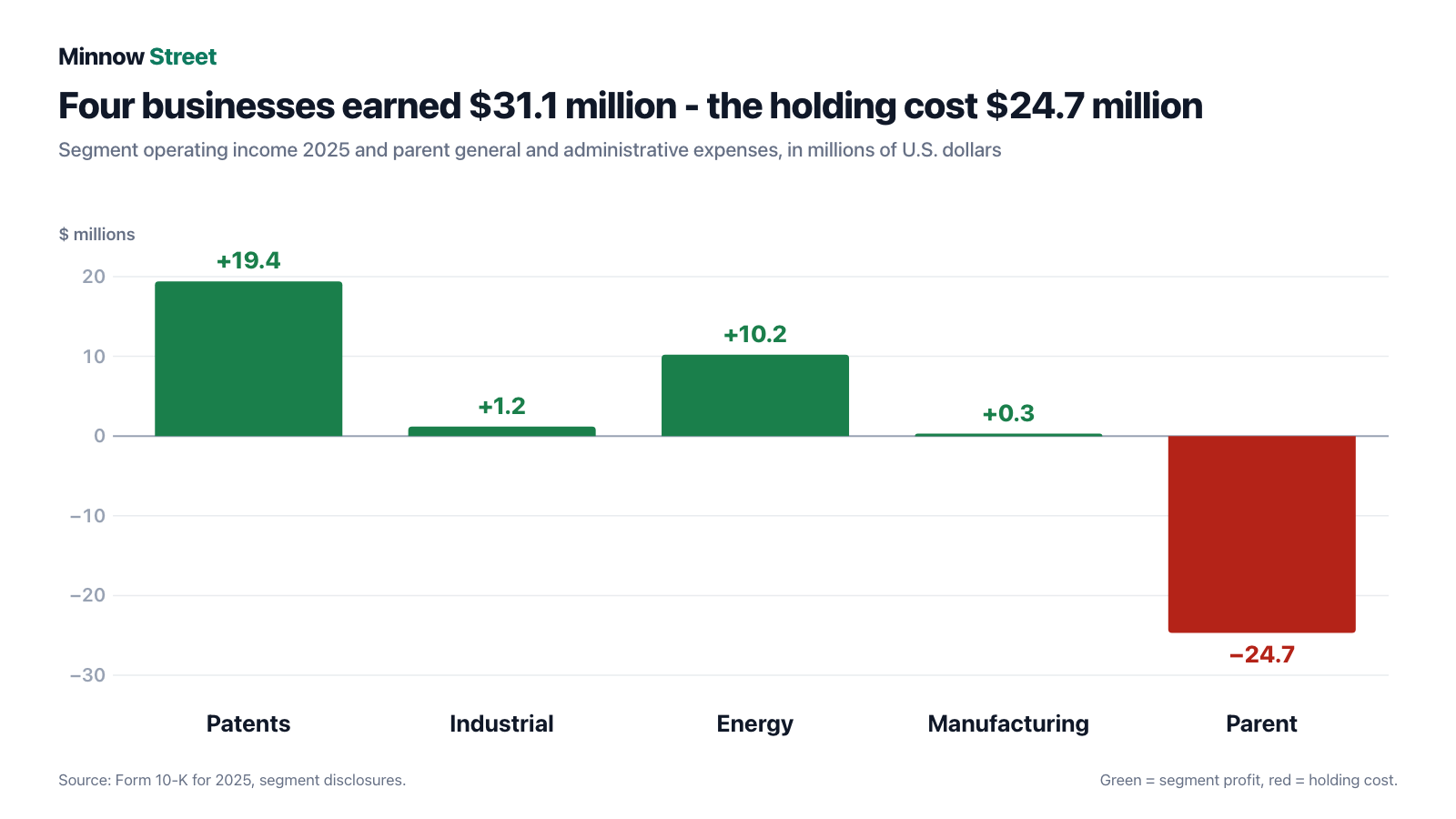
That is 79 percent of the entire segment profit, carried by 13 people at the parent company. What remained was $6.4 million of operating income on $285.2 million of revenue - an operating margin of 2.2 percent in the best year in ages.
The year before was worse: in 2024 the head office cost $30.3 million while the four segments together lost $2.6 million, producing a $32.9 million operating loss. And in the first quarter of 2026 the holding company cost $6.7 million, up from $4.8 million a year earlier, a 41 percent increase, while the segments together lost $1.6 million.
To be fair about it: a holding company that buys businesses needs a team that finds and vets them - analysts, lawyers, deal people. Those costs arrive before the first acquisition pays anything. The question is not whether the head office costs money but whether the acquisitions ever earn enough to pay for it. So far the answer in four of five years has been no. The same question applies to every holding company - we worked through it in our analysis of Biglari Holdings, another house in which one large shareholder makes the capital allocation calls.
Uncomfortable truth No. 3: in the first quarter of 2026 the patent segment booked $0.7 million - and bought nothing new
The first quarter of 2026 is the reality check. Group revenue fell from $124.4 million to $54.2 million, down 56 percent. A $38.3 million operating profit became an $8.4 million operating loss, and $24.3 million of net income became a net loss of $15.7 million, or $0.16 per share.
The entire decline comes from one segment:
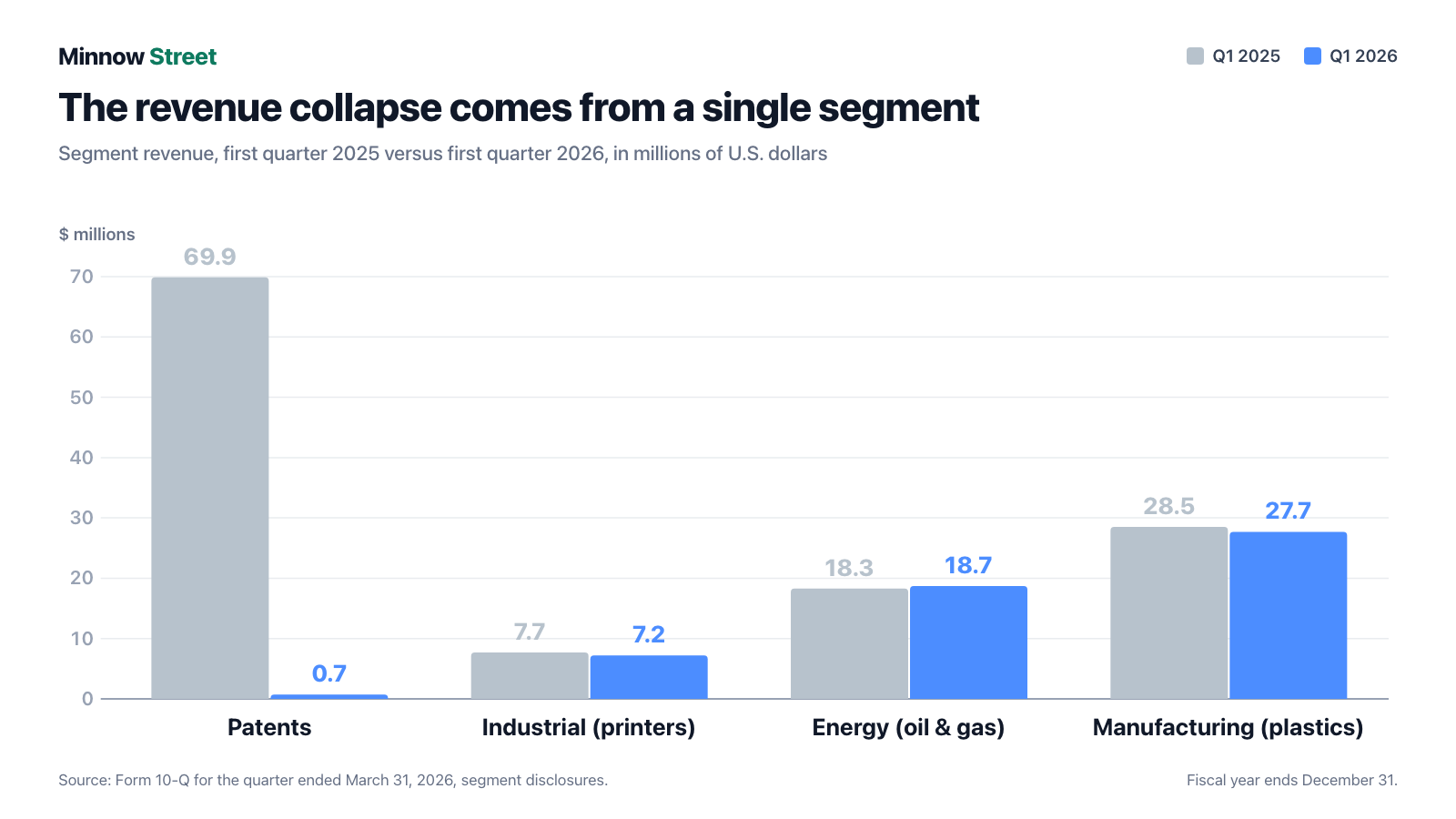
The three operating businesses booked $53.5 million together, down from $54.5 million in the prior-year quarter - industrial $7.2 million after $7.7 million, energy $18.7 million after $18.3 million and manufacturing $27.7 million after $28.5 million. A decline of 1.8 percent, in other words a standstill. The patent segment, by contrast, fell from $69.9 million to $0.7 million and produced a $7.4 million operating loss, because those $0.7 million of revenue met $4.8 million of direct costs and $3.3 million of overhead. Patent amortization and inventor royalties keep running even when no settlement lands.
And then there is a sentence that is easy to skim past:
"During the three months ended March 31, 2026, ARG did not obtain control of any new patent portfolios. During the three months ended March 31, 2025, ARG obtained control of one new patent portfolio."
- Acacia Research Corporation, Form 10-Q for the quarter ended March 31, 2026, Note 17 (Segment Reporting)

Why it matters: for a patent licensing house, portfolio intake is what flour is to a baker. One quarter without a purchase is not a disaster - but it is not an accident either, in a business whose own filing names "Patent Portfolio Intake" as one of its significant challenges. Anyone wanting to know whether the segment has a future watches this line, not the revenue.
Uncomfortable truth No. 4: one shareholder holds two thirds - and with it the key
Now to the lock on the vault. The risk factors put it plainly:
"Starboard beneficially owns 61,123,595 shares of common stock as of March 9, 2026, representing approximately 63.4% of the common stock based on 96,475,469 shares of common stock issued and outstanding as of such date. As a result, Starboard is able to control the election of our directors and thereby determine our corporate and management policies, including potential mergers or acquisitions, asset sales … This concentration of our ownership may delay or deter possible changes in control of the Company, which may reduce the value of an investment in our common stock."
- Acacia Research Corporation, Form 10-K for 2025, Item 1A Risk Factors

What that feels like in practice was on display at the annual meeting on June 23, 2026: 86.7 million shares were represented, roughly 70 percent of them Starboard's. The say-on-pay vote passed with 79.7 million votes for and 1.1 million against, and the ratification of Grant Thornton as auditor with 85.8 million in favor. Results like that say little about approval and a lot about arithmetic.
How Starboard got there, incidentally, was not a hostile takeover but a rescue: in a recapitalization in July 2023 the fund converted 350,000 preferred shares into 9.6 million common shares and exercised 31.5 million warrants - cancelling $60 million of senior secured notes and injecting $55 million of fresh money. Since then no preferred shares and no warrants remain outstanding, and the capital structure is simple. But so is the majority: it sits in one place.
One more point belongs here. Because Acacia also holds stakes in businesses it does not operate, the filing discloses a risk you rarely read: if the company ceased to control and operate its operating businesses, it could be deemed an investment company under the Investment Company Act of 1940, with substantial regulatory consequences. It is a tail risk. But it describes well where this company stands: somewhere between a fund and a conglomerate.
Valuation: what you get and what you pay
Let us work through the order of magnitude - stating clearly which number comes from when. Market value stood at roughly $450 million (fundamental data, as of July 25, 2026; closing price of $4.66 on July 24, 2026 against 96,589,132 shares outstanding per the cover page of the quarterly report dated May 4, 2026).
Against that, from the balance sheet as of March 31, 2026: $307.5 million of cash, $14.2 million of listed equity securities and $8.1 million of loans receivable - less $90.5 million of subsidiary debt. Deduct all of that and roughly $210 million remains for the four operating businesses. Those businesses produced $31.1 million of operating income in 2025. That is roughly seven times - not expensive, if 2025 was a normal year. But 2025 was not a normal year: without the one patent contract it would have been $11.7 million, and the same calculation would read as eighteen times.
The classic ratios help only so far, for a reason that can be stated cleanly. There is no price-to-earnings ratio, because trailing twelve-month earnings are negative at -$0.19 per share (as of July 25, 2026). The price-to-sales ratio is around 2.1 - but trailing revenue contains exactly that exceptional quarter. What is reliable is the price-to-book ratio of roughly 0.85: book value per share stood at $5.47 as of March 31, 2026, and the share price sits below it.
A second anchor comes from the company itself: cash, securities and loans receivable added up to $329.9 million at quarter end, or $3.41 per share. Roughly three quarters of the market value is therefore liquidity. That is the essence of the vault trap: the number is true, and it still says nothing about when or whether that money reaches the shareholder.
Because that is exactly where things get thin. Acacia has paid no dividend since November 2015. The last repurchase program - authorized on November 9, 2023 for up to $20 million - was fully used in December 2024 with 4,358,361 shares bought back; there were no repurchases at all during 2025. The money stays in the house, waiting for the next acquisition. For a buyer betting on the discount closing, that is the decisive piece of information: there is currently no mechanism that narrows the gap between price and book value.
The professional view is correspondingly thin: the fundamental data consensus consists of a single analyst with a price target of $6.00 (as of July 25, 2026). With 63 percent of the stock locked up and roughly 33.8 million freely traded shares that is no surprise - but a consensus of one voice is not a consensus, it is an opinion.
Opportunities and risks at a glance
What speaks for Acacia Research:
- Real substance, not just book value: $307.5 million of cash and $528.5 million of equity as of March 31, 2026, plus $58.5 million of free cash flow in 2025. The vault is full and recently got fuller, not emptier.
- Three segments carry on unbothered: industrial, energy and manufacturing booked $53.5 million together in the first quarter of 2026 after $54.5 million a year earlier - flat, but not a collapse.
- Energy delivers: Benchmark Energy posted its strongest revenue quarter under Acacia ownership at $18.7 million in the first quarter of 2026 with $5.3 million of segment income; proved reserves rose to 33.0 million barrels of oil equivalent as of December 31, 2025.
- No maturity wall: the $90.5 million of debt sits at the subsidiaries, and the largest facility runs to April 17, 2029. Interest income ($2.8 million in the first quarter of 2026) and interest expense ($1.9 million) almost cancel out.
- A large shareholder with skin in the game: Starboard sits in the same boat with 61.1 million shares. If anyone can push on the cost side, it is this shareholder.
What speaks against it:
- Earning power without the exceptional year is thin: without the single patent contract the segments would have earned roughly $11.7 million in 2025 - against $24.7 million of head office cost.
- Concentration risk in the patent business: 88 percent of 2025 revenue from one licensee, no new portfolio in the first quarter of 2026, a $7.4 million segment loss in that quarter.
- No route out for the cash: no dividend since November 2015, no buyback since December 2024. The discount to book value can persist for a very long time.
- Control without a counterweight: 63.4 percent in one hand. A takeover premium is effectively impossible without that shareholder's consent; the filing itself warns this may reduce the value of the investment.
- Commodity and tariff risk in the operating businesses: the energy segment lost $10.7 million on its price hedge in the first quarter of 2026, depends on four large customers (11 to 29 percent of 2025 segment revenue) and is geographically concentrated in the Anadarko Basin; the manufacturing segment faces tariff-driven demand headwinds according to the filing.
A human conclusion, not a recommendation
Back to the vault. It is real: $307.5 million sits there, equity exceeds market value, and in good years the company earns money. Look only at that number and you see a safety net.
Read further and three things shift the picture. First: 88 percent of the best year's profit came from a single licensee - that is a lottery win with a footnote, not a business model. Second: between what the businesses earn and what reaches the shareholder stands a head office that consumed nearly four fifths of segment profit in 2025. Third: the key to the vault is held by a shareholder with 63.4 percent who pays no dividend and is currently buying back no stock.
None of that makes Acacia Research a bad company. It makes it a bet with a very specific condition: that the people at the head office earn back more than their own cost through acquisitions - and that whoever holds the majority eventually sees a reason to close the discount. Both can happen. Neither is in the filings yet.
What you make of that is your decision. And that is exactly as it should be.
Sources
- Form 10-K for fiscal year 2025, Acacia Research Corporation, CIK 0000934549, filed March 12, 2026 - Item 1 Business, Item 1A Risk Factors, segment disclosures, notes Note 2 (Concentrations) and Note 17 (Stockholders' Equity).
- Form 10-K for 2024, filed March 17, 2025 - comparative segment and parent company figures.
- Form 10-Q for the quarter ended March 31, 2026, filed May 7, 2026 - balance sheet, statement of operations, Note 12 (Fair Value), Note 17 (Segment Reporting), Note 18 (Subsequent Events).
- Form 8-K dated May 7, 2026, Exhibit 99.1 - first-quarter 2026 earnings release including the reconciliation of adjusted measures.
- Form 8-K dated June 25, 2026 - voting results of the annual meeting held June 23, 2026.
- Form 8-K dated February 6, 2026 - a director declining to stand for re-election.
- Screening, valuation and rating data: our in-house stock scanner and fundamental data (as of July 25, 2026, last trading day July 24, 2026), including the Big Earnings Surprise screen (U.S. selection, rank 46 of 81 hits, RS rating 63); the lists are recalculated daily.
This analysis is editorial commentary based on publicly available documents. It is expressly not investment advice, not a recommendation to buy or sell, and not a solicitation to buy or sell securities. Stocks can lose value substantially at any time, up to and including the total loss of the capital invested. All figures come from the SEC filings named above and from fundamental data with the stated as-of date; ratios can change with every new publication. The author holds no position in Acacia Research Corporation at the time of publication.
Our Bottom Line at a Glance
- Balance sheet and liquidity positive
- As of March 31, 2026 the books held $307.5 million of cash and $528.5 million of equity; the $90.5 million of debt sits at the subsidiaries and runs to 2029. Free cash flow came to $58.5 million in 2025. The asset base is real and recently grew larger.
- Quality of earnings negative
- The 2025 profit hung on a single licensee that accounted for 88 percent of patent revenue; $69.9 million of the $78.4 million landed in one quarter. In the first quarter of 2026 the patent segment booked $0.7 million and posted a $7.4 million operating loss. Without that one-off, earning power sits in the low tens of millions.
- Cost of the holding company negative
- Parent general and administrative expenses ran to $24.7 million in 2025 - 79 percent of the $31.1 million of total segment income; in 2024 it was $30.3 million against a $2.6 million segment loss. In the first quarter of 2026 that line rose 41 percent to $6.7 million. The superstructure still has to earn its keep.
- Ownership structure negative
- Starboard Value LP owns roughly 63.4 percent (as of March 9, 2026) and is named the controlling shareholder in the annual report. The filing itself warns that this concentration may delay or deter a change of control and reduce the value of the investment. A takeover premium is effectively impossible without Starboard.
- Operating segments neutral
- Industrial, energy and manufacturing booked $53.5 million together in the first quarter of 2026 after $54.5 million a year earlier - stable, but without growth. Benchmark Energy delivered its strongest quarter since the acquisition at $18.7 million, yet lost $10.7 million on its price hedge over the same period.
- Valuation neutral
- At roughly $450 million of market value (as of July 25, 2026) and $5.47 of book value per share (March 31, 2026) the stock trades at about 0.85 times book; on paper the four operating businesses cost around $210 million. Cheap - but with no dividend since 2015 and no buyback since December 2024, the lever that would close the discount is missing.
Acacia Research is the vault trap in its purest form: $307.5 million of cash and a book value above the share price look like a safety net, yet 88 percent of the record 2025 profit came from a single licensee, the head office consumed $24.7 million of the $31.1 million of segment income, and in the first quarter of 2026 the patent segment booked just $0.7 million. Above it all sits Starboard Value with 63.4 percent - and with no dividend since 2015 and no buyback since December 2024 there is currently no mechanism that closes the discount to book value. Not investment advice.
What Our Rating Means
Open questions
The business works in principle, but one material question is open. As long as it stays open, our findings do not carry a quality verdict.
The asset base is proven and not in dispute: $307.5 million of cash and $528.5 million of equity as of March 31, 2026, $90.5 million of debt held solely at the subsidiaries and not due until 2029, plus $58.5 million of free cash flow in 2025 — none of it points to a threat to the going concern. What is open is a purely operational question, and it carries weight: 88 percent of the record 2025 profit came from a single licensee, and in the first quarter of 2026 that segment booked just $0.7 million and acquired not a single new patent portfolio. Behind it sits a head office that consumed $24.7 million in 2025, 79 percent of the $31.1 million of total segment income — whether acquisitions ever earn that superstructure back is unproven so far. The three remaining segments do run steadily ($53.5 million of revenue in the first quarter of 2026 after $54.5 million), but they do not yet carry the holding company on their own. That is not a threat to substance, but it is not proven earnings quality either — hence yellow. The decision is yours.
A journalistic assessment by our editorial team at the time of the deep dive, based on public sources — not investment advice and not a solicitation to buy or sell. Your personal circumstances (investment goals, risk capacity, taxes) cannot be taken into account. What our levels mean, how verdicts are formed, and what conflicts of interest exist →
Worth Noting
- Acacia Research reached our research list through our in-house stock scanner "Big Earnings Surprise" (U.S. selection, rank 46 of 81 hits, RS rating 63, as of July 25, 2026). The lists are recalculated daily. One important qualification: the measured surprise refers to the adjusted earnings figure (Q1 2026: -$0.07 per share), not the GAAP number (-$0.16). The run of quarters is also not unbroken - the quarter ended June 30, 2025 came in 20 percent below the estimate.
- As-of dates differ and are stated with every figure: balance sheet and segment values as of December 31, 2025 (Form 10-K) and March 31, 2026 (Form 10-Q), share count as of May 4, 2026 (10-Q cover page), the Starboard stake as of March 9, 2026, market data as of July 25, 2026. The closing price of July 24, 2026 serves solely as a dated valuation anchor, not as an argument to buy.
- Easily confused: Acacia Research Corporation (Nasdaq: ACTG) is unrelated to similarly named consulting or real estate firms and should not be mixed up with its subsidiary Acacia Research Group, which denotes only the patent segment. The segments trade under their own brands - Printronix, Benchmark Energy, Deflecto.
Frequently Asked Questions
Acacia Research is a holding company with four segments: patent licensing (Acacia Research Group), industrial printers (Printronix), oil and gas production in the Anadarko Basin (Benchmark Energy) and plastics manufacturing (Deflecto). The original patent business contributed just $0.7 million of the $54.2 million of revenue in the first quarter of 2026. As of December 31, 2025 the group had 986 full-time employees.
In the first quarter of 2026 revenue dropped from $124.4 million to $54.2 million. The entire decline came from the patent segment, which fell from $69.9 million to $0.7 million. The three operating businesses booked $53.5 million together after $54.5 million in the prior-year quarter, down 1.8 percent. Patent revenue comes from individual settlements and therefore swings enormously.
Starboard Value LP owns 61,123,595 shares, roughly 63.4 percent of the common stock (as of March 9, 2026). The annual report calls the hedge fund the controlling shareholder: Starboard determines the election of the board and can block any acquisition or sale. Roughly 33.8 million shares are freely traded.
Neither at present. The last dividend was paid in November 2015. The $20 million repurchase program authorized on November 9, 2023 was completed in December 2024 with 4,358,361 shares; there were no repurchases in 2025. The $307.5 million of cash as of March 31, 2026 is earmarked for acquisitions.
For the first quarter of 2026 the earnings release shows a GAAP net loss of $15.7 million, or $0.16 per share, and alongside it an adjusted net loss of $6.6 million, or $0.07 per share. The adjusted figure strips out valuation effects among other items. Analyst estimates and surprise percentages refer to the adjusted measure.
Yes. Book value per share stood at $5.47 as of March 31, 2026 while market value was roughly $450 million (as of July 25, 2026) - a price-to-book ratio of about 0.85. Cash, securities and loans receivable alone totaled $329.9 million, or $3.41 per share. No mechanism to close that discount is currently visible.
Parent general and administrative expenses came to $24.7 million in 2025 according to the segment disclosures, and $30.3 million in 2024. Against that, segment operating income totaled $31.1 million in 2025 - so the head office consumed 79 percent of the entire segment profit. In the first quarter of 2026 the figure was $6.7 million after $4.8 million a year earlier.
It is the second largest segment by revenue and one of the steadiest by result: $63.8 million of revenue and $10.2 million of segment income in 2025, and $18.7 million of revenue with $5.3 million of segment income in the first quarter of 2026. However, the price hedge lost $10.7 million in that same quarter, and four customers accounted for 11 to 29 percent of 2025 segment revenue.
Found an error?
Did you spot a factual error, an outdated number, or a typo in this deep dive? Let us know briefly — your report goes straight to the editorial team.