Indivior Stock: A New U.S. Passport, a Record Profit — and One Monthly Injection Carrying 69 Percent of Revenue
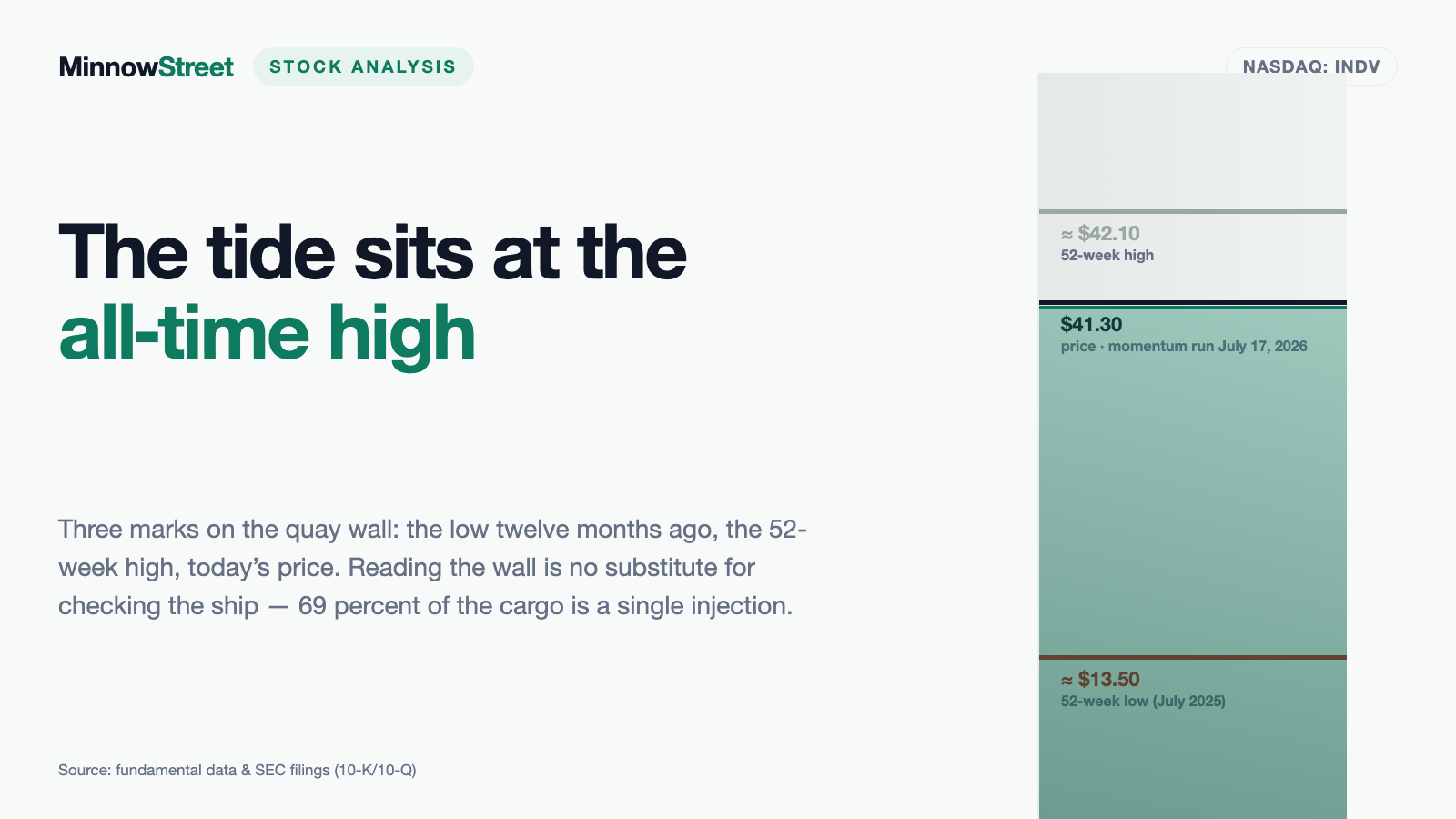
Indivior treats opioid addiction — and is painting the highest high-water mark in its history: 27 hits in our in-house stock scanner, from the Weinstein stage-2 uptrend to the RS leaders, after a gain of 197 percent in twelve months (momentum run of July 17, 2026). We read the first annual report (10-K) since the move from London to Virginia and the quarterly report (10-Q) as of March 31, 2026: a record $210 million profit for 2025, a fully paid Department of Justice settlement, a $400 million buyback program — but also 69 percent of revenue riding on a single depot injection, a pipeline that died twice in one quarter, three wholesalers billing more than half the revenue, and stockholders' equity below zero. Not investment advice — just a look below the waterline of a stock trading at its high-water mark.
 Thomas Mücke
Founder & Publisher
Thomas Mücke
Founder & Publisher
Chart
Interactive price chart (TradingView).
Note: pure fact-based analysis, not investment advice and not a solicitation to buy or sell. All figures without guarantee.
Harbor walls have those carved lines: high-water marks, each with a year next to it. And there is an investor trap that strikes exactly there — call it the high-water trap: when the water rises, we mistake rising water for safe water. A stock that climbs for a year feels like a quality verdict; the higher the mark, the more unnecessary a look below the waterline seems. Few names are painting a prettier mark on the quay wall in the summer of 2026 than Indivior Pharmaceuticals, Inc. (Nasdaq: INDV): up 197 percent in twelve months, essentially at its all-time high, 27 hits in our in-house stock scanner (momentum run of July 17, 2026). Behind it stands no meme stock but a pharmaceutical company that makes medicines for opioid addiction — and that has just completed the biggest molt in its history: out of the British legal shell, into Delaware, legacy legal cases settled, record profit reported. So let\'s make a deal: before you accept the water level as proof, we read together what the company itself reported, under penalty of law, to the U.S. securities regulator, the SEC — the first annual report (10-K) since the move (for 2025, filed February 26, 2026) and the quarterly report (10-Q) as of March 31, 2026. Alongside a genuine clean-up story, these filings also tell of a single injection carrying almost the entire company, and of a pipeline that died twice in a single quarter. In the end, you decide.
What Indivior actually does — and why the company is now American
At its core, Indivior sells two products for opioid use disorder (OUD). The old one is SUBOXONE Film — a sublingual film that dissolves under the tongue and releases buprenorphine: it occupies the same receptors as heroin or fentanyl, but in a damped way — it takes away withdrawal and craving without the high. The new one is SUBLOCADE: the same molecule as a depot injection, administered once a month under the skin, holding a steady level for thirty days. Translated: instead of one willpower decision at the bathroom cabinet every day, the patient makes one per month at the clinic — for a disease whose essence is loss of control, that is the real product advantage. Per the annual report, more than 475,000 patients have been treated with SUBLOCADE since approval; over 88 percent of insured lives are covered, and over 95 percent of patients enrolled in the manufacturer\'s co-pay program pay $0 out of pocket. The market behind it is as large as it is dark: the U.S. still counts tens of thousands of opioid deaths per year, and only a fraction of those affected are in treatment at all. Historically, Indivior is a child of the Suboxone era: spun off from Britain\'s Reckitt Benckiser in 2014 as Indivior PLC, listed in London, with one heavy legacy — in 2020 a U.S. subsidiary pleaded guilty in the dispute over misleading Suboxone marketing, and the group committed to $600 million in payments to federal and state authorities (more on that below). Since then the company has shed its skin piece by piece: Nasdaq became the primary listing effective June 27, 2024; the London listing was cancelled entirely on July 24, 2025 — and after market close on January 23, 2026, a court-approved scheme of arrangement made the newly formed Indivior Pharmaceuticals, Inc. of Delaware the parent company; every PLC share was exchanged one for one, and headquarters are now in North Chesterfield, Virginia. The stock joined the Russell 2000 and 3000 in June 2025 and the S&P SmallCap 600 in December 2025 — index inclusions that force funds to buy and mechanically explain part of the rally. Which brings us to the central tension of this analysis: a company that finally delivers — record profit, a clean legal file, buybacks — stands economically on exactly one pillar: a monthly injection with a 69 percent revenue share, and since this spring, no pipeline behind it. What scale can achieve in U.S. healthcare, we recently dissected at the physician network Astrana Health — and what a genuinely broad pharma portfolio looks like, at Eli Lilly.
Where the stock shows up in our scanner
We run roughly 3,500 stocks through our scanners every day. Indivior landed on the research list via the momentum run of July 17, 2026 — with 27 hits, one of the broadest confluence pictures of this series. The standouts: the stock sits in a Stan Weinstein stage-2 uptrend (price above a rising 200-day moving average — the cycle phase in which trend followers engage at all), belongs to the RS leaders above 90 with a relative strength of 90 (it beat 90 percent of all stocks over the past twelve months), meets the Mark Minervini trend criteria, flags a power trend and EPS acceleration (earnings per share growing faster than in prior quarters) — and, remarkable for a stock near its high: seven insider buys against zero insider sells in the latest reading. Behind it stand plus 42 percent in three months, plus 14 in six, and plus 197 percent in twelve — at essentially zero distance to the all-time high (momentum run of July 17, 2026). The fundamental lens of the same scanner also reports solid readings: fundamental grade B, a trailing price-to-earnings ratio around 21, an Altman Z-score around 3.6 (an early-warning gauge of insolvency risk built from several balance-sheet ratios; the danger zone historically begins below 1.8). Only the Piotroski F-score of 4 out of 9 (a nine-point test of the direction of the books) cautions that not every metric is pulling along — why, the look at cash flow and equity below will show. To replicate it yourself: open the Indivior stock page or browse the stage-2 scanner. Remember this for everything that follows: a scanner measures the water level — not the ship. What the ship carries is in the filings.
The numbers over the years — honestly appraised
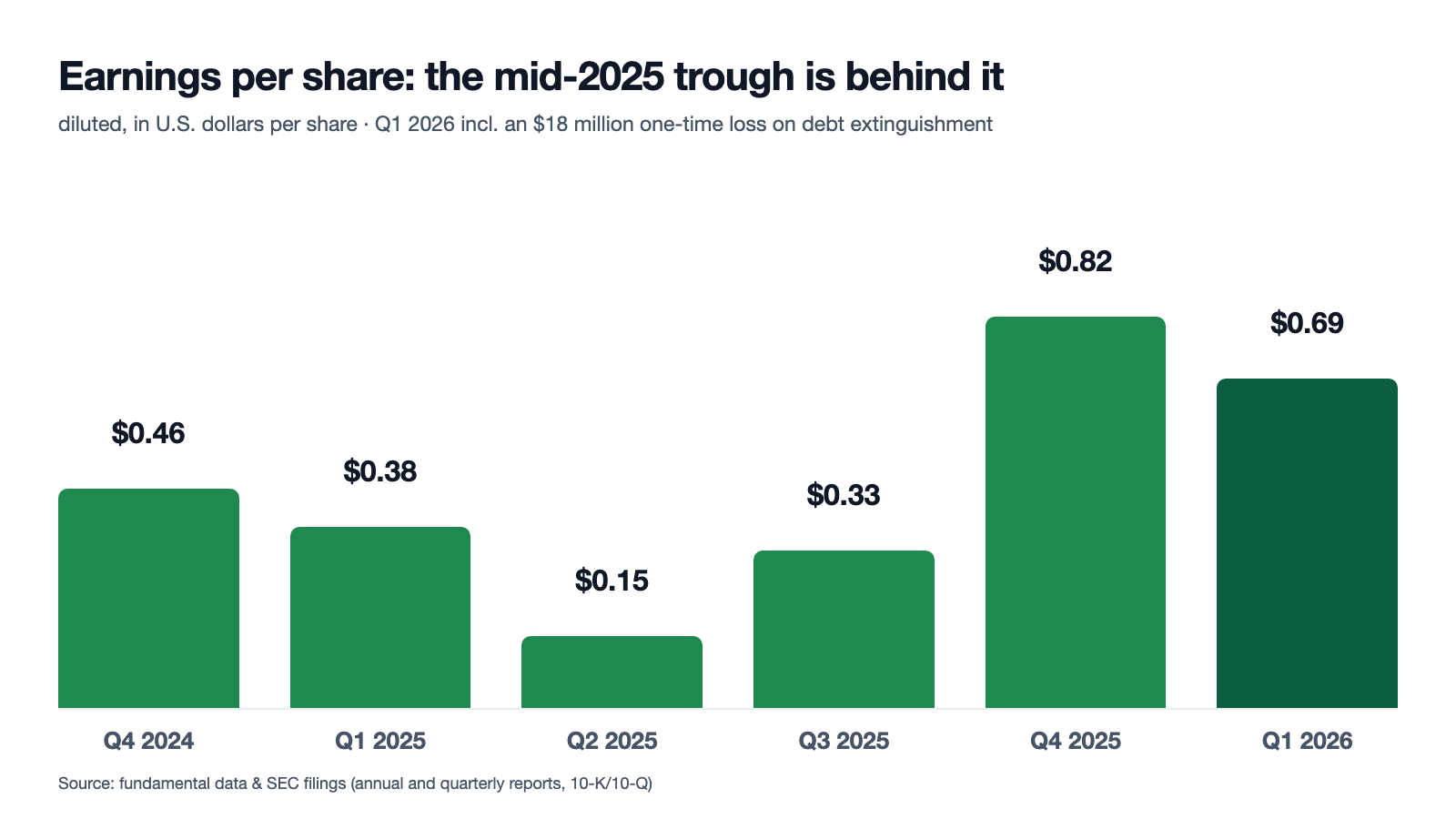
First, what genuinely impresses. In 2025 Indivior delivered the turnaround investors had waited three years for: $1,239 million in revenue (+4 percent), a gross margin around 80 percent — and a bottom line of $210 million in net income, after $7 million in 2024 and a $126 million loss in 2023. SUBLOCADE carries it: $856 million in revenue (+13 percent), $794 million of it in the U.S. And the pace is picking up: in the first quarter of 2026, total revenue grew 19 percent to $317 million, SUBLOCADE alone 32 percent to $232 million, and net income nearly doubled to $89 million ($0.69 per diluted share) — despite an $18 million one-time loss on debt extinguishment. The cost base was tightened at the same time: selling, general and administrative expenses fell from $133 to $124 million in the quarter, and the "Indivior Action Agenda" restructuring has cost a cumulative $136 million since late 2024 and has entered Phase II ("Accelerate"). Read only this paragraph and you see a company in the best shape of its life. Both are true — and both have a flip side that is in the filings.
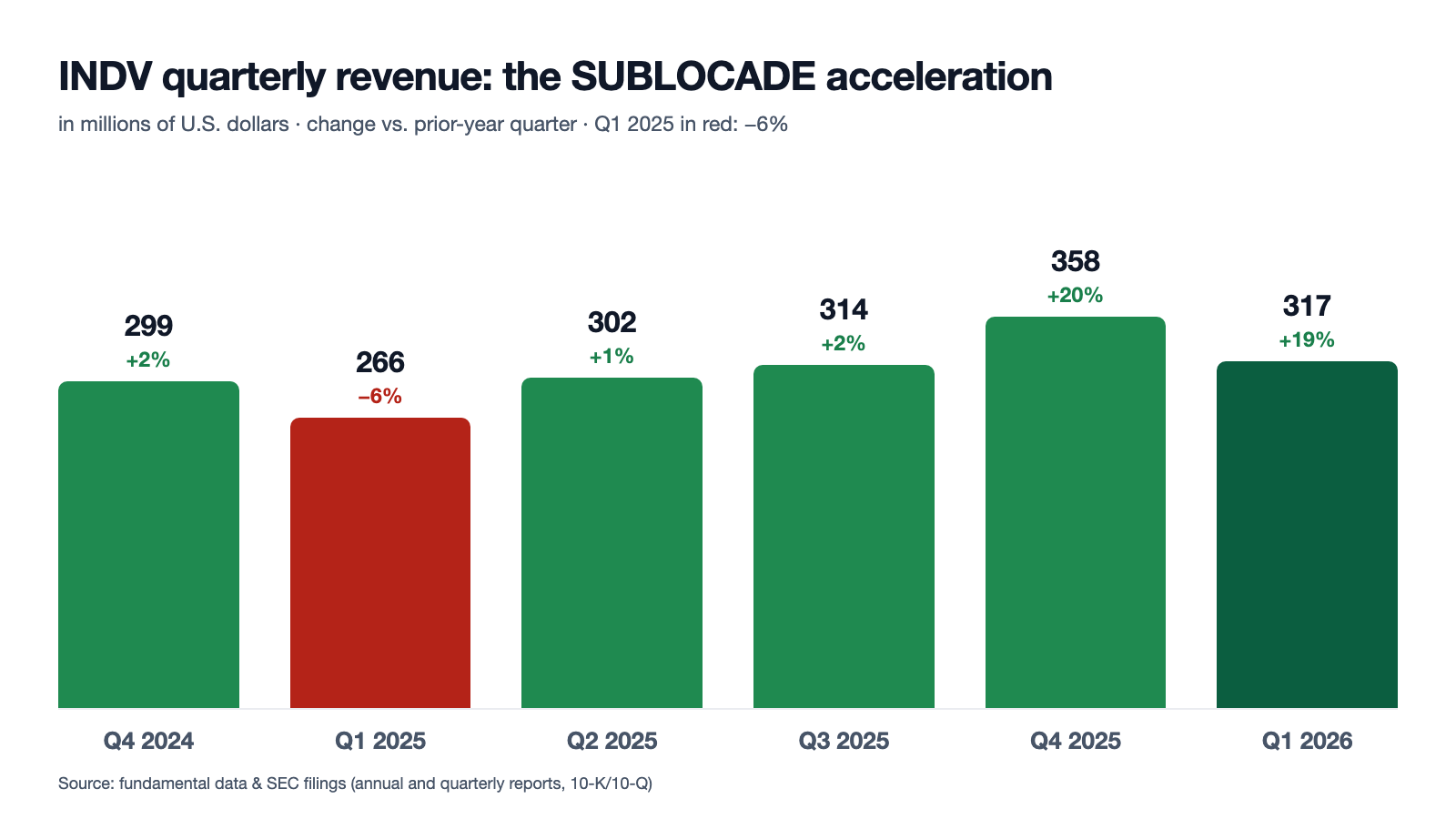
Honesty requires a close look at the engine: the growth comes exclusively from SUBLOCADE. The sublingual business (mostly SUBOXONE Film) shrank 7 percent to $351 million in 2025 — the film holds only about a 14 percent category share per the quarterly report, with four U.S. generics eating at it for years. The two side products are effectively discontinued: marketing for the schizophrenia depot PERSERIS ended in 2024, for the overdose nasal spray OPVEE in the third quarter of 2025 — together they contributed $32 million in 2025, and the company expects "negligible revenues" for 2026. The international business ($186 million, 15 percent of revenue) is being pruned as well: Indivior is exiting several countries, including its home market, the United Kingdom — the remaining markets represent 76 percent of prior Rest of World revenue. Remember the pattern: this is not a company growing — this is one product growing, with everything else being dismantled around it.
What the filings say — the uncomfortable truths
Uncomfortable truth no. 1: 69 percent on one injection — and the pipeline behind it died twice in one quarter
The risk factors section of the annual report names the dependence without make-up:
"In the last three years, SUBLOCADE has become increasingly important to our revenue growth and financial results. SUBLOCADE accounted for 69%, 64%, and 58% of our total net revenues in 2025, 2024, and 2023, respectively."
— Indivior Pharmaceuticals, Inc., SEC annual report 10-K for 2025, Item 1A "Risk Factors"
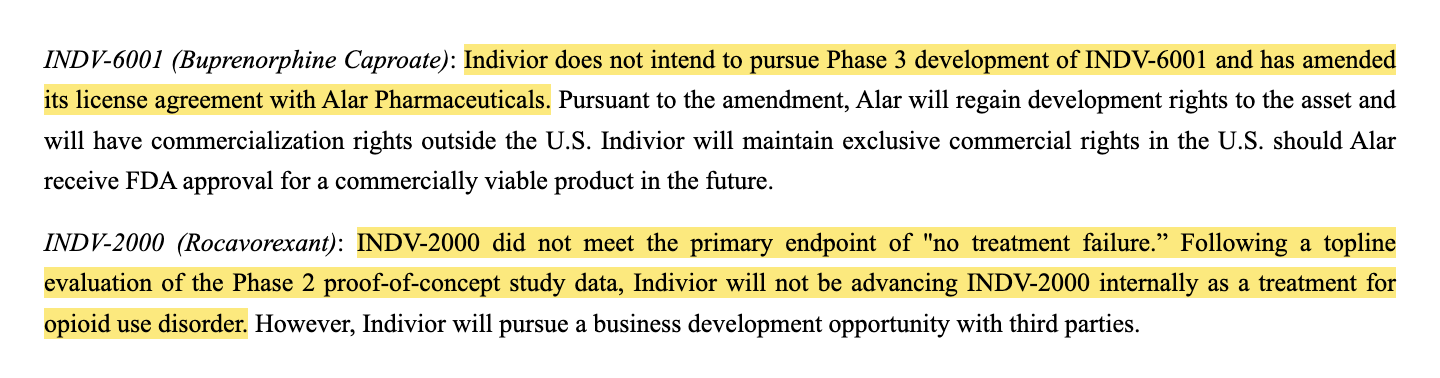
In the first quarter of 2026 the share had already reached 73 percent — the dependence grows with every good SUBLOCADE quarter. That would be tolerable if new products were maturing behind it. Exactly that hope died twice in the spring of 2026. The quarterly report records soberly that both clinical candidates were dropped: INDV-6001, the planned three-month injection, will not enter Phase 3 — the license was handed back to partner Alar (Indivior would retain only U.S. commercial rights should Alar ever win approval). And the second candidate failed at its core:
"INDV-2000 did not meet the primary endpoint of "no treatment failure.” Following a topline evaluation of the Phase 2 proof-of-concept study data, Indivior will not be advancing INDV-2000 internally as a treatment for opioid use disorder."
— Indivior Pharmaceuticals, Inc., SEC quarterly report 10-Q as of March 31, 2026, MD&A "Research & Development Pipeline Updates"
To be fair: SUBLOCADE is no fading product — the long-acting injectable category is growing, the product is patent protected in the U.S., Australia and Canada, and the report expects further U.S. growth in 2026. But the same report names the challengers: "SUBLOCADE faces competition from BRIXADI in the U.S." — the rival depot from Camurus and its U.S. partner Braeburn, which outside the U.S. (marketed as BUVIDAL) holds the first-mover advantage almost everywhere. And SUBOXONE Film already fights four generics in the U.S.; an additional entrant would, per the risk factors, hurt further. A pharma company without a pipeline is like a harbor with a single pier: as long as the one ship keeps docking, all is well. Whoever buys this stock buys exactly one molecule in exactly one dosage form — plus the hope that management converts the record cash flow into new products it does not yet own.
Uncomfortable truth no. 2: three wholesalers bill more than half the revenue
The second concentration sits a few pages before the first — on the customer side:
"Our three largest customers (which are wholesale pharmaceutical companies in the U.S.) accounted for 51%, 55%, and 54% of global net revenues in 2025, 2024, and 2023, respectively. Our largest customer in each year accounted for 20%, 19%, and 19% of our net revenues in 2025, 2024, and 2023, respectively."
— Indivior Pharmaceuticals, Inc., SEC annual report 10-K for 2025, Item 1 "Business" (customer structure)
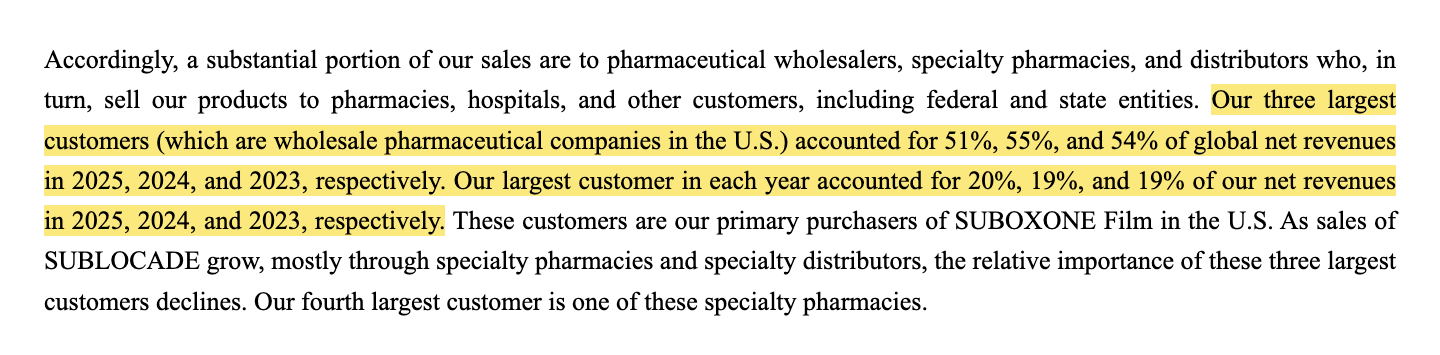
Picture a bakery that sells more than every second roll through three kiosks. In U.S. pharma this is industry standard — drug distribution simply runs through a handful of national wholesalers, with thousands of pharmacies and clinics behind them as the real buyers. But the mechanics are worth knowing: the ordering rhythms and inventory decisions of three corporations can visibly bend Indivior\'s quarterly numbers without anything changing in the number of patients treated. The report supplies the mitigation itself — and qualifies it: as SUBLOCADE grows through specialty pharmacies and specialty distributors, the relative weight of the three wholesalers declines; the fourth-largest customer is already one of those specialty pharmacies. The concentration is shifting — it is not disappearing.
Uncomfortable truth no. 3: the biggest payer is named Washington — and Washington is cutting
Who actually pays for addiction medicine? In the U.S., to a substantial degree, the government — opioid use disorder disproportionately affects people insured through the state program Medicaid. That is precisely where lawmakers took out the red pen in 2025, and the annual report turns it into a dedicated risk factor:
"Congressional action to reduce spending, such as the 2025 budget reconciliation act (OBBBA), could lead to Medicaid cuts. These cuts may reduce patient eligibility, limit coverage of higher-cost treatments for OUD, and impose Medicaid work or eligibility requirements. Such changes could impair patient access to our products, thereby adversely affecting our revenues and results of operations."
— Indivior Pharmaceuticals, Inc., SEC annual report 10-K for 2025, Item 1A "Risk Factors"
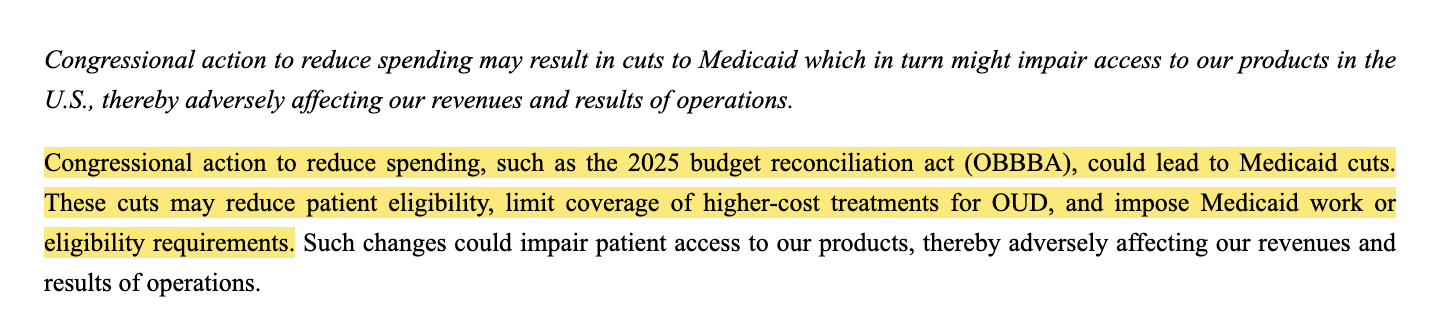
Why this is more than boilerplate: SUBLOCADE is the more expensive dosage form — exactly the category ("higher-cost treatments for OUD") the report names as a potential target of cuts. A patient who falls out of Medicaid or is switched to the cheaper generic film is not slightly less revenue for Indivior; in the worst case it is a move from the $850 million product into the shrinking generic segment. The counter-argument belongs here too: addiction treatment demonstrably saves the healthcare system follow-on costs, political support for fighting the opioid crisis is bipartisan, and Indivior points to real-world evidence that adherent SUBLOCADE patients relapse less often and generate lower hospital costs. But the paymaster remains the same: a substantial share of the SUBLOCADE bill goes to budget politicians — and their priorities are written in no filing.
Uncomfortable truth no. 4: the great spring cleaning left marks — negative cash flow in a record year, equity below zero
Perhaps the most important line of fiscal 2025 is not in the income statement but in the cash flow statement: operating cash flow was negative at minus $27 million — in the year of record profit. The reason, however, is one you should rather credit to management:
"In November 2025, the Company opted to prepay the remaining liability of $295 million with a resulting gain on early settlement of $4 million recorded in litigation settlement expenses on the consolidated statement of operations. Indivior has no further financial obligation with respect to this matter."
— Indivior Pharmaceuticals, Inc., SEC annual report 10-K for 2025, Note 11 "Accrued Litigation Settlement Expenses"

With that, the Suboxone case of 2020 — a subsidiary\'s guilty plea, $600 million to federal and state authorities, compliance obligations — is financially history; the corporate integrity obligations to the health department were completed in July 2025, and the final antitrust installment ($25 million) was paid in 2025. What remains: about $94 million of accruals, mostly for the civil opioid litigation (about $86 million payable over four years), and an FTC order running to November 2030. That is genuine relief. But the spring cleaning visibly drained the balance sheet: cash fell within fifteen months from $319 million to $175 million (March 31, 2026), and stockholders\' equity sits below zero — total liabilities exceed total assets by $144 million, after another $125 million went into buybacks in the first quarter of 2026 and a new $500 million convertible note (0.625 percent, due 2031, conversion price $41.66) retired the old term loan. Negative equity is no death sentence for a stable cash machine — but it means: there is no asset cushion here. The entire safety of this company is the future SUBLOCADE cash flow — see truth no. 1.
Valuation: $4.7 billion for a one-product house with a tailwind
In mid-July 2026 the Indivior share cost about $41, for a market value of roughly $4.7 billion (momentum run of July 17, 2026). Against trailing earnings that is moderate for a growing pharma company: a price-to-earnings ratio around 21 and a price-to-sales ratio around 3.6. The estimates of the — at seven firms, small — analyst group sit around $3.80 in earnings per share for 2026 and a good $4.10 for 2027; if that holds, today\'s price pays about eleven times current-year and ten times next-year earnings — no fantasy valuation for double-digit profit growth, and the analyst consensus stands at "buy" (data from the momentum run of July 17, 2026). A price-to-book ratio effectively does not exist — with negative equity the metric is meaningless. What supports the math: a running $400 million buyback program ($275 million remaining after the first quarter, running through mid-2027) against only 122 million shares outstanding, a lower interest bill after the refinancing, and management under CEO Joseph Ciaffoni (in office since May 2025) that delivers. What qualifies it: the convertible note starts to dilute above $41.66 — almost exactly where the stock recently traded — and each of the three concentrations from the uncomfortable truths (one product, three wholesalers, one government payer) can quickly make an eleven-times valuation look like a twenty-times one. The market is not paying for a vision here but for a machine — and betting that nothing jams in that machine for three years.
Opportunities and risks at a glance
What speaks for Indivior:
- A growing core product with a real medical advantage: SUBLOCADE up 13 percent to $856 million (2025), up 32 percent in the first quarter of 2026; more than 475,000 patients treated, over 88 percent of insured lives covered, a growing long-acting injectable category (10-K 2025, 10-Q Q1 2026).
- The earnings turnaround is in: $210 million net income in 2025 (after $7 million and minus $126 million), $89 million in the first quarter of 2026, gross margin around 80 percent, quarterly operating margin above 40 percent.
- Legacy legal cases cleared: the DOJ settlement is paid in full ($295 million final payment in November 2025), corporate integrity obligations completed in July 2025, the last antitrust installment paid — leaving mainly about $86 million of opioid settlement payments over four years.
- Shareholder-friendly capital policy: four buyback programs totaling roughly $400 million completed since July 2021; a new program of up to $400 million since February 2026 ($125 million already executed at an average of $31.45); refinancing into a 0.625 percent convertible cuts the interest bill; seven insider buys against zero sells (momentum run of July 17, 2026).
- Technicals and tailwind: stage-2 uptrend, relative strength 90, up 197 percent in twelve months, index inclusions in the Russell 2000/3000 (June 2025) and S&P SmallCap 600 (December 2025).
What speaks against it:
- Extreme product concentration: 69 percent of 2025 revenue (Q1 2026: 73 percent) on SUBLOCADE — and the pipeline behind it was cleared out entirely in the first quarter of 2026 (INDV-2000 missed its endpoint, INDV-6001 without Phase 3).
- Competition at the core: per the 10-K, SUBLOCADE faces BRIXADI (Camurus/Braeburn) in the U.S., a depot that as BUVIDAL holds the first-mover advantage almost everywhere internationally; SUBOXONE Film fights four U.S. generics and fell to an average category share of 14.2 percent in 2025.
- Payer and customer concentration: three U.S. wholesalers at 51 percent of revenue (largest: 20 percent); a substantial Medicaid share in addiction treatment, with an explicit OBBBA cut risk in the 10-K.
- A balance sheet without a cushion: negative stockholders\' equity (minus $144 million as of March 31, 2026), negative working capital, $582 million of accrued rebate obligations, cash down from $319 to $175 million — while buybacks can absorb $125 million per quarter.
- A dilution option from $41.66: the $500 million convertible (2031) starts converting almost exactly at the recent price level — above that mark, part of the buyback effect can reverse; the weak international business will shrink further through market exits (including the U.K.).
A human conclusion
Back to the quay wall. The high-water trap is not that high marks lie — Indivior\'s 2026 mark is honestly earned: record profit, settled legacy cases, a product that brings order into lives and leads its category. The trap is inferring the state of the ship from the water level. Below the waterline you see: a hull that consists of practically one cargo hold (69 percent SUBLOCADE, rising), a shipyard that has just cancelled both new builds, three shipping lines as half the customer base and a government budget as the most important client — with equity below zero, because management has put every free dollar into settlement payments and its own shares. You can like all of that: focus, discipline, capital returns — that is the anatomy of many strong late-cycle stocks. You just have to know that nothing stands between you and this one product anymore. So the honest question is not "is the momentum real?" (it is — the scanner counts 27 hits), but: do you believe this one injection grows for three more years — against BRIXADI, against generic filers, against Washington\'s red pen? If yes, you are paying about eleven times expected earnings for a category leader with a tailwind. If no, every new high-water mark is merely a prettier entry price for the same concentration risk. What you make of it is your decision. And that is exactly as it should be.
Sources
All original documents used in this analysis — for your own reading:
- Indivior Pharmaceuticals, Inc. — SEC annual report 10-K for 2025 (filed February 26, 2026)
- Indivior Pharmaceuticals, Inc. — SEC quarterly report 10-Q as of March 31, 2026 (filed April 30, 2026)
- Indivior PLC — SEC annual report 10-K for 2024 (filed March 3, 2025)
- Indivior PLC — SEC quarterly report 10-Q as of September 30, 2025 (filed October 30, 2025)
- Indivior PLC — SEC quarterly report 10-Q as of June 30, 2025 (filed July 31, 2025)
- Indivior PLC — SEC quarterly report 10-Q as of March 31, 2025 (filed May 1, 2025)
- Complete SEC filing history (including the 20-F/6-K years as a foreign private issuer and the name change from Indivior PLC to Indivior Pharmaceuticals, Inc.): EDGAR overview (sec.gov)
- Fundamental data (metrics, quarterly series, valuation), reconciled against the SEC filings.
- Screener and rating data: in-house stock scanner, momentum run of July 17, 2026.
Transparency & disclaimer: This analysis is a journalistic contextualization of publicly available information and is not investment advice, not a financial analysis in the regulatory sense, and not a solicitation to buy or sell securities. Stock investments carry substantial risks up to and including total loss. All information without guarantee; the data cut-off is noted in the text. The author holds no position in Indivior shares at the time of publication.
Our Bottom Line at a Glance
- Core product & earnings turnaround positive
- SUBLOCADE grew 13 percent to $856 million in 2025 and 32 percent in the first quarter of 2026; the company swung from a $126 million loss (2023) to $210 million in net income (2025) and $89 million in the quarter — at a gross margin around 80 percent (10-K 2025, 10-Q as of 03/31/2026).
- Product concentration & pipeline negative
- 69 percent of 2025 revenue (Q1 2026: 73 percent) hangs on SUBLOCADE, and in the first quarter of 2026 both pipeline candidates were dropped: INDV-2000 missed its primary endpoint, INDV-6001 will not enter Phase 3 (10-Q, "Pipeline Updates"). The risk factors also flag generics and branded competition against SUBLOCADE and the film.
- Customer & payer concentration negative
- Three U.S. wholesalers accounted for 51 percent of 2025 revenue (the largest for 20 percent), and the 10-K names Medicaid cuts under the OBBBA budget act as a concrete risk to coverage of higher-cost OUD treatments — which is precisely the depot injection.
- Balance sheet & capital policy neutral
- Legacy legal cases cleared (the $295 million DOJ prepayment in November 2025, no further obligation), the interest bill cut via a 0.625 percent convertible, a $400 million buyback running — but stockholders' equity stands at minus $144 million, cash fell to $175 million, and the note starts to dilute above $41.66 (10-Q as of 03/31/2026).
- Valuation & technicals neutral
- A stage-2 uptrend, relative strength 90, 27 scanner hits and a 197 percent twelve-month gain meet a trailing P/E around 21 and about eleven times 2026 estimates (momentum run of July 17, 2026) — moderate for the growth, but with no asset cushion underneath, and with insider buying as a notable counterpoint (seven buys, zero sells).
Indivior is delivering the best version of itself: record profit, paid-off legal legacy, a core product with a medical advantage and category tailwind, plus buybacks and insider buying. At the same time, after the double pipeline failure in the first quarter of 2026, the company is economically a one-product house with three wholesalers as half its customer base, Washington as its most important payer and stockholders' equity below zero — all of its resilience lies in future SUBLOCADE cash flow. Whoever holds the stock holds a focused cash machine with concentration risk in every dimension. Not investment advice.
What Our Rating Means
- If you don't own the stock
- As long as the question raised in the bottom line stays open, we see no basis for an entry.
- If you hold it in your portfolio
- Our findings offer no acute reason to sell — the checkpoints named remain decisive.
A journalistic assessment by our editorial team at the time of the deep dive, based on public sources — not investment advice and not a solicitation to buy or sell. Your personal circumstances (investment goals, risk capacity, taxes) cannot be taken into account. What our categories mean, how verdicts are formed, and what conflicts of interest exist →
Worth Noting
- INDV reached the research list via the momentum run of July 17, 2026 with 27 scanner hits (including Stan Weinstein stage 2, RS leaders ≥90, Minervini trend criteria, power trend, net insider buying) — identity verified against SEC EDGAR: SEC title since January 2026 is "Indivior Pharmaceuticals, Inc." (formerly Indivior PLC), CIK 1625297.
- Scanner metrics (P/E, P/S, Piotroski, Altman Z, fundamental grade) use trailing twelve-month figures; the DOJ prepayment (November 2025) depresses trailing operating cash flow, and the $18 million loss on debt extinguishment weighs on the first quarter of 2026.
- Price and valuation figures are dated to the momentum run of July 17, 2026 (about $41 per share, about $4.7 billion market value); analyses are evergreen, daily prices are not a buy argument.
Frequently Asked Questions
Indivior Pharmaceuticals, Inc. (Nasdaq: INDV) develops and sells medicines for opioid use disorder: the once-monthly buprenorphine depot injection SUBLOCADE and the SUBOXONE sublingual film. In 2025 the company generated $1,239 million in revenue ($1,053 million of it in the U.S.) and $210 million in net income. SUBLOCADE accounted for 69 percent of revenue.
The company moved its legal domicile from the U.K. to the U.S.: after stockholder approval on December 11, 2025, a court-approved scheme of arrangement took effect after market close on January 23, 2026, making the newly formed Indivior Pharmaceuticals, Inc. (Delaware) the parent company; every Indivior PLC share was exchanged one for one into a U.S. share. The former Indivior PLC now operates as the subsidiary Indivior Limited.
Very: per the annual report (10-K) for 2025, SUBLOCADE accounted for 69 percent of total revenue, after 64 percent (2024) and 58 percent (2023); in the first quarter of 2026 it was 73 percent. Both pipeline candidates were dropped in that same quarter: INDV-2000 missed its primary endpoint, and INDV-6001 will not enter Phase 3.
Financially, yes: Indivior prepaid the remaining $295 million of the $600 million 2020 settlement with the U.S. Department of Justice in November 2025 and states it has no further financial obligation in the matter; the corporate integrity obligations ended in July 2025. What remains are about $94 million of accruals, mostly for civil opioid litigation (about $86 million over four years), and an FTC order running to November 2030.
As of March 31, 2026, total liabilities exceed total assets by $144 million. The causes are years of settlement charges (a total of $600 million to the Department of Justice), large accrued rebate obligations to payers ($582 million at the end of 2025), and share buybacks of roughly $400 million since 2021 plus $125 million in the first quarter of 2026 alone. A price-to-book ratio is therefore meaningless for this stock.
A substantial share of opioid addiction treatment in the U.S. is paid through the state program Medicaid. The annual report (10-K) for 2025 explicitly names the OBBBA budget act as a risk: cuts could reduce patient eligibility and limit coverage of higher-cost OUD treatments — which is precisely the category of the SUBLOCADE depot injection.
After a 197 percent gain in twelve months (momentum run of July 17, 2026), the stock trades at about 21 times trailing earnings and — against analyst estimates of roughly $3.80 in earnings per share for 2026 — about eleven times current-year earnings, at a price-to-sales ratio around 3.6. That is moderate for double-digit growth, but it presumes the one-product risk never bites.
Found an error?
Did you spot a factual error, an outdated number, or a typo in this deep dive? Let us know briefly — your report goes straight to the editorial team.