Incyte: $1.29 Billion in Profit — and One Molecule Whose Patent Expires in 2028
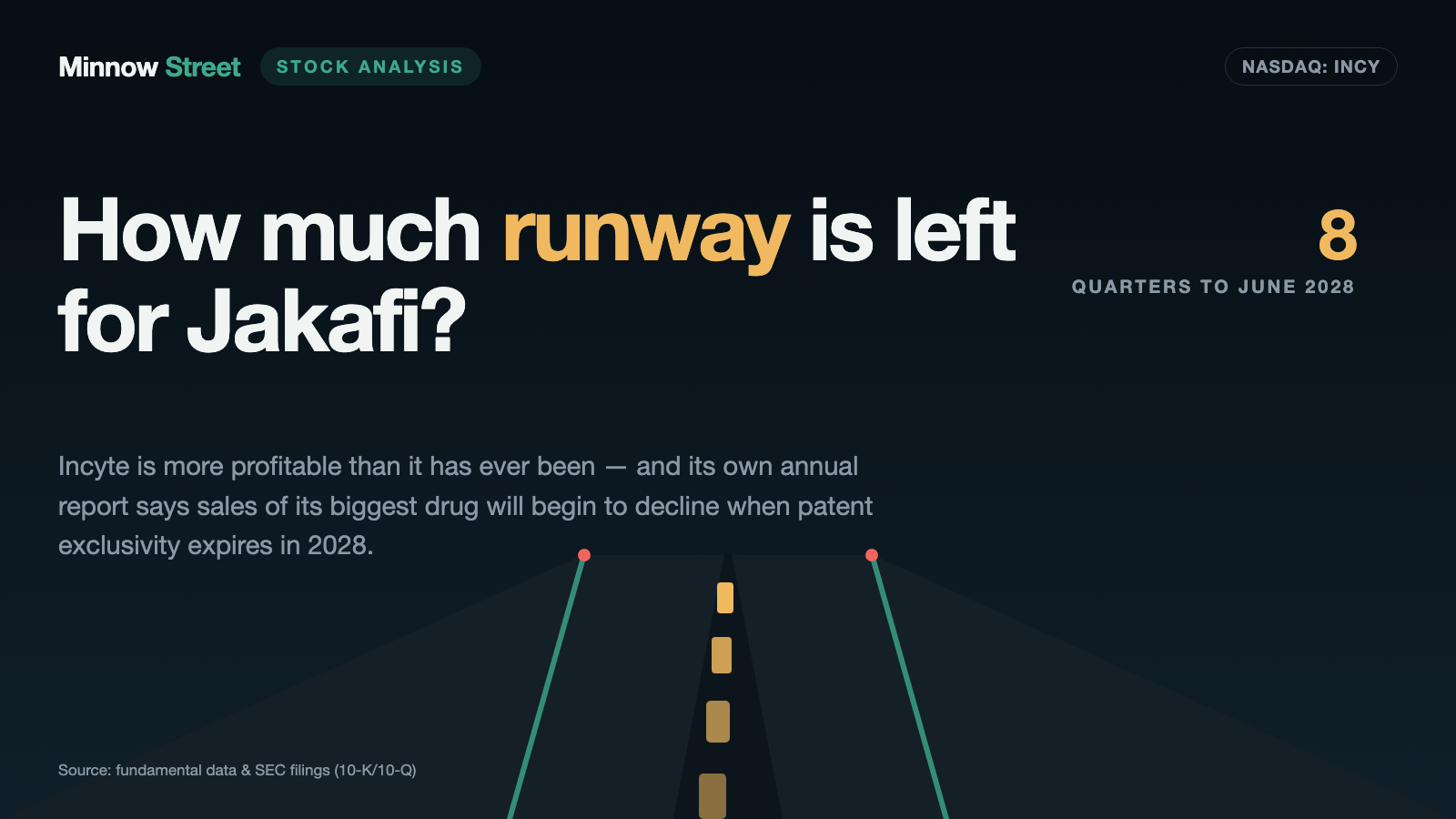
Incyte earned the largest profit in its history in 2025: $1,286.7 million on revenue of $5,141.2 million. That is exactly why the stock looks inexpensive. The annual report filed February 10, 2026, also explains why the market hesitates: four of every five revenue dollars ride on a single active ingredient, and its U.S. patent protection runs out in 2028 — Incyte wrote that sentence itself. From the middle of 2026, that is roughly eight quarters away. Not investment advice — just the question of who pays the bills after 2028.
 Thomas Mücke
Founder & Publisher
Thomas Mücke
Founder & Publisher
Chart
Interactive price chart (TradingView).
Note: pure fact-based analysis, not investment advice and not a solicitation to buy or sell. All figures without guarantee.
There is an investing trap that likes to spring on genuinely good companies: the record reflex. You see the best year in a company's history, extend it forward in your head — and then wonder why the stock still trades at a price-to-earnings ratio of roughly 17. "The market is asleep," you think. At Incyte Corporation (Nasdaq: INCY) the market is not asleep. It is simply looking further ahead than the last balance sheet date. So let us make a deal: before we talk about price, we will read together what the company itself filed with the U.S. securities regulator, the SEC — the annual report (10-K) for 2025, filed February 10, 2026, and the quarterly report (10-Q) as of March 31, 2026, filed April 28, 2026. An SEC filing is honest under penalty of law. And this one describes a cancer drug that has paid the bills for fifteen years, $4,015.8 million sitting in the bank — and a date Incyte wrote into the report itself: 2028.
What Incyte actually does — seven names, one molecule at the core
Incyte is a biopharmaceutical company: it searches for compounds, carries them through clinical development and sells the approved medicines itself. It is headquartered in Wilmington, Delaware, and as of December 31, 2025, employed 2,844 people worldwide — 940 of them in research and development, 975 in sales and marketing. William J. Meury has led the company since June 2025. The filings recognize a single operating segment; there is no second division waiting to step in.
Seven of its own brand names sit on the price list: JAKAFI (blood cancers), OPZELURA (a cream for atopic dermatitis and vitiligo), ICLUSIG, PEMAZYRE, MINJUVI/MONJUVI, ZYNYZ and NIKTIMVO. That sounds like a broad shelf. It is only partly one — because JAKAFI and OPZELURA contain the same active ingredient: ruxolitinib, once as a tablet, once as a cream. And outside the United States, Novartis sells that very molecule as JAKAVI and pays Incyte royalties for it. Put plainly: this is not a bakery with seven varieties; it is a bakery with one dough and seven shapes.
That frames the central tension of this analysis, and it runs through every chapter: Incyte has never been more profitable than it is today — and the very earnings source carrying that record loses its patent protection in 2028. The company writes that into its own annual report. For how hard a large biotech finds it when a revenue pillar erodes, see our analysis of Biogen.
How the stock reached our desk
This time the hook was not a price move but a balance-sheet screen. Our in-house stock scanner lists Incyte on the U.S. side of its fundamental ranking — the screen that sorts companies by the quality of their numbers rather than the shape of their chart (as of July 26, 2026; the screens are recalculated daily). On that same date, 38 U.S. names met the criteria, and the page shows the first 25 of them. You can replicate it in three clicks: open the stock scanner, choose the "Fundamental Rank (A / A+)" screen, set the market to the United States.
What stands out is less the one screen than the confluence. On July 26, 2026, INCY appeared on 19 screens at once, and the list reads like a textbook for quality investors — Buffett criteria (Buffettology), Terry Smith: Quality (Fundsmith criteria), QARP — quality at a reasonable price, Peter Lynch: PEG below 1, Altman Z: balance-sheet fortress, alongside trend screens such as Stan Weinstein: Stage 2 and Power Trend. When one stock counts as cheap, as high quality and as trending upward all at the same time, it deserves a second look. That is what follows.
Two metrics from the July 24, 2026, data cut-off belong here, and both are rated, not merely listed. The Piotroski F-Score, a nine-point test for the health of the books, stands at 7 of 9 — good, but not spotless; genuinely robust companies reach 8 or 9. The Altman Z-score, which estimates bankruptcy risk, is 11.94; anything above 3 counts as safe, and 11.94 is a fortress. And a debt-to-equity figure of 0.006 simply means this company carries almost no borrowings.
The numbers over the years — credit where it is due
First, what genuinely impresses. Revenue rose to $5,141.2 million in 2025 — after $4,241.2 million (2024) and $3,695.6 million (2023). That is 39 percent in two years, without buying a revenue stream. And the bottom line for 2025 showed net income of $1,286.7 million, or $6.41 per diluted share. For comparison: 2024 produced $32.6 million ($0.15 per share) and 2023 $597.6 million ($2.65).
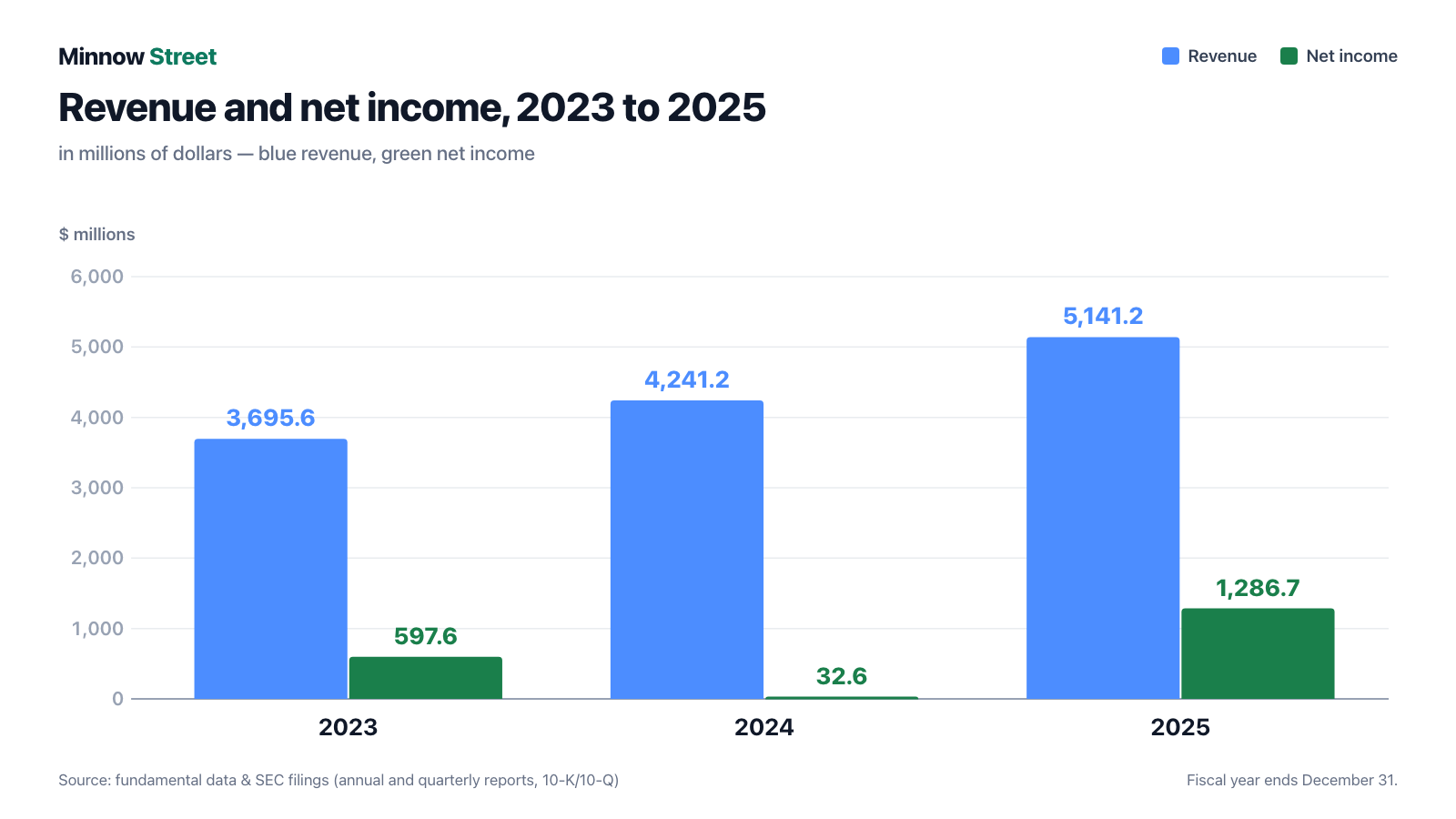
The start of 2026 continues the run. First-quarter revenue climbed to $1,272.7 million from $1,052.9 million a year earlier (up 20.9 percent), and net income to $303.3 million from $158.2 million. Operating cash flow — the money the running business actually deposits — came to $369.4 million against $266.1 million.
Where the growth comes from matters most. The four newest products all jumped in the first quarter of 2026: NIKTIMVO to $55.1 million (prior-year quarter: $13.6 million), ZYNYZ to $41.4 million ($3.1 million), MINJUVI/MONJUVI to $49.2 million ($29.6 million) and OPZELURA to $143.0 million ($118.7 million). That is precisely the diversification a company facing a patent expiry needs. Remember the sentence: at Incyte the question is not how fast revenue grows, but which part of it grows.
And the balance sheet? That is the real trump card. As of March 31, 2026, $3,461.1 million of cash and another $554.7 million of marketable securities sat on the books, $4,015.8 million together. Against that stood financial liabilities of just $33.8 million of lease obligations; the revolving credit facility was undrawn. Equity of $5,622.8 million equals 76.6 percent of the $7,339.1 million balance sheet. A year earlier, on March 31, 2025, equity was still $3,667.6 million and retained earnings were negative.
What the filings say — the uncomfortable truths
Uncomfortable truth no. 1: four of every five revenue dollars ride on one molecule
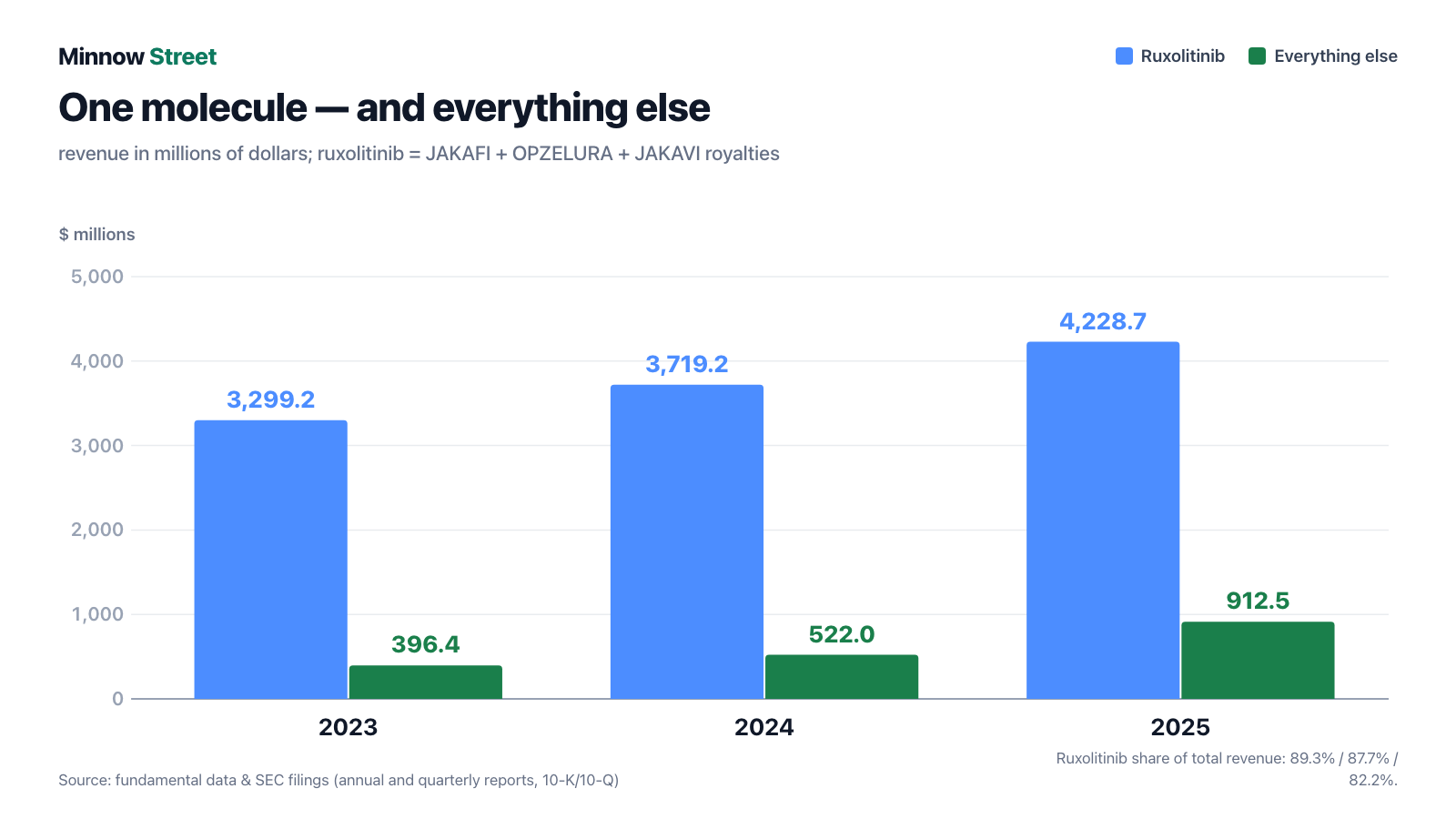
Add up what the filings report separately. In 2025, JAKAFI produced $3,092.5 million, OPZELURA $678.5 million and the JAKAVI royalties from Novartis $457.7 million. All three are ruxolitinib. Together that is $4,228.7 million, or 82.2 percent of total revenue.
And now the sentence everything turns on. It does not come from an analyst note but from the risk section of the company's own annual report:
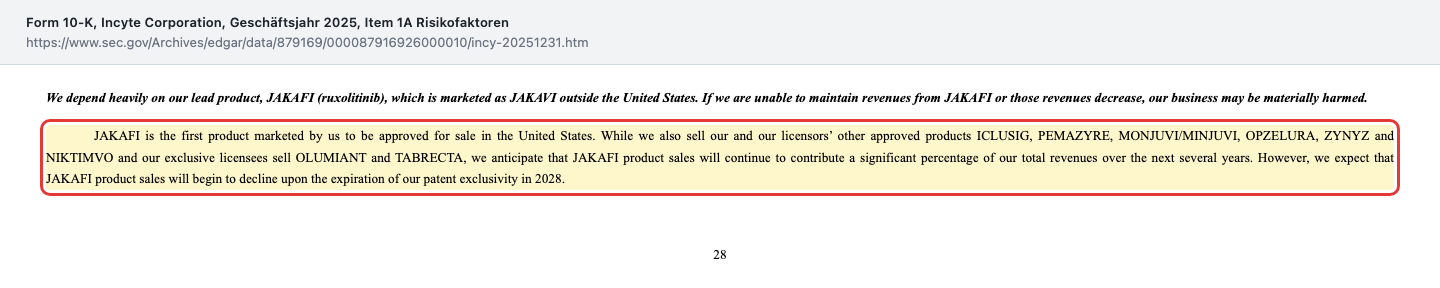
"While we also sell our and our licensors’ other approved products ICLUSIG, PEMAZYRE, MONJUVI/MINJUVI, OPZELURA, ZYNYZ and NIKTIMVO and our exclusive licensees sell OLUMIANT and TABRECTA, we anticipate that JAKAFI product sales will continue to contribute a significant percentage of our total revenues over the next several years. However, we expect that JAKAFI product sales will begin to decline upon the expiration of our patent exclusivity in 2028."
— Incyte Corporation, SEC annual report 10-K for 2025, Item 1A Risk Factors
How concrete this is shows up a few pages later. Six generic manufacturers — Apotex, Hikma, Sun Pharmaceutical, Granules India, Dr. Reddy's and Eugia — have already applied to the U.S. Food and Drug Administration to market copies and challenged the patents in doing so. The composition-of-matter patents on ruxolitinib expire in June 2028 with pediatric extension, and the ruxolitinib phosphate patents in December 2028. Incyte has settled confidentially with Hikma (October 2025) and Granules (February 2026); the remaining cases are pending. From the middle of 2026, that leaves roughly eight quarters. Put plainly: the runway is not short — but it has been measured, and it does end.
Fairness requires the other side. First, the dependency is measurably falling: from 89.3 percent (2023) through 87.7 percent (2024) to 82.2 percent (2025), and to 79.1 percent in the first quarter of 2026. Second, the 2028 expiry chiefly affects the United States — the JAKAVI royalties from abroad run on their own schedule. Third, OPZELURA as a cream carries additional formulation patents reaching to November 2031 and 2040. So the hole does not open all at once. It still opens.
Uncomfortable truth no. 2: two one-time items sit inside the record 2025 profit
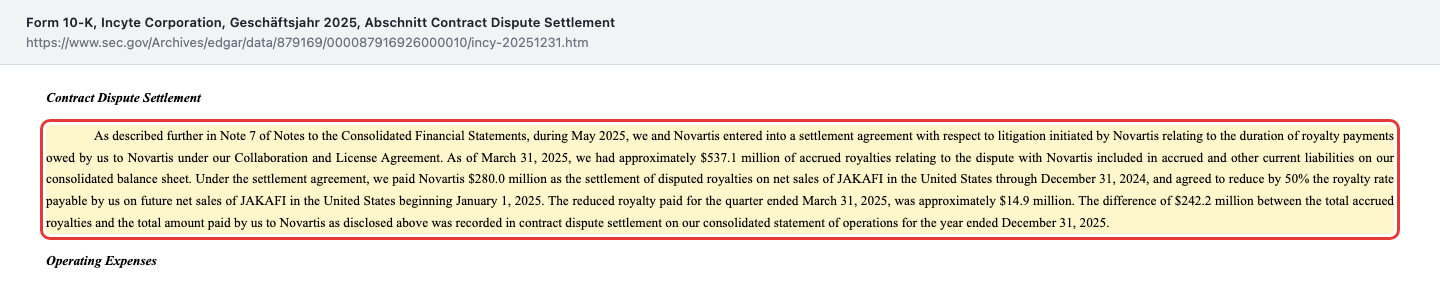
Net income of $1,286.7 million sounds like a new level of earning power. Part of it, though, was a single accounting event. In its dispute with Novartis over how long royalties were owed, Incyte had accrued roughly $537.1 million as of March 31, 2025. The two sides settled on May 11, 2025 — and releasing the excess accrual landed in the income statement:
"Under the settlement agreement, we paid Novartis $280.0 million as the settlement of disputed royalties on net sales of JAKAFI in the United States through December 31, 2024, and agreed to reduce by 50% the royalty rate payable by us on future net sales of JAKAFI in the United States beginning January 1, 2025. The reduced royalty paid for the quarter ended March 31, 2025, was approximately $14.9 million. The difference of $242.2 million between the total accrued royalties and the total amount paid by us to Novartis as disclosed above was recorded in contract dispute settlement on our consolidated statement of operations for the year ended December 31, 2025."
— Incyte Corporation, SEC annual report 10-K for 2025, "Contract Dispute Settlement"
Do the arithmetic: without that credit, 2025 operating income would be $1,272.6 million instead of $1,514.9 million — roughly 16 percent lower. The second one-time item sits in milestone and contract revenues: they jumped to $150.0 million (2024: $43.0 million; 2023: $7.0 million), and $100.0 million of that came from a single upfront payment by Eli Lilly in the fourth quarter of 2025 for extending the baricitinib agreement to type 1 diabetes.
One more line deserves attention, this time from the first quarter of 2026: pre-tax income of $343.6 million carried only $40.3 million of tax expense — an effective rate of 11.7 percent. A year earlier it was $76.0 million on $234.2 million, or 32.4 percent. Had the rate held, quarterly net income would have been roughly $232 million rather than $303 million. None of this is improper — but anyone extrapolating the record quarter is extrapolating these one-offs too.
Uncomfortable truth no. 3: when Incyte buys, the money is gone immediately
A company with four billion in the bank and a patent expiry ahead has to buy. Incyte does — and the accounting behind it is uncomfortable for shareholders. In May 2024 it acquired Escient Pharmaceuticals for $782.5 million in cash. Because the acquired drug candidates had no alternative future use, $679.4 million was booked straight to research expense — $644.8 million of it for the lead molecule INCB000262 and $34.6 million for the second candidate, INCB000547. That is precisely why only $32.6 million of net income survived from $4,241.2 million of 2024 revenue. What happened next is in the risk section of the annual report:
"For example, in 2024 we acquired Escient Pharmaceuticals, Inc., but later in that year we stopped development of the two lead compounds acquired from Escient."
— Incyte Corporation, SEC annual report 10-K for 2025, Item 1A Risk Factors

$782.5 million paid, $679.4 million written off, development stopped inside the same year. In this industry that is not a scandal — research is a business with a high failure rate, and Incyte documented the miss openly. For you as an investor it still means two things: first, low debt says nothing about how fast a cash pile empties. Second, this company's profits are poorly comparable from year to year, because a single acquisition can halve the result.
Uncomfortable truth no. 4: six buyers account for 81 percent of product revenue
In the United States, medicines do not go straight to pharmacies but through wholesalers and specialty pharmacies. The quarterly report as of March 31, 2026, discloses how narrow that funnel is: six anonymized customers accounted for 13, 8, 21, 19, 10 and 10 percent of total net product sales in the quarter — 81 percent together. Two individual buyers therefore represent about a fifth of the business each. A year earlier the same six readings were 14, 10, 20, 19, 9 and 10 percent — 82 percent combined. The concentration is not new; it is the normal state.
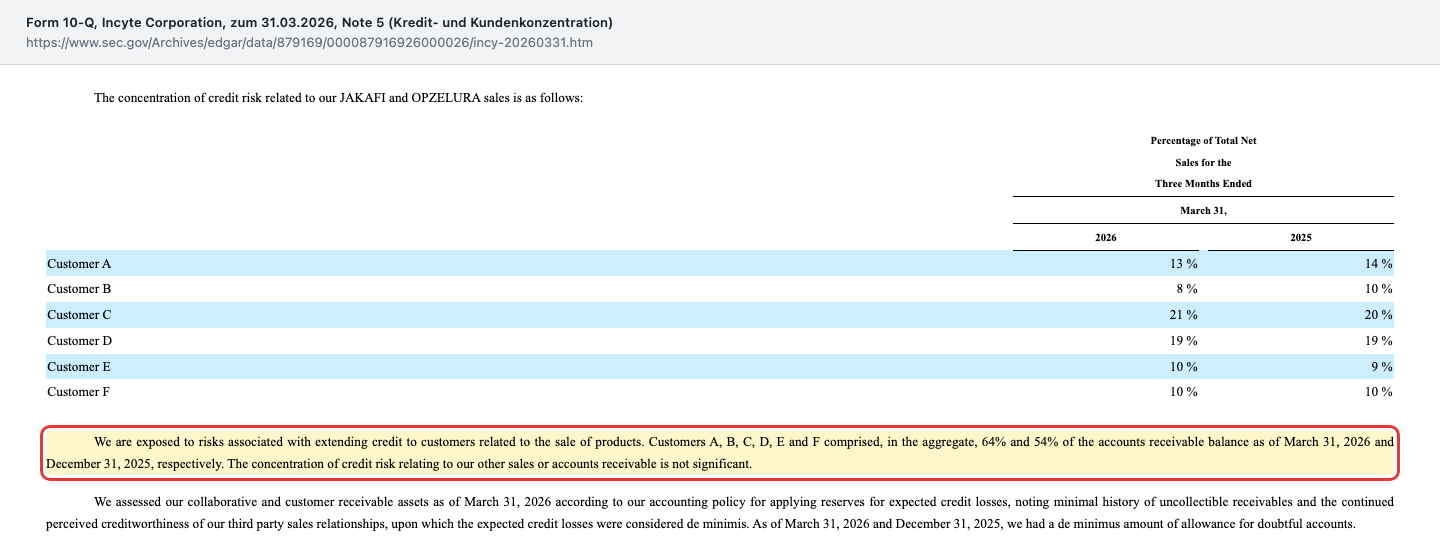
Put plainly: if a neighbor told you his shop was thriving, and you learned that six customers pay eight of every ten invoices, you would swallow hard. Context matters, though: this concentration is normal in U.S. pharmaceutical distribution, because only a handful of large intermediaries exist. The risk is less about losing a customer than about their bargaining power on rebates. And that rebate mechanism has just cost Incyte money — more on that next.
What has changed since the last quarterly report
Three mandatory filings sit between the quarterly report of April 28, 2026, and today, and two of them move the picture noticeably.
June 22, 2026 — the rebate dispute is settled. The U.S. health agency CMS wanted to treat the cream OPZELURA as a "line extension" of the tablet JAKAFI under the Medicaid rebate program; Incyte sued and, as a precaution, accrued $245.9 million. The deduction alone cost roughly 8.4 percent of OPZELURA gross sales in the first quarter of 2026. CMS will now not apply the rule, and the lawsuit has been withdrawn. Incyte expects a one-time, non-cash benefit of roughly $246 million in the second quarter of 2026 and permanently better net pricing on OPZELURA. Read only the quarterly report and the accrual still looks like an open risk.
July 6, 2026 — the largest acquisition to date has closed. Incyte acquired Vega Therapeutics for $1.25 billion in cash, with up to $750 million more available as sales milestones. What it bought is a single candidate: VGA039, an antibody in late-stage development for von Willebrand disease, the most common inherited bleeding disorder. And as with Escient, the release explicitly states that the purchase price will be recorded as a one-time research expense in the third quarter and full year 2026. Quarterly earnings will therefore swing deep into negative territory — by plan, but it will happen.
The third filing, dated June 8, 2026, announced that same acquisition. Together they mean this: of the $4,015.8 million of cash and marketable securities held at March 31, 2026, roughly $1.25 billion is already committed and gone.
Valuation — why a P/E of about 17 means something different here
As of the July 24, 2026 data cut-off, market capitalization stood at roughly $21.3 billion. Against the 199,782,155 shares the quarterly report reports as of April 21, 2026, that implies roughly $107 per share. The resulting orders of magnitude:
- Price-to-earnings ratio: about 17 on 2025 net income of $1,286.7 million.
- Price-to-sales ratio: about 4 on 2025 revenue of $5,141.2 million.
- Enterprise value: deducting net cash of $3,982.0 million ($4,015.8 million of cash and securities less $33.8 million of leases, as of March 31, 2026) leaves roughly $17.3 billion. Measured against 2025 operating income of $1,514.9 million, that is about 11.5 times.
And here it gets honestly uncomfortable. Strip out the $242.3 million Novartis credit and operating income falls to $1,272.6 million — enterprise value then equals roughly 13.6 times. Count the $1.25 billion that left for Vega on July 6, 2026, and enterprise value rises to roughly $18.6 billion and the multiple to about 14.6 times. "Cheap" becomes "normal" — for a company that loses part of its earnings base in 2028.
How do the professionals see it? As of July 24, 2026, 27 analysts follow the stock, with a mean price target of $111.27 — roughly 4 percent above the implied share price. Translated: the professionals see the stock as fairly valued, not as a bargain. On the other side, 9.1 percent of the float was sold short on the same date; a meaningful group is betting on falling prices. Together that describes not an excess in either direction but a serious argument about 2028.
One word on ownership, because it affects how the stock trades: the fund Baker Bros. Advisors reported 30,865,077 shares, or 15.4 percent, in its ownership filing of May 11, 2026 (as of May 7, 2026); Julian C. Baker sits on the board. In the large June 2024 buyback — 33,325,849 shares at $60.00 each for roughly $2.0 billion — that group was allowed, under a separate agreement, to sell $328.0 million of stock back to the company in order to hold its then roughly 16.4 percent stake. Seen from today, buying stock back at $60.00 was a good trade for the remaining shareholders. For how differently capital allocation can look in biotech, compare our analysis of Neurocrine Biosciences, which appears on the same scanner screen.
Opportunities and risks at a glance
What speaks for Incyte:
- Record numbers confirmed in the current year: $5,141.2 million of revenue and $1,286.7 million of net income in 2025, then $1,272.7 million of revenue (up 20.9 percent) and $303.3 million of net income in the first quarter of 2026.
- A balance sheet without debt: $4,015.8 million of cash and marketable securities as of March 31, 2026, only $33.8 million of lease liabilities, a 76.6 percent equity ratio and an Altman Z-score of 11.94 (data as of July 24, 2026).
- Very high production margins: cost of sales was $372.1 million in 2025 — 8.5 percent of $4,354.3 million in product revenue.
- Diversification is under way: the ruxolitinib share of revenue fell from 89.3 percent (2023) to 82.2 percent (2025) and 79.1 percent in the first quarter of 2026, while NIKTIMVO, ZYNYZ and MINJUVI/MONJUVI multiplied their sales year over year.
- The CMS rebate dispute has been settled since June 22, 2026: roughly $246 million of benefit in the second quarter of 2026 and better net pricing on OPZELURA going forward.
- Research firepower that is being funded: $2,050.2 million of research spending in 2025 — nearly 40 percent of revenue — plus a late-stage acquisition (Vega, closed July 6, 2026).
What speaks against it:
- The patent expiry is dated and announced by the company itself: composition-of-matter patents on ruxolitinib to June 2028, phosphate patents to December 2028; six generic manufacturers have already filed for approval.
- The dependency remains large: $4,228.7 million, or 82.2 percent of 2025 revenue, came from a single active ingredient.
- One-time items sit inside the record 2025 profit: $242.3 million from the Novartis settlement and a $100.0 million upfront payment from Eli Lilly.
- Acquisitions hit earnings immediately and in full: $679.4 million for Escient in 2024 (development halted the same year) and $1.25 billion for Vega in the third quarter of 2026.
- Distribution concentration: six buyers account for 81 percent of net product sales and 64 percent of receivables (March 31, 2026).
- The 11.7 percent effective tax rate in the first quarter of 2026 is not a permanent condition; a year earlier it was 32.4 percent.
- Even the professionals see little headroom: a mean price target of $111.27, roughly 4 percent above the implied share price, with 9.1 percent of the float sold short (data as of July 24, 2026).
A human conclusion
Back to the record reflex from the opening. Its problem is not that it leads you to bad companies — Incyte is a good company. It earns money, it carries no debt, it spends 40 percent of revenue on research, and it writes its risks into the annual report so plainly that you do not have to hunt for them. The problem with the reflex is that it obscures the time axis. A price-to-earnings ratio describes a relationship between today's price and today's profit. It says nothing about how long that profit keeps flowing.
At Incyte that word is in the filing, and it reads 2028. From the middle of 2026 that leaves roughly eight quarters in which the company has to show that NIKTIMVO, ZYNYZ, MINJUVI/MONJUVI, OPZELURA and the Vega candidate just bought for $1.25 billion can carry together what JAKAFI carries alone today. The runway is paid for, it is long, and the engines have thrust. Whether the plane lifts off in time is decided in exactly those eight quarters.
So the honest question is not "is a P/E of 17 cheap?" but: do you trust this research organization to turn $912.5 million of non-ruxolitinib revenue into a multiple of that by 2028 — and are you willing to sit through quarters with billion-dollar write-offs along the way without losing your nerve? If yes, you have a thesis, and the filings give you clear checkpoints every quarter. If no, you have seen a pretty number from the past. What you make of it is your decision. And that is exactly as it should be.
Sources
Every original document used in this analysis, for you to read yourself:
- Incyte Corporation — SEC quarterly report 10-Q as of March 31, 2026 (filed April 28, 2026)
- Incyte Corporation — SEC annual report 10-K for 2025 (filed February 10, 2026)
- Incyte Corporation — Current report 8-K dated June 22, 2026 (settlement with CMS on OPZELURA)
- Incyte Corporation — Current report 8-K dated July 6, 2026 (closing of the Vega acquisition, with Exhibit 99.1) and the announcement 8-K dated June 8, 2026
- Baker Bros. Advisors LP and others — ownership filing SC 13D/A no. 33 dated May 11, 2026, and all other filings: EDGAR index for CIK 0000879169 (sec.gov)
- Fundamental data (metrics, valuation, analyst estimates; data as of July 24, 2026), reconciled with the SEC filings.
- Scanner screens: our in-house stock scanner, as of July 26, 2026; the screens are recalculated daily.
Transparency & disclaimer: this analysis is a journalistic contextualization of publicly available information. It is not investment advice, not a regulated financial analysis and not a solicitation to buy or sell securities. Equity investments carry substantial risk up to and including total loss. All information is provided without warranty; the as-of date for each figure is noted in the text. The author holds no position in Incyte shares at the time of publication.
Our Bottom Line at a Glance
- Business and growth positive
- Revenue rose to $5,141.2 million in 2025 after $4,241.2 million (2024) and $3,695.6 million (2023) — 39 percent in two years. The first quarter of 2026 added 20.9 percent, to $1,272.7 million. The growth increasingly comes from the younger products: NIKTIMVO climbed year over year to $55.1 million (from $13.6 million) and ZYNYZ to $41.4 million (from $3.1 million).
- Balance sheet and funding positive
- As of March 31, 2026, $4,015.8 million of cash and marketable securities stood against only $33.8 million of lease liabilities, with the revolving credit facility undrawn. The equity ratio was 76.6 percent and the Altman Z-score 11.94 (data as of July 24, 2026). This company can afford failures — and it takes that option.
- Single-molecule dependency negative
- JAKAFI, OPZELURA and the JAKAVI royalties all rest on the same molecule, ruxolitinib, and together produced $4,228.7 million, or 82.2 percent of 2025 revenue. The annual report for 2025 states that JAKAFI sales will begin to decline once patent exclusivity expires in 2028; the composition-of-matter patents end in June 2028 and the phosphate patents in December 2028.
- Quality of earnings neutral
- The record 2025 net income of $1,286.7 million includes $242.3 million from the Novartis settlement and a $100.0 million upfront payment from Eli Lilly. Without the credit, operating income would have been $1,272.6 million instead of $1,514.9 million. The strong first quarter of 2026 also benefited from an effective tax rate of 11.7 percent, against 32.4 percent a year earlier.
- Capital allocation neutral
- Repurchasing 33,325,849 shares at $60.00 each in June 2024 looks well timed in hindsight. On acquisitions the record is mixed: Escient cost $782.5 million in 2024, of which $679.4 million was expensed immediately — and development of both lead compounds was stopped later that year. Another $1.25 billion went out for Vega Therapeutics on July 6, 2026, again as a one-time research expense.
- Valuation neutral
- At roughly $21.3 billion of market capitalization (data as of July 24, 2026), 2025 earnings imply a price-to-earnings ratio of about 17. After deducting net cash of $3,982.0 million, enterprise value equals 11.5 times 2025 operating income — 13.6 times excluding the Novartis credit, and about 14.6 times once the Vega outflow is counted. The mean analyst price target of $111.27 sits roughly 4 percent above the implied share price.
Incyte is not a stock the market overlooked. It is a stock with a date on it. The business works: $5,141.2 million of revenue and $1,286.7 million of net income in 2025, a start to 2026 up 20.9 percent, $4,015.8 million in the bank and effectively no debt. Against that sit 82.2 percent of revenue from a single active ingredient whose U.S. patent protection ends in 2028 by the company's own account, two one-time items inside the record profit, and an acquisition style that charges billion-dollar sums straight to the income statement. Buying here is not a bet on yesterday's numbers but on the pipeline of the day after tomorrow. Not investment advice.
What Our Rating Means
Open questions
The business works in principle, but one material question is open. As long as it stays open, our findings do not carry a quality verdict.
There is nothing to argue about on substance: $4,015.8 million of cash and marketable securities against $33.8 million of lease liabilities, a 76.6 percent equity ratio, an Altman Z-score of 11.94 and cost of sales at just 8.5 percent of product revenue. What is open is a material operating question, and it has a date attached: 82.2 percent of 2025 revenue came from one active ingredient whose U.S. patent protection ends in 2028 by the company's own account. The replacement is growing — $912.5 million of non-ruxolitinib revenue in 2025, up from $396.4 million in 2023 — but it is not yet large enough to carry the shortfall. That is not existential; a debt-free company with billions in cash does not fail over it. But it is more than housekeeping. Hence yellow: documented quality, unproven succession. The decision is yours.
A journalistic assessment by our editorial team at the time of the deep dive, based on public sources — not investment advice and not a solicitation to buy or sell. Your personal circumstances (investment goals, risk capacity, taxes) cannot be taken into account. What our levels mean, how verdicts are formed, and what conflicts of interest exist →
Worth Noting
- Incyte reached our research list through our in-house stock scanner: the stock appears on the U.S. side of the "Fundamental Rank (A / A+)" screen, which ranks companies by the quality of their numbers (as of July 26, 2026; 38 U.S. names meet the criteria and the page shows the first 25). On the same date INCY appeared on 19 screens at once, among them Buffett criteria, Terry Smith: Quality, QARP and Peter Lynch: PEG below 1. The screens are recalculated daily.
- Currency of the analysis: it evaluates the annual report 10-K for 2025 (filed February 10, 2026), the quarterly report 10-Q as of March 31, 2026 (filed April 28, 2026) and every filing made since — in particular the 8-K reports dated 08.06., 22.06. and July 6, 2026 and the SC 13D/A ownership filing of May 11, 2026. Two items in the quarterly report are therefore out of date: the CMS rebate dispute was settled on June 22, 2026, and the Vega acquisition closed on July 6, 2026.
- Valuation figures are dated and evergreen: the implied share price of roughly $107 comes from market capitalization of $21.3 billion (data as of July 24, 2026) divided by the 199,782,155 shares the quarterly report reports as of April 21, 2026. Analyses are evergreen; daily prices are not a buy argument.
Frequently Asked Questions
Incyte Corporation (Nasdaq: INCY), based in Wilmington, Delaware, is a biopharmaceutical company: it discovers compounds, runs them through clinical development and sells the approved medicines itself. Its focus areas are blood cancers, other oncology indications and inflammatory skin disease. Revenue reached $5,141.2 million in 2025, and the company had 2,844 employees as of December 31, 2025.
Ruxolitinib is the active ingredient the whole business rests on. As a tablet it is called JAKAFI and treats blood disorders; as a cream it is called OPZELURA and treats atopic dermatitis and vitiligo. Outside the United States, Novartis sells the same molecule as JAKAVI and pays royalties for it — $457.7 million in 2025 alone.
The annual report for 2025 says 2028. Specifically, the composition-of-matter patents on ruxolitinib expire in June 2028 with pediatric extension, and the ruxolitinib phosphate patents in December 2028. Six generic manufacturers have already filed for approval of copies. Incyte states itself that JAKAFI sales will begin to decline once exclusivity ends.
Heavily — though less so than before. In 2025, JAKAFI ($3,092.5 million), OPZELURA ($678.5 million) and the JAKAVI royalties ($457.7 million) added up to $4,228.7 million, or 82.2 percent of total revenue. In 2023 the share was 89.3 percent; in the first quarter of 2026 it was down to 79.1 percent.
Because of an acquisition. Incyte bought Escient Pharmaceuticals in May 2024 for $782.5 million. Since the acquired drug candidates had no alternative future use, $679.4 million was expensed immediately as research and development. Of $4,241.2 million in 2024 revenue, only $32.6 million was left as net income. Development of both compounds was stopped later that same year.
Only in part. The $1,286.7 million of net income contains two one-time items: $242.3 million from the Novartis settlement of May 11, 2025, and a $100.0 million upfront payment from Eli Lilly in the fourth quarter of 2025. Without the Novartis credit, 2025 operating income would have been $1,272.6 million instead of $1,514.9 million.
Practically none. As of March 31, 2026, $4,015.8 million of cash and marketable securities stood against just $33.8 million of lease liabilities, and the revolving credit facility was undrawn. The equity ratio was 76.6 percent. That said, $1.25 billion left the cash pile on July 6, 2026, to pay for Vega Therapeutics.
No. As of the July 24, 2026, data cut-off the stock carries no running dividend and the payout ratio is zero. Capital has been returned through buybacks instead: in June 2024 the company repurchased 33,325,849 of its own shares at $60.00 each, for roughly $2.0 billion, and retired them.
Found an error?
Did you spot a factual error, an outdated number, or a typo in this deep dive? Let us know briefly — your report goes straight to the editorial team.