Agenus: $33.7 Million in Quarterly Revenue — and $29.1 Million of It Lands in Someone Else's Account
On the metrics Agenus looks like a bargain: a price-earnings ratio below three, an operating margin above 40 percent. Both numbers are arithmetically correct and still misleading. Almost all of the reported revenue is royalty money that the vaccine maker GSK wires directly to a financial investor — Agenus sold that claim in January 2018 for $190.0 million and has merely booked it as revenue ever since. The first-quarter 2026 profit came from selling the company's own manufacturing plant. And the same quarterly report states that substantial doubt exists about the company's ability to keep going. Not investment advice — just the question of who actually owns the money sitting in the revenue line.
 Thomas Mücke
Founder & Publisher
Thomas Mücke
Founder & Publisher
Chart
Interactive price chart (TradingView).
Note: pure fact-based analysis, not investment advice and not a solicitation to buy or sell. All figures without guarantee.
There is an investor trap that does not run on greed. It runs on tidiness — call it the label trap. A table says "revenue," and we think: money coming in. It says "net income," and we think: money left over. It says "price-earnings ratio of 2.9," and we think: cheap.
At Agenus Inc. (NASDAQ: AGEN) all three labels are correctly printed — and all three mean something other than what you expect. Most of the revenue is money the company never sees. The profit came from selling its own factory. And the very same quarterly report that shows that profit also states that substantial doubt exists about the company's survival.
Before we turn that into a verdict, let us make a deal: we read together what Agenus itself has filed, under penalty of law, with the U.S. securities regulator, the SEC — the quarterly report (10-Q) as of March 31, 2026, the audited annual report (10-K) for 2025 and every mandatory disclosure since, through July 20, 2026. And we keep two things apart that get muddled in this stock with remarkable persistence: what appears in the income statement, and what sits in the bank account.
What Agenus actually does — and why the company used to have a different name
Cancer cells are masters of camouflage. They switch off the immune system's alarm so the body's defenses leave them alone. Immuno-oncology tries to switch that alarm back on.
Agenus works on two antibodies that are always mentioned together: botensilimab (short: BOT, internally AGEN1181) and balstilimab (BAL). Put simply, they release two different brakes on the immune system — one at the cell, the other at the tumor. The target is colon cancer, specifically the so-called microsatellite stable type, where today's immunotherapies almost never work.
Agenus also owns an adjuvant called QS-21 (brand name STIMULON), purified from the bark of the Chilean soapbark tree, Quillaja. An adjuvant makes vaccines work harder — think of it as a loudspeaker that delivers the message to the immune system more loudly. GSK uses QS-21 in its vaccines. As we are about to see, this ingredient is the financially most important element of the whole story — even though it has nothing to do with cancer.
Two things about the company's identity are worth knowing:
First: the company used to be called something else. Until January 5, 2011 it traded as Antigenics Inc. — the name change is recorded in the SEC's own registrant data. The subsidiary that holds the QS-21 license agreement is still called Antigenics, LLC to this day. Anyone reading older filings has to search under two names.
Second: today's share count is not comparable with yesterday's. On April 12, 2024 Agenus carried out a 1-for-20 reverse stock split: twenty old shares became one new one. The trigger was a Nasdaq deficiency notice dated December 4, 2023, because the stock had closed below one dollar for 30 consecutive business days. A split like that changes nothing about the value of the company — it is the accounting equivalent of cutting a pizza into eight slices instead of sixteen. All share counts in this analysis are stated on the post-split basis, exactly as the SEC filings do.
That brings us to the central tension of this analysis, which runs through every chapter: Agenus has sold its future three times over before it arrived — the royalties in 2018, a slice of future proceeds in 2024, the manufacturing plant in 2026. Each time money came in and survival was secured. And each time the share a shareholder keeps of any eventual success got smaller.
How the stock reached our desk
Agenus has been on the watch list of our Reddit hype scanner since July 14, 2026 — from the very first run with which that scanner went live. For this initial batch no mention count is on record; we therefore cannot say how loudly the stock was being discussed, only that it was there from the start. That is an honest finding, not a gap we fill with an estimate.
What our in-house stock scanner says about Agenus is more interesting anyway. As of July 26, 2026 the stock sits on three lists at the same time — and two of them contradict the third:
- P/E ranking (stocks with positive earnings and a price-earnings ratio of no more than 10). Agenus comes in at roughly 2.9.
- EBIT margin ranking (stocks with an operating margin of at least 40 percent). Agenus stands at roughly 44.6 percent.
- Insolvency radar: cash running out (the operating business burns money, and at the current burn rate the cash lasts less than four quarters).
So the same company appears on two bargain lists and on one warning list. That is not a bug in the scanner — it is what happens when three lists read three different numbers. Two of them work off the income statement, one works off the bank account. That difference is precisely the subject of this analysis. To repeat the exercise yourself: open the scanner and call up the three lists named above. They are recalculated daily, so the hit lists can shift.
The numbers over the years — and what genuinely impresses
Let us start with what is good. And there is more of it than the warning list suggests.
First: there is real clinical data, not a press release. In the two Phase 2 studies NEST and UNICORN, the combination of botensilimab and balstilimab produced a pathologic response in roughly 60 to 70 percent of colon cancer patients, a major pathologic response in roughly 35 to 40 percent and a complete pathologic response in roughly 30 percent. At a median follow-up of about 9 to 18 months, the current report of July 13, 2026 states that all treated patients remained disease free. Those are numbers from a setting where immunotherapies have so far achieved close to nothing.
Second: costs have been cut hard. Research spending fell 45 percent in the first quarter of 2026 to $11.8 million (prior-year quarter: $21.5 million), administrative expenses fell 56 percent to $6.9 million (prior-year quarter: $15.7 million). On an annual view the drop is steeper still: Agenus spent $234.6 million on research in 2023 and $79.3 million in 2025. A company that cuts spending by two thirds in two years is still capable of acting.
Third: there is product revenue for the first time. The first quarter of 2026 shows $4.6 million of "pre-commercial product revenue" — money from early access programs, among them France's compassionate-use framework for medicines that are not yet approved. In the prior-year quarter that line was zero. This is real money from real patients for a drug that has no approval yet.
Fourth: liquidity was genuinely turned around. As of December 31, 2025 the company held all of $3.0 million in cash — for a business this size, a hair's breadth from insolvency. Three months later it was $35.0 million, and after the July 2026 placement roughly $85 million in gross proceeds came on top. Management delivered what it had to deliver.
Fifth: a pharmaceutical group voted with its own money. In January 2026 Zydus Lifesciences of India did not just buy the manufacturing operations; through its subsidiary Zynext Ventures it also subscribed for 2,133,333 shares at $7.50, roughly $16.0 million. At the closing on January 15, 2026 the Zydus agreements together brought in $91.0 million of cash — the $16.0 million for the shares is part of that figure, and roughly $5.8 million of transaction costs plus $7.5 million placed in a twelve-month escrow come off it. Someone who buys a factory and subscribes for stock on top does not think the technology is worthless.
And now the numbers that tip the picture.
Uncomfortable truth No. 1: the revenue belongs to someone else
In January 2018 Agenus, through its subsidiary Antigenics, LLC, sold 100 percent of the worldwide rights to the royalties GSK pays on vaccines containing QS-21 to the financial investor Healthcare Royalty Partners. The price: $190.0 million in one payment.
Since then GSK wires those royalties straight to Healthcare Royalty. Not a cent of it reaches Agenus. And yet every quarter they show up as revenue in the income statement — because for accounting purposes the sale is treated not as a sale but as a loan. Agenus puts it plainly:
"As a result of this liability accounting, even though the royalties are remitted directly to HCR, we record these royalties from GSK as revenue."
— Agenus Inc., SEC quarterly report 10-Q as of March 31, 2026, Item 2 (Management's Discussion and Analysis)
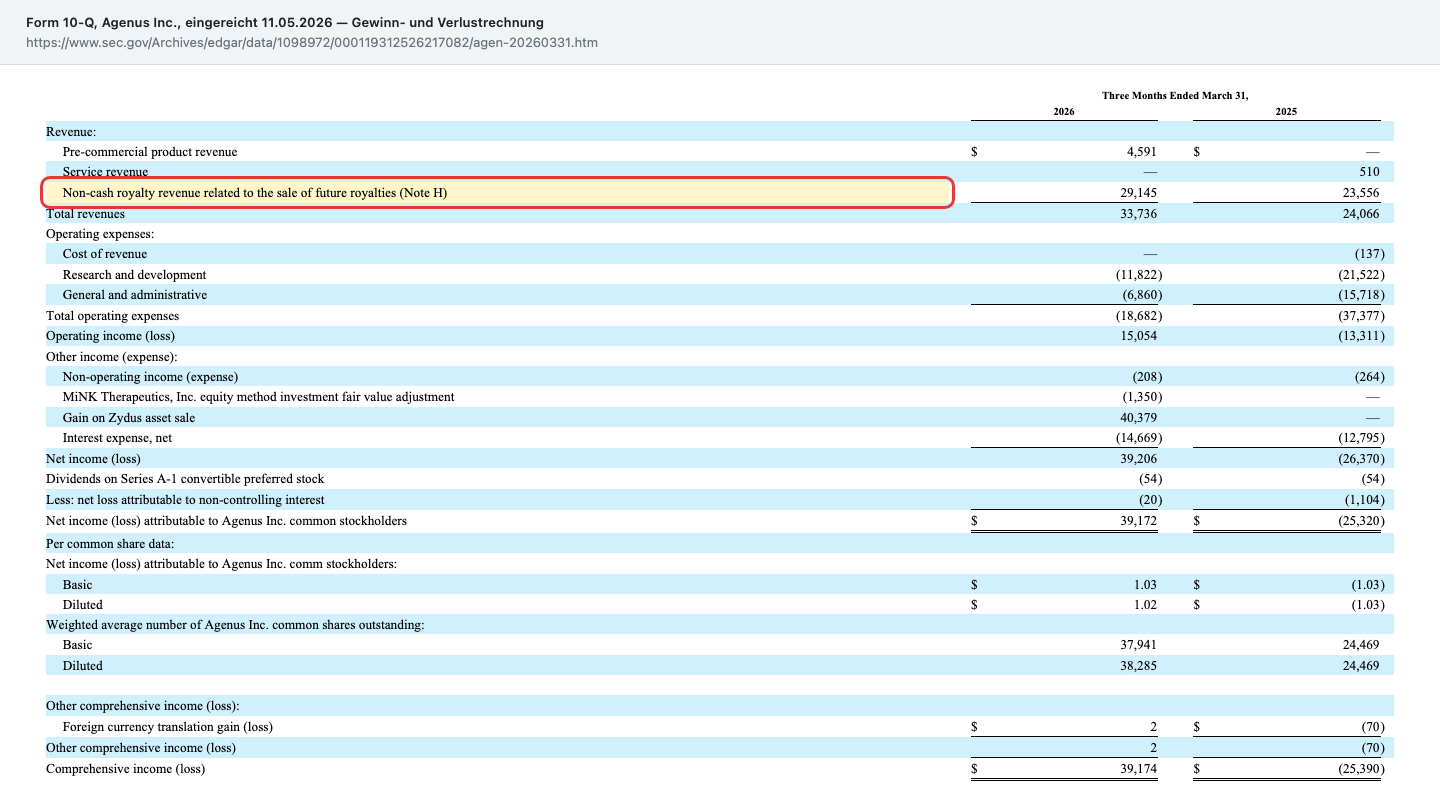
In figures, the share of total revenue attributable to that line looks like this:
- 2023: $114.6 million of $156.3 million — 73.3 percent
- 2024: $101.0 million of $103.5 million — 97.6 percent
- 2025: $108.6 million of $114.2 million — 95.1 percent
- First quarter of 2026: $29.1 million of $33.7 million — 86.4 percent
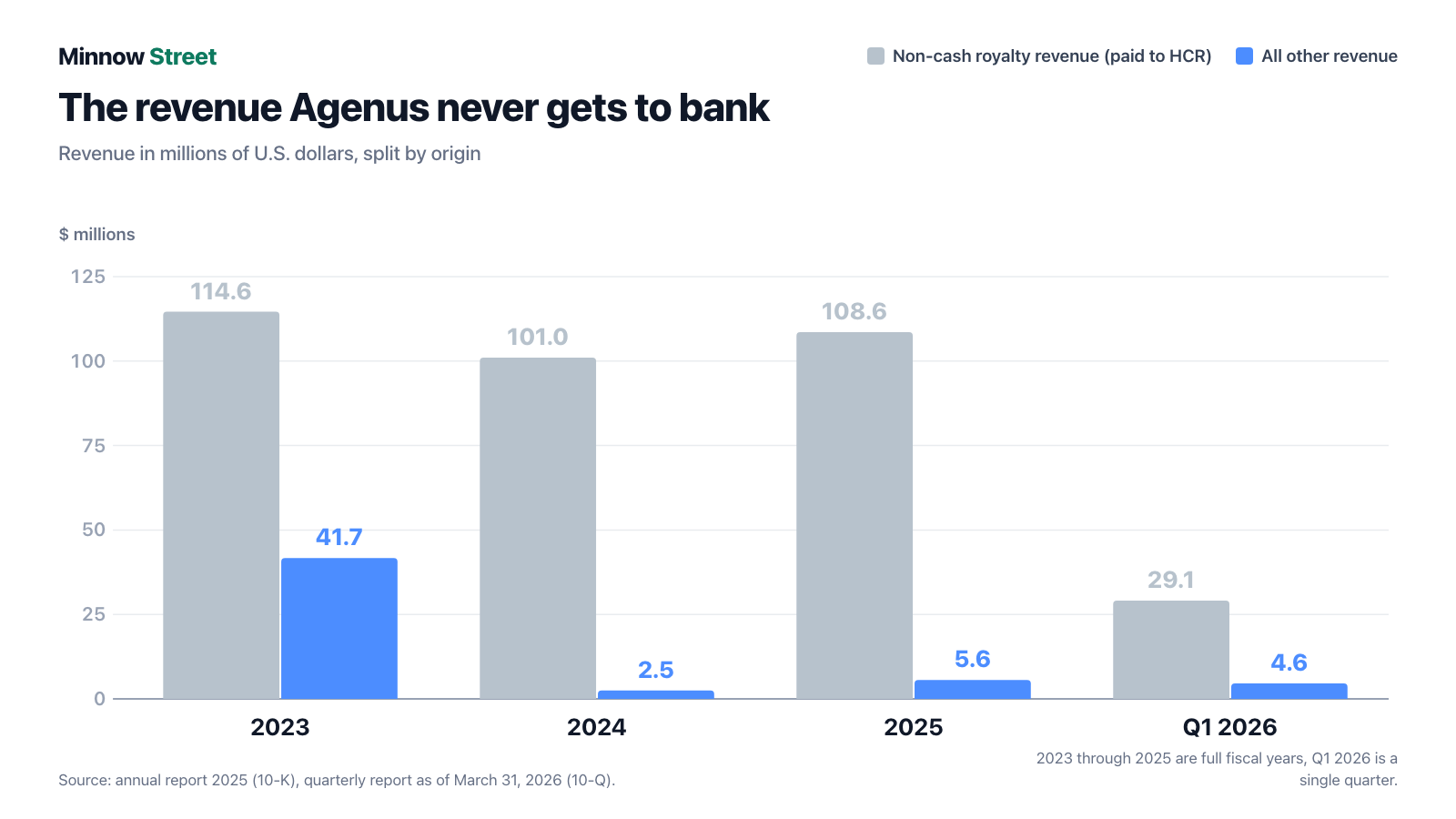
The second half of this truth sits on the balance sheet. Because the sale is carried as a liability, it accrues interest. As of March 31, 2026 the liability related to the sale of future royalties stood at $264.4 million — against a $190.0 million inflow back in 2018. In the first quarter of 2026 it was reduced by $29.1 million and simultaneously built back up by $13.5 million of non-cash interest. Net, it fell by $15.6 million.
Worth remembering: Agenus received $190 million and, eight years later, owes $264 million — in a currency it does not have to pay, but is not allowed to keep either.
And it did not stop at that one forward sale. In May 2024 Agenus sold Ligand Pharmaceuticals a bundle of future proceeds for $75.0 million gross: 31.875 percent of the milestone payments from five partnership agreements, 18.75 percent of the royalties flowing from them, and a synthetic royalty of 2.625 percent on worldwide net sales of botensilimab and balstilimab. So if the company's great hope ever does generate revenue, a slice of it goes to a third party from the very first pack sold. What a one-off sale proceeds looks like inside an income statement is something we have laid out in detail elsewhere — in our analysis of PTC, where $462.6 million of a $590.7 million quarterly profit came out of a single transaction.
Uncomfortable truth No. 2: the profit came from selling the factory
The first quarter of 2026 shows net income of plus $39.2 million, after minus $26.4 million in the prior-year quarter. The jump looks like a turning point. It is not one.
Inside those $39.2 million sits a $40.4 million book gain on the sale of the manufacturing operations to Zydus Lifesciences, closed on January 15, 2026. Strip out that one item and a loss remains. The check against the prior year shows it was no accident: the 2025 net loss came to only $3.1 million — because it contained a $100.9 million book gain from the deconsolidation of the subsidiary MiNK Therapeutics, whose ownership stake had fallen below 50 percent in July 2025. In the two years before that, without such effects, losses ran to $232.3 million (2024) and $257.4 million (2023).
The most honest number is in the cash flow statement: operations consumed $36.0 million in the first quarter of 2026, against $25.6 million in the prior-year quarter. The cash burn did not shrink — it grew, even though costs were cut. The report explains why: during the quarter Agenus paid roughly $51.8 million of bills accrued in earlier periods, $18.0 million of it to contract manufacturers and contract research organizations.
Worth remembering: whoever reads a quarter's profit without laying the cash flow statement beside it reads half the story.
The operating margin of roughly 44.6 percent that put the stock in front of our scanner dissolves the same way. It exists because the $29.1 million of royalty revenue carries no cost line against it — the money leaves the books one line further down, as interest expense of $14.7 million. Same figure, different spot on the form.
Uncomfortable truth No. 3: the doubt about survival is in the current report
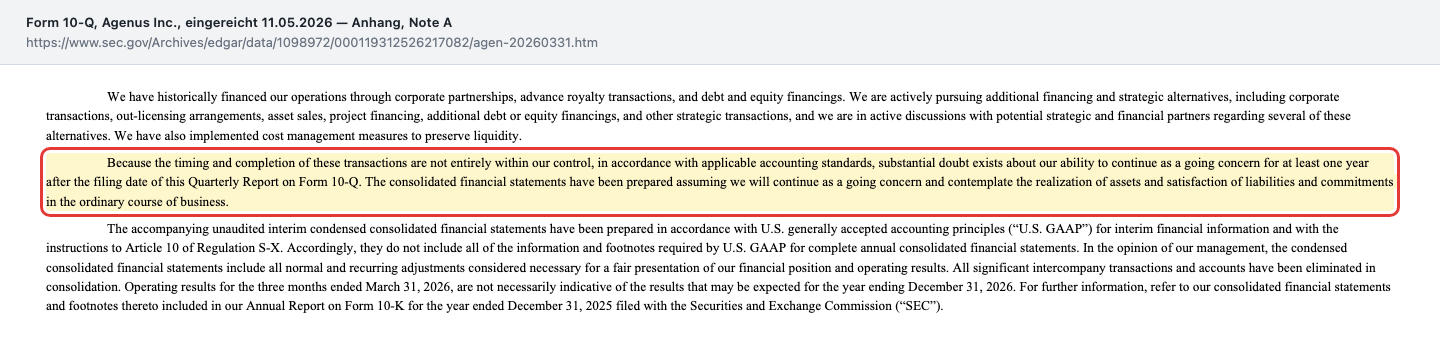
When a company files a report with the SEC, it has to assess whether it is likely to survive the coming year. If that assessment comes out negative, the doubt has to be named explicitly. At Agenus it appears in the most recent quarterly report, filed on May 11, 2026:
"Because the timing and completion of these transactions are not entirely within our control, in accordance with applicable accounting standards, substantial doubt exists about our ability to continue as a going concern for at least one year after the filing date of this Quarterly Report on Form 10-Q."
— Agenus Inc., SEC quarterly report 10-Q as of March 31, 2026, Note A
The balance sheet behind it, as of March 31, 2026: total assets of $186.5 million, current assets of $95.3 million, current liabilities of $249.2 million — including $71.1 million of unpaid supplier invoices and $109.4 million as the current portion of the royalty liability. Equity stood at negative $228.0 million; the balance sheet consistently labels the line not "equity" but "stockholders' deficit." Accumulated deficit since the 1994 founding: $2.14 billion.
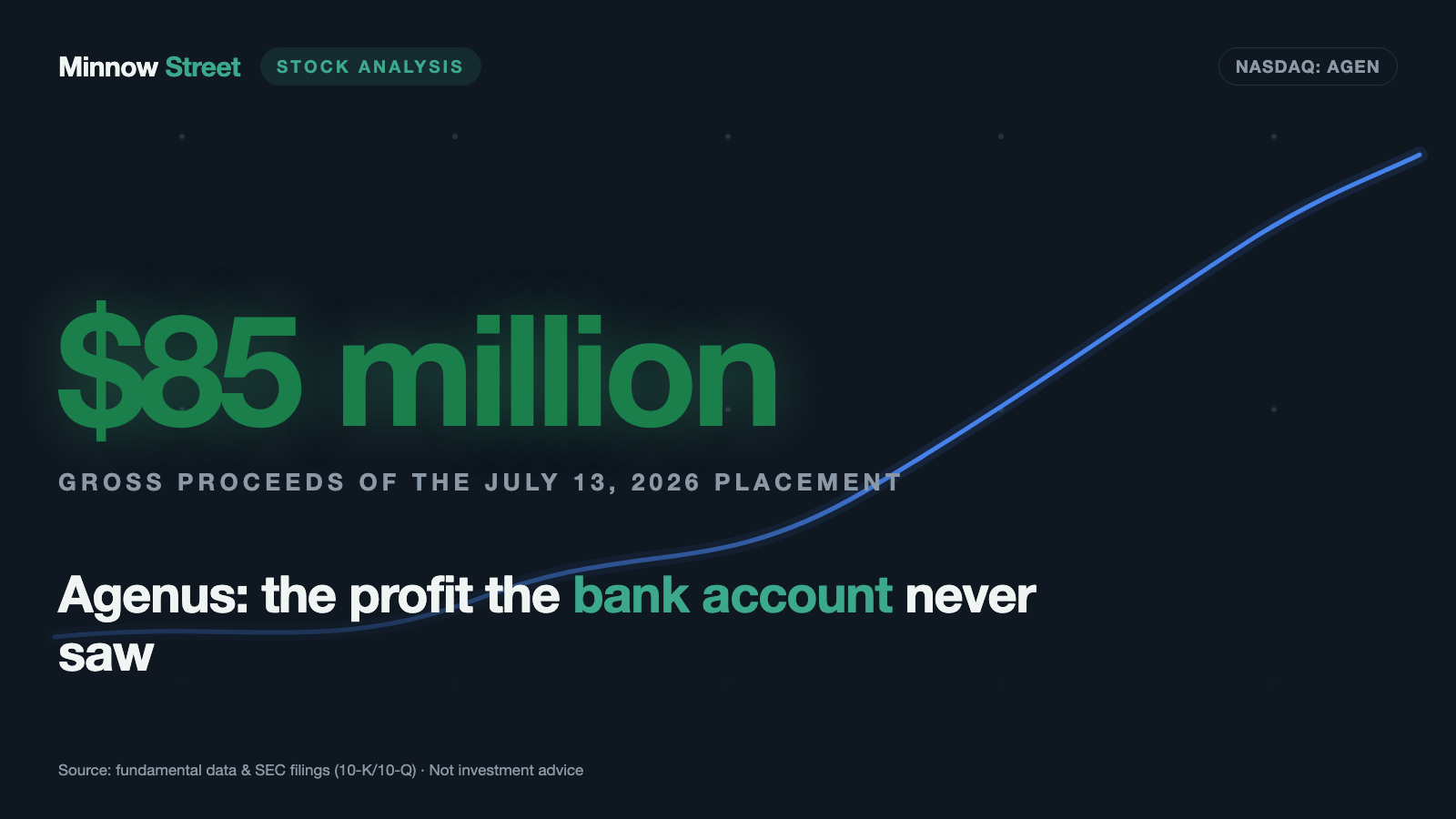
What happened afterwards matters, and it is substantial. On July 13, 2026 Agenus placed shares and warrants for roughly $85 million in gross proceeds. In the same current report the company states a new runway: "into the third quarter of 2027" without exercise of the warrants, "through year-end 2031" if they are exercised in full. The next quarterly report, due in mid-August 2026, will show whether the going-concern warning then falls away. Until then the state of play is the one filed on May 11, 2026 — and it is unambiguous.
Uncomfortable truth No. 4: the warrants are bigger than the company
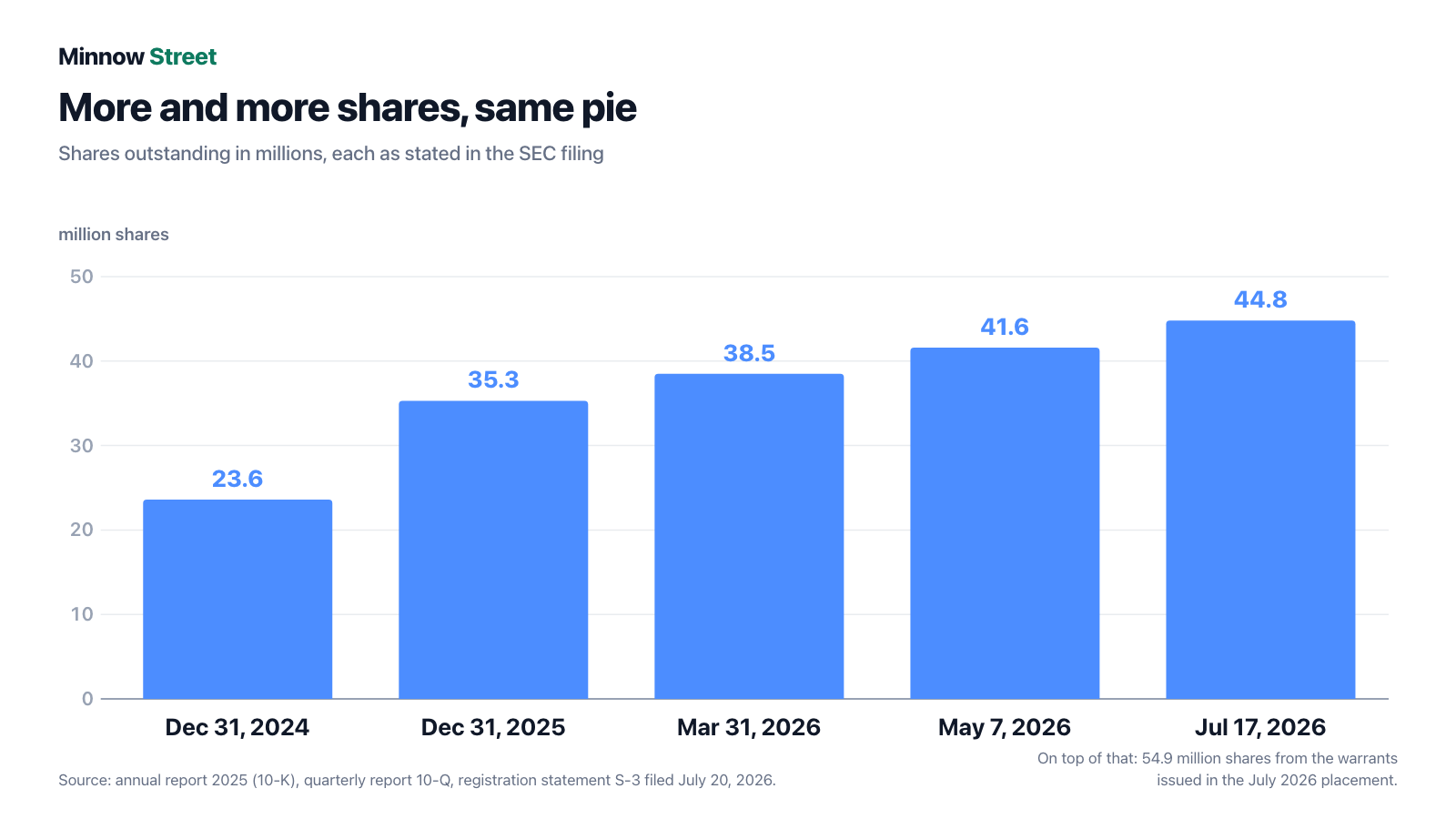
Dilution is a technical word for a simple event: your slice of the cake gets smaller because new slices are cut. At Agenus that has been happening at a steady beat for years.
The driver is a sales program under which Agenus continuously sells shares straight into the market. The average prices achieved under that program tell the story of recent years better than any chart: $32.60 per share in 2023, $9.37 in 2024, $3.84 in 2025 (all restated on the post-split basis). Raising $133.2 million took roughly 4.2 million shares in 2023; raising $36.1 million took roughly 9.7 million shares in 2025.
And then came July 13, 2026. According to the current report, the private placement with institutional investors comprised:
"Under the terms of the Purchase Agreement, the Company has agreed to issue and sell (i) 23,035,227 shares … (ii) accompanying Series A purchase warrants … to purchase 21,144,277 shares of common stock … with an exercise price of $4.02 per share and (iii) accompanying Series B purchase warrants … to purchase 33,797,214 shares of common stock … with an exercise price of $5.03 per share."
— Agenus Inc., SEC current report 8-K of July 13, 2026, Item 1.01

Do the arithmetic. The two warrant series together come to 54,941,491 shares. Shares outstanding on July 17, 2026, per the registration statement, were 44,752,288. So the warrants alone can create more new shares than the company has in existence today. Legally there is nothing in the way: authorized capital runs to 800,000,000 shares.
The effective price of the placement was $3.69 per package of one share plus warrants. The last share price documented in an SEC filing was $5.00, on July 16, 2026. So the new investors got a discount — and two warrants on top. Agenus also agreed to expand the board to nine seats and hand two of them to the investor Commodore Capital for as long as it holds at least 5 percent.
Four weeks earlier the annual meeting had already added its share. On June 16, 2026 shareholders approved topping up the 2019 employee equity plan by another 5,000,000 shares — measured against the 44.8 million shares of mid-July, that is a good 11 percent on top. In the same session they approved a one-time stock option exchange program: old options whose strike prices sat far above the market after the share price collapse may be swapped for new ones at a lower price. Employees may see retention in that. Shareholders were remarkably unenthusiastic — 10,034,030 votes in favor, 9,252,690 against. Nothing else at Agenus comes that close.
One further detail shows how tight things had been. Of the $30.5 million of debt outstanding on March 31, 2026, $5.09 million fell due on June 20, 2026. It was not repaid; on June 29, 2026 it was extended by eight months to February 18, 2027 — and Agenus paid for that not in cash but by extending old warrants and issuing new ones. The second tranche of $24.75 million falls due in November 2026. How a company with a thin cash position uses an at-the-market share program to settle invoices is something we have also described in our analysis of NeOnc — there with $138,601 in the bank and a program worth $75 million.
Uncomfortable truth No. 5: one Phase 3 trial is being dropped, the other starts in 2027
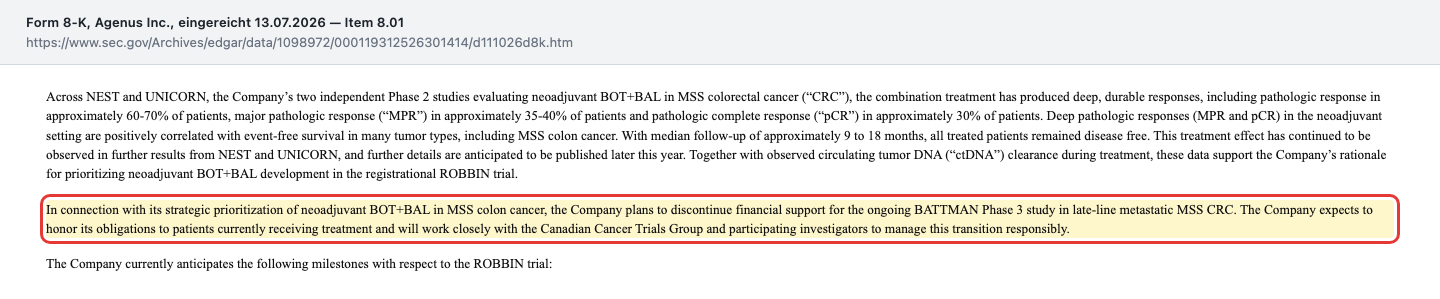
With the fresh money Agenus has made a prioritization decision — and it comes at a price. The ongoing Phase 3 study BATTMAN in late-line metastatic colon cancer will no longer be funded:
"In connection with its strategic prioritization of neoadjuvant BOT+BAL in MSS colon cancer, the Company plans to discontinue financial support for the ongoing BATTMAN Phase 3 study in late-line metastatic MSS CRC."
— Agenus Inc., SEC current report 8-K of July 13, 2026, Item 8.01
Taking its place is ROBBIN: a planned global Phase 3 trial with 850 patients treated before surgery, with event-free survival as the primary endpoint. The addressable market Agenus cites for it is large — roughly 38,000 patients a year in the United States, more than 200,000 worldwide, an estimated U.S. addressable market of more than $7 billion, and no new curative-intent therapy approved in more than twenty years.
The timetable from the same disclosure is sobering in its length:
- First quarter of 2027: first patient dosed
- Second half of 2027: interim pathologic response data
- Second half of 2029: interim analysis of event-free survival
- Second half of 2030: final readout
Four years to the interim analysis, during which 850 patients want treating and paying for. For scale: Agenus has estimated total payments of $690.2 million under its clinical trial agreements, of which $586.1 million had been paid by March 31, 2026. A global Phase 3 trial with 850 patients plays in that league — and the $85 million from the placement does not cover it.
What the stock costs — and what that says about expectations
A valuation in the classic sense is not possible here, and that is a finding rather than a convenience. A price-earnings ratio of 2.9 presupposes earnings that came from selling a factory and will not repeat. A price-to-sales ratio presupposes revenue that flows 95 percent to a third party. And a book value cannot be formed when equity is negative $228.0 million.
What can be formed is an order of magnitude. At 44,752,288 shares (as of July 17, 2026) and the last share price documented in an SEC filing, $5.00 (July 16, 2026), the market capitalization comes to roughly $224 million. The fundamental data feed shows roughly $249 million as of July 26, 2026 — it works with 41,642,431 shares, the figure on the cover of the May 7, 2026 quarterly report, and with a more recent, higher share price. The gap of about 11 percent stays well below the one-fifth threshold at which we discard a market capitalization and every metric derived from it.
$224 million for a company with negative $228 million of equity means the market is paying for hope alone. And the professionals disagree with each other. Five houses cover the stock (data as of July 26, 2026): one strong buy, one buy, three holds — no sell. The mean price target is $30, six times the last documented price. At the same time 7,057,525 shares are sold short — roughly 17 percent of all shares outstanding, and one of the highest ratios we come across in this size class (a month earlier it was 5,994,778 shares).
Worth remembering: a price target at six times the price and one in six shares sold short — that is not a valuation argument, those are two entirely different futures.
Metrics from our own data set put that in context (data as of July 26, 2026): the Piotroski score, which grades balance sheet quality on a scale from 0 to 9, stands at 6 — acceptable, not good; a genuinely healthy company sits at 8 or 9. The Altman Z-score, which estimates proximity to insolvency, comes in at minus 13.98; anything below 1.8 counts as the danger zone. Both figures should be read with care at a company with negative equity — they are arithmetic artifacts of a balance sheet those formulas were never built for.
Opportunities and risks at a glance
What speaks for Agenus:
- Clinical data from two independent Phase 2 studies with pathologic response in roughly 60 to 70 percent of patients and complete response in roughly 30 percent — in a cancer type where immunotherapies have barely worked so far (8-K of July 13, 2026).
- A market opportunity Agenus puts at more than $7 billion for the United States alone, with roughly 38,000 patients affected each year and no new curative-intent therapy approved in more than twenty years.
- Fresh capital of roughly $85 million in gross proceeds (July 2026) and a company-stated runway into the third quarter of 2027 — through the end of 2031 if the warrants are exercised in full.
- Costs cut by two thirds: research spending from $234.6 million (2023) to $79.3 million (2025), administrative expenses from $78.7 million to $54.4 million.
- Own product revenue for the first time, from early access programs: $4.6 million in the first quarter of 2026 after zero in the prior-year quarter.
- A strategic partner with its own money at stake: the Zydus agreements brought in $91.0 million of cash at the January 15, 2026 closing, including roughly $16.0 million for 2,133,333 shares at $7.50 each.
What speaks against it:
- The going-concern warning in the quarterly report of May 11, 2026 — verbatim "substantial doubt," explicitly for at least one year after the filing date.
- Equity of negative $228.0 million and current liabilities of $249.2 million against $95.3 million of current assets (March 31, 2026).
- Operating cash outflow of $36.0 million in the first quarter of 2026 alone, against a cash balance of $35.0 million at quarter end.
- 95 percent of 2025 revenue is royalty money that goes straight to Healthcare Royalty; the matching liability stood at $264.4 million after a $190.0 million inflow in 2018.
- Warrants over 54,941,491 shares from the July placement — more than were outstanding at all on July 17, 2026 (44,752,288); authorized capital 800,000,000 shares.
- The annual meeting of June 16, 2026 topped up the employee equity plan by another 5,000,000 shares and approved a one-time option exchange program — the latter by a remarkably narrow 10,034,030 to 9,252,690.
- $24.75 million of debt falls due in November 2026; the June tranche of $5.09 million was not repaid but extended in exchange for new warrants.
- The decisive interim analysis of the new Phase 3 trial ROBBIN is guided to the second half of 2029 — four years that have to be funded.
- Accumulated deficit of $2.14 billion since 1994 and a 1-for-20 reverse stock split in April 2024 following a Nasdaq deficiency notice.
A human conclusion
Back to the label trap from the opening. It works so well precisely because it does not target carelessness — it targets diligence. Someone who checks the metrics instead of following a story is doing everything right, as long as they know what sits behind the label.
At Agenus, behind "revenue" sits a contract from 2018, behind "net income" a factory sale from 2026, and behind "margin" a line whose costs appear three lines further down. None of it is misstated. All of it is there in the open, in the filings. You just have to keep reading as far as the cash flow statement.
And what remains is a company that has pulled off something remarkable: it turned $3.0 million of cash at the end of 2025 back into freedom of action within six months — by selling the manufacturing plant, by selling shares into the market day after day, and finally through an $85 million placement. The price of that is written in the share count.
Whoever invests here is not buying a metric. They are buying the bet that 850 patients in a trial starting in 2027 will deliver a result good enough by 2029 — and that the money lasts until then without their own slice being halved once more. That can work out. The Phase 2 data is not marketing; it is published and reviewed.
What you make of it is your decision. And that is exactly as it should be.
Sources
- Agenus Inc., SEC quarterly report (10-Q) as of March 31, 2026, filed May 11, 2026 — balance sheet, income statement, cash flow statement, Note A (going concern) and Note H (sale of future royalties)
- Agenus Inc., SEC annual report (10-K) for 2025, filed March 16, 2026 — multi-year comparison, reverse stock split, at-the-market program, Ligand agreement
- Agenus Inc., SEC current report (8-K) of July 13, 2026 — Items 1.01, 3.02, 7.01 and 8.01: private placement, warrants, the ROBBIN trial program, discontinuation of BATTMAN
- Agenus Inc., SEC current report (8-K) of July 6, 2026 — Item 1.01: extension of the 2015 notes to February 18, 2027 in exchange for warrants
- Agenus Inc., SEC current report (8-K) of June 23, 2026 — Item 5.07: results of the annual meeting of June 16, 2026, including the 5,000,000-share increase to the equity plan and the option exchange program
- Agenus Inc., SEC registration statement (S-3) of July 20, 2026 — share count as of July 17, 2026, authorized capital, last documented share price, resale of the Zynext shares
- Source: fundamental data & SEC filings (annual and quarterly reports, 10-K/10-Q) — metrics, analyst coverage and short interest as of July 26, 2026
A note on how to read this: This article is journalistic analysis of publicly available documents. It is not investment advice and not a solicitation to buy or sell securities. Shares in clinical-stage biotechnology companies can lose their entire value at any time; at a company carrying a stated going-concern warning and negative equity, that risk is particularly tangible. All figures come from the primary sources linked above and carry the reporting date stated with them. The author holds no position in Agenus Inc. at the time of publication.
Our Bottom Line at a Glance
- Science and pipeline positive
- Two independent Phase 2 studies (NEST, UNICORN) show pathologic response in roughly 60 to 70 percent of patients with microsatellite stable colon cancer and complete response in roughly 30 percent, with all treated patients disease free at 9 to 18 months of follow-up (8-K of 07/13/2026). In this cancer type immunotherapies have so far achieved close to nothing — that is a real, checkable finding.
- Quality of earnings negative
- Quarterly net income of $39.2M (Q1 2026) includes a $40.4M book gain on the sale of the manufacturing operations to Zydus; the 2025 net loss of just $3.1M included a $100.9M book gain from the deconsolidation of MiNK. Without those effects, losses of $232.3M (2024) and $257.4M (2023) remain. Operations consumed $36.0M of cash in the first quarter of 2026.
- Quality of revenue negative
- In 2024 and 2025, 97.6 percent and 95.1 percent of reported revenue was "non-cash royalty revenue" — money GSK wires directly to Healthcare Royalty Partners, ever since Agenus sold that claim in January 2018 for $190.0M. The matching liability stood at $264.4M as of 03/31/2026, above the original proceeds.
- Balance sheet and liquidity negative
- Equity of minus $228.0M, current liabilities of $249.2M against $95.3M of current assets, cash of $35.0M against a $36.0M quarterly burn (all figures 03/31/2026), accumulated deficit $2.14B. The placement of 07/13/2026, raising roughly $85M gross, buys room into the third quarter of 2027 — on the company's own guidance and without exercise of the warrants.
- Dilution negative
- The share count rose from 23.6M (12/31/2024) to 44.8M (07/17/2026), after a 1-for-20 reverse split in April 2024. The Series A and Series B warrants from the July placement carry rights over a combined 54,941,491 shares — more than are outstanding at all. The average price of the running at-the-market program fell from $32.60 (2023) to $9.37 (2024) to $3.84 (2025), and the annual meeting added another 5,000,000 plan shares on 06/16/2026.
- Timeline neutral
- The decisive Phase 3 trial ROBBIN (850 patients) is guided to dose its first patient in the first quarter of 2027; interim pathologic response data is expected in the second half of 2027 and the interim analysis of event-free survival in the second half of 2029. All of that has to be funded — and the ongoing Phase 3 study BATTMAN loses its funding to pay for it (8-K of 07/13/2026).
Agenus is the label trap in its purest form: a price-earnings ratio of 2.9 and an operating margin of 44.6 percent are exactly what the metrics say, and they still mean nothing, because the profit came from selling the company's own manufacturing plant ($40.4M of the $39.2M reported in the first quarter of 2026) and 95 percent of 2025 revenue was royalty money GSK wires straight to Healthcare Royalty. In the same quarterly report, filed 05/11/2026, the company flags substantial doubt about its ability to continue as a going concern, with minus $228.0M of equity and $35.0M of cash against a $36.0M quarterly burn. The placement of 07/13/2026, raising roughly $85M gross, buys time into 2027 — paid for with warrants over 54,941,491 shares, more than the company has today. Against that stand real Phase 2 data in a cancer type where nothing has worked so far. Not investment advice.
What Our Rating Means
Substance risk
We found at least one documented issue that threatens the company itself — regardless of how the stock is currently valued.
This rating judges the substance of the company, not the share price — and the substance is demonstrably at risk. The most recent quarterly report (10-Q, filed May 11, 2026, Note A) states verbatim that substantial doubt exists about the ability to continue as a going concern for at least one year after the filing date. On top of that sit equity of minus $228.0M, current liabilities of $249.2M against $95.3M of current assets, and cash of $35.0M against an operating cash outflow of $36.0M in the same quarter (all figures as of March 31, 2026) — less than one quarter of runway from the company's own resources. Any single one of those points is enough for the red rating. This is explicitly not a verdict on the science: the Phase 2 results from NEST and UNICORN are published and remarkable for their setting, and the July 13, 2026 placement of roughly $85M gross gives the company runway into the third quarter of 2027 on its own guidance. Whether the going-concern warning then falls away will be decided by the quarterly report due in mid-August 2026. The decision is yours.
A journalistic assessment by our editorial team at the time of the deep dive, based on public sources — not investment advice and not a solicitation to buy or sell. Your personal circumstances (investment goals, risk capacity, taxes) cannot be taken into account. What our levels mean, how verdicts are formed, and what conflicts of interest exist →
Worth Noting
- AGEN reached the research list through the Reddit hype scanner, on July 14, 2026, in the very first run with which that scanner went live. No mention count is on record for that initial batch, so no figure is quoted here. In our in-house stock scanner the stock sits on three lists at once as of July 26, 2026: "P/E ranking," "EBIT margin ranking" and "insolvency radar: cash running out." The scanner lists are recalculated daily.
- Identity and risk of confusion: the company traded as Antigenics Inc. until January 5, 2011; the subsidiary Antigenics, LLC, which holds the QS-21 license agreement, still carries the name. A 1-for-20 reverse stock split took effect on April 12, 2024, following a Nasdaq deficiency notice of December 4, 2023 over a share price below one dollar. All share counts and average prices in this analysis are stated on the post-split basis, exactly as the SEC filings do. Agenus is not to be confused with its listed holding MiNK Therapeutics, which has not been consolidated since the third quarter of 2025.
- Currency note: the most recent quarterly report (10-Q) is dated May 11, 2026 and has been evaluated in full. Filings submitted afterwards have been reviewed — current reports 8-K of 05/15, 06/23, 07/06 and 07/13/2026, the proxy supplement of 05/13/2026, the registration statement S-3 of 07/20/2026, two ownership filings (Schedule 13G) of 07/17/2026 (the Invus group around Raymond Debbane, 4,533,755 shares as of 07/13/2026) and 07/20/2026 (RA Capital Management), plus insider filings (Form 4) of 07/07 and 07/14/2026 — all of them grants to directors and the chief executive, not open-market purchases. The annual meeting of 06/16/2026 increased the employee equity plan by 5,000,000 shares, approved a one-time option exchange program and confirmed KPMG as auditor for 2026; there was no resolution on a further reverse stock split. No accounts exist yet for the quarter ended 06/30/2026; that filing is due in mid-August 2026. There is no Form 15 and no Form 25 — the Nasdaq listing continues.
- The market capitalization used in this analysis is deliberately calculated from the filings: 44,752,288 shares as of 07/17/2026 times $5.00, the last share price documented in an SEC filing (07/16/2026), gives roughly $224M. The fundamental data feed shows roughly $249M as of 07/26/2026; it works with 41,642,431 shares (the 05/07/2026 cover figure) and a more recent, higher price. The gap of roughly 11 percent sits far below the one-fifth threshold at which we discard a market capitalization and the metrics derived from it.
Frequently Asked Questions
In January 2018 Agenus sold the worldwide rights to GSK royalties on the vaccine adjuvant QS-21 to Healthcare Royalty Partners and received $190.0 million for them. For accounting purposes that does not count as a sale but as a liability. Agenus therefore keeps recording the royalties as revenue even though GSK pays them directly to the buyer.
As of March 31, 2026 the company held $35.0 million in cash, up from $3.0 million at the end of 2025. Operations consumed $36.0 million during the first quarter of 2026. On July 13, 2026 roughly $85 million in gross proceeds arrived from a private placement. Agenus itself then guided to a runway into the third quarter of 2027, assuming none of the issued warrants are exercised.
It means Agenus itself is flagging substantial doubt about its ability to keep operating for at least twelve months after the filing date. The statement appears verbatim in the quarterly report (10-Q) filed May 11, 2026. Whether it falls away after the July 2026 capital raise will only be visible in the next quarterly report, due in mid-August 2026.
On July 17, 2026 there were 44,752,288 shares outstanding. The Series A and Series B warrants from the July 13, 2026 placement carry rights over a combined 54,941,491 additional shares, at $4.02 and $5.03. Authorized capital runs to 800,000,000 shares, so headroom is not the constraint. The annual meeting also added 5,000,000 shares to the employee equity plan.
The company was founded in 1994 and traded as Antigenics Inc. until January 5, 2011, when it was renamed Agenus Inc. The subsidiary Antigenics, LLC, which holds the QS-21 license agreement, still carries the old name. Older SEC filings for the company can therefore be found under both names.
On April 12, 2024 Agenus combined every twenty old shares into one new share. The trigger was a Nasdaq deficiency notice of December 4, 2023, because the stock had closed below one dollar for 30 consecutive business days. A step like that changes nothing about the value of the company. All share counts in this analysis are stated on the post-split basis.
The planned Phase 3 trial ROBBIN, with 850 patients treated with botensilimab and balstilimab before surgery. According to the current report of July 13, 2026, the first patient is guided to be dosed in the first quarter of 2027, interim pathologic response data is expected in the second half of 2027, and the interim analysis of event-free survival in the second half of 2029.
Because the two lists read different numbers. The price-earnings ratio and the operating margin come from the income statement, which contains a one-off sale gain and the non-cash royalty revenue. The insolvency radar works off the cash balance and the operating cash outflow. Scanner lists as of July 26, 2026; they are recalculated daily.
Found an error?
Did you spot a factual error, an outdated number, or a typo in this deep dive? Let us know briefly — your report goes straight to the editorial team.