Idaho Strategic Resources: $42 Million From One Gold Mine — and Nothing From the Rare Earths in Its Name
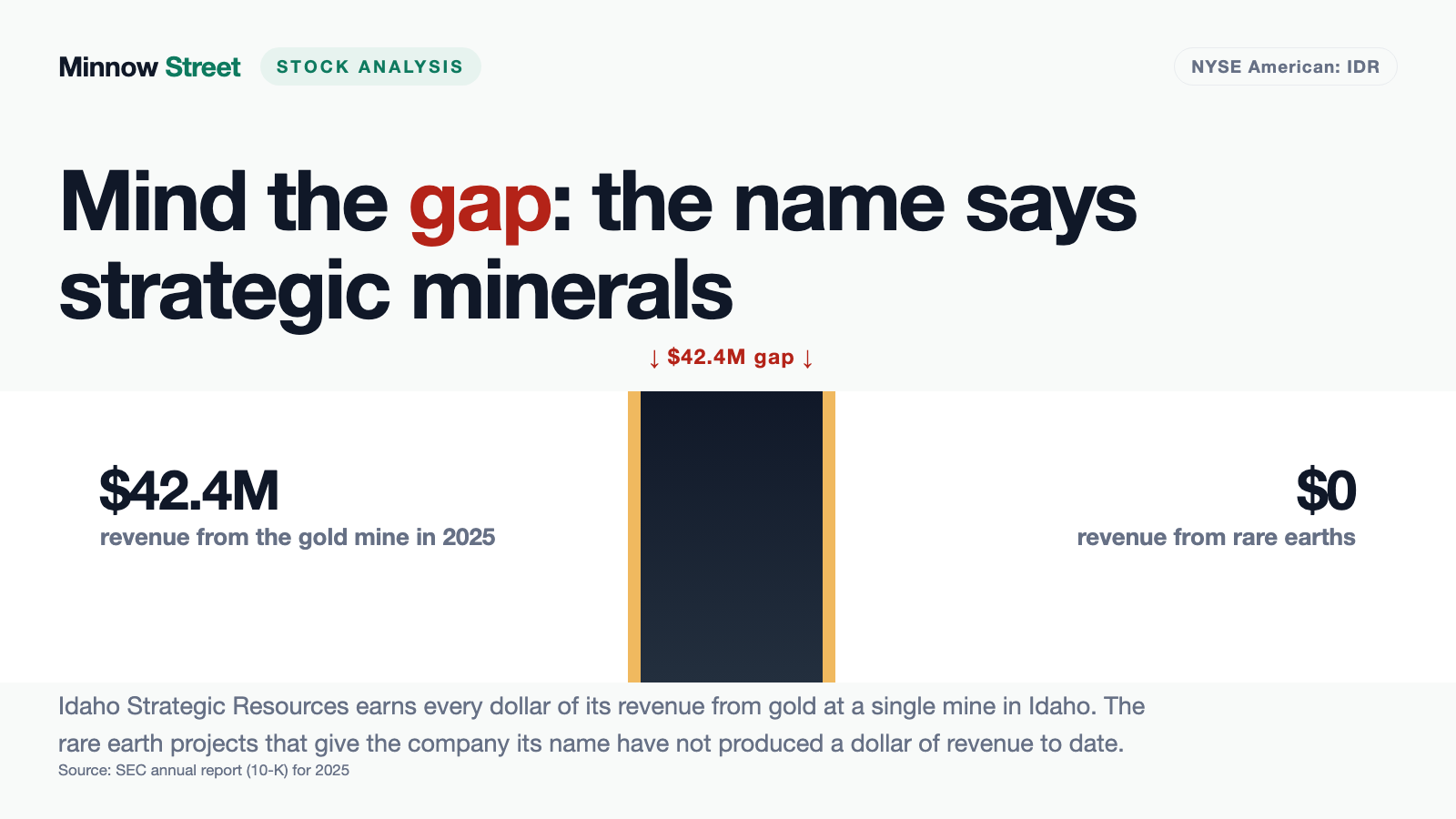
Our in-house stock scanner listed Idaho Strategic Resources in eight screens on July 26, 2026, including the fundamental rating at grade A. The SEC filings explain where that grade comes from — and what it leaves out: all $42,406,253 of 2025 revenue came from gold at a single underground mine, and 98 percent of it went to one broker who also happens to be a shareholder. The three rare earth projects that give the company its name have, according to the annual report, no resources, no reserves and no revenue at all. And the company itself attributes 97 percent of the first-quarter 2026 revenue jump to the gold price. Not investment advice — just a look at what the share price is actually paying for.
 Thomas Mücke
Founder & Publisher
Thomas Mücke
Founder & Publisher
Chart
Interactive price chart (TradingView).
Note: pure fact-based analysis, not investment advice and not a solicitation to buy or sell. All figures without guarantee.
There is an investing trap that springs shut before you have read a single number: the shop-window trap. The most exciting thing sits in the window, the money is made in the back room — and your brain confuses the two. Idaho Strategic Resources (NYSE American: IDR) has carried that name only since December 6, 2021; before then the same company was plainly called New Jersey Mining Company. "Strategic Resources" sounds like rare earths, thorium, critical minerals for defense and robotics. And the company does own three such projects. Except that every single dollar of 2025 revenue came from gold.
So let us make a deal. We set the name aside and read together what the company itself reported, under penalty of law, to the U.S. securities regulator, the SEC — the annual report (10-K) for 2025, filed March 23, 2026, and the quarterly report (10-Q) for March 31, 2026, filed May 14, 2026. A SEC filing may advertise, but it may not lie. And this one describes a surprisingly profitable little gold mine, a single buyer, a treasury larger than the annual revenue — and a story that does not yet have a number attached to it. What you make of that is your call.
What Idaho Strategic Resources actually does — one mine, one mill, one buyer
The business is simple enough to explain in a sentence. Idaho Strategic operates the Golden Chest mine near Murray in northern Idaho, hauls the ore out from underground, trucks it to the New Jersey Mill near Kellogg, which the company operates, and grinds out a flotation concentrate — a powder in which the gold is heavily enriched but not yet refined. That concentrate is sold and shipped; the actual smelting happens at facilities in South Korea and Japan.
The numbers behind it are remarkable for a company this size. In 2025 the mill processed 41,840 tonnes of ore grading 10.14 grams of gold per tonne at a recovery of 93.0 percent, yielding 12,538 ounces of gold (2024: 11,915). For scale: the major gold producers count their output in millions of ounces a year. Idaho Strategic is not a mining conglomerate but a high-grade small mine with a real margin — and that is exactly the strength we are discussing here.
Alongside sit the rare earths. The company controls three exploration projects in Idaho — Mineral Hill, Lemhi Pass and Diamond Creek — covering roughly 21,385 acres of mining claims. In 2025 samples returned up to 17.6 percent total rare earth content, a first drill program of 2,056 meters ran in the fourth quarter, and there is a memorandum of understanding with nuclear fuel developer Clean Core Thorium Energy covering thorium from Lemhi Pass. All of that is real. It is simply exploration: searching, drilling, sampling — paid out of the treasury, with no matching entry on the revenue line.
Which names the central tension of this analysis, and it runs through every chapter: one small gold mine is funding a large minerals story — and the share price is already paying for both.
How this stock landed on our desk
The prompt came from our in-house stock scanner. As of July 26, 2026, Idaho Strategic sits in the U.S. selection of the screen "Fundamental Rank (A / A+)". That screen ranks every stock against every other on a percentile basis: earnings and revenue growth, earnings surprises, margins and margin expansion, Piotroski points, free cash flow, return on equity, balance sheet safety. The result is a score from minus 100 to plus 100; anything from 51 up earns grade A. Idaho Strategic scores 57 — grade A, but in the lower third of the list. In total 38 U.S. names meet the condition and at most 25 are displayed. One caveat matters: these lists are recomputed daily, so what held on July 26, 2026 may look different a week later.
More interesting than the single screen is the combination. On the same day IDR appeared in eight scanner lists, and they contradict one another in instructive ways:
- High revenue growth and Matt Caruso: Sales Leader — revenue beat the year-earlier quarter by at least 20 percent in each of the last six quarters. That is true, and it is impressive.
- Gary Antonacci: Dual Momentum and Pradeep Bonde: $ Breakout Bullish — price strength over longer windows and heavy dollar trading volume.
- High ADR (5 percent or more) — the stock moves more than five percent on an average day. That is not a distinction; it is a warning to your nerves.
- Stan Weinstein: Stage 1 — base building after a downtrend. In plain English: the price has had a rough time. As of July 24, 2026 the 52-week range ran from $16.03 to $54.70, and the closing price that day was $28.38.
- Beneish M-Score — and this is the uncomfortable one. It collects companies whose accounting ratios look unusual in the model of Professor Messod Beneish. The threshold is minus 1.78; Idaho Strategic sits at minus 1.02, inside the warning zone.
Before that turns into a scandal: the M-Score is not proof, it is a reason to read carefully. It reacts to margin jumps, rapid growth and rising receivables — and all three are present here. The gold sales receivable climbed from $1,578,694 at December 31, 2024 to $3,912,922 at December 31, 2025, up 148 percent, while revenue grew 64.6 percent. The filing explains why: concentrate shipments are paid provisionally at first and only finally settled once the smelter has assayed them. Read the ratio alone and you see a red flag; read the filing and you see a settlement mechanism. Remember that: a ratio is a question, not an answer.
The same caution pays off at every small gold producer. How quickly rising ounces fail to become rising profits is something we worked through line by line in our Allied Gold analysis.
The numbers over the years — given their due
First the part that genuinely impresses. This company pulled off the transition most small miners never manage: from a chronic loss maker to a real profit generator. The series speaks for itself (fiscal year ends December 31; all figures from the SEC filings):
- Revenue: $7.6 million (2021) to $9.6 million (2022) to $13.7 million (2023) to $25.8 million (2024) to $42.4 million (2025).
- Net income: losses of $3.3 million (2021) and $2.6 million (2022), then profits of $1.1 million (2023), $8.8 million (2024) and $16,631,198 (2025).
- Gross margin: from 50.3 percent (2024) to 61.8 percent (2025) and on to 66.1 percent in the first quarter of 2026.
The first quarter of 2026 continues the trend: revenue of $14,482,286 against $7,278,536 a year earlier, operating income of $7,582,160 (prior year: $1,401,254) and net income of $6,369,190, or $0.40 per share. The company is also paying taxes now: a $1,359,320 income tax provision in the quarter, against zero a year earlier. That, too, is a sign of maturity — loss carryforwards do not last forever.
But where did the jump come from? The company answers that question itself, and refreshingly bluntly:
"Revenue increased 99% to $14,482,286 from $7,278,536 for the three-month periods ended March 31, 2026 and 2025 respectively. The increase in revenue was 97% due to the increased average gold price realized on ounces sold which was $4,702.04 in the first quarter of 2026 and $2,848.74 in the first quarter of 2025. The remaining 3% of the increased revenue was from producing 334 more ounces of gold."
— Idaho Strategic Resources, Inc., SEC quarterly report 10-Q for March 31, 2026, Results of Operations
Ninety-seven percent price, three percent performance. That is not a criticism of management — nobody sets the gold price. But it answers the question of what you are actually buying: first a leveraged bet on the gold price, and second a well-run mine. And leverage cuts both ways.
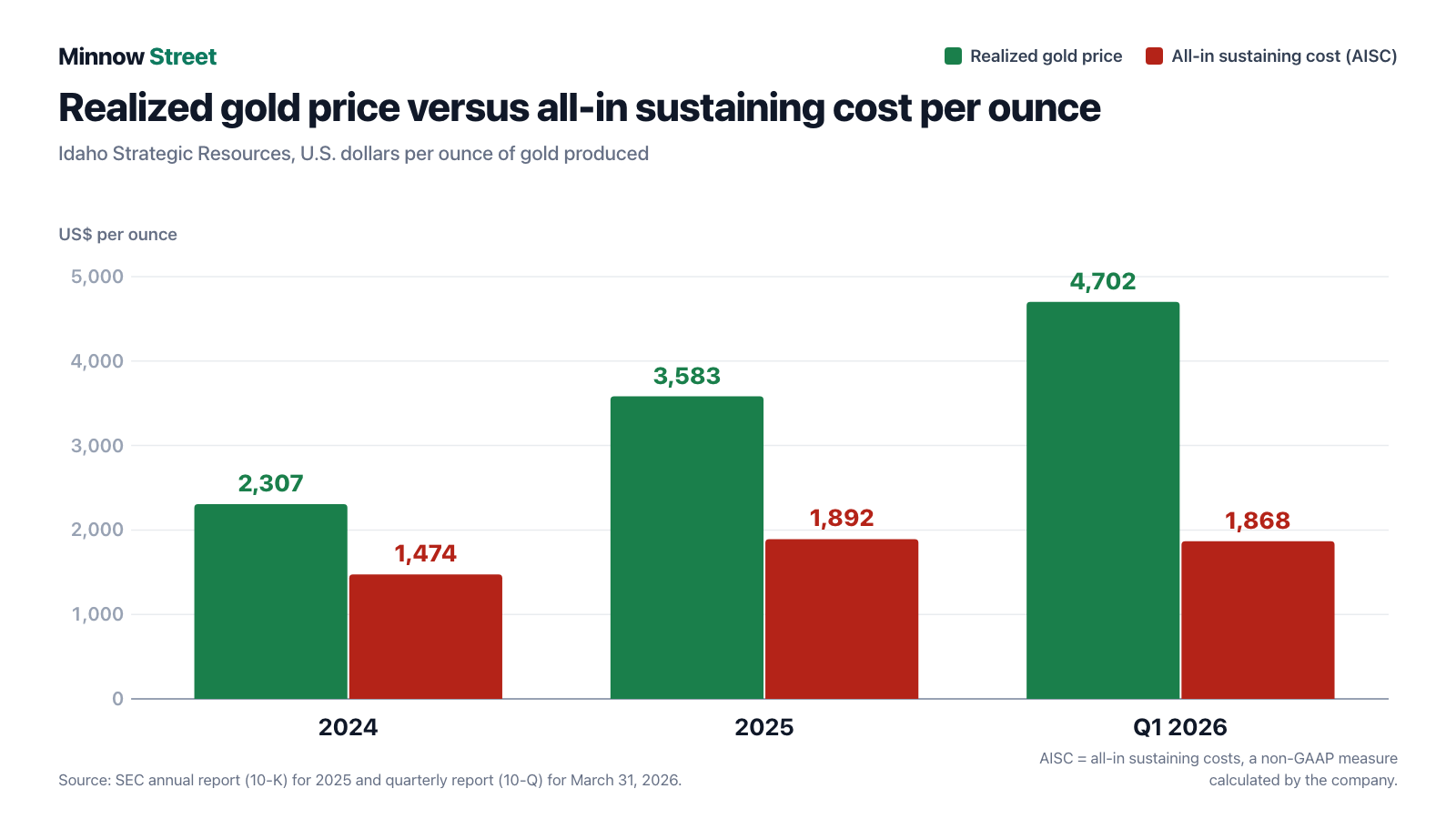
What the chart also shows: costs are climbing too. All-in sustaining costs — operating costs plus sustaining capital plus exploration plus general and administrative expense — rose by $417.74 in 2025 to $1,891.79 per ounce. Strip out exploration and the figure was $1,494.75 against $1,256.16 the year before, still about 19 percent higher. In the first quarter of 2026 pure cash costs came in at $1,190.33 per ounce, up $344.11 from the year-earlier quarter.
What the filings say — the uncomfortable truths
Now the lines that never make it into a presentation. Four of them, numbered, each with a source.
Uncomfortable truth no. 1: one buyer takes almost everything — and owns stock
Customer concentration is one of those phrases that sounds tamer than it is. Translated: if your neighbor tells you business is booming, and you learn in passing that a single customer accounts for nearly all of it, you would swallow hard. That is exactly what the annual report says:
"The Company sold all its flotation gold concentrate to H&H Metals Corporation ("H&H Metals" or "H&H") of New York, NY which accounted for 98% of gold sales in 2025. The remaining gold sales were gold doré which was sold to a western U.S. refinery. H&H Metals is also an IDR shareholder."
— Idaho Strategic Resources, Inc., SEC annual report 10-K for 2025, Item 1 (Customer Dependence and Product Distribution)

In the first quarter of 2026 it was no longer 98 percent but 100 percent: there were no doré sales, and the entire $14,482,286 of revenue ran through H&H. The open receivable at March 31, 2026 — $3,920,174 — is due solely from that one counterparty, with no allowance for doubtful accounts. The company argues a replacement buyer could be found readily because the concentrate is high value with little deleterious content. That is plausible. It does not change the fact that exactly one signature stands between the mine and the money — nor that the concentrate ships to South Korea and Japan, which the company itself connects to tariffs, sanctions and trade conflicts in its risk factors.
Uncomfortable truth no. 2: the reserve is growing — its grade is shrinking
A reserve is the portion of the ore body a qualified person considers economically mineable. It is the life insurance of any producer: what you mine today has to be replaced tomorrow. Here there is good news first, then the fine print.
The good news: reserves at Golden Chest rose to 338,521 tonnes at December 31, 2025, after 170,819 tonnes a year earlier and 127,477 tonnes in 2023. The company replaced far more than it mined. The fine print: the gold grade of those reserves fell from 8.99 to 6.95 grams per tonne. Yet the mill processed ore at 10.14 grams per tonne in 2025 and 9.68 grams in the first quarter of 2026. In other words, what sits in the reserve is roughly a third leaner than what is currently being ground. And in mining one rule always holds: as the grade falls, the cost per ounce rises, because you have to move more rock for the same ounce.
Do the arithmetic yourself: 338,521 tonnes times 6.95 grams is about 2.35 tonnes of gold, and at 93 percent recovery roughly 70,000 recoverable ounces. At the 2025 production rate of 12,538 ounces, that is a little over five years. For an underground operation that is not unusual, and it is extended every year by drilling — 19,362 meters of core in 2025 and another 8,700 meters in the first quarter of 2026. But it explains why exploration expense rose from $2,920,535 to $7,637,435: this company has to drill in order to stay.

Uncomfortable truth no. 3: more money came from shareholders than from the mine
The Idaho Strategic balance sheet looks like a model student's. At March 31, 2026 the company held $20,791,904 in cash and $55,660,141 in U.S. treasury notes against total liabilities of only $6,635,889, of which just $2,023,500 was interest-bearing debt. Equity stood at $119,333,642. Roughly 61 percent of total assets is cash or government paper. A fortress.
Except this fortress was largely bought, not earned. The 2025 statement of cash flows says so plainly.
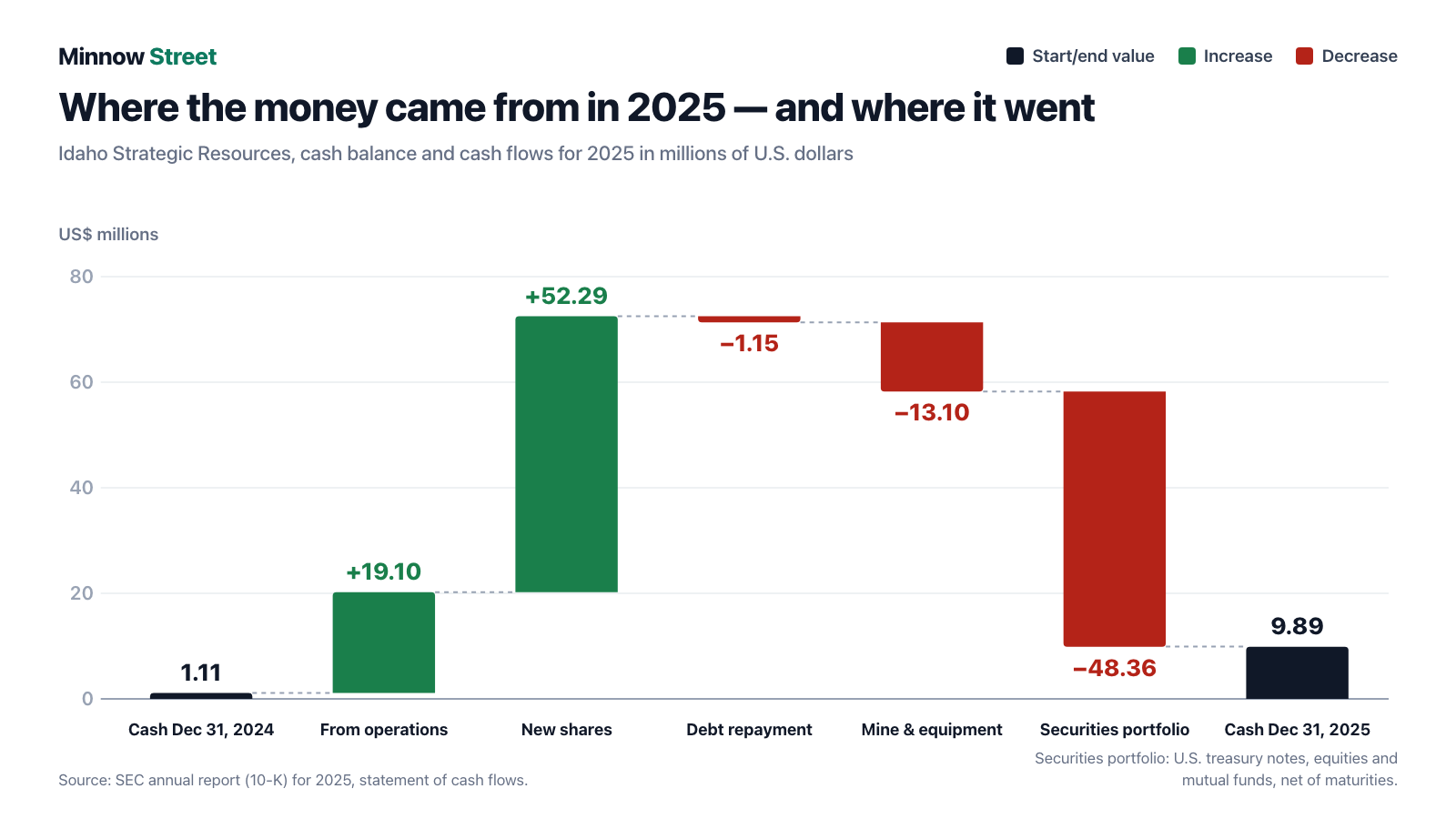
Operations generated $19,101,691 in 2025. Selling new stock brought in $52,027,149 net — more than two and a half times as much. And most of that money moved straight on: $51,759,798 into U.S. treasury notes, plus almost $8 million into equities and mutual funds. Into the mine itself — plant, equipment and mineral properties — went about $13.1 million.
What that means for you is called dilution. Picture the company as a cake: your slice shrinks when new slices are cut, even if the cake itself is growing. The numbers: 13,665,058 shares at December 31, 2024, 15,705,199 at December 31, 2025 (up 14.9 percent) and 15,809,859 at May 1, 2026. On October 2, 2025 the company also launched an at-the-market program of up to $20 million, selling shares into the open market on a rolling basis; the prospectus supplement cites the October 1, 2025 closing price of $34.23 as its reference. Two weeks later, on October 16, 2025, the company filed an automatic shelf registration (Form S-3ASR) — a document that carries no dollar cap and becomes effective immediately. Growth paid for with fresh shares is never entirely free.
Worth noting, too, is where the money sat in the meantime. At December 31, 2025 this gold producer held $8,087,018 in other companies' shares and in mutual funds. All of it was sold during the first quarter of 2026 — at a $304,241 hit to the quarter.

Uncomfortable truth no. 4: the mill everything runs through is only 65 percent owned
All of this company's revenue is created in a single plant — and it shares that plant. The annual report describes a 2011 joint venture: Crescent Silver, LLC funded the New Jersey Mill expansion and received 35 percent of the joint venture assets plus the right to process 7,000 tonnes of its own ore per month. Idaho Strategic holds 65 percent, manages the operation — and is contractually entitled to 3,000 tonnes per month. Actual throughput in 2025 was 41,840 tonnes, about 3,487 tonnes a month.

The company is drawing the right conclusion and building its own 360-tonne-per-day mill right at Golden Chest. Jaw and cone crushers arrived in the first quarter of 2026, the electrical service is being doubled to 2,000 kVA during 2026, the new tailings storage facility is in permitting, and the annual report expects processing to move there in 2027. Until then: a construction project and a third-party interest stand between the mine and the revenue.
Valuation — what the price already reflects
A dated price anchor, and explicitly not a buy argument: on July 24, 2026 the stock closed at $28.38. With the 15,809,859 shares outstanding at May 1, 2026 that implies a market capitalization of roughly $449 million. For comparison, the annual report puts the market value of stock held by non-affiliates at $168,504,500 as of June 30, 2025, and the prospectus supplement cites a closing price of $34.23 on October 1, 2025 — the orders of magnitude line up.
From that follow these ranges (data as of July 24, 2026): a price-to-earnings ratio of about 20 on trailing twelve-month earnings of $1.42 per share, a price-to-sales ratio of about 9 on trailing revenue of $49.6 million, and a price-to-book ratio of about 3.8 on book value of $7.38 per share at March 31, 2026. Subtract cash and treasuries and add back the debt, and enterprise value lands near $375 million — roughly seven and a half times annual revenue.
For a gold producer turning out 12,538 ounces a year, that is not a bargain price. A price-to-sales ratio of 9 is what you normally pay for software, not for ore. The market is clearly paying for two extra things here: leverage to the gold price — and the rare earth story, for which there are as yet no resources, no reserves and no revenue. How risky it is to build a valuation on exploration ground without numbers is something we took apart at a pure explorer in our Solaris Resources analysis.
The "professional view" is thinner here than the phrase suggests: as of July 24, 2026 exactly one analyst follows the stock, with a price target of $45. A single opinion is not a consensus. The other side speaks more loudly: 1,264,926 shares were sold short, roughly 8.5 percent of the 14,930,357-share float — a remarkably large bet against a profitable small producer.
Opportunities and risks at a glance
What speaks for Idaho Strategic:
- Real, documented profitability: net income of $16,631,198 in 2025 after $8,753,377 in 2024 — and $6,369,190 in the first quarter of 2026 alone.
- A balance sheet without worries: $76.5 million in cash and treasuries against $2.0 million of interest-bearing debt at March 31, 2026; the company can fund every project of its own out of its own pocket.
- High ore grades: 10.14 grams of gold per tonne in 2025 at 93.0 percent recovery, producing gross margins of 61.8 percent (2025) and 66.1 percent (Q1 2026).
- Reserves nearly doubled: 338,521 tonnes at December 31, 2025 against 170,819 tonnes a year earlier, backed by 19,362 meters of core drilling in 2025.
- A free option on rare earths and thorium: three projects across roughly 21,385 acres, a first drill program at Lemhi Pass in the fourth quarter of 2025, and samples up to 17.6 percent total rare earth content at the Cardinal prospect.
- The company's own mill at Golden Chest removes the joint venture dependency from 2027; crushers have been delivered and the power supply is being doubled in 2026.
What speaks against it:
- The profit is largely borrowed — from the gold price: the company attributes 97 percent of the first-quarter 2026 revenue increase to price and only 3 percent to higher output.
- One customer for practically everything: 98 percent of 2025 gold sales and 100 percent in the first quarter of 2026 went to H&H Metals, which is also a shareholder; the entire $3,920,174 receivable is due from that party.
- One mine, one mill: Golden Chest is the only property with calculated reserves, and the mill is only 65 percent owned.
- The reserve grade is falling: 6.95 grams per tonne in the reserve against 10.14 grams in the 2025 mill feed — lower grades mean higher cost per ounce.
- Open-ended dilution: a 14.9 percent increase in shares during 2025, an at-the-market program of up to $20 million still running, and since October 16, 2025 an automatic shelf registration with no dollar cap.
- The rare earths in the company name have, per the annual report, no resources, no reserves and no revenue — and are being paid for regardless.
- A demanding price: a price-to-sales ratio of about 9 and a price-to-earnings ratio of about 20 (data as of July 24, 2026), alongside short interest of 8.5 percent of the float.
A human conclusion
Back to the shop-window trap from the opening. Its problem is not that it steers you toward bad companies — Idaho Strategic is not a bad company. Quite the opposite: a small team of 62 full-time employees (as of December 31, 2025) runs a high-grade mine properly, earns real money, keeps the balance sheet clean and puts the awkward passages in the filing out in the open instead of hiding them. That is more than can be said for plenty of larger houses.
The trouble with the shop-window trap is that it makes you ask the wrong question. It asks: "What are three rare earth projects worth in an age of critical minerals?" The honest question is: "What is a gold mine producing 12,538 ounces a year, with five years of reserves and a single buyer, actually worth — and how much of the remaining roughly $449 million of market value am I paying for a story that has no number attached to it yet?"
There are two defensible answers, and both have merit. If you believe the gold price stays high and that Lemhi Pass eventually becomes a deposit, you hold an unusually well-funded option on exactly that outcome — no debt, no solvency risk, and an operating business that pays for the waiting. If instead you think nine times revenue is generous for a mine with one customer and five years of reserves, every number is on your side too. What you make of it is your decision. And that is exactly as it should be.
Sources
Every original document used in this analysis, so you can read it yourself:
- Idaho Strategic Resources, Inc. — SEC quarterly report 10-Q for March 31, 2026 (filed May 14, 2026)
- Idaho Strategic Resources, Inc. — SEC annual report 10-K for 2025 (filed March 23, 2026)
- Idaho Strategic Resources, Inc. — Prospectus supplement 424B5 of October 2, 2025 covering the at-the-market program of up to $20 million
- Annual report 10-K for 2024, the quarterly reports 10-Q of May 8, August 7 and November 12, 2025, the current reports 8-K of March 24, May 14, June 8 and June 11, 2026, the proxy statement DEF 14A of May 1, 2026 and the automatic shelf registration S-3ASR of October 16, 2025: EDGAR filing index for CIK 0001030192 (sec.gov)
- Fundamental data (metrics, valuation, price anchor; data as of July 24, 2026), reconciled against the SEC filings.
- Scanner lists: our in-house stock scanner, as of July 26, 2026; the lists are recomputed daily.
Transparency & disclaimer: this analysis is journalistic commentary on publicly available information. It is not investment advice, not a regulated financial analysis and not a solicitation to buy or sell securities. Equity investments carry substantial risk up to and including total loss. All information is provided without warranty; the date of each data point is noted in the text. The author holds no position in Idaho Strategic Resources shares at the time of publication.
Our Bottom Line at a Glance
- Earnings power positive
- A chronic loss maker has turned into a genuine profit generator: net income of $16,631,198 in 2025 after $8,753,377 (2024) and $1,157,746 (2023), preceded by losses. The gross margin rose from 50.3 to 61.8 percent, and to 66.1 percent in the first quarter of 2026. Operating cash flow reached $19,101,691 in 2025. Since the first quarter of 2026 the company also pays income tax ($1,359,320 in the quarter).
- Balance sheet positive
- At March 31, 2026 the company held $20,791,904 in cash and $55,660,141 in U.S. treasury notes against total liabilities of $6,635,889, of which only $2,023,500 was interest-bearing debt. Equity stood at $119,333,642. This company can fund its drill programs and the new mill out of its own resources — a position few small producers ever reach.
- Dependence on the gold price negative
- The earnings jump is largely borrowed. The realized gold price rose from $2,306.86 per ounce (2024) to $3,583.43 (2025) and $4,702.04 in the first quarter of 2026, while output grew only from 11,915 to 12,538 ounces. The company itself attributes 97 percent of the first-quarter 2026 revenue increase to price. At the same time all-in sustaining costs rose by $417.74 in 2025 to $1,891.79 per ounce.
- Concentration risk negative
- One mine, one mill, one buyer: the annual report calls Golden Chest the only property with calculated reserves, the New Jersey Mill is only 65 percent owned, and 98 percent of 2025 gold sales — 100 percent in the first quarter of 2026 — went to H&H Metals, which is also a shareholder. The entire $3,920,174 receivable at March 31, 2026 is due from that single counterparty.
- Dilution negative
- The share count rose 14.9 percent during 2025, from 13,665,058 to 15,705,199, and stood at 15,809,859 on May 1, 2026. Stock sales brought in $52,027,149 net — more than two and a half times operating cash flow. An at-the-market program of up to $20 million has been running since October 2, 2025, and an automatic shelf registration with no dollar cap has been on file since October 16, 2025.
- Rare earths neutral
- The three projects Mineral Hill, Lemhi Pass and Diamond Creek cover roughly 21,385 acres; samples in 2025 returned up to 17.6 percent total rare earth content and 2,056 meters were drilled in the fourth quarter. But the annual report states expressly that no resources and no reserves have been established there. It is a real option — with an open timetable and no figure by which to measure it.
Idaho Strategic Resources is a small, well-run and unusually well-funded gold mine with a big story attached. The business is real: $42,406,253 of revenue and $16,631,198 of net income in 2025, $76.5 million of cash and treasuries against $2.0 million of debt at March 31, 2026. The limits are just as real: 97 percent of the first-quarter 2026 revenue increase came from the gold price, 98 to 100 percent of sales go to one broker, the reserve grade has fallen to 6.95 grams per tonne, and the rare earths in the company name still have no resources and no revenue. At roughly $449 million of market value (closing price $28.38 on July 24, 2026) the market is paying for both — the mine and the story. Not investment advice.
What Our Rating Means
Open questions
The business works in principle, but one material question is open. As long as it stays open, our findings do not carry a quality verdict.
The company demonstrably earns money, the balance sheet is unusually clean, and management puts the awkward passages into the filing itself — all of which points to quality. What remains open is the operating core question, and it is not a small one: the entire business rests on a single mine with a little over five years of reserves, on a mill the company owns only 65 percent of, and on a single buyer who most recently took 100 percent of sales. On top of that, the earnings jump was 97 percent price-driven by the company's own arithmetic, and the reserve grade has fallen from 8.99 to 6.95 grams per tonne. This is no threat to the substance — the treasury is too full and the debt too small for that — but it is considerably more than a formality. Hence yellow: proven earnings power, unresolved concentration. The decision is yours.
A journalistic assessment by our editorial team at the time of the deep dive, based on public sources — not investment advice and not a solicitation to buy or sell. Your personal circumstances (investment goals, risk capacity, taxes) cannot be taken into account. What our levels mean, how verdicts are formed, and what conflicts of interest exist →
Worth Noting
- Idaho Strategic Resources reached our research list through our in-house stock scanner: the stock sits in the U.S. selection of the "Fundamental Rank (A / A+)" screen with a fundamental rating of 57 (grade A starts at 51), plus seven further screens — Beneish M-Score, Gary Antonacci: Dual Momentum, High ADR (5 percent or more), High revenue growth, Matt Caruso: Sales Leader, Pradeep Bonde: $ Breakout Bullish and Stan Weinstein: Stage 1 (as of July 26, 2026). The lists are recomputed daily.
- Risk of confusion: Idaho Strategic Resources was named New Jersey Mining Company until December 6, 2021, which is why the New Jersey Mill and New Jersey Mine carry those names although every asset lies in Idaho. The Form 15-12G of May 16, 2013 in the EDGAR file relates to a class of securities deregistered at that time; the common stock has been continuously registered since and trades on the NYSE American under commission file number 001-41320.
- Valuation figures are dated and evergreen: the $28.38 price anchor is the closing price of July 24, 2026 and is explicitly not a buy argument. Two filing figures confirm the order of magnitude: $168,504,500 of market value held by non-affiliates at June 30, 2025 (annual report 10-K) and a closing price of $34.23 on October 1, 2025 (prospectus supplement 424B5). The roughly $449 million market capitalization is calculated from 15,809,859 shares (as of May 1, 2026) and the closing price.
Frequently Asked Questions
Idaho Strategic Resources, Inc. (NYSE American: IDR) mines gold at the underground Golden Chest mine near Murray in northern Idaho and processes the ore at the New Jersey Mill it operates into a gold concentrate. In 2025 the mill handled 41,840 tonnes grading 10.14 grams of gold per tonne and produced 12,538 ounces of gold. The company also runs three exploration projects for rare earths and thorium, which generate no revenue so far.
No. The 2025 annual report states expressly that no resources and no reserves have been established at the three projects Mineral Hill, Lemhi Pass and Diamond Creek. All $42,406,253 of 2025 revenue came from gold and silver sales at the Golden Chest mine, of which only $234,523 was silver. The rare earths remain pure exploration and so far only consume cash.
Because the company was named New Jersey Mining Company until December 6, 2021. The name comes from the mining history of the Coeur d'Alene district, not from the state of New Jersey. The company was incorporated in Idaho in 1996 and still files with the SEC under CIK 1030192. The mill and mine kept their historic names even though every asset sits in Idaho.
Heavily. The annual report says roughly 98 percent of 2025 gold sales went to H&H Metals Corporation of New York, which is also a shareholder of the company. In the first quarter of 2026 it was 100 percent, and the entire $3,920,174 gold receivable at March 31, 2026 is due from that one buyer. Management believes a replacement buyer could be found readily because the concentrate is high value.
At December 31, 2025 the company reported 338,521 tonnes of reserves grading 6.95 grams of gold per tonne. At 93 percent recovery that works out to roughly 70,000 recoverable ounces — a little over five years at the 2025 production rate of 12,538 ounces. Reserves nearly doubled during 2025, but at a lower grade: in 2024 they still stood at 8.99 grams per tonne.
Mostly from the gold price. The realized price rose from $2,306.86 per ounce in 2024 to $3,583.43 in 2025 and $4,702.04 in the first quarter of 2026. Output over the same period grew only from 11,915 to 12,538 ounces. For the first quarter of 2026 the company itself states that 97 percent of the revenue increase came from price and 3 percent from 334 additional ounces.
The share count rose from 13,665,058 at December 31, 2024 to 15,705,199 at December 31, 2025, an increase of 14.9 percent. Net proceeds from selling stock were $52,027,149 — more than two and a half times the $19,101,691 generated by operations. At May 1, 2026 there were 15,809,859 shares outstanding. Further issuance is possible at any time via the at-the-market program and the shelf registration.
No. The prospectus supplement of October 2, 2025 states that the company has never paid or declared a cash dividend and does not expect to in the foreseeable future. All available funds and future earnings are meant to go into developing and expanding the business — currently above all into drill programs and the construction of the new mill at Golden Chest.
Found an error?
Did you spot a factual error, an outdated number, or a typo in this deep dive? Let us know briefly — your report goes straight to the editorial team.