Hyliion Stock: Up 166 Percent in Three Months — for a Product Nobody Can Buy Yet
Hyliion was one of the celebrated SPAC listings of the 2020 electric-truck wave — then the stock lost more than 90 percent, the powertrain business was wound down, and today the company builds something entirely different: the KARNO generator, a power module born in General Electric's labs that is meant to feed, among other things, AI data centers. The stock ranks no. 4 in our in-house Qullamaggie Top Gainers 3M scanner (as of July 18, 2026) and has nearly tripled within three months. We read the annual reports (10-K) and the quarterly report (10-Q) as of March 31, 2026: a real cash cushion of $139 million, real contracts with the U.S. Navy — and annual revenue of $3.5 million that comes entirely from government contracts cancellable at any time, while commercialization is only targeted for year end. Not investment advice — just a reminder that a tripled stock price is not a shipped product.
 Thomas Mücke
Founder & Publisher
Thomas Mücke
Founder & Publisher
Chart
Interactive price chart (TradingView).
Note: pure fact-based analysis, not investment advice and not a solicitation to buy or sell. All figures without guarantee.
There is an investor trap that feeds on well-told stories: the comeback trap. It works like this: a company crashes, reinvents itself, the stock takes off — and your brain concludes the resurrection has been proven. After all, you can see it in the chart. Hyliion Holdings Corp. (NYSE American: HYLN) is currently the textbook example: listed in 2020 as an electric-truck hopeful via a SPAC merger, then down more than 90 percent and its entire original business wound down — and now, reborn as a generator maker for the power gap of the AI era, up nearly threefold within three months. In our in-house Qullamaggie Top Gainers 3M scanner, the stock sits at rank 4 of the U.S. selection (as of July 18, 2026). So let\'s make a deal: before you trust your portfolio to the comeback, we read together what Hyliion itself filed, under penalty of law, with the U.S. securities regulator, the SEC — the annual reports (10-K) for 2024 and 2025 and the quarterly report (10-Q) as of March 31, 2026. Both sides are in there: a cash cushion of $139.4 million and real contracts with the U.S. Navy. And annual revenue of $3.475 million, of which not a cent comes from a product sale. In the end, you decide how much proof a price jump really is.
What Hyliion actually does — and why it is no longer what the company went public for
The history in short form, because everything else depends on it: Hyliion came to the stock market in October 2020 through a merger with the shell Tortoise Acquisition Corp. — the name change is recorded in the SEC\'s database as a "former name" to this day. The product promise back then was called Hypertruck ERX: electrified powertrains for heavy trucks. On November 7, 2023, the board pulled the plug — the powertrain business was wound down by resolution, with the final wind-down work running through the end of 2025 per the annual report. Whoever buys the stock today is not buying the company of the 2020 listing prospectus, but its second attempt.
That second attempt is called the KARNO Power Module: a stationary power generator that works differently from conventional gensets. Instead of a combustion engine with a crankshaft, the core is a linear generator — in an everyday image: no rotating motor, but a piston that swings back and forth like a bicycle pump, pushing magnets through coils. The heat comes from flameless oxidation, the working gas is helium, and because no open flame is involved, the machine runs, per the annual report, on more than 20 different fuels — from natural gas to diesel to hydrogen. One core delivers 200 kilowatts; for data centers, Hyliion is developing a containerized multi-megawatt variant. The pedigree is remarkable: per the annual report, the technology "emerged out of General Electric\'s long-running R&D investments" and was acquired from GE via an Asset Purchase Agreement in August 2022 — not a garage project, but corporate inheritance with patent protection.
And the story has a real core. The annual report names the target customers verbatim:
"Hyliion is initially targeting the datacenter, commercial, industrial, and defense sectors with a locally-deployable generator designed to meet a wide range of power generation needs."
— Hyliion Holdings Corp., SEC annual report 10-K for 2025, Item 1 "Business"
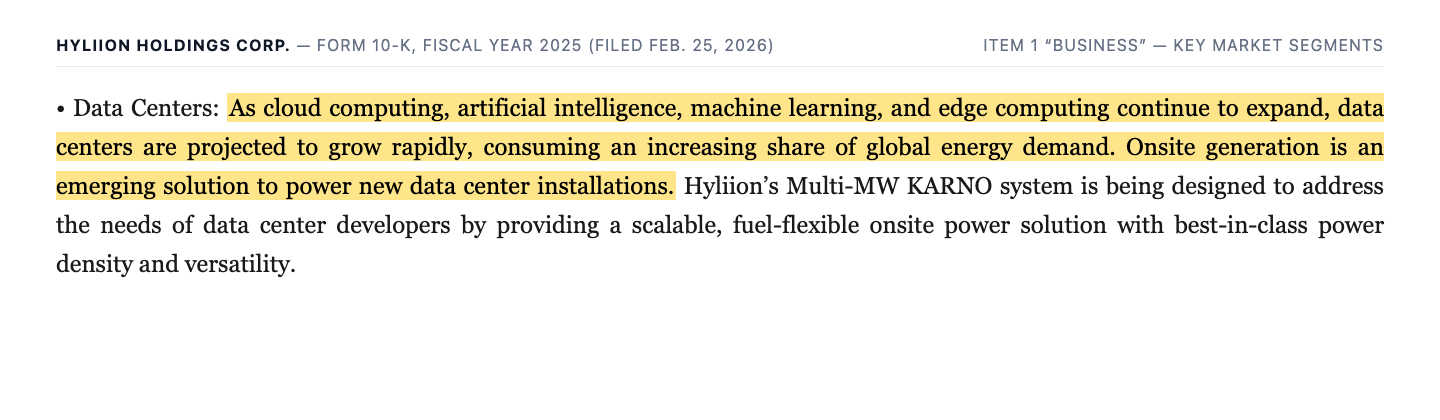
Data centers are not first on that list by accident: AI data centers need electricity faster than grids can be built — the same demand we watched a $500 billion company monetize in our Caterpillar analysis, and whose capital hunger we examined from the other side in our Nvidia analysis. The annual report puts it like this: "As datacenter rack power densities rise to support increased AI workloads, Hyliion\'s KARNO Power Module\'s native 800V DC architecture simplifies power system design and enhances site resiliency." Which brings us to the central tension of this analysis, running through every chapter: the demand story is real and the technology has a serious pedigree — but Hyliion has not reached the market with it yet, and the stock is pricing the comeback as if it had already succeeded.
Where the stock shows up in our scanner
We run roughly 3,500 stocks through our scanners every day. As of July 18, 2026, Hyliion appears in the Qullamaggie Top Gainers 3M scanner at rank 4 of the U.S. selection. To replicate it yourself: open the scanner, set the country filter to "US" — the list shows the strongest three-month gainers in scanner order. The scanner hunts for the pattern of the Swedish trader Qullamaggie: stocks with a three-month relative strength above 98 (Hyliion: 99 — stronger than 99 of 100 U.S. stocks), an average daily range of at least 3.5 percent, and sufficient dollar volume. Hyliion overshoots all three: up 166 percent in three months, an average daily range around 15 percent (in plain terms: on a normal day this stock moves as much as a blue chip does in a good quarter) and about $27 million in daily dollar volume. The fundamental lens of the same scanner tells a different story: a Piotroski F-Score of 4 out of 9 (a nine-point health check of the books — 4 is weak, robust territory starts at 8), an overall grade of C, and no price-to-earnings ratio, for lack of earnings. Only the Altman Z-Score looks spectacular at around 21 — but be careful with the translation: this early-warning gauge for financial distress only spikes that high because a large pile of securities meets a tiny balance sheet with almost no debt. It measures the cushion, not the business. Remember the principle: a momentum scanner measures movement — whether there is substance behind the movement, you have to read in the filings. Which is exactly what we do now.
The numbers over the years — honestly appraised
First, what genuinely has substance. Number one: the cash. As of March 31, 2026, Hyliion held $139.4 million in cash and short- and long-term investments — against total liabilities of less than $12 million (December 31, 2025), essentially office leases. Practically debt-free, conservatively invested. Number two: real, paying counterparties. The U.S. Navy, through its Office of Naval Research (ONR), has awarded research contracts of up to $16 million (2024) plus earlier contracts of up to $2.4 million, and in July 2025 a Phase II SBIR award of up to $1.5 million came on top; in 2025 Hyliion delivered two early adopter units to the Navy, with two more running internal endurance tests and UL certification. Number three: the direction is right. Revenue rose 130 percent in 2025 to $3.475 million, and 479 percent in the first quarter of 2026 to $2.832 million — while the quarterly loss shrank year over year from $17.3 million to $11.7 million, partly because development work now happens inside paid government projects.
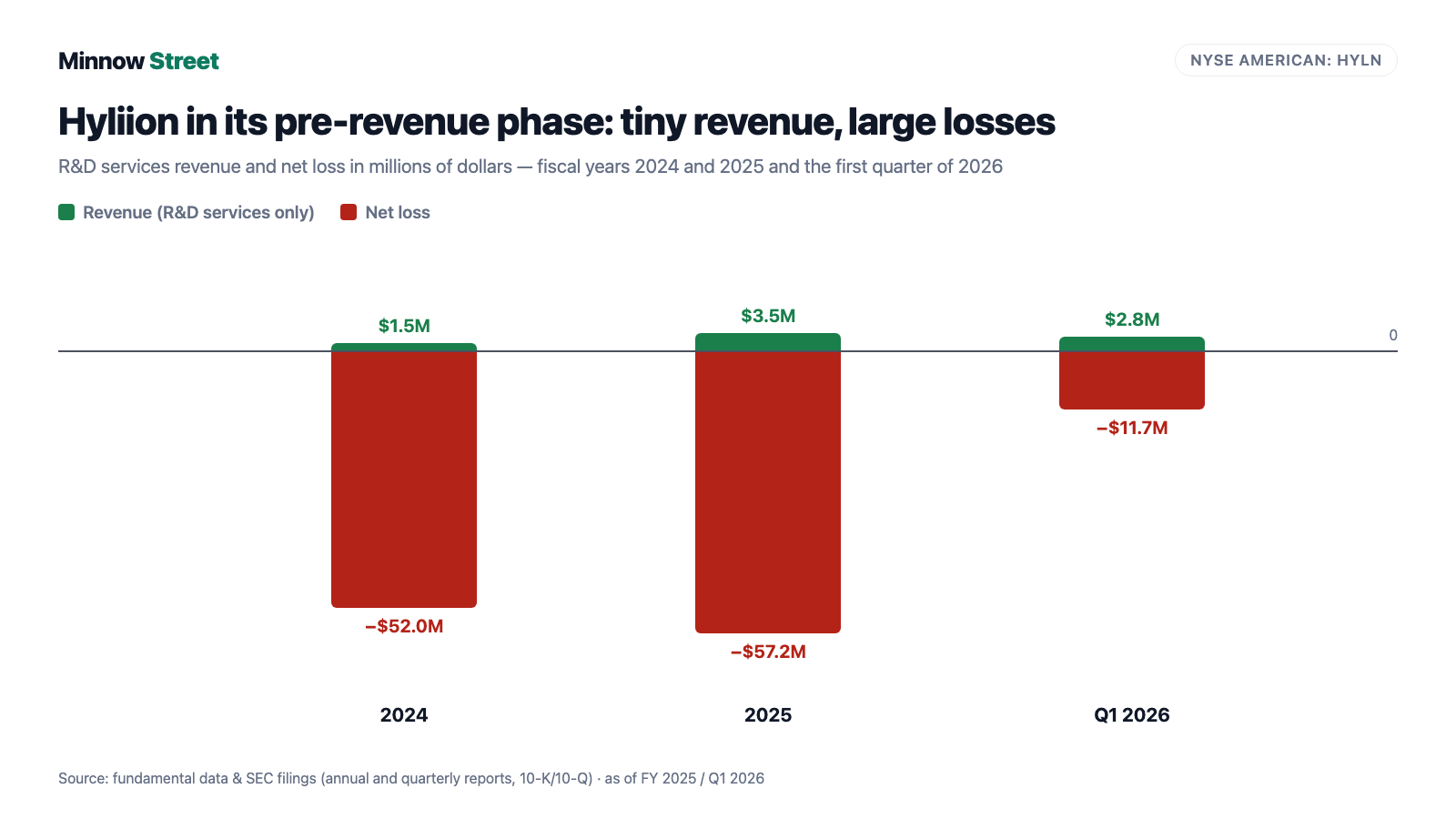
Honesty demands the counter-entry, and it is in the same filing: all of that revenue is services, not product — Hyliion gets paid to do research under government contract, not for generators sold. The gross margin on those contracts is razor thin (2025: $170 thousand of gross profit on $3.475 million of revenue), while research and administration cost $65.7 million. And the timeline has wobbled before: in early 2025, Hyliion had to postpone the delivery of the first customer units — due to design and production problems with a key 3D-printed component, the regenerator, and delays at the contract manufacturer of the linear electric motors. That is everyday life for a pre-production company, not a scandal. But remember the image: what is growing here is a research budget with a ticker symbol — the test as a product company is still ahead.
What the filings say — the uncomfortable truths
Uncomfortable truth no. 1: Hyliion calls itself an early-stage company — and does not rule out never becoming profitable
The most sober self-assessment sits in the risk factors of the annual report:
"We are an early-stage company with a history of losses, and expect to incur significant expenses and continuing losses for the foreseeable future. […] We believe that we will continue to incur significant operating and net losses each quarter until we are generating sufficient positive gross margins from sales of KARNO generator products or R&D services, and we may never achieve such performance."
— Hyliion Holdings Corp., SEC annual report 10-K for 2025, Item 1A "Risk Factors"
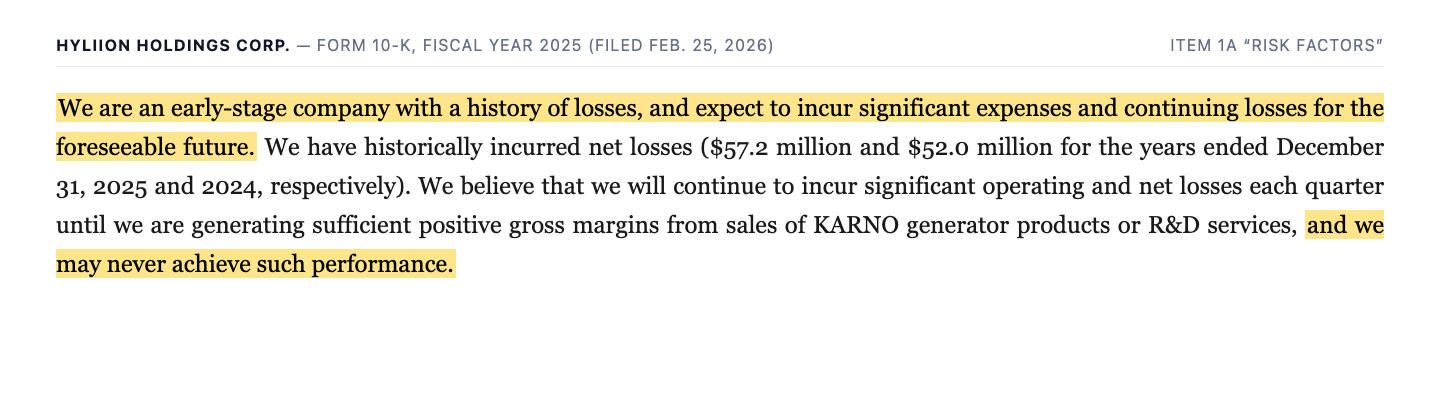
The numbers behind it: a net loss of $57.2 million in 2025 after $52.0 million in 2024; as of December 31, 2025, the balance sheet has piled up $207 million in accumulated deficit — against $413 million shareholders have paid in altogether. In plain terms: of every dollar investors ever entrusted to Hyliion, half has already gone into development, the electric-truck adventure and its wind-down. That may come with the territory of a technology bet — but "early-stage" is a remarkably honest word for a company that has been listed since October 2020.
Uncomfortable truth no. 2: all revenue hangs on government contracts — cancellable "for convenience"
Hyliion\'s revenue has exactly one source, and that source has a built-in trapdoor. The quarterly report describes both in two sentences:
"The remaining amounts of revenue that we may recognize under these contracts was up to $11.2 million as of March 31, 2026, which is expected to primarily be recognized in 2026. These contracts can be cancelled by the United States government at any time for, among other reasons, convenience."
— Hyliion Holdings Corp., SEC quarterly report 10-Q as of March 31, 2026, Item 2 "Management\'s Discussion and Analysis"
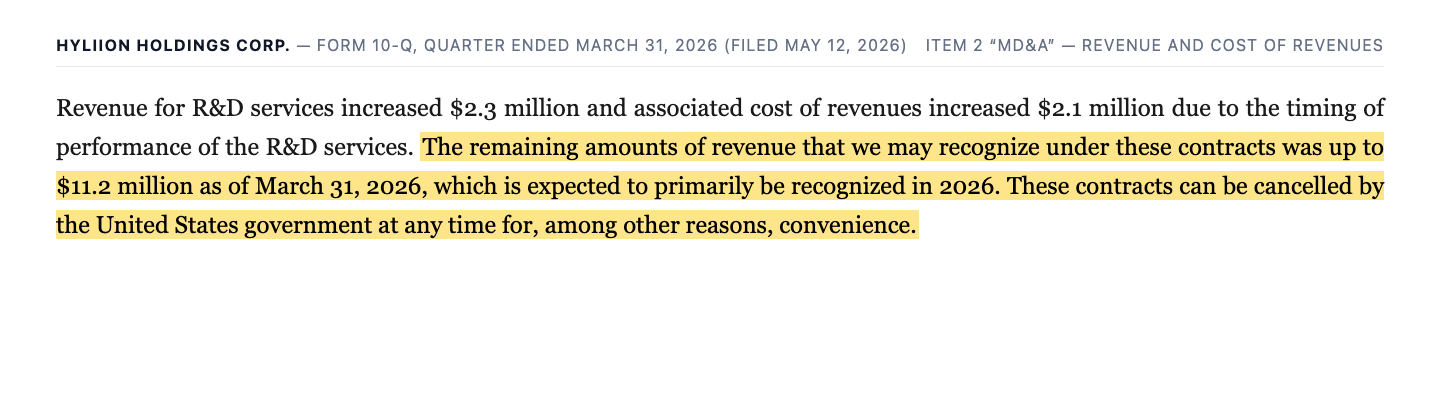
In an everyday image: picture a contractor with exactly one client — whose contract says the client may walk away at any time, no reason required. Such clauses are standard in U.S. government contracting, and working with the Navy is also a genuine badge of technical credibility. But until paying private customers exist, this single, cancellable order book of up to $11.2 million is the entire revenue base of a company valued at roughly $0.9 billion on the stock market (as of July 18, 2026). A footnote in the annual report completes the picture: the outstanding customer receivables came "majority" from a single customer. Customer concentration is not a fine-print risk here — it is the state of the business.
Uncomfortable truth no. 3: the cash is melting on schedule — and the company\'s own projection already assumes fresh debt
$139.4 million of cushion sounds comfortable. The annual report itself calculates how quickly it becomes less:
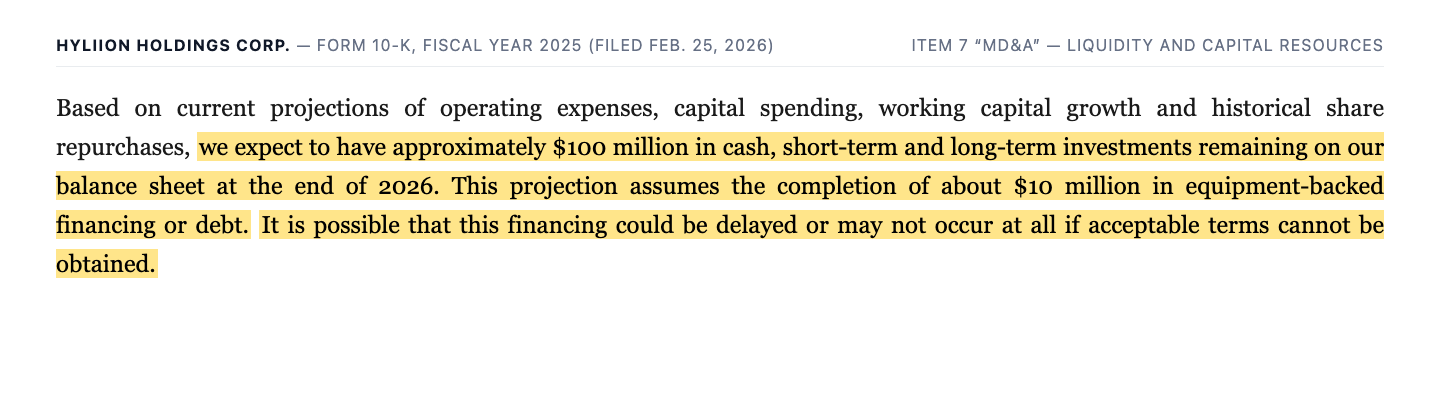
"Based on current projections of operating expenses, capital spending, working capital growth and historical share repurchases, we expect to have approximately $100 million in cash, short-term and long-term investments remaining on our balance sheet at the end of 2026. This projection assumes the completion of about $10 million in equipment-backed financing or debt. It is possible that this financing could be delayed or may not occur at all if acceptable terms cannot be obtained."
— Hyliion Holdings Corp., SEC annual report 10-K for 2025, Item 7 "Management\'s Discussion and Analysis" (Liquidity and Capital Resources)
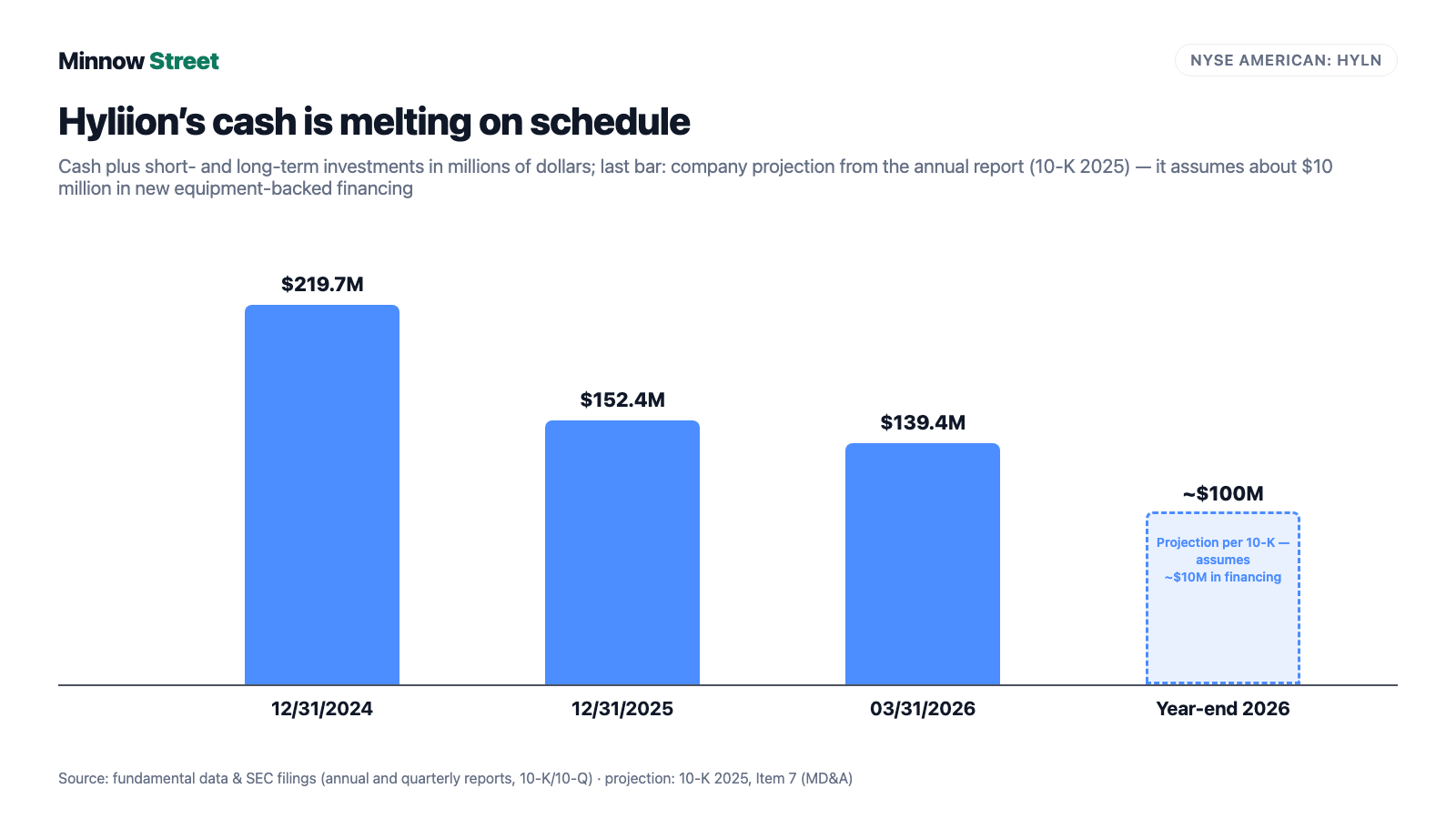
The cascade in numbers: $219.7 million (year-end 2024) → $152.4 million (year-end 2025) → $139.4 million (March 31, 2026) → projected ~$100 million (year-end 2026). Operations burned about $46.5 million in 2025, plus $23.7 million of capital spending — above all for the additive printers that produce the generator components. At the current pace, the cushion carries roughly two more years — if commercialization succeeds and if the planned $10 million financing arrives. If not, the capital market knows chiefly one remedy for growth-hungry pre-revenue companies, and it is called a share offering. Remember the image: your slice of the pie shrinks when new slices keep being cut — with 178.3 million shares outstanding (May 7, 2026), the dilution machine is currently throttled, but not dismantled.
Valuation: what the market pays for the comeback
Now for the price tag. As of July 18, 2026, the stock trades around $4.90; across 178.3 million shares, that is a market value of roughly $0.9 billion. Put that in proportion: it is about 250 times fiscal 2025 revenue ($3.475 million) and still roughly 150 times the revenue of the last four quarters — levels at which the word "valuation" loses its meaning, because what is being priced is not a business but an expectation. A price-to-earnings ratio does not exist; per the fundamental data, the (single) recorded analyst estimate expects losses per share through 2028 as well. As a reminder of the drop in both directions: on June 30, 2025, the stock stood at $1.32 per the 10-K cover page — whoever bought then has nearly quadrupled their money. Whoever bought in the SPAC autumn of 2020 at prices above $50, however, is still down more than 90 percent despite the recent rally (source: fundamental data as of July 18, 2026). It is the same stock in both cases. The difference was never the technology — it was the price the story happened to cost at the time.
Opportunities and risks at a glance
What speaks for Hyliion:
- A real demand tailwind: data centers for cloud and AI need onsite power — per the annual report Hyliion\'s first-named target market, with a multi-megawatt variant in development and a native 800V DC architecture for AI racks.
- Technology with a pedigree: the KARNO generator emerged from General Electric\'s R&D labs (Asset Purchase Agreement 2022), is patent-protected and fuel-agnostic (more than 20 fuels) — and the U.S. Navy has been funding development since 2024 with contracts totaling up to nearly $20 million.
- A solid balance sheet for a pre-production company: $139.4 million in cash and investments (March 31, 2026) against minimal liabilities; the quarterly loss fell year over year from $17.3 million to $11.7 million.
- First hardware in the field: two early adopter units were delivered to the U.S. Navy in 2025; UL certification and endurance testing are under way, and commercialization is targeted for the end of 2026.
What speaks against it:
- A pre-revenue phase by its own admission: $3.475 million in 2025 revenue — exclusively R&D services, no product sales; Hyliion calls itself an "early-stage company" in the 10-K and does not rule out never becoming profitable.
- Extreme customer concentration: the entire order book (up to $11.2 million as of March 31, 2026) hangs on the U.S. government and is cancellable at any time "for convenience" per the 10-Q.
- The cash is melting: $219.7 million → $152.4 million → $139.4 million within 15 months; the company\'s own ~$100 million projection for year-end 2026 already assumes $10 million in new equipment-backed financing.
- Timeline risk: the delivery of the first customer units was already postponed in early 2025 over problems with the 3D-printed regenerator; every additive printer comes from a single manufacturer (Colibrium Additive, formerly GE Additive).
- The price of the momentum: roughly 250 times fiscal 2025 revenue, an average daily range around 15 percent, a Piotroski F-Score of 4 out of 9 — and the reminder that the same stock, despite tripling, still sits more than 90 percent below its 2020 SPAC high above $50.
A human conclusion
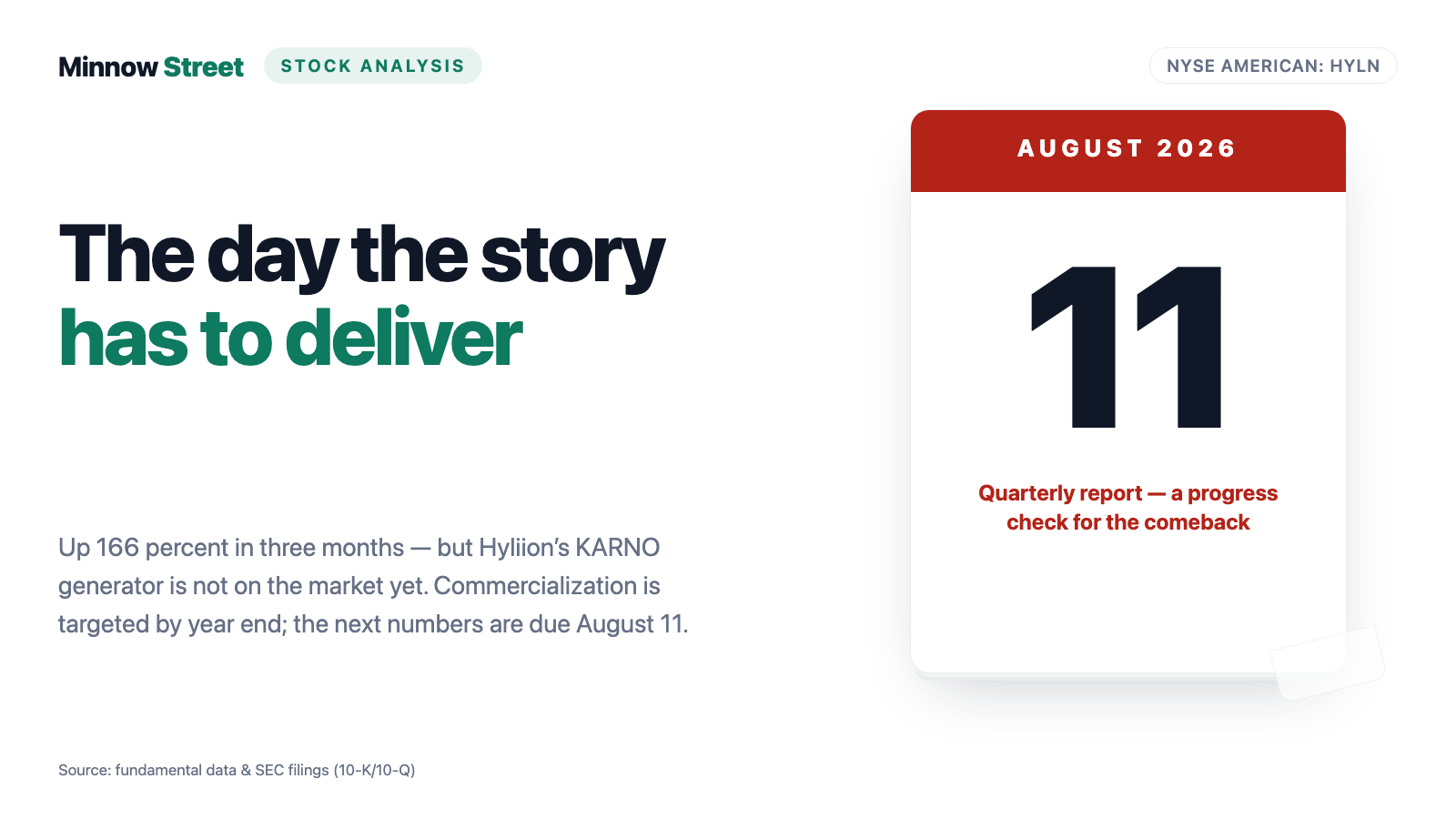
Back to the comeback trap from the opening. Its core is not that comebacks never succeed — its core is that a rising price feels like the proof when it is only the bet. At Hyliion, the two sides are unusually cleanly separated. On the evidence side: a technology from GE\'s labs, a paying U.S. Navy, a clean cash cushion, a shrinking loss, and a target market whose hunger for power nobody disputes. On the bet side: not a single product sold, a sole customer who may cancel at any time, a cash pile melting on schedule — and a market value that prices in 250 times annual revenue. The SEC filings will not take any of these bets off your hands, but they hand you the checkpoints: does commercialization actually arrive "by year end", as the quarterly report puts it? Do customers out of uniform appear in the next filing? And does the $10 million financing close without fresh shares shrinking your slice of the pie? The next quarterly report is scheduled for August 11, 2026 — a good date to demand answers instead of consulting the chart. What you make of it is your decision. And that is exactly as it should be.
Sources
All original documents used in this analysis — for your own reading:
- Hyliion Holdings Corp. — SEC annual report 10-K for 2025 (filed February 25, 2026)
- Hyliion Holdings Corp. — SEC annual report 10-K for 2024 (filed February 25, 2025)
- Hyliion Holdings Corp. — SEC quarterly report 10-Q as of March 31, 2026 (filed May 12, 2026)
- Identity verification (name change Tortoise Acquisition Corp. → Hyliion Holdings Corp.): EDGAR company overview (sec.gov)
- Fundamental data (metrics, quarterly series, price and valuation data; data as of July 18, 2026), cross-checked against the SEC filings.
- Screener and rating data: in-house stock scanner (data as of July 18, 2026), including the Qullamaggie Top Gainers 3M scanner (U.S. selection, rank 4).
Transparency & disclaimer: This analysis is a journalistic contextualization of publicly available information and is not investment advice, not a financial analysis in the regulatory sense, and not a solicitation to buy or sell securities. Stock investments carry substantial risks up to and including total loss; for highly volatile names like Hyliion, that applies in particular. All information without guarantee; the data cut-off is noted in the text. The author holds no position in Hyliion shares at the time of publication.
Our Bottom Line at a Glance
- Demand story & technology positive
- The KARNO generator emerged from General Electric's R&D labs (Asset Purchase Agreement 08/2022), runs on more than 20 fuels and, per the 10-K 2025, targets data centers first — a market whose power demand is growing structurally on AI workloads; the U.S. Navy is funding development with contracts totaling up to nearly $20 million.
- Revenue base & customer concentration negative
- All revenue (2025: $3.475 million; Q1 2026: $2.832 million) is R&D services for the U.S. government — no product sales; the remaining order book of up to $11.2 million (03/31/2026) is cancellable at any time "for convenience" per the 10-Q, and receivables came majority from a single customer (10-K 2025, Note 1).
- Financial position neutral
- $139.4 million in cash and investments against minimal liabilities (03/31/2026) stand opposite a 2025 operating cash outflow of $46.5 million plus $23.7 million in capital spending; the company's own ~$100 million projection for year-end 2026 assumes a new $10 million equipment-backed financing that, per the 10-K, may not occur.
- Profitability & maturity negative
- Net loss of $57.2 million (2025) after $52.0 million (2024), $207 million accumulated; Hyliion calls itself an "early-stage company" in the 10-K 2025 and does not rule out never reaching sufficient gross margins; the first customer units were postponed in early 2025 over regenerator problems, and commercialization is only targeted "by year end" 2026.
- Valuation negative
- A market value of roughly $0.9 billion (as of 07/18/2026) equals about 250 times fiscal 2025 revenue and roughly 75 times the entire remaining order book; no P/E exists, and the recorded analyst estimate expects losses per share through 2028.
- Momentum & tradability neutral
- Rank 4 in the Qullamaggie Top Gainers 3M scanner (U.S. selection, 07/18/2026), up 166 percent in three months, 3M RS of 99 — but an average daily range around 15 percent and a price that, despite the rally, sits more than 90 percent below the 2020 SPAC high: a trading vehicle by Qullamaggie criteria, not a resting pillow.
Hyliion is the rare comeback story in which both sides are documented: a GE-born generator technology with a paying U.S. Navy, a $139 million cushion and a target market whose AI-driven hunger for power is real — and at the same time a self-declared early-stage company without a single product sale, whose entire revenue hangs on government contracts cancellable at any time, whose cash is melting on schedule and whose market value prices in 250 times annual revenue. Whoever invests here is not buying today's business but the hope that a research operation becomes a product company by the end of 2026. Not investment advice.
What Our Rating Means
- If you don't own the stock
- In our view, the documented risks clearly outweigh — we see no basis for an entry.
- If you hold it in your portfolio
- In our view, the findings carry enough weight to warrant a critical look at your own position.
A journalistic assessment by our editorial team at the time of the deep dive, based on public sources — not investment advice and not a solicitation to buy or sell. Your personal circumstances (investment goals, risk capacity, taxes) cannot be taken into account. What our categories mean, how verdicts are formed, and what conflicts of interest exist →
Worth Noting
- HYLN made the research list as rank 4 of our in-house Qullamaggie Top Gainers 3M scanner (U.S. selection, as of July 18, 2026) — part of our series on the hits of this momentum scanner.
- Scanner metrics (3M RS, daily range, Piotroski, Altman Z, dollar volume) are calculated as of July 18, 2026; the high Altman Z-Score around 21 results from a large securities portfolio meeting minimal debt and measures the cushion, not earning power.
- Price and market-value figures (~$4.90, ~$0.9 billion) from the July 18, 2026 feed, sanity-checked against 178,327,240 shares outstanding per the 10-Q cover page dated May 7, 2026; analyses are evergreen, daily prices are not a buy argument.
- The local database company name was reconciled with EDGAR (SEC title "Hyliion Holdings Corp.", former name "Tortoise Acquisition Corp." until 09/28/2020).
Frequently Asked Questions
Hyliion Holdings Corp. (NYSE American: HYLN, Cedar Park, Texas) develops the KARNO Power Module, a stationary power generator built around a linear generator: fuel-agnostic (more than 20 fuels from natural gas to hydrogen per the annual report), 200 kilowatts per core, with a multi-megawatt variant for data centers in development. Its 2025 revenue ($3.475 million) came exclusively from R&D services for the U.S. government — product commercialization is targeted for the end of 2026 per the quarterly report (10-Q Q1 2026).
With a gain of 166 percent in three months and a three-month relative strength of 99, the stock is one of the strongest U.S. momentum names (rank 4 in our in-house Qullamaggie Top Gainers 3M scanner, as of July 18, 2026). The driver is the narrative that Hyliion's KARNO generator can help close the power gap of AI data centers — as recently as June 30, 2025, the stock stood at $1.32 per the 10-K cover page. Fundamental milestones such as first product sales are still outstanding per the SEC filings.
The KARNO generator produces electricity via a linear piston instead of a rotating shaft; the heat comes from flameless oxidation and the working gas is helium. Per the annual report (10-K 2025), the technology emerged out of General Electric's long-running R&D investments and was acquired via an Asset Purchase Agreement in August 2022; the components are metal 3D-printed on machines from Colibrium Additive (formerly GE Additive).
No. In 2025, revenue of $3.475 million (R&D services only, up 130 percent) stood against a net loss of $57.2 million; in the first quarter of 2026 it was $2.832 million of revenue (up 479 percent) against an $11.7 million loss. The balance sheet shows $207 million in accumulated deficit as of December 31, 2025. Hyliion calls itself an "early-stage company" in the 10-K and expects continuing losses for the foreseeable future.
Data centers are the first-named target market of the KARNO generator per the annual report (10-K 2025): cloud computing, artificial intelligence and edge computing are growing power demand faster than grids, so operators look for onsite generation. Hyliion is developing a containerized multi-megawatt variant for that market; per the 10-K, the native 800V DC architecture is meant to match the rising rack power density of AI workloads. Nothing has been sold in this market yet.
As of March 31, 2026, Hyliion held $139.4 million in cash and investments against minimal liabilities. In 2025, operations burned about $46.5 million, plus $23.7 million in capital spending. Per the 10-K, management expects about $100 million left at the end of 2026 — but that projection assumes roughly $10 million in new equipment-backed financing, which per the filing may be delayed or may not occur at all.
It no longer exists: Hyliion went public in October 2020 as a maker of electrified truck powertrains (Hypertruck ERX) via a SPAC merger with Tortoise Acquisition Corp. On November 7, 2023, the board resolved to wind down the powertrain business while preserving the intellectual property; the wind-down was substantially complete by the end of 2025 per the annual report. Today's business — the KARNO generator — has nothing to do with the 2020 listing prospectus.
Found an error?
Did you spot a factual error, an outdated number, or a typo in this deep dive? Let us know briefly — your report goes straight to the editorial team.