Highlander Silver Books Its First Profit Ever — and $28.5 Million of the $20.4 Million Is an Accounting Entry
Twenty trading days after its NYSE American debut, a London fund running $2.6 billion in U.S. equities opens a brand-new position in Highlander Silver. Weeks later the company reports net income of $20.4 million for the first quarter of 2026 — the first profit in its history. One line above sits a $28.5 million remeasurement of the old Bear Creek stake that moved no money at all; the same quarter's operating result is negative $10.0 million. The share register carries Richard Warke, Eric Sprott and the Lundin family, who came in between C$0.10 and C$6.80. Not investment advice, just one question: what are you buying when you buy a guest list?
 Thomas Mücke
Founder & Publisher
Thomas Mücke
Founder & Publisher
Chart
Interactive price chart (TradingView).
Note: pure fact-based analysis, not investment advice and not a solicitation to buy or sell. All figures without guarantee.
There is a shortcut almost every investor takes sooner or later, and it does not feel reckless — it feels like common sense. Call it the guest-list trap. It works like this: checking a company is hard work. Checking who else is invested takes two minutes. If the names are ones you recognize, something in your head relaxes: they must know what they are doing. At Highlander Silver Corp. (NYSE American: HSLV; Toronto: HSLV) that list is unusually well stocked — Richard Warke, Eric Sprott, the Lundin family, and since the spring of 2026 a London fund running $2.6 billion in U.S. equities. So let's make a deal anyway: we read the bill, not the guest list. That means what the company reported to the U.S. securities regulator, the SEC — the annual report on Form 40-F for the fifteen months ended December 31, 2025, filed on March 31, 2026, and the interim report as of March 31, 2026. A filing to the SEC is honest under penalty of law. And this one tells you about a corporate shell that was once named after cannabis, about 568 percent more shares in 31 months, about a profit that is not money, and about three projects other people already take a cut of. What you make of it is your decision.
What Highlander Silver actually does — two construction sites in Peru, one mine in Mexico
Highlander Silver is not a producer that sells ore and lives off it. It is a developer: it owns deposits, drills them, runs the numbers and wants to turn them into mines one day. Three assets carry the whole thing. First, San Luis, a gold-silver project in the Ancash department of central Peru, roughly 513 kilometers north-northwest of Lima, 32 mineral rights over about 23,298 hectares. The annual report calls it the company's only material mineral project. Second, Corani, a large silver deposit in the Puno department that Highlander has owned since late February 2026 and describes as the largest fully permitted silver project in the world. And third, Mercedes, a working gold-silver mine in Sonora, Mexico, which produced about 30,000 ounces of gold in 2025.
The difference between a developer and a producer is the difference between a blueprint and a house — and it decides which metrics mean anything for this stock. There is no price-to-earnings ratio, because there was no profit for years. There is no revenue history, because nothing was sold before February 2026. What counts are four other numbers: how much cash is in the bank, how fast it drains, how many shares there now are, and what is actually in the ground. Those four are what we work through.
Which sets the central tension of this analysis, running through every chapter below: in thirty months Highlander Silver turned a shell with C$307,983 of total assets into a company with $580 million of total assets — paid for almost entirely in new shares, and the only profit ever recorded in its books never left the building.
How this stock landed on our desk
This analysis does not begin with a hit in our in-house stock scanner. It begins with a form. On May 8, 2026, Helikon Investments Ltd of London filed its Form 13F-HR with the SEC for the quarter ended March 31, 2026 (accession 0001839497-26-000002). A 13F is the mandatory quarterly disclosure for large U.S. institutional managers: anyone running more than $100 million in U.S.-listed equities must show what they hold. Helikon's table lists 17 positions worth $2,648,555,113 — and at the very bottom, brand new and absent before, 5,171,822 Highlander shares worth $30,410,313. At each of the three preceding quarter-ends (June 30, September 30 and December 31, 2025) the same fund reported zero shares.
Two things make that entry notable, and both cut in two directions. First, the timing. Highlander Silver has only traded on the NYSE American since March 11, 2026. On the 13F reporting date the U.S. listing was twenty trading days old. A fund this size did not ease into the name; it was there essentially from the start. Second, the size. At $30.4 million Highlander is the smallest of the 17 positions and makes up about 1.1 percent of the portfolio — but measured against the 203,286,668 shares outstanding on March 9, 2026, it is roughly 2.5 percent of the company. That is the uncomfortable half of the number: what is a rounding error for the fund is a large block for the stock. And a large block is easier to build than to unwind. If a billion-dollar fund wants out of a name this size, the selling pressure does not land on the fund — it lands on the retail investors on the other side of the trade.
Now the limit that belongs with every 13F, so a disclosure form does not turn into a legend. A 13F shows U.S.-listed long positions only, reported with a 35- to 45-day delay, with no short positions and no derivatives, and nothing that trades outside the United States. It is a rear-view mirror, not a road map. With Highlander there is an extra wrinkle: because the shares also trade in Toronto, the form does not even tell you whether the fund already owned the stock through the Canadian listing. It tells you only what sat in the U.S. book on March 31, 2026.
A word on the scanner, because honesty demands it — and the word is short. For Highlander Silver our metrics base is thin and in parts useless, data as of July 24, 2026: only six quarters exist and the fourth quarter of 2025 is missing entirely. The Piotroski F-Score, a nine-point test for the health of the books, stands at 3 of 9 — a genuinely healthy company sits at 8 or 9, but for an explorer with no revenue that test simply measures the wrong thing. There is no price-to-earnings ratio. The Altman Z-Score and the cash figure are missing too, and the reason is not a data gap but an accounting event we take apart in a moment. The equity ratio of 96.4 percent still reflects the balance sheet before the Bear Creek takeover; per the interim report as of March 31, 2026 it is 71.2 percent. Both numbers say the same thing: this company carries no debt. No momentum, value or quality filter would have pushed this stock to the front. That is precisely the gap a filing sometimes fills.
Two number traps you have to know before anything else
Before we judge a single figure, two things belong on the table, or you end up comparing apples with oranges — and in both cases the company itself is the source of the confusion.
Trap 1: the annual report is in Canadian dollars, the quarterly report in U.S. dollars
The audited annual statements for the fifteen months ended December 31, 2025 are presented entirely in Canadian dollars. The interim report as of March 31, 2026 is presented entirely in U.S. dollars. That is not an error but a switch — and it is stated verbatim in the filing:
"On January 1, 2026, the Company elected to change its presentation currency from Canadian dollars to United States dollars. The change in presentation currency is to better reflect the Company's business activities and to improve comparability of the Company's financial results with peer companies in the mining industry."
— Highlander Silver Corp., interim report as of March 31, 2026, Note 3 "Change in Presentation Currency" (6-K exhibit 99.1 of May 13, 2026)
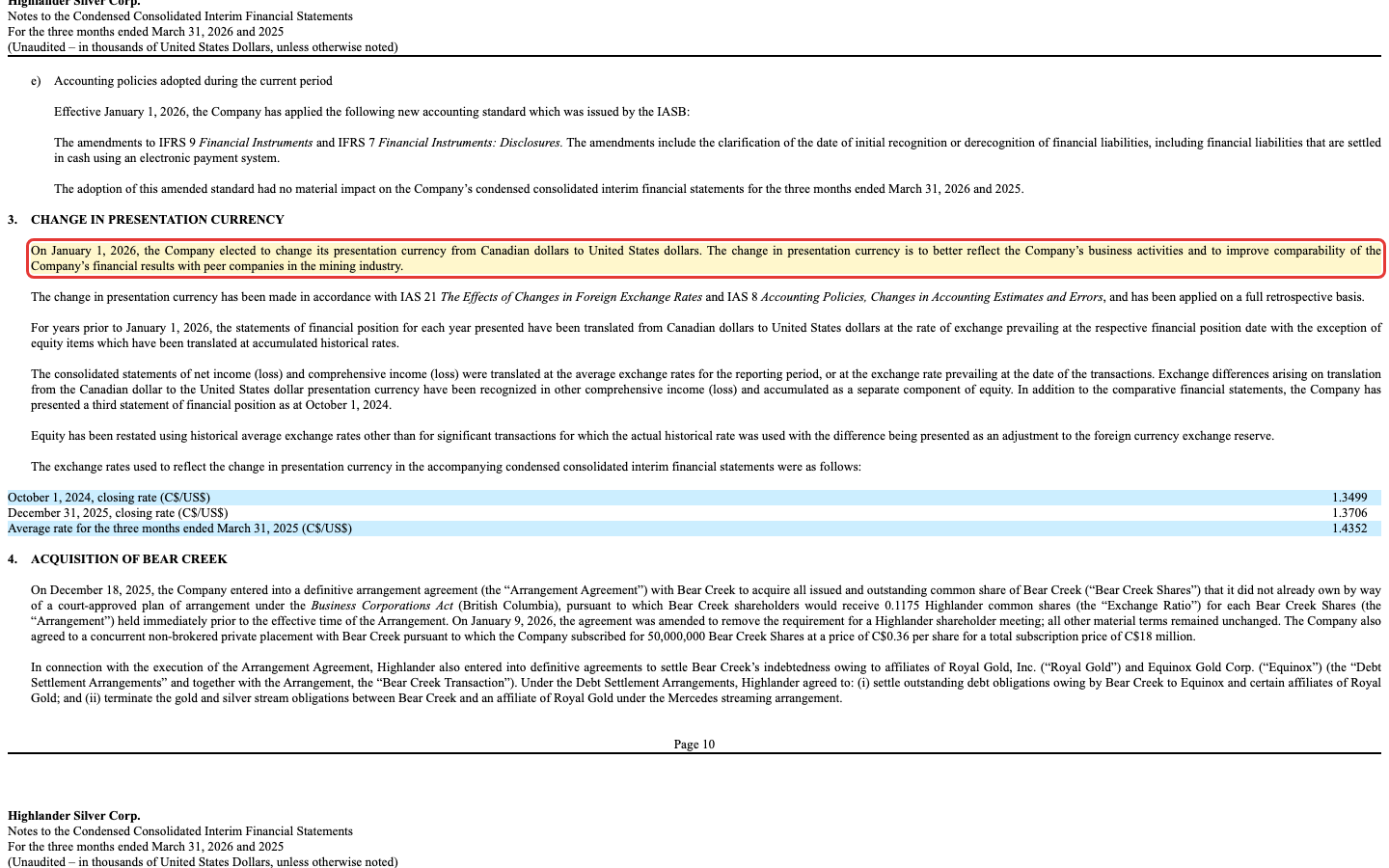
The change was made under IAS 21 and IAS 8 on a fully retrospective basis: all comparative figures in the interim report are restated, and the company even presents a third balance sheet as of October 1, 2024. That is done properly — but for any reader it means one thing: put the annual numbers next to the quarterly numbers and you are comparing two currencies. On December 31, 2025 one U.S. dollar bought C$1.3706. So C$108.2 million of cash becomes $78.9 million — the same cash, two numbers. Throughout this article the rule is therefore: annual figures through December 31, 2025 are Canadian dollars, everything from the first quarter of 2026 onward is U.S. dollars, and it is labeled every time.
Trap 2: the $18.3 million of "revenue" is five weeks of Mercedes
The first quarter of 2026 shows a revenue line at Highlander Silver for the first time: $18.330 million. Anyone concluding that the company's own business has started to run is wrong. The Bear Creek Mining acquisition closed on February 26, 2026; from that day the Mercedes gold-silver mine is consolidated. The report does the arithmetic itself: Bear Creek contributed $18.330 million of revenue and a pre-tax loss of $2.865 million — so the entire consolidated revenue of the quarter comes from roughly five weeks in Mexico. The company even states what the quarter would have looked like had Bear Creek been on board since January 1: $40.521 million of revenue and $15.735 million of pre-tax income.
Remember this mechanism, it returns with every acquisition: in the quarter a deal closes, the revenue line is an accident of the calendar. It says nothing about growth — only about the day a contract was signed.
The back story — from cannabis shell to billion-dollar explorer
With a company this young the back story is half the analysis, and it is all in the Annual Information Form. The company was incorporated in British Columbia on October 19, 2016 — under the name "1093684 B.C. Ltd.". Four name changes followed: Blue Aqua Holdings Ltd. (March 28, 2018), Commonwealth Cannabis Corp. (December 14, 2018), Lido Minerals Ltd. (February 11, 2020) and finally, on August 12, 2021, in connection with the business combination with CAPPEX Mineral Ventures Inc., Highlander Silver Corp.
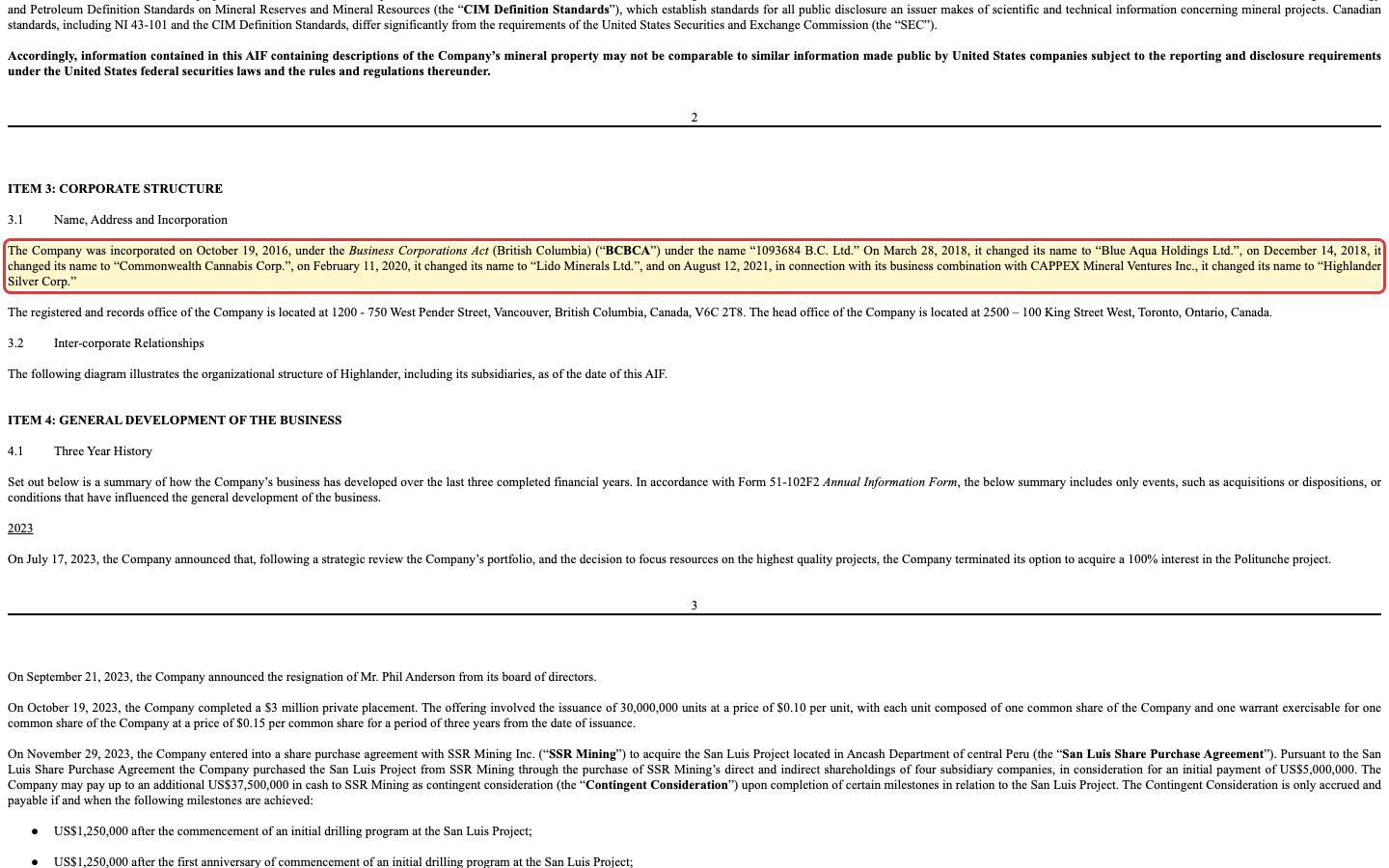
This is not an accusation — shells that change purpose are routine on Canada's junior exchanges, and the cannabis episode has nothing to do with today's business. But it explains why this company has no ten-year record to measure anything against. The real beginning is November 29, 2023: that day Highlander signed the purchase agreement for the San Luis project with SSR Mining. The price: $5 million up front, plus up to $37.5 million of contingent payments in six milestones tied to project progress, plus a 4 percent net smelter returns royalty for SSR Mining. Closing was announced on May 23, 2024.
After that it moved fast — and every station was an equity raise. All prices below are Canadian dollars:
- October 19, 2023: 30,000,000 units at $0.10 — $3 million raised.
- May 8, 2024: 20,514,222 shares at $0.45 — $9.2 million, subscribed by the Lundin family, Richard Warke and Eric Sprott.
- October 22, 2024: Highlander joins the Augusta Group; Richard Warke becomes a director and interim chief executive. On January 7, 2025 Daniel Earle takes over as president and chief executive.
- March 11, 2025: 23,000,000 shares at $1.40 — $32.2 million.
- May 13, 2025: the listing moves from the Canadian Securities Exchange to the Toronto Stock Exchange.
- September 29 and October 17, 2025: 25,330,000 shares at $3.75 — $94.99 million in total.
- January 30, 2026: 8,060,226 shares at $6.80 to Eric Sprott — $40 million gross in U.S. dollars.
- February 26, 2026: the Bear Creek acquisition closes; 36,225,457 new shares.
- March 11, 2026: trading begins on the NYSE American.
Hold on to that price ladder — C$0.10 / C$0.45 / C$1.40 / C$3.75 / C$6.80 — we need it again in the conclusion. And one more figure from the same source: on February 25, 2026 the stock closed in Toronto at C$9.71. In September 2024, less than eighteen months earlier, the range on the old exchange was C$0.58 to C$0.83.
The deal that changed everything — Bear Creek Mining
On December 18, 2025 Highlander agreed to acquire Bear Creek Mining Corporation, owner of the Corani silver project in Peru and the Mercedes mine in Mexico. At the same time Highlander subscribed for 50,000,000 Bear Creek shares at C$0.36 — C$18 million for roughly 14 percent. On February 26, 2026 it took the rest: 0.1175 Highlander shares for each Bear Creek share, for a total of 36,225,457 new Highlander shares. After closing, existing holders owned about 82 percent and former Bear Creek holders about 18 percent.
So it was paid for in paper, not cash. Valued at the closing price of February 25, 2026, the purchase consideration is C$351.7 million; together with the C$57.0 million fair value of the stake already held, C$408.8 million, or $298.7 million. Coming the other way were $532.2 million of assets and $233.5 million of liabilities — including $117.5 million of deferred taxes alone. Net assets equal the purchase price exactly: no goodwill, no bargain purchase gain.
And this is precisely where the number in the next chapter is born. A buyer that already holds a piece of the target — as Highlander did — must remeasure that old piece at the acquisition date under the accounting rules, and the difference to its carrying value lands in the income statement.
What the filings say — the uncomfortable truths
Uncomfortable truth no. 1: the first profit in company history never moved any money
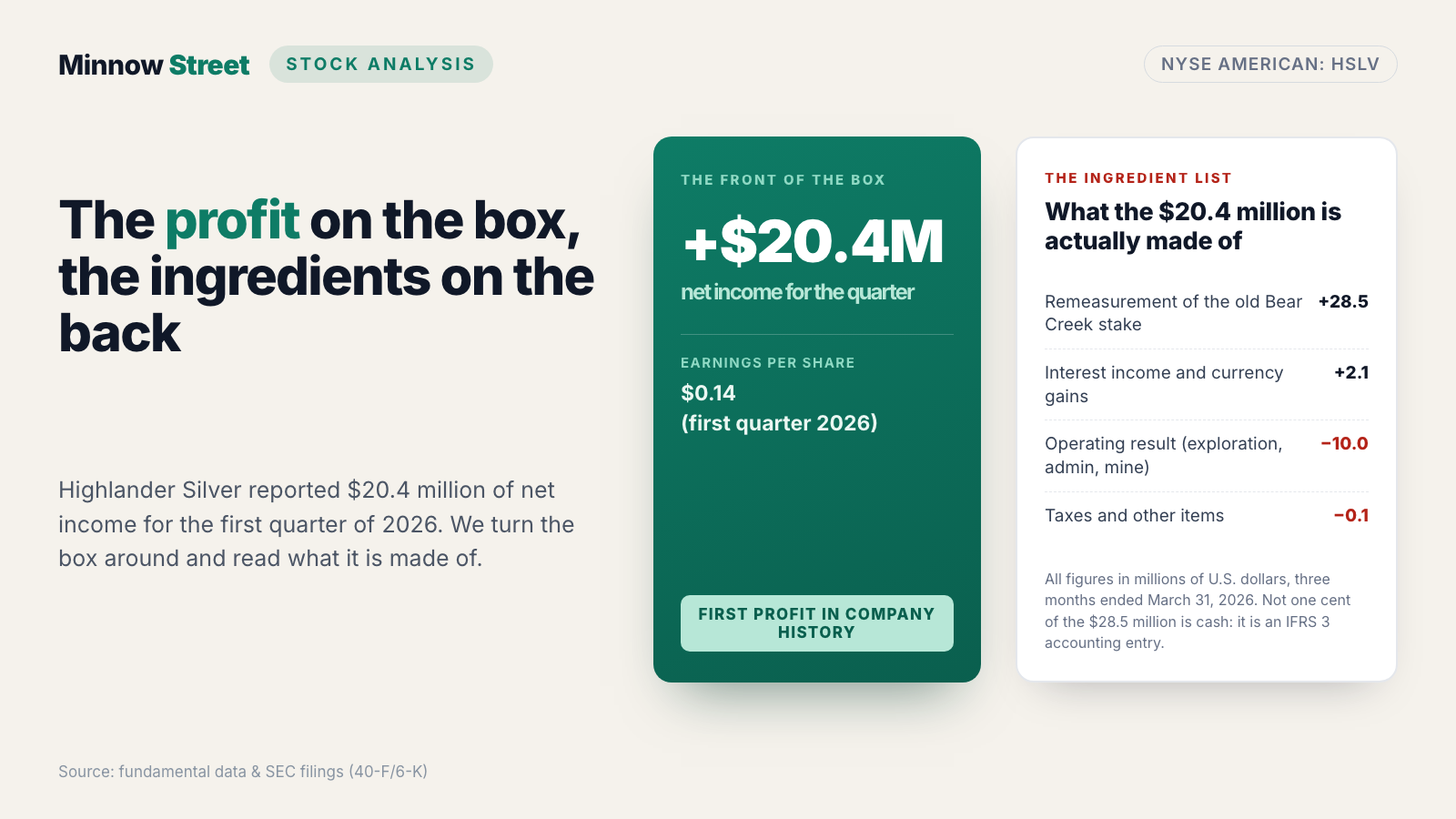
The first quarter of 2026 is the first with a plus at the bottom: $20.408 million of net income, $0.14 per share. Watch how that number is built. At the top: $18.330 million of revenue, less $12.461 million of cost of sales and $5.795 million of depletion, amortization and depreciation — leaving a gross profit of $74,000. Not million. Seventy-four thousand. Then $1.954 million of exploration expense and $8.115 million of general and administrative costs come off, and the operating result stands at negative $9.995 million. Only below that comes the line that flips everything:
"Remeasurement gain on previously held equity interest in Bear Creek … 28,466"
— Highlander Silver Corp., interim report as of March 31, 2026, statement of net income (loss) (6-K exhibit 99.1 of May 13, 2026), in thousands of U.S. dollars
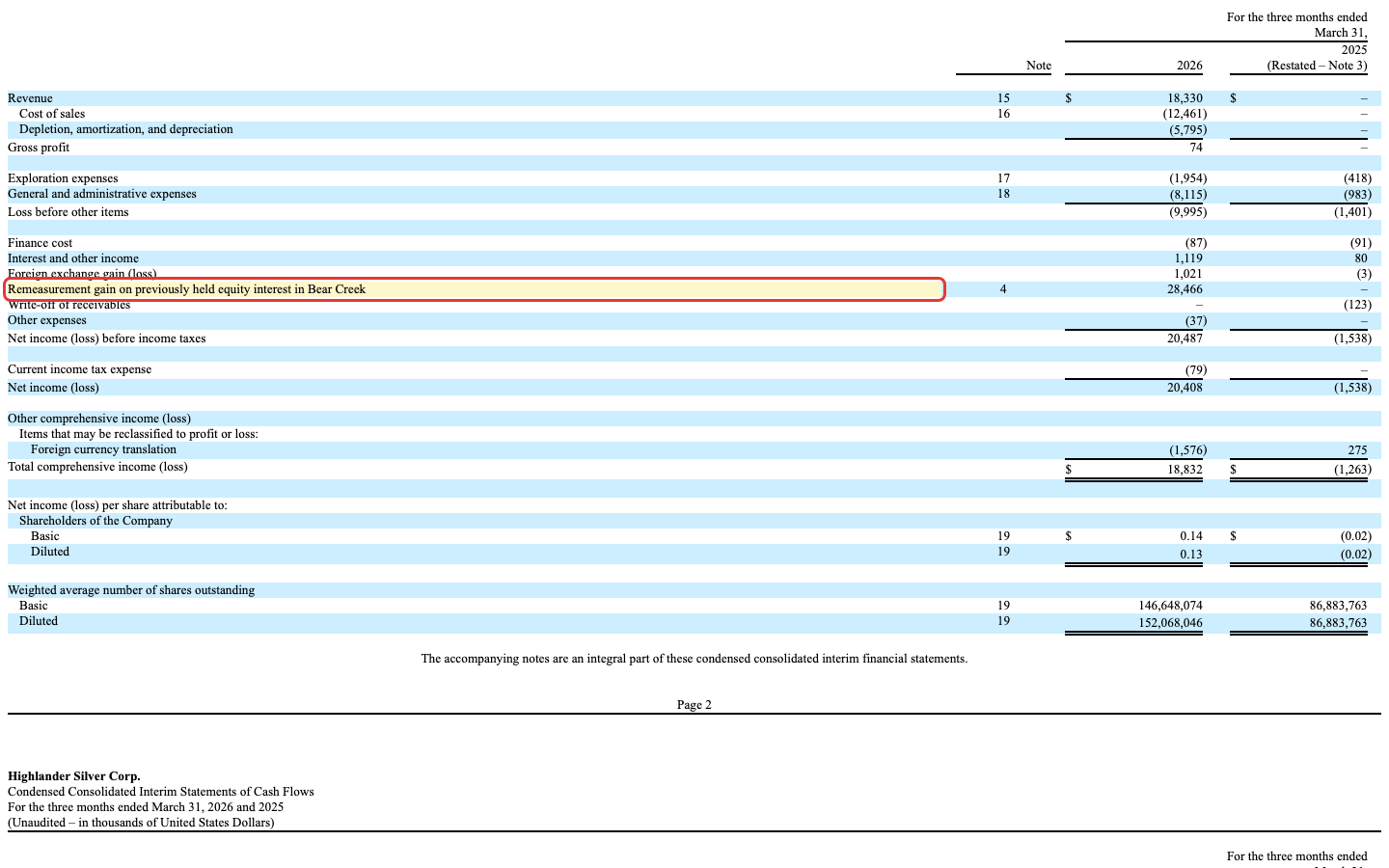
Here is what happened, in everyday terms. Years ago you bought a tenth of your neighbor's house for $10,000. Now you buy the rest — and it turns out your old tenth is worth $40,000 today. Under the rules you must book that $30,000 as income, even though nobody wired you a cent. Exactly that happened here: the previously held Bear Creek stake was remeasured at the acquisition date, and the difference of $28.466 million landed as income. Without that single entry the quarter would have ended with a loss of roughly $8 million.
To be fair: this is not a trick but a prescribed entry, and Highlander shows it on its own clearly labeled line. Remember the mechanism anyway, because it returns with every step acquisition: a profit that comes from a remeasurement raises equity, not cash. And there is a side effect: the company's accumulated deficit shrank from $20.563 million to $0.155 million. On paper Highlander is now almost square with its own past — it just did not earn that money.
Uncomfortable truth no. 2: 30 million shares became 203 million
Dilution means your slice of the cake gets smaller because new slices keep being cut. At Highlander Silver that is not a detail, it is the financing method. On October 1, 2023 there were 30,460,475 shares. On September 30, 2024 there were 81,221,620, on December 31, 2025 130,910,687 — and on May 12, 2026 the books show 203,423,418 shares, plus 12,180,000 options and 2,909,943 warrants.
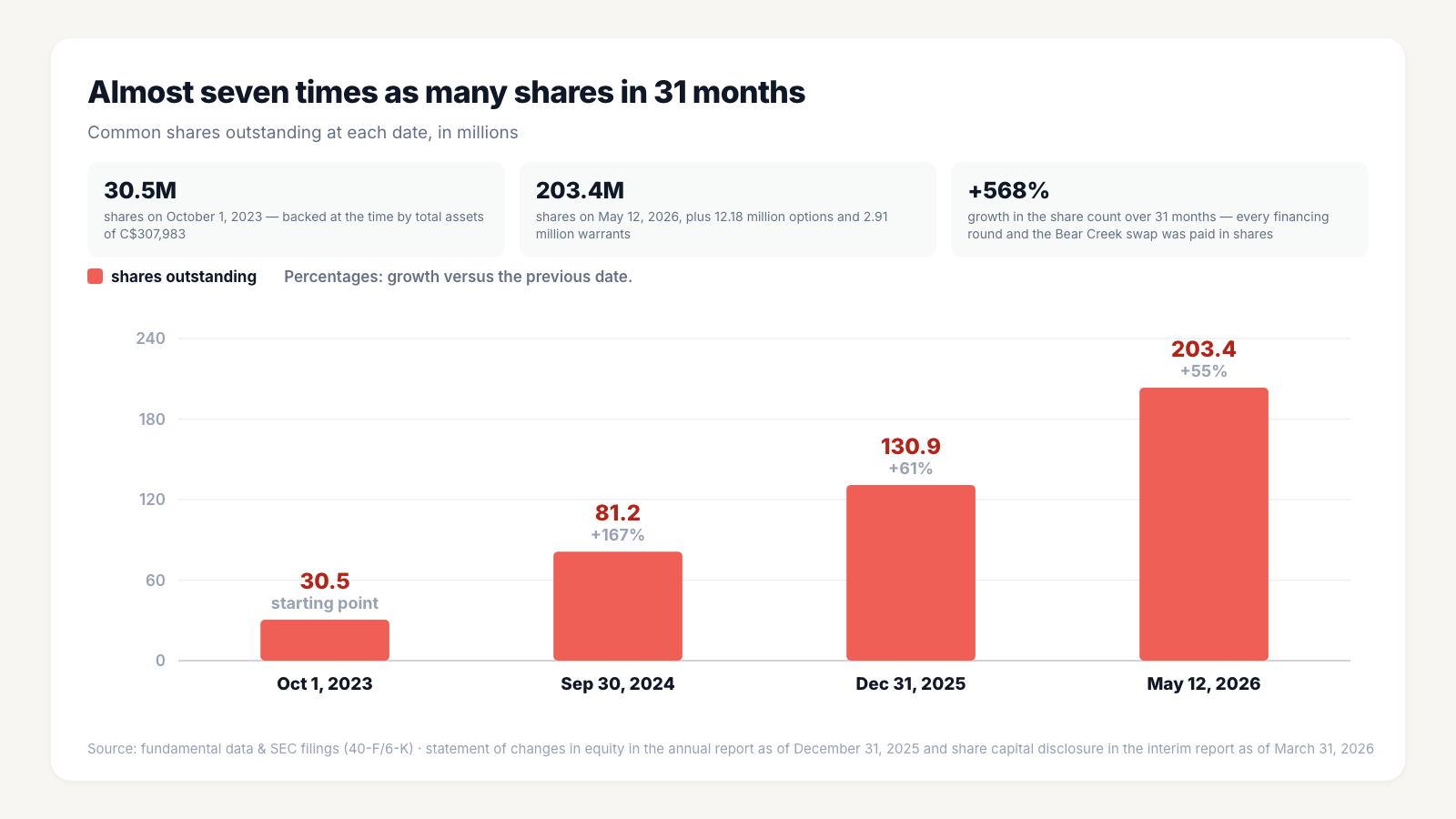
That is 568 percent more shares in 31 months. To be fair: dilution is not automatically bad. If you issue paper for cash and buy something worth more than the slice you gave away, existing holders end up richer, not poorer — and the ladder from C$0.10 to C$6.80 shows each round was sold higher than the one before. But the arithmetic only works while the market plays along. Remember the sentence: growth paid for with fresh shares is never entirely free. And at this company it is the only currency the business has used so far — there was no mining revenue of its own before February 2026.
One easily missed item: Bear Creek's old warrants live on and trade on the TSX Venture Exchange under "BCM.WT". They are now exercisable into Highlander shares — at roughly C$3.57 per whole Highlander share.
Uncomfortable truth no. 3: three other parties already earn on the future ore
A net smelter returns royalty is a share of revenue, not of profit — it is owed whether the mine makes money or not. At Highlander three layers of them now sit on top of each other. On San Luis, SSR Mining holds 4 percent, half of it repurchasable for $15 million. On Corani, since the Bear Creek takeover, 2.75 percent goes to Royal Gold and 0.5 percent to Equinox Gold — 3.25 percent in total. On Mercedes, 2 percent goes to Royal Gold. These rights were not a gift; they were the price of settling Bear Creek's debts, and the report puts their fair value at $42.6 million.
Two more obligations belong here that no headline carries. First, the up to $37.5 million still owed to SSR Mining, staged by project progress through two years after the start of production. Second, the Corani framework agreement: since 2013 the project company pays the district municipality and five communities 4 million Peruvian soles a year into a trust for community projects. As of March 31, 2026 the remaining undiscounted obligation stood at $13.7 million. None of that is a scandal — it is the price of a social license in the Andes — but it belongs in every project calculation.
Uncomfortable truth no. 4: economically viable reserves have not even been established
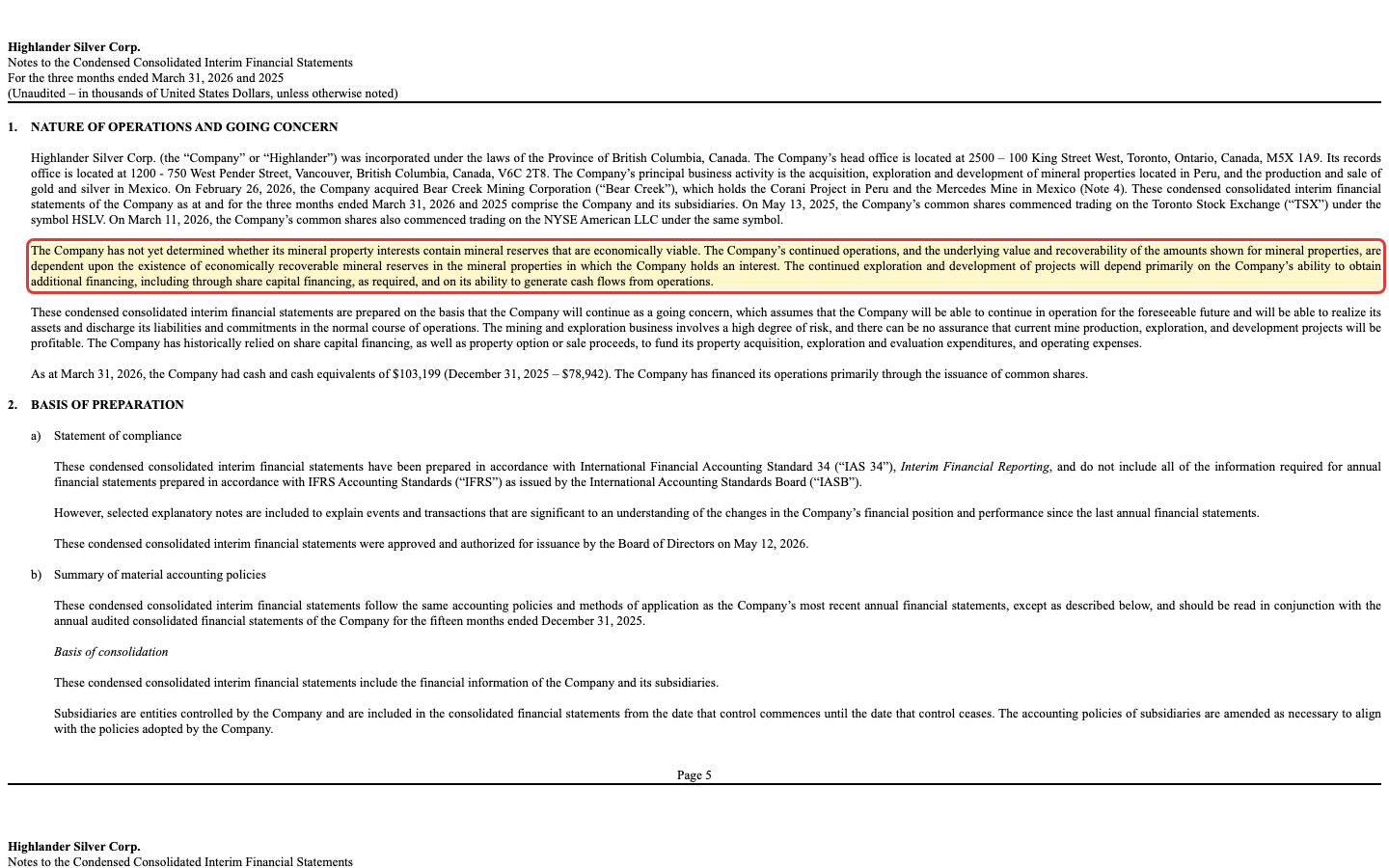
This truth is not in the fine print. It is in the very first note of the interim report, and it is the most honest sentence in the whole document:
"The Company has not yet determined whether its mineral property interests contain mineral reserves that are economically viable. The Company's continued operations, and the underlying value and recoverability of the amounts shown for mineral properties, are dependent upon the existence of economically recoverable mineral reserves in the mineral properties in which the Company holds an interest. The continued exploration and development of projects will depend primarily on the Company's ability to obtain additional financing, including through share capital financing, as required, and on its ability to generate cash flows from operations."
— Highlander Silver Corp., interim report as of March 31, 2026, Note 1 "Nature of Operations and Going Concern" (6-K exhibit 99.1 of May 13, 2026)
The difference between two words matters here. A resource is a deposit you know is there. A reserve is the part of it you have calculated can be taken out at a profit at today's prices. For San Luis a resource estimate with an effective date of January 15, 2025 exists: 453,784 tonnes in the indicated category at 24.42 grams of gold and 578.9 grams of silver per tonne — 356,000 ounces of gold and 8.4 million ounces of silver. The grades are extraordinary; the tonnage is not. For comparison, a mid-sized silver producer such as Silvercorp Metals pulls close to seven million ounces of silver out of the ground in a single year. The accompanying technical report accordingly recommends no mine but a two-phase exploration program costing $10 million.
For Corani the decisive date is still ahead: an updated feasibility study based on a staged build is due by the end of the third quarter of 2026. Only then will anyone know what construction costs — and where the money is supposed to come from.
The cash and the clock
Which brings us to the metric that replaces everything else at a developer: how long does the money last? On March 31, 2026 the balance sheet showed $103.199 million of cash, plus inventories and receivables; there is no debt. A year and a half earlier, on October 1, 2024, the figure was $1.853 million. In the first quarter of 2026, $9.015 million flowed out of operations (prior-year quarter: $1.061 million) and another $8.155 million out of investing; $42.276 million came in, essentially all of it from the Sprott placement.
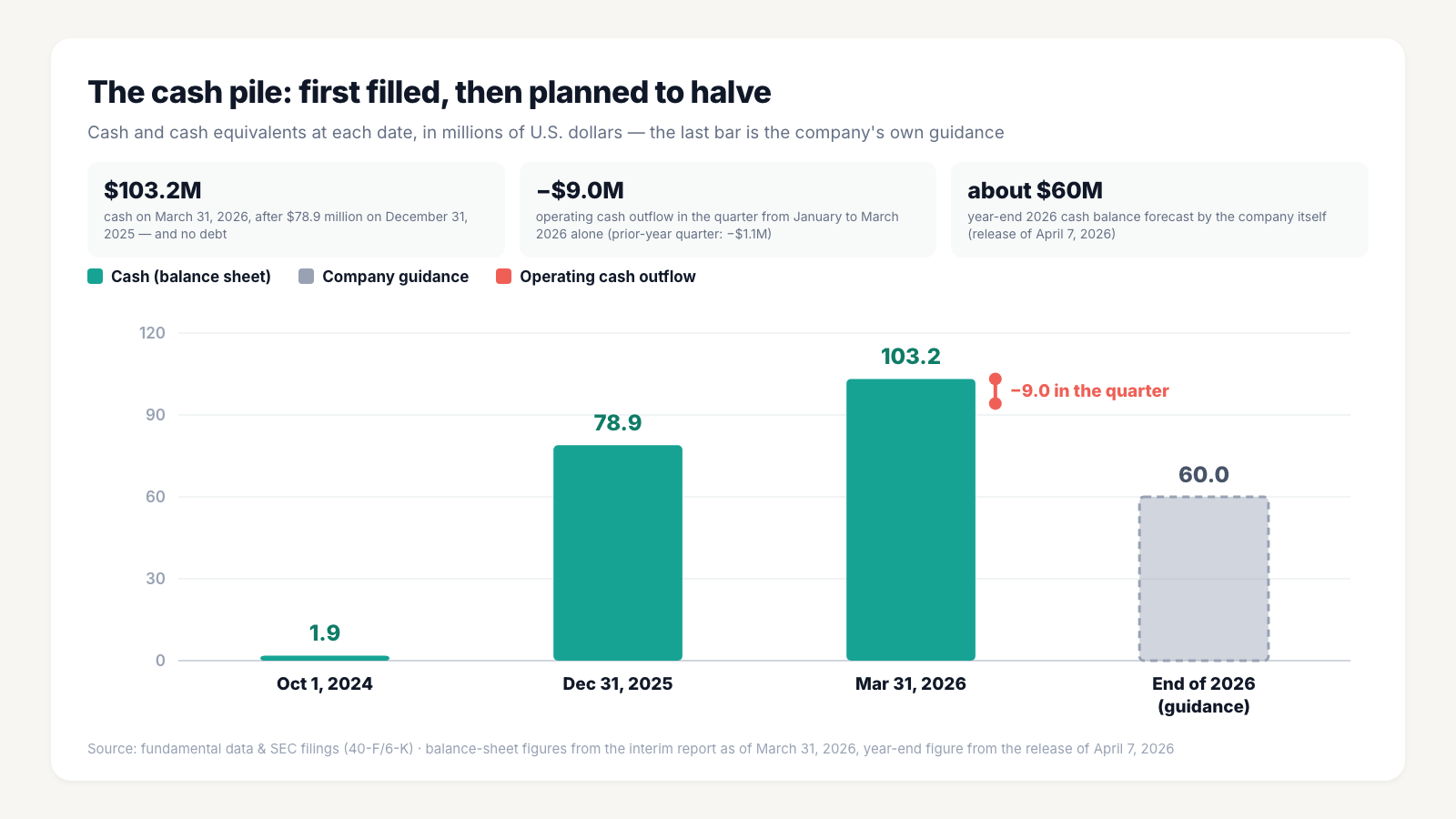
The most interesting number comes from the company itself. In its release of April 7, 2026, chief executive Daniel Earle cites an unaudited cash balance of about $100 million with no debt — and in the same paragraph the expectation that roughly $60 million will be left at year-end 2026. That is a stated $40 million of cash outflow over nine months, under what the company describes as a deliberately disciplined spending plan. On June 25, 2026 it confirmed an unaudited cash balance of about $100 million and noted that the Mercedes mine now offsets part of the spending.
Do the next step yourself: a mine the size of Corani costs hundreds of millions. With $60 million in the bank and no debt, it cannot be built. There are three ways out — another equity raise, debt, or selling future production to a financier. All three cost existing shareholders something. Which one the company picks will not be known before the feasibility study lands.
Valuation — what is actually being paid for here
A price-to-earnings ratio would be a lie at this company, and so would a price-to-sales ratio. So we use the one cleanly dated anchor available: Helikon's 13F reports 5,171,822 shares worth $30,410,313 as of March 31, 2026 — arithmetically $5.88 per share. Across 203,286,668 shares that is a market value of roughly $1.2 billion, and with $103.2 million of cash an enterprise value of about $1.1 billion.
Against that stands book equity of $413.5 million — at the reporting date the market was paying roughly three times book value, and that book value consists largely of provisional amounts from the Bear Creek acquisition. Plus a mine that produced about 30,000 ounces of gold in 2025 and generated $74,000 of gross profit in the first quarter of 2026. Plus an indicated resource at San Luis of 356,000 ounces of gold and 8.4 million ounces of silver. Plus Corani, whose value sits inside the $284.8 million of mineral property interests on the March 31, 2026 balance sheet — with no updated project economics published yet.
Put differently: what is being paid for here is overwhelmingly a plan. That is normal for a developer and nothing to be ashamed of — at a producing peer such as Allied Gold you can weigh output against cost per ounce; here you cannot. All you can check is whether the plan is credible and who is executing it. No analyst estimates for earnings or revenue are available for Highlander Silver; that too belongs in an honest account of the data.
Opportunities and risks at a glance
What speaks for Highlander Silver:
- As of March 31, 2026, $103.2 million of cash and no debt; the equity ratio is 71.2 percent, and the one large liability is a deferred tax that costs no money.
- Corani is a fully permitted silver project — in the Andes, permitting is often the most expensive and slowest part of any project.
- San Luis is extraordinarily high grade: 24.42 grams of gold and 578.9 grams of silver per tonne in the indicated category. High grades forgive a lot of cost-model error.
- Mercedes has provided a source of income since February 2026 that carries part of the spending; a legacy gold stream was extinguished at closing.
- The team is relevant: chairman Richard Warke and chief executive Daniel Earle both come from Solaris Resources, and site managers with experience at major mines in Peru and Ecuador were hired for Corani and Mercedes.
- A dated test is coming: the updated Corani feasibility study is due by the end of the third quarter of 2026, with the first drill results in more than a decade expected from July 2026.
What speaks against it:
- No reserves established. The interim report states expressly that it has not been determined whether the mineral property interests contain economically viable reserves.
- The only profit is an accounting entry. Of the $20.4 million reported for the first quarter of 2026, $28.5 million comes from a remeasurement; the operating result is negative $10.0 million.
- 568 percent more shares in 31 months — and building Corani cannot be financed out of the $60 million of guided year-end cash.
- A provisional balance sheet: the values from the Bear Creek acquisition may be revised retroactively until February 26, 2027, and deferred tax assets are so far carried at zero.
- Country risk in two jurisdictions. The annual report devotes a separate risk section to Peruvian permitting, consultation and judicial proceedings, on top of community relations, crime, and in Mexico a unionized workforce under collective agreements.
- Thin reporting. No 10-K, no 10-Q; interim figures only as an unaudited 6-K exhibit. Because of the transition period for newly public companies there is neither a management report nor an auditor attestation on internal control over financial reporting.
- Owner concentration. Roughly 30 percent sits with Richard Warke and Eric Sprott; Warke filed a Schedule 13D expressly stating an intent to exert control.
A human conclusion
Back to the guest list. At Highlander Silver it really is impressive, and it is not an accident either: people who have made their money in resource projects for decades came in early and large. It is just that every one of those names has a price next to it, and that price is the decisive piece of information. The Lundin family, Richard Warke and Eric Sprott subscribed at C$0.45 in May 2024. The March 2025 round went at C$1.40, the September 2025 round at C$3.75, the Sprott placement in January 2026 at C$6.80. At the end of February 2026 the stock closed at C$9.71.
That does not mean those investors are wrong — it means they did a different deal than someone buying on the exchange today. They made a bet on a corporate shell with a Peruvian drill project and paid a price that matched the risk. Whoever buys today pays a price that already contains the success of that bet: the takeover, the permits, the New York listing, the team. What is left is execution — and execution is the hardest part in mining.
The three numbers that decide it over the coming months are not hard to remember. First: what does the updated Corani feasibility study, due by the end of the third quarter of 2026, put on the capital cost line? Second: does the year-end cash balance actually land near $60 million, or is money needed sooner? Third: where does the share count go from the 203,423,418 last reported? Answer all three and you know what you are buying. Answer none of them and you are buying a guest list.
What you make of it is your decision. And that is exactly as it should be.
Sources
- Highlander Silver Corp., annual report on Form 40-F for the fifteen months ended December 31, 2025 (filed March 31, 2026, accession 0001213900-26-036688)
- Annual Information Form for the fifteen months ended December 31, 2025 (40-F exhibit 99.1, dated March 30, 2026)
- Audited consolidated financial statements for the fifteen months ended December 31, 2025 and the year ended September 30, 2024 (40-F exhibit 99.2, in Canadian dollars)
- Management's Discussion and Analysis for the fifteen months ended December 31, 2025 (40-F exhibit 99.3)
- Condensed consolidated interim financial statements as of March 31, 2026 (Form 6-K of May 13, 2026, exhibit 99.1, in U.S. dollars)
- Management's Discussion and Analysis for the first quarter of 2026 (Form 6-K of May 13, 2026, exhibit 99.2)
- Release of April 7, 2026: portfolio update, start of drilling at Corani, cash balance and year-end guidance (6-K exhibit 99.1)
- Release of June 25, 2026: Corani geophysics program and unaudited cash balance (6-K exhibit 99.1)
- Release of July 7, 2026: construction progress at Corani (6-K exhibit 99.1)
- Early warning report of March 3, 2026 on the acquisition of Bear Creek Mining (6-K exhibit 99.1)
- Schedule 13D filed March 11, 2026 (Augusta Ozama Investment LP, Augusta Investments Inc., Richard W. Warke)
- Schedule 13G filed May 13, 2026 (Eric Sprott, 2176423 Ontario Ltd.)
- Helikon Investments Ltd, Form 13F-HR for the quarter ended March 31, 2026 (filed May 8, 2026, accession 0001839497-26-000002)
This analysis is a journalistic contextualization of publicly available information. It is not investment advice, not a solicitation to buy or sell securities, and not a recommendation of any particular investment strategy. Shares of mining exploration and development companies are highly volatile; a total loss of invested capital is possible. All figures are taken from the original sources named above with the reporting dates stated and were checked to the best of our knowledge; no liability is accepted for completeness or accuracy. Make your investment decisions independently and seek independent advice if in doubt.
Our Bottom Line at a Glance
- Balance sheet & liquidity positive
- On March 31, 2026 the company held $103.199 million of cash and carried no debt; the equity ratio is 71.2 percent, and the largest liability is a $117.5 million deferred tax that costs no money. That funds the next work steps — the company itself expects about $60 million left at year-end 2026 (release of April 7, 2026).
- Quality of the reported profit negative
- The first profit in company history — $20.408 million in the first quarter of 2026 — comes from a non-cash remeasurement of the previously held Bear Creek stake worth $28.466 million. The operating result for the same quarter is negative $9.995 million, and gross profit from mining is $74,000. Not one cent of that profit ever entered the building.
- Project substance neutral
- San Luis is extraordinarily high grade (24.42 grams of gold and 578.9 grams of silver per tonne, effective January 15, 2025) but small: 356,000 ounces of gold and 8.4 million ounces of silver in the indicated category. Corani is described as fully permitted and is the real source of value — but the updated feasibility study is still outstanding. The interim report states expressly that economically viable reserves have not yet been established.
- Capital structure & dilution negative
- From 30,460,475 shares on October 1, 2023 to 203,423,418 on May 12, 2026 — up 568 percent in 31 months, plus 12.18 million options and 2.91 million warrants. Every financing round and the Bear Creek swap was paid in shares. Building Corani cannot be covered by the guided year-end cash of about $60 million; another financing round is the most likely route.
- Reporting & data quality negative
- No 10-K, no 10-Q; interim figures only as an unaudited 6-K exhibit. The annual statements are in Canadian dollars and the interim report is in U.S. dollars — the presentation currency changed on January 1, 2026. The balance sheet from the Bear Creek acquisition is expressly provisional and may be revised retroactively until February 26, 2027. Because of the transition period for newly public companies there is no judgment at all on internal control over financial reporting.
- Owners & country risk neutral
- Roughly 30 percent of the company sits with Richard Warke (23.2 percent, Schedule 13D with a stated control intent) and Eric Sprott (6.5 percent). That brings experience and capital but concentrates power; at the annual meeting of June 25, 2026, 14.58 percent of votes were withheld from Warke. On top of that sits country risk in Peru (permitting and consultation processes, community relations) and Mexico (collective bargaining at the Mercedes mine).
Highlander Silver is the guest-list trap in pure form: the share register carries Richard Warke, Eric Sprott and the Lundin family, and since March 31, 2026 a London fund running $2.6 billion — those names came in between C$0.10 and C$6.80 per share. The books, meanwhile, show a company that grew out of a 2016 corporate shell, raised its share count by 568 percent in 31 months, and whose only reported profit ever — $20.408 million in the first quarter of 2026 — consists to the tune of $28.466 million of a remeasurement, while the operating result stands at negative $9.995 million. Against that: $103.2 million of cash with no debt, a fully permitted silver project and a team that has done this before. Not investment advice.
What Our Rating Means
Open questions
The business works in principle, but one material question is open. As long as it stays open, our findings do not carry a quality verdict.
Whoever buys today is overwhelmingly buying a plan: that Corani gets built, that San Luis grows beyond its current resource, and that Mercedes turns from a legacy problem into a source of earnings. The price for that plan is roughly three times a book equity that is itself made of provisional values — and the bill for construction has not been presented yet. Whoever holds the stock is betting that the next financing round prices higher than the last. Whoever waits should check exactly three numbers in the coming months: what capital cost does the updated Corani feasibility study, due by the end of the third quarter of 2026, put on the table? Does the year-end cash balance really land near $60 million? And where does the share count go from the 203,423,418 last reported? The decision is yours.
A journalistic assessment by our editorial team at the time of the deep dive, based on public sources — not investment advice and not a solicitation to buy or sell. Your personal circumstances (investment goals, risk capacity, taxes) cannot be taken into account. What our levels mean, how verdicts are formed, and what conflicts of interest exist →
Worth Noting
- Highlander Silver came onto the research list not through a scanner hit but through the Form 13F-HR of Helikon Investments Ltd (London) for the quarter ended March 31, 2026: 5,171,822 shares worth $30,410,313, a brand-new position, the smallest of 17 — and roughly 2.5 percent of the company. A 13F shows only U.S.-listed long positions with a 35- to 45-day delay, without shorts or derivatives: a rear-view mirror, not a road map.
- Highlander Silver is a Canadian issuer under the multijurisdictional disclosure system with the United States: there is no 10-K and no 10-Q. Audited figures appear once a year on Form 40-F, interim figures only as an unaudited exhibit to a Form 6-K. The fiscal year end was moved from September 30 to December 31 effective October 31, 2025, which is why the last annual period covers fifteen months. Accounting is under IFRS.
- Every dollar figure in this article comes from the 40-F or the 6-K exhibits, not from the metrics base: two presentation currencies are mixed there, which is why the Altman Z-Score, NCAV and the cash figure are missing. Annual figures through December 31, 2025 are Canadian dollars; all quarterly figures from 2026 onward are U.S. dollars. The arithmetic price of $5.88 per share comes from the 13F filing as of March 31, 2026 and serves as a dated order of magnitude, not a daily price. Analyses are evergreen, daily prices are not a buy argument.
Stock Watch
This analysis is as of July 24, 2026. Stock Watch will tell you what's changed at HSLV since then.
Later $1 a month per stock — signing up is free, and you'll be the first to know when it launches.
Frequently Asked Questions
Highlander Silver Corp. (NYSE American and Toronto: HSLV) develops mining projects in Peru: the high-grade San Luis gold-silver project in the Ancash department and the Corani silver project in the Puno department. Since February 26, 2026 it has also owned the producing Mercedes gold-silver mine in Sonora, Mexico, which produced about 30,000 ounces of gold in 2025. The head office is in Toronto.
The $20.408 million of net income comes almost entirely from a non-cash remeasurement of the previously held stake in Bear Creek Mining worth $28.466 million, triggered when the acquisition closed on February 26, 2026. The operating result for the same quarter is negative $9.995 million, and gross profit from mining is $74,000.
U.S. dollars since January 1, 2026. Before that the presentation currency was the Canadian dollar, so the audited annual statements for the fifteen months ended December 31, 2025 are still entirely in Canadian dollars. The change was applied retrospectively under IAS 21 and comparative figures were restated. On December 31, 2025 one U.S. dollar bought C$1.3706.
On March 31, 2026 the company held $103.199 million in cash and carried no debt. In the first quarter of 2026, $9.015 million flowed out of operations. In its release of April 7, 2026 the company itself guided to a year-end 2026 cash balance of about $60 million — roughly $40 million of outflow over nine months.
Highlander Silver is a Canadian company using the multijurisdictional disclosure system between Canada and the United States. Its annual report is therefore filed on Form 40-F with the Canadian original documents attached, and interim figures appear only as an unaudited exhibit to a Form 6-K. Accounting is under IFRS. No internal control report exists because of the transition period for newly public companies.
Per the Schedule 13D of March 11, 2026, Richard Warke is attributed 47,333,334 shares, or 23.2 percent, through Augusta Ozama Investment LP and Augusta Investments Inc.; he is also chairman of the board. Eric Sprott reported 13,304,671 shares, or 6.5 percent, on a Schedule 13G filed May 13, 2026. Both percentages are based on 203,286,668 shares outstanding on March 9, 2026.
A 13F is the mandatory quarterly disclosure of large U.S. institutional managers. Helikon Investments Ltd of London reported 5,171,822 Highlander shares worth $30,410,313 for the quarter ended March 31, 2026 — roughly 2.5 percent of the company, yet the smallest of its 17 positions. A 13F shows only U.S.-listed long positions with a 35- to 45-day delay, without shorts or derivatives.
Found an error?
Did you spot a factual error, an outdated number, or a typo in this deep dive? Let us know briefly — your report goes straight to the editorial team.