Hertz Stock: The Operations Are Turning, the Balance Sheet Is Tipping — A Turnaround Built on Negative Equity
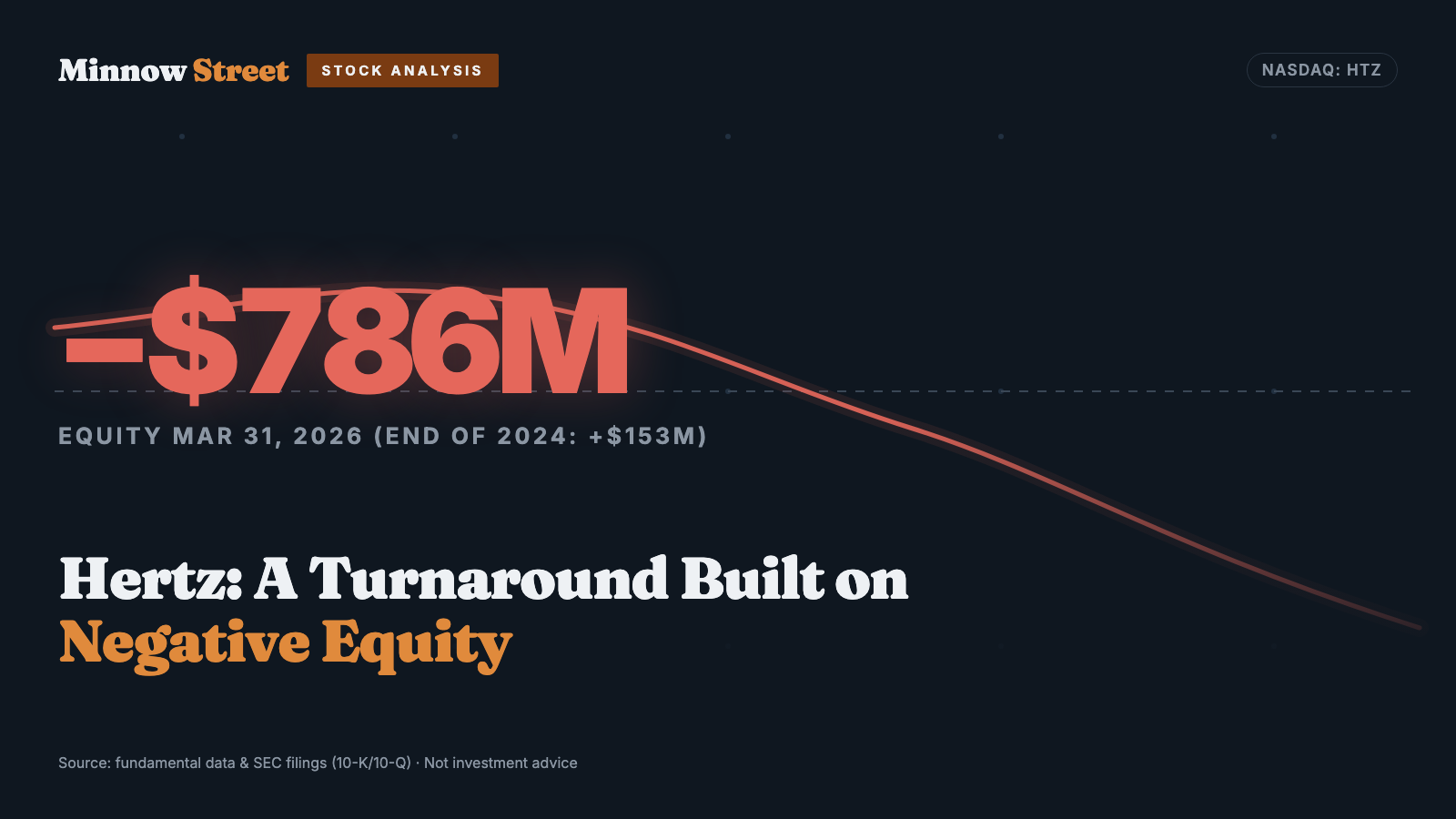
Hertz is back — the brand many remember from the 2021 Reddit frenzy, when a bankrupt car rental company suddenly became a stock-market legend. In 2025 the net loss shrank from $2.9 billion to $747 million, and the business is visibly recovering. Yet half the progress comes from normalized fleet depreciation, not from operations — and equity has gone negative: from plus $153 million (end of 2024) to minus $786 million (March 31, 2026), against $17 billion in debt. On Reddit the stock is a quiet topic again with 5 mentions in 24 hours (ApeWisdom, as of July 23, 2026). We read the annual reports (10-K) and the quarterly report (10-Q). Not investment advice — just the sober question of what a famous name is worth when the balance sheet has a hole in it.
 Thomas Mücke
Founder & Publisher
Thomas Mücke
Founder & Publisher
Chart
Interactive price chart (TradingView).
Note: pure fact-based analysis, not investment advice and not a solicitation to buy or sell. All figures without guarantee.
There is an investor trap that is especially stubborn because it feels like experience: the phoenix trap. It works like this: a famous brand goes spectacularly bankrupt — and comes back. From that moment on, your brain files it as "unkillable." Anyone who was around in 2020 and 2021 remembers Hertz: the car rental company filed for bankruptcy in the middle of the pandemic, the stock was supposed to go to zero — and then an army of Reddit and Robinhood investors bought the left-for-dead shares higher until the company actually emerged, restructured, in June 2021. A resurrection story of the kind the stock market loves. And that is exactly why caution is warranted: a name that once rose from the ashes feels immortal. But immortality is the one thing a balance sheet can never promise. On Reddit, Hertz Global Holdings (Nasdaq: HTZ) surfaces again in July 2026 — quietly, with 5 mentions in 24 hours (ApeWisdom, as of July 23, 2026). So let's make a deal: before you buy the legend, we read together what the company itself reported, under penalty of law, to the U.S. securities regulator, the SEC — the annual reports (10-K) for 2024 and 2025 and the quarterly report (10-Q) as of March 31, 2026. And this filing tells the story of a genuine operating turnaround — and of equity that turned negative in the middle of that very turnaround. In the end, the decision is yours.
What Hertz actually does — and why there are two Hertzes
The business is as everyday as a vacation trip: Hertz rents cars — at airports, in cities, to business travelers and vacationers, under three brands for three price tiers: Hertz (premium), Dollar (mid-market) and Thrifty (value). On top of that, the company resells its used rental cars through its own channels (Hertz Car Sales, the "Rent2Buy" program). As of December 31, 2025, Hertz employed roughly 26,000 people (21,000 in the U.S., 5,000 internationally) and operated a peak-season fleet of roughly 442,000 vehicles in the Americas and 96,000 internationally. Its headquarters are in Estero, Florida.
Now the peculiarity you need to know to even classify the stock correctly: there are two Hertzes. The old Hertz Global Holdings filed for Chapter 11 in May 2020; in the restructuring its shares were essentially wiped out. The listed entity you buy today under the ticker HTZ is the new company that emerged from the proceeding in June 2021 — carried at the SEC under its own new identifier (CIK 0001657853). Anyone looking at old "Hertz" price charts is often looking at an extinguished company. For you, only the new entity counts — and its books open with a mountain of restructuring legacy. This is precisely where the central tension of this analysis lies, and it runs through every chapter: the operations are turning, the balance sheet is tipping. Operationally the recovery is underway, yet equity is negative, debt piles up to $17 billion, and half the improvement in earnings comes from accounting, not from the business.
Where the stock shows up in our scanner
Hertz did not reach our list through the fundamental rankings but through the in-house Reddit hype scanner: it counts which tickers suddenly get mentioned more often in investor forums. On July 23, 2026, Hertz showed up there with 5 mentions in 24 hours (data source ApeWisdom) — no storm, more an echo of the 2021 meme legend. That is deliberately the starting point, not the conclusion: attention is not a quality verdict. Run the stock through our stock scanner afterward and you see the counterpart to the Reddit warmth: value and quality filters that screen for profit, equity and solid balance sheets skip Hertz almost by necessity — a company with a net loss, negative equity and $17 billion in debt simply does not meet the criteria. In other words: the scanner does not classify Hertz as cheap quality, but as a turnaround bet — and turnaround bets are measured by the direction of the numbers over time, not by a single Reddit day. So let's look at the direction.
The numbers over the years — honestly appraised
First what genuinely speaks for Hertz — and that is more than the 2020 headlines would suggest. The recovery is measurable: the net loss shrank to $747 million in 2025, after a catastrophic loss of $2,862 million in 2024. Hertz's preferred operating metric, adjusted corporate EBITDA, shows it even more clearly: it improved from minus $1,541 million (2024) to minus $339 million (2025). And the start of 2026 continues the trend: in the first quarter revenue rose 10.5 percent to $2,004 million (Q1 2025: $1,813 million), and the net loss narrowed to $333 million (Q1 2025: −$443 million). So management's "Back-to-Basics" program — disciplined fleet management, revenue optimization, cost control — is directionally working. Here is the revenue and earnings curve over the years:
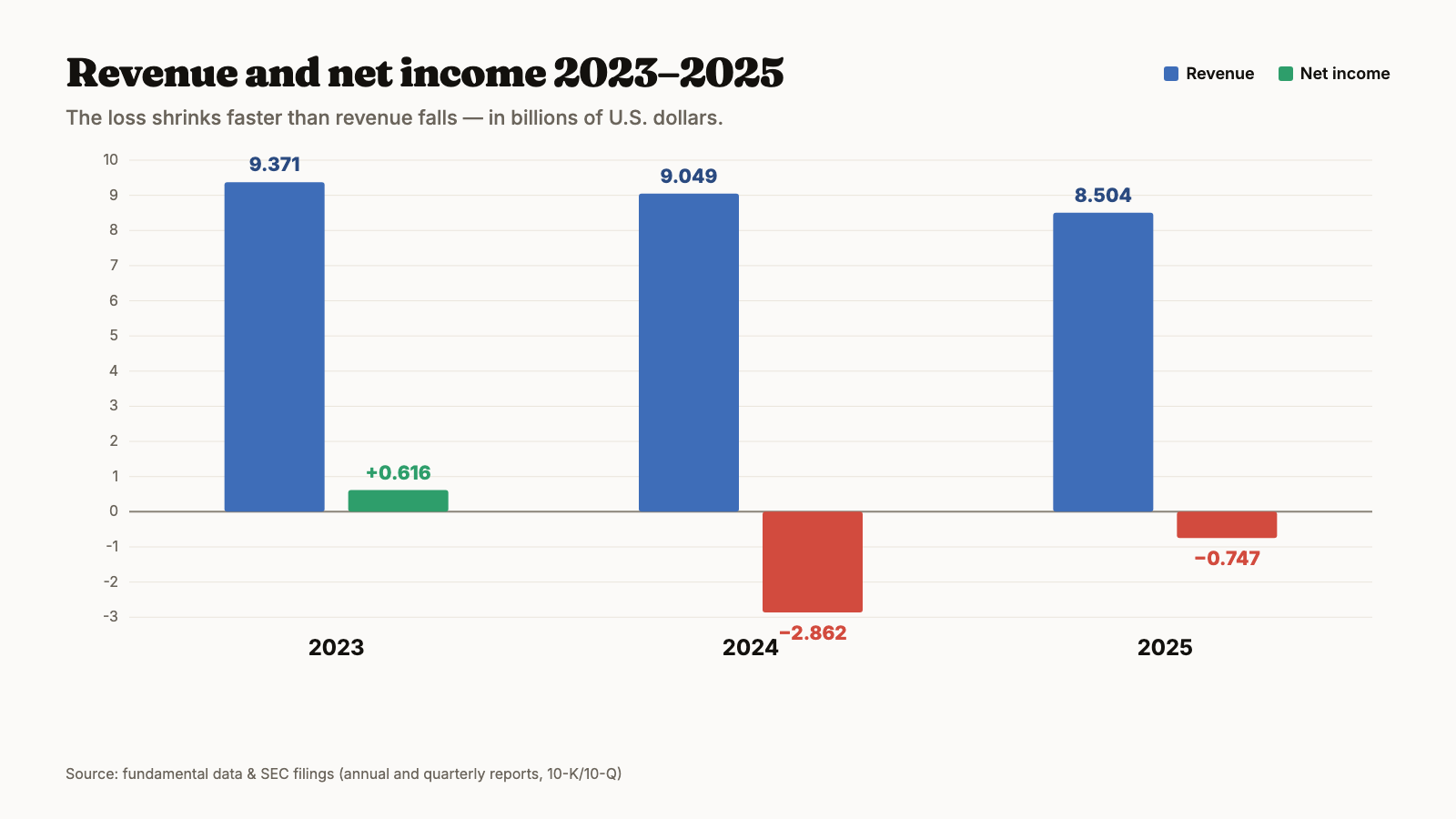
But the curve also tells the uncomfortable half: revenue is not growing — it is falling. $9,371 million (2023), $9,049 million (2024), $8,504 million (2025): three years, three times less. So the improvement is not on the revenue side but in costs — and there, as we are about to see, sits a large accounting effect. Remember the pattern: a shrinking loss on shrinking revenue is a restructuring, not growth. Which brings us to the uncomfortable truths.
What the filings say — the uncomfortable truths
Uncomfortable truth no. 1: Half the progress comes from depreciation, not from the business
When a loss falls from $2.9 billion to $747 million, you think of an operating feat. The annual report names a soberer reason. A rental company's largest single cost block is depreciation on the rental fleet ("Depreciation of revenue earning vehicles and lease charges, net") — the loss of value of the cars while they are rented out. And that is almost exactly what halved:
"Depreciation of revenue earning vehicles and lease charges, net decreased $1.7 billion in 2025 compared to 2024, which is primarily attributable to our Americas RAC segment."
— Hertz Global Holdings, Inc., SEC annual report 10-K for fiscal year 2025, Item 7 "Management's Discussion and Analysis" (sec.gov)
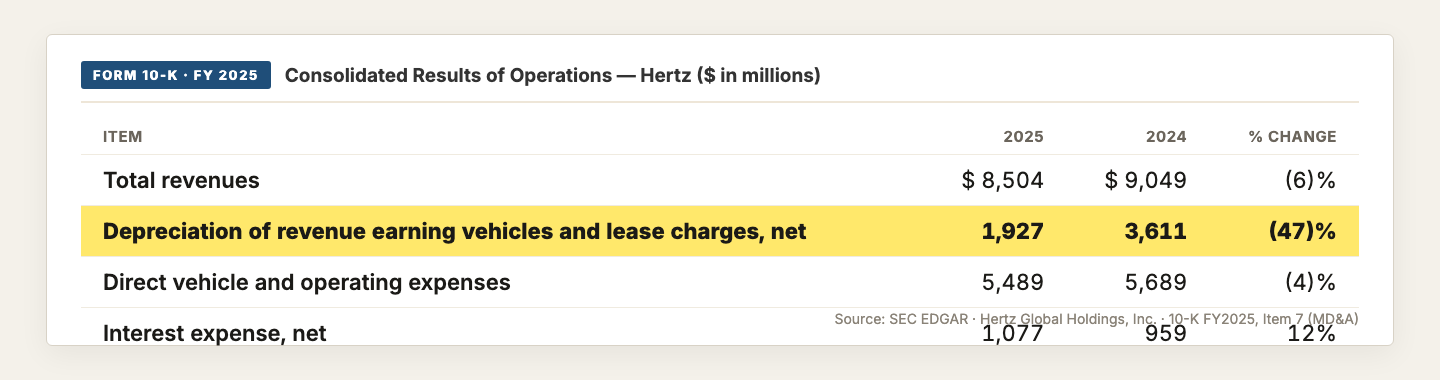
In numbers: fleet depreciation fell from $3,611 million (2024) to $1,927 million (2025). On top of that comes a second one-off: in 2024 Hertz had booked a $1,048 million special impairment on long-lived assets (the written-down electric-vehicle fleet, more on that below) — in 2025 that item was zero. Add the two together, and most of the roughly $2.1 billion improvement in pre-tax results is explained before a single car was rented more often. To be fair: part of it is genuine substance — used-car prices recovered, Hertz bought the fleet more cheaply ("fleet refresh"), and each car sold produced gains rather than losses in 2025. But that is a price cycle, not a business-model leap: if used-car prices roll over again, depreciation rolls with them. Remember the mechanism: anyone praising the halved loss should know that accounting did half the work.
Uncomfortable truth no. 2: Equity is negative — and getting more negative
Now the line that appears in no comeback story. On the balance sheet, the bottom line is equity — simplified: what would belong to shareholders if you subtracted all debt. At Hertz that number has slipped below zero and keeps falling:
"Total stockholders' equity (deficit): $(459) million (December 31, 2025) versus $153 million (December 31, 2024)."
— Hertz Global Holdings, Inc., SEC annual report 10-K for fiscal year 2025, consolidated balance sheet (sec.gov)
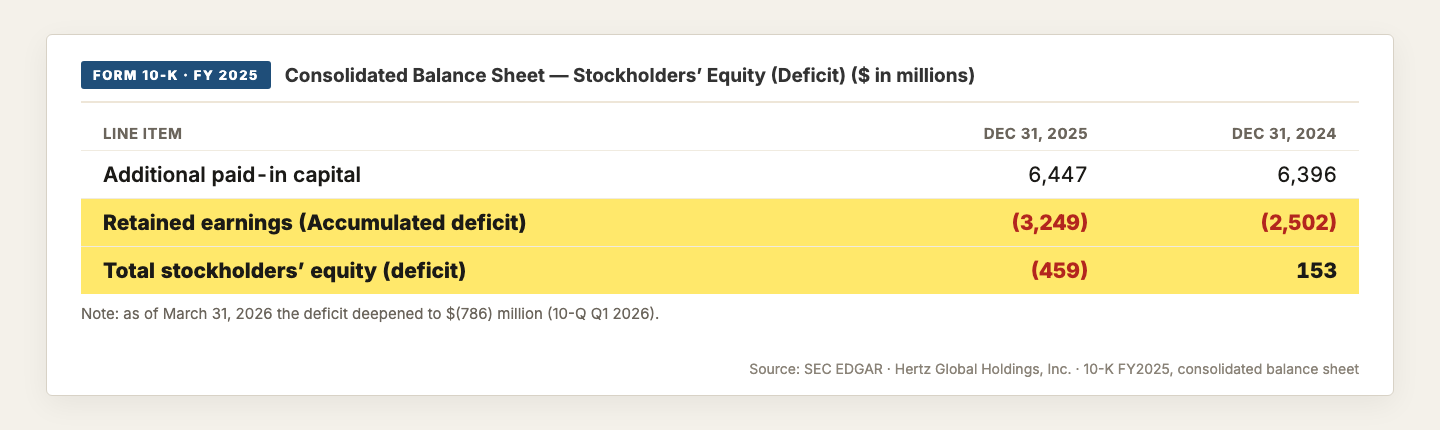
And the trend continues: as of March 31, 2026, the deficit deepened to minus $786 million per the quarterly report — a further $327 million in a single quarter. Accumulated losses stand at $3,249 million. Here is what the fall through zero looks like:
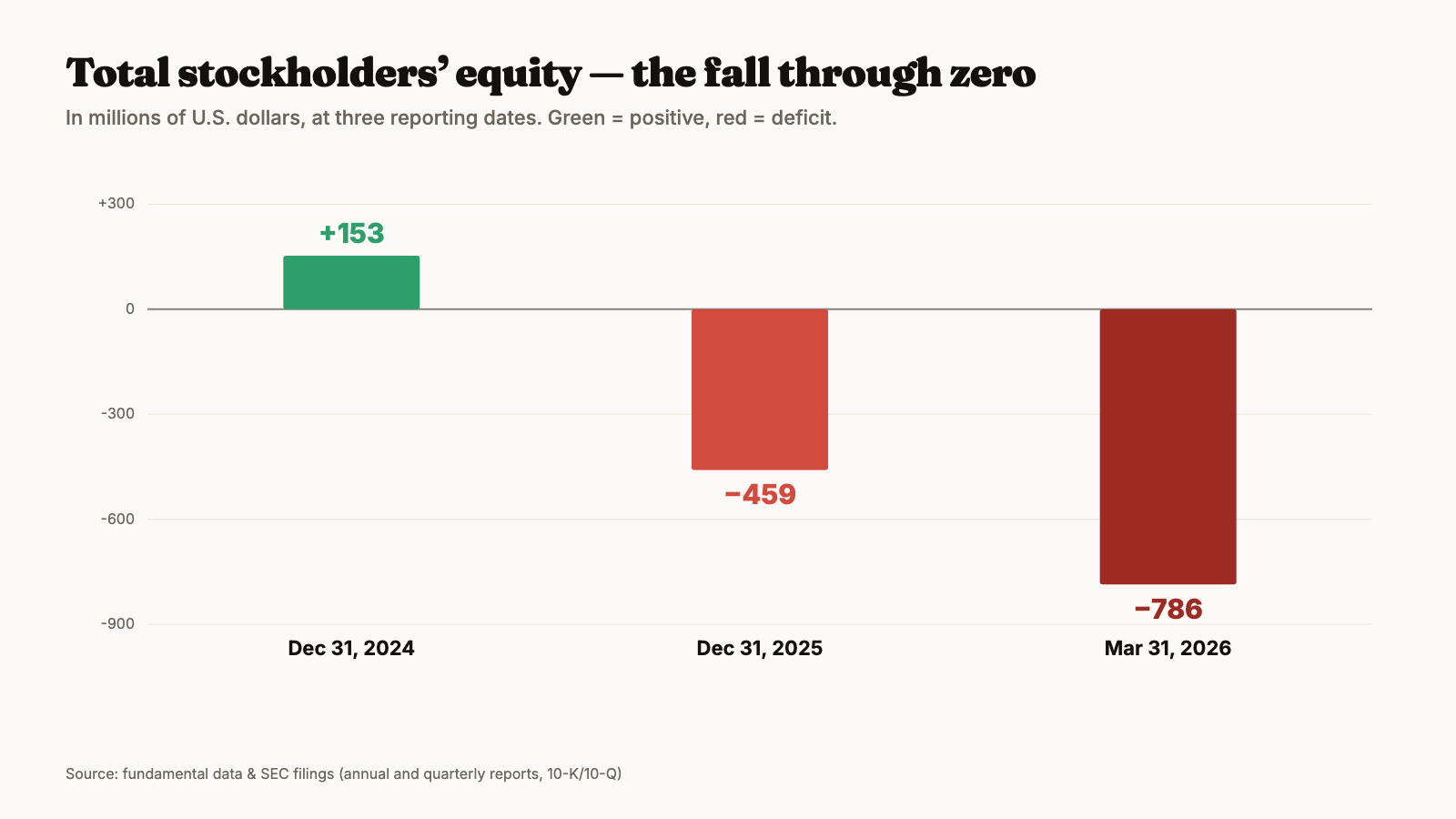
Picture it in everyday terms: imagine a homeowner whose mortgage is larger than the value of the house — he can still live there and make the payments as long as his job and rental income hold. But his net worth is mathematically negative, and every month in the red digs the hole deeper. That is where Hertz stands: the vehicles are pledged as collateral, the business is generating more again — but as long as losses exceed fresh capital, the substance erodes. This is not an acute bankruptcy alarm, but it is the most honest single number in the whole analysis: the turnaround is taking place on negative equity.
Uncomfortable truth no. 3: $17 billion in debt — and part of it is genuinely expensive
A car rental company is a debt model at its core: you borrow money, buy fleets with it, rent them out and sell them again. The balance sheet is correspondingly large — and it gets correspondingly expensive when rates rise. As of December 31, 2025, Hertz carried $17,054 million in total debt: $11,629 million of vehicle financing (through so-called asset-backed programs, in which the cars themselves serve as collateral) and $5,425 million of non-vehicle debt. Part of this debt stems from the restructuring and is remarkably expensive — it appears by name in the report's glossary:
"'Exchangeable Notes Due 2029' means the 8.000% Exchangeable Senior Second-Lien Secured Paid-in-Kind ('PIK') Notes due 2029 …"
— Hertz Global Holdings, Inc., SEC annual report 10-K for fiscal year 2025, definitions / Note 7 "Debt" (sec.gov)
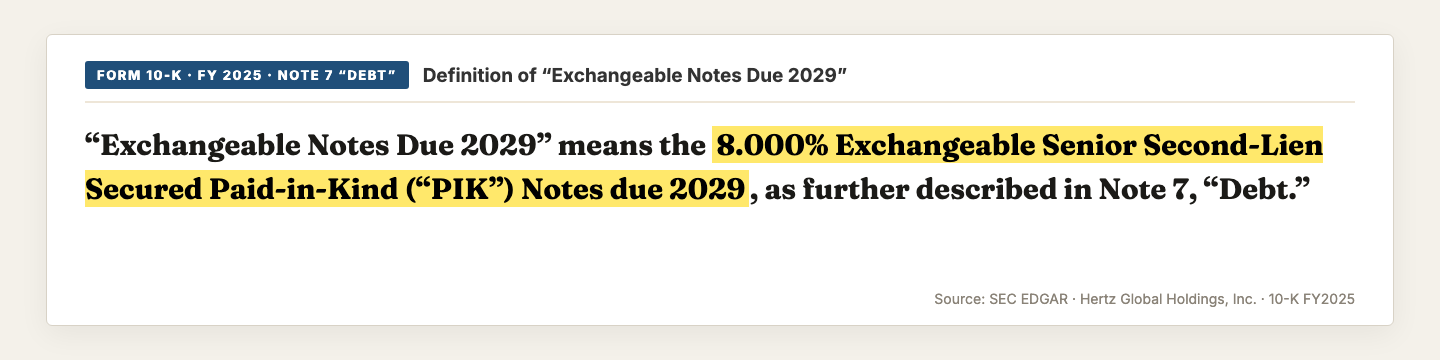
Two things are packed in there. First, the rate: 8.000 percent is a price tag a financially comfortable company would not have to pay — it is the pricing tier of distressed borrowers. Second, the acronym "PIK" (paid-in-kind): the interest is not paid in cash but in the form of additional notes — so the debt grows out of itself as long as it is outstanding. Total interest expense consumed $1,077 million in 2025 alone (2024: $959 million, +12 percent) — more than the entire reduction in the net loss that same year. In other words: the business is rowing painfully toward zero, and the interest meter is pulling in the opposite direction at the same time. As long as debt is this high and partly this expensive, every operating recovery must first clock the interest meter before anything is left for shareholders at the bottom line.
Uncomfortable truth no. 4: The big electric-vehicle bet is history — the fleet-value risk remains
One chapter of this story is especially instructive, because it shows how fast a bet on the future becomes a billion-dollar hole. After emergence, Hertz bought electric vehicles in bulk, aiming to become a pioneer of the mobility transition. Then prices for used EVs fell, repairs got expensive, demand disappointed — and Hertz had to write the EV fleet down massively (the core of the $1,048 million special impairment in 2024). In the current annual report, the retreat sounds like this:
"While we have de-emphasized the use of EVs, we continue to own a number of EVs and expect that we will continue to purchase EVs in the future."
— Hertz Global Holdings, Inc., SEC annual report 10-K for fiscal year 2025, Item 1A "Risk Factors" (sec.gov)
The EV episode is closed — but it left behind a more general truth that stays central to the stock: Hertz's result hinges on the resale value of its cars. The report expressly warns that falling market values of the fleet can jeopardize the collateral behind the asset-backed financings — at which point Hertz would have to reduce debt or post more collateral:
"… we may have difficulty meeting collateral requirements under our asset-backed financing arrangements, requiring us to either reduce the outstanding principal amount of debt or provide more collateral … to the creditors …"
— Hertz Global Holdings, Inc., SEC annual report 10-K for fiscal year 2025, Item 1A "Risk Factors" (sec.gov)
Picture it in everyday terms: Hertz has half its assets on wheels, and the value of those wheels swings with the used-car market. In 2025 that market ran in Hertz's favor — which is exactly what carried the halved depreciation from truth no. 1. But the same mechanism runs in both directions. A rental company with a thin (here: negative) equity cushion is barely padded against another price decline in its own fleet. It is this sensitivity to the car-resale cycle — and the pull of attention over balance-sheet substance — that ties Hertz to other stocks from the Reddit meme era, such as AMC Entertainment.
Valuation: What does the legend cost?
At Hertz the usual valuation route misleads. A price-to-earnings ratio cannot be computed — there are no earnings. The price-to-sales ratio looks optically low against roughly $8.5 billion in revenue, but it hides the decisive point: for a rental company this heavily indebted, the yardstick is not the market cap but the enterprise value including the $17 billion of debt. Put differently: whoever buys the stock buys a thin — currently even negative — slice of equity that sits at the very end of a $17 billion debt line. If enterprise value rises, that thin remainder benefits disproportionately (that is the appeal of any turnaround bet); if it falls, the remainder is consumed first (that is its risk). On top of that comes dilution: the share count rose from 306.7 million (end of 2024) through 311.7 million (end of 2025) to 315.1 million as of March 31, 2026 — your slice of the cake shrinks while new slices are cut, and the 8% PIK notes are moreover exchangeable into shares. So the honest order of magnitude is neither "cheap" nor "expensive" but: a leveraged bet on a resale and restructuring cycle whose stake is the thinnest item on the entire balance sheet. How quickly the market re-prices such bets was on display in the meme era at AMC Entertainment — where the story carried the price far beyond the balance sheet, until dilution presented the bill.
Opportunities and risks at a glance
What speaks for Hertz:
- A genuine operating turnaround: net loss narrowed from −$2,862 million (2024) to −$747 million (2025), adjusted corporate EBITDA from −$1,541 million to −$339 million; Q1 2026 revenue +10.5 percent, loss shrinking further.
- Strong, world-famous brand family (Hertz, Dollar, Thrifty), established airport presence, roughly 442,000 vehicles peak fleet in the Americas — a business with real cash turnover, not a concept without substance.
- Tailwind from the used-car market: recovered residual values and cheaper fleet purchasing pushed depreciation down in 2025 and produced gains per vehicle sold.
- "Back-to-Basics" focus: disciplined fleet management, revenue optimization, cost control — the EV misbet is written off and out of the strategy.
- Leverage upside: with equity this thin, every further operating improvement acts disproportionately on the share value — the flip side of the risk.
What speaks against it:
- Negative and falling equity: +$153 million (2024) → −$459 million (2025) → −$786 million (March 31, 2026); $3,249 million in accumulated losses.
- Debt load: $17,054 million total, including 8.000% second-lien PIK exchangeable notes due 2029; interest expense of $1,077 million in 2025 — more than the entire reduction in the loss.
- Half the progress is accounting: −$1.7 billion of fleet depreciation and the absence of the $1,048 million special impairment from 2024 explain the lion's share of the earnings improvement — a price cycle, not a model leap.
- Falling revenue ($9,371 → $9,049 → $8,504 million) and dependence on the volatile fleet resale value; if residuals fall, that endangers the collateral behind the asset-backed financing.
- Dilution and meme volatility: share count 306.7 → 315.1 million, exchangeable PIK notes on top, and a tendency inherited from the 2021 Reddit legend toward violent, fundamentally unwarranted price swings.
A human conclusion
Back to the phoenix trap from the opening. Its core is not that the resurrection is a lie — Hertz is back, the operations are turning, the brand is real, the fleet is on the road. Its core is that a familiar comeback story gives you the feeling you have already passed the test an investment thesis actually demands. Whoever buys "Hertz" because Hertz once rose from the ashes is in truth buying three very concrete bets: that the operating turnaround holds even when the used-car tailwind fades; that the $17 billion debt load and the 8% PIK interest meter do not devour the recovery before it reaches the shareholder; and that a negative, still-falling equity turns back into real substance rather than diluting further through new shares. All of it is possible — restructurings succeed, and the direction is right. But the honest question for you is not "Is Hertz coming back?" but: Would you buy this balance sheet if the name meant nothing to you? If yes, you have a thesis. If no, you had a legend. What you make of it is your decision. And that is exactly as it should be.
Sources
All original documents used in this analysis — for you to read yourself:
- Hertz Global Holdings, Inc. — SEC annual report 10-K for 2025 (filed February 26, 2026)
- Hertz Global Holdings, Inc. — SEC annual report 10-K for 2024 (filed February 18, 2025)
- Hertz Global Holdings, Inc. — SEC quarterly report 10-Q as of March 31, 2026 (filed May 8, 2026)
- Complete SEC filing history of Hertz Global Holdings, Inc.: EDGAR overview (sec.gov)
- Fundamental data (metrics, quarterly series, valuation; data as of July 23, 2026), reconciled with the SEC filings and the SEC XBRL data series.
- Screener and attention data: in-house stock scanner; Reddit mentions: ApeWisdom (as of July 23, 2026).
Transparency & disclaimer: This analysis is a journalistic contextualization of publicly available information and is not investment advice, not a financial analysis in the regulatory sense, and not a solicitation to buy or sell securities. Stock investments carry substantial risks up to and including total loss. All information without warranty; the data cut-off is noted in the text in each case. At the time of publication, the author holds no position in Hertz shares.
Our Bottom Line at a Glance
- Operating turnaround positive
- The direction is right: net loss narrowed from −$2,862 million (2024) to −$747 million (2025), adjusted corporate EBITDA from −$1,541 million to −$339 million, and Q1 2026 with +10.5 percent revenue and a further narrower loss. The "Back-to-Basics" program is directionally working.
- Earnings quality negative
- Half the progress is accounting: fleet depreciation fell by $1.7 billion to $1,927 million (2024: $3,611 million), and the $1,048 million special impairment from 2024 dropped out — both explain the lion's share of the earnings improvement before a single car was rented more often. A used-car price cycle, not a model leap.
- Balance sheet & equity negative
- Equity is negative and falling: +$153 million (end of 2024) → −$459 million (end of 2025) → −$786 million (March 31, 2026), against $3,249 million in accumulated losses. The substance erodes as long as losses exceed fresh capital — the most honest single number in the analysis.
- Leverage & interest burden negative
- $17,054 million in total debt (vehicle $11,629 + non-vehicle $5,425), including expensive 8.000% second-lien PIK exchangeable notes due 2029, whose interest grows in new notes. The $1,077 million interest expense (2025) exceeded the entire reduction in the net loss — the recovery must first clock the interest meter.
- Dilution & volatility negative
- The share count rose from 306.7 to 315.1 million (March 31, 2026), the PIK notes are additionally exchangeable into shares, and the 2021 Reddit meme past makes the price prone to attention-driven, fundamentally unwarranted swings.
Hertz is the phoenix trap in pure form: a world-famous brand that already rose from bankruptcy once, with a real operating turnaround (net loss from −$2,862 million to −$747 million, adjusted corporate EBITDA from −$1,541 million to −$339 million, Q1 2026 revenue +10.5 percent) — but with a balance sheet that tips in the middle of that very turnaround: equity slid from +$153 million to −$786 million, debt stands at $17 billion including 8% PIK notes, the $1,077 million interest burden eats half the progress, and the halved loss comes half from normalized fleet depreciation. Whoever invests buys a leveraged bet on a resale and restructuring cycle — carried by a familiar story, not by balance-sheet substance. Not investment advice.
What Our Rating Means
Substance risk
We found at least one documented issue that threatens the company itself — regardless of how the stock is currently valued.
Whoever buys today bets that the operating turnaround holds even without the used-car tailwind, that the $17 billion debt load and the 8% PIK interest meter do not devour the recovery before it reaches the shareholder, and that a negative, still-falling equity turns back into real substance rather than diluting through new shares. Whoever waits checks four lines in every quarterly report (10-Q): the equity deficit (last −$786 million), the direction of fleet depreciation, the interest burden and the shares outstanding. With negative equity, $17 billion in debt and expensive PIK notes, the drop is long — the decision is yours.
A journalistic assessment by our editorial team at the time of the deep dive, based on public sources — not investment advice and not a solicitation to buy or sell. Your personal circumstances (investment goals, risk capacity, taxes) cannot be taken into account. What our levels mean, how verdicts are formed, and what conflicts of interest exist →
Worth Noting
- Hertz reached the research list via the Reddit hype scanner (5 mentions in 24 hours, ApeWisdom, as of July 23, 2026) — an echo of the 2021 meme legend, not a fundamental signal. The real test comes from the SEC filings.
- Important for classification: today's listed entity (CIK 0001657853) is the new company after the 2021 emergence, not the old entity that went bankrupt in 2020. Old "Hertz" price histories can show an extinguished stock.
- The number basis is evergreen: revenue, earnings, equity and debt as of fiscal year 2025 (ended December 31, 2025) resp. March 31, 2026; no daily prices. The net loss refers to Hertz Global Holdings; the operating subsidiary The Hertz Corporation reports slightly different figures (partly due to the public warrants at the holding level).
Stock Watch
This analysis is as of July 23, 2026. Stock Watch will tell you what's changed at HTZ since then.
Later $1 a month per stock — signing up is free, and you'll be the first to know when it launches.
Frequently Asked Questions
Hertz Global Holdings, Inc. (Nasdaq: HTZ) of Estero, Florida, is a U.S. car rental operator with the Hertz, Dollar and Thrifty brands. The company rents vehicles at airports and in cities and then resells its used rental cars through its own channels. As of December 31, 2025, Hertz employed roughly 26,000 people and operated a peak fleet of roughly 442,000 vehicles in the Americas and 96,000 internationally. Revenue 2025: $8,504 million.
No. The old Hertz Global Holdings filed for Chapter 11 in May 2020; its shares were essentially wiped out in the restructuring. The entity listed today under HTZ is the new company that emerged from the proceeding in June 2021 and is carried at the SEC under its own identifier (CIK 0001657853). Old "Hertz" price charts often show the extinguished company — for today's stock, only the new entity counts.
On a net basis, no: 2025 ended with a net loss of $747 million, after −$2,862 million in 2024. The loss is shrinking, but the biggest driver was fleet depreciation falling by $1.7 billion and the absence of a $1,048 million special impairment from 2024, not the operating business alone. In the first quarter of 2026 the net loss stood at $333 million (Q1 2025: −$443 million).
After years of heavy losses, the accumulated deficits ($3,249 million at the end of 2025) exceed the paid-in capital. As a result, total stockholders' equity slipped from plus $153 million (December 31, 2024) to minus $459 million (December 31, 2025) and minus $786 million (March 31, 2026). For a heavily debt-financed rental company, that is not an acute bankruptcy alarm, but a sign of thin substance: as long as losses exceed fresh capital, the number keeps falling.
As of December 31, 2025, Hertz carried $17,054 million in total debt: $11,629 million of vehicle financing through asset-backed programs and $5,425 million of non-vehicle debt. Part of it stems from the restructuring and is expensive — including 8.000% second-lien PIK exchangeable notes due 2029, whose interest is paid in the form of additional notes. Total interest expense was roughly $1,077 million in 2025.
After emergence, Hertz bought electric vehicles in bulk, but then had to write the fleet down massively because of falling used prices, high repair costs and weak demand — the core of the $1,048 million special impairment in 2024. The 2025 annual report says the company has "de-emphasized" the use of EVs but still owns some and expects to keep buying EVs in the future. The big EV bet is thus closed; the general risk of swinging fleet resale values remains.
Hertz became a meme-stock legend in 2020/2021: in the middle of bankruptcy, Reddit and Robinhood investors bought the left-for-dead stock higher. That past keeps the name prone to attention-driven price swings to this day. On July 23, 2026, our Reddit hype scanner recorded 5 mentions in 24 hours (data source ApeWisdom) — no storm, but an echo. Attention, however, is not a quality verdict; the balance sheet decides the value, not the forum noise.
Found an error?
Did you spot a factual error, an outdated number, or a typo in this deep dive? Let us know briefly — your report goes straight to the editorial team.