Guardant Health stock: 48 percent growth, a $112 million quarterly loss — and a federal billing investigation since April 2026
Guardant Health sells blood tests that find cancer before it hurts — Shield is the first blood test approved by the FDA for primary colorectal cancer screening. Revenue rose 48 percent to $301.7 million in the first quarter of 2026, and screening revenue alone jumped 633 percent. The bottom line still showed a loss of $112.1 million, equity is gone at negative $181.1 million, and a single payer accounts for 27 percent of revenue. On April 22, 2026 a U.S. Attorney asked for the billing records tied to that very payer. We read the filings line by line — and keep count of who ends up owning how much.
 Thomas Mücke
Founder & Publisher
Thomas Mücke
Founder & Publisher
Chart
Interactive price chart (TradingView).
Note: pure fact-based analysis, not investment advice and not a solicitation to buy or sell. All figures without guarantee.
There is an investor trap that is especially cruel because it feels like decency: the halo trap. It works like this. A company plainly does something good — it finds cancer before it hurts — and your brain quietly switches from "is this a good business?" to "who wants to be the cynic here?" The numbers become a detail because the mission is so large. Guardant Health, Inc. (NASDAQ: GH) of Palo Alto, California is the hardest test case for that trap. The company sells blood tests that search for traces of tumor DNA in the bloodstream. Its Shield test is, according to the quarterly report, the first blood test approved by the U.S. Food and Drug Administration for primary colorectal cancer screening. That is not a marketing line; it is written into a filing with the U.S. securities regulator, the SEC. So let us make a deal: we admire the medicine — and then we read together what the annual report (10-K) for 2025 and the quarterly report (10-Q) as of March 31, 2026 say about the business behind it. An SEC filing is honest under penalty of law. And this one tells a story of 48 percent growth, of a $112.1 million quarterly loss, of equity that has been used up — and of a federal prosecutor who has been asking for billing records since April 22, 2026.
What this analysis covers
- What Guardant Health actually does
- How the stock landed on our desk
- The numbers over the years — honestly credited
- What the filings say — the uncomfortable truths
- What the market is charging for it
- Opportunities and risks at a glance
- A human conclusion
- Sources
What Guardant Health actually does — a vial of blood instead of a tissue sample
The everyday picture is quickly told. To find out which mutations drive a tumor, you used to need a piece of the tumor — surgery, or a needle through the skin. Guardant sells the shortcut: a vial of blood. Dying tumor cells shed tiny fragments of their DNA into the bloodstream. Anyone who can sort those fragments can read the tumor without touching it. The technical term is liquid biopsy — a tissue sample without the tissue.
Four product families have grown out of that idea. Guardant360 is the original: it looks for targets for precision drugs in patients with advanced cancer, and the Guardant360 CDx version is, per the filing, the first comprehensive liquid biopsy approved by the FDA for tumor mutation profiling. Guardant Reveal answers the question that follows surgery: is there tumor left that nobody can see? Shield is screening for healthy people — a blood test for colorectal cancer aimed at average-risk adults aged 45 and older, and it is included in the colorectal cancer screening guidelines of the National Comprehensive Cancer Network. And GuardantINFORM sells curated data to pharmaceutical companies for their drug development.
In the books that turns into four revenue sources. For full-year 2025: oncology, $683.6 million; biopharma and data, $210.1 million; screening, $79.7 million; and licensing and other, $8.6 million — $982.0 million in total. As of December 31, 2025 the company employed 2,506 people, 2,490 of them full-time and roughly 2,278 in the United States. It is run by two co-chief executive officers, Helmy Eltoukhy and AmirAli Talasaz, and reports as a single operating segment.
And that names the central tension of this analysis, which runs through every chapter that follows: Guardant\'s growth does not hang on the laboratory but on a reimbursement decision. Whoever pays for the test decides whether it sells — and since April 22, 2026 that same payer is the one whose prosecutors are examining the billing.
How the stock landed on our desk — rank 21 in the weekly list
Guardant Health did not reach us through a press release but through a ranking produced by our in-house stock scanner. In the list Richard Moglen: 1 Week Top Performers (U.S. selection) the stock sat at rank 21 of 28, with a relative strength rating of 92 out of 100, as of July 25, 2026. That list is recomputed daily — the placement is a snapshot of that day, not a permanent state. To reproduce it: the ranking is openly available in the scanner overview and sorts by price performance over the past trading week.
The three conditions behind the list, translated and judged. At least 15 percent price gain over four trading days — a pure momentum criterion; it says something about demand for the shares that week, nothing about the company. Average daily dollar volume of at least $10 million — this filter keeps out securities you may not be able to exit; Guardant clears it easily at roughly $409 million (data as of July 26, 2026), which is real liquidity. A relative strength rating of at least 70 — the measure compares a share price against the broad market on a scale to 100. A reading of 92 means only 8 percent of tracked stocks did better. Impressive — and also the only thing on this list you can have without opening the books. Remember the sentence right at the start: a momentum scanner finds movement, not quality. So into the books we go.
The numbers over the years — honestly credited
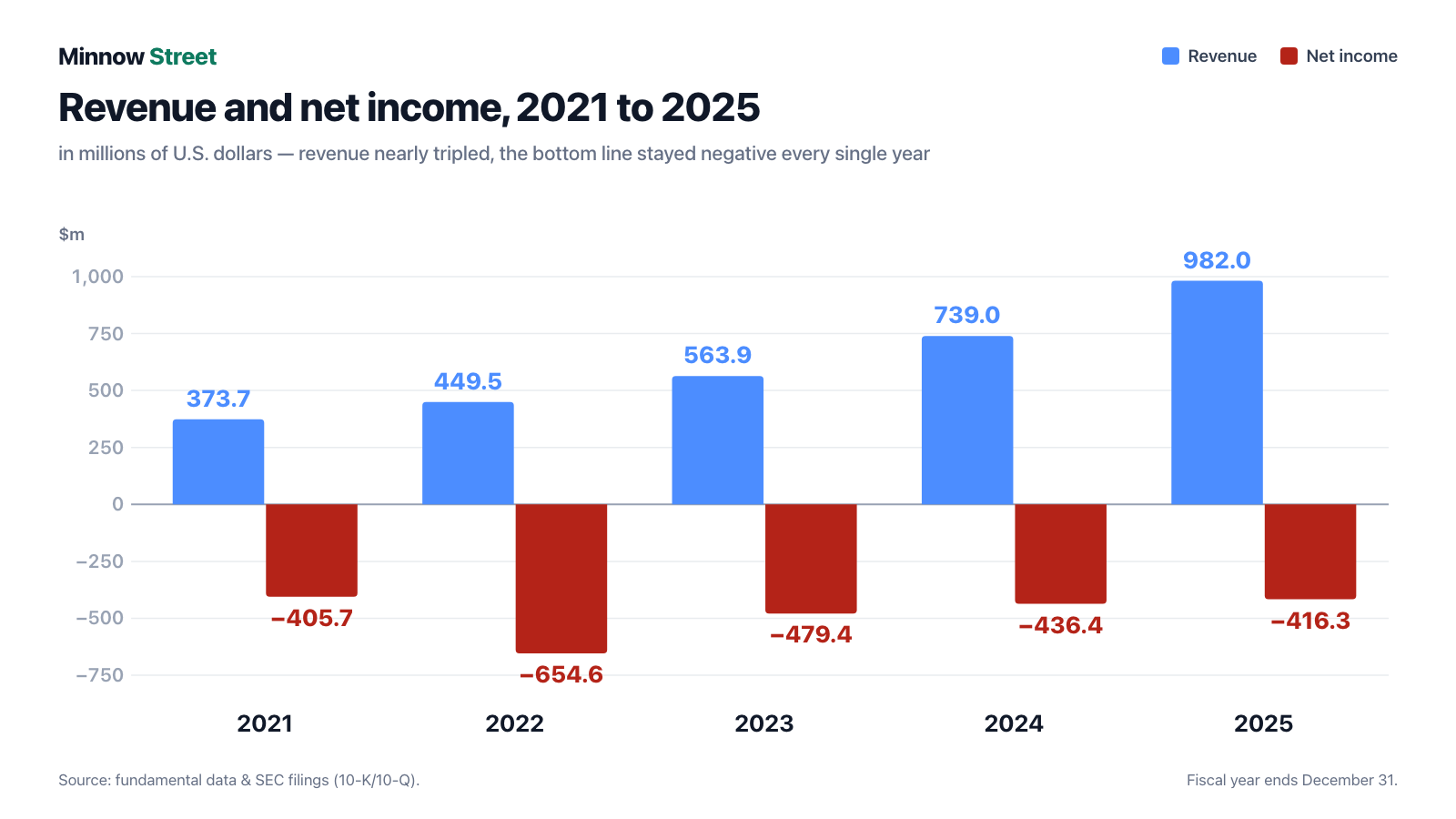
First what genuinely impresses, and there is plenty of it. Revenue has nearly tripled in five years: from $373.7 million in 2021 to $982.0 million in 2025, a gain of 33 percent in 2025 alone. And the pace did not fade afterwards, it picked up: revenue rose 48 percent to $301.7 million in the first quarter of 2026. If you wonder how often a billion-dollar company manages that, the honest answer is: rarely.
The driver has a name: Shield. Screening was still a rounding error in 2024 at $5.1 million, brought in $79.7 million in 2025 from roughly 87,000 tests — and then came the first quarter of 2026. The filing puts it plainly:
"Screening revenue was $41.6 million for the three months ended March 31, 2026, compared to $5.7 million for the three months ended March 31, 2025, an increase of $35.9 million, or 633%. The increase was driven primarily by an increase in our Shield screening test volume to approximately 44,000 for the three months ended March 31, 2026 from approximately 9,000 for the three months ended March 31, 2025."
— Guardant Health, Inc., Form 10-Q as of March 31, 2026, "Comparison of the Three Months Ended March 31, 2026 and 2025"

Do the arithmetic: $41.6 million across roughly 44,000 tests works out to just under $950 per test — our own calculation from the figures in the quarterly report. The oncology core did not stall either: $205.0 million in the first quarter of 2026, up 36 percent, on roughly 86,000 tests against roughly 59,000 a year earlier. The gross margin — the share of revenue left after the pure laboratory cost — held at a solid 65 percent in the first quarter of 2026 ($196.7 million of $301.7 million). For a laboratory running sequencers and reagents, that is a respectable number. If you want to see how another supplier in the genomics business handles persistent losses, the comparison is in our analysis of Twist Bioscience.
What the filings say — the uncomfortable truths
Uncomfortable truth No. 1: one payer accounts for 27 percent of revenue
Guardant does not name its largest customers; it calls them "Customer A" and "Customer B." What the filing does say: a significant customer is any biopharmaceutical customer, clinical testing payer or international laboratory partner that represents 10 percent or more of revenue or of receivables. The table underneath is blunt.
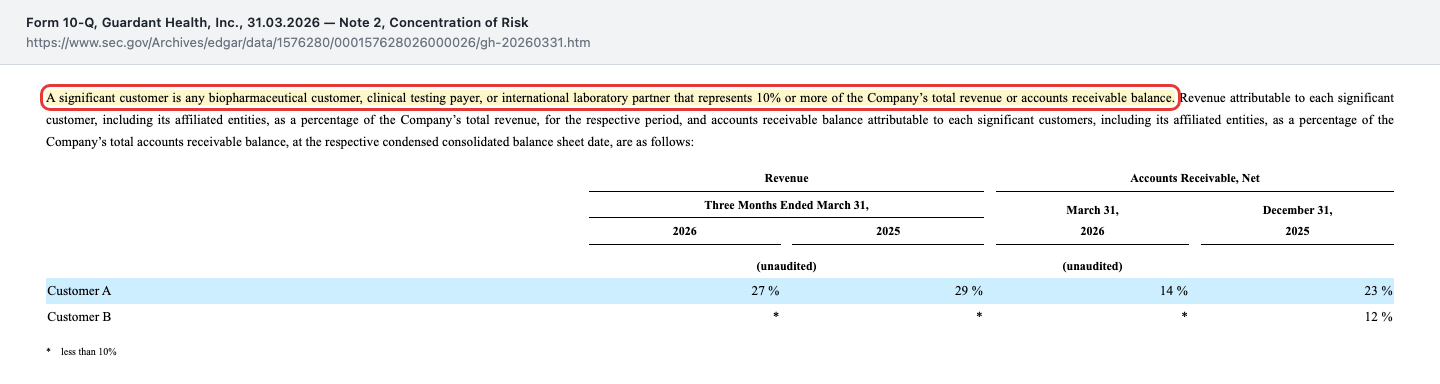
Across full years the dependence is documented even further back: 28 percent in 2025, 29 percent in 2024, 31 percent in 2023. The annual report adds a second line in the open: "Revenue attributable to Medicare accounted for more than 10% of our total revenue in each of the years ended December 31, 2025, 2024 and 2023." What does that mean day to day? A single reimbursement decision can move a quarter of the business. When Medicare brought Shield into coverage in August 2024 and granted ADLT status in March 2025 — a special rule for novel laboratory tests that allows a separate, market-based price — the result within eighteen months was a business generating $41.6 million of quarterly revenue. The same mechanism runs in reverse.
Uncomfortable truth No. 2: since April 22, 2026 a prosecutor has been examining exactly that billing
This line was not in the annual report of February 19, 2026. It appears for the first time in the quarterly report of May 7, 2026, in Note 9 under the unremarkable heading "Other Legal Matters":
"On April 22, 2026, the Company received a civil investigative demand, or CID, from the United States Attorney for the Southern District of Florida in connection with an investigation under the False Claims Act. The CID requests information and documents regarding billing to federally funded health insurance programs. The Company is fully cooperating with the investigation. At this time, the Company is unable to predict the outcome of this investigation."
— Guardant Health, Inc., Form 10-Q as of March 31, 2026, Note 9 "Other Legal Matters"
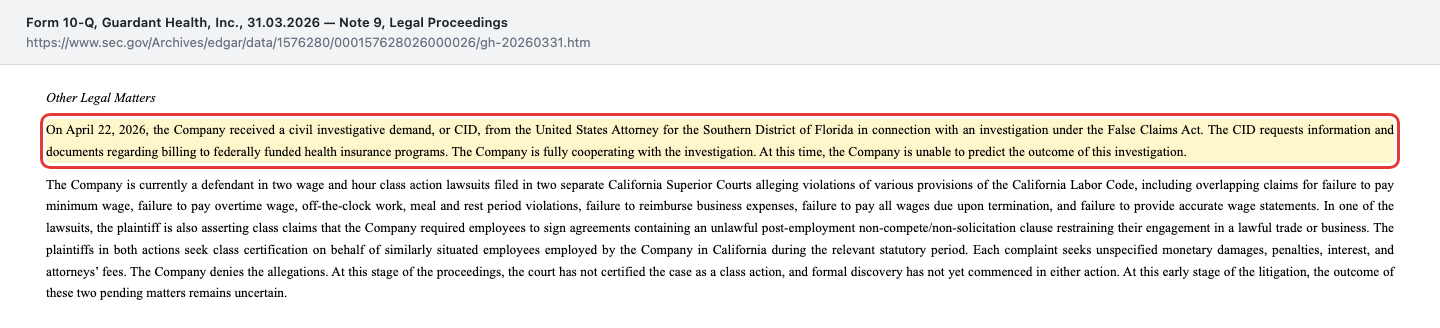
For context, without drama: a civil investigative demand is neither a verdict nor a charge; it is a request to produce documents. The False Claims Act, however, is no minor statute — it is the sharpest tool the United States has against fraudulent billing of government programs, and on conviction it provides for treble damages plus per-claim penalties. Guardant has recorded no accrual and named no order of magnitude. That is exactly the point: this exposure cannot be quantified today, neither upward nor downward. It sits in the filing, it is open, and it touches the artery carrying a quarter of revenue.
Uncomfortable truth No. 3: equity has been used up
Look at the balance sheet as of March 31, 2026 — at the heading, not the numbers. It does not read "Stockholders\' Equity" but "Stockholders\' Deficit." That is not stylistic whim: total liabilities of $2,096.4 million exceed total assets of $1,915.3 million. What is left is a deficit of $181.1 million. At the end of 2021 the same line still showed positive $645.0 million.
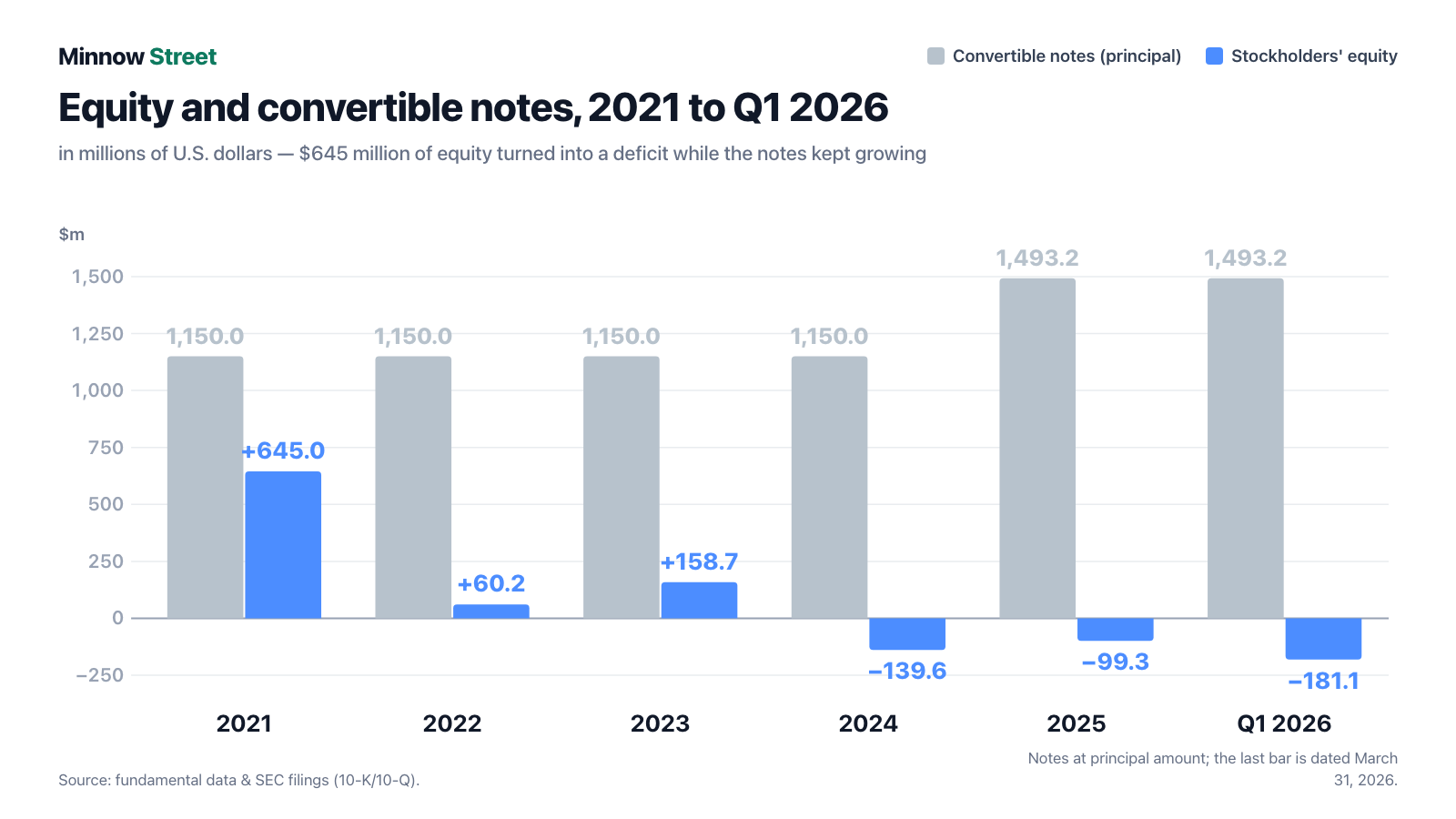
The reason is in the filing too, and it is no accounting trick but simply the sum of every loss since inception:
"We have incurred losses and negative cash flows from operations since our inception, and as of March 31, 2026, we had an accumulated deficit of $3.1 billion. We expect to incur additional operating losses in the near future and our operating expenses will increase as we continue to invest in clinical studies and develop new products, expand our sales organization, and increase our marketing efforts to drive market adoption of our tests."
— Guardant Health, Inc., Form 10-Q as of March 31, 2026, "Liquidity and capital resources"

Fairness demands the other side. There is no going concern warning in the filing. On the contrary, Guardant states that its resources are sufficient for more than twelve months. The cash box is genuinely full: $989.3 million in cash and equivalents plus $113.5 million in short-term marketable securities as of March 31, 2026, or $1,102.8 million together; including restricted cash the filing arrives at roughly $1.2 billion. At the first quarter\'s free cash outflow of $71.2 million that lasts roughly 15 quarters on paper. The money did not come from the business, though, but from the capital market: in November 2025 the company placed 2,856,981 new shares and 976,351 treasury shares at $90.00 each and netted $327.3 million.
Uncomfortable truth No. 4: $1.49 billion of convertible notes — and the first tranche matures in 2027
A convertible note is a loan with a share voucher built in: the buyer lends money and may later swap it for stock if the price has risen far enough. Guardant has three of them outstanding, $1,493.2 million of principal in total:
- 2027 notes, $490.7 million, zero percent interest, maturing November 15, 2027, conversion price roughly $139.82 per share.
- 2031 notes, $600.0 million, 1.25 percent interest, maturing February 15, 2031, conversion price roughly $62.22. These met the price condition during the first quarter of 2026 and were therefore convertible from April 1 to June 30, 2026; as of May 1, 2026 the filing reports that no conversion notices had been received.
- 2033 notes, $402.5 million, zero percent interest, issued in November 2025, maturing May 15, 2033, conversion price roughly $121.50.
Two things matter here. First, the date: the 2027 notes of $490.7 million come due in a little over a year — against $1,102.8 million of cash and securities that is payable, but it is a real payment, not an accounting entry. Second, the dilution — your slice of the pie gets smaller when new slices are handed out. The filing does the math itself: 28.466 million potential additional shares were excluded from diluted loss per share, 16.465 million of them from the convertible notes. Against the 131.273 million weighted-average shares of the quarter that is roughly 22 percent. On top of that, 32,075,509 shares were reserved for employee programs as of March 31, 2026, and an at-the-market program of up to $400.0 million sits ready, from which no share had been sold by that date.
Uncomfortable truth No. 5: sales is growing faster than revenue
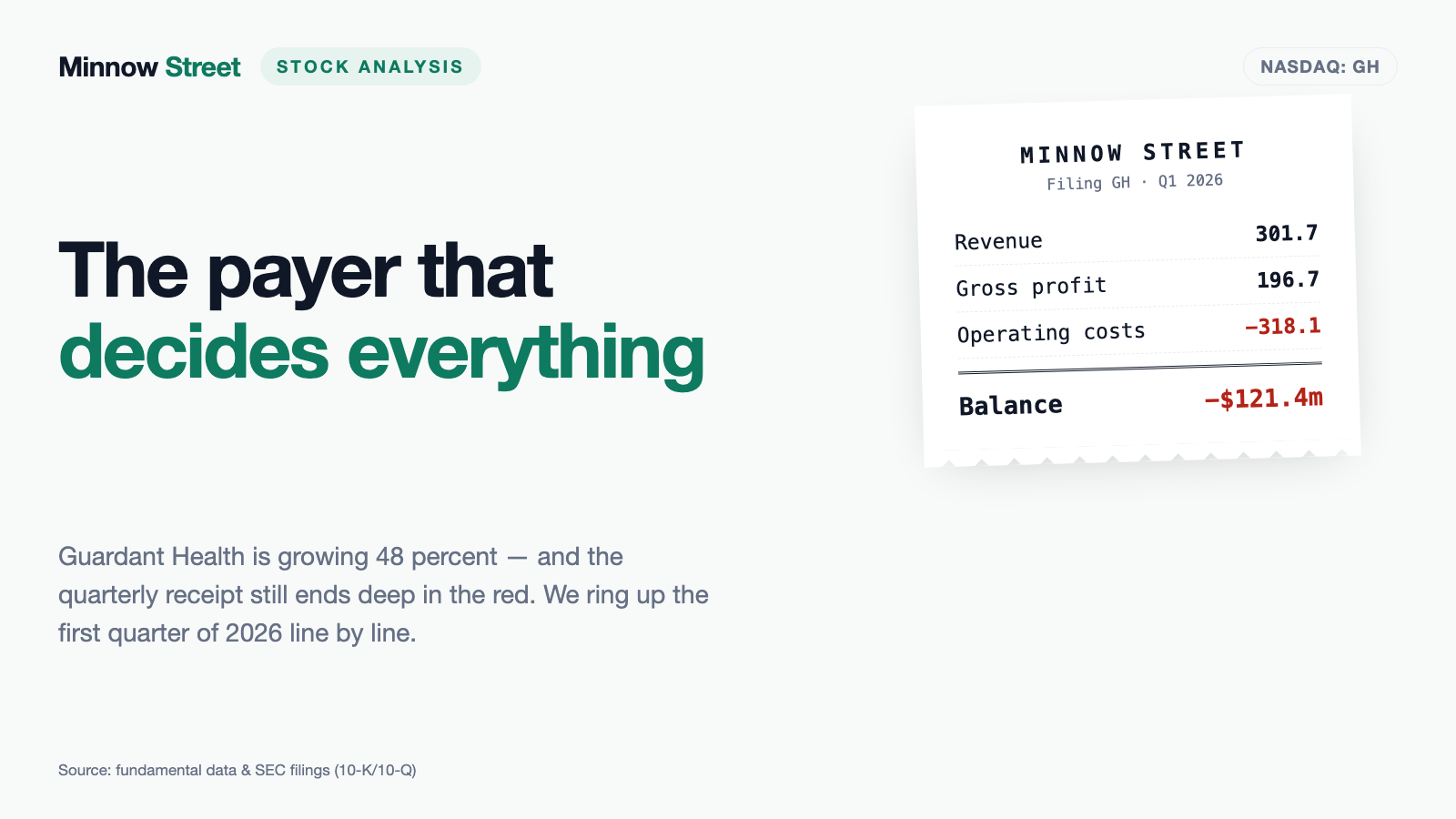
This is the line on which the whole question of eventual profitability turns. Revenue rose 48 percent in the first quarter of 2026 — sales and marketing expense rose 62 percent to $169.1 million. That is 56 percent of revenue: for every dollar sold, more than half a dollar goes into selling it. Add research and development of $91.0 million and general and administrative expense of $57.9 million. In total, a gross profit of $196.7 million faced operating costs of $318.1 million — and the $121.4 million gap is exactly the quarter\'s operating loss.
None of that is wrong in itself: a screening test does not sell itself, primary care physicians have to know it and order it. But it makes the calculation investors must run very concrete: for this company to turn a profit, either the price per test has to rise or sales spending has to stop growing. A third cost block runs quietly alongside: stock-based compensation was $47.6 million in the first quarter of 2026 and $166.2 million for full-year 2025 — roughly 17 percent of annual revenue, paid not in cash but in ownership. For a profitable counterexample from the laboratory business, see our analysis of Bio-Techne.
What the market is charging for it
A price-earnings ratio cannot be formed — there are no earnings. That leaves the price-to-sales ratio, which sets market value against annual revenue and answers the question of how many years of sales the market is paying for today. At a market value of roughly $19.5 billion (as of July 26, 2026, based on the closing price of July 24, 2026) and trailing twelve-month revenue of roughly $1.08 billion, that works out to about 18 times; measured against fiscal 2025 it is just under 20 times. Adding the notes and deducting cash changes little: enterprise value also lands at roughly 18 times trailing revenue.
For context, and without turning it into a buy argument: 18 times revenue is what you normally pay for software with 80 percent margins and recurring contracts — not for a laboratory with a 65 percent gross margin that loses money every year. The price therefore already contains the assumption that Shield scales into the millions of tests. One cross-check that supports the point: market value equals roughly ten times every asset on the balance sheet ($1.92 billion as of March 31, 2026).
How the professionals see it: 23 analysts covered the stock as of July 26, 2026 — 18 at the highest buy rating, 4 at buy, none at hold and one at sell; the average price target was around $171. That is a remarkably unanimous picture, and precisely for that reason it deserves one sentence of caution: a consensus of 22 to 1 has little friction built in. For the current year, incidentally, those same estimates still expect a loss per share.
Opportunities and risks at a glance
What speaks for Guardant Health:
- Shield is, per the quarterly report, the first blood test approved by the FDA for primary colorectal cancer screening and the first to meet Medicare\'s coverage requirements — a head start a rival cannot close overnight.
- Growth is accelerating rather than flattening: up 33 percent in 2025, up 48 percent in the first quarter of 2026, and screening alone reached half of the entire prior-year volume in that one quarter with roughly 44,000 tests.
- The 65 percent gross margin in the first quarter of 2026 shows that each additional test genuinely contributes — scaling does not fail in the laboratory.
- With $1,102.8 million in cash and short-term securities as of March 31, 2026 the company is funded for years, and there is expressly no going concern warning.
- A won lawsuit against rival Natera worth $287.0 million (affirmed July 28, 2025) sits out there as a possible cash inflow without appearing on the balance sheet.
What speaks against it:
- No profit in any year since the 2018 IPO; the accumulated deficit is $3.1 billion and equity is used up at negative $181.1 million.
- A single payer accounts for 27 percent of quarterly revenue — one reimbursement decision can move a quarter of the business, in either direction.
- The civil investigative demand of April 22, 2026 under the False Claims Act targets exactly that billing; Guardant says it cannot predict the outcome and has recorded no accrual.
- Roughly 22 percent of potential dilution from convertible notes and employee programs; the 2027 note of $490.7 million matures on November 15, 2027.
- Sales is growing faster than revenue (up 62 versus up 48 percent in the first quarter of 2026) — which lengthens the road to profit rather than shortening it.
- A price-to-sales ratio of roughly 18 leaves little room for disappointment, and the competition is well staffed: Foundation Medicine (Roche), Exact Sciences, Natera, Tempus AI, Caris, Quest and LabCorp are named in the annual report.
A human conclusion
Back to the halo trap from the opening. It is stubborn because both halves are true: a blood test that finds colorectal cancer before anyone has symptoms is a good thing — and a company with a $3.1 billion accumulated deficit, used-up equity and an open billing investigation is a risky investment. Neither refutes the other. You are allowed to hold both thoughts at once, and whoever does not ends up buying a mission instead of a stock.
What is documented: revenue rose 48 percent in the first quarter of 2026, screening grew 633 percent, the gross margin holds at 65 percent, and $1.1 billion sits in the bank. Equally documented: not one profitable year since inception, equity gone, a quarter of revenue hanging on a single payer — and since April 22, 2026 a federal prosecutor wants to see the invoices sent to that very payer. The price today pays roughly 18 times a year of revenue, and therefore pays for a future in which both of those stories end well.
We are not going to tell you whether to buy this stock. We will tell you which three numbers carry the answer: the revenue share of the largest payer, the gap between gross profit and operating costs — and the next line in Note 9. What you make of that is your decision. And that is exactly as it should be.
Sources
- Guardant Health, Inc. — Form 10-Q as of March 31, 2026 (filed May 7, 2026, accession 0001576280-26-000026)
- Guardant Health, Inc. — Form 10-K for 2025 (filed February 19, 2026, accession 0001576280-26-000013)
- Guardant Health, Inc. — Form 10-K for 2024 (filed February 20, 2025, accession 0001576280-25-000044)
- Guardant Health, Inc. — Form 8-K of May 7, 2026 (Item 2.02, quarterly results)
- All SEC filings of Guardant Health, Inc. (CIK 0001576280) on EDGAR
- Fundamental data (metrics, quarterly series, analyst estimates), as of July 26, 2026, based on the closing price of July 24, 2026
This analysis is journalistic commentary and expressly not investment advice, not a buy or sell recommendation and not a solicitation to buy or sell securities. All figures come from the primary sources linked above and were verified on July 26, 2026; later developments are not reflected. Shares can lose substantial value, and a total loss of invested capital is possible. The author holds no position in Guardant Health, Inc. at the time of publication.
Our Bottom Line at a Glance
- Business model and market position positive
- According to the Form 10-Q as of March 31, 2026, Shield is the first blood test approved by the FDA for primary colorectal cancer screening and the first to meet Medicare's coverage requirements; it also appears in the NCCN screening guidelines. Guardant360 CDx was the first comprehensive liquid biopsy approved by the FDA for tumor mutation profiling. Those regulatory head starts are documented and cannot be copied quickly.
- Growth positive
- Revenue rose from $373.7 million in 2021 to $982.0 million in 2025 and climbed 48 percent to $301.7 million in the first quarter of 2026. Screening grew 633 percent in that quarter to $41.6 million on roughly 44,000 tests versus roughly 9,000 a year earlier; oncology added 36 percent to $205.0 million. The pace increased in 2026 rather than fading.
- Earnings power negative
- There has been no profitable year since the 2018 IPO: a net loss of $405.7 million in 2021, $654.6 million in 2022, $479.4 million in 2023, $436.4 million in 2024, $416.3 million in 2025 and $112.1 million in the first quarter of 2026. In that quarter sales and marketing expense grew 62 percent to $169.1 million, faster than revenue at 48 percent; gross profit of $196.7 million faced operating costs of $318.1 million.
- Balance sheet and funding negative
- Equity is used up: negative $181.1 million as of March 31, 2026 against positive $645.0 million at the end of 2021, with an accumulated deficit of $3.1 billion. Against that sit $1,102.8 million of cash and short-term securities and $1,493.2 million principal of convertible notes, the first tranche of which — $490.7 million — matures on November 15, 2027. There is expressly no going concern warning; the most recent funding came from an equity offering at $90.00 per share in November 2025.
- Concentration and legal exposure negative
- A single payer accounted for 27 percent of revenue in the first quarter of 2026 (28 percent in 2025, 31 percent in 2023). On April 22, 2026 Guardant received a civil investigative demand from the U.S. Attorney for the Southern District of Florida under the False Claims Act, aimed at billing to federally funded health insurance programs. Neither an amount nor an accrual is disclosed; the company says it cannot predict the outcome.
- Dilution neutral
- The quarterly report shows 28.466 million potential share equivalents as of March 31, 2026, of which 16.465 million come from the convertible notes — roughly 22 percent of the 131.273 million weighted-average shares. On top of that, 32,075,509 shares are reserved for employee programs, and an at-the-market program of up to $400.0 million stands ready, from which no share had been sold by that date. Transparently reported, but material in size.
Guardant Health is the halo trap in its purest form: the medicine is unarguably good, the business behind it is not automatically good too. What is documented is growth that is accelerating — up 48 percent to $301.7 million in the first quarter of 2026, with screening up 633 percent — alongside a 65 percent gross margin and $1,102.8 million in cash and securities. Equally documented: no profit since inception, an accumulated deficit of $3.1 billion, equity of negative $181.1 million and a single payer behind 27 percent of revenue — whose billing has been under examination by a U.S. Attorney since April 22, 2026. The market pays roughly 18 times a year of revenue for that. Not investment advice.
What Our Rating Means
Substance risk
We found at least one documented issue that threatens the company itself — regardless of how the stock is currently valued.
Red is not for the price and not for the losses alone, but for two documented findings about substance. First, equity is used up: the balance sheet as of March 31, 2026 heads the section "Stockholders' Deficit" and shows negative $181.1 million, on an accumulated deficit of $3.1 billion and operating cash outflow in every year since inception. Second, 27 percent of quarterly revenue hangs on a single payer whose billing has been the subject of a False Claims Act investigation since April 22, 2026 — with no quantifiable exposure and no accrual. Plenty stands on the other side: a regulatory head start, 48 percent growth, a 65 percent gross margin, $1.1 billion of liquidity and no going concern warning. That does not make the company bad — it makes it a company whose substance currently depends on a reimbursement decision and a government file. In case of doubt the more cautious level applies. The decision is yours.
A journalistic assessment by our editorial team at the time of the deep dive, based on public sources — not investment advice and not a solicitation to buy or sell. Your personal circumstances (investment goals, risk capacity, taxes) cannot be taken into account. What our levels mean, how verdicts are formed, and what conflicts of interest exist →
Worth Noting
- Guardant Health landed on the research list through our in-house stock scanner: rank 21 of 28 in the list "Richard Moglen: 1 Week Top Performers" (U.S. selection) with a relative strength rating of 92, as of July 25, 2026. That list is recomputed daily; it measures price momentum over four trading days, liquidity and relative strength — demand for the shares, not quality of the company.
- Every figure carries its own reporting date: annual figures from the Form 10-K for 2025 (filed February 19, 2026), quarterly figures from the Form 10-Q as of March 31, 2026 (filed May 7, 2026). Valuation metrics as of July 26, 2026 based on the closing price of July 24, 2026 — meant to be evergreen, with no daily price used as a buy argument. The status of the legal proceedings is that of the quarterly report of May 7, 2026; no Form 8-K reporting an outcome was filed between then and July 26, 2026.
- Easy to confuse: the ticker GH belongs to Guardant Health, Inc. of Palo Alto (CIK 0001576280), not to the same letters on other exchanges. The SEC registration lists no former company names. Guardant should also not be confused with rival Natera, against which it won a trial in November 2024, or with Tempus AI, with which two proceedings run in opposite directions.
Frequently Asked Questions
Guardant Health sells liquid biopsies — blood tests that search the bloodstream for fragments of tumor DNA. Guardant360 looks for drug targets in advanced cancer, Guardant Reveal monitors for recurrence after surgery, and Shield is colorectal cancer screening for adults aged 45 and older. Revenue from all of it reached $982.0 million in 2025.
No. Since its October 2018 IPO, Guardant Health has never reported a profitable year: a net loss of $416.3 million in 2025, $436.4 million in 2024 and $479.4 million in 2023. The first quarter of 2026 ended at negative $112.1 million, or $0.85 per share. The accumulated deficit stood at $3.1 billion as of March 31, 2026.
Because losses since inception have consumed the capital raised. As of March 31, 2026, total liabilities of $2,096.4 million faced total assets of $1,915.3 million, leaving a deficit of $181.1 million. The balance sheet itself heads the section "Stockholders' Deficit." There is no going concern warning in the filing.
According to the quarterly report, Shield is the first blood test approved by the FDA for primary colorectal cancer screening. Medicare has reimbursed it once every three years since August 2024, with its own ADLT pricing status since March 2025. Screening revenue therefore grew 633 percent to $41.6 million in the first quarter of 2026 on roughly 44,000 tests.
Very. One payer accounted for 27 percent of consolidated revenue in the first quarter of 2026, 29 percent a year earlier, 28 percent in 2025 and 31 percent in 2023. The annual report adds that revenue attributable to Medicare exceeded 10 percent of total revenue in each year from 2023 through 2025.
On April 22, 2026 Guardant Health received a civil investigative demand from the U.S. Attorney for the Southern District of Florida seeking documents on billing to federally funded health insurance programs. That is neither a verdict nor a charge. Guardant says it is cooperating and cannot predict the outcome; no accrual has been recorded.
Three convertible notes totaling $1,493.2 million were outstanding as of March 31, 2026. The quarterly report shows 16.465 million potential shares from those notes alone and 28.466 million together with employee programs — roughly 22 percent of the 131.273 million weighted-average shares in the quarter.
As of March 31, 2026 the company held $989.3 million in cash and equivalents and $113.5 million in short-term securities, or $1,102.8 million together. At the first quarter's free cash outflow of $71.2 million that equates to roughly 15 quarters. Guardant itself considers the resources sufficient for more than twelve months.
Found an error?
Did you spot a factual error, an outdated number, or a typo in this deep dive? Let us know briefly — your report goes straight to the editorial team.