Greenlight Re: A Reinsurer Whose Profit Is Made in the Portfolio
Greenlight Capital Re shows up in our cash flow ranking at a ratio of 2.19 — a metric that simply measures the wrong thing at a reinsurer: the cash inflow consists largely of premiums set aside as reserves for claims still to come. We work that through, separate underwriting from investment results, and look at what having the portfolio run by an entity of the chairman of the board costs every year.
 Thomas Mücke
Founder & Publisher
Thomas Mücke
Founder & Publisher
Chart
Interactive price chart (TradingView).
Note: pure fact-based analysis, not investment advice and not a solicitation to buy or sell. All figures without guarantee.
There is an investor trap that catches the thorough in particular — the wrong-instrument trap. It works like this: you have a measure that served you well at a hundred companies, and you apply it to the hundred and first without asking whether it measures anything there at all. A thermometer is an excellent device in an oven. In an aquarium it still tells you nothing about the fish. That is exactly what happens when you point the price-to-free-cash-flow ratio at a reinsurer. Greenlight Capital Re, Ltd. (NASDAQ: GLRE) sits in our ranking at a value of 2.19 — and at this company that value measures nothing a shareholder owns. So let us do it properly: look at where the cash inflow comes from, replace the metric with one built for insurers, and then separate this group two engines cleanly.
What Greenlight Re actually does — buy risk, invest money
A reinsurer is the insurance company insurance company. When a primary insurer has written a thousand home contents policies and does not want a single storm to knock it over, it passes on part of those risks — in return for part of the premium. That is precisely what Greenlight Re buys: shares in other insurers portfolios, from property damage through specialty risks to personal lines. 84 people handle that from Camana Bay on Grand Cayman. In 2025 the group wrote gross premiums of $773.3 million, up 10.7 percent.
Now the part that sets Greenlight Re apart from other reinsurers. Every insurer invests the premiums until it needs them for claims — usually conservatively, in bonds. Greenlight Re does not. The group is contractually obliged to place substantially all of its investable assets in a single fund: Solasglas Investments, LP. That fund is managed by DME Advisors — an entity of David Einhorn, chairman of the board of Greenlight Re and at the same time president of the investment firm Greenlight Capital, Inc. The reinsurer is therefore also a vehicle through which you invest in Einhorn investing style.
That sets the central tension of this analysis: two engines drive the same profit — the underwriting business and a securities portfolio run by a related party. Anyone judging the stock has to look at both separately and know what the management of that portfolio costs.
One note on the filing status, because it is often assumed wrongly for Cayman companies: Greenlight Re does not report as a foreign private issuer. Nowhere in its record with the U.S. securities regulator, the SEC, is there a 20-F or a 6-K; instead there are U.S.-standard annual and quarterly reports (10-K and 10-Q) throughout. The figures in this article come from those reports and are therefore comparable quarter by quarter.
How the stock reached our desk
Greenlight Re reached our list through a sort. The in-house stock scanner P/FCF Ranking collects every name with positive free cash flow and a price-to-free-cash-flow ratio of at most 10 and sorts ascending.
On July 27, 2026 we measured, separately for each edition. With the market filter set to the United States, both show 545 hits; the German list covering all markets comes to 836. Greenlight Re sits in 47th place at a value of 2.19 — identical on both brands, and therefore outside the 25 rows displayed. To see the row, use the screener, which filters and sorts the entire universe without a cap, or reach the company page through the stock search. The lists are recalculated daily — 47th place is a dated snapshot.
And now the point this analysis turns on: that metric measures nothing here. It divides market value by free cash flow. At an industrial company free cash flow is the money left after all investment — available for dividends, buybacks or debt reduction. At an insurer it is something else entirely: premiums collected for claims that have not yet been paid.
Uncomfortable truth No. 1: half the cash inflow is other people money
The statement of cash flows shows it line by line. In 2025, $210.2 million came in from operating activities, after $111.5 million (2024) and $7.5 million (2023). Yet net income in the same year was only $74.8 million. The difference sits in two lines:
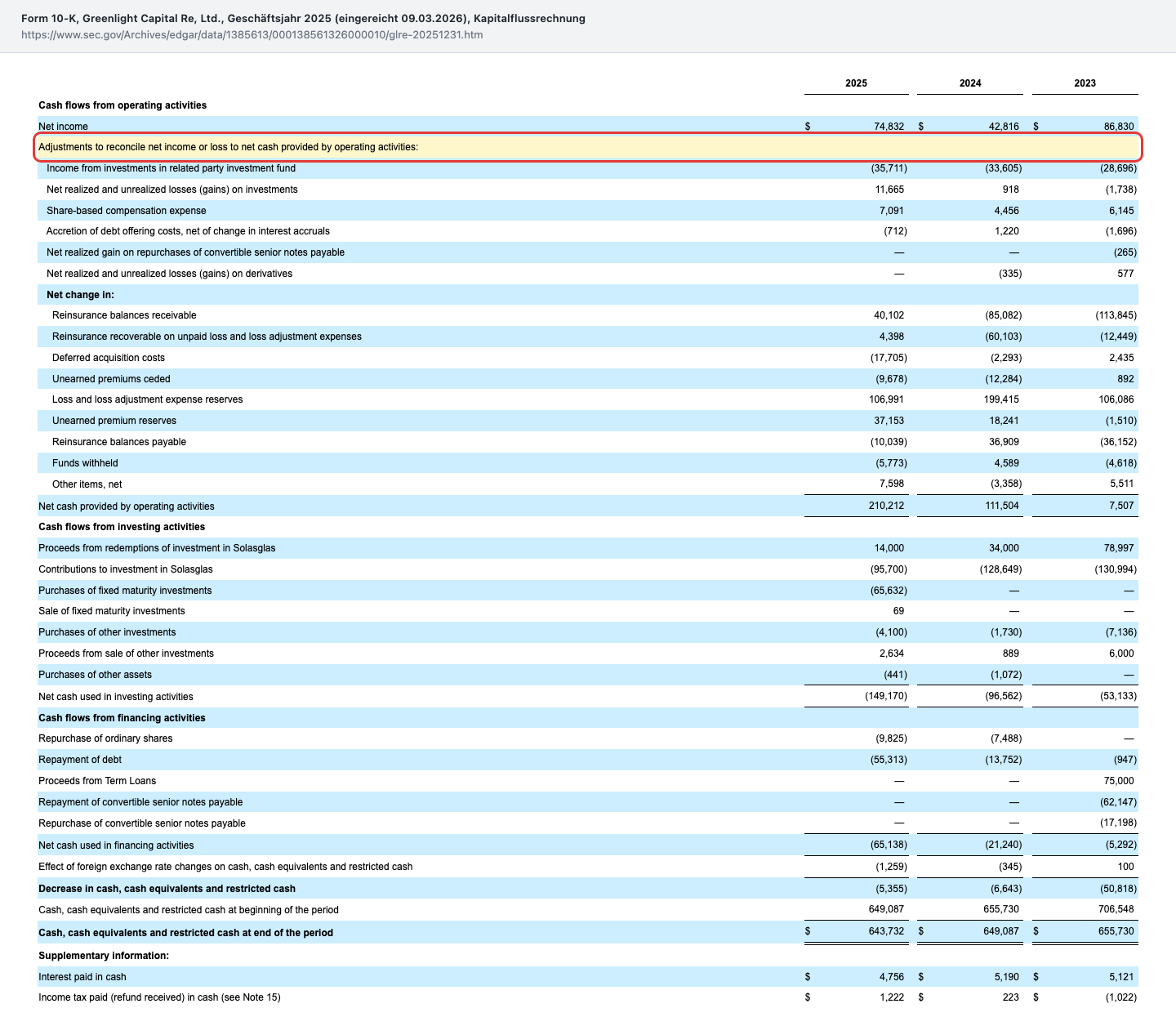
Loss reserves: up $107.0 million. Unearned premiums: up $37.2 million. Together $144.1 million — more than two thirds of the entire cash inflow. Both are money that sits in the house without belonging to it: loss reserves are amounts for reported or expected claims that will be paid out over the coming years. Unearned premiums are premiums for coverage periods that have not even begun.
An image for it: a reinsurer is like a notary with a client account. The balance grows when business is brisk — and it is still not the notary money. At a growing insurer the cash inflow rises automatically, because premiums arrive before claims. A low price-to-free-cash-flow ratio at an insurer is therefore not a sign of cheapness but of growth. The reverse holds too: if an insurer shrinks, the metric turns negative without the company having got any worse. The same pattern — a cash flow metric that claims something entirely different depending on definition — is what we took apart at DXC Technology from the same ranking.
The honest alternative: book value per share
So what do you measure a reinsurer with instead? The company answers that itself. The annual report states that it prioritizes long-term growth in fully diluted book value per share as its primary financial metric. That is not marketing but industry standard and sensible: book value is what belongs to shareholders after all reserves and liabilities.
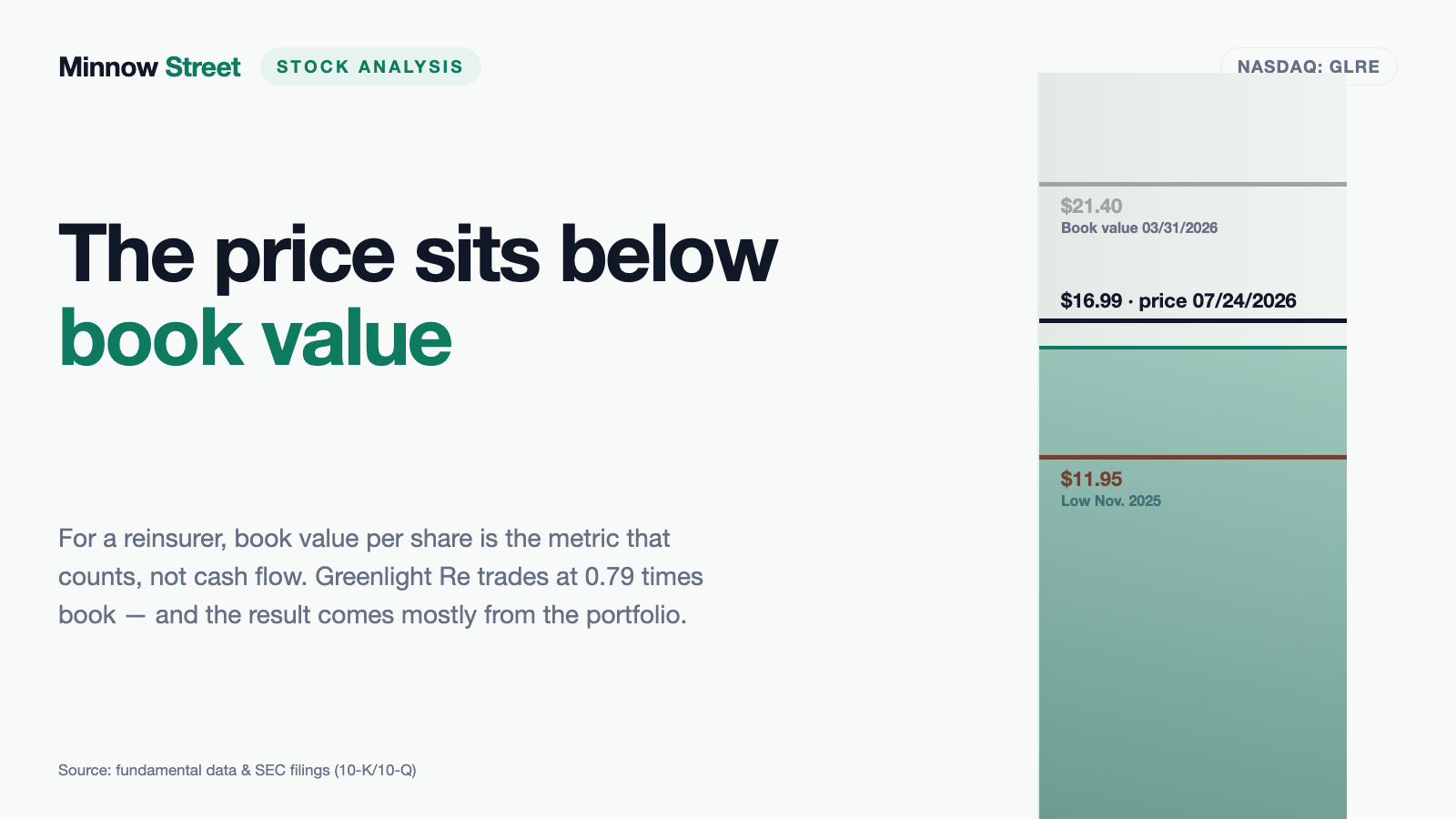
The figures, each with its date: fully diluted book value per share stood at $20.43 as of December 31, 2025, after $17.95 a year earlier — up 13.8 percent. As of March 31, 2026 it rose to $21.40, another 4.7 percent. Over five years it grew by an average of 8.8 percent a year. Shareholders equity at year-end was $708.0 million, after $635.9 million.
Against the closing price of $16.99 on July 24, 2026 that gives a price-to-book ratio of 0.79. The market pays 79 cents for a dollar of book equity. That is the metric this stock should be measured by — not 2.19.
Two more figures belong alongside it, because they describe whether the capital earns its keep: the combined ratio (more on that shortly) and the return on equity. The latter was roughly 11.1 percent in 2025 — $74.8 million of profit on average equity of about $672 million.
A word on the Altman insolvency early-warning score, which our data set puts at 4.13: that formula was not built for a reinsurer. It combines working capital, retained earnings and operating result with total assets — quantities that at an insurer either do not exist or mean something else. An insurer has no working capital in the industrial sense; its largest balance sheet item is technical reserves, which are high by construction. We therefore do not cite the value as evidence. What is meaningful instead is equity ($708.0 million), investments, reserve development, the combined ratio and interest coverage: pre-tax income of $78.3 million covered interest expense of $4.4 million roughly 19 times in 2025. On top of that comes a hard external verdict: A.M. Best raised its financial strength rating to A (Excellent) — at a reinsurer that is the ticket to doing business at all.
The two engines — and which one really pulls
Now to the real question. Greenlight Re earns in two places, and the reports disclose both separately.
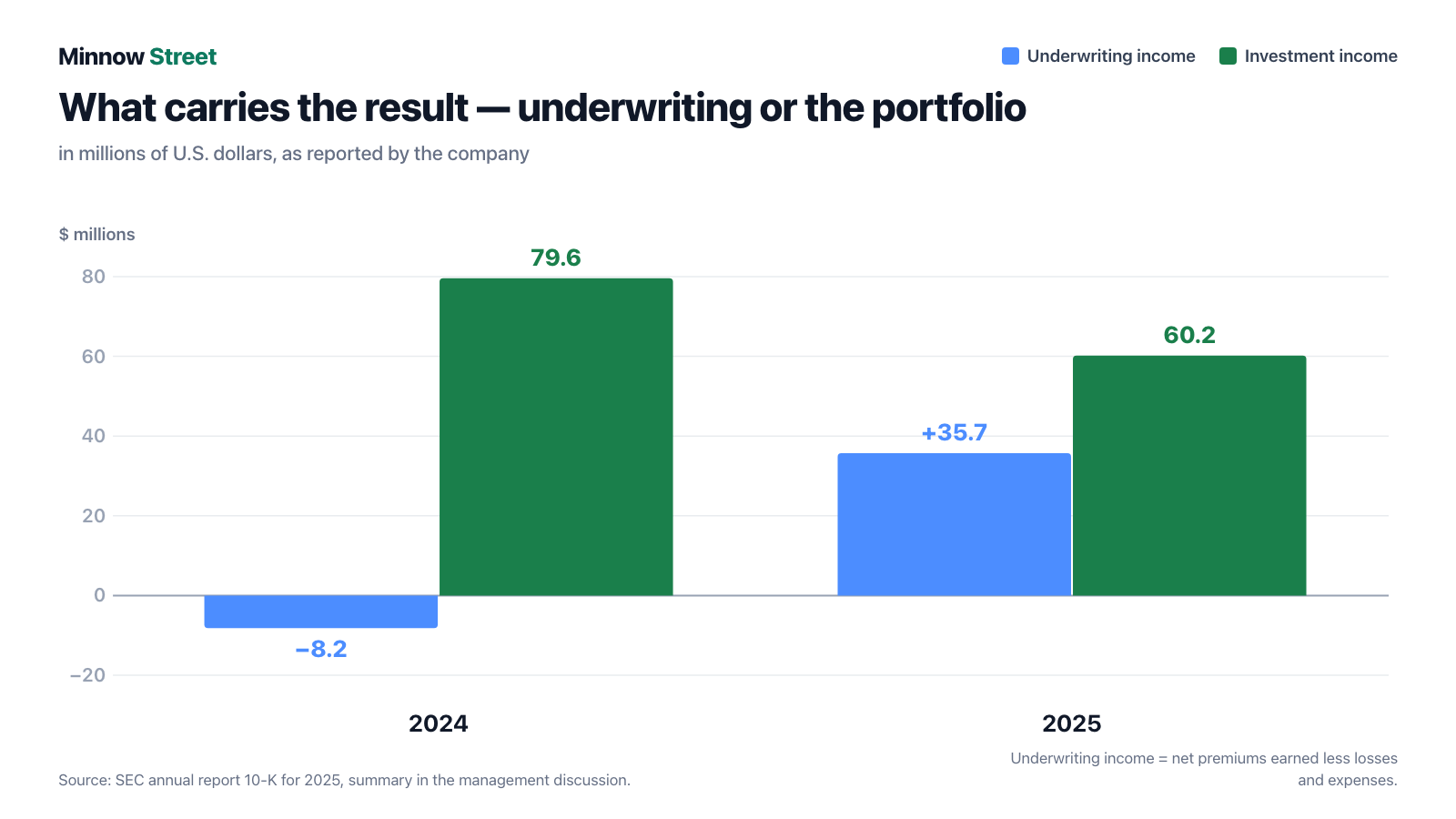
Engine one, underwriting: in 2025 it produced income of $35.7 million, after a loss of $8.2 million in 2024. The reason sits in the combined ratio — the share of claims and costs in earned premiums. It fell from 101.4 to 94.6 percent. Above 100 percent means the underwriting business itself loses money and has to be carried by the investment result. Below 100 means it earns. In the first quarter of 2026 it stood at 96.0 percent, after 104.6 percent in the prior-year quarter. That is a real, documented improvement.
Engine two, the portfolio: total investment income came to $60.2 million in 2025 — a decline of 24.4 percent from $79.6 million in 2024. It consists of the share in the Solasglas fund ($35.7 million) and other investment income ($24.5 million).
That answers the question this stock demands: in both years the portfolio carried the result. In 2024 it was the only positive contributor. In 2025, at $60.2 million against $35.7 million, it still delivered considerably more than underwriting. Anyone buying this stock is buying, to a substantial degree, a bet on a securities portfolio — and only to a smaller degree on a reinsurer.
Uncomfortable truth No. 2: running the portfolio costs eight figures — and goes to the chairman
Whoever invests other people money gets paid. The terms are disclosed in the annual report, and they are hedge fund terms:
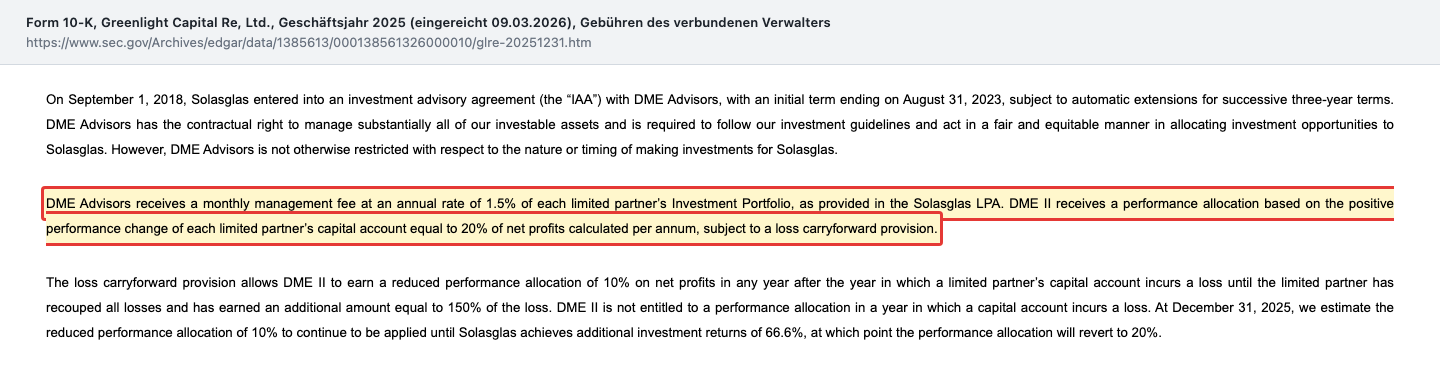
The report puts it this way:
"DME Advisors receives a monthly management fee at an annual rate of 1.5% of each limited partner’s Investment Portfolio, as provided in the Solasglas LPA. DME II receives a performance allocation based on the positive performance change of each limited partner’s capital account equal to 20% of net profits calculated per annum, subject to a loss carryforward provision."
— Greenlight Capital Re, Ltd., SEC annual report 10-K for 2025, disclosures on the related party investment fund
In dollars it looks like this:
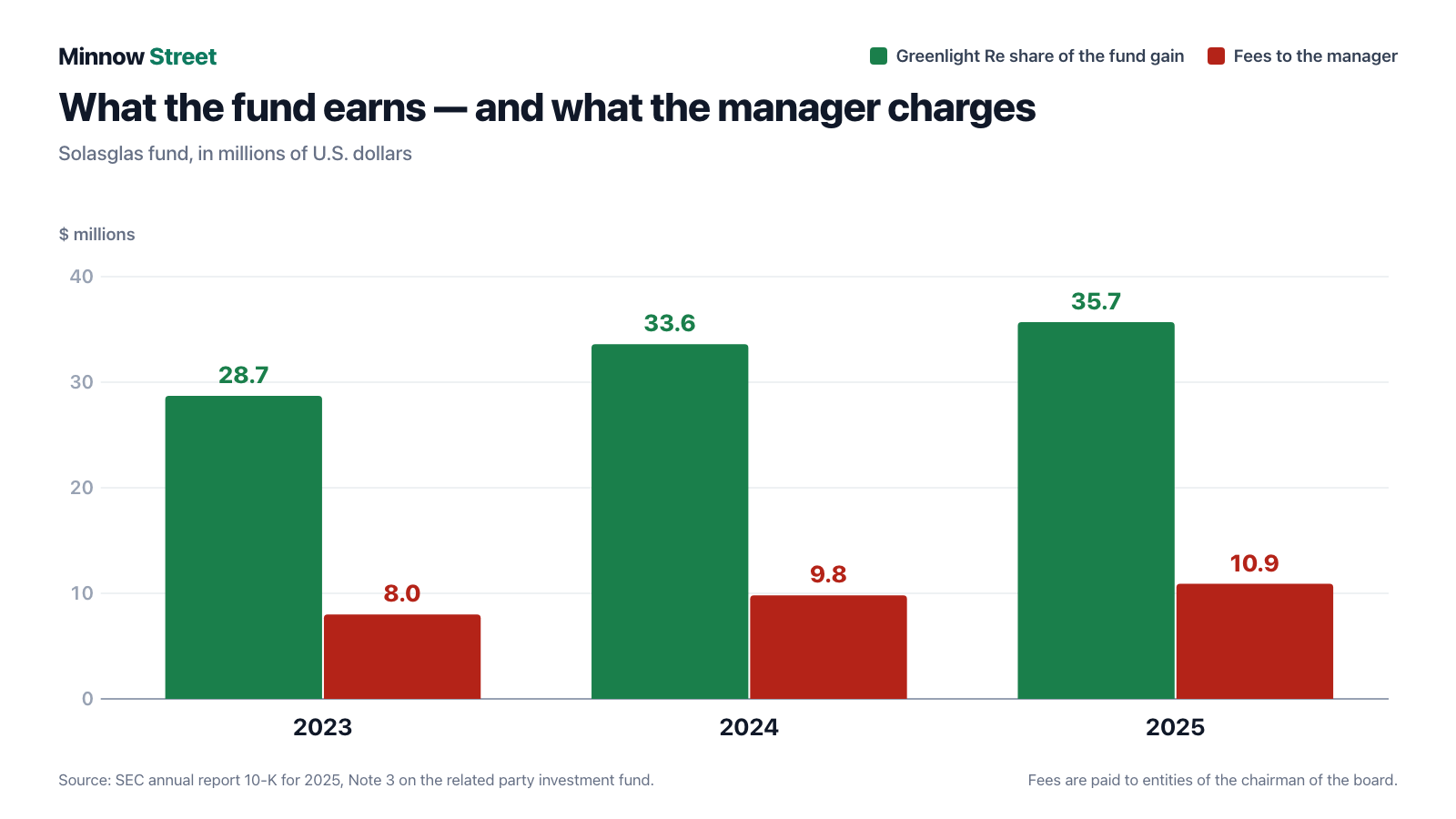
Two clarifications, because fairness matters here. First, the fees are charged at the fund level, and investors other than Greenlight Re participate in that fund; they therefore do not fall on GLRE shareholders alone. Second, the $35.7 million Greenlight Re books as its share of the fund gain is already a figure after those fees. Even so, the order of magnitude is striking: $10.9 million of fees against $74.8 million of group profit — just under 15 percent. And the recipient is not an arm-length address but an entity of the man who chairs the board.
There is at least a discount: because of a loss carryforward provision the performance allocation currently stands at 10 rather than 20 percent. It only reverts once the fund has earned a further 66.6 percent of investment returns. That number is also the reminder of how deep the portfolio once sat under water.
Uncomfortable truth No. 3: buybacks that land a third with the chairman
Since the 2023 annual meeting Greenlight Re has only one class of shares — the former split into Class A and Class B was abolished. Each share carries one vote. In principle no holder may control more than 9.9 percent of the voting power; for David Einhorn the board granted an exception.
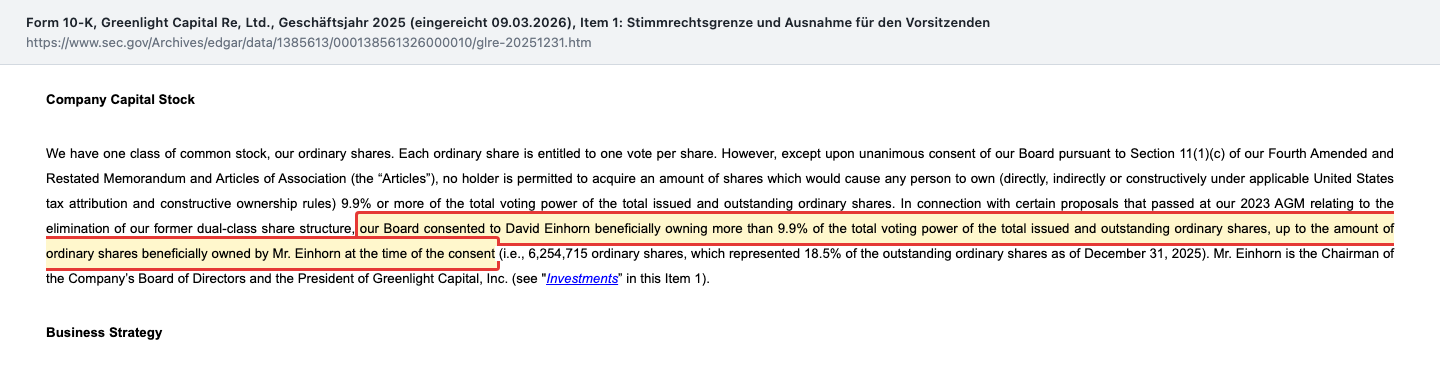
Here it gets interesting. Buybacks shrink the share count — GLRE spent $9.8 million on them in 2025, and the share count fell from 34.83 to 33.90 million. Anyone who does not sell sees their percentage rise automatically. For Einhorn that is a problem: the company considers a further increase in his stake disadvantageous for tax reasons. The solution appears in a filing dated June 1, 2026:

Concretely, Greenlight Re buys from an Einhorn family trust a number of shares equal to 33 percent of the volume acquired under the running buyback plan — at the same average price, with closing scheduled for August 3, 2026. You can view that soberly: it keeps the ownership percentage stable and avoids a tax problem that could hit all shareholders. You can also note what it means in practice: of every dollar of buyback, a third goes not to the market but to the chairman. To that extent the remaining shareholders lose the effect a buyback would otherwise have.
Valuation — orders of magnitude, not day prices
Let us pull it together, each figure with its date. The quarterly report cover page reports exactly 33,166,448 shares outstanding as of April 30, 2026. Multiplied by the closing price of $16.99 on July 24, 2026 that gives a market value of roughly $564 million. The value carried in the data set sits about 8 percent lower at $0.518 billion; we use our own figure from the cover page count and the price.
- Price-to-book 0.79 — against fully diluted book value of $21.40 per share as of March 31, 2026. That is the guiding metric.
- Price-to-earnings roughly 8 — against diluted earnings of $2.17 per share for 2025.
- Return on equity 11.1 percent (2025) — at a combined ratio of 94.6 percent.
- Price-to-free-cash-flow 2.19 — the metric that led us here and which, for the reasons given, we do not use.
A discount to book value is not unusual at reinsurers; it expresses that the market sees future returns on capital below what investors demand — or that it does not entirely trust the stated book value. At Greenlight Re one extra factor applies: a substantial part of the assets sits in a fund on hedge fund terms whose performance can swing and whose manager chairs the board. Anyone who considers the discount excessive is betting on two things at once: that the combined ratio stays below 100 percent, and that the portfolio delivers.
On price history: from the highest closing price in the series — $35.00 on September 4, 2014 — the decline is 51.5 percent. The 52-week high was $19.00 (April 24, 2026), the low $11.95 (November 4, 2025). Our data set puts the distance from the high at 52.8 percent; we use the self-calculated figure. How badly a metric can mislead when the balance sheet beside it speaks a different language is also on show at TTEC Holdings.
Opportunities and risks at a glance
What speaks for Greenlight Re:
- Underwriting earns again: combined ratio 94.6 percent (2025) after 101.4 percent, and 96.0 after 104.6 percent in the first quarter of 2026.
- Book value grows reliably: up 13.8 percent during 2025, another 4.7 percent in the first quarter of 2026, averaging 8.8 percent a year over five years.
- Valued below book: 0.79 times price-to-book at a return on equity of 11.1 percent.
- Solid balance sheet: $708.0 million of equity, only $5.0 million of debt outstanding after the loans were fully repaid in 2025, interest coverage around 19 times.
- Better credit standing: upgrade by A.M. Best to A (Excellent) — which the company itself cites as the reason for better underwriting opportunities at the January 1, 2026 renewals.
What speaks against it:
- The portfolio carries the result: $60.2 million against $35.7 million (2025), $79.6 million against minus $8.2 million (2024) — and it swings more than underwriting.
- Conflict of interest: the chairman of the board also heads the firm that manages the portfolio and received $10.9 million in total for 2025.
- A third of buybacks goes to the chairman: agreement of June 1, 2026, closing scheduled for August 3, 2026.
- Reserve strengthening: losses from re-estimating prior-year claims of $11.4 million (2025) and $21.8 million (2024).
- Concentration in investments: the group is contractually obliged to place substantially all investable assets in a single fund.
- Competition: the company itself names increasing competition in the open market as a trend for 2026.
A human conclusion
Back to the thermometer in the aquarium. The 2.19 from our ranking was not a scanner error — it is the correct application of a formula to a company the formula was not built for. The scanner sorts the universe by a metric; deciding whether the metric means anything in a given case remains work for humans.
What is left once you apply the right measure? A reinsurer that, after weak years, is making money from insurance again, whose book value has grown for years and which trades below book. And beside it a securities portfolio that contributes more to profit than the actual business, that is managed by a related party on hedge fund terms, and whose manager sits at the head of the table. None of it is hidden — it is all in the filings. You just have to look in the right place.
Perhaps that is the takeaway: before you judge a metric, check whether it was meant for this business at all. What you make of that is your decision. And that is exactly as it should be.
Sources
- Quarterly report 10-Q for March 31, 2026 (filed May 5, 2026, most recent periodic report) — cover page share count, income statement, combined ratio, book value per share
- Annual report 10-K for 2025 (filed March 9, 2026) — Item 1 business and share class, management discussion with combined ratio and book value, statement of cash flows, disclosures on the related party fund Solasglas and its fees
- Current report 8-K of June 1, 2026 — Item 1.01, repurchase agreement with a family trust of the chairman of the board
- Schedule 13D/A of June 1, 2026 — 6,254,715 shares, or 18.9 percent, held by David Einhorn and entities attributed to him
- SEC master record for CIK 0001385613 (listing venue Nasdaq Global Select Market, no former names, 10-K/10-Q throughout with no 20-F or 6-K at all; checked July 27, 2026 for deregistration, delisting and tender offers — no hits)
- Screening and valuation data: in-house stock scanner and fundamental data — measured on July 27, 2026: P/FCF Ranking, U.S. selection, 47th of 545 hits at a value of 2.19, identical on both editions; 25 rows are displayed
- Own price series (closing price $16.99 on July 24, 2026; highest closing price $35.00 on September 4, 2014; 52-week high $19.00 on April 24, 2026, 52-week low $11.95 on November 4, 2025)
This article is journalistic analysis and explicitly not investment advice, not a recommendation to buy or sell, and not a solicitation to trade in securities. Stocks can suffer a total loss at any time. All figures rest on publicly available documents retrieved on the dates stated and may have changed since. The author holds no position in Greenlight Capital Re, Ltd. at the time of publication.
Our Bottom Line at a Glance
- Underwriting positive
- The combined ratio fell to 94.6 percent in 2025 from 101.4 percent, and to 96.0 from 104.6 percent in the first quarter of 2026. A loss of $8.2 million turned into income of $35.7 million. Gross premiums rose 10.7 percent to $773.3 million, and A.M. Best raised its rating to A (Excellent).
- Dependence on the portfolio negative
- Investment income contributed $60.2 million to the 2025 result against $35.7 million from underwriting; in 2024, at $79.6 million, it was the only positive contribution. The group is contractually obliged to place substantially all of its investable assets in a single fund.
- Conflict of interest and fees negative
- The fund is managed by an entity of the chairman of the board on hedge fund terms: a 1.5 percent management fee and a 20 percent performance allocation, currently reduced to 10 percent. That cost $10.9 million in 2025, after $9.8 million and $8.0 million in the prior years. On top of that, since 01.06.2026 the company buys a third of every buyback directly from a family trust of the chairman.
- Balance sheet and capital positive
- Equity rose $72.1 million during 2025 to $708.0 million. The loans were fully repaid; only $5.0 million on a credit facility was outstanding at 31.12.2025, and interest coverage stood at roughly 19 times. The Altman insolvency early-warning score is deliberately not used here — the formula was not built for insurers.
- Reserves neutral
- Re-estimating prior-year claims cost $11.4 million in 2025 and $21.8 million in 2024 — considerable against underwriting income of $35.7 million in 2025. In the first quarter of 2026 the line turned positive for the first time, at a gain of $1.6 million.
- Hook and data quality neutral
- 47th of 545 U.S. hits in the in-house P/FCF ranking at 2.19, measured identically on both editions on 27.07.2026 — outside the 25 rows displayed and visible only through the screener or the company page. The metric itself is not used for valuation in this article: at an insurer it measures premiums collected that are future obligations. The market value carried in the data set, $0.518 billion, sits roughly 8 percent below our own calculation from the cover page share count and the price ($564 million).
Greenlight Capital Re is two businesses in one share: a reinsurer that earns again after weak years — combined ratio 94.6 percent after 101.4 — and a securities portfolio that contributed $60.2 million to the 2025 result against $35.7 million from underwriting. That portfolio is managed by an entity of the chairman of the board, which received $10.9 million for it. The metric that put the name on our list measures nothing distributable at an insurer; the fitting measure is book value per share, and there the stock trades at 0.79 times. Not investment advice.
What Our Rating Means
Open questions
The business works in principle, but one material question is open. As long as it stays open, our findings do not carry a quality verdict.
Yellow, because substance and structure contradict each other. Green is ruled out by the lack of standalone operating strength: in both of the last two years the result was carried mainly by the securities portfolio — $60.2 million against $35.7 million in 2025, $79.6 million against minus $8.2 million in 2024 — and that portfolio is managed by an entity of the chairman of the board on hedge fund terms for most recently $10.9 million a year. Add reserve strengthening on prior-year claims of $11.4 million and $21.8 million, plus buybacks of which a third has gone directly to a family trust of the chairman since 01.06.2026. Red is ruled out by the absence of any substance finding: equity rose $72.1 million to $708.0 million during 2025, book value per share grew 13.8 percent, the loans are repaid, the combined ratio sits below 100 percent, and A.M. Best raised its rating to A (Excellent). This is a judgment on the company, not on the share price. The decision is yours.
A journalistic assessment by our editorial team at the time of the deep dive, based on public sources — not investment advice and not a solicitation to buy or sell. Your personal circumstances (investment goals, risk capacity, taxes) cannot be taken into account. What our levels mean, how verdicts are formed, and what conflicts of interest exist →
Worth Noting
- Hook and source: 47th of 545 U.S. hits in the in-house P/FCF ranking at a value of 2.19, measured live on July 27, 2026 and identical on both editions; the German list covering all markets counted 836 hits the same day. Only the 25 strongest rows are displayed — Greenlight Re is not among them and has to be found through the screener or the company page. The lists are recalculated daily.
- Why the hook metric is not used for valuation in the article: at a reinsurer, operating cash flow consists largely of premiums for claims not yet paid. Of $210.2 million in 2025, $107.0 million came from the increase in loss reserves and $37.2 million from higher unearned premiums. Used instead is the price-to-book ratio, which the company itself names as its guiding measure.
- Why we calculated the market value ourselves: the value carried in the data set, $0.518 billion, sits roughly 8 percent below the calculation from the share count on the 10-Q cover page (33,166,448 as of 30.04.2026) and the closing price of $16.99 on 24.07.2026, which gives $564 million.
- On the Altman score: our data set carries a value of 4.13 for GLRE. It is deliberately not used as evidence in the article, because the formula was developed for industrial and trading companies and at insurers draws on quantities that are not comparable there. The argument runs instead on equity, investments, reserve development, combined ratio and interest coverage.
- On the distance from the high: our data set shows 52.8 percent. Calculated ourselves from the price series we get 51.5 percent against the highest closing price of $35.00 on 04.09.2014. The article uses the self-calculated figure.
- Status of the mandatory checks on July 27, 2026: the most recent periodic report is the quarterly report for March 31, 2026 (filed 05.05.2026). The filing record contains no tender offer, no merger, no going-private transaction, no Form 15 and no Form 25. Filed after the quarterly report were the current report 8-K of 01.06.2026 (Item 1.01), a Schedule 13D/A of the same day, and insider and sale notices; all have been reviewed.
- Risk of confusion: Greenlight Capital Re, Ltd. (GLRE, Nasdaq) is the listed reinsurer. Greenlight Capital, Inc. and DME Advisors, LP are separate entities from the orbit of David Einhorn; they manage the portfolio but are not themselves listed.
Frequently Asked Questions
Because an insurer cash inflow is largely other people money. Of $210.2 million of operating cash flow in 2025, $107.0 million came from the increase in loss reserves and $37.2 million from higher unearned premiums. Those are amounts for claims that will only be paid in coming years and for coverage that has not started. When an insurer grows, that number rises automatically.
Book value per share — the company itself calls it its primary measure. Fully diluted it stood at $21.40 as of March 31, 2026; against the closing price of $16.99 on July 24, 2026 that is a price-to-book ratio of 0.79. Alongside it belong the combined ratio (94.6 percent in 2025) and the return on equity (11.1 percent).
No. Although the company is registered in the Cayman Islands and based there, it reports as a domestic filer on annual reports (10-K) and quarterly reports (10-Q). Nowhere in its record with the U.S. securities regulator is there a Form 20-F or 6-K. For readers that means the figures arrive quarterly and under U.S. accounting standards, so they compare directly with other U.S. names.
Solasglas Investments, LP is the fund into which Greenlight Re is contractually obliged to place substantially all of its investable assets. It is managed by DME Advisors, an entity of David Einhorn — the chairman of the board of Greenlight Re. The terms are typical of hedge funds: a 1.5 percent annual management fee and a 20 percent performance allocation, currently reduced to 10 percent because of a loss carryforward provision.
In the last two years mostly from investing. In 2025 investment income of $60.2 million faced underwriting income of $35.7 million. In 2024 investment income of $79.6 million was the only positive contribution, because underwriting lost $8.2 million. Underwriting did improve markedly in 2025.
According to the Schedule 13D/A of June 1, 2026 he holds 6,254,715 shares, or 18.9 percent; as of December 31, 2025 it was 18.5 percent. Since the 2023 annual meeting there is only one class of shares with one vote each; the former split into Class A and Class B was abolished. For Einhorn the board granted an exception from the general 9.9 percent limit.
Because buybacks in the market reduce the share count and thereby raise the percentage held by everyone who does not sell. The company considers a further increase in David Einhorn stake disadvantageous for tax reasons. Since June 1, 2026 it therefore also buys shares from a family trust — equal to 33 percent of the volume acquired under the running program, at the same average price.
No. The formula combines working capital, retained earnings and operating result with total assets — quantities that at an insurer are either missing or mean something else. The largest balance sheet item is technical reserves, which are high by construction. Meaningful instead are equity ($708.0 million), the combined ratio, reserve development, interest coverage (around 19 times) and the A.M. Best rating, raised to A (Excellent) in 2025.
Found an error?
Did you spot a factual error, an outdated number, or a typo in this deep dive? Let us know briefly — your report goes straight to the editorial team.