GoDaddy: $1.6 Billion Into Its Own Shares — Bought at Prices That No Longer Exist
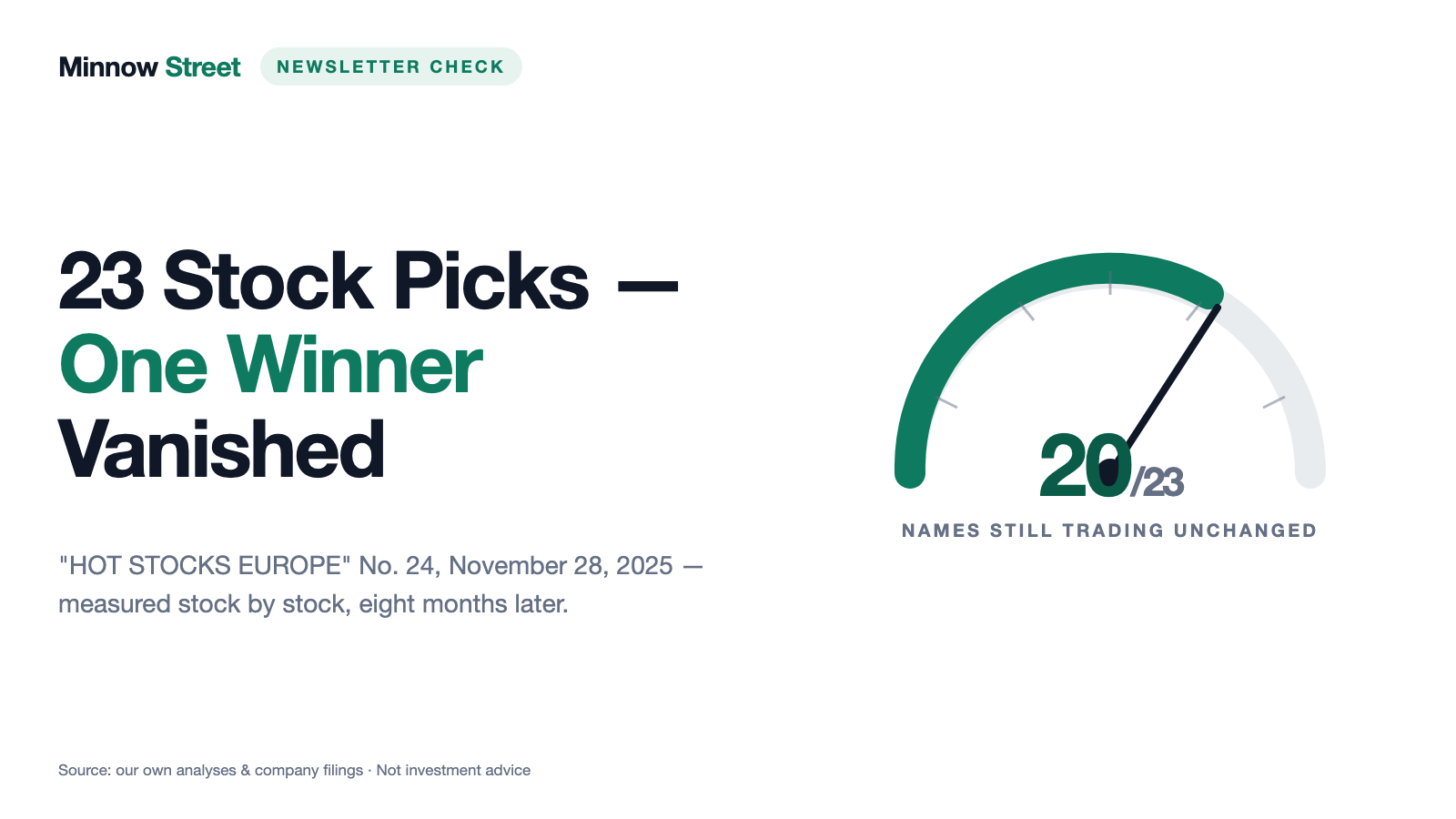
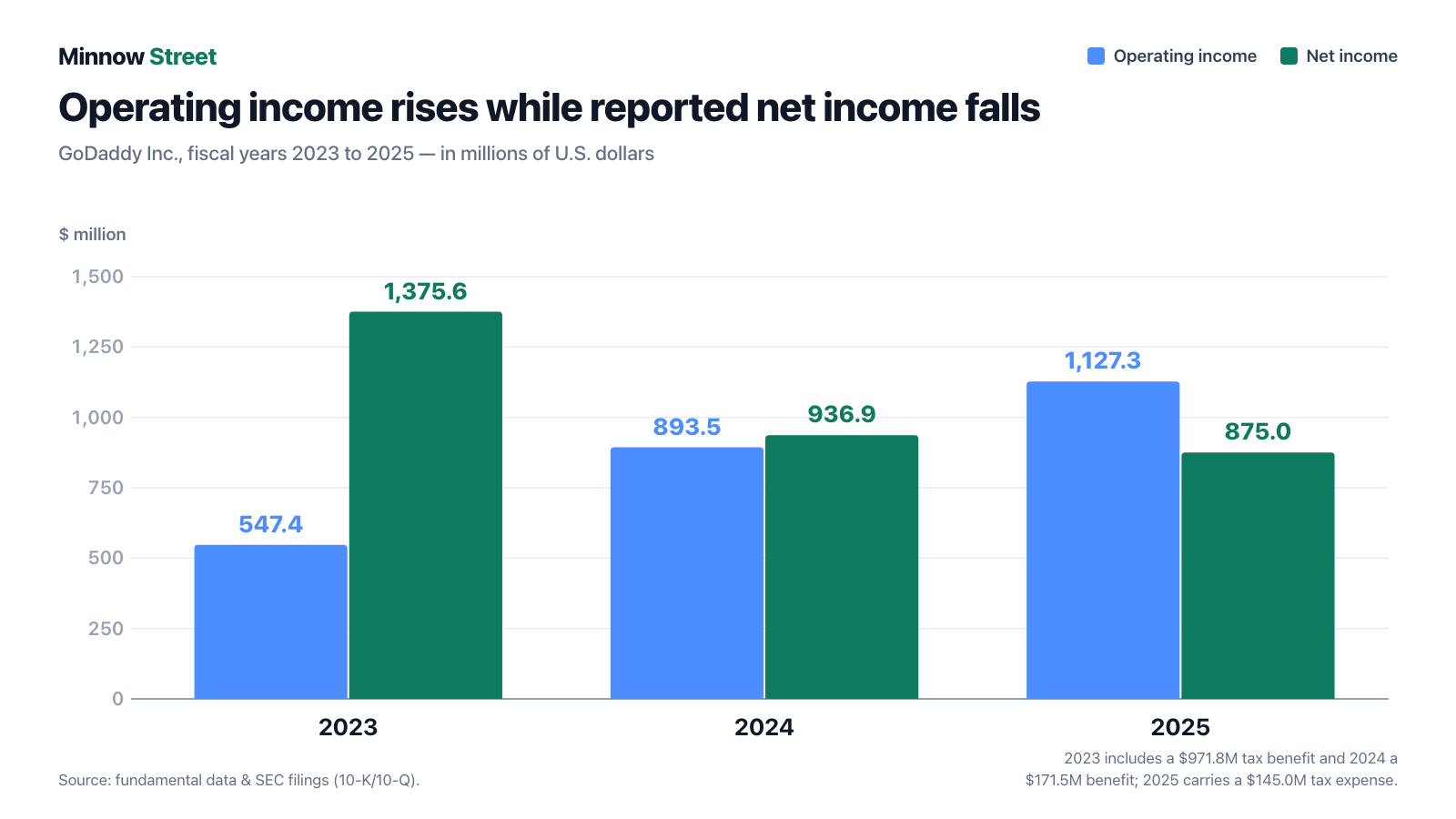
GoDaddy sells domains, websites and payments to 20.4 million customers, and the business is measurably better than it was three years ago: the operating margin rose from 12.9 to 22.8 percent and free cash flow from $1,005.6 million to $1,575.5 million. Reported profit still fell — from $1,375.6 million to $875.0 million — because 2023 carried a $971.8 million tax benefit and 2025 a $145.0 million tax expense. And almost the entire surplus went back into the company's own shares: $1,601.9 million in 2025, part of it at a weighted average price of $176.02. Not a recommendation — just the question of who that money actually served.
 Thomas Mücke
Founder & Publisher
Thomas Mücke
Founder & Publisher
Chart
Interactive price chart (TradingView).
Note: pure fact-based analysis, not investment advice and not a solicitation to buy or sell. All figures without guarantee.
There is one sentence investors almost never question: "The company is buying back its own stock — that is good for us." The reflex runs deep, and it has a blind spot. A buyback is a purchase, and in every purchase the price decides whether it was worth it. Call it buyback romance: we celebrate the action and forget the arithmetic. GoDaddy Inc. (NYSE: GDDY) is an unusually instructive case, because both things are true at once — a business that has demonstrably improved, and a use of capital that looks different at today's price than it did a year ago. So let us make a deal: we read the annual report (10-K) for 2025, the quarterly report (10-Q) as of March 31, 2026, and the one current report (8-K) filed since — and do the math ourselves.
The central tension of this analysis runs through every chapter: the business got considerably better, reported profit got worse — and practically the entire surplus went into the company's own shares, at prices nobody pays today.
Contents
- What GoDaddy actually does
- How the stock landed on our desk
- The numbers over the years — given their due
- What the filings say — five uncomfortable truths
- What happened after the last quarterly report
- Valuation: what you get for your money
- Opportunities and risks at a glance
- A human conclusion
- Sources
What GoDaddy actually does — the registry office of the internet that also sells the shop fittings
Founded in 1997 and listed on the New York Stock Exchange since April 1, 2015, GoDaddy is the world's largest registrar of internet addresses. Buying a domain means renting a name — annually, predictably, with a high renewal rate. From that anchor, GoDaddy sells everything that comes next: hosting, website builders, business email, online stores, appointment booking and payments. The company calls it the "Entrepreneur's Wheel" and serves it with 20.4 million customers across more than 200 markets (as of December 31, 2025), 9.8 million of them outside the United States.
The business splits into two segments. Core Platform — domains, hosting, security — produced $3,062.1 million in 2025 (61.8 percent of revenue) and grows slowly, up 4.9 percent. Applications and Commerce — builders, email, payments, marketing tools — contributed $1,889.0 million (38.2 percent) and grew 14.3 percent, roughly three times as fast. Translated: the domain is the doorman; the money increasingly comes from the shop behind it.
Why the model is so durable sits in one paragraph of the annual report that is worth reading twice.
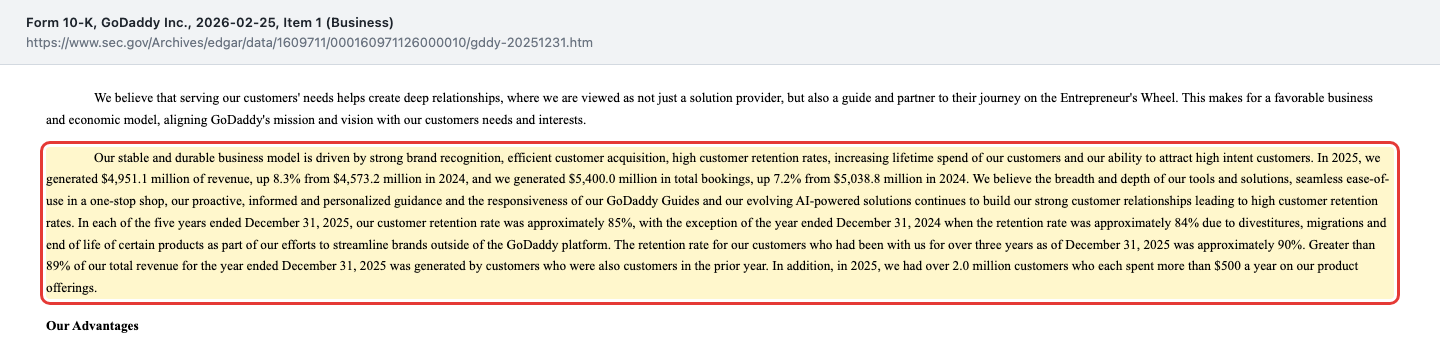
Three numbers in there matter. First, bookings of $5,400.0 million — what customers committed to in 2025, $449 million above reported revenue, because GoDaddy collects up front and recognizes revenue over the subscription term. Second, customer retention of roughly 85 percent (about 90 percent for customers of more than three years). Third: more than 89 percent of 2025 revenue came from customers who were already customers the prior year. A business that repeats nine tenths of itself every year is a merchant's dream — and the reason customer prepayments, at $3,450.6 million as of March 31, 2026, are the largest liability on the balance sheet.
Since 2024 a new product layer sits on top, and GoDaddy puts it front and center: Airo, a bundle of AI-powered tools that helps find the domain name, generate a logo and build the website — including paid tiers.

"In 2025, we continued to harness the power of AI, with a focus on enabling agentic AI capabilities across Airo and our existing products. Our expanded AI solutions include conversational chat interfaces that utilize natural language to help with website creation and customization; Airo Plus Logo, which supports automated brand identity creation; Airo Plus Marketing, to assist with AI-enabled marketing content and campaign management; and Airo Plus Site Optimizer, an AI-driven tool to obtain website performance insights and recommendations."
— GoDaddy Inc., SEC annual report 10-K for 2025, Item 1 (Business)
One bet reaches further still. GoDaddy has launched the Agent Name Service (ANS), an open architecture meant to make AI agents identifiable to one another online. The logic is a straight extension of the existing business: if software agents are going to transact with each other, they too will need names, identity and trust — precisely what GoDaddy has sold to humans for almost thirty years.
How the stock landed on our desk
GoDaddy reached our research list through our in-house stock scanner Turnaround Candidates. The scanner looks for beaten-down stocks whose business is measurably turning: at least 50 percent below the all-time high, survival secured, and at least 6 of 8 points on a checklist it calls the turnaround check. To repeat it: open the scanner, set the market filter to the United States, look at the turnaround check column.
Now the honest version. As of July 27, 2026 the scanner lists 60 hits in the U.S. selection — identical on both of our brands. GoDaddy scores 6 of 8. That is the entry threshold, and also the bottom of the field: 44 of the 60 hits score exactly 6 as well, 15 score 7, and a single name scores 8. Within that tie group the order is an arbitrary database sort that shifts with every overnight recalculation. Only the 25 strongest names are displayed — and GoDaddy is currently not among them. The stock came from the full hit list, not the front page.
What the scanner saw can be recomputed. The share price stood at $93.16 on July 24, 2026; the all-time high closing price was $214.35 on January 28, 2025 — some 56 percent below, so the 50 percent hurdle is cleared. Over the twelve months to July 24, 2026 the stock traded between $71.59 and $167.09. GoDaddy also appears in two of our valuation rankings, the price-to-cash-flow ranking and the price-to-free-cash-flow ranking — both recalculated daily.
On the survival criterion: the Altman Z-score in our data set stands at 2.28 (data as of July 24, 2026). We use the variant intended for non-manufacturers, whose thresholds are 1.1 (distress zone) and 2.6 (safe zone). GoDaddy therefore sits in the grey zone — which is not a contradiction of a 22.8 percent operating margin but the logical consequence of a balance sheet whose equity has been almost entirely consumed by buybacks. Why that is so is uncomfortable truth number four.
The numbers over the years — given their due
Start with what genuinely impresses. Revenue rose in each of the last three years: $4,254.1 million (2023), $4,573.2 million (2024, up 7.5 percent), $4,951.1 million (2025, up 8.3 percent). For a 30-year-old internet company that is a respectable pace. More impressive is what happened underneath: operating income climbed from $547.4 million to $1,127.3 million, lifting the operating margin from 12.9 to 22.8 percent. That was possible because costs stood still while revenue ran: technology and development rose over three years only from $839.6 million to $841.5 million, customer care fell from $304.5 million to $289.1 million, and restructuring costs dropped from $90.8 million to $11.1 million.
Cash flow followed emphatically: operating cash flow rose from $1,047.6 million (2023) through $1,287.7 million (2024) to $1,599.4 million (2025). Because GoDaddy needs almost no physical capital — capital expenditures were $23.9 million in 2025, less than half a percent of revenue — nearly all of it survives: $1,575.5 million of free cash flow. That is the real metric for this company. Remember: a business that collects in advance and builds almost nothing finances itself.
The first quarter of 2026 continued in the same direction: revenue $1,266.9 million (up 6.1 percent), operating income $310.5 million against $247.3 million a year earlier — a 24.5 percent margin — and operating cash flow of $471.5 million against $404.7 million.
Now the other side. Reported net income fell across exactly those three years: from $1,375.6 million (2023) through $936.9 million (2024) to $875.0 million (2025). In the first quarter of 2026 it even slipped slightly — $214.6 million against $219.5 million — while operating income rose 25.6 percent. Anyone reading only the profit line sees a company in reverse. What actually happened fills the next chapter.
What the filings say — five uncomfortable truths
Uncomfortable truth no. 1: The profit decline is a tax line, not a business problem
The answer sits in the reconciliation table of the annual report. The line "Provision (benefit) for income taxes" shows a $971.8 million benefit for 2023, a $171.5 million benefit for 2024 and, for the first time, a $145.0 million expense for 2025. A tax benefit does not arrive as a payment from the tax authorities; it appears when a company recognizes on its balance sheet that it may offset future profits against past losses. GoDaddy carried such loss carryforwards from a decade of red ink — and lifted them in 2023.
Strip the effect out and the picture reverses: pre-tax income was $403.8 million in 2023, $765.4 million in 2024 and $1,020.0 million in 2025. The company's own adjusted earnings measure (NEBITDA) rose from $1,134.5 million through $1,395.9 million to $1,585.9 million. The business has not deteriorated — it has simply started paying taxes. For you as an investor that means: the 2023 profit line was never the truth about this company, and the 2025 line is not either. The truth is in the cash flow.
Uncomfortable truth no. 2: All of free cash flow goes into the company's own shares
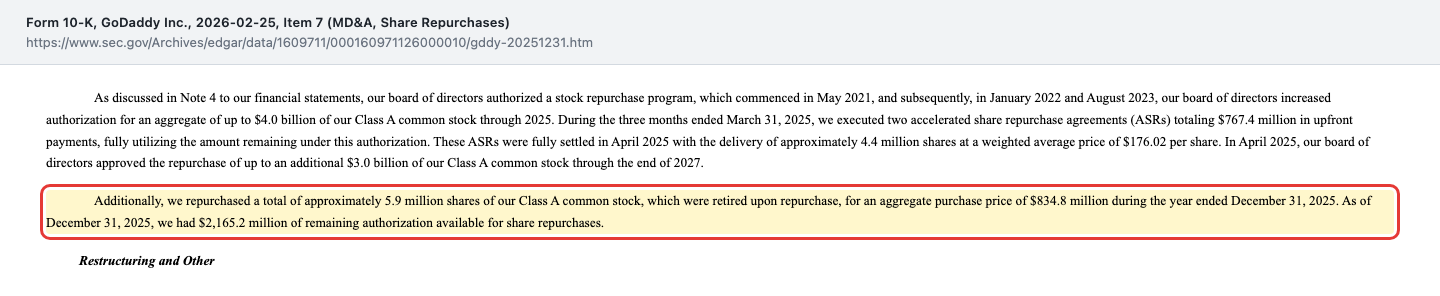
GoDaddy pays no dividend and does not intend to. What it does with its money shows up in the statement of cash flows: $1,270.2 million (2023), $676.5 million (2024) and $1,601.9 million (2025) went into repurchasing its own stock. In 2025 that was 102 percent of the $1,575.5 million of free cash flow.
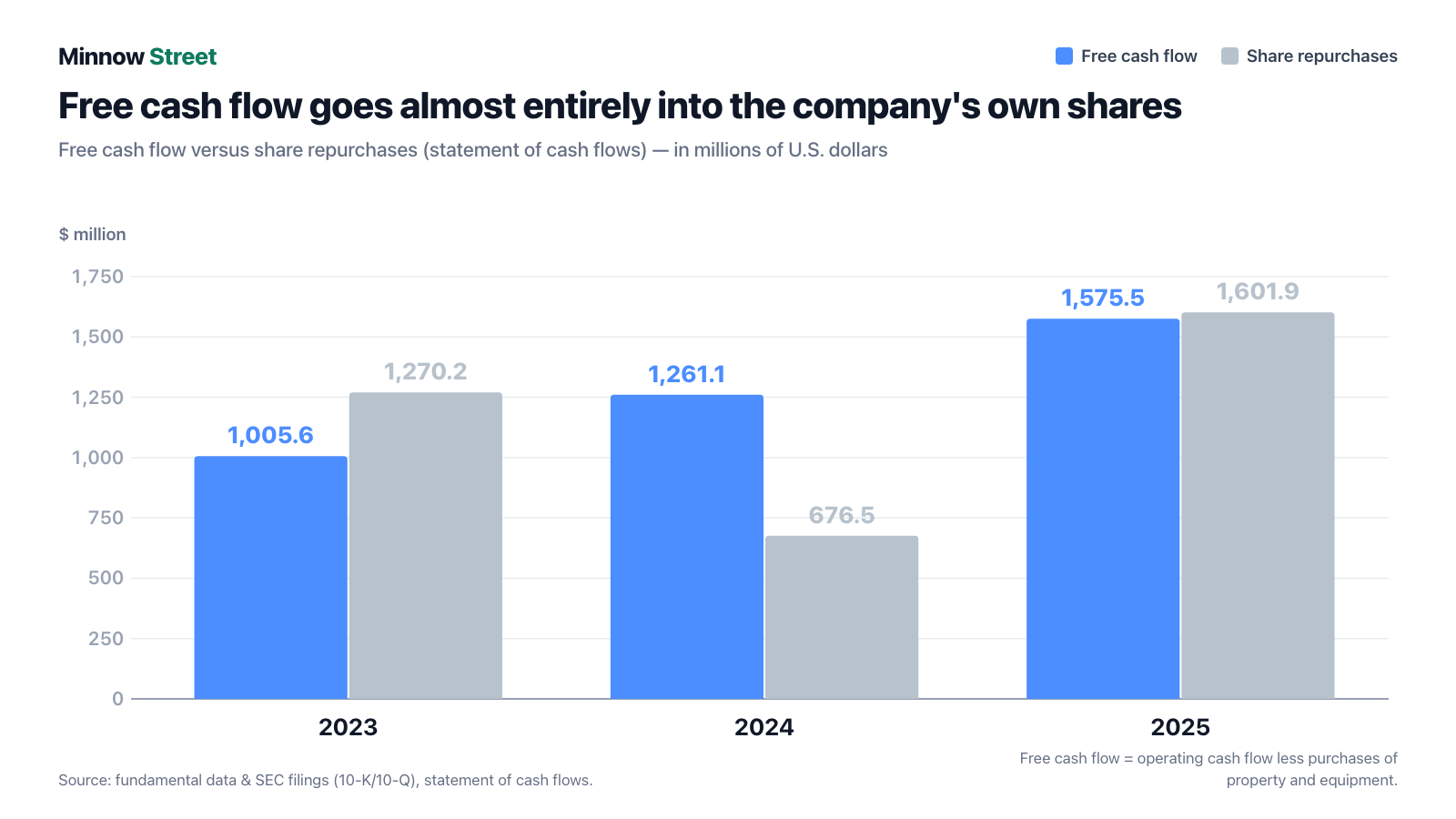
It works: shares outstanding fell from 141.208 million (December 31, 2024) through 134.737 million (December 31, 2025) to 132.658 million (March 31, 2026) — down 6.1 percent in fifteen months. That is exactly why earnings per share rose to $1.60 in the first quarter of 2026 (from $1.51) even though absolute profit fell: the cake got smaller, but the number of slices shrank faster.
Set against that is equity-based compensation: $296.3 million (2023), $299.9 million (2024) and $317.8 million (2025). Those shares are newly created. Roughly one fifth of the annual repurchase budget therefore only offsets what the company hands out with the other hand.
Uncomfortable truth no. 3: Some of those shares cost $176.02
This is where buyback romance gets expensive. The annual report names the price at which the accelerated repurchases from the first quarter of 2025 were settled.
"During the three months ended March 31, 2025, we executed two accelerated share repurchase agreements (ASRs) totaling $767.4 million in upfront payments, fully utilizing the amount remaining under this authorization. These ASRs were fully settled in April 2025 with the delivery of approximately 4.4 million shares at a weighted average price of $176.02 per share."
— GoDaddy Inc., SEC annual report 10-K for 2025, Item 7 (MD&A, Share Repurchases)
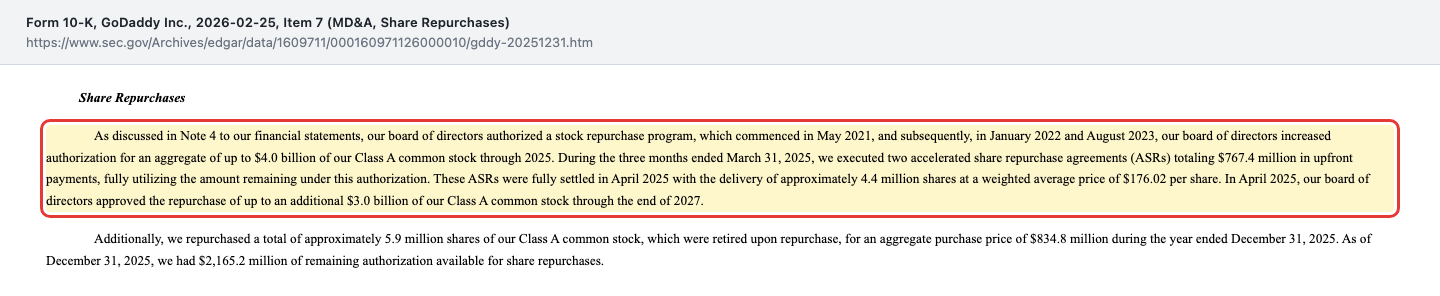
In the fourth quarter of 2025 GoDaddy bought a further 1.623 million shares at average prices between $127.32 and $134.45. On July 24, 2026 the stock traded at $93.16. It has to be said plainly: a substantial part of the $1.6 billion spent in 2025 went out at prices the market has not paid since. And the program continues — in April 2025 the board approved a further $3.0 billion through the end of 2027, of which $2,165.2 million was still open at December 31, 2025.
Uncomfortable truth no. 4: There is practically no equity left
Repurchases are charged against equity. After years of that practice, the balance sheet as of March 31, 2026 reads: total assets $8,154.4 million, shareholders' equity $237.3 million — an equity ratio of 2.9 percent. As recently as autumn 2023 equity was negative (September 30, 2023: minus $973.4 million); the 2023 tax benefit is what flipped it positive.
The second look sharpens it. Inside those $237.3 million sit $3,614.2 million of goodwill from old acquisitions and $970.6 million of other intangible assets. Strip both out — everything that is not a tangible asset — and what remains is tangible equity of roughly negative $4.35 billion. Against that stand $3,777.6 million of debt (2029 term loans of $1,444.2 million at 6.6 percent, 2031 term loans of $985.0 million at 6.2 percent, notes of $600.0 million at 5.5 percent due December 2027 and $800.0 million at 3.6 percent due March 2029) and $1,261.7 million of cash.
Is that dangerous? Not immediately: interest coverage is about 7.9 — operating income of the last four quarters covers interest expense nearly eight times — the $998.6 million revolving facility is undrawn, and every covenant was met at the balance sheet date. But the company has removed its own cushion. A business that collects in advance and barely invests can afford that as long as it runs. It simply has no second line of defense if one day it does not.
Uncomfortable truth no. 5: Two figures in the data set do not survive the arithmetic
We check the metrics our scanners run on against the annual accounts — and at GoDaddy two of them do not hold.
First, market capitalization. On July 27, 2026 our data set carried roughly $10.6 billion. That does not square with the share count in the quarterly report: 132.658 million shares as of March 31, 2026, multiplied by the $93.16 price of July 24, 2026, gives about $12.36 billion — some 14 percent more. Every valuation figure in this article is therefore computed by us, using the full share count from the filing.
Second, the Piotroski score, a nine-point checklist of balance sheet quality. On July 27, 2026 the data set says 8 of 9. Rebuilt from the 2025 accounts against 2024 we arrive at 5 of 9: return on assets edged down (10.9 from 11.4 percent), the long-term debt ratio rose (46.9 from 45.9 percent of total assets), the current ratio fell (0.62 from 0.72) and gross margin slipped marginally (63.6 from 63.9 percent). Here is the interesting part: three of those four deductions are consequences of the buybacks, not of the business — converting $1.6 billion of cash into own shares necessarily worsens the current ratio and the debt ratio. Five of nine at GoDaddy is therefore not a warning about earning power but a portrait of capital policy.
The third figure we checked held up: the Altman Z-score of 2.28 sits exactly where it belongs in the variant we use — between the distress zone at 1.1 and the safe zone from 2.6.
What happened after the last quarterly report
The most recent periodic report is the quarterly report (10-Q) as of March 31, 2026, filed May 1, 2026. Only one current report followed, and it fits this article's theme: at the annual meeting on June 3, 2026, shareholders elected nine directors and approved an amended and restated equity incentive plan — increasing the number of shares issuable under it by 3,116,000. Measured against 132.658 million shares outstanding, that is about 2.3 percent. In plain terms: while one hand buys slices of the cake back, the other cuts new slices for employees.
No other events — capital measures, acquisitions, executive changes, amendments to the credit agreements — were reported between May 1 and July 27, 2026.
Valuation: what you get for your money
All figures below are computed by us, using 132.658 million shares (quarterly report as of March 31, 2026) and a price of $93.16 (data as of July 24, 2026) — market capitalization therefore about $12.36 billion.
First, revenue. Over the last four quarters GoDaddy booked $5,023.7 million. That gives a price-to-sales ratio of roughly 2.5. For a subscription business with a 22.8 percent operating margin and 85 percent retention that is not an excess — software subscribers with similar metrics regularly fetch more.
Second, earnings. Over the last four quarters the company earned $870.1 million net, or $6.31 per diluted share. That puts the price-to-earnings ratio at roughly 14 to 15. Importantly, this figure is honest for the first time in years, because it carries a normal tax charge — the optically lower multiples of 2023 and 2024 rested on tax benefits.
Third, cash flow. Over the last four quarters $1,666.2 million came in from operations against $24.9 million of capital expenditure — $1,641.3 million of free cash flow. Market capitalization therefore equals 7.5 times free cash flow. Adding net debt of $2,515.9 million puts enterprise value at about $14.87 billion, or roughly 9.4 times the adjusted earnings measure NEBITDA. That is the figure that put the stock on our valuation rankings.
What the professionals think. Sixteen analysts cover the stock with an average price target of $111.93 (data as of July 24, 2026) and expect roughly $7.12 per share for the current fiscal year and about $8.98 for the next. Those estimates assume Applications and Commerce holds its double-digit growth. Roughly 6.7 percent of the float is sold short. And we deliberately omit a price-to-book ratio: at $1.79 of book equity per share, that metric tells you nothing about GoDaddy.
Opportunities and risks at a glance
Opportunities
- The subscription business is unusually stable: roughly 85 percent retention, more than 89 percent of 2025 revenue from existing customers, over 2.0 million customers spending more than $500 a year, and bookings of $5,400.0 million.
- Margins are expanding sharply: operating income from $547.4 million to $1,127.3 million in three years, margin from 12.9 to 22.8 percent — on essentially flat development spending.
- The business needs almost no capital: $23.9 million of capital expenditure in 2025 on $4,951.1 million of revenue. Nearly all operating cash flow is free.
- The faster-growing segment is also the higher-margin one: Applications and Commerce rose 14.3 percent to $1,889.0 million in 2025 and 11.6 percent in the first quarter of 2026.
- AI here is a product, not an announcement: Airo Plus Logo, Airo Plus Marketing and Airo Plus Site Optimizer are paid modules, and the Agent Name Service adds a bet on naming for AI agents.
Risks
- The balance sheet has no cushion: a 2.9 percent equity ratio, roughly negative $4.35 billion of tangible equity, $3,777.6 million of debt.
- Capital deployment has been costly: $1,601.9 million of repurchases in 2025, part of it at $176.02 per share, while the stock traded at $93.16 on July 24, 2026.
- Equity-based compensation of $317.8 million a year eats roughly a fifth of the repurchase budget; on June 3, 2026 another 3,116,000 issuable shares were added.
- The larger segment grows slowly: Core Platform rose only 4.9 percent in 2025 and 2.8 percent in the first quarter of 2026 — domains are a mature business.
- $983.4 million of deferred tax assets on the balance sheet rest on an estimate of future profits; they are more than four times shareholders' equity.
- AI cuts both ways: it makes GoDaddy's tools better — and it lowers the cost for every competitor to build a website.
A human conclusion
Remember the buyback romance from the opening? At GoDaddy you can see both sides in a single balance sheet. On one: a genuinely good business. Twenty million customers who come back every year, a margin that nearly doubled in three years, and a capital requirement close to zero. On the other: the decision to put practically every dollar earned into its own shares — including when those shares cost $176 and today cost $93.
The two belong together. The first is why the second was possible at all; the second is why almost nothing of this company's substance remains on paper. Buying today is not a bet on domains — those run regardless — but a bet that management handles the next two billion of authorization more shrewdly than the last.
Two comparisons worth reading: for a software company that had to relearn capital discipline after a crash, see our Twilio analysis. And for how far a company can go financing growth with debt, our Oracle analysis shows it on an entirely different scale.
What you make of it is your decision. And that is exactly how it should be.
Sources
- Annual report 10-K for 2025, GoDaddy Inc., filed February 25, 2026 (CIK 0001609711)
- Quarterly report 10-Q as of March 31, 2026, filed May 1, 2026
- Current report 8-K dated April 30, 2026 — first quarter 2026 results (Item 2.02)
- Current report 8-K dated June 5, 2026 — annual meeting of June 3, 2026 and amended equity incentive plan (Items 5.02, 5.07)
- Source: fundamental data & SEC filings (annual and quarterly reports, 10-K/10-Q) — metrics, price history and analyst estimates as of July 24, 2026; scanner readings as of July 27, 2026
Journalistic analysis, not investment advice and not a solicitation to buy or sell securities. Share prices can move sharply; a total loss is possible. All figures come from the primary documents linked above and carry the reporting date stated there. The author holds no position in GoDaddy Inc. at the time of publication.
Our Bottom Line at a Glance
- Quality of the business model positive
- A subscription business that collects in advance and repeats nearly nine tenths of itself every year: 20.4 million customers (December 31, 2025), roughly 85 percent retention, more than 89 percent of 2025 revenue from existing customers, and bookings of $5,400.0 million. Capital expenditure of only $23.9 million on $4,951.1 million of revenue.
- Earnings trajectory positive
- Operating income rose from $547.4 million (2023) through $893.5 million (2024) to $1,127.3 million (2025), lifting the margin from 12.9 to 22.8 percent — on essentially flat development spending. In the first quarter of 2026 operating income grew 25.6 percent to $310.5 million. The decline in reported net income comes from the tax line, not the business.
- Capital allocation negative
- Practically all free cash flow goes into the company's own shares: $1,601.9 million in 2025 against $1,575.5 million of inflow. The accelerated repurchases settled in April 2025 at $176.02 per share and fourth-quarter 2025 purchases ranged from $127.32 to $134.45 — the stock traded at $93.16 on July 24, 2026. $2,165.2 million of authorization was still open at December 31, 2025.
- Balance sheet structure negative
- Shareholders' equity of $237.3 million on $8,154.4 million of total assets (2.9 percent, March 31, 2026), including $3,614.2 million of goodwill and $970.6 million of other intangibles — tangible equity therefore roughly negative $4.35 billion. Against that stand $3,777.6 million of debt. No cushion if the business ever stalls.
- Dilution neutral
- Shares outstanding fell from 141.208 million (December 31, 2024) to 132.658 million (March 31, 2026), down 6.1 percent — which measurably lifts earnings per share. Against that sit $317.8 million of equity-based compensation in 2025 and an increase of 3.116 million issuable shares approved on June 3, 2026. The net effect remains positive but consumes about a fifth of the repurchase budget.
- Data quality and metrics neutral
- Two values in our data set did not hold: market capitalization (about $10.6 billion against the $12.36 billion we computed) and the Piotroski score (8 of 9 against the 5 of 9 we rebuilt). Every valuation figure in the text is therefore computed by us from the share count in the quarterly report. The Altman Z-score of 2.28 did hold up as a grey-zone reading between 1.1 and 2.6.
GoDaddy is a very good business with a very particular capital policy. The model — 20.4 million subscribers, payment in advance, roughly 85 percent retention, $23.9 million of capital expenditure on $4,951.1 million of revenue — has lifted the operating margin from 12.9 to 22.8 percent in three years and now throws off more than $1.5 billion of free cash flow a year. The falling reported profit is a tax effect, not a business problem. The problem sits alongside it: nearly every dollar earned goes into the company's own shares — $1,601.9 million in 2025, part of it at $176.02 per share while the stock traded at $93.16 on July 24, 2026. What remains is a balance sheet with a 2.9 percent equity ratio and roughly negative $4.35 billion of tangible equity. Not investment advice.
What Our Rating Means
Open questions
The business works in principle, but one material question is open. As long as it stays open, our findings do not carry a quality verdict.
The business demonstrably carries its own weight, and comfortably: $4,951.1 million of revenue in 2025 at a 22.8 percent operating margin, $1,599.4 million of operating cash flow, only $23.9 million of capital expenditure, roughly 85 percent customer retention and interest coverage of about 7.9 with an undrawn $998.6 million revolving facility. Two real questions remain open. First the balance sheet: $237.3 million of equity on $8,154.4 million of assets (2.9 percent), tangible equity roughly negative $4.35 billion, plus $983.4 million of deferred tax assets whose recognition rests on an estimate of future profits. Second, capital allocation: $1,601.9 million of repurchases in 2025 — 102 percent of free cash flow — settled in part at $176.02 per share against a price of $93.16 on July 24, 2026. Red would require a substance finding, and there is none: no loss, no covenant breach, no going-concern doubt. Green is out of reach while the balance sheet carries no substance and there is no evidence yet that the next $2,165.2 million of authorization will be spent better. The decision is yours.
A journalistic assessment by our editorial team at the time of the deep dive, based on public sources — not investment advice and not a solicitation to buy or sell. Your personal circumstances (investment goals, risk capacity, taxes) cannot be taken into account. What our levels mean, how verdicts are formed, and what conflicts of interest exist →
Worth Noting
- GoDaddy reached our research list through our in-house stock scanner "Turnaround Candidates" (U.S. selection, as of July 27, 2026, 60 hits). The stock scores 6 of 8 on the turnaround check — exactly like 44 of the 60 hits; 15 score 7 and one scores 8. Within that tie group the order is an arbitrary database sort, and only the 25 strongest names are displayed: GoDaddy is currently not among them. The lists are recalculated daily.
- Metric caveat: the market capitalization in our data set (about $10.6 billion) does not square with the share count in the quarterly report; every valuation figure in this article is computed by us from 132.658 million shares (March 31, 2026) and a price of $93.16 (July 24, 2026), giving about $12.36 billion. The Piotroski score was likewise rebuilt: the annual accounts give 5 of 9 rather than the 8 reported — three of the four deductions are consequences of the share repurchases, not of the operating business. The Altman Z-score of 2.28 was confirmed: in the variant used here it sits between the distress zone (1.1) and the safe zone (2.6).
- Timing: the most recent periodic report is the quarterly report (10-Q) as of March 31, 2026, filed May 1, 2026. Only one current report was filed between then and July 27, 2026 (the annual meeting of June 3, 2026, which increased the equity incentive plan by 3.116 million shares). Do not confuse the structure: GoDaddy Inc. now has only one class of stock outstanding — the multi-class structure from the period after the 2015 IPO no longer exists.
Frequently Asked Questions
GoDaddy is the world's largest registrar of internet addresses and also sells hosting, website builders, business email, online stores and payments. As of December 31, 2025 it had 20.4 million customers in more than 200 markets, 9.8 million of them outside the United States, and employed 5,845 people.
Because of the tax line. In 2023 GoDaddy recognized deferred tax assets and reported a $971.8 million tax benefit, lifting net income to $1,375.6 million. A $171.5 million benefit still ran through 2024, and 2025 carried a $145.0 million expense for the first time. Pre-tax income over the same period rose from $403.8 million to $1,020.0 million.
In 2025, $1,601.9 million went into its own shares — 102 percent of the $1,575.5 million of free cash flow. The two prior years saw $1,270.2 million (2023) and $676.5 million (2024). Shares outstanding fell as a result from 141.208 million (December 31, 2024) to 132.658 million (March 31, 2026).
The accelerated share repurchase agreements entered into in the first quarter of 2025, totaling $767.4 million upfront, were settled in April 2025 with roughly 4.4 million shares at a weighted average price of $176.02. Fourth-quarter 2025 average prices ranged from $127.32 to $134.45. On July 24, 2026 the stock traded at $93.16.
Because share repurchases are charged against equity. As of March 31, 2026, shareholders' equity of $237.3 million stood against total assets of $8,154.4 million — 2.9 percent. Until September 2023 equity was even negative. Subtracting $3,614.2 million of goodwill and $970.6 million of other intangibles leaves tangible equity of roughly negative $4.35 billion.
Debt stood at $3,777.6 million as of March 31, 2026, against $1,261.7 million of cash. It consists of two term loans ($1,444.2 million at 6.6 percent due 2029, $985.0 million at 6.2 percent due 2031) and two notes ($600.0 million at 5.5 percent due December 2027, $800.0 million at 3.6 percent due March 2029). Interest coverage is about 7.9 and the $998.6 million revolving facility is undrawn.
Both, but the emphasis is on selling. The 2025 annual report names Airo Plus Logo, Airo Plus Marketing and Airo Plus Site Optimizer as paid AI modules within the offering and describes AI-powered tools as part of the solutions sold. GoDaddy has also launched the Agent Name Service (ANS), a naming and trust layer for AI agents.
With 132.658 million shares per the quarterly report as of March 31, 2026 and a price of $93.16 (data as of July 24, 2026), about $12.36 billion. That implies a price-to-sales ratio of roughly 2.5, a price-to-earnings ratio of about 14 to 15, and 7.5 times free cash flow of the last four quarters.
Found an error?
Did you spot a factual error, an outdated number, or a typo in this deep dive? Let us know briefly — your report goes straight to the editorial team.