GEO Group Stock: 47 Percent of Revenue Comes From a Single Agency — and It Is ICE
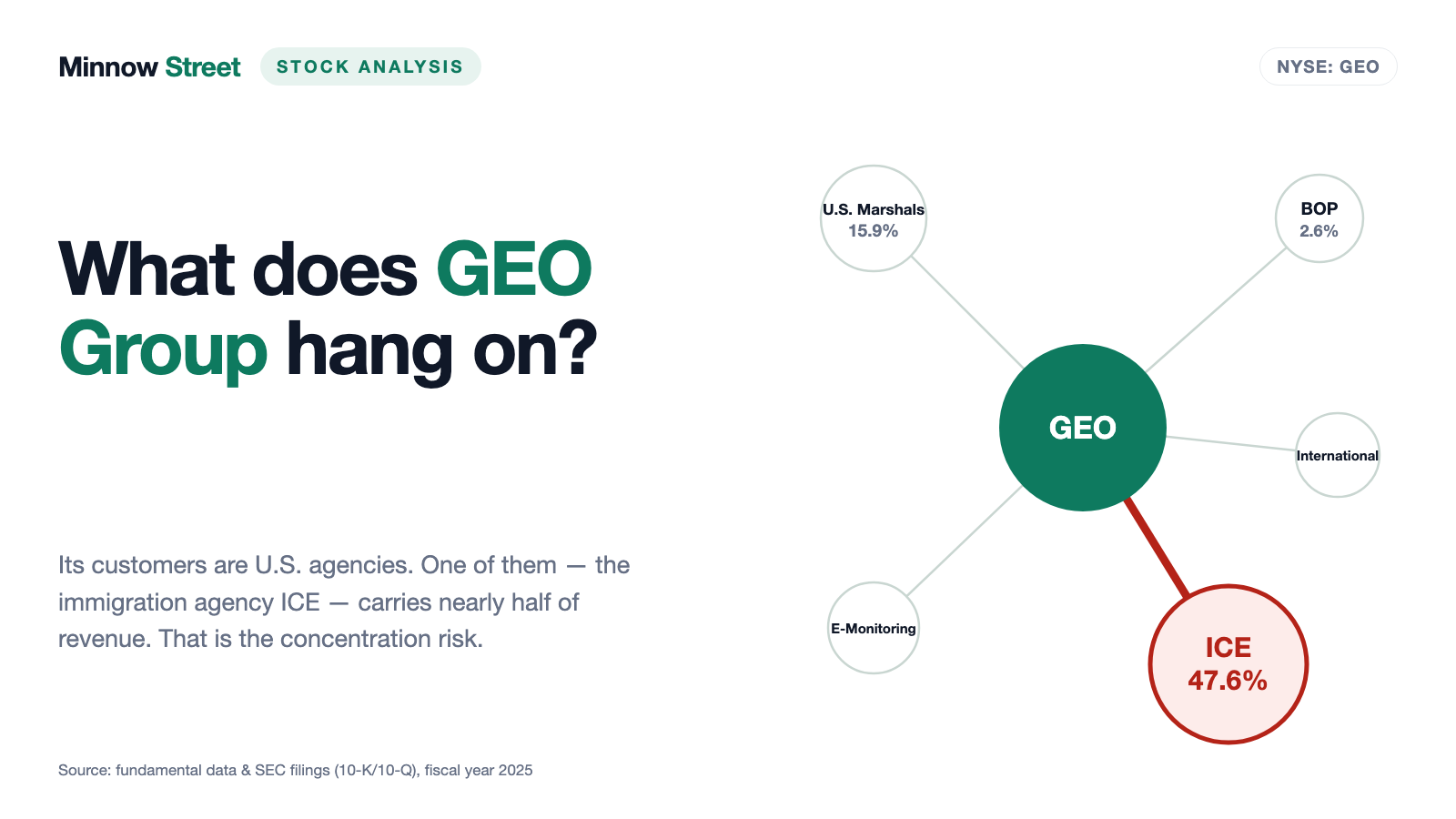
The GEO Group runs private prisons and immigration-detention centers for the U.S. government — and lights up our in-house Joshua growth scanner (rank 9 of 75, as of July 17, 2026) after a 80 percent share-price gain in six months. We read the annual report (10-K) for 2025 and the quarterly report (10-Q) as of March 31, 2026: net income that jumped from $32 million to $254 million, fueled by the immigration agency ICE, which alone supplies 47.6 percent of revenue — and a $42 billion pile of debt for which the company gave up its REIT status and dividend in 2021. Not investment advice — just the question of what a business is worth when half its revenue hangs on one agency and the policy of one administration.
 Thomas Mücke
Founder & Publisher
Thomas Mücke
Founder & Publisher
Chart
Interactive price chart (TradingView).
Note: pure fact-based analysis, not investment advice and not a solicitation to buy or sell. All figures without guarantee.
There is an investor trap that springs shut especially in politically charged times: the tailwind trap. It works like this: a government decides something big — a funding program, a war on X, a $45 billion offensive — and suddenly a stock's future looks inevitable. The price climbs, the scanner glows green, and your FOMO devil whispers: "This one's a gift, politics is paying." Hardly any stock feeds that trap in the summer of 2026 as textbook-perfectly as The GEO Group, Inc. (NYSE: GEO) of Boca Raton, Florida: the largest private operator of detention and immigration-detention facilities in the U.S., up 80 percent in six months (data as of July 17, 2026), carried by the harshest immigration policy in decades. So let's make a deal: before you trust the tailwind, we read together what the company itself reported, under penalty of law, to the U.S. securities regulator, the SEC — the annual report (10-K) for fiscal year 2025 and the quarterly report (10-Q) as of March 31, 2026. And these filings tell a story of an earnings jump that hangs by nearly half on a single agency — and of a wind that can change direction. In the end, you decide for yourself.
What GEO actually does — and for whom
GEO earns its money doing something most investors would rather not think through to the end: locking up and monitoring people on the government's behalf. The company operates roughly 75,000 beds at 95 facilities and employs about 18,000 full-time people. The business splits into four segments: U.S. Secure Services (prisons and immigration-detention centers, the core), electronic monitoring and supervision (ankle monitors, GPS tracking, case management — through the subsidiary BI Incorporated), reentry (halfway houses) and International Services (facilities in Australia, South Africa and the UK). Translated, GEO is something like a contract landlord for detention beds: the government says how many people it needs to house, GEO provides buildings, staff and technology — and bills per head per day. One quirk belongs right at the start because it shapes the entire risk profile: GEO's customers are almost exclusively government agencies, and the most important of them is the immigration enforcement agency ICE (U.S. Immigration and Customs Enforcement). Two more traits round out the picture: the company was called Wackenhut Corrections Corp. until 2003, and from 2013 through late 2021 it was a tax-favored real estate investment trust (REIT) — both matter later. Which brings us to the central tension of this analysis, and it runs through every chapter: the numbers are as good as they have been in years — but their quality stands or falls with the policy of a single administration toward a single agency. How quickly a government contract turns into a concentration risk is something we dissected at defense and government supplier Materion — and how deeply regulation can shape an entire business model, at Latin American network operator Millicom (Tigo).
Where the stock shows up in our scanner
Every day we run about 3,500 stocks through our scanners. GEO reached the research list through our Joshua growth scanner — a filter for stocks in a strong, broadly confirmed uptrend. As of the July 17, 2026 data cut-off, GEO sat at rank 9 of 75 hits, and the stock also lights up in a confluence of further trend filters: a Stan Weinstein stage-2 uptrend (price above a rising 200-day average), above the 50- and 200-day lines, a power trend, quality growth, "pros 80%" and institutional accumulation (most recently 12 funds added, 5 trimmed). The in-house best-of-all score, which bundles hits across all categories, stands at 18 — a high reading. Behind it stand plus 80 percent in six months and plus 76 percent in three (data as of July 17, 2026). Unlike many trend hits, the fundamental lens here is not the counter-program: return on equity 19.3 percent, a Levermann score of 6, and the valuation is moderate at a price-to-earnings ratio around 15 and a price-to-sales ratio of 1.4. But remember this fingerprint, because it is the thread of the analysis: a scanner measures the move and the balance sheet — it does not measure how many election days lie between today and the next political reversal. That question presses harder at GEO than at almost any other stock.
The numbers over the years — honestly appraised
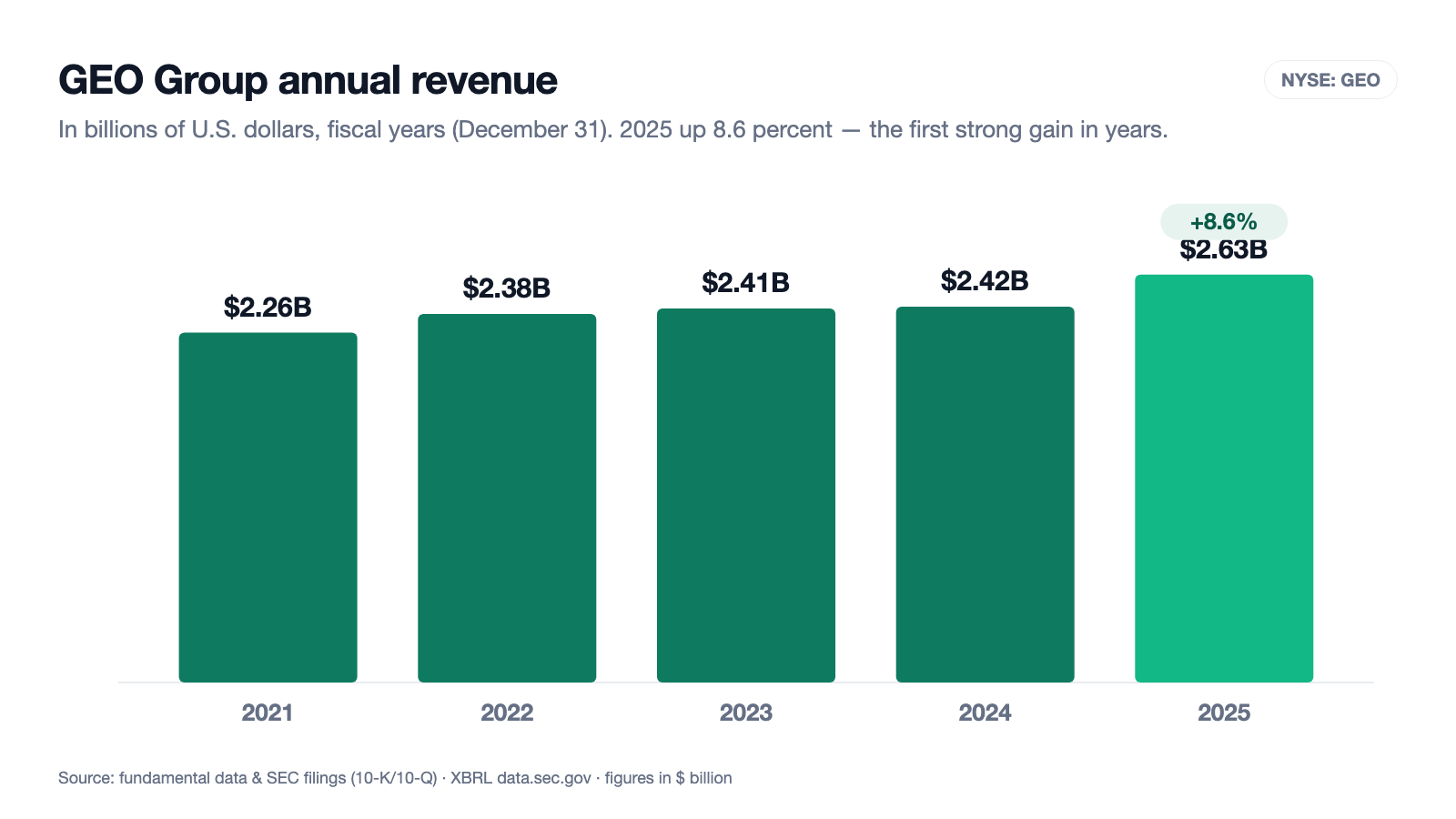
First, what genuinely impresses. After years of drifting sideways — revenue idled between $2.26 and $2.42 billion from 2021 to 2024 — fiscal year 2025 jumped: revenue rose 8.6 percent to $2.63 billion, and net income shot from $32.0 million (2024) to $254.4 million — diluted earnings per share climbed from $0.22 to $1.82. Before you celebrate that eightfold jump, honesty requires a caveat: the 2024 comparison was artificially low because a refinancing then pushed a loss on extinguishment of debt of $86.6 million onto the books (in 2025 it was only $8.4 million). But even adjusted, the direction is unmistakable: operating income reached $257.5 million in 2025, and the quarters are visibly accelerating. Look at the revenue curve over the years:
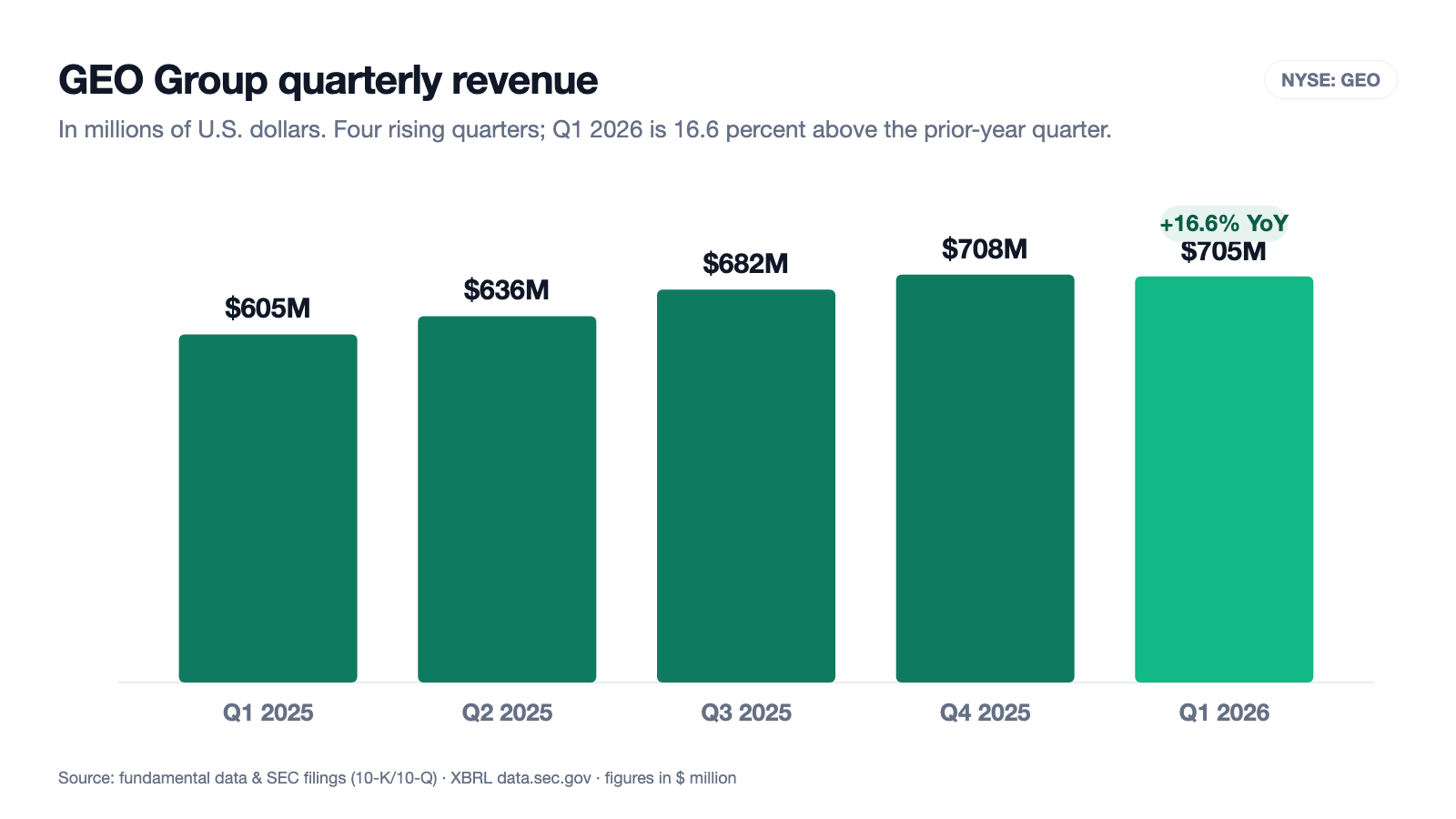
The acceleration is even clearer quarter by quarter: revenue climbed from $604.6 million in the first quarter of 2025 through $636.2 and $682.3 million to $708.4 million in the fourth quarter, and the first quarter of 2026 came in at $705.2 million, up 16.6 percent from the prior-year quarter. The balance sheet also tells a story of cleanup: annual interest expense fell from $218.3 million (2023) via $190.6 million to $160.5 million (2025) as GEO steadily pays down debt — more on that shortly. And the company is buying back its own shares: the count fell from roughly 141.5 million (August 2025) to about 133.6 million (early May 2026). If you read only these paragraphs, you see a textbook turnaround: more revenue, much more profit, less interest, fewer shares. But every one of these figures has the same engine — and it is not "better management," it is "more detainees on the federal government's behalf." Which brings us to the uncomfortable truths.
What the filings say — the uncomfortable truths
Uncomfortable truth no. 1: Nearly half of revenue comes from a single agency
If your neighbor says his business is booming, and you learn that a single customer accounts for nearly half of revenue, you would swallow hard. That is exactly what GEO's annual report says — with names and percentages:
"Of our governmental partners, three federal governmental agencies with correctional and detention responsibilities, the BOP, ICE, and the U.S. Marshals Service, accounted for 66.6% and 61.8% of our total consolidated revenues for the year ended December 31, 2025 and 2024, respectively […] ICE accounting for 47.6% and 41.5% of our total consolidated revenues for 2025 and 2024, respectively […]"
— The GEO Group, Inc., SEC annual report 10-K for fiscal year 2025, Item 1A "Risk Factors"
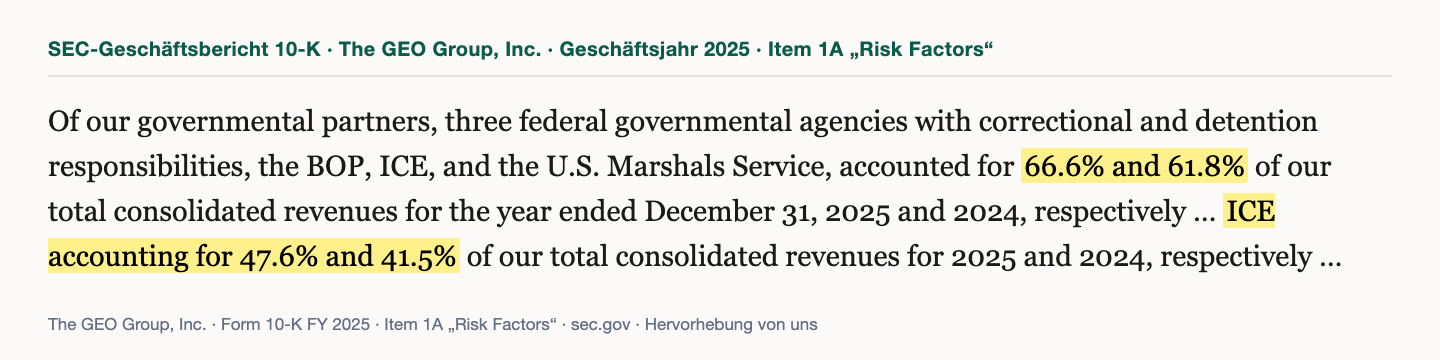
This is customer concentration in its purest form — and it carries a special edge, because the one big customer is not a supermarket chain but a politically steered agency. The report warns explicitly that the government could "re-negotiate, cancel or decide not to renew" its contracts, and cites a real recent example: on January 26, 2021, President Biden signed an executive order directing the Justice Department not to renew contracts with privately operated criminal detention facilities. That order has since been revoked — but it is living proof that a stroke of the pen in the White House can shift GEO's business foundation. And the concentration is growing: ICE rose from 41.5 to 47.6 percent, the three-agency block from 61.8 to 66.6 percent. Remember the image: whoever buys GEO buys not a broad customer base but a bet on the immigration policy of whichever party governs. In fairness: roughly 10 percent of revenue comes from contracts expiring by the end of 2026 that must be renewed — GEO has a long track record of renewals here, but no filing offers a guarantee.
Uncomfortable truth no. 2: The earnings jump is a bet on a single political will
Why the jump right now? The annual report is unusually candid: the driver is the immigration detention that the Trump administration has vastly expanded, underpinned by fresh federal money at a historic scale.
"On July 4, 2025, President Trump signed into law the One Big Beautiful Bill Act, or OBBBA. OBBBA appropriates a total of $75 billion in mandatory funding to ICE for immigration enforcement activities and to increase detention capacity. Specifically, OBBBA appropriates $45 billion for single adult alien detention capacity and family residential center capacity."
— The GEO Group, Inc., SEC annual report 10-K for fiscal year 2025, Item 1 "Business"
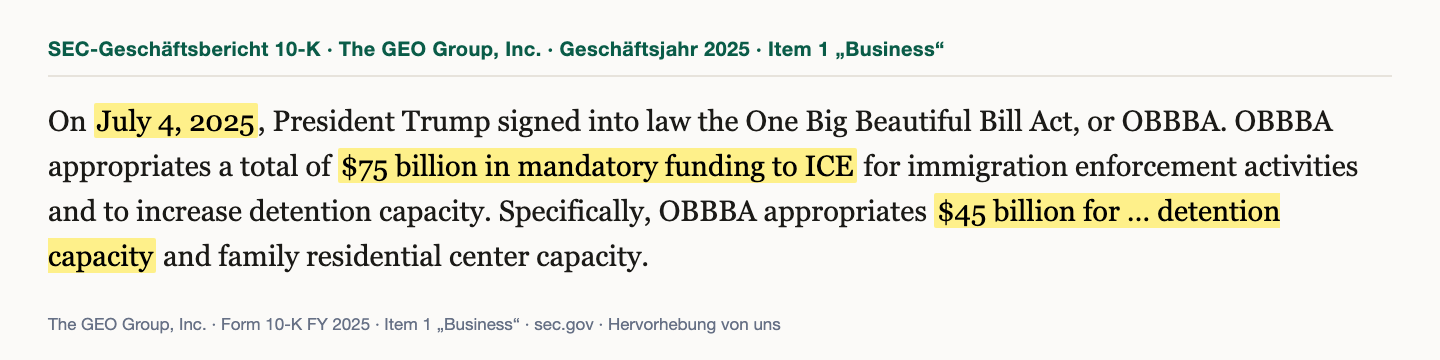
This is the other side of the customer concentration: when the one customer receives $45 billion of fresh budget, that is an enormous tailwind — GEO reactivates idle facilities (such as its company-owned, 1,868-bed D. Ray James facility in Folkston, Georgia, activated in June 2025) and keeps a further 5,896 idle beds as a quiet reserve. But this is exactly where the tailwind trap springs: a budget one law grants, another law can cut; a policy one administration hardens, the next can reverse. GEO's 2025 earnings jump is not evidence of a wider moat but of a friendlier political wind — and wind, by definition, is weather, not climate. The 2021 Biden order (truth no. 1) and the 2025 OBBBA windfall are the same mechanism with the sign reversed, just one term apart. Anyone holding the stock should honestly ask whether they would want to sit through the next reversal.
Uncomfortable truth no. 3: The debt pile that cost the dividend and the REIT status
GEO carries $1.67 billion of debt against just $69 million in cash (December 31, 2025) — a debt-to-equity ratio of about 1.1. That burden is so defining it cost the company one of its biggest strategic decisions. Through late 2021 GEO was a REIT (real estate investment trust) — a tax-favored structure that in return must distribute nearly all of its profit as dividends. Then the company pulled the ripcord:
"In connection with terminating GEO's REIT status in 2021, the Board also voted unanimously to discontinue our quarterly dividend payments and prioritize allocating GEO's free cash flow to reduce debt."
— The GEO Group, Inc., SEC annual report 10-K for fiscal year 2025, Item 5 "Market for Registrant's Common Equity"

Why so much debt, and why no easy refinancing? Because the capital market makes GEO's life hard — for ethical, not balance-sheet, reasons. The report names it itself: several financial institutions, including former lenders, have announced they will no longer enter new agreements with operators of private detention facilities — "several financial institutions, including some of our lenders, had announced that they will not be renewing existing agreements or entering into new agreements with companies that operate such facilities and centers" (10-K 2025, Item 1A). For GEO that means costlier debt, a narrower circle of lenders and the need to deleverage under its own power rather than refinance comfortably. To be fair — and this is the honest counter — the plan works: interest expense falls year by year, and with the 2025 earnings jump, debt reduction is accelerating. But the stock remains a name with no dividend, high leverage and an investor base structurally narrowed by ESG exclusions. Growth that hangs on a debt pile and a shunned business model is never quite cheap to own.
Valuation: moderate on paper — as long as you ignore the engine
On metrics alone, GEO looks almost inexpensive in the summer of 2026: the price-to-earnings ratio sits around 15, price-to-sales around 1.4, price-to-book 2.6, and the return on equity of 19.3 percent is respectable for a capital-intensive real estate operator (all fundamental data as of July 17, 2026). Market value is on the order of $3.8 billion at a share price around $28 — but add roughly $1.6 billion of net debt, and enterprise value (market value plus debt minus cash) is closer to $5.4 billion. These numbers say the market does not price GEO like a highflyer but cautiously — fitting for a shunned business model. The "professionals' view" here should be taken with care: only a handful of analysts (four, per fundamental data) still follow the stock at all, because several banks discontinued their research coverage on ESG grounds. Their consensus is positive on average, but it rests on a base so thin it is less "wisdom of the crowd" than "opinion of the few." And the earnings estimates themselves are a bet on politics: they assume double-digit earnings growth for the coming years (data as of July 17, 2026) — plausible as long as OBBBA money flows and ICE fills beds, but only that long. Translated: the low P/E is not a safety net but the price for a political risk the market has correctly priced in.
Opportunities and risks at a glance
What speaks for GEO:
- A tailwind with the force of law: the OBBBA of July 4, 2025, appropriates $75 billion to ICE, $45 billion of it for detention capacity — GEO reactivates facilities and holds 5,896 idle beds as an immediately usable reserve (10-K 2025).
- The turnaround is in the numbers: revenue up 8.6 percent to $2.63 billion in 2025, net income $254.4 million (EPS $1.82 after $0.22), latest quarterly revenue up 16.6 percent year over year, operating income $257.5 million.
- The deleveraging is working: interest expense fell from $218 million (2023) via $191 million to $161 million (2025); alongside share buybacks (count down from roughly 141.5 to 133.6 million).
- Solid profitability and moderate valuation: return on equity 19.3 percent, P/E around 15, P/S 1.4, Levermann score 6 (data as of July 17, 2026).
- Strong technicals: a Joshua growth hit (rank 9 of 75), best-of-all score 18, stage-2 uptrend, plus 80 percent in six months (data as of July 17, 2026).
What speaks against it:
- Extreme concentration risk with a political fuse: ICE alone 47.6 percent, three federal agencies 66.6 percent of revenue (2025, rising) — the 2021 Biden order shows a stroke of the pen in the White House can shift the business foundation (10-K 2025, Item 1A).
- The earnings jump is borrowed politics, not a moat: it grows with an administration's immigration severity — and shrinks with it; roughly 10 percent of revenue hangs on contracts expiring by the end of 2026.
- High leverage, no dividend: $1.67 billion of debt against $69 million in cash; REIT status and dividend were sacrificed in 2021 for debt reduction.
- Structural ESG headwind: several banks no longer finance GEO and have even discontinued their equity research coverage — a narrower circle of lenders and investors, costlier capital, thin analyst coverage.
- Reputational and litigation risk: operating detention and immigration-detention facilities is socially contested and a permanent target of lawsuits, campaigns and legislation.
A human conclusion
Back to the tailwind trap from the opening. Its core is not that political tailwind brings no real profit — GEO's $254 million of net income in 2025 is real, attested in the annual report and reported under penalty of law. Its core is that a tailwind feels like merit even though it is weather: whoever sees the strongest numbers in company history today easily blocks out that nearly half of them hang on a single agency and on the immigration policy of a single administration — and that the opposite direction is only one term ago. GEO is no house of cards: the business is running, debt is falling, the stock is moderately valued, and if the OBBBA money flows for years, the tailwind can become a long, profitable ride — the beds, the staff and the reactivatable capacity for it are all in place. But it is also no ordinary company: it is a leveraged bet on a political will, wrapped in a morally contested business model that banks and ESG investors avoid. So the honest question for you is not "Are earnings growing?" (right now, yes), but: do you want to tie your money to a business whose half of revenue is up for a vote on the next election day — and whose subject you would have to be able to defend at the breakfast table? What you make of it is your decision. And that is exactly as it should be.
Sources
All original documents used in this analysis — to read for yourself:
- The GEO Group, Inc. — SEC annual report 10-K for fiscal year 2025 (ended December 31, 2025; filed February 25, 2026)
- The GEO Group, Inc. — SEC annual report 10-K for fiscal year 2024 (ended December 31, 2024; filed February 28, 2025)
- The GEO Group, Inc. — SEC quarterly report 10-Q as of March 31, 2026 (filed May 7, 2026)
- The GEO Group, Inc.'s complete SEC filing history: EDGAR overview (sec.gov)
- Fundamental data (metrics, quarterly series, valuation, scanner hits; data as of July 17, 2026), reconciled with the SEC filings and the XBRL financial data from data.sec.gov.
- Screener and rating data: Joshua growth scanner and in-house stock scanner (data as of July 17, 2026).
Transparency & disclaimer: This analysis is a journalistic contextualization of publicly available information and is not investment advice, not a financial analysis in the regulatory sense, and not a solicitation to buy or sell securities. Stock investments carry substantial risks up to total loss. All information without guarantee; the data cut-off is noted in the text in each case. The author holds no position in GEO Group stock at the time of publication.
Our Bottom Line at a Glance
- Growth & earnings positive
- Revenue up 8.6 percent to $2.63 billion in 2025, net income jumped from $32.0 to $254.4 million (diluted EPS $1.82 after $0.22), latest quarterly revenue up 16.6 percent year over year — the strongest momentum in years, carried by expanded ICE detention demand (10-K 2025; 10-Q as of 03/31/2026).
- Customer concentration & politics negative
- ICE alone supplied 47.6 percent of 2025 revenue (2024: 41.5%), three federal agencies 66.6 percent combined — and rising. The 2021 Biden order (no renewal of DOJ detention contracts) shows a change of administration can flip the business foundation; roughly 10 percent of revenue hangs on contracts expiring by the end of 2026 (10-K 2025, Item 1A).
- Balance sheet & debt neutral
- $1.67 billion of debt against $69 million in cash (12/31/2025), but the reduction is working: interest expense fell from $218 million (2023) via $191 million to $161 million (2025), alongside buybacks. The price for it was giving up the REIT status and the dividend in 2021; there is no distribution for the foreseeable future.
- Capital markets & ESG negative
- Several banks no longer finance GEO and have even discontinued equity research coverage (10-K 2025, Item 1A) — costlier capital, a narrower investor base, only a handful of analysts. Operating detention and immigration-detention facilities remains a permanent target of lawsuits and campaigns.
- Valuation & technicals neutral
- P/E around 15, P/S 1.4, P/B 2.6, return on equity 19.3 percent (data as of July 17, 2026) meet a Joshua growth hit (rank 9 of 75), a best-of-all score of 18 and plus 80 percent share price in six months. The moderate valuation is not a safety net but the priced-in expression of the political risk.
The GEO Group is delivering the strongest numbers in years — revenue up 8.6 percent to $2.63 billion, net income from $32 to $254 million, falling interest expense, ongoing buybacks. Yet nearly half of revenue (ICE: 47.6 percent) and two thirds in total hang on three federal agencies, the earnings jump rests on the OBBBA windfall and the immigration severity of a single administration, and the capital market shuns the model via ESG exclusion. Whoever invests here buys a leveraged, moderately valued bet on a political will — with a counterexample only one term in the past. Not investment advice.
What Our Rating Means
- If you don't own the stock
- In our view, the documented risks clearly outweigh — we see no basis for an entry.
- If you hold it in your portfolio
- In our view, the findings carry enough weight to warrant a critical look at your own position.
A journalistic assessment by our editorial team at the time of the deep dive, based on public sources — not investment advice and not a solicitation to buy or sell. Your personal circumstances (investment goals, risk capacity, taxes) cannot be taken into account. What our categories mean, how verdicts are formed, and what conflicts of interest exist →
Worth Noting
- GEO reached our research list via the Joshua growth scanner (rank 9 of 75, best-of-all score 18, data as of July 17, 2026); the trend confluence (stage 2, power trend, quality growth, "pros 80%", institutional accumulation) is real, but it measures the move and the balance sheet — not the political risk.
- The 2025 earnings jump is partly a base effect: 2024 was depressed by an $86.6 million loss on extinguishment of debt (2025: $8.4 million). Adjusted, the direction is still clearly upward, carried by ICE detention demand.
- Price and valuation figures are dated to July 17, 2026 (price around $28, market value roughly $3.8 billion); analyses are evergreen, daily prices are not a buy argument. All revenue, income and balance-sheet figures come from the SEC filings or the XBRL financial data (data.sec.gov).
Frequently Asked Questions
The GEO Group, Inc. (NYSE: GEO) of Boca Raton, Florida, is the largest private operator of detention and immigration-detention facilities in the U.S. — roughly 75,000 beds at 95 facilities, plus electronic monitoring (ankle monitors, GPS through its BI Incorporated unit), reentry and international facilities. Its customers are almost exclusively government agencies. Revenue in fiscal year 2025: $2.63 billion.
Very dependent: per the annual report (10-K), ICE alone accounted for 47.6 percent of consolidated revenue in 2025 (2024: 41.5 percent). Together with the U.S. Marshals Service (15.9 percent) and the federal prison bureau BOP (2.6 percent), three federal agencies account for 66.6 percent of revenue. This concentration is rising and makes GEO a bet on the immigration policy of whichever administration is in power.
Net income jumped from $32.0 million (2024) to $254.4 million (2025). Two reasons: first, 2024 was artificially depressed by a $86.6 million loss on extinguishment of debt. Second, the Trump administration expanded immigration detention — the OBBBA law signed July 4, 2025, provides ICE with $75 billion, $45 billion of it for detention capacity. Revenue rose 8.6 percent in 2025 as a result.
No. GEO terminated its tax-favored REIT status in late 2021 and simultaneously discontinued the quarterly dividend to prioritize free cash flow for debt reduction. Per the annual report, a dividend will only be reconsidered once the debt and leverage targets are met. The company carries $1.67 billion of debt (December 31, 2025).
For reasons of corporate social responsibility (ESG): operating private detention facilities is contested. Per the annual report, several financial institutions — including former lenders — have announced they will not enter new agreements with private detention operators, and some have even discontinued their equity research coverage. For GEO that means costlier capital, a narrower circle of lenders and thin analyst coverage.
Yes. The company operated as Wackenhut Corrections Corp. until 2003 (listed under that name from 1996 to November 2003 per the SEC EDGAR history) and then renamed itself The GEO Group. From 2013 through late 2021 GEO was also structured as a real estate investment trust (REIT), before it gave up that status in favor of debt reduction.
On metrics it looks moderate: price-to-earnings ratio around 15, price-to-sales 1.4, price-to-book 2.6, return on equity 19.3 percent (data as of July 17, 2026), market value on the order of $3.8 billion. But the low P/E is less a bargain than the priced-in expression of the political concentration risk and the ESG headwind. Not investment advice.
Found an error?
Did you spot a factual error, an outdated number, or a typo in this deep dive? Let us know briefly — your report goes straight to the editorial team.