Getty Images Stock: $2.006 Billion of Debt, a Dead Merger — and an AI Lawsuit It Mostly Lost
Getty Images is the company suing the AI industry for copying its pictures — and it sells its archive to that same industry for model training, while generative AI eats into the segment that makes up 56.7 percent of its revenue. We read the annual report (10-K) for 2025, the quarterly report (10-Q) as of March 31, 2026 and the two current reports (8-K) from the end of the Shutterstock merger: the licensing business earns $320.9 million of adjusted EBITDA, and the interest on the de-SPAC debt takes more than the entire operating profit. Not investment advice — just a careful look at what happens when the plaintiff and the defendant need the same technology.
 Thomas Mücke
Founder & Publisher
Thomas Mücke
Founder & Publisher
Chart
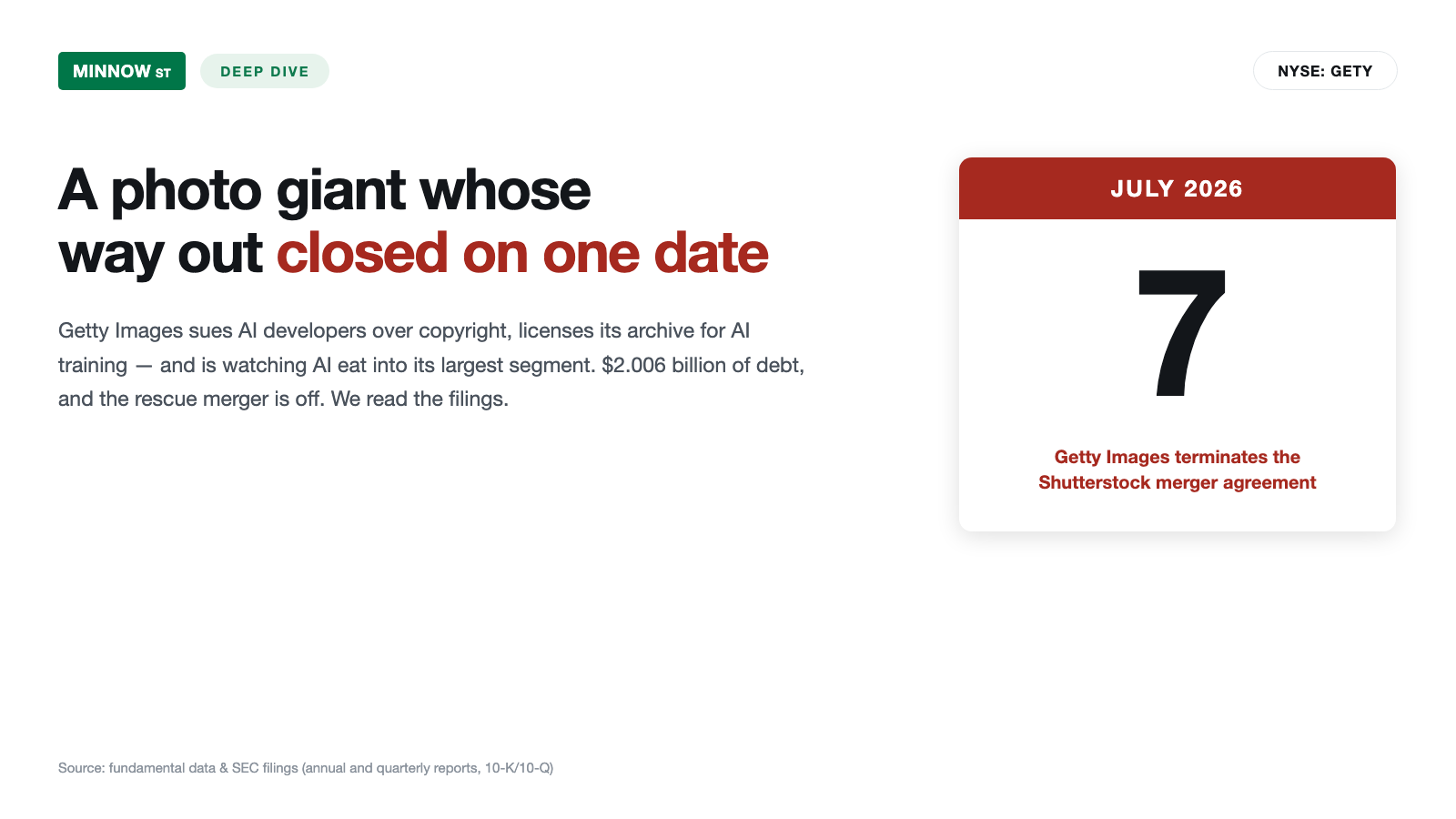
Interactive price chart (TradingView).
Note: pure fact-based analysis, not investment advice and not a solicitation to buy or sell. All figures without guarantee.
When someone we own goes to court against the thing that threatens them, our minds file the threat under "handled". Call it the plaintiff's illusion: a lawsuit looks like a wall. It feels like the company has taken the danger, wrapped it in legal paper and put it somewhere a judge will deal with — so we go back to reading the revenue line. Getty Images (NYSE: GETY) is the purest test of that reflex on the market today. This is the company that sued Stability AI on two continents for training an image generator on its pictures; the rights holder standing up for every photographer. It is also a company that sells its archive to AI developers for model training, ships its own AI image generators, and watches generative AI compete with the segment that pays 56.7 percent of its bills. And on July 7, 2026, the merger that was supposed to be its way out died. Reddit barely noticed — our Reddit hype scanner counted 2 mentions in 24 hours (ApeWisdom, as of July 16, 2026). So let's make a deal: we drop the courtroom drama and read only what Getty Images reported, under penalty of law, to the U.S. securities regulator, the SEC. Our material: the annual report (10-K) for 2025, the quarterly report (10-Q) as of March 31, 2026, and the two current reports (8-K) that ended the merger. At the end you will not get a verdict from us. You will get the findings.
What Getty Images actually does — a library that rents, not a studio that sells
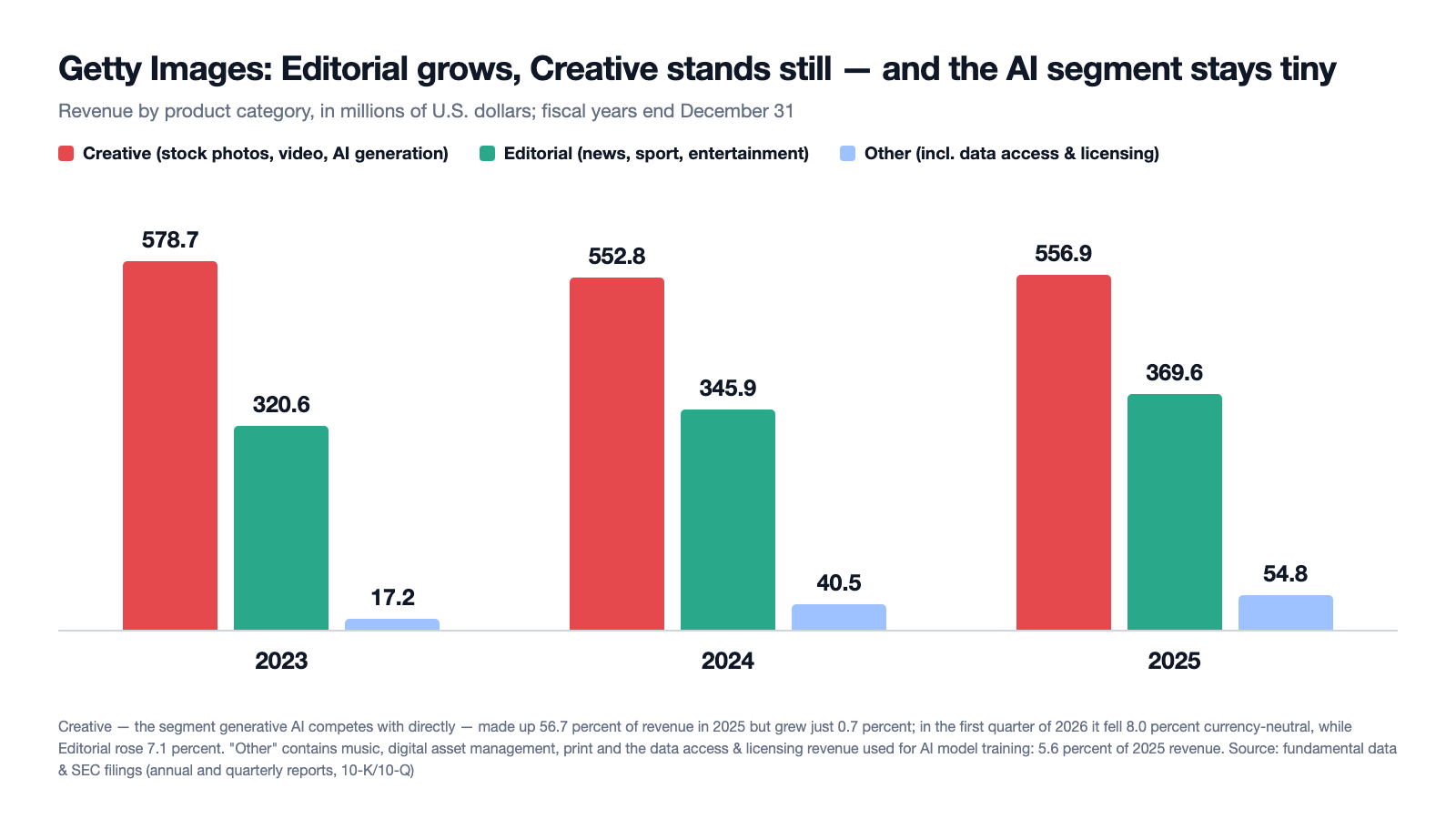
Getty Images is a licensing business, and that word carries the whole model. The company mostly does not sell you a photograph; it rents you the right to use one, over and over, to as many customers as want it. The archive is the asset — and it is stocked three ways: over 115 full-time staff photographers and videographers on the payroll, a global network of contributors and "Image Partners", and exclusive deals for access to events. The output splits into three product lines, and the split matters more than anything else in this analysis. Creative — the stock imagery a marketing team drops into a campaign, plus video, music and now AI generation — brought in $556.9 million in 2025, 56.7 percent of revenue. Editorial — news, sport and entertainment, the pictures of the actual thing that actually happened — brought in $369.6 million (37.7 percent). Other — music licensing, digital asset management, print, and the licensing of data and content for AI model training — brought in $54.8 million (5.6 percent). The brands you know sit on top: gettyimages.com for professionals, iStock for small businesses, Unsplash for the creator economy. Nearly 1,650 employees, headquartered in Seattle, run by CEO Craig Peters.
Now the part that explains the share price. Getty Images did not reach the market by the front door. In July 2022 it merged with CC Neuberger Principal Holdings II, a special purpose acquisition company — a "SPAC", a listed shell that raises cash first and finds a company to buy afterwards; the merger, a "de-SPAC", turns the private company public without a traditional IPO. What Getty inherited from that arrangement was not a clean balance sheet but a leveraged one, plus a lawsuit from the SPAC's own former warrant holders that is still running four years later. So hold on to the central tension of this analysis, because every chapter turns on it: the picture business works — it throws off a 32.7 percent adjusted EBITDA margin — but the structure wrapped around it takes more than it earns, the segment that pays the bills is the one AI competes with, and the two escape routes (a merger, a lawsuit) have both now mostly closed. De-SPACs that never shook off their capital structure are a pattern we have followed before, most vividly at Virgin Galactic; what a business looks like when interest eats the operating profit, we traced at AMC Entertainment. Getty is a healthier company than either. It is carrying a similar weight.
Where the ticker comes from — and why our fundamental scanner does not know it
Honesty first: GETY appears in none of our fundamental stock scanners, and there is no company row for it in our database. That is not a verdict, it is systematics — our in-house stock scanner works through the Russell 3000 universe, and this ticker is not in our grid; no Piotroski score, no Altman Z, no scanner row to show you. And here a warning that belongs in every Getty conversation: our database does hold a GTY — that is Getty Realty Corporation, a real-estate investment trust that owns petrol stations. Same family name, entirely different company, one letter apart. If you go looking for this stock with the wrong four letters, you will end up buying filling stations instead of photographs. The ticker landed on our desk through a different tool: our Reddit hype scanner, which counts daily which small U.S. tickers the forums are talking about (data basis: ApeWisdom). On July 16, 2026 it counted 2 mentions in 24 hours — essentially silence. That silence is itself the finding. A company at the centre of the most consequential copyright fight of the AI era, whose rescue merger collapsed nine days earlier, and the forums have moved on. What forum attention does to a share price we dissected at Virgin Galactic; here there is none of it, and the price has to stand on the filings alone. So the filings are all we will use.
The numbers over the years — honestly appraised
Start with what genuinely impresses, because it is real and it is easy to lose in the noise. Getty Images makes money on its pictures. Revenue grew from $916.6 million (2023) via $939.3 million (2024) to $981.3 million in 2025 (+4.5 percent reported, +3.8 percent currency-neutral). Adjusted EBITDA — operating profit before interest, taxes, depreciation, amortisation and one-off items — came in at $320.9 million, a 32.7 percent margin (2024: $300.3 million, 32.0 percent). Translated: of every $100 of revenue, about $33 survives as operating cash generation before the financing structure gets its turn. That is not a broken company; a third of revenue as EBITDA margin is what a genuine library asset looks like, and after capital expenditure of $59.5 million there was still $261.3 million left. Editorial, the irreplaceable half of the archive, grew 6.9 percent to $369.6 million and kept growing 7.1 percent currency-neutral in the first quarter of 2026 — nobody generates a photograph of a goal that was actually scored.
Now turn the page over. In 2025 that same company reported a net loss of $206.2 million — after $39.5 million of net income in 2024, a swing of $245.7 million. No goodwill was written off; the annual report confirms no impairment charge was recognised in 2025 or 2024. The loss was assembled from the structure, not the business: $156.2 million of interest, a $100.5 million loss on litigation, a $78.9 million foreign-exchange loss and $54.8 million of "other operating expenses – net". And there is one number the growth headline hides. The customer base is shrinking: total purchasing customers fell from 799,000 (2023) via 717,000 (2024) to 689,000 (2025), and active annual subscribers from 314,000 to 278,000. Revenue held up because the remaining customers pay more — annual revenue per purchasing customer rose 8.7 percent to $1,424 — and because two large multi-year licence deals closed in the fourth quarter of 2025 with accelerated revenue recognition. The first quarter of 2026 shows what that looks like without the sugar: revenue of $226.6 million, up 1.1 percent reported but down 2.5 percent currency-neutral. Remember the yardstick for the rest of this piece: the pictures earn; the structure spends; and the customer count is already telling a different story from the revenue line.
What the filings say — the uncomfortable truths
Uncomfortable truth no. 1: the lawsuit is not a wall — Getty mostly lost, and paid Stability AI's costs
This is where the plaintiff's illusion meets the record. Getty Images sued Stability AI, maker of the image generator Stable Diffusion, in the United States and — as claimants including Getty Images (UK) Limited and iStockphoto LP — in the High Court of England & Wales, claim number IL2023-000007. The UK case went to trial in June 2025. What happened there is not what the headlines suggested. During the trial the claimants dropped their claims for primary copyright infringement (training and output) and database rights, because — per Stability AI — the training took place outside the UK and beyond the reach of UK copyright law. On November 4, 2025 the court found for Getty only on trademark infringement. Getty did win one thing that matters for the industry: a factual finding that its copyright-protected works were used to train Stable Diffusion, wherever that training happened. But the bill went the other way:
"The Court assessed an interim costs award to Stability AI for the matters on which Claimants did not prevail or dropped at trial of $5.8 million. This cost award was included in "Accrued expenses" in the Consolidated Balance Sheet as of December 31, 2025 and included in "Other operating expense - net" in the Consolidated Statement of Operations for the year ended December 31, 2025."
— Getty Images Holdings, Inc., SEC annual report 10-K 2025, Note 11 "Commitments and Contingencies"

Both sides are appealing: Getty has permission to appeal the secondary-infringement ruling, Stability AI is asking the Court of Appeal to revisit the trademark decision, and the parties are waiting on that. The US case — filed in the Northern District of California after Stability AI successfully challenged jurisdiction in Delaware — is still in fact discovery, with oral argument on a partial motion to dismiss scheduled for April 7, 2026. The annual report itself refuses the comfort investors reach for: "There can be no assurance that we will be successful in these cases, or in preventing other generative AI developers or technologies from using our content without authorization or fair compensation." Remember the mechanism: a lawsuit is a cost centre with an option attached, not a moat. Getty's litigation line cost $100.5 million in 2025 — the courts have so far taken money out of this company, not put it in.
Uncomfortable truth no. 2: AI is a customer worth 5.6 percent and a competitor to 56.7 percent
Here is the strangest sentence in Getty's accounts, and it is in the revenue-recognition note, not the AI marketing: "The Company also generates revenue by providing customers with access to its data and content for machine learning and generative artificial intelligence model training uses." Getty sells the training data. It also sells the output: Generative AI by Getty Images launched in 2023 and Generative AI by iStock in early 2024, both text-to-image services trained on Getty's own creative library and marketed as "commercially safe". So the company suing an AI developer for training on its pictures runs a business licensing its pictures for training, and a business generating pictures. That is not hypocrisy — it is the only rational answer to the situation. But look at the sizes. All of it lives in the "Other" line: $54.8 million, 5.6 percent of 2025 revenue, alongside music, print and digital asset management — and in the first quarter of 2026 that line fell 7.0 percent to $8.6 million on licensing timing. Meanwhile the risk factors describe what AI does to the other 56.7 percent:
"Generative AI technologies also have the potential to create images and videos that directly compete with or substitute for our licensed content. As these technologies become more accessible and capable, customers may opt for AI generated content that bypasses traditional licensing models, impacting our revenue and market position."
— Getty Images Holdings, Inc., SEC annual report 10-K 2025, Item 1A "Risk Factors"

The numbers are already moving in the direction the risk factor describes. In the first quarter of 2026, Creative fell 8.0 percent currency-neutral (reported: minus 4.5 percent to $126.2 million) while Editorial rose 7.1 percent. Read the two segments as two different businesses, because that is what they are: Editorial sells evidence — the photograph of the event, which no model can generate because the event happened once and a camera was there. Creative sells illustration — a smiling team in a bright office, a hand holding a phone — and that is precisely what a text prompt now produces for the price of a subscription. Getty's answer is to be the safe supplier of both, and "commercially safe" is a genuine argument: an enterprise that wants indemnity against a copyright claim buys from a licensor, not from an open model. But hold the proportions in your head: the AI business Getty sells is a rounding error next to the AI competition it faces. 5.6 percent is defending 56.7 percent.
Uncomfortable truth no. 3: $2.006 billion of debt — and interest that now exceeds the operating profit
This is the number that decides the equity. Getty's own risk factors state it plainly:
"As of December 31, 2025, we had $2.006 billion in aggregate principal amount of total debt (inclusive of $628.4 million in connection with our merger). Additionally, our revolving credit facility has remaining borrowing capacity of $150.0 million as of December 31, 2025."
— Getty Images Holdings, Inc., SEC annual report 10-K 2025, Item 1A "Risk Factors"

Look at what that debt costs. The pieces, per the maturity table: $628.4 million of 10.500% senior secured notes, $539.9 million of 11.250% senior secured notes due 2030, $537.2 million of term loans (the US tranche at a fixed 11.25 percent, the euro tranche at roughly 8 percent), $294.7 million of 2025 senior unsecured notes and a $5.3 million remnant from 2019. In everyday terms: this is a company paying credit-card rates on the price of a mid-size acquisition. The result is the single chart that matters. Interest expense of $156.2 million in 2025 exceeded income from operations of $83.9 million — the lenders took roughly twice what the business earned after costs. In the first quarter of 2026 the jaws opened further: $54.2 million of interest against $31.6 million of operating income, and the quarter closed with a $4.4 million net loss despite a $14.8 million foreign-exchange gain.
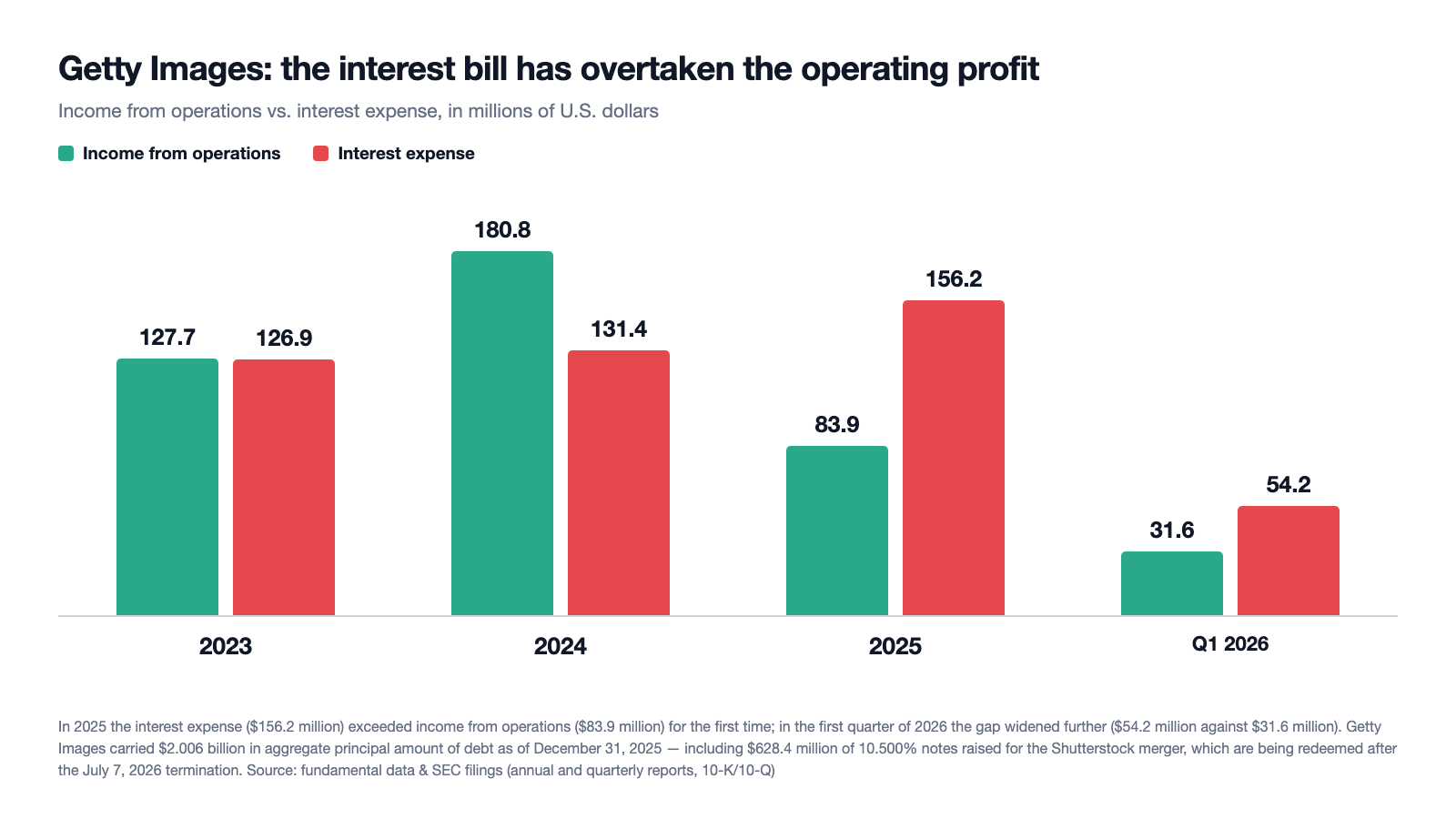
Fairness requires the other side, and it is substantial. Measured against adjusted EBITDA of $320.9 million, the debt is about 6.3 times — heavy, but not the arithmetic of a company that cannot pay its coupons; interest is covered roughly twice over on that measure. The near-term maturity wall is also thinner than it looks: the $628.4 million of 10.500% notes are matched by $640.7 million of restricted cash (March 31, 2026) sitting in escrow for exactly that purpose, and after the merger terminated they are being redeemed. Strip both out and the picture is roughly $1.33 billion of net debt against $320.9 million of adjusted EBITDA — about 4.2 times, with the next real maturity in 2028. That is a leveraged company, not a doomed one. But remember the order of the queue: at 10.5 and 11.25 percent, the lenders are paid before the shareholders, and on 2025's figures there was nothing left after them.
Uncomfortable truth no. 4: the escape hatch closed on July 7, 2026
For eighteen months there was an answer to all of the above, and its name was Shutterstock. On January 6, 2025 Getty Images agreed to merge with its largest rival — a deal that promised scale against the AI threat, cost savings against the interest bill, and a combined library no model could match. It is over. The UK Competition and Markets Authority would clear the deal only if Shutterstock's editorial business was sold — a condition Getty was not obliged to accept under the merger agreement, and did not. On June 30, 2026 the board unanimously resolved not to proceed and to terminate; on July 6, 2026 the Second Extended End Date passed; on July 7, 2026 the notice went out:
"On July 7, 2026, Getty Images delivered a written notice to Shutterstock terminating the Merger Agreement pursuant to the terms thereof, effective upon delivery of such notice."
— Getty Images Holdings, Inc., SEC current report 8-K of July 7, 2026, Item 8.01 "Other Events"

Three consequences follow directly, and all three are in the filings. First, the 10.500% notes are being redeemed under a special mandatory redemption per the indenture dated October 21, 2025 — the escrow unwinds, the balance sheet shrinks, and roughly $63 million of annual interest goes away with it. That is genuinely good news, and it is the mechanical silver lining of the collapse. Second, the strategic answer is gone: Getty faces the AI decade at its own scale, with a customer count that is already falling. Third — and this is the sentence to sit with — the board "intends to retain a financial advisor to advise the Getty Images Board on strategic financing alternatives available to Getty Images" (8-K of June 30, 2026). A company with $1.3 billion of remaining debt at double-digit coupons, whose merger just died, hiring an adviser on financing alternatives, is a company thinking out loud about refinancing, asset sales or a different owner. Remember the image: the escape hatch did not open onto a rescue — it closed, and the room is the one the company was already in.
Valuation: a quarter of a billion of equity on top of a billion-plus of debt
In mid-July 2026 the market valued all of Getty Images at roughly $264 million (data as of July 16, 2026) — for a company that licensed $981.3 million of revenue and generated $320.9 million of adjusted EBITDA in 2025. A price-to-sales ratio of about 0.27 is, on its face, the kind of number that makes bargain hunters reach for the mouse. There is no meaningful price-to-earnings ratio: 2025 ended in a $206.2 million loss. But price-to-sales is exactly the wrong lens on a balance sheet like this one, and here is why. Calculate like a buyer of the whole company: equity of about $264 million plus roughly $1.33 billion of debt that will remain after the 10.500% notes are redeemed from escrow, less unrestricted cash of $96.6 million (March 31, 2026), and the business costs you around $1.5 billion — about 1.5 times revenue and 4.7 times adjusted EBITDA. That is not a giveaway; it is a fair-to-cheap price for a leveraged, slow-growing licensor. The equity is small not because the business is small but because the debt is large — the shareholders own the thin slice on top. Remember the mechanism: leverage works like a lens, and it magnifies in both directions. If the enterprise is worth 10 percent more than the market thinks, the equity roughly doubles; if it is worth 10 percent less, the equity roughly halves. That is the whole investment case, and it is why this share price moves the way it does.
The professionals' view is thin and bullish, and you should weigh it accordingly: three analysts cover the stock, with two strong buys and one hold and an average target of about $3.93 (data as of July 16, 2026) — a multiple of the recent price. Three analysts is not a consensus; it is a small room. And two structural facts belong beside any valuation. First, litigation reserves of $205.3 million (December 31, 2025; $208.4 million by March 31, 2026) sit on the balance sheet against $60.0 million of insurance cover, of which about $35.0 million of recovery receivable remained — a liability worth roughly three-quarters of the entire market value, in a case the Second Circuit affirmed against Getty on January 15, 2026, and on which not one dollar of the judgments has yet been paid. Second, ownership is concentrated to a degree that shapes everything: insiders hold about 78 percent of the shares (data as of July 16, 2026) — the legacy of the de-SPAC, in which the Getty family and the private-equity owner Koch Equity Development kept the bulk of the equity. The free float is roughly 197 million of about 419 million shares. Whatever happens strategically here will be decided by a handful of owners, not by the market.
Opportunities and risks at a glance
What speaks for Getty Images:
- The licensing business genuinely earns: $981.3 million of revenue in 2025 (+4.5 percent) at $320.9 million of adjusted EBITDA — a 32.7 percent margin — and $261.3 million of adjusted EBITDA after capital expenditure (annual report 10-K 2025).
- Editorial is structurally AI-proof and growing: $369.6 million in 2025 (+6.9 percent), +7.1 percent currency-neutral in the first quarter of 2026 — news, sport and entertainment are photographs of events that happened, which no model can generate.
- The merger collapse has a mechanical upside: the $628.4 million of 10.500% notes are being redeemed from $640.7 million of escrowed restricted cash, removing roughly $63 million of annual interest and leaving about $1.33 billion of debt — around 4.2 times adjusted EBITDA, with the next real maturity in 2028.
- Getty is on the selling side of AI too, not only the receiving end: licensing of data and content for AI model training, plus "Generative AI by Getty Images" and "by iStock" as commercially safe, indemnified services — a real argument for enterprises that need legal certainty.
- The shift to committed solutions is working on price: annual revenue per purchasing customer up 8.7 percent to $1,424 (LTM December 31, 2025); Premium Access subscriptions up $12.8 million, video subscriptions up $6.1 million in 2025.
What speaks against it:
- The structure takes more than the business earns: $2.006 billion of debt (December 31, 2025) at 10.500 and 11.250 percent; interest of $156.2 million against $83.9 million of income from operations in 2025, and $54.2 million against $31.6 million in the first quarter of 2026; net loss of $206.2 million in 2025.
- AI competes with 56.7 percent of revenue and pays only a slice of 5.6 percent: Creative fell 8.0 percent currency-neutral in the first quarter of 2026, while the "Other" line containing AI licensing fell 7.0 percent to $8.6 million; the risk factors describe customers bypassing licensing entirely.
- The customer base is eroding: purchasing customers down from 799,000 (2023) to 689,000 (2025), annual subscribers from 314,000 to 278,000, annual subscriber revenue retention at 89.9 percent; total revenue fell 2.5 percent currency-neutral in the first quarter of 2026.
- The de-SPAC litigation is unresolved and large: litigation reserves of $205.3 million against $60.0 million of insurance, the Second Circuit affirmed against Getty on January 15, 2026, nothing paid to date — roughly three-quarters of the market value; plus a Canadian tax assessment with a potential maximum of $28.6 million.
- The strategic answer is gone and the lawsuit is not a substitute: the Shutterstock merger was terminated on July 7, 2026, the UK case was won only on trademark with a $5.8 million costs award to Stability AI, and the board is retaining an adviser on "strategic financing alternatives"; about 78 percent insider ownership means minorities decide nothing (data as of July 16, 2026).
A human conclusion
Back to the plaintiff's illusion. Getty Images went to court against the technology that threatens it, and for three years that lawsuit did what lawsuits do to our attention: it made the threat feel handled. The record says otherwise. In the UK, the claims that mattered most were dropped mid-trial and the plaintiff wrote a cheque to the defendant. In California, discovery grinds on with no assurance in the filing. Meanwhile the thing the lawsuit was supposed to hold back kept moving: Creative down 8.0 percent currency-neutral in a quarter, 110,000 paying customers gone in two years, and an AI revenue line too small to catch what is falling. Finding one, then: the business is better than the share price suggests. A 32.7 percent adjusted EBITDA margin, an Editorial archive nothing can synthesise, and a genuine claim to being the safe supplier in an unsafe medium. Finding two: the shareholders are last in a long queue. Two billion dollars of debt at credit-card coupons, a $205.3 million litigation reserve against a $264 million market value, and interest that has now overtaken the operating profit. Finding three: both exits closed within eight months of each other — the court in November 2025, the merger in July 2026 — and what is left is an adviser, a mandate on "strategic financing alternatives", and a company that must now argue its case to lenders rather than to judges. If you buy this stock you are not buying a photo library; you are buying the thin, leveraged slice of equity on top of one, and betting that the picture business outlasts the interest bill. That bet is not absurd — at 4.2 times adjusted EBITDA after the escrow unwinds, it is arguable. But it is a bet on a structure, not on a moat, and the lawsuit you have been reading about in the headlines will not pay it. What you make of that is your decision. And that is exactly as it should be.
Sources
All original documents used in this analysis — to read for yourself:
- Getty Images Holdings, Inc. — SEC annual report 10-K for 2025 (filed March 16, 2026)
- Getty Images Holdings, Inc. — SEC annual report 10-K/A for 2025, amendment (filed April 27, 2026)
- Getty Images Holdings, Inc. — SEC quarterly report 10-Q as of March 31, 2026 (filed May 11, 2026)
- Getty Images Holdings, Inc. — SEC current report 8-K of July 7, 2026 (termination of the Shutterstock merger agreement)
- Getty Images Holdings, Inc. — SEC current report 8-K of June 30, 2026 (CMA condition, board resolution, financial advisor)
- Getty Images Holdings, Inc. — SEC quarterly report 10-Q as of September 30, 2025 (filed November 10, 2025)
- Getty Images Holdings, Inc.'s complete SEC filing history: EDGAR overview (sec.gov)
- Fundamental data (market value, share count, ownership, analyst estimates; data as of July 16, 2026), reconciled with the SEC filings.
- Reddit mentions: ApeWisdom (as of July 16, 2026). GETY has no company row in our in-house stock scanner (Russell 3000 universe).
Transparency & disclaimer: This analysis is a journalistic contextualization of publicly available information and is not investment advice, not a financial analysis in the regulatory sense, and not a solicitation to buy or sell securities. Stock investments carry substantial risks up to total loss. All information without guarantee; the data cut-off is noted in the text in each case. The author holds no position in Getty Images stock at the time of publication.
Our Bottom Line at a Glance
- Licensing business & Editorial archive positive
- The core business earns: $981.3 million of revenue in 2025 at $320.9 million of adjusted EBITDA — a 32.7 percent margin — and $261.3 million after capital expenditure. Editorial ($369.6 million, +6.9 percent in 2025, +7.1 percent currency-neutral in Q1 2026) sells photographs of events that happened and is structurally beyond the reach of generative models (annual report 10-K 2025).
- AI: vendor and target at the same time negative
- Getty licenses data and content for AI model training and sells Generative AI by Getty Images and by iStock — but that revenue sits in the "Other" line at 5.6 percent of 2025 revenue and fell 7.0 percent in Q1 2026. The risk factors state that AI-generated content can substitute for licensed content; Creative, at 56.7 percent of revenue, fell 8.0 percent currency-neutral in Q1 2026. Purchasing customers are down from 799,000 (2023) to 689,000 (2025).
- Debt & capital structure negative
- $2.006 billion of debt (December 31, 2025) at coupons of 10.500 and 11.250 percent; interest expense of $156.2 million exceeded income from operations of $83.9 million in 2025, and $54.2 million against $31.6 million in Q1 2026. After the escrowed 10.500% notes are redeemed, roughly $1.33 billion remains — about 4.2 times adjusted EBITDA, with the next real maturity in 2028.
- Litigation: Stability AI and the de-SPAC warrants negative
- The AI lawsuit is a cost centre, not a moat: the UK case was won only on trademark, the primary copyright claims were dropped at trial, and $5.8 million of interim costs went to Stability AI (ruling November 4, 2025). Separately, the de-SPAC warrant litigation carries reserves of $205.3 million against $60.0 million of insurance; the Second Circuit affirmed against Getty on January 15, 2026 and nothing has been paid to date.
- Strategy after the merger collapse neutral
- The Shutterstock merger was terminated on July 7, 2026 after the UK CMA demanded a sale of Shutterstock's editorial business. Mechanically that helps — the $628.4 million of 10.500% notes are redeemed from escrow, removing roughly $63 million of annual interest — but the strategic answer to AI and scale is gone, and the board is retaining a financial advisor on "strategic financing alternatives" (8-K of June 30 and July 7, 2026).
- Valuation & ownership neutral
- A market value of roughly $264 million on $981.3 million of revenue looks like a price-to-sales ratio of 0.27, but a whole-company buyer pays about $1.5 billion including the remaining debt — some 1.5 times revenue and 4.7 times adjusted EBITDA: fair to cheap, not a giveaway. Insiders hold about 78 percent, three analysts cover the stock with an average target of about $3.93 (data as of July 16, 2026).
Getty Images is a good business inside a hard structure. The licensing engine throws off a 32.7 percent adjusted EBITDA margin and an Editorial archive that generative models cannot synthesise — but $2.006 billion of de-SPAC debt at 10.5 to 11.25 percent takes more than the business earns ($156.2 million of interest against $83.9 million of operating income in 2025), the Creative segment that pays 56.7 percent of the bills fell 8.0 percent currency-neutral in the first quarter of 2026, and both escape routes closed: the UK court gave Getty only its trademark claim plus a $5.8 million costs award to Stability AI, and the Shutterstock merger was terminated on July 7, 2026. What is left is a thin, leveraged equity slice, a $205.3 million litigation reserve and an adviser on financing alternatives. Not investment advice.
What Our Rating Means
- If you don't own the stock
- In our view, the documented risks clearly outweigh — we see no basis for an entry.
- If you hold it in your portfolio
- In our view, the findings carry enough weight to warrant a critical look at your own position.
A journalistic assessment by our editorial team at the time of the deep dive, based on public sources — not investment advice and not a solicitation to buy or sell. Your personal circumstances (investment goals, risk capacity, taxes) cannot be taken into account. What our categories mean, how verdicts are formed, and what conflicts of interest exist →
Worth Noting
- GETY reached our research list via the Reddit hype scanner (ApeWisdom, 2 mentions in 24 hours, as of July 16, 2026) — the striking part was the silence around a company whose rescue merger had collapsed nine days earlier. GETY has no company row in our in-house stock scanner, whose fundamental filters cover the Russell 3000 universe; there are therefore no scanner metrics (Piotroski, Altman Z) in this analysis, only the original filings.
- Careful with the ticker: GTY is Getty Realty Corporation, a petrol-station real-estate investment trust, and has nothing to do with Getty Images (NYSE: GETY).
- Valuation figures are dated to July 16, 2026 (market value roughly $264 million); balance-sheet items are as of March 31, 2026 and annual figures for fiscal 2025 (ended December 31, 2025). Analyses are evergreen, daily prices are not a buy argument.
Frequently Asked Questions
Getty Images (NYSE: GETY) licenses visual content rather than selling it: customers pay for the right to use photos, video and music, mostly through subscriptions. Of $981.3 million of 2025 revenue, Creative (stock imagery, video, AI generation) contributed $556.9 million (56.7 percent), Editorial (news, sport, entertainment) $369.6 million (37.7 percent) and Other — including music, digital asset management and data licensing for AI training — $54.8 million (5.6 percent).
It is dead. Getty Images terminated the merger agreement — signed January 6, 2025 — on July 7, 2026. The UK Competition and Markets Authority would clear the deal only if Shutterstock's editorial business were sold, a condition Getty was not required to accept and which its board unanimously rejected on June 30, 2026. The $628.4 million of 10.500% notes raised for the deal are being redeemed from escrow, and the board is retaining a financial advisor on strategic financing alternatives.
Mostly no. In the UK High Court, Getty dropped its primary copyright and database-rights claims during the June 2025 trial and prevailed on November 4, 2025 only on trademark infringement; the court assessed an interim costs award of $5.8 million in favour of Stability AI. Getty did win a factual finding that its works were used to train Stable Diffusion, and is appealing the secondary-infringement ruling. The parallel US case in the Northern District of California is still in fact discovery.
At the operating level yes, at the bottom line no. In 2025 Getty Images generated $320.9 million of adjusted EBITDA on $981.3 million of revenue — a 32.7 percent margin — and $83.9 million of income from operations. But interest expense of $156.2 million, a $100.5 million loss on litigation and a $78.9 million foreign-exchange loss produced a net loss of $206.2 million, after net income of $39.5 million in 2024.
$2.006 billion in aggregate principal amount as of December 31, 2025, including $628.4 million of 10.500% senior secured notes raised for the Shutterstock merger, $539.9 million of 11.250% notes due 2030, $537.2 million of term loans and $294.7 million of 2025 senior unsecured notes. After the merger terminated, the 10.500% notes are being redeemed from $640.7 million of escrowed restricted cash, leaving roughly $1.33 billion — about 4.2 times adjusted EBITDA.
Both, in very unequal sizes. Getty licenses data and content for AI model training and sells its own Generative AI by Getty Images and by iStock services — but that revenue sits in the "Other" line worth 5.6 percent of 2025 revenue. Meanwhile its own risk factors warn that AI-generated content can substitute for licensed content, and Creative — 56.7 percent of revenue — fell 8.0 percent currency-neutral in the first quarter of 2026 while AI-proof Editorial grew 7.1 percent.
Because the equity is the thin slice on top of a large debt pile. A market value of roughly $264 million against $981.3 million of revenue looks like a price-to-sales ratio of 0.27, but a buyer of the whole company pays that equity plus about $1.33 billion of remaining debt, less $96.6 million of cash — around $1.5 billion, or 1.5 times revenue and 4.7 times adjusted EBITDA (data as of July 16, 2026).
Insiders hold about 78 percent of the shares (data as of July 16, 2026) — a legacy of the July 2022 de-SPAC merger with CC Neuberger Principal Holdings II, in which the Getty family and the private-equity owner Koch Equity Development retained the bulk of the equity. The free float is roughly 197 million of about 419 million shares. Craig Peters has been Chief Executive Officer since 2019.
Found an error?
Did you spot a factual error, an outdated number, or a typo in this deep dive? Let us know briefly — your report goes straight to the editorial team.