Generate Biomedicines: The IPO Rescued the Balance Sheet — and Switched On a Royalty Payable to the Largest Shareholder
On March 2, 2026, Generate Biomedicines closed its IPO: 25 million shares at $16.00, $369.3 million net. Overnight, stockholders' equity of minus $616.0 million became a positive $514.8 million, and the going-concern paragraph Ernst & Young had issued in the IPO prospectus was gone. What the IPO did not settle: the company has no approved product at all, its entire revenue comes from two collaborations with Amgen and Novartis and contractually runs out by 2027 — and the same pricing switched on a high-single-digit royalty on every product containing lead asset GB-0895, payable to an entity of largest shareholder Flagship Pioneering. Not investment advice — just the question of who gets paid on every medicine that is ever sold.
 Thomas Mücke
Founder & Publisher
Thomas Mücke
Founder & Publisher
Chart
Interactive price chart (TradingView).
Note: pure fact-based analysis, not investment advice and not a solicitation to buy or sell. All figures without guarantee.
There is an investor trap that catches you precisely when you are being careful: the fresh-start illusion. It works like this. A company goes public, and you do exactly what you are supposed to do — you look at the balance sheet. You find half a billion in equity, a full treasury, no meaningful debt. All clean. What you do not see, because it is no longer there, is that the same balance sheet had a $616.0 million hole twelve weeks earlier, and that the auditor wrote into its report that there was substantial doubt about whether the company could continue at all. An IPO wipes the numbers clean. It does not wipe the business clean.
Generate Biomedicines, Inc. (Nasdaq: GENB) of Somerville, just outside Boston, is a particularly clear case of that illusion — and a particularly interesting one. Because the story here is not thin, it is genuinely good: 312 people, 138 of them with doctorates, build software that invents new protein molecules. Not searches for them — invents them. Three of these computationally designed molecules are already being tested in humans, one of them in the decisive third phase. Two of the world’s largest pharmaceutical companies, Amgen and Novartis, each wired $50 million upfront for the right to take part. On March 2, 2026, the IPO added $369.3 million net.
So let us make a deal. Before you decide whether the story convinces you, we will read together what the company itself filed with the U.S. securities regulator, the SEC: the IPO prospectus (Form 424B4) dated February 26, 2026 with the audited financial statements, and the first quarterly report of its own (Form 10-Q) dated May 7, 2026. Those documents are honest under penalty of law. They describe a balance sheet that swung by $1.1 billion in one quarter, revenue with a contractual expiry date, a royalty on the most important medicine that goes to the largest shareholder — and a date in August that anyone considering this stock should know. In the end, you decide.
What Generate Biomedicines Actually Does — Software That Invents Proteins
Proteins are the body’s tools. They transport, they recognize, they switch things on and off — and almost every modern biotech medicine is a protein, usually an antibody that intercepts a disease-driving molecule. The classic route to such a drug is laborious: you immunize animals or screen enormous molecular libraries and hope something fits. In everyday terms: you look for a key by tipping out a sack of keys and trying each one in the lock.
Generate does it the other way around. Its in-house Generate Platform learns from structural and assay data how a protein has to be built to hit a given target — and then designs new ones that do not exist in nature. Technically these are diffusion models (the company’s own model is called Chroma) and graph neural networks, the same model family that generates images elsewhere. Only here the output is not a picture but a blueprint made of amino acids. The prospectus states the ambition itself:
"We are a clinical-stage generative biology company pioneering the AI revolution in biotechnology and drug design and development."
— Generate Biomedicines, Inc., SEC IPO prospectus Form 424B4 dated February 26, 2026, "Prospectus Summary — Overview"
The second half is the underrated part. A design is only as good as its verification, and Generate has built a factory for that: automated DNA assembly, rapid protein production and miniaturized multiplexed assays that, by the company’s account, can measure up to billions of molecules per generation cycle, plus an in-house cryogenic electron microscope that produced more than 500 high-resolution maps in 2025 alone. Every round creates new data that improves the models. The company calls it a design–build–test–learn loop.
And the loop has produced something. The most important result is GB-0895, an antibody against TSLP, the signaling protein that drives inflammation in severe asthma. Two things make it unusual: it binds at 106 femtomolar, roughly twenty times more tightly than the approved comparator tezepelumab, and it was engineered with a known three-amino-acid modification so that it stays in the body for about 98 days. Which is why it is meant to be injected only every six months — today’s biologics need a shot every two to eight weeks. Two Phase 3 trials (SOLAIRIA-1 and SOLAIRIA-2) have been running since December 2025, with the first patient dosed on January 26, 2026. Alongside it sit GB-4362, an antibody that mops up free cytotoxic payload released from cancer antibody-drug conjugates and received Fast Track designation from the U.S. Food and Drug Administration on January 23, 2026, and GB-5267, a cell therapy for ovarian cancer developed with Roswell Park Comprehensive Cancer Center.
Which names the central tension of this analysis, and it runs through every chapter: the technology has already delivered what many AI biotechs only promise — but it has not produced a single dollar of product revenue, and the IPO that rescued the balance sheet simultaneously created two new burdens that were not there before.
How the Stock Reached Our Desk
Honestly: not through one of our filters. GENB landed on our research list on July 26, 2026 via our Reddit mention scan — that is, because retail forums were talking about it unusually often. On the same date it appears on no list at all in our in-house stock scanner, and that is not a flaw but arithmetic: nearly every one of our filters needs multi-year series — five-year revenue growth, margin trends, balance-sheet ratios over time. A company that has traded only since late February 2026 and whose first own quarterly report dates from May simply does not have them. Our scanner lists are recalculated daily; the statement holds for July 26, 2026.
That is the first useful lesson about IPOs. Measure a fresh listing with the tools built for established firms and you get nonsense out. The Altman insolvency score for GENB is −3.49 and the Piotroski balance-sheet score is 3 out of 9 — numbers that would sound the alarm at an industrial company and that mean precisely nothing at a biotech without product revenue, because both formulas assume earnings and sales that cannot exist here. Remember the sentence: at a company without a product you do not measure the ratios, you measure the cash, the calendar and the contracts. That is what we will do now.
The Numbers — Fairly Credited and Fairly Placed
Start with what genuinely impresses: the IPO did not improve the balance sheet, it turned it over. On December 31, 2025, stockholders' equity stood at minus $616.0 million. On March 31, 2026 it stood at plus $514.8 million. That is a swing of roughly $1.1 billion in three months — and much of it is an accounting move: at the IPO, all of the venture investors' preferred stock converted into 69,333,244 common shares. Before that, those $811.8 million of preferred capital sat in a mezzanine line outside equity, because under certain conditions it could be redeemed; afterwards it is ordinary equity. The rest of the swing is genuine new money: $369.3 million net after $30.7 million of costs. Cash and marketable securities jumped from $221.5 million to $516.6 million.
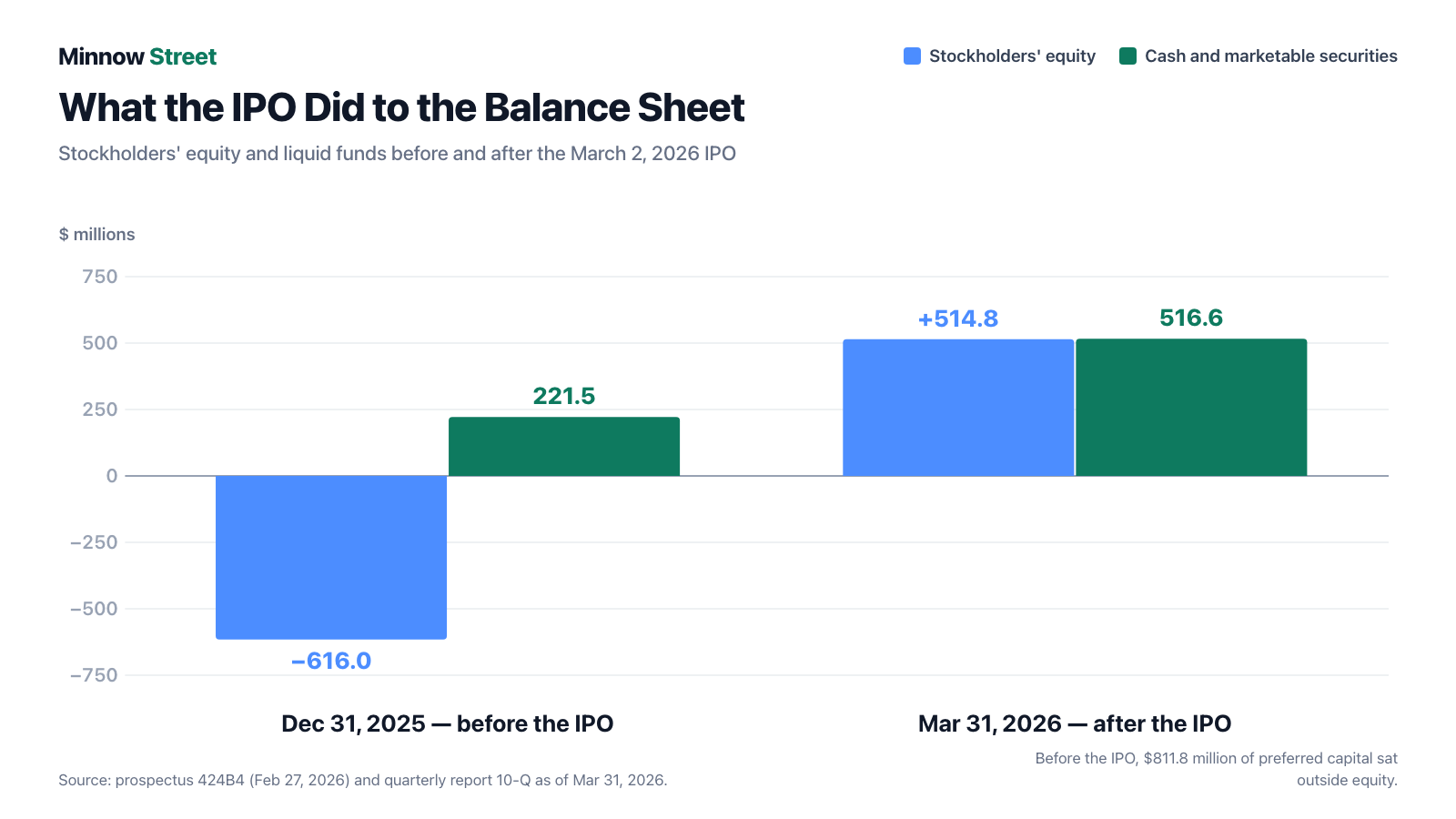
Now the second chart, which tells a quieter but more important story: what comes in, and what the research costs.
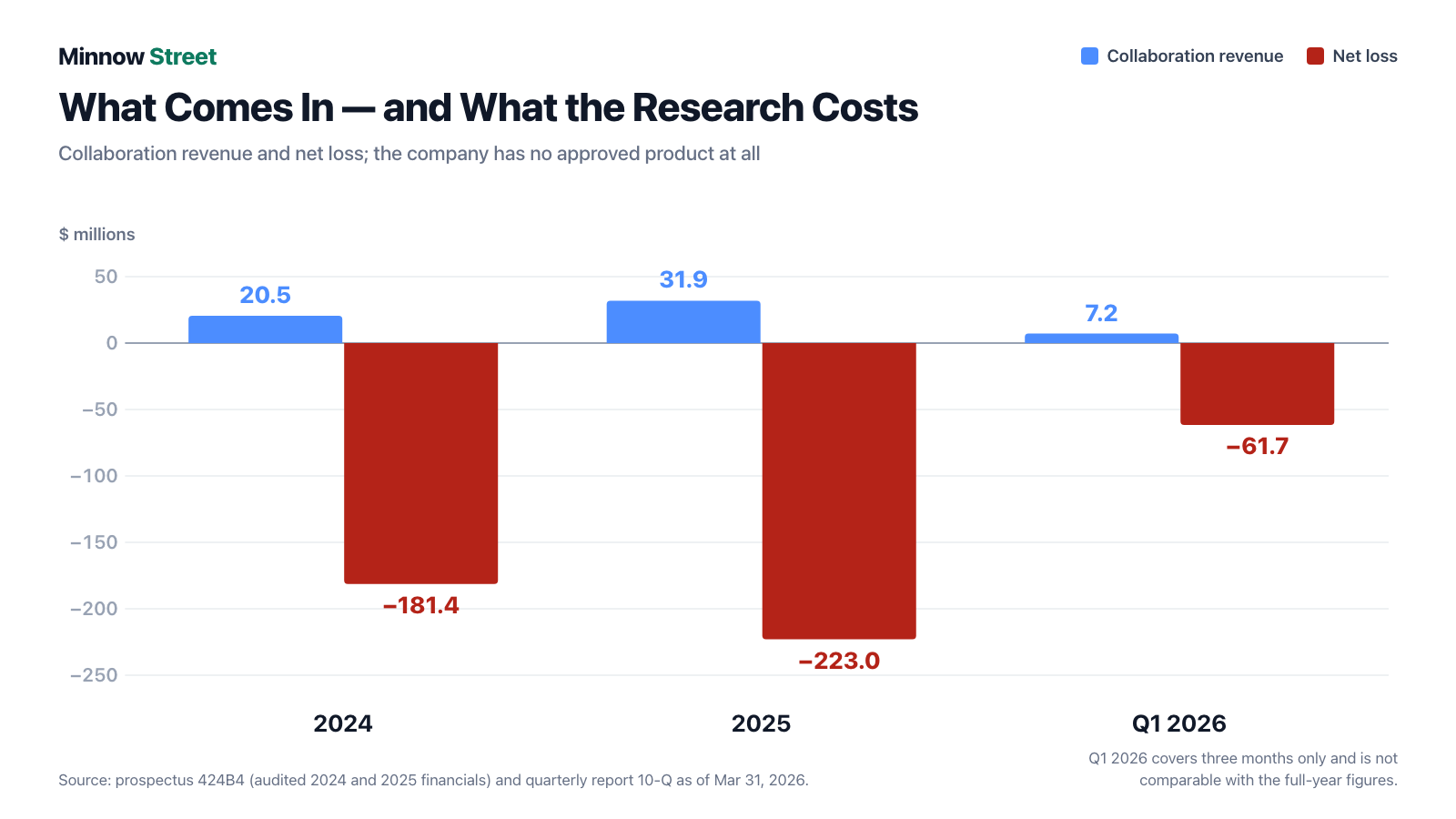
Revenue rose roughly 56 percent in 2025 to $31.9 million — which sounds good but is not growth in the usual sense, as we will see. The loss in the same year rose to $223.0 million, from $181.4 million in 2024. In the first quarter of 2026, $7.2 million came in (prior-year quarter: $8.8 million) against $71.3 million of operating expenses — $57.8 million for research and development, $13.5 million for general and administrative costs. The bottom line was a quarterly loss of $61.7 million, or $1.07 per share (prior-year quarter: $1.62, on a quarter as many shares). The accumulated deficit since inception stands at $737.7 million.
Two figures matter more than the loss itself. First, operating cash outflow: $80.4 million left the business in the first quarter of 2026, up from $53.2 million a year earlier. Measured against $516.6 million of cash and marketable securities on March 31, 2026, that arithmetic gives a little over six quarters — the company itself guides to runway "into the first half of 2028," because the burn varies over the trial cycle. Second, the reason for the increase: external research spending on GB-0895 alone rose from $3.8 million to $15.6 million in the quarter — a fourfold increase, because two Phase 3 trials are ramping at once. Remember the pattern: the closer a biotech gets to approval, the faster it burns money. Which brings us to the uncomfortable truths.
What the Filings Say — the Uncomfortable Truths
Uncomfortable Truth No. 1: The IPO Prospectus Carried a Going-Concern Warning — It Was Real, and It Is Gone
When an auditor doubts that a company can continue, it has to say so in the audit report. That is the sharpest sentence an accounting firm can utter about a business, and it stood in Generate Biomedicines' IPO prospectus — on page F-2, signed by Ernst & Young LLP in Boston:
"The accompanying consolidated financial statements have been prepared assuming that the Company will continue as a going concern. As discussed in Note 1 to the financial statements, the Company has suffered recurring losses from operations and has stated that substantial doubt exists about the Company's ability to continue as a going concern."
— Ernst & Young LLP, audit report in the SEC IPO prospectus Form 424B4 dated February 26, 2026, page F-2

The arithmetic behind it was simple: $221.5 million was left in the treasury on December 31, 2025, down from $393.6 million a year earlier. Against a full-year loss of $223.0 million, that was less than a year of runway. And because the two Phase 3 trials had only just started, the burn was set to rise, not fall.
Now the fair part, and it deserves the same emphasis: that warning is gone. The first quarterly report of the company's own says so plainly:
"As of December 31, 2025, the Company had concluded that there was substantial doubt about its ability to continue as a going concern. Upon closing of the IPO and receipt of the associated cash proceeds, the Company has alleviated the substantial doubt that previously existed, and based on the Company's current capital resources, which consists of its cash, cash equivalents and marketable securities on hand at March 31, 2026, it expects to have sufficient cash to support current operating plans into the first half of 2028."
— Generate Biomedicines, Inc., SEC quarterly report Form 10-Q as of March 31, 2026, Note 1 "Liquidity and Managements Plan"
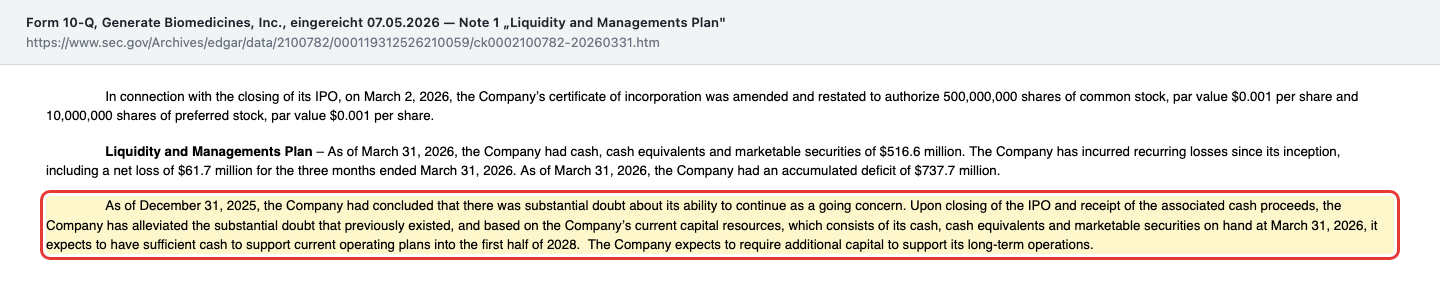
So why file this under "uncomfortable"? Because of the last clause of the same paragraph, which reads: "The Company expects to require additional capital to support its long-term operations." And because of a calendar coincidence worth reading twice. The cash lasts, by the company's own account, into the first half of 2028. Full enrollment of the two Phase 3 trials is likewise expected by the first half of 2028. In plain terms: the money lasts until just before the answer, but not reliably until the answer. At some point before that, Generate will need capital again — and whether it comes from new shares, a partner or a license will help decide how much of the company you end up owning.
Uncomfortable Truth No. 2: The Entire Revenue Line Is Two Prepayments Unwinding — and It Ends in 2027
"Revenue" sounds like something that comes back. At Generate Biomedicines it does not. The quarterly report is refreshingly direct about it: "Collaboration revenue consists entirely of revenue from the Novartis Collaboration Agreement and Amgen Collaboration Agreement." There is no product revenue, because no compound is approved.
Both agreements work the same way. The partner pays a large sum upfront, and Generate books that sum as revenue over the years while the research proceeds — the way a builder recognizes a deposit piece by piece as the work gets done. Amgen paid $50.0 million in December 2021 and another $5.0 million in late 2023 for a sixth target; Novartis paid $50.0 million in September 2024. Both also bought equity: Amgen for $25.0 million, Novartis for $15.0 million.
And here sits the number you need. The quarterly report quantifies exactly how much of those prepayments is left in accounting terms: from the Novartis agreement a remaining transaction price of $16.1 million, to be recognized through 2027, and from the Amgen agreement $2.4 million through 2026. Together $18.5 million. At a most recent quarterly revenue of $7.2 million, that is roughly two and a half quarters — after which the revenue line is empty unless something new arrives. The rise from $20.5 million to $31.9 million between 2024 and 2025 was accordingly not growth but a faster unwinding of the same pots.
What could arrive? Two things. Milestones: up to $370.0 million per program from Amgen ($160.0 million for development and regulatory steps, $210.0 million on commercial success) and up to $1.0 billion across all Novartis programs. Plus royalties on later sales, tiered "from a mid-single digit to a low tens percentage." Those are large numbers — but the report carries every one of them as constrained, meaning not recognized, because their occurrence is uncertain. To date exactly one such payment has arrived: $5.0 million from Amgen in 2024. And in July 2025 an Amgen amendment eliminated the remaining service obligation for one target. Remember the distinction: a contract worth a billion is not a billion — it is a ticket to a lottery that has not been drawn. How quickly such a royalty staircase can turn into a permanent burden is spelled out in our analysis of Alnylam, where every success makes the rate step more expensive.
Uncomfortable Truth No. 3: Every GB-0895 Product Carries a Royalty — Payable to the Largest Shareholder
This part is easy to skip on a fast read of the prospectus, because it looks like a technical group tidy-up. It is in fact the most durable economic point in this analysis.
Since 2023 Generate had a subsidiary called Pioneering Medicines 02, Inc. ("PMCo") in which another party held the majority of the equity: Pioneering Medicines 02, LLC ("PM LLC") — an entity of Flagship Pioneering, the firm that founded Generate in 2018 and remains by far its largest shareholder. On February 4, 2026, three weeks before the IPO priced, both signed a stock purchase agreement: Generate takes over PMCo in full. It closed on February 26, 2026 and was expressly contingent on the execution of the underwriting agreement for the IPO.
Payment was not in cash but in a permanent share of future revenue:
"The Company is obligated to make net sales payments equal to a high-single digit percentage of net sales of Generate Products, including any Generate Product that contains GB-0895."
— Generate Biomedicines, Inc., SEC quarterly report Form 10-Q as of March 31, 2026, Note 15 "Variable Interest Entities"
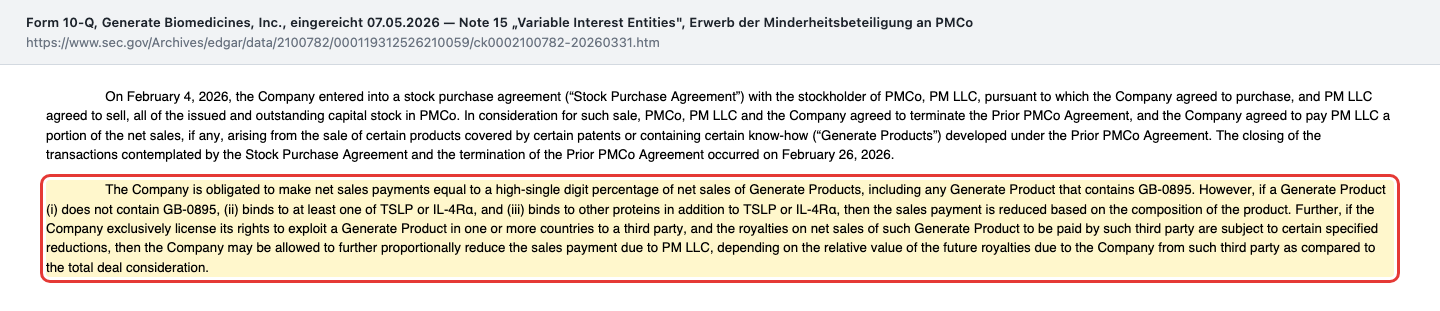
In everyday terms: imagine buying out your business partner's stake in your shared workshop — and paying not once, but by promising him a slice of every job the workshop ever wins. That is what happened here, for the product on which practically the entire value of the company rests.
How large is the recipient? The Schedule 13G filed on May 15, 2026 lists the Flagship group around Noubar Afeyan with 62,673,117 shares, or 48.9 percent — after the IPO. PM LLC itself appears there with 1,562,500 shares. So the same house earns twice on the success of GB-0895: through the equity stake you share as an investor, and through a revenue payment served ahead of you. Legally there is nothing objectionable about it, and it is fully disclosed. In fairness, too: either side can buy the obligation out — upon an exclusive out-licensing to a third party, or, at Generate's option, upon an acquisition by a "qualified acquirer" — in exchange for a single payment equal to the fair market value of the projected future payments. But the principle stands: part of the upside of this medicine is already committed before the first dollar of product revenue has been earned.
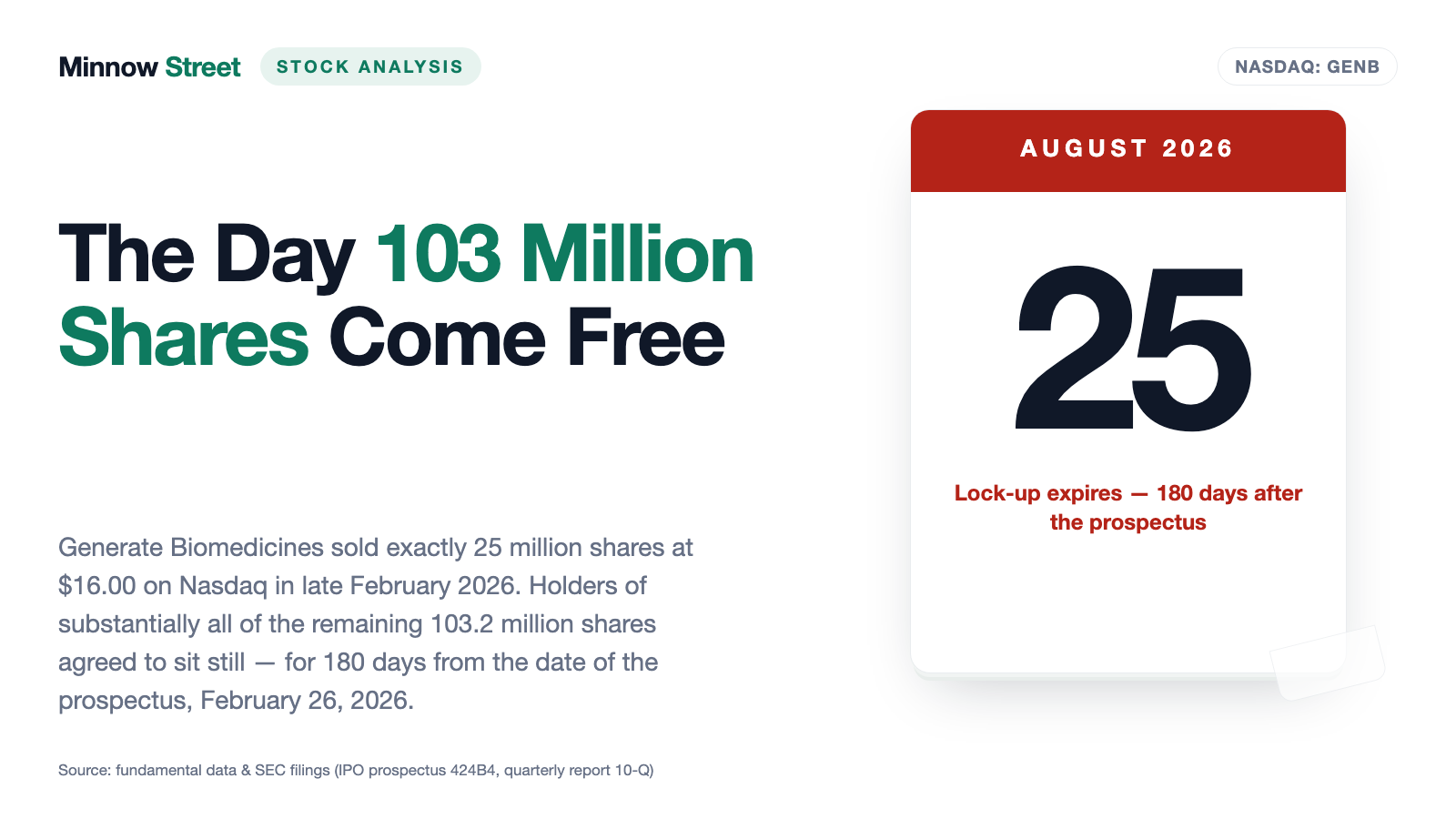
Uncomfortable Truth No. 4: On August 25, 2026 the Lock-Up Ends for Roughly 103 Million Shares
In an IPO only a fraction of the shares reaches the market. The rest sits with founders, venture investors and employees and is locked for a fixed period — otherwise everyone could sell on day one. That lock-up is not a detail, it is a supply gate with a date. The prospectus describes it this way:
"In connection with our initial public offering, we, all of our directors and officers and the holders of substantially all of our capital stock and securities convertible into or exchangeable for our capital stock have entered into lock-up agreements with the underwriters and/or are subject to market standoff agreements or other agreements with us under which we and they agreed, subject to specific exceptions, not to sell any of our stock for at least 180 days following the date of our initial public offering."
— Generate Biomedicines, Inc., SEC IPO prospectus Form 424B4 dated February 26, 2026, risk factors on future share sales

The legally binding "Underwriting" section counts the 180 days from the date of the prospectus, that is from February 26, 2026. That gives August 25, 2026. Only Goldman Sachs and Morgan Stanley can lift the lock-up early, and only in writing — which happens occasionally but is not the norm.
Now the scale, which is the point. Based on the share count of December 31, 2025 the prospectus projected 127,450,201 shares outstanding after the offering; in fact 128,192,484 shares were outstanding on March 31, 2026, confirmed both by the cover page of the quarterly report (as of April 29, 2026) and by both Schedule 13G filings of May 15, 2026. Of those, only 25,000,000 were placed in the IPO. The standstill covers the remaining roughly 103.2 million shares. The free float, per fundamental data as of July 26, 2026, is only 60,287,643 shares — Flagship alone holds more than the entire tradable float today.
Then there is the headroom for everything that follows: the amended certificate of incorporation of March 2, 2026 authorizes 500,000,000 common shares plus 10,000,000 preferred shares — up from 200,456,735 common before. Only 128,192,484 have been issued. That is not an announcement of a capital raise, but it is the legal room the company created for the round it says it will still need.
That others see the date too shows up in one number from the same data set: short interest of 6,985,520 shares, or roughly 9.4 percent of the float, up from 5,916,840 a month earlier. That is not a forecast and not a price argument — it is the sober observation that part of the market is positioning for the August date. Remember the principle: at a fresh listing, the calendar often matters more than the balance sheet.
Valuation: What Is Actually Being Paid For Here
There is no price-to-earnings ratio, because there are no earnings. A price-to-sales ratio can be calculated but misleads: at a market value in the order of $1.7 billion (data as of July 26, 2026) and $30.3 million of trailing twelve-month revenue it comes to roughly 57 — a number whose main message is that revenue plays no part in this valuation. The price-to-book ratio of about 3.3 is more honest: book value per share stood at $4.02 on March 31, 2026, and it consists almost entirely of the money the IPO brought in.
The most informative route therefore runs through the cash. Of the roughly $1.7 billion market value, $516.6 million is simply cash and marketable securities. The remainder — roughly $1.2 billion, which our data set reports as an enterprise value of $1.27 billion — is what the market pays for the platform and for three compounds in clinical testing, none of them approved. Put plainly: about $1.2 billion is pure expectation. Whether that is a lot or a little depends entirely on whether GB-0895 delivers in Phase 3 what the early data suggested — and severe asthma is a genuine unmet need, since by the industry sources cited in the prospectus only 15 to 25 percent of eligible patients receive a biologic at all. What such a single-asset calculation looks like when you carry it all the way through, we worked out for Abivax, where the overwhelming share of the stock price is likewise pure expectation.
A third anchor is the company's own offering price: on February 26, 2026 institutional investors bought 25 million shares at $16.00. Applied to all 128,192,484 shares, that price implies roughly $2.05 billion — while the market data feed shows about $1.72 billion as of July 26, 2026, some 16 percent lower. The professionals are split: the average analyst price target in our data set is $25.40, well above the offering price, while at the same time 9.4 percent of the float is sold short. Both camps have read the same documents. That alone says a good deal about how uncertain this valuation is.
Opportunities and Risks at a Glance
What speaks for Generate Biomedicines:
- The platform has delivered rather than merely promised: three computationally designed proteins are in clinical testing, GB-0895 in two Phase 3 trials since December 2025; GB-4362 received FDA Fast Track designation on January 23, 2026.
- A differentiated lead asset: GB-0895 binds at 106 femtomolar, roughly twenty times more tightly than the approved comparator, with a half-life of about 98 days — one injection every six months instead of every two to eight weeks would be a real patient benefit.
- External validation from two heavyweights: Amgen (since December 2021) and Novartis (since September 2024) each paid $50.0 million upfront and bought equity for $25.0 million and $15.0 million respectively; up to $370.0 million per Amgen program and up to $1.0 billion across all Novartis programs remain possible.
- Solidly funded for the next few years: $516.6 million of cash and marketable securities on March 31, 2026, positive equity of $514.8 million, total liabilities of only $110.9 million; the auditor's going-concern paragraph is expressly alleviated.
- A qualified team and a patient anchor investor: 312 full-time employees as of December 31, 2025, 138 of them with doctorates and 254 in research; founder and largest shareholder Flagship Pioneering still holds 48.9 percent after the IPO, and the board includes chemistry Nobel laureate Frances H. Arnold.
What speaks against it:
- No approved product, no product revenue, an accumulated deficit of $737.7 million (March 31, 2026) — and a quarterly loss of $61.7 million with $80.4 million of operating cash outflow.
- The entire revenue line is running out: $16.1 million remaining from Novartis (through 2027) and $2.4 million from Amgen (through 2026); every milestone is carried as uncertain, and exactly one has ever been paid, $5.0 million in 2024.
- A permanent high-single-digit share of net sales of every GB-0895-containing product goes to Pioneering Medicines 02, LLC — an entity of the 48.9 percent shareholder Flagship Pioneering; it took effect with the IPO pricing on February 26, 2026.
- Single-asset concentration: external research spending on GB-0895 quadrupled to $15.6 million in the first quarter of 2026; if that one Phase 3 program fails, the overwhelming share of the valuation goes with it.
- A supply date and a funding gap: on August 25, 2026 the lock-up expires for roughly 103.2 million shares against a free float of 60,287,643; and the runway "into the first half of 2028" ends exactly when Phase 3 enrollment is supposed to be complete — the company itself expects to need additional capital.
A Human Conclusion
Back to the fresh-start illusion. Its core is not that an IPO conceals something — quite the opposite, a company is rarely as fully disclosed as at the moment of listing. Its core is that a healed balance sheet feels like a healed company. At Generate Biomedicines those are demonstrably not the same thing. The $369.3 million answered a genuine existential question: the company will not run out of money in the next few years. It answered none of the other three — whether GB-0895 works in Phase 3, what the company will live on once the last $18.5 million of contracted revenue is used up in 2027, and how much of an eventual success even reaches the new shareholders, given that part of it is contractually committed to the largest legacy owner.
You can like this stock for good reasons. Software that invents proteins which never existed, and that carries one of them from design to the third clinical phase within a few years, is not a brochure but a documented technical achievement — and if one injection every six months genuinely controls severe asthma, that is a large business. You can avoid it for equally good reasons: because a company without a product, whose only revenue contractually expires, is in truth a research project with a stock listing.
So the honest question is not "is this the next big AI story?" but: are you willing to fund a single clinical trial whose answer arrives late this decade at the earliest — knowing that on August 25, 2026 roughly 103 million locked shares become mobile, and that a slice of any eventual success goes to the largest shareholder first? If yes, you have a thesis and a clear calendar against which to test it. If no, you had a nice story. What you make of it is your decision. And that is exactly as it should be.
Sources
Every original document used in this analysis — for you to read yourself:
- Generate Biomedicines, Inc. — SEC IPO prospectus Form 424B4 (prospectus dated February 26, 2026, filed February 27, 2026), containing the audited 2024 and 2025 financial statements and the Ernst & Young LLP audit report
- Generate Biomedicines, Inc. — SEC quarterly report Form 10-Q as of March 31, 2026 (filed May 7, 2026)
- Generate Biomedicines, Inc. — SEC current report Form 8-K of March 2, 2026 (Item 5.03, amended certificate of incorporation after the IPO)
- Generate Biomedicines, Inc. — SEC current report Form 8-K of May 7, 2026 (Item 2.02, quarterly results)
- Schedule 13G ownership filings of May 15, 2026 (Flagship group around Noubar Afeyan; Michael Nally) — complete SEC filing history of Generate Biomedicines (EDGAR)
- Fundamental data (market value, free float, short interest, analyst price target; data as of July 26, 2026), reconciled against the SEC filings.
- Hook: Reddit mention scan of July 26, 2026; scanner status checked via our in-house stock scanner on the same date.
Transparency & disclaimer: this analysis is a journalistic assessment of publicly available information. It is not investment advice, not a regulated financial analysis and not a solicitation to buy or sell securities. Equity investments carry substantial risk up to total loss; that applies with particular force to biotech companies without an approved product. All information without warranty; the as-of date for each figure is noted in the text. At the time of publication the author holds no position in shares of Generate Biomedicines.
Our Bottom Line at a Glance
- Technology and pipeline positive
- The platform has delivered what many AI biotechs only promise: three computationally designed proteins are in clinical testing. GB-0895 binds TSLP at 106 femtomolar, roughly twenty times more tightly than the approved comparator, carries a half-life of about 98 days and has been in two Phase 3 trials since December 2025 (first patient dosed January 26, 2026). GB-4362 received Fast Track designation on January 23, 2026. That Amgen (since 2021) and Novartis (since 2024) each paid $50.0 million upfront plus equity is external validation.
- Balance sheet and funding positive
- The IPO repaired the balance sheet: stockholders' equity moved from minus $616.0 million (December 31, 2025) to plus $514.8 million (March 31, 2026), cash and marketable securities from $221.5 million to $516.6 million, total liabilities from $141.6 million down to $110.9 million. The auditor's going-concern paragraph is expressly alleviated per the quarterly report of May 7, 2026, and the company puts its runway "into the first half of 2028."
- Earnings power and revenue base negative
- There is no approved product and no product revenue. The $31.9 million of 2025 revenue and $7.2 million in the first quarter of 2026 come 100 percent from two collaborations — and both have a contractual end: $16.1 million of the Novartis upfront remains to be recognized (through 2027) and $2.4 million of Amgen's (through 2026). Against that stand $71.3 million of quarterly operating expenses and $80.4 million of operating cash outflow in the first quarter of 2026 alone.
- Single-asset dependency negative
- External research spending on GB-0895 alone rose to $15.6 million in the first quarter of 2026, from $3.8 million a year earlier — a fourfold increase. Virtually the entire value of the company rides on that one Phase 3 program, whose full enrollment is not expected before the first half of 2028. That is exactly when the cash runway ends by the company's own account: it states that it expects to require additional capital to support its long-term operations.
- Ownership and royalty negative
- With the IPO pricing on February 26, 2026, an obligation took effect to pay a high-single-digit percentage of net sales of every GB-0895-containing product to Pioneering Medicines 02, LLC — an entity of largest shareholder Flagship Pioneering, which per the Schedule 13G filed May 15, 2026 still holds 62,673,117 shares, or 48.9 percent. The upside of the lead asset is permanently shared with the largest owner before the first dollar of product revenue ever arrives.
- Share supply and lock-up neutral
- Of 128,192,484 shares outstanding (March 31, 2026), only 60,287,643 sat in the free float as of July 26, 2026; for substantially all of the remaining roughly 103.2 million shares the lock-up expires on August 25, 2026, 180 days after the prospectus date. Short interest stands at 6,985,520 shares, or 9.4 percent of the float, up from 5,916,840 a month earlier. That is not a solvency finding, but it is a dated supply event worth knowing about.
Generate Biomedicines is the fresh-start illusion in its purest form: the IPO of March 2, 2026 swung stockholders' equity from minus $616.0 million to plus $514.8 million in a single quarter and cleared the auditor's going-concern paragraph — while changing nothing about the business itself. There is no approved product, all revenue ($31.9 million in 2025) comes from two collaborations that contractually run out by 2027, and the first quarter of 2026 alone consumed $80.4 million of operating cash. On top of that sit two burdens the same IPO created: a high-single-digit royalty on every GB-0895 product payable to an entity of the 48.9 percent shareholder Flagship Pioneering — and a lock-up that expires on August 25, 2026. The science may still turn out to be world class; it simply is not proven yet. Not investment advice.
What Our Rating Means
Open questions
The business works in principle, but one material question is open. As long as it stays open, our findings do not carry a quality verdict.
This rating judges the company, not the share price. Red is not warranted: stockholders' equity is positive at $514.8 million, cash and marketable securities stood at $516.6 million on March 31, 2026 against $80.4 million of operating cash outflow in the quarter, and the going-concern paragraph Ernst & Young issued in the IPO prospectus is expressly described as alleviated in the quarterly report of May 7, 2026. Green is not warranted either, because there is no proof the business model carries: no compound is approved, there is no product revenue, and the $31.9 million of 2025 collaboration revenue is a remainder with an expiry date — $16.1 million from Novartis through 2027 and $2.4 million from Amgen through 2026. That leaves exactly the open operating question yellow describes: whether GB-0895 delivers in Phase 3 what the Phase 1 data suggested. The answer arrives after full enrollment in the first half of 2028 at the earliest — and the company says it will need additional capital before then. The decision is yours.
A journalistic assessment by our editorial team at the time of the deep dive, based on public sources — not investment advice and not a solicitation to buy or sell. Your personal circumstances (investment goals, risk capacity, taxes) cannot be taken into account. What our levels mean, how verdicts are formed, and what conflicts of interest exist →
Worth Noting
- GENB reached our research list through the Reddit mention scan of July 26, 2026, not through a metrics screen. As of that same date the stock appears on no list of our in-house stock scanner — normal for a company that only listed in February 2026, because almost every filter requires multi-year series. The scanner lists are recalculated daily.
- Data basis and timeliness: no annual report (10-K) exists for GENB yet. The audited 2024 and 2025 figures come from the IPO prospectus (Form 424B4, prospectus dated February 26, 2026, filed February 27, 2026) carrying the Ernst & Young LLP audit report dated February 4, 2026. The most recent periodic report is the quarterly report (10-Q) as of March 31, 2026, filed May 7, 2026 and fully evaluated. Everything filed since has been reviewed: two Schedule 13G ownership filings dated May 15, 2026, from the Flagship group around Noubar Afeyan (62,673,117 shares, 48.9 percent) and from CEO Michael Nally (6,919,051 shares, 5.2 percent); both confirm 128,192,484 shares outstanding as of March 31, 2026. There is no Form 15 and no Form 25 — the Nasdaq listing remains in place.
- On valuation: the market value used here is an order of magnitude, not a daily figure. The market data feed shows roughly $1.72 billion as of July 26, 2026. The cross-check from the filings — 128,192,484 shares times the $16.00 IPO price — gives $2.05 billion. The 16.3 percent gap sits below the one-fifth threshold at which we discard a market value and every metric derived from it. The Altman Z-score of −3.49 and the Piotroski score of 3 in our data set carry no meaning for a biotech without product revenue and are deliberately not used as arguments here.
- Possible confusion: the company was named Generate Biologics, Inc. until February 2020. The reverse stock split of February 20, 2026 is already reflected in every share count and per-share figure quoted here, as it is in the SEC filings. The subsidiary Pioneering Medicines 02, Inc. (PMCo) and its sole stockholder Pioneering Medicines 02, LLC (PM LLC) are two different entities: the Inc. has belonged entirely to Generate since February 26, 2026, while the LLC receives the royalty and itself holds 1,562,500 GENB shares.
Frequently Asked Questions
Generate Biomedicines, Inc. (Nasdaq: GENB) of Somerville, Massachusetts designs protein therapeutics with generative AI models. Its in-house Generate Platform pairs diffusion models and graph neural networks with automated laboratory systems that build and measure the proposals at scale. Three compounds from that loop are in clinical testing — GB-0895, GB-4362 and GB-5267. As of March 31, 2026, none of them is approved.
Because the IPO only closed on March 2, 2026. A company files its first annual report on Form 10-K after the end of its first full fiscal year as a public company. The audited 2024 and 2025 financial statements appear instead in the IPO prospectus (Form 424B4) dated February 26, 2026, together with the audit report from Ernst & Young. The first quarterly report (Form 10-Q) is dated May 7, 2026.
No — the IPO removed it. In the prospectus dated February 26, 2026 the Ernst & Young audit report still carried a going-concern paragraph. The quarterly report of May 7, 2026 states verbatim that the proceeds from the IPO alleviated the substantial doubt that previously existed. Cash and marketable securities stood at $516.6 million on March 31, 2026, and the company expects that runway to last "into the first half of 2028."
Entirely from two collaborations: Novartis (since September 19, 2024) and Amgen (since December 24, 2021). Both pay for the Generate Platform to design proteins against their targets; the quarterly report expressly treats both as customers under the ASC 606 revenue standard. In the first quarter of 2026 that meant $6.5 million from Novartis and $0.7 million from Amgen. There is no product revenue at all.
On August 25, 2026. Per the prospectus, the lock-up runs 180 days from the prospectus date of February 26, 2026; Goldman Sachs and Morgan Stanley may release it early. It binds the company, its officers and directors and the holders of substantially all remaining shares — of 128,192,484 shares outstanding, only 60,287,643 sat in the free float as of July 26, 2026.
GB-0895 is an antibody against the signaling protein TSLP, designed on the Generate Platform. It binds roughly twenty times more tightly than the approved comparator and has a half-life of about 98 days — which is why it is meant to be injected only every six months rather than every two to eight weeks. Two Phase 3 trials in severe asthma have been running since December 2025; full enrollment is not expected until the first half of 2028.
Pioneering Medicines 02, LLC — an entity of largest shareholder Flagship Pioneering, which still holds 48.9 percent after the IPO. With the pricing on February 26, 2026, Generate bought out the minority interest in its PMCo subsidiary and in exchange committed to payments equal to a high-single-digit percentage of net sales of every product containing GB-0895. Either side may buy out the obligation under defined conditions.
Very expensive on classic metrics — which says little for a biotech without an approved product. At a market value in the order of $1.7 billion (data as of July 26, 2026) and $30.3 million of trailing twelve-month revenue, price-to-sales is roughly 57 and price-to-book 3.3. No price-to-earnings ratio exists, because there are no earnings. The price is essentially a bet on GB-0895.
Found an error?
Did you spot a factual error, an outdated number, or a typo in this deep dive? Let us know briefly — your report goes straight to the editorial team.