Abivax: One Drug, 69 Employees — and $111 of a $125 Share Price Is Pure Expectation
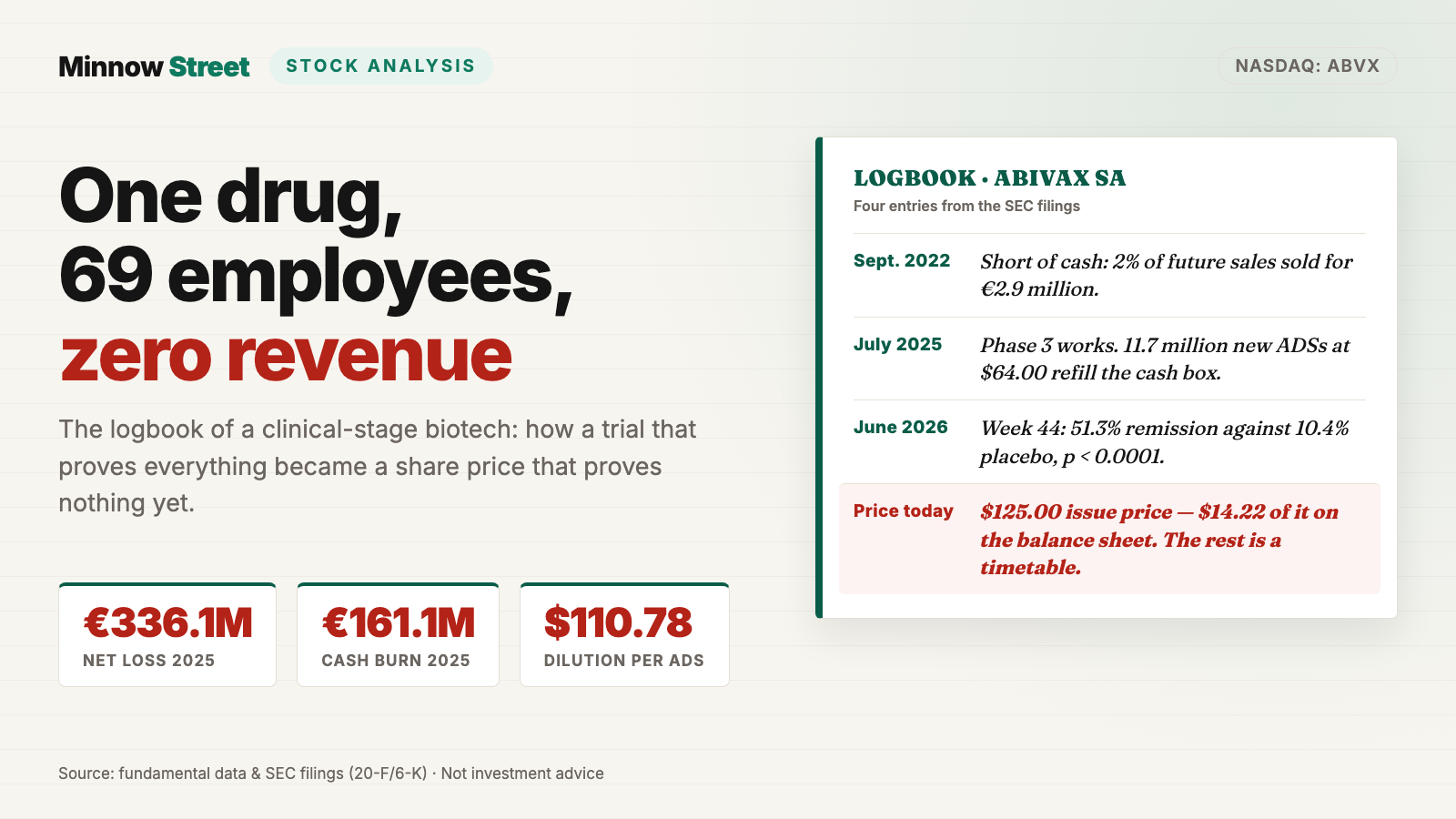
The trial data at Abivax are about as good as trial data get: in June 2026, 51.3 percent of patients on obefazimod were in clinical remission after 44 weeks, against 10.4 percent on placebo, p below 0.0001. The same filings with the U.S. securities regulator, the SEC, carry the other half of the story: no product revenue at all, a net loss of €336.1 million in 2025, €161.1 million of cash burned, and 96.5 percent of research spending inside a single molecule. The bill is paid in stock — 62.9 million shares at the end of 2023, roughly 86.1 million after the offering of June 30, 2026. In that offering prospectus Abivax does the arithmetic itself: of the $125.00 issue price, $110.78 is dilution. London hedge fund Helikon Investments opened a brand-new position in the first quarter of 2026. Not investment advice — just the sum of how much of a share price is evidence and how much is an advance on an approval nobody has even applied for yet.
 Thomas Mücke
Founder & Publisher
Thomas Mücke
Founder & Publisher
Chart
Interactive price chart (TradingView).
Note: pure fact-based analysis, not investment advice and not a solicitation to buy or sell. All figures without guarantee.
There is an investor trap that springs shut precisely where the work was done most carefully — call it the p-value trap. It goes like this: you read a trial result, and it carries a kind of rigor the stock market almost never offers. 1,275 patients, 36 countries, double-blind, placebo-controlled, and at the end a number like p < 0.0001. Translated: the probability that this effect was chance is below one in ten thousand. Your brain files that under "proven" — and stops asking. Yet the p-value answered exactly one question: does the drug work? It says nothing about whether the drug gets approved, what it may cost, who pays for it, how many more shares it takes to get there, and what the company is worth on the exchange. At Abivax SA (Nasdaq: ABVX; also Euronext Paris) that is the whole situation: a Paris biotech with 69 full-time employees, one relevant drug candidate, and perhaps the best Phase 3 data published in gastroenterology in 2026. So let's make a deal: before you mistake statistical strength for investment safety, we read together what Abivax itself reported to the U.S. securities regulator, the SEC — the annual report (20-F) for 2025, the interim report as of March 31, 2026, and the prospectus for the share offering of June 30, 2026. A filing to the SEC is honest under penalty of law. And this one tells you about a molecule that works, a cash pile with an expiry date, and an issue price on which the company itself calculates how much is substance. In the end, the decision is yours.
What Abivax actually does — one company, one molecule
Abivax is a clinical-stage biotech company, founded in Paris in 2013, listed on Euronext Paris since June 2015 and additionally on Nasdaq since October 2023. "Clinical-stage" is the operative word: the company develops a medicine, it does not sell one. There is no approved product, no sales force, no pharmacy where you could buy anything from Abivax — and therefore no product revenue. What there is, is obefazimod (formerly ABX464), a once-daily tablet that boosts the body's own signaling molecule miR-124. Translated into an everyday image: the immune system of someone with inflammatory bowel disease behaves like a burglar alarm that keeps screaming although nobody broke in. Most modern therapies cut individual wires of that alarm — each one blocks a single messenger substance. Obefazimod instead turns down the sensitivity of the whole system by amplifying a damper the body already has. Target disease number one is ulcerative colitis (UC), a chronic inflammation of the colon; target disease number two is Crohn's disease, where a Phase 2b trial is running.
How completely everything hangs on that one molecule shows up in the research budget. Of €177.8 million in research and development spending in 2025, €171.6 million went into obefazimod — 96.5 percent. Of that, €117.4 million went to ulcerative colitis and €17.6 million to Crohn's disease. The remaining €6.2 million covers everything else the company does. With 69 full-time employees as of December 31, 2025 — 49 of them in research and development, 42 in France and 27 in the United States — Abivax has one of the smallest headcounts you will find on Nasdaq relative to its market value. That names the central tension of this analysis, and it runs through every chapter below: the efficacy of obefazimod is as well documented as that of almost any new drug of recent years — the commercial success is entirely unproven, and the share price already prices the second part in.
How this stock landed on our desk
Not through one of our momentum or value scanners, but through a mandatory filing — and through a contradiction that makes you curious. London hedge fund Helikon Investments Ltd reports in its Form 13F-HR for the quarter ended March 31, 2026 (filed May 8, 2026) 1,013,324 Abivax shares worth $112,833,627. The remarkable part is not the size but the origin: at June 30, 2025, at September 30, 2025 and at December 31, 2025 the fund reported zero shares each time. So this is a brand-new position. And it sits in a portfolio it does not obviously fit: Helikon reports 17 U.S. positions worth $2,648,555,113 in total, dominated by miners (Skeena, Allied Gold, Collective Mining, Silvercorp) and Argentine names (Corporación América Airports, TGS, IRSA, Edenor). A French clinical biotech with no revenue is a foreign body in that neighborhood. In the same quarter the fund opened six brand-new positions and sold six others out entirely — Abivax is one of the newcomers.
Before that turns into a signal, here is the framing that such headlines always leave out: a 13F is a rearview mirror, not a roadmap. It shows only U.S.-listed long positions, appears with a 35 to 45 day delay, and contains neither short sales nor derivatives nor European holdings — which matters especially for a stock with a second listing on Euronext Paris. What happened between the reporting date and the filing date, nobody outside the fund knows. Exactly one fact is documented: a professional investor bought in during the first quarter of 2026. Why, he does not say.
And the classic metrics from our in-house stock scanner? They barely help here — and that deserves to be said plainly instead of being papered over with a pretty table (data as of July 23, 2026). There is no price-to-earnings ratio, because there are no earnings. The Piotroski F-Score, a nine-point test for improving balance sheet quality, stands at 4 of 9 — but at a company with no revenue and no profit that test mostly measures noise. The equity ratio of 77.9 percent as of December 31, 2025 looks perfectly healthy and is, but it only says that the balance sheet consists almost entirely of money collected from shareholders. And three metrics are missing altogether: Altman Z-Score, net current asset value and cash balance are deliberately not shown by our system, because Abivax keeps its books in euros while the stock trades in U.S. dollars — a currency guard that would rather show an empty field than a wrong number. The revenue series is no use either: Abivax reports semi-annually in France, four of the last eight quarters simply show zero, and one quarter even shows a negative figure because a research tax credit was corrected after the fact. Remember the finding right at the start: at a clinical-stage biotech you do not measure with revenue and margin, but with cash, burn rate, trial status and share count. That is exactly what we do now.
The numbers over the years — honestly appraised
First the part that genuinely speaks for Abivax, and it is the substance of the whole case: the trial data. The Phase 3 ABTECT program comprised two induction trials and one maintenance trial across 36 countries; 1,275 patients were randomized in total and 1,272 were treated. In the pooled induction analysis (announced July 22, 2025), 20.8 percent of patients on 50 mg obefazimod were in clinical remission after eight weeks, against 4.4 percent on placebo. The real proof arrived on June 1, 2026 from the maintenance trial: after 44 weeks, 51.3 percent of patients on 50 mg and 50.8 percent on 25 mg were in clinical remission — against 10.4 percent on placebo. All key secondary endpoints were met, from endoscopic improvement to corticosteroid-free remission. And this was a difficult patient group: about half had already failed at least one advanced therapy, roughly one in five of those a JAK inhibitor as well. If you want to know how rare such numbers are: per the company, the placebo remission rate of 10.4 percent is the lowest ever reported in a Phase 3 ulcerative colitis maintenance re-randomization trial. The same announcement puts the planned NDA submission to the FDA in the late fourth quarter of 2026.
And now the other half of the same company. Those trials cost money, a great deal of money, and Abivax took in nothing while running them:
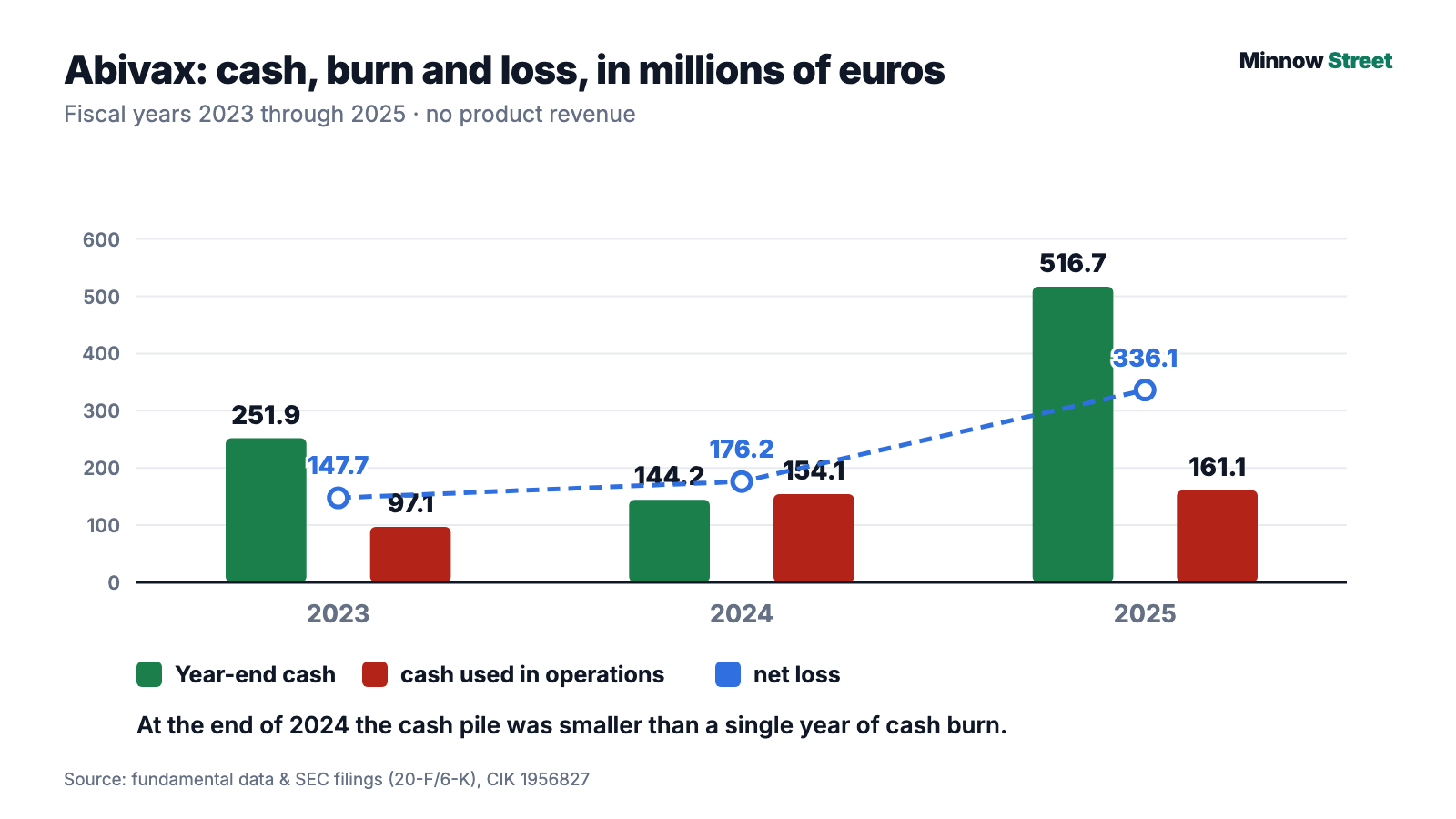
The net loss rose from €147.7 million (2023) through €176.2 million (2024) to €336.1 million (2025) — up 91 percent. Cash used in operations, meaning the money that actually leaves the building, came to €161.1 million in 2025 (2024: €154.1 million; 2023: €97.1 million). In the first quarter of 2026 it was already €50.5 million, against €33.3 million in the prior-year quarter — the burn is accelerating, because the preparation of a market launch is being paid for alongside the trials. The company's only income is €4.6 million of other operating income (2025), essentially the French research tax credit (CIR) of €3.1 million. For scale: that is less than Abivax spends in two weeks.
One detail is easy to miss and shows the drop height: as of December 31, 2024, total shareholders' equity was down to €40.6 million, from €196.0 million a year earlier. At that point Abivax was arithmetically less than a quarter away from needing capital. What saved the company was not income but the stock market: on July 28, 2025 it placed 11,679,400 ADSs at $64.00 and took in gross proceeds of $747.5 million (€637.5 million). Remember the pattern, because it is the core of this business model: a clinical-stage biotech does not earn its money in the market but in the capital market — and the capital market pays in shares.
What the filings say — the uncomfortable truths
Uncomfortable truth no. 1: everything hangs on one single molecule
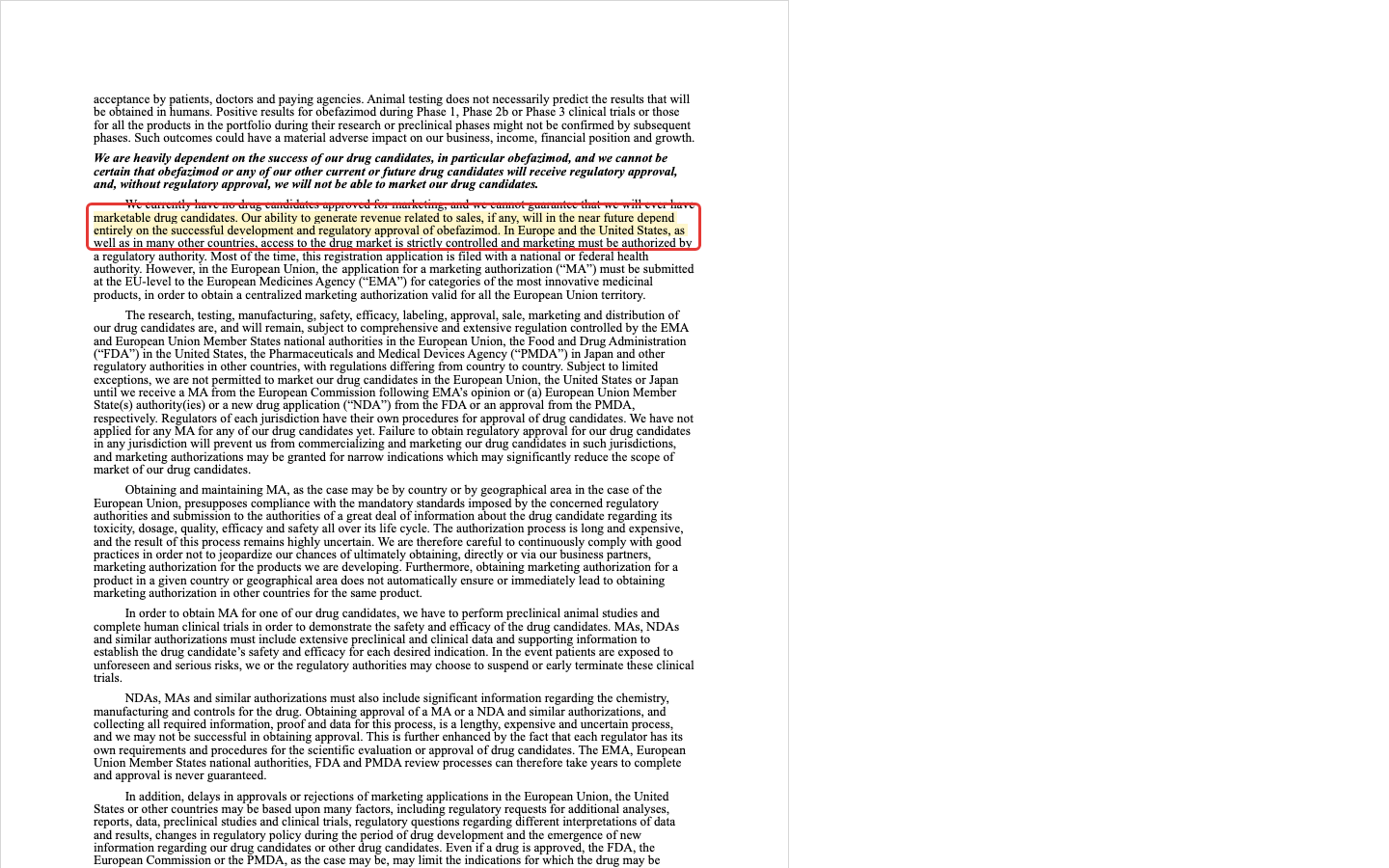
The annual report states that dependency unusually plainly — no marketing, no hedging:
"Our ability to generate revenue related to sales, if any, will in the near future depend entirely on the successful development and regulatory approval of obefazimod."
— Abivax SA, SEC annual report 20-F for 2025, Item 3.D "Risk Factors"
Translated into an everyday image: picture a builder who has worked on a single commission for thirteen years, has put every bit of savings and several loans into it, and whose entire future depends on whether the final inspection passes. The workmanship is excellent, the expert reports are glowing — but there is no second commission to catch a failure. At Abivax that second leg exists only as a line in the research budget: €17.6 million for Crohn's disease, where the Phase 2b trial ENHANCE-CD is running and results are expected, per the company, in mid-2027 — after the planned approval decision for ulcerative colitis. To be fair: the safety data look unremarkable so far. Through the data cut of September 30, 2025, 1,372 patients had received obefazimod, 324 of them for more than a year; the most common adverse event is headache. In the maintenance trial, three malignancies other than non-melanoma skin cancer occurred in the 50 mg arm, which investigators assessed as not treatment-related — for a drug meant to be taken for life, that is a number to keep watching in the years ahead.
Uncomfortable truth no. 2: the cash has an expiry date — and the company names it itself
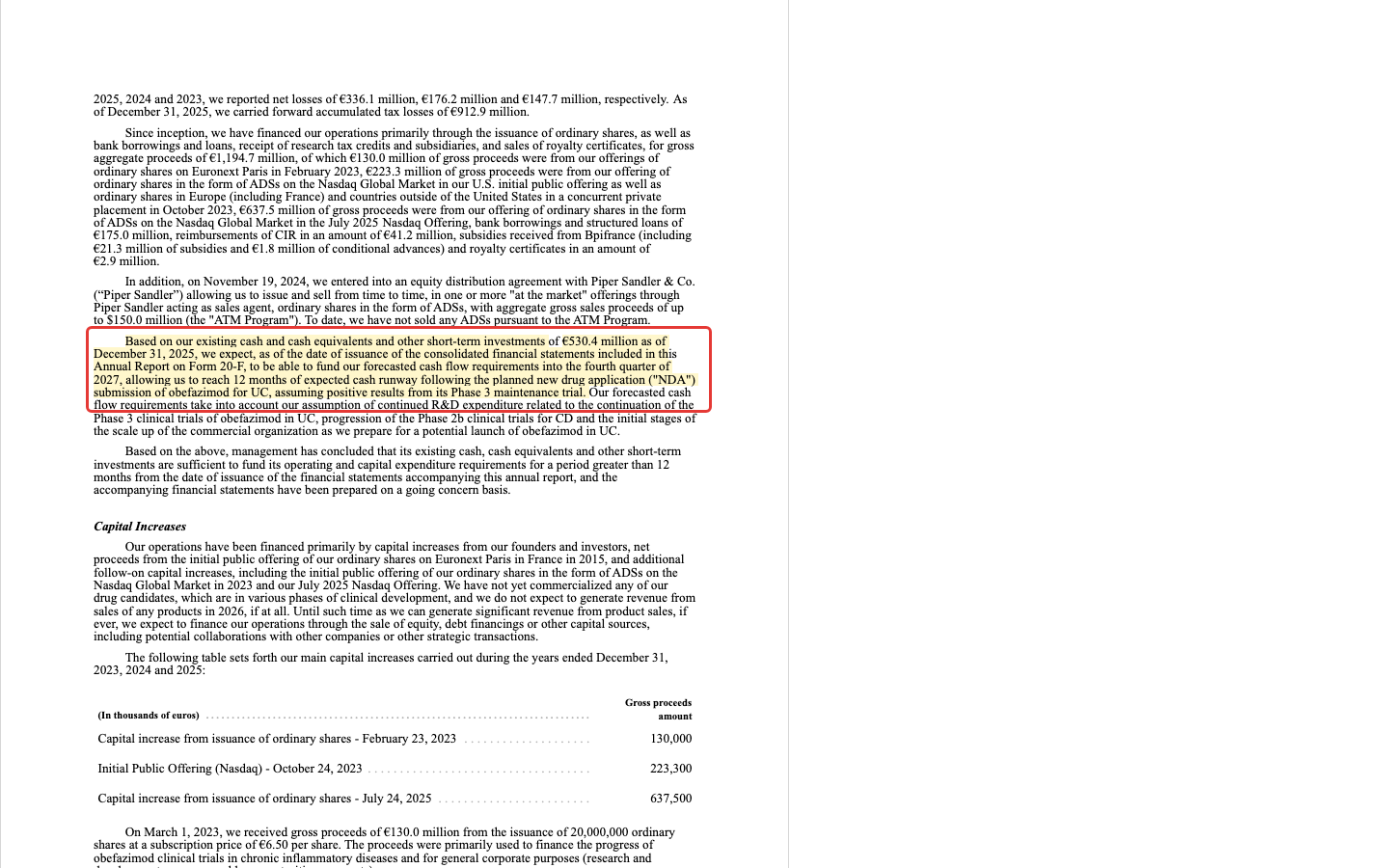
At a company with no revenue, the most important metric is not margin but cash runway: how long does the money on hand last? Abivax answers that question in the annual report itself — and attaches a condition:
"Based on our existing cash and cash equivalents and other short-term investments of €530.4 million as of December 31, 2025, we expect […] to be able to fund our forecasted cash flow requirements into the fourth quarter of 2027, allowing us to reach 12 months of expected cash runway following the planned new drug application ("NDA") submission of obefazimod for UC, assuming positive results from its Phase 3 maintenance trial."
— Abivax SA, SEC annual report 20-F for 2025, Item 5.B "Liquidity and Capital Resources"
As of March 31, 2026 that liquidity stood at €491.6 million and the runway statement was unchanged. Do the arithmetic yourself: at a recent burn of roughly €50 million per quarter — and rising — half a billion carries you about two to two and a half years. Which is exactly why Abivax did not wait. After the positive maintenance data of June 1, 2026, the company placed 6,400,000 new ADSs at $125.00 on June 30, 2026; net proceeds of about $759.8 million (€666.8 million) were expected on closing, set for July 6, 2026. On a pro forma basis that puts roughly €1,105 million in the bank. That is the good news — and at the same time the bridge to the next uncomfortable truth, because this money is not a gift.
Uncomfortable truth no. 3: of a $125 issue price, $111 is expectation — per the company's own prospectus
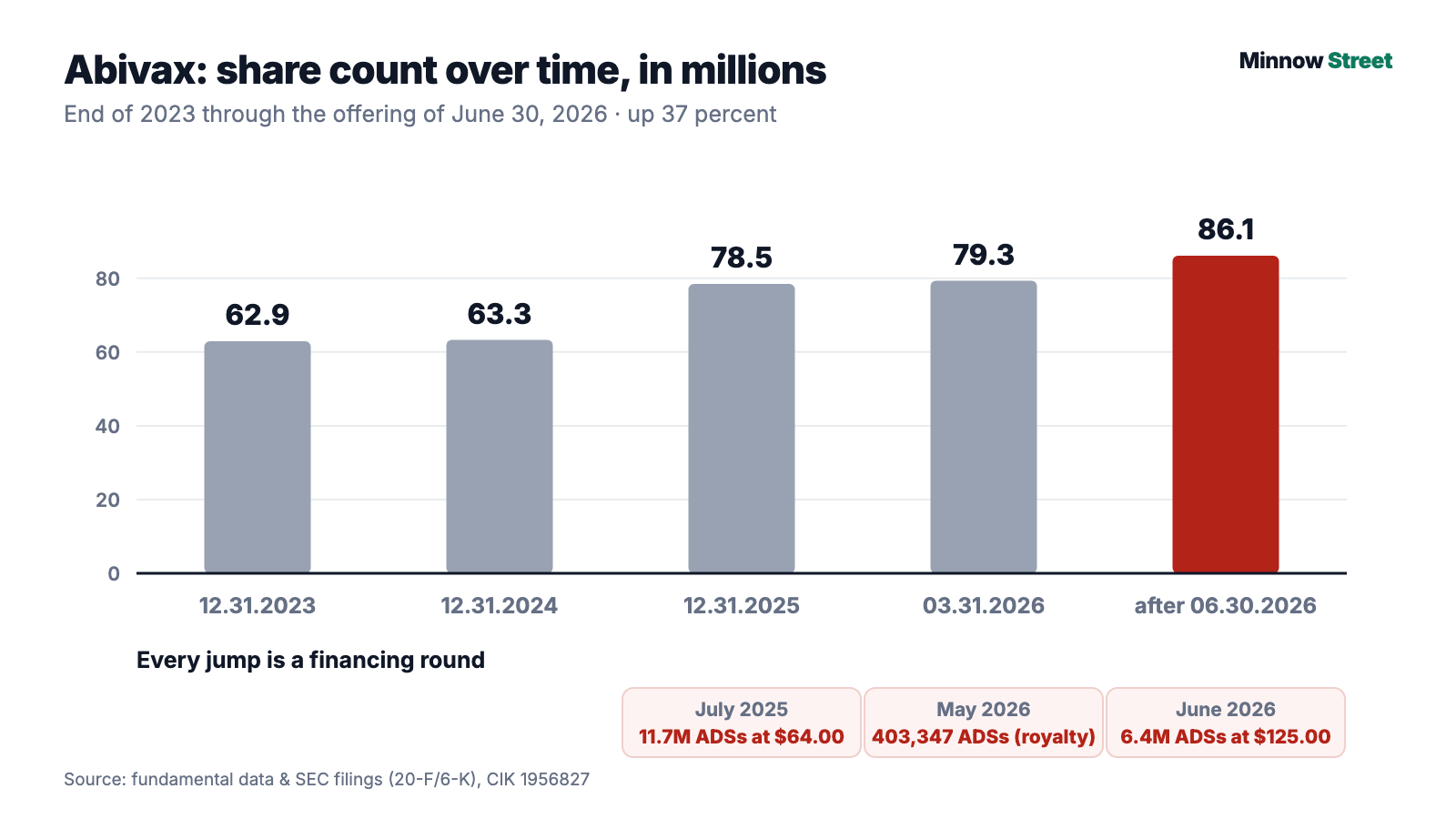
Every capital raise by a biotech is dilution: your slice of the cake gets smaller because new slices keep being cut — except that here the proceeds go into baking the same cake further. At Abivax the process can be counted line by line. The share count stood at 62,928,818 at the end of 2023, 63,347,837 at the end of 2024, 78,536,412 at the end of 2025 after the July offering and the conversion of all convertible notes, and 79,291,188 as of March 31, 2026. After the royalty buyback in May and the offering of late June 2026 it is roughly 86.1 million — up 37 percent in two and a half years.
What a buyer actually receives in substance for that issue price is something Abivax calculates itself in the prospectus for the offering — in a section almost nobody reads:
"If you purchase ADSs in the offering, you will experience substantial and immediate dilution of $110.78 per ADS (€97.27 per ordinary share) in as adjusted net tangible book value after giving effect to the Royalty Certificate Repurchase and this offering at the public offering price of $125.00 per ADS in the offering, because the price that you pay will be substantially greater than the as adjusted net tangible book value per ADS that you acquire."
— Abivax SA, SEC prospectus supplement 424B5 dated July 2, 2026, section "Dilution"
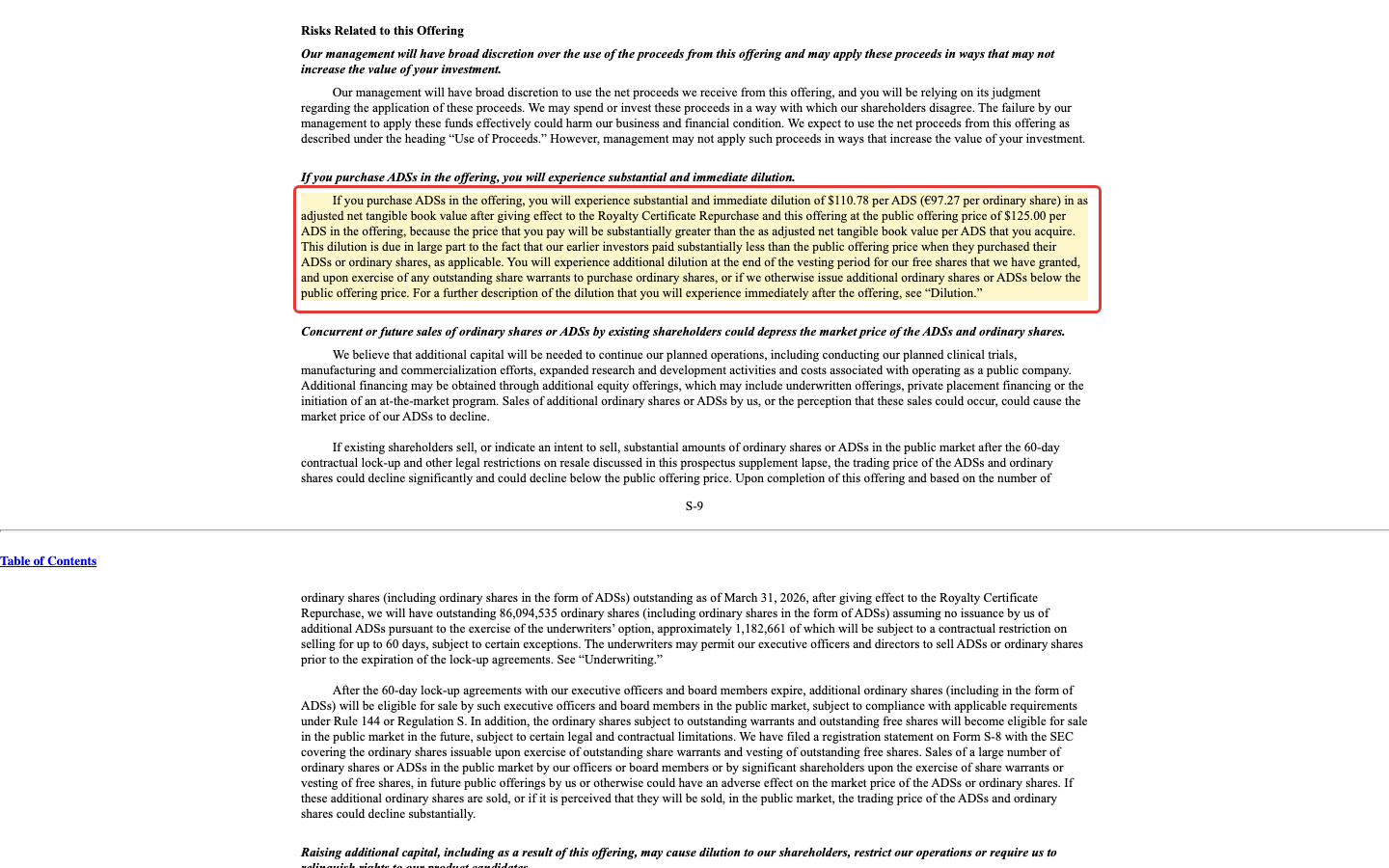
That is not an accusation, it is a definition. At a clinical-stage biotech the price has to sit far above book value — the value lives in the molecule, not in the fixed assets. But you should know the order of magnitude before saying "cheap" or "expensive": of a $125.00 issue price, $14.22 is tangible on the balance sheet and $110.78 is an expectation about the future. Roughly 89 percent of the price is hope — very well-founded hope, but hope. And the dilution is not over: an at-the-market program of up to $150.0 million has been in place since November 2024 and has not been used; on top of that sit outstanding free share awards and warrants. Remember the arithmetic: whoever buys a biotech before approval is not buying the balance sheet — they are buying the timetable.
Uncomfortable truth no. 4: €2.9 million raised, $90 million paid back
In September 2022 Abivax was short of cash. The company raised €49.2 million at the time — €46.2 million of it through a capital increase, and the rest through an instrument that barely registered on the balance sheet:
"The royalty certificates give right to their holders to royalties equal to 2% of the future net sales of obefazimod (worldwide and for all indications) as from the commercialization of such product. The amount of royalties that may be paid under the royalty certificates is capped at €172,000 thousand."
— Abivax SA, SEC annual report 20-F for 2025, Note 15.9 "Royalty certificates"
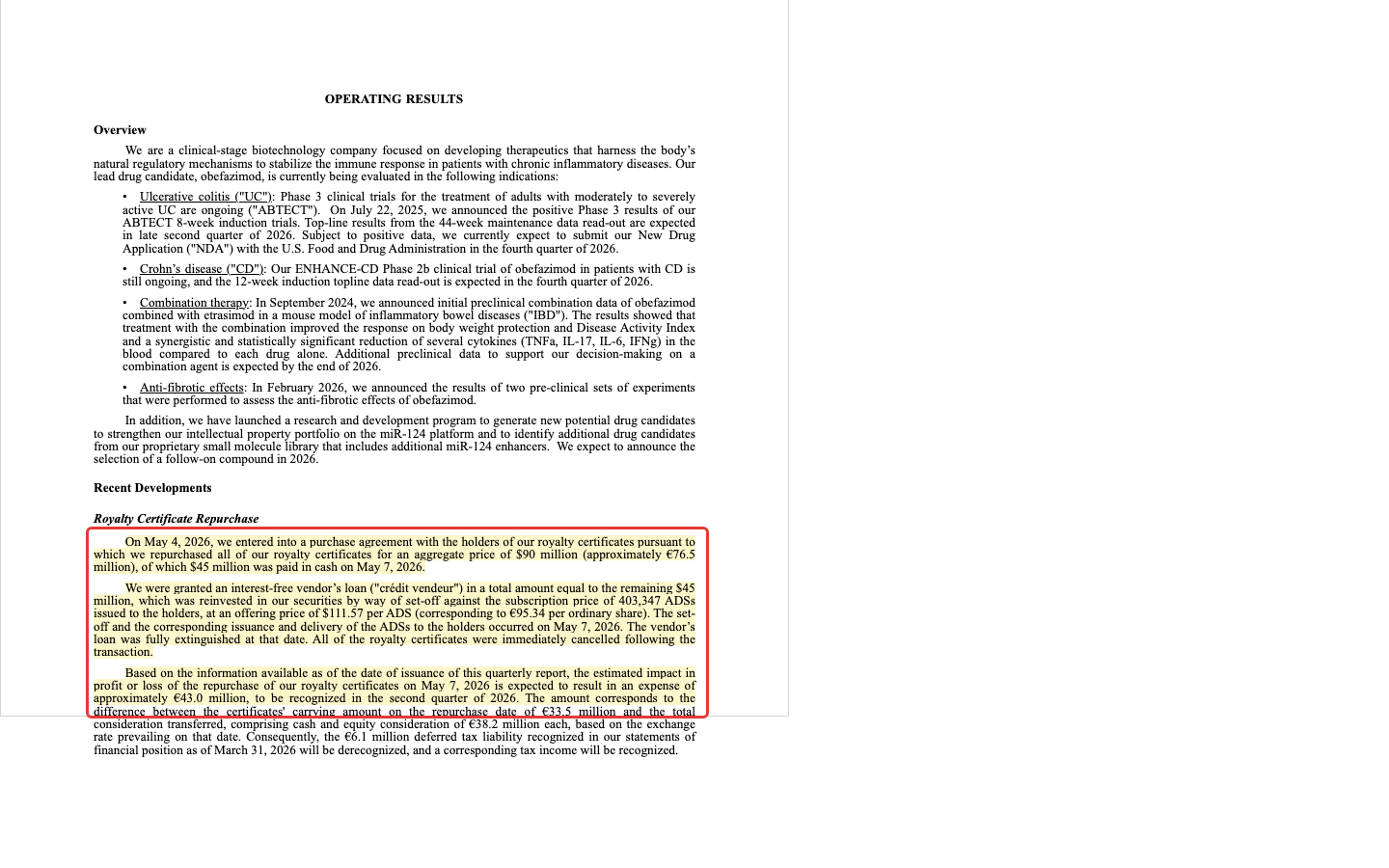
The subscription price for those 2 percent was €2,931 thousand. As long as obefazimod was a research project, that was cheap credit; the fair value of the certificates even fell to €7.3 million by the end of 2024. Then came the Phase 3 data, and with them the probability of real sales: at the end of 2025 Abivax valued the very same paper at €102.0 million. On May 4, 2026 the company pulled the emergency brake and bought all of the certificates back from seven funds — for $90 million, half in cash, half settled against 403,347 new ADSs at $111.57. The earnings impact: about €43.0 million of expense in the second quarter of 2026, more than an entire quarterly loss. Economically the move makes sense — 2 percent of the revenue of a potential blockbuster costs far more over time than $90 million once. But it shows the price a biotech pays for capital before the proof: what was worth €2.9 million in a crunch cost €76.5 million to buy back in success.
Uncomfortable truth no. 5: the bookkeeping has had the same gaps for three years
For a company that spent roughly €250 million in 2025 and raised more than half a billion, the following sentence is remarkably uncomfortable:
"These material weaknesses continue to exist as of December 31, 2025."
— Abivax SA, SEC annual report 20-F for 2025, Item 3.D "Risk Factors"
What is meant are four material weaknesses in internal control over financial reporting. They concern risk assessment, documented control procedures, internal information flow and monitoring, and the report traces them back to too few staff with relevant control experience. They were first reported in the Nasdaq listing prospectus and in the report for 2023 — so they have been in place for three years. Abivax stresses two things that belong in a fair account: the weaknesses have not led to a misstatement in the financial statements, and as an emerging growth company Abivax is not yet required to have its auditor attest to internal controls. Even so, the company writes that it can name no timeline for remediation. Translated into an everyday image: the cash box is right, but the bookkeeping around it is done by too few people — and the larger the amounts get, the less comfortable that is.
Valuation: whoever buys Abivax is buying a timetable
There is no price-to-earnings ratio and no price-to-sales ratio — with zero revenue, any such metric is either infinite or meaningless. The only clean, dated anchor is the price at which the company itself last sold shares: $125.00 per ADS on June 30, 2026. Multiplied by the roughly 86.1 million shares outstanding after the offering, that puts market value in the order of $10.8 billion — for a company with 69 employees, no approval, no revenue and roughly €1.1 billion of liquidity. Put differently: the market values obefazimod, net of cash, at about nine billion dollars. Whether that is a lot or a little turns on a single question: how large will sales of an oral tablet become in a market so far ruled by injected antibodies and JAK inhibitors — and how quickly will they arrive?
That also settles which numbers matter at Abivax and which do not. Not margin, not book value, not Piotroski. Rather: the date of the NDA submission (planned for late in the fourth quarter of 2026), the FDA decision that follows it, the cash burn per quarter (€50.5 million most recently), the share count (roughly 86.1 million most recently), and whether the company can carry a market launch alone or needs a partner. What the road after that looks like is best seen at a biotech that has already walked it: our analysis of Aurinia Pharmaceuticals describes a company with an approved drug, real revenue — and the grinding work of convincing physicians and payers. And if you want to see how a clinical-stage biotech finances the same bet with other people's money instead of its own shares, that is in our analysis of Arcus Biosciences. Both comparisons are worth the time, because they show one thing: proving that a drug works is not the end of the story, it is the beginning of the business.
Opportunities and risks at a glance
What speaks for Abivax:
- Exceptionally clear trial data: in the Phase 3 maintenance trial, 51.3 percent (50 mg) and 50.8 percent (25 mg) of patients were in clinical remission after 44 weeks, against 10.4 percent on placebo (p<0.0001), and all key secondary endpoints were met — in a patient group that had half of its members failing advanced therapies already.
- A tablet against injections: obefazimod is taken orally once a day and works through a new mechanism (miR-124 enhancement) rather than by blocking individual messenger substances — in a market shaped by infusions and injections, that is a genuine differentiator.
- Full cash box and no debt: €491.6 million of liquidity as of March 31, 2026, roughly €1.1 billion pro forma after the offering of June 30, 2026 (net proceeds of $759.8 million); all convertible notes and secured loans were converted or repaid during 2025, and the equity ratio stood at 77.9 percent as of December 31, 2025.
- A clear, dated roadmap: the NDA submission to the FDA is planned for late in the fourth quarter of 2026, with Phase 2b results in Crohn's disease in mid-2027 as a second, independent source of value; €912.9 million of tax loss carryforwards would keep early profits untaxed for a long time.
- The heaviest legacy is gone: the royalty certificates sold in 2022 on 2 percent of all future obefazimod sales were bought back and cancelled in May 2026 — future revenue now flows to shareholders undiminished.
What speaks against it:
- All or nothing: €171.6 million of €177.8 million in 2025 research spending (96.5 percent) went into obefazimod, and the annual report itself says the ability to generate revenue depends "entirely" on its approval. A setback at the FDA has no cushion — the Crohn's results only arrive in mid-2027.
- No revenue, high and rising burn: a €336.1 million net loss in 2025 (up 91 percent), €161.1 million of cash used in operations for the year, and already €50.5 million in the first quarter of 2026 against €33.3 million a year earlier; the only income is €4.6 million of other operating income, mostly a tax credit.
- Permanent dilution: the share count rose from 62.9 million (end of 2023) to roughly 86.1 million after the June 2026 offering (+37 percent); per the prospectus that creates dilution of $110.78 per ADS at a $125.00 issue price. An unused at-the-market program of $150.0 million stands ready.
- The price of past financings: royalty certificates sold in 2022 for €2.9 million had to be bought back in May 2026 for $90 million — with an expected charge of about €43.0 million in the second quarter of 2026. In 2025, share-price-driven effects (employer contributions on free share awards, fair values of the convertible instruments) cost roughly €93 million.
- Structural weak spots: the material weaknesses in internal control reported since 2023 still existed as of December 31, 2025, with no timeline for remediation; 69 employees have to run a trial program, an approval filing and the build-out of a commercial organization in parallel, with €205.1 million of off-balance-sheet purchase commitments to contract research organizations outstanding.
A human conclusion
Back to the p-value trap from the opening. Its core is not that the trials are weak — they are the opposite. In one of the hardest test procedures science knows, Abivax showed that a tablet helps people with severe ulcerative colitis: half the patients in remission after 44 weeks, against one in ten on placebo. That is a real achievement, and nobody should talk it down. Its core is that this certainty is a medical certainty, while your portfolio needs an economic one. The economic questions are all still open. The approval filing has not been submitted. The agency has not decided. No payer has accepted a price. No physician has prescribed the drug. And until then, roughly €50 million flows out every quarter, paid for by shareholders whose slice shrinks with every round. So the honest question for you is not "does the drug work?" — that is answered as well as it can be before an approval. It is this: would you pay $125 for something of which $14 sits on the balance sheet and $111 is a timetable an agency can move at any moment? If yes, you know your stake and your horizon — and you have a thesis. If no, what you had was a trial result. What you make of it is your decision. And that is exactly as it should be.
Sources
All original documents used in this analysis — for you to read yourself:
- Abivax SA — SEC annual report 20-F for 2025 (filed March 23, 2026)
- Abivax SA — SEC annual report 20-F for 2024 (filed March 24, 2025)
- Abivax SA — SEC interim report on Form 6-K as of March 31, 2026 (furnished May 22, 2026)
- Abivax SA — SEC report on Form 6-K on the Phase 3 maintenance results (furnished June 2, 2026)
- Abivax SA — SEC report on Form 6-K on part 2 of the maintenance trial (furnished June 29, 2026)
- Abivax SA — SEC prospectus supplement 424B5 for the offering of June 30, 2026 (filed July 2, 2026)
- Abivax SA — SEC report on Form 6-K on the underwriting agreement for the offering (furnished July 2, 2026)
- Complete SEC filing history of Abivax SA: EDGAR overview (sec.gov)
- Helikon Investments Ltd — Form 13F-HR reports as of March 31, 2026 and prior quarters (sec.gov)
- Fundamental data (metrics, valuation; data as of July 23, 2026), reconciled against the SEC filings.
Transparency & disclaimer: this analysis is a journalistic contextualization of publicly available information. It is not investment advice, not a regulated financial analysis and not a solicitation to buy or sell securities. It is expressly not medical information and says nothing about the suitability of any medicine. Equity investments carry substantial risk up to and including total loss. All figures without warranty; the as-of date of every data point is stated in the text. The author holds no position in Abivax shares at the time of publication.
Our Bottom Line at a Glance
- Trial evidence & efficacy positive
- The Phase 3 ABTECT maintenance trial cleared its primary endpoint by a wide margin on June 1, 2026: 51.3 percent clinical remission at week 44 on 50 mg and 50.8 percent on 25 mg, against 10.4 percent on placebo (p<0.0001), with all key secondary endpoints met — in a patient group where half had already failed advanced therapies. The induction data of July 2025 showed 20.8 percent against 4.4 percent after eight weeks.
- Concentration risk negative
- 96.5 percent of 2025 research spending (€171.6 million of €177.8 million) went into obefazimod, and the annual report 20-F for 2025 states that the ability to generate revenue depends "entirely" on its development and approval in the near future. The second indication, Crohn's disease, only delivers data in mid-2027 — a setback in the approval process would have no cushion.
- Cash & runway neutral
- €491.6 million of liquidity as of March 31, 2026, roughly €1.1 billion pro forma after the offering of June 30, 2026 (net proceeds $759.8 million), with no convertible notes and no secured loans left. Against that stands €161.1 million of cash used in operations in 2025 and already €50.5 million in the first quarter of 2026; the runway statement into the fourth quarter of 2027 holds explicitly only if trial results stay positive.
- Dilution negative
- The share count rose from 62,928,818 (December 31, 2023) to roughly 86.1 million after the offering of June 30, 2026, up 37 percent. The prospectus puts the immediate dilution at $110.78 per ADS at a $125.00 issue price — leaving $14.22 of pro forma net tangible book value. An unused at-the-market program of $150.0 million stands ready.
- Financing legacies neutral
- The royalty certificates sold in 2022 for €2,931 thousand on 2 percent of all future obefazimod sales were bought back for $90 million in May 2026 and cancelled — right for the future, expensive for the second quarter of 2026 (a charge of about €43.0 million). In 2025, share-price-driven effects cost roughly €93 million, including €27.3 million of employer contributions on free share awards.
- Governance & controls negative
- The material weaknesses in internal control over financial reporting first reported in the listing prospectus and in the report for 2023 still existed as of December 31, 2025 per the 20-F — four areas from risk assessment to monitoring, with no stated timeline for remediation. They have not led to a misstatement so far, and as an emerging growth company Abivax does not yet need an auditor attestation on internal controls.
Abivax is the p-value trap in its purest form: the medical question is answered about as well as it can be answered before an approval — 51.3 percent clinical remission after 44 weeks against 10.4 percent on placebo, p<0.0001, all key secondary endpoints met. The commercial questions are all still open: no product revenue, a €336.1 million net loss in 2025, €161.1 million of cash burned, 96.5 percent of research inside a single molecule, 69 employees to carry an approval filing and a market launch. The road there is paid for in stock: 37 percent more shares since the end of 2023, and per the company's own prospectus $110.78 of a $125.00 issue price is pure expectation. Not investment advice.
What Our Rating Means
Open questions
The business works in principle, but one material question is open. As long as it stays open, our findings do not carry a quality verdict.
Whoever buys today is no longer betting that obefazimod works — that is documented. They are betting on a timetable: that the approval filing goes in as planned late in the fourth quarter of 2026, that the FDA accepts it without extra requirements, that payers accept a price capable of carrying a valuation in the ten-billion-dollar range, and that 69 employees can build a commercial organization without another large capital raise. Whoever waits checks three lines in every release: is the NDA date holding (planned for late in the fourth quarter of 2026)? How large is the cash burn per quarter (€50.5 million most recently)? And how many shares are there by now (roughly 86.1 million most recently)? The all-or-nothing risk of a single drug candidate is the dominant risk here and the reason for caution. The decision is yours.
A journalistic assessment by our editorial team at the time of the deep dive, based on public sources — not investment advice and not a solicitation to buy or sell. Your personal circumstances (investment goals, risk capacity, taxes) cannot be taken into account. What our levels mean, how verdicts are formed, and what conflicts of interest exist →
Worth Noting
- Abivax did not reach our research list through a momentum or value screen but through the Form 13F-HR of Helikon Investments Ltd for the quarter ended March 31, 2026: 1,013,324 shares worth $112,833,627, a brand-new position (zero shares in each of the prior quarters) inside a portfolio otherwise shaped by miners and Argentine names. A 13F shows only U.S.-listed long positions, appears with a 35 to 45 day delay and contains neither short sales nor derivatives nor the Euronext holdings — a rearview mirror, not a roadmap.
- Classic metrics do not work at Abivax: there is no price-to-earnings and no price-to-sales ratio, the Piotroski F-Score of 4 of 9 mostly measures noise at a company with no revenue, and the Altman Z-Score, net current asset value and cash balance are deliberately not shown because the books are kept in euros while the stock trades in U.S. dollars. What carries meaning is liquidity, cash burn, trial status and share count.
- Valuation figures are dated and evergreen: the only clean anchor is the company's own issue price of $125.00 per ADS on June 30, 2026 (market value in the order of $10.8 billion at roughly 86.1 million shares); analyses are evergreen, daily prices are not a buy argument. Watch list: the half-year 2026 report on September 21, 2026 with the charge from the royalty buyback, the planned NDA submission late in the fourth quarter of 2026, the Phase 2b results in Crohn's disease in mid-2027, and the next Form 13F-HR (quarter ended June 30, 2026, published in mid-August 2026).
Frequently Asked Questions
Abivax SA (Nasdaq: ABVX, also Euronext Paris) of Paris is a clinical-stage biotech company with no approved product and no product revenue. It develops obefazimod, a once-daily oral tablet that boosts the body's own signaling molecule miR-124 and thereby dampens excessive inflammation. The lead indication is ulcerative colitis, the second is Crohn's disease. In 2025, €171.6 million of €177.8 million in research spending went into that one drug.
Unusually good. In the Phase 3 ABTECT maintenance trial (results announced June 1, 2026), 51.3 percent of patients on 50 mg and 50.8 percent on 25 mg were in clinical remission after 44 weeks, against 10.4 percent on placebo (placebo-adjusted deltas of 40.3 and 39.3 percentage points, p<0.0001). All key secondary endpoints were met. In the induction phase, the remission rate after eight weeks was 20.8 percent (50 mg) against 4.4 percent on placebo.
Per the SEC report furnished on June 2, 2026, Abivax intends to submit the New Drug Application (NDA) for obefazimod in ulcerative colitis to the U.S. Food and Drug Administration late in the fourth quarter of 2026. That is not an approval: the agency review process follows the submission. Results of the Phase 2b trial in Crohn's disease are expected in mid-2027.
The annual report (20-F) for 2025 states a runway into the fourth quarter of 2027 based on €530.4 million of liquidity as of December 31, 2025 — twelve months after the planned approval filing, and explicitly assuming positive trial results. As of March 31, 2026 liquidity stood at €491.6 million. The offering of June 30, 2026 added about $759.8 million net; pro forma that is roughly €1,105 million.
The share count rose from 62,928,818 (December 31, 2023) to 78,536,412 (December 31, 2025) and, after the royalty buyback in May 2026 and the issue of 6,400,000 ADSs on June 30, 2026, to roughly 86.1 million — up 37 percent in two and a half years. The prospectus for the June offering puts the immediate dilution at $110.78 per ADS: the $125.00 issue price meets a pro forma net tangible book value of $14.22 per ADS.
In September 2022, Abivax issued royalty certificates for a subscription price of €2,931 thousand. They carried 2 percent of all future worldwide net sales of obefazimod, capped at €172.0 million. After the Phase 3 data their fair value rose to €102.0 million by the end of 2025. On May 4, 2026, Abivax bought all of them back for $90 million ($45 million cash, $45 million in 403,347 new ADSs) and cancelled them; the charge of about €43.0 million falls in the second quarter of 2026.
Helikon Investments Ltd of London reports Abivax in its Form 13F-HR for the quarter ended March 31, 2026 with 1,013,324 shares worth $112,833,627 — a brand-new position, since the fund reported zero shares at June 30, 2025, September 30, 2025 and December 31, 2025. A 13F, however, shows only U.S.-listed long positions, appears with a 35 to 45 day delay and contains neither short sales nor derivatives nor European holdings — it is a rearview mirror, not a roadmap.
A price-to-earnings ratio cannot be formed, because Abivax has no earnings and no product revenue. Altman Z-Score, net current asset value and cash balance are deliberately not shown, because the books are kept in euros while the stock trades in U.S. dollars — a currency guard that prefers an empty field to a wrong number. What carries meaning at a clinical-stage biotech instead is liquidity (€491.6 million as of March 31, 2026), cash burn (€50.5 million in the first quarter of 2026), trial status and share count.
Found an error?
Did you spot a factual error, an outdated number, or a typo in this deep dive? Let us know briefly — your report goes straight to the editorial team.