FutureFuel: Nine Million Gallons Instead of Forty-Five — and a Cash Pile That Shrank by $87 Million in Five Quarters
FutureFuel Corp. runs a chemical plant in Batesville, Arkansas, with a biodiesel unit built for 59 million gallons a year. In 2025 it made nine. Revenue fell 61 percent to $95.7 million, both segments turned negative, and cash dropped from $109.5 million to $22.4 million. The quarterly dividend, 6 cents for years, has stood at 1 cent since the second quarter of 2026. At the same time the U.S. Environmental Protection Agency locked in the highest blending mandates in the program's history on March 27, 2026 — so demand for biodiesel is coming back. Not investment advice — just a look at the bank balance and the clock running against it.
 Thomas Mücke
Founder & Publisher
Thomas Mücke
Founder & Publisher
Chart
Interactive price chart (TradingView).
Note: pure fact-based analysis, not investment advice and not a solicitation to buy or sell. All figures without guarantee.
There is an investor trap that catches you not with greed but with memory: the anchoring trap. It works like this — you see a number somewhere, and your head keeps it as a yardstick long after the world has moved past it. With FutureFuel Corp. (NYSE: FF) several such anchors are lying around: revenue of $368 million (2023). A special dividend of $2.50 per share, paid in April 2024. A company without a cent of bank debt. Hold those three numbers in your head, then look at a share price of a little over four dollars, and you automatically think: "That has to be cheap." That is exactly where the trap snaps shut. So let us make a deal: before you anchor yourself to any of those numbers, we will read together what FutureFuel itself reported to the U.S. Securities and Exchange Commission — the annual report (10-K) for 2025, the quarterly report (10-Q) as of March 31, 2026, and the current reports (8-K) of May 11 and of June 26 and 30, 2026. Those filings are honest under penalty of law. And they tell the story of a plant that stood still 85 percent of the time, of a cash pile that shrank by $87 million in five quarters, of a dividend cut to one cent — and of a regulatory decision that could turn everything around in 2027. In the end you decide for yourself.
What FutureFuel actually does — one plant, two completely different businesses
FutureFuel is not an idea, it is a place: a 2,200-acre industrial site in Batesville, Arkansas, roughly 500 acres of it developed, with about 493 employees (annual report 10-K for 2025). The site once belonged to Eastman Chemical; in 2006 a blank check vehicle called Viceroy Acquisition Corporation bought it, renamed itself FutureFuel Corp. and went public that way — a backstory that no longer appears in today's reports but is documented in the SEC filing history under the same identifier (CIK 0001337298). Two businesses run on that single site, and they have little to do with each other.
The first is specialty chemicals. FutureFuel manufactures chemicals on behalf of other corporations that do not want to produce them in-house — biocides, specialty polymers, dyes, solvents, pharmaceutical intermediates. Put in everyday terms: FutureFuel is the contract kitchen of the chemical industry. The customer brings the recipe, FutureFuel cooks at industrial scale, and both sides tie themselves together with multi-year contracts. It is a quiet, high-margin business — and a very narrow one: that contract manufacturing alone accounted for 54 percent of total group revenue in 2025.
The second business is biodiesel. Vegetable oils and used fats become a diesel substitute that is blended into ordinary diesel. According to the report, the Batesville unit has a demonstrated capacity of 59 million gallons a year — around 223 million liters. And here lies the heart of the whole story: whether that plant pays off is decided not by the market but by Washington. Two sets of rules determine everything. First the blending mandate (Renewable Fuel Standard, RFS): the government prescribes how much biofuel must be blended into fossil diesel, and every gallon generates a tradable credit (RIN). Second the tax credits: until the end of 2024 there was the blenders' tax credit (BTC) — a full U.S. dollar per gallon. That names the central tension of this analysis, and it runs through every chapter that follows: the very regulation that nearly shut FutureFuel's biodiesel business down in 2025 promises the highest demand in the program's history from 2027 onward. The question is not whether biodiesel will be needed again — it is whether FutureFuel's cash lasts until then.
How the stock landed on our desk
This time it was not a scanner. As of July 26, 2026, FutureFuel appears in not a single list of our in-house stock scanner — not momentum, not quality, not valuation; we queried the data set before writing this chapter and the result was empty. What did surface was the daily Reddit hype scan: first seen on July 26, 2026 at 07:00 UTC, with all of 2 mentions and a market value captured in the scan of roughly $204.0 million. Two mentions are not a storm, they are a whisper — and whispers are often more interesting than shouts, because nobody has talked them to death yet.
Because no scanner criterion applies, the usual shortcuts are worthless here. A price-earnings ratio cannot be formed because there are no earnings. A price-sales ratio compares today's market value with revenue that has fallen three quarters in two years. And the 5 percent dividend yield some databases still show refers to a payout that no longer exists in that form. Note the finding right at the start: with FutureFuel you do not measure with ratios from the past, you measure with the bank statement of the present. So let us take the bank statement. Our scanner lists are recalculated daily, by the way — the "no hits" finding applies to July 26, 2026 and can change with every run.
The numbers over the years — fairly credited
Let us start with what speaks for FutureFuel, because there is more of it than the headline suggests. This company was solidly profitable for years: from 2018 through 2024 every single year showed a profit, equity stood at $467 million at the end of 2019, and bank debt was practically never there. The company has paid quarterly dividends without interruption since 2010, for years 6 cents a share per quarter ($0.24 a year in 2023, 2024 and 2025) — and special dividends on top of that several times: $141.7 million went to shareholders in 2020, $119.9 million in 2021, and in April 2024 another $109.4 million as a special dividend of $2.50 per share. If you want to know where the money went that is missing from the account today: a large part of it sits in shareholders' accounts. That is not waste, it is a decision — just one that, in hindsight, fell at a very unfortunate moment.
The chemicals business delivered too: $79.3 million of revenue in 2023, $80.0 million in 2024, with segment results of $29.9 million and $22.6 million respectively. Those are gross margins of 38 percent (2023) and 28 percent (2024) in a business where the customer brings the recipe — a decent performance. And then came 2025. The chart below shows what happened, and it shows it brutally simply:
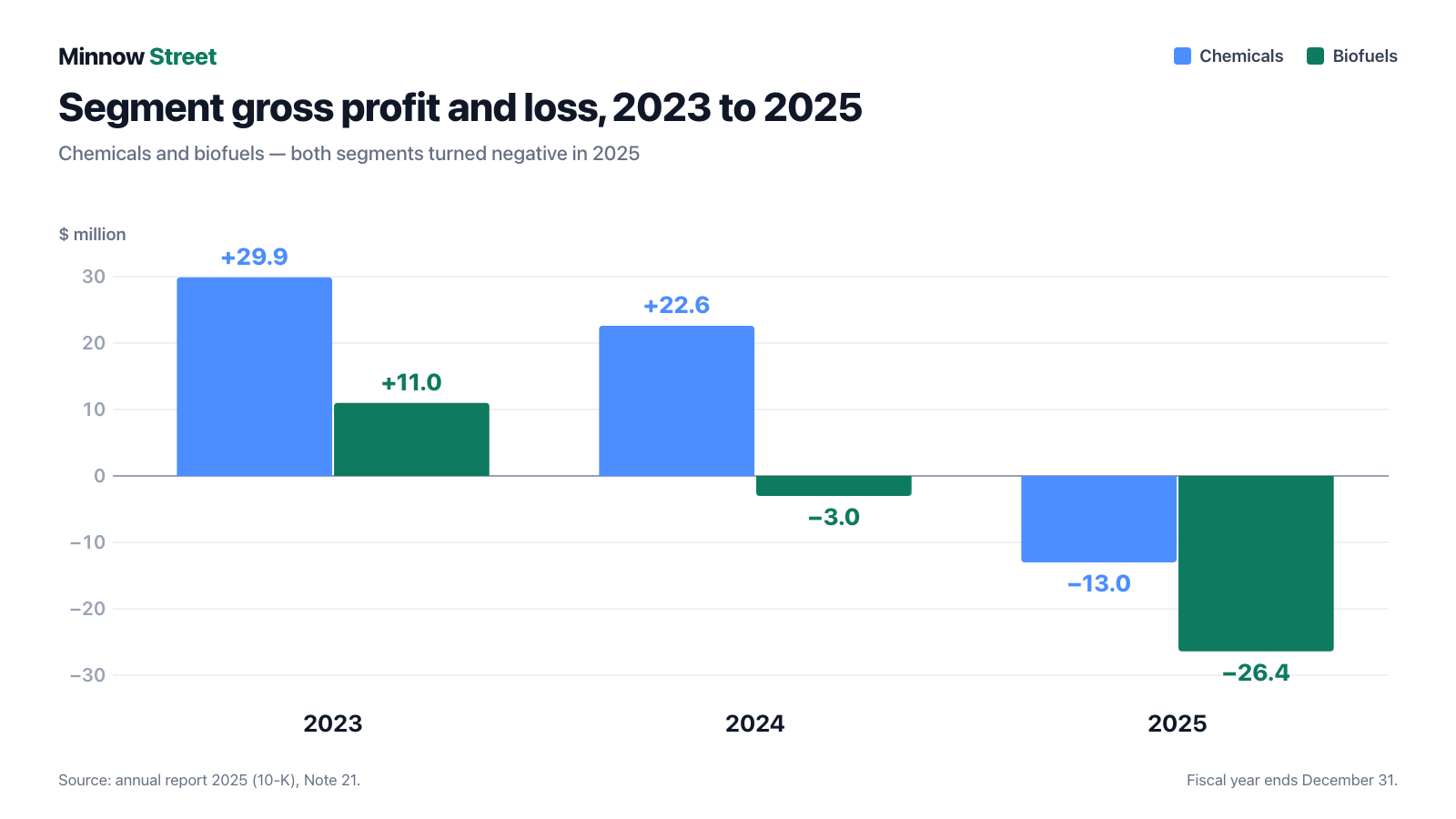
In numbers: group revenue fell 61 percent to $95.7 million in 2025 — a drop of $147.6 million against 2024. Of that, $127.2 million came from biodiesel alone, whose revenue collapsed 78 percent; volume sold fell 75 percent and the average selling price another 3 percent. Pre-tax income swung from +$16.3 million (2024) to −$49.2 million (2025). And in the first quarter of 2026 it continued: revenue did recover to $32.0 million (year-ago quarter: $17.5 million) — but the loss grew with it. The bottom line showed −$20.6 million, or −$0.47 per share, after −$18.1 million and −$0.41 in the first quarter of 2025. That is the most important sentence of this chapter: more revenue has not made the loss smaller, it has made it bigger. Which brings us to the uncomfortable truths.
What the filings say — the uncomfortable truths
Uncomfortable truth no. 1: the plant stood still — voluntarily
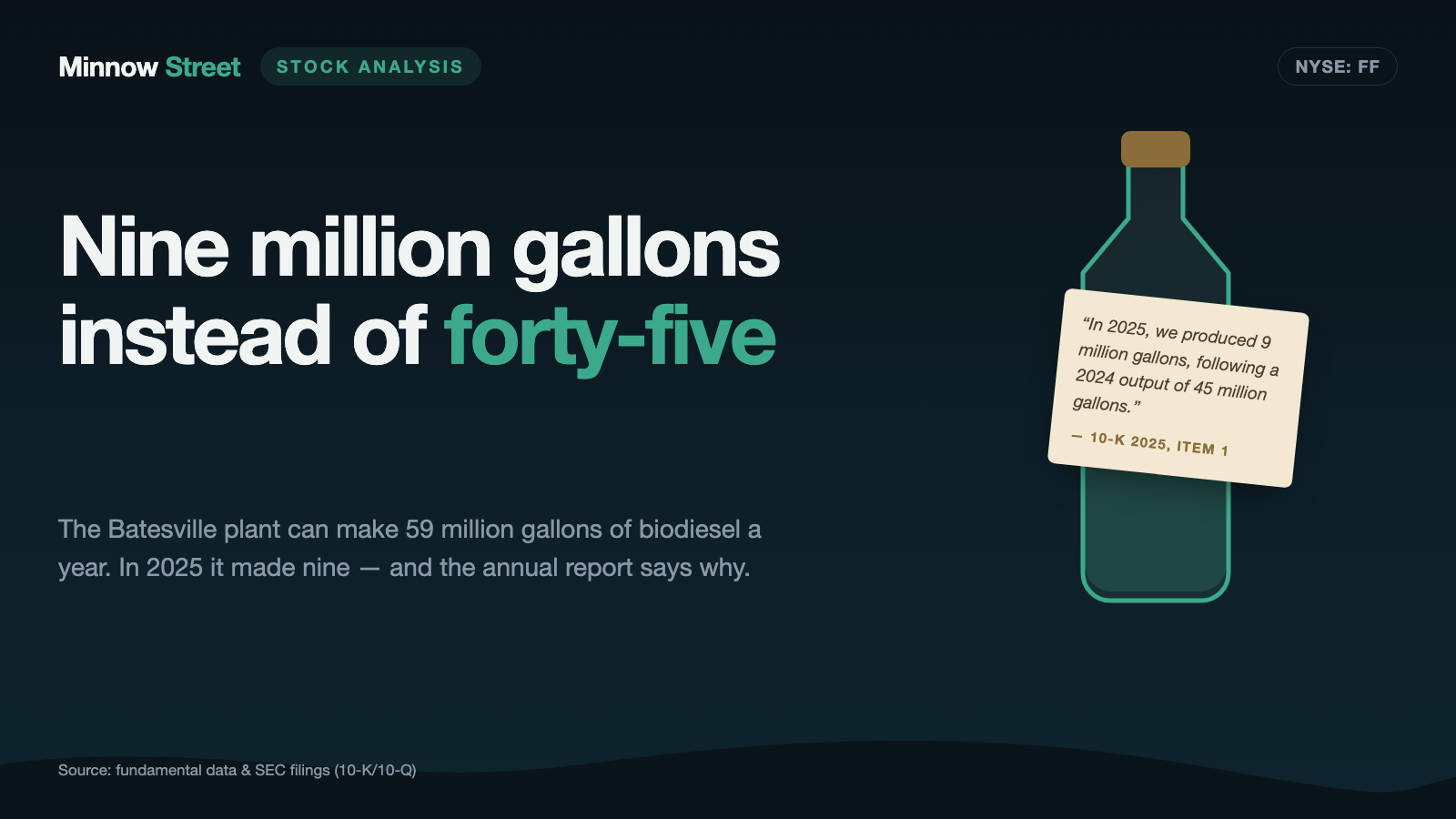
The most striking figure in the entire annual report is a production volume. The Batesville biodiesel unit can make 59 million gallons a year. In 2024 it made 45 million. In 2025 it made nine. That is roughly 15 percent of capacity — a plant that could have stood idle eleven months out of twelve and largely did exactly that. The report also explains why, and it does so remarkably openly:
"The decline in performance is attributable to an extended plant turnaround initiated to enhance long-term reliability, followed by the subsequent strategic decision to idle production due to regulatory uncertainty surrounding the CFPC and other adverse market conditions."
— FutureFuel Corp., SEC annual report 10-K for 2025, item 7 (MD&A, biofuels segment)

Why a company voluntarily halts its own plant becomes clear once you know the arithmetic. Until December 31, 2024 the blenders' tax credit applied: one dollar of tax credit per gallon, granted to whoever first blended biodiesel with fossil diesel. From January 1, 2025 it was replaced by the clean fuel production credit, §45Z in the statute — a credit whose size depends on the fuel's greenhouse gas emissions and which starts from a base of $0.20 per gallon. The report is blunt about it: the maximum $1.00 would require zero emissions, which is "unrealistic for almost every biodiesel producer, including the Company." Fairness demands the rest of the picture: FutureFuel sits above that base because the plant meets the prevailing wage and apprenticeship requirements — it booked $2.5 million from the credit for 2025 and another $1.2 million in the first quarter of 2026. But that too is a fraction of what the old dollar per gallon would have delivered. Put in everyday terms: a baker who received a euro per loaf from the state for years suddenly gets a fraction of it — with flour and energy costing the same. He does not bake less because he does not want to. He bakes less because every loaf costs him money.
On top came the uncertainty: the implementing rules for §45Z were only published in draft form in early February 2026, a year after the credit took effect. A company that does not know how much subsidy it gets per gallon cannot price its product. So FutureFuel switched off — and in doing so also lost the contribution margins that had been carrying the fixed costs of the whole plant. That is exactly why the chemicals business slipped into the red in 2025 as well, even though nobody there lost a subsidy: the site's costs are spread over two segments, and when one of them stops producing, the other carries more. If you want another example of a result that depends on something outside the actual operation, you will find it in our analysis of Liberty Energy, where the profit came from the securities portfolio rather than the drill bit.
Uncomfortable truth no. 2: cash shrank by $87 million in five quarters
As long as a company has no debt, it looks invulnerable. FutureFuel indeed has not a cent of financial debt and on top of that a $35 million revolving credit facility with Regions Bank and PNC that runs to February 21, 2030 and was undrawn as of March 31, 2026. That is a genuine strength. But debt-free does not protect against what is happening here — and that is the cash balance:
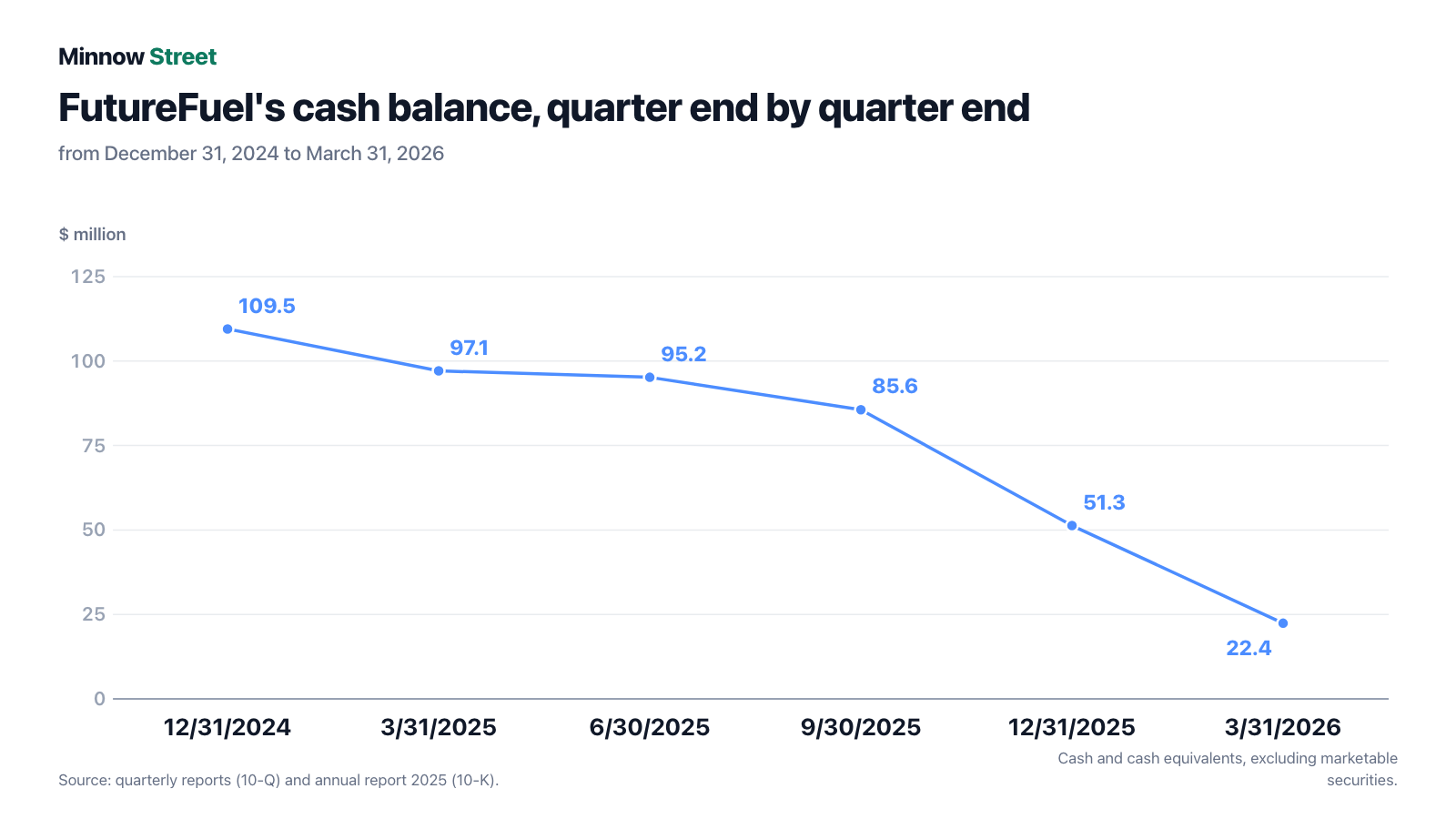
Breaking down the first quarter of 2026 shows where the money goes: $20.0 million flowed out of operations, $6.3 million went into investment (of which $5.4 million was capital spending), $2.6 million was paid out as dividends — $28.9 million in three months. Fairness requires noting that part of it moved into inventories and receivables, so it was tied up rather than burned: inventories rose to $31.1 million, receivables to $13.3 million. And current assets of $84.1 million stand against current liabilities of just $17.6 million. So this company is not insolvent.
But the calculation that counts is a different one: $22.4 million of cash against $20.0 million of operating cash outflow in a single quarter. Even adding the full credit line, the buffer at that pace lasts roughly two to three quarters — and the facility is tied to a maximum leverage ratio and a minimum interest coverage ratio, two covenants that are hardest to meet precisely when results are negative. Remember the image: debt-free does not mean unlimited time. It only means nobody knocks on the door beforehand.
Honesty requires the other side, and it is stronger than the cash curve suggests. In the quarterly report the company itself writes that it believes "existing cash balances and cash flow to be generated from operating activities and borrowing capacity under the amended and restated credit agreement will be sufficient to fund operations, product development, cash dividends, and capital requirements for the foreseeable future." The earnings release FutureFuel filed the same day as a current report (8-K of May 11, 2026, item 2.02) is more concrete: the company expects more than $27 million in customer deposits in 2026 for a directed capabilities expansion at Batesville, including a customer-funded capacity project worth $25 million in chemicals; more than 65 percent of the 2026 capital spending plan is to be paid for by customers. For the full year 2026 management guides to positive adjusted operating earnings — though explicitly excluding the timing distortions from hedging. And those were the single largest item in the first quarter: $11.6 million of derivative valuation losses, $9.1 million of them realized, which according to the company will be recovered once the underlying physical product is sold. Two things have to be kept apart here: the $22.4 million cash balance is an audited figure with an as-of date. The $27 million of customer deposits and the positive full-year result are a management expectation dated May 11, 2026 — documented as a statement, not as a fact.
The company has already drawn its own conclusion, and you find it in the most honest place of all — the dividend. For years FutureFuel paid 6 cents per share per quarter. That rate still applied to the first quarter of 2026. For the second quarter of 2026 it then declared 1 cent — and on June 30, 2026 the board confirmed the same amount for the third quarter:
"On June 30, 2026, FutureFuel Corp. (NYSE: FF) ("FutureFuel") issued a press release announcing that it has declared its third quarter 2026 cash dividend of U.S. $0.01 per share payable to shareholders of record on September 4, 2026. The dividend will be paid on September 18, 2026."
— FutureFuel Corp., SEC current report 8-K of June 30, 2026, item 8.01

A dividend cut of more than 80 percent is rarely an accident and almost never a marketing move. It is how a board tells the public that it needs cash. A token cent instead of a suspension formally keeps the payout streak alive — the effect on the bank account is practically the same as zero. How quickly a frozen payout becomes a permanent state we saw at NGL Energy Partners, where the distribution has been suspended since 2020.
Uncomfortable truth no. 3: the concentration risk merely switched sides
Anyone reading FutureFuel's filings across the years knows a recurring warning: too few biodiesel customers. In 2023, 35 percent of revenue went to two buyers, in 2024 still 25 percent, and at the end of 2024 those customers held 13 percent of all receivables. For 2025 the notes report an all-clear — and in the same breath the new tightness:
"For the year ended December 31, 2025, three chemical customers each represented greater than 10% of total sales revenue for a total of 50%. … Two chemical customers had receivables that were 38% and 29% of total receivables as of December 31, 2025."
— FutureFuel Corp., SEC annual report 10-K for 2025, note 2 ("Customer concentrations")

A year earlier a single chemical customer held 20 percent of all receivables — one has become two with 67 percent between them. The risk section of the same report quantifies the dependence more precisely still: those three customers account for 81 percent of chemical product sales. And unlike biodiesel, there is no replacement around the corner: biodiesel is a commodity with a world market price that can be sold to anyone — a tailor-made intermediate for one specific corporation cannot. The report says so explicitly for biodiesel and explicitly does not for chemicals: there, losing one of those customers would have a "material adverse effect." Put in everyday terms: the contract kitchen has three regulars who together pay half the rent — and two of them have not settled their bills yet. A detail on the side that belongs to careful reading: elsewhere in the same report the figure for that same metric reads 48 percent rather than 50. We take the number from the audited notes.
Uncomfortable truth no. 4: and then there was a fire
As if 2026 had a sense of drama, two operational disruptions came on top. First winter storm "Fern": from January 27, 2026 extreme cold forced most of the plant into a 30-day shutdown; $1.4 million of one-off costs for idle labor and emergency repairs landed in the first quarter. That disruption is behind them: as of February 25, 2026 all but one continuous process had restarted according to the annual report, and the earnings release names February 26, 2026 as the day Batesville was producing at normal rates again. And then, shortly before the quarterly report was published, this:
"On May 9, 2026, the Company experienced a localized fire at its Batesville facility. … The event resulted in a temporary shutdown of biodiesel production but did not affect the Company's chemical facilities. The Company is currently evaluating the affected portion of the facility and repairs necessary for a safe and rapid restart of production."
— FutureFuel Corp., SEC quarterly report 10-Q as of March 31, 2026, note 14 ("Subsequent events")

What matters here is what is not in the record. The quarterly report appeared on May 11, 2026, two days after the fire. Through July 26, 2026 FutureFuel has filed no further disclosure on it — no current report about a restart, no damage estimate, no word on insurance. After May 11, 2026 the company filed only two current reports: the dividend declaration of June 30 and the notice of June 26 that board member Paul M. Manheim, on the board since 2011 and most recently chair of the audit committee, will not stand for re-election at the 2026 annual meeting; the board shrinks to eight members as a result, and there was no dispute according to the filing. So the state of play is soberly this: biodiesel production was last reported as halted, and the most recent documented sentence about it is "currently evaluating." Anyone making a statement today about production running does so without evidence.
Valuation: what $204 million buys you
There is no price-earnings ratio here — there are no earnings. That leaves two more honest yardsticks. The first is book value: equity stood at $141.9 million on March 31, 2026, which across 43,863,507 shares is roughly $3.24 per share. The market value of about $204.0 million captured in the Reddit scan of July 26, 2026 therefore corresponds to about 1.4 times book. We cross-checked that figure: the cover page of the annual report states an aggregate market value of shares held by non-affiliates of $134.4 million as of June 30, 2025. Subtract the 17,085,100 shares of major holder St. Albans from the 43,863,507 outstanding and roughly 26.8 million freely tradable shares remain — that works out to a good $5.02 per share on that day and, extrapolated to all shares, around $220 million of market value. The gap to the scan figure is therefore around eight percent over a year — the order of magnitude holds.
The second yardstick is substance. For that market value you get a paid-for plant with $89.9 million of net property, plant and equipment, $31.1 million of inventories, $13.3 million of receivables and $22.4 million of cash — against total liabilities of just $37.1 million and not a cent of bank debt. Strip out net cash and the market values the operating business at roughly $182 million; measured against trailing twelve-month revenue (around $110 million) that is about 1.8 times. For a company currently making losses, that is no bargain price — you are already paying for the plant to run again some day.
And on that point there is a concrete signal you should not overlook. On March 27, 2026 the U.S. Environmental Protection Agency locked in blending volumes for the coming years — per the quarterly report the highest in the program's history, up around 60 percent against 2025: 5.3 to 5.4 billion gallons of biomass-based diesel for 2026 and 5.7 to 5.8 billion for 2027. At the same time the arithmetic advantage that competing renewable diesel enjoyed on the credit side was cut from 1.7 to 1.6 and further to 1.5 by 2027 — the same level as biodiesel. To hit the 2027 volumes, the report writes, utilization of domestic capacity is expected to be 100 percent. Translated: demand for exactly the product FutureFuel is no longer making is supposed to be larger in a year and a half than ever before. That is the opportunity in this stock — and at the same time the reason the cash balance matters so much.
Opportunities and risks at a glance
What speaks for FutureFuel:
- No financial debt, an undrawn $35 million revolver running to February 2030, and current assets of $84.1 million against current liabilities of only $17.6 million (as of March 31, 2026) — acute insolvency is not the issue.
- The EPA blending requirements of March 27, 2026 are the highest in the program's history (5.7 to 5.8 billion gallons for 2027, up 60 percent on 2025); the arithmetic advantage of competing renewable diesel falls from 1.7 to 1.5 by 2027 — both play into the hands of a biodiesel producer with an idled plant.
- The capacity is paid for and in place: 59 million gallons a year, of which only 9 million were used in 2025. Restarting requires working capital, not a large investment — property, plant and equipment sit on the books at $89.9 million.
- The chemicals business is sound at its core: it earned segment results of $29.9 million and $22.6 million in 2023 and 2024; in 2025 it suffered mainly from the extended plant turnaround and the fixed costs of the idled biodiesel unit.
- One chemical customer paid roughly $9.7 million upfront in 2025 for a plant expansion — a vote of confidence in cash, sitting on the balance sheet as deferred revenue and only hitting the income statement with later deliveries.
- For 2026 management expects more than $27 million in customer deposits, a customer-funded capacity project worth $25 million in chemicals, and a capital spending plan more than 65 percent funded by customers; for the full year it guides to positive adjusted operating earnings excluding derivative timing effects (current report 8-K of May 11, 2026, item 2.02). Those are expectations, not booked numbers — but they are dated and filed with the SEC.
What speaks against it:
- Cash fell from $109.5 million to $22.4 million in five quarters, with $20.0 million flowing out of operations in the first quarter of 2026 alone — at that pace the buffer lasts only a few quarters even with the revolver fully drawn, and its covenants (maximum leverage, minimum interest coverage) bite precisely when there are losses.
- Both segments were negative in 2025 (chemicals −$13.0 million, biofuels −$26.4 million), and in the first quarter of 2026 the net loss grew to $20.6 million despite nearly doubled revenue — the turnaround is not yet demonstrated.
- Earnings hang on a political decision: the §45Z tax credit starts at $0.20 per gallon instead of the former $1.00, and its implementing rules were only available in draft form in February 2026.
- Three chemical customers stand for 50 percent of revenue and two for 67 percent of all receivables (December 31, 2025); at the same time 32 to 38 percent of revenue is booked as bill-and-hold, that is, before the goods leave the plant.
- Biodiesel production was halted twice in 2026 — for 30 days by winter storm "Fern" from January 27, and again by a fire on May 9; there is no further SEC filing on the restart through July 26, 2026. The quarterly dividend stands at 1 cent.
A human conclusion
Back to the anchoring trap from the beginning. Its core is not that the old numbers were lies — FutureFuel did book $368 million of revenue, did pay a $2.50 special dividend, does have no debt. Its core is that every one of those numbers comes from a world in which there was a dollar of subsidy per gallon. That world ended on December 31, 2024. Anyone buying today is not buying the company of 2023 but a very concrete bet: that $22.4 million of cash plus $35 million of credit line plus the customer deposits of more than $27 million announced for 2026 will last until the new blending mandates bite in 2027 — and that the Batesville plant restarts in time and without an expensive surprise after frost and fire. That can work out; the demand side supports it, and a debt-free balance sheet buys time. It can also mean the company needs fresh money first — at a price that hurts existing shareholders. So the honest question to you is not "is FutureFuel cheap?" but: do you trust yourself to time the race between a shrinking cash balance and a calendar in Washington? If yes, you have a thesis. If no, you had an anchor. What you make of it is your decision. And that is exactly how it should be.
Sources
Every original document used in this analysis — for you to read yourself:
- FutureFuel Corp. — SEC annual report 10-K for 2025 (filed March 16, 2026)
- FutureFuel Corp. — SEC quarterly report 10-Q as of March 31, 2026 (filed May 11, 2026)
- FutureFuel Corp. — SEC current report 8-K of May 11, 2026, item 2.02 with exhibit 99.1 (first quarter 2026 results, customer deposits, full-year outlook)
- FutureFuel Corp. — SEC current report 8-K of March 31, 2026, item 8.01 (second quarter 2026 dividend: $0.01)
- FutureFuel Corp. — SEC current report 8-K of June 30, 2026, item 8.01 (third quarter 2026 dividend)
- FutureFuel Corp. — SEC current report 8-K of June 26, 2026, item 5.02 (change on the board of directors)
- Complete SEC filing history of FutureFuel Corp.: EDGAR overview (sec.gov) — including the former name Viceroy Acquisition Corporation (2005 to 2006)
- Fundamental data (metrics, quarterly series, valuation; data as of July 26, 2026), reconciled with the SEC filings.
- Reddit mentions: in-house Reddit hype scan of July 26, 2026, 07:00 UTC (2 mentions, market value captured $204.0 million).
Transparency & disclaimer: this analysis is journalistic commentary on publicly available information. It is not investment advice, not a financial analysis in any regulatory sense, and not an invitation to buy or sell securities. Equity investments carry substantial risks up to total loss. All information without warranty; the as-of date of the data is noted in the text. The author holds no position in FutureFuel shares at the time of publication.
Our Bottom Line at a Glance
- Liquidity and cash runway negative
- Cash fell from $109.5 million (12/31/2024) to $22.4 million (3/31/2026); in the first quarter of 2026 alone, $20.0 million flowed out of operations, plus $6.3 million of investment and $2.6 million of dividends. Even with the undrawn $35 million revolver, the buffer at that pace lasts roughly two to three quarters — and its covenants (leverage, interest coverage) bite precisely when there are losses. The company considers its funds sufficient for the foreseeable future in the quarterly report of 05/11/2026 and expects more than $27 million in customer deposits in 2026; that is documented as an expectation, not as an inflow.
- Earnings power negative
- Both segments were negative in 2025 (chemicals −$13.0 million, biodiesel −$26.4 million) after +$29.9 million and +$11.0 million in 2023. In the first quarter of 2026 revenue rose to $32.0 million (year-ago quarter $17.5 million) but the net loss grew to $20.6 million, or $0.47 per share. More revenue has not shrunk the loss so far.
- Balance sheet structure positive
- No financial debt, total liabilities of only $37.1 million against equity of $141.9 million and current assets of $84.1 million versus current liabilities of $17.6 million (3/31/2026). The plant is paid for; property, plant and equipment stand at $89.9 million. This balance sheet buys time, even if it does not stop the outflow.
- Dependence on politics and large customers negative
- The biodiesel result hangs on tax credits: $1.00 per gallon until 12/31/2024, then §45Z with a base of $0.20 and draft rules only from early February 2026. On the other side, three chemical customers account for 50 percent of revenue and two for 67 percent of all receivables (12/31/2025). Both clusters sit outside the company's own control.
- Demand outlook positive
- On 03/27/2026 the EPA locked in the highest blending volumes in the program's history: 5.3 to 5.4 billion gallons of biomass-based diesel for 2026 and 5.7 to 5.8 billion for 2027, roughly 60 percent more than 2025; the credit advantage of competing renewable diesel falls from 1.7 to 1.5 by 2027. For 2027, 100 percent utilization of U.S. capacity is expected — at a plant that ran at 15 percent in 2025.
- Operational reliability negative
- Winter storm "Fern" shut most of the plant for 30 days from 01/27/2026 ($1.4 million of extraordinary costs), and a fire on 05/09/2026 halted biodiesel production again. The quarterly report of 05/11/2026 describes evaluation and repairs as ongoing; through 07/26/2026 there is no further SEC filing on it, so neither a damage figure nor a confirmed restart.
FutureFuel is a debt-free plant whose product no longer fetches an economic price since a subsidy disappeared: the biodiesel unit ran at 9 of 59 million gallons in 2025, revenue fell 61 percent to $95.7 million, and both segments slipped into the red. The decisive figure is not in the income statement but on the bank account: $22.4 million as of March 31, 2026 after $109.5 million five quarters earlier, with $20.0 million of operating cash outflow in the first quarter of 2026 alone. That is why the quarterly dividend stands at 1 cent. On the other side stand the highest blending mandates in the program's history from 2027 and a paid-for capacity used to just 15 percent. It is a race between cash and calendar. Not investment advice.
What Our Rating Means
Substance risk
We found at least one documented issue that threatens the company itself — regardless of how the stock is currently valued.
This rating judges the company, not the share price — and at the company level there is a documented substance finding: cash of $22.4 million (3/31/2026) stands against an operating cash outflow of $20.0 million in the first quarter of 2026 alone; even together with the undrawn $35 million revolver the runway is clearly below four quarters, and the covenants (maximum leverage, minimum interest coverage) bite precisely when there are losses. Add five consecutive loss quarters, two negative segments and the cut of the quarterly dividend from $0.06 to $0.01 — the company itself is signalling a need for cash. Against that stands what we will not suppress: management considers its funds sufficient for the foreseeable future, expects more than $27 million in customer deposits in 2026 and guides to a positive adjusted full-year result. But those are expectations dated May 11, 2026, while the cash balance is an audited as-of figure — and in a borderline case like that the more cautious level applies. Explicitly not part of this colour are price, valuation or trading volume: the balance sheet is debt-free, the plant is paid for, and the demand outlook from 2027 is good. That is precisely why this is not a verdict on the share but on the time the company has left to fill its own plant again. The decision is yours.
A journalistic assessment by our editorial team at the time of the deep dive, based on public sources — not investment advice and not a solicitation to buy or sell. Your personal circumstances (investment goals, risk capacity, taxes) cannot be taken into account. What our levels mean, how verdicts are formed, and what conflicts of interest exist →
Worth Noting
- FutureFuel reached our research list through the daily Reddit hype scan (first seen on July 26, 2026, 07:00 UTC, 2 mentions, market value captured $204.0 million). There is no hit in our momentum, quality or valuation lists on that date; those lists are recalculated daily.
- Data basis: annual figures from the annual report 10-K for 2025, quarterly figures from the 10-Q as of 3/31/2026. Effective January 1, 2026 FutureFuel changed its inventory accounting from LIFO to weighted average cost and restated prior-year quarters retrospectively — quarterly and annual figures therefore rest on different measurement bases and are not comparable to the last digit. The cash balance is unaffected.
- The market value of $204.0 million is a dated scan figure from July 26, 2026. Cross-check: the cover page of the annual report states an aggregate market value of shares held by non-affiliates of $134.4 million as of June 30, 2025; across roughly 26.8 million freely tradable shares that equals $5.02 per share and, extrapolated to all 43,863,507 shares, around $220 million. The gap is roughly eight percent. Analyses are evergreen; daily prices are not a buying argument.
- Not to be confused: on the Nasdaq, the ticker FF also stood for Faraday Future Intelligent Electric until 2025. This analysis refers exclusively to FutureFuel Corp. on the NYSE, SEC identifier CIK 0001337298.
Frequently Asked Questions
FutureFuel Corp. (NYSE: FF) runs a single plant in Batesville, Arkansas, on a 2,200-acre site with roughly 493 employees. There are two segments: specialty chemicals, meaning contract manufacturing of biocides, polymers, dyes and pharmaceutical intermediates for a handful of large customers, and biodiesel with a demonstrated capacity of 59 million gallons a year. In 2025, $59.6 million of revenue came from chemicals and $36.2 million from biodiesel.
Because the blenders' tax credit of $1.00 per gallon expired on December 31, 2024 and its successor, §45Z, starts at only $0.20 per gallon; its implementing rules were only available in draft form in February 2026. FutureFuel says it strategically idled biodiesel production as a result and made only 9 million gallons in 2025 instead of 45 million. Group revenue fell from $243.3 million to $95.7 million.
As of March 31, 2026 there was $22.4 million in cash, down from $109.5 million on December 31, 2024. In the first quarter of 2026 alone, $20.0 million flowed out of operations, plus $6.3 million of investment and $2.6 million of dividends. On top of that comes an undrawn $35 million revolver running to February 2030. At an unchanged pace that buffer lasts roughly two to three quarters — but the covenants tie to leverage and interest coverage. The company itself considers cash, operating cash flow and the credit line sufficient for the foreseeable future and expects more than $27 million in customer deposits in 2026 (current report 8-K of May 11, 2026) — that is an expectation, not a booking.
Yes, but only a symbolic one. After years at $0.06 per share per quarter, that rate was paid for the last time for the first quarter of 2026. For the second quarter of 2026 the company declared $0.01, and on June 30, 2026 it announced the same amount for the third quarter of 2026 (record date September 4, payment date September 18, 2026). For comparison: in April 2024 a special dividend of $2.50 per share, or $109.4 million, was still flowing out.
The U.S. Environmental Protection Agency set blending volumes for biomass-based diesel at 5.3 to 5.4 billion gallons for 2026 and 5.7 to 5.8 billion for 2027 — per the quarterly report the highest in the program's history and roughly 60 percent more than 2025. At the same time the credit advantage of competing renewable diesel falls from 1.7 through 1.6 to 1.5 by 2027. For 2027, utilization of U.S. capacity is expected to be 100 percent.
It is narrow. In 2025 three chemical customers accounted for 50 percent of total revenue and for 81 percent of chemical product sales; two of them held 38 percent and 29 percent of all receivables as of December 31, 2025. In biodiesel, by contrast, no customer crossed the 10 percent line any longer, whereas in 2023 two customers accounted for 35 percent. The report explicitly names the loss of a large chemical customer as a material risk.
According to note 14 of the quarterly report, a localized fire occurred at the Batesville plant. It was quickly extinguished, nobody was injured, and the chemical facilities were unaffected. Biodiesel production was temporarily shut down, however; as of the reporting date the company was still evaluating the necessary repairs. Through July 26, 2026 there is no further SEC filing on it, so no figure for the damage and no confirmation of a restart.
A price-earnings ratio cannot be formed for lack of earnings. Measured against book value of $141.9 million of equity, or roughly $3.24 per share as of March 31, 2026, the market value of about $204.0 million captured in the scan of July 26, 2026 equals about 1.4 times. Net of cash, the operating business is valued at roughly $182 million, about 1.8 times trailing twelve-month revenue. For a loss-making company that is not a bargain.
Found an error?
Did you spot a factual error, an outdated number, or a typo in this deep dive? Let us know briefly — your report goes straight to the editorial team.