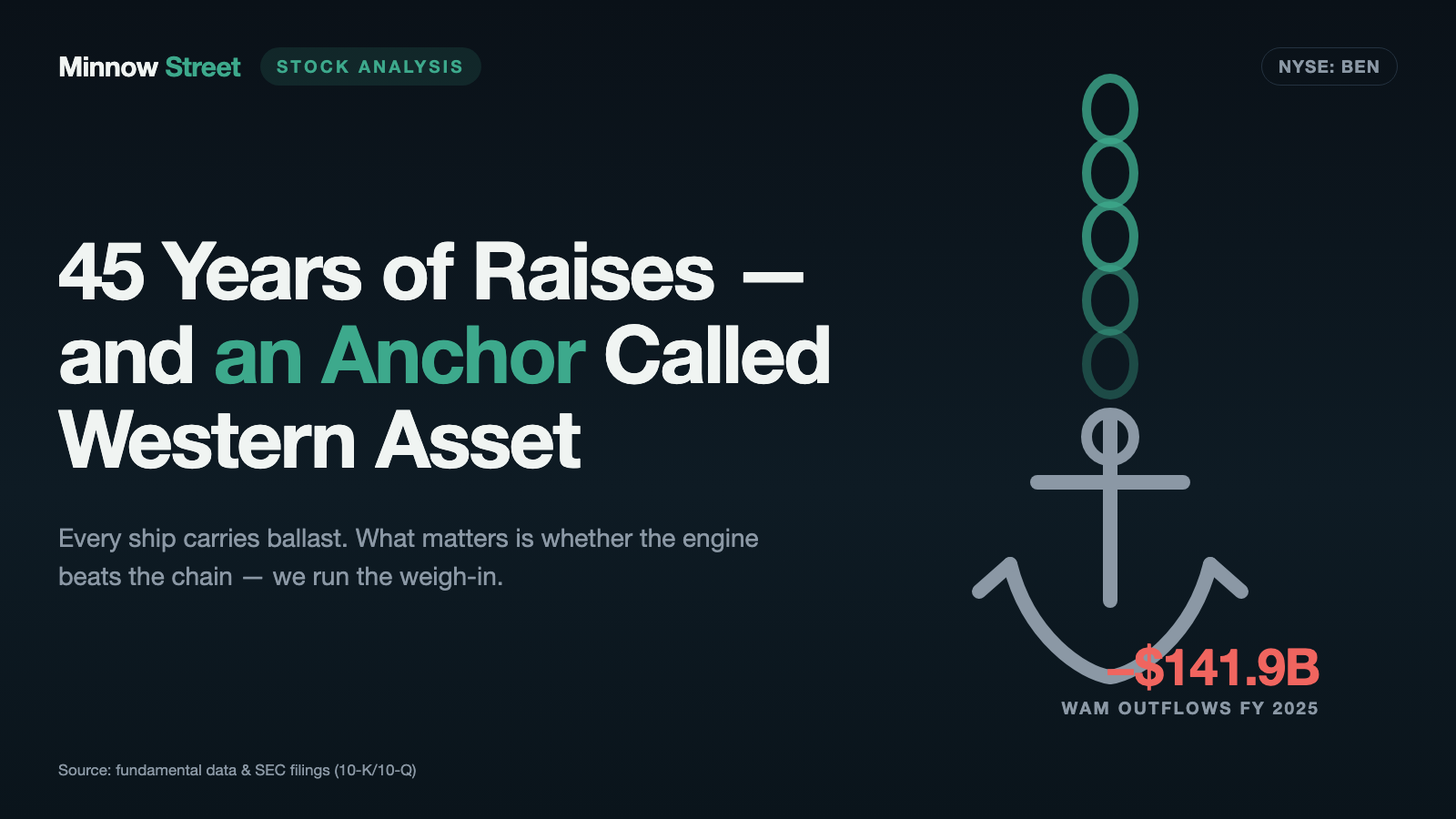
Franklin Resources Stock: 45 Years of Dividend Raises — and an Anchor Called Western Asset
Franklin Resources (Franklin Templeton) has raised its dividend every year since 1981 — through every crash. The stock sits at rank 3 of the U.S. selection in our in-house Dividend Aristocrats scanner (as of July 18, 2026), with a dividend yield around 5.5 percent. We read the annual reports (10-K) and the quarterly reports (10-Q) through March 31, 2026: a scandal at bond subsidiary Western Asset that drove $141.9 billion out the door in fiscal 2025, two years in which the dividend exceeded reported earnings — and a turnaround that has been in the numbers since October 2025. Not investment advice — just a weigh-in of engine versus anchor chain.
 Thomas Mücke
Founder & Publisher
Thomas Mücke
Founder & Publisher
Chart
Interactive price chart (TradingView).
Note: pure fact-based analysis, not investment advice and not a solicitation to buy or sell. All figures without guarantee.
There is an investor trap that catches precisely the careful people: the dividend autopilot. It works like this: a company has raised its dividend every single year for 45 years — through the crash of 1987, the dotcom bust, the financial crisis, the pandemic. Past a certain streak length, your brain stops checking the company and only checks the streak: "45 years? They know what they are doing." The autopilot takes over, the 5.5 percent yield gleams, the buy button moves closer. Franklin Resources (NYSE: BEN), the parent of Franklin Templeton, is a textbook case in the summer of 2026: rank 3 in our in-house Dividend Aristocrats scanner (U.S. selection, as of July 18, 2026), dividend raised every year since 1981. So let\'s make a deal: before the autopilot decides for you, we read together what the company itself reported, under penalty of law, to the U.S. securities regulator, the SEC — the annual reports (10-K) for fiscal years 2024 and 2025 and the quarterly reports (10-Q) through March 31, 2026. Both things are in there: a dividend machine straight out of the textbook — and an anchor chain called Western Asset that at one point had $141.9 billion hanging from it. In the end you decide for yourself whether the engine is stronger than the chain.
What Franklin Resources actually does — and why the fiscal year confuses people
Franklin Resources sells no sofas and no chips, but something invisible: the management of other people\'s money. Clients — retail investors, pension funds, sovereign wealth funds — hand the company their assets, Franklin\'s fund managers invest them, and the house keeps a fee, measured in basis points: in fiscal 2025 it averaged 40.5 basis points, roughly $4 of annual fees per $1,000 of assets managed. That is why the most important number of an asset manager is not revenue but assets under management — AUM: as of March 31, 2026, Franklin managed $1,682.1 billion — a sum in the neighborhood of Spain\'s annual economic output, spread across equities ($669.7 billion), fixed income ($434.3 billion), alternatives such as private credit ($282.8 billion), multi-asset solutions ($207.5 billion) and cash management ($87.8 billion). Under the Franklin Templeton umbrella the company gathers specialist brands such as Putnam (acquired January 2024), Royce, Brandywine Global, Benefit Street Partners — and the bond subsidiary Western Asset Management, of which much more below. Roughly 9,800 employees work in offices in over 30 countries; headquarters is San Mateo, California. The house, founded in 1947 and named after Benjamin Franklin (hence the ticker BEN), is run in its third generation by the founding family: Jennifer Johnson is CEO, her brother Gregory is executive chairman, and their uncle Rupert has sat on the board since 1971.
Before we get into the numbers, the calendar trap: Franklin\'s fiscal year ends September 30. "Fiscal 2025" ran from October 2024 through September 2025; the second quarter of "fiscal 2026" is the calendar quarter January through March 2026. And that brings us to the central tension of this analysis, which runs through every chapter: on top gleams a 45-year dividend raise streak with a 5.5 percent yield — underneath sit two fiscal years in which the dividend exceeded reported earnings, because a scandal at the bond subsidiary drove billions out of the house. Since October 2025 the tanker has been turning — but the SEC investigation is not off the table. Why a high payout alone is never a buy case is something we dissected at the commercial landlord CTO Realty Growth; how quickly a trust business can be repriced when a legal cloud forms, at the insurer Globe Life.
Where the stock shows up in our scanner
Every day we run roughly 3,500 stocks through our scanners. The hook for this analysis is the Dividend Aristocrats scanner: it filters for companies that have raised their dividend every year for at least 25 consecutive years — computed from the actual payout history, supplemented by the curated S&P 500 Aristocrats list. In the U.S. selection, Franklin Resources ranks third as of July 18, 2026 — with a streak that stands out even in this elite list: a raise every year since 1981, 45 years running. To replicate it yourself: open the scanner, set the country filter to USA, walk the list — and check the other hits on the Franklin stock page. The fundamental lens of the same scanner rates the stock as follows (data as of mid-July 2026): a trailing price-to-earnings ratio around 25 — which sounds expensive but is distorted by impairments, more on that shortly —, a price-to-book ratio around 1.4, a meager return on equity of 6.7 percent (each dollar of equity produced 6.7 cents of annual profit lately) and a Piotroski F-Score of 5 of 9 (a nine-point test of the direction of the books — 5 is midfield, neither alarm nor honor roll). What stands out is momentum: plus 41 percent in six months (data as of mid-July 2026) — the market has begun pricing the turnaround we get to below. Remember the principle: a dividend streak is a promise made by the past — it gets paid out of the future. Whether the future can afford it is what the next chapters are about.
The numbers over the years — honestly appraised
First, what genuinely impresses. Revenue has grown despite all the turbulence: from $7,849.4 million (fiscal 2023) through $8,478.0 million (+8 percent, fiscal 2024) to $8,770.7 million in fiscal 2025 (+3 percent) — helped by the Putnam acquisition of January 2024. Assets under management held above the $1.6 trillion mark despite the scandal, and the fee base is deliberately shifting toward higher-margin alternatives (private credit, real estate, hedge fund strategies): $282.8 billion as of March 31, 2026, up 12 percent year over year; on October 1, 2025, the pan-European private credit manager Apera joined. The first half of fiscal 2026 (October 2025 through March 2026) was then the strongest in years: revenue $4,622.0 million (+6 percent), operating income $604.3 million (+66 percent) — as much as in all of fiscal 2025 —, earnings per share $0.95 after $0.55 in the prior-year period. Read only these paragraphs and you see a tanker picking up speed. Now look at the whole curve:
The curve the autopilot misses is the earnings line: net income crashed from $882.8 million (fiscal 2023) to $464.8 million (fiscal 2024) and recovered to only $524.9 million in fiscal 2025 — per share $1.72, then $0.85, then $0.91. The operating margin fell from 14.0 to 4.8 and most recently 6.9 percent — startlingly little for a manager of $1.7 trillion. Two items explain most of it: impairments of fund management contracts ($389.2 million in fiscal 2024, $226.6 million in fiscal 2025 — largely Western Asset) and the costly integration of Putnam. The company itself prefers to count "adjusted": on that basis, fiscal 2025 still delivered $1,195.8 million of profit and a 24.5 percent margin — but down for the third year in a row (fiscal 2023: $1,332.2 million; fiscal 2024: $1,276.7 million). Remember the image: the tanker earns money even in a storm — the question is which earnings line carries the dividend. Which brings us to the uncomfortable truths.
What the filings say — the uncomfortable truths
Uncomfortable truth no. 1: The Western Asset scandal cost $141.9 billion of client money — in a single fiscal year
Western Asset Management (WAM), Franklin\'s big bond subsidiary out of Pasadena, was an institution of the U.S. bond market for decades. Then an internal investigation found irregularities in how derivatives trades were allocated to client accounts — the suspicion: profitable trades preferentially landed in certain portfolios. The SEC, the Department of Justice (DOJ) and the derivatives regulator CFTC investigated in parallel. For clients that was reason enough to leave, and the annual report quantifies the exodus dryly:
"AUM decreased $17.4 billion or 1% during fiscal year 2025 primarily due to $97.4 billion of long-term net outflows, inclusive of $141.9 billion of long-term net outflows at Western Asset Management (“WAM”), partially offset by the positive impact of $67.6 billion of net market change, distributions and other, and $12.6 billion of cash management net inflows."
— Franklin Resources, SEC annual report 10-K for fiscal year 2025, Item 7 "Management’s Discussion and Analysis — Assets under Management"

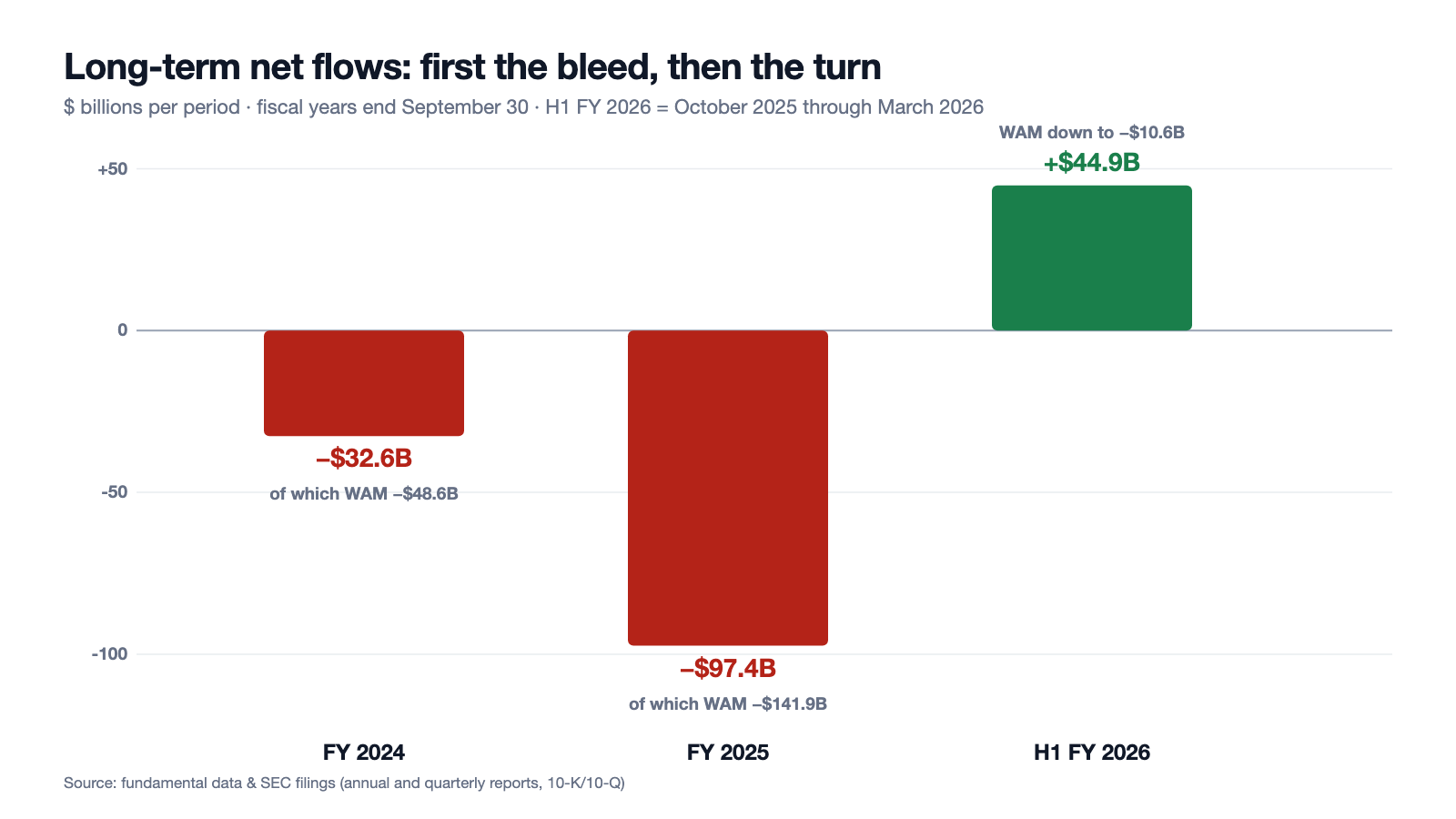
Read the number correctly: group-wide, "only" $97.4 billion flowed out — so the rest of the house actually gathered roughly $44 billion net despite the scandal, while $141.9 billion left WAM. In fiscal 2024, WAM had already lost $48.6 billion. On top came the write-down: in fiscal 2025 Franklin impaired $200.0 million of WAM fund management contracts (after a $389.2 million impairment the year before), because smaller assets and remaining clients switching to cheaper products shrink the future fee streams. And the legal tip of the case carries a name — the annual report records it in Note 15:
"On November 25, 2024, the SEC filed a complaint in the United States District Court for the Southern District of New York against Mr. Leech alleging violations of certain laws related to trade allocations. Concurrently, the DOJ filed an indictment with the United States District Court for the Southern District of New York against Mr. Leech for similar allegations and for false statements made to the SEC."
— Franklin Resources, SEC annual report 10-K for fiscal year 2025, Note 15 "Commitments and Contingencies — Western Asset Management Investigations and Litigation"

Ken Leech was not just anyone but WAM\'s co-chief investment officer and the face of its flagship strategies; he has been out since August 2024. Important context: the man is charged, not the company — and since spring 2026 the regulatory front has been visibly easing, more below. But a concentration risk of a special kind remains on display: at an asset manager, a single person with an allocation button can cost a decade of reputation and a tenth of the firm\'s assets. Trust is not a side dish here — it is the product itself. Since July 3, 2025, an investor class action against Franklin, WAM and Leech has also been pending (Western PA Electrical Employees Insurance Trust Fund, U.S. District Court for the Western District of Pennsylvania).
Uncomfortable truth no. 2: For two years, the dividend exceeded reported earnings
Now for the dividend autopilot\'s core discipline — the question of what actually pays for the streak. The equity statement\'s answer is uncomfortable: in fiscal 2024 Franklin declared $670.1 million of dividends on $464.8 million of net income; in fiscal 2025, $688.4 million of dividends on $524.9 million of income. Per share: a $1.24 dividend against $0.85 of earnings, then $1.28 against $0.91 — a GAAP payout ratio of roughly 146 and 141 percent. In everyday terms: for two years running, the household wired out more allowance than the bank statement showed in income — possible only because part of the "expenses" on that statement never cost any cash. The gap stems largely from the non-cash impairments of fund contracts (truth no. 1); on adjusted earnings of $2.22 per share, the fiscal 2025 payout ratio was a manageable 58 percent. Management, for its part, did not blink — in December 2025 came raise number 45, in the same breath as a buyback top-up:
"The quarterly dividend of $0.33 per share represents a 3.1% increase over the dividends paid for the prior quarter and the same quarter last year. The Company has raised its dividend every year since 1981."
— Franklin Resources, SEC current report 8-K dated December 17, 2025, Exhibit 99.1 (dividend press release)

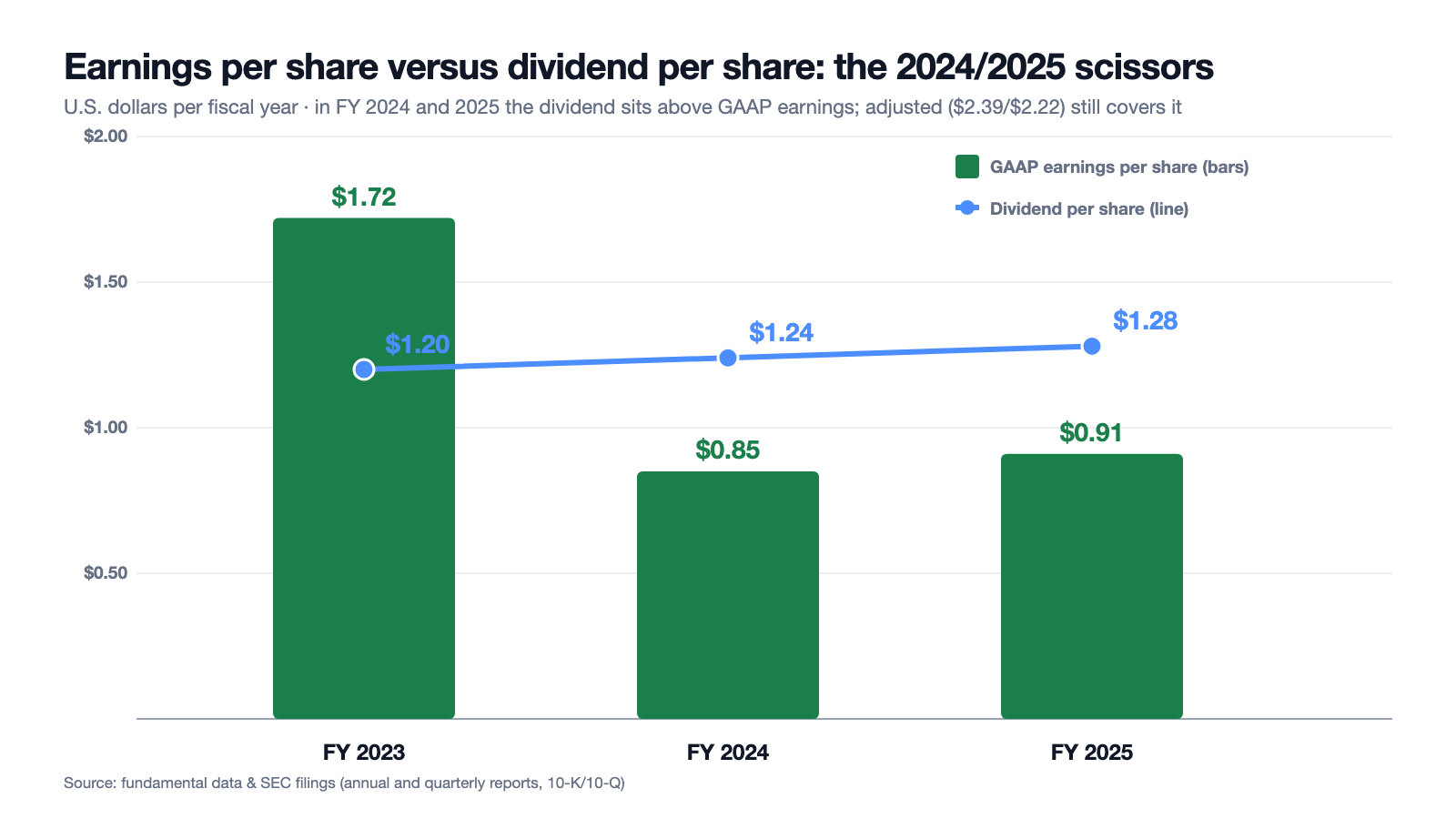
Fairness demands three defense witnesses. First: the impairments cost no cash — operating cash flow stayed positive, and the parent\'s liquid resources (cash, receivables, own investments) stood at $5,036.5 million as of March 31, 2026, against only $2,253.3 million of debt, all of it fixed-rate. Second: in the first half of fiscal 2026, GAAP earnings ($0.95 per share) covered the dividend ($0.66) again at a 69 percent ratio. Third: buybacks are slowly shrinking the share count (10.7 million shares for $240.3 million in fiscal 2025), which makes every future raise cheaper. Still: a streak that survived two years only thanks to the footnote "non-cash" is not a law of nature — it is a management decision with a balance-sheet cushion.
Uncomfortable truth no. 3: The price tag of the core business shrinks — year after year
The third truth is the quietest, but long-term perhaps the most important. Franklin\'s revenues hang on the average fee charged on assets — and that fee is structurally falling, because clients migrate from expensive active funds into cheaper products. The annual report makes no secret of it:
"Our effective investment management fee rate excluding performance fees (investment management fees excluding performance fees divided by average AUM) was 40.5 and 41.1 basis points for fiscal years 2025 and 2024. The rate decrease was primarily due to higher average AUM in lower-fee equity products and catch-up fees recognized in the prior year […]"
— Franklin Resources, SEC annual report 10-K for fiscal year 2025, Item 7 "Management’s Discussion and Analysis — Investment Management Fees"
40.5 basis points means: of every $1,000 of client money, Franklin keeps a good $4 a year — before distribution, salaries and technology. For comparison: big index providers charge under 10 basis points for standard products; exactly this price pressure is why Franklin has spent years replacing expensive active mutual funds with acquisitions in private credit and alternatives (Benefit Street, Apera), where 100 basis points and more are customary. The strategy is coherent — but it also explains why 8 percent more average assets produced only 9 percent more revenue in the latest quarter, and why adjusted profit fell three years in a row. A business model whose price tag loses a few basis points every year has to run just to stand still. That is not a Franklin weakness but the fate of the whole active fund industry — yet the next 45 years of dividends have to be earned against this headwind.
The turnaround: inflows, an earnings jump — and regulators offering peace
Now for the other side of the ledger, because since October 2025 the engine room has looked different. In the first half of fiscal 2026 Franklin recorded $44.9 billion of long-term net inflows — WAM\'s outflows shrank to $10.6 billion, and to just $4.1 billion in the January-through-March 2026 quarter. Assets under management reached $1,682.1 billion (+9 percent year over year), quarterly net income jumped 77 percent to $268.2 million, earnings per share rose 88 percent to $0.49, and the operating margin doubled to 14.1 percent. Impairments of fund contracts in six months: zero. In parallel, the regulatory front is dissolving: the CFTC has closed its investigation — and from the Department of Justice, a remarkable sentence sits in the quarterly report:
"The Company has also previously disclosed that it was informed by the DOJ that it is prepared to resolve its investigation through a disposition that does not require the filing of any criminal charges against WAM. […] The Company continues to cooperate with the SEC investigation, which remains ongoing."
— Franklin Resources, SEC quarterly report 10-Q as of March 31, 2026, Note 10 "Commitments and Contingencies"

Honestly framed: one half-year does not make a summer. Part of the earnings jump is simply the base effect of the scandal year, the inflows benefited from strong equity markets into the fall of 2025, and in the January-through-March 2026 quarter the market correction already shaved $17.3 billion of market value off assets under management. The SEC outcome — penalty, conditions, timing — is in no filing. But the direction is documented beyond dispute: the chain is getting shorter link by link, and the engine is running again.
Valuation: $12.2 billion of market value for $1.7 trillion of client money
In mid-July 2026, Franklin Resources weighed in at roughly $12.2 billion of market value (fundamental data, as of mid-July 2026) — about 1.9 times annual revenue and roughly 0.7 percent of assets under management. Depending on the earnings line, two very different price tags emerge: on trailing GAAP earnings the stock looks sportily priced at a price-to-earnings ratio around 25 (scanner, data as of mid-July 2026) — but that number carries the scandal-year impairments. On fiscal 2025 adjusted earnings ($2.22 per share) the multiple sits around 10 to 11, and measured against analyst estimates for the current fiscal year (on average roughly $2.80 per share, data as of mid-July 2026) it is in the single digits — the professionals\' view thus already prices in half the recovery, after the stock gained a good 40 percent in six months. The dividend yield stood around 5.5 percent in mid-July 2026 (a $1.32 annual rate). The balance sheet behind it is comfortable: $5,036.5 million of parent liquid resources against $2,253.3 million of fixed-rate debt (March 31, 2026), equity of $12.1 billion (September 30, 2025). And the buyback got fresh ammunition in December 2025: up to 40 million shares are authorized — nearly 8 percent of the share count of roughly 517.5 million. Cheap is not the question here — the question is whether "adjusted" remains the honest earnings line for good.
Opportunities and risks at a glance
What speaks for Franklin Resources:
- 45 consecutive years of dividend raises (every year since 1981, most recently +3.1 percent to $0.33 per quarter in December 2025) and a yield around 5.5 percent (mid-July 2026) — rank 3 in our Dividend Aristocrats scanner (U.S. selection, July 18, 2026).
- The turnaround is documented: $44.9 billion of long-term net inflows in the first half of fiscal 2026, WAM outflows down to $4.1 billion in the latest quarter, earnings per share up 73 percent (10-Q as of 03/31/2026).
- Regulatory easing: CFTC probe closed, DOJ prepared to resolve without criminal charges against WAM — the tail risk of a criminal case against the subsidiary has dropped markedly.
- Growth where the fees are high: alternatives at $282.8 billion (+12 percent year over year, 03/31/2026), acquisitions Putnam (2024) and Apera (October 2025); multi-asset +18 percent.
- A solid parent balance sheet: $5.0 billion of liquid resources against $2.3 billion of fixed-rate debt (03/31/2026), and a buyback authorization of up to 40 million shares (December 2025).
What speaks against it:
- The SEC investigation into Western Asset remains open — penalty, conditions and timing unknown; add the investor class action pending since July 2025 and the SEC complaint/DOJ indictment against former co-CIO Leech as an ongoing reputational witness for the prosecution.
- Two years of GAAP payout ratios above 100 percent (fiscal 2024: $670.1M vs. $464.8M; fiscal 2025: $688.4M vs. $524.9M) — the streak was lately paid out of the balance-sheet cushion, not out of reported earnings.
- Structural fee pressure: an effective rate of 40.5 after 41.1 basis points (fiscal 2025 vs. 2024), mix shift toward cheaper products; adjusted profit fell three years in a row ($1,332.2M → $1,276.7M → $1,195.8M).
- The bond business keeps shrinking: $434.3 billion of fixed income AUM as of 03/31/2026, down 3 percent year over year — the WAM legacy lingers; part of the fiscal 2026 earnings jump is the base effect of the scandal year.
- Market dependence squared: fees hang on asset levels, which already lost $17.3 billion of market value in the January-through-March 2026 quarter; after a good 40 percent share-price run in six months (mid-July 2026), part of the recovery is already paid for.
A human conclusion
Back to the dividend autopilot from the beginning. Its core is not that long streaks are worthless — 45 years of raises through four crises is a genuine seal of quality, and Franklin earned it. Its core is that in your head, the streak replaces the very check that makes it worth anything. That check looks like this at Franklin: you get an asset manager with $1.7 trillion of client money, a yield around 5.5 percent, a comfortable cash position, documented net inflows after two years of bleeding, and a regulatory front that is visibly clearing. In exchange you carry: an open SEC investigation, a dividend that spent two years above reported earnings, a core business whose price tag loses a few basis points every year — and a trust business in which a single allocation button can cost $141.9 billion. Whether the engine is stronger than the chain will be decided by three lines in the coming quarterly reports (10-Q): the long-term net flows, the SEC sentence in Note 10 — and whether GAAP earnings keep covering the dividend. Switch off the autopilot and read those three lines yourself. What you make of it is your decision. And that is exactly as it should be.
Sources
All original documents used in this analysis — for your own reading:
- Franklin Resources, Inc. — SEC annual report 10-K for fiscal year 2025 (ended September 30, 2025; filed November 10, 2025)
- Franklin Resources, Inc. — SEC annual report 10-K for fiscal year 2024 (ended September 30, 2024; filed November 12, 2024)
- Franklin Resources, Inc. — SEC quarterly report 10-Q as of March 31, 2026 (filed April 28, 2026)
- Franklin Resources, Inc. — SEC quarterly report 10-Q as of December 31, 2025 (filed January 30, 2026)
- Franklin Resources, Inc. — SEC current report 8-K dated December 17, 2025, Exhibit 99.1 (dividend increase + buyback top-up)
- Complete SEC filing history of Franklin Resources: EDGAR overview (sec.gov)
- Fundamental data (metrics, quarterly series, valuation; data as of mid-July 2026), reconciled with the SEC filings.
- Screener and rating data: in-house stock scanner, in particular Dividend Aristocrats (as of July 18, 2026).
Transparency & disclaimer: This analysis is a journalistic contextualization of publicly available information and is not investment advice, not a financial analysis in the regulatory sense, and not a solicitation to buy or sell securities. Stock investments carry substantial risks up to and including total loss. All information without guarantee; the data cut-off is noted in the text. The author holds no position in Franklin Resources shares at the time of publication.
Our Bottom Line at a Glance
- Dividend history & capital returns positive
- Raised every year since 1981 — 45 consecutive years, most recently +3.1 percent to $0.33 per quarter (8-K dated 12/17/2025); a yield around 5.5 percent (mid-July 2026), plus a buyback program topped up to as many as 40 million shares in December 2025.
- Dividend coverage neutral
- In fiscal 2024 and 2025 the dividend exceeded GAAP net income ($670.1M vs. $464.8M and $688.4M vs. $524.9M) — carried by adjusted earnings (58 percent payout in FY 2025) and the cash pile; in the first half of fiscal 2026, GAAP earnings ($0.95 per share) covered the dividend ($0.66) again.
- Flows & AUM turnaround positive
- After −$32.6 billion (FY 2024) and −$97.4 billion (FY 2025, of which WAM −$141.9B), long-term net flows turned to +$44.9 billion in the first half of fiscal 2026; AUM $1,682.1 billion as of 03/31/2026 (+9 percent), alternatives +12 percent (10-K FY 2025, 10-Q as of 03/31/2026).
- Western Asset legal risk neutral
- CFTC probe closed and the DOJ prepared to resolve without criminal charges against WAM — but the SEC investigation continues, the investor class action (since 07/03/2025) is pending, and the case against former co-CIO Leech is open (10-Q as of 03/31/2026, Note 10).
- Margin & fee pressure negative
- Effective fee rate of 40.5 after 41.1 basis points (FY 2025 vs. 2024), adjusted profit down three years in a row ($1,332.2M → $1,276.7M → $1,195.8M), GAAP operating margin of just 6.9 percent in FY 2025 — the mix shift toward alternatives takes time.
- Valuation & momentum neutral
- Roughly $12.2 billion of market value (mid-July 2026): P/E around 25 on GAAP, around 10 to 11 on fiscal 2025 adjusted earnings, single-digit on analyst estimates — after a good 40 percent share-price run in six months, part of the recovery is already paid for.
Franklin Resources is the case of a Dividend Aristocrat with an anchor: 45 years of raises and a 5.5 percent yield stand against two fiscal years in which the payout exceeded reported earnings, because the Western Asset scandal cost $141.9 billion of client money and over $600 million in impairments. Since October 2025 the tanker has been turning — net inflows, an earnings jump, the CFTC out, the DOJ easing — yet the SEC investigation and structural fee pressure remain. Whoever invests here buys the raise streak and bets that the turnaround closes the coverage gap for good. Not investment advice.
What Our Rating Means
- If you don't own the stock
- As long as the question raised in the bottom line stays open, we see no basis for an entry.
- If you hold it in your portfolio
- Our findings offer no acute reason to sell — the checkpoints named remain decisive.
A journalistic assessment by our editorial team at the time of the deep dive, based on public sources — not investment advice and not a solicitation to buy or sell. Your personal circumstances (investment goals, risk capacity, taxes) cannot be taken into account. What our categories mean, how verdicts are formed, and what conflicts of interest exist →
Worth Noting
- BEN made the research list via our in-house Dividend Aristocrats scanner: rank 3 of the U.S. selection as of July 18, 2026; the scanner requires at least 25 consecutive years of dividend raises — Franklin stands at 45 (since 1981).
- Scanner metrics (P/E around 25, P/B around 1.4, Piotroski 5) use trailing twelve-month GAAP figures; the fiscal 2024/2025 impairments ($389.2M + $226.6M) distort the P/E upward. Franklin's fiscal year ends September 30 — all annual figures carry that offset.
- Market value and valuation figures (~$12.2 billion) from the fundamental data, as of mid-July 2026; analyses are evergreen, daily prices are not a buy argument.
Frequently Asked Questions
Franklin Resources (NYSE: BEN) is the parent of Franklin Templeton and manages assets for clients — $1,682.1 billion as of March 31, 2026, across equity, fixed income, alternative, multi-asset and cash management products. For that the company collects a management fee averaging 40.5 basis points (fiscal 2025), roughly $4 per $1,000 of client money per year, plus distribution, servicing and performance fees. Revenue in fiscal 2025 (ended September 30): $8,770.7 million.
Every year since 1981 — 45 consecutive years. The latest raise came on December 17, 2025: up 3.1 percent to $0.33 per quarter, recorded in the SEC 8-K filing ("The Company has raised its dividend every year since 1981"). In our in-house Dividend Aristocrats scanner the stock ranked third in the U.S. selection on July 18, 2026; the dividend yield stood around 5.5 percent in mid-July 2026.
It is well cushioned but not flawlessly covered: in fiscal years 2024 and 2025 the declared dividend ($670.1 million and $688.4 million) exceeded GAAP net income ($464.8 million and $524.9 million). The cause was mostly non-cash impairments of fund management contracts; on adjusted earnings ($2.22 per share in fiscal 2025) the payout ratio was 58 percent. In the first half of fiscal 2026, GAAP earnings ($0.95 per share) covered the dividend ($0.66) again, and the parent held about $5.0 billion of liquid resources against $2.3 billion of debt as of March 31, 2026.
At Franklin's bond subsidiary Western Asset Management (WAM), the issue was how derivatives trades were allocated to client accounts. The SEC, DOJ and CFTC investigated; on November 25, 2024, the SEC filed a complaint against former co-CIO Ken Leech and the DOJ filed a parallel indictment. Clients pulled $141.9 billion net out of WAM in fiscal 2025; Franklin impaired $200.0 million of WAM fund contracts. As of the 10-Q for March 31, 2026: the CFTC probe is closed, the DOJ is prepared to resolve without criminal charges against WAM, and the SEC investigation remains ongoing.
Franklin's fiscal year ends September 30. "Fiscal 2025" ran from October 2024 through September 2025; the second quarter of "fiscal 2026" is the calendar quarter January through March 2026. When comparing with competitors that report on a calendar-year basis, keep this one-quarter offset in mind.
Markedly better: in the first half of fiscal 2026 (October 2025 through March 2026), $44.9 billion flowed in long-term net, assets under management rose 9 percent year over year to $1,682.1 billion, earnings per share climbed 73 percent to $0.95, and the operating margin nearly doubled to 13.1 percent. Part of that is the base effect of the scandal year — and the market correction already cost assets under management $17.3 billion of market value in the January-through-March 2026 quarter.
It depends on the earnings line: the market value stood around $12.2 billion in mid-July 2026 — a price-to-earnings ratio around 25 on impairment-distorted trailing GAAP earnings, around 10 to 11 on fiscal 2025 adjusted earnings ($2.22 per share), and single-digit against analyst estimates for the current year. Add a dividend yield around 5.5 percent and a buyback program topped up to as many as 40 million shares in December 2025. After a roughly 40 percent share-price gain in six months, part of the recovery is already priced in, though.
Found an error?
Did you spot a factual error, an outdated number, or a typo in this deep dive? Let us know briefly — your report goes straight to the editorial team.