Fortress Biotech: $205 Million for a Regulatory Voucher — and the Question of Who Owns the Money
On July 26, 2026, our in-house stock scanner put Fortress Biotech 12th in the price-to-free-cash-flow ranking of the U.S. selection, at a ratio of 0.6. Read the filings with the U.S. securities regulator, the SEC, and you find no business success behind that number but a single sale: a priority review voucher from the Food and Drug Administration that the subsidiary Cyprium handed over on March 30, 2026 for $205 million. In the four quarters before that, cash flowed out. And of the $205 million, $41 million goes straight back to a U.S. health agency. A consolidated balance sheet is not a treasure map: it adds up cash boxes that belong to different people.
 Thomas Mücke
Founder & Publisher
Thomas Mücke
Founder & Publisher
Chart
Interactive price chart (TradingView).
Note: pure fact-based analysis, not investment advice and not a solicitation to buy or sell. All figures without guarantee.
There is an investor trap that likes to catch the people who actually read balance sheets — call it the treasure map trap. It works like this: you open the accounts of a small company and find more cash than the whole company costs on the stock market. Your brain fills in the rest: "So the cash comes free." That is exactly how Fortress Biotech, Inc. (NASDAQ: FBIO) landed on our desk. But a consolidated balance sheet is not a treasure map. It adds up cash boxes that belong to different people, and it does not say at first glance whether the money was earned or sold. So let us make a deal: before we celebrate the cash, we read where it came from and who is allowed to spend it. The sources are the filings Fortress submits to the U.S. securities regulator, the SEC — the annual report (Form 10-K) for 2025, filed March 31, 2026, the quarterly report (Form 10-Q) for the period ended March 31, 2026, filed May 14, 2026, and the current reports (Form 8-K) in between. Those documents are honest under threat of penalty. And they describe a holding company with 78 employees whose entire profit this year hangs on a single piece of paper.
Contents
- What Fortress Biotech actually does
- How the stock landed on our desk — and what a 0.6 ratio means here
- The numbers over the years — fairly credited
- What the filings say — the uncomfortable truths
- Valuation: what a share in this holding company really is
- Opportunities and risks at a glance
- A human conclusion
- Sources
What Fortress Biotech actually does
Fortress Biotech is not a drug maker in the everyday sense. It is a holding company whose business is owning other companies. The model is unusual enough to deserve a careful explanation, because without it not a single number in this analysis makes sense. Fortress looks for compounds and product candidates at universities, hospitals and pharmaceutical groups, secures the rights, and then sets up a separate small company for each candidate to develop it. In the group\'s own language, those subsidiaries are called partner companies when they are publicly listed and simply subsidiaries when they are not.
As of December 31, 2025 the family tree looked like this. Publicly traded: Journey Medical Corporation (Nasdaq: DERM) with dermatology products, Mustang Bio (Nasdaq: MBIO) with cell therapies against brain tumors, and Avenue Therapeutics, whose shares were suspended from Nasdaq trading on March 19, 2025, formally delisted in July 2025, and have traded over the counter under the symbol ATXI since March 19, 2025. Private: Cellvation, Cyprium, Helocyte, LemmaTx, Oncogenuity and Urica. The whole group employed 78 full-time staff (Form 10-K for 2025). This is not a factory. It is an investment office with laboratory access.
The parent is supposed to make money three ways. First, through a founders agreement: every subsidiary owes Fortress an annual payment-in-kind dividend of 2.5 percent of its capital in its own shares — plus 2.5 percent of everything it newly issues. So whenever a subsidiary sells new shares to outside investors, Fortress gets a slice on top, for free. Second, through management services agreements, for which the subsidiaries pay fees. Third — and this is what everything turns on — through selling the subsidiaries themselves. That has worked three times in five years: Caelum went to AstraZeneca in 2021 ($56.9 million upfront to Fortress, plus a claim on 42.4 percent of potential milestones that would total up to roughly $182 million), Checkpoint Therapeutics went to Sun Pharma in May 2025 ($28.0 million in cash), and Baergic went to Axsome in November 2025.
Which names the central tension of this analysis, and it runs through every chapter that follows: the operating business of this holding company has lost money for years — earnings appear only when something is sold. The ratio that put the stock on our desk measures exactly one such sale and mistakes it for the business.
How the stock landed on our desk — and what a 0.6 ratio means here
We came across Fortress Biotech in our in-house stock scanner, specifically in the price-to-free-cash-flow ranking. That ranking sorts the entire stock universe by the ratio of market value to free cash flow — ascending, cheapest first. On July 26, 2026 the list held 544 hits, of which the 25 strongest are displayed; within the U.S. selection Fortress Biotech stood 12th at a ratio of 0.6. To repeat it yourself: open the stocks section, go to scanners, pick the price-to-free-cash-flow ranking, set the market filter to the United States. The lists are recomputed daily, so the placement is a snapshot from July 26, 2026, not a permanent state.
Now the ratio itself, in plain language. Free cash flow is the money left over after all running costs and investments — what a company could use to repay debt, pay dividends or buy back stock. The price-to-free-cash-flow ratio divides market value by the sum of that figure over the trailing four quarters. A reading of 20 means you are paying twenty times one year of freely available cash, which works out to 5 percent. A reading of 0.6 means, arithmetically, that the company produced considerably more free cash in four quarters than it costs on the stock market. At an industrial company that would be a sensation.
Here it is not. That is the most important sentence in this analysis. Look at how those four quarters are composed:
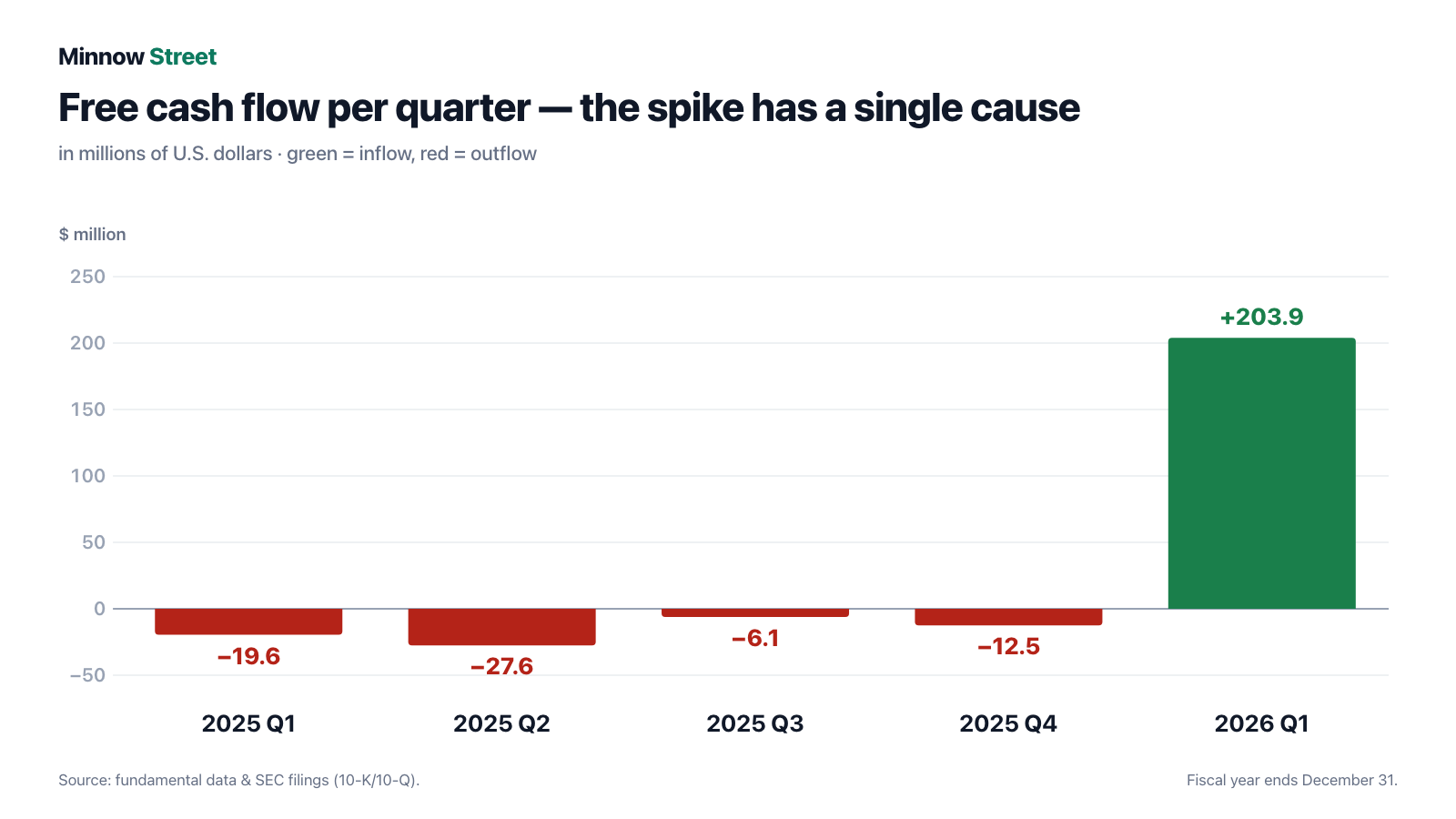
Four quarters in a row, cash flowed out: $19.6 million, $27.6 million, $6.1 million and $12.5 million. Then came the first quarter of 2026 at plus $203.9 million. Everything the ranking flags as cheap sits in that one bar. And the bar has a single cause.
On January 13, 2026 the Food and Drug Administration approved ZYCUBO (copper histidinate, development name CUTX-101) for the treatment of Menkes disease in pediatric patients — a very rare inherited disorder of copper metabolism. In the United States, approving a drug for a rare pediatric disease produces a by-product: a rare pediatric disease priority review voucher. The holder may demand an accelerated review for any other application — six months instead of ten. For a large group whose blockbuster reaches the market four months earlier, that is worth real money. So these vouchers are traded. And so Fortress got this line into its annual report:

So the finding is settled: the free cash flow the ranking measures is not an operating result, it is sale proceeds. It does not repeat, because there was only one voucher. Remember the sentence: a one-time sale looks exactly like durable earning power inside an annual ratio — until you read the filing.
In fairness to our own house, a second finding belongs here. Our scanner system does not count this ranking as a full hit: the stock page states explicitly that pure ratio rankings, which sort the whole universe, do not qualify as hits. As genuine strategy hits, the page listed five screens on July 26, 2026: 21-day EMA trend, Gary Antonacci dual momentum, power trend and Stan Weinstein stage 2 — all four from the momentum and trend category — plus, from the risk and weakness category, the Beneish M-score. That last one is a warning flag, not a seal of approval: the M-score is a statistical model that scans financial statements for patterns more common in manipulated accounts. At a company whose quarterly result jumps on a $158.9 million one-off gain, such a model will almost inevitably trip — that is an invitation to read further rather than an accusation. These lists, too, are recomputed daily.
The numbers over the years — fairly credited
First what genuinely impresses, and there is more of it than the headline suggests. Fortress has delivered on its core promise three times in five years: Caelum brought $56.9 million in 2021, Checkpoint another $28.0 million in May 2025 — plus a claim on up to $4.8 million from a contingent value right and on 2.5 percent of future net sales of the cancer drug UNLOXCYT — and the voucher sale in March 2026 the $205 million gross already mentioned. For a company whose entire market value stood at roughly $111 million on July 26, 2026, that is a remarkable hit rate. Anyone who thinks such a holding structure is an oddity should look at our analysis of Biglari Holdings, where the same basic idea runs on steakhouses and insurance.
There is operating progress too, and it has a name: Journey Medical. The dermatology subsidiary supplies essentially all of the group\'s product revenue. Net revenue rose from $57.7 million in 2024 to $63.3 million in 2025, and in the first quarter of 2026 to $16.0 million from $13.1 million a year earlier — up 22 percent. The driver is Emrosi, a low-dose minocycline product for rosacea approved in November 2024 and launched in March 2025. At the same time, the group\'s operating loss narrowed from $110.4 million in 2024 to $70.2 million in 2025, and in the first quarter of 2026 to $7.7 million from $22.3 million a year earlier. Half of that improvement, though, is arithmetic rather than merit: when Checkpoint left the group in June 2025, its research budget left the consolidated accounts with it.
And now the other side, in a single line: the operating business did not bring in money in either full year. In 2024, $80.2 million flowed out; in 2025, $65.8 million. The gap was covered not by earnings but by the capital market — and not by the parent but by the subsidiaries. The 2025 cash flow statement shows $61.6 million from subsidiary equity offerings and option exercises and another $19.1 million from their at-the-market programs. The parent\'s own program contributed $1.0 million. Put differently: four of every five dollars that came in arrived because the subsidiaries sold new stakes in themselves to outside investors.
What the filings say — the uncomfortable truths
Uncomfortable truth no. 1: $205 million gross does not stay $205 million
The purchase price was a gross price. The quarterly report for the period ended March 31, 2026 names two payouts that come straight off the top:
"In connection with the closing of the PRV sale, Cyprium is obligated to remit 20% of the gross proceeds, or $41 million, to the Eunice Kennedy Shriver National Institute of Child Health and Human Development (“NIH”) and 2.5% of gross proceeds, or $5.1 million, to a third-party pursuant to an agreement."
— Fortress Biotech, Inc., Form 10-Q for the quarter ended March 31, 2026, Note 3

Neither amount had been wired at the balance sheet date. You can see it in accounts payable and accrued expenses, which jumped from $47.1 million at December 31, 2025 to $93.0 million at March 31, 2026. So a sixth of the $255.8 million cash balance is already committed. The same quarter also carried $14.2 million for the contractually triggered redemption of Cyprium preferred shares and $14.5 million of repayments to the lender Oaktree. The reported gain on the sale, net of expenses, was $158.9 million, against which $5.1 million of income tax expense was booked in the quarter.
Uncomfortable truth no. 2: the cash is not where a shareholder assumes it is
This is where the treasure map trap from the opening springs shut. A consolidated balance sheet adds up the cash of every company the parent controls — not every company it owns outright. Journey Medical, Mustang Bio and Avenue Therapeutics have their own shareholders, their own boards and their own bank accounts. Their money appears in the consolidated figures but is not at the parent\'s free disposal. Fortress writes down how much is really upstairs:
"Current cash and cash equivalents as of March 31, 2026 of $209.9 million for Fortress and private subsidiaries primarily funded by Fortress (“Parent Entity”) are considered sufficient to fund the Parent Entity’s operations for at least 12 months following the date of filing of this Quarterly Report on Form 10-Q."
— Fortress Biotech, Inc., Form 10-Q for the quarter ended March 31, 2026, Liquidity and Capital Resources
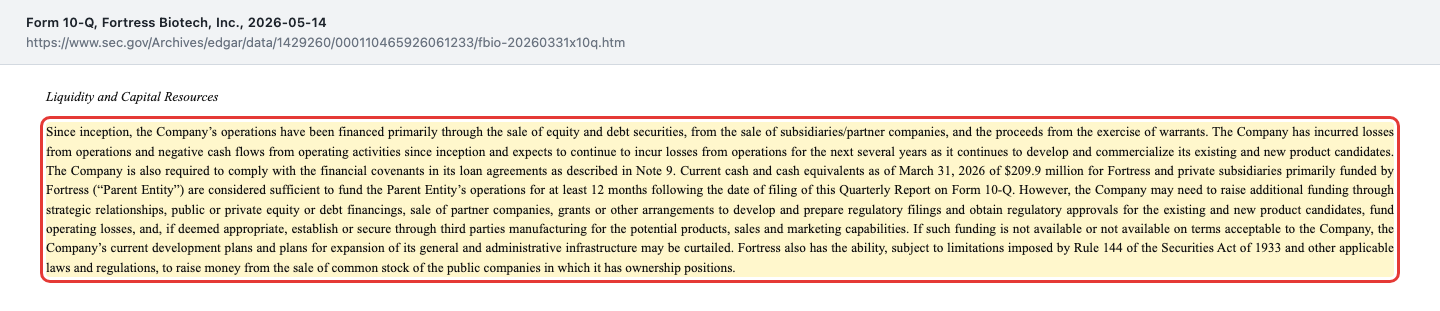
For scale, take the prior year end: of $79.4 million of group cash at December 31, 2025, only $35.2 million sat at the parent and its private subsidiaries — $24.1 million belonged to Journey Medical, $17.3 million to Mustang Bio and $2.9 million to Avenue. The segment figures at March 31, 2026 tell the same story: of $356.9 million of group assets, $246.3 million falls to the Fortress segment, $91.5 million to Journey, $16.6 million to Mustang and $2.5 million to Avenue. The cash is real. It is simply not as free as the consolidated line makes it look. And what the parent actually expects from the voucher proceeds is in the filing as well:

Uncomfortable truth no. 3: the group loses money while the parent earns it — at the expense of outside minorities
This mechanism is the most interesting part of the whole balance sheet, and it is rarely this visible. When a subsidiary that is 60 percent owned loses $100 million, all $100 million shows up in the consolidated accounts — but $40 million is attributed to outside minority holders and taken back out before the result "for the parent" is struck. At Fortress that line is larger than the result itself:
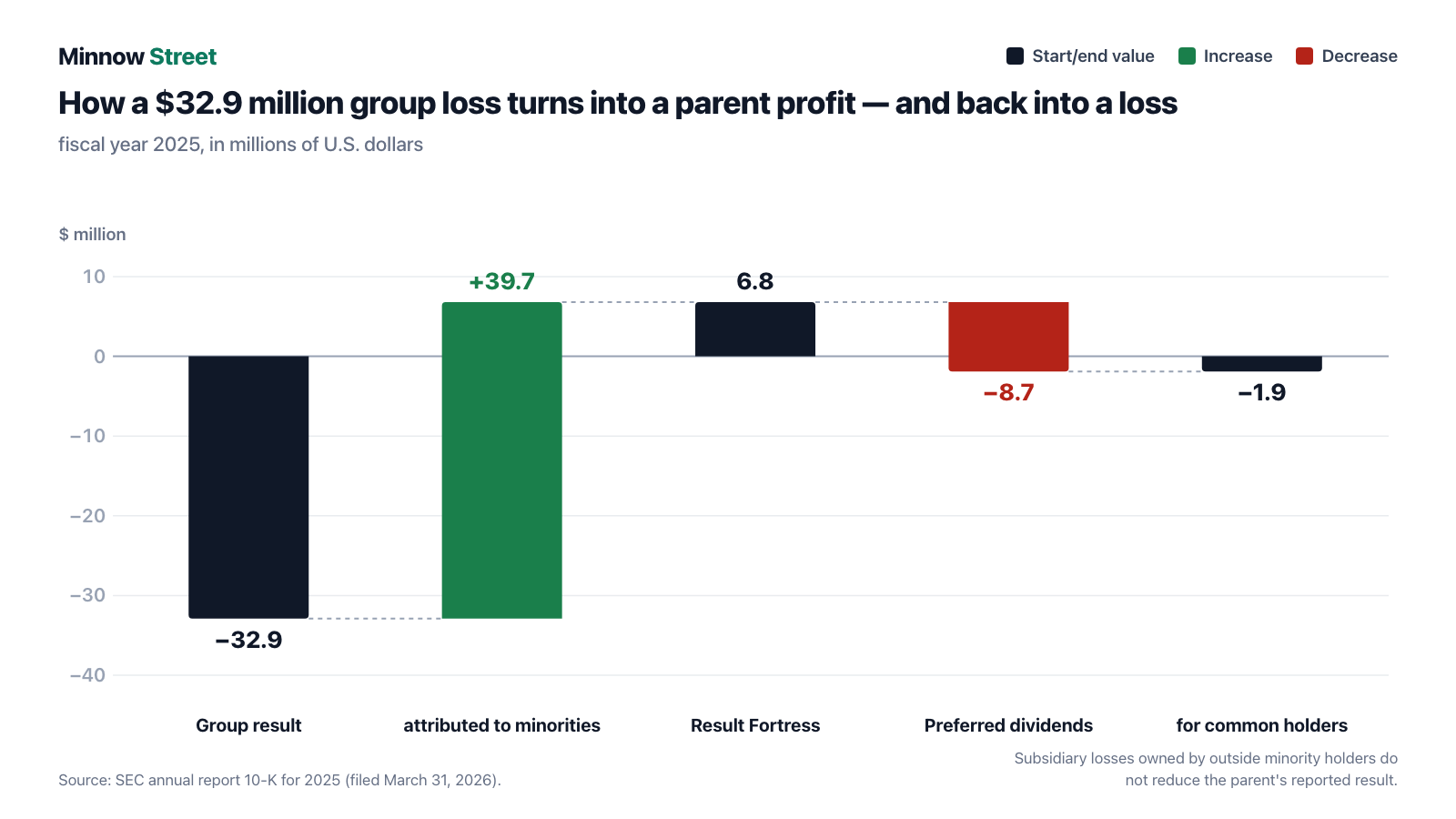
In plain terms: the group lost $32.9 million in 2025. Of that, $39.7 million was attributed to minority holders in the subsidiaries, leaving a $6.8 million profit for Fortress. After $8.7 million of preferred dividends that turned back into a $1.9 million loss, or $0.07 per share. This is entirely correct accounting — and it describes precisely what this holding company does: it lets outside investors carry the development costs and keeps the sale proceeds when something works. In the first quarter of 2026 the same mechanism ran the other way: of $137.2 million of group profit, $26.8 million went to minorities, mainly to Cyprium\'s co-owners.
Uncomfortable truth no. 4: the preferred dividend has been paused since July 5, 2024
Alongside the common stock, a second class trades on Nasdaq: the 9.375 percent Series A cumulative redeemable perpetual preferred stock under the symbol FBIOP, 3,427,138 shares with a $25.00 liquidation preference each. It was designed to pay monthly. Since July 5, 2024 it has paid nothing:
"However, on July 5, 2024, the board of directors paused the payment of dividends on our Series A Preferred Stock until further notice. As a result, the Company is not currently eligible to use Form S-3 and has lost the ability to use the 2024 Shelf."
— Fortress Biotech, Inc., Form 10-Q for the quarter ended March 31, 2026, Note 13
That has two consequences. First, for holders of the preferred: the claims do not lapse, they accumulate. As of March 31, 2026 the filing puts total undeclared dividends at roughly $14.0 million, growing by about $2.0 million per quarter. Second, for the company itself: without a paid dividend it cannot use the simplified Form S-3 registration — and therefore cannot use its 2024 shelf, under which $42.1 million of capacity remained at March 31, 2026. Eligibility returns only once it pays everything by the time it files its next annual report. Since March 30, 2026 the money to do so has been in the bank. Whether the board uses it is the most concrete open question on this balance sheet — the filing says the board revisits the pause regularly.
Uncomfortable truth no. 5: 12.7 million warrants against 33.2 million shares
Dilution means your slice of the cake gets smaller because the cake is cut into more pieces. At Fortress the portion still waiting to be cut is unusually large. As of March 31, 2026 there were 33,186,671 common shares outstanding and, at the same time, 12,737,206 warrants in issue, with a weighted average exercise price of $2.24 and a weighted average remaining life of 3.3 years. That is a good 38 percent of the shares outstanding. The effect is visible directly in the first quarter of 2026: earnings per share were $3.44 basic but only $2.82 diluted, because the diluted share count is 38.4 million rather than 31.5 million. For the trend: the weighted average share count was 20.8 million in 2024, 27.9 million in 2025 and 31.5 million in the first quarter of 2026 — up by more than half in just over two years.
Valuation: what a share in this holding company really is
Start with what was measured on July 26, 2026: market value stood at roughly $111 million across 33.2 million shares outstanding, and trailing four-quarter revenue was $66.2 million. Against that sit, as of March 31, 2026, group cash of $255.8 million and financial debt of $40.0 million ($15.0 million at the parent to Oaktree at an 11.3 percent rate maturing June 30, 2028, plus $25.0 million at Journey Medical to SWK). Arithmetically that produces a negative enterprise value — the company costs less on the stock market than the net cash in its accounts.
Before you reach for the phone: this is exactly where the treasure map trap closes. Of the $255.8 million, $46.1 million is already committed to the NIH and a third party. Roughly $46 million sits at the listed subsidiaries and belongs there, pro rata, to outside shareholders. Accrued preferred dividends account for another $14.0 million, and the preferred shares themselves carry a liquidation claim of $85.7 million that ranks ahead of the common stock. A negative enterprise value is therefore not a valuation gap here but an invitation to look closer. And the other side belongs in the calculation: the operating business burns cash. At an operating loss of $7.7 million in the first quarter of 2026, the parent\'s cash would last for many years — if nothing new came along. At a development holding company, something new coming along is the normal case.
Conventional valuation ratios do not help much here, and that should be said openly. A price-to-earnings ratio of about 1 sounds spectacular but rests entirely on the one-off gain from the voucher sale; the analyst estimate for the coming fiscal year points to a loss per share. A price-to-sales ratio measures Journey Medical\'s revenue, of which Fortress owns only a share. And the price-to-free-cash-flow ratio that put the stock on our desk measures an event that does not repeat. What remains are three anchors you can rely on: the parent\'s cash ($209.9 million at March 31, 2026), the value of the stakes in the listed subsidiaries, which anyone can compute, and the hit rate on sales — three successful monetizations in five years. For contrast, our analysis of Puma Biotechnology shows what a single small biotech with one product rather than a portfolio looks like.
Opportunities and risks at a glance
Opportunities
- The cash is real and unusually large. $255.8 million at March 31, 2026, of which $209.9 million at the parent — against financial debt of $40.0 million and a market value of roughly $111 million (data as of July 26, 2026). Equity swung from minus $1.6 million at December 31, 2024 to plus $202.4 million at March 31, 2026.
- The model has delivered three times. Caelum to AstraZeneca (2021, $56.9 million to Fortress), Checkpoint to Sun Pharma (May 2025, $28.0 million plus a contingent value right and a 2.5 percent royalty), and the FDA voucher to a buyer (March 2026, $205 million gross). Ongoing claims remain: up to $128 million of milestones from Sentynl for ZYCUBO plus tiered royalties of 3 to 12.5 percent.
- A growing product business. Journey Medical lifted net revenue from $57.7 million in 2024 to $63.3 million in 2025 and, in the first quarter of 2026, to $16.0 million from $13.1 million — up 22 percent, driven by the rosacea product Emrosi launched in March 2025.
- Credit covenants have eased. After repayment down to $15.0 million, the Oaktree minimum liquidity covenant fell to $2.0 million and the minimum net sales, capital raise and minimum Journey ownership covenants no longer apply. All applicable covenants were met at March 31, 2026.
Risks
- The operating business does not pay for itself. $80.2 million flowed out of operations in 2024 and $65.8 million in 2025; the operating loss was $70.2 million in 2025. The accumulated deficit of $623.7 million at March 31, 2026 stands against additional paid-in capital of $785.9 million — four of every five dollars ever raised have been spent.
- Funding depends on the subsidiaries. In 2025, $80.7 million came from subsidiary equity offerings and share sales, against $1.0 million from the parent\'s own program. If the subsidiaries lose access to the capital market, group funding loses its main source.
- The proceeds are one-off. There was only one voucher; whether another ever appears depends on a further approval for a rare pediatric disease. The reported $158.9 million gain in the first quarter of 2026 is therefore no basis for extrapolation.
- Dilution. 12,737,206 warrants at a weighted average $2.24 stand against 33,186,671 shares (as of March 31, 2026); the weighted average share count rose from 20.8 million in 2024 to 27.9 million in 2025 and 31.5 million in the first quarter of 2026.
- Capital market access and the preferred dividend. Payments on FBIOP have been paused since July 5, 2024 and roughly $14.0 million has accrued, so the 2024 shelf with $42.1 million of remaining capacity is currently unusable. The filings also note that the company has previously failed to satisfy Nasdaq continued listing rules.
- Subsidiaries under pressure. Avenue Therapeutics was suspended from Nasdaq trading on March 19, 2025, formally delisted in July 2025 and has traded over the counter since; Mustang Bio needed a 1-for-50 reverse stock split in January 2025 to meet the Nasdaq minimum bid price rule.
A human conclusion
Back to the treasure map trap from the opening. It is stubborn because everything about it is true: the $255.8 million really is on the balance sheet, the roughly $111 million market value really is smaller, and free cash flow over the trailing four quarters really is positive. None of those three numbers answers the question that matters: who owns the money, and will there be more tomorrow?
What remains is an honest picture of an unusual company. Fortress Biotech is a 78-person investment house that collects compounds, packs them into separate companies and waits for a large buyer to move. Three times in five years that has worked. In between, the group burns cash, and the bill is paid by the shareholders of its subsidiaries. Whoever buys this stock is buying neither a drug nor a cash flow but a bet that the next monetization arrives — and that the money from the last one reaches the top rather than seeping away into payouts, minority interests and development costs.
We are not telling you whether to buy. We are telling you what the filings say and what to measure the next chapter against: the parent\'s cash after the $46.1 million of payouts, whether the preferred dividend starts flowing again, and whether Journey Medical ever earns enough to carry the rest of the group. What you make of that is your decision. And that is exactly as it should be.
Sources
- Fortress Biotech, Inc., annual report Form 10-K for 2025 (filed March 31, 2026, CIK 0001429260)
- Form 10-Q for the quarter ended March 31, 2026 (filed May 14, 2026)
- Annual report Form 10-K for 2024 (filed March 31, 2025)
- Form 10-Q for the quarter ended September 30, 2025 (filed November 14, 2025)
- Form 8-K dated February 23, 2026 — Items 1.01 and 2.03: purchase agreement for the FDA voucher ($205 million) and the second amendment to the Oaktree credit agreement
- Form 8-K dated June 5, 2025 — Item 2.01: completion of the Checkpoint Therapeutics acquisition by Sun Pharma
- Form 8-K dated March 10, 2025 — Item 1.01: Checkpoint/Sun Pharma merger agreement at $4.10 per share plus a contingent value right
- Fundamental data (quarterly free cash flow series, market value, share count; data as of July 26, 2026), reconciled against the cash flow statements in the filings
- Our in-house stock scanner, price-to-free-cash-flow ranking, U.S. selection, measured live on July 26, 2026
This analysis is journalistic commentary on publicly available documents. It is not investment advice and not a solicitation to buy or sell securities. Shares of small biotech holding companies can move sharply; a total loss is possible. All figures come from the filings named above and carry their as-of dates. At the time of publication the author holds no position in Fortress Biotech, Inc.
Our Bottom Line at a Glance
- Business model neutral
- The holding company buys rights to compounds, spreads them across separate companies and lets those raise money in the capital markets; a founders agreement channels an annual 2.5 percent payment-in-kind dividend plus 2.5 percent of every new subsidiary issue back to the parent. The model has delivered three times — Caelum in 2021, Checkpoint in May 2025, the FDA voucher in March 2026 — but it depends on single events and cannot be planned.
- Operating earning power negative
- Net revenue of $63.3 million in 2025 met an operating loss of $70.2 million, and $65.8 million flowed out of operations after $80.2 million in 2024. All product revenue comes from the subsidiary Journey Medical, whose own segment posted a $1.5 million operating loss in the first quarter of 2026. The accumulated deficit stood at $623.7 million as of March 31, 2026.
- Balance sheet and liquidity positive
- After the voucher sale, March 31, 2026 showed $255.8 million of cash — $209.9 million of it at the parent — against $40.0 million of financial debt and equity of $202.4 million, up from minus $1.6 million at December 31, 2024. The Oaktree loan was repaid down to $15.0 million, cutting the minimum liquidity covenant to $2.0 million; all applicable covenants were met at the balance sheet date.
- Funding and dilution negative
- In 2025, $80.7 million came from subsidiary equity offerings and share sales against $1.0 million from the parent's own program. The weighted average share count rose from 20.8 million in 2024 to 27.9 million in 2025 and 31.5 million in the first quarter of 2026; at March 31, 2026, 33,186,671 shares stood against 12,737,206 warrants at a weighted average $2.24.
- Ownership and distributions negative
- Payments on the 9.375 percent FBIOP preferred stock have been paused since July 5, 2024; roughly $14.0 million had accrued by March 31, 2026, and the company therefore cannot use its 2024 shelf with $42.1 million of remaining capacity. At the same time, part of the group cash belongs to minority shareholders of the listed subsidiaries: of $79.4 million at December 31, 2025, only $35.2 million sat at the parent.
- Hook and data quality neutral
- 12th place in our in-house price-to-free-cash-flow ranking of the U.S. selection at a ratio of 0.6 (as of July 26, 2026, 544 hits in total, 25 listed). The underlying cash flow is arithmetically correct but stems from a one-time sale: $203.9 million in the first quarter of 2026 after four negative quarters. Our own scanner system explicitly does not count pure ratio rankings as strategy hits; as such, the stock page listed four momentum screens and the Beneish M-score from the risk and weakness category on July 26, 2026.
Fortress Biotech is not a cheap company but a holding company with a one-time cash inflow. The $203.9 million that lifts the stock to 12th place in the price-to-free-cash-flow ranking comes from selling an FDA voucher for $205 million — of which $41 million goes to the National Institutes of Health and $5.1 million to a third party. The operating business lost $65.8 million of cash in 2025 and was carried by $80.7 million of equity raises at the subsidiaries. What is real: $255.8 million of cash at March 31, 2026, equity of $202.4 million and a growing product business at Journey Medical. What is open: whether the parent builds something lasting with the proceeds or simply funds the next round. Not investment advice.
What Our Rating Means
Open questions
The business works in principle, but one material question is open. As long as it stays open, our findings do not carry a quality verdict.
Yellow here stands for an open operating question, not for a threat to the substance of the business. Against red: the balance sheet shows $255.8 million of cash versus $40.0 million of financial debt at March 31, 2026, equity of $202.4 million after minus $1.6 million at the end of 2024, covenants met, and no going-concern qualification. Against green: the business has not paid for itself in any year reviewed. The operating loss was $70.2 million in 2025, $65.8 million flowed out of operations, and four fifths of the funding came from the subsidiaries selling shares to outside investors. This year's entire profit hangs on a single sale that does not repeat. Whether the model works will be decided by what the parent does with the $209.9 million in its own accounts. The decision is yours.
A journalistic assessment by our editorial team at the time of the deep dive, based on public sources — not investment advice and not a solicitation to buy or sell. Your personal circumstances (investment goals, risk capacity, taxes) cannot be taken into account. What our levels mean, how verdicts are formed, and what conflicts of interest exist →
Worth Noting
- Hook and reference: 12th place in our in-house price-to-free-cash-flow ranking of the U.S. selection, measured live on July 26, 2026 (544 hits in total, 25 listed, ratio 0.6). The scanner lists are recomputed daily, so the placement is a snapshot.
- Where the low ratio comes from — checked, not assumed: the ranking divides market value by free cash flow over the trailing four quarters. Practically all of that sum comes from one quarter: plus $203.9 million in the first quarter of 2026, after minus $19.6 million, minus $27.6 million, minus $6.1 million and minus $12.5 million in the four quarters before. The cause is the sale of a rare pediatric disease priority review voucher by the subsidiary Cyprium for $205 million, closed March 30, 2026. Neither royalty payments nor subsidiary equity raises contribute to the figure — equity raises run through financing activities and do not enter free cash flow.
- Group and parent must be kept apart: all product revenue comes from the listed subsidiary Journey Medical ($15.9 million of $15.9 million in the first quarter of 2026); the Fortress segment itself reported $77 thousand of other revenue. Of $255.8 million of group cash at March 31, 2026, $209.9 million sat at the parent and its private subsidiaries.
- Mandatory M&A check, including at the subsidiary level: nothing pending at the parent (no S-4, no DEFM14A, no Rule 425 communication in the filing history). At the subsidiary level, Sun Pharmaceutical Industries completed its acquisition of Checkpoint Therapeutics on May 30, 2025; Fortress received $28.0 million in cash plus a contingent value right and a royalty claim. Avenue's subsidiary Baergic went to Axsome in November 2025. As of July 26, 2026 no further combination has been announced.
- Risk of confusion: Fortress Biotech, Inc. (FBIO) is not the same company as the similarly named investment firm Fortress Investment Group. Until April 27, 2015 the company was named Coronado Biosciences, Inc.; the symbol FBIOP denotes the same company's preferred stock.
Frequently Asked Questions
Fortress Biotech is a biotech holding company based in Bay Harbor Islands, Florida. It acquires rights to drug compounds, sets up a separate company for each candidate and lets those companies raise capital on their own. Three subsidiaries are publicly traded: Journey Medical (dermatology), Mustang Bio (cell therapies) and Avenue Therapeutics. The entire group employed 78 full-time staff as of December 31, 2025.
Because $203.9 million of cash flowed in from operations in the first quarter of 2026 — from the sale of an FDA priority review voucher by the subsidiary Cyprium for $205 million, closed on March 30, 2026. In the four quarters before that, cash flowed out: $19.6 million, $27.6 million, $6.1 million and $12.5 million. The ratio therefore measures a one-time sale, not an ongoing business.
A company that wins U.S. approval for a drug against a rare pediatric disease receives a transferable voucher from the FDA. Its holder may demand an accelerated review for any other application — six months instead of ten. For a group whose product reaches the market four months earlier, that is worth real money. Cyprium received the voucher with the ZYCUBO approval on January 13, 2026 and sold it for $205 million.
Not at the parent level: the SEC filing history contains no merger prospectus (Form S-4), no merger proxy (DEFM14A) and no Rule 425 communication. At the subsidiary level, Sun Pharmaceutical Industries completed its acquisition of Checkpoint Therapeutics on May 30, 2025, and Fortress received $28.0 million. As of July 26, 2026 no further combination has been announced.
Considerably less than the gross price. Twenty percent, or $41.0 million, goes to the National Institutes of Health and another 2.5 percent, or $5.1 million, to a third party; both amounts were still booked as accrued expenses at March 31, 2026. The annual report for 2025 states the parent's expectation: an aggregate of at least $100.0 million from Cyprium through dividends and intercompany agreements.
Because part of the subsidiaries' losses belongs to outside minority holders and is taken back out. In 2025 the group lost $32.9 million; $39.7 million of that was attributed to minorities, leaving a $6.8 million profit for Fortress. After $8.7 million of preferred dividends, common stockholders were left with a $1.9 million loss, or $0.07 per share.
No. The board paused payments on the 9.375 percent Series A preferred stock on July 5, 2024 until further notice. The claims do not lapse but accumulate: roughly $14.0 million had accrued as of March 31, 2026, growing by about $2.0 million per quarter. While payments are paused, the company cannot use its 2024 shelf registration.
Considerably. As of March 31, 2026, 33,186,671 shares stood against 12,737,206 warrants at a weighted average exercise price of $2.24 — a good 38 percent. In the first quarter of 2026 earnings per share were $3.44 basic and $2.82 diluted. The weighted average share count rose from 20.8 million in 2024 to 27.9 million in 2025 and 31.5 million in the first quarter of 2026.
Found an error?
Did you spot a factual error, an outdated number, or a typo in this deep dive? Let us know briefly — your report goes straight to the editorial team.