Flowco Holdings: $27.5 Million in Quarterly Profit — $7.4 Million of It Belongs to the Stock
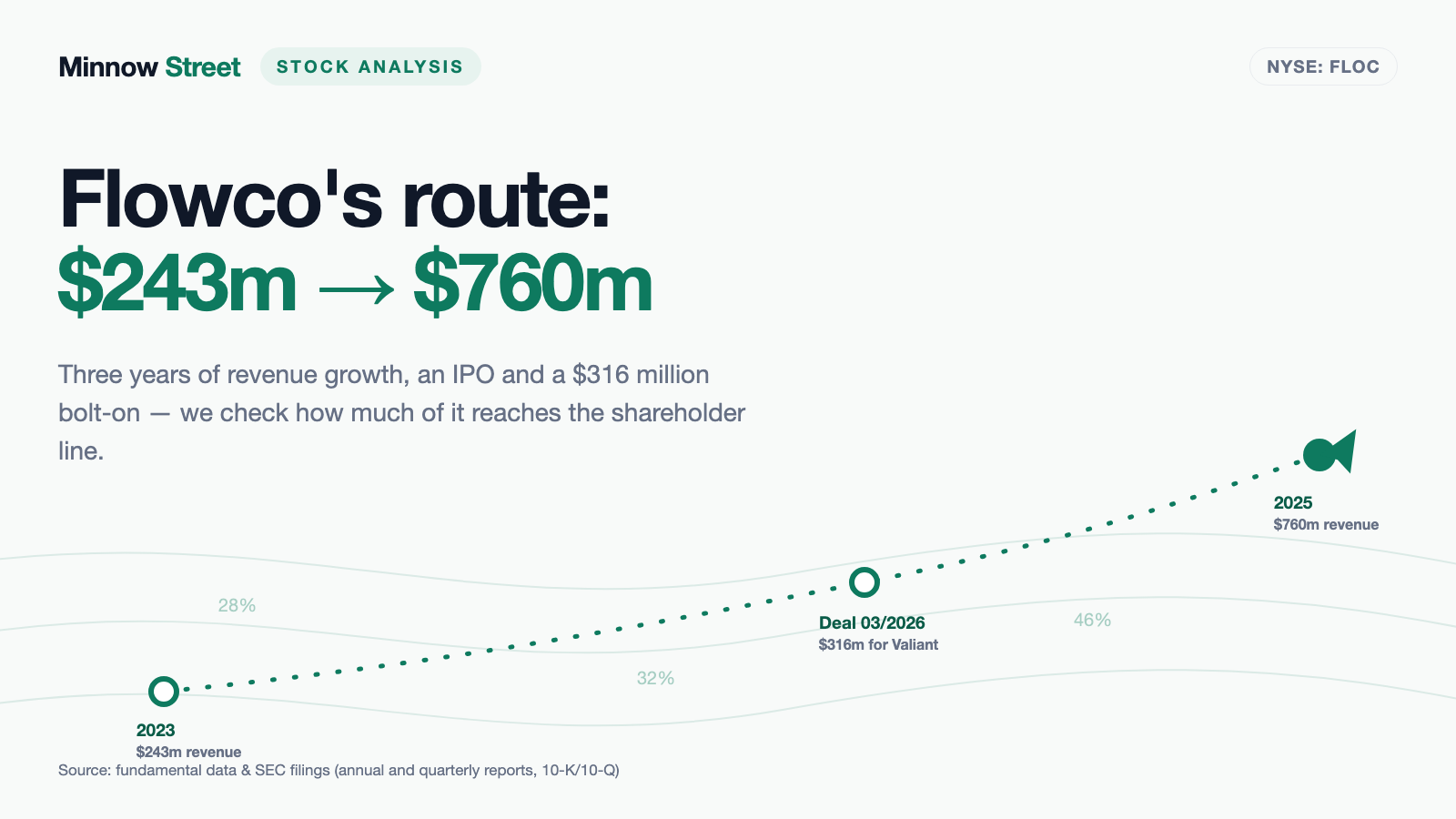
Flowco keeps aging oil wells flowing: gas lift, plunger lift, compressors, vapor recovery. The business works — revenue climbed from $243.3 million in 2023 to $759.7 million in 2025, net income reached $131.7 million, and the adjusted margin sits at 41 percent. Most of that profit, however, does not land with the shareholders of the listed company but with the pre-IPO owners of an entity one floor below: in the first quarter of 2026, $7.4 million of $27.5 million in group profit reached the shareholder line. And with every unit exchange by those pre-IPO owners, an obligation toward them grows — $92.4 million so far, without a single installment paid. Let us read who is actually earning here.
 Thomas Mücke
Founder & Publisher
Thomas Mücke
Founder & Publisher
Chart
Interactive price chart (TradingView).
Note: pure fact-based analysis, not investment advice and not a solicitation to buy or sell. All figures without guarantee.
There is an investor trap that springs shut precisely when you are being careful — call it the surprise trap. It works like this: you screen the market for companies whose quarterly result came in far from expectations. A list spits out names. And your brain immediately fills in the blank: "Someone earned a lot more than anyone thought." What the brain skips is the one question that decides everything: whose profit is that — and across how many shares is it spread? At Flowco Holdings (NYSE: FLOC) of Houston, that is exactly the question. The group earned $27.5 million in the first quarter of 2026. The line that belongs to your share showed $7.4 million. Both numbers are correct, both appear in the same report — and between them sits a corporate structure you have to understand once. So let us make a deal: we will read together what Flowco reported to the U.S. securities regulator, the SEC — the annual report (10-K) for 2025, the quarterly report (10-Q) as of March 31, 2026, and the current reports (8-K) on the Valiant acquisition. An SEC filing is honest under penalty of law. What you do with it is your decision.
What Flowco actually does — the company that keeps old oil wells flowing
An oil well is easy in its early life: pressure in the rock pushes the oil upward on its own. A few years later that pressure is gone — and nothing flows, even though plenty of oil remains below. This is exactly where the business of Flowco Holdings Inc. begins. The company supplies the technology that gets those wells moving again, and the industry calls it artificial lift. In everyday terms: Flowco is the contractor who installs the pump in the well — and in many cases keeps ownership of the pump and rents it out instead of selling it.
There are three building blocks. First, gas lift: high-pressure gas is injected into the wellbore, the oil becomes lighter and rises again; that requires compressors, which Flowco installs and services. Second, plunger lift: a piston travels up and down the wellbore and pushes the liquid ahead of it like the plunger in a bicycle pump — cheap, rugged, the first choice for many wells. Third, vapor recovery: gas escapes from tanks at every wellsite and used to be simply flared. Flowco builds units that capture that gas and make it saleable — the operator earns money, cuts emissions and meets regulatory requirements at the same time. All of this is sorted into two segments: Production Solutions (high-pressure gas lift, conventional gas lift, plunger lift and, since the acquisition, electric submersible pumps) and Natural Gas Technologies (vapor recovery, natural gas systems, downhole components).
One point matters for reading the numbers: a large share of the business is rental, not sale. Of $759.7 million in 2025 revenue, roughly $418.0 million came from rentals and $341.8 million from sales. That explains the heavy depreciation and amortization ($144.8 million in 2025) and the heavy capital expenditure ($127.3 million) — Flowco buys the equipment itself and lets it work for years. It is a capital-hungry business with recurring income, not a light-footed software model. If you want to see how a rental fleet in the same industry looks in detail, our analysis of Natural Gas Services Group follows the same principle with compressors.
And that names the central tension of this analysis, which runs through every chapter: the business earns money reliably — but who owns that money is decided by the corporate structure, not by the income statement.
Where the stock crossed our desk — and what the list actually measures
Flowco reached us through our in-house stock scanner, specifically the "Big Earnings Surprise" list. It collects companies whose reported quarterly result deviated markedly from expectations. Flowco sits there at rank 45 of 81 U.S. entries, with a relative strength rating of 63 — as of July 25, 2026. To reproduce it: open the scanner, choose the Big Earnings Surprise list, filter for the U.S. selection and scroll down. These lists are recalculated daily — today's rank is not tomorrow's.
Before we build a thesis on a ranking, the cross-check in the filing. A relative strength rating of 63 means the stock outperformed 63 percent of the market recently. That is decent, not outstanding — genuine momentum leaders sit at 90 and above. And the surprise itself? The quarterly report as of March 31, 2026 shows earnings per share of $0.24 basic and $0.23 diluted. A year earlier the figures were $0.24 and $0.24. On that line, precisely nothing happened. Analyst consensus for the same quarter stood at $0.33 per share (data as of July 25, 2026).
So how does a large surprise arise? Through arithmetic that mixes numerator and denominator from two different levels of the group. Flowco reported adjusted net income of $35.7 million for the first quarter of 2026 — that is the profit of the entire group, including the share that belongs to the pre-IPO owners. Divide those $35.7 million by the diluted Class A share count (32,719,382 shares) and you arrive at $1.09 per share — more than four times what the report states. That is exactly how mismatched figures arise at a company built this way. Remember the sentence: with Flowco you always have to ask whether a profit figure comes from the ground floor or from the top floor. Why there are two floors at all we will clear up shortly. First, the numbers that genuinely impress.
The numbers over the years — given their due
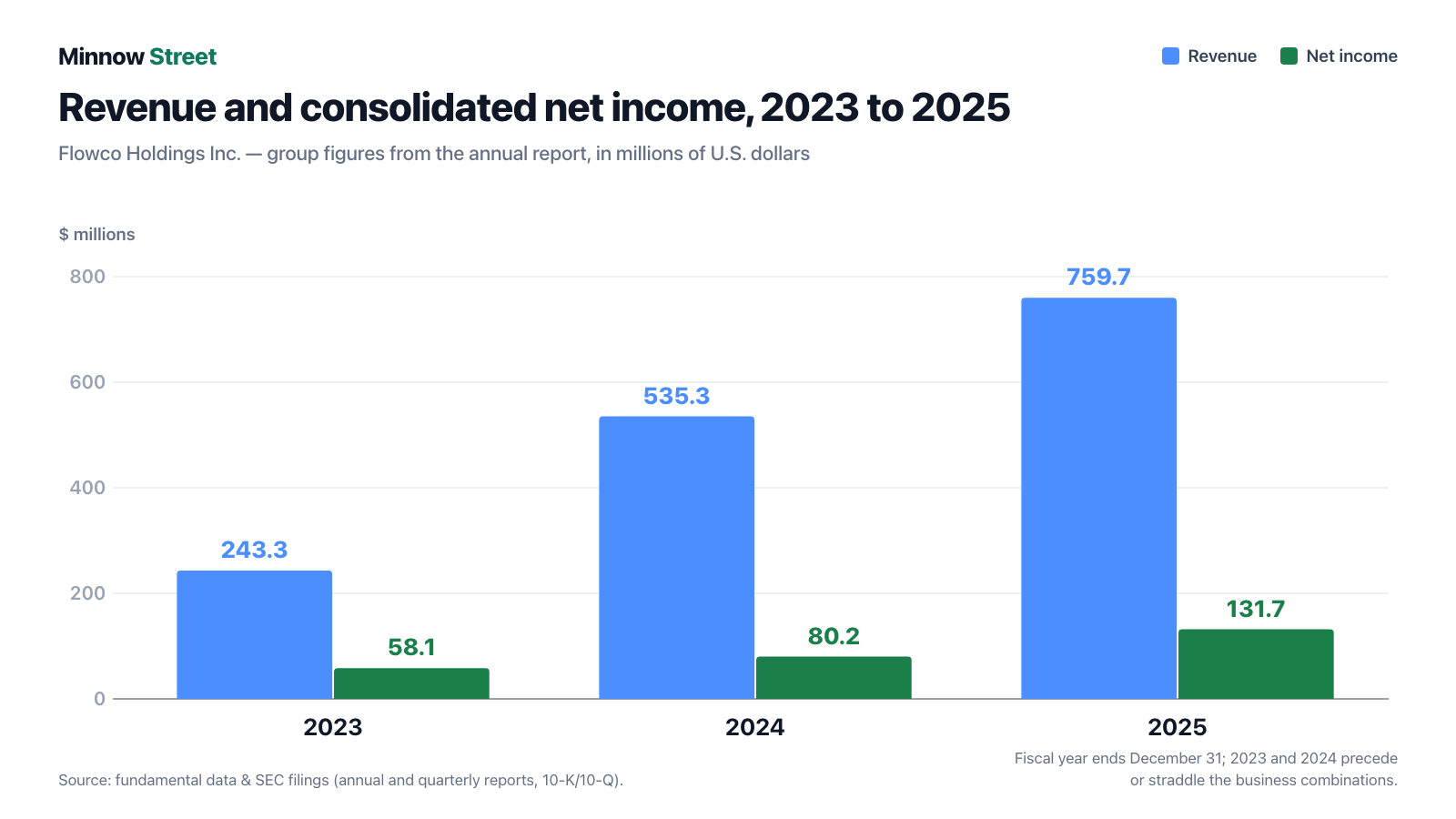
Let us start with what speaks for Flowco, and that is quite a lot. Revenue rose from $243.3 million in 2023 through $535.3 million in 2024 to $759.7 million in 2025 — more than a tripling in two years. To be fair: much of that is combination, not organic growth. Today's group was formed in June 2024 by combining three companies (Estis Compression, Flowco Production Solutions, Flogistix); 2024 contains only half a year of that, 2025 the full year. Net income followed revenue: $58.1 million (2023), $80.2 million (2024), $131.7 million (2025).
The margins are remarkable for this business. Adjusted EBITDA — earnings before interest, taxes, depreciation and amortization, adjusted for one-off items such as transaction costs and share-based compensation — came to $311.7 million in 2025 after $223.7 million the year before. Measured against revenue, that is 41.0 percent. For context: 20 to 25 percent is normal in oilfield services, and anything above 35 percent indicates real pricing power. Flowco sits above that, and it is no fluke: 42.4 percent in the fourth quarter of 2025 and still 40.8 percent in the first quarter of 2026.
The cash is there too. Operating cash flow — the money the ongoing business actually brings in — rose to $294.4 million in 2025 (2024: $179.4 million). Of that, $127.3 million went into new equipment (2024: $90.5 million, 2023: $43.5 million), leaving $167.1 million of free cash flow. In the first quarter of 2026 the figures were $78.7 million operating and $52.3 million free. For a company that finances its own fleet, that is a strong number.
And shareholders see some of it: in the first quarter of 2026 Flowco repurchased 780,000 of its own shares for $16.5 million (average price $21.18); of the $50 million program authorized on June 11, 2025, $18.2 million remained available at March 31, 2026. On May 1, 2026 the board raised the quarterly dividend by 12.5 percent to $0.09 per Class A share. And the IPO did what it was supposed to do: at the end of 2024, $635.9 million was drawn under the credit facility; a year later only $167.8 million — the net proceeds of roughly $461.8 million went into debt reduction. So much for the good half. Now the other one.
What the filings say — the uncomfortable truths
Uncomfortable truth no. 1: the group earns — the stock gets less than half of it
Flowco Holdings Inc., the company whose share you buy on the NYSE, does not operate a single wellbore itself. It is a holding company that owns units in the operating Flowco MergeCo LLC — and only part of them. The rest is held by the pre-IPO owners, above all the private equity firms GEC and White Deer along with management and employees. This design is called Up-C, short for umbrella partnership C corporation, and it is common in IPOs out of private equity because it preserves tax advantages for the pre-IPO owners. The quarterly report says so without embellishment:
"Following the IPO, we have a minority economic interest in Flowco LLC but control the management of Flowco LLC as its sole managing member."
— Flowco Holdings Inc., SEC quarterly report 10-Q as of March 31, 2026, "Organizational Structure"
In plain terms: the listed company runs the group, but economically it owns the minority. At the IPO the figure was 28.4 percent, at December 31, 2025 32.4 percent, and at March 31, 2026, after extensive unit exchanges, 46.3 percent — so roughly 28, then roughly 32, most recently roughly 46 percent. Still less than half. For the income statement that means: the full group revenue and the full group profit appear in the report, because Flowco Holdings controls the operating company and therefore consolidates it fully. The outside share is then deducted again. It looks like this:
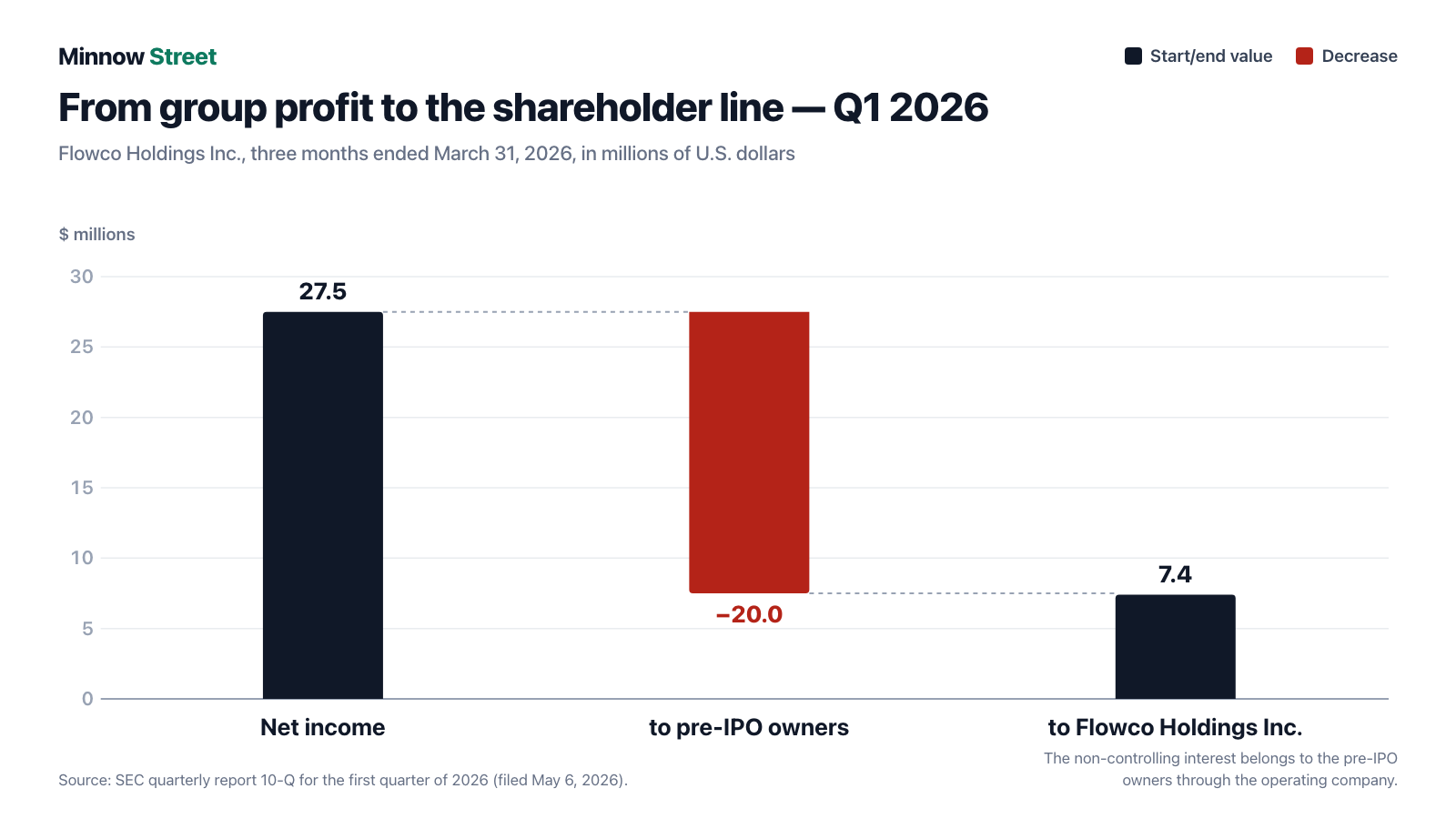
This is not an accounting nicety but the core of the valuation. Anyone applying the group's $131.7 million of 2025 net income to the share is using a number that belongs to them by less than half. The filing is unambiguous: for the period from the IPO to year-end 2025, $41.4 million was attributable to Flowco Holdings Inc. — $1.53 per share basic, $1.24 diluted. On the plus side: with every unit exchange the listed entity's share grows, and so does the profit per Class A share. But that exchange has a price — and the listed entity pays it.
Uncomfortable truth no. 2: every unit exchange creates a new obligation toward the pre-IPO owners
At the IPO, Flowco Holdings signed a Tax Receivable Agreement. The mechanism in everyday terms: when a pre-IPO owner exchanges units in the operating company for shares, the listed entity gains a tax benefit — it can deduct more in future and pays less tax. Of that benefit, however, the listed entity keeps only 15 percent; it must pay 85 percent to whoever made the exchange. The filing puts it this way:
"Any payments made by us to the TRA Participants under the Tax Receivable Agreement will reduce cash otherwise arising from such tax savings. We expect such payments will be substantial."
— Flowco Holdings Inc., SEC quarterly report 10-Q as of March 31, 2026, "Tax Receivable Agreement"
How fast this grows is visible in the first quarter of 2026. The pre-IPO owners exchanged 12,041,729 units. That produced deferred tax assets of $6.7 million for Flowco Holdings — and at the same time $70.5 million of new liability toward exactly those pre-IPO owners. The balance sheet position jumped from $22.0 million (December 31, 2025) to $92.4 million. And not one installment has been paid:

For scale: $92.4 million equals roughly 27 percent of the equity attributable to the listed entity at March 31, 2026 ($336.2 million). And the process is not over — at the reporting date the pre-IPO owners still held 48,521,254 units, all of which can eventually be exchanged. The takeaway: the shareholders' stake grows, but they are buying it from the pre-IPO owners in installments.
Uncomfortable truth no. 3: the acquisition cost markedly more than the current report suggested
On February 1, 2026 Flowco signed the purchase agreement for Valiant Artificial Lift Solutions, a supplier of electric submersible pumps; the deal closed on March 2, 2026. The current reports (Form 8-K) spoke of approximately $200.0 million — explicitly net of the target's cash on hand, made up of $170.0 million in cash and 1,454,849 new Class A shares. The quarterly report presents the same transaction on a gross basis:

Both figures are correct — one net, one gross. But the balance sheet cares about the gross number: $283.1 million left in cash, and it came from the credit facility. Borrowings accordingly jumped from $167.8 million (December 31, 2025) to $328.0 million (March 31, 2026), while cash on hand was just $17.3 million. The facility itself is well equipped — $725 million, maturing August 20, 2029 — and the covenants (interest coverage of at least 2.50, total leverage of no more than 3.50) were met at the reporting date. The interest rate floats:

As of May 1, 2026 Flowco reported $332.9 million drawn against a borrowing base of $721.6 million, leaving $387.5 million of availability. The company is not in distress — but within a single quarter it took back on a large part of what the IPO had paid down. And because the margin depends on leverage, the facility gets more expensive automatically if results weaken. That is the mechanism that catches cyclical companies in bad years.
Uncomfortable truth no. 4: few customers, one commodity price, a short history
Flowco does not sell to millions of consumers but to a manageable number of producers. The annual report says so openly:

On top of that comes dependence on the oil price. Flowco's customers only invest when production pays; if the oil price falls persistently, they cut service providers first. The rental fleet cushions that because running contracts continue, but it does not remove it. And finally: Flowco has only been listed since January 16, 2025. There are two annual reports and four quarterly reports, but not a single full downturn you could read off this company in its present form. Anyone who wants to price in cyclicality has to estimate it here, not look it up.
Valuation — the order of magnitude, not the daily quote
Let us work through the order of magnitude properly, using a dated anchor instead of a daily quote. On July 24, 2026 the stock closed at $20.15. As of May 1, 2026 there were 41,824,162 Class A shares and 48,521,254 Class B shares outstanding; Class B carries no economic rights but stands one-for-one for exchangeable units in the operating company. Economically, therefore, the sum counts: roughly 90.3 million shares, and thus a market capitalization on the order of $1.8 billion. Adding net debt ($328.0 million drawn less $17.3 million of cash) puts enterprise value at roughly $2.1 billion.
That gives three ratios — and, depending on the perspective, two different profit references:
Price-to-earnings on the shareholder line: roughly 17. Diluted earnings per share for the twelve months to March 31, 2026 were $1.19. Price-to-earnings on a look-through basis: roughly 14, if you apply the entire group profit of $131.7 million (2025) to the 90.3 million economic shares. Both are legitimate as long as you say which one you mean. Price-to-sales: roughly 2.4 against 2025 revenue. Enterprise value to adjusted EBITDA: roughly 6.8 ($2.1 billion against $311.7 million). For context: for an oilfield service company with a 41 percent adjusted margin and recurring rental income, that is a middling rather than a euphoric valuation — such companies traded at 8 to 10 times in good years and at 4 to 5 times in downturns.
The professionals take a considerably friendlier view than this arithmetic: eight analyst opinions, four of them strong buy and four buy, with no sell and no hold, and an average price target of $31.22 (data as of July 25, 2026). A unanimously positive analyst picture is not a seal of quality but a warning to yourself: if nobody disagrees, the skepticism is not yet priced in — and supplying it is your job. And the dividend? Four quarters at $0.09 add up to roughly $0.36 a year, or about 1.8 percent against the anchor price. Pleasant, but not an investment thesis.
Opportunities and risks at a glance
What speaks for Flowco:
- Recurring rental income at a high margin: $418.0 million of $759.7 million in 2025 revenue came from rentals; the adjusted EBITDA margin was 41.0 percent in 2025 and still 40.8 percent in the first quarter of 2026.
- Real cash flow rather than book profit: $294.4 million from operations in 2025 and $167.1 million free after capital expenditure — enough to carry acquisitions, buybacks and a dividend at the same time.
- The shareholder stake grows mechanically: from 28.4 percent at the IPO through 32.4 percent to 46.3 percent as of March 31, 2026; every further exchange lifts the profit share per Class A share.
- Regulatory tailwind: vapor recovery and methane abatement technology is not merely a cost item for producers but a revenue source and a compliance tool at once.
- Visible capital discipline: debt cut from $635.9 million to $167.8 million in the first year as a public company, $16.5 million of buybacks in the first quarter of 2026, and a dividend raised by 12.5 percent.
What speaks against it:
- Less than half the profit belongs to the stock: of $27.5 million in group net income in the first quarter of 2026, only $7.4 million was attributable to Flowco Holdings Inc.
- A growing obligation toward insiders: $92.4 million under the Tax Receivable Agreement as of March 31, 2026, $70.5 million of it from a single quarter — and not one installment paid so far.
- The debt is back: $328.0 million drawn against $17.3 million of cash (March 31, 2026), floating at 5.52 percent, with a margin that rises automatically if results weaken.
- Customer concentration and commodity exposure: significant concentration in the top ten customers per the 2025 annual report; customers' willingness to invest depends on oil and gas prices.
- Short history: IPO on January 16, 2025, two annual reports, no downturn survived in the present group form; the 2023 and 2024 comparatives partly predate the business combinations.
A human verdict
Remember the surprise trap from the opening? It did not spring shut at Flowco because anyone cheated. Every number sits properly in the filings, each one audited and reported under penalty of law. The trap is that this group contains two honest profit figures side by side — $27.5 million and $7.4 million for the same quarter — one applying to the group and the other to your share. Grab the wrong one and you are valuing a company that does not exist in that form.
What remains once you have sorted that out? A solid business that genuinely earns: technology that keeps aging wells running, at a 41 percent adjusted margin, with real cash flow and a management team that put the IPO proceeds first into debt reduction and then into an acquisition. And next to it, a structure in which the pre-IPO owners sit on more than half the profit and have their exit paid for in installments — legal, disclosed, customary for this design, but also: real. Buying here means buying a good business with a built-in right of way for someone else.
Whether that is worth the price to you depends on how quickly the shareholder stake keeps growing, whether the oil price cooperates, and whether a rising insider obligation makes you nervous or not. That is yours to decide, not mine. And that is exactly as it should be.
Sources
- SEC quarterly report 10-Q as of March 31, 2026 (filed May 6, 2026) — balance sheet, income statement, cash flow statement, Note 3 (Valiant), Note 10 (credit facility), Note 11 (taxes and Tax Receivable Agreement), Note 12 (equity and non-controlling interests), Note 18 (subsequent events)
- SEC annual report 10-K for 2025 (filed February 26, 2026) — business model, risk factors, revenue and earnings series 2023 to 2025, credit facility and covenants, headcount
- SEC annual report 10-K for 2024 (filed March 20, 2025) — prior-year comparatives, the 2024 business combination
- SEC current report 8-K dated February 2, 2026 — purchase agreement for Valiant Artificial Lift Solutions
- SEC current report 8-K dated March 3, 2026 — closing of the acquisition, registration rights and lock-up agreement
- First quarter 2026 earnings release (Exhibit 99.1 to the current report 8-K dated May 6, 2026) — adjusted EBITDA, free cash flow, liquidity, dividend
- Fourth quarter and full year 2025 earnings release (Exhibit 99.1 to the current report 8-K dated February 26, 2026)
- SEC amendment 10-K/A dated July 2, 2026 — contains only corrected certifications under Section 302 of the Sarbanes-Oxley Act; no changed figures
- Fundamental data (ratios, analyst consensus, price anchor) — data as of July 25, 2026
This analysis is journalistic reporting and explicitly not investment advice and not a solicitation to buy or sell securities. Stocks can lose their entire value; with single names in cyclical industries a total loss cannot be ruled out. All figures come from the primary sources linked above and carry their respective as-of dates. The author holds no position in Flowco Holdings Inc. at the time of publication. Please never base an investment decision on a single article alone.
Our Bottom Line at a Glance
- Business model and margin positive
- A real, earning business: $418.0 million of $759.7 million in 2025 revenue came from rentals, and the adjusted EBITDA margin was 41.0 percent (Q1 2026: 40.8 percent). For an oilfield service company that sits well above the usual 20 to 25 percent and points to pricing power in an indispensable technology.
- Cash flow and capital discipline positive
- Operations generated $294.4 million in 2025; after $127.3 million of capital expenditure, roughly $167.1 million remained free. IPO proceeds of about $461.8 million went into debt reduction ($635.9 million down to $167.8 million during 2025), followed by $16.5 million of buybacks in Q1 2026 and a dividend raised by 12.5 percent.
- Group structure and profit attribution negative
- Flowco Holdings Inc. held only 46.3 percent of the operating company as of March 31, 2026. Of $27.5 million in group net income in Q1 2026, $20.0 million went to the pre-IPO owners and just $7.4 million to the listed entity. Any ratio that applies undivided group profit to the share overstates the earning power of that share.
- Tax Receivable Agreement obligation negative
- The Tax Receivable Agreement liability rose from $22.0 million (December 31, 2025) to $92.4 million (March 31, 2026), $70.5 million of it from the exchange of 12,041,729 units in Q1 2026 alone. That is roughly 27 percent of the listed entity's equity — and per the filing, not one installment had been paid by the reporting date.
- Leverage after the acquisition neutral
- The Valiant acquisition cost $315.9 million gross, including $283.1 million of cash drawn on the credit facility; borrowings therefore rose from $167.8 million to $328.0 million against $17.3 million of cash (March 31, 2026). Reassuring: a maturity of August 20, 2029, an all-in rate of 5.52 percent, covenants met, and $387.5 million of availability as of May 1, 2026.
- Cyclicality, customer concentration and history negative
- The 2025 annual report cites significant concentration in the top ten customers, and those customers' willingness to invest tracks oil and gas prices. Add the short history: IPO on January 16, 2025, two annual reports, no downturn survived in the present group form — cyclicality has to be estimated here, not looked up.
Flowco Holdings is the surprise trap in its purest form: a genuinely good business whose numbers are told on two levels. The group generated $759.7 million of revenue and $131.7 million of profit in 2025 at a 41.0 percent adjusted margin, plus $167.1 million of free cash flow. Less than half of that reaches the line that belongs to the share — in the first quarter of 2026 it was $7.4 million out of $27.5 million. At the same time an obligation is growing toward exactly the pre-IPO owners who hold the other part: $92.4 million under the Tax Receivable Agreement, with no installment paid. Anyone valuing this company must first decide which profit they mean. Not investment advice.
What Our Rating Means
Open questions
The business works in principle, but one material question is open. As long as it stays open, our findings do not carry a quality verdict.
The business carries its own weight: renting out production technology brought in $418.0 million of $759.7 million in 2025 revenue, the adjusted EBITDA margin was 41.0 percent, and $294.4 million of operating cash flow paid for capital expenditure, buybacks and the dividend at the same time. The balance sheet is not in distress: the credit covenants (interest coverage of at least 2.50, leverage of no more than 3.50) were met as of March 31, 2026, the facility runs to August 20, 2029, and $387.5 million of availability remained as of May 1, 2026 — that is a long way from a threat to substance. Two operational questions are open: the 2025 annual report cites significant concentration in the top ten customers, whose investment budgets track oil and gas prices, and since the IPO on January 16, 2025 the group has not lived through a downturn in its present form — whether the 41 percent margin holds in a weak oil year is unproven. On top of that sits an obligation of the listed entity itself that grows with every unit exchange: $92.4 million under the Tax Receivable Agreement as of March 31, 2026, roughly 27 percent of its equity, with not one installment paid. Dependable earning power, but a business still untested in this form in a cyclical market — hence yellow. The decision is yours.
A journalistic assessment by our editorial team at the time of the deep dive, based on public sources — not investment advice and not a solicitation to buy or sell. Your personal circumstances (investment goals, risk capacity, taxes) cannot be taken into account. What our levels mean, how verdicts are formed, and what conflicts of interest exist →
Worth Noting
- Flowco Holdings reached our research list through our in-house stock scanner, the "Big Earnings Surprise" list, at rank 45 of 81 U.S. entries with a relative strength rating of 63 (as of July 25, 2026). These lists are recalculated daily, so the rank changes continuously.
- Do not confuse the two profit concepts: group net income (Q1 2026: $27.5 million) includes the pre-IPO owners' share; $7.4 million was attributable to Flowco Holdings Inc., which produced basic earnings per share of $0.24. Adjusted net income of $35.7 million is likewise a group figure and must not be divided by the Class A share count.
- The 10-K/A and 10-Q/A amendments filed on July 2, 2026 state in their own explanatory notes that they contain only corrected certifications under Section 302 of the Sarbanes-Oxley Act — explicitly not a restatement. After the quarterly report of May 6, 2026, a current report 8-K dated June 22, 2026 followed with a conference presentation (Item 7.01).
- Valuation figures are dated and evergreen: price anchor $20.15 (closing price July 24, 2026), market capitalization roughly $1.8 billion based on roughly 90.3 million economic shares (Class A and B as of May 1, 2026). Daily quotes are not a buying argument.
Frequently Asked Questions
Flowco supplies technology that keeps aging oil and gas wells producing: high-pressure gas lift, conventional gas lift, plunger lift, compressors and vapor recovery units. A large share is rented rather than sold — of $759.7 million in 2025 revenue, $418.0 million came from rentals. The work is organized in two segments: Production Solutions and Natural Gas Technologies.
Because Flowco Holdings Inc. is only the listed top of the operating Flowco MergeCo LLC, of which it held just 46.3 percent as of March 31, 2026. The filing first shows the full group profit and then deducts the outside share: of $27.5 million in the first quarter of 2026, $7.4 million remained for the listed entity — which works out to $0.24 per share.
It obliges Flowco Holdings to pay 85 percent of the tax benefits arising from unit exchanges to the pre-IPO owners. As of March 31, 2026 the balance sheet carried a liability of $92.4 million, up from $22.0 million at year-end 2025; the exchange of 12,041,729 units in the first quarter of 2026 alone created $70.5 million of it. No installment had been paid by the reporting date.
The current reports dated February 2 and March 3, 2026 put the price at approximately $200.0 million net of the target's cash on hand. The quarterly report presents it gross: aggregate consideration of $315.9 million, of which $283.1 million in cash and 1,454,849 Class A shares. The cash portion came from the credit facility, whose drawn balance rose from $167.8 million to $328.0 million.
As of March 31, 2026, $328.0 million was drawn under a $725 million revolving credit facility at an all-in rate of 5.52 percent. The facility runs to August 20, 2029 with no earlier amortization. The covenants — interest coverage of at least 2.50 and total leverage of no more than 3.50 — were met at the reporting date; as of May 1, 2026, $387.5 million of availability remained.
Yes. On May 1, 2026 the board raised the quarterly dividend by 12.5 percent to $0.09 per Class A share, payable May 27, 2026; it had previously been $0.08. In addition, a $50 million share repurchase program is running, of which $18.2 million remained available at March 31, 2026. During that quarter, 780,000 shares were repurchased for $16.5 million.
No. The amendment to the 2025 annual report filed on July 2, 2026 states in its own explanatory note that it contains only corrected management certifications under Section 302 of the Sarbanes-Oxley Act, because language had been omitted from paragraph 4. No figures were changed. The same applies to the quarterly report amendment filed the same day.
The IPO took place on January 16, 2025 on the New York Stock Exchange, with 20,470,000 Class A shares issued for net proceeds of roughly $461.8 million. That leaves two annual reports and four quarterly reports — enough for a solid analysis, but too little to judge how the company behaves through a full industry downturn.
Found an error?
Did you spot a factual error, an outdated number, or a typo in this deep dive? Let us know briefly — your report goes straight to the editorial team.