Five9: The First Profit in 13 Years — and the AI That Eats Its Own Revenue
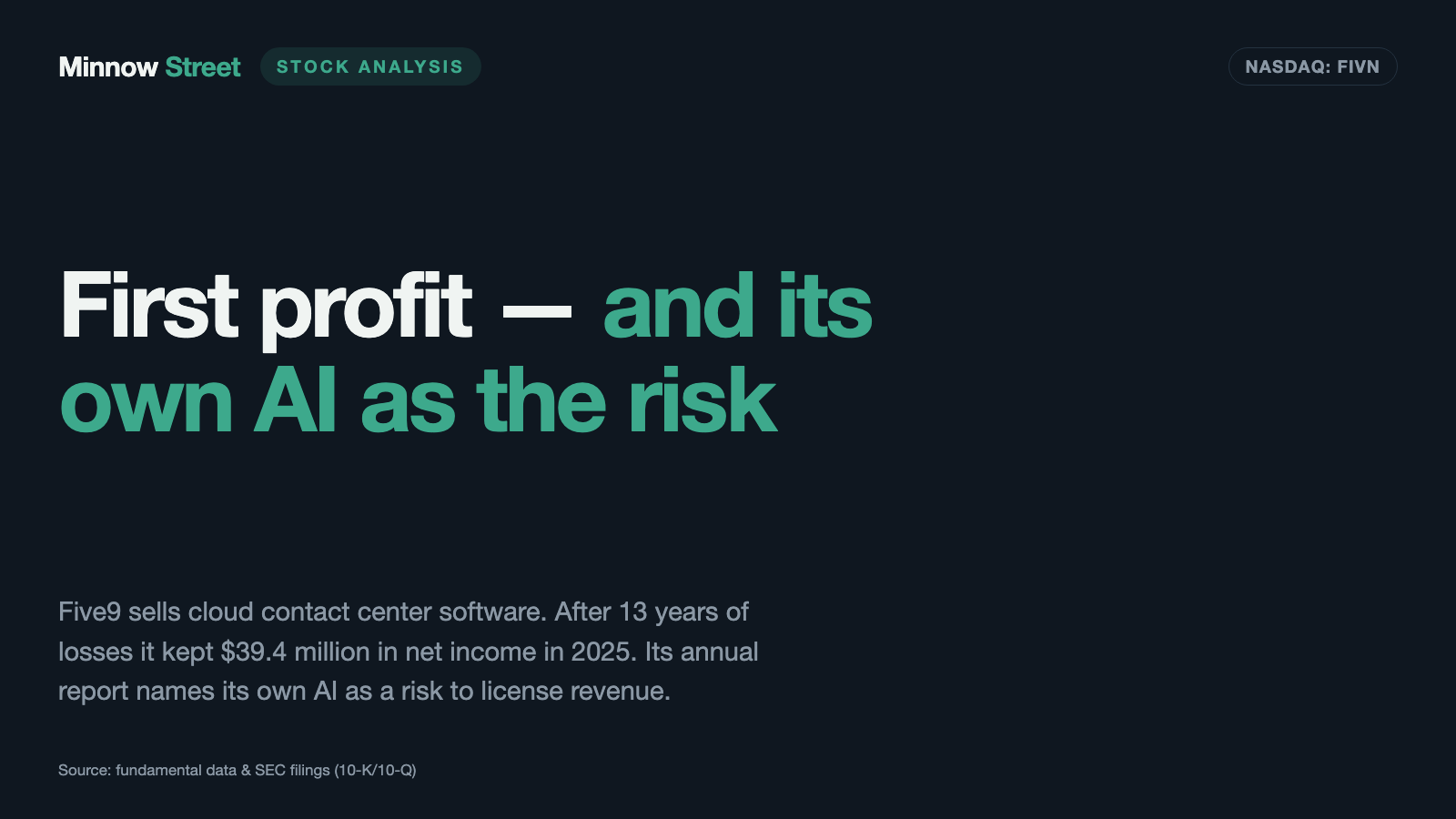
Five9 sells cloud contact center software. In 2025 it kept $39.4 million in net income for the first time since going public, after 13 straight years of losses. The annual report filed February 20, 2026, also explains why that need not be a new era: growth has fallen from 40.2 percent to 10.3 percent, net revenue retention from 108 to 105 percent — and the risk factors state that the AI Five9 sells will shrink its own license revenue. Not investment advice — just the question of who pays for software that replaces the seats it is billed on.
 Thomas Mücke
Founder & Publisher
Thomas Mücke
Founder & Publisher
Chart
Interactive price chart (TradingView).
Note: pure fact-based analysis, not investment advice and not a solicitation to buy or sell. All figures without guarantee.
There is a moment when your brain flips a switch that nobody touched: the first profit. Call it the at-last trap. For years you read nothing but red ink at a company, you get used to the phrase "still does not make money" — and then a plus sign appears. Instantly the story gets rewritten in your head: from here on it works. The catch is that a first profit says nothing at all about why it is there. At Five9, Inc. (Nasdaq: FIVN), the cloud contact center software provider from San Ramon, California, that is exactly the interesting question. So let us make a deal: before we celebrate $39.4 million in net income, we read together what the company itself reported to the U.S. securities regulator, the SEC — the annual report (10-K) for 2025 filed February 20, 2026, and the quarterly report (10-Q) as of March 31, 2026, filed April 30, 2026. A filing to the SEC is honest under penalty of law. And this one contains, right next to the good news, a risk factor you have to read twice to believe.
What Five9 actually does — renting seats, not selling switchboards
Picture a bank's customer service center: hundreds of people with headsets, plus the technology that routes calls, manages queues, records conversations and writes everything into the customer system. That technology used to sit as hardware in the bank's basement. Five9 rents it out of a data center instead — the customer books licenses, pays monthly and gets updates without installing anything. The industry calls that software as a service; in everyday terms, you stop buying the switchboard and start renting the seats.
As of December 31, 2025, more than 3,000 organizations did exactly that, from regional banks to retail chains. Single-customer dependence is low: in 2025, 2024 and 2023 no customer accounted for more than 10 percent of revenue. About 89 percent of 2025 revenue came from customers with U.S. billing addresses. Five9 employed 2,910 full-time people at year end, 43 percent of them in cost-of-revenue functions and 25 percent in engineering.
On the product side, AI is everywhere now: the Genius AI suite summarizes calls, suggests replies, analyzes contact reasons and handles simple tasks end to end. And that names the central tension of this analysis, which runs through every chapter: Five9 is billed largely per seat — and sells the very technology that makes seats unnecessary. That is not our framing. It is written into the risk factors of the company's own annual report, and we will get to the exact wording in a moment.
Where the stock shows up in our scanner
The hook is not a price move but a balance-sheet list. Our in-house stock scanner carries Five9 in the U.S. selection of the "Fundamental Rank (A / A+)" list — the one that sorts companies by the quality of their numbers rather than their chart (as of July 26, 2026; the page currently lists 38 U.S. hits, and the lists are recomputed daily). You can replicate it in three clicks: open the stock scanner, pick the "Fundamental Rank (A / A+)" list, set the market to the United States.
More telling than any single list is the confluence. On July 26, 2026, FIVN appeared in twelve lists at once, and the mix tells the story before the first number: turnaround candidates and EPS acceleration stand for the earnings turn, the two cash-flow rankings for the valuation, power trend and the 50-/200-day moving average lists for the price action. A stock that reads as a turnaround and as cheap on cash flow at the same time usually has something important in dispute. That is what we are here for.
Two metrics from the July 24, 2026, data cut belong here, and both get rated, not just listed. A return on equity of 7.7 percent is thin for a software house — good ones run in the double digits, often far higher; it shows how young this profit still is. A debt-to-equity ratio of 0.97 sounds heavy but misleads: it measures the convertible notes against equity and ignores that almost the same amount sits right next to it in cash and marketable investments. Remember the sentence: at Five9, ratios read without the balance sheet tell you the wrong thing.
The numbers over the years — honestly appraised
First, what genuinely impresses. Five9 has grown revenue sevenfold in nine years: from $162.1 million (2016) to $1,149.1 million (2025), without a single down year in between. And 2025 finally left something over: $39.4 million in net income, or $0.45 per diluted share, after a loss of $12.8 million the year before.
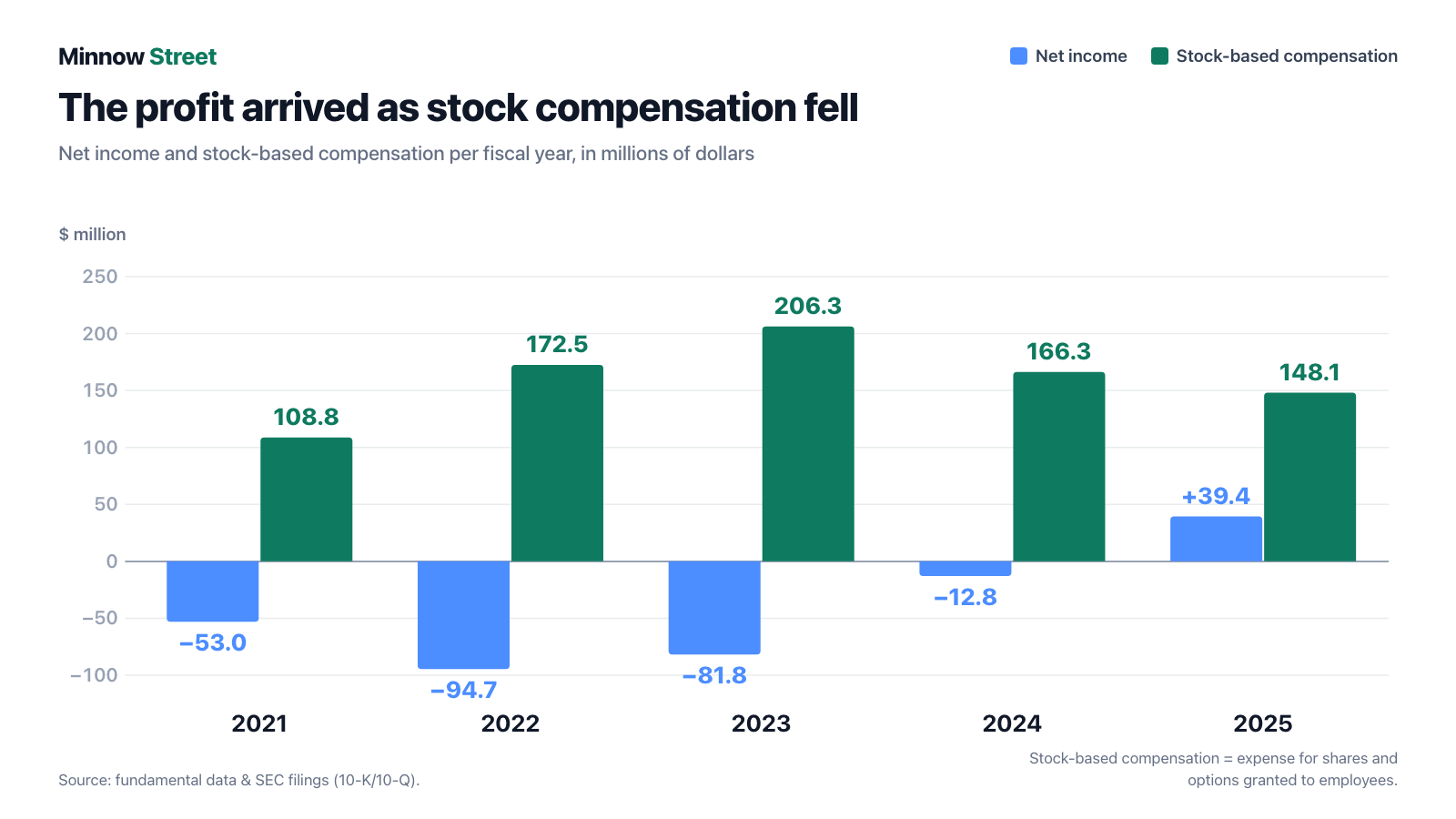
How big that break is only shows up in the long series. In the 13 years from 2012 through 2024 the bottom line was a loss every single time: $53.0 million (2021), $94.7 million (2022), $81.8 million (2023), $12.8 million (2024). The accumulated deficit still stood at $359.8 million as of March 31, 2026 — that is the net amount the company burned before it started earning.
Cash flow turned positive long before profit did, and it is the strongest number in the whole filing. Operating cash flow — the money the running business actually deposits — climbed from $88.9 million (2022) through $128.8 million (2023) and $143.2 million (2024) to $226.2 million (2025). In the first quarter of 2026 it was $63.9 million after $48.4 million a year earlier. Remember: at software companies cash flow often arrives years before profit — because customers pay up front and part of the payroll is settled in shares.
The balance sheet holds up too. As of March 31, 2026, $273.0 million in cash and $450.9 million in marketable investments sat on the books, $723.9 million combined. Against that stands exactly one financial liability: the convertible notes, carried at $736.4 million. Net debt is therefore about $12.5 million — for a company that collects $226 million a year from operations, practically a wash. Stockholders' equity of $829.6 million equals 44.5 percent of total assets of $1,865.3 million.
And the first quarter of 2026 kept it going: $305.3 million in revenue after $279.7 million, and $18.4 million in net income after $0.6 million. So much for the good half. Now the other one.
What the filings say — the uncomfortable truths
Uncomfortable truth no. 1: Five9 sells the technology that shrinks its own revenue
The single most important sentence in this analysis does not come from an analyst note but from the risk section of the company's own annual report. In four lines it explains why a vendor billed per seat has a problem when seats are replaced by software:
"AI solutions will likely perform an increasing proportion of contact center interactions, particularly for customer self-service, slowing the growth of interactions handled by live agents. This will result in a decrease in our license revenues from our installed base, as well as a decrease in license revenue opportunities from new customers, that may not be offset by additional revenue from our AI solutions."
— Five9, Inc., SEC annual report 10-K for 2025, Item 1A "Risk Factors"

Read that again and replace "AI solutions" with "our best-selling product." That is what it means. Elsewhere the filing states plainly that the industry is in the early stages of this transition, which makes customer behavior and the revenue impact very difficult to forecast. In fairness: Five9 hides nothing and invests aggressively in exactly this field — the AI products are the stated growth promise. But the arithmetic is a subtraction, not an addition: whatever AI adds has to replace what licenses lose before anything is left over. Whether anything is left over, nobody knows today, the company included.
Uncomfortable truth no. 2: growth has quartered — and retention is slipping
The number that sums up this filing best is not a revenue figure but a growth rate. It has fallen for four years, without a single step back up.
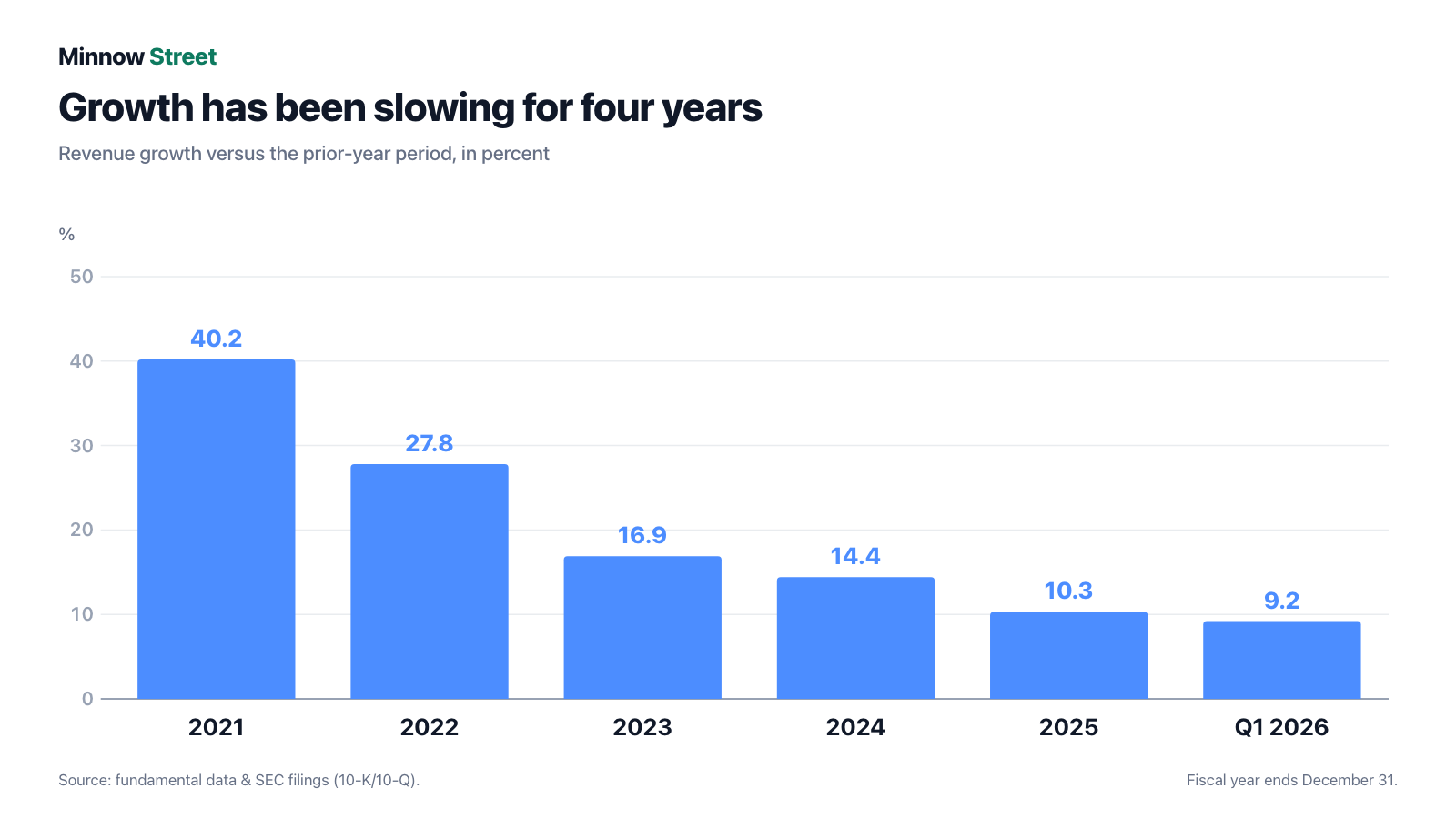
Slowing growth on a bigger base is normal — adding 40 percent to $609.6 million (2021) is easier than adding it to $1,041.9 million (2024). Which is why the metric that strips that effect out matters more: net revenue retention. It looks only at customers who were already there a year ago and answers one question: is the same customer base paying more today? In everyday terms: is your garden growing, or are you just replanting faster than it drains out the back?
The answer sits in the annual report: 105 percent for 2025 after 108 percent for 2024. The installed base is still growing — just more slowly, and every point lost has to be replaced by new customers. The company supplies its own explanation:

One more detail from the competition chapter is worth knowing: contracts are generally long term, but customers can reduce the number of licenses or their level of consumption with 30 days' notice. So if AI makes seats unnecessary, nobody has to wait for a contract to end. Remember the picture: the lease runs for years, but the number of rented desks is cancelable monthly.
Uncomfortable truth no. 3: the profit came from the cost brake, not from revenue
Between 2024 and 2025 revenue rose by $107.2 million. Net income improved over the same span by $52.2 million — from minus $12.8 million to plus $39.4 million. The rest of that improvement came from two sources, both of them about spending less.
First, stock-based compensation. It fell from $206.3 million (2023) through $166.3 million (2024) to $148.1 million (2025) — measured against revenue, from 22.7 percent to 12.9 percent. Stock-based compensation is the expense of paying part of the payroll in shares. In everyday terms: the company pays with newly issued slices — your piece of the cake gets smaller without any money leaving the till. How quickly that practice turns into real dilution is something we took apart in our Backblaze analysis.
Second, headcount. In August 2024 the board approved a plan that cut roughly 6 percent of global full-time staff at a cost of $9.6 million. On March 31, 2025, the next one followed, roughly 4 percent for $7.9 million. Both are defensible management decisions. Both can only be done once.
Then there is the gap between two profit figures worth knowing about. Five9 reports adjusted EBITDA of $269.7 million for 2025 (2024: $196.0 million). Reported operating income under U.S. accounting rules is $28.9 million (2024: minus $51.3 million). The roughly $241 million in between consists largely of three items, all of them real: $148.1 million of stock-based compensation, about $61.8 million of depreciation and amortization, and $7.9 million of restructuring. Remember: adjusted figures are not a fraud — but they strip out something that still costs the shareholder.
For a sense of what a software margin can look like when the business carries itself: Five9's gross margin in 2025 was 55.1 percent ($632.9 million of gross profit on $1,149.1 million of revenue), its operating margin 2.5 percent. Our Fortinet analysis covers the same industry at 80 percent gross margin and a 30.7 percent operating margin. There is a reason for the gap: Five9 does not only sell software, it also carries telephony and data center costs.
Uncomfortable truth no. 4: the dilution never arrives — the bill does
Anyone hunting for risk at Five9 lands quickly on the convertible notes. A convertible note is a loan with a built-in swap right: the lender collects interest and may exchange the claim for shares if the price clears an agreed threshold. In March 2024 Five9 issued $747.5 million of them, a 1.00 percent coupon, due 2029. The swap condition is spelled out in the annual report:
"Each $1,000 principal amount of the 2029 convertible senior notes is initially convertible into 12.5918 shares of the Company's common stock (the '2029 Conversion Option'), which is equivalent to an initial conversion price of approximately $79.42 per share of common stock, subject to adjustment upon the occurrence of specified events."
— Five9, Inc., SEC annual report 10-K for 2025, convertible senior notes footnote

Now the cross-check from the most recent quarterly report — same company, same stock, two years later:

Between $17.28 and $79.42 lies a canyon. As long as it stays that wide, nobody swaps notes for shares voluntarily — so the much-discussed dilution does not happen. Two other things happen instead. First, earnings per share are still computed on the shares that may never exist: in the first quarter of 2026, 76.823 million basic shares stood against 86.298 million diluted. The difference of roughly 9.5 million comes mostly from these notes. That is why Five9 reports $0.24 per basic share for the quarter but only $0.21 per diluted share.
Second, and more important: the $747.5 million then comes due in money. As of March 31, 2026, $723.9 million in cash and marketable investments stood ready for it — so it works out, if nothing intervenes. Except that since October 2025 the board has decided to spend $350.0 million out of that same till on its own shares: $150.0 million in the October 2025 program and another $200.0 million in the program approved April 30, 2026. On May 4, 2026, an accelerated repurchase of $90.0 million began, with an initial delivery of roughly 3.1 million shares; final settlement is expected by September 30, 2026. It exhausts what was left of the older program — as of March 31, 2026, exactly $90.0 million of the $150.0 million remained available. The $200.0 million approved on April 30, 2026, is therefore still entirely untouched. Held next to $148.1 million of stock-based compensation in 2025, that means: the two buyback programs amount to roughly two years' worth of the new shares handed to employees. Buying back here is less a return of capital than a delayed cash settlement of payroll.
What the stock costs — valuation in orders of magnitude
At a market value of roughly $1.5 billion (data as of July 24, 2026) you pay about 1.3 times the $1,149.1 million of 2025 revenue — for a software house with a gross margin above 50 percent, that is not expensive. Measured against $39.4 million of 2025 net income it is about 38 times, and that is expensive. Both numbers are correct; they simply measure different things — one the size of the business, the other its current earning power.
Because net debt is effectively nil at roughly $12.5 million, enterprise value here is close to market value. On cash flow the stock looks cheap: price to free cash flow ran at about 7.5 (data as of July 24, 2026). That is exactly where the two cash-flow scanner hits come from.
The professionals' view is unusually split. The mean price target across 24 analysts was $27.81 (data as of July 24, 2026) — roughly 42 percent above the price implied by market value and share count. At the same time 10.2 percent of the float was sold short: a tenth of the freely tradable shares had been borrowed and sold by investors betting on a decline. Remember: when analysts see 42 percent of upside while short sellers hold a tenth of the float, that is not a disagreement about price but about the business model. And that is precisely what this analysis is about.
Opportunities and risks at a glance
What speaks for Five9:
- The earnings turn is real and confirmed: $39.4 million of net income in 2025 after 13 years of losses, and $18.4 million in the first quarter of 2026 after $0.6 million a year earlier.
- Operating cash flow grows faster than revenue: $226.2 million in 2025 after $143.2 million in 2024 — up 58 percent on 10.3 percent revenue growth.
- Net debt free: $723.9 million of cash and marketable investments against $736.4 million of convertible notes as of March 31, 2026, a 44.5 percent equity ratio, no bank debt and no covenants disclosed in the filing.
- A broad customer base without concentration: more than 3,000 organizations, and no customer above 10 percent of revenue in 2025, 2024 or 2023.
- Stock-based compensation has fallen for two years — from 22.7 percent of revenue (2023) to 12.9 percent (2025), and most recently $32.7 million in the first quarter of 2026 after $39.2 million.
- The company is buying shares back rather than issuing them: $350.0 million authorized since October 2025, of which $90.0 million has been in execution since May 4, 2026.
What speaks against it:
- The company's own annual report names AI as the reason license revenue from the installed base will decline — for a model billed per seat, that hits the center.
- Revenue growth has fallen from 40.2 percent (2021) to 10.3 percent (2025) and 9.2 percent in the first quarter of 2026, with no countermove.
- Net revenue retention slipped from 108 to 105 percent, and customers can cut licenses or capacity with 30 days' notice per the filing.
- The profit came from cost cuts: $58.2 million less stock-based compensation than in 2023, plus two reduction-in-force plans of roughly 6 and roughly 4 percent of staff.
- About $241 million separates adjusted EBITDA ($269.7 million) from reported operating income ($28.9 million) — largely stock compensation, depreciation and restructuring.
- $747.5 million will most likely come due in cash in 2029, because conversion at $79.42 is far out of reach; meanwhile $350.0 million flows into buybacks.
- The market is deeply split: 42 percent of distance to the mean analyst target alongside 10.2 percent of the float sold short (data as of July 24, 2026).
A human conclusion
Back to the at-last trap from the opening. It is not a weakness for the careless — quite the opposite, it catches patient investors who have watched a company for years and waited for exactly this moment. The first profit feels like a reward for the waiting. But it is not a forecast. It is a measurement of a year that is over.
So the sober question at Five9 is: what actually happened in 2025? Answer: revenue grew more slowly than in any year since the IPO, existing customers added less than the year before — and a plus sign still appeared at the bottom, because the company cut stock-based compensation by $18.2 million and reduced headcount in two rounds. That is solid work. It is a different story from "from here on it works."
The real bet is written into the risk factors, and it is honestly phrased: Five9 sells technology that reduces the number of paid seats in customer service centers. Whether selling that technology earns more than the licenses it costs, nobody knows today — the company itself writes that the industry is only at the start. So the honest question for you is not "is 1.3 times revenue cheap?" but: do you believe a vendor billed per seat can earn more from selling AI than it loses in seats — and are you willing to check that over several quarters instead of hoping? If yes, every quarterly report hands you the measuring points: growth rate, net revenue retention, stock-based compensation, share count. If no, you have seen a nice turning point and nothing more. What you make of it is your decision. And that is exactly as it should be.
Sources
Every original document used in this analysis — read them yourself:
- Five9, Inc. — SEC quarterly report 10-Q as of March 31, 2026 (filed April 30, 2026)
- Five9, Inc. — SEC annual report 10-K for 2025 (filed February 20, 2026)
- Five9, Inc. — Current report 8-K dated May 5, 2026 (accelerated share repurchase of $90.0 million)
- Five9, Inc. — Current report 8-K dated February 20, 2026 (amendment to the cooperation agreement with Anson Funds), plus the current report 8-K dated November 12, 2025 (repurchase of $50.0 million)
- All filings including insider reports (Form 4) and ownership filings: EDGAR overview for CIK 0001288847 (sec.gov)
- Fundamental data (metrics, valuation, analyst estimates; data as of July 24, 2026), reconciled with the SEC filings.
- Scanner lists: our in-house stock scanner, as of July 26, 2026; the lists are recomputed daily.
Transparency & disclaimer: This analysis is a journalistic contextualization of publicly available information. It is not investment advice, not a regulated financial analysis and not a solicitation to buy or sell securities. Equity investments carry substantial risk up to total loss. All information without warranty; the data cut-off is noted in the text. The author holds no position in Five9 shares at the time of publication.
Our Bottom Line at a Glance
- The earnings turn positive
- After 13 years of losses from 2012 through 2024, 2025 finally showed a profit: $39.4 million, against minus $12.8 million the year before. Operating income swung from minus $51.3 million to plus $28.9 million. The first quarter of 2026 confirmed the trend with $18.4 million in net income after $0.6 million in the prior-year quarter.
- Cash flow and balance sheet positive
- Operating cash flow rose to $226.2 million in 2025 after $143.2 million (2024) and $128.8 million (2023); the first quarter of 2026 brought $63.9 million after $48.4 million. As of March 31, 2026, $723.9 million in cash and marketable investments stood against a single financial liability of $736.4 million — roughly $12.5 million of net debt.
- Growth negative
- Revenue growth has fallen for four straight years: 40.2 percent (2021), 27.8 (2022), 16.9 (2023), 14.4 (2024), 10.3 percent (2025) and 9.2 percent in the first quarter of 2026. Net revenue retention on existing customers slipped from 108 to 105 percent; the filing cites, among other things, the loss of a single large customer ramp from 2024.
- Where the profit came from neutral
- The 2025 profit came from the cost side, not from more revenue. Stock-based compensation fell from $206.3 million (2023) through $166.3 million (2024) to $148.1 million, and two reduction-in-force plans cut roughly 6 percent of staff in 2024 and roughly 4 percent in 2025. That is disciplined work — but each of those levers can only be pulled once.
- Its own AI as the risk negative
- The 2025 annual report states in its risk factors that AI will handle a growing share of contact center interactions, slow the growth of interactions handled by live agents and reduce license revenue from the installed base — and that it is open whether selling its own AI solutions offsets that. For a model billed per seat, this is not a footnote.
- Capital allocation neutral
- Since October 2025 the board has authorized $350.0 million of buybacks — close to a quarter of a company worth roughly $1.5 billion (data as of July 24, 2026). The March 2026 purchases were made at an average of $17.28. Against that stand $148.1 million of annual stock-based compensation and $747.5 million coming due in 2029.
Five9 is not a broken company — 2025 delivered the first profit after 13 years of losses, operating cash flow reached $226.2 million, and the balance sheet is net debt free. Against that stands growth that has quartered in four years, retention that has slipped from 108 to 105 percent, and a profit built on costs removed rather than revenue added. Above it all sits the sentence from the company's own annual report: the AI Five9 sells shrinks the license revenue Five9 lives on. Buying here is not a bet on the cost brake but on selling more AI than AI takes away in seats. Not investment advice.
What Our Rating Means
Open questions
The business works in principle, but one material question is open. As long as it stays open, our findings do not carry a quality verdict.
Nothing here is rotten at the core: $723.9 million in cash and marketable investments against $736.4 million of convertible notes, a 44.5 percent equity ratio, $226.2 million of operating cash flow in 2025 and more than 3,000 customers, none of them above 10 percent of revenue. What is missing for green is proof that the business model survives the company's own technology: growth has fallen from 40.2 to 10.3 percent, net revenue retention from 108 to 105 percent, and the first profit came from $58.2 million less stock-based compensation and two reduction-in-force plans rather than from more demand. The decisive operating question is written in the company's own annual report — whether selling AI replaces the licenses AI costs — and it is unanswered. This is not an existential issue; a net debt free company with $226 million of annual cash flow does not fail over it. Hence yellow: proven numbers, open future. The decision is yours.
A journalistic assessment by our editorial team at the time of the deep dive, based on public sources — not investment advice and not a solicitation to buy or sell. Your personal circumstances (investment goals, risk capacity, taxes) cannot be taken into account. What our levels mean, how verdicts are formed, and what conflicts of interest exist →
Worth Noting
- Five9 reached our research list through our in-house stock scanner: the stock sits in the U.S. selection of the "Fundamental Rank (A / A+)" list, which ranks companies by the quality of their numbers (as of July 26, 2026; the page currently lists 38 U.S. hits, and the lists are recomputed daily). On the same date FIVN appeared in twelve lists at once, among them turnaround candidates, EPS acceleration, the free-cash-flow ranking and power trend.
- Currency of the data: this analysis evaluates the annual report 10-K for 2025 (filed February 20, 2026), the quarterly report 10-Q as of March 31, 2026 (filed April 30, 2026), and every filing submitted afterwards — in particular the 8-K reports dated May 5, 2026 (accelerated repurchase of $90.0 million), May 20, 2026 (annual meeting results: board declassification, removal of supermajority voting requirements, election of Amit Mathradas and Sagar Gupta), May 27, 2026 (amended and restated charter filed in Delaware plus matching bylaws) and June 22, 2026 (change in product engineering leadership), plus the Form S-8 dated June 8, 2026. The next quarterly report was expected on July 30, 2026; it is not part of this analysis.
- Valuation figures are dated and evergreen: the market value of roughly $1.5 billion carries a data cut-off of July 24, 2026, and rests on 76.6 million shares. Cross-check against the last price documented in a filing: 76,563,988 shares (April 27, 2026) times $17.28 (the average repurchase price in March 2026) gives about $1.32 billion — a deviation of roughly 11 percent. The initial delivery of roughly 3.1 million shares from the May 5, 2026, repurchase is not reflected. Analyses are evergreen; daily prices are not a buy argument.
Frequently Asked Questions
Five9, Inc. (Nasdaq: FIVN), based in San Ramon, California, rents contact center software from the cloud. Companies book the platform instead of running their own phone systems and pay per license and per usage — for calls, chats, emails and, increasingly, AI assistants. Revenue reached $1,149.1 million in 2025, and the company employed 2,910 people as of December 31, 2025.
Yes, measured by reported net income under U.S. accounting rules. Five9 kept $39.4 million in 2025. In each of the 13 years before that — 2012 through 2024 — the bottom line was a loss, at its worst $94.7 million in 2022. The accumulated deficit still stood at $359.8 million as of March 31, 2026.
Because Five9 is billed largely per seat. If an AI assistant handles the conversation, the customer needs fewer licenses for human agents. That is exactly what the risk factors in the 2025 annual report say: AI will take over a growing share of interactions, license revenue from the installed base will decline, and it is open whether selling AI solutions makes up the difference.
It measures how revenue develops with customers who were already there a year earlier. 105 percent means that group paid 5 percent more in 2025 than the year before — expansions less churn and downgrades. In 2024 the figure was 108 percent. Every point lost has to be replaced by new business to keep growth steady.
Exactly one financial liability: convertible notes with $747.5 million in principal, a 1.00 percent coupon and a 2029 maturity. As of March 31, 2026, they were carried at $736.4 million. Against them stood $273.0 million in cash and $450.9 million in marketable investments. Net debt is therefore roughly $12.5 million — practically a wash.
On paper yes, in practice probably not. The notes convert at $79.42 per share, and that price has not changed since the March 2024 issuance. In March 2026 Five9 repurchased its own stock at an average of $17.28. At that distance conversion stays unattractive — which means $747.5 million will most likely be due in cash in 2029.
Not from revenue: it grew only 10.3 percent in 2025 after 14.4 percent the year before. The swing came from the cost side. Stock-based compensation fell from $166.3 million to $148.1 million, two reduction-in-force plans cut roughly 6 percent of staff in 2024 and roughly 4 percent in 2025, and operating income turned from minus $51.3 million to plus $28.9 million.
No. As of July 24, 2026, the stock carries no running dividend and the payout ratio is zero. Capital comes back exclusively through buybacks: $150.0 million authorized in the October 2025 program and another $200.0 million in the program approved on April 30, 2026.
Found an error?
Did you spot a factual error, an outdated number, or a typo in this deep dive? Let us know briefly — your report goes straight to the editorial team.