FirstCash: A Record Half at the Pawn Counter — and 71 Percent of the Gain Came From Scrap Gold
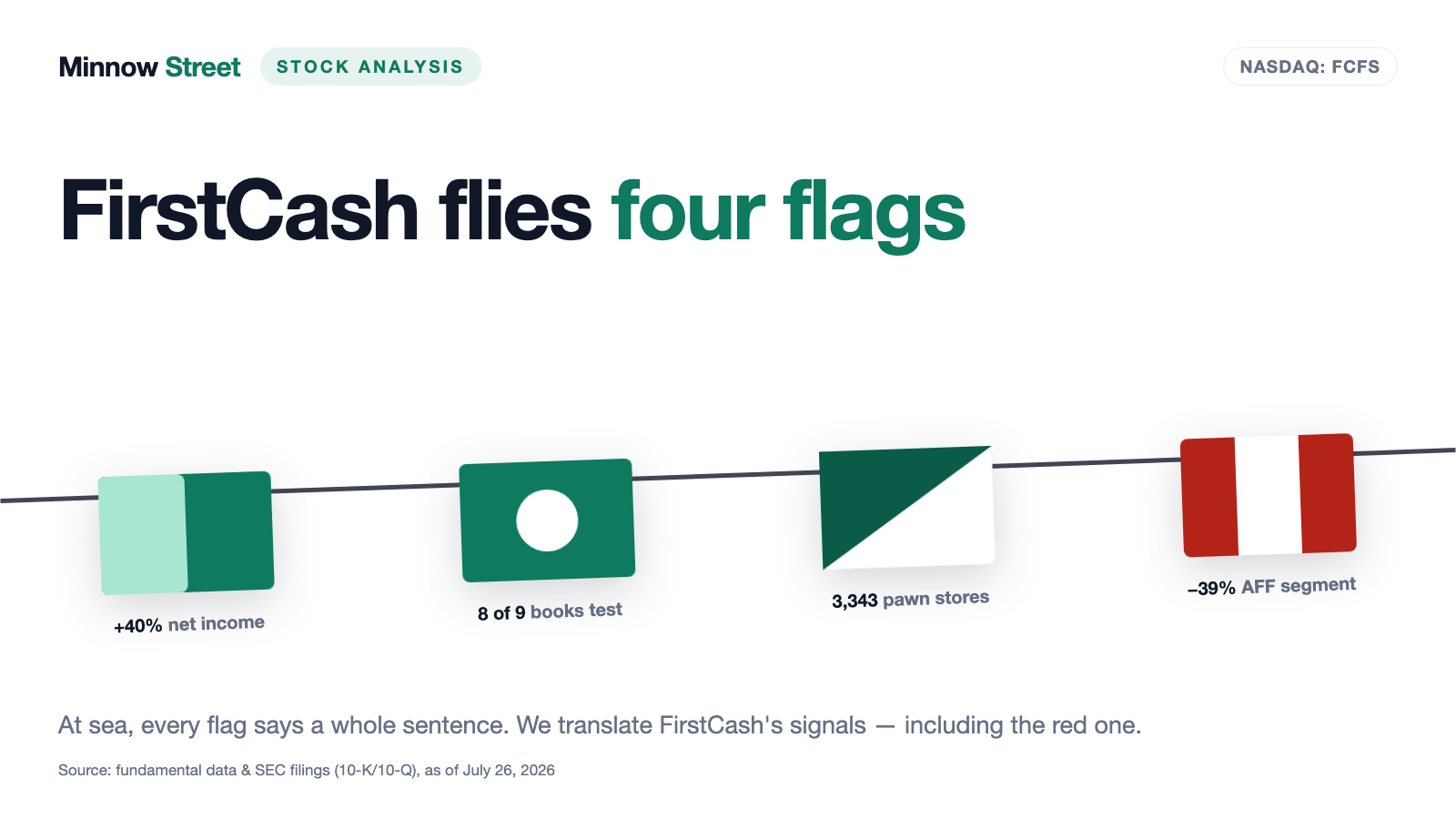
On July 26, 2026, our in-house stock scanner listed FirstCash on eleven screens, including the Piotroski test for healthy books: 8 of 9 points. The company runs 3,343 pawn stores in four countries and reported a record first half on July 23, 2026 — $2,126.3 million in revenue and $201.2 million in net income, up 40 percent. The segment tables in that same release show where the jump came from: gross profit on scrap gold rose from $11.7 million to $68.8 million, which is 71 percent of the entire increase in pre-tax income. Meanwhile the AFF lease-to-own segment shrank 39 percent, with $486.2 million of goodwill still sitting unchanged on its balance sheet line. No advice here — just the question of which part of this record belongs to the pawn shop and which to the gold price.
 Thomas Mücke
Founder & Publisher
Thomas Mücke
Founder & Publisher
Chart
Interactive price chart (TradingView).
Note: pure fact-based analysis, not investment advice and not a solicitation to buy or sell. All figures without guarantee.
There is an investor conviction that feels like prudence: the recession-hedge reflex. You read the words “pawn shop” and something clicks — “That business always works. When people are broke, the pawn shop thrives.” The reflex is seductive because it feels counter-cyclical, like a shield inside a portfolio. And at FirstCash Holdings, Inc. (Nasdaq: FCFS) every number seems to confirm it. The company reported the best half-year in its history on July 23, 2026. Our in-house stock scanner listed the stock on eleven screens as of July 26, 2026. And on the Piotroski test for healthy books it scores 8 out of 9. So let us make a deal. Before you follow the reflex, we read what the company itself told the U.S. securities regulator, the SEC: the annual report (10-K) for 2025 filed February 9, 2026, the quarterly report (10-Q) as of March 31, 2026, and the half-year release (Form 8-K) of July 23, 2026. An SEC filing is honest under penalty of law. And this one describes a pawn business that is running beautifully, a jump in earnings that came mostly from the gold price, a second segment that has shrunk 39 percent, and equity made almost entirely of goodwill. What you do with that is your call.
What FirstCash actually does — the bank for people without one
The model is as old as commerce and fits in one sentence: you bring something valuable, you walk out with cash. A gold chain, a toolbox, a laptop, a guitar. FirstCash lends a fraction of the resale value and keeps the item as collateral. Redeem the pledge and you pay fees; leave it and the store sells the item on its own shelf. The key word is non-recourse: if you do not repay, you lose the item — and nothing else. No collection letter, no credit-bureau mark, no court. For customers without a bank account or a usable credit score, that is often the only door to short-term cash.
As of June 30, 2026, FirstCash ran 3,343 stores: 1,212 in the U.S., 1,836 in Latin America (mostly Mexico, plus Guatemala, El Salvador and Colombia) and 295 in the United Kingdom. Roughly 22,000 people worked for the group across seven countries as of December 31, 2025. That makes FirstCash the largest listed pawn operator in the world, in an industry where the competition consists of tens of thousands of single-location shops.
There is a second business, and for this analysis it matters just as much. In 2021 FirstCash bought American First Finance (AFF), a provider of lease-to-own and retail finance at the checkout. Picture it: you are standing in a furniture store in front of a $1,200 couch, you do not have the cash and no credit card that will stretch. Instead of a bank loan you sign a lease-purchase agreement — AFF buys the couch from the merchant and leases it to you until it is yours. The merchant is paid immediately, you get the couch, AFF carries the credit risk. As of June 30, 2026, AFF worked with roughly 16,700 merchant locations. The company says pawn operations account for about 90 percent of net revenue, with AFF providing the rest.
That frames the central tension of this analysis, and it runs through every chapter: the pawn business is demonstrably excellent — but the 2026 earnings jump came mostly from the gold price and from acquisitions, not from the pawn margin. And the second segment, carrying a fifth of the book value, is shrinking.
How the stock reached our desk
FirstCash landed on the research list through the Piotroski F-Score, a nine-point test that checks the books for health: is the company profitable, does it generate more cash than it books, is leverage falling, are margins improving, is it issuing new shares? Each yes earns a point. Eight out of nine is a very strong reading — for context, 5 or 6 is average, below 4 gets uncomfortable, and only a handful of companies reach 9 in any given year. FirstCash appeared in this screen's U.S. selection as of July 26, 2026, which held 16 American names at the time.
More interesting than any single screen is the confluence. On the same day our in-house stock scanner listed FirstCash on eleven screens. Three of them speak to quality — Piotroski F-Score (7–9), Quality Growth and Martin Zweig: Growth at a Reasonable Price, which only credits growth when revenue and earnings carry it together. The rest are trend screens: Stan Weinstein: Stage 2 (the phase after a base has formed, when an uptrend is running), 21-EMA Trend, Tight Weekly Closes and Strength on Stress Days — the last of which measures how a stock holds up on days when the broad market falls. Relative strength stood at 80 out of 99: over the previous twelve months the stock outperformed 80 percent of all U.S. names in the data set.
Two honest caveats belong right here. First, these lists are recalculated daily; what held on July 26, 2026, can look different a week later. Second — and this is why we wrote the piece — the Piotroski test grades the balance sheet and the income statement, not the origin of the profit. An earnings gain from a commodity price counts exactly as much as one from more customers. That is the distinction we now make. For a case study in how a single metric can mislead when you do not ask what it measures, see our analysis of Flexsteel — a furniture maker whose end market runs through the very channel AFF depends on.
The numbers over the years — given their due
Start with what genuinely impresses, because there is plenty. Revenue rose from $3,151.8 million in 2023 to $3,388.5 million in 2024 and $3,661.0 million in 2025. Net income climbed from $219.3 million to $258.8 million and then $330.4 million; diluted earnings per share went from $4.80 to $5.73 to $7.42. Three years, each better than the last, without a stumble.
In 2026 the pace accelerated. First-half revenue reached $2,126.3 million (prior-year period: $1,667.0 million) and net income $201.2 million ($143.4 million) — up 40.3 percent. Over the twelve months to June 30, 2026, revenue totaled roughly $4.1 billion and net income $388 million, with operating cash flow of $673 million. Cash generation running well above reported profit is a good sign: this is money, not paper.
The operating detail holds up too. U.S. pawn receivables rose 20 percent in total and 19 percent on a same-store basis as of June 30, 2026 — the twelfth consecutive quarter of double-digit same-store receivable growth. The U.S. retail margin was 43 percent, matching the prior-year quarter, and inventory aged more than one year fell to 1.5 percent. Translated: the stores lend well and turn merchandise quickly.
To see where that money is earned, read the segment table. In 2025 U.S. pawn contributed $452.6 million of pre-tax income (2024: $397.3 million; 2023: $336.3 million), Latin America $177.4 million ($150.2 million; $156.2 million), the newly added United Kingdom $52.5 million — and AFF $169.1 million after $128.6 million and $132.0 million in the two prior years.
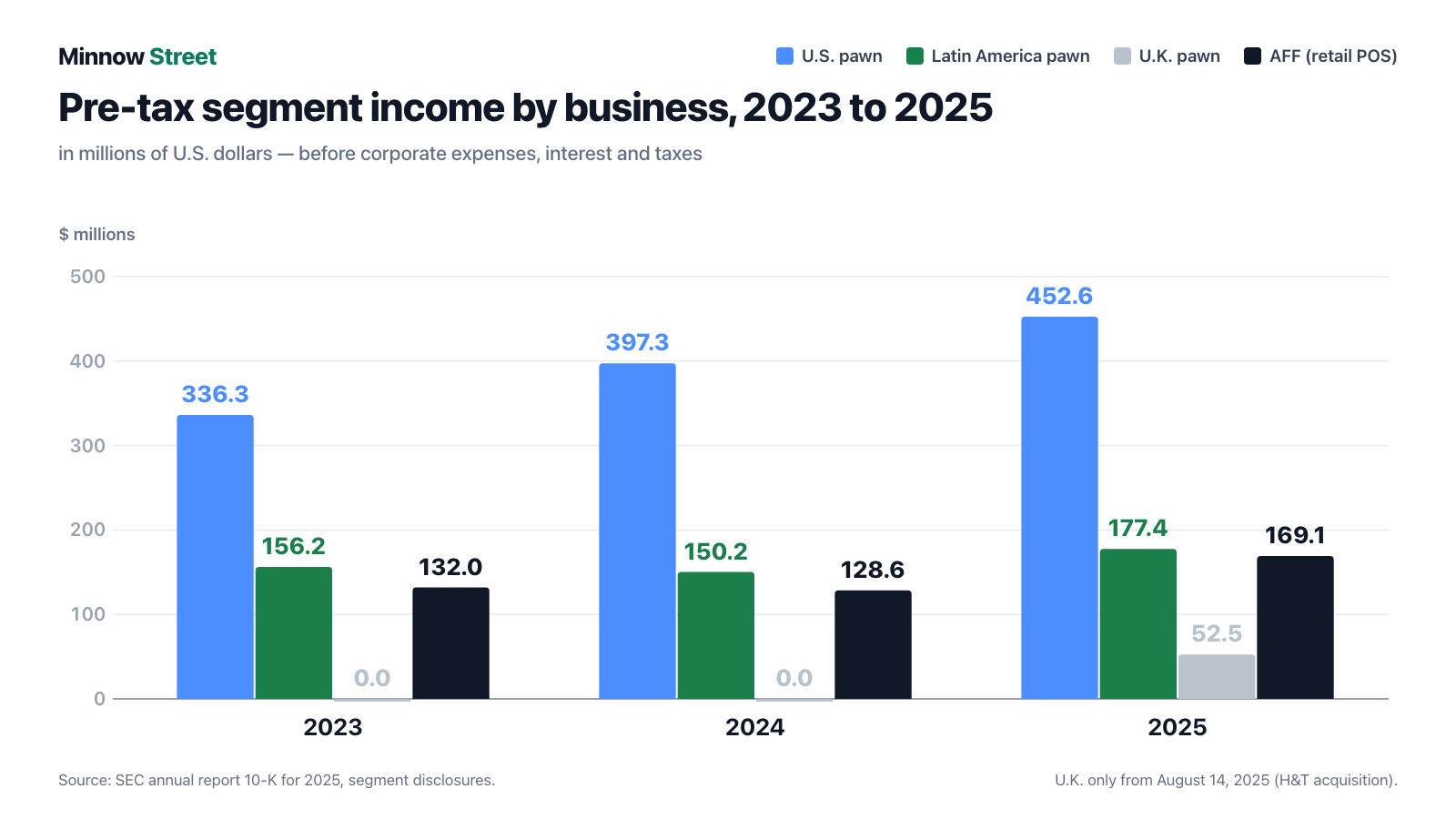
Hold on to this picture. It shows three years in which everything pointed up — and it explains why the AFF numbers of 2026 come as such a surprise.
What the filings say — the uncomfortable truths
Now turn the July 23, 2026, release over and read the back. None of this is hidden; all of it sits in the segment tables attached to the numbers. It is simply rare for anyone to read them.
Uncomfortable truth No. 1: 71 percent of the earnings gain came from scrap gold
Pawn shops sell merchandise that is never redeemed — and whatever will not move on the shelf goes to the smelter as scrap gold. In the filings this line is called “wholesale scrap jewelry sales,” and for years it was a footnote. In 2026 it stopped being one.
The arithmetic is simple. In the first half of 2026 FirstCash sold $264.6 million of scrap, against $195.8 million of cost — $68.8 million of gross profit. A year earlier it was $82.0 million of sales, $70.3 million of cost and therefore only $11.7 million of gross profit. The increase is $57.1 million. Consolidated pre-tax income over the same half rose from $192.3 million to $272.1 million — a gain of $79.8 million. Put differently: 71 percent of the increase in pre-tax income is attributable to scrap gold.
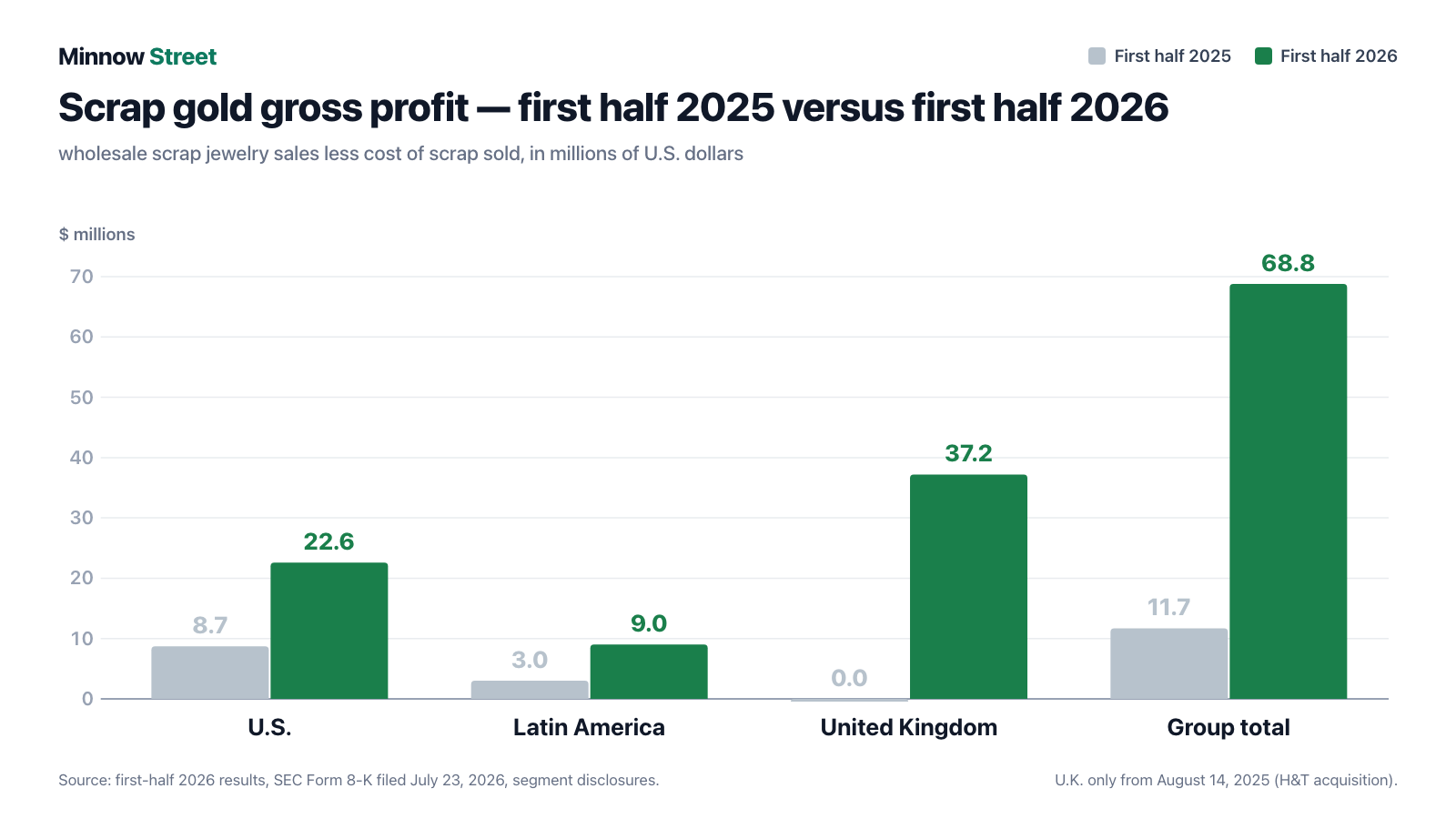
The chart supplies the second half of the story. Of the $57.1 million increase, $37.2 million came from the United Kingdom — a business FirstCash only bought on August 14, 2025, when it acquired the H&T chain. In the first half of 2025 there was simply nothing there to compare against. That leaves $13.9 million from the U.S. and $6.0 million from Latin America genuinely out of the existing footprint — and much of that from price rather than volume. The company says so itself:
“The increase in wholesale scrap jewelry revenue was primarily due to increases in pawn lending activity over the past several quarters, which created more forfeited collateral to scrap, and the increase in gold prices over the past year.”
— FirstCash Holdings, Inc., SEC quarterly report 10-Q as of March 31, 2026, MD&A, U.S. Pawn Segment

To be fair: even without the scrap effect, first-half pre-tax income would have risen about $22.7 million, or roughly 12 percent. That is a respectable number. It is simply not the 40 percent profit growth printed on page one. Remember: a record tells you how high the mountain is, not who piled it up.
How seriously FirstCash now takes the gold trade shows up in a footnote you would not expect in a pawn filing — part of its future gold deliveries is already sold forward.
“As of March 31, 2026, the Company had contractual commitments to deliver a total of 51,750 gold ounces between April 2026 and September 2027 at a weighted-average price of $3,614 per ounce.”
— FirstCash Holdings, Inc., SEC quarterly report 10-Q as of March 31, 2026, Note 8 “Commitments and Contingencies”

These forwards are not a warning sign; they are ordinary commercial prudence, locking in part of the stream against a falling gold price. But they show how closely the record now depends on a commodity price no store manager can influence.
Uncomfortable truth No. 2: the second segment is shrinking — the goodwill is not
In 2025 AFF was still a powerhouse: $169.1 million of pre-tax income, its best year since the acquisition. In the first half of 2026 it earned $54.7 million against $90.2 million a year earlier — down 39 percent. Origination volume fell 14 percent in the second quarter and segment net revenue fell 26 percent over the half. For full-year 2026 FirstCash itself expects net revenue down 20 to 25 percent.
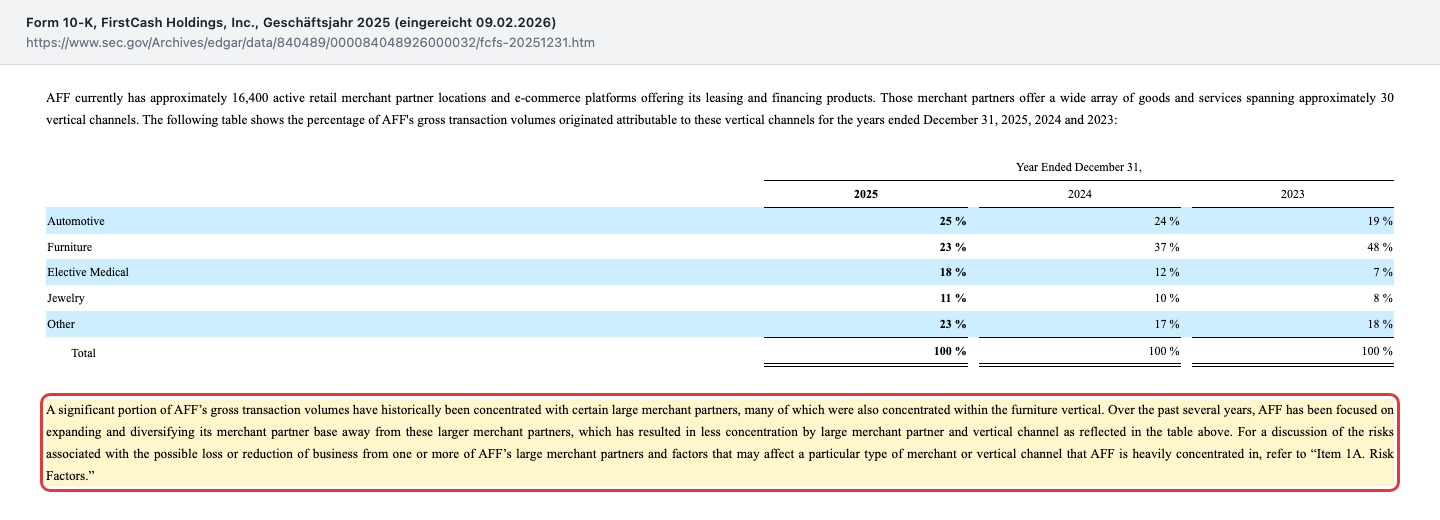
The reasons are in the filings and are part self-inflicted, part not. AFF leaned for years on furniture retailers, and that end market has cracked. Furniture fell from 48 percent of transaction volume in 2023 to 37 percent in 2024 and 23 percent in 2025. Two large partners — the chains American Freight and Conn's — filed for bankruptcy at the end of 2024, and their absence still weighs on the numbers. FirstCash describes the concentration risk plainly:
“A significant portion of AFF’s gross transaction volumes have historically been concentrated with certain large merchant partners, many of which were also concentrated within the furniture vertical.”
— FirstCash Holdings, Inc., SEC annual report 10-K for 2025, Item 1 “Business,” Retail POS Payment Solutions
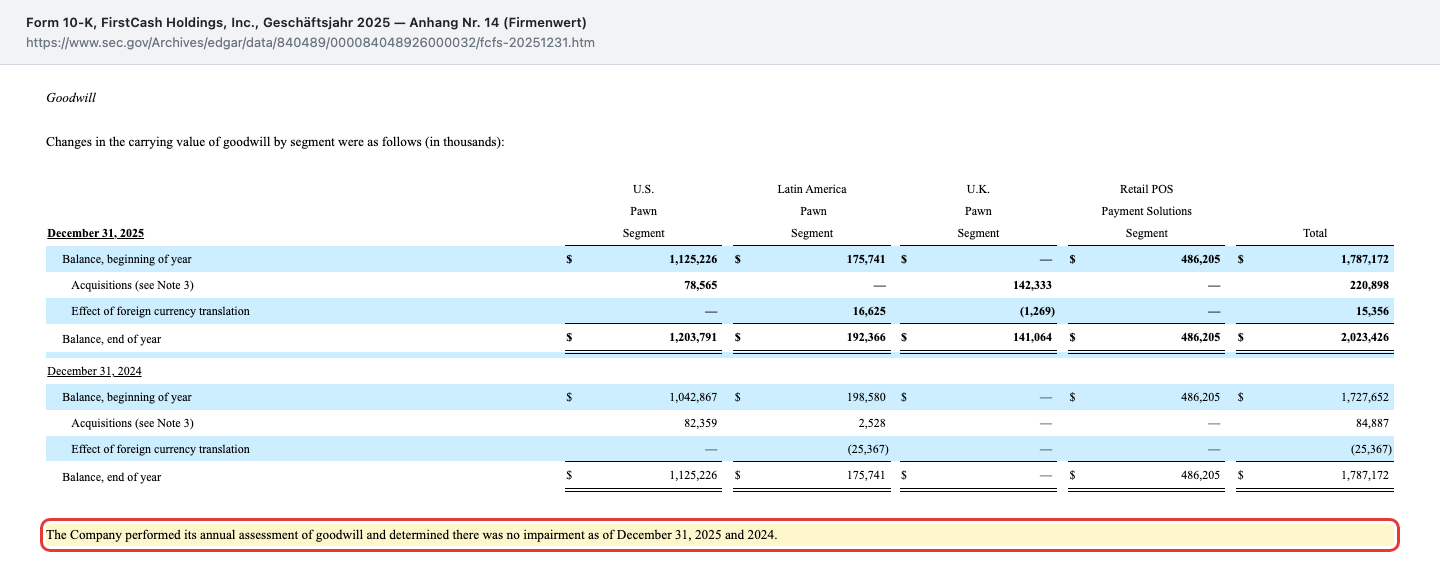
Now the balance-sheet part. When FirstCash bought AFF in 2021 it recorded goodwill — the premium paid above the value of identifiable assets. Everyday picture: you buy a bakery for $500,000 although the oven, the fittings and the flour are worth $200,000 together. The $300,000 difference is goodwill, paid for the customers, the name and the hope. As long as the bakery hums, that is fine. If it slows, the number has to be written down.
The goodwill assigned to AFF is $486.205 million — and it stood identical to the dollar as of December 31, 2023, 2024 and 2025. The annual report states explicitly that no impairment was determined for 2025 or 2024. That is by the book: the test runs once a year, and it fell in a period when AFF was posting its best results ever. The next test lands in the annual report for 2026 — a year for which the company itself expects 20 to 25 percent less segment net revenue.
For a lease-to-own business serving the same customers through the same cycle, see our analysis of PROG Holdings — including what happens when the single most important retail partner disappears.
Uncomfortable truth No. 3: tangible equity comes to $91 million
As of June 30, 2026, FirstCash reported total assets of $5,485.6 million and shareholders' equity of $2,321.8 million — an equity ratio of roughly 42 percent, comfortable on paper. Except that this equity consists almost entirely of items you cannot touch: $2,030.6 million of goodwill and $200.2 million of other intangible assets. Subtract both and $91.0 million of tangible equity remains, or 1.7 percent of total assets. As of December 31, 2025, the figure was just $22.3 million.
What does that mean day to day? Goodwill is neither fraud nor a bookkeeping trick; it is the premium paid for acquired companies, and for a group that bought 313 pawn stores in twelve months for $453 million it is necessarily large. But it has one property: it can only shrink, never grow. If everything goes well it simply sits there. If an acquired business underperforms, it gets written down — and with only $91 million of cushion underneath, a sizable impairment would run straight through equity. The counterweight belongs here too: such a write-down costs no cash and breaches no covenant tied to debt-to-earnings ratios. It would be a book loss — but one that would instantly change the picture of a rock-solid balance sheet.
Uncomfortable truth No. 4: the growth is bought on credit
Of the 347 locations added in the twelve months to June 30, 2026, 313 were acquired and only 34 opened de novo. Acquisitions cost money, and FirstCash borrows it. Financial debt rose from $1,729.3 million (December 31, 2024) to $2,208.4 million (December 31, 2025) and on to $2,346.0 million as of June 30, 2026. On May 1, 2026, the company closed an offering of $750 million of 6.125 percent senior notes due 2034, using the proceeds to pay down the more expensive revolver and retire the debt assumed with H&T.
The price shows up in the income statement. Interest expense climbed from $93.2 million (2023) to $105.2 million (2024) and $121.3 million (2025) — and in the first half of 2026 alone to $70.2 million versus $53.8 million a year earlier, up roughly 31 percent. For full-year 2026 FirstCash expects interest expense 15 to 20 percent above 2025.
And the shopping continues. On June 23, 2026, the group made a recommended cash offer for U.K.-listed Ramsdens Holdings plc (174 stores) at 609 pence per share; on July 16, 2026, it raised the terms to 684 pence — roughly 229 million pounds in total, about 26 million more than the original bid. Completion is expected by the end of 2026 and would take the U.K. network past 450 locations. For scale: net debt to adjusted EBITDA stood at 2.7 times as of June 30, 2026 — inside the company's stated 2.0 to 3.0 range and below the 2.9 times of nine months earlier. The house is mortgaged, but the payments are comfortable.
Uncomfortable truth No. 5: a good share of the Latin America growth is currency
The Latin American segment looks spectacular: pawn fees rose 37 percent in the first half of 2026 — measured in U.S. dollars. On a constant currency basis the increase was 21 percent. The difference is the Mexican peso, which moved 13 percent in the company's favor over the half (an average of 17.5 pesos to the dollar). Twenty-one percent is still an excellent number — it is simply not 37. FirstCash quantifies the sensitivity itself: each full point of change in the peso rate moves annual earnings by roughly $0.10 to $0.12 per share. Currencies run both ways; in the first half of 2026 this one ran the friendly way.
Valuation — what the market pays for the pawn counter
Daily prices say nothing about the worth of a company, so here are orders of magnitude with dates attached. Market capitalization stood at roughly $9.7 billion as of July 24, 2026, spread over 43,836,687 shares (as of April 22, 2026). Against net income of $388 million for the twelve months to June 30, 2026, that is a price-to-earnings ratio of about 25; against the company's adjusted net income of $447 million, about 22. For a documented price anchor from the company's own checkbook: FirstCash repurchased 725,000 of its own shares in 2026 at an average of $206.73 through July 23; through June 30, 2026, the total was $127 million at an average of $204.77. Management, in other words, considered those prices acceptable.
Include the debt and the picture gets more honest. As of June 30, 2026, $2,346.0 million of financial debt stood against $172.3 million of cash — $2,173.7 million of net debt. Added to the market capitalization, that gives an enterprise value of roughly $11.9 billion, or about 15 times adjusted EBITDA of $802 million for the trailing twelve months. For a chain growing its store base at a double-digit rate that is no bargain, but no bubble either.
One metric deserves to be set aside here: price to book. Around 4 sounds moderate — except that 96 percent of that book value is goodwill and intangibles. Measured against tangible equity of $91.0 million, the ratio would be astronomical and therefore meaningless. For a company assembled out of acquisitions, book value measures what was paid, not what is there.
The professionals' view: five analysts cover the stock, with an average price target of $239.25 (data as of July 24, 2026). The dividend is $0.42 per quarter, payable August 28, 2026 — $1.68 annualized, a yield in the neighborhood of 0.8 percent. Together with buybacks, roughly $256 million flowed to shareholders in the twelve months to June 30, 2026, about two thirds of net income. On July 22, 2026, the board authorized a new $150 million repurchase program, immediately after the previous one of the same size had been completed in under nine months.
The case for and against, side by side
What speaks for FirstCash:
- The core business is verifiably strong: consolidated pawn receivables up 63 percent year over year as of June 30, 2026 (22 percent same-store), a twelfth consecutive quarter of double-digit same-store growth in the U.S., and a retail margin steady at 43 percent.
- Three years of records without a stumble: revenue from $3,151.8 million to $3,661.0 million (2023 to 2025), net income from $219.3 million to $330.4 million, diluted earnings per share from $4.80 to $7.42.
- Solid internal funding: $673 million of operating cash flow in the twelve months to June 30, 2026, well above reported net income of $388 million; adjusted free cash flow of $309 million.
- Return on equity of 17 percent (20 percent adjusted) and leverage of 2.7 times inside the stated 2.0 to 3.0 range — both for the twelve months to June 30, 2026.
- Shareholder-friendly capital allocation: a $0.42 quarterly dividend, 725,000 shares repurchased year to date, and a new $150 million buyback authorized July 22, 2026.
- Growth with substance behind it: 466 owned properties (38 percent of the U.S. store base), 313 pawn stores acquired in twelve months for $453 million, and the integration of roughly 300 H&T stores onto the group point-of-sale system completed in June 2026, ahead of schedule.
- One lawsuit fewer: the case brought by the U.S. Consumer Financial Protection Bureau over lending to service members (filed November 12, 2021) was settled with court approval on July 11, 2025 — up to $7.0 million in consumer redress and a $4.0 million penalty.
What speaks against it:
- The earnings jump is 71 percent scrap gold: $57.1 million of the $79.8 million increase in first-half 2026 pre-tax income came from scrap gross profit — and $37.2 million of that from a U.K. business only acquired in August 2025.
- The second segment is shrinking fast: AFF pre-tax income of $54.7 million in the first half of 2026 against $90.2 million a year earlier, with company guidance of 20 to 25 percent lower segment net revenue for the full year.
- $486.205 million of goodwill sits unchanged on exactly that segment (as of December 31, 2025, identical to 2024 and 2023) — the next impairment test falls in the annual report for 2026.
- Of $2,321.8 million in shareholders' equity, $91.0 million remains after deducting goodwill and intangibles (June 30, 2026).
- Interest expense is growing faster than revenue: $70.2 million in the first half of 2026 versus $53.8 million, with company guidance of 15 to 20 percent above 2025 for the full year.
- Currency exposure: each full point of change in the peso rate moves annual earnings by $0.10 to $0.12 per share according to the company; first-half Latin America growth was 21 percent in local currency versus 37 percent in dollars.
- Regulatory risk is structural: pawn and small-dollar lending sit under CFPB, FTC and state supervision, and AFF originates part of its loans through a partner bank — a model the annual report itself describes as open to legal challenge.
A human conclusion
Back to the recession-hedge reflex. Its problem is not that it is wrong — FirstCash is a good business. The stores work, the customers come, the books are clean enough for 8 of 9 on the Piotroski test, and the company has been acquiring successfully for years. The problem with the reflex is that it hands you an explanation before you have looked. It says: “People are broke, hence the record.” The filings say something more precise: people are broke, the gold price rose, and we bought a British chain — roughly in reverse order of impact.
So anyone buying FirstCash today is not simply buying a recession-proof pawn shop. They are buying three things at once: a store network that clearly works, a substantial slice of the gold price, and a second segment whose earnings fell 39 percent while $486.2 million of goodwill still rests on it. All three appear in the same filings, and all three come with measuring points: scrap gold gross profit, AFF pre-tax segment income, and the goodwill line in the next annual report.
The honest question is therefore not “is a pawn shop recession-proof?” but: do you want to own a company whose store network undoubtedly works, whose 2026 earnings jump was carried mostly by a commodity price and an acquisition, and whose balance sheet shows $91 million of substance once everything bought is deducted? If yes, you have a thesis and you know where to test it. If no, you had a gut feeling. What you do with that is your decision. And that is exactly as it should be.
Sources
Every original document used in this analysis — for reading yourself:
- FirstCash Holdings, Inc. — SEC quarterly report 10-Q as of March 31, 2026 (filed April 24, 2026)
- FirstCash Holdings, Inc. — SEC annual report 10-K for 2025 (filed February 9, 2026)
- FirstCash Holdings, Inc. — First-half 2026 results, Exhibit 99.1 to the SEC Form 8-K filed July 23, 2026 (segment tables, balance sheet, outlook, dividend, buyback)
- FirstCash Holdings, Inc. — SEC Forms 8-K dated May 1, 2026 ($750 million of 6.125 percent senior notes due 2034), June 18, 2026 (Texas reincorporation), June 23 and July 16, 2026 (offer for Ramsdens Holdings plc, raised to 684 pence) and July 22, 2026 (CEO transition): EDGAR filing index for CIK 0000840489 (sec.gov)
- Fundamental data (metrics, valuation, market capitalization; data as of July 24, 2026), reconciled against the SEC filings.
- Screen membership: our in-house Piotroski F-Score screen, as of July 26, 2026; the lists are recalculated daily.
Transparency & disclaimer: This analysis is journalistic commentary on publicly available information. It is not investment advice, not a regulated financial analysis and not a solicitation to buy or sell securities. Equity investments carry substantial risk, including total loss of capital. All information is provided without warranty; the as-of date for each figure is noted in the text. The author holds no position in FirstCash shares at the time of publication.
Our Bottom Line at a Glance
- Core pawn business positive
- The store business is verifiably strong: consolidated pawn receivables were 63 percent above the prior year as of June 30, 2026, and 22 percent higher on a same-store basis. In the U.S. it was the twelfth consecutive quarter of double-digit same-store growth, the retail margin held at 43 percent and inventory aged over one year fell to 1.5 percent. Pre-tax income of the three pawn segments reached $452.4 million in the first half of 2026 versus $283.8 million.
- Where the earnings gain came from negative
- Of the $79.8 million increase in first-half 2026 pre-tax income, $57.1 million is attributable to gross profit on scrap gold — about 71 percent. Of that, $37.2 million came from the U.K. business acquired on August 14, 2025. Without the scrap effect, pre-tax income would have grown roughly 12 percent instead of 42 percent. A commodity price is not an operating achievement.
- The AFF segment negative
- The lease-to-own arm AFF earned $54.7 million of pre-tax income in the first half of 2026 against $90.2 million a year earlier — down 39 percent. Origination volume fell 14 percent in the second quarter, and the company expects segment net revenue 20 to 25 percent lower for full-year 2026. Furniture fell from 48 percent of volume in 2023 to 23 percent in 2025.
- Balance sheet substance negative
- Of $2,321.8 million in shareholders' equity as of June 30, 2026, $2,030.6 million is goodwill and $200.2 million other intangibles; tangible equity comes to $91.0 million. $486.205 million of that goodwill sits on the shrinking AFF segment and was carried unchanged as of December 31, 2023, 2024 and 2025 — with no impairment determined for 2025 or 2024.
- Funding and capital discipline neutral
- Financial debt rose from $1,729.3 million to $2,346.0 million in eighteen months, and first-half 2026 interest expense reached $70.2 million versus $53.8 million. Against that stand leverage of 2.7 times inside the stated 2.0 to 3.0 range, $673 million of operating cash flow over twelve months, and a $750 million note issue in May 2026 that termed out debt to 2034 at 6.125 percent.
- Valuation neutral
- At a market capitalization of roughly $9.7 billion (data as of July 24, 2026), the price-to-earnings ratio is about 25 on trailing twelve-month net income and about 22 on adjusted net income. Enterprise value of roughly $11.9 billion equals about 15 times adjusted EBITDA. The company itself repurchased shares in 2026 at an average of $206.73.
FirstCash runs 3,343 pawn stores in four countries, and that core business clearly works: pawn receivables 63 percent above the prior year as of June 30, 2026, twelve consecutive quarters of double-digit same-store growth in the U.S., $673 million of operating cash flow over twelve months and 8 of 9 points on the Piotroski test. But the record first half of 2026 stands on two legs that do not belong to pawn lending: 71 percent of the earnings gain came from gross profit on scrap gold, much of it from a U.K. business bought in August 2025. At the same time the AFF lease-to-own segment saw earnings fall 39 percent while $486.2 million of goodwill remains booked against it — on tangible equity of $91.0 million. Not investment advice.
What Our Rating Means
Open questions
The business works in principle, but one material question is open. As long as it stays open, our findings do not carry a quality verdict.
The business model plainly carries: pawn lending has been robust for centuries, the store metrics are strong, the books are clean enough for 8 of 9 on the Piotroski test, operating cash flow runs well above reported profit, and leverage stays inside the stated range. What remains open is a material operating question — twice over. First, the 2026 earnings jump depends 71 percent on a commodity price and an acquisition rather than on the pawn margin. Second, the AFF segment is shrinking 39 percent while $486.2 million of goodwill sits unchanged on it and tangible equity amounts to only $91.0 million. This is not an existential issue — interest coverage, cash flow and an Altman Z-Score of 7.71 argue clearly against that — but it is more than a formality. Hence yellow: proven strength at the core, unresolved questions at two edges. The decision is yours.
A journalistic assessment by our editorial team at the time of the deep dive, based on public sources — not investment advice and not a solicitation to buy or sell. Your personal circumstances (investment goals, risk capacity, taxes) cannot be taken into account. What our levels mean, how verdicts are formed, and what conflicts of interest exist →
Worth Noting
- FirstCash reached our research list through our in-house Piotroski F-Score screen (8 of 9 points, relative strength 80 of 99, as of July 26, 2026); the U.S. selection of that screen held 16 names at the time. On the same day the stock appeared on eleven scanner screens in total, including Quality Growth, Martin Zweig: Growth at a Reasonable Price and Stan Weinstein: Stage 2. These lists are recalculated daily.
- Identity note: FirstCash Holdings, Inc. (CIK 0000840489) was named FirstCash, Inc. until 2021 and First Cash Financial Services, Inc. before that; older documents carry those names. On June 18, 2026, the company reincorporated from Delaware to Texas — share count, shareholder rights and the Nasdaq listing were unaffected. Not to be confused with the U.K. acquisition H&T Group plc (part of the group since August 14, 2025) or with the pending acquisition of Ramsdens Holdings plc.
- Data basis and evergreen note: annual figures come from the 10-K for 2025 (filed February 9, 2026), quarterly figures from the 10-Q as of March 31, 2026 (filed April 24, 2026), and half-year figures from the Form 8-K filed July 23, 2026. The only price anchor in the text is not a daily quote but the average repurchase price of $206.73 documented in that release. Analyses are evergreen; daily prices are not a buy argument.
Frequently Asked Questions
FirstCash Holdings (Nasdaq: FCFS), based in Fort Worth, Texas, operated 3,343 pawn stores across the U.S., Latin America and the United Kingdom as of June 30, 2026. The stores lend cash against pledged property and resell forfeited merchandise on their own shelves. It also owns American First Finance, which offers lease-to-own and retail finance at roughly 16,700 merchant locations.
Pre-tax income rose from $192.3 million to $272.1 million in the first half of 2026. Of that $79.8 million increase, $57.1 million is attributable to gross profit on scrap gold, which jumped from $11.7 million to $68.8 million — about 71 percent. Of that gain, $37.2 million came from the U.K. business acquired in August 2025.
American First Finance is the lease-to-own and retail finance arm FirstCash acquired in 2021. Pre-tax segment income fell to $54.7 million in the first half of 2026 from $90.2 million a year earlier. The cause is the furniture downturn: furniture fell from 48 percent of transaction volume in 2023 to 23 percent in 2025, and two large partners filed for bankruptcy at the end of 2024.
As of June 30, 2026, the company reported $5,485.6 million of total assets and $2,321.8 million of shareholders' equity — a ratio of about 42 percent. However, $2,030.6 million of that is goodwill and $200.2 million other intangibles, leaving $91.0 million of tangible equity. Net debt equaled 2.7 times adjusted EBITDA for the trailing twelve months.
The Piotroski F-Score checks nine criteria of accounting quality: profitability, cash flow, leverage, margins, asset turnover and share issuance. Each criterion met scores one point. Eight out of nine is a very strong reading; 5 or 6 counts as average. The test grades the quality of the numbers, not where the profit came from.
The U.S. Consumer Financial Protection Bureau sued FirstCash on November 12, 2021, alleging violations of the Military Lending Act in pawn transactions. On July 11, 2025, the court approved a settlement without any admission: up to $7.0 million in consumer redress, a $4.0 million penalty, and a new pawn product for covered service members and their dependents.
Ramsdens Holdings plc runs 174 pawn stores in the United Kingdom. FirstCash offered 609 pence per share on June 23, 2026, and raised the terms to 684 pence on July 16, 2026 — roughly 229 million pounds in total. Completion is expected by the end of 2026 and would take the U.K. network past 450 stores and the group past 3,500 locations.
Found an error?
Did you spot a factual error, an outdated number, or a typo in this deep dive? Let us know briefly — your report goes straight to the editorial team.