Everspin Stock: The Market's Only MRAM Pure Play — Operating in the Red, Rescued by Interest and a $14.6 Million Award
Everspin of Chandler, Arizona, is the only listed company that lives entirely off MRAM magnetic memory — the ticker is literally MRAM. Revenue grew 9.5 percent to $55.2 million in 2025, yet the company lost $6.5 million at the operating level; the bottom line only landed near zero thanks to interest income and an aerospace-and-defense award worth up to $14.6 million. On Reddit the stock is a whisper with 5 mentions in 24 hours (ApeWisdom, as of July 18, 2026) — but our in-house stock scanner listed it in ten momentum rankings at once (data as of July 8, 2026). We read the annual reports (10-K), the quarterly report (10-Q), a fresh 8-K and the insider filings. Not investment advice — just a tape measure held against the gap between the price story and the operating result.
 Thomas Mücke
Founder & Publisher
Thomas Mücke
Founder & Publisher
Chart
Interactive price chart (TradingView).
Note: pure fact-based analysis, not investment advice and not a solicitation to buy or sell. All figures without guarantee.
There is an investor trap that looks so harmless that hardly anyone recognizes it as a trap: the label trap. It works like this: you read that a memory technology called MRAM could be the future — magnetic memory that forgets nothing when the power goes out. You look for the matching stock. And then you find a company whose ticker symbol literally reads MRAM. Your head goes click: technology good, ticker equals technology, stock good. That an entire annual report sits between a label and an investment thesis feels, in that moment, like a formality. Everspin Technologies (Nasdaq: MRAM) of Chandler, Arizona, is exactly that stock: the market's only listed MRAM pure play — and in the spring of 2026 a momentum darling that rose 155 percent in three months (data as of July 8, 2026) before giving a large chunk back. On Reddit the stock is not a storm, more of a whisper: 5 mentions in 24 hours (ApeWisdom, as of July 18, 2026). So let's make a deal: before you buy the label, we read together what the company itself reported, under penalty of law, to the U.S. securities regulator, the SEC — the annual reports (10-K) for 2024 and 2025, the quarterly report (10-Q) as of March 31, 2026, a fresh July 8-K and the insider filings. And these documents tell of a near-breakeven that does not come from the factory, of one buyer holding more than half of the outstanding invoices, of a patent lawsuit — and of a board member who sold everything near the top. In the end, you decide for yourself.
What Everspin actually does — and why the ticker is half the story
MRAM stands for magnetoresistive random access memory — in an everyday image: memory that writes as fast as a whiteboard but forgets nothing when the lights go out. Ordinary working memory (DRAM, SRAM) loses everything in a power cut; flash memory keeps its data but is slow and wears out with every write. MRAM stores data magnetically instead of via electrical charge — which is why it sits wherever a power failure must not cost data: industrial controls, medical devices, vehicles, RAID storage systems in data centers, avionics and satellite electronics. The annual report (10-K) for 2025 calls Everspin the leading supplier of discrete MRAM components; more than 1,405 end customers bought the products in 2025. The company is a child of the chip industry: in 2008, Freescale Semiconductor (now part of NXP) spun out its MRAM business as Everspin; the stock has traded on Nasdaq since October 2016. Today the company employs 85 people — not a typo: eighty-five. Production runs on two tracks: the older Toggle MRAM chips get their magnetic back-end processing in Everspin's own 200mm fab in Chandler; the modern STT-MRAM wafers are manufactured exclusively by GLOBALFOUNDRIES. On top sits a licensing and services business: MRAM technology for radiation-tolerant aerospace designs, a radiation-hardened FPGA program developed with Frontgrade, patent sales. Worth knowing for context: spintronics neighbor NVE Corp uses the same physics for sensors and is highly profitable — Everspin is the volume player on the memory side, and that side has been losing money at the operating level since 2024. Which brings us to the central tension of this analysis, and it runs through every chapter: the price trades the MRAM future — the books show a $55 million niche operation whose near-breakeven is paid for by interest and a time-limited award, not by the factory.
Where the stock shows up in our scanner
We run roughly 3,500 stocks through our scanners every day. As of July 8, 2026, Everspin delivered a remarkably one-sided picture: 10 hits — and all ten are momentum or trend scanners. The stock stood simultaneously in the Stan Weinstein Stage 2 scanner (uptrend phase), in the RS leader ranking with a relative strength rating of 97 (the stock outperformed 97 percent of the market), among the "Doublers," in the dual momentum and the swing trading setups. Translated: the price had gained 155 percent in three months and 142 percent in six — and had at the same time fallen 28 percent in the month before the data cut-off, with an average daily swing of roughly 11 percent. A stock that moves eleven percent on an ordinary Tuesday is a roller coaster, not a trading floor. The fundamental side of the same scanner judges more mildly than all that drama suggests: fundamental grade B, a Piotroski F-Score of 8 out of 9 (a nine-point test of the direction of the books — 8 means almost every metric is improving), an Altman Z-Score around 7.7, far from any distress zone. But the valuation rankings where bargains appear are entirely absent — on the contrary: the price-to-sales ratio stood at 8.7 on July 8, price-to-cash-flow above 50. Remember the finding: the market was buying movement and story here, not books and price — exactly the mixture the label trap is built from.
The numbers over the years — honestly appraised
First, what genuinely speaks for Everspin — and it is more than the price chart suggests. The gross margin sits stable above 50 percent (2025: 51.2 percent; 2024: 51.8 percent) — a strong figure for a small chipmaker, and proof that the niche carries real pricing power: whoever needs MRAM pays the premium. The balance sheet is tidy: $40.5 million in cash, no bank debt, only $12.9 million in total liabilities (March 31, 2026). And the company has proven it can print black ink: from 2021 through 2023 the bottom line was positive every year, in 2023 as much as $9.1 million. Dilution stayed civilized too — the diluted share count rose about 23 percent since 2020 to 23.1 million (Q1 2026); for a small cap of this size, that is moderate. Now look at the whole curve:
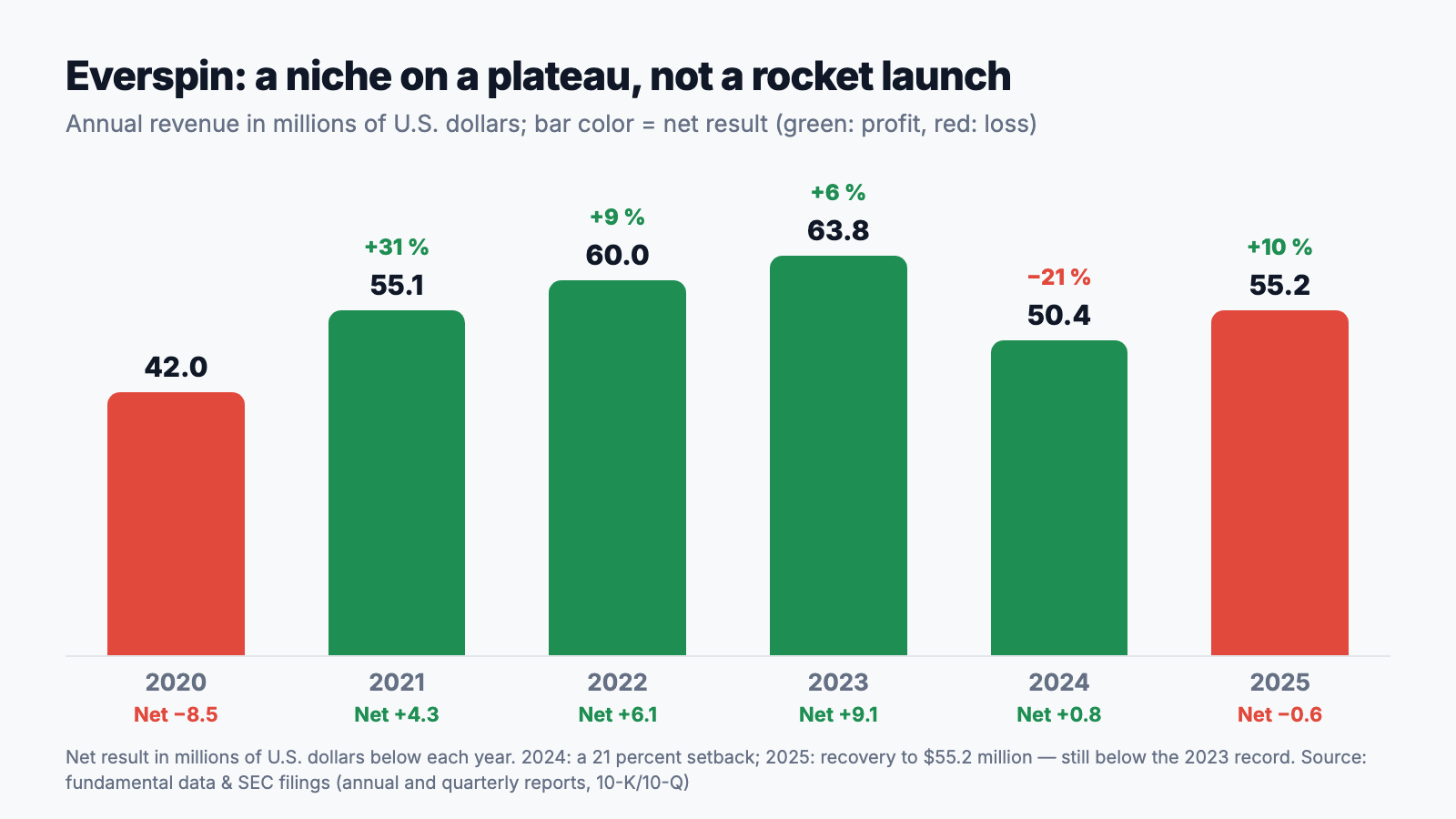
The curve tells an uncomfortable truth about growth: there isn't any. $55.1 million of revenue in 2021, $55.2 million in 2025 — in between a peak ($63.8 million in 2023), a 21 percent slump (2024, when industrial customers emptied their inventories) and a recovery. The ten-year view is even more sobering: Everspin already booked $49.4 million back in 2018. To be fair: in 2025, pure product revenue grew 14.4 percent to $48.3 million, and in the first quarter of 2026 by 27.9 percent — the recovery is real, it comes from the core business, and Asia-Pacific (63 percent of revenue) is pulling again. But a base effect after a slump is not the same as a breakout into a new order of magnitude. And one balance sheet line is a reminder of what this niche has cost: $137.8 million of accumulated deficit sits in the books as of March 31, 2026 — in 18 years of corporate history, Everspin has never earned money on a cumulative basis. Remember the rhythm: the niche carries a 50 percent margin, but it does not carry growth that would explain a 155 percent price surge on its own. Which brings us to the uncomfortable truths.
What the filings say — the uncomfortable truths
Uncomfortable truth no. 1: the near-breakeven does not come from the factory — it comes from interest and a $14.6 million award
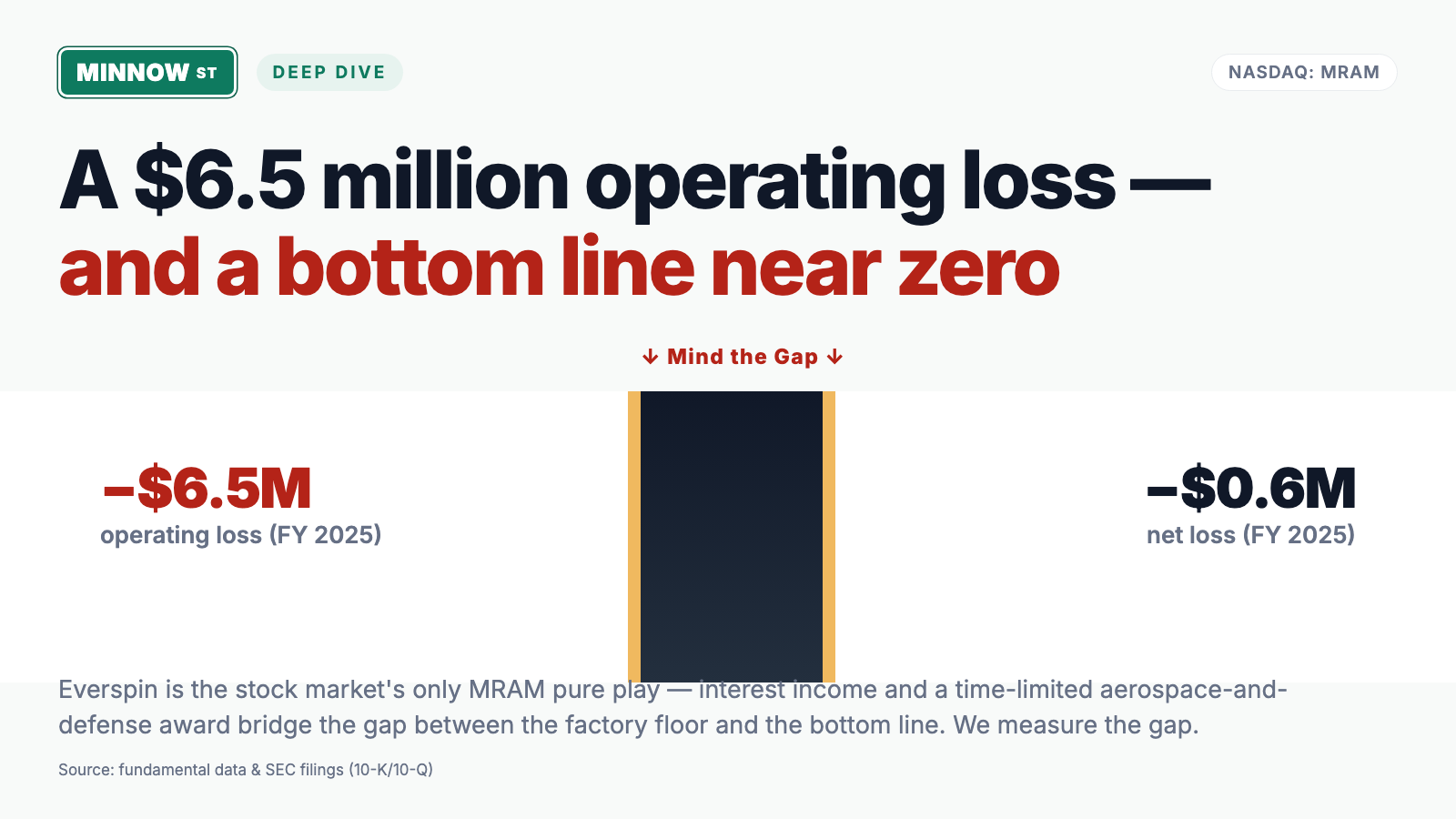
If you only look at the bottom line, Everspin has posted results near zero for years, and you might think: a breakeven niche operator. The truth sits one line higher: at the operating level — revenue minus costs of the actual business — Everspin lost $7.1 million in 2024 and another $6.5 million in 2025. That the net result was a mini profit in 2024 (+$0.8 million) and only a mini loss in 2025 (−$0.6 million) is owed to two items below the operating line: interest income on the cash pile ($1.6 to $1.8 million a year) — and a remarkable windfall the filing describes like this:
"The Award allows for milestones totaling up to approximately $14.6 million for the Company over a span of 2.5 years. The Award is not in the ordinary course of the Company’s business and hence not a contract with a customer."
— Everspin Technologies, Inc., SEC annual report 10-K for 2025, notes, "Other Income, Net"
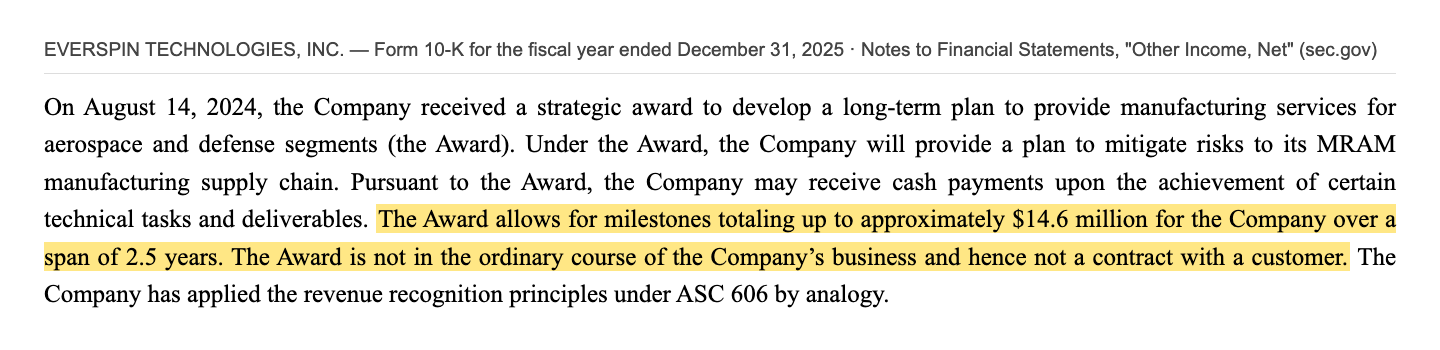
The "strategic award," received on August 14, 2024, pays Everspin to develop a long-term plan for manufacturing services for aerospace and defense segments and to de-risk its MRAM supply chain — who provides the money, the filing does not say. The effect is measurable: $6.1 million flowed in as other income in 2024, another $4.4 million in 2025, and $2.2 million in the first quarter of 2026 — turning an operating loss of $2.7 million into a net mini loss of $0.3 million. Here is the gap in detail:
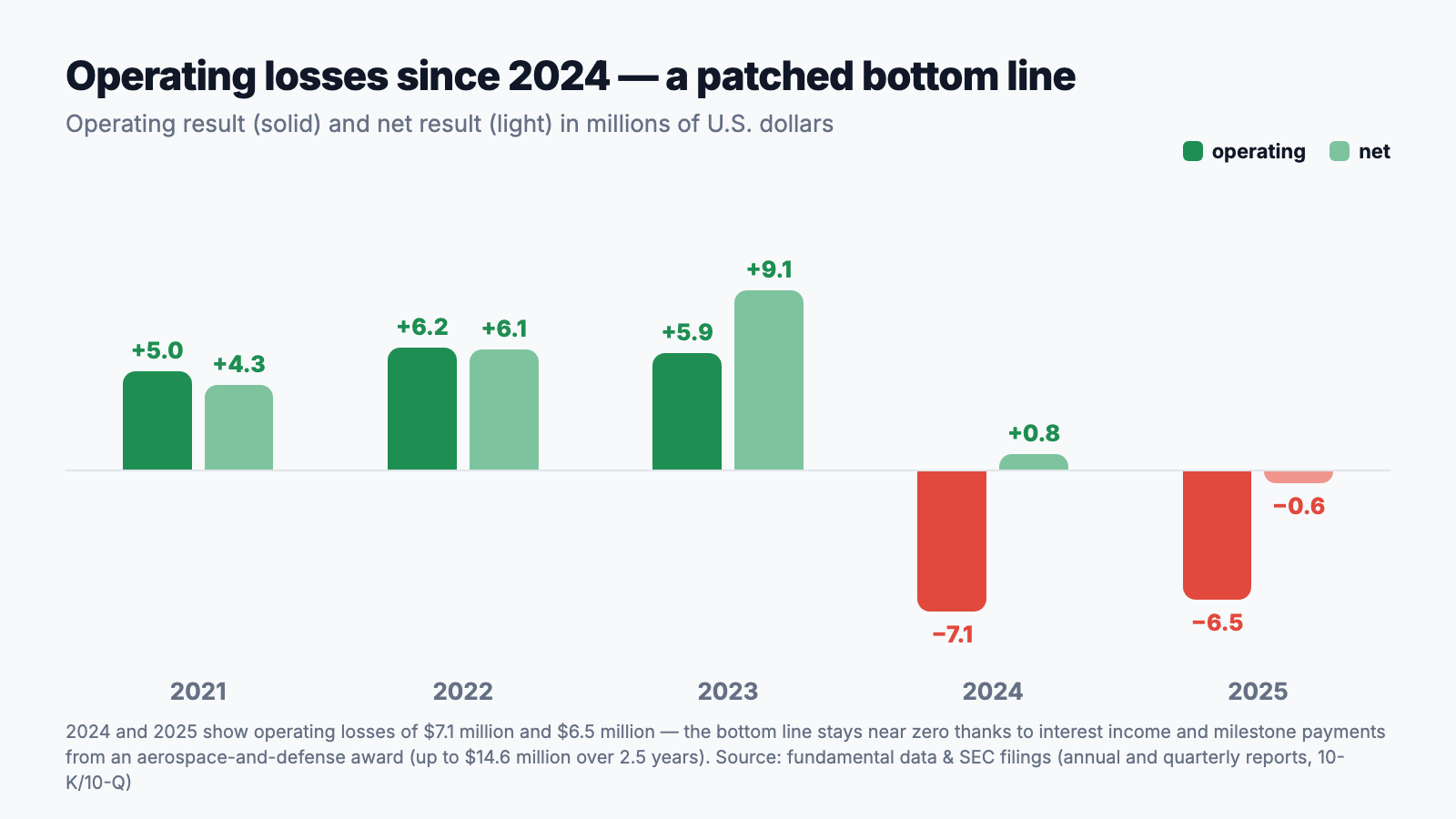
To be fair: none of this is hidden or improper — Everspin discloses the award openly, and a defense-adjacent backer wanting to secure the MRAM supply chain is, if anything, a knighthood for the technology's strategic relevance. But for your math, the fine print is what counts: 2.5 years from August 2024 run out in early 2027. Then the crutch falls away — and the factory must earn on its own what the award and the interest on the cash currently contribute. Remember the gap: whoever praises the near-breakeven should know who paid for it.
Uncomfortable truth no. 2: one buyer holds 57 percent of the outstanding invoices — and the wafers come from exactly one source
Everspin sells to more than 1,405 end customers — that sounds broadly diversified. The filing shows the opposite:
"During the year ended December 31, 2025, more than 1,405 end customers purchased our products. Our two largest end customers together accounted for 33% of our total revenue for the year ended December 31, 2025 and one of these customers accounted for more than 10% of our revenue during that period."
— Everspin Technologies, Inc., SEC annual report 10-K for 2025, Item 1 "Business"
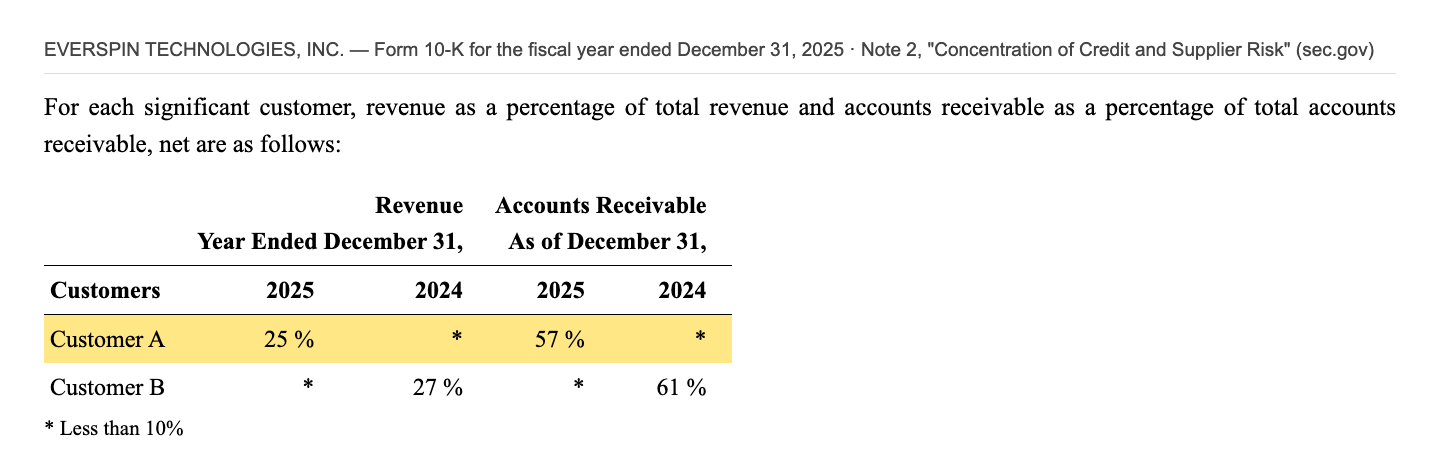
The concentration table in the notes gets more specific: a single direct customer — "Customer A," a distributor — accounted for 25 percent of 2025 revenue and 57 percent of all accounts receivable; the year before, "Customer B" played the same role at 27 and 61 percent. In an everyday image: picture a bakery with 1,405 customers where a single wholesale buyer holds more than half of all unpaid invoices — if he goes under or simply orders less, it is not one customer that wobbles but the cash register. In the first quarter of 2026 the pattern sharpened further: 90 percent of revenue ran through distributors (prior-year quarter: 60 percent), Customer A alone stood for 28 percent. And the concentration does not end at the sales side — it starts at purchasing:
"We do not currently source these wafers from anyone other than GLOBALFOUNDRIES, which has the ability to discontinue its manufacture of any of our wafers upon due notice and completion of the notice period."
— Everspin Technologies, Inc., SEC annual report 10-K for 2025, Item 1A "Risk Factors"
Add a take-or-pay element: the manufacturing agreement obliges Everspin to order and pay for the binding portion of its own forecast — if demand drops, Everspin may end up paying for unused capacity. With 85 employees, one dominant distributor and a single wafer source, Everspin is a company where a few individual decisions by other people can swing the annual result — in both directions.
Uncomfortable truth no. 3: an MRAM rival is suing — in court and at the trade commission that can stop imports
Since January 2026, the label trap has had a legal hook. The quarterly report states under contingencies:
"On January 28, 2026, Avalanche Technology, Inc. filed a patent infringement lawsuit against the Company in the United States District Court for the District of Delaware, alleging infringement of certain patents. Avalanche Technology, Inc. also filed a complaint with the U.S. International Trade Commission seeking the institution of an investigation under Section 337 of the Tariff Act of 1930, as amended."
— Everspin Technologies, Inc., SEC quarterly report 10-Q as of March 31, 2026, Note 5 "Commitments and Contingencies"
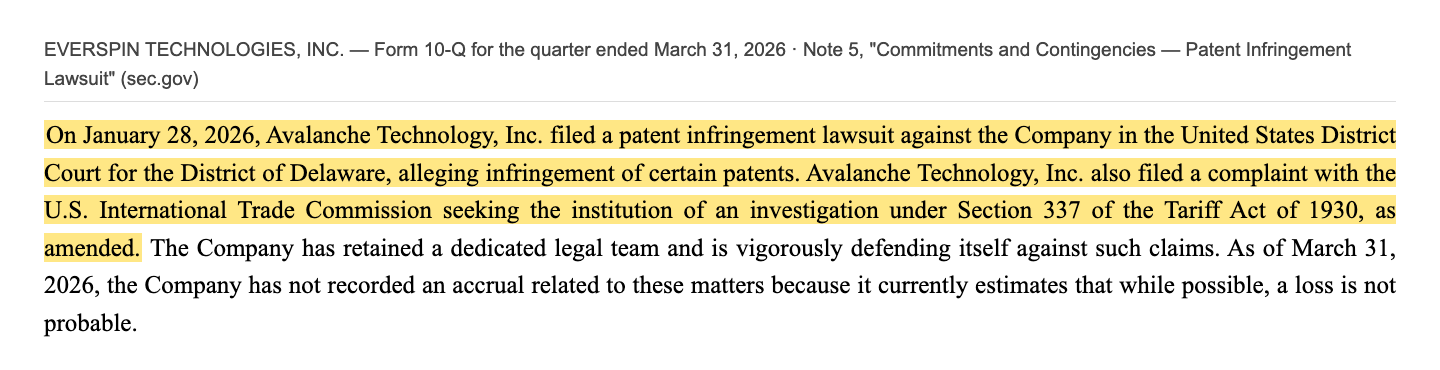
Avalanche Technology is a privately held MRAM developer — a competitor from the very same small niche, one that Everspin's own annual report lists among its potential future rivals. The double-barreled attack is the real news: a Delaware trial costs time and money, but an ITC investigation under Section 337 can, in the extreme case, end in an import ban — and Everspin's modern STT-MRAM wafers are made by GLOBALFOUNDRIES, with the company also holding assets in Singapore per the filing. Everspin considers the claims unfounded, is defending itself with "a dedicated legal team," and has booked no accrual, because a loss is "possible" but "not probable." This can end well — patent wars in chip niches often end in settlements. But for a company with $40 million in cash and zero operating profit, a patent war against a determined rival is not background noise: the defense costs are already running (general and administrative expenses jumped 32 percent in the first quarter of 2026, "primarily due to legal expenses"), and a bad outcome would hit the only product the company has.
Uncomfortable truth no. 4: a director sold all of his shares near the top — and resigned six weeks later
While Reddit and momentum scanners were discovering the stock, one insider did the opposite. Per Form 4, director Lawrence G. Finch sold 310,091 shares in three transactions on May 11 and May 29, 2026, at prices between $26.03 and $34.29 — roughly $8.5 million in total. Holdings afterwards: zero. No pre-arranged 10b5-1 trading plan is indicated on the form. Six weeks later, the company reported via 8-K:
"On July 14, 2026, Lawrence G. Finch notified Everspin Technologies, Inc. (the “Company”) of his resignation from the Company’s board of directors (the “Board”), including as a member of the Board’s audit committee, effective August 4, 2026."
— Everspin Technologies, Inc., SEC Form 8-K dated July 17, 2026, Item 5.02
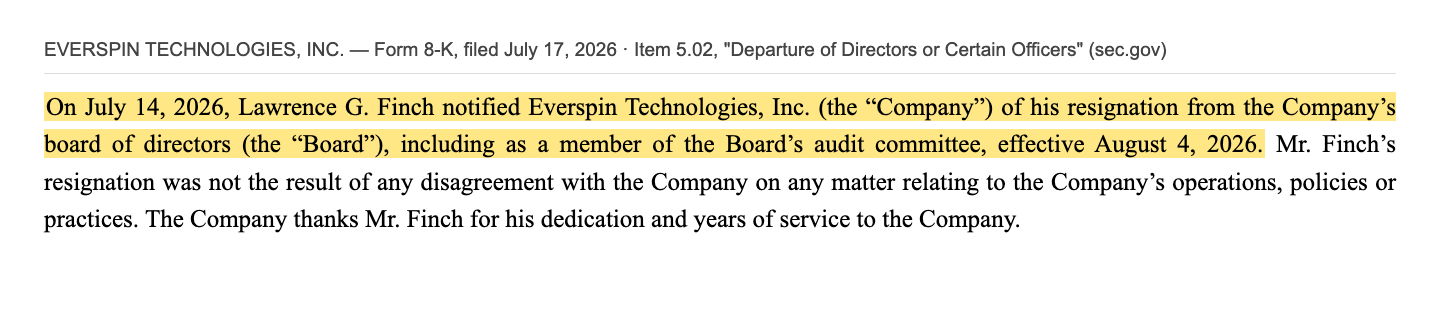
For fairness, everything belongs on the table: per the 8-K, the resignation was explicitly "not the result of any disagreement" with the company; the sales and the filings are legal and timely; and the early-July share sales by CEO Sanjeev Aggarwal and CFO William Cooper were, per the forms, solely tax-withholding sales on vesting stock units — the CEO still held roughly 840,000 shares afterwards. A single insider exit proves nothing; perhaps someone is simply arranging his retirement. But a board member with audit committee insight who exits completely near the high and then leaves the body is the opposite of the signal a momentum rally would like to see. In total, insiders still held about 6 percent of the shares as of July 8, 2026, institutions about 64 percent.
Valuation: half a billion dollars for a $55 million label — depending on the week
How much does the label cost? On July 8, 2026, the stock traded around $21.80 — roughly $490 million of market value for $55.2 million in revenue: a price-to-sales ratio of 8.7. By mid-July (as of July 18, 2026), the market value had melted to about $340 million — still roughly six times trailing-twelve-month revenue. For comparison: a price-to-earnings ratio cannot even be computed for lack of earnings; even measured against the best year in company history ($9.1 million of net income in 2023), the market was paying 37 times in mid-July — for a business whose 2025 revenue sat at the level of 2021. The analyst estimates embedded in our scanner assume about 13 percent earnings growth over the coming twelve months (data as of July 8, 2026) — solid, but no justification for a growth premium of this size. What supports the valuation: the spotless balance sheet ($40.5 million in cash, no bank debt), the 50 percent gross margin, the strategic scarcity — there simply is no second listed MRAM bet. What does not support it: the earnings. The filing itself states the worst case dryly: "We have no committed sources of funding" — if losses persisted, Everspin would have to curtail activities or raise fresh capital. That is not acute — the cash covers the current loss rate for years. But it is a reminder of what is being priced here: an option on the MRAM future whose carrier, in the here and now, is a small operation losing money at the operating level. How quickly the market reprices such options is something we dissected at ACM Research — there the mood turned with politics; here it can turn with a court date.
Opportunities and risks at a glance
What speaks for Everspin:
- Genuine niche leadership: per the annual report the leading supplier of discrete MRAM components, more than 20 years of manufacturing experience, over 1,405 end customers, gross margin stable above 51 percent (2025) — whoever needs MRAM pays the premium.
- A spotless balance sheet: $40.5 million in cash, no bank debt, only $12.9 million in total liabilities (March 31, 2026), Altman Z-Score around 7.7, Piotroski F-Score of 8 out of 9 (data as of July 8, 2026).
- The core business is turning: product revenue +14.4 percent (2025) and +27.9 percent (Q1 2026), Asia-Pacific pulling again; gross margin rose to 52.7 percent in Q1 2026.
- Strategic tailwind: the aerospace-and-defense award (up to $14.6 million) shows Everspin's supply chain matters to security policy; the RAD-Hard program with Frontgrade and the licensing business open doors beyond chip sales.
- Scarcity premium: MRAM is a candidate for future memory generations — and Everspin is the only listed way to bet on it directly.
What speaks against it:
- Earnings quality: operating losses of $7.1 million (2024), $6.5 million (2025), $2.7 million (Q1 2026); the near-zero bottom line comes from interest and award milestones — and the award runs out in early 2027.
- No growth across the cycle: 2025 revenue ($55.2 million) at the level of 2021 ($55.1 million); revenue broke 21 percent lower in 2024; $137.8 million of accumulated deficit since inception.
- Concentration risks: Customer A at 25 percent of revenue and 57 percent of receivables (end of 2025), two end customers at 33 percent of revenue, 90 percent distributor share in Q1 2026, GLOBALFOUNDRIES as sole STT wafer source including take-or-pay obligations.
- A patent war inside its own niche: the Avalanche lawsuit in Delaware plus an ITC proceeding under Section 337 (possible import ban); no accrual booked, legal costs already driving up administrative expenses.
- Momentum instead of valuation: P/S of 8.7 (July 8, 2026) and roughly 6 (July 18, 2026) for single-digit revenue growth, roughly 11 percent daily swing, −28 percent in one month — plus a board member's complete exit near the high.
A human conclusion
Back to the label trap from the opening. Its core is not that labels lie — Everspin is the MRAM pure play, the technology is real, the niche defended, the balance sheet clean. Its core is that a label spares you the examination an investment thesis demands. Whoever buys "MRAM" because MRAM is the future is in truth buying three very concrete bets: that an 85-person operation exits its operating loss zone before the award expires in early 2027; that a patent war against a determined rival ends mildly; and that a revenue line that has not grown on balance since 2021 suddenly grows into the order of magnitude that a price-to-sales ratio of 6 to 9 assumes. All of that is possible. But the director who sold his last 310,091 shares near the high in May read the same filings we did — and made his decision. The honest question for you is therefore not "Is MRAM the future?" but: would you buy this company if its ticker were XYZ? If yes, you have a thesis. If no, you had a label. What you make of it is your decision. And that is exactly as it should be.
Sources
All original documents used in this analysis — for your own reading:
- Everspin Technologies, Inc. — SEC annual report 10-K for 2025 (filed March 4, 2026)
- Everspin Technologies, Inc. — SEC annual report 10-K for 2024 (filed February 27, 2025)
- Everspin Technologies, Inc. — SEC quarterly report 10-Q as of March 31, 2026 (filed April 29, 2026)
- Everspin Technologies, Inc. — SEC Form 8-K dated July 17, 2026 (resignation of Lawrence G. Finch, Item 5.02)
- Everspin Technologies, Inc. — SEC Form 4 dated June 2, 2026 (sales by Lawrence G. Finch, May 11/29, 2026)
- Everspin Technologies, Inc. — SEC proxy statement DEF 14A for the 2026 annual meeting (filed April 7, 2026)
- Complete SEC filing history of Everspin Technologies, Inc.: EDGAR overview (sec.gov)
- Fundamental data (metrics, quarterly series, valuation; data as of July 8, 2026), reconciled against the SEC filings and the SEC's XBRL series.
- Screener and rating data: in-house stock scanner (data as of July 8, 2026); Reddit mentions: ApeWisdom (as of July 18, 2026).
Transparency & disclaimer: This analysis is a journalistic contextualization of publicly available information and is not investment advice, not a financial analysis in the regulatory sense, and not a solicitation to buy or sell securities. Stock investments carry substantial risks up to and including total loss. All information without guarantee; the data cut-off is noted in the text. The author holds no position in Everspin shares at the time of publication.
Our Bottom Line at a Glance
- Niche & technology positive
- Leading supplier of discrete MRAM components (10-K 2025) with more than 20 years of manufacturing experience, over 1,405 end customers and a gross margin stable above 51 percent — plus a licensing business, the RAD-Hard program with Frontgrade and an aerospace-and-defense award that documents the supply chain's security-policy relevance.
- Earnings quality negative
- Loss-making at the operating level since 2024 (−$7.1 million and −$6.5 million; Q1 2026: −$2.7 million); the near-zero bottom line comes from interest income and award milestones ($6.1/$4.4/$2.2 million) — the award arithmetically runs out in early 2027, after which the factory must close the gap on its own.
- Balance sheet & liquidity positive
- $40.5 million in cash with no bank debt against only $12.9 million in total liabilities (03/31/2026), an Altman Z around 7.7 and a Piotroski score of 8 out of 9 (data as of July 8, 2026) — the current loss rate is covered for years; the counterweight is $137.8 million of accumulated deficit since 2008.
- Concentration & litigation negative
- Customer A accounted for 25 percent of 2025 revenue and 57 percent of receivables, two end customers for 33 percent of revenue; GLOBALFOUNDRIES is the sole STT wafer source including take-or-pay obligations — and since January 2026 the Avalanche patent lawsuit plus ITC proceeding (Section 337) has been running with no accrual booked.
- Momentum & valuation negative
- Ten momentum scanner hits, +155 percent in three months, RS rating 97 — but roughly 11 percent daily swing, −28 percent in the month before the data cut-off (July 8, 2026), a P/S between 6 and 9 for single-digit revenue growth, and a board member's complete exit near the high (310,091 shares, ~$8.5 million, May 2026).
Everspin is the label trap in its purest form: the only listed MRAM bet, technologically real, clean on the balance sheet ($40.5 million cash, no bank debt) and holding a 51 percent gross margin in a genuine niche — but loss-making at the operating level since 2024, without revenue growth across the cycle (2025 at the level of 2021), and with a near-breakeven that is paid for by interest and a $14.6 million award expiring in early 2027. Add Customer A at 57 percent of receivables, the Avalanche lawsuit with its ITC proceeding, and a board member who exited completely near the high. Whoever invests buys a technology option at a growth price — carried by momentum, not by results. Not investment advice.
What Our Rating Means
- If you don't own the stock
- As long as the question raised in the bottom line stays open, we see no basis for an entry.
- If you hold it in your portfolio
- Our findings offer no acute reason to sell — the checkpoints named remain decisive.
A journalistic assessment by our editorial team at the time of the deep dive, based on public sources — not investment advice and not a solicitation to buy or sell. Your personal circumstances (investment goals, risk capacity, taxes) cannot be taken into account. What our categories mean, how verdicts are formed, and what conflicts of interest exist →
Worth Noting
- MRAM landed on the research list via the Reddit hype scanner (5 mentions in 24 hours, ApeWisdom, as of July 18, 2026) — in our in-house stock scanner the stock stood exclusively in momentum and trend rankings on July 8, 2026: attention and price strength are the topic here, not valuation.
- Scanner metrics (P/S, Piotroski, Altman Z, fundamental grade, relative strength) work with trailing twelve-month figures; the award income sits inside the net numbers and polishes them — the operating loss only shows one line above the bottom line.
- Price and valuation figures are dated: ~$21.80 and ~$490 million market value on July 8, 2026, ~$340 million on July 18, 2026; analyses are evergreen, daily prices are not a buy argument. Not to be confused: NVE Corp (Nasdaq: NVEC) uses the same spintronics physics but is a different, highly profitable sensor company.
Frequently Asked Questions
Everspin Technologies, Inc. (Nasdaq: MRAM) of Chandler, Arizona, develops, manufactures and sells MRAM memory chips — magnetic memory that keeps its data without power. The company was spun out of Freescale Semiconductor in 2008, has been public since October 2016, and is, per its annual report, the leading supplier of discrete MRAM components. Revenue 2025: $55.2 million at a 51.2 percent gross margin with 85 employees; customers sit in industrial, medical, automotive, aerospace and data center markets.
MRAM (magnetoresistive random access memory) stores data magnetically instead of via electrical charge — it is as fast as classic working memory but loses nothing in a power cut. It is used wherever an outage must not cost data: industrial controls, medical devices, vehicles, RAID systems in data centers, and avionics and satellite electronics, where magnetic storage is additionally radiation tolerant.
At the operating level, no: 2024 ended with a $7.1 million operating loss, 2025 with $6.5 million, and the first quarter of 2026 with $2.7 million. The bottom line only looked better (+$0.8 million in 2024, −$0.6 million in 2025, −$0.3 million in Q1 2026) because interest income and milestone payments from an aerospace-and-defense award filled the gap. From 2021 through 2023 Everspin was profitable at the operating level too — 2023 was the best year with $9.1 million in net income.
On August 14, 2024, Everspin received a "strategic award" to develop a long-term plan for manufacturing services for aerospace and defense segments and to de-risk its MRAM supply chain — with milestones of up to roughly $14.6 million over 2.5 years. The grantor is not named in the annual report; the award is "not a contract with a customer" and is booked as other income: $6.1 million (2024), $4.4 million (2025), $2.2 million (Q1 2026). Arithmetically it runs out in early 2027.
MRAM competitor Avalanche Technology filed a patent infringement lawsuit in Delaware on January 28, 2026 and additionally requested an ITC investigation under Section 337 — the U.S. trade commission can impose import bans in the extreme case; Everspin's STT-MRAM wafers are manufactured by GLOBALFOUNDRIES. Everspin is defending itself with a dedicated legal team and has booked no accrual, because a loss is "possible" but "not probable." Legal costs already drove administrative expenses up 32 percent in the first quarter of 2026.
As of March 31, 2026, the balance sheet held $40.5 million in cash and no bank debt; total liabilities were only $12.9 million against $70.2 million in stockholders' equity. An Altman Z-Score around 7.7 signals no distress whatsoever (data as of July 8, 2026). The flip side: $137.8 million in accumulated deficit since the 2008 inception — cumulatively, Everspin has never earned money, and the filing warns it has "no committed sources of funding."
As of July 8, 2026, the stock stood in ten momentum and trend rankings of our in-house stock scanner at once — with +155 percent in three months, +142 percent in six months and a relative strength rating of 97. At the same time the price swung roughly 11 percent per day on average and sat 28 percent below its level of four weeks earlier; by July 18, 2026, the market value had fallen to roughly $340 million. Momentum is a speed signal here, not a quality verdict.
Found an error?
Did you spot a factual error, an outdated number, or a typo in this deep dive? Let us know briefly — your report goes straight to the editorial team.