ACM Research Stock: 99.6 Percent China Under a Nasdaq Label — and Its Own Subsidiary Sits on the U.S. Export Blacklist
ACM Research builds cleaning and plating tools for chip fabs and is one of the most striking names in our in-house momentum scanner run of July 17, 2026: a stage-2 uptrend, relative strength of 97, plus 151 percent year to date. We read the annual reports (10-K) for 2024 and 2025 and the quarterly report (10-Q) as of March 31, 2026: 99.6 percent of revenue comes from mainland China, the operating subsidiary ACM Shanghai has been on the U.S. Commerce Department's export blacklist since December 2024, the Nasdaq holding still owns 74.6 percent of it — and a $94 million annual profit met a negative operating cash flow. Not investment advice — just the question of who really owns a company whose ticker trades in New York while its cash sits in Shanghai.
 Thomas Mücke
Founder & Publisher
Thomas Mücke
Founder & Publisher
Chart
Interactive price chart (TradingView).
Note: pure fact-based analysis, not investment advice and not a solicitation to buy or sell. All figures without guarantee.
There is an investor trap everyone knows at the supermarket and almost nobody knows at the stock exchange: the label trap. At the shelf you grab the familiar package — and only at home do you read that the contents come from a very different country than the label suggested. At the exchange it works like this: a Nasdaq ticker, a Delaware corporation, headquarters in California — and the feeling of buying an American tech stock is complete. Hardly any name feeds that trap in the summer of 2026 as textbook-perfectly as ACM Research, Inc. (Nasdaq: ACMR), a maker of production tools for chip fabs: 25 hits in our in-house stock scanner, a relative strength of 97, plus 151 percent year to date (data as of July 17, 2026) — and an annual report stating that 99.6 percent of revenue comes from customers in mainland China and that the operating subsidiary sits on the export blacklist of the U.S. Commerce Department. So let's make a deal: before you buy the label, we read together what the company itself reported, under penalty of law, to the U.S. securities regulator, the SEC — the annual reports (10-K) for 2024 and 2025 and the quarterly report (10-Q) as of March 31, 2026. An SEC filing is honest under penalty of law. And this one is, in places, more honest than the momentum crowd might like. In the end, you decide for yourself.
What ACM Research actually does — and where
Chips are made by building wafer-thin structures onto silicon discs — wafers — in hundreds of process steps. Between almost every one of those steps, the disc has to be cleaned, because a single speck of dust in the wrong place turns a high-performance chip into scrap. That is exactly where ACM Research earns its money: the company builds wafer cleaning tools — the high-tech car washes of the chip fab, so to speak — plus tools for copper plating (electrochemical plating, ECP in industry jargon), furnaces for thermal processing, and machines for so-called advanced packaging, the stacking and connecting of finished chips. The cleaning line is the core business, at $626.0 of $901.3 million in 2025 revenue; the customers are the chip fabs themselves. ACM Research was founded in California in 1998 and has been a Delaware holding headquartered in Fremont since 2016 — but the operating business has run since 2005 through the subsidiary ACM Shanghai, which has additionally been listed on Shanghai's STAR Market technology exchange since November 2021 and in which ACM Research still holds 74.6 percent. The workforce tells the real geography: of 2,513 full-time employees, 2,357 work in mainland China and the Taiwan region, 127 in Korea — and 29 in the United States (all figures: annual report 10-K for 2025). Which brings us to the central tension of this analysis, and it runs through every chapter: first-class momentum on the price chart of a U.S. ticker — while the business, the cash and the political risk sit almost entirely in China. What an equipment giant with a broad Western customer base looks like is something we dissected at process-control world leader KLA — and why a U.S. ticker guarantees no U.S. business, in our look at Chinese streamer iQIYI.
Where the stock shows up in our scanner
Every day we run about 3,500 stocks through our scanners. ACM Research reached the research list through the momentum run of July 17, 2026 — with 25 hits, one of the broadest confluences of this series. The most striking ones: the stock sits in a Stan Weinstein stage-2 uptrend (price above a rising 200-day average — the cycle phase in which trend followers even consider buying), belongs with a relative strength of 97 to the RS leaders above 90 (it beat 97 percent of all stocks over the trailing twelve months), meets the Minervini trend template and trades only about 4 percent below its 52-week high. Behind that stand plus 151 percent year to date, plus 150 percent in six months and plus 312 percent in twelve (data as of July 17, 2026). The fundamental lens of the very same scanner reports a mixed picture: a fundamental grade of B and an Altman Z-score around 9.7 (an early-warning gauge of insolvency risk built from several balance-sheet ratios; the danger zone historically starts below 1.8 — bankruptcy is simply a non-topic here), but a Piotroski F-score of 3 of 9 (a nine-point test of the direction of the books — 3 means more metrics are deteriorating than improving) and an EPS rating of just 24, because earnings per share shrank recently. Plus a signal from the engine room: 18 insider sales against zero buys over the past twelve months, including the CEO (data as of July 17, 2026). To replicate it yourself: open the ACMR stock page or browse the stage-2 scanner. Remember this for everything that follows: a scanner measures how a stock trades — not under whose law its business operates.
The numbers over the years — honestly appraised
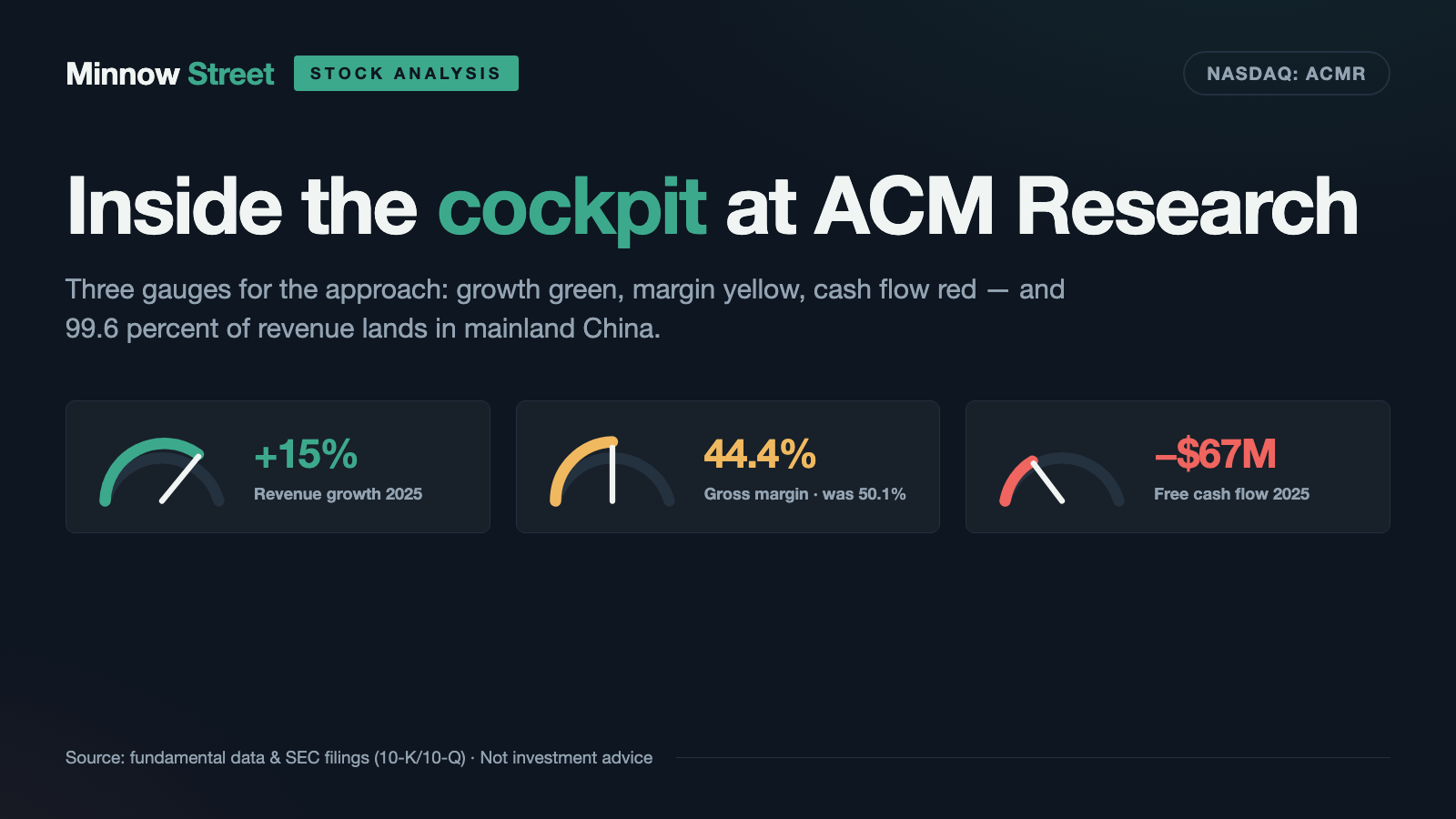
First, what genuinely impresses — and here that is a lot. ACM Research has more than tripled its revenue in four years: from $259.8 million (2021) via $388.8 and $557.7 million to $782.1 million (2024) and finally $901.3 million in 2025 (+15 percent). This is no subsidized flash in the pan but a profitable business: in 2025, $121.9 million in net income remained at the bottom line, of which $94.1 million was attributable to ACM Research (the rest belongs to the minority shareholders of ACM Shanghai — more on that later). The company grows at double-digit rates, spends heavily on research (development expenses 2025: $145.0 million, plus 37 percent) and held $1,132.6 million in cash, time deposits and restricted cash on the balance sheet as of December 31, 2025 — more than twice as much as a year earlier. The first quarter of 2026 delivered growth too: $231.3 million in revenue, plus 34 percent versus the prior-year quarter.
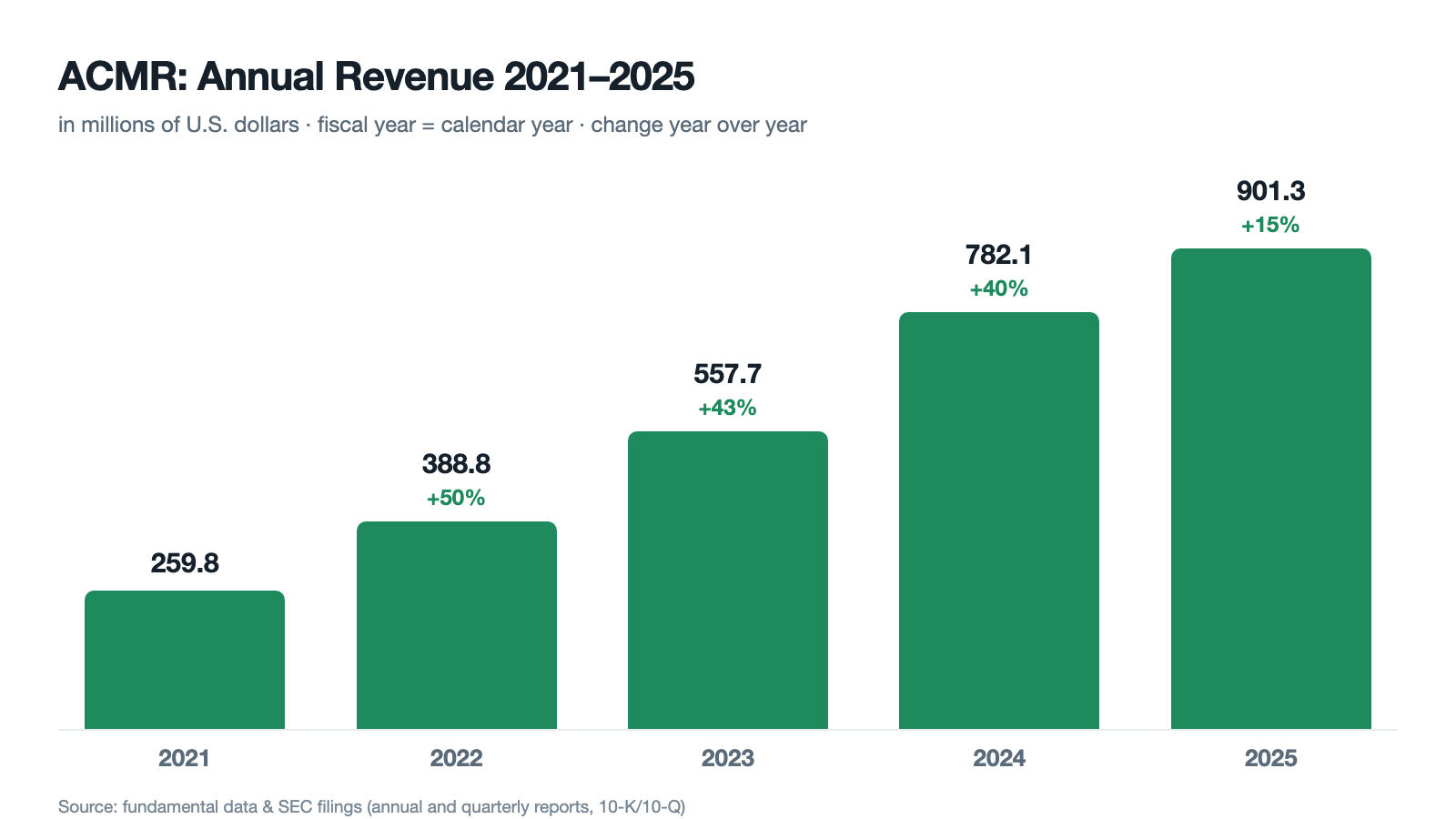
Now the honest counter-bill, because 2025 was also the year the quality of the growth slipped. Gross margin fell from 50.1 to 44.4 percent — per the annual report because of a less favorable product mix and higher inventory write-downs. Operating income sank from $151.0 to $109.4 million, net income attributable to ACM Research from $103.6 to $94.1 million, diluted earnings per share from $1.53 to $1.37. And the first quarter of 2026 hides a subtlety that gets lost in the plus-34-percent headline: the core cleaning business shrank 5.5 percent; all of the growth came from the smaller plating-and-furnace line (+205 percent) and the packaging business (+62 percent). Quarterly earnings per share fell from $0.30 to $0.24. Remember the pattern: revenue is growing, but less of every revenue dollar sticks — and the core product is not carrying the growth right now. Which brings us to the uncomfortable truths.
What the filings say — the uncomfortable truths
Uncomfortable truth no. 1: 99.6 percent of revenue hangs on mainland China — and the company's own subsidiary sits on the U.S. export blacklist
The geography table in the annual report for 2025 is brutally clear: $898.0 of $901.3 million in revenue came from customers in mainland China; all other regions combined delivered $3.3 million — 0.4 percent. ACM Research is thus no "semiconductor equipment maker with China exposure" but a Chinese equipment maker with a U.S. mailbox. And since late 2024 this equipment maker has had a singular problem, which the report records soberly:
"Among the 140 companies added to the BIS Entity List were two subsidiaries of ACM Research, ACM Shanghai, located in the People’s Republic of China, and ACM Korea, a direct subsidiary of ACM Shanghai, which is located in the Republic of Korea, and other related entities. In general terms, the new BIS Entity List designations prohibit any party worldwide from furnishing hardware, software, or technologies that are subject to U.S. export controls jurisdiction directly or indirectly to ACM Shanghai or ACM Korea without obtaining authorization."
— ACM Research, Inc., SEC annual report 10-K for 2025, Item 7 "Management’s Discussion and Analysis", section "Addition of ACM Shanghai and ACM Korea to U.S. Entity List"
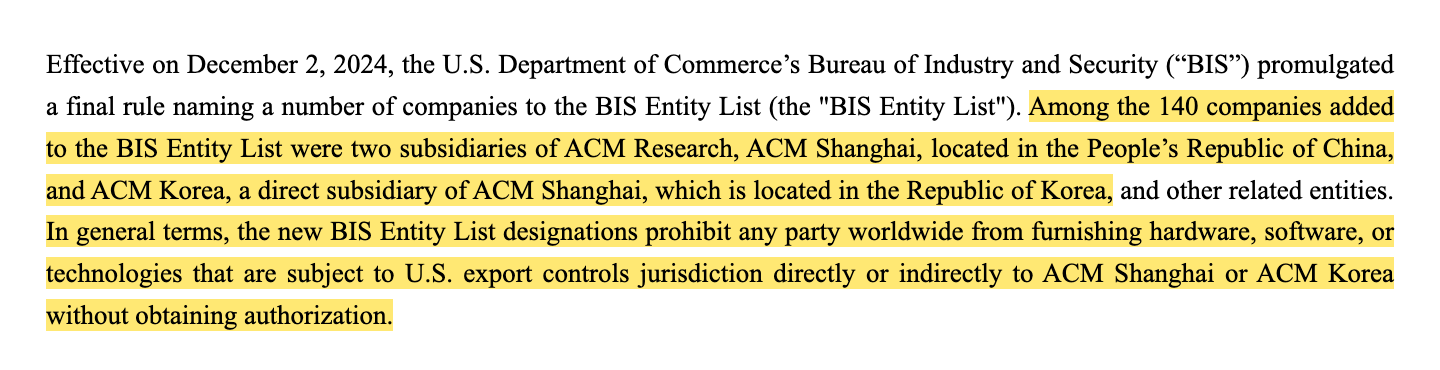
For perspective, without alarmism: the parent company ACM Research itself is not on the list, and the business has not collapsed since December 2024 — on the contrary, the supply chain has evidently been largely converted to suppliers outside U.S. jurisdiction. But every shareholder should understand the mechanics: the Entity List hits the subsidiary's purchasing (U.S. components and technology only with authorization), not directly its sales — and it is at the same time a symptom of a larger game. The same U.S. regulatory wave that put ACM Shanghai on the list is driving China's chip industry to localize its equipment — from which ACM Shanghai, as a domestic supplier, profits. Like it or not, the stock is a bet on the continuation of exactly the bloc-building that can also hit it harder at any time: Washington can tighten rules, Beijing can enact countermeasures, and between those two chairs sits a Delaware holding with 29 U.S. employees.
Uncomfortable truth no. 2: The Nasdaq shareholder owns 74.6 percent of a company whose cash he cannot touch
The second truth sits in the risk factors and describes the construction of the company itself. ACM Research is a holding; the business, the employees and the money sit at ACM Shanghai. What that means for access to the earnings, the report puts like this:
"We generate substantially all of our revenue through ACM Shanghai, our mainland China subsidiary. Mainland China statutory laws and regulations permit payments of dividends by ACM Shanghai only out of its retained earnings, which are determined in accordance with mainland China accounting standards and regulations that differ from U.S. generally accepted accounting principles."
— ACM Research, Inc., SEC annual report 10-K for 2025, Item 1A "Risk Factors"
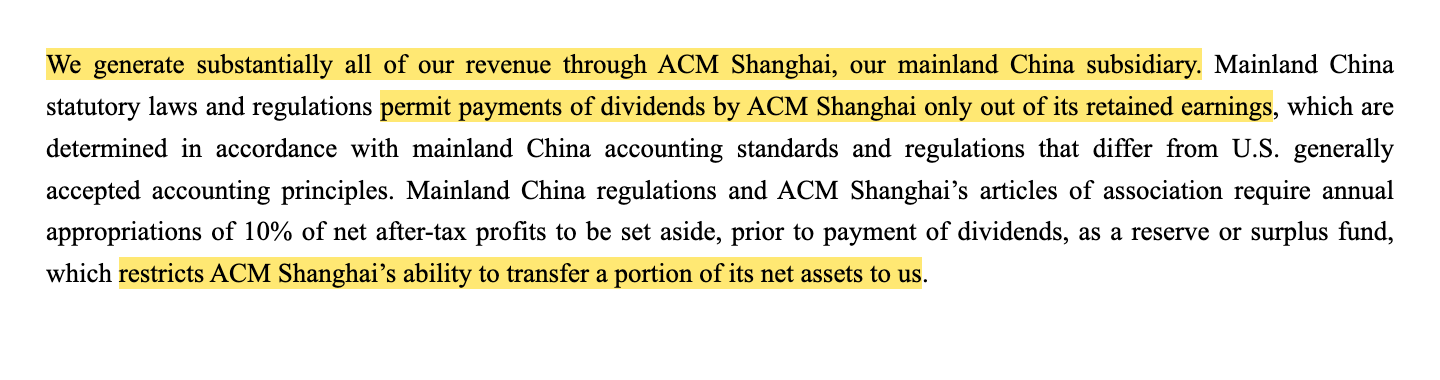
Add the dilution staircase: ACM Research once held 100 percent of its subsidiary — after pre-IPO placements (91.7 percent, 2019), the STAR Market IPO (82.5 percent, 2021), option exercises (81.5 percent, 2024) and the private offering of September 2025, it is down to 74.6 percent. In that offering, ACM Shanghai raised roughly $623.0 million net from investors in mainland China — money that largely explains the gleaming group cash pile of $1,132.6 million, but that per the report is generally not available for distributions to ACM Research ("Those proceeds generally are not available for distribution to ACM Research", Item 1A). Translated into an everyday picture: you are the co-owner of a house whose well-stuffed safe stands in the neighbor's basement — you may look at it, but not open it. A quarter of the profit ($27.8 of $121.9 million in 2025) belongs, on top, to the minority shareholders in Shanghai. To be fair: this structure is no fraud — it is disclosed, forced by Chinese law and common for China subsidiaries; ACM Shanghai even paid dividends upstream from 2023 through 2025 (most recently with cash also flowing to the minority shareholders). But whoever buys ACMR should know: they are buying a claim on a claim.
Uncomfortable truth no. 3: $94 million in profit, negative $10 million in operating cash flow — the money sits in the warehouse and in open invoices
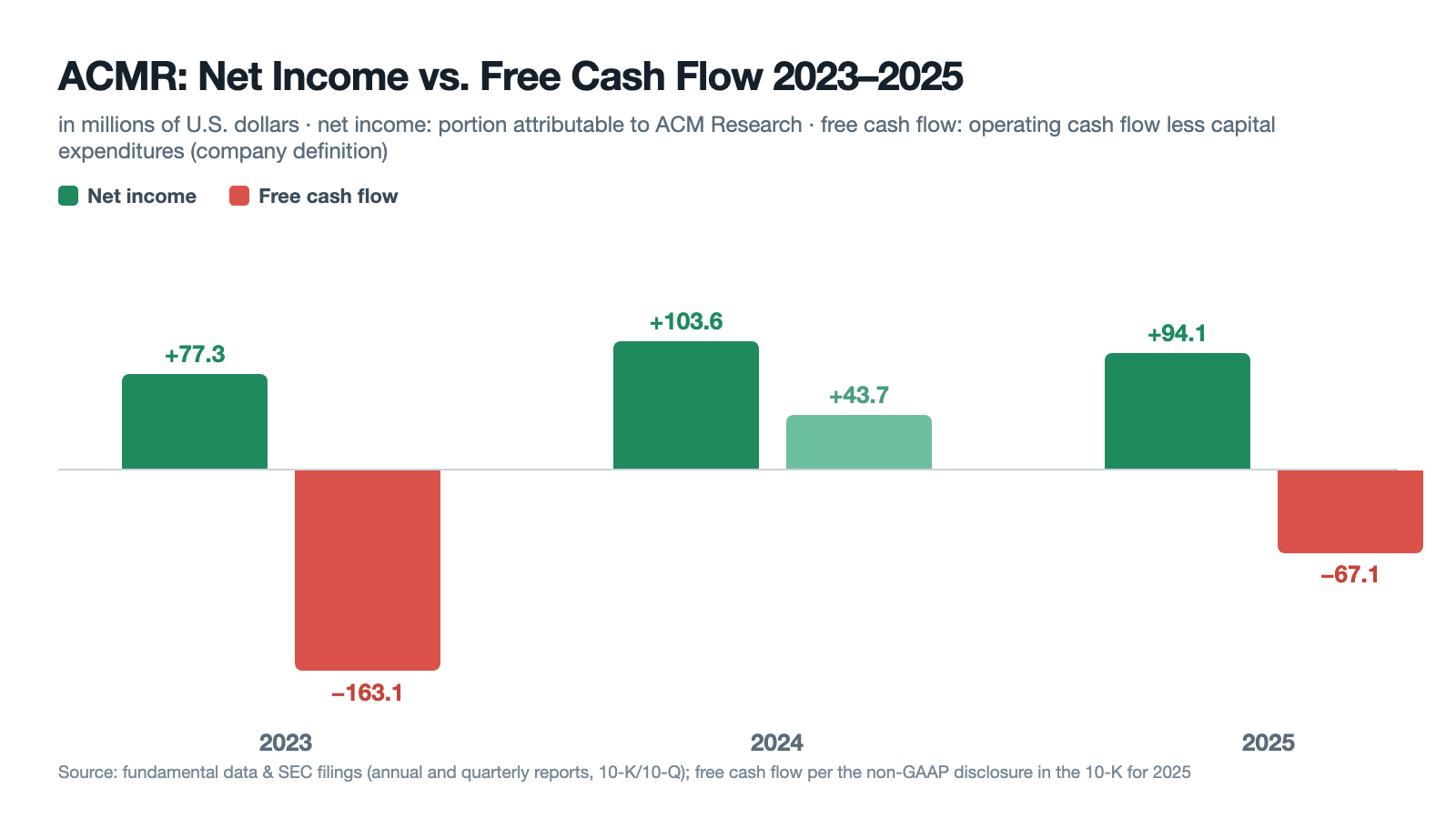
In 2025, ACM Research earned $121.9 million ($94.1 million of it for its own shareholders) — and still, money flowed out of the operating business: operating cash flow came to negative $10.3 million, free cash flow (after investments, company definition) to negative $67.1 million. In 2023 it was already negative $163.1 million; only 2024 was positive, at plus $43.7 million. Where does the profit disappear? Into the balance sheet: inventories grew to $702.6 million — the equivalent of a good nine months of revenue — of which $349.7 million alone is raw materials and $291.6 million finished tools, part of which already stands at customer sites as "first tools" and gets paid only after acceptance. At the same time, the allowance for credit losses rose from $4.8 to $32.8 million within two years. That is the fine print of the equipment business in China: long acceptance cycles, manufacturer prepayment, fab payment terms. None of it is illegal or hidden — but it explains why the cash pile grew despite record profits only thanks to the subsidiary's $623 million offering. Remember the sentence: profit is an opinion, cash flow is a fact — and at ACM Research the two have pointed in different directions for years.
Uncomfortable truth no. 4: Four unnamed customers pay more than half the bill
The concentration risk stands in black and white in the risk factors:
"The chip manufacturing industry is highly concentrated, and we derive most of our revenue from a limited number of customers. A total of four customers accounted for 52.2% of our revenue in 2025, four customers accounted for 52.2% of our revenue in 2024, and three customers accounted for 45.5% of our revenue in 2023."
— ACM Research, Inc., SEC annual report 10-K for 2025, Item 1A "Risk Factors"
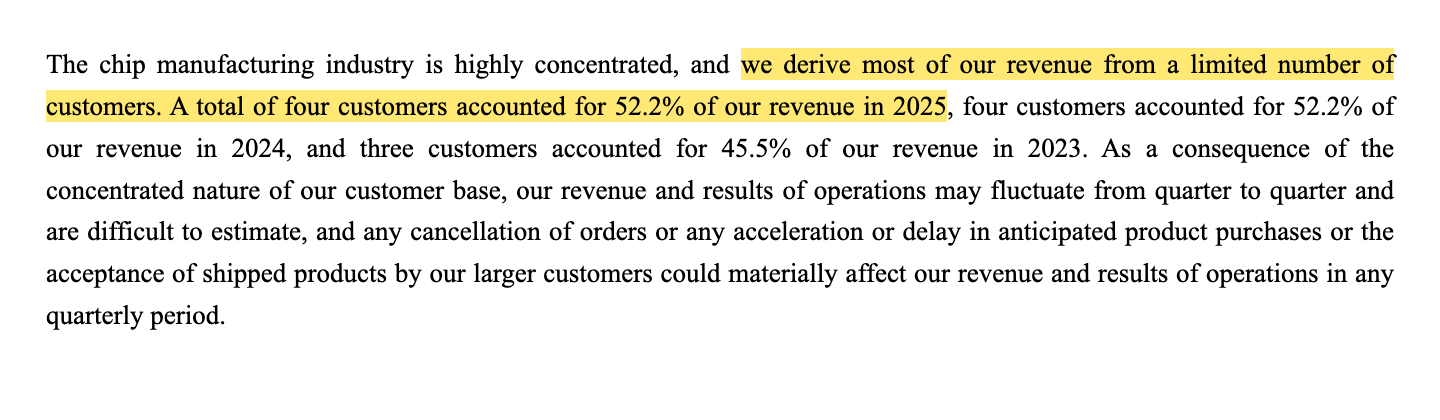
The concentrations footnote breaks it down: roughly 17, 14, 12 and 10 percent of 2025 revenue fell to the four largest — nameless — customers, and the same handful accounted for 62 percent of outstanding receivables. Picture a workshop that writes more than every second invoice to four regulars — and does not name the customers, while their unpaid invoices make up almost two thirds of the receivables book. In the chip industry, customer concentration is normal (there are only a few dozen large fab operators worldwide), and behind the abbreviations most likely stand China's big foundries and memory makers — addresses more likely to expand than to cut back. But the combination of clumping, anonymity and the political charge of the end market belongs on every risk checklist.
Valuation: $7.3 billion in market value — and a voting-rights architecture like a family business
In mid-July 2026 the ACMR stock cost about $107, putting the market value at roughly $7.3 billion (data as of July 17, 2026). Measured against trailing earnings, that is sporty: a price-to-earnings ratio around 78, a price-to-sales ratio around 7.6, 4.7 times book value. Analyst estimates (data as of July 17, 2026) expect roughly $1.68 in earnings per share for 2026 and roughly $2.25 for 2027 — that would be 64 and 47 times earnings, respectively. For comparison: the big Western equipment names cost 25 to 35 times their earnings, but also grow more slowly. The market is thus paying a clear premium for a continuation of the China localization boom — on a stock that traded at a quarter of this price twelve months ago. And there is a second price component, measured not in dollars but in say. The annual report discloses it:
"Class B common stock has twenty votes per share and Class A common stock has one vote per share. As of February 25, 2025, stockholders who hold shares of Class B common stock, who consist principally of our executive officers, employees, directors and their respective affiliates, collectively held 62.3% of the voting power of our outstanding capital stock."
— ACM Research, Inc., SEC annual report 10-K for 2025, Item 1A "Risk Factors"
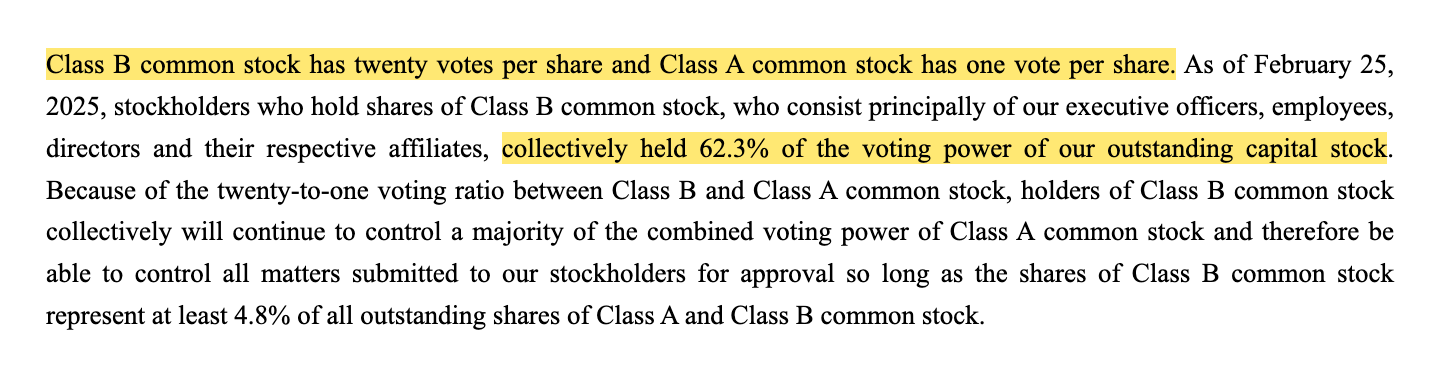
Concretely: roughly 5.0 million Class B shares (against 60.7 million Class A shares, as of February 25, 2026) suffice, thanks to the 20-to-1 voting ratio, for founder and CEO Dr. David Wang and his leadership circle to control every shareholder-meeting decision — and that stays so as long as the Class B shares represent at least 4.8 percent of all shares. Together with the 74.6 percent stake in the subsidiary, that puts two floors between you and the business: you hold low-vote shares of a holding that in turn holds a majority of the actual company. That the same twelve-month window recorded 18 insider sales and not a single insider buy, including sales by the CEO (data as of July 17, 2026), is humanly understandable after a stock has quadrupled — but it is also no vote of confidence from the people who know the company best. Institutional investors hold roughly 74 percent of the free float; most recently 11 funds added while 4 trimmed (data as of July 17, 2026).
Opportunities and risks at a glance
What speaks for ACM Research:
- Real, profitable growth: revenue from $259.8 to $901.3 million in four years (+15 percent in 2025), $94.1 million in net income, Q1 2026 up 34 percent; a $145 million development budget secures the product pipeline (10-K 2025, 10-Q as of 03/31/2026).
- Structural tailwind: China's chip industry has to localize its equipment — exactly ACM Shanghai's product range; the portfolio is growing from cleaning specialist to multi-line equipment maker (plating-and-furnace line in Q1 2026: +205 percent).
- Comfortable balance sheet: $1,132.6 million in cash, time deposits and restricted cash with moderate debt (debt-to-equity around 0.2), an equity ratio above 50 percent, Altman Z around 9.7 (12/31/2025 and data as of July 17, 2026).
- First-class technicals: a stage-2 uptrend, relative strength of 97, the Minervini trend template, about 4 percent below the 52-week high, 25 scanner hits (data as of July 17, 2026).
- A double capital source: the subsidiary's STAR Market listing taps Chinese capital ($623 million net in September 2025) — growth does not have to be financed through dilutive ACMR share offerings.
What speaks against it:
- Extreme country risk: 99.6 percent of revenue from mainland China; ACM Shanghai and ACM Korea have been on the BIS Entity List since December 2, 2024 — any tightening of U.S. or Chinese rules hits the business model directly (10-K 2025).
- A holding discount with an announcement: only 74.6 percent of the operating subsidiary left, Chinese dividend restrictions, offering proceeds "generally … not available" to the holding, a quarter of the profit belongs to minority shareholders.
- The cash flow gap: negative $10.3 million operating and negative $67.1 million free cash flow in 2025 despite record profit; $702.6 million of inventories and an allowance for credit losses that septupled from $4.8 to $32.8 million within two years.
- Clumping and anonymity: four unnamed customers = 52.2 percent of revenue and 62 percent of receivables; the core cleaning business declined in Q1 2026 (−5.5 percent), gross margin fell from 50.1 to 44.4 percent.
- Governance and signals: 20-fold voting rights on the Class B shares (insiders: 62.3 percent of the votes), 18 insider sales against zero buys including the CEO, a P/E around 78 after a quadrupling, daily swings around 10 percent (data as of July 17, 2026).
A human conclusion
Back to the label trap from the opening. Its core is not that the labels are false — ACM Research's package lists everything, in a 10-K of remarkable candor: the 99.6 percent China, the Entity List, the 74.6 percent, the 20-fold votes, the negative cash flow. Its core is that nobody reads the fine print when the package shines so brightly: plus 151 percent year to date, 25 scanner hits, a relative strength of 97. The honest appraisal reads: here grows a real, profitable, technologically serious company in one of the world's most strategically important markets — and precisely because the world is splitting into blocs. Whoever buys the stock buys that bloc-building with it: as tailwind (the localization of Chinese chipmaking) and as sword of Damocles (export controls, capital-flow borders, a holding floor with no grip on the cash). So the question for you is not "Is the stock trending?" — it is, as of July 17, 2026. The question is: would you still want to hold this company if tomorrow a new line appeared on some list in Washington or Beijing — and the ticker remained the only thing about it that is American? If yes, you know what you own. If no, the momentum owns you. What you make of it is your decision. And that is exactly as it should be.
Sources
All original documents used in this analysis — to read for yourself:
- ACM Research, Inc. — SEC annual report 10-K for 2025 (filed March 2, 2026)
- ACM Research, Inc. — SEC annual report 10-K for 2024 (filed March 3, 2025)
- ACM Research, Inc. — SEC annual report 10-K for 2023 (filed February 28, 2024; figures for 2021/2022)
- ACM Research, Inc. — SEC quarterly report 10-Q as of March 31, 2026 (filed May 8, 2026)
- ACM Research, Inc.’s complete SEC filing history: EDGAR overview (sec.gov)
- Fundamental data (metrics, quarterly series, valuation; data as of July 17, 2026), reconciled with the SEC filings.
- Screener and rating data: in-house stock scanner (momentum run of July 17, 2026).
Transparency & disclaimer: This analysis is a journalistic contextualization of publicly available information and is not investment advice, not a financial analysis in the regulatory sense, and not a solicitation to buy or sell securities. Stock investments carry substantial risks up to total loss. All information without guarantee; the data cut-off is noted in the text in each case. The author holds no position in ACM Research stock at the time of publication.
Our Bottom Line at a Glance
- Growth & profitability positive
- Revenue more than tripled in four years ($259.8 → $901.3 million through 2025), $94.1 million in net income for ACM Research, Q1 2026 up 34 percent and a $145 million development budget — the business is real and profitable (10-K 2025, 10-Q as of 03/31/2026). But: gross margin fell from 50.1 to 44.4 percent, and earnings per share declined.
- China clumping & Entity List negative
- 99.6 percent of revenue from mainland China, four unnamed customers with a 52.2 percent revenue share, and the operating subsidiaries ACM Shanghai and ACM Korea have been on the BIS Entity List since December 2, 2024 — the business model hangs on the continuation of a bloc-building that can also hit it harder at any time (10-K 2025).
- Holding structure & access to the cash negative
- ACM Research holds only 74.6 percent of ACM Shanghai (down from 91.7 percent in 2019); Chinese law restricts dividends, the $623 million from the September 2025 private offering is per the 10-K generally not available to the holding, and a quarter of the profit belongs to minority shareholders — the Nasdaq shareholder buys a claim on a claim.
- Cash flow & balance-sheet quality neutral
- Negative $10.3 million operating and negative $67.1 million free cash flow in 2025 despite record profit; $702.6 million of inventories and an allowance for credit losses up from $4.8 to $32.8 million stand against a comfortable $1,132.6 million cash position and an Altman Z around 9.7 (12/31/2025; data as of July 17, 2026) — solidly financed, but the business ties up money continuously.
- Valuation, governance & technicals neutral
- A stage-2 uptrend, relative strength of 97 and 25 scanner hits meet a trailing P/E around 78 after a quadrupling, 20-fold insider voting rights (62.3 percent of the votes), 18 insider sales against zero buys and daily swings around 10 percent (data as of July 17, 2026) — first-class momentum at a price that forgives little.
ACM Research is a genuine growth company in the world's most strategically important equipment market — and at the same time the purest China bet you can make with a Nasdaq ticker: 99.6 percent of revenue from mainland China, the operating subsidiary on the U.S. Entity List, a holding with a 74.6 percent stake and legally narrowed access to the cash, plus negative free cash flow despite record profit. Whoever invests here buys the localization of Chinese chipmaking as tailwind and geopolitics as a permanent risk — at 78 times trailing earnings. Not investment advice.
What Our Rating Means
- If you don't own the stock
- As long as the question raised in the bottom line stays open, we see no basis for an entry.
- If you hold it in your portfolio
- Our findings offer no acute reason to sell — the checkpoints named remain decisive.
A journalistic assessment by our editorial team at the time of the deep dive, based on public sources — not investment advice and not a solicitation to buy or sell. Your personal circumstances (investment goals, risk capacity, taxes) cannot be taken into account. What our categories mean, how verdicts are formed, and what conflicts of interest exist →
Worth Noting
- ACMR reached our research list via the momentum/stage-2 run of July 17, 2026, with 25 scanner hits (incl. Stan Weinstein stage 2, RS leaders ≥90, Minervini trend template) — the trend strength is the hook of this analysis, not its verdict.
- Scanner metrics (P/E, P/S, Piotroski, Altman Z, fundamental grade, insider transactions) are computed from trailing twelve-month figures as of the July 17, 2026 data cut-off; the 2025 margin and EPS decline is baked in, a potential new customer investment cycle naturally is not.
- Price and valuation figures are dated to July 17, 2026 (about $107, market value roughly $7.3 billion); analyses are evergreen, daily prices are not a buy argument. The voting-power figure (62.3 percent for Class B) comes from the 10-K for 2025 with its stated record date of February 25, 2025.
Frequently Asked Questions
ACM Research, Inc. (Nasdaq: ACMR) builds production tools for chip fabs: above all cleaning tools for silicon wafers (2025: $626.0 of $901.3 million in revenue), plus electrochemical plating tools for copper deposition, furnaces and machines for advanced packaging. The operating business runs through the subsidiary ACM Shanghai; sales go almost exclusively to chip fabs in mainland China.
Formally a Delaware holding headquartered in Fremont, California, with a Nasdaq listing — economically a Chinese equipment maker: $898.0 of $901.3 million in revenue (99.6 percent) came from customers in mainland China in 2025, 2,357 of 2,513 employees work in mainland China and the Taiwan region, only 29 in the United States. The operating subsidiary ACM Shanghai has additionally been listed on Shanghai's STAR Market since November 2021 (annual report 10-K for 2025).
Since December 2, 2024, the subsidiaries ACM Shanghai and ACM Korea have been on the Entity List of the U.S. Commerce Department (BIS). Without authorization, no party worldwide may furnish them hardware, software or technology subject to U.S. export controls. The parent company ACM Research itself is not on the list; the business kept growing in 2025 because the supply chain has largely been converted to non-U.S. suppliers — but the regulatory risk remains (10-K for 2025).
At the end of 2025, ACM Research still held 74.6 percent of ACM Shanghai — down from 91.7 percent in 2019, 82.5 percent after the 2021 STAR Market IPO and 81.5 percent in 2024; the private offering of September 2025 (net proceeds of roughly $623 million) diluted the stake further. As an ACMR shareholder you hold shares of the holding, not of the operating business; roughly a quarter of the group's profit is attributable to the minority shareholders in Shanghai.
Because the profit gets tied up in the balance sheet: in 2025, net income of $121.9 million ($94.1 million for ACM Research) stood against an operating cash flow of negative $10.3 million and a free cash flow of negative $67.1 million. Inventories grew to $702.6 million — many tools stand unpaid at customer sites as "first tools" until acceptance — and the allowance for credit losses rose from $4.8 to $32.8 million within two years (10-K for 2025).
In mid-July 2026 the stock cost about $107, equal to roughly $7.3 billion in market value, a trailing price-to-earnings ratio around 78 and a price-to-sales ratio around 7.6 (data as of July 17, 2026). On analyst estimates for 2026 (about $1.68 per share) it would be 64 times earnings. The stock has roughly quadrupled within twelve months — the market is paying a premium for a continuation of the Chinese localization boom.
In the twelve months through July 17, 2026, our data recorded 18 insider sales and not a single insider buy, including sales by the CEO. After a quadrupling of the stock, management profit-taking is not unusual — but it is no vote of confidence in the current price either. At the same time, the Class B holders (essentially management) control 62.3 percent of the voting power.
Found an error?
Did you spot a factual error, an outdated number, or a typo in this deep dive? Let us know briefly — your report goes straight to the editorial team.