EverQuote Stock: The Turnaround Is Real — but One Insurance Carrier Pays 40 Percent of Revenue
EverQuote is quiet on Reddit: 3 mentions in 24 hours (as of July 15, 2026) — yet the online marketplace for auto insurance referrals lights up 9 filters of our in-house stock scanner: a P/E around 8, a Piotroski score of 8 of 9, no debt. We read the annual reports (10-K) for 2024 and 2025 and the quarterly report (10-Q) as of March 31, 2026: revenue jumped 38.5 percent to $692.5 million in 2025, a $51.3 million loss (2023) became $99.3 million in net income — but a single carrier stood for 40 percent of revenue in the first quarter of 2026, and per the filings these customers may cut their spend to zero at any time, without notice. Not investment advice — just the arithmetic of what a discount is worth when one customer writes 40 percent of the checks.
 Thomas Mücke
Founder & Publisher
Thomas Mücke
Founder & Publisher
Chart
Interactive price chart (TradingView).
Note: pure fact-based analysis, not investment advice and not a solicitation to buy or sell. All figures without guarantee.
There is a weather rule investors firmly believe in even though it is not one: tomorrow will be roughly like yesterday. Psychologists call it the recency effect — the latest experience outshines everything that came before, and two good summers turn into a climate in your head. EverQuote, Inc. (Nasdaq: EVER) is a textbook case in the summer of 2026: two years of revenue surges (+73.7 percent in 2024, +38.5 percent in 2025), a swing from a $51.3 million loss to $99.3 million in net income, a P/E around 8 — and still hardly anyone is talking about it: our Reddit hype scanner counts just 3 mentions in 24 hours (ApeWisdom, as of July 15, 2026). A cheap, profitable, debt-free growth company that nobody is watching? That is exactly the thought where the recency effect takes over. So let's make a deal: before you turn two good years into a climate, we read together what EverQuote reported to the U.S. securities regulator, the SEC — the annual report (10-K) for 2025, its predecessor and the quarterly report (10-Q) as of March 31, 2026. An SEC filing is honest under penalty of law. And this one also shows what the weather looked like before the two record years. In the end, you decide for yourself.
What EverQuote actually does — and who pays whom here
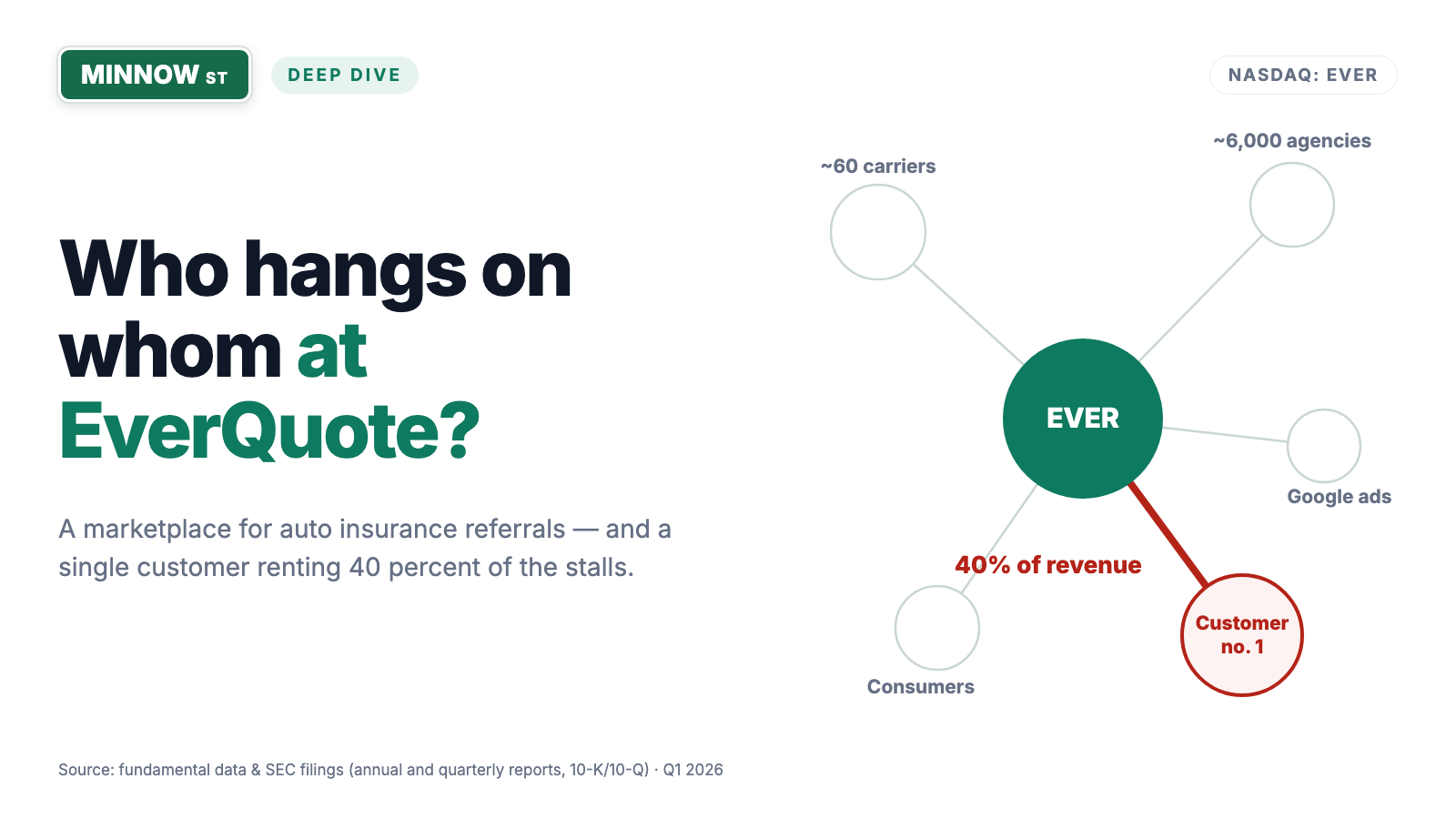
EverQuote (based in Cambridge, near Boston, public since June 2018, 356 employees today) runs an online marketplace for insurance customer referrals. Translated into everyday language: the company is a bulk buyer of attention. It places massive volumes of ads on Google and elsewhere, draws consumers to portals like everquote.com, has them fill out a comparison form for their auto insurance — and sells that completed quote request as a "referral" to insurance carriers and agencies that want to turn it into a policy. Roughly 60 insurance carriers and about 6,000 agencies hang on this network; the service is free for consumers, and the insurance side pays EverQuote. The business works like a fishmonger at the wholesale market: buy the crates at auction in the morning (ad inventory), sell them on filleted at noon (customer referrals) — what sits in between is the spread. In 2025, EverQuote generated $692.5 million in revenue this way, 91 percent of it in the auto vertical ($629.8 million), with the rest almost entirely from home and renters referrals. Which brings us to the central tension of this analysis, and it runs through every chapter: the turnaround is real and the balance sheet is clean — but the switch it hangs on is not in Cambridge; it sits in the marketing departments of a few large auto insurers. One of them recently paid 40 percent of revenue. How quickly a marketplace model tips over when the paying side gets thrifty is something we just dissected at Groupon — and how a consumer brand deals with a shrinking core, at Wendy's.
Where the stock shows up in our scanner
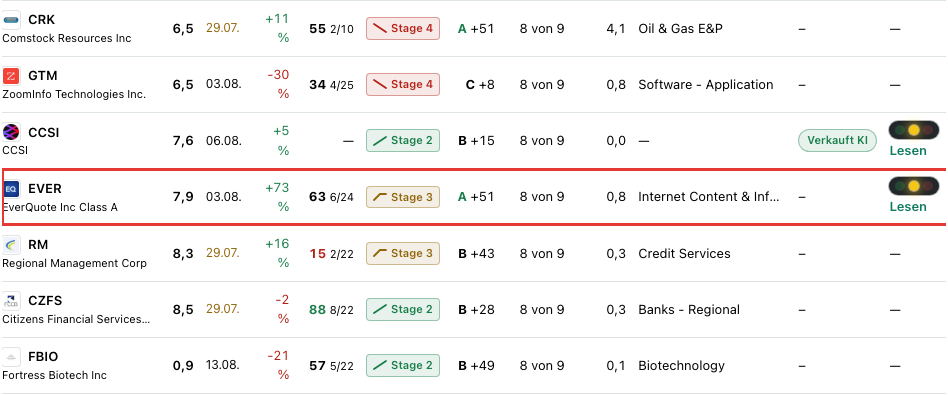
Every day we run about 3,500 stocks through our scanners. EverQuote did not reach our research list through tavern noise this time — 3 Reddit mentions is library atmosphere — but through the sheer mass of hits: 9 filters fire as of the July 8, 2026 data cut-off, and the list reads like a value investor's wish-list profile. The valuation lens: the P/E ranking with a price-to-earnings ratio of 7.9, the P/CF ranking at 7.5 times operating cash flow, the P/FCF ranking at 7.7 times free cash flow, and "Peter Lynch: PEG ≤ 1" — the PEG divides the P/E by earnings growth, below 1 counts as cheap; here every percentage point of growth costs less than one P/E point. The quality lens: Fundamental Rank A, a Piotroski F-Score of 8 of 9 (a nine-point test of balance-sheet quality — 8 is the territory of thoroughly healthy companies) and an Altman Z-score around 10.8, miles above the danger zone that begins below 1.8 — no surprise with $178.5 million in cash and zero bank debt. Even the trend lens delivers hits: "above the 50- and 200-day averages", power trend, pocket pivot — the stock recovered 23.5 percent in one month and 53.6 percent in three. And now the other side of the same data set: a relative-strength rating of 35 (over twelve months the stock performed worse than 65 percent of all others), a stage-3 downtrend, minus 23.1 percent year to date, roughly 66 percent below the all-time high — and among insiders, 20 sales stand against zero purchases. About 97 percent of the shares sit with institutional investors (the "pros over 80 percent" filter). Cheap, thoroughly healthy, with a fresh recovery impulse — but the company's own executives are selling, not buying. A contradiction like that should not be smoothed over; it should be explainable. For that we need the filings.
The numbers over the years — honestly appraised
First, what genuinely impresses — and here that is quite a lot. In 2025, revenue grew 38.5 percent to $692.5 million, after already jumping 73.7 percent in 2024. Out of that revenue came $99.3 million in net income — a 14.3 percent net margin — and $94.6 million in adjusted EBITDA. The first quarter of 2026 followed through: $190.9 million in revenue (+14.5 percent) and $18.7 million in net income after $8.0 million in the prior-year quarter, which, to be fair, carried $7.9 million in legal settlement costs. The balance sheet behind it is the kind you want to frame: $178.5 million in cash (March 31, 2026), no bank debt — the $60.0 million credit line is untouched — and since July 2025 a $50 million buyback program has been running, from which shares worth $19.9 million were retired in the first quarter of 2026. A dividend has never been paid. Whoever reads only these paragraphs does not understand the P/E of 8. But now look at the whole weather series, not just the last two summers:
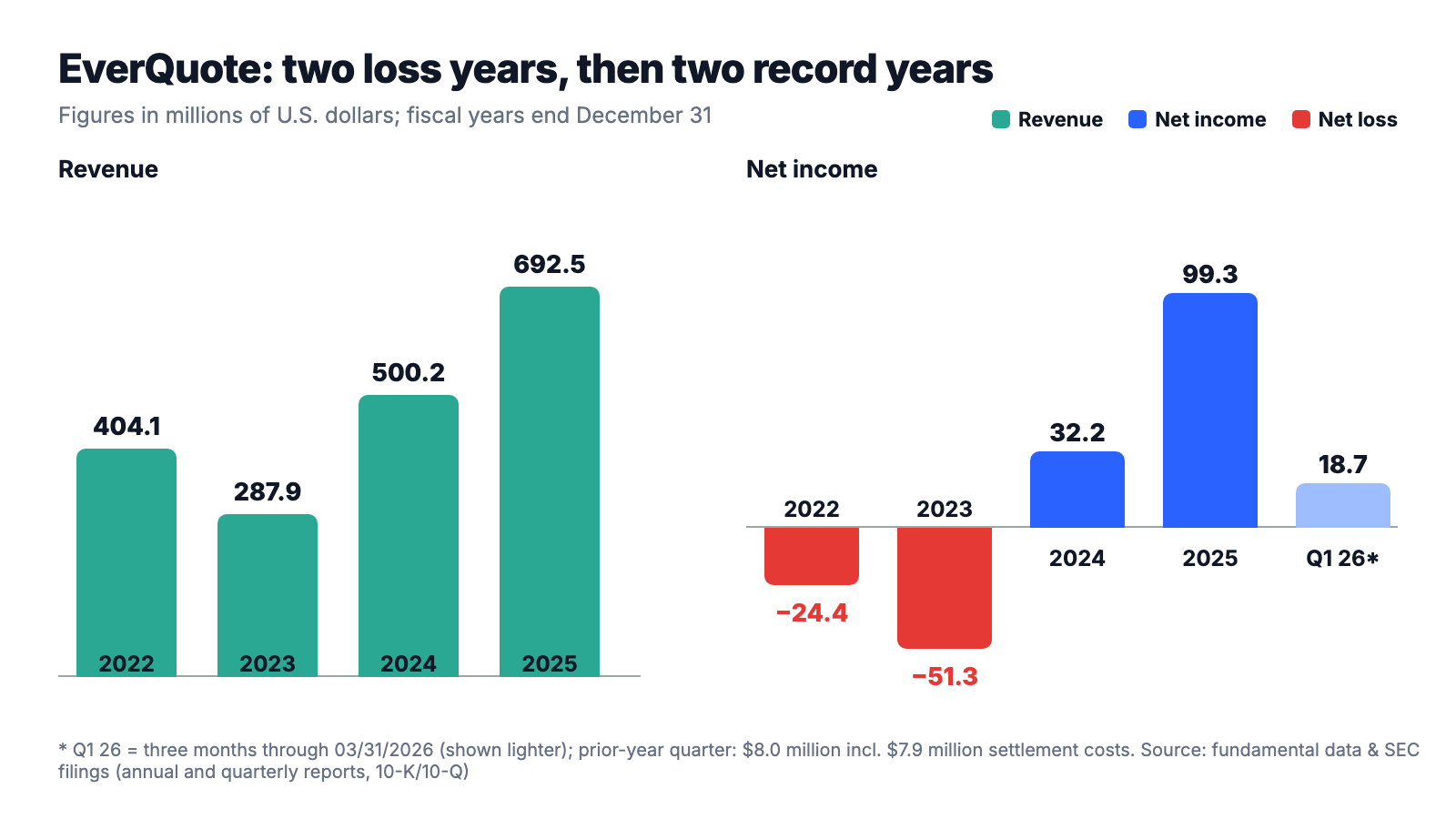
In 2022, EverQuote generated $404.1 million in revenue and lost $24.4 million. In 2023, revenue collapsed 28.8 percent to $287.9 million and the loss doubled to $51.3 million — not because the product had gotten worse, but because U.S. auto insurers, after two years of inflation and claims-cost shock, slashed their customer-acquisition budgets. The annual report records the turnaround soberly in one sentence:
"We had net income of $99.3 million and $32.2 million for the years ended December 31, 2025 and 2024, respectively, and a net loss of $51.3 million for the year ended December 31, 2023, and had $94.6 million, $58.2 million and $0.5 million in adjusted EBITDA for these same periods, respectively."
— EverQuote, Inc., SEC annual report 10-K 2025, Item 7 "Management's Discussion and Analysis — Overview"

Remember just one thing at this point: the same company, the same model, the same managers delivered minus $51 million and plus $99 million within four years. What changed was not EverQuote — it was the customers' ad budgets. Which brings us to the uncomfortable truths.
What the filings say — the uncomfortable truths
Uncomfortable truth no. 1: a single insurance carrier pays 40 percent of revenue
The most important number of this analysis is not in the income statement but in the customer-concentration disclosures. In the annual report for 2025 it reads like this:
"Furthermore, total revenue from our two largest customers accounted for 38% and 11%, respectively, of our total revenue for the year ended December 31, 2025 and revenue from our largest auto insurance carrier customer was 39% of our revenue for the year ended December 31, 2024."
— EverQuote, Inc., SEC annual report 10-K 2025, Item 1A "Risk Factors"

And the quarterly report as of March 31, 2026 goes further — the concentration is not easing, it is tightening:
"For the three months ended March 31, 2026, one customer represented 40% of total revenue. For the three months ended March 31, 2025, two customers represented 43% and 13% of total revenue, respectively."
— EverQuote, Inc., SEC quarterly report 10-Q as of March 31, 2026, Note 2 "Concentrations of Credit Risk and of Significant Customers"

Let's translate that into an everyday image: EverQuote runs a market hall — but a single merchant rents 40 percent of all the stalls. A market hall whose largest merchant rents 40 percent of the stalls already belongs to him in part: he negotiates the prices, he sets the pace, and if he moves out, it is not one stall standing empty but half the hall. Fairness requires saying: this concentration is also a compliment — the carrier (the filing names no names) evidently finds EverQuote's referrals so efficient that it deploys nine-figure sums there year after year; per the filing, 2025 revenue grew "primarily from our three largest customers". But as a shareholder you pay for each of those millions with a piece of bargaining power. Remember the image of the market hall — it returns shortly.
Uncomfortable truth no. 2: no minimum spend, no notice period — the switch sits with the customer
How durable are those 40 percent? The annual report's answer is disarmingly clear:
"Our insurance provider customers can stop participating in our marketplace or reduce or terminate their marketing spend with us at any time without notice. Furthermore, our agreements with these customers do not require them to spend any minimum amount."
— EverQuote, Inc., SEC annual report 10-K 2025, Item 1A "Risk Factors"

This is not a theoretical risk — it is recent company history. The same risk section continues: "For example, we experienced significantly decreased insurance provider marketing spend in 2023 and while spending patterns have improved, not all of our carrier customers have increased their spend in a proportional or significant manner" (10-K 2025). The cycle behind it is documented industry-wide: in 2022/2023, inflation and exploding repair costs made U.S. auto insurers' premiums unprofitable — so they halted new-customer advertising, and EverQuote's revenue fell 28.8 percent. In 2024/2025 the premiums worked again, the budgets returned, and revenue jumped 73.7 and 38.5 percent. EverQuote is a lever on the advertising mood of the auto insurers — upward and downward alike. One quarter does not make a new winter, and the current filings report rising budgets. But whoever buys the stock because of the last two years should treat 2023 not as an accident but as an operating condition.
Uncomfortable truth no. 3: 72 cents of every revenue dollar flow straight back into advertising — and the spread is shrinking
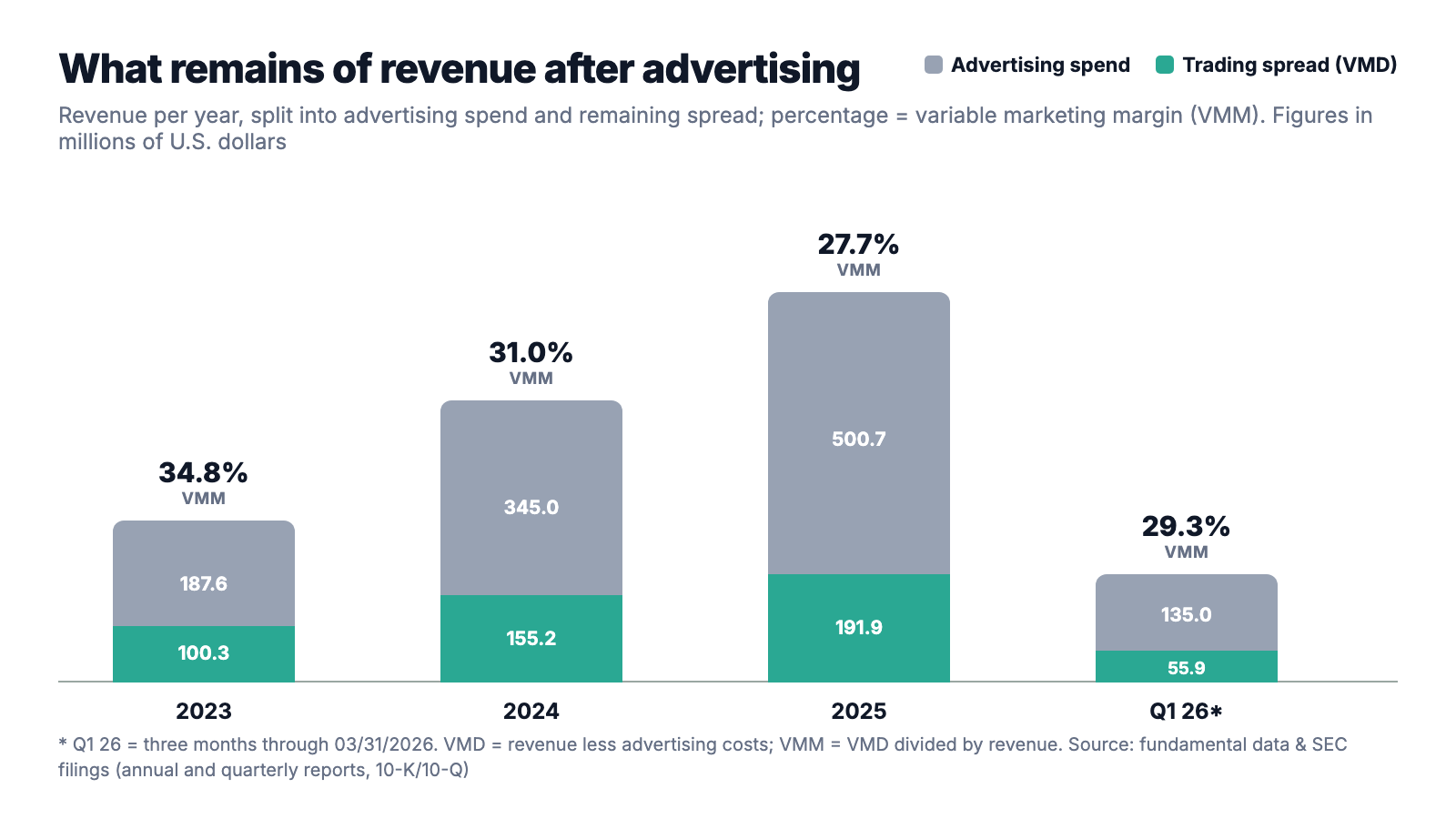
Back to the fishmonger image: what matters is not how many crates he moves, but what sticks between buying and selling. At EverQuote this spread is called the variable marketing margin (VMM) — revenue minus advertising costs, divided by revenue. In 2025 the company spent $500.7 of $692.5 million in revenue on advertising, a good 72 percent; total sales and marketing expense reached 78.1 percent of revenue. The VMM fell from 34.8 percent (2023) via 31.0 percent (2024) to 27.7 percent (2025) — per the annual report "primarily due to competitive pricing for advertising spend and the relative mix of referral types". In plain terms: the record growth was bought at a high price — Google clicks for insurance search terms are among the most expensive in the world, and to feed the referral machine, EverQuote had to push ever more volume through at a shrinking spread. The first quarter of 2026 at least shows the counter-move: VMM of 29.3 percent after 28.1 percent in the prior-year quarter, per the filing thanks to "better optimization of our traffic". Fairness also requires saying: this model ties up almost no capital — no warehouse, no factory, 356 employees for almost $700 million in revenue, minimal capital expenditures — which is why profit arrives almost one-to-one as cash. But remember the sentence: growth bought at the advertising wholesale market keeps no inventory — it has to be auctioned anew every morning.
Uncomfortable truth no. 4: two retreats in two years — what remains is a one-product business
EverQuote has twice tried to emancipate itself from the pure auto-referral trade — and has since ended both excursions. Excursion one, health insurance:
"In June 2023, the Company committed to exiting its health insurance vertical to increase focus on core verticals and implemented a workforce reduction plan (the “Reduction Plan”) to improve operating efficiency."
— EverQuote, Inc., SEC annual report 10-K 2025, Note 15 "Restructuring and Other Charges"
Excursion two, the in-house insurance agency, ended even more remarkably: the distributor PolicyFuel, acquired in 2021, turned into litigation with its former owners — settled in 2025 with $7.9 million in legal settlement costs and the sale of the remaining carrier contracts back to those very former owners (May 1, 2025). You can tell this story two ways. Kindly: management is cleaning house consistently, concentrating everything on the profitable core, and has trimmed the cost base far enough that the 2025 turnaround succeeded — focus is a virtue. Unkindly: the diversification attempts failed, and what remains is a business that hangs 91 percent on a single insurance vertical whose ad budgets are steered by a handful of large carriers (truths no. 1 and 2 send their regards). Add a legal framework that is a permanent construction site for the entire lead industry: the FCC's "one-to-one consent" rule, which would have hit the industry's phone marketing hard, was vacated by a federal appeals court only three days before taking effect (January 2025). And one more footnote on the power structure: through a dual-class share structure (ten votes per Class B share), EverQuote is a "controlled company" — the founder camp around chairman David Blundin controls roughly 57 percent of the votes; as a Class A shareholder you ride in the passenger seat.
Valuation: a $763 million market value — the discount has a name
In early July 2026 the EverQuote stock cost about $21.70, for a market value of roughly $763 million (data as of July 8, 2026). Against $99.3 million in 2025 net income, that is a P/E around 8, a price-to-sales ratio of 1.1 and about 7.7 times free cash flow. Subtract the $178.5 million in cash and an enterprise value around $585 million remains — roughly six times 2025 net income. For comparison: profitable U.S. technology marketplaces usually fetch 15 to 25 times. This discount is no oversight and no hidden-gem bonus — it has a name, and it stands in truth no. 1: the market prices a business whose largest customer pays 40 percent and may leave tomorrow like a business on call. Add the cycle: a P/E of 8 on earnings made at the top of an advertising cycle can quickly prove an optical illusion once the cycle turns — in 2023 you could not have computed a P/E for this company at all; there were no earnings. The professionals are on board anyway (about 97 percent institutional ownership), but insiders sold 20 times recently and bought zero times (all data as of July 8, 2026) — for a stock trading 66 percent below its high, that is worth at least a raised eyebrow. The counter-calculation is just as honest: if auto insurers' ad budgets merely stay at this level for two more years, EverQuote earns half its enterprise value in cash — and the buyback program collects the shares cheaply along the way.
Opportunities and risks at a glance
What speaks for EverQuote:
- A genuine, audited turnaround: net income of $99.3 million in 2025 after $32.2 million (2024) and minus $51.3 million (2023); Q1 2026 more than doubled to $18.7 million versus the prior-year quarter (annual and quarterly reports, 10-K/10-Q).
- A balance sheet without an attack surface: $178.5 million in cash (March 31, 2026), no bank debt, an untouched $60.0 million credit line; Piotroski 8 of 9, Altman Z around 10.8 (data as of July 8, 2026).
- An asset-light model with operating leverage: 356 employees, minimal capital expenditures, a return on equity around 56 percent per the scanner metric (data as of July 8, 2026); profit arrives almost entirely as cash and feeds a $50 million buyback program.
- A valuation with a safety discount: P/E around 8, PEG below 1, enterprise value around six times 2025 net income — if the carriers' ad budgets merely hold steady, that is not much (data as of July 8, 2026).
- The structural trend runs alongside: insurers keep shifting customer acquisition online; EverQuote's network of roughly 60 carriers and about 6,000 agencies is one of the two large U.S. marketplaces for it (annual report 10-K for 2025).
What speaks against it:
- Extreme concentration risk: one customer stood for 40 percent of revenue in Q1 2026, the two largest for 38 plus 11 percent in 2025; the contracts know neither minimum spend nor notice period (10-K 2025, 10-Q as of March 31, 2026).
- Full advertising-cycle leverage: in 2023, revenue fell 28.8 percent and the loss doubled because carriers cut budgets — the same mechanics can return at any time; 91 percent of revenue hangs on a single vertical (auto).
- A shrinking trading spread: the variable marketing margin fell from 34.8 (2023) to 27.7 percent (2025); a good 72 percent of revenue flows straight back into advertising whose prices EverQuote does not control.
- Insider and market-technical signals: 20 insider sales without a single purchase, a relative-strength rating of 35, a stage-3 downtrend, minus 23.1 percent year to date, roughly 66 percent below the all-time high (data as of July 8, 2026).
- Governance and regulation: a "controlled company" with tenfold voting rights for the founder camp (roughly 57 percent of the votes); TCPA/FCC regulation remains a permanent construction site for the lead industry — the one-to-one-consent rule was struck down only three days before taking effect (10-K 2025).
A human conclusion
Back to the recency effect from the opening. Like every good trap, it has a true core: the last two summers really were excellent. The swing from minus $51 million to plus $99 million is no accounting cosmetics — it is audited, converted into cash and backed by a balance sheet without debt; the P/E of 8 is real, and so is the Piotroski score of 8. But two good summers are not a climate — and at EverQuote the change in weather has a precise address: the marketing department of a single insurance carrier that pays 40 percent of revenue, owes no minimum amount and knows no notice period. In 2023 the insurers flipped that switch once before, and within four quarters the growth stock became a loss-maker. None of this is a verdict on management — it cleaned house, focused and delivered. It is a verdict on the architecture: EverQuote is an excellently run market hall in which one merchant rents 40 percent of the stalls. Whoever buys the stock buys the hall — and bets that this merchant stays and keeps his mood. The discount of one half to two thirds versus comparable marketplaces is the price the market quotes for exactly that bet. Whether it is high enough for you is your decision. And that is exactly as it should be.
Sources
All original documents used in this analysis — to read for yourself:
- EverQuote, Inc. — SEC annual report 10-K for 2025 (filed February 24, 2026)
- EverQuote, Inc. — SEC annual report 10-K for 2024 (filed February 25, 2025)
- EverQuote, Inc. — SEC quarterly report 10-Q as of March 31, 2026 (filed May 5, 2026)
- EverQuote, Inc. — SEC quarterly report 10-Q as of September 30, 2025 (filed November 4, 2025)
- EverQuote, Inc. — SEC quarterly report 10-Q as of June 30, 2025 (filed August 5, 2025)
- EverQuote, Inc. — SEC quarterly report 10-Q as of March 31, 2025 (filed May 7, 2025)
- EverQuote's complete SEC filing history: EDGAR overview (sec.gov)
- Fundamental data (metrics, quarterly series, valuation; data as of July 8, 2026), reconciled with the SEC filings.
- Screener and rating data: in-house stock scanner (data as of July 8, 2026); Reddit mentions: ApeWisdom (as of July 15, 2026). Company profile: EverQuote in the stocks section.
Transparency & disclaimer: This analysis is a journalistic contextualization of publicly available information and is not investment advice, not a financial analysis in the regulatory sense, and not a solicitation to buy or sell securities. Stock investments carry substantial risks up to total loss. All information without guarantee; the data cut-off is noted in the text in each case. The author holds no position in EverQuote stock at the time of publication.
Our Bottom Line at a Glance
- Turnaround & cash flow positive
- From a $51.3 million loss (2023) to $99.3 million in net income (2025) and $94.6 million in adjusted EBITDA; Q1 2026 more than doubled to $18.7 million. The asset-light model (356 employees, minimal capital expenditures) converts profit into cash almost one-to-one (annual and quarterly reports, 10-K/10-Q).
- Customer concentration negative
- One customer stood for 40 percent of revenue in Q1 2026, the two largest for 38 plus 11 percent in 2025; per the annual report the contracts provide for neither minimum spend nor notice period. That is the central risk of this stock — and the explanation of the valuation discount.
- Cycle dependency negative
- 91 percent of revenue hangs on the auto vertical, whose ad budgets are cyclical: in 2023, revenue fell 28.8 percent and the loss doubled; the 2024/2025 recovery came per the filing "primarily from our three largest customers". The variable marketing margin fell from 34.8 (2023) to 27.7 percent (2025) before recovering to 29.3 percent in Q1 2026.
- Balance sheet & capital allocation positive
- $178.5 million in cash, no bank debt, an untouched credit line, Piotroski 8 of 9, Altman Z around 10.8; a $50 million buyback program ($19.9 million deployed in Q1 2026). Footnote: $21.0 million of the program went into an August 2025 block purchase from the chairman's vehicle — disclosed, at a 1.8 percent discount (10-Q reports 2025/2026; score data as of July 8, 2026).
- Valuation & signals neutral
- A P/E around 8, a PEG below 1, an enterprise value around six times 2025 net income — against a relative-strength rating of 35, a stage-3 downtrend, minus 23.1 percent year to date, 20 insider sales without a single purchase and a "controlled company" structure with roughly 57 percent of the votes in the founder camp (data as of July 8, 2026).
EverQuote is the rare combination of a rock-bottom valuation and a thoroughly healthy balance sheet: a P/E around 8, Piotroski 8 of 9, $178.5 million in cash without bank debt, plus an audited turnaround. But the discount has a name: a single insurance carrier paid 40 percent of revenue in Q1 2026, may cut its budget at any time without notice — and in 2023 the industry did exactly that, upon which revenue collapsed 28.8 percent. Whoever invests here buys an excellently run market hall in which one merchant rents 40 percent of the stalls. Not investment advice.
What Our Rating Means
- If you don't own the stock
- As long as the question raised in the bottom line stays open, we see no basis for an entry.
- If you hold it in your portfolio
- Our findings offer no acute reason to sell — the checkpoints named remain decisive.
A journalistic assessment by our editorial team at the time of the deep dive, based on public sources — not investment advice and not a solicitation to buy or sell. Your personal circumstances (investment goals, risk capacity, taxes) cannot be taken into account. What our categories mean, how verdicts are formed, and what conflicts of interest exist →
Worth Noting
- EVER did not reach our research list through hype: the Reddit hype scanner counted just 3 mentions in 24 hours (ApeWisdom, as of July 15, 2026) — instead, 9 filters of our in-house stock scanner fired (data as of July 8, 2026); both snapshots rotate daily.
- Scanner metrics (P/E, P/CF, P/FCF, PEG, Piotroski, Altman Z, ROE) are computed from trailing twelve-month figures — they reflect the top of the advertising cycle and would tip only with a lag if the carriers' budgets turned.
- Price and valuation figures are dated to July 8, 2026 (about $21.70, market value roughly $763 million); analyses are evergreen, daily prices are not a buy argument.
Frequently Asked Questions
EverQuote (Nasdaq: EVER) runs an online marketplace for insurance customer referrals: the company places ads, has consumers fill out comparison forms on everquote.com and sells those quote requests as referrals to roughly 60 insurance carriers and about 6,000 agencies. Revenue in 2025 was $692.5 million (+38.5 percent), 91 percent of it from the auto vertical; the service is free for consumers.
Despite the turnaround ($99.3 million in net income in 2025), the stock cost only about 8 times earnings as of July 8, 2026. The market prices two risks: a single insurance carrier stood for 40 percent of revenue in the first quarter of 2026, and carriers' ad budgets are cyclical — in 2023, revenue collapsed 28.8 percent when the industry cut spending. The discount is the price of the concentration risk.
The filings name no name. What is documented is the order of magnitude: the largest customer — an auto insurance carrier — stood for 39 percent of total revenue in 2024, 38 percent in 2025 and 40 percent in the first quarter of 2026 (10-K 2025; 10-Q as of March 31, 2026). The two largest customers together delivered nearly half of 2025 revenue; the contracts provide for no minimum spend and no notice period.
U.S. auto insurers cut their advertising budgets because of inflation and high claims costs — EverQuote's revenue fell from $404.1 million (2022) to $287.9 million (2023, minus 28.8 percent), and the net loss grew to $51.3 million. In addition, the company exited its health insurance vertical in 2023 and reduced headcount. Only when the budgets returned in 2024/2025 did the turnaround to $32.2 million and then $99.3 million in net income follow.
As of March 31, 2026, EverQuote held $178.5 million in cash and had no bank debt; the $60.0 million credit line was untouched. A dividend has never been paid. Instead, a $50 million share repurchase program has been running since July 2025, under which shares worth $19.9 million were retired in the first quarter of 2026 (10-Q as of March 31, 2026).
About 97 percent of the Class A shares sit with institutional investors (data as of July 8, 2026). What matters, though, is the dual-class structure: Class B shares carry ten votes apiece, and the camp around co-founder and chairman David Blundin (Link Ventures, Cogo Labs) controlled roughly 57 percent of the voting power as of January 31, 2026. That makes EverQuote a "controlled company" under Nasdaq rules.
Both excursions have ended: in June 2023, EverQuote committed to exiting its health insurance vertical and sold its Eversurance subsidiary; on May 1, 2025, as part of a litigation settlement ($7.9 million in settlement costs), the company also sold the remaining carrier contracts of its direct-to-consumer agency back to the former owners of PolicyFuel, acquired in 2021. What remains is the pure referral marketplace with a 91 percent auto share.
Found an error?
Did you spot a factual error, an outdated number, or a typo in this deep dive? Let us know briefly — your report goes straight to the editorial team.