Gossamer Bio: The Trial Missed Its Primary Endpoint — and the Company Is Filing for Approval Anyway
On February 23, 2026 the pivotal Phase 3 study of Gossamer Bio missed its primary endpoint: a p-value of 0.0320 against a prespecified threshold of 0.025. Five months later the company reports that the FDA treats the degree of statistical significance and the size of the effect as questions of review rather than of filing — the NDA is planned for September 2026; it has not been submitted, let alone accepted. The same filing reports the end of the Chiesi partnership: on July 23, 2026 Gossamer terminated the agreement, took back worldwide rights, and switched off its only source of revenue: $55.5 million over twelve months. What remains is $57.0 million in cash against a contractual minimum liquidity of $40 million, a stockholders' deficit of $161.5 million, and a Nasdaq deadline of October 5, 2026. Not investment advice — just the question of what arrives first here: the approval or the bill.
 Thomas Mücke
Founder & Publisher
Thomas Mücke
Founder & Publisher
Chart
Interactive price chart (TradingView).
Note: pure fact-based analysis, not investment advice and not a solicitation to buy or sell. All figures without guarantee.
There is an investor trap that spares no one, because it feels like plain common sense: the acquittal trap. It works like this — a regulator says "we will hear the case", and you hear "the case is closed". Permission to submit an application turns, inside your head, into a promise that it will succeed; a procedural step turns into a verdict. Gossamer Bio (Nasdaq: GOSS) of San Diego delivered exactly that kind of announcement on July 27, 2026: the company is filing for approval of its only drug — even though the pivotal Phase 3 trial had missed its primary endpoint five months earlier. The U.S. Food and Drug Administration has not accepted that application, let alone approved anything; it has merely signaled that it intends to examine the data on the merits rather than turn the submission away at the door. The same document contains one number that got no headline: a cash position of $57.0 million as of June 30, 2026. Two more belong beside it, and they sit in other mandatory filings: a stockholders' deficit of $161.5 million (quarterly report as of March 31, 2026) and a contractual minimum liquidity of $40 million that, under the indenture dated June 4, 2026 (reported in the 8-K of June 5, 2026), was first tested for the fiscal month ending June 30, 2026 and monthly since. So let us make a deal: before you decide whether the good news carries this company, we read together what Gossamer Bio itself has filed with the U.S. securities regulator, the SEC — the annual report on Form 10-K for 2025, the quarterly report on Form 10-Q as of March 31, 2026, and the six current reports on Form 8-K we quote from here. An SEC filing is honest under penalty of law. You decide at the end.
What Gossamer Bio actually does — one company, one molecule
Gossamer Bio is a clinical-stage biopharmaceutical company. In everyday terms: a business that sells nothing yet and is trying to push a single medicine through the regulatory gates — a shipyard that has spent eight years building one vessel that has never touched water. It was incorporated in Delaware in October 2015 as FSG, Bio, Inc. and renamed Gossamer Bio in 2017; its offices sit on Merryfield Row in San Diego, California. As of March 10, 2026 it employed 161 full-time and one part-time people, 32 of them holding a Ph.D. or an M.D. That figure is already history: six days later, on March 16, 2026, the company began a reduction of 73 positions — roughly 46 percent of its workforce, expected by the company to be substantially completed by the end of May 2026. Of 162 employees, about 89 remained.
The vessel is called seralutinib (development name GB002). Patients inhale it — a dry-powder inhaler delivers it straight into the lungs, much like an asthma inhaler, so it acts where the disease sits rather than loading the whole body. It inhibits three kinases (PDGFR, CSF1R and c-KIT). Think of kinases as switches that tell cells to grow. In pulmonary arterial hypertension cells proliferate inside and around the small blood vessels of the lung and choke them. The heart must pump harder and harder until the right ventricle fails. Seralutinib is designed to flip those switches and not merely slow the overgrowth but reverse it. A second indication was planned — pulmonary hypertension associated with interstitial lung disease (PH-ILD) — but it is on hold: the Phase 3 SERANATA study, which activated its first clinical site in October 2025, has taken in no new patients since February 2026. The 8-K of February 23, 2026 gives the reason in the same breath as the trial results: "The Company is pausing enrollment into the SERANATA Study to evaluate the impact of PROSERA results, particularly regional discrepancies in placebo response." The quarterly report as of March 31, 2026 confirms the pause and frames a restart as an intention, subject to resource allocation.
That very nearly describes the entire company. There is no second asset of its own to fall back on and no cash-generating business subsidizing the research. What does exist is deliberately small: since September 24, 2025 Gossamer has held an option to acquire Respira Therapeutics and its compound RT234, an inhaled PDE5 inhibitor for as-needed use. The 2025 annual report lists it as a strategic priority of its own: "Advance RT234 under our option agreement with Respira in a capital-efficient manner" — capital-efficient meaning money and people stay with seralutinib. In numbers: the option was valued at $7.5 million (2,500,000 of the company's own shares at the price of September 24, 2025) and expensed immediately in 2025 as in-process research and development — a separate line item outside ongoing research and development expense; on top came a commitment to fund up to $7.8 million of manufacturing and device-readiness work. RT234 could re-enter clinical development no earlier than 2027. Gossamer nonetheless puts the dependence on its own molecule plainly in its risk language:
"the Company's future performance is dependent entirely on the success of seralutinib"
— Gossamer Bio, Inc., Form 8-K of July 27, 2026, "Forward-Looking Statements" (SEC EDGAR)
That names the central tension of this analysis, and it runs through every chapter: the scientific door has just opened — but the company has to get through it before the cash runs out and the Nasdaq clock expires. Remember that tension. Everything else is the question of which of the two clocks runs faster.
How this stock reached our desk
Not through a ranked list. Gossamer Bio appears in none of our stock scanners (as of July 28, 2026; the lists are recomputed daily) — hardly a surprise for a company with no product revenue, no earnings and negative equity: the metric filters find nothing to grip. The stock reached our desk through the filing stream at the SEC, and through one document in particular that makes you look twice: a single Form 8-K dated July 27, 2026 carrying six item numbers at once — 1.01 (entry into a material agreement), 1.02 (termination of a material agreement), 2.02 (results of operations), 7.01 (Regulation FD disclosure), 8.01 (other events) and 9.01 (exhibits).
That kind of pile-up is rare and always a signal: a company is rearranging its entire shop window in one day. Anyone who wants to see how that plays out in practice will find the same mechanics in our analysis of Outlook Therapeutics, where a regulator likewise decided the fate of a single product. At Gossamer we followed the document backwards — and hit a chain of ten further Form 8-K filings since February 2026 that together tell a different story than the press release. That chain is what we read now.
What was actually decided on July 27, 2026
Three things, and they hang together.
First: the company is filing. Gossamer held a so-called Pre-NDA Type B meeting with the FDA in mid-June 2026 — a formal conversation in which regulator and company settle, ahead of the actual submission, whether the existing data are even sufficient to support an application. The official minutes have since been received; the filing gives no date for their arrival. They contain the sentence everything turns on:
"Based on the meeting minutes, the FDA characterized the degree of statistical significance and the magnitude of the treatment effect observed in PROSERA as review issues rather than filing issues."
— Gossamer Bio, Inc., Form 8-K of July 27, 2026, Item 8.01 (SEC EDGAR)
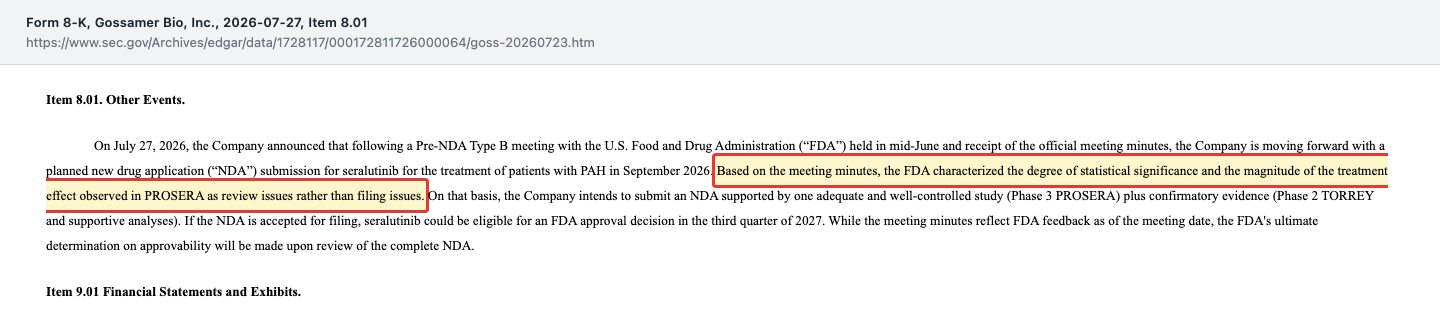
The distinction matters and deserves precision. A "filing issue" would have meant: the data are not even sufficient for us to accept the application. A "review issue" means: this is a question for the substantive review. Just as important is what has not happened: the application has not been submitted at all — the company plans to submit in September 2026 — and acceptance for filing comes only after that. The Form 8-K of July 27, 2026, Item 8.01, puts it in the conditional: "If the NDA is accepted for filing, seralutinib could be eligible for an FDA approval decision in the third quarter of 2027." Gossamer itself notes that the minutes reflect only the agency's view as of the meeting date and that the ultimate determination on approvability comes after review of the complete application. That is the honest version — and a considerably narrower one than "FDA gives green light".
Second: the Chiesi partnership is over. On July 23, 2026 Gossamer and the Italian pharmaceutical group Chiesi Farmaceutici terminated the collaboration and license agreement they had signed in May 2024. Gossamer thereby reacquires worldwide development and commercial rights to seralutinib, including regulatory filings and intellectual property. The prior 50/50 U.S. profit share falls away, as does the ex-U.S. license structure. Chiesi makes a one-time payment of $5 million as reimbursement of outstanding development costs; Gossamer pays nothing upfront but now owes success-based milestones and a capped royalty on worldwide net sales.
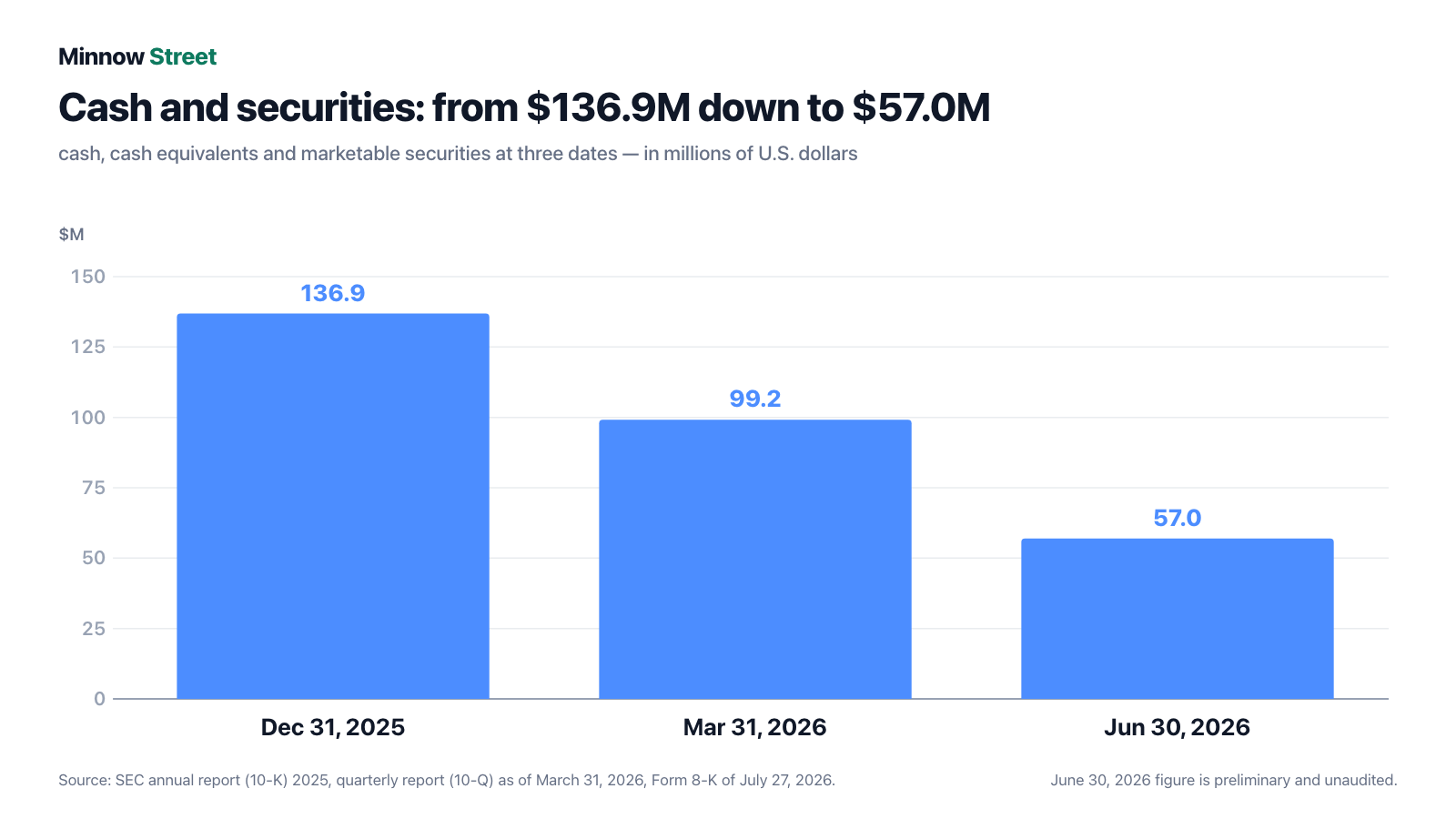
Third: the cash. In the same document Gossamer gives a figure for the second quarter of 2026 for the first time — preliminary and unaudited: approximately $57.0 million in cash, cash equivalents and marketable securities as of June 30, 2026. Why that number weighs more than the other two announcements becomes clear in a moment.
The numbers over the years — given their due
First what genuinely impresses. From October 2017 through December 31, 2025 Gossamer raised roughly $1,396.9 million (2025 annual report) — through preferred stock, the February 2019 IPO, convertible notes, several common-stock offerings and the Chiesi agreement. With that money it carried a molecule from preclinical work into Phase 3. The 2024 Chiesi deal was a real success: it produced revenue of $114.7 million in 2024 — $78.9 million from the U.S. license and $11.7 million from the rest-of-world license — plus another $48.5 million in 2025 from ongoing cost reimbursements. A clinical-stage biotech that books nine-figure revenue without selling a product has done something right.
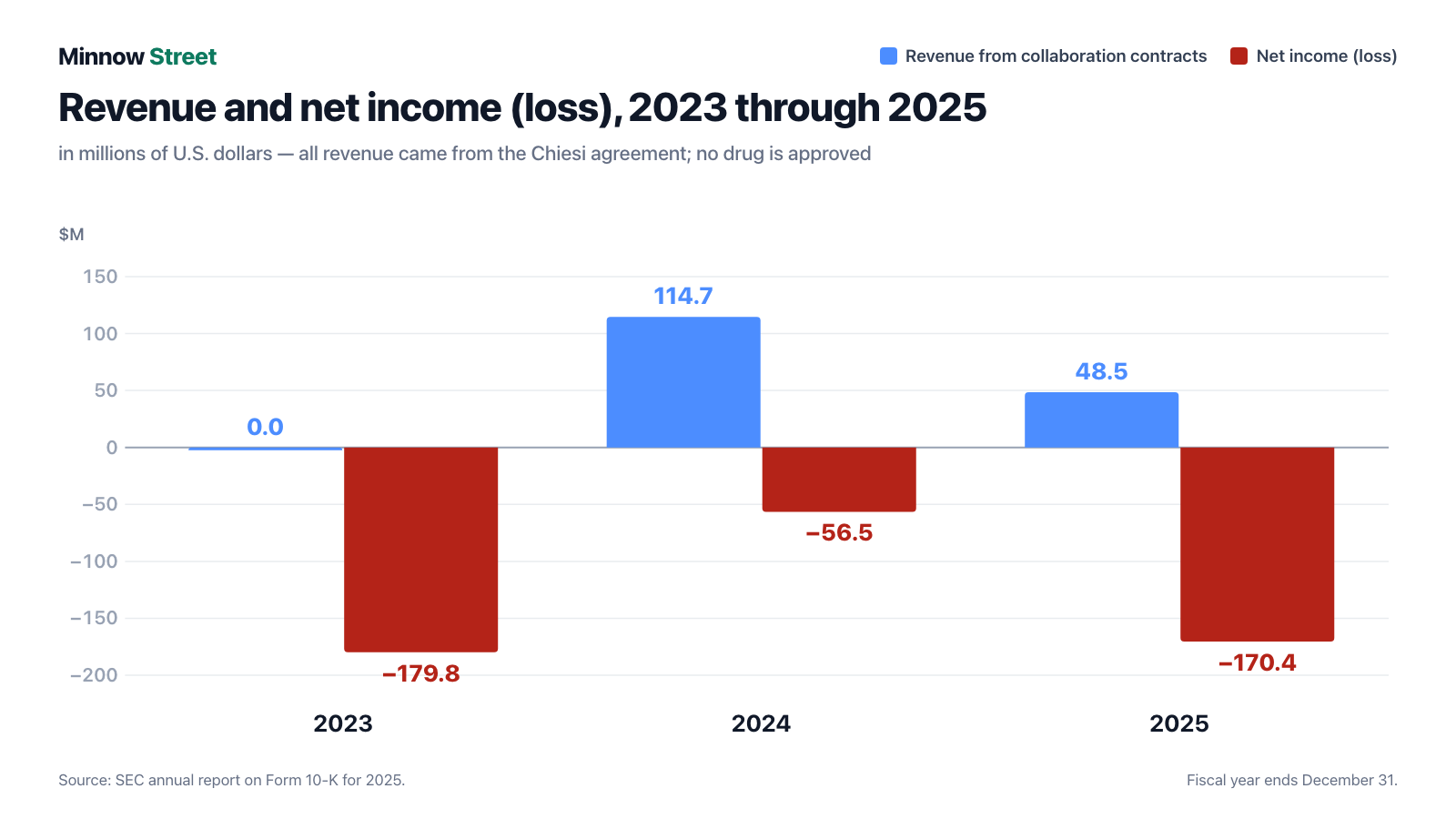
Now the other side of the same curve. The net loss was $179.8 million in 2023, fell to $56.5 million in 2024 thanks to the Chiesi upfront payments, and rose again to $170.4 million in 2025. Research and development spending climbed from $135.3 million (2023) through $138.5 million (2024) to $174.1 million (2025) — the Phase 3 trial cost money. The first quarter of 2026 continued the pattern: $17.0 million of revenue, $43.1 million of research and development expense, $18.7 million of general and administrative expense, and a bottom line of $46.7 million of loss, or $0.20 per share. The accumulated deficit since inception stood at $1,485.6 million as of March 31, 2026. In one sentence: the company has raised about $1.40 billion and spent $1.49 billion.
Which brings us to the number that outshines all the others — the cash position:
What the filings say — the uncomfortable truths
Uncomfortable truth no. 1: the pivotal trial missed its primary endpoint
On February 23, 2026 Gossamer released topline results from the Phase 3 PROSERA study. It enrolled 390 patients with WHO functional class II or III pulmonary arterial hypertension, 197 on seralutinib and 193 on placebo. The measure was how far patients can walk in six minutes after 24 weeks — the standard yardstick in this disease. The result: the seralutinib arm improved by a median of 28.2 meters, the placebo arm by 13.5 meters. The estimated treatment effect was +13.3 meters. And then comes the sentence that took the stock apart:
"The estimated Hodges-Lehmann treatment effect was +13.3 meters, with a p-value of 0.0320, which did not meet the prespecified threshold on the primary endpoint (α = 0.025); therefore, p values for the key secondary endpoints cannot be evaluated for statistical significance. All p values herein are nominal."
— Gossamer Bio, Inc., Form 8-K of February 23, 2026, Item 8.01 (SEC EDGAR)
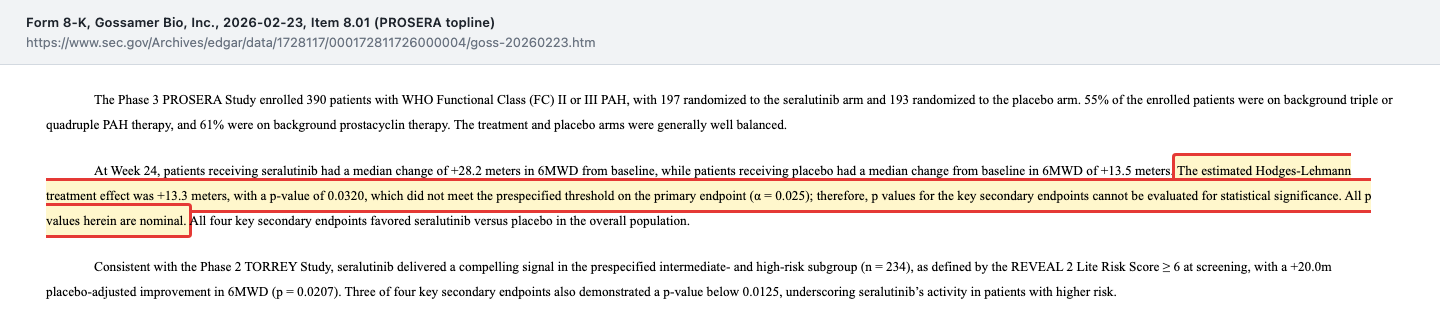
What is a p-value? In plain language it answers the question "how likely would a result like ours be if the drug in truth did nothing?" A value of 0.0320 means 3.2 percent. That sounds small — but the trial had committed itself beforehand to 2.5 percent. You cannot move that line afterwards, or no trial would mean anything. And because the primary endpoint was missed, the four key secondary endpoints could no longer be formally tested — even though all of them favored seralutinib, and in the prespecified subgroup of intermediate- and high-risk patients (234 people) clearly so: there the advantage was +20.0 meters. Fairness requires the rest too: the safety profile was manageable, the most frequent adverse event was cough in 37.0 percent of treated patients, and transaminase elevations of three times or greater of the upper limit of normal were observed in 13 percent of patients receiving seralutinib versus 1 percent on placebo. Keep the image: the trial did not find the net — it hit the post. Whether that is enough will be decided by the FDA in 2027.
Uncomfortable truth no. 2: the worldwide rights come at the cost of the only revenue line
Taking the rights back sounds like a victory, and economically it may be one — Gossamer keeps the substantial majority of future economics instead of splitting them in the United States. Except: until a drug is approved there are no economics to keep. What did exist was the Chiesi agreement, and it was the company's only source of revenue. The 2025 annual report says so explicitly for its single operating segment: "The Company's operating segment derives its revenues from the Chiesi Collaboration Agreement." In numbers: $114.7 million in 2024, $48.5 million in 2025 and $17.0 million in the first quarter of 2026. Those three figures must not be added — they overlap. On a rolling basis — full-year 2025 minus the first quarter of 2025 ($9.9 million) plus the first quarter of 2026 — the result is $55.5 million for the twelve months to March 31, 2026. That line now ends.
The offset is thin:
"Chiesi will pay to Gossamer $5 million (the “Chiesi Amount”) within 10 days after the date of the Rights Reacquisition Agreement as reimbursement of outstanding development costs yet to be reimbursed or incurred"
— Gossamer Bio, Inc., Form 8-K of July 27, 2026, Item 1.01 (SEC EDGAR)
And one clause appears in no press release: the licenses Chiesi granted over the jointly held intellectual property may be revoked if Gossamer breaches its undisputed payment obligations under the Rights Reacquisition Agreement, subject to certain specified cure periods (Form 8-K of July 27, 2026, Item 1.01). For a company whose entire value hangs on a single molecule that is no formality: Gossamer now owes success-based milestones and a royalty, and failing to service them risks not merely a penalty but the intellectual property itself.
Five million once, against a revenue line that most recently ran at $55.5 million over a twelve-month span — and on top of that Gossamer now carries the full development and pre-commercial costs that were previously shared with a partner. Anyone celebrating the reacquisition should read that arithmetic alongside it: the company bought more future and paid for it with its present.
Uncomfortable truth no. 3: equity is negative, and the filing doubts the company can continue
As of March 31, 2026 total assets of $128.9 million faced liabilities of $290.4 million. Equity — what would notionally be left for stockholders after all debts — was negative $161.5 million. At the end of 2025 it was negative $122.8 million; at the end of 2024 it had still been positive $29.5 million. In everyday terms: the house is worth less than the mortgage on it.
The quarterly report draws the conclusion itself:
"The Company's existing cash and cash equivalents are not sufficient to fund operating plans for at least one year from the issuance date of these financial statements. Accordingly, these conditions raise substantial doubt about the Company's ability to continue as a going concern."
— Gossamer Bio, Inc., Form 10-Q as of March 31, 2026, Note 1 "Liquidity and Going Concern" (SEC EDGAR)
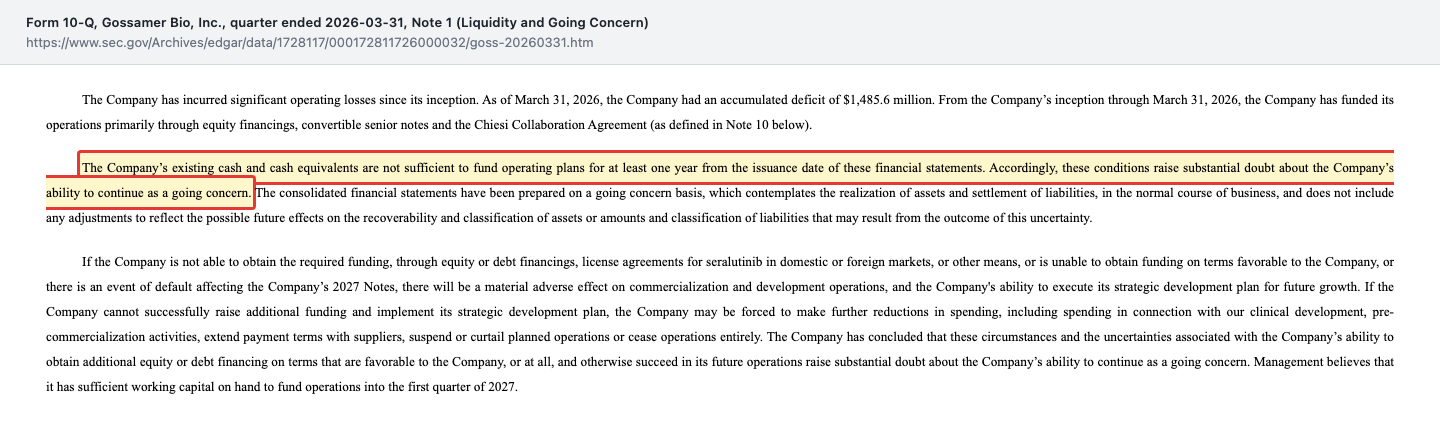
A going-concern statement is not exotic at clinical-stage biotechs and it is not a bankruptcy forecast — it is a statement about dependence on fresh capital. But neither is it a formality: it is a conclusion by management that the auditor confirmed with a separate explanatory paragraph in the 2025 annual report.
Uncomfortable truth no. 4: $57 million of cash against a $40 million covenant, tested monthly
This is the sharpest number in the whole analysis, and it does not appear on the balance sheet but in the indenture dated June 4, 2026:
"The New Convertible Notes Indenture also contains a minimum liquidity covenant that requires the Company to maintain a minimum amount of liquidity of $40 million, tested monthly on the date that the compliance certificate for the applicable month will be delivered and commencing with the fiscal month ending June 30, 2026; provided that the minimum liquidity requirement will be reduced to (x) $20 million, upon completion of one or more equity raises with aggregate proceeds of at least $100 million, (y) $10 million, subject to satisfaction of condition (x) above and written notice from the FDA by December 1, 2026 that it has accepted for filing the Company’s new drug application and (z) $0, subject to satisfaction of conditions (x) and (y) above and completion of one or more equity raises with aggregate proceeds (including all proceeds under condition (x) above) of at least $150 million."
— Gossamer Bio, Inc., Form 8-K of June 5, 2026, Item 1.01 "New Convertible Notes Indenture" (SEC EDGAR)
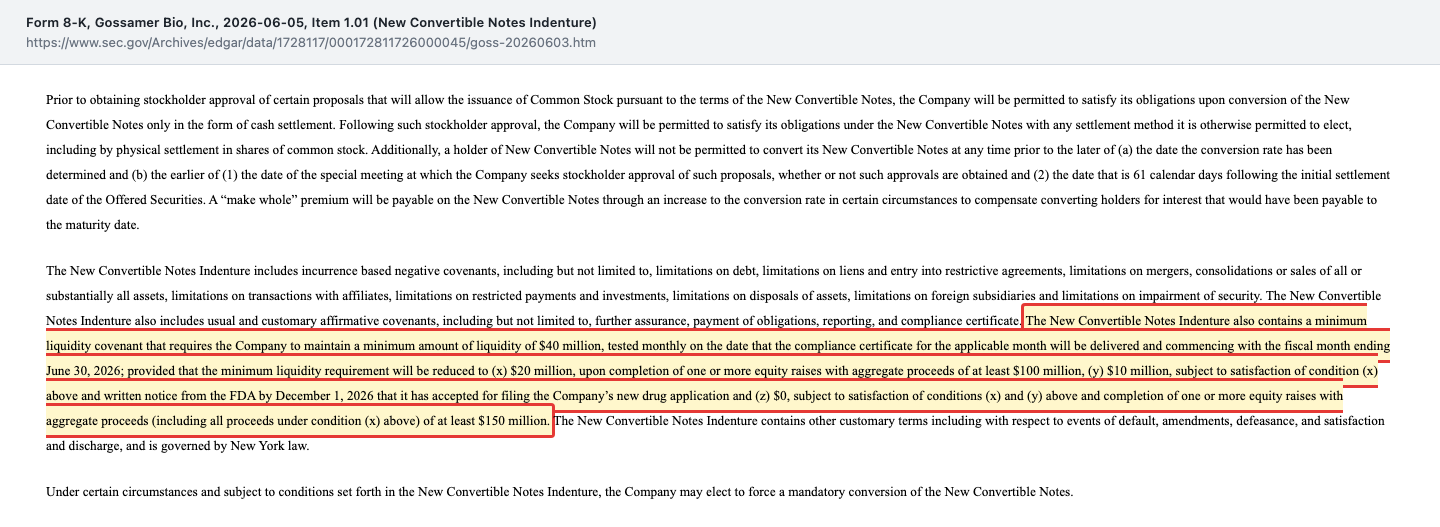
Put the two numbers side by side: $57.0 million on hand at June 30, 2026, $40 million required. That leaves roughly $17 million of headroom. In the first quarter of 2026 the company consumed about $37.7 million of cash and securities, in the second about $42.2 million. Extend that order of magnitude and the covenant is breached not in years but in a few months — unless fresh capital arrives. Which is precisely what the indenture anticipates: the threshold falls to $20 million after equity raises totaling at least $100 million, to $10 million on top of that after written FDA confirmation by December 1, 2026 that the application has been accepted for filing, and to zero after $150 million of new equity in total. Read that ladder twice to see what it says: the lenders did not permit a capital raise, they scheduled one.
How long the money lasts was last quantified by the company on May 15, 2026, in the quarterly report: "Management believes that it has sufficient working capital on hand to fund operations into the first quarter of 2027." The same sentence had already appeared verbatim in the annual report of March 17, 2026. The context matters: that assessment rests on a cash position of $99.2 million as of March 31, 2026. Since the cash announcement of July 27, 2026 ($57.0 million) Gossamer has not repeated it. And the arithmetic carries one more item that few people read alongside: beyond ordinary operations the company has committed to pay up to $7.8 million to Respira Therapeutics for the manufacturing and device-readiness work on RT234 (2025 annual report, Note 14) — money out of the same account that has to hold the $40 million line.
On the cost side the company has already acted, and hard: on March 16, 2026 it began a reduction of 73 positions — roughly 46 percent of its workforce, expected by the company to be substantially completed by the end of May 2026 (quarterly report as of March 31, 2026, Note 1). Of 162 employees about 89 remained. That noticeably lowers the outflow, but it only shifts the arithmetic: the second quarter of 2026 still consumed about $42 million. And it says something about the order of events inside the company: the cutting came before the good news from the FDA.
Uncomfortable truth no. 5: the share count has doubled — and the headroom allows far more
Dilution means your slice of the pie gets smaller because new slices keep being cut. At Gossamer the pie was re-cut in a single stroke in June 2026. To defuse the $200.0 million convertible note maturing in June 2027, the company offered an exchange. It was taken up at 90.5 percent: $181.1 million of old notes were tendered and cancelled. In return Gossamer issued:
"the Company issued $65,174,000 in aggregate principal amount of New Convertible Notes, 254,150,441 shares of its Common Stock, 33,402,727 Prefunded Warrants and 135,789,000 Purchase Warrants to eligible holders of the Existing Convertible Notes accepted for exchange in the Exchange Offer."
— Gossamer Bio, Inc., Form 8-K of June 5, 2026, Item 3.02 "Unregistered Sales of Equity Securities" (SEC EDGAR)
The ledger on that exchange cuts both ways. On the positive side: the principal amount of debt fell by roughly $115.9 million, the looming 2027 maturity shrank to a $18.9 million stub, and the new notes run to July 2030. On the negative side: the share count rose from 234,696,282 (March 31, 2026) to 488,846,722 (as of June 5, 2026) — more than a doubling. And the coupon on the new, now secured notes is 7.50 percent instead of 5.00 percent. Anyone who owned 1 percent of the company before owns 0.48 percent now, holding the same number of shares. On top come the instruments that can still become stock: up to 498,389,410 shares on conversion of the new notes, 135,789,000 from the purchase warrants (exercisable from December 3, 2026) and 33,402,727 from the prefunded warrants — together roughly 667 million. And one detail that was only fixed on July 1, 2026: the conversion price of the new notes was set at approximately $0.19 per share (a conversion rate of 5,347.5936 shares per $1,000 of principal), and the exercise price of the warrants at $0.34. The lower the price, the closer conversion moves to the maximum. The quarterly report as of March 31, 2026 also listed 109,965,409 potentially dilutive securities that stay out of earnings per share only because they are anti-dilutive in a loss year — among them 58,816,985 stock options. That table predates the exchange: the 12,321,900 shares it carries for the old 2027 notes fell away by 90.5 percent on June 4, 2026, so they cannot simply be added to the 667 million. Authorized capital was raised on July 14, 2026 from 700 million to 4 billion shares. The rule of thumb: debt paid with stock does not disappear — it merely changes the pocket it is paid from. And that pocket is yours.
Uncomfortable truth no. 6: the Nasdaq clock runs to October 5, 2026
On April 8, 2026 Nasdaq notified the company that its stock had failed to maintain the required minimum bid price of $1.00 for 30 consecutive business days between February 24 and April 7, 2026. That is not an expulsion, but it is a countdown:
"In accordance with Nasdaq Listing Rule 5810(c)(3)(A) (the “Compliance Period Rule”), the Company has 180 calendar days, or until October 5, 2026 (the “Compliance Date”), to regain compliance with the Minimum Bid Price Requirement."
— Gossamer Bio, Inc., Form 8-K of April 9, 2026, Item 3.01 (SEC EDGAR)
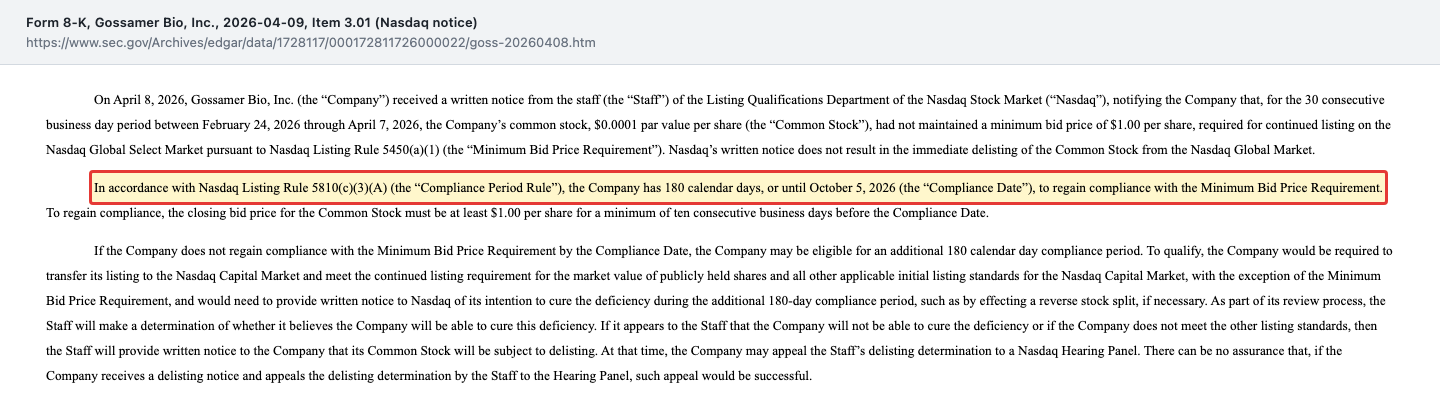
Where does the stock stand against that threshold? The most recent value recorded in a mandatory filing does not sit in a company report but in the exhibit to someone else's ownership filing: Schedule I to the SC 13D/A of July 24, 2026, where the investor D. E. Shaw lists its daily sales with prices — the final entry is July 24, 2026 at $0.1351 per share (a weighted average, that day's range $0.1327 to $0.1423). Before that: $0.34 on May 15, 2026 (proxy statement of June 9, 2026), $0.329 at March 31, 2026, $0.456 on March 16, 2026, and $3.10 on the final trading day of 2025. Between those last two points lies February 23, 2026 — the day of the trial results. Against the $1.00 minimum bid price the gap is therefore not a third but a factor of roughly seven.
And October 5 is not necessarily the end: if the deadline passes, the same notice says the company may be eligible for a second 180-calendar-day compliance period — but only if it transfers its listing to the Nasdaq Capital Market, meets that market's initial listing standards and gives written notice of its intent to cure. That escape route has a price, and it is spelled out in the proxy statement of June 9, 2026: for as long as any of the old notes remain outstanding, a move to the Nasdaq Capital Market constitutes a "fundamental change" under the new notes — and forces Gossamer to offer to repurchase them for cash. The emergency brake against delisting triggers precisely the payment the company has no money for.
That is why stockholders authorized a reverse split on July 14, 2026 with 383,876,939 votes in favor — a consolidation in which, say, ten shares become one and the price notionally rises tenfold. The board may choose among 15 ratios (1-for-10 through 1-for-150 in steps of ten), set out in 30 alternate charter amendments — one version per ratio with and one without the increase in authorized capital; the company expects to effect it "in or promptly following the third quarter of 2026". As of the data cut-off for this analysis it has not been effected. A reverse split cures the listing, not the balance sheet — and the company itself cautions that it may not produce a sustained increase in the price.
Valuation: why we deliberately quote no market capitalization
Here is the point where an analysis normally lines up price-to-sales and price-to-earnings ratios. For Gossamer Bio we explicitly do not — and the reasoning belongs in the analysis.
A market capitalization is share count times price. We know the share count precisely from the mandatory filings: 488,846,722 shares as of June 5, 2026. The most recent price any SEC document records is the trade price of July 24, 2026 from Schedule I to the SC 13D/A: $0.1351. Multiplying the two gives roughly $66 million. Market data show about $97.5 million for the same period — an implied price of about $0.20 that already reflects the rally after the July 27 announcement. The two calculations diverge by roughly 48 percent because they capture two different days; on top of that a reverse split is pending that would change share count and price by the same factor at the same moment. With a divergence of that size the most honest metric is no metric at all — and anything derived from it, such as a price-to-sales ratio, would be false precision.
What can be stated reliably instead: on the debt side stand $65.2 million of new secured 7.50 percent convertible notes (due July 2030, with a springing maturity in March 2027) and a $18.9 million stub of the old 5.00 percent notes (due June 2027). Against that stands $57.0 million of cash at June 30, 2026. And as the view from the professionals: nine analyst opinions rate the stock at an average of 4.2 on a scale from 1 to 5 where 5 is the best grade, with a mean price target of about $3.86 (data as of July 28, 2026). Read that correctly: this target sits at a multiple of the last documented price. It is not a forecast but the calculation "what would the company be worth if seralutinib is approved?" multiplied by a probability each analyst sets differently. That is exactly how binary the situation is.
Opportunities and risks at a glance
What speaks for Gossamer Bio:
- The regulatory path is open: per the minutes, the FDA treated the degree of significance and the size of the effect as questions of review rather than of filing; submission is planned for September 2026. If the application is then accepted for filing, a decision would be possible in the third quarter of 2027.
- Worldwide rights to seralutinib have been back with Gossamer in full since July 23, 2026 — including pricing, manufacturing and lifecycle strategy, with no upfront payment and $5 million flowing in from Chiesi.
- The efficacy signals are consistent: in the prespecified subgroup of intermediate- and high-risk patients (234 people) the advantage was +20.0 meters of walking distance, and in patients with connective tissue disease-associated PAH it was +37.0 meters; the biomarker NT-proBNP improved by 120.4 ng/L versus placebo in the overall population.
- The note exchange cut the principal amount of debt by roughly $115.9 million and all but dissolved the pressing 2027 maturity. On the runway, the company last said on May 15, 2026 (quarterly report as of March 31, 2026, verbatim already in the annual report of March 17, 2026) that the capital funds operations "into the first quarter of 2027" — measured against $99.2 million of cash; after the cash announcement of July 27, 2026 ($57.0 million) that statement was not repeated.
- The capital structure was defused before it became a problem: the exchange ran ahead of the 2027 maturity, voluntarily and with 90.5 percent acceptance — not under the pressure of a default.
What speaks against it:
- One product, no net: the company itself says its future performance depends "entirely" on the success of seralutinib. An FDA rejection would not be a setback but the end of the investment case.
- A documented threat to substance: a stockholders' deficit of $161.5 million (March 31, 2026), an accumulated deficit of $1,485.6 million, and an explicit going-concern statement in the quarterly report and in the auditor's report on the 2025 annual report.
- The $40 million covenant: with $57.0 million on hand at June 30, 2026 and a recent quarterly cash burn of about $42 million there is little room; the covenant is tested monthly, and lowering it requires equity raises of $100 million to $150 million.
- Dilution with no end in sight: the share count doubled from 234.7 million to 488.8 million, with up to 667 million further shares available from conversions and warrants — against authorized capital that now stands at 4 billion shares.
- Listing risk: a compliance date of October 5, 2026 for a $1.00 minimum bid price; the most recent price recorded in a mandatory filing was $0.1351 (July 24, 2026, Schedule I to the SC 13D/A). A second 180-day period is available only by moving to the Nasdaq Capital Market, which triggers a cash repurchase offer on the new notes. The authorized reverse split has not been effected and would not address the cause.
- A co-owner from the note exchange is selling: D. E. Shaw reported a 7.1 percent stake on July 24, 2026 — down from 8.3 percent on July 1 and 9.5 percent on June 11, 2026. Schedule I to that filing lists sales on every trading day from July 2 to July 24, 2026, at prices between $0.13 and $0.19.
- The revenue line ends: all revenue of the twelve months to March 31, 2026 ($55.5 million on a rolling basis) came from the now-terminated Chiesi agreement; until an approval there is no replacement.
- No second leg within reach: the PH-ILD study SERANATA has taken in no patients since February 2026, and the optioned compound RT234 could re-enter clinical development no earlier than 2027 — while already tying up a funding commitment of up to $7.8 million.
A human conclusion
Back to the acquittal trap from the opening. Its core is not that the news is wrong — it is right: Gossamer Bio is filing, and the FDA treating the missed significance as a question for the substantive review is, after a trial that missed its primary endpoint, genuinely more than many expected. Its core is that "the case will be heard" becomes "the case is won" inside our heads — and that with that feeling we stop reading the numbers that were already there. And they are no side issue here: negative equity of $161.5 million, $57.0 million of cash against a $40 million requirement, a deadline of October 5, and a share count that doubled in a single day, June 4, 2026.
Whoever buys today is not buying a company but a sequence: that the September submission happens, that the FDA accepts the application for filing at all and confirms it in writing by December 2026, that the capital raise this requires arrives before the liquidity covenant breaks, and that at the end there is an approval whose proceeds come, for the first time in the company's history, from a medicine actually sold. Each of those steps is plausible. All four in a row are a bet — and not a small one.
So the honest question to you is not "is the FDA news good?" — it is good. It is this: can you live with the fact that the good news and the bill are true at the same time, and that you do not know which of the two arrives first? If yes, you have a thesis, and you now know the dates on which it will be decided. If no, you had an acquittal that nobody handed down. What you make of it is your decision. And that is exactly as it should be.
Sources
All original documents used in this analysis — for you to read yourself:
- Gossamer Bio, Inc. — SEC quarterly report on Form 10-Q as of March 31, 2026 (filed May 15, 2026)
- Gossamer Bio, Inc. — SEC annual report on Form 10-K for 2025 (filed March 17, 2026)
- Gossamer Bio, Inc. — SEC Form 8-K of July 27, 2026 (FDA update, reacquisition of worldwide rights, cash position) including press release EX-99.1
- Gossamer Bio, Inc. — SEC Form 8-K of July 15, 2026 (charter amendment, reverse-split authorization, voting results)
- Gossamer Bio, Inc. — SEC Form 8-K of July 1, 2026 (conversion price of the new notes, exercise price of the warrants)
- Gossamer Bio, Inc. — SEC Form 8-K of June 5, 2026 (note exchange, new secured convertible notes, warrants)
- Gossamer Bio, Inc. — SEC Form 8-K of April 9, 2026 (Nasdaq minimum bid price notice)
- Gossamer Bio, Inc. — SEC Form 8-K of February 23, 2026 (PROSERA topline results)
- Gossamer Bio, Inc. — SEC proxy statement DEF 14A of June 9, 2026 (special meeting, documented closing prices)
- Gossamer Bio, Inc. — SEC post-effective amendment POS AM of March 17, 2026 (documented closing price of March 16, 2026)
- D. E. Shaw & Co., L.P. — SEC Schedule 13D/A of July 24, 2026 (share count as of June 5, 2026; Schedule I with documented trade prices through July 24, 2026)
- Complete SEC filing history of Gossamer Bio, Inc.: EDGAR overview (sec.gov)
- Fundamental data (share count, analyst consensus; as of July 28, 2026), reconciled with the SEC filings.
Transparency & disclaimer: this analysis is journalistic commentary on publicly available information. It is not investment advice, not a regulated financial analysis, and not a solicitation to buy or sell securities. Equity investments carry substantial risk up to and including total loss. All information without warranty; the as-of date of each figure is noted in the text. The author holds no position in Gossamer Bio shares at the time of publication.
Our Bottom Line at a Glance
- Regulatory path positive
- After the Pre-NDA Type B meeting in mid-June 2026 the FDA, per the minutes, characterized the degree of statistical significance and the magnitude of the treatment effect in PROSERA as questions of review rather than of filing (8-K of July 27, 2026). The application is planned for September 2026 — as of the data cut-off it has therefore neither been submitted nor accepted for filing by the agency; only upon acceptance would a decision in the third quarter of 2027 be possible. After a trial that missed its primary endpoint, that is considerably more than the base case.
- Trial result neutral
- On February 23, 2026 the Phase 3 PROSERA study produced a treatment effect of +13.3 meters of walking distance at a p-value of 0.0320 — the prespecified threshold was α = 0.025. The primary endpoint is therefore missed and the secondary endpoints are formally uninterpretable. The signals in the prespecified risk subgroup (+20.0 meters, n = 234) and in the NT-proBNP biomarker (−120.4 ng/L) are consistent, but they do not replace the evidence that was missed.
- Balance sheet & going concern negative
- As of March 31, 2026 there was a stockholders' deficit of $161.5 million (end of 2024: positive $29.5 million), an accumulated deficit of $1,485.6 million, and an explicit going-concern statement in the quarterly report and in the auditor's report on the 2025 annual report. Cash and marketable securities fell within six months from $136.9 million to a preliminary $57.0 million.
- Debt covenants negative
- The indenture of June 4, 2026 requires minimum liquidity of $40 million, tested monthly and first for the fiscal month ending June 30, 2026 — with $57.0 million on hand and a recent quarterly burn of about $42 million there is little room. Lowering the threshold to $20 million or $10 million requires equity raises of $100 million to $150 million and written FDA confirmation of acceptance by December 1, 2026.
- Dilution & listing negative
- The note exchange of June 4, 2026 lifted the share count from 234,696,282 to 488,846,722; up to 667 million further shares can arise from conversions and warrants, and authorized capital was raised to 4 billion. In parallel the Nasdaq compliance date of October 5, 2026 runs for a $1.00 minimum bid price; the most recent price recorded in a mandatory filing was $0.1351 on July 24, 2026 (Schedule I to the SC 13D/A). A second 180-day period is available only on a move to the Nasdaq Capital Market — which triggers a cash repurchase offer on the new notes.
- Revenue negative
- All reported revenue came from the Chiesi agreement: $114.7 million in 2024, $48.5 million in 2025 and $17.0 million in the first quarter of 2026; on a rolling basis the twelve months to March 31, 2026 came to $55.5 million. With the termination on July 23, 2026 that line ends; the offset is a one-time $5 million, and Gossamer now carries the development and pre-commercial costs alone.
Gossamer Bio is the acquittal trap in its purest form: the announcement of July 27, 2026 — an NDA planned for September, worldwide rights back, $5 million from Chiesi — is real and relevant. It changes nothing about the numbers underneath: a stockholders' deficit of $161.5 million, a going-concern statement, $57.0 million of cash against a monthly-tested $40 million covenant, a Nasdaq deadline of October 5, 2026, and a share count that jumped to 488,846,722 in a single day, June 4, 2026. Whoever invests here buys a sequence: submission in September, acceptance for filing and written FDA confirmation by December, a capital raise before the covenant breaks, approval in 2027. Not investment advice.
What Our Rating Means
Substance risk
We found at least one documented issue that threatens the company itself — regardless of how the stock is currently valued.
Red here is not a judgment on the price and not a verdict on the science — the seralutinib signals in the risk subgroup deserve to be taken seriously, and the open regulatory path is a genuine opportunity. Red follows from four documented findings on substance, each of which would carry the rating on its own: a stockholders' deficit of $161.5 million as of March 31, 2026; an explicit going-concern statement in the quarterly report and the auditor's report; a cash runway well under four quarters against continuing outflows and a monthly-tested minimum liquidity of $40 million; and a listing deadline of October 5, 2026 whose only extension would require a move to the Nasdaq Capital Market, which in turn triggers a cash repurchase offer on the new notes. If approval arrives together with durable financing, this rating deserves a fresh look. Until then the substance itself is at stake, not merely the price. The decision is yours.
A journalistic assessment by our editorial team at the time of the deep dive, based on public sources — not investment advice and not a solicitation to buy or sell. Your personal circumstances (investment goals, risk capacity, taxes) cannot be taken into account. What our levels mean, how verdicts are formed, and what conflicts of interest exist →
Worth Noting
- Gossamer Bio did not reach our research list through a ranked list — the company appears in none of our stock scanners (as of July 28, 2026; the lists are recomputed daily), which is to be expected given no product revenue, a loss and negative equity. The hook was the EDGAR filing stream: a single Form 8-K of July 27, 2026 carrying six item numbers at once.
- This analysis deliberately quotes no market capitalization and no derived multiple. The reason: the most recent price recorded in a mandatory filing ($0.1351 on July 24, 2026, Schedule I to the SC 13D/A) multiplied by 488,846,722 shares gives about $66 million, while market data show about $97.5 million for the same period — a divergence of roughly 48 percent and thus far more than one fifth. On top of that an authorized but unexecuted reverse split is pending.
- Every date in this analysis is sourced from a mandatory filing: NDA submission planned for September 2026, FDA acceptance confirmation as a covenant condition by December 1, 2026, Nasdaq compliance date October 5, 2026, springing maturity of the new notes March 2, 2027, maturity of the old notes June 2027. Not to be confused: Gossamer Bio, Inc. (GOSS) is not the same as similarly named private companies without SEC registration.
Frequently Asked Questions
Gossamer Bio, Inc. (Nasdaq: GOSS) of San Diego is a clinical-stage biopharmaceutical company with exactly one asset: seralutinib, an inhaled inhibitor of the PDGFR, CSF1R and c-KIT kinases for pulmonary arterial hypertension. The company owns no approved drug. As of March 10, 2026 it employed 161 full-time and one part-time people; on March 16, 2026 a reduction of 73 positions, roughly 46 percent of headcount, began and was substantially completed by the end of May 2026. The planned second indication, pulmonary hypertension associated with interstitial lung disease (PH-ILD), is dormant: the Phase 3 SERANATA study has taken in no new patients since February 2026. Gossamer also holds, since September 2025, an option over Respira Therapeutics and its inhaled PDE5 inhibitor RT234, which could re-enter clinical development no earlier than 2027.
No. On February 23, 2026 Gossamer reported, for the 390-patient trial, an estimated treatment effect of +13.3 meters of walking distance after 24 weeks with a p-value of 0.0320. The prespecified threshold was alpha = 0.025 — the primary endpoint was therefore missed, and the four key secondary endpoints could no longer be tested for statistical significance. In the subgroup of intermediate- and high-risk patients the advantage was +20.0 meters.
Because after a Pre-NDA Type B meeting in mid-June 2026 the FDA, per the official minutes, characterized the degree of statistical significance and the magnitude of the treatment effect as "review issues rather than filing issues" — that is, questions of review rather than of filing. Gossamer plans to submit in September 2026, supported by PROSERA plus confirmatory evidence from the Phase 2 TORREY study. Importantly, the application has neither been submitted nor accepted by the agency. Only if the FDA accepts it for filing would a decision be possible in the third quarter of 2027.
On July 23, 2026 Gossamer reacquired worldwide development and commercial rights to seralutinib and pays nothing upfront; Chiesi makes a one-time payment of $5 million. Going forward Gossamer owes milestones and a capped royalty. At the same time the only revenue line ends: all revenue of the twelve months to March 31, 2026 — $55.5 million on a rolling basis — came from the Chiesi agreement.
Cash, cash equivalents and marketable securities fell from $136.9 million (December 31, 2025) to $99.2 million (March 31, 2026) and to a preliminary $57.0 million (June 30, 2026). In the quarterly report of May 15, 2026 — measured against the $99.2 million then on hand — management expected the funds to last "into the first quarter of 2027"; after the cash announcement of July 27, 2026 that statement was not repeated. The same quarterly report states substantial doubt about the company's ability to continue as a going concern. The indenture additionally requires minimum liquidity of $40 million, tested monthly, and a funding commitment of up to $7.8 million to Respira Therapeutics sits on top.
On April 8, 2026 Nasdaq determined that the stock had traded below the $1.00 minimum bid price for 30 consecutive business days between February 24 and April 7, 2026. The cure period runs to October 5, 2026; to regain compliance the closing bid price must be at least $1.00 for a minimum of ten consecutive business days. The most recent price recorded in a mandatory filing was $0.1351 on July 24, 2026 (Schedule I to the SC 13D/A). If the deadline passes, a second 180-day period is available only by moving to the Nasdaq Capital Market — which, per the proxy statement of June 9, 2026, triggers a cash repurchase offer on the new notes.
Stockholders authorized one on July 14, 2026 with 383,876,939 votes in favor — the board may choose among 15 ratios (1-for-10 through 1-for-150), set out in 30 alternate charter amendments. As of the data cut-off for this analysis (July 28, 2026) it has not been effected; the company expects the step "in or promptly following the third quarter of 2026". A reverse split lifts the notional price but changes neither the balance sheet nor the cash burn, and the company cautions it may not produce a sustained increase.
In the note exchange of June 4, 2026, $181.1 million of the old 5.00 percent convertible notes due 2027 were swapped for $65.2 million of new 7.50 percent notes, 254,150,441 new shares, 33,402,727 prefunded warrants and 135,789,000 purchase warrants. The share count rose from 234,696,282 (March 31, 2026) to 488,846,722 (June 5, 2026). Authorized capital was raised on July 14, 2026 from 700 million to 4 billion shares.
Found an error?
Did you spot a factual error, an outdated number, or a typo in this deep dive? Let us know briefly — your report goes straight to the editorial team.