Clarivate: $9.4 Billion on the Books, $1.3 Billion on the Exchange
A data house that keeps more than 90 percent of its customers every year and has still posted losses for four straight years. Free cash flow looks cheap at 3.6 times market capitalization — until you set $4.0 billion of net debt beside it. And it arises mostly because Clarivate writes off the purchase prices of its acquisitions twice as fast as it invests. In July 2026 the company sold its healthcare business. Not investment advice — just an attempt to finish reading a balance sheet.
 Thomas Mücke
Founder & Publisher
Thomas Mücke
Founder & Publisher
Chart
Interactive price chart (TradingView).
Note: pure fact-based analysis, not investment advice and not a solicitation to buy or sell. All figures without guarantee.
Picture two companies. The first keeps more than nine out of ten customers every year, bills in advance, draws 83 percent of its revenue from recurring contracts and throws off $365 million in cash. The second has not turned a profit in four years, carries $4.0 billion of net debt, has written off $1.5 billion of its goodwill and trades 94 percent below its all-time high. Most investors would buy the first and avoid the second. They are the same company. It is called Clarivate (NYSE: CLVT), and it is one of the clearest examples of why a single valuation metric is never an investment decision. So we read together what the company itself filed with the U.S. securities regulator, the SEC — the annual report (10-K) for 2025, the quarterly report (10-Q) as of March 31, 2026, and the current report (8-K) of July 6, 2026. An SEC filing is honest under threat of prosecution. In the end, the decision is yours.
What Clarivate does — and why it is registered in Jersey
Clarivate sells knowledge about knowledge. Researchers who need to know how often a study has been cited use Web of Science — a citation database maintained for more than sixty years and, per the annual report, used by 99 percent of the top 400 universities. Anyone hunting a dissertation or a historical source ends up at ProQuest. Anyone researching a patent or keeping one alive worldwide uses Derwent; anyone clearing a trademark uses CompuMark. In total there are more than 45,000 customers: universities, libraries, government bodies, corporations and law firms.
The company runs three segments: Academia & Government ($1,266.0 million of 2025 revenue), Intellectual Property ($799.4 million) and Life Sciences & Healthcare ($389.8 million). The third is being sold right now — more on that shortly.
On the legal form, because it often causes confusion: Clarivate Plc was incorporated on January 7, 2019 under the laws of Jersey, Channel Islands, and is headquartered in London. That is neither cause for concern nor a special case for reporting: the company files with the SEC as a domestic filer, meaning full Forms 10-K and 10-Q at "large accelerated filer" status — not the leaner Forms 20-F and 6-K that foreign private issuers may use. For you that means quarterly numbers under U.S. accounting rules, audited and in full depth. That is exactly what we work with here.
That frames the central tension of this analysis, and it runs through every section: the business is about as stable as a subscription business gets — but the company that owns it was assembled with borrowed money, and that bill is still open.
Where the stock landed on our desk
CLVT showed up in our price-to-free-cash-flow ranking — a list that sorts stocks by market capitalization divided by free cash flow, ascending. Free cash flow is the money left after all running costs and investment. A low ratio means a lot of recurring cash for a small purchase price. To repeat it yourself: open the scanner section, choose the price-to-free-cash-flow ranking and set the country filter to the United States. The lists are recomputed daily.
And now the honest part. The U.S. selection of that list had 545 hits on July 27, 2026; CLVT sits inside it with a reading of 2.10 at rank 45. The page, however, displays only the 25 strongest hits — so CLVT cannot be seen there. To look the stock up, take the other route: open the stock screener, set the country to the United States, choose "under 10" in the P/FCF filter and type CLVT into the search box. That path works regardless of how the ranking sorts itself tomorrow. Remember it as a rule: a ranking page is an excerpt, not a directory.
For context, two metrics we checked against the audited accounts. The Altman Z-score of 1.78 (data as of July 24, 2026) is a bankruptcy early-warning figure; we use the Z-double-prime variant for non-manufacturers, where anything below 1.1 counts as distress and anything above 2.6 as the safe zone. At 1.78 the reading sits in the grey zone between the two — for this stock that is not an accident but an honest description. The Piotroski F-score of 6 out of 9 is decent but no top mark; it scores nine yes-or-no questions on balance-sheet quality, and a genuinely healthy company scores 8 or 9. The stock also appears in the price-to-sales ranking and the price-to-cash-flow ranking.
The numbers over the years — given their due
First what is genuinely strong, and it is more than the share price suggests. Clarivate has a subscription business many companies would envy. The annual report puts it like this:
“We serve more than 45,000 customers worldwide, including academic institutions and libraries, research organizations, corporations, law firms, government entities, and companies across the pharmaceutical, biotechnology, and medical device industries, providing a trusted foundation and quality user experience resulting in our strong and consistent annual customer renewal rates exceeding 90 percent.”
— Clarivate Plc, SEC annual report 10-K for 2025

That translates into hard cash. In 2025 operations produced $628.5 million; after $263.2 million of capital expenditure, free cash flow of $365.3 million remained — the definition the company itself uses and reconciles in its filings. The year before it was $357.5 million, in 2023 $501.7 million. Adjusted operating income came to $1,001.8 million in 2025, a margin of 40.8 percent. You only reach margins like that with a product customers cannot easily switch away from.
And now the other side of the same accounts. The bottom line in 2025 was a net loss of $201.1 million — after $636.7 million (2024) and $911.2 million (2023). How do a billion dollars of adjusted operating income and a nine-figure loss fit together? The answer sits in exactly two lines: depreciation and amortization of $757.2 million and interest of $265.4 million. Together that is over a billion — and it is precisely the price of a company that was assembled by acquisition and financed with debt.
What the filings say — the uncomfortable truths
Uncomfortable truth No. 1: the cash flow is largely an accounting effect
A short detour through accounting is worth it here, because it explains almost everything. When one company buys another, it may not expense the purchase price; it must allocate it to items such as customer relationships, technology and content and trade names and amortize it over their useful lives. That amortization costs no money — it is a pure entry. Which is why it reappears in the cash flow statement as an add-back: it lifts cash flow without any money coming in.
“Amortization expense related to intangible assets was $735.3, $708.0, and $685.1 during the years ended December 31, 2025, 2024, and 2023, respectively.”
— Clarivate Plc, SEC annual report 10-K for 2025, note 6

For comparison: depreciation on property and equipment — computers, fixtures, buildings — came to just $21.9 million in the same year. Of the $757.2 million total, 97 percent therefore relates to acquired intangibles. And what does the company invest to renew that asset base? $263.2 million — after $289.1 million (2024) and $242.5 million (2023). The ratio is what matters: amortization is nearly three times own investment, and has been for years.
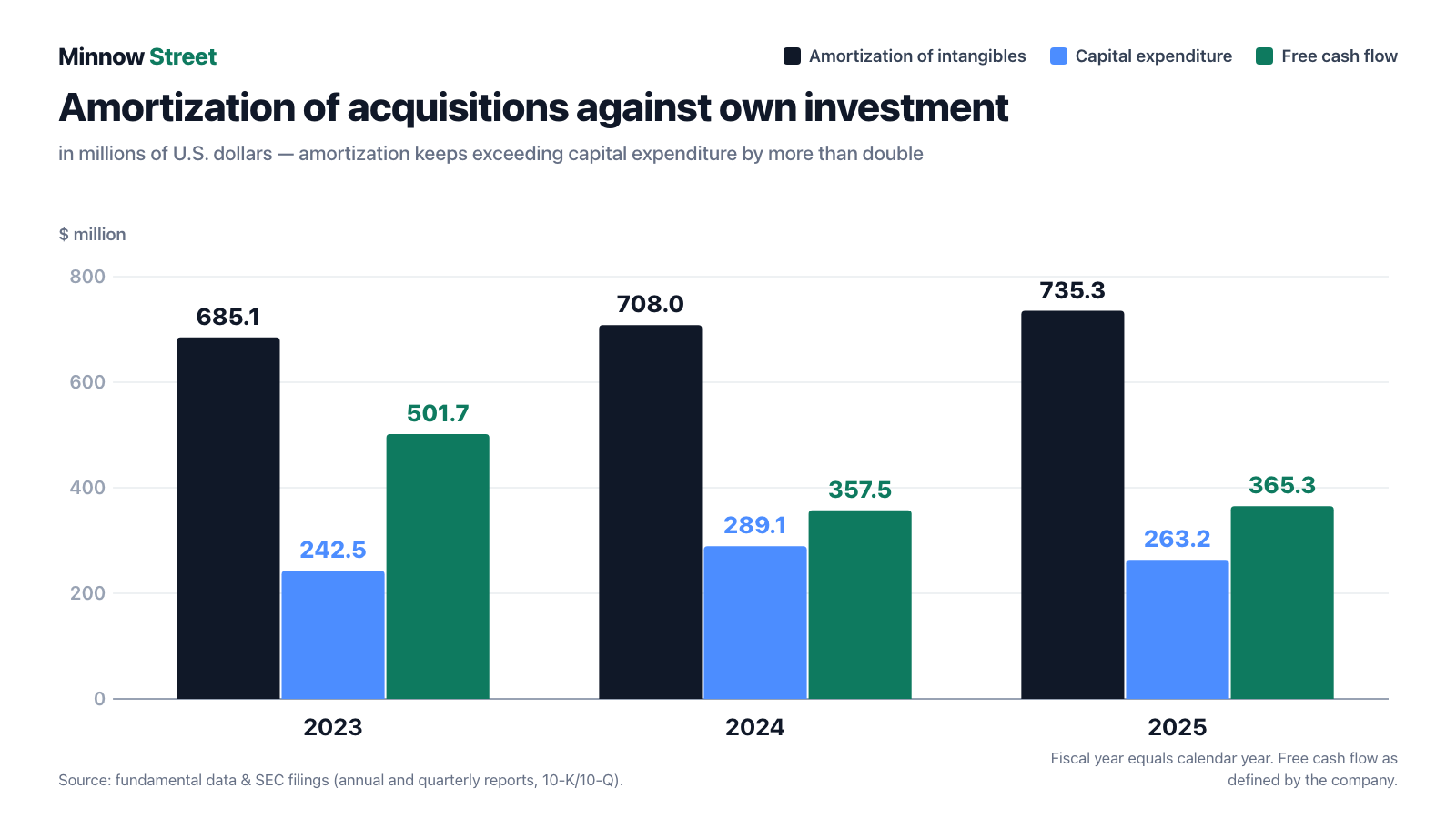
How should you read that? Two honest readings stand side by side. One: yesterday's purchase prices are paid, the amortization on them is pure history, and what comes in today as cash is real. The other: if the amortization does reflect actual wear — if customer relationships and databases genuinely age — then the net loss is the more honest figure, and the cash flow lives off under-investment. Which reading holds is settled by organic growth. Hence the next section.
Uncomfortable truth No. 2: almost nothing grows under its own steam
Clarivate discloses, exemplarily, where every revenue movement comes from — split into acquisitions, disposals, currency and organic growth, meaning what the existing business manages on its own. The 2025 figures:
- Subscription $1,605.5 million (−1.3 percent), of which organic +0.8 percent
- Re-occurring revenue from patent and trademark renewals $434.2 million (+1.0 percent), of which organic −0.4 percent
- Transactional $415.5 million (−16.9 percent), of which organic −4.8 percent
- Total $2,455.2 million (−4.0 percent), of which organic −0.1 percent
The first quarter of 2026 looked marginally better: revenue $585.5 million (−1.4 percent), organic +0.6 percent. But treat that number with care — in the same quarter currency contributed +2.2 percentage points. Without the weaker dollar, revenue would have fallen 3.6 percent rather than 1.4.
What does that mean for the question from the last section? An asset whose revenue stagnates organically while $735 million a year is written off against it is an asset that does not regrow. A renewal rate above 90 percent also means up to 10 percent leaves every year — and that price increases are just about covering it. That is not the same as a growing business, and it favors the harsh reading of the amortization over the mild one.
One figure belongs here for fairness: the subscription business, the stable core, grew organically by 1.7 percent in the first quarter of 2026. The decline comes from transactional revenue and from product groups the company itself discontinued. Anyone who believes only the subscription core will remain is looking at the better part of the company.
Uncomfortable truth No. 3: the balance sheet is almost nothing but purchase prices
Clarivate came to the market in 2019 through a shell company and built itself up by acquisition — the largest being ProQuest in 2021. What that does to a balance sheet is visible as of March 31, 2026: of $10,927.1 million in total assets, $7,863.7 million are intangibles and $1,566.6 million goodwill — together $9,430.3 million, or 86 percent. Property and equipment stand at $50.9 million, half a percent. Shareholders' equity is $4,788.8 million — so the acquisition values are twice the entire equity.
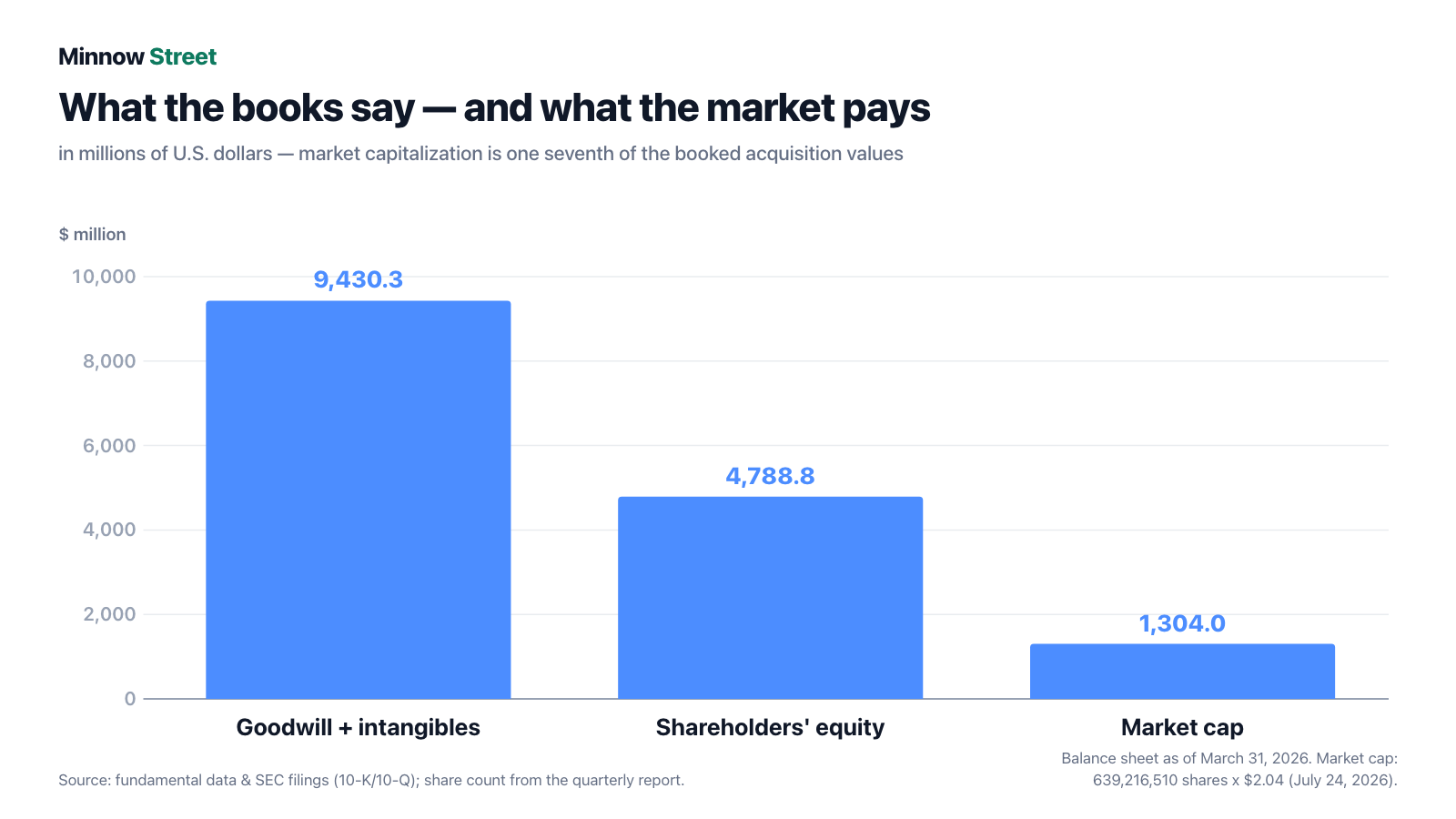
Part of those purchase prices has already been written off, and not on schedule but as impairment: $979.9 million (2023), $540.7 million (2024) and $15.0 million (2025) — together $1,535.6 million in three years. The justification for the largest single item is unusually candid:
“In 2024, we recorded a goodwill impairment charge of $465.7 primarily due to sustained declines in our share price and worsening macroeconomic and market conditions.”
— Clarivate Plc, SEC annual report 10-K for 2025, management discussion

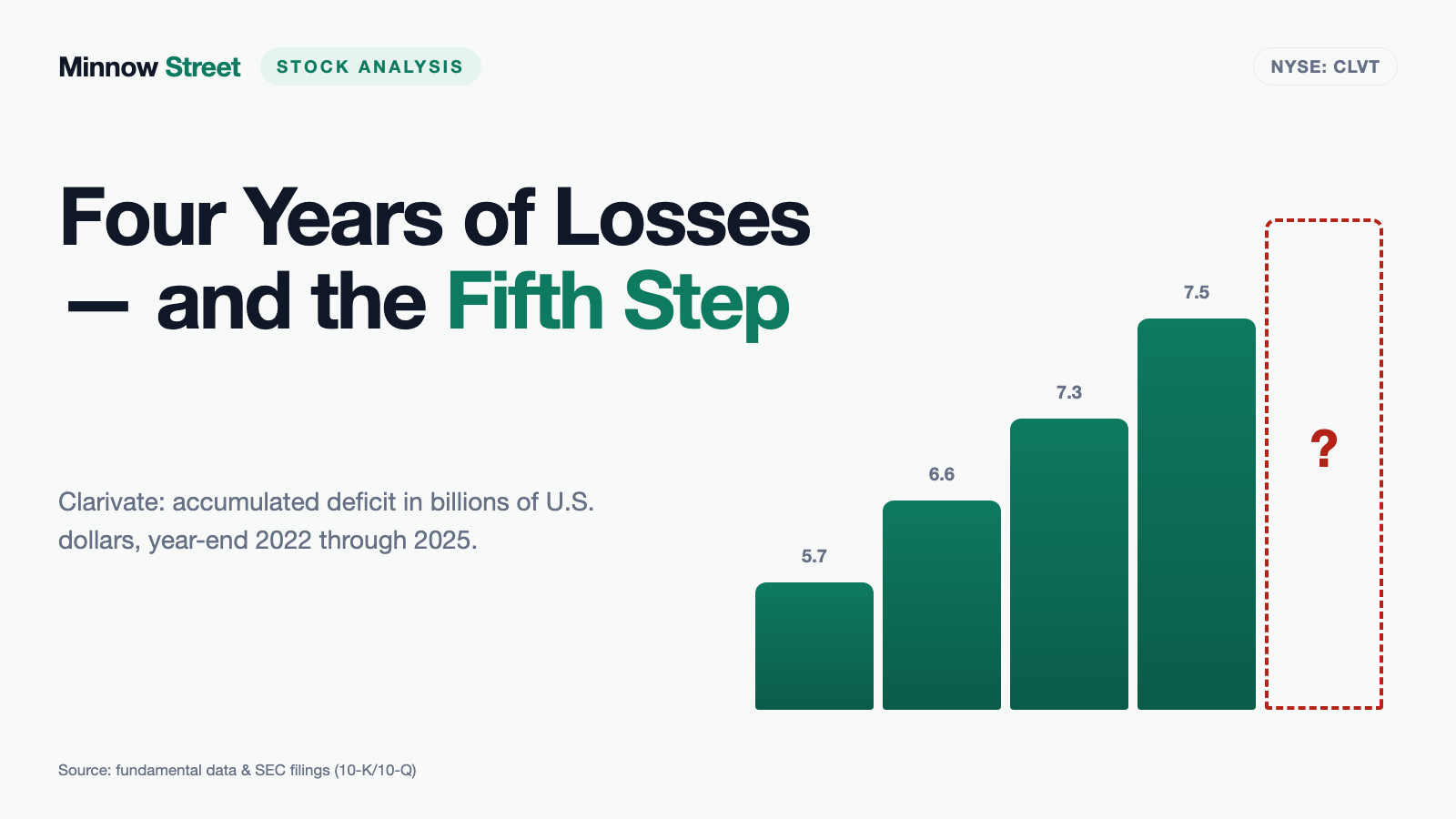
The goodwill of the Intellectual Property segment has stood at zero since 2024; it was written off entirely. And the accumulated deficit — the sum of all losses since the listing — has climbed from $5,658.9 million (end of 2022) through $6,645.5 million (end of 2023) and $7,313.5 million (end of 2024) to $7,514.6 million at year-end 2025 — and on to $7,554.8 million by March 31, 2026, against $12,801.3 million of paid-in capital. Put differently: of every dollar shareholders and prior owners contributed, about 59 cents remain.
Uncomfortable truth No. 4: market capitalization is a quarter of the purchase price
Now the calculation that puts the opening figure straight. A price-to-cash-flow ratio measures market capitalization. Anyone actually buying the company would have to assume the debt. From the cover of the quarterly report: as of March 31, 2026 there were 639,216,510 ordinary shares outstanding — a single class. At $2.04 (price data as of July 24, 2026) that gives market capitalization of $1,304.0 million.
Net debt at the same date: financial debt of $4,283.1 million less $242.2 million of cash equals $4,040.9 million. Enterprise value is therefore about $5,344.9 million. Now the same calculation as at the start, only complete: measured against free cash flow of $365.3 million, the company costs not 3.6 times but 14.6 times. For every dollar of market capitalization there are $3.10 of net debt.
The debt in detail (as of December 31, 2025): $921.2 million of secured notes due 2028 at 3.875 percent, $921.4 million of notes due 2029 at 4.875 percent, $1,999.2 million of term loans due 2031 at 6.466 percent and $500.0 million of term loans due 2031 at 6.966 percent. The trend inside that matters more than the total: the old notes are cheap, the new loans expensive. In May 2025 the company redeemed $500 million of its 4.5 percent notes using a term loan at 6.966 percent. Every refinancing in that pattern raises the interest bill — which in 2025 already came to $265.4 million, or 20 percent of the entire market capitalization. On the plus side: no large maturity falls due before 2028, and the revolving facility was untouched at $768.5 million at the end of 2025.
Uncomfortable truth No. 5 — or the good news: the healthcare business is sold
On July 3, 2026 subsidiaries of Clarivate signed a purchase agreement covering the entire Life Sciences & Healthcare segment. The buyer is an affiliate of the private equity firm Altaris LLC.
“Buyer has agreed to pay an aggregate purchase price of $600,000,000, which consists of (i) cash consideration of $500,000,000 payable upon the closing of the Transaction … (ii) deferred consideration of $25,000,000 … and (iii) the issuance of an unsecured senior note by an affiliate of Buyer in an aggregate principal amount of $75,000,000 to a subsidiary of Clarivate at the closing of the Transaction.”
— Clarivate Plc, SEC current report 8-K of July 6, 2026, Item 1.01

The context. The segment produced $389.8 million of revenue in 2025 — so the price equals 1.54 times segment revenue, while the market pays only 0.53 times for the whole company. A financial investor is putting up nearly half the entire market capitalization for one sixth of the revenue. That is a strong argument that the stock is too cheap. It is also a hint of the opposite: if the segment being handed over is precisely the one where $451.9 million of goodwill was already written off in 2024 and which still carries $477.8 million of goodwill, the next quarterly report deserves close reading. Shareholder approval is not required; closing is expected by the end of 2026.
One more point about the stock itself, because it is often overlooked: the preferred shares issued in 2019 are history. All 14.4 million of them, carrying $1,392.6 million on the books, converted fully into 55.3 million ordinary shares in 2024. The dividend on them ($75.4 million in 2023, $31.3 million in 2024) has ceased. Anyone running the numbers today no longer needs to deduct a preferred dividend or model a future conversion — the dilution has already happened.
Valuation — what the market is pricing in
Let us pull it together, all with price data as of July 24, 2026 and balance-sheet figures as of March 31, 2026. Market capitalization is $1,304.0 million, enterprise value $5,344.9 million. The price-to-sales ratio is 0.53, enterprise value equals 5.3 times adjusted operating income, and the price stands at 0.27 times book value. The share price sits roughly 94 percent below its all-time high; about 15 percent of the float is sold short. Analysts lean cautiously constructive: three rate it a strong buy, two a buy, four a hold and one a sell; the average price target was $2.50 when pulled on July 27, 2026.
A price-to-book ratio of 0.27 is a statement, not a metric: the market considers the booked acquisition values far too high. It is pricing in that substantial amounts of the $9,430.3 million of goodwill and intangibles will still be written off. And it has an argument that sits in the filings: an asset whose revenue stagnates organically while $735 million a year is amortized against it really is losing value.
The counter-calculation is just as real. At an enterprise value of $5,344.9 million and adjusted operating income of $1,001.8 million, you pay 5.3 times for a business with a renewal rate above 90 percent and a 40 percent margin. Anyone who has seen at FactSet what the market pays for a growing data subscription will spot the difference immediately — and the question is whether it is worth five times as much. And anyone who read our analysis of Upland Software knows the pattern: a company built from acquisitions whose debt outlives its equity.
Opportunities and risks at a glance
Opportunities
- Very stable subscription business: more than 45,000 customers, annual renewal rate above 90 percent, $2,039.7 million or 83 percent recurring revenue (2025); subscriptions grew organically by 1.7 percent in the first quarter of 2026.
- High operating margin and real cash flow: adjusted operating income of $1,001.8 million (40.8 percent margin), free cash flow of $365.3 million (2025) and $78.9 million in the first quarter of 2026.
- Healthcare business sold at a high multiple: $600 million for a segment with $389.8 million of revenue — 1.54 times against the 0.53 times the market applies to the whole company; $500 million of it in cash.
- No preferred shares and no open conversion rights: the conversion of 14.4 million preferred shares into 55.3 million ordinary shares was completed in 2024; the preferred dividend of $31.3 million most recently has ceased.
- Share count is falling: buybacks of $100.0 million (2023), $200.0 million (2024) and $224.5 million (2025) cut the count from 691.4 million to 639.2 million shares.
- No near-term maturity wall: the next large bond falls due in 2028; the revolving facility stood untouched at $768.5 million at the end of 2025.
Risks
- Four consecutive loss years: net losses of $911.2 million (2023), $636.7 million (2024) and $201.1 million (2025), plus $40.2 million in the first quarter of 2026; the accumulated deficit stands at $7,554.8 million.
- Heavy leverage: $4,040.9 million of net debt against $1,304.0 million of market capitalization — $3.10 of debt per dollar of market cap; interest expense was $265.4 million in 2025.
- More expensive refinancing: the old notes cost 3.875 and 4.875 percent, the new term loans 6.466 and 6.966 percent; in May 2025 $500 million of 4.5 percent notes were replaced by a loan at 6.966 percent.
- No organic growth: −0.1 percent in 2025 and +0.6 percent in the first quarter of 2026, with currency contributing 2.2 percentage points there; transactional revenue fell 16.9 percent in 2025.
- Further impairment risk: $9,430.3 million of goodwill and intangibles against $4,788.8 million of equity; $465.7 million was written off in 2024 explicitly because of the falling share price, and the price has fallen further since.
- The sale shrinks the company: after the Life Sciences & Healthcare segment departs, roughly $390 million of annual revenue is gone; whether that produces a book gain or a further write-down is open given $477.8 million of allocated goodwill.
- Altman Z in the grey zone: 1.78 in the Z-double-prime variant, whose safe zone only starts at 2.6.
A human conclusion
Back to the two companies from the start. Both really exist, and they are nested inside each other. The first — the data subscription with a 90 percent renewal rate and a 40 percent margin — is a good business. The second — the holding company that bought that business with $4 billion of debt — is a bet that the good business will carry the interest and the purchase prices. Six years after the listing, that bet stands at a 94 percent share-price loss.
And yet the picture is not one-sided. A financial investor is right now paying nearly half the market capitalization for one sixth of the revenue. That may mean the market is too pessimistic. It may equally mean the remaining business is worth less than the price for the departing part suggests. Both readings sit in the same documents; the filings do not settle it for you.
If you follow this one, three numbers in the next quarterly report will decide the argument. First, organic growth — if it turns durably positive, the harsh reading of the amortization was too pessimistic. Second, what happens to the sale proceeds — $500 million in cash against $4,040.9 million of net debt is one twelfth, but it is a start. Third, whether the sale triggers another write-down. What you make of that is your call. And that is exactly as it should be.
Sources
- SEC annual report 10-K, Clarivate Plc, fiscal 2025, filed February 24, 2026
- SEC quarterly report 10-Q as of March 31, 2026, filed April 29, 2026 (most recent periodic report)
- SEC current report 8-K of July 6, 2026, Item 1.01 (purchase agreement dated July 3, 2026 for the sale of the Life Sciences & Healthcare segment)
- SEC current report 8-K of July 6, 2026, Item 7.01 (announcement of the sale)
- Fundamental data and metrics from our in-house data set (price, valuation, analyst consensus, short interest; price data as of July 24, 2026, analyst consensus pulled July 27, 2026)
- Our in-house price-to-free-cash-flow ranking (U.S. selection, 545 hits), measured July 27, 2026
This analysis is journalistic commentary and expressly not investment advice, not a buy or sell recommendation, and not a solicitation to buy or sell securities. Stocks can lose value substantially at any time; a total loss is possible, and at a company whose net debt is a multiple of its market capitalization, any deterioration in the business hits the share price disproportionately. All figures come from the primary sources named above and carry the reporting date stated there. The author holds no position in the security discussed at the time of publication.
Our Bottom Line at a Glance
- Business model and customer retention positive
- More than 45,000 customers, an annual renewal rate above 90 percent and $2,039.7 million of recurring revenue — 83 percent of 2025 revenue. Adjusted operating income was $1,001.8 million, a margin of 40.8 percent. Only a product customers cannot easily switch away from produces numbers like that.
- Where the cash flow comes from negative
- Free cash flow of $365.3 million (2025) rests largely on an accounting entry: $735.3 million of amortization on acquired intangibles faces just $263.2 million of own investment, with only $21.9 million of depreciation on property and equipment. The bottom line was a net loss of $201.1 million — the fourth loss-making year in a row, after $636.7 million (2024) and $911.2 million (2023).
- Organic growth negative
- Excluding acquisitions, disposals and currency, growth was −0.1 percent in 2025 and +0.6 percent in the first quarter of 2026, with currency contributing 2.2 percentage points there. The subscription core grew organically by 0.8 and 1.7 percent respectively, while transactional revenue fell 16.9 percent in 2025. An asset whose revenue stagnates while $735 million a year is amortized against it does not regrow.
- Balance sheet and impairment risk negative
- Goodwill and intangibles totaled $9,430.3 million as of March 31, 2026 — 86 percent of total assets and twice the $4,788.8 million of equity. Between 2023 and 2025, $1,535.6 million has already been written off, including $465.7 million in 2024 explicitly because of the company's own falling share price. The accumulated deficit stands at $7,554.8 million and the price-to-book ratio at 0.27.
- Leverage negative
- Net debt of $4,040.9 million faces $1,304.0 million of market capitalization — $3.10 of debt per dollar of market cap. Interest expense was $265.4 million in 2025, or 20 percent of market capitalization. Refinancing is getting dearer: old notes cost 3.875 and 4.875 percent, new term loans 6.466 and 6.966 percent. On the plus side, no large maturity falls due before 2028 and the revolving facility stood untouched at $768.5 million at the end of 2025.
- Share structure and the healthcare sale neutral
- There is a single share class: 639,216,510 ordinary shares; the 14.4 million preferred shares converted fully into 55.3 million ordinary shares in 2024 and no conversion rights remain open. On July 3, 2026 the sale of the Life Sciences & Healthcare segment was agreed for $600 million — 1.54 times the segment's $389.8 million of revenue, while the market values the whole company at 0.53 times. At the same time the segment carries $477.8 million of allocated goodwill.
Clarivate is two things at once, and both sit in the same filings. The business underneath is strong: a renewal rate above 90 percent, 83 percent recurring revenue and a 40.8 percent margin on adjusted operating income of $1,001.8 million. The company on top is a debt pile assembled from acquisitions: $4,040.9 million of net debt against $1,304.0 million of market capitalization, $9,430.3 million of goodwill and intangibles against $4,788.8 million of equity, a $7,554.8 million accumulated deficit and a fourth consecutive loss-making year. Free cash flow of $365.3 million looks cheap at 3.6 times market capitalization and costs 14.6 times with the debt included; it arises mostly because amortization of acquisitions ($735.3 million) exceeds own investment ($263.2 million) by more than double. The business does not grow under its own steam: −0.1 percent in 2025. Not investment advice.
What Our Rating Means
Substance risk
We found at least one documented issue that threatens the company itself — regardless of how the stock is currently valued.
The operating business deserves a better mark than the company as a whole — but the rating judges the company. And there, a fourth consecutive loss-making year meets stagnating organic growth: net losses of $911.2 million (2023), $636.7 million (2024) and $201.1 million (2025), plus $40.2 million in the first quarter of 2026; organic growth of −0.1 percent (2025) and +0.6 percent (Q1 2026), the latter only thanks to a 2.2 percentage point currency tailwind. The substance is largely bought and being written off: $9,430.3 million of goodwill and intangibles against $4,788.8 million of equity, $1,535.6 million of impairments in 2023 through 2025 alone — $465.7 million of it explicitly because of the company's own share-price decline — and an accumulated deficit of $7,554.8 million against $12,801.3 million of paid-in capital. Leverage is high: $4,040.9 million of net debt against $1,304.0 million of market capitalization, $265.4 million of annual interest, and refinancing that gets more expensive (3.875 to 4.875 percent on the old notes against 6.466 to 6.966 percent on the new loans). The Altman Z-score of 1.78 sits in the Z-double-prime grey zone between 1.1 and 2.6. A good business inside a balance sheet that cannot carry it — that is red.
A journalistic assessment by our editorial team at the time of the deep dive, based on public sources — not investment advice and not a solicitation to buy or sell. Your personal circumstances (investment goals, risk capacity, taxes) cannot be taken into account. What our levels mean, how verdicts are formed, and what conflicts of interest exist →
Worth Noting
- Clarivate reached our research list through our in-house price-to-free-cash-flow ranking (U.S. selection). Important for context: the list had 545 U.S. hits on July 27, 2026, and CLVT sat at rank 45 with a reading of 2.10 — outside the 25 displayed places and without a tie against any other stock. The stock can be looked up through the stock screener (country United States, P/FCF filter "under 10", search box CLVT). It also appears in the price-to-sales and price-to-cash-flow rankings. All lists are recomputed daily. The ranking reading of 2.10 is based on a trailing twelve-month view; this analysis works throughout with the free cash flow the company itself published for fiscal 2025, $365.3 million, which produces 3.6 times.
- Legal form and filing status were checked before the source work: Clarivate Plc was incorporated on January 7, 2019 under the laws of Jersey, Channel Islands, and is based in London, but files with the SEC as a domestic filer on Forms 10-K, 10-Q and 8-K at "large accelerated filer" status — not as a foreign private issuer on Forms 20-F and 6-K. The data basis is therefore the annual report 10-K for 2025 (filed February 24, 2026), the quarterly report 10-Q as of March 31, 2026 (filed April 29, 2026, the most recent periodic report) and the two 8-K filings of July 6, 2026 on the sale of the Life Sciences & Healthcare segment.
- Market capitalization was calculated by us: 639,216,510 ordinary shares per the quarterly report cover page (as of March 31, 2026) times the $2.04 closing price of July 24, 2026 gives $1,304.0 million. There is only one share class — the preferred shares converted fully in 2024. The Altman Z-score of 1.78 comes from the Z-double-prime variant for non-manufacturers, whose thresholds are 1.1 (distress) and 2.6 (safe zone) — not from the original formula with 1.8 and 3.0; on that scale 1.78 means grey zone, not distress.
Frequently Asked Questions
Clarivate Plc (NYSE: CLVT) sells research and patent data to more than 45,000 customers — universities, libraries, government bodies, corporations and law firms. Its best-known brands are the citation database Web of Science, the content collection ProQuest, the patent service Derwent and the trademark search CompuMark. Revenue in 2025 was $2,455.2 million, split across the segments Academia & Government ($1,266.0 million), Intellectual Property ($799.4 million) and Life Sciences & Healthcare ($389.8 million).
No. Although the company was incorporated on January 7, 2019 under the laws of Jersey, Channel Islands, and is headquartered in London, it files with the SEC as a domestic filer: annual report 10-K, quarterly reports 10-Q and current reports 8-K, at "large accelerated filer" status. Investors therefore get quarterly figures under U.S. accounting rules in full depth, rather than the leaner Forms 20-F and 6-K.
Only while you leave the debt out. With 639,216,510 shares at $2.04 (price data as of July 24, 2026), market capitalization is $1,304.0 million — 3.6 times free cash flow of $365.3 million. Add net debt of $4,040.9 million (March 31, 2026) and enterprise value is $5,344.9 million, so the same cash flow costs 14.6 times. For every dollar of market capitalization there are $3.10 of net debt.
Because of two lines that do not reduce cash flow but do reduce earnings: depreciation and amortization of $757.2 million and interest of $265.4 million in 2025. Amortization is 97 percent attributable to acquired intangibles ($735.3 million); depreciation on property and equipment was only $21.9 million. Adjusted operating income of $1,001.8 million therefore became a net loss of $201.1 million — the fourth loss-making year in a row.
Barely at all. Organic growth — excluding acquisitions, disposals and currency — was minus 0.1 percent in 2025 and plus 0.6 percent in the first quarter of 2026, with currency contributing 2.2 percentage points there. The subscription core grew organically by 0.8 percent (2025) and 1.7 percent (Q1 2026), while transactional revenue fell 16.9 percent in 2025. The annual renewal rate exceeds 90 percent according to the annual report.
As of March 31, 2026 the books carried $1,566.6 million of goodwill and $7,863.7 million of intangibles — together $9,430.3 million, or 86 percent of total assets and twice the $4,788.8 million of shareholders' equity. Property and equipment account for just $50.9 million. Between 2023 and 2025, $1,535.6 million has already been written off, including $465.7 million in 2024 explicitly because of the company's own falling share price.
No. The 14.4 million mandatory convertible preferred shares carrying $1,392.6 million on the books converted fully into 55.3 million ordinary shares during 2024. The preferred dividend was $75.4 million (2023) and $31.3 million (2024) and has been zero since 2025. As of March 31, 2026 there are 639,216,510 ordinary shares of no par value outstanding — a single class, with no open conversion rights.
On July 3, 2026 subsidiaries of Clarivate agreed to sell the entire Life Sciences & Healthcare segment to an affiliate of Altaris LLC. The aggregate price is $600 million: $500 million in cash at closing, $25 million deferred until January 31, 2028 at the latest, and $75 million as an unsecured senior note issued by an affiliate of the buyer. The segment produced $389.8 million of revenue in 2025. Shareholder approval is not required; closing is expected by the end of 2026.
Found an error?
Did you spot a factual error, an outdated number, or a typo in this deep dive? Let us know briefly — your report goes straight to the editorial team.