Encore Capital: Earnings Per Share Double — and the Biggest Push Comes From the Company's Own Forecast
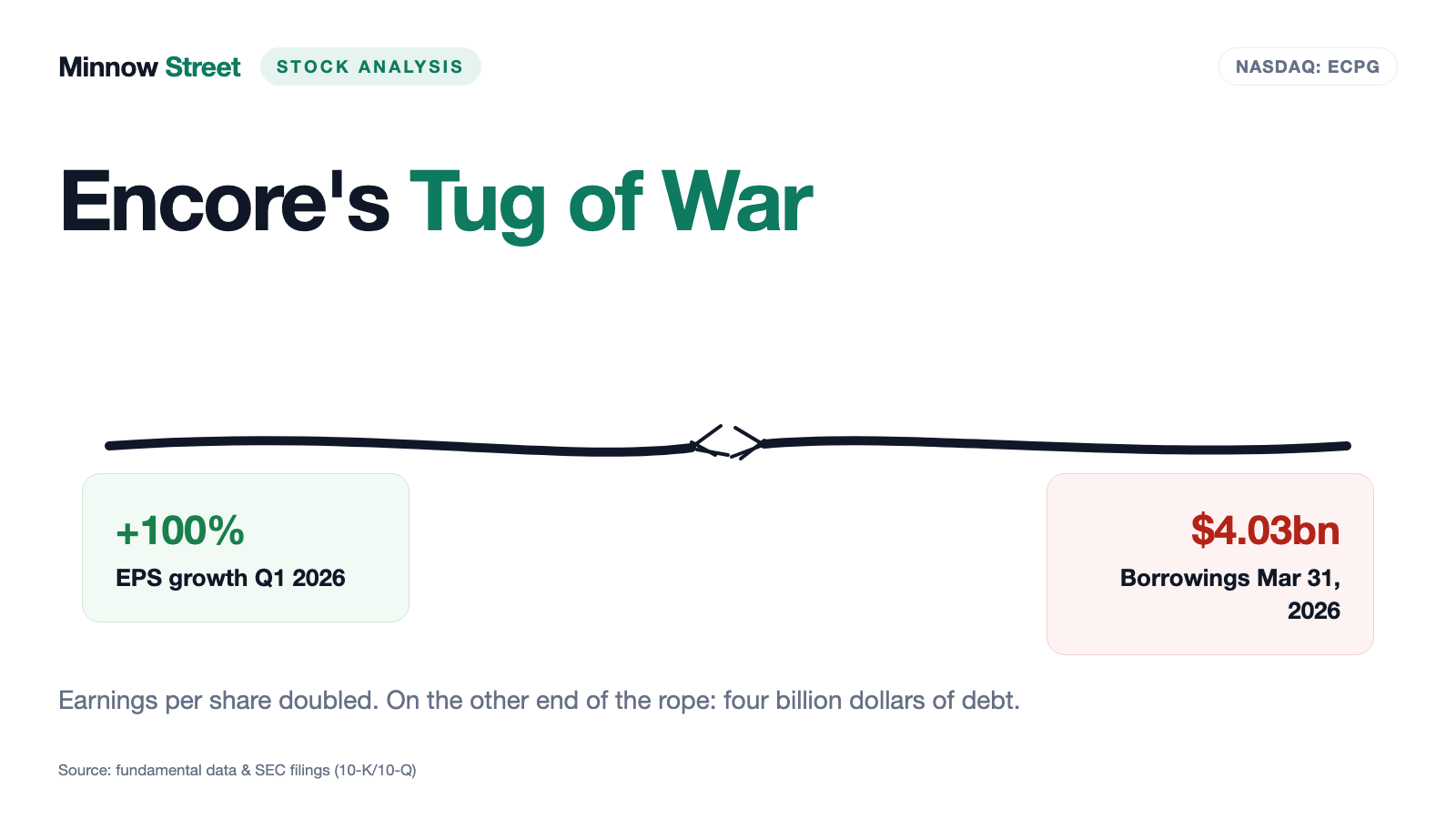
Encore Capital buys charged-off consumer debt for cents on the dollar and collects it. Diluted earnings per share doubled to $3.86 in the first quarter of 2026, the fifth straight quarter above the analyst consensus. The filings with the U.S. securities regulator, the SEC, also show where much of it comes from: a line called changes in recoveries, which subtracted $89.7 million from revenue in 2024 and added $208.8 million in 2025. Carrying all of it are $4,033.3 million of borrowings against $1,034.8 million of equity as of March 31, 2026. Let us separate the money that arrived from the money that was calculated.
 Thomas Mücke
Founder & Publisher
Thomas Mücke
Founder & Publisher
Chart
Interactive price chart (TradingView).
Note: pure fact-based analysis, not investment advice and not a solicitation to buy or sell. All figures without guarantee.
At a high jump, nobody cheers for the bar. Everyone watches the jumper — and that is exactly where the bar trap sits: a company beats the analyst consensus, once, twice, five quarters running, and at some point we stop asking who set the bar, and how high. With Encore Capital Group, Inc. (Nasdaq: ECPG) that question earns its keep, because there are two estimates in play: the one analysts publish outside the company, and the one that sits inside the income statement. The stock holds rank 18 in our Big Earnings Surprise scanner (U.S. universe, 81 hits, as of July 25, 2026). Before the streak carries us away, here is the deal: we read the annual report (10-K) for 2025, the quarterly report (10-Q) for the period ended March 31, 2026 and the current reports (8-K) through late July 2026 together — and we separate the part of the profit that was collected from the part that was calculated. Remember: a surprise is not a payment.
Contents
- What Encore Capital actually does
- How the stock reached our desk
- The numbers over the years — fairly credited
- What the filings say: five uncomfortable truths
- What the stock costs
- Opportunities and risks at a glance
- A human conclusion
- Sources
What Encore Capital actually does — the buyer of bills that bounced
Encore Capital went public in 1999 and is headquartered in San Diego. It makes money from something most people prefer to forget about: unpaid bills. When a bank writes off a credit card balance after months of fruitless effort, it sells the receivable for a fraction of face value. Encore buys it. Then the real work begins — letters, calls, payment plans and, where necessary, litigation. In plain language: Encore buys old debt in bulk and lives off the gap between what the bag cost and what eventually comes out of it.
The business stands on two legs. In the United States it trades as Midland Credit Management (MCM), with call centers in Phoenix, St. Cloud, Troy and Roanoke plus operations in India and Costa Rica. In Europe it owns Cabot Credit Management, including the servicing brand Wescot and its own law firm, Mortimer Clarke Solicitors, in the United Kingdom. Smaller activities in India and Mexico are described by the company itself as immaterial. As of December 31, 2025 roughly 7,350 people worked for Encore, 79 percent of them outside the United States.
In 2025 the group spent $1,408.1 million on new receivable portfolios (United States $1,174.0 million, Europe $234.1 million) and collected $2,592.8 million, up 19.9 percent on 2024. Slightly more than half of collections came through call centers and digital channels, close to a third through the legal channel and the remainder through outside agencies. Encore describes itself as a partner helping consumers back to financial health and points to its own Consumer Bill of Rights; regulators have traditionally viewed the industry more soberly — more on that below.
Which brings us to the central tension of this analysis, running through every chapter: a large share of the profit jump is real cash that actually arrived — but the line that makes it visible in the accounts is a forecast produced in-house. And that forecast carries four billion dollars of debt.
How the stock reached our desk
Encore Capital holds rank 18 in our in-house stock scanner named Big Earnings Surprise (U.S. universe, 81 hits, as of July 25, 2026). The filter looks for companies whose reported earnings per share came in well above the analyst consensus. Reproducing it takes two clicks: open the scanner, set the country to the United States, read from the top. The lists are recalculated daily — a rank today says nothing about tomorrow.
What makes this case interesting is the streak. According to fundamental data (as of July 25, 2026), reported earnings per share beat the consensus for five consecutive quarters: by roughly 96 percent in the first quarter of 2025, 108 percent in the second, 65 percent in the third, 60 percent in the fourth and roughly 41 percent in the first quarter of 2026. Before that the picture was very different: the final quarter of 2024 missed the estimate by a wide margin because a goodwill impairment of $100.6 million pushed the full year into a loss.
Translated and assessed: five straight beats is impressive, but so far it only tells us that analysts underestimated the business model — not that the model holds up indefinitely. For a look at how quickly a surprise turns into an accounting entry, our analysis of PDF Solutions covers the same scanner hit with a very different resolution. And Tilly’s sits in the same ranking as a company whose comparable sales jump while the quarter still ends in a loss. The scanner finds anomalies — the interpretation is our job.
The numbers over the years — fairly credited
Start with what genuinely impresses. Collections have risen sharply for years: $1,862.6 million in 2023, $2,162.5 million in 2024, $2,592.8 million in 2025. The first quarter of 2026 brought in $718.4 million, 19 percent more than a year earlier and the highest quarterly figure ever reported. That is not an accounting effect, that is money in the bank. The U.S. subsidiary MCM alone collected $556 million in the quarter, up 23 percent year over year.
The earnings statement has turned as well. After two loss years — a net loss of $206.5 million in 2023 and $139.2 million in 2024, both weighed down by goodwill impairments of $238.2 million and $100.6 million respectively — 2025 closed with net income of $256.8 million and diluted earnings per share of $10.91. The first quarter of 2026 continued the run: $86.2 million of net income and $3.86 per diluted share after $1.93 a year earlier, a clean doubling. Management raised guidance accordingly and now expects roughly $2.8 billion of collections and $13.00 of earnings per share for 2026 (release dated May 6, 2026).
And the company buys back its own stock. In 2025 it repurchased 2,117,733 shares for $89.5 million, adding a further 345,548 shares for $20.0 million in the first quarter of 2026. Shares outstanding fell from 23,691 thousand on December 31, 2024 to 21,499 thousand on March 31, 2026. Anyone buying the business today gets a larger slice per share than two years ago — a real and comparatively rare positive. Encore has never declared or paid a dividend as a public company.
What the filings say: five uncomfortable truths
Uncomfortable truth no. 1: the biggest revenue push is a change in forecast
Encore’s revenue has two building blocks, and only one behaves like ordinary revenue. The first, portfolio revenue, is essentially a yield: at purchase Encore fixes an internal rate of return, and the book throws off that yield year after year. That came to $1,455.8 million in 2025 and $1,302.6 million in 2024 — a calm, plannable climb.
The second block is called changes in recoveries and measures the deviation from the company’s own forecast. It in turn has two halves: one records how much more cash arrived in the quarter than expected — that is real money. The other is the present value of a revised expectation about the future and moves not a cent. And that is the line that flipped: in 2024 it subtracted $89.7 million from revenue, in 2025 it added $208.8 million. A swing of $298.5 million, against pre-tax income of $336.2 million for 2025.
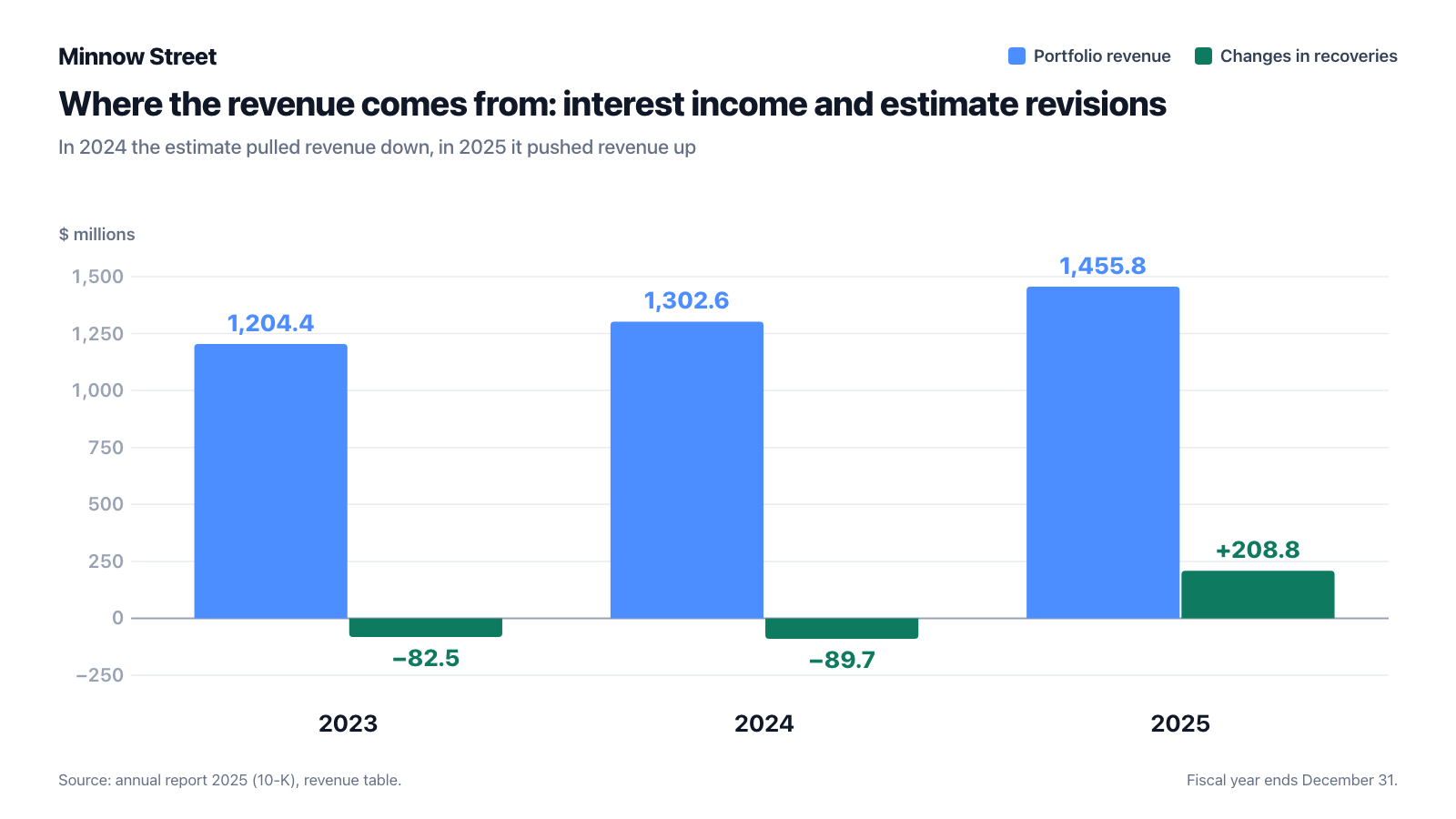
This deserves a fair reading. By far the larger part of the line is cash that genuinely arrived. In 2025 collections came in $197.8 million above what the model expected, while the future expectation was raised by only $11.0 million. In 2024 over-performance ran at $78.2 million while the future expectation was written down by $167.9 million — hence the minus. The swing therefore originates less in the cash book than in the forecast. The first quarter of 2026 repeated the pattern: $46.0 million of genuine over-performance plus $16.7 million from raised future expectations. Encore explains it in the quarterly report:
"Additionally, the sustained over-performance in recent quarters led to increases in forecasted future recoveries for recently acquired vintages. As a result, we recorded a net positive change of $16.7 million in expected future recoveries during the three months ended March 31, 2026."
— Encore Capital Group, Form 10-Q for the quarter ended March 31, 2026, management’s discussion and analysis
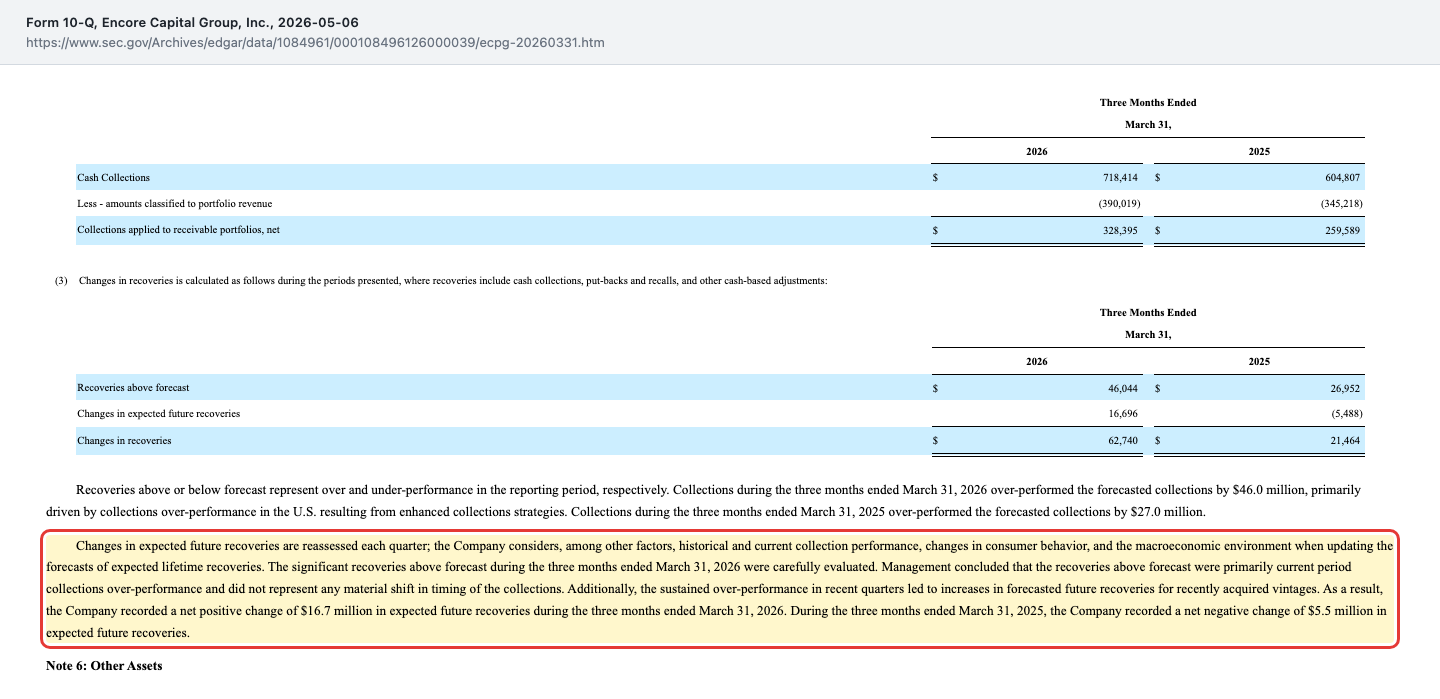
Arithmetically, for the first quarter of 2026: strip the line out of the $111.7 million of pre-tax income and $49.0 million remains. Assessed: none of this makes the numbers wrong — but it makes them dependent on a judgment made by the same management that is measured against it. It also explains why analysts were so far off: they cannot model the over-performance of someone else’s model.
Uncomfortable truth no. 2: the main asset reaches beyond 2034
Encore’s balance sheet carries a line worth $4,437.4 million (March 31, 2026) named receivable portfolios, net. It sounds like receivables — technically it is something else. Encore writes off every purchased receivable in full immediately and then books the discounted present value of all expected future recoveries against it. In plain language: the asset side holds a projection, not a promissory note.
How far that projection reaches shows up in the estimated remaining collections table. As of March 31, 2026 it totaled $9,825.3 million across 180 months — fifteen years. $870.6 million of that is not expected until after 2034, and Europe accounts for a disproportionate share. On an 84-month basis the figure stood at $8,264.6 million at year-end 2025 versus $9,684.3 million over 180 months; the roughly $1.4 billion difference is exactly the money expected beyond seven years.
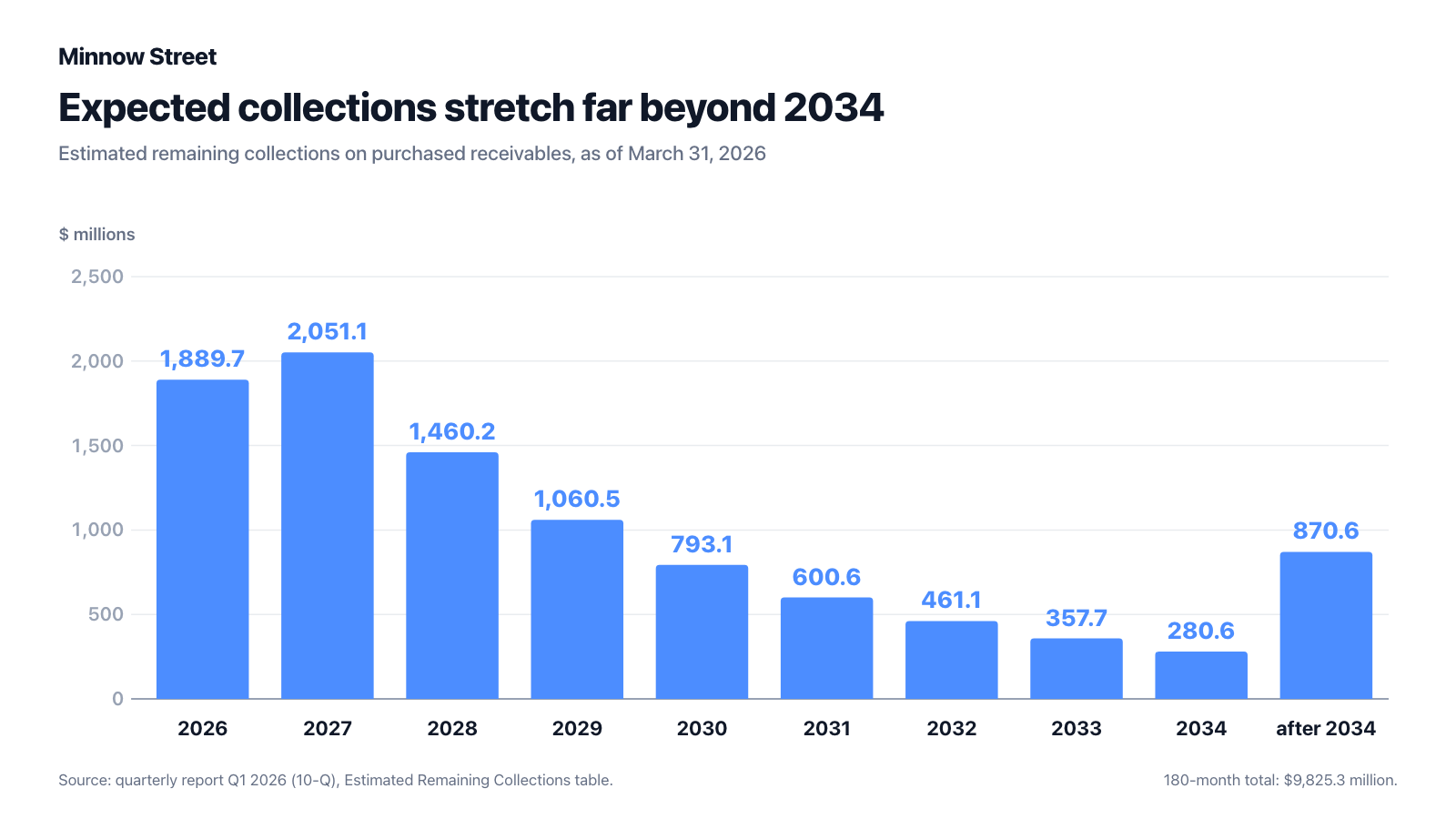
Assessed: a fifteen-year projection is standard practice in this industry and is reviewed every quarter. Even so, the further out an expected payment sits, the less the past says about it. Encore itself lists in its risk factors that its statistical models may prove inaccurate — unemployment, new laws or a changed reading of existing rules can shift the expectation at any time.
Uncomfortable truth no. 3: four dollars of debt for every dollar of equity
The business only works with borrowed money, because portfolios must be paid for in cash long before the first dollar returns. The liability side reflects that. As of March 31, 2026 there were $4,033.3 million of borrowings against $1,034.8 million of equity — close to four to one. The equity ratio stood at 19.0 percent of a $5,450.6 million balance sheet. The annual report puts it plainly:
"As described in greater detail in "Note 6: Borrowings" to our consolidated financial statements, as of December 31, 2025, our total long-term indebtedness outstanding was $4.0 billion."
— Encore Capital Group, Form 10-K for 2025, Item 1A Risk Factors

The cost shows up in the income statement: $293.9 million of interest expense in 2025 (2024: $252.5 million, 2023: $201.9 million), close to 47 percent of the $626.6 million of operating income. In the first quarter of 2026 it was $73.1 million against $184.0 million of operating income, roughly 40 percent. Translated: for every dollar earned in operations, nearly half goes to lenders before the tax authorities even knock. Encore must satisfy three maintenance covenants — a loan-to-value ratio of no more than 0.75, a second of no more than 0.275 and fixed charge coverage of at least 2.0. As of the quarter end the company reports compliance with all of them in all material respects.
The structure has shifted further since the quarter closed. In May 2026 Encore issued $750.0 million of senior secured notes at 6.625 percent due 2032 — upsized from the $550.0 million originally announced — and 325.0 million euros of floating rate notes due 2033. Working the other way is the redemption of 200.0 million euros of notes due 2028 on May 28, 2026. What that nets out to for borrowings and interest cost will only appear in the next quarterly report.
Uncomfortable truth no. 4: the supervisor left the building in October 2025
Collecting on bounced bills means working under observation. In the United States that means the Consumer Financial Protection Bureau (CFPB); in the United Kingdom it means the Financial Conduct Authority (FCA), which explicitly classifies debt collection as a high-risk activity. Encore has history with both. In 2015 it settled with the CFPB over practices between 2011 and 2015. In 2020 the same agency sued again — this time alleging violations of that very settlement. The case ended in a stipulated judgment and a payment. The annual report states:
"The Stipulated Judgment required us to, among other things, continue to follow a narrow subset of the operational requirements contained in the 2015 Consent Order, all of which have long been part of the Company’s routine practices and pay a $15.0 million civil monetary penalty. The Stipulated Judgment expired in October 2025."
— Encore Capital Group, Form 10-K for 2025, Item 1A Risk Factors
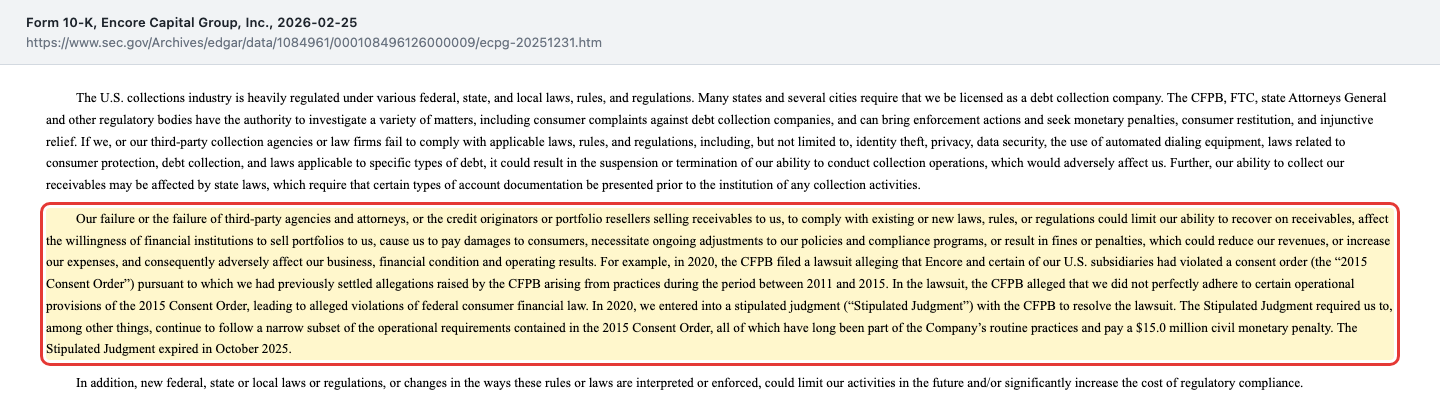
Assessed: the expiry is good news — a decade of special supervision ended without a replacement order. It is also the removal of external oversight in exactly the year in which the company’s own recovery models started producing record numbers. Anyone who takes the first item on this list seriously should not skip the second. One further detail appeared in the 2025 annual report that was absent a year earlier: Encore names artificial intelligence in its risk factors for the first time — both as the danger of falling behind on automation and as a reputational risk, because concerns about AI-enabled collection technologies could impair its ability to buy receivables at all. Nowhere does the company describe AI as a source of revenue.
Uncomfortable truth no. 5: the convertible bond is being paid in cash — roughly $332.5 million
On July 22, 2026 Encore announced that it was calling the entire 4.00 percent convertible notes due 2029, $230.0 million in principal, for redemption on September 24, 2026. Holders converting by September 22 receive an increased 16.2056 shares per $1,000 of principal instead of the regular 15.1763. The decisive sentence follows: converted notes are settled in cash, not in stock.
"If all of the Notes called for redemption were converted in connection with the Redemption and the price for the Company’s common stock on each day during the observation period over which the conversion consideration is determined remained equal to the closing price of the Company’s common stock on July 21, 2026, the Company would expect to make an aggregate cash payment of approximately $332.5 million to settle such conversions."
— Encore Capital Group, Form 8-K dated July 22, 2026, Item 8.01
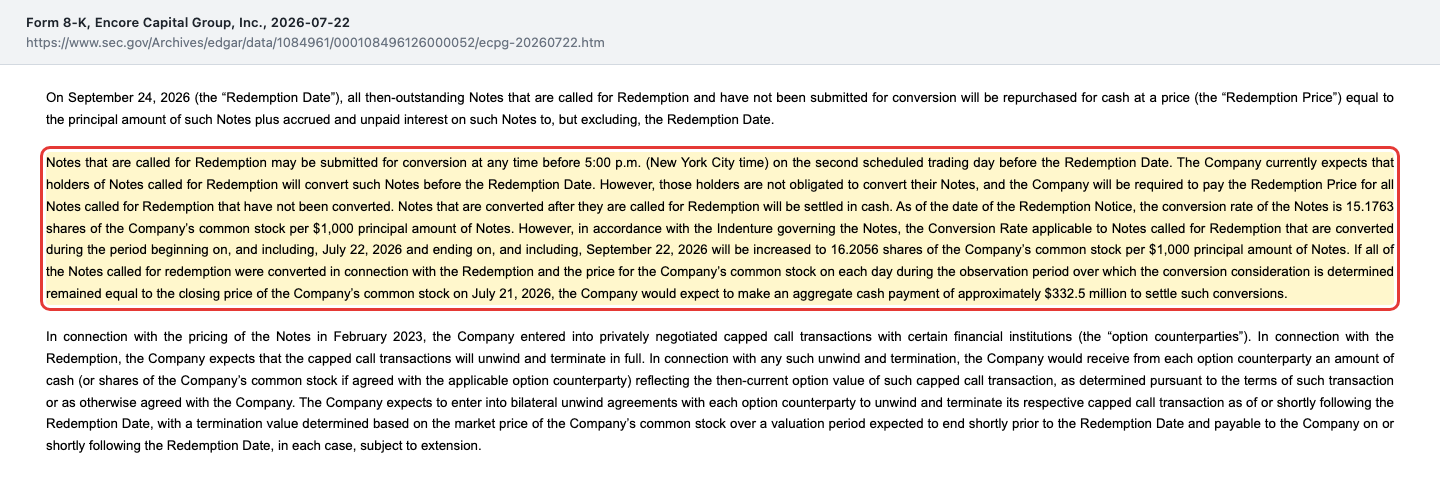
Assessed from both sides: for existing shareholders cash settlement is good news, because no new shares are created and the familiar dilution effect never arrives. Encore also receives the value of the capped call transactions entered into in 2023, which unwind with the redemption; no filing names the amount. The other side of the ledger: roughly $332.5 million leaves the company — about 17 percent of the roughly $1,933.0 million market capitalization (data as of July 25, 2026). Cash stood at $227.2 million on March 31, 2026, so the remainder has to come from operations or from the credit facility, on which $681.3 million was drawn at the same date.
What the stock costs
Market capitalization stood at roughly $1,933.0 million (data as of July 25, 2026) across 21,440,412 shares outstanding — an unusually small share count for a company of this size, which makes the price per share look optically high. Against trailing twelve-month earnings that is a price-to-earnings ratio of roughly 6.7, and roughly 5.5 against the analyst estimate for the current year. Book value per share is $48.13, putting the price-to-book ratio at roughly 1.8. Enterprise value including debt runs to about $5,640 million, or 8.1 times operating earnings before depreciation and amortization.
Translated and assessed: a single-digit price-to-earnings ratio is not a bargain signal in this industry, it is the norm — the market is pricing in that the profits stem from a model calculation and that the balance sheet is heavily levered. The spread of opinion is more telling. Five analysts carry an average target price of $113.33, three of them at the highest buy rating. At the same time 8.15 percent of the float is sold short — 1.4 million shares, more than four days of average volume. The 52-week range ran from $35.675 to $94.60 (data as of July 25, 2026). Rarely is so much disagreement packed into so little space.
Opportunities and risks at a glance
Opportunities
- Supply holds up: according to the annual report, U.S. lending and charge-off rates remain near recent peaks, issuers sell predominantly fresh portfolios and commit through multi-year forward flow arrangements. U.S. purchases alone absorbed $1,174.0 million in 2025.
- Regulation as scale advantage: Encore itself sees smaller competitors disadvantaged by the cost of compliance — high regulatory costs work like a moat for the market leader.
- Collections grow in cash, not only on paper: $718.4 million in the first quarter of 2026 is a record and 19 percent above the prior-year quarter.
- The share count is falling: from 23,691 thousand on December 31, 2024 to 21,499 thousand on March 31, 2026, with $302.4 million of buyback authorization still open at year-end 2025.
- The decade-long CFPB stipulated judgment expired in October 2025 without a replacement order.
Risks
- A meaningful share of the earnings jump rides on the company’s own forecast: changes in recoveries swung by $298.5 million within a single year. If it swings back, profit follows.
- Leverage: $4,033.3 million of borrowings against $1,034.8 million of equity (March 31, 2026), three maintenance covenants, and interest expense that absorbed close to half of operating income in 2025.
- Roughly $332.5 million is expected to leave for the convertible redemption by September 24, 2026 — against $227.2 million of cash as of March 31, 2026.
- Regulatory background noise: the CFPB, the FTC, state attorneys general, the FCA and the Central Bank of Ireland can open proceedings at any time; changes in practice can directly lower estimated remaining collections, per the annual report.
- Europe is soft: Cabot bought only $234.1 million of portfolios in 2025 after $353.2 million in 2024, with pricing described as too competitive.
- Two-way economic exposure: rising unemployment means consumers pay less, falling unemployment means fewer defaults to buy.
A human conclusion
Back to the bar trap. Five consecutive quarters above the analyst consensus feels like proof. What it mainly proves is that Encore’s own recovery model has been reading reality conservatively. That is good news. It is simply a different statement from "this company earns more money", because part of the jump is present value rather than cash.
What is left once you separate the two? A business that collects more money every year than the year before, that is shrinking its share count, that breathes freely again after a decade of special supervision — and that sits on four dollars of debt per dollar of equity, owes a nine-figure cash payment in September and whose largest asset is a projection running past 2034. Both halves belong together. Anyone who sees only the streak is buying a statistic; anyone who sees only the debt is missing a functioning business.
The most honest sentence about this stock is written into its own valuation: a price-to-earnings ratio of barely seven with an average analyst target far above the price — and eight percent of the float sold short all the same. Two camps read the same filings and reach opposite conclusions. Where the fault line between them runs is now on the page. What you make of it is your decision. And that is exactly as it should be.
Sources
- Form 10-K for the year 2025, filed February 25, 2026 (SEC EDGAR, CIK 0001084961)
- Form 10-Q for the quarter ended March 31, 2026, filed May 6, 2026
- First quarter 2026 earnings release (Form 8-K dated May 6, 2026, Exhibit 99.1) — raised guidance
- Form 8-K dated July 22, 2026 — redemption of the 4.00 percent convertible notes due 2029
- Form 8-K dated May 26, 2026 — $750.0 million of senior secured notes at 6.625 percent
- Form 8-K dated May 29, 2026 — 325.0 million euros of floating rate notes
- Form 8-K dated June 16, 2026 — results of the annual meeting held June 12, 2026
- Form 10-K for the year 2024, filed February 26, 2025 — comparison year
- Fundamental data (valuation metrics, analyst view, earnings surprises), data as of July 25, 2026
- Our in-house stock scanner Big Earnings Surprise, U.S. universe, as of July 25, 2026
This article is journalistic commentary on publicly available company filings and is not investment advice. It contains no recommendation to buy or sell and is not a solicitation to buy or sell securities. Shares can suffer substantial losses, and a total loss of invested capital is possible. All figures come from the sources listed above and carry the reporting date stated there. The author holds no position in Encore Capital Group, Inc. at the time of publication.
Our Bottom Line at a Glance
- Operating momentum positive
- Cash actually collected has risen for years and is no accounting effect: $1,862.6 million (2023), $2,162.5 million (2024), $2,592.8 million (2025) and a record quarter of $718.4 million for the period ended March 31, 2026 (up 19 percent). The U.S. subsidiary MCM alone contributed $556 million in the quarter.
- Earnings quality negative
- A meaningful share of the earnings jump hangs on the changes in recoveries line, which swung by $298.5 million within a year (2024: minus $89.7 million; 2025: plus $208.8 million) against pre-tax income of $336.2 million for 2025. In the first quarter of 2026, $16.7 million of the $62.7 million came from pure forecast increases with no cash effect.
- Balance sheet and leverage negative
- $4,033.3 million of borrowings against $1,034.8 million of equity (March 31, 2026), an equity ratio of 19.0 percent. Interest expense of $293.9 million consumed close to 47 percent of operating income in 2025; May 2026 added $750.0 million and 325.0 million euros of new secured notes on top.
- September 2026 cash date negative
- The redemption of the 4.00 percent convertible notes due 2029, announced on July 22, 2026, is expected to cost roughly $332.5 million in cash by September 24, 2026 — about 17 percent of market capitalization, against $227.2 million of cash as of March 31, 2026. No new shares are issued, and the value of the unwound capped calls flows back.
- Regulation neutral
- The 2020 stipulated judgment with the U.S. Consumer Financial Protection Bureau ($15.0 million civil monetary penalty) expired in October 2025 without a replacement order — a genuine relief. At the same time the CFPB, the FTC, state attorneys general, the FCA and the Central Bank of Ireland remain free to act, and changes in practice directly lower estimated remaining collections per the annual report.
- Share count and valuation positive
- Shares outstanding fell from 23,691 thousand (December 31, 2024) to 21,499 thousand (March 31, 2026), with $302.4 million of buyback authorization still open at year-end 2025. The market prices this at roughly 6.7 times earnings and 1.8 times book value (data as of July 25, 2026) — against an average analyst target of $113.33 and 8.15 percent of the float sold short.
Encore Capital is the case where two numbers have to be kept apart. The cash collected grows steadily and for real — $2,592.8 million in 2025, a record quarter of $718.4 million for the period ended March 31, 2026. Yet the celebrated jump to $3.86 of earnings per share rests to a meaningful degree on the changes in recoveries line, which swung by $298.5 million within a year and whose future-expectation half moves no cash at all. Carrying both is $4,033.3 million of borrowings against $1,034.8 million of equity, and in September 2026 roughly $332.5 million is expected to leave for the convertible redemption. Investing here means buying a working collection business attached to a balance sheet that forgives no forecasting errors. Not investment advice.
What Our Rating Means
Open questions
The business works in principle, but one material question is open. As long as it stays open, our findings do not carry a quality verdict.
The decisive number is not earnings per share but the changes in expected future recoveries line in the next quarterly report: it most recently stood at plus $16.7 million (Q1 2026) after subtracting $167.9 million in 2024. Anyone who wants to know whether the streak holds waits for that line and for the cash impact of the September 24, 2026 convertible redemption — together they say more about the next twelve months than any analyst estimate. The decision is yours.
A journalistic assessment by our editorial team at the time of the deep dive, based on public sources — not investment advice and not a solicitation to buy or sell. Your personal circumstances (investment goals, risk capacity, taxes) cannot be taken into account. What our levels mean, how verdicts are formed, and what conflicts of interest exist →
Worth Noting
- Hook: rank 18 in our in-house Big Earnings Surprise ranking (U.S. universe, 81 hits), as of July 25, 2026 — the lists are recalculated daily.
- Data dates: annual figures from the Form 10-K for 2025 (filed February 25, 2026), quarterly figures from the Form 10-Q for the period ended March 31, 2026 (filed May 6, 2026), financing events from current reports through July 22, 2026, valuation metrics as of July 25, 2026.
- Do not confuse: Encore Capital Group (Nasdaq: ECPG, receivables purchasing) has nothing to do with Encore Wire (copper cable, acquired by Prysmian in 2024) or Encore Energy. The company was named MCM Capital Group Inc. until March 2002.
- The balance sheet as of March 31, 2026 does not yet include the May 2026 issues of $750.0 million and 325.0 million euros; the next quarterly report is the first in which they appear.
Frequently Asked Questions
Encore buys defaulted consumer receivables — mostly charged-off credit card balances — at a deep discount to face value and collects on them over years. In the United States this runs through Midland Credit Management, in Europe through the Cabot group. In 2025 the company spent $1,408.1 million on portfolios and collected $2,592.8 million.
Because Encore's own recovery model underestimated reality. The changes in recoveries line captures that deviation and contributed a positive $208.8 million in 2025 after subtracting $89.7 million in 2024. Analysts can hardly forecast the over-performance of a company's internal model, which is what produced the streak of surprises.
Both, in a known ratio. Of the $62.7 million contributed by the line in the first quarter of 2026, $46.0 million came from payments actually collected above forecast and $16.7 million from raised future expectations that move no money at all. For 2025 the split was $197.8 million against $11.0 million.
As of March 31, 2026 borrowings stood at $4,033.3 million against $1,034.8 million of equity, an equity ratio of 19.0 percent. Interest expense of $293.9 million absorbed close to 47 percent of operating income in 2025. The company reports compliance with its three maintenance covenants in all material respects.
On July 22, 2026 Encore called the entire $230.0 million of 4.00 percent convertible notes due 2029 for redemption on September 24, 2026. Conversions are settled in cash, with an expected payment of roughly $332.5 million. No new shares are created, but the cash position takes a noticeable hit.
That is Encore's own estimate of how much cash the already purchased portfolios will still produce. As of March 31, 2026 it totaled $9,825.3 million over 180 months, or fifteen years, with $870.6 million not expected until after 2034. Only the discounted present value of $4,437.4 million appears on the balance sheet.
Heavily, and across two jurisdictions. In the United States the Consumer Financial Protection Bureau supervises collection practices; in the United Kingdom the Financial Conduct Authority does, classifying debt collection as a high-risk activity. A 2020 settlement with the CFPB cost $15.0 million in penalties and expired in October 2025.
No. The company has never declared or paid a dividend as a public company, and bond covenants plus the credit facility restrict distributions further. Capital goes into new receivable portfolios and share buybacks instead — 2,117,733 shares for $89.5 million in 2025.
Found an error?
Did you spot a factual error, an outdated number, or a typo in this deep dive? Let us know briefly — your report goes straight to the editorial team.