Tilly's: Comparable Sales Jump 22.9 Percent — and the Quarter Still Ends With an $8.0 Million Loss
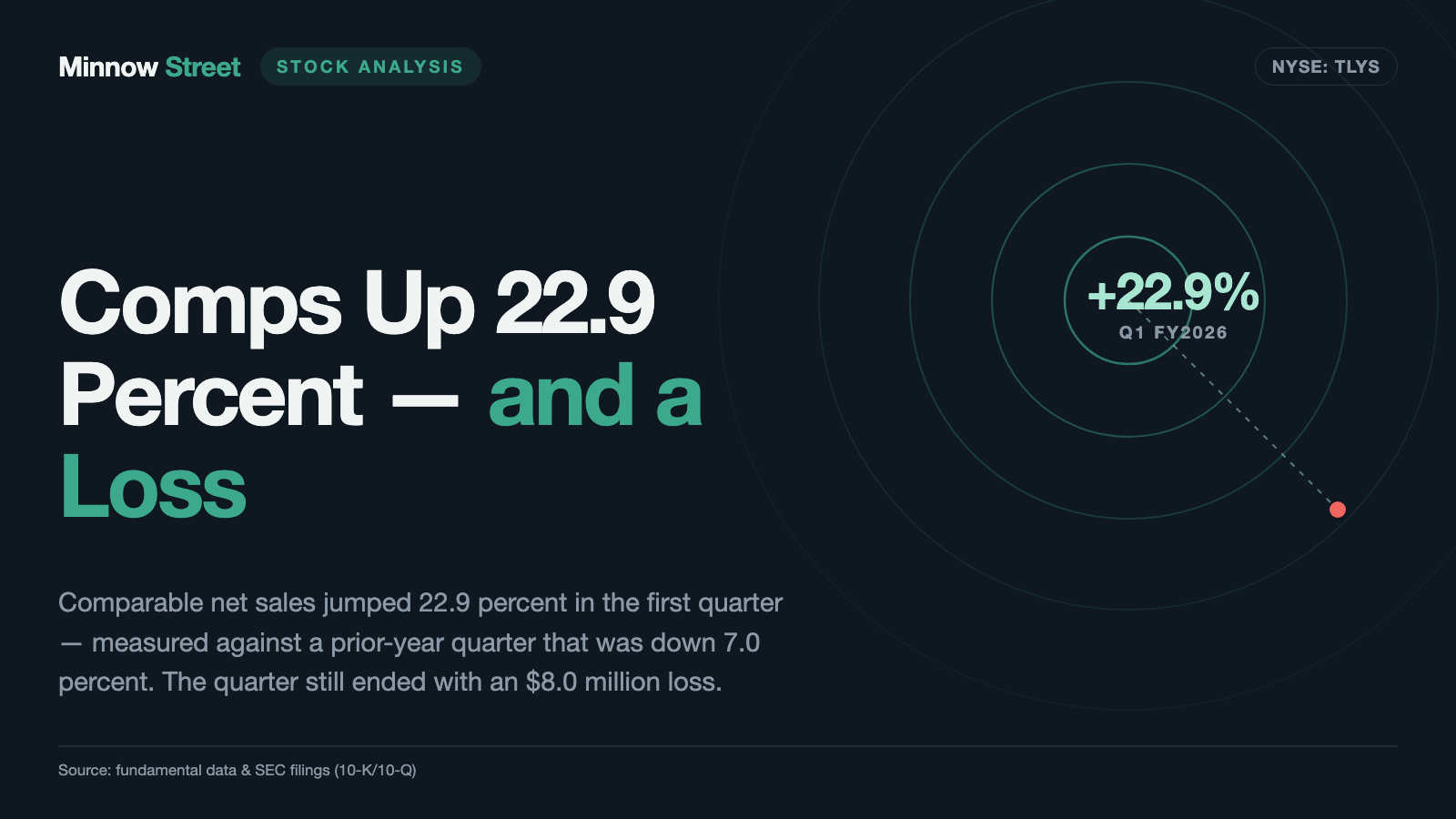
One number is enough to make a stock look like a turnaround: comparable net sales up 22.9 percent in the first quarter of fiscal 2026. The quarterly report to the U.S. securities regulator, the SEC, supplies the second half of that sentence right away — it was measured against a prior-year quarter that was down 7.0 percent, and despite the jump the company still lost $8.0 million. Its own outlook for the current quarter calls for only 6 to 10 percent. Add rent paid to companies owned by the two co-founders ($4.3 million in fiscal 2025), 75.9 percent of the voting power in two pairs of hands holding about 24 percent of the equity, and 2,500,000 newly registered employee shares in June 2026. Not investment advice — just the question of how much turnaround fits inside a single percentage.
 Thomas Mücke
Founder & Publisher
Thomas Mücke
Founder & Publisher
Chart
Interactive price chart (TradingView).
Note: pure fact-based analysis, not investment advice and not a solicitation to buy or sell. All figures without guarantee.
There is an investor trap that needs no greed and no panic — just a large percentage. Call it the base trap. It works like this: you read "up 22.9 percent" and your head fills in "the company is growing again." What it does not fill in is the question of up from where. A percentage always describes two things — the height of the jump and the depth of the spot you jumped from. And the deeper that spot, the bigger the number, without anything actually having been won. Tilly's (NYSE: TLYS), a teen apparel retailer from Irvine, California, delivered exactly such a number in the first quarter of its fiscal 2026: comparable net sales rose 22.9 percent. On our side the stock landed at rank 9 in our in-house Big Earnings Surprise ranking (U.S. selection, as of July 25, 2026). So let us make a deal: before you file that number under "turnaround," we read together what Tilly's actually reported to the U.S. securities regulator, the SEC — the quarterly report (10-Q) for the period ended May 2, 2026, the annual report (10-K) for fiscal 2025, and the earnings releases that go with them. An SEC filing is honest under penalty of law, and this one names the launch point itself. At the end, you decide.
What Tilly's actually does — skate looks, brand racks, shopping centers
Tilly's is a specialty retailer of casual apparel: T-shirts, pants, sneakers, backpacks, caps — for young men, young women, boys and girls. Translated into an everyday picture: a store in a shopping center where a sixteen-year-old finds the brands her friends wear, with the retailer's own labels sitting on the same rack. The company describes itself as a destination for an "active, outdoor and social lifestyle" — skate, surf and streetwear aesthetics, music videos on the walls, sales associates who are meant to look like the customers. It started in 1982, when co-founders Hezy Shaked and Tilly Levine opened their first store in Orange County; since 1984 the operating business has run through the California corporation World of Jeans & Tops, and since the initial public offering in May 2012 it has sat under the Delaware holding company Tilly's, Inc.
The scale today: 220 stores in 32 states as of May 2, 2026, averaging about 7,127 square feet of selling space each. E-commerce accounted for 22.8 percent of net sales in the first quarter of fiscal 2026; online orders ship to all 50 states. The annual report names Abercrombie & Fitch, American Eagle Outfitters, Hollister, Hot Topic, Urban Outfitters and Zumiez among its competitors — plus Amazon and the low-price players Shein and Temu. One word on the calendar, because otherwise every figure slips: the fiscal year ends on the Saturday closest to January 31. When Tilly's says "fiscal 2025," it means the 52 weeks ended January 31, 2026; the current fiscal 2026 ends on January 30, 2027. That sets the central tension of this analysis, and it runs through every chapter: comparable sales are rising sharply, but the company is not earning money yet — and the jump is getting smaller from quarter to quarter as the base gets higher.
How the stock landed on our desk
Tilly's sits at rank 9 in the U.S. selection of our in-house stock scanner for big earnings surprises (as of July 25, 2026), with a relative strength rating of 95 out of 100. To reproduce it: open the stock scanner section, pick the "Big Earnings Surprise" list, filter to the U.S. selection and read the ranking from the top — the lists are recomputed daily, so today's rank is not tomorrow's rank. What does this filter measure? It looks for companies whose actual earnings per share came in well above what analysts expected. At Tilly's the streak is unusually long: four consecutive quarters above expectations. On September 3, 2025 it was $0.10 per share against an estimate of −$0.04; on December 3, 2025, −$0.05 against −$0.30; on March 11, 2026, $0.10 against −$0.15; on June 3, 2026, −$0.26 against −$0.33.
And now the translation, because naming a metric is not judging it: an earnings surprise says nothing about whether a company earns money — only that it did better than the estimate. Three of those four quarters ended in a loss or with a profit of ten cents a share despite the "surprise." Remember the sentence right here: a positive surprise measures the distance to the estimate, not the distance to breakeven. Which is exactly why the filings are worth reading.
The numbers over the years — credit where it is due
First the part that genuinely impresses, and it is more than the red bottom line suggests. In the first quarter of fiscal 2026 (13 weeks ended May 2, 2026) net sales rose 15.9 percent to $124.7 million, comparable net sales 22.9 percent. E-commerce net sales grew 30.9 percent to $28.4 million, physical store sales 12.1 percent to $96.3 million — with 18 fewer stores than a year earlier. More important is what happened to the margin: gross profit — what is left after merchandise cost, buying, distribution and store occupancy — rose from $21.3 million to $36.1 million, from 19.8 percent to 28.9 percent of net sales. Product margin climbed from 52.6 percent to 56.6 percent because less merchandise had to be marked down. The operating loss fell from $22.7 million to $8.1 million, the net loss from $22.2 million to $8.0 million, or from $0.74 to $0.26 per share. Net sales per store rose from $353 thousand to $430 thousand, and per square foot from $49 to $60. Those are real, audited improvements — not an accounting trick.
Now the frame around that improvement. Net sales by fiscal year look like this:
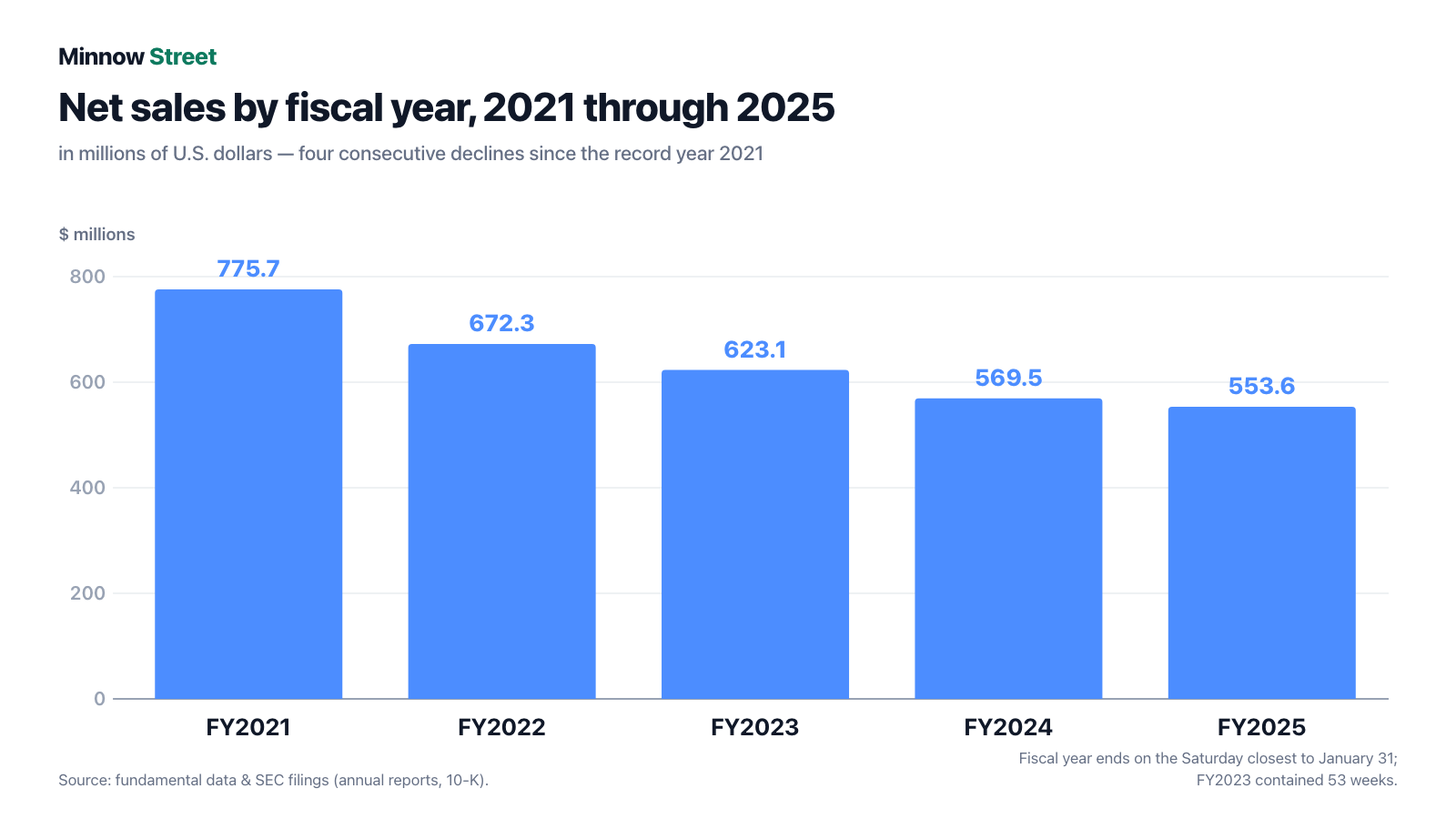
The record year 2021 fell into the period of U.S. stimulus support — Tilly's earned $64.2 million net back then. Four years downhill followed: $9.7 million of profit in fiscal 2022, then a $34.5 million loss (2023), a $46.2 million loss (2024) and a $17.5 million loss (2025). The store count came down too: 248 at the end of fiscal 2023, 240 (2024), 223 (2025). And comparable net sales — the metric at the heart of this story — ran at minus 10.6 percent (2023), minus 8.0 percent (2024) and plus 0.3 percent (2025). Lining up the quarters shows the turn more clearly than the annual figures do:
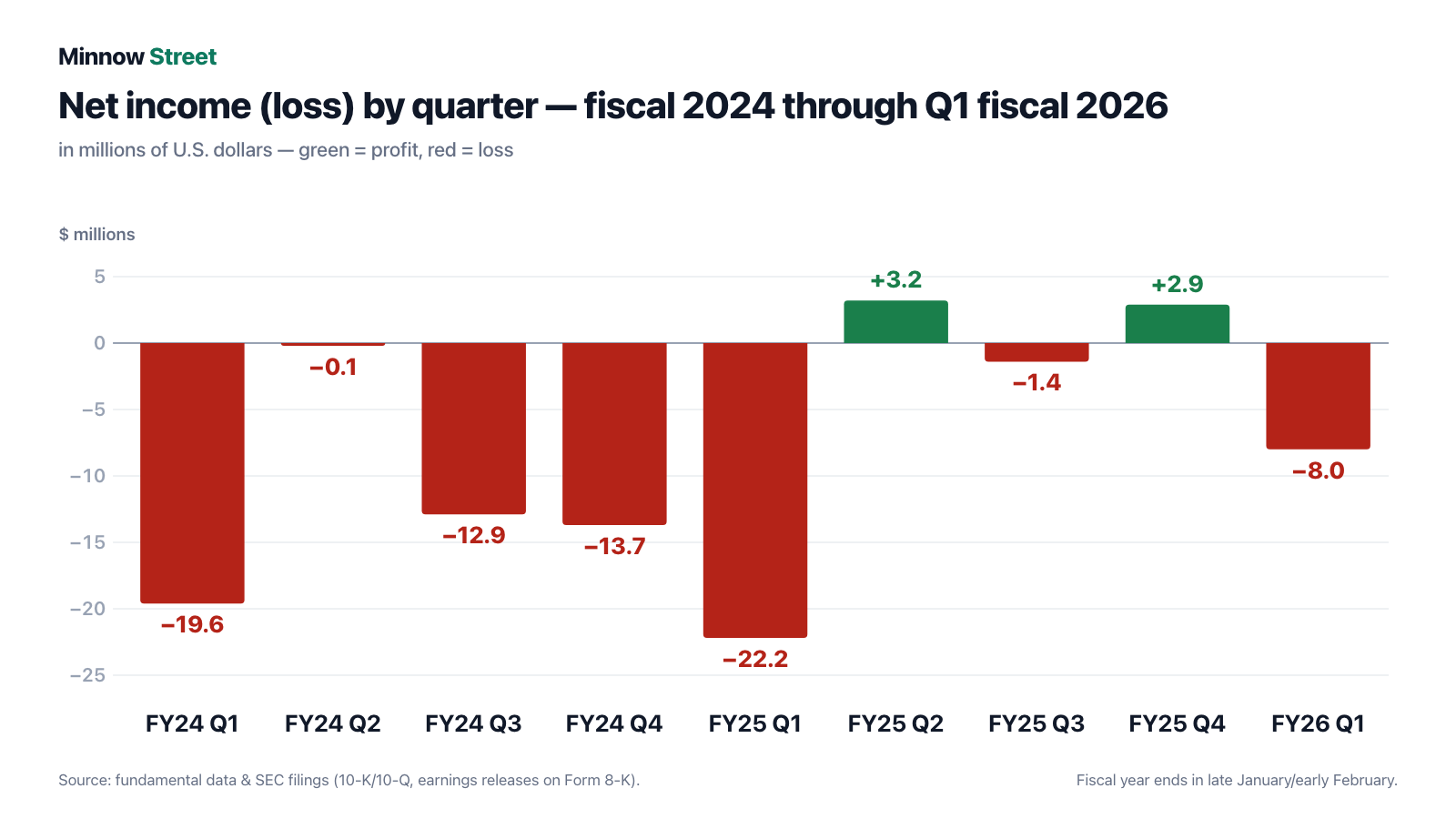
The fourth quarter of fiscal 2025 (the holiday quarter, 13 weeks ended January 31, 2026) was, per the company's own release, the first profitable fourth quarter since fiscal 2021: $155.1 million of net sales, comparable net sales up 10.1 percent, $2.9 million of net income. And President and CEO Nate Smith states the goal for the current year as plainly as one rarely reads it:
"Returning to profitability is our foremost goal for fiscal 2026. We believe the strength of our start to the fiscal year gives us a clear and credible path to get there, provided we can maintain a strong, positive sales trajectory throughout the year."
— Tilly's, Inc., Form 8-K earnings release dated June 3, 2026, Exhibit 99.1
So let us be precise: the improvement is real, broad and visible across several quarters. And yet the sentence above it all is not "Tilly's is earning money again" but "Tilly's wants to earn money again." The difference is the rest of this analysis.
What the filings say — the uncomfortable truths
Uncomfortable truth No. 1: the 22.9 percent sits on a base of minus 7.0 percent
The quarterly report gives the good half of the sentence first:
"Total net sales were $124.7 million, an increase of 15.9%. Total comparable net sales, including both physical stores and e-com, increased by 22.9%."
— Tilly's, Inc., Form 10-Q for the quarter ended May 2, 2026, Item 2 (MD&A)

Two pages later, in the store operating data table, sits the other half: in the prior-year quarter — the 13 weeks ended May 3, 2025 — comparable net sales were down 7.0 percent. Let us compound it, the way one should with any jump figure: start at 100, end year one at 93, then add 22.9 percent and you stand at 114.3. Over two years that is 14.3 percent of growth, or roughly 7 percent a year. For an apparel retailer in a difficult market that is decent — but it is not what "up 22.9 percent" suggests at first glance. Translated into an everyday picture: losing ten pounds in January after gaining twelve in December makes for an impressive percentage and an unimpressed scale.
And the number is already shrinking. In the same release that announced the 22.9 percent, Tilly's published its outlook for the current second quarter (13 weeks ending August 1, 2026): in fiscal May — through May 30, 2026 — comparable net sales were up 8.3 percent, the tenth consecutive month of growth. For the full second quarter the company expects net sales of $154 million to $160 million, which would translate into comparable net sales growth of 6 to 10 percent. The jump gets smaller because the base gets higher — in the second quarter of fiscal 2025 Tilly's already earned $3.2 million. That is not a criticism, it is arithmetic. But it means that anyone extrapolating the 22.9 percent is extrapolating a number the company itself has already halved.
Uncomfortable truth No. 2: the growth comes out of a shrinking store base
The second line in the exhibit above is the one that rarely travels with the headline: Tilly's ended the first quarter with 220 stores against 238 a year earlier — 18 fewer, a decrease of 7.6 percent. Selling space fell from 1.707 million to 1.568 million square feet. That is precisely why comparable net sales (up 22.9 percent) look so much stronger than total net sales (up 15.9 percent): comparable sales count only stores open in both periods, plus e-commerce. Closed stores drop out of that calculation — but their sales are missing from the total.
This is not accounting sleight of hand; that is how the metric is defined worldwide. It is, however, the explanation for why the annual series stubbornly refuses to grow: in fiscal 2025 comparable net sales rose 0.3 percent — and total net sales still fell 2.8 percent to $553.6 million, because 17 fewer stores were open. The annual report does the math itself: plus $1.6 million from comparable sales, minus $17.5 million from the stores that went away. For the current fiscal year Tilly's plans four to six new stores — while also facing roughly 40 lease decisions where, per the filing, further closures are possible if the terms are not right. At the end of the quarter on August 1, 2026 the company expects 221 stores against 232 a year earlier. Remember the pattern: the space is getting more productive, but it is also getting smaller — and so far the two together do not add up to growing sales. How quickly store closures can turn into a downward spiral is something we worked through elsewhere using the discount grocer Grocery Outlet, which gave up 36 locations and wrote off $307 million of goodwill.
Uncomfortable truth No. 3: a quarter of the annual loss is rent paid to the founders
Tilly's runs its head office, warehouse and online distribution center out of three buildings in Irvine — and leases all three from companies owned by the co-founders. The quarterly report puts it without varnish:
"We lease approximately 172,000 square feet of office and warehouse space (10 and 12 Whatney, Irvine, California) from a company that is owned by the co-founders of Tillys."
— Tilly's, Inc., Form 10-Q for the quarter ended May 2, 2026, Note 3 (Leases, Related Party)

Add 11 Whatney (about 26,000 square feet, $0.2 million of quarterly rent, term through June 30, 2032) and 17 Pasteur (about 81,000 square feet, the e-commerce distribution center, $0.4 million of quarterly rent, term through October 31, 2031). Together, fiscal 2025 carried $4.3 million of related-party rent expense through the income statement — $3.727 million inside cost of goods sold and $0.534 million inside selling, general and administrative expenses. That is roughly 24 percent of the $17.5 million net loss reported for the same year. And the contracts have direction built in: at 11 Whatney and 17 Pasteur the rent rises annually by the greater of 5 percent or the Los Angeles-area consumer price index — a floor, not a ceiling. At 10 and 12 Whatney the consumer price index applies with a cap of 7 percent. Remaining commitments to these landlords stood at $16.8 million on May 2, 2026.
In fairness: all of this is fully disclosed, has been known since the IPO, and the leases date from 2003, 2011 and 2012 — they were not invented yesterday. The point is a different one: when the largest of the three expires in December 2027, Tilly's will renegotiate with a company owned by its own founders — and on the corporate side of the table sits Hezy Shaked, the same man who chairs the board as Executive Chairman. That is the point at which a minority shareholder has no say. Why, is the next truth.
Uncomfortable truth No. 4: 75.9 percent of the votes belong to two people holding 24 percent of the equity
Tilly's has two classes of stock. The NYSE-listed Class A carries one vote per share; the unlisted Class B carries ten. The annual report says who owns them:
"All of the shares of Class B common stock are beneficially owned by Hezy Shaked and Tilly Levine. As a result, Mr. Shaked and Ms. Levine own a significant economic interest in the company and substantial majority of the total voting power of our outstanding common stock."
— Tilly's, Inc., Form 10-K for fiscal 2025, Item 1A (Risk Factors)
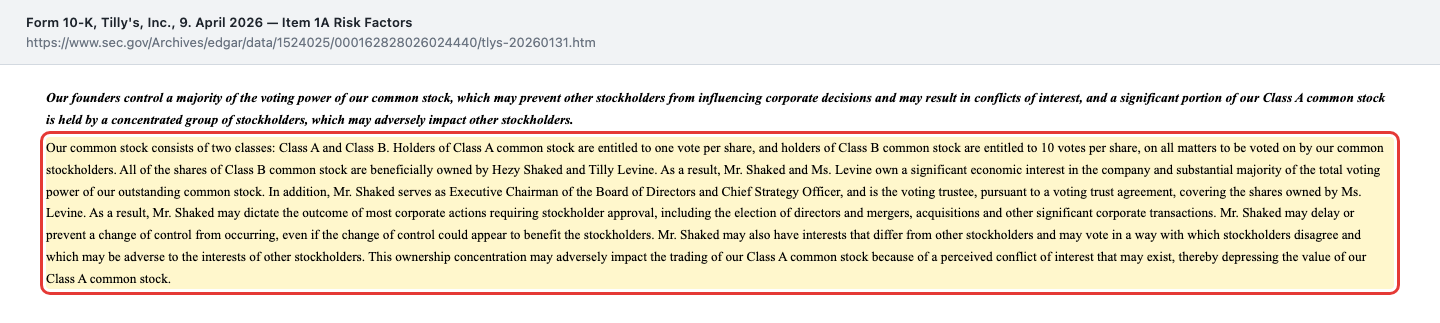
The arithmetic sits in the report on the annual meeting held June 10, 2026. As of the record date, April 17, 2026, there were 23,182,312 Class A shares and 7,306,108 Class B shares, together 96,243,392 votes. Class B alone supplies 73,061,080 of them — 75.9 percent of the votes on about 24 percent of the equity. Hezy Shaked is Executive Chairman and Chief Strategy Officer and also voting trustee for Tilly Levine's shares; per the filing he may dictate the outcome of most matters requiring shareholder approval and may prevent a change of control. Formally, that makes Tilly's a "controlled company" under NYSE rules — a status that exempts it from several corporate governance requirements; the company states it complies anyway, and five of its seven directors are independent.
A second number from the same report makes the situation tangible: the aggregate market value of the shares held by non-affiliates was exactly $15,363,799 on August 1, 2025 — at a closing price of $1.70 that is roughly 9.0 million of the 30.5 million shares. The rest sits with the founders and a handful of large holders who together own more than 30 percent of the Class A. Translated into an everyday picture: you are buying into a family business where every decision has already been made before you raise your hand — and where very few shares can move the price a great deal. How much a brand can hang on a single shareholder base despite strong numbers is visible in the comparison with footwear group Deckers, which delivered a record year and whose stock still hung on the clearance rack.
Uncomfortable truth No. 5: two weeks after the annual meeting, 2.5 million new shares appeared
On June 10, 2026, shareholders approved the fourth amended and restated 2012 equity plan — with 79,220,610 votes for against 739,201 votes opposed, which is no surprise when 75.9 percent of the voting power sits in two pairs of hands. Two weeks later, on June 26, 2026, the company told the SEC what that means in practice:
"The Plan authorizes the issuance of 11,113,900 shares of Common Stock, of which 2,500,000 shares of Common Stock are being registered hereunder …"
— Tilly's, Inc., Form S-8 dated June 26, 2026, Exhibit 107.1 (Filing Fee Table)

Against the 30,488,420 shares outstanding, 2.5 million new shares are 8.2 percent. "Dilution" sounds technical; translated it means: your slice of the pie gets smaller without you doing anything. For balance: such plans are drawn down over years, and equity compensation in a company without profits is a legitimate way to keep staff without burning cash — share-based compensation expense in the first quarter of fiscal 2026 was $0.5 million. You just want to know that the turnaround math includes this line too. And the S-8 supplies a clean, dated valuation anchor along the way: $4.3150, the average of the high and low price on the New York Stock Exchange on June 25, 2026.
What the company itself flags as the risk
In its forward-looking statements the quarterly report lists one item worth reading twice, because it packs the whole investment question into a single line:
"our recent history of operating losses, and our potential need to commence borrowing under our credit facility and/or to acquire additional liquidity if our comparable net sales trend were to remain negative for an extended period of time"
— Tilly's, Inc., Form 10-Q for the quarter ended May 2, 2026, forward-looking statements
Translated: comparable net sales at Tilly's are not just any metric — they are the condition on which the company avoids drawing on its bank line. And that metric is currently the good news. How the cash position looks is the next chapter.
Valuation — what the market pays for this turnaround
The balance sheet first, because no valuation stands without one. On May 2, 2026, Tilly's held $31.2 million in cash and $9.9 million in short-term marketable securities, together $41.1 million. Bank debt: none. The asset-based credit facility with Wells Fargo Bank of up to $65.0 million was untouched, $50.7 million was available to borrow, and the only usage was a $1.7 million standby letter of credit. The company puts total liquidity at $91.8 million. On June 10, 2026, an amendment extended the maturity of that facility from June 2027 to September 10, 2028 — which takes the financing question off the table for the next two years. Against that: $175.9 million of operating lease liabilities from the store leases, equity of $77.8 million (down from $85.1 million three months earlier) and an accumulated deficit of $99.6 million. Working capital fell during the quarter from $25.1 million to $13.5 million. One point on order of magnitude: for a teen apparel retailer the first quarter is the weakest — back-to-school and the holidays fall in the third and fourth quarters. So the $8.0 million quarterly loss must not be multiplied by four; in fiscal 2025 a first-quarter loss of $22.2 million ended the year at a $17.5 million annual loss because the second half ran considerably better.
And the price? Market value was around $115 million as of the July 24, 2026 data date; multiplying the 30.5 million shares by the $4.3150 price documented in the S-8 filing for June 25, 2026 gives about $132 million. Take the range, because only the order of magnitude is evergreen: roughly $115 million to $132 million. Against annual net sales of $553.6 million that is a price-to-sales ratio of about 0.21 to 0.24 — very low for a retailer with an intact store base, but typical for a company without profits. A price-to-earnings ratio cannot be formed for lack of earnings. Book value is $2.55 per share, so the price-to-book ratio is roughly 1.5. Adding the lease liabilities and deducting cash puts enterprise value at roughly $250 million to $267 million — just under half a year of sales. The professionals' view is brief: two analyst firms cover the stock, both at hold, with a mean price target of $5.50 (data as of July 24, 2026). Two warning lights from the ratio systems belong next to that: the Altman Z-score of 1.57 sits in the zone considered stressed (below 1.81) — though for a retailer with large lease liabilities that score routinely overstates the case. The Piotroski score of 5 out of 9 is middling: a genuinely healthy company scores 8 or 9.
Opportunities and risks at a glance
What speaks for Tilly's:
- The margin is coming back. First-quarter gross margin of 28.9 percent instead of 19.8 percent, product margin of 56.6 percent instead of 52.6 percent — achieved through fewer markdowns on fresher inventory, not through one-off items.
- Three consecutive quarters of comparable sales growth, ten straight months of growth through May 2026, and with the fourth quarter of fiscal 2025 the first profitable holiday quarter since fiscal 2021.
- No bank debt, $41.1 million in cash and securities, $50.7 million of available credit, maturity not until September 2028 — time to finish the turnaround.
- E-commerce is growing (up 30.9 percent in the quarter, 22.8 percent of sales) and does not depend on store square footage.
- An explicit profit forecast: $3.8 million to $6.0 million of net income for the quarter ending August 1, 2026 — checkable, with a date.
What speaks against it:
- Net sales have fallen for four straight years, and the comparable sales jump is already halving (22.9 percent in the quarter, 8.3 percent in May, 6 to 10 percent in the outlook).
- Four consecutive years without an annual profit; the accumulated deficit has grown to $99.6 million and equity fell $7.4 million in a single quarter.
- Control in two pairs of hands: 75.9 percent of the voting power on about 24 percent of the equity; a change of control against the founders' wishes is effectively impossible.
- Related-party dealings of $4.3 million in annual rent with a contractual escalator and $16.8 million of remaining commitments.
- Dilution: 2.5 million newly registered plan shares in June 2026 equal 8.2 percent of the shares outstanding.
- A market under pressure: the annual report explicitly names tariffs, weak consumer spending and the low-price players Shein and Temu as risks — with a customer base whose budget is small and whose brand loyalty is short.
A human conclusion
Back to the base trap. The 22.9 percent are neither invented nor a trick — they appear verbatim in the filing to the SEC, they are audited in substance, and they describe a company that genuinely runs better than a year ago. They also describe, however, how badly it ran a year ago. Compounded over two years, roughly 14.3 percent remain; for the current quarter Tilly's itself guides to only 6 to 10 percent; and the first quarter still ended with an $8.0 million loss. This is not a story of recovery or of decline, but of an in-between state: a retailer that has its inventory back under control, is shrinking its footprint and repairing its margin — and that still owes the proof that a year will end in the black. The company intends to deliver that proof in fiscal 2026. The date is known and so is the number: $3.8 million to $6.0 million of net income for the quarter ending August 1, 2026.
So anyone buying here is not buying a finished turnaround but the probability that a started one holds — at a company where two people hold the voting majority, where part of the rent flows to exactly those people, and where new employee shares shrink your own slice. Anyone who waits may miss the cheap entry but gets a real number instead of a forecast on September 2, 2026. Both are defensible. What you make of it is your decision. And that is exactly as it should be.
Sources
- Tilly's, Inc. — Form 10-Q for the quarter ended May 2, 2026 (filed June 4, 2026)
- Tilly's, Inc. — Form 10-K for fiscal 2025 (filed April 9, 2026)
- Tilly's, Inc. — Form 8-K earnings release dated June 3, 2026, Exhibit 99.1 (first quarter of fiscal 2026 and outlook)
- Tilly's, Inc. — Form 8-K earnings release dated March 11, 2026, Exhibit 99.1 (fourth quarter and fiscal 2025)
- Tilly's, Inc. — Form 8-K dated June 11, 2026 (annual meeting of June 10, 2026, voting results)
- Tilly's, Inc. — Form 8-K dated June 12, 2026 (Second Amendment to Credit Agreement with Wells Fargo Bank)
- Tilly's, Inc. — Form S-8 dated June 26, 2026, Exhibit 107.1 (Filing Fee Table)
- SEC EDGAR — all filings by Tilly's, Inc. (CIK 0001524025)
- Source: fundamental data & SEC filings (annual and quarterly reports, 10-K/10-Q) — ratios, earnings surprises and analyst coverage, data as of July 24, 2026
This analysis is journalistic commentary on publicly available mandatory filings. It is not investment advice and not a solicitation to buy or sell securities. Stocks can fall to zero; in a small-cap with roughly 9.0 million freely tradable shares there is an added liquidity risk. All figures come from the sources named above and carry the as-of dates stated there. The author holds no position in Tilly's, Inc. at the time of publication.
Our Bottom Line at a Glance
- Operating turnaround positive
- The improvement is broad and documented across several quarters: first-quarter gross margin of 28.9 percent instead of 19.8 percent, product margin of 56.6 percent instead of 52.6 percent, and the operating loss cut from $22.7 million to $8.1 million. The holiday quarter, at $2.9 million of net income, was the first profitable fourth quarter since fiscal 2021.
- Quality of the growth number negative
- The 22.9 percent comparable sales figure sits on a prior-year quarter of minus 7.0 percent; compounded over two years, roughly 14.3 percent remains. The jump is already shrinking: 8.3 percent in fiscal May 2026 and 6 to 10 percent in the company's own outlook for the quarter ending August 1, 2026. Total net sales have fallen for four straight years — $553.6 million in fiscal 2025 against $775.7 million in 2021.
- Balance sheet and liquidity neutral
- No borrowings drawn, $41.1 million in cash and marketable securities, $50.7 million of available credit maturing only in September 2028 — $91.8 million of total liquidity as of May 2, 2026. Against that stand $175.9 million of operating lease liabilities and equity of $77.8 million, which fell $7.4 million during the quarter; the accumulated deficit is $99.6 million.
- Control and related parties negative
- The founders' Class B shares carry ten votes each: 75.9 percent of the voting power on about 24 percent of the equity (record date April 17, 2026). Add $4.3 million of fiscal 2025 rent paid to companies owned by those same founders, with a contractual escalator and $16.8 million of remaining commitments. A change of control against the founders' wishes is effectively impossible.
- Dilution negative
- On June 26, 2026, Tilly's registered 2,500,000 new Class A shares for the equity plan approved on June 10, 2026 — 8.2 percent of the 30,488,420 shares outstanding. The plan authorizes 11,113,900 shares in total since 2012. Share-based compensation expense in the first quarter of fiscal 2026 was $0.5 million.
- Valuation positive
- Market value of roughly $115 million to $132 million (data as of July 24, 2026, and the $4.3150 filing price of June 25, 2026) equals about 0.21 to 0.24 times annual sales and a price-to-book ratio of roughly 1.5. For a store base generating $553.6 million of annual sales with no bank debt, that is a low order of magnitude — the price of an absent profit.
Tilly's is the base trap in its purest form: the 22.9 percent comparable sales growth in the first quarter of fiscal 2026 is real and filed — but it was measured against a prior-year quarter of minus 7.0 percent, compounded over two years roughly 14.3 percent remains, and the quarter still ended with an $8.0 million loss. The operating repair is visible (gross margin 28.9 percent instead of 19.8 percent, the first profitable holiday quarter since fiscal 2021), yet annual net sales have fallen for four straight years and the company's own outlook calls for only 6 to 10 percent this quarter. Add 75.9 percent of the votes in two pairs of hands, $4.3 million of annual rent paid to the founders and 2.5 million new plan shares. Not investment advice.
Worth Noting
- Tilly's landed on the research list at rank 9 in our in-house Big Earnings Surprise ranking (U.S. selection, as of July 25, 2026, relative strength rating 95). The lists are recomputed daily — today's rank is not tomorrow's rank. Earnings per share beat the estimate in four consecutive quarters; that measures the distance to the estimate, not the distance to breakeven.
- Calendar trap: the fiscal year ends on the Saturday closest to January 31. "Fiscal 2025" means the 52 weeks ended January 31, 2026, and fiscal 2026 ends January 30, 2027; fiscal 2023 contained 53 weeks. The first quarter is seasonally the weakest — back-to-school and the holidays fall in the third and fourth quarters, so a quarterly loss must not be multiplied by four.
- Valuation figures are dated and evergreen: market value roughly $115 million to $132 million (data as of July 24, 2026, and share count times the $4.3150 price documented in the S-8 filing for June 25, 2026). Not to be confused: the aggregate market value of shares held by non-affiliates was $15,363,799 on August 1, 2025 — that is the free float, not the market capitalization.
Frequently Asked Questions
Tilly's, Inc. is a U.S. specialty retailer of casual apparel, footwear and accessories for young men, young women, boys and girls, built around skate, surf and streetwear aesthetics. The company was founded in 1982 by Hezy Shaked and Tilly Levine in Orange County, California, and has been listed on the NYSE since May 2012. As of May 2, 2026 it operated 220 stores in 32 states; 22.8 percent of net sales came from e-commerce.
Because inventory was fresher and needed fewer markdowns — and because the prior-year quarter was very weak. In the first quarter of fiscal 2026 (ended May 2, 2026) comparable net sales rose 22.9 percent; in the prior-year quarter they had fallen 7.0 percent. Compounded over two years, roughly 14.3 percent of growth remains. For the quarter ending August 1, 2026 Tilly's itself guides to only 6 to 10 percent.
Not in fiscal 2025 (52 weeks ended January 31, 2026): net sales of $553.6 million and a net loss of $17.5 million, after a $46.2 million loss the year before. The first quarter of fiscal 2026 ended with an $8.0 million loss, against $22.2 million a year earlier. Individual quarters have already been profitable — most recently the holiday quarter with $2.9 million of net income, the first profitable fourth quarter since fiscal 2021.
On the Saturday closest to January 31. What Tilly's calls "fiscal 2025" is the 52 weeks ended January 31, 2026; fiscal 2026 ends on January 30, 2027. Fiscal 2023 exceptionally contained 53 weeks. Anyone comparing annual figures should keep that shift in mind — otherwise a filing quickly looks a year older or younger than it is.
The stock comes in two classes: Class A with one vote and Class B with ten votes per share. All Class B shares are held by co-founders Hezy Shaked and Tilly Levine. As of the record date, April 17, 2026, that gave Class B 73,061,080 of 96,243,392 votes — 75.9 percent of the voting power on about 24 percent of the equity. Tilly's qualifies as a controlled company under NYSE rules.
Yes. Its head office, warehouse and online distribution center in Irvine sit in three buildings owned by companies of the co-founders. Fiscal 2025 carried $4.3 million of related-party rent expense — roughly 24 percent of the annual loss. Remaining commitments stood at $16.8 million on May 2, 2026. Two of the three leases escalate by at least 5 percent a year; the third follows the consumer price index with a cap of 7 percent.
Measured against sales, yes; measured against earnings, not at all — because there are none. Market value ranged between roughly $115 million (data as of July 24, 2026) and roughly $132 million (share count times the $4.3150 price documented in the S-8 filing for June 25, 2026). Against annual net sales of $553.6 million that is a price-to-sales ratio of about 0.21 to 0.24. Book value is $2.55 per share.
There are no borrowings drawn. On May 2, 2026 the company held $41.1 million in cash and marketable securities plus $50.7 million of available credit, for $91.8 million of total liquidity; after an amendment dated June 10, 2026 the facility runs to September 2028. Against that stand $175.9 million of operating lease liabilities from store leases, equity of $77.8 million and an accumulated deficit of $99.6 million.
Found an error?
Did you spot a factual error, an outdated number, or a typo in this deep dive? Let us know briefly — your report goes straight to the editorial team.