AMN Healthcare Stock: 31 Green Signals Above a Business Cut in Half
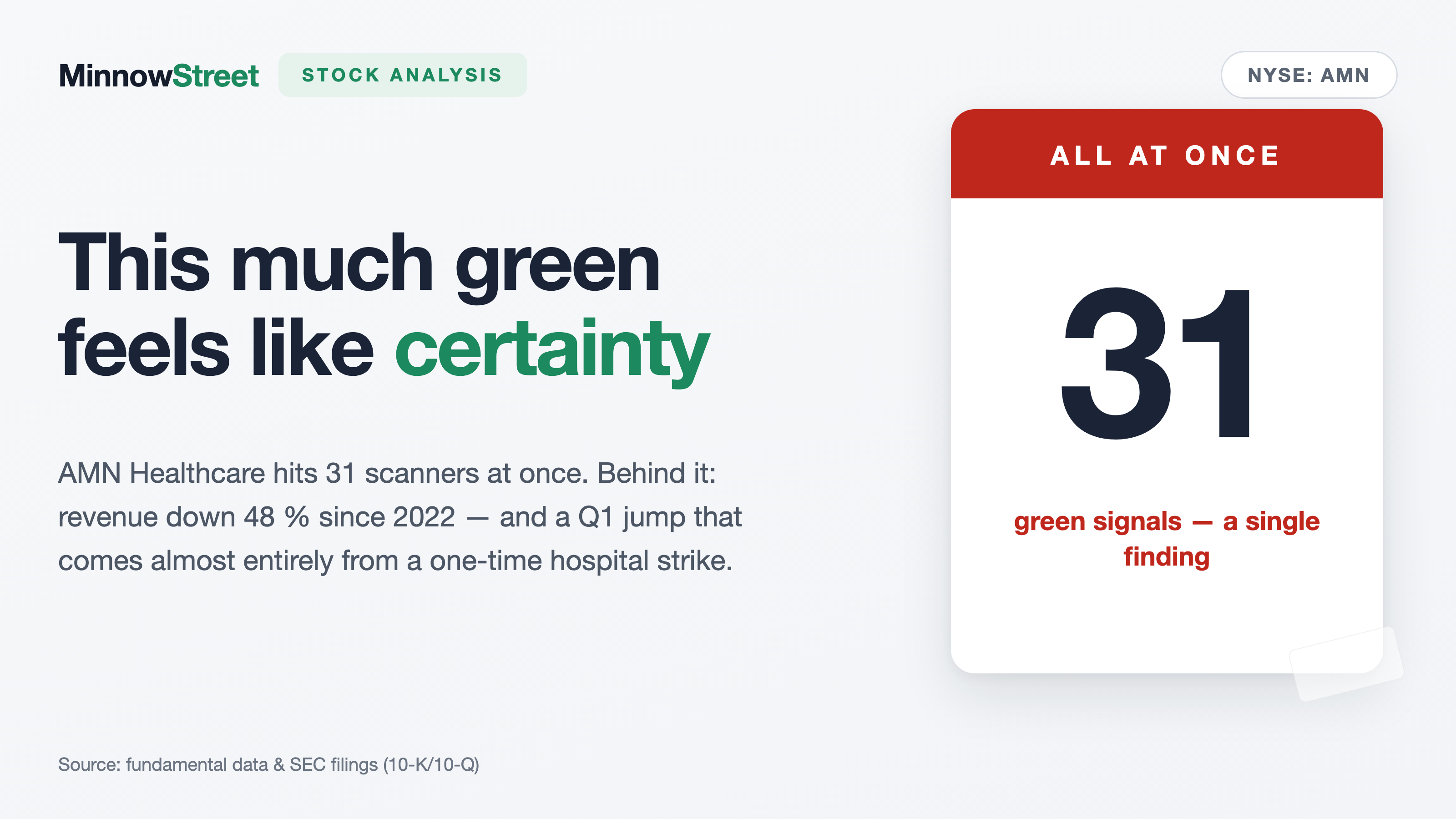
No stock in our series fires in this many filters at once: hospital staffing firm AMN Healthcare hits 31 in-house scanners simultaneously — from "quality growth" to "William O'Neil" to "institutional accumulation". That much green feels like certainty. We read the annual and quarterly reports — and found behind it a business whose revenue has shrunk 48 percent since the 2022 COVID peak, that posted losses in 2024 and 2025, and whose first-quarter 2026 revenue jump stems almost entirely from a one-time hospital strike. Not investment advice — just the question of whether 31 green lights are measuring a business, or merely a rebound off the low and one strike.
 Thomas Mücke
Founder & Publisher
Thomas Mücke
Founder & Publisher
Chart
Interactive price chart (TradingView).
Note: pure fact-based analysis, not investment advice and not a solicitation to buy or sell. All figures without guarantee.
There is a thinking error that grabs us investors exactly when a tool lights up most impressively: the more signals point in the same direction at once, the safer we feel. Call it the signal illusion — the quiet assumption that "many indicators mean much certainty". At AMN Healthcare (NYSE: AMN) this illusion is more seductive than at any other stock in our series: the share fires in 31 of our scanners at the same time. Thirty-one green lights. That feels like thirty-one independent proofs that something big is under way here. So let's make a deal: before you believe the green lights, we read together what sits in the filings with the U.S. securities regulator, the SEC — an annual report is honest under penalty of law. In the end, you decide.
So you know where we are heading, here is the central tension that runs through this entire analysis: the 31 hits are real — but they do not measure 31 different truths. At their core they measure the same thing: a price that has recovered from its low, and a single outlier quarter. The decisive question is not "why is so much green glowing?" but: is there a genuine turnaround behind it — or merely a base effect, the recovery from a very low level? Remember that question. It is the thread of this piece.
What AMN Healthcare actually does
Picture a hospital that is suddenly short twenty nurses overnight — because of a flu wave, a vacation crunch or a strike. Who steps in? That is exactly what AMN is for: at its core the company is a temp agency for the hospital. It places medical staff on a temporary basis — above all travel nurses (licensed nurses who move with their suitcase for a few weeks to wherever hands are missing), plus physicians on contract, interim executives and permanent staff. AMN is one of the largest providers of this kind in the United States.
The business stands on three legs that AMN calls segments: Nurse & Allied Solutions (nursing and allied health professions — by far the largest leg), Physician & Leadership Solutions (temporary physicians and executives) and Technology & Workforce Solutions (hospital interpreting services, workforce-management software, placement platforms). One detail to hold on to for later: almost half of revenue (roughly 48 percent) runs through so-called managed services programs — where AMN takes over the entire management of contingent staffing for a large hospital system. That binds customers tightly, but it also makes AMN dependent on individual large clients. Remember the image: AMN earns money on other people's staffing shortages — and the more acute the shortage, the fuller the coffers. Which is exactly why the COVID boom was blessing and curse at once.
Where the stock shows up in our scanner
Every day we run thousands of stocks through our in-house stock scanner. AMN is the strongest confluence hit we have encountered so far: 31 filters fire at once (data as of July 10, 2026). That is rare, and it is impressive. Here are the most important ones — deliberately not all 31:
- "Quality growth" and "EPS & revenue power" — filters aimed at earnings and revenue momentum.
- "William O'Neil (CAN SLIM)" and "Stage 2 leader" — classics of growth and trend analysis.
- "Institutional accumulation" — big money is buying; indeed almost all shares sit with institutions.
- "Qullamaggie: High Tight Flag" and "Tight Weekly Closes" — momentum patterns with tight weekly closes.
- "Strength on stress days", "Patrick Walker: 40, 40" and "Pros 80" — relative strength versus the overall market.
How to get there yourself: on minnowstreet.com, open one of these filters in the "Scanner" menu and look for the AMN row. And now the honest part that the signal illusion likes to skip. A scanner is a measuring device, not a verdict — and you have to know what it measures. Half the list consists of momentum filters: they measure the price behavior of recent weeks and months, not the business model. The stock has roughly doubled in half a year — so every trend and strength filter lights up. The other half are fundamental filters such as "quality growth" or "EPS & revenue power". And here is the catch: after a deep crash, such metrics can look mechanically good — a profit rising from a miserable prior year, or a revenue jump off a depressed base, produces splendid growth rates without the business being healthy. Thirty-one hits are therefore not 31 proofs. They are a single finding — "the stock has risen sharply" — described from 31 angles. Whether there is substance behind it, only the business can tell. So let's look at it.
The numbers over the years
Let's start with what genuinely impresses — because the boom did happen. During the pandemic, hospitals desperately needed nurses and paid record rates for them. AMN's revenue exploded from $2.39 billion (2020) to a staggering $5.24 billion in 2022; net income reached $444 million. Whoever held the stock back then lived a dream. But — and this is the core of this analysis — that peak was not a normal state; it was an exception. What came next, the following chart shows with full clarity:
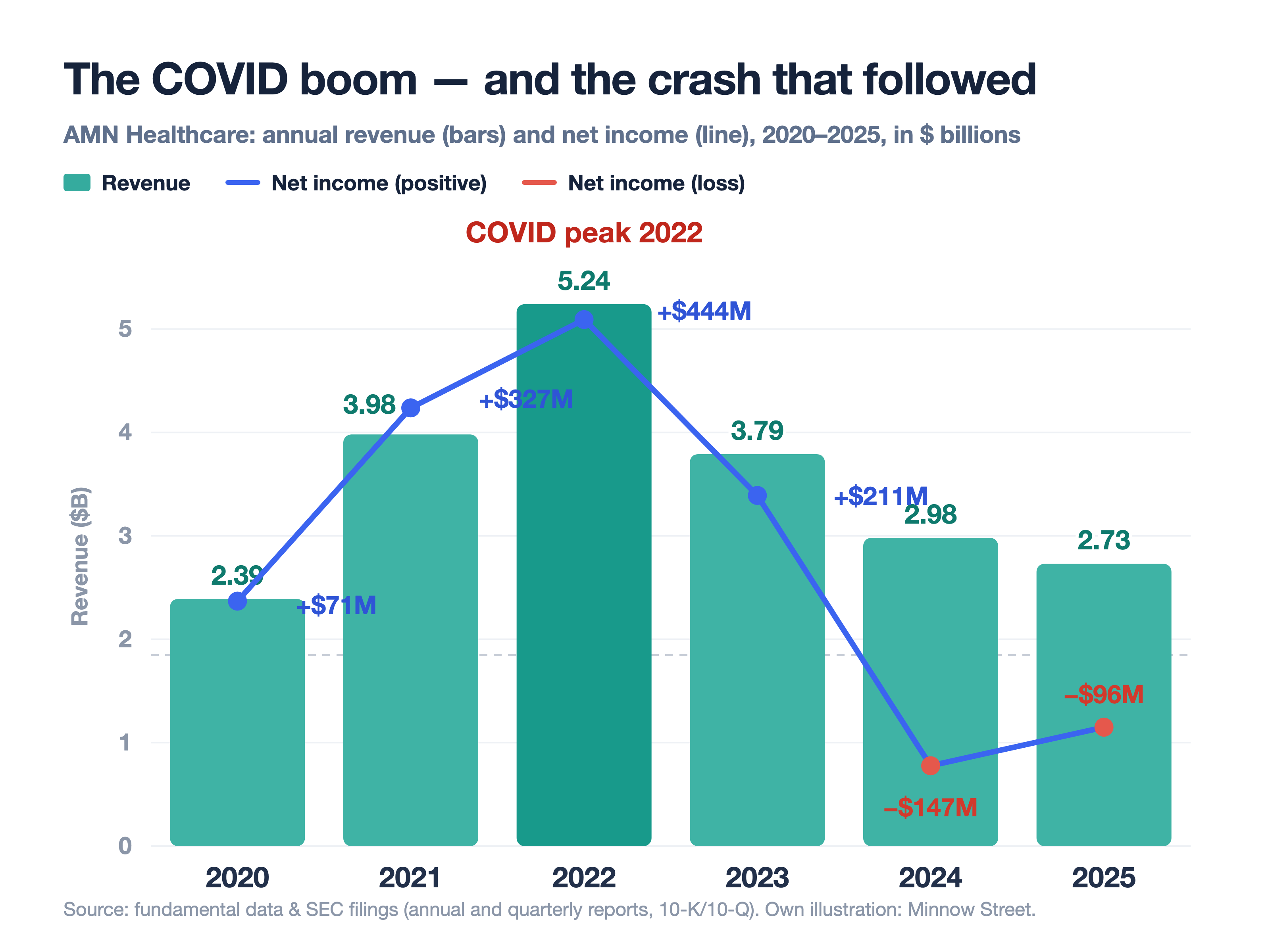
Read the chart at leisure: after 2022, revenue falls three years in a row — to $3.79 billion (2023), $2.98 billion (2024) and finally $2.73 billion (2025). That is 48 percent below the peak, practically a halving. And the blue line, net income, tells the second half of the story: $444 million of profit (2022) turned into losses of $147.0 million (2024) and $95.7 million (2025). Operating income was narrowly positive again in 2025 at $33 million — but impairments and interest pushed the bottom line back into the red. This is exactly where the turnaround question earns its keep: a genuine turnaround would mean the trough has been passed and things are heading up again. Yet consensus expects another roughly 20 percent less revenue over the next twelve months. That is not the picture of a turning point, but of a retreat that has not yet ended.
The uncomfortable truths
With a stock glowing in 31 scanners, the uncomfortable truths are especially quiet — and therefore especially important. We now pull three of them into the light, each with its exact locus in the original.
Uncomfortable truth no. 1: The boom was the exception — not the crash
The signal illusion whispers that the current strength is the normal state. The truth is the other way around: the COVID boom was the special event, and the business is only now finding its way back to a normal, lower level. AMN names the mechanism in its own annual report:
"Initially, demand for some temporary healthcare professionals and services declined as non-essential and elective healthcare was postponed. As the pandemic progressed, demand and bill rates, particularly in our nurse and allied solutions businesses, rose sharply and then declined. The subsequent decline in demand and bill rates negatively affected our revenue, financial condition, and results of operations."
— AMN Healthcare Services, Inc., SEC annual report 10-K for fiscal year 2025, Item 1A "Risk Factors"
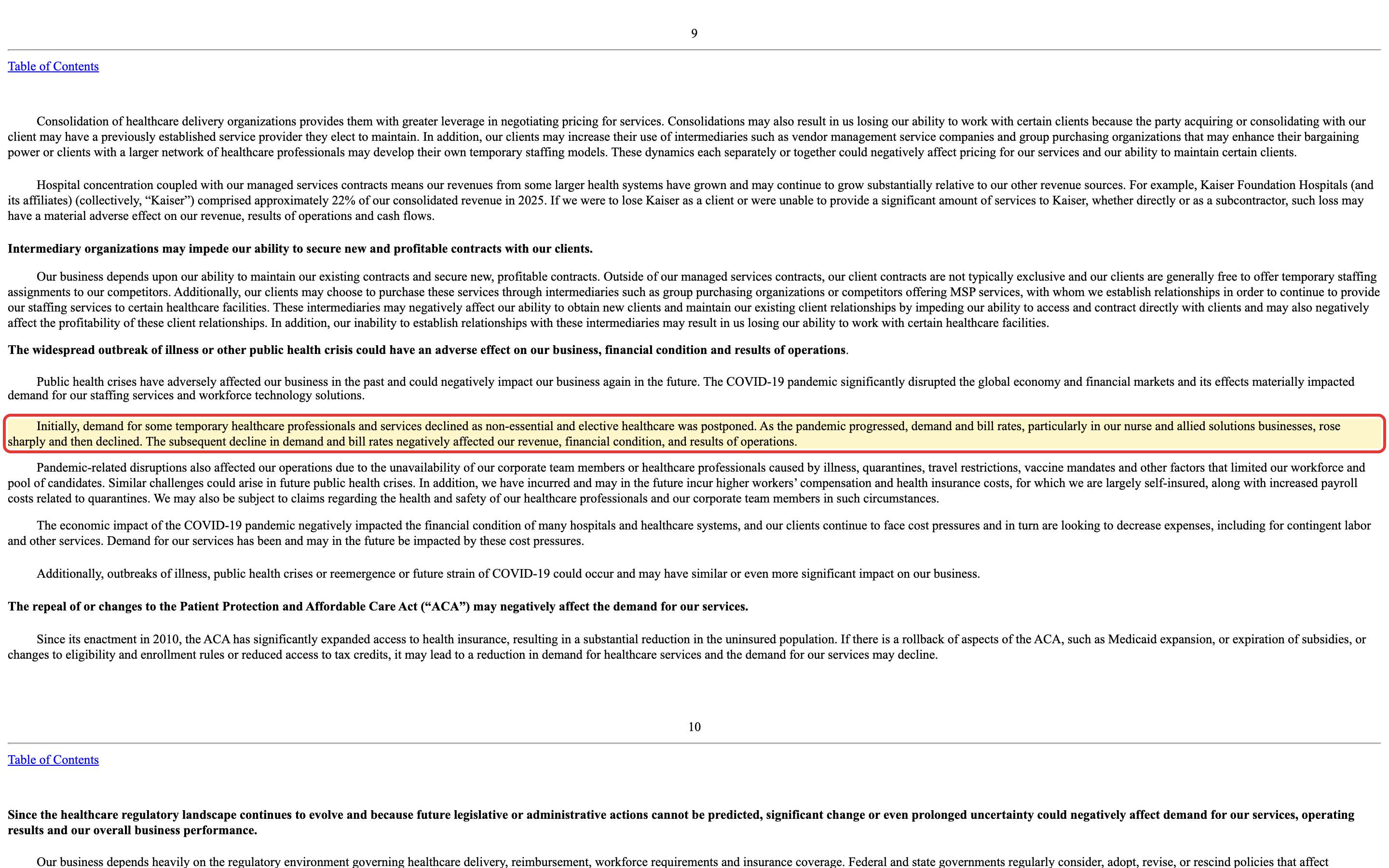
A look at the same screenshot reveals a second risk the green lights cannot see: Kaiser Foundation Hospitals alone accounts for roughly 22 percent of group revenue (and 32 percent of the largest segment). Customer concentration means: if a neighbor told you his shop was doing great but a fifth of his orders hung on one client — you would swallow briefly. AMN itself writes that losing Kaiser would have a "material adverse effect". Remember: a halved business with a 22-percent customer is not a turnaround; it is a normalization with concentration risk attached.
Uncomfortable truth no. 2: The first-quarter 2026 revenue jump is a strike
Here it gets decisive — because this very outlier is what set many of the 31 scanners glowing in the first place. In the first quarter of 2026, AMN's revenue doubled to $1.38 billion. Sounds like a turnaround? Look closely: virtually the entire jump comes from "labor disruption" — emergency assignments when hospital staff go on strike. This revenue exploded from $38.6 million (prior-year quarter) to $721.9 million. AMN itself explicitly calls such events unpredictable:
"In states where healthcare professionals have union representation, clients value the Company's ability to support them through labor disruption events. … Even if somewhat recurrent over the long term, labor disruption events are unpredictable and have driven spikes in demand and related financial outcomes when they happen."
— AMN Healthcare Services, Inc., SEC quarterly report 10-Q as of March 31, 2026, MD&A
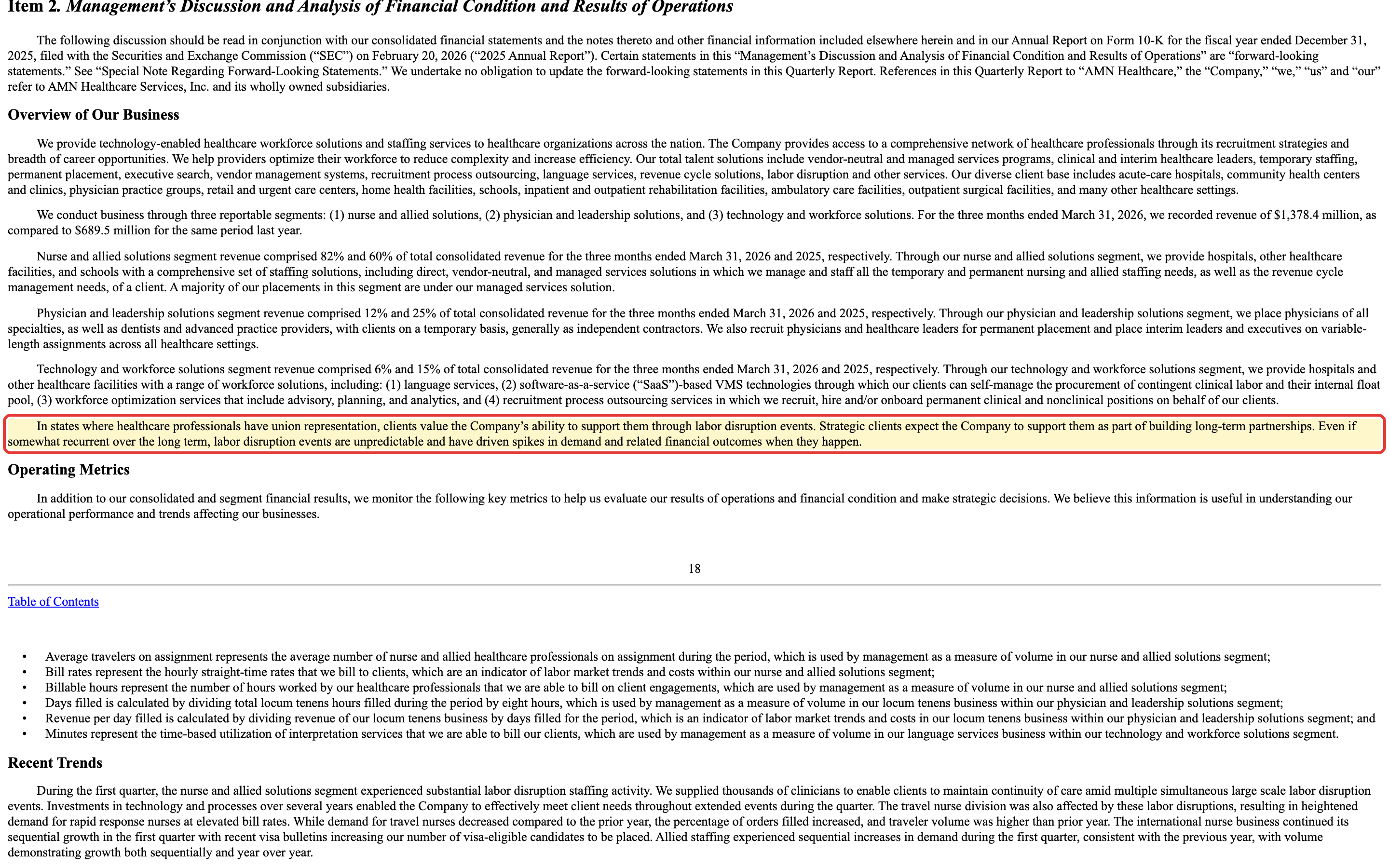
Strip out the one-off, and the magic evaporates. The following chart separates the strike business (blue) from the rest (green):
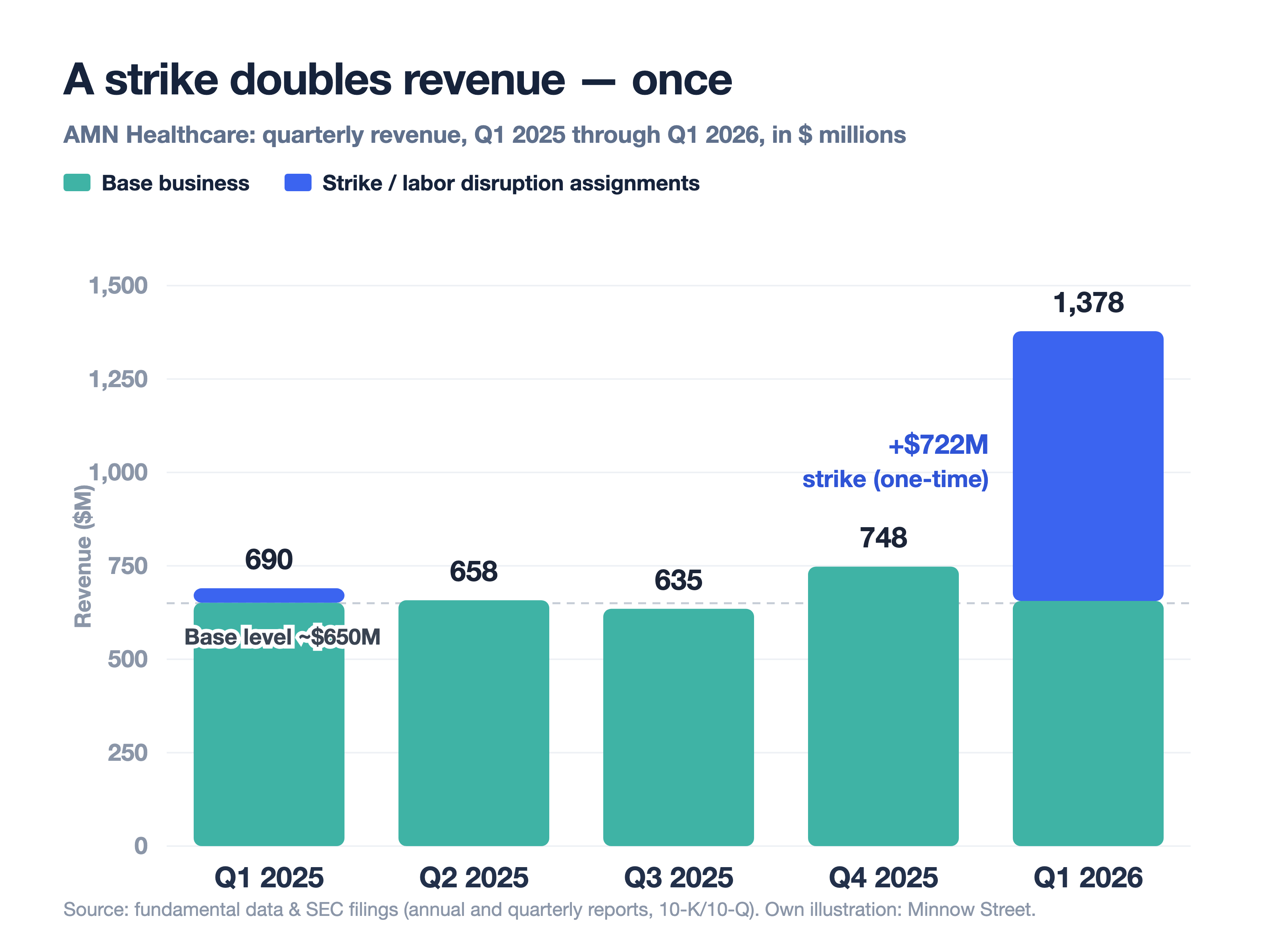
This is the core of the base-effect question in one picture: without the strike, AMN sat at roughly $656 million in the first quarter of 2026 — barely above the shrinking prior quarters. AMN even writes explicitly that demand for travel nurses declined year over year. A strike is a lucky one-off, not a business model — and when it ends, so does the revenue. Which is exactly why the market expects noticeably less again for the coming quarters.
Uncomfortable truth no. 3: The goodwill of the boom years is being worked off
Whoever buys expensively in good times carries the bill in bad ones. AMN grew for years through acquisitions; the premium paid above the tangible assets is booked as goodwill (simplified: the price of the hope that the whole is worth more than the sum of its parts). If the annual impairment test fails, a write-down follows that hits earnings in one stroke. That is exactly what has been happening at AMN for two years:
"A goodwill impairment loss of $109.5 million was recognized in the physician and leadership solutions segment during the year ended December 31, 2025 as compared to $123.3 million and $99.2 million in the nurse and allied solutions segment and physician and leadership solutions segment, respectively, during the year ended December 31, 2024."
— AMN Healthcare Services, Inc., SEC annual report 10-K for fiscal year 2025, Item 7 MD&A
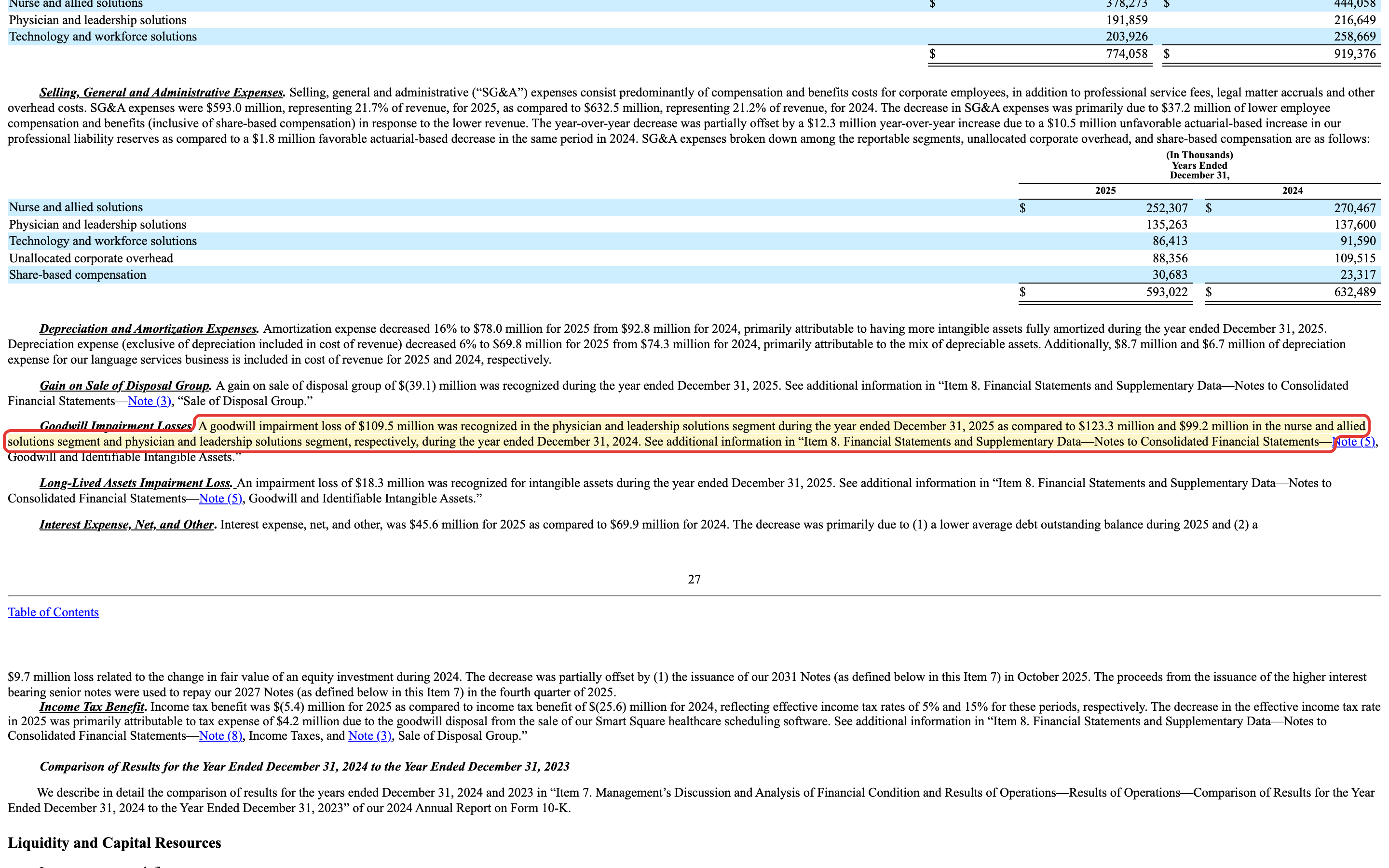
The balance sheet shows the pattern: $546.9 million of goodwill has already been written off, and $755.8 million still stands — roughly 36 percent of total assets and about 118 percent of equity. The largest remaining chunk sits, of all places, in the shrinking technology segment. Then the debt side: net roughly $769 million (at least down from more than a billion). In October 2025, however, AMN swapped a bond paying 4.625 percent for a new vintage at 6.5 percent — more expensive money — and had the banks give it breathing room: the credit covenant (the maximum permitted leverage ratio) was temporarily loosened to 5.25 times and only steps back down to 4.75 from 2027. At the same time, the available credit line was reduced from $750 million to $450 million and becomes more expensive at higher leverage. To be fair: no blocker on share buybacks or dividends was part of it, and no default looms. But this is the choreography of a borrower whose banks are accommodating it at the earnings trough — not the balance sheet of a growth stock.
Valuation — what the green lights cost
Now to the price question. Because AMN posted a bottom-line loss in 2025, there is no meaningful trailing price-to-earnings ratio. On the earnings expectation for the current year, the forward price-to-earnings ratio stands at roughly 26. Enterprise value equals roughly 7.8 times operating earnings before depreciation (EV/EBITDA), the price-to-sales ratio sits at only roughly 0.36, price-to-book at roughly 1.9. At first glance: astonishingly cheap for a billion-dollar revenue base.
But right here the signal illusion lurks a second time. A price-to-sales ratio of 0.36 is not "cheap" when the market expects revenue to keep falling — and it does: consensus reckons with roughly 20 percent less revenue over the next twelve months as the strike effect drops out. A low price-to-sales ratio on a shrinking, thin-margin revenue base is not a bargain; it is the price of uncertainty. The capital history of the boom years is telling, too: in 2022 and 2023, AMN bought back roughly one billion dollars of its own shares — at average prices around $100. Today the stock trades roughly three quarters below its all-time high. The money is spent; the debt remains. Whoever buys the 31 green lights today is not betting on cheap revenue, but on the normalization somehow still turning into a genuine upswing.
Opportunities and risks at a glance
What speaks for AMN:
- Genuine, broad momentum: the stock has roughly doubled in half a year and fires in 31 scanners; relative strength versus the market is exceptionally high, and beta is low at roughly 0.4.
- Market leader in a structurally demanded niche: the demographically driven staffing shortage in U.S. healthcare remains real; AMN benefits disproportionately from spikes such as strikes and flu waves.
- Operating income is positive again in 2025 ($33 million), net debt has been cut from more than a billion to roughly $769 million, and the credit covenants are met.
- Optically cheap on substance: price-to-sales roughly 0.36, EV/EBITDA roughly 7.8 — should demand turn surprisingly, the leverage is large.
What speaks against it:
- No proven turnaround, but a base effect: revenue has fallen 48 percent since 2022, 2024 and 2025 brought net losses, and consensus expects another roughly 20 percent decline.
- The Q1 2026 jump is a one-time strike effect (labor disruption $721.9 million instead of $38.6 million); the base business stagnates or shrinks, and demand for travel nurses actually declined.
- Balance-sheet burdens of the boom years: $546.9 million of goodwill already written off, $755.8 million (roughly 118 percent of equity) remaining; more expensive refinancing (6.5 instead of 4.625 percent) and a loosened credit covenant.
- Concentration risk Kaiser (22 percent of revenue) and the structural AI threat: AMN itself names in its risk factors that clients could use AI to improve their internal workforce planning and reduce the need for staffing intermediaries.
A human conclusion
Remember the signal illusion from the opening — the feeling that many green lights mean much certainty? After the look into the filings you now know why it is so treacherous here. The 31 hits are no fraud; they are honestly measured. But they describe the same event from 31 directions: a price that has recovered from its low, amplified by a single strike quarter that mechanically triggers the growth and quality filters. It is a choir of many voices all singing the same song — and the loud choir feigns polyphony where only one motif sounds.
The other half of the truth sits in the fine print: a halved business, two loss years, a 22-percent customer, goodwill written off and more still looming, more expensive money — and a revenue jump that AMN itself calls "unpredictable". That is no reason to panic and no judgment on the people at the company. It is simply the plain observation that a price rebound and a turnaround are two different things. How easily a recovery jump dresses up as growth is something we have seen at other healthcare names too — at physician-services group Pediatrix and at insurance marketplace EverQuote.
What you make of it is your decision. And that is exactly as it should be. What matters is only that you know what you are betting on: not on 31 independent proofs, but on the single question behind them — whether the recovery from the low becomes a genuine upswing. The scanner shows you what the price has done lately. Whether the business follows, it does not know — and your own signal illusion knows it least of all.
Sources
- AMN Healthcare Services, Inc. — SEC annual report 10-K for fiscal year 2025 (as of December 31, 2025; filed February 20, 2026)
- AMN Healthcare Services, Inc. — SEC quarterly report 10-Q as of March 31, 2026 (filed May 8, 2026)
- AMN Healthcare Services, Inc. — SEC annual report 10-K for fiscal year 2024 (multi-year comparison); additionally the quarterly reports 10-Q for Q1–Q3 2025.
- Fundamental data (metrics, valuation, annual and quarterly series); in-house stock scanner, data as of July 10, 2026.
Transparency & disclaimer: This analysis is a journalistic contextualization of publicly available information and is not investment advice, not a financial analysis in the regulatory sense, and not a solicitation to buy or sell securities. Stock investments carry substantial risks up to total loss. All information without guarantee; the data cut-off is noted in the text in each case. Make your investment decisions on your own responsibility and seek independent advice when in doubt.
Our Bottom Line at a Glance
- Turnaround or base effect? negative
- Clearly a base effect: revenue fell from the 2022 COVID peak ($5.24 billion) to $2.73 billion in 2025 (−48 percent), 2024 and 2025 brought net losses of $147.0 million and $95.7 million, and consensus expects another roughly 20 percent revenue decline. Operating income is narrowly positive again, but the business keeps retreating.
- Earnings quality & the Q1 2026 jump negative
- The revenue jump to $1.38 billion in the first quarter of 2026 stems almost entirely from one-time hospital strikes (labor disruption $721.9 million instead of $38.6 million). Without the one-off, the base business sat at roughly $656 million — at shrinking prior-quarter level; demand for travel nurses actually declined. AMN itself calls such events "unpredictable".
- Balance sheet: goodwill & debt negative
- The burdens of the boom years: $546.9 million of goodwill already written off, $755.8 million (roughly 118 percent of equity) remaining — the largest chunk in the shrinking technology segment. Net debt roughly $769 million; more expensive refinancing (6.5 instead of 4.625 percent) and a credit covenant loosened to 5.25 times.
- Scanner / momentum signal neutral
- The momentum is real: the stock has roughly doubled in half a year and hits 31 scanners at once — the strongest confluence finding of the series. But the many hits measure the same price rebound plus one strike quarter, not 31 independent truths. A momentum filter measures price behavior, not a business model.
- Valuation & price neutral
- Optically cheap (price-to-sales roughly 0.36, EV/EBITDA roughly 7.8), but no classic trailing P/E because of the net loss; forward P/E roughly 26. The low price-to-sales ratio mirrors an expected shrinking revenue base — the price of uncertainty, not a safe discount. In the boom years 2022/2023, AMN bought back roughly one billion dollars of shares at prices around $100.
AMN Healthcare delivers the strongest scanner finding of our series — 31 hits at once. Yet the many green lights measure the same price rebound off the low plus a one-time strike quarter, not a turnaround. The hospital staffing firm's business has shrunk 48 percent since the 2022 COVID peak (from $5.24 billion to $2.73 billion), 2024 and 2025 brought losses, and consensus expects another roughly 20 percent less revenue. The Q1 2026 jump to $1.38 billion came almost entirely from "unpredictable" strike assignments. Add written-off and still-looming goodwill, a 22-percent customer and more expensive money. A momentum stock with an honest rebound chart, but without a proven operating upswing. Not investment advice.
What Our Rating Means
- If you don't own the stock
- As long as the question raised in the bottom line stays open, we see no basis for an entry.
- If you hold it in your portfolio
- Our findings offer no acute reason to sell — the checkpoints named remain decisive.
A journalistic assessment by our editorial team at the time of the deep dive, based on public sources — not investment advice and not a solicitation to buy or sell. Your personal circumstances (investment goals, risk capacity, taxes) cannot be taken into account. What our categories mean, how verdicts are formed, and what conflicts of interest exist →
Worth Noting
- Materiality gate (July 10, 2026) — finding by finding: (1) business decline/base effect: revenue −48 percent since the 2022 COVID peak, but 2025 above the pre-COVID level of 2020, operating income +$33 million, cash flow positive → cyclical price finding, no existential finding (company intact). (2) Q1 2026 strike one-off ($721.9 million instead of $38.6 million): earnings/signal quality, no solvency question → price finding. (3) Goodwill $755.8 million (~118 percent of equity): a further impairment would be non-cash and triggers no covenant → balance-sheet-quality price finding. (4) Net debt $769 million: the banks loosened the net-leverage covenant via the Fifth Amendment (10/2025) temporarily to 5.25× (step-down to 5.00× from 04/2027, 4.75× from 07/2028) but simultaneously reduced the credit line from $750 to $450 million and made it more expensive above 4.25× leverage. Decisive for the gate: NO buyback/dividend blocker ("covenants otherwise remained unchanged"), no going concern, ~$404.8 million of the line available → bearable, an amber flag, no existential finding. (5) Customer concentration Kaiser 22 percent: per the gate calibration (21 percent = dent) a dent; the company would remain intact → concentration-risk dent. Result: no existential finding, but clustered, same-direction price/cycle findings → not "caution", but no buy either; "watch", tied to the strike-free quarterly numbers.
- Price and valuation figures dated mid-2026; analyses are evergreen, daily prices are not a buy argument. The market value of roughly $1.2 billion refers to roughly 38.8 million shares outstanding; the stock has roughly doubled in half a year but still trades roughly three quarters below its all-time high.
- Revenue/earnings series from the annual and quarterly reports (10-K/10-Q): 2022: $5.24 billion / +$444 million; 2023: $3.79 billion / +$211 million; 2024: $2.98 billion / −$147 million; 2025: $2.73 billion / −$96 million. Operating income 2025 was positive at +$33 million; the net loss arose from goodwill impairment ($109.5 million) and interest.
- Special-situations screening (EDGAR): no ongoing takeover, no strategic review, no rights plan, no Nasdaq/NYSE notice. Only passive large-holder filings (SC 13G / SC 13G/A), no activist SC 13D. The CEO transition to Caroline Grace is long completed; the 8-Ks concerned routine matters (conference, by-law update under Delaware law, bond refinancing, quarterly results).
- AI classification: threatened. In its risk factors AMN concretely names the growing adoption of AI as a danger to its own staffing model (clients could plan better internally with AI and reduce the need for intermediaries; AI could reduce demand for the services). AI is no proven revenue source of its own; internally it is used for efficiency. Under the precedence rule, the threat prevails.
Frequently Asked Questions
AMN Healthcare Services (NYSE: AMN) is one of the largest U.S. staffing providers for hospitals — at its core a temp agency for the hospital. The company places travel nurses, physicians and executives on a temporary basis and additionally offers interpreting services and workforce software. It operates in three segments: Nurse & Allied, Physician & Leadership and Technology & Workforce Solutions. It is headquartered in Dallas, Texas.
The stock has roughly doubled in half a year, so every momentum and trend filter lights up. The fundamental filters such as "quality growth" additionally react to the revenue jump in the first quarter of 2026. The 31 hits thereby measure essentially the same thing: a price rebound off the low plus a one-time strike quarter — not 31 independent truths.
The numbers point to a base effect. Revenue fell from the 2022 COVID peak ($5.24 billion) to $2.73 billion in 2025 (−48 percent), 2024 and 2025 brought net losses, and consensus expects roughly 20 percent less revenue over the next twelve months. Operating income is positive again, but the business keeps retreating.
Almost entirely from a one-off: hospital strikes. "Labor disruption" revenue rose from $38.6 million to $721.9 million and doubled quarterly revenue to $1.38 billion. Without the strike, the base business sat at roughly $656 million — level with the shrinking prior quarters. AMN itself calls such labor disruption events "unpredictable".
As of December 31, 2025, net debt stood at roughly $769 million (down from more than a billion). Goodwill still amounts to $755.8 million — roughly 118 percent of equity; $546.9 million has already been written off. In 2025 AMN refinanced a 4.625 percent bond at a more expensive 6.5 percent and loosened its leverage covenant to 5.25 times.
Optically yes; in substance, handle with care. A low price-to-sales ratio is no bargain when the market expects revenue to keep falling — and it does (consensus roughly −20 percent). Because 2025 brought a net loss, there is no classic trailing P/E; the forward P/E stands at roughly 26, EV/EBITDA at roughly 7.8. That is the price of uncertainty, not a safe discount.
Found an error?
Did you spot a factual error, an outdated number, or a typo in this deep dive? Let us know briefly — your report goes straight to the editorial team.