Aveanna Healthcare: $225 Million in Profit — and Nobody Wired $118 Million of It
Aveanna Healthcare cares for medically fragile children at home and sits at rank 42 in our Big Earnings Surprise ranking (U.S. selection, 81 hits, as of July 25, 2026). Fiscal 2025 closed with $225.0 million of net income — but pre-tax income was only $106.9 million. The gap is a $118.1 million income tax benefit from released valuation allowances; adjusted, the company earned $0.60 rather than $1.05 per share. Underneath sits a genuine turn all the same: adjusted EBITDA of $320.9 million, up 74.8 percent, and $125.9 million of operating cash flow. Next to it stand 81.5 percent of revenue tied to Medicaid, $1,483.4 million of debt as of April 4, 2026, and 6,513,687 new shares issued in a single quarter. Not investment advice — just the question of what is left of a profit nobody wired.
 Thomas Mücke
Founder & Publisher
Thomas Mücke
Founder & Publisher
Chart
Interactive price chart (TradingView).
Note: pure fact-based analysis, not investment advice and not a solicitation to buy or sell. All figures without guarantee.
Everyone knows the feeling. You reach into the pocket of a jacket that has hung in the closet for a year and pull out a $118 gift card. For a moment you feel richer. You are not — your wallet weighs exactly what it weighed before. You have merely rediscovered something you had written off. Call it the gift card trap: we mistake the recovery of a claim for income. That reach into the old jacket is what happened at Aveanna Healthcare Holdings Inc. (Nasdaq: AVAH) in fiscal 2025 — except the amount was $118.1 million, and the find landed directly on the profit line. The stock sits at rank 42 in our in-house Big Earnings Surprise ranking (U.S. selection, 81 hits, as of July 25, 2026). Before the headline number blocks the view, let us make a deal: we read the annual report on Form 10-K for fiscal 2025, the quarterly report on Form 10-Q for the period ended April 4, 2026, and the current reports on Form 8-K through early June 2026 together — and separate cleanly what was earned from what was booked. Remember the line from the start: a profit that comes out of the tax line comes exactly once.
Contents
- What Aveanna actually does
- How the stock reached our desk
- The numbers over the years — fairly credited
- What the filings say: five uncomfortable truths
- What the stock costs — and what that price assumes
- Opportunities and risks at a glance
- A human conclusion
- Sources
What Aveanna actually does — the intensive care unit that comes home
Aveanna Healthcare, based in Atlanta, Georgia, earns its money doing something few people think about until it hits their own family: in-home intensive nursing for critically ill children. A child with a tracheostomy and a ventilator, with cystic fibrosis, with cerebral palsy or after an anoxic brain injury needs a trained nurse around the clock. That care can happen in a hospital — or in a bedroom. Aveanna sends registered and licensed practical nurses into the home, and in some cases along to school. In plain language: Aveanna moves the intensive care unit into the child\'s bedroom, because that is better for the family and cheaper for the payer. By its own account, the company is the largest provider of this service in the United States.
The business stands on three legs. By far the largest is Private Duty Services (PDS) — the skilled nursing described above, plus pediatric therapy (physical, occupational, speech), care in pediatric day health centers, and non-clinical personal care for people with disabilities. One striking detail from the annual report: patients enter the program as children and often stay for years — roughly 30 percent of private duty nursing patients are over the age of 18. The second leg, Home Health & Hospice (HHH), serves mainly older patients at home and accompanies the dying. The third, Medical Solutions (MS), delivers enteral nutrition and medical supplies to the home.
People are the product. As of January 3, 2026, 32,000 people worked for Aveanna, roughly 3,500 of them full-time support staff; the large remainder are caregivers working part-time, per diem or on a temporary basis. That is also where the first fault line runs, and the company names it itself:
"Currently, we are experiencing a shortage of licensed clinicians, which has impacted our industry in general."
— Aveanna Healthcare Holdings Inc., Form 10-K for fiscal 2025, Item 1 "Business"
The work is paid for almost entirely by government. Aveanna bills more than 1,500 distinct payers, yet the origin of the money is unambiguous — which sets the central tension of this analysis, running through every chapter that follows: a business whose prices are set by legislatures, and whose fiscal 2025 profit came half out of a tax entry, has to be read differently from a company that writes its own invoices.
How the stock reached our desk — rank 42 out of 81
We run several thousand stocks through our scanners every day. As of July 25, 2026, Aveanna appears at rank 42 of the 81 U.S. hits in the Big Earnings Surprise ranking, with a relative strength rating of 65 out of 100 — meaning the stock outperformed 65 percent of all tracked names over twelve months, which is solid rather than outstanding. To repeat it yourself: open the scanner, set the country filter to U.S., read the list from the top. The rankings are recalculated daily, so today\'s rank says nothing about tomorrow\'s.
The filter\'s condition is strict and easy to check: reported earnings per share must have exceeded the analyst estimate by at least 20 percent in each of the last four completed quarters. For Aveanna the run looks like this (fundamental data, as of July 25, 2026): plus 47.8 percent for the quarter ended March 31, 2026 ($0.18 versus $0.12 expected), plus 28.9 percent (December 31, 2025), plus 87.5 percent (September 30, 2025) and plus 1,500 percent (June 30, 2025 — $0.16 versus $0.01 expected). Four consecutive quarters comfortably over the bar.
And here is the point you need before the streak impresses you: those surprises measure the adjusted earnings figure, not the tax benefit. Analysts estimate adjusted earnings per share; Aveanna beat them because the operating business genuinely improved. The $118.1 million tax benefit, by contrast, sits inside the reported number — precisely the figure a screen scraper uses to compute a price-earnings ratio. Two different numbers, two different stories. Remember: the surprise is real; the price-earnings ratio next to it is not.
The numbers over the years — fairly credited
First what genuinely speaks for Aveanna, and it is more than the tax objection suggests. Revenue in fiscal 2025 rose 20.2 percent to $2,433.2 million (prior year: $2,024.5 million). The driver was skilled nursing: the PDS segment added $366.5 million, or 22.4 percent — 11.0 percent from more hours delivered and 11.4 percent from higher reimbursement rates granted by various state Medicaid programs. Gross margin climbed from 31.4 percent to 33.3 percent, and operating income went from $139.8 million to $256.5 million (10.5 percent of revenue, up from 6.9 percent).
More telling still is the number the company itself uses to steer the business. Adjusted EBITDA — earnings before interest, taxes, depreciation, amortization and one-off items, roughly what the ongoing operation throws off before the cost of capital — rose 74.8 percent to $320.9 million, moving from 9.1 to 13.2 percent of revenue. And it did not stay a computed figure: operating cash flow, the money that actually arrived from the business, grew from $32.6 million to $125.9 million. Anyone doubting the turnaround needs a good argument at this point.
The debt side improved as well. On September 17, 2025 the company refinanced its credit facilities and repaid a second lien term loan of $415.0 million in full; interest expense fell from $156.6 million to $140.1 million. The weighted average interest rate dropped from 9.0 percent (March 29, 2025) to 7.3 percent (April 4, 2026). On May 26, 2026 Aveanna went further:
"The Amendment constitutes a repricing of the facilities under the Existing Credit Agreement resulting in a 0.50% reduction to applicable interest rate margins."
— Aveanna Healthcare Holdings Inc., Form 8-K dated May 28, 2026, Item 8.01
On the repriced term loans of $1,318.375 million, half a percentage point is roughly $6.6 million less interest a year — and another 0.25 points follow once a rating agency assigns at least a B2 or B. The first quarter of 2026 continued the trend: revenue of $647.9 million (up 15.9 percent), operating income of $69.3 million (up 33.8 percent), adjusted EBITDA of $84.4 million (up 25.2 percent).
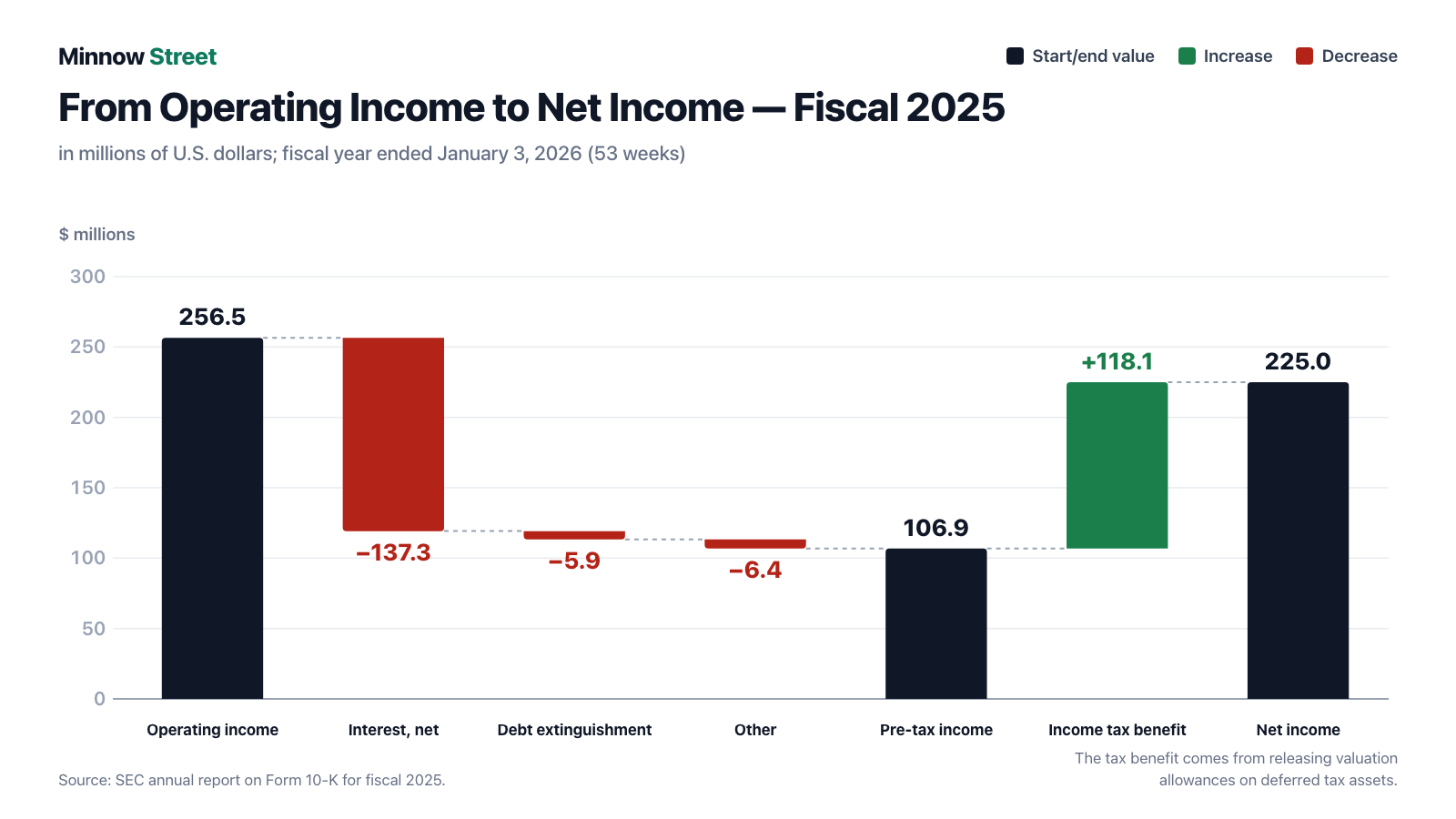
And then comes the line this analysis is about. Here is how $256.5 million of operating income became $225.0 million of net income:
What the filings say: five uncomfortable truths
Uncomfortable truth No. 1: more than half of the annual profit is an accounting entry
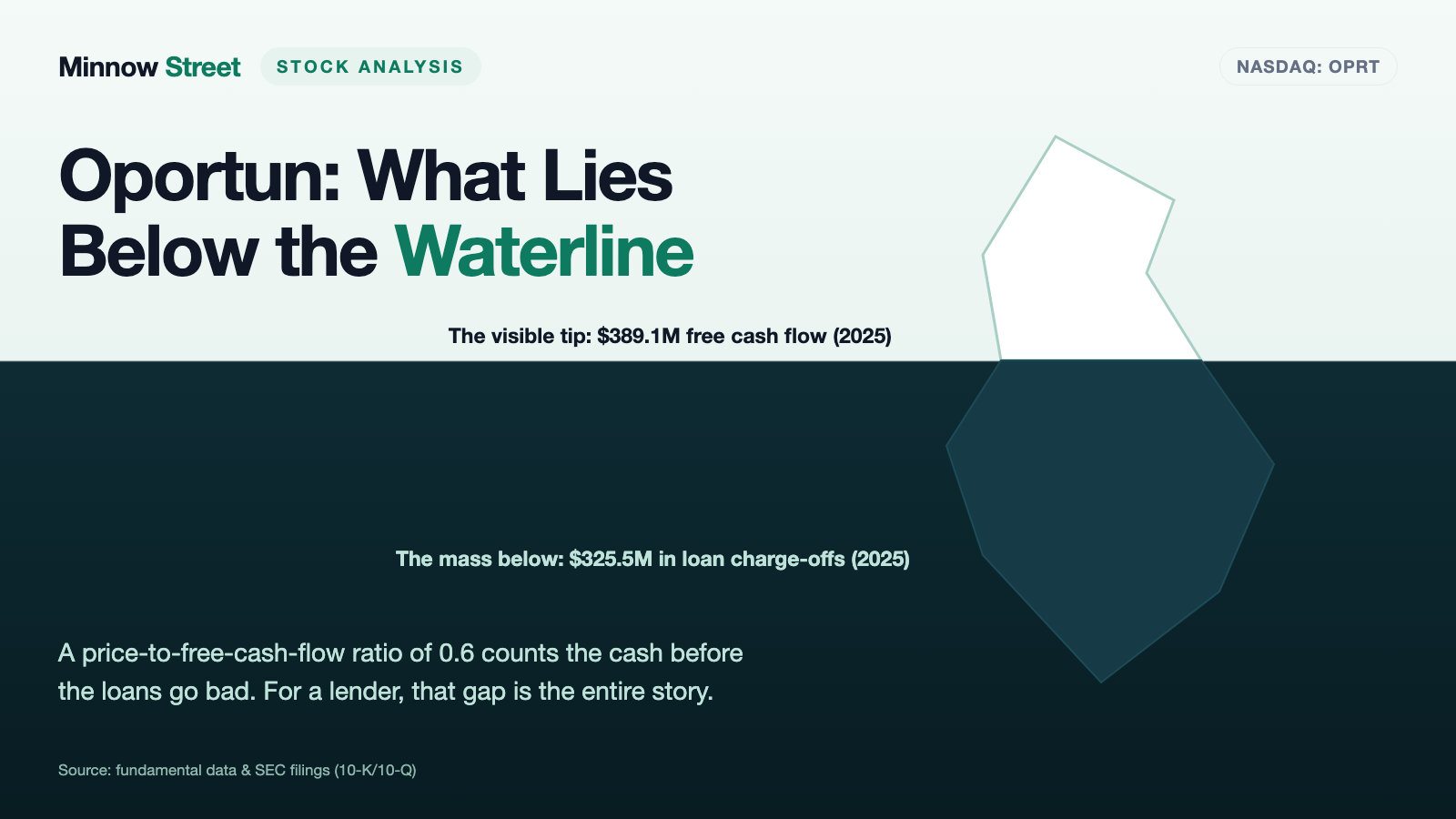
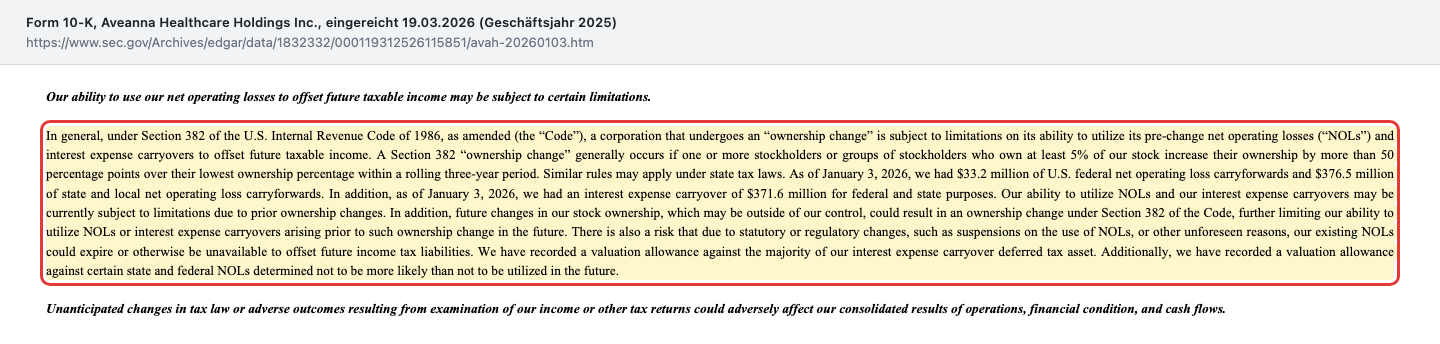
Pre-tax income in fiscal 2025 was $106.9 million. The bottom line said $225.0 million. The difference is not income but an income tax benefit of $118.1 million — created because Aveanna released valuation allowances on deferred tax assets. Translated into everyday terms: the company had written old tax credits down to a token value because it did not expect ever to use them. In 2025 it concluded that it would use them after all, and wrote them back up. The gift card in the old jacket. The valuation allowance fell from $243.0 million to $104.2 million as a result.
That no money changed hands is written plainly in the cash flow statement: to get from net income to actual operating cash flow, Aveanna subtracts $143.0 million of "deferred income taxes" again — a non-cash item. What remains is $125.9 million of operating cash flow. And the company itself does the adjustment for you: $1.05 per diluted share under accounting rules, $0.60 adjusted.
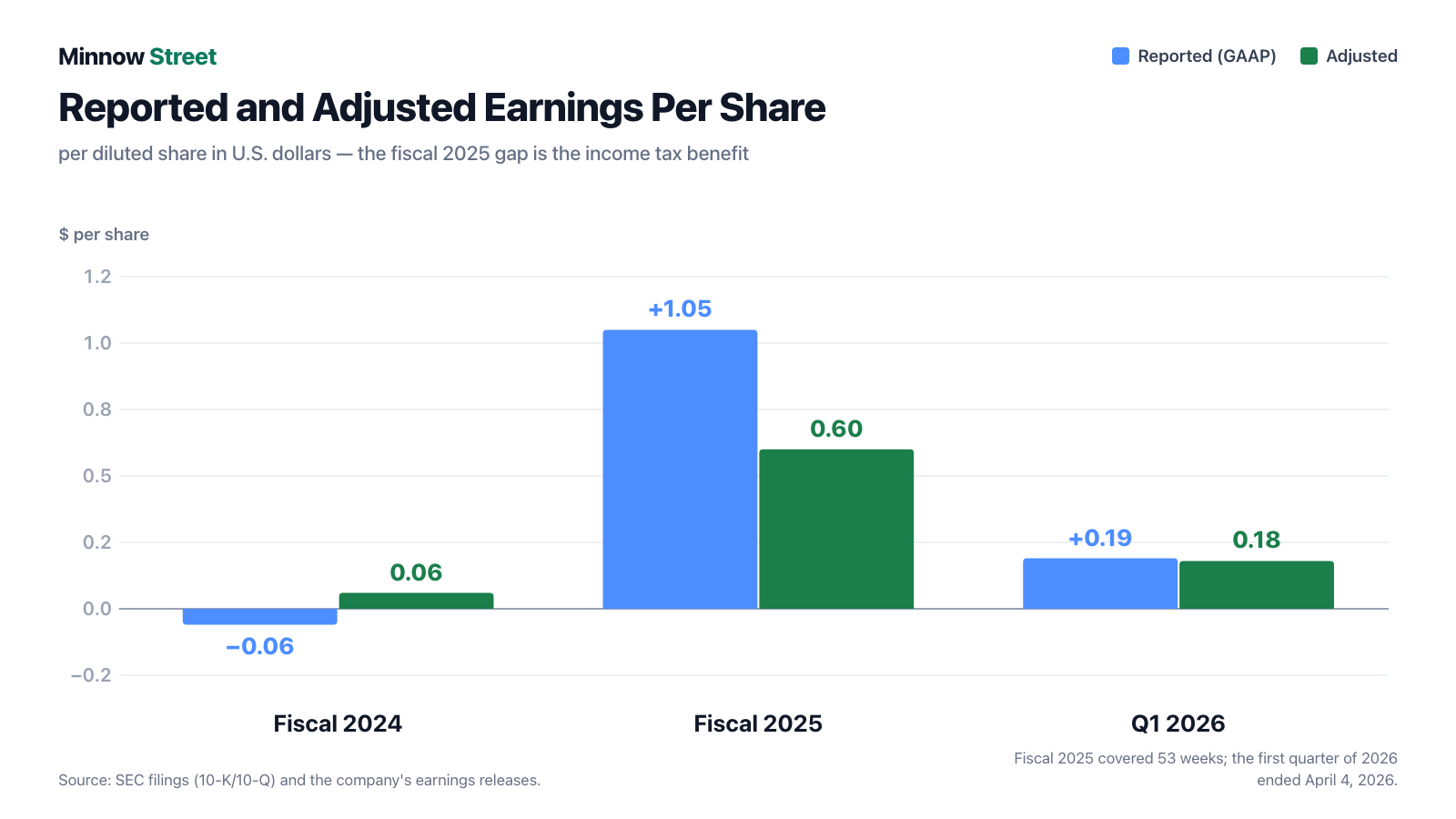
The first quarter of 2026 supplies the control test. There was no tax benefit in the books, but $3.3 million of income tax expense. Reported $0.19, adjusted $0.18 per share — the two numbers are back together. The gift card was a one-off.
Uncomfortable truth No. 2: the record year had one week more than the year before
Aveanna does not count in calendar years but in weeks — and every few years an extra one fits in. That is exactly what happened in 2025:
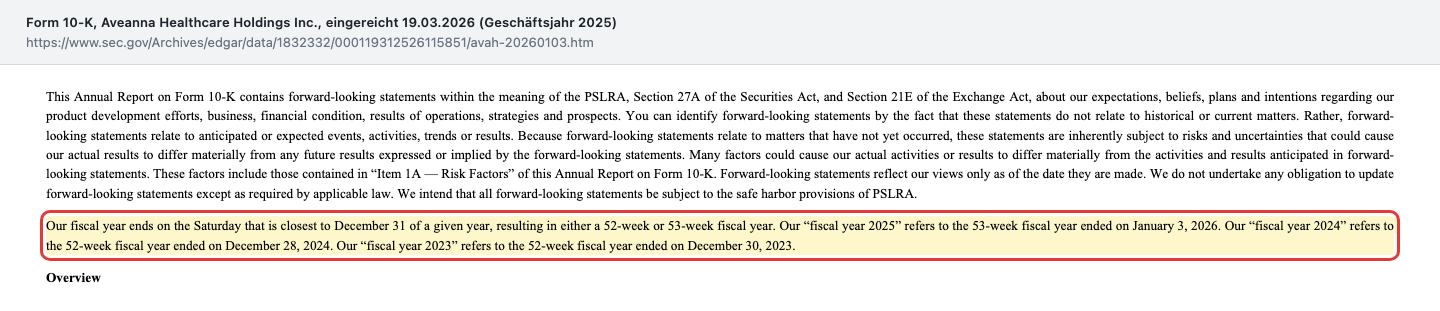
It sounds like bookkeeping, but it shifts every growth figure. A 53rd week is about 1.9 percent more time — so of the 20.2 percent revenue growth in fiscal 2025, roughly 18 percent is genuine expansion. The effect is even clearer in the final quarter: the fourth quarter of 2025 covered 14 weeks versus 13 the year before, and that very quarter reported 27.4 percent revenue growth. About a seventh of that jump is simply the extra block of days. Anyone extrapolating the trend should measure against the full-year figure, not that quarter — in the first quarter of 2026, back to normal length, growth was 15.9 percent.
Uncomfortable truth No. 3: legislatures decide 81.5 percent of revenue
Aveanna does not set its own prices. The revenue table in the notes to the annual report allocates fiscal 2025 revenue as follows: 58.7 percent Medicaid managed care, 22.8 percent traditional Medicaid, 9.9 percent Medicare, 8.5 percent commercial insurers, 0.1 percent self-pay. Added up: 81.5 percent from Medicaid, the public health program for people on low incomes, and 91.4 percent from public programs in total. The prior-year comparison: 79.9 percent Medicaid — so the dependency has grown.
What that means shows up a few pages later in the same filing. The U.S. Centers for Medicare & Medicaid Services initially proposed cutting home health payments by 6.4 percent for 2026 and settled at minus 1.3 percent in the final rule. And for Medicaid, a larger number is on the table:
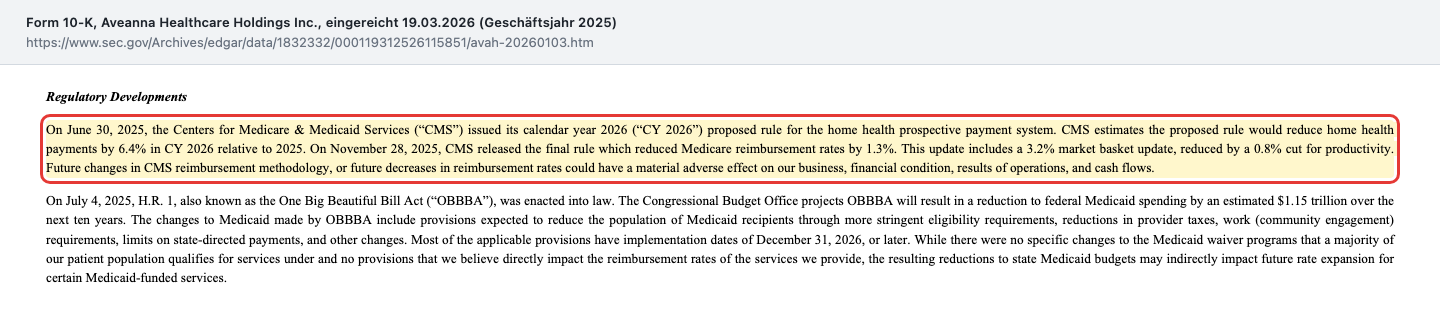
"The Congressional Budget Office projects OBBBA will result in a reduction to federal Medicaid spending by an estimated $1.15 trillion over the next ten years."
— Aveanna Healthcare Holdings Inc., Form 10-K for fiscal 2025, "Regulatory Developments"
Aveanna adds that most of the applicable provisions take effect on December 31, 2026 or later and that it does not believe its own services are directly affected — but that tighter state budgets may indirectly slow future rate increases. That is exactly where the risk sits: of the fiscal 2025 revenue jump, 11.4 percentage points came from higher rates. Take that tailwind away and only volume growth is left.
Uncomfortable truth No. 4: a profitable year — and still $1.48 billion of debt
The turnaround did not heal the balance sheet; it merely pushed it back above zero. As of April 4, 2026, $1,483.4 million of debt stood against $240.1 million of equity; a year earlier equity was negative. The accumulated deficit of the company\'s history still stands at $1,115.5 million. And of the $2,022.0 million of total assets, $1,121.0 million is goodwill and $91.9 million is other intangibles — together roughly 60 percent, positions that cannot be sold.
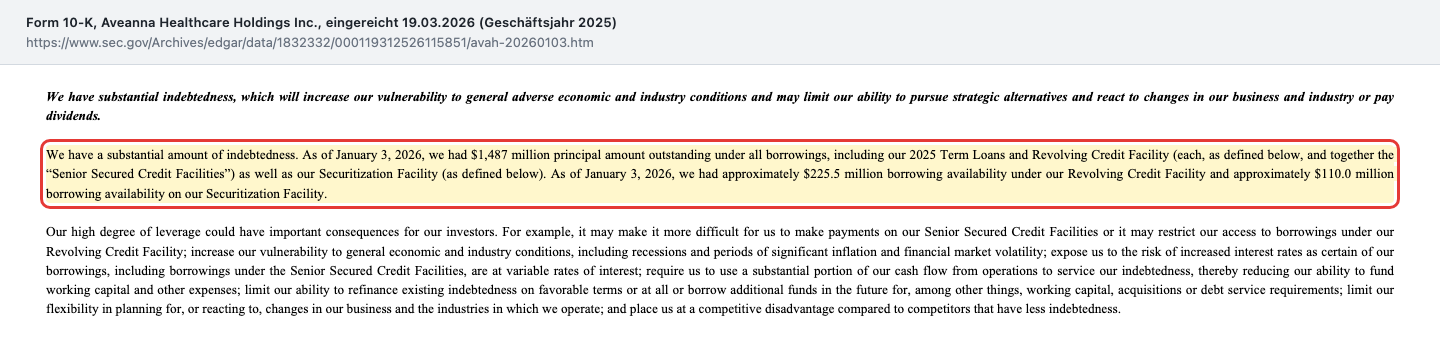
Measured against the company\'s own 2026 guidance — adjusted EBITDA of $338 million to $342 million, as of June 2, 2026 — that is a good four to four and a half times annual earnings power. It is within what lenders in this sector accept, but it leaves little room. A second point comes on top: in the first quarter of 2026, operating cash flow was only $4.3 million and free cash flow was negative $3.8 million — in the same quarter that reported $41.7 million of net income. The causes are seasonal payouts and growing receivables ($332.7 million as of April 4, 2026, up from $313.4 million at year end). Remember: a quarter with profit and no cash is normal in this business model — but only if the cash arrives later. And on June 1, 2026, $175.5 million in cash went out for the Family First Homecare acquisition, from a balance that stood at $189.3 million on April 4.
Uncomfortable truth No. 5: the share count grows faster than earnings
Dilution means your slice of the cake gets smaller without the cake getting bigger. At Aveanna it moves quickly. As of January 3, 2026 there were 210,996,359 shares, as of April 4, 2026 already 217,510,046, and as of May 8, 2026 217,755,203. Of the 6,513,687 new shares in the first quarter, 6,458,687 came from vested restricted shares and 55,000 from options; the cash that arrived was $269,000. In a single quarter, every existing shareholder\'s slice shrank by roughly 3.1 percent.
The pipeline is not empty either. As of January 3, 2026 there were 12,995,652 options outstanding at a weighted average exercise price of $6.41, 7,540,876 of them exercisable, plus 15,617,361 restricted stock units. Together, 28.6 million potential new shares — a good 13 percent of the count. There was a preview in 2025: for the acquisition of competitor Thrive Skilled Pediatric Care on June 2, 2025, Aveanna paid $75.7 million, of which only $15.9 million was cash — the rest was 11.2 million new shares worth $59.8 million. To its credit, Family First was paid for entirely in cash a year later. If you want the comparison case where an entire equity swing came from a single accounting entry, it is in our Battalion Oil analysis.
What the stock costs — and what that price assumes
And here the circle back to the gift card trap closes, because the trap sits inside the valuation. As of July 25, 2026, Aveanna carries a market value of roughly $2.06 billion on 217,755,203 shares (as of May 8, 2026). A screen shows a price-earnings ratio of 7.5 alongside it — calculated on $1.26 of trailing twelve-month earnings per share. That figure contains the tax benefit. Use the adjusted fiscal 2025 result of $0.60 instead and the ratio is about 16. Analysts expect $0.71 per share for the current year, which puts the ratio near 12 (fundamental data, as of July 25, 2026). Remember: a single-digit price-earnings ratio produced by a tax entry is not a margin of safety; it is an arithmetic error with a date stamp.
The other orders of magnitude, same as-of date: revenue is valued at 0.8 times, book value at 8.2 times — the latter only because equity turned positive again in 2025. More meaningful is enterprise value, that is market value plus debt less cash: roughly $3.29 billion, or 9.6 to 9.7 times the adjusted EBITDA of $338 million to $342 million guided for 2026. That is neither cheap nor expensive — it is the price of a leveraged service provider whose customer is the state.
The professionals\' view fits that. Eight analysts cover the stock: one strong buy, five holds, one sell and one strong sell, with an average price target of $10.45 (fundamental data, as of July 25, 2026). As a dated valuation anchor from a primary document, the prospectus supplement of October 21, 2025 names the last reported sale price of the stock at $10.23 — while placing 10.0 million shares for existing holders at $9.00. If you want to see what a turnaround under a heavy debt load looks like over several years, there is a second example in our Sirius XM analysis.
A word on the owners, because it explains how the stock trades: Bain Capital and J.H. Whitney together held 57.7 percent of the shares as of January 3, 2026, so Aveanna qualifies as a "controlled company" under Nasdaq rules and need not have a majority of independent directors. The proxy statement as of April 6, 2026 lists Bain at 37.5 percent and Whitney at 18.4 percent. The freely traded portion is correspondingly small — about 87 million shares, a good 40 percent of the count (fundamental data, as of July 25, 2026).
Opportunities and risks at a glance
What speaks for Aveanna:
- The operating turn is documented, not asserted. Adjusted EBITDA up 74.8 percent to $320.9 million in fiscal 2025, operating cash flow from $32.6 million to $125.9 million, operating margin from 6.9 to 10.5 percent.
- Structural tailwind. Care at home is cheaper for payers than a hospital or nursing facility; Aveanna is, by its own account, the largest U.S. provider of pediatric private duty nursing and adds growth through acquisitions (Thrive in 2025, Family First in 2026).
- Interest costs are falling to plan. The $415.0 million second lien loan was repaid in September 2025, margins were cut by 0.50 percentage points in May 2026 with another 0.25 points available on a better rating; the average rate fell from 9.0 to 7.3 percent.
- Interest rate risk partly hedged. As of April 4, 2026 the company held interest rate swaps with a notional amount of $520.0 million and caps of $880.0 million with a SOFR ceiling of 2.96 percent.
What speaks against it:
- More than half of the reported fiscal 2025 profit is a tax entry — $118.1 million out of $225.0 million. Every metric built on reported earnings per share is flattered as a result.
- 81.5 percent of revenue depends on Medicaid, 91.4 percent on public programs. The Congressional Budget Office projects $1.15 trillion less federal Medicaid spending over ten years.
- High leverage against thin equity. $1,483.4 million of debt versus $240.1 million of equity as of April 4, 2026; roughly 60 percent of total assets are goodwill and intangibles.
- Ongoing dilution. 6,513,687 new shares in the first quarter of 2026 for $269,000 of cash received, plus 28.6 million options and restricted stock units outstanding.
- Labor shortage as a growth brake. The company reports a shortage of licensed clinicians itself; the business grows only as fast as caregivers can be hired.
- Two large holders with 55.9 percent (as of April 6, 2026) and a history of placements — in October 2025 existing holders sold 10.0 million shares at $9.00.
A human conclusion
Back to the old jacket. The $118 gift card was real — it truly was in the pocket, it truly had value, and finding it is a good day. It is just not a salary. It does not come back every month, and you cannot build your life around it. That is exactly how Aveanna\'s fiscal 2025 profit works: the $118.1 million tax benefit is neither a trick nor cosmetic accounting but a correct entry that even carries good news — the company now believes it will earn enough to use old tax credits. But it is a one-off, and the first quarter of 2026 has already proved it.
What remains once you take the gift card back out of the calculation is still remarkable: a company that was in the red in 2024, that has nearly doubled its margin in two years, that has shed its most expensive debt, and that works in a field where demand will not disappear. Next to it stands a company whose prices are set by legislatures, that carries $1.48 billion of debt, and that pays its own people with shares that belong to you.
Both are true. Anyone investing here really decides only one question: do you believe adjusted earnings will grow, over the next few years, to where the reported figure already stood once in 2025? We have shown you the numbers to check that with — the tax rate, free cash flow, the share count on the cover page. What you do with them is your decision. And that is exactly as it should be.
Sources
- Form 10-K for fiscal 2025 (53 weeks, ended January 3, 2026), filed March 19, 2026: sec.gov
- Form 10-K for fiscal 2024 (ended December 28, 2024), filed March 13, 2025: sec.gov
- Form 10-Q for the quarter ended April 4, 2026, filed May 14, 2026: sec.gov
- Form 8-K dated May 14, 2026 (first quarter results and 2026 guidance): sec.gov
- Form 8-K dated May 28, 2026 (repricing, $1,318.375 million of 2026 term loans): sec.gov
- Form 8-K dated June 2, 2026 (completion of Family First Homecare, $175.5 million, updated guidance): sec.gov
- Form 8-K dated March 12, 2026 (purchase agreement for Family First Homecare): sec.gov
- Proxy statement DEF 14A 2026, filed April 17, 2026 (ownership as of April 6, 2026): sec.gov
- Prospectus supplement 424B4 dated October 21, 2025 (placement of 10.0 million shares at $9.00; last reported sale price $10.23 on October 21, 2025): sec.gov
- Screening, valuation and analyst data: our in-house stock scanner and fundamental data (as of July 25, 2026), including the Big Earnings Surprise ranking (U.S. selection, rank 42 of 81 hits, RS rating 65); the lists are recalculated daily.
Disclaimer: This article is journalistic analysis of publicly available documents. It is not investment advice, not a recommendation to buy or sell, and not a solicitation to buy or sell securities. Equity investments can result in a total loss. All figures are taken from the SEC filings named above or from fundamental data with the as-of date stated in each case, and may have changed since. The author holds no position in Aveanna Healthcare Holdings Inc. at the time of publication.
Our Bottom Line at a Glance
- Earnings quality negative
- Of the $225.0 million of fiscal 2025 net income, $118.1 million came from an income tax benefit created by releasing valuation allowances; pre-tax income was $106.9 million. The company itself reports $0.60 adjusted against $1.05 reported per diluted share. In the first quarter of 2026 the effect disappeared — $0.19 reported against $0.18 adjusted.
- Operating turnaround positive
- Adjusted EBITDA rose 74.8 percent in fiscal 2025 to $320.9 million (13.2 percent of revenue, up from 9.1 percent), operating cash flow went from $32.6 million to $125.9 million and the operating margin from 6.9 to 10.5 percent. The first quarter of 2026 continued that with 15.9 percent revenue growth and 25.2 percent EBITDA growth.
- Payer concentration negative
- 81.5 percent of fiscal 2025 revenue came from Medicaid and 91.4 percent from public programs; a year earlier the Medicaid share was 79.9 percent. The annual report cites the Congressional Budget Office projection of $1.15 trillion less federal Medicaid spending over ten years and the 1.3 percent CMS rate cut for 2026.
- Balance sheet and funding neutral
- $1,483.4 million of debt against $240.1 million of equity and $189.3 million of cash as of April 4, 2026; roughly 60 percent of total assets are goodwill and intangibles. Against that stand real improvements: repayment of the $415.0 million second lien loan in September 2025, a 0.50 percentage point repricing on May 26, 2026, and an average rate of 7.3 percent rather than 9.0 percent.
- Dilution negative
- In the first quarter of 2026 the share count rose by 6,513,687 to 217,510,046 for $269,000 of cash received; by May 8, 2026 it stood at 217,755,203. As of January 3, 2026 there were also 12,995,652 options at an average exercise price of $6.41 and 15,617,361 restricted stock units outstanding — a good 13 percent of the count.
- Valuation neutral
- The headline price-earnings ratio of 7.5 rests on reported trailing twelve-month earnings of $1.26 per share and therefore on the tax benefit; on the adjusted fiscal 2025 basis it is about 16 and on the analyst estimate about 12. Enterprise value of roughly $3.29 billion equals 9.6 to 9.7 times the 2026 EBITDA guidance (as of July 25, 2026).
Aveanna Healthcare is the gift card trap in pure form: fiscal 2025 net income of $225.0 million looks like a breakthrough, but $118.1 million of it came from a one-time tax benefit on pre-tax income of only $106.9 million — the company itself reports $0.60 rather than $1.05 per share. Underneath sits a documented operating turn all the same: adjusted EBITDA up 74.8 percent to $320.9 million, operating cash flow from $32.6 million to $125.9 million, the average interest rate down from 9.0 to 7.3 percent. Against that stand 81.5 percent of revenue tied to Medicaid, $1,483.4 million of debt against $240.1 million of equity, and 6,513,687 new shares in a single quarter. Not investment advice.
What Our Rating Means
Open questions
The business works in principle, but one material question is open. As long as it stays open, our findings do not carry a quality verdict.
The business carries its own weight: Aveanna is, by its own account, the largest U.S. provider of home-based pediatric intensive nursing, operating income rose to $256.5 million in fiscal 2025, operating cash flow went from $32.6 million to $125.9 million, and equity is positive again at $240.1 million — no threat to the going concern is documented anywhere. Two operational questions remain open. First, the turn is only a year old and the headline earnings power is flattered: $118.1 million of the $225.0 million of net income came from a one-time tax benefit, leaving $0.60 rather than $1.05 per share on an adjusted basis. Second, the company does not set its own prices — 81.5 percent of fiscal 2025 revenue came from Medicaid, and 11.4 of the 22.4 percentage points of growth in the nursing segment came from higher state rates. On top of that sit $1,483.4 million of debt and a balance sheet in which roughly 60 percent of assets are goodwill and intangibles. That is not a threat to substance, but it is not proven quality either — hence yellow. The decision is yours.
A journalistic assessment by our editorial team at the time of the deep dive, based on public sources — not investment advice and not a solicitation to buy or sell. Your personal circumstances (investment goals, risk capacity, taxes) cannot be taken into account. What our levels mean, how verdicts are formed, and what conflicts of interest exist →
Worth Noting
- Aveanna reached our research list at rank 42 of the U.S. selection in our in-house Big Earnings Surprise ranking (81 hits, RS rating 65, as of July 25, 2026). The filter requires reported earnings per share to have exceeded the analyst estimate by at least 20 percent in each of the last four completed quarters. The lists are recalculated daily, so the rank is a dated snapshot.
- An important distinction: the scanner's earnings surprises refer to adjusted earnings per share, while the $118.1 million tax benefit sits only in the reported figure. Metrics from screening tools built on reported trailing twelve-month earnings of $1.26 per share — above all the price-earnings ratio of 7.5 — are distorted as a result.
- Fiscal 2025 covered 53 weeks rather than 52 and ended January 3, 2026; the final quarter had 14 weeks rather than 13. Growth rates from that period (20.2 percent for the year, 27.4 percent for the fourth quarter) are therefore not directly comparable with the 15.9 percent of the normal-length first quarter of 2026.
- Two events have occurred since the last quarterly report and are reflected in this article: the repricing of May 26, 2026 ($1,318.375 million of term loans at Term SOFR plus 3.25 percent) and the completion of the Family First Homecare acquisition on June 1, 2026 for $175.5 million in cash.
Frequently Asked Questions
Aveanna Healthcare Holdings Inc. (Nasdaq: AVAH) of Atlanta, Georgia, cares for patients at home. Its largest business is in-home skilled nursing for medically complex children and young adults (the Private Duty Services segment), alongside home health and hospice care and the delivery of enteral nutrition and medical supplies (Medical Solutions). As of January 3, 2026 the company employed 32,000 people.
Because a one-time tax benefit was added to an improved operating result. Pre-tax income for fiscal 2025 was $106.9 million; the reported net income of $225.0 million came from an income tax benefit of $118.1 million created by releasing valuation allowances on deferred tax assets. The allowance fell from $243.0 million to $104.2 million. On an adjusted basis, the company earned $0.60 rather than $1.05 per diluted share.
That ratio is based on reported trailing twelve-month earnings of $1.26 per share, which include the one-time tax benefit. On the adjusted fiscal 2025 result of $0.60 per share the ratio is about 16, and on the analyst estimate for the current year of $0.71 it is about 12. Enterprise value equals roughly 9.6 to 9.7 times the adjusted EBITDA guided for 2026 (as of July 25, 2026).
Very dependent. In fiscal 2025, 58.7 percent of revenue came from Medicaid managed care organizations and another 22.8 percent from traditional Medicaid — 81.5 percent combined. Medicare added 9.9 percent, commercial insurers 8.5 percent and self-pay 0.1 percent. In total, 91.4 percent of revenue comes from public health programs; a year earlier the Medicaid share was 79.9 percent.
Aveanna always ends its fiscal year on the Saturday closest to December 31, which produces 52-week or 53-week years. Fiscal 2025 ended January 3, 2026 and covered 53 weeks, while fiscal 2024 ended December 28, 2024 with 52 weeks. The extra week is worth about 1.9 percent more time; the final quarter of 2025 had 14 weeks instead of 13, which is why it reported 27.4 percent revenue growth.
As of April 4, 2026 total indebtedness was $1,483.4 million against $189.3 million of cash and $240.1 million of equity. As of January 3, 2026, $1,487 million of principal was outstanding. On May 26, 2026 the loans were repriced to $1,318.375 million at Term SOFR plus 3.25 percent — 0.50 percentage points lower than before, with a further 0.25 point reduction available once the borrower obtains a rating of at least B2 or B.
Two private equity firms hold the controlling block. According to the proxy statement, entities affiliated with Bain Capital held 81,600,880 shares (37.5 percent) and J.H. Whitney Equity Partners VII held 40,065,892 shares (18.4 percent) as of April 6, 2026; Nut Tree Capital Management held 5.7 percent. The annual report puts the two founding sponsors' combined stake at 57.7 percent as of January 3, 2026 — which is why Aveanna qualifies as a controlled company under Nasdaq rules.
Family First Homecare is a pediatric home care provider with 27 locations in seven states (Florida, Illinois, Iowa, North Carolina, Pennsylvania, South Dakota and Texas) that primarily delivers skilled private duty nursing. Aveanna paid $175.5 million in cash and closed the transaction on June 1, 2026. Full-year 2026 guidance rose to revenue of $2.63 billion to $2.65 billion and adjusted EBITDA of $338 million to $342 million, of which the acquisition contributes $70.0 million and $10.0 million respectively.
Found an error?
Did you spot a factual error, an outdated number, or a typo in this deep dive? Let us know briefly — your report goes straight to the editorial team.