Kodak: $446 Million of Cash Flow — $618 Million of It From the Pension Plan
On paper Eastman Kodak just posted its best cash year since bankruptcy: $446 million of free cash flow against a market value of roughly $800 million. The statement of cash flows shows where the money came from — $618 million as a reversion from the terminated U.S. pension plan, of which $153 million immediately left again as excise tax. What the actual business produced was minus $19 million. We read the filings with the U.S. securities regulator, the SEC, line by line and separate the one-off from the operation — printing plates, chemicals and brand licensing one by one.
 Thomas Mücke
Founder & Publisher
Thomas Mücke
Founder & Publisher
Chart
Interactive price chart (TradingView).
Note: pure fact-based analysis, not investment advice and not a solicitation to buy or sell. All figures without guarantee.
On July 24, 2020 a Kodak share cost $2.10. Five trading days later, on July 29, it touched $60.00 intraday — twenty-eight times as much. That day 276 million shares changed hands; on a normal day beforehand it was about 75,000. The trigger was a single headline about a government loan. That is the one-number trap: one story, one figure, and the mind stops reading. Six years later the same stock trades near eight dollars — and once again there is a single number attracting attention. This time it is a price-to-free-cash-flow ratio of 2.05. Let us do it differently and look up where the cash flow came from. The answer sits in the statement of cash flows in the annual report to the U.S. securities regulator, the SEC, it is honest under penalty of law, and it reads: from the pension plan.
What Kodak actually does today — three businesses with nothing in common
Anyone who thinks of cameras when they hear Kodak is thinking of a company that no longer exists in that form. The Eastman Kodak Company of Rochester, New York employs 3,500 people in 27 countries (as of December 31, 2025) and consists of three parts that have to be looked at separately.
Print is the largest business: aluminum printing plates, imaging machines, ink, software. Anyone printing a magazine, a catalog or packaging by offset first exposes such a plate. Kodak sells the machine once and the plates over and over — a consumables business on contracts that typically run two years. In 2025 Print brought in $715 million of revenue, or 67 percent of the group.
Advanced Materials and Chemicals is the industrial chemistry: film for motion pictures, industrial films, pharmaceutical starting materials, functional coatings. In 2025 it came to $316 million, up 17 percent — the only genuinely growing segment.
Brand is the smallest and strangest business: Kodak rents out its own name. Cameras, eyewear, batteries and clothing made by other manufacturers carry the Kodak name without Kodak building them. Revenue in 2025: $23 million. Remember that figure; we will come back to it.
That sets the central tension of this analysis, and it runs through every chapter: the balance sheet is the best it has been in years — and the business still earns nothing. What looked like record cash flow in 2025 was a one-time unwinding of the pension plan.
How the stock reached our desk
Kodak reached our list through a sort. The in-house stock scanner P/FCF Ranking collects every name with positive free cash flow and a price-to-free-cash-flow ratio of at most 10 and sorts ascending. The metric is a division: market value divided by free cash flow over the last four quarters. A value of 2 means two years of that cash stream equal today price.
On July 27, 2026 we measured, separately for each edition. With the market filter set to the United States, both show 545 hits; the German list covering all markets comes to 836. Kodak sits there in 42nd place at a ratio of 2.05 — identical on both brands.
And now the part that belongs to honesty: the scanner page displays only the 25 strongest rows. At 42nd place, Kodak is not among them. To see the row you do not use the scanner page but the screener, which filters and sorts the entire universe with no cap at 25 rows. Alternatively the stock search leads straight to Kodak company page, where the same metrics appear. The lists are recalculated daily — 42nd place is a dated snapshot of July 27, 2026, not a permanent state.
For scale: the 2.05 comes from a market value of $0.945 billion as carried in the data set and $460 million of free cash flow over the last four quarters. We will look at both more closely — the second is what this analysis is really about.
The numbers over the years — given their due
Let us start with what genuinely improved in 2025, because it is more than you would expect.
Revenue is growing again, modestly: $1,069 million after $1,043 million (2024) and $1,117 million (2023). The $26 million increase came mainly from better pricing in printing ($29 million) and from chemicals ($26 million price, $19 million volume). The gross margin rose from 19 to 22 percent.
Segment profit more than doubled: the sum of the segments reached $64 million in 2025 after $28 million the year before. Print swung from minus $8 million to plus $3 million, chemicals from $17 million to $39 million, brand licensing from $17 million to $20 million.
And the balance sheet is the best in years. As of March 31, 2026 there is $299 million of cash against $160 million of financial debt ($52 million current, $108 million long-term). That is net cash of $139 million — Kodak holds more money than debt. A year earlier things looked different: in 2025 the company repaid $306 million of loans in one move. The Altman insolvency early-warning score stands accordingly at 4.69. A word on the scale, or the number gets misread: we carry this value in the balance-sheet variant (the "double-prime" version), which uses neither market value nor a revenue term. On that scale, below 1.1 is the distress zone and 2.6 or higher is the safe zone — not the 1.8 and 3.0 familiar from textbooks, which belong to the older formula for manufacturers. At 4.69, Kodak sits comfortably in the safe zone.
All of that is real and deserves credit. It just does not explain the cash flow.
What the filings say — the uncomfortable truths
Uncomfortable truth No. 1: the free cash flow came out of the pension plan
In 2025 Kodak reported operating cash flow of $480 million, after minus $7 million in 2024 and $38 million in 2023. After $34 million of capital expenditures that leaves free cash flow of $446 million. That is the number the 2.05 is built on.
The statement of cash flows says right below it where that came from — as its own line in the reconciliation from net result to operating cash flow:
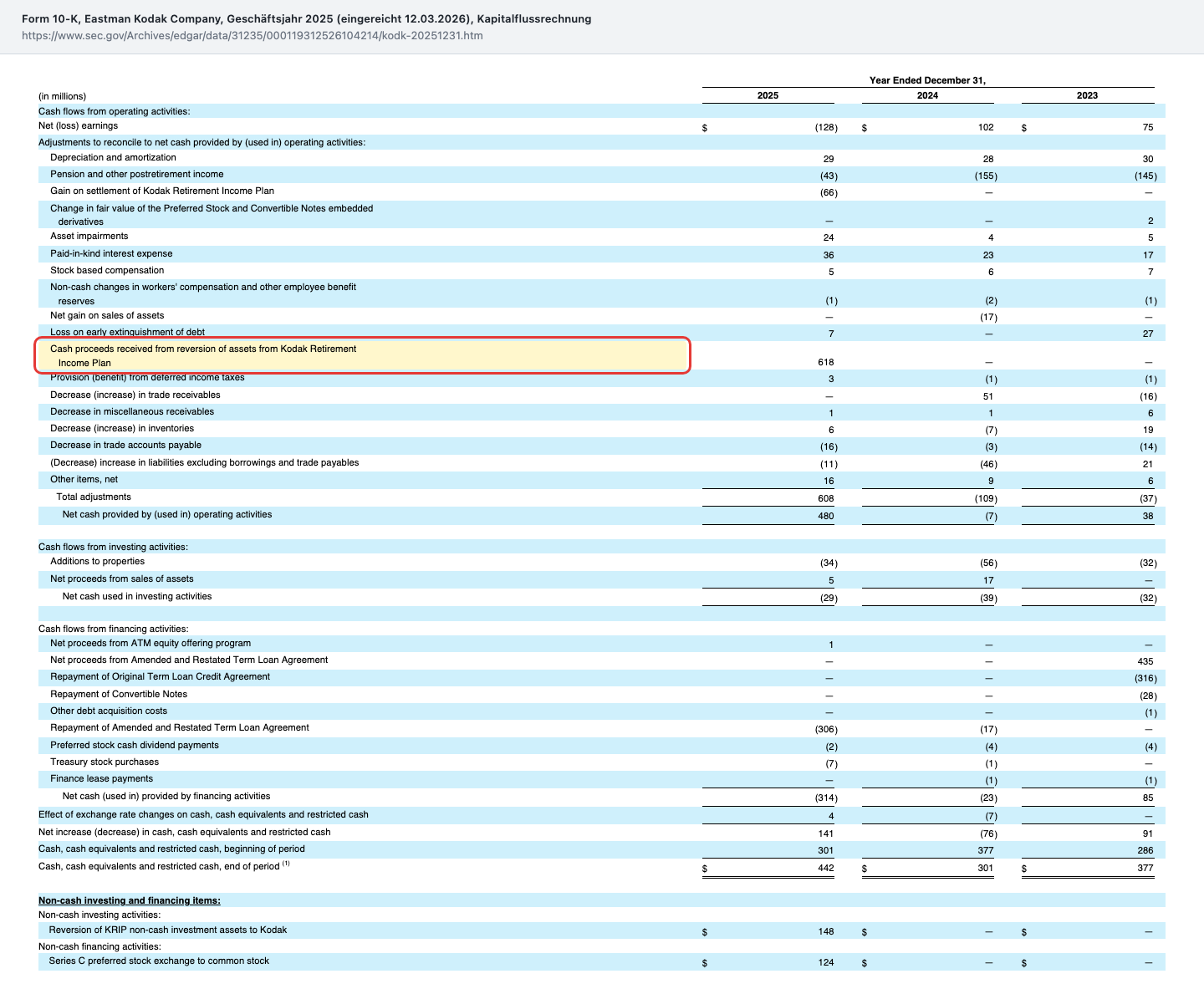
The background in plain terms: Kodak ran a traditional defined-benefit pension, the Kodak Retirement Income Plan (KRIP). It was overfunded — more money sat in it than the pensions required. As of March 31, 2025 the plan was frozen and terminated. On October 21, 2025 Kodak transferred the pension obligations for roughly 27,000 people, worth about $1.8 billion, to an insurer, paid for solely out of the plan assets. What remained reverted to the company.
The company sets out the arithmetic itself in the management discussion:
"Net cash from operating activities increased $487 million for the year ended December 31, 2025 as compared with the prior year primarily due to cash proceeds received from Reversion Assets from KRIP of $618 million and a decrease in inventory and improved earnings from operations, which were partially offset by a $153 million payment of excise tax on KRIP reversion asset surplus"
— Eastman Kodak Company, SEC annual report 10-K for 2025, Liquidity and Capital Resources
Put it together. From the reported free cash flow, subtract $618 million of reversion and add back $153 million of excise tax — both items run through operating activities in the report:
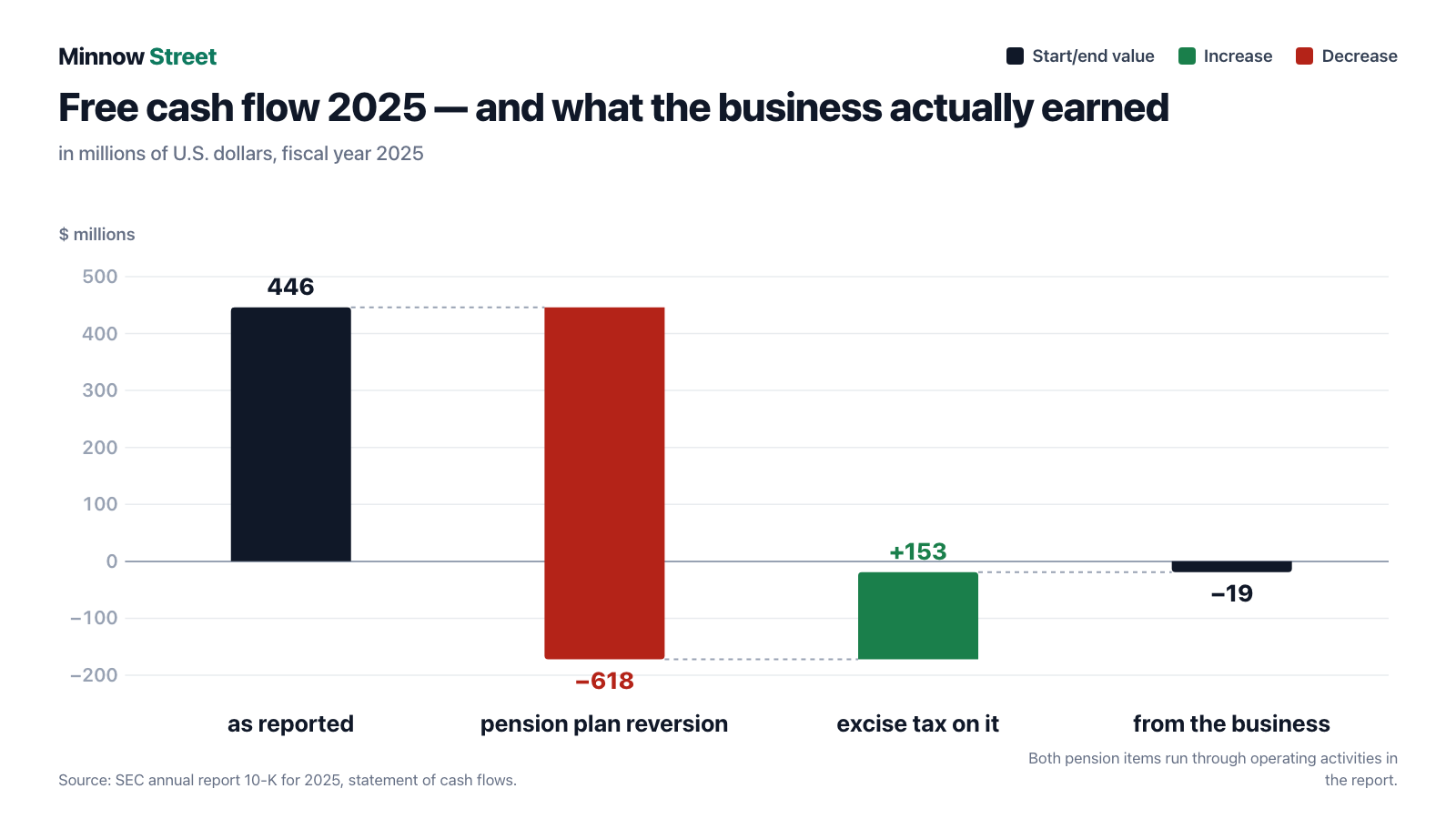
Remember this anchor: a cash flow that happens once in a lifetime is no denominator for a valuation ratio. And the first quarter of 2026 confirms the picture without detours: there the business consumed $30 million, after minus $38 million in the prior-year quarter. After $6 million of capital expenditures that is minus $36 million of free cash flow in a single quarter.
Uncomfortable truth No. 2: before interest and pension income, Kodak earned exactly zero in 2025
The income statement tells the same story, only more bluntly. The management discussion carries a line worth reading twice: earnings from continuing operations before interest expense, before pension income and before the special items. For 2025 it shows a dash — zero. For 2024, minus $7 million.
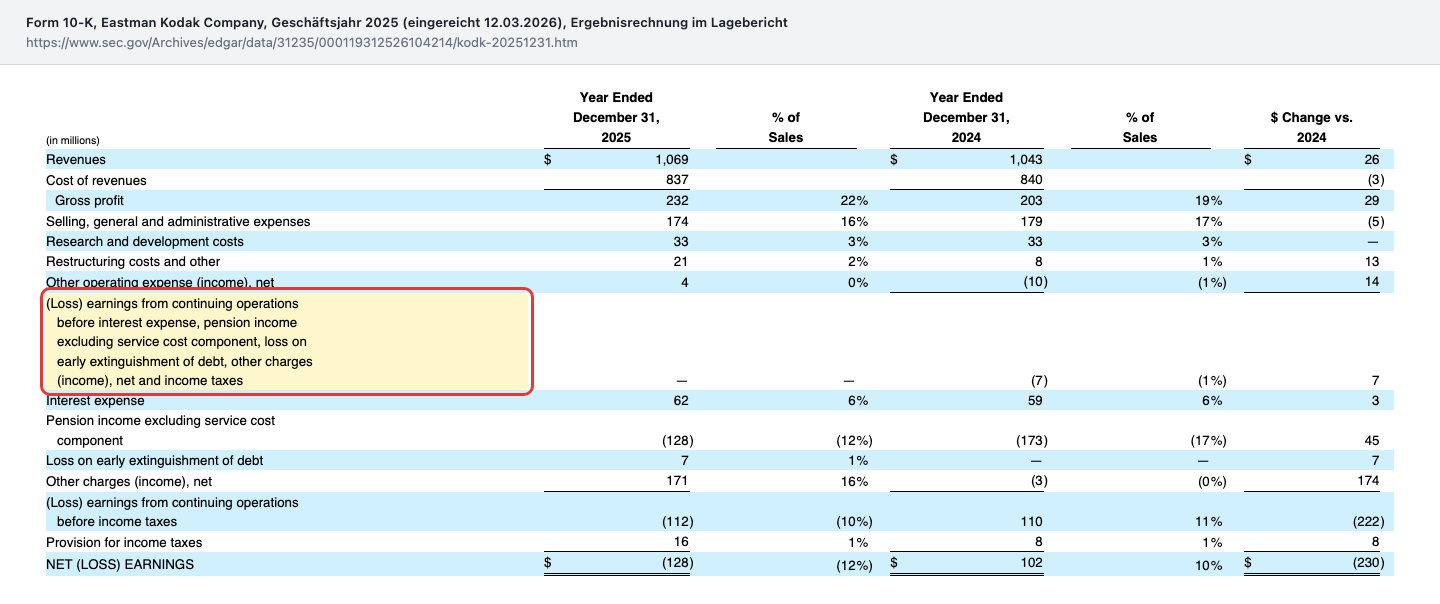
What follows is accounting arranged around that zero: minus $62 million of interest expense, plus $128 million of pension income (2024: plus $173 million), minus $7 million of loss on early debt extinguishment and minus $171 million of other charges — including the excise tax on the pension surplus. The bottom line is a loss of $128 million after a $102 million profit the year before, or minus $1.78 per share after plus $0.97.
The pension income deserves an explanation because it is so large. An overfunded pension plan produces accounting income without cash moving: the plan assets earn more than has to be set aside for the pensions, and the difference lands in the profit and loss account. That is by the rules — but it is not revenue, not a customer and not a product. And with the plan wound up, that source largely disappears going forward.
Uncomfortable truth No. 3: two percent of revenue delivers a third of the profit
Now back to that $23 million from the brand business. Kodak reports segment results as Operational EBITDA, an adjusted result before interest, taxes, depreciation and amortization. Put revenue and result side by side and a picture emerges that you rarely see this clearly:
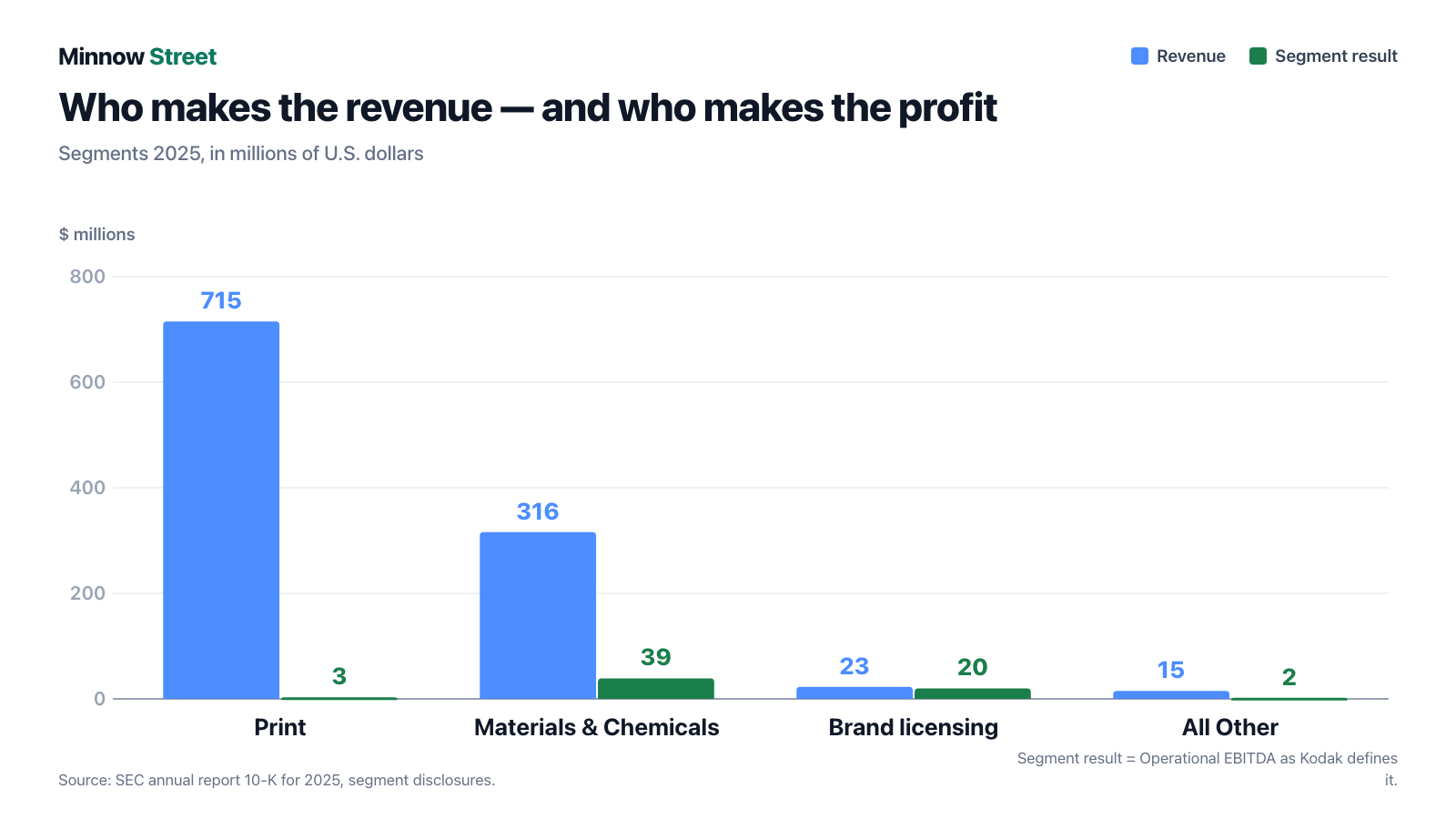
In words: Print produces $715 million of revenue and $3 million of profit. That is less than half a cent on every revenue dollar. Brand licensing produces $23 million of revenue and $20 million of profit — an 87 percent margin, because renting out a name costs almost nothing. Two percent of revenue therefore delivers nearly a third of segment profit.
That is not a criticism of the brand business, quite the opposite: it is the most profitable part of the group. But it limits the upside. A licensing business grows only as long as new licensees appear, and its raw material — the memory of a brand — does not renew itself. Chemicals is the segment with real growth; there, however, about a third of revenue depends on a single buyer. Readers who like tracking such concentrations will find them regularly in our side finds section — three entries from this research cover Kodak.
Uncomfortable truth No. 4: a year ago the company existence itself was in question
The quarterly report for June 30, 2025, filed on August 11, 2025, contains a sentence no company writes voluntarily:
"These conditions raise substantial doubt about Kodak’s ability to continue as a going concern."
— Eastman Kodak Company, SEC quarterly report 10-Q for June 30, 2025
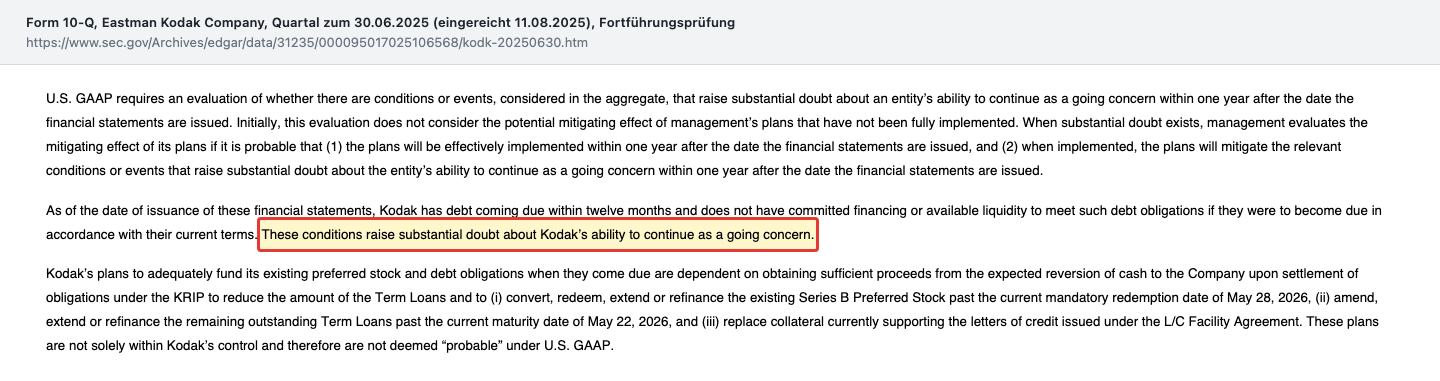
The reason: two dates in May 2026 fell together — the loans maturing on May 22 and the preferred stock becoming redeemable on May 28. Kodak had committed financing for neither. The plan depended on the pension reversion, which, as the company itself wrote, was not solely within Kodak control.
The good news: it worked. The reversion arrived, $306 million of loans were repaid, and on March 11, 2026 the preferred stock was restructured — the 4.0 percent issue became a 6.0 percent issue with a new term, alongside a fourth amendment to the credit agreement. In the annual report for 2025 and in the quarterly report for March 31, 2026, the going-concern statement no longer appears. That is the difference between a company in trouble and a company that has left trouble behind — and it belongs in the assessment just as much as the warning did.
Uncomfortable truth No. 5: 45 percent of the share capital stands ready for resale
Anyone computing value per share should know how many shares there may soon be. The quarterly report cover page reports exactly 97.6 million common shares outstanding as of May 1, 2026. Then, in July 2026, Kodak filed two selling prospectuses within nine days:

Together that is 43,884,811 shares, or roughly 45 percent of today share capital. One clarification, because this is easy to misread: dilution normally means new shares are created and your slice of the cake gets smaller. Here no new shares are created — existing stock held by large holders, or obtainable by them through conversion, is made tradable. No money flows to Kodak, as the prospectus states explicitly. The supply reaching the market can still rise considerably.
On top of that comes genuine conversion overhang: the 6.0 percent preferred stock created in March 2026 — one million shares with a $100 redemption value each — converts at a ratio of one-for-ten into common stock, that is at a conversion price of $10.00 per share. Fully converted it would add 10 million common shares, a good tenth more.
Valuation — orders of magnitude, not day prices
Let us calculate for ourselves, with dates attached. The closing price in our own price series stood at $8.23 on July 24, 2026. As a cross-check, the prospectus of July 1, 2026 carries an officially documented price: $9.25 on June 30, 2026 — and our series shows the same value for that day.
With the 97.6 million shares from the cover page that gives a market value of roughly $803 million. The value carried in the data set is about 18 percent higher at $0.945 billion; from here on we use our own figure and say where it comes from. Fully converted — that is, including the 10 million shares from the preferred stock — it would be roughly $886 million.
Because Kodak holds more cash than debt, enterprise value is smaller than market value: $803 million less $139 million of net cash gives roughly $664 million. Which brings us to the ratios, measured against both the reported and the adjusted cash flow:
- Against reported free cash flow ($446 million, 2025): market value 1.8 times, enterprise value 1.5 times. That looks spectacularly cheap.
- Against cash flow excluding the pension reversion (minus $19 million, 2025): there is no ratio. You cannot divide by a negative number and get anything meaningful out of it.
- Against revenue ($1,069 million): 0.75 times. For an industrial business with a 22 percent gross margin and no profit that is neither cheap nor expensive — it is simply what the market pays for a business it credits with no growth.
- A price-to-earnings ratio does not exist: 2025 produced a loss.
The Piotroski score of 3 out of 9 fits that. It counts nine yes-or-no criteria on profit, cash flow, leverage and efficiency; from 7 upward a balance sheet counts as very solid, below 3 as a warning sign. Three points means the debt reduction counts in its favor while the annual result and earning power do not.
To place the share price: from the highest closing price in the series since relisting — $37.20 on January 9, 2014 — the decline is 77.9 percent; from the 52-week high of $14.51 (May 6, 2026) it is 43.3 percent. Our data set puts the distance from the all-time high at 74.8 percent; we use the self-calculated figure. The intraday spike to $60.00 on July 29, 2020 stays out of it — that was an hour of market action, not a valuation level. How quickly a seemingly cheap cash flow ratio shifts once you measure it more strictly is also on show at DXC Technology, another name from the same ranking whose ratio moves between 1.6 and 7.1 depending on definition. And that a low ratio often says more about the balance sheet beside it than about the price is the lesson of TTEC Holdings, where debt writes the story. At Kodak it is the other way round: the balance sheet is the strong part and earnings are the weak one.
Opportunities and risks at a glance
What speaks for Kodak:
- Net cash instead of net debt: $299 million of cash against $160 million of financial debt as of March 31, 2026 — after repaying $306 million during 2025.
- The going-concern question is settled: the statement from the quarterly report of August 11, 2025 is absent from both following reports; the May 2026 maturities are cleared.
- A growing chemicals division: revenue up 17 percent and segment profit of $39 million after $17 million.
- A highly profitable licensing business: $20 million of segment profit on $23 million of revenue, plus $50 million of licensing payments already collected but not yet recognized, sitting on the balance sheet at March 31, 2026.
- Pricing is sticking: gross margin rose from 19 to 22 percent in 2025, and first-quarter 2026 revenue grew 7 percent to $265 million.
What speaks against it:
- The business earns nothing: zero dollars before interest, pension income and special items in 2025, minus $7 million in 2024.
- The cash flow is a one-off: minus $19 million of free cash flow in 2025 without the pension reversion, and minus $36 million in the first quarter of 2026.
- The pension income is drying up: $128 million in 2025 after $173 million in 2024 — the plan that produced it has been wound up.
- Concentration in revenue: Print delivers 67 percent of revenue and 5 percent of segment profit; in chemicals about a third depends on a single buyer.
- Supply pressure: 43.9 million shares registered for resale, plus 10 million from converting the preferred stock — together more than half of today share capital.
- Piotroski 3 out of 9 and an annual loss of $128 million.
A human conclusion
Back to July 29, 2020. What happened then was not a valuation but a reflex to a headline. Six years later the temptation is quieter but related: a ratio of 2.05 that looks as if you were buying an entire company for two years of its cash stream. The only difference is that this time you can look up where the cash stream came from — and the answer sits in a single line of the statement of cash flows.
Kodak is no longer a restructuring case. The debt is gone, the cash box is full, the going-concern question has been answered. That is real progress, and the number 2.05 captures it no better than it captures the fact that the business behind it earned exactly zero in 2025. Both are true, and both sit in the same filings.
Perhaps that is the takeaway: a valuation ratio is only as good as the repeatability of its denominator. Anyone who wants to know what Kodak is worth waits not for the next sort but for the next statement of cash flows. What you make of that is your decision. And that is exactly as it should be.
Sources
- Quarterly report 10-Q for March 31, 2026 (filed May 7, 2026, most recent periodic report) — cover page share count, balance sheet, statement of cash flows, Note 5 (other long-term liabilities), Note 6 (credit facilities), Note 7 (preferred stock)
- Annual report 10-K for 2025 (filed March 12, 2026) — Item 1 Business and segments, Item 7 management discussion with the results of operations table and liquidity section, statement of cash flows, pension note on the KRIP termination
- Quarterly report 10-Q for June 30, 2025 (filed August 11, 2025) — going-concern statement with the May 2026 maturities
- Annual report 10-K for 2024 (filed March 17, 2025) — comparative figures for 2024 and 2023
- Prospectus supplement 424B7 of July 1, 2026 — resale registration for up to 39,458,543 shares, documented closing price of $9.25 on June 30, 2026
- Prospectus 424B3 of July 9, 2026 — resale registration for up to 4,426,268 shares
- SEC master record for CIK 0000031235 (listing venue NYSE, no former names; checked July 27, 2026 for deregistration, delisting and tender offers — no hits for the common stock)
- Screening and valuation data: in-house stock scanner and fundamental data — measured on July 27, 2026: P/FCF Ranking, U.S. selection, 42nd of 545 hits at a ratio of 2.05, identical on both editions; 25 rows are displayed
- Own price series (closing price $8.23 on July 24, 2026; highest closing price since relisting $37.20 on January 9, 2014; 52-week high $14.51 on May 6, 2026; intraday high $60.00 on July 29, 2020)
This article is journalistic analysis and explicitly not investment advice, not a recommendation to buy or sell, and not a solicitation to trade in securities. Stocks can suffer a total loss at any time. All figures rest on publicly available documents retrieved on the dates stated and may have changed since. The author holds no position in Eastman Kodak Company at the time of publication.
Our Bottom Line at a Glance
- Earning power negative
- Before interest expense, pension income and special items, Kodak earned exactly zero dollars in 2025 and minus $7 million in 2024. The bottom line for 2025 was a loss of $128 million after a $102 million profit the year before. The Piotroski score of 3 out of 9 reflects the same thing.
- Cash generation negative
- The reported free cash flow of $446 million (2025) came almost entirely from unwinding the pension plan: $618 million of reversion less $153 million of excise tax, both inside operating activities. Adjusted, minus $19 million remains; in the first quarter of 2026 it was minus $36 million.
- Balance sheet positive
- As of March 31, 2026 there is $299 million of cash against $160 million of financial debt — net cash of $139 million. During 2025, $306 million of loans were repaid. The Altman score in the balance-sheet variant stands at 4.69, clearly above the 2.6 threshold of the safe zone.
- Going concern positive
- The quarterly report for June 30, 2025 cited substantial doubt about the company ability to continue, triggered by two maturities in May 2026. Both are cleared: loans repaid, preferred stock restructured on March 11, 2026. Neither the annual report for 2025 nor the quarterly report for March 31, 2026 repeats the statement.
- Business mix neutral
- Print delivers 67 percent of revenue ($715 million) and $3 million of segment profit; brand licensing delivers 2 percent of revenue ($23 million) and $20 million of profit. The growing chemicals division (up 17 percent) depends on a single buyer, Kodak Alaris, for roughly a third of its revenue.
- Hook and data quality neutral
- 42nd of 545 U.S. hits in the in-house P/FCF ranking at 2.05, measured identically on both editions on 27.07.2026 — therefore outside the 25 rows displayed and visible only through the screener or the company page. The market value carried in the data set, $0.945 billion, sits roughly 18 percent above our own calculation from share count and closing price ($803 million); the article uses our own figure.
Kodak repaired its balance sheet in 2025 and looks dirt cheap on a single metric — both are true, and both belong apart. The $446 million of free cash flow that produces the price-to-free-cash-flow ratio came from unwinding the overfunded U.S. pension plan: $618 million of reversion, $153 million of excise tax, leaving minus $19 million from the actual business. Before interest and pension income the group earned exactly zero in 2025. Against that stand net cash of $139 million and a going-concern question that has been settled. Not investment advice.
What Our Rating Means
Open questions
The business works in principle, but one material question is open. As long as it stays open, our findings do not carry a quality verdict.
Yellow, not red — and yellow, not green. Against red stands the balance sheet: as of March 31, 2026 there is $299 million of cash against $160 million of financial debt, the Altman score in the balance-sheet variant sits at 4.69, well inside the safe zone, and the going-concern statement of August 11, 2025 has disappeared from both following reports after $306 million of loans were repaid. There is no documented solvency problem here. Against green stands earning power: before interest expense, pension income and special items Kodak earned exactly zero dollars in 2025, the reported cash flow rests on a one-time pension reversion, and 67 percent of revenue produces $3 million of segment profit. The Piotroski score of 3 out of 9 fits that. This is a judgment on the company, not on the share price. The decision is yours.
A journalistic assessment by our editorial team at the time of the deep dive, based on public sources — not investment advice and not a solicitation to buy or sell. Your personal circumstances (investment goals, risk capacity, taxes) cannot be taken into account. What our levels mean, how verdicts are formed, and what conflicts of interest exist →
Worth Noting
- Hook and source: 42nd of 545 U.S. hits in the in-house P/FCF ranking at a ratio of 2.05, measured live on July 27, 2026 and identical on both editions. The German list covering all markets counted 836 hits the same day. Only the 25 strongest rows are displayed — Kodak is not among them and has to be found through the screener or the company page. The lists are recalculated daily.
- Why we calculated the market value ourselves: the value carried in the data set, $0.945 billion, sits roughly 18 percent above the "share count times price" calculation. Our figure rests on the 97.6 million common shares from the quarterly report cover page (as of May 1, 2026) and the closing price of $8.23 on July 24, 2026. As a cross-check, the prospectus supplement of July 1, 2026 documents a closing price of $9.25 on June 30, 2026, which our price series confirms for the same day.
- On the distance from the high: our data set shows 74.8 percent. Calculated ourselves we get 77.9 percent against the highest closing price in the series since relisting ($37.20 on January 9, 2014). The intraday spike to $60.00 on July 29, 2020 is mentioned in the article as market action but deliberately not used as a valuation anchor.
- On the comparability of the cash flow series: the 2023 to 2025 figures all come from the consolidated statement of cash flows in the annual report for 2025 ($480 million, minus $7 million and $38 million from operations; $34 million, $56 million and $32 million of capital expenditures). The pension reversion appears there as its own line inside operating activities, and the excise tax on it is named in the management discussion.
- Status of the mandatory checks on July 27, 2026: the most recent periodic report is the quarterly report for March 31, 2026 (filed May 7, 2026); no newer one existed at the editorial deadline. The filing record contains no tender offer, no merger and no going-private transaction. The Form 15-12G of 2013 and the two 25-NSE filings of 2018 relate to other classes of securities, not to the common stock listed on the NYSE. Filed after the quarterly report were, among others, a current report 8-K (May 22, 2026, Item 5.07), a shelf registration statement S-3 and a prospectus supplement 424B7 (both July 1, 2026) and a prospectus 424B3 (July 9, 2026); all have been reviewed.
- Risk of confusion: Eastman Kodak Company (KODK, NYSE) is not the same as Kodak Alaris, the former consumer business carved out in 2013 — Kodak Alaris is an independent company today and at the same time a major customer of the chemicals segment.
Frequently Asked Questions
Because the denominator is a one-off. The metric divides market value by free cash flow over the last four quarters — here $460 million. Roughly $465 million of that came from unwinding the KRIP pension plan: $618 million of reversion less $153 million of excise tax. Without that item, free cash flow in 2025 was minus $19 million.
KRIP is Kodak old defined-benefit pension. It was overfunded, meaning more money sat in it than the pensions required. The plan was frozen as of March 31, 2025, and on October 21, 2025 Kodak transferred the obligations for roughly 27,000 people, worth about $1.8 billion, to an insurer, paid out of the plan assets. The surplus reverted to the company and was hit with $153 million of excise tax.
No. On July 27, 2026 Kodak ranked 42nd of the 545 U.S. hits at a ratio of 2.05 — identical on both editions. The scanner page shows only the 25 strongest rows. To see the row, use the screener, which filters and sorts the entire universe without a cap, or go straight to the company page through the stock search. The lists are recalculated daily.
Not acutely, judging by the two most recent reports. As of March 31, 2026 there is $299 million of cash against $160 million of financial debt, so net cash of $139 million. The going-concern statement from the quarterly report of August 11, 2025 appears neither in the annual report for 2025 nor in the quarterly report for March 31, 2026. The Altman early-warning score in the balance-sheet variant stands at 4.69, inside the safe zone.
Not the biggest one. Print accounts for $715 million of 2025 revenue and $3 million of segment profit. Chemicals brings $316 million of revenue and $39 million of profit. Brand licensing, meaning renting the Kodak name to other manufacturers, delivers $20 million of profit on just $23 million of revenue — 2 percent of group revenue therefore accounts for nearly a third of segment profit.
The quarterly report cover page reports roughly 97.6 million common shares outstanding as of May 1, 2026. On top of that come two resale registrations dated July 1 and July 9, 2026 covering 43,884,811 shares in total — that creates no new stock but makes existing stock tradable. The 6.0 percent preferred issued in March 2026 converts at one-for-ten into another 10 million common shares.
It is an early-warning system for payment difficulties. We carry it in the balance-sheet variant, whose scale puts the distress zone below 1.1 and the safe zone at 2.6 or above — not the 1.8 and 3.0 familiar from textbooks. At 4.69, Kodak sits well inside the safe zone, which fits the balance sheet after the deleveraging and with net cash of $139 million as of March 31, 2026. The score says nothing about earning power.
The second quarter 2026 report is next; our data set lists August 10, 2026 as the expected date. Three lines will decide it: operating cash flow excluding pension items after minus $30 million in the first quarter, the Print segment result after $3 million for the whole of 2025, and the share count on the cover page following the two resale registrations from July.
Found an error?
Did you spot a factual error, an outdated number, or a typo in this deep dive? Let us know briefly — your report goes straight to the editorial team.