Duolingo: $414 Million in Profit — and $256.7 Million of It Came From a Tax Entry
Duolingo crossed the billion-dollar line in 2025: $1,037.6 million in revenue, $414.1 million in net income, 56.5 million people learning every single day. That is exactly why the stock sits in the best-of list of our scanner. The annual report filed on February 27, 2026 also says where that profit came from: $256.7 million of it was a one-time tax entry. And the money actually billed is growing at half the pace of reported revenue. No recommendation — just the question of what is left once the tax entry is used up.
 Thomas Mücke
Founder & Publisher
Thomas Mücke
Founder & Publisher
Chart
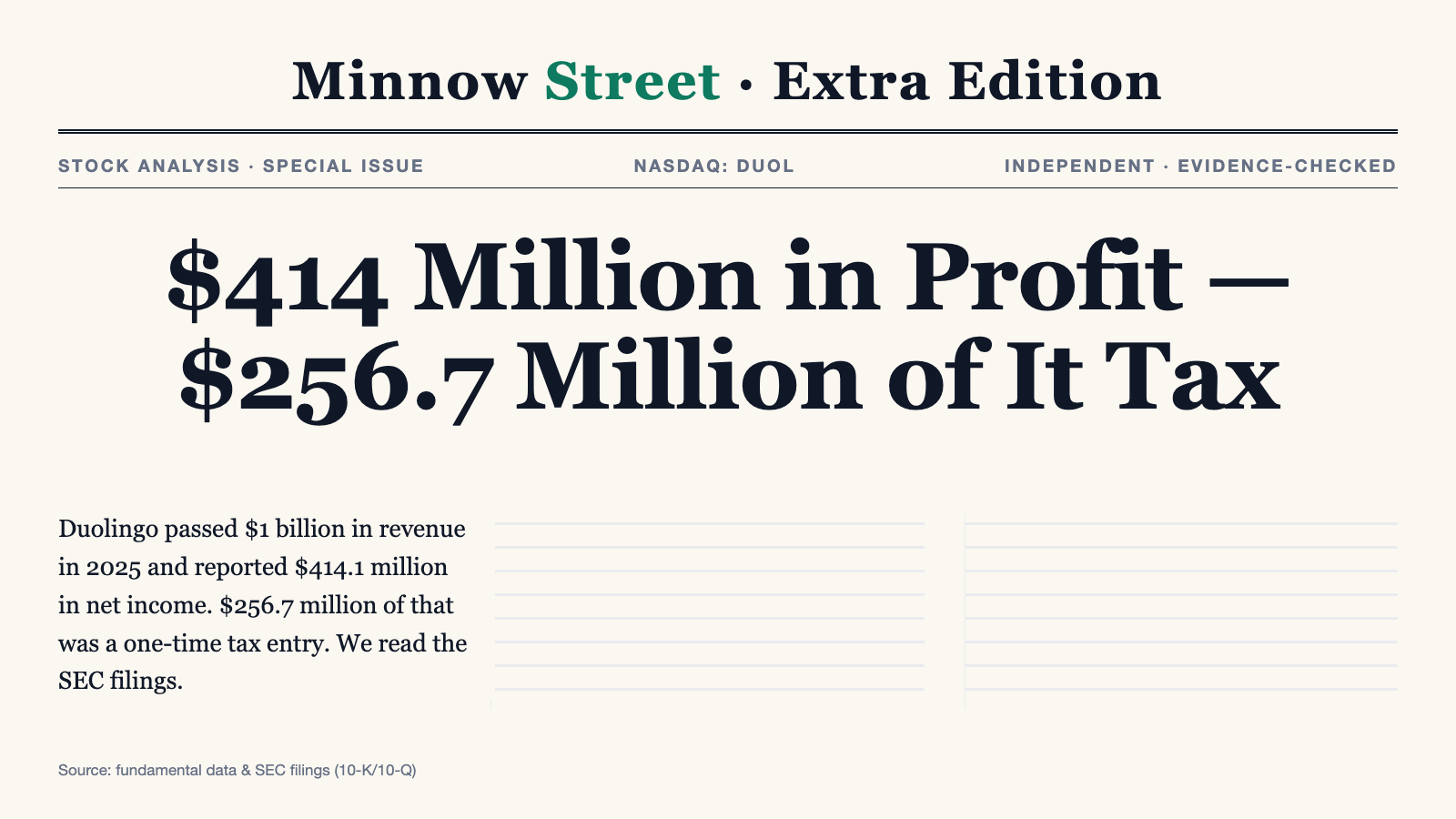
Interactive price chart (TradingView).
Note: pure fact-based analysis, not investment advice and not a solicitation to buy or sell. All figures without guarantee.
Duolingo invented an investor trap without noticing, then built it into its own product. It is called the streak. Someone who has completed a lesson 400 days in a row completes one on day 401 too — tired, late, and knowing full well the Spanish will never be used. Not because they want to learn, but because they refuse to break the streak. That same reflex lives in portfolios. A company that has delivered for twelve quarters straight feels incapable of stopping, and when the run finally breaks it feels like a mistake by the market rather than a piece of news. At Duolingo, Inc. (Nasdaq: DUOL) the run broke over the past year: the cover page of the annual report cites a closing price of $410.02 on June 28, 2025; as of July 24, 2026 the implied price was roughly $122. So let us make a deal. Before we argue about whether the market has lost its mind, we read together what Duolingo itself reported to the U.S. securities regulator, the SEC — the annual report (10-K) for 2025 filed on February 27, 2026, and the quarterly report (10-Q) for the quarter ended March 31, 2026, filed on May 5, 2026. A filing to the SEC is honest under penalty of law. And this one tells of 56.5 million people who come back voluntarily every day — and of $256.7 million in profit that came out of a tax form.
What Duolingo actually does — a green owl as a subscription machine
Duolingo runs a language learning app that costs nothing. That is not a footnote, it is the business model. More than 250 courses, plus math, music and chess; each lesson takes a few minutes and is built like a mobile game. Those who pay nothing see an advertisement at the end of every lesson. Those who pay get quiet and extra features. The industry calls it freemium; in plain terms it is the bakery handing out free half-rolls every morning, betting that enough people eventually buy the whole loaf. As of December 31, 2025, roughly 9 percent of monthly active users did.
The scale is remarkable. In the first quarter of 2026, 137.8 million people opened the app at least once a month and 56.5 million every single day; 12.5 million paid for a subscription. The annual report quantifies the pull of the streak: as of December 31, 2025, about 43 million daily active users held a streak of at least seven days — and about 15 million a streak of at least 365 days. Fifteen million people did not miss a single day for a year.
It is sold in three tiers: Super Duolingo (ad-free, and since 2021 also as a family plan for up to six people), Duolingo Max (more expensive, with AI features) and the Duolingo English Test, an online proficiency exam universities accept for admissions. In 2025, $873.4 million of the $1,037.6 million in revenue came from subscriptions, $79.7 million from advertising, $42.0 million from the English Test, $40.5 million from in-app purchases and $1.9 million from other sources. Only one line shrank: the English Test, which stood at $45.6 million in 2024.
That names the central tension of this analysis, and it runs through every chapter: Duolingo reported the largest profit in its history in 2025 — and almost two thirds of it came not from the business but from a one-time tax entry. At the same time the leading indicator of that business is growing at half the pace of reported revenue. For how quickly a growing user base can turn into a stagnant one, see our analysis of Nextdoor.
Where the stock showed up in our scanner
The hook is not a price move but a balance-sheet list. Our in-house stock scanner lists Duolingo in the U.S. selection of the fundamental ranking — the list that sorts companies by the quality of their numbers rather than the shape of their chart (as of July 26, 2026; the lists are recalculated daily). On the same date, 38 U.S. names meet the criteria of that list, and the page shows the first 25. You can replicate it in three clicks: open the stock scanner, pick the list Fundamental Rank (A / A+), set the market to the United States.
What is interesting is the confluence — and how contradictory it is. On July 26, 2026, DUOL appeared in 16 lists at once, and they almost politely disagree with one another: Buffett criteria, Peter Lynch PEG below 1, quality stocks and high revenue growth on one side; fallen angels, turnaround candidates and short-squeeze potential on the other. Translated: the numbers look first-class, the price looks like an accident. This analysis lives in that gap.
Three metrics from the July 24, 2026 data cut belong here, and all three are rated rather than merely listed. A return on equity of 37.0 percent sounds world-class — it is, but it contains the same one-time tax item we are about to discuss. A debt-to-equity ratio of 0.068 simply means this company has no bank debt, only leases. And 7,494,489 shares sold short amount to roughly 16 percent of all shares outstanding — unusually many for a company that makes money. Remember the sentence: when quality lists and turnaround lists carry the same stock, two calculations are arguing about the same number.
The numbers over the years — honestly appraised
First what genuinely impresses. Revenue rose to $1,037.6 million in 2025 — after $748.0 million in 2024 and $531.1 million in 2023. That is close to a doubling in two years, entirely organic, with no bought-in revenue. Gross profit came to $749.5 million, or 72.2 percent of revenue; in the first quarter of 2026 the gross margin rose to 73.0 percent. And income from operations changed sign twice over three years: minus $13.3 million in 2023, plus $62.6 million in 2024, plus $135.6 million in 2025.
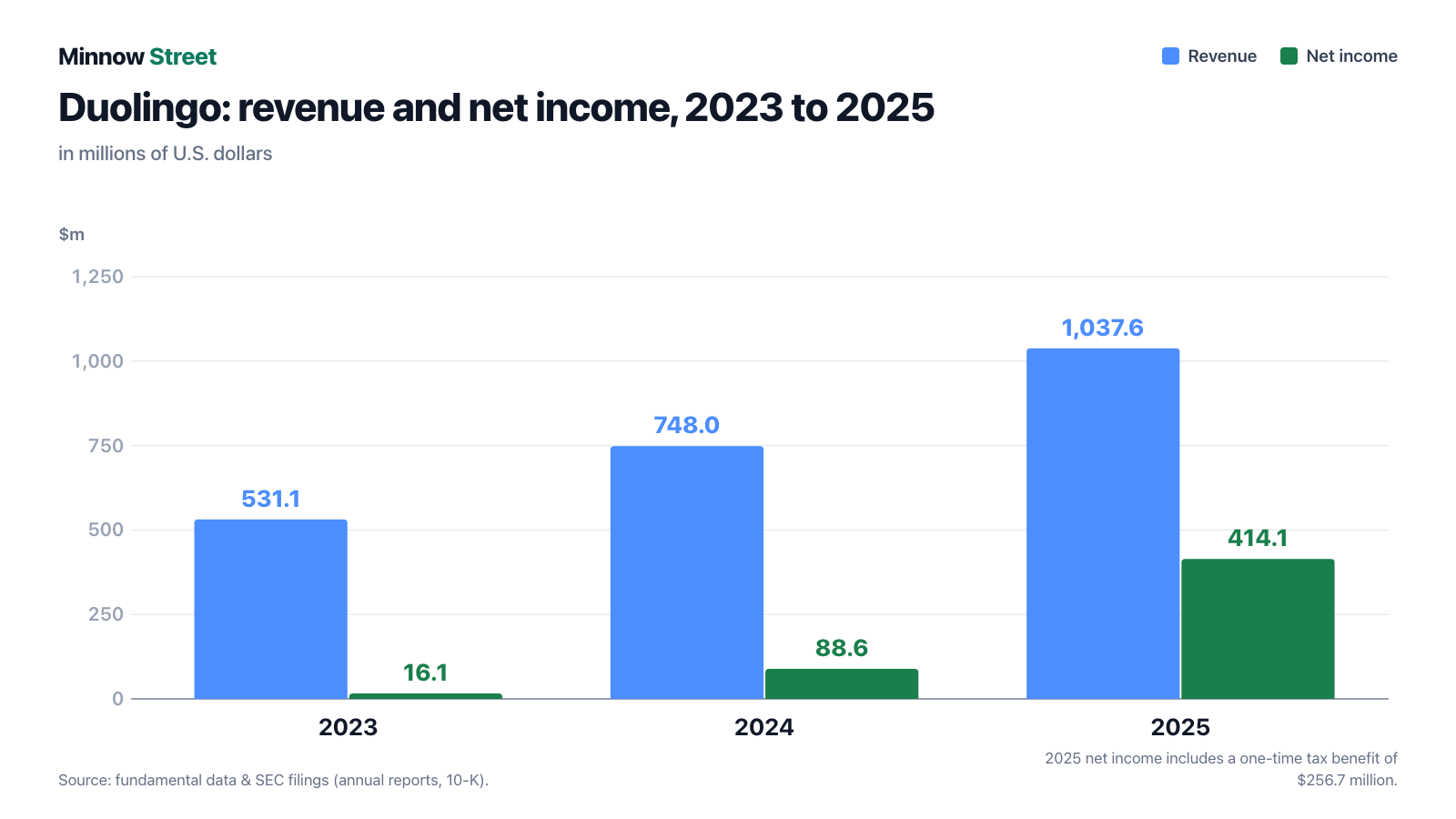
The start of 2026 continued the run. In the first quarter revenue climbed to $292.0 million from $230.7 million a year earlier, up 26.5 percent, and income from operations to $44.5 million from $23.6 million. Cash from operations — the money the running business actually deposits — came to $150.8 million after $105.6 million. Across full-year 2025 it was $387.8 million, after $285.5 million in 2024 and $153.6 million in 2023.
And the balance sheet belongs to a company that has to ask nobody for anything. As of March 31, 2026 it held $1,138.6 million in cash and another $253.3 million in investments. Against that stands, in financial debt, nothing. No notes, no loan, no convertible. The only long-term obligation is $91.9 million of operating leases. Of the $666.2 million in total liabilities, $513.3 million is simply subscription money collected in advance that has yet to be recognized as revenue. Equity of $1,391.8 million funds 67.6 percent of the balance sheet.
One detail that tends to be missed: cash and investments together — $1,391.8 million — match total equity almost to the dollar as of March 31, 2026. On the balance sheet this company consists of money and a brand.
What the filings say — the uncomfortable truths
Uncomfortable truth no. 1: $256.7 million of the $414.1 million profit came from a tax form
The jump from $88.6 million to $414.1 million in net income looks like the moment a business model ignites. Almost two thirds of it is an accounting entry. Duolingo lost money for years and prudently wrote off the resulting tax credits — in technical terms, it carried a valuation allowance against them. In plain terms: you hold a $250 voucher, doubt you will ever redeem it, and therefore carry it at zero. When it became clear in 2025 that Duolingo makes money permanently, the voucher was restored to full value. The difference landed in profit in one go.
“During the three months ended September 30, 2025, the Company released the valuation allowance previously recorded against its federal and state DTAs, resulting in a one-time income-tax benefit, net of a return-to-provision adjustment, in the period of $256.7 million.”
— Duolingo, Inc., SEC annual report 10-K for 2025, income taxes note
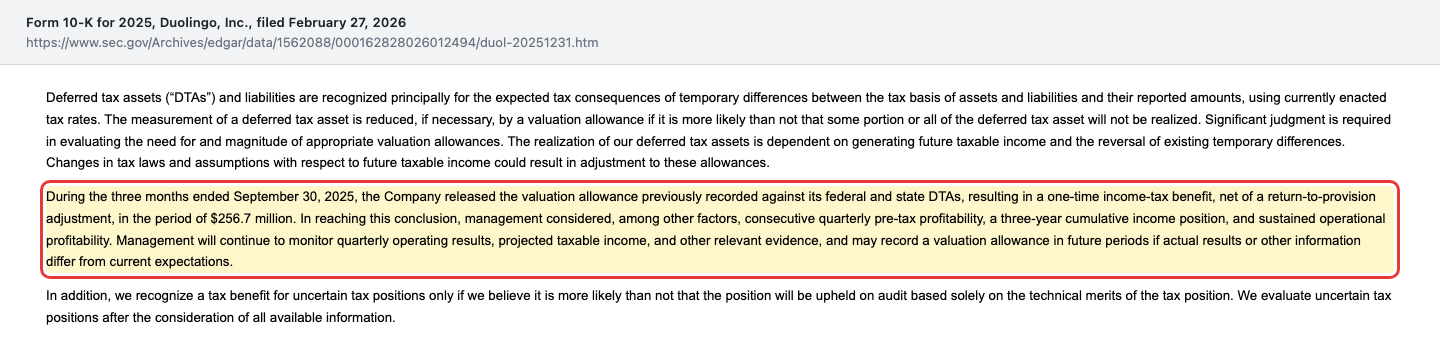
What remains without that item? Pre-tax, Duolingo earned exactly $182.4 million in 2025 — 17.6 percent of $1,037.6 million in revenue. Deduct the $256.7 million from reported net income and roughly $157 million is left. And the tax line is already flipping: for 2025 the income statement shows no tax expense at all but an income-tax benefit of $231.7 million, which puts the effective tax rate at negative 127.0 percent. In 2024 it was 13.4 percent, in 2023 it was 9.6 percent. By the first quarter of 2026 Duolingo was paying 21.8 percent — more than the 21.0 percent U.S. federal statutory rate. The tailwind is not just one-off; it is turning into a headwind.
In fairness, the other half of the story is better than its reputation: a real advantage sits behind the entry. As of March 31, 2026 the balance sheet carried $217.8 million of deferred tax assets that shelter future profits from tax. In the first quarter of 2026 Duolingo reported $12.1 million of income tax expense — yet paid $19 thousand in cash taxes. The profit jump was a one-time entry. The tax shield behind it is real and will work for years.
Uncomfortable truth no. 2: revenue grows twice as fast as the money actually billed
Duolingo mostly sells annual subscriptions. The cash arrives at once, the revenue is spread across twelve months. That is why the quarterly report carries two growth numbers side by side — and in the first quarter of 2026 they drift far apart. Reported revenue rose 26.5 percent to $292.0 million. Total bookings, the amounts actually billed, rose only 13.6 percent to $308.5 million (prior-year quarter: $271.6 million).
In plain terms: bookings are the order slip, revenue is the plate served later. If the kitchen is still cooking from last year’s orders, the accounts look fine — but the counter is emptying. Across full-year 2025 the picture was still the other way round: bookings of $1,158.4 million after $870.6 million, up 33 percent. The break came only recently.
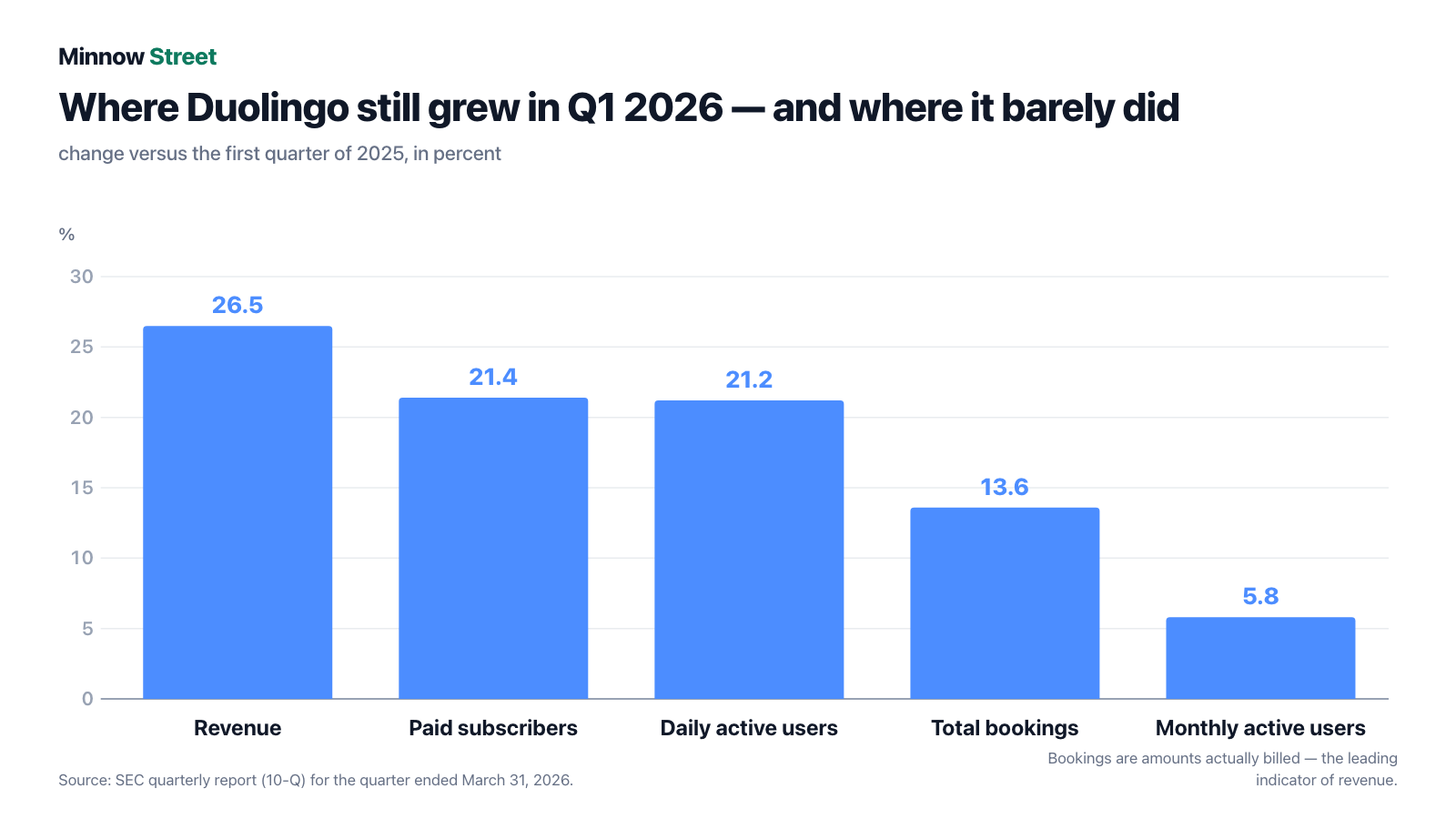
The third figure from the same filing completes the picture: monthly active users grew only 5.8 percent to 137.8 million, while daily active users rose 21.2 percent to 56.5 million. That is a good and a bad piece of news in one sentence. Good: whoever is there stays and uses the product more intensely. Bad: almost nobody new is arriving at the top. A freemium funnel with less flowing in can only pour out more for as long as the existing base can be squeezed harder.
Uncomfortable truth no. 3: 85 percent of the money flows through somebody else’s till
A single line in the notes to the annual report sums up the power balance of this business model: Apple processed 61.6 percent of total revenue in 2025, Google 23.4 percent and Stripe 10.3 percent. That is 95.3 percent combined, of which 85.0 percent runs through the two app store operators. A year earlier it was 60.8, 23.4 and 11.7 percent — so Apple’s share has actually grown.
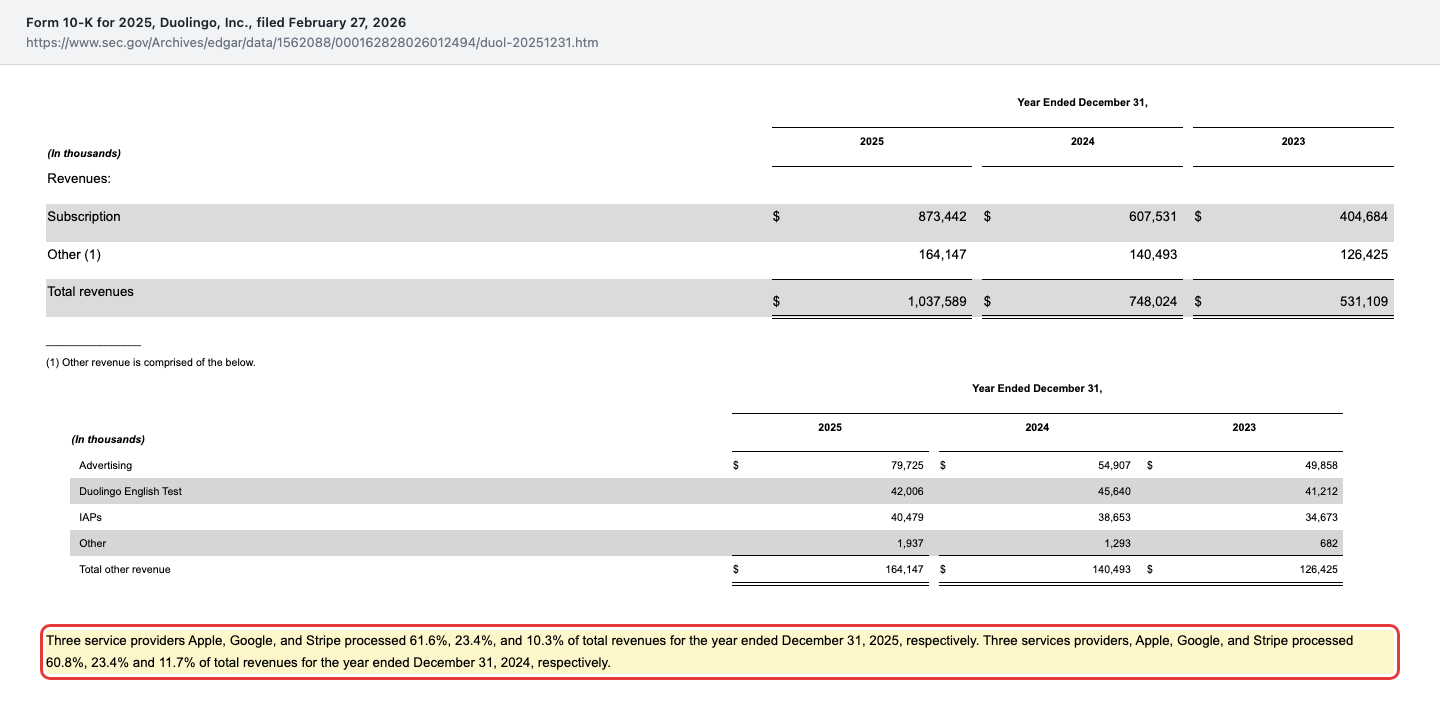
This is not merely payment processing. Apple and Google set the commission, the subscription rules and the visibility in the store. The handsome 72.2 percent gross margin already reflects those fees — but their level is decided by two companies that are themselves building AI assistants with language features. For how quickly a platform rule can reshape a business model, look at our analysis of Digital Turbine, whose entire business sits on top of app store ecosystems.
Uncomfortable truth no. 4: an eighth of revenue is paid in the company’s own shares
Duolingo paid its people $137.4 million in shares in 2025 — 13.2 percent of revenue. That is not a cash outflow, so it does not dent the much-praised free cash flow. It dents something else: your slice of the cake. Every new share issued to employees makes your holding a little smaller; the term for it is dilution.
The effect shows up in the metric Duolingo likes to present most. Adjusted EBITDA of $305.9 million in 2025 is reached in part by adding back $148.6 million of stock-based compensation and related costs. Almost half of that flattering number, in other words, is what employees received in shares. The same calculation applies to free cash flow: at $360.4 million, the market capitalization of roughly $5.7 billion (data as of July 24, 2026) equals 15.8 times — deduct the $137.4 million of share-based pay and $223.0 million remains, or 25.5 times.
The AI question: Duolingo sells it and fears it in the same filing
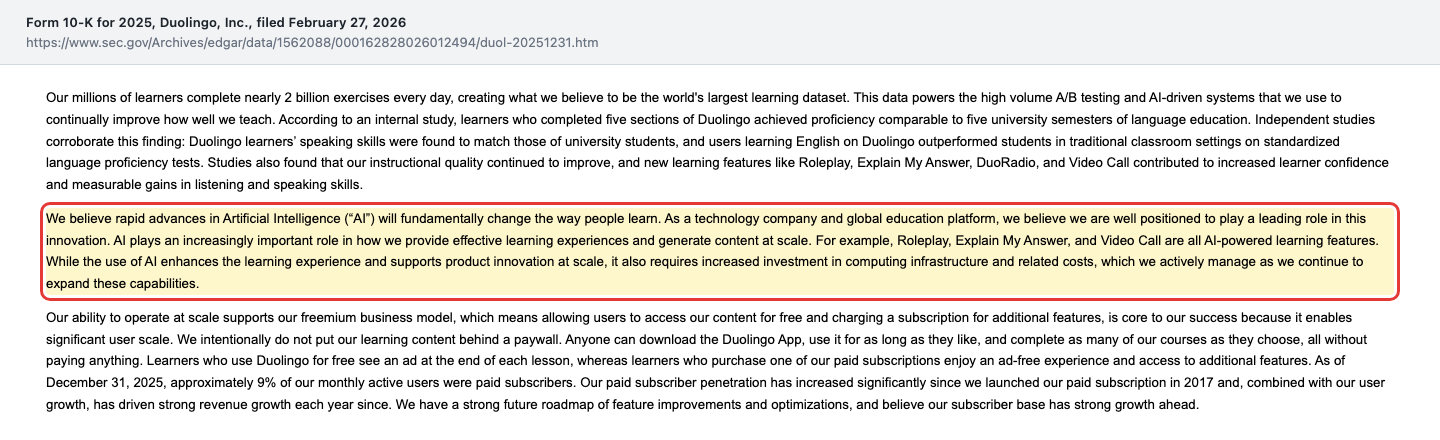
At few companies does artificial intelligence sit so awkwardly across the business model. On one side, AI is a source of revenue. The more expensive Duolingo Max tier is defined in the annual report by the fact that it offers incremental features and exercises powered by AI technology. The Duolingo English Test appears in the filing under the heading “AI-Driven Language Assessment” and produced roughly 4.0 percent of total revenue in 2025. Learning features such as Roleplay, Explain My Answer and Video Call are all AI-powered.
“We believe rapid advances in Artificial Intelligence (“AI”) will fundamentally change the way people learn. As a technology company and global education platform, we believe we are well positioned to play a leading role in this innovation. AI plays an increasingly important role in how we provide effective learning experiences and generate content at scale.”
— Duolingo, Inc., SEC annual report 10-K for 2025, Item 1 Business
On the other side, the same technology appears in the risk factors — twice. Once as an execution risk of its own: the development, implementation and use of AI technologies, including third-party technologies, “may not be successful” and could impair the ability to compete effectively. And once, in the competition section, as the scenario that has weighed on the share price for a year:
“It is possible that a new product could gain rapid scale at the expense of existing brands through harnessing a new technology (such as generative artificial intelligence “GenAI”)), or a new or existing distribution channel, creating a new or different approach to connecting people or some other means.”
— Duolingo, Inc., SEC annual report 10-K for 2025, Item 1 Competition (parentheses as in the original)
Both sentences sit in the same document, written by the same people. That is not incoherence, it is an honest description of the situation: whoever wants to sell language teaching by chatbot has to be better than the chatbot people already get for free. Duolingo’s answer is not the technology but the habit — 15 million people with a streak of more than a year do not switch easily. Whether a habit holds against a better tool is the real question about this stock. The annual report does not answer it.
Valuation — two price-to-earnings ratios for the same stock
Here it gets interesting, because the earnings figure you pick produces a completely different company. At a market capitalization of roughly $5.7 billion (data as of July 24, 2026) and reported 2025 net income of $414.1 million, the price-to-earnings ratio is about 14. Use earnings excluding the one-time tax benefit — roughly $157 million — and it becomes 36. Both numbers are arithmetically correct. Only one describes the running business.
The other yardsticks sit in between. The price-to-sales ratio is about 5.2, price to book 4.1, and the forward price-to-earnings ratio on the analyst estimate for the current year 18.1. Enterprise value net of the cash pile equals roughly 4.1 times 2025 revenue. For a company earning a 72 percent gross margin, carrying no debt and generating hundreds of millions in free cash every year, that is not an excess — for a company whose leading indicator has halved, it is not a bargain either.
The professionals’ view is unusually lukewarm. Twenty-three analyst ratings produce a mean price target of $113.24 — below the implied share price of roughly $122. The distribution: six strong buy, eight buy, nine hold, not a single sell. Translated: nobody wants out, but nobody dares write a target above the current price. The 7,494,489 shares sold short, roughly 16 percent of all shares outstanding, fit that picture.
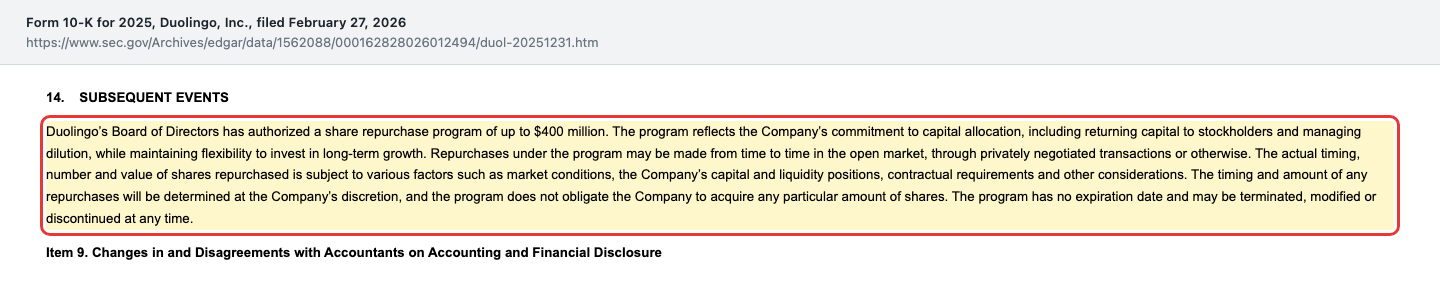
And then there is the frame the company set itself: a share repurchase program of up to $400 million, authorized as a subsequent event in the 2025 annual report. That is roughly 7 percent of the market capitalization. In the first quarter of 2026 it produced 262,000 shares for $25.8 million — six percent of the authorization in one quarter.
Opportunities and risks at a glance
What speaks for Duolingo
- A habit as a moat. 56.5 million daily active users in the first quarter of 2026, roughly 15 million of them with a learning streak of more than a year (as of December 31, 2025). That kind of attachment cannot be bought with an advertising budget.
- A balance sheet without a single debt. $1,138.6 million in cash plus $253.3 million in investments as of March 31, 2026, no borrowings, a 67.6 percent equity ratio.
- Real money, not just book profit. $387.8 million of cash from operations in 2025 after $285.5 million and $153.6 million in the two prior years — that trend contains no tax entry.
- A tax shield for years. $217.8 million of deferred tax assets as of March 31, 2026; actual cash taxes paid in the first quarter of 2026 were $19 thousand.
- Pricing room above. Only about 9 percent of monthly active users were paying as of December 31, 2025 — and paid subscriptions still grew 21.4 percent to 12.5 million in the first quarter of 2026.
What speaks against it
- Quality of earnings. $256.7 million of the $414.1 million in 2025 profit was a one-time tax entry; the operating margin was 13.1 percent.
- The growth gap. Bookings up 13.6 percent against revenue up 26.5 percent in the first quarter of 2026 — the lead is cooling faster than the echo.
- The top of the funnel. Monthly active users up only 5.8 percent, to 137.8 million.
- Somebody else’s till. 85 percent of revenue runs through Apple and Google, whose commissions and rules Duolingo does not set.
- The AI question. Duolingo itself writes that a new product could take share from established brands by harnessing generative AI.
- Dilution and voting power. $137.4 million of stock-based compensation in 2025 (13.2 percent of revenue); 76.3 percent of the voting power sat with directors, officers and 5 percent stockholders as of December 31, 2025.
A human conclusion
Back to the streak. Duolingo built a product that gets people to do something 365 days running that they never have to do. That is a genuine achievement, and the numbers prove it: 137.8 million people a month, $1,037.6 million in revenue, $360.4 million of free cash flow, zero debt. Anyone who calls this company a fad has not read the annual report.
But the streak that matters on the stock market is a different one. It reads: every quarter grows faster than expected. That streak broke over the past year — not in revenue, but one level below, in bookings and in monthly active users. And the profit that makes the stock look so cheap in our fundamental list came almost two thirds from an event that does not repeat. The market responded with a decline you can look up in the company’s own filing: $410.02 on June 28, 2025, an implied roughly $122 on July 24, 2026.
Perhaps that is an overreaction. Perhaps it is the beginning of the realization that a language learning app in a world where every phone translates simultaneously is a different product than it was in 2021. Both readings sit in the same documents, and both are verifiable. You have now seen both sides, with the original filings on the table. What you make of it is your decision. And that is exactly as it should be.
Sources
- Duolingo, Inc. — SEC annual report 10-K for 2025 (filed February 27, 2026)
- Duolingo, Inc. — SEC quarterly report 10-Q for the quarter ended March 31, 2026 (filed May 5, 2026)
- Duolingo, Inc. — SEC annual report 10-K for 2024 (filed February 28, 2025)
- All SEC filings by Duolingo, Inc. (CIK 0001562088) — reviewed through July 26, 2026, including the 8-K of June 5, 2026 and the beneficial ownership filings of May 6 and May 14, 2026
- Fundamental data (metrics, valuation, analyst estimates), data as of July 24, 2026
- In-house stock scanner, list Fundamental Rank (A / A+), as of July 26, 2026
Journalistic analysis, not investment advice and not a solicitation to buy or sell securities. Share prices can move sharply and a total loss is possible. All figures come from the original sources linked above and carry the as-of date stated there; metrics from fundamental data are labelled with their data cut. The author holds no position in Duolingo, Inc. at the time of publication.
Our Bottom Line at a Glance
- Business and reach positive
- Revenue climbed from $531.1 million in 2023 through $748.0 million in 2024 to $1,037.6 million in 2025 — close to a doubling in two years, with no acquisition. The first quarter of 2026 added another 26.5 percent. 137.8 million people open the app each month, 56.5 million every day; roughly 15 million of them hold a learning streak of more than a year. That habit is the real moat.
- Balance sheet and funding positive
- As of March 31, 2026 the company held $1,138.6 million in cash and $253.3 million in investments — and not a single line of debt. The only long-term obligation is $91.9 million of operating leases. Equity funded 67.6 percent of the balance sheet, and free cash flow reached $360.4 million in 2025. This company needs nobody to lend it money.
- Quality of earnings negative
- Of the $414.1 million in 2025 net income, $256.7 million came from the one-time release of a tax valuation allowance in the third quarter of 2025. Pre-tax income was $182.4 million — 17.6 percent of the $1,037.6 million in revenue. The operating margin was 13.1 percent in 2025. Anyone computing a P/E of roughly 14 on reported earnings is computing with an item that happened once.
- Growth momentum negative
- The leading indicator is cooling. In the first quarter of 2026 total bookings rose only 13.6 percent to $308.5 million while reported revenue rose 26.5 percent. Monthly active users grew just 5.8 percent, to 137.8 million from 130.2 million. The installed base is being monetized more deeply — the top of the funnel is drying up.
- Dependencies neutral
- Apple processed 61.6 percent of 2025 revenue, Google 23.4 percent and Stripe 10.3 percent. So 85 percent of the money runs through two app stores whose operators set the commission, the rules and the visibility — and who are building AI assistants with language features themselves. Add the voting structure: 76.3 percent of the voting power sat with directors, officers and 5 percent stockholders as of December 31, 2025.
- Valuation neutral
- At a market capitalization of roughly $5.7 billion (data as of July 24, 2026), reported 2025 earnings give a price-to-earnings ratio of about 14 — excluding the tax benefit it is about 36. Free cash flow of $360.4 million implies 15.8 times; deduct the $137.4 million of stock-based compensation and it is 25.5 times. The mean analyst price target of $113.24 sits below the implied share price of roughly $122.
Duolingo is an unusually good product in an unusually unsettled moment. The business works: $1,037.6 million in 2025 revenue, $360.4 million of free cash flow, $1,138.6 million in cash, zero debt and 56.5 million people who come back voluntarily every day. Against that stand a profit that came almost two thirds from a one-time tax entry, a leading indicator growing at half the pace of revenue, and 85 percent of the money running through somebody else's till. Buying here does not buy the 2025 profit; it buys the question of whether habit still converts into revenue once every chatbot speaks Spanish. Not investment advice.
What Our Rating Means
Open questions
The business works in principle, but one material question is open. As long as it stays open, our findings do not carry a quality verdict.
There is little to argue about on substance: no debt, $1,138.6 million in cash plus $253.3 million in investments as of March 31, 2026, a 67.6 percent equity ratio, a 72.2 percent gross margin and three straight years of rising cash flow. Two operating questions are open, and both are documented. First, quality of earnings: $256.7 million of the $414.1 million profit in 2025 was a one-time tax entry, and income from operations was 13.1 percent of revenue. Second, momentum: bookings up 13.6 percent against revenue up 26.5 percent in the first quarter of 2026, and monthly active users up only 5.8 percent. This is not an existential question — a debt-free company with a billion in cash and positive cash flow does not fail over it. But it is more than a formality. Hence yellow: substance documented, continuation unproven. The decision is yours.
A journalistic assessment by our editorial team at the time of the deep dive, based on public sources — not investment advice and not a solicitation to buy or sell. Your personal circumstances (investment goals, risk capacity, taxes) cannot be taken into account. What our levels mean, how verdicts are formed, and what conflicts of interest exist →
Worth Noting
- Duolingo reached our research list through our in-house stock scanner: the stock sits in the U.S. selection of the list Fundamental Rank (A / A+), which sorts companies by the quality of their numbers (as of July 26, 2026; 38 U.S. names meet the criteria and the page shows the first 25). On the same date DUOL appeared in 16 lists at once, among them Buffett criteria, Peter Lynch PEG below 1, quality stocks and high revenue growth. The lists are recalculated daily.
- Recency: this analysis is based on the annual report 10-K for 2025 (filed February 27, 2026), the quarterly report 10-Q for the quarter ended March 31, 2026 (filed May 5, 2026) and the annual report 10-K for 2024 (filed February 28, 2025). Every filing submitted afterwards was reviewed — the 8-K of June 5, 2026 (annual meeting results), the SCHEDULE 13G/A filings of May 6 and May 14, 2026, and Forms 4 through July 14, 2026. None of them changes the picture; the next quarterly report is expected in early August 2026.
- One trap in the metrics: some data providers list only the 40,237,065 Class A shares as outstanding. In fact 6,356,052 Class B shares come on top (cover page of the quarterly report, as of May 1, 2026), for 46,593,117 in total. The market capitalization of roughly $5.7 billion quoted here (data as of July 24, 2026) uses the full share count; the cross-check of 46,593,117 shares times the implied price of $122.24 confirms it. Analyses are evergreen; a daily price is not a reason to buy.
Frequently Asked Questions
From subscriptions. In 2025, $873.4 million of the $1,037.6 million in revenue came from subscriptions, or 84 percent. The rest splits into advertising ($79.7 million), the Duolingo English Test ($42.0 million), in-app purchases ($40.5 million) and other ($1.9 million). The app itself stays free; as of December 31, 2025, roughly 9 percent of monthly active users were paying.
Because a tax position was released. In the third quarter of 2025 Duolingo removed the valuation allowance on its deferred tax assets and booked a one-time income-tax benefit of $256.7 million. Strip that out and roughly $157 million remains of the reported $414.1 million in net income. Pre-tax, Duolingo earned $182.4 million in 2025.
No, but it does not repeat. A real advantage sits behind it: as of March 31, 2026 the balance sheet carried $217.8 million of deferred tax assets that shelter future profits from tax. In the first quarter of 2026 Duolingo reported $12.1 million of income tax expense yet paid only $19 thousand in cash taxes. The income statement entry, however, was a one-off.
Bookings are the amounts Duolingo has actually billed. Because annual subscriptions are collected up front but recognized as revenue over twelve months, bookings lead revenue. In the first quarter of 2026 total bookings rose 13.6 percent to $308.5 million while revenue rose 26.5 percent to $292.0 million. The lead indicator is cooling faster than the echo.
Both at once. AI is a revenue source: the higher-priced Duolingo Max tier is defined in the annual report through its AI features, and the Duolingo English Test, described as AI-driven, brought in roughly 4.0 percent of revenue in 2025. The same filing also says a new product could gain rapid scale at the expense of existing brands by harnessing generative AI. Both statements come from Duolingo itself.
None. The balance sheet as of March 31, 2026 shows no loans and no notes whatsoever. Of the $666.2 million in total liabilities, $513.3 million is deferred subscription revenue and $91.9 million is a long-term operating lease obligation. On the other side stand $1,138.6 million in cash and $253.3 million in investments.
A small group. Duolingo has two share classes: Class A with one vote, Class B with twenty votes per share. As of December 31, 2025, directors, executive officers, 5 percent stockholders and their affiliates together held 76.3 percent of the voting power. The 6,356,052 Class B shares are roughly 13.6 percent of the capital but carry about three quarters of the votes.
No. As of the July 24, 2026 data cut the stock shows no dividend and a payout ratio of zero. Capital is meant to return through buybacks instead: the 2025 annual report announces a program of up to $400 million. In the first quarter of 2026, 262,000 shares were repurchased for $25.8 million.
Found an error?
Did you spot a factual error, an outdated number, or a typo in this deep dive? Let us know briefly — your report goes straight to the editorial team.