DHI Group: Ten Quarters of Beating Estimates — and Eleven of Shrinking Revenue
DHI Group runs the job boards Dice and ClearanceJobs and has beaten the analyst estimate for ten straight quarters. That is exactly what puts the stock in our Big Earnings Surprise ranking, where DHX sits at number 20 of the U.S. selection (as of July 25, 2026). The catch: over the same stretch revenue has fallen for eleven straight quarters, 2025 closed with a net loss of $13.5 million, and the company wrote $9.6 million off its own Dice brand — the reason given in the annual report being AI models lowering demand for technology professionals. Not investment advice — just the question of who is surprising whom here.
 Thomas Mücke
Founder & Publisher
Thomas Mücke
Founder & Publisher
Chart
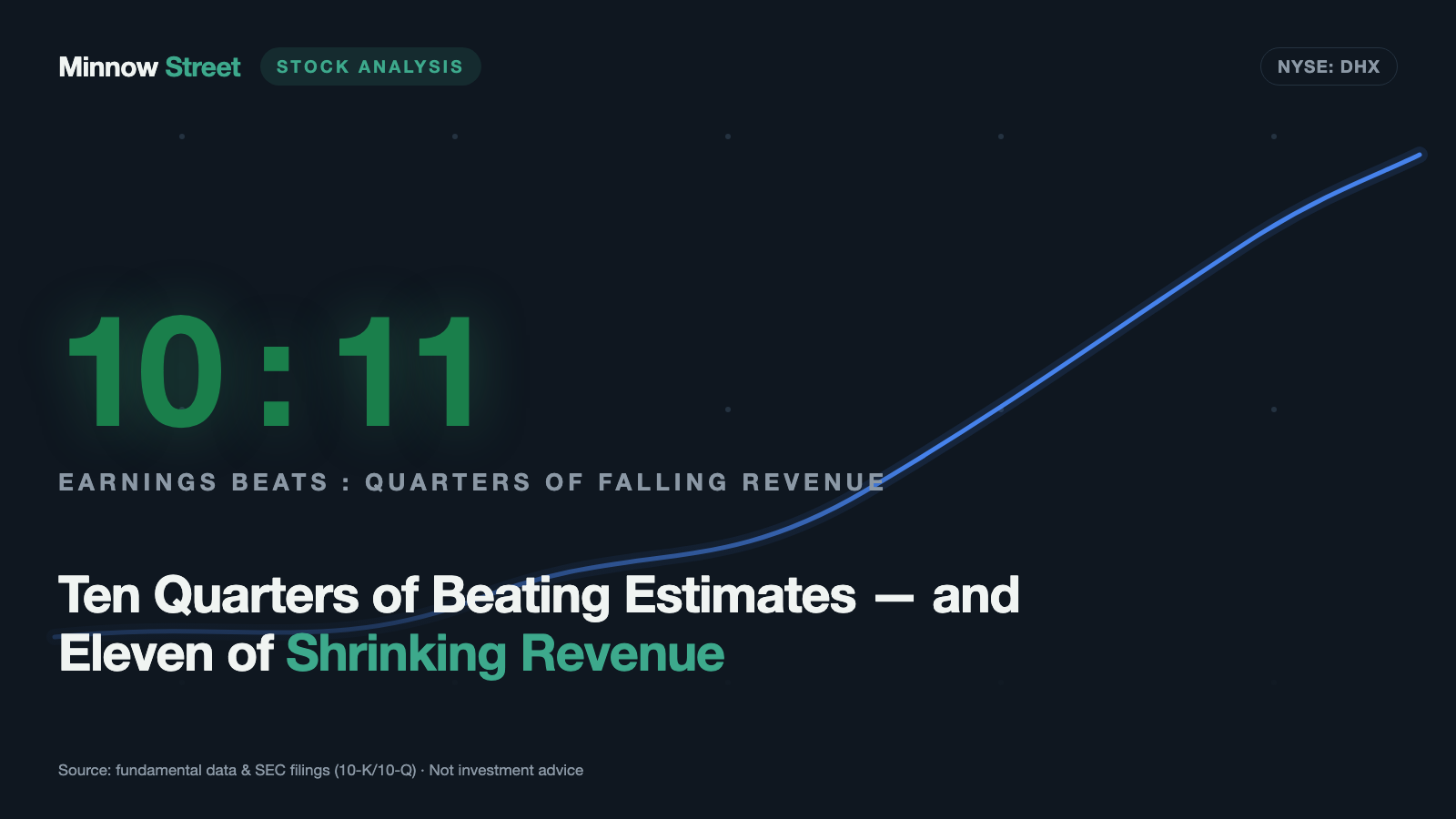
Interactive price chart (TradingView).
Note: pure fact-based analysis, not investment advice and not a solicitation to buy or sell. All figures without guarantee.
There is an investor trap that springs precisely when a company does something right: the lowered bar. Picture a high jumper. He jumps, the bar stays up, the crowd cheers. Ten meets in a row. What nobody watches is the official quietly dropping the bar a notch before every attempt. The jump is real and the cheering is real — only the height keeps shrinking. On the stock market that official is called the analyst consensus, and a company that clears its own estimate quarter after quarter can still get smaller every quarter. DHI Group (NYSE: DHX) of Centennial, Colorado is the textbook case. So let us make a deal: before a run of earnings beats convinces you of anything, we read together what the company itself told the U.S. securities regulator, the SEC — the annual report (10-K) for 2025, the quarterly report (10-Q) as of March 31, 2026, and the current current reports (Form 8-K). An SEC filing is honest under penalty of law. And this one tells of two brands running in opposite directions, of a balance sheet that is three quarters goodwill — and of a writedown for which the company itself blames artificial intelligence.
What DHI Group actually does — two job boards, two worlds
DHI Group does not sell software you own; it rents access to two marketplaces. Think of two very specialized farmers markets for labor. Employers pay an annual fee for a stall — a "recruitment package" in the company's language — and in return may post jobs and search the resume database. Roughly 90 percent of each brand's revenue came from those packages in 2025. That is the entire business model, and it explains why the numbers move so slowly: a customer who signs an annual contract in spring keeps showing up in revenue for twelve months.
ClearanceJobs is the smaller and the better market. It connects professionals holding an active U.S. security clearance with the companies that serve defense, intelligence and government agencies. As of December 31, 2025 it carried roughly 56,000 job postings, and during 2025 it averaged 967,000 monthly users. Access is scarce by construction: a security clearance is not granted at signup but after months of vetting. That is the moat.
Dice has been the address for U.S. technology jobs for 35 years — roughly 83,000 job postings as of December 31, 2025 and an average of 1.5 million monthly users. Here access is not scarce at all but fiercely contested: every large search engine, every social network and every applicant tracking system competes for the same attention. And here sits the technology DHI markets itself with:
"Candidate Match and Search on Dice is powered by IntelliSearch, a proprietary machine-learning technology that is foundational to many Dice products and services. Approximately 90% of Dice revenue was derived from recruitment packages in 2025."
— DHI Group, Inc., SEC annual report on Form 10-K for 2025, Item 1 Business

That frames the central tension of this analysis, and it runs through every chapter: DHI sells AI-powered tools to human resources departments — and loses revenue because the same technology reduces demand for the very professionals DHI places. The annual report calls the company a "leading provider of artificial intelligence-powered software products." Both statements live in the same document.
How this stock reached our desk
DHI Group ranks number 20 in our in-house Big Earnings Surprise ranking (U.S. selection with 81 hits, as of July 25, 2026). The full list sits in our "Big Earnings Surprise" stock scanner — the filter looks for companies whose reported earnings came in well above the estimate. One caveat: these lists are recomputed every day, so rank and composition can shift with the next run.
What triggered the filter is impressive. For the first quarter of 2026 the estimate stood at $0.03 per share and the company reported $0.08 — a surprise of roughly 167 percent. And it was no one-off: according to fundamental data (as of July 25, 2026), DHI came in above the estimate in ten consecutive quarters from late 2023 through the first quarter of 2026, in one quarter by 600 percent. Add a relative strength rating of 88: the stock has outperformed 88 percent of its comparison field (as of July 25, 2026).
Now the counter-entry, from the same data set. Over exactly that stretch revenue has fallen for eleven consecutive quarters — from the third quarter of 2023 through the first quarter of 2026, most recently by 8.1 percent to $29.693 million. Note the finding right at the start: an earnings surprise measures the distance to an estimate, not the direction of the business. Only together do the two produce a picture — and that picture is what we look at now.
The numbers over the years — honestly credited
First what genuinely speaks for DHI, which is more than the loss line suggests. The key point: this company earns cash even while reporting a loss. Operating activities provided $21.102 million in 2025, virtually unchanged from 2024 ($21.045 million). Because fixed asset purchases were nearly halved from $13.932 million to $7.309 million, $13.793 million of free cash flow remained, after $7.113 million in the prior year and $1.093 million in 2023. The first quarter of 2026 added $8.4 million operating and $6.8 million free, against $0.1 million a year earlier.
The reason lies in the model: customers pay up front. As of March 31, 2026 the balance sheet carried $44.275 million of short-term deferred revenue — money already in the bank that only counts as revenue later. A loss made mostly of depreciation and impairments costs no cash.
Second, earning power holds once the special items come out: adjusted earnings before interest, taxes, depreciation and amortization came to $35.103 million in 2025 after $35.313 million a year earlier — on 10 percent less revenue. The adjusted margin therefore rose from 25 to 27 percent. For a provider whose main market is eroding, that is remarkable cost discipline. It carries a price we will return to shortly.
Third, and this is the genuinely good news, one of the two brands works:
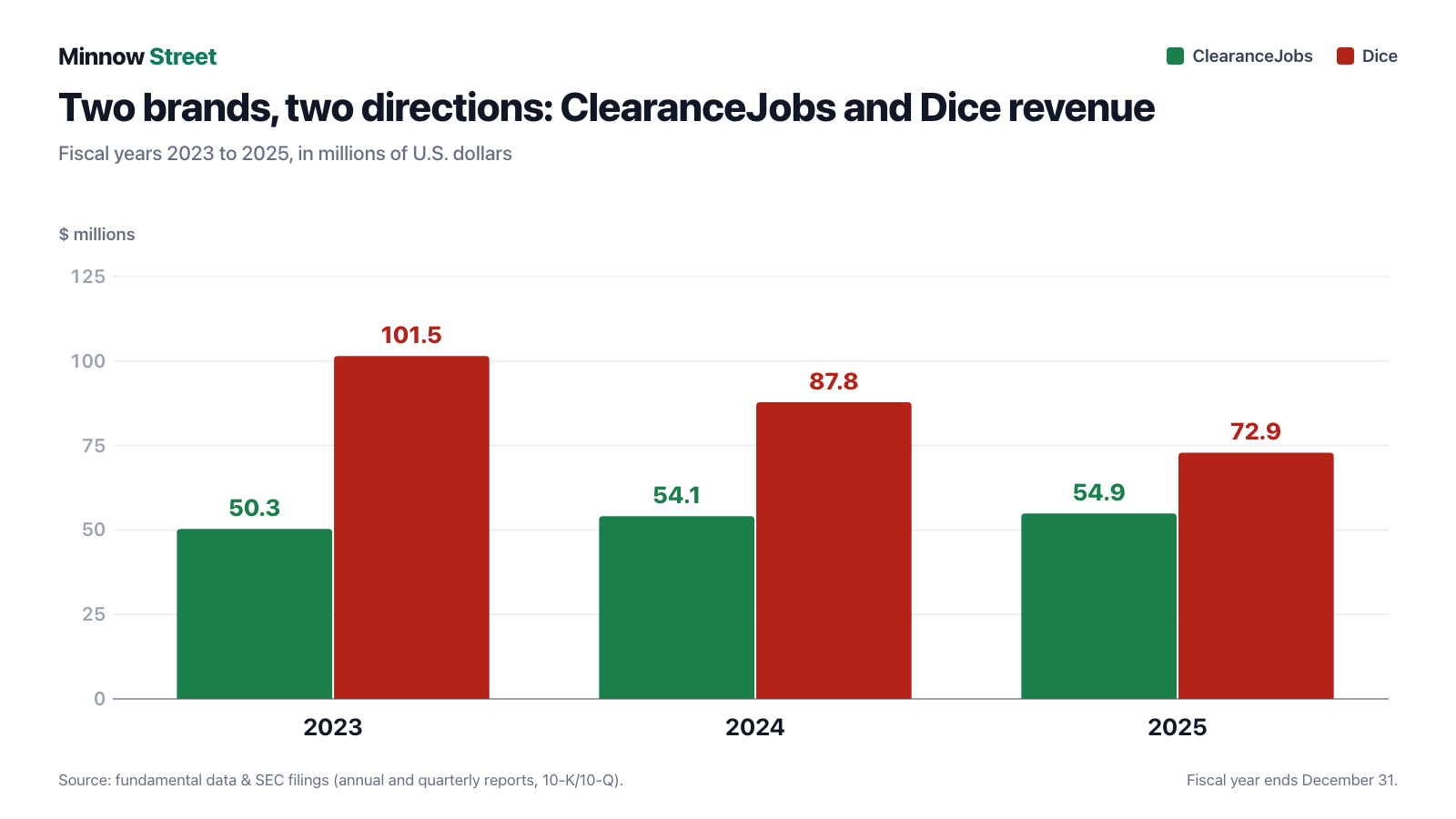
ClearanceJobs earns handsomely. In 2025 the brand produced $54.889 million of revenue and $23.746 million of adjusted earnings before interest, taxes, depreciation and amortization — a 43 percent margin. In the first quarter of 2026 revenue rose 4.6 percent to $13.996 million and bookings climbed 7 percent to $18.0 million. Average annual revenue per recruitment package customer gained 6 percent to $27,286. The 2025 renewal rate was 89 percent and the revenue retention rate 106 percent, meaning existing customers spent more than the year before. And DHI is adding to it: AgileATS (an applicant tracking system for government contractors, July 31, 2025, total consideration $1.9 million) and Point Solutions Group (engineering and technology services for defense contracting, February 27, 2026, $5.4 million).
Hold on to the picture: there are two companies inside this shell. One grows at a 43 percent margin, the other has been shrinking for three years. Which brings us to the uncomfortable truths.
What the filings say — the uncomfortable truths
Uncomfortable truth number 1: Dice has lost more than a quarter in two years
This is the core of the analysis. Dice generated $101.530 million in 2023, $87.783 million in 2024 and only $72.937 million in 2025 — 28.2 percent less in two years. The annual report does not dress it up:
"In a year shaped by unprecedented macroeconomic volatility and a softened technology hiring market coupled with headwinds in government hiring, the Company experienced a revenue decline of 10% year-over-year."
— DHI Group, Inc., SEC annual report on Form 10-K for 2025, Item 1 Business
Behind the decline is customer attrition. As of March 31, 2026 Dice had 3,832 recruitment package customers, down from 4,490 a year earlier — 15 percent fewer. At the same time average annual revenue per customer fell 6 percent to $15,466. That combination is the dangerous one: fewer customers who also pay less. The 2025 renewal rate was 72 percent and revenue retention 94 percent, so the average renewed contract was smaller than the one it replaced.
And the leading indicator points down. Dice bookings fell 20 percent to $20.2 million in the first quarter of 2026. Bookings are what turns into revenue later, so they move first. Total company backlog — deferred revenue plus contracted commitments not yet invoiced — fell 5 percent to $99.571 million as of December 31, 2025, with deferred revenue alone down 12 percent to $39.939 million. Company guidance from May 5, 2026 calls for Dice revenue of $62 million to $64 million in 2026, roughly 13 percent lower again. That would leave Dice smaller than ClearanceJobs for the first time.
Uncomfortable truth number 2: the company put a number on AI — $9.6 million
Plenty is speculated about artificial intelligence and job boards. With DHI Group there is no need to speculate: the company recorded the effect in an audited balance sheet line. In the third quarter of 2025 it cut the carrying value of the Dice brand by $9.6 million to $14.2 million, and the reason is spelled out in the annual report:
"During the third quarter of 2025, because of the continuing impacts of tariffs, DOGE, and artificial intelligence (AI) models lowering the demand for technology professionals, when combined with the demand impacts of uncertainty surrounding the U.S. federal budget during the quarter, and the subsequent shut-down of the U.S. government, the Company recorded an impairment charge of $9.6 million, reducing the carrying value of the Dice trademarks and brand name to $14.2 million."
— DHI Group, Inc., SEC annual report on Form 10-K for 2025, Critical Accounting Estimates

The same document states the point once more among the risk factors, in a sentence that goes to the heart of the business model: "AI models may reduce the demand for technology professionals in the workforce." Anyone selling job postings for programmers is ultimately selling that demand.
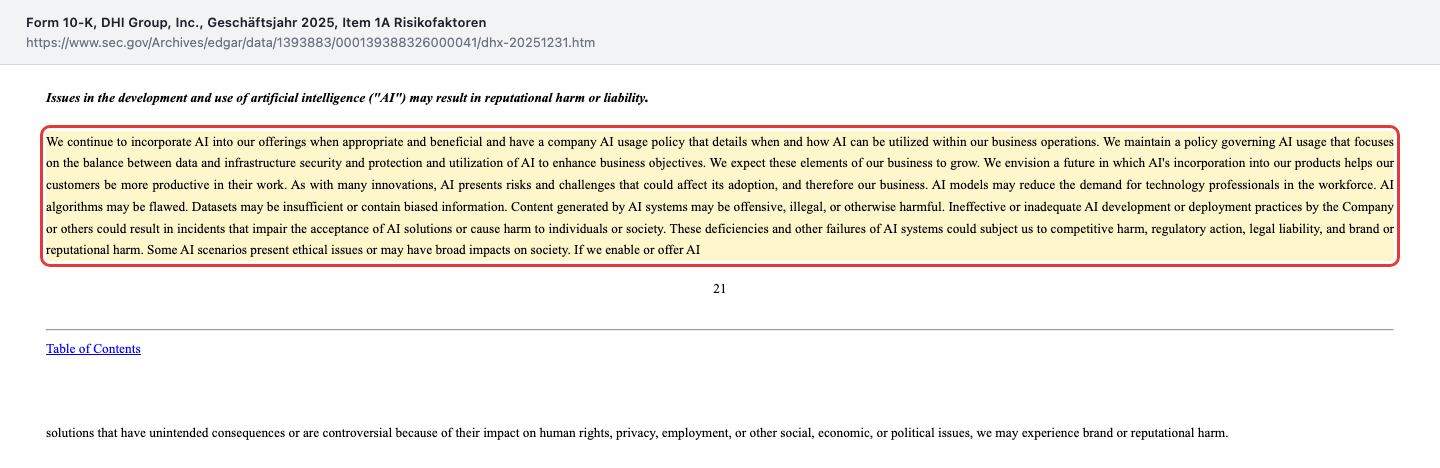
Fairness demands the other side. The same paragraph also says the company envisions "a future in which AI's incorporation into our products helps our customers be more productive in their work," and on May 5, 2026 chief executive Art Zeile pointed to "increasing demand for AI-related skills" as a tailwind for Dice. Both readings are available. Only one of them has so far produced a number in the balance sheet: minus $9.6 million. How different the other side of that coin looks is visible at the company that owns the search engine through which many of these job postings are found in the first place — see our analysis of Alphabet.
Uncomfortable truth number 3: the surprise is an adjusted number
Back to the bar. The $0.08 per share that beat the $0.03 estimate in the first quarter of 2026 is a non-GAAP measure — a company-defined figure that leaves certain costs out. Under generally accepted accounting principles DHI earned $1.532 million, or $0.04 per diluted share, in the same quarter. That is half. Both numbers appear in the same May 5, 2026 release, but only one of them is compared with the estimate.
For the full year 2025 the gap widens further. The annual report shows adjusted earnings before interest, taxes, depreciation and amortization of $35.103 million — and a net loss of $13.510 million. Between them sit $32.8 million of excluded items, $26.7 million after tax, or $0.59 per diluted share. The bridge looks like this:
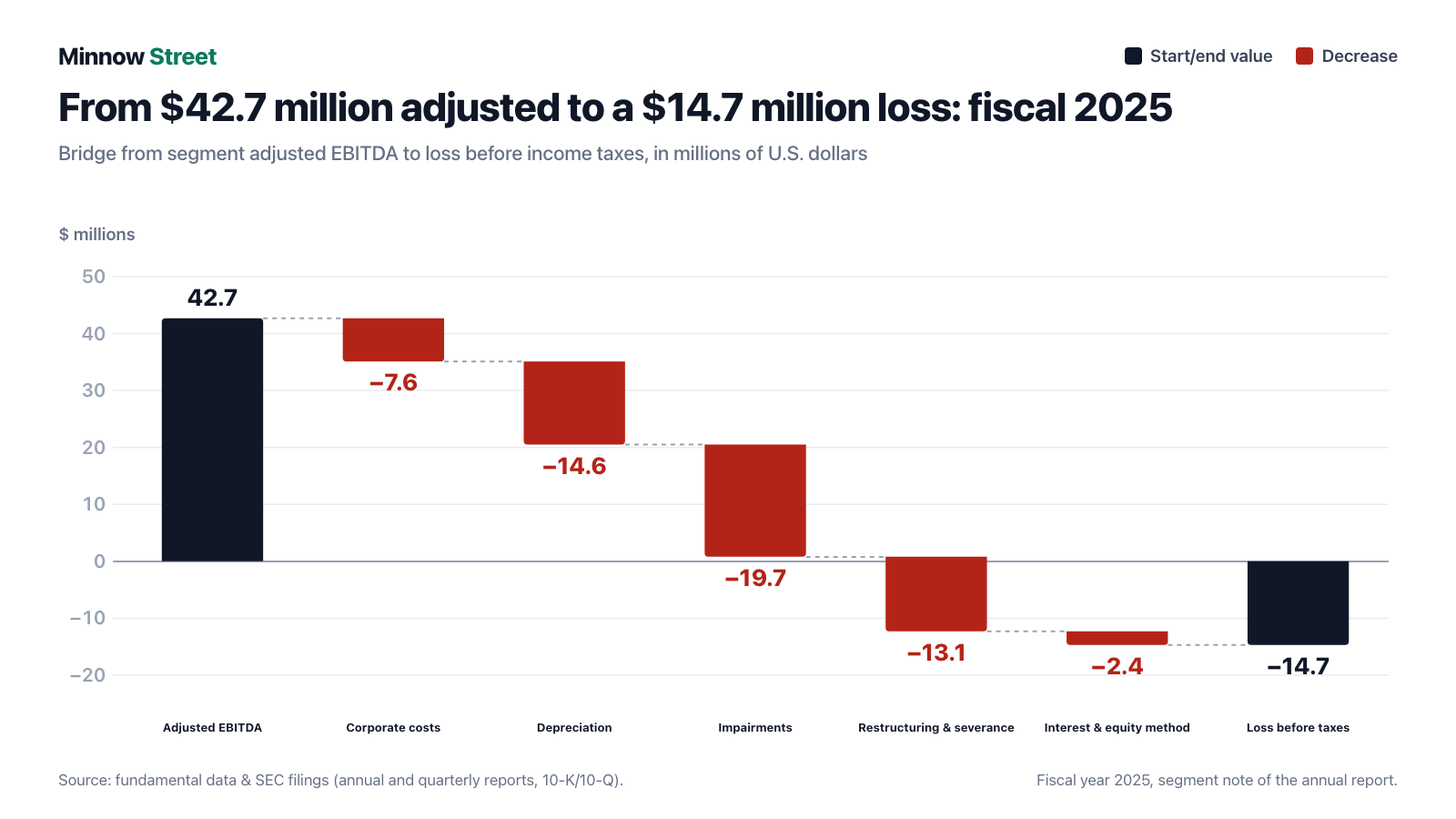
The bridge starts at segment adjusted earnings of $42.7 million. From there it subtracts $7.6 million of corporate costs allocated to neither segment, $14.6 million of depreciation and amortization on internally developed software and fixed assets, $19.7 million of impairments, $13.1 million of restructuring and severance, and $2.4 million for interest and the eFinancialCareers equity stake. What remains is a loss before income taxes of $14.7 million, and after a tax benefit a net loss of $13.510 million.
Two items deserve a closer look. The $19.7 million of impairments consists of $7.8 million on Dice goodwill (first quarter of 2025), $9.6 million on the Dice brand (third quarter), $1.4 million on a lease right (fourth quarter) and $0.9 million on the equity stake in eFinancialCareers. And the $13.1 million of restructuring and severance has a human face: in January 2025 DHI cut roughly 8 percent of its workforce, and in June 2025 roughly 25 percent more, mostly at Dice. Around 270 employees remained at year end. Part of that handsome 27 percent margin is simply the absence of people.
To be fair: non-GAAP measures are permitted, common, and the SEC requires them to be reconciled to the official figures, which DHI does. This is not about trickery. It is about the bar being built from adjusted numbers while the balance sheet works with unadjusted ones.
Uncomfortable truth number 4: tangible book value is negative $47.5 million
As of March 31, 2026 DHI Group reported stockholders equity of $92.519 million against total assets of $191.996 million — a ratio of 48 percent. That sounds solid. But much of the asset side consists of book values from earlier acquisitions: $122.741 million of goodwill plus $17.232 million of other intangibles. Subtract both and what is left is a tangible book value of negative $47.5 million. Cash stood at $3.012 million and bank debt at $33.0 million.
For a software marketplace that is not unusual — servers and desks are not this company's capital. It does mean, however, that any further writedown cuts straight into equity. And the quarterly report keeps that door explicitly open: "If future cash flows that are attributable to the Dice reporting unit are not achieved, the Company could realize a further impairment in a future period." After the 2025 charge, Dice goodwill still carries $22.9 million, and 2026 guidance calls for less Dice revenue than 2025. It takes no prophet to know what the October 1, 2026 impairment test will be looking at.
The Altman Z-score of 1.49 (data as of July 25, 2026) fits that picture; on this common distress indicator anything below 1.81 counts as a warning zone. It should not be overread here — the formula penalizes exactly the intangible-heavy balance sheets that are normal for software companies, and a business generating $13.8 million of free cash flow is not at the edge. But together with a Piotroski score of 4 out of 9 — a genuinely healthy company scores 8 or 9 — it gives a sober reading of the substance.
Uncomfortable truth number 5: the new credit line is larger, dearer, and pledges the good business
On April 1, 2026 DHI entered a new credit agreement with Bank of America as administrative agent: a revolving facility of $70 million with an accordion option for a further $37.5 million, maturing April 1, 2030. Roughly $33 million was drawn immediately to repay the old facility in full. The commitment is now more than double the previously drawn amount — headroom for further acquisitions.
Two details sit in the fine print. First, money got more expensive: the margin on SOFR loans now runs from 2.50 to 3.25 percent, where the old agreement charged 2.00 to 2.75 percent. Second, the collateral:
"The Facility and the loans made under the Facility are guaranteed by two of the Company's subsidiaries, ClearanceJobs, LLC and Point Solutions Group, LLC and secured by substantially all of the personal property of the Company, Dice, DCS and the guarantors."
— DHI Group, Inc., SEC current report on Form 8-K filed April 6, 2026, Item 1.01

Translated: the brand that grows and earns a 43 percent margin is on the hook for the group's debt. As long as the covenants hold, that is plain contract mechanics. Two limits still belong in the calendar: new borrowings are permitted only while the consolidated leverage ratio stays at or below 2.50 to 1.00 and the fixed charge coverage ratio stays above 1.20 to 1.00 — share repurchases and dividends only up to 2.00 to 1.00. With $33 million of debt against $35.1 million of adjusted annual earnings, leverage sits comfortably below that today. Should adjusted earnings drift toward $17 million, the buyback goes first.
One more item belongs in the file: on February 24, 2026 the audit committee dismissed Deloitte & Touche LLP and appointed RSM US LLP as the new independent registered public accounting firm. The filing explicitly reports no disagreements and no reportable events, and shareholders ratified RSM on May 15, 2026 with more than 37 million votes in favor. An auditor change after a loss year is still something you note.
Valuation: you pay for the cash, not the growth
How expensive is the stock? We use a dated anchor rather than a daily quote: 43,198,507 shares outstanding (quarterly report cover page, as of April 30, 2026) times $3.85 (data as of July 25, 2026) gives a market value of roughly $166 million. Fundamental data reports $166.3 million for the same date, so the cross-check lands exactly.
From there: a price-to-sales ratio of about 1.3 (on $127.8 million of 2025 revenue), a price-to-book ratio of about 1.8, and an enterprise value of roughly $196 million ($166 million plus $33 million of debt less $3 million of cash). Measured against adjusted annual earnings of $35.1 million that is about 5.6 times — not a rich price for a marketplace running a 27 percent adjusted margin. There is no price-to-earnings ratio, because 2025 was a loss year.
The second calculation says more. At $13.8 million of free cash flow in 2025, you pay roughly 12 times what the business leaves over in cash. That is the real reason the stock has risen roughly 148 percent since the start of the year (data as of July 25, 2026) inside a 52-week range of $1.44 to $4.33: the market has stopped treating DHI as a growth story and now prices it as a cash machine in managed decline.
The professional view is thin but friendly: three analysts follow the stock with an average target price of $5.83 (data as of July 25, 2026), all three positively rated. With three voices that is an opinion, not a consensus — you are thrown back on the numbers. How quickly a staffing market can turn once demand returns is something we worked through at another placement business in our analysis of AMN Healthcare.
Opportunities and risks at a glance
What speaks for DHI Group:
- ClearanceJobs is a genuine niche franchise: $54.889 million of 2025 revenue at $23.746 million of adjusted earnings (a 43 percent margin), an 89 percent renewal rate, 106 percent revenue retention, and first-quarter 2026 growth of 4.6 percent in revenue and 7 percent in bookings.
- The business throws off cash despite the loss: $21.102 million of operating cash flow in 2025 and $13.793 million free after capital spending — more than in either prior year; the first quarter of 2026 already delivered $6.8 million free against $0.1 million a year earlier.
- Cost discipline is working: adjusted annual earnings of $35.103 million in 2025 were essentially flat against $35.313 million, and the adjusted margin rose from 25 to 27 percent on 10 percent less revenue.
- Valuation has a floor: roughly $166 million of market value equals about 5.6 times adjusted annual earnings and about 12 times 2025 free cash flow, alongside a $10 million repurchase program running through February 2027.
- Funding secured to 2030: a new $70 million revolving facility (plus a $37.5 million option) dated April 1, 2026, maturing April 1, 2030 and prepayable without penalty; acquisitions such as AgileATS and Point Solutions Group keep building out ClearanceJobs.
What speaks against it:
- Dice is eroding: $101.530 million of revenue in 2023, $72.937 million in 2025, guidance of $62 million to $64 million for 2026; 15 percent fewer package customers and 6 percent less revenue per customer as of March 31, 2026, with first-quarter 2026 bookings down 20 percent.
- The company itself names artificial intelligence as a cause of a $9.6 million writedown on the Dice brand; the remaining $14.2 million of brand value and $22.9 million of Dice goodwill face the next impairment test on October 1, 2026.
- Negative tangible substance: $122.741 million of goodwill plus $17.232 million of intangibles against $92.519 million of equity leaves minus $47.5 million of tangible book value (as of March 31, 2026); Altman Z 1.49, Piotroski 4 of 9 (data as of July 25, 2026).
- The earnings beats rest on adjusted figures: $0.08 versus $0.04 per share in the first quarter of 2026, and for full-year 2025 excluded items of $32.8 million ($0.59 per share) against a net loss of $13.510 million.
- The restructuring cut deep: roughly 8 percent of staff in January 2025 and roughly 25 percent in June 2025, leaving around 270 employees at year end. Part of the margin gain is saved payroll, not better business. Add an auditor change from Deloitte to RSM in February 2026.
A human conclusion
Back to the lowered bar. Its point is not that the ten earnings beats were invented — they are in the filings exactly as reported. Its point is that a surprise only ever measures the distance to somebody else's estimate, never the direction of the business. For DHI Group in 2025 the honest answer reads: $127.8 million of revenue against $151.9 million two years earlier, a net loss of $13.5 million, $19.7 million of impairments, a third fewer employees — and still $13.8 million of cash left over at the end of the year. That is not a disaster. It is also not a growth story. It is two companies in one coat: a growing niche at a 43 percent margin, and a shrinking job board whose main headwind, according to its own annual report, is the technology the company markets itself with.
So the honest question is not "how often has DHI beaten the estimate?" but this: are you buying a cash machine at 5.6 times adjusted earnings, or a company whose larger half is being overtaken by a technology it sells itself? If ClearanceJobs really passes Dice in 2026 and free cash flow holds, the first reading is right. If Dice keeps falling by double digits, the cheap price will simply turn out to have been cheap for a reason. What you make of that is your decision. And that is exactly as it should be.
Sources
Every primary document used in this analysis — for you to read yourself:
- DHI Group, Inc. — SEC quarterly report on Form 10-Q as of March 31, 2026 (filed May 5, 2026)
- DHI Group, Inc. — SEC annual report on Form 10-K for 2025 (filed February 12, 2026)
- DHI Group, Inc. — SEC current report on Form 8-K filed May 5, 2026, Exhibit 99.1: first quarter 2026 results and guidance
- DHI Group, Inc. — SEC current report on Form 8-K filed April 6, 2026: new credit agreement (Items 1.01, 1.02, 2.03)
- DHI Group, Inc. — SEC current report on Form 8-K filed March 2, 2026: acquisition of Point Solutions Group, LLC (Item 1.01)
- DHI Group, Inc. — SEC current report on Form 8-K filed February 26, 2026: change in certifying accountant (Item 4.01)
- DHI Group, Inc. — SEC current report on Form 8-K filed May 19, 2026: 2026 annual meeting (Items 5.02, 5.07)
- DHI Group, Inc. — SEC current report on Form 8-K filed January 28, 2025: Section 382 Rights Agreement
- DHI Group, Inc. — SEC proxy statement on Schedule DEF 14A filed April 2, 2026
- Complete SEC filing history for DHI Group, Inc. (CIK 0001393883): EDGAR overview (sec.gov)
- Fundamental data (metrics, valuation, 52-week range, estimates and quality scores; data as of July 25, 2026), reconciled against the SEC filings.
- Rank and relative strength rating: our in-house "Big Earnings Surprise" stock scanner, U.S. selection with 81 hits, as of July 25, 2026; the lists are recomputed daily.
Transparency & disclaimer: This analysis is journalistic commentary on publicly available information. It is not investment advice, not a regulated financial analysis, and not a solicitation to buy or sell securities. Equity investments carry substantial risk up to total loss. The most recent periodic report evaluated is the quarterly report on Form 10-Q as of March 31, 2026; 2026 figures are unaudited. All information without warranty; the data date is stated in the text. The author holds no position in DHI Group shares at the time of publication.
Our Bottom Line at a Glance
- ClearanceJobs positive
- The smaller brand is the better one: $54.889 million of 2025 revenue (up 1 percent) at $23.746 million of adjusted earnings — a 43 percent margin. Renewal rate 89 percent, revenue retention 106 percent; first-quarter 2026 revenue up 4.6 percent, bookings up 7 percent and revenue per customer up 6 percent. The AgileATS and Point Solutions Group acquisitions build out exactly this segment.
- Dice negative
- Revenue fell from $101.530 million in 2023 to $72.937 million in 2025, with 2026 guidance of $62 million to $64 million. As of March 31, 2026 there were 15 percent fewer package customers and 6 percent less revenue per customer, and first-quarter 2026 bookings dropped 20 percent. That would leave Dice smaller than ClearanceJobs for the first time in 2026.
- Cash generation positive
- Despite the net loss, operating activities provided $21.102 million in 2025; after $7.309 million of capital spending, $13.793 million of free cash flow remained — more than in 2024 ($7.113 million) or 2023 ($1.093 million). The first quarter of 2026 delivered $6.8 million free against $0.1 million a year earlier. Customers pay up front: $44.275 million of deferred revenue as of March 31, 2026.
- Balance sheet substance negative
- As of March 31, 2026, goodwill of $122.741 million and other intangibles of $17.232 million stand against equity of $92.519 million — tangible book value of minus $47.5 million. Altman Z 1.49 and Piotroski 4 of 9 (data as of July 25, 2026). The quarterly report explicitly allows for a further impairment of Dice goodwill ($22.9 million).
- Quality of the earnings beat neutral
- The streak is real — ten consecutive quarters above the estimate (data as of July 25, 2026) — but it is measured on adjusted figures: $0.08 versus $0.04 per share in the first quarter of 2026. For 2025 the company excluded $32.8 million of items ($0.59 per share) while revenue fell for eleven consecutive quarters.
- Valuation positive
- Roughly $166 million of market value (43,198,507 shares × $3.85, data as of July 25, 2026) equals about 5.6 times adjusted annual earnings of $35.1 million and about 12 times free cash flow of $13.8 million. Price-to-sales is about 1.3. For a shrinking but cash-generative business that is not a rich price — 52-week range $1.44 to $4.33.
DHI Group is the lowered bar in its purest form: ten consecutive quarters above the analyst estimate — and eleven consecutive quarters of falling revenue. Both are true, because the surprise is measured on adjusted numbers and the estimate shrank alongside the business. Two companies sit inside the group: ClearanceJobs grows at a 43 percent margin, while Dice has lost 28 percent of its revenue in two years and is guided lower again for 2026. The company has quantified the cause itself: a $9.6 million writedown of the Dice brand, explicitly citing AI models lowering demand for technology professionals. Against that stand $13.8 million of free cash flow and a market value of roughly $166 million — with tangible book value at minus $47.5 million. Not investment advice.
What Our Rating Means
Open questions
The business works in principle, but one material question is open. As long as it stays open, our findings do not carry a quality verdict.
The price is low; the question is whether it is low for good reason. Three tests are concrete and dated. First, the second-quarter 2026 report: does ClearanceJobs stay on track toward full-year guidance of $62 million to $64 million, and does Dice keep falling by double digits? Dice bookings (last down 20 percent) will say so before revenue does. Second, the 2026 annual report: what does the October 1, 2026 impairment test do to the Dice brand ($14.2 million carrying value) and Dice goodwill ($22.9 million)? Third, the share count: does the $10 million repurchase program keep shrinking it on a net basis, or do the 2,800,000 plan shares approved on May 15, 2026 absorb the effect? If the first test comes back well, about 5.6 times adjusted earnings is an argument. Until then watching is the more honest stance. The decision is yours.
A journalistic assessment by our editorial team at the time of the deep dive, based on public sources — not investment advice and not a solicitation to buy or sell. Your personal circumstances (investment goals, risk capacity, taxes) cannot be taken into account. What our levels mean, how verdicts are formed, and what conflicts of interest exist →
Worth Noting
- DHI Group reached our research list at number 20 in our in-house Big Earnings Surprise ranking (U.S. selection with 81 hits), as of July 25, 2026, with a relative strength rating of 88. These lists are recomputed daily, so rank and composition can shift with the next run.
- Do not confuse the ticker: on the NYSE, DHX belongs to DHI Group, Inc. (CIK 0001393883), not to the Canadian animation studio DHX Media, which is now called WildBrain. DHI Group traded as Dice Holdings, Inc. until April 20, 2015, which is where the ticker comes from.
- Data status: the most recent periodic report evaluated is the quarterly report on Form 10-Q as of March 31, 2026 (filed May 5, 2026); 2026 figures are unaudited. Everything filed afterwards through July 25, 2026 was reviewed — the Form 8-K of May 19, 2026 (annual meeting) and the Form S-8 of May 26, 2026 (registration of the 2,800,000 plan shares) are incorporated.
- Two states described in the 2025 annual report are outdated and were carried forward corrected: the credit agreement was replaced on April 1, 2026 by a new $70 million revolving facility maturing April 1, 2030, and the auditor changed on February 24, 2026 from Deloitte & Touche LLP to RSM US LLP.
- On the takeover question: there is no pending transaction involving DHI Group itself — no Form 15 or Form 25, no SC 13E-3, PREM14A or DEFM14A. The company acts as the buyer (AgileATS on July 31, 2025, Point Solutions Group on February 27, 2026). The annual report does, however, list both a possible review of strategic alternatives and unsolicited offers to purchase the company among its risk factors, and the Section 382 Rights Agreement of January 28, 2025 acts as a takeover hurdle at a 4.99 percent acquisition threshold.
Frequently Asked Questions
DHI Group, Inc. (NYSE: DHX) of Centennial, Colorado operates two career marketplaces. ClearanceJobs connects professionals holding active U.S. security clearances with defense and government contractors ($54.889 million of 2025 revenue). Dice has been a technology job board for U.S. professionals for 35 years ($72.937 million). Roughly 90 percent of each brand's revenue comes from annual recruitment packages sold to employers.
No. On the New York Stock Exchange the ticker DHX belongs to DHI Group, Inc. (CIK 0001393883), a U.S. career marketplace operator. DHX Media was a Canadian animation studio now named WildBrain and listed in Toronto. DHI Group traded as Dice Holdings, Inc. until April 20, 2015, which is where the ticker comes from.
Because reported earnings have repeatedly come in well above the analyst estimate. In the first quarter of 2026, $0.08 per share met an estimate of $0.03 — a surprise of roughly 167 percent. According to fundamental data (as of July 25, 2026) DHI beat the estimate in ten consecutive quarters. That places DHX at number 20 of the U.S. selection with 81 hits as of July 25, 2026; the lists are recomputed daily.
Under generally accepted accounting principles it was a net loss of $13.510 million, or $0.30 per diluted share, after net income of $0.253 million in 2024. Adjusted earnings before interest, taxes, depreciation and amortization came to $35.103 million (prior year $35.313 million). Between the two sit $32.8 million of excluded items, chiefly $19.7 million of impairments and $13.1 million of restructuring and severance.
A double one. The 2025 annual report calls the company a leading provider of AI-powered software products and describes IntelliSearch, its own machine-learning technology, as foundational to many Dice products. The same report names AI models lowering demand for technology professionals as one reason for a $9.6 million impairment of the Dice brand in the third quarter of 2025.
Revenue fell from $101.530 million in 2023 to $87.783 million in 2024 and $72.937 million in 2025 — 28.2 percent in two years. As of March 31, 2026 Dice had 3,832 package customers against 4,490 a year earlier, down 15 percent, and revenue per customer fell 6 percent to $15,466. Bookings dropped 20 percent in the first quarter of 2026. Guidance for 2026 is $62 million to $64 million (as of May 5, 2026).
Using 43,198,507 shares outstanding (quarterly report, as of April 30, 2026) and $3.85 per share (data as of July 25, 2026), market value is roughly $166 million. That implies a price-to-sales ratio of about 1.3, a price-to-book ratio of about 1.8 and about 5.6 times adjusted annual earnings. There is no price-to-earnings ratio because 2025 was a loss year. The 52-week range runs from $1.44 to $4.33.
There is no dividend. The company repurchases its own shares instead: the November 2025 program of $5.0 million was completed in January 2026 with 2.9 million shares, and a new $10 million program running through February 2027 followed in February 2026. The first quarter of 2026 retired 2.0 million shares for $4.7 million. Working the other way, shareholders approved 2,800,000 additional plan shares on May 15, 2026.
Found an error?
Did you spot a factual error, an outdated number, or a typo in this deep dive? Let us know briefly — your report goes straight to the editorial team.