Designer Brands: Most of the Earnings Beat Is Money That Belongs to Topo Athletic's Minority Owners
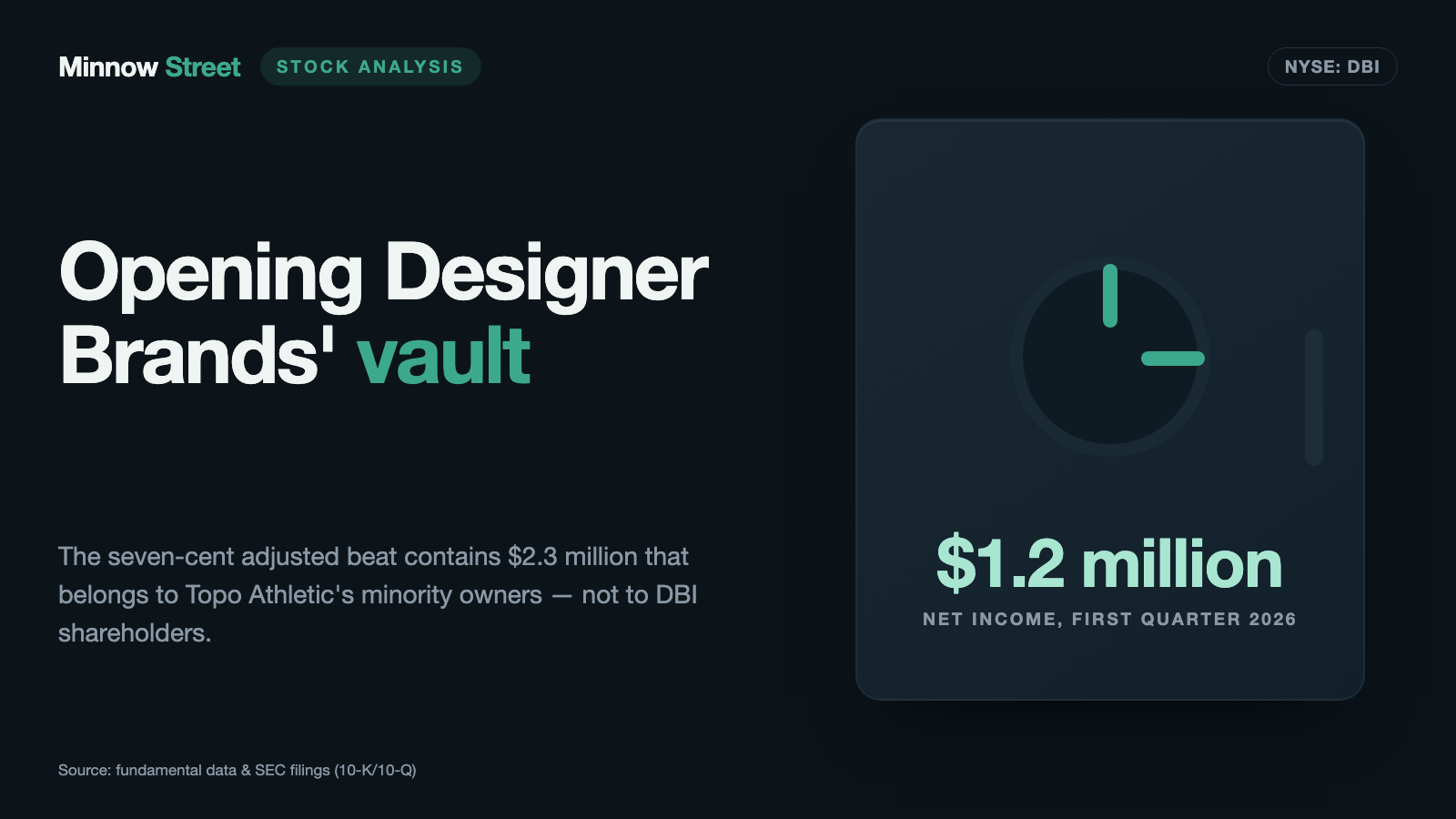
In the first quarter of fiscal 2026 the footwear retailer Designer Brands reported adjusted earnings of $0.07 per share against a $0.03 estimate. The reconciliation the company itself filed with the U.S. securities regulator, the SEC, shows where the difference comes from: $2.295 million of the $2.647 million of adjustments is income attributable to the minority owners of Topo Athletic, who hold 20.6 percent of the growth brand. Strip that line out and exactly $0.03 remains. The same Topo stake shows up three more times in the filings: as $8.4 million of back duties, as a put option priced off future performance, and as the demand of an activist holding 16.3 percent of the shares. We read the filings line by line — and you draw your own conclusion at the end.
 Thomas Mücke
Founder & Publisher
Thomas Mücke
Founder & Publisher
Chart
Interactive price chart (TradingView).
Note: pure fact-based analysis, not investment advice and not a solicitation to buy or sell. All figures without guarantee.
There is an investor trap that disguises itself as diligence. Call it the adjustment trap. It works like this: you read "adjusted earnings" and your mind fills in "so, the honest number, without one-off noise." That is exactly the point of the exercise — severance, write-downs and currency accidents should not obscure the underlying business. But sometimes the reconciliation contains a line that has nothing to do with one-off noise: profit that belongs to somebody else. Designer Brands (NYSE: DBI), the footwear retailer behind DSW Designer Shoe Warehouse, reported adjusted earnings of $0.07 per share for the first quarter of fiscal 2026 against a $0.03 estimate. That put the stock at rank 25 in our in-house Big Earnings Surprise ranking (U.S. selection, as of July 25, 2026). So let us make a deal: before you file that number away, we read the reconciliation Designer Brands itself supplied to the U.S. securities regulator, the SEC. An SEC filing is honest under penalty of law — it hides nothing, it simply puts things a long way down the page. You draw your own conclusion at the end.
What Designer Brands actually does — warehouse racks for brand-name shoes, plus its own labels
Designer Brands sells shoes two ways. The bigger one is Retail: 663 company-operated stores in the United States and Canada as of May 2, 2026, plus the matching e-commerce sites. The flagship is DSW Designer Shoe Warehouse (518 locations) — picture a warehouse where the shoe boxes sit open on the racks, sorted by size, carrying brand names at last season\'s prices. Alongside come the Canadian chains The Shoe Co. (118) and Rubino (27), the latter acquired in Québec in April 2024 for $16.1 million in cash. Roughly 30 million people are enrolled in the loyalty program and have bought something in the past two years; they accounted for 89 percent of Retail segment net sales in fiscal 2025.
The smaller route is Brand Portfolio: here the company designs and sources footwear under owned and licensed labels — Vince Camuto, Keds, Topo Athletic, Kelly & Katie, Mix No. 6, Crown Vintage, plus licenses for Lucky Brand and Jessica Simpson — and sells them to third-party retailers, to its own stores and through its own e-commerce sites. The Vince Camuto intellectual property sits in a joint venture called ABG-Camuto, in which Designer Brands holds 40 percent and to which it simultaneously pays royalties: $19.2 million in fiscal 2025 alone. Nothing is manufactured in-house; in 2025, 60 percent of units came from China, 19 percent from Cambodia and 15 percent from Vietnam.
Two things you need to know, or every figure shifts. First, the calendar: the fiscal year ends on the Saturday closest to January 31. When Designer Brands says "fiscal 2025," it means the 52 weeks ended January 31, 2026; the current fiscal 2026 ends January 30, 2027, and fiscal 2023 contained 53 weeks. Second, the name: until March 15, 2019 the company was called DSW Inc. — older data series run under that name, and the SEC registration under the same filer number goes back to March 14, 2005. That fixes the central tension of this analysis, and it runs through every chapter: the only brand that is clearly growing belongs to Designer Brands only four-fifths — and it is precisely the outside fifth that produces the earnings beat.
How the stock landed on our desk
Designer Brands sits at rank 25 in the U.S. selection of our in-house stock scanner for large earnings surprises (as of July 25, 2026), with a relative strength rating of 83 out of 100. To replicate it: open the Big Earnings Surprise list, filter to the U.S. selection and read the ranking from the top — the lists are recomputed daily, so today\'s rank is not tomorrow\'s rank. What the filter measures: companies whose actual earnings per share came in well above the analyst estimate. For Designer Brands the run reads $0.07 against $0.03 expected (reported June 9, 2026, a beat of 133 percent), minus $0.31 against minus $0.49 (March 26, 2026), $0.38 against $0.18 (December 9, 2025) and $0.34 against $0.22 (September 9, 2025). Four consecutive quarters ahead of the estimate, and by a comfortable margin.
Now the translation, because naming a metric is not the same as judging it. An earnings surprise measures the distance to the estimate, not the distance to breakeven — and it measures it against whatever number the analysts have settled on. At Designer Brands that is the adjusted figure, not the one reported under U.S. accounting rules. Under those rules the quarter produced $0.02 per share. Fix this sentence in your mind now: when a beat is measured against an adjusted number, you have to know what was adjusted. That is exactly what the earnings release spells out — and that is where it gets interesting.
The numbers over the years — given their due
First the part that genuinely impresses, because the latest quarter holds more of it than the red annual line suggests. In the first quarter of fiscal 2026 (13 weeks ended May 2, 2026) net sales rose 1.4 percent to $696.350 million. More important than the top line is the margin: gross profit — what is left after cost of goods and the directly attributable costs — climbed from $294.481 million to $315.318 million, from 42.9 percent to 45.3 percent of net sales. That is 240 basis points, or 2.4 percentage points, and the filing attributes it to lower promotional activity and better inventory management. An operating loss of $7.907 million turned into operating profit of $18.870 million. Corporate shared services costs fell 15.2 percent to $39.976 million. That is real repair work, not an accounting trick.
The smaller segment stands out most. Brand Portfolio grew net sales 19.4 percent to $114.518 million and operating profit from $1.946 million to $15.423 million — almost eight times as much. The filing names the reason directly: higher demand from retail customers, positive trends in the dress category, and "the expansion of retail partner locations for Topo along with new Topo product introductions." Retail, by contrast, delivered flat: $626.684 million against $627.145 million, on comparable sales of minus 1.2 percent and roughly 7 percent fewer transactions.
Now the frame that improvement sits in:
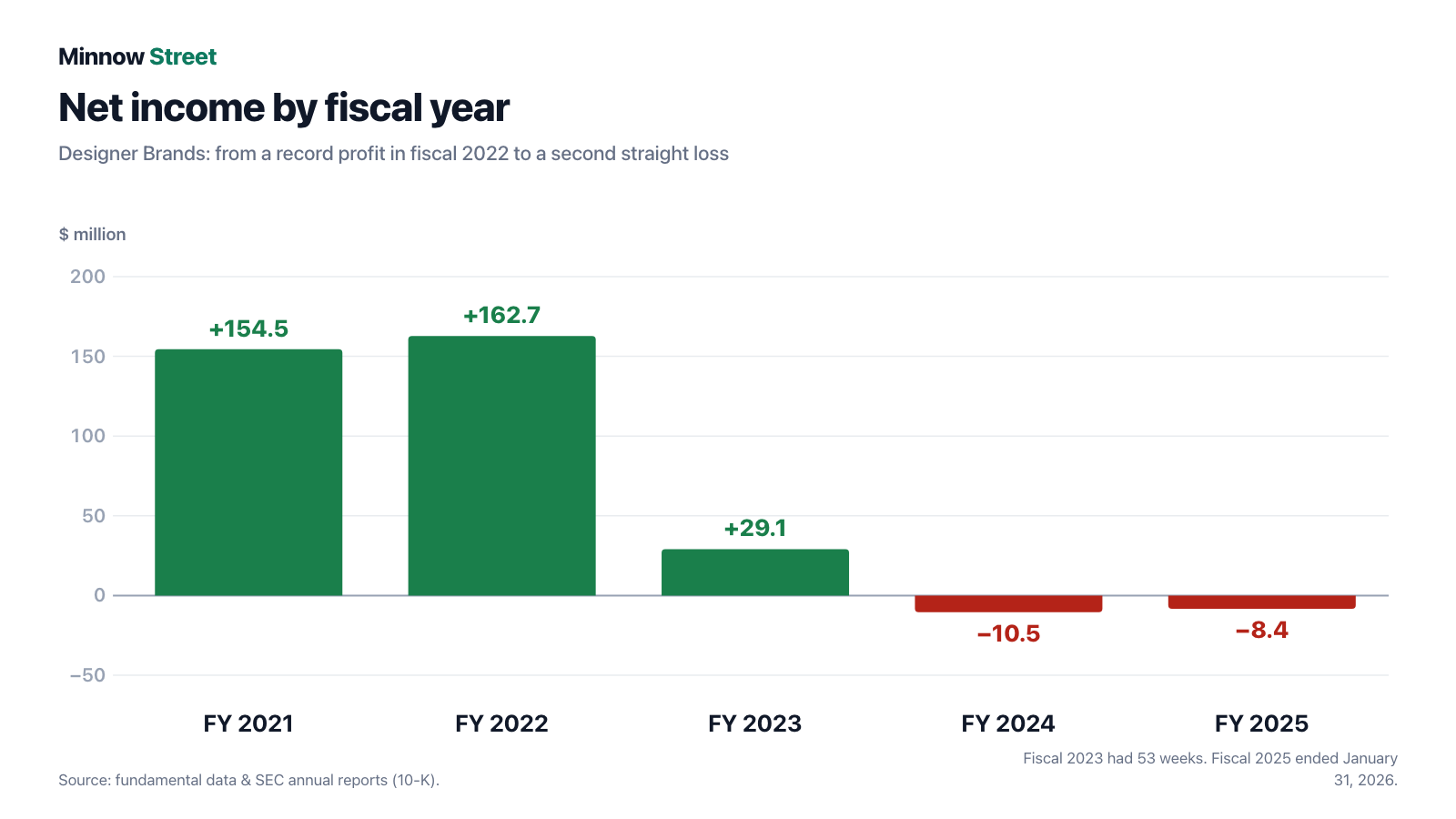
Net sales follow the same line, only flatter: $2,892.671 million in fiscal 2025 against $3,009.262 million the year before — down 3.9 percent and the third consecutive decline. Comparable sales fell 4.3 percent, and Retail transactions dropped roughly 8 percent. The bottom line showed a net loss of $8.374 million, or $0.17 per share. One line in that calculation deserves its own look: operating profit of $47.764 million was almost entirely consumed by $45.338 million of net interest expense. What remained — $2.234 million of pre-tax income — did not even cover the $6.958 million tax provision. Hence the curious 311.5 percent effective tax rate: not a scandal, just the arithmetic of a tiny tax base.
So: the current year looks considerably better than the three before it. And yet the sentence that governs everything is not "Designer Brands is earning money again," but "Designer Brands is almost earning money again." How almost — that is in the reconciliation.
What the filings say — the uncomfortable truths
Uncomfortable truth No. 1: most of the beat belongs to somebody else
The June 9, 2026 earnings release contains a table that walks from reported to adjusted net income line by line. It is the single most important table in this analysis:
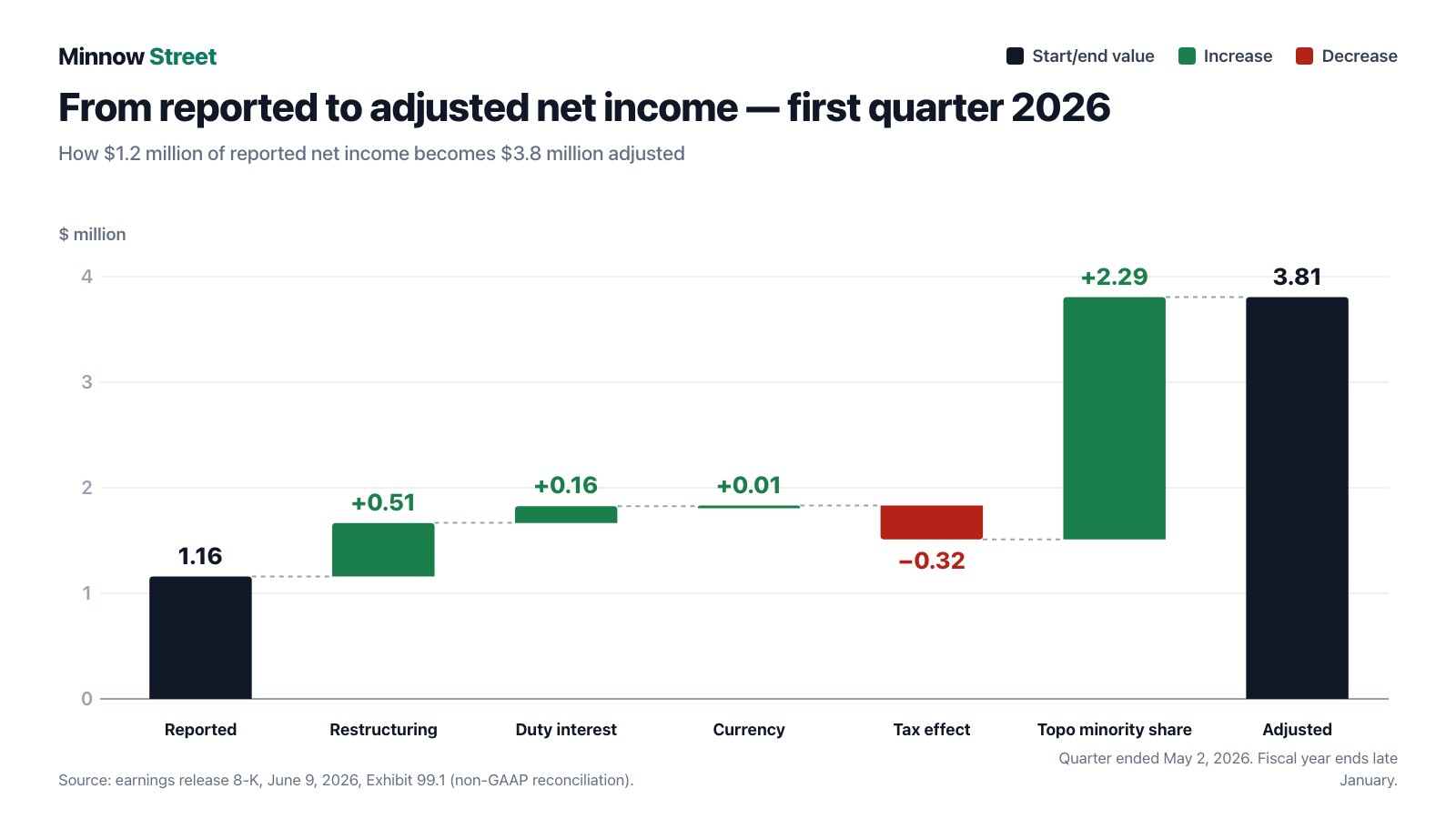
Let us do the arithmetic slowly. Reported net income attributable to Designer Brands shareholders was $1.159 million. Adjusted, it became $3.806 million. The difference is $2.647 million. Of that, the classic adjustments are: $0.508 million of restructuring and integration costs, $0.159 million of interest on under-reported import duties, $0.005 million of currency effects, less $0.320 million of tax effect — $0.352 million in total. The remainder, $2.295 million, is a single line: net income attributable to redeemable noncontrolling interest. In plain English: the share of profit that belongs to the minority owners of Topo Athletic — and that Designer Brands adds back into the adjusted figure.
Eighty-seven percent of the adjustment is somebody else\'s money. Now the check: $1.159 million plus $0.352 million is $1.511 million. Divided by the 55.920 million diluted shares, that is $0.027 per share — $0.03 rounded. Which is exactly the number analysts expected. The entire 133 percent beat that carried this stock into our ranking sits in an item that does not belong to Designer Brands shareholders.
Is this fraud? No. It is permitted, it is disclosed openly in the table, and there is a logic to it: if you want to measure the operating performance of the group, you can argue that Topo is fully part of the group. That, however, is not the question a shareholder asks. His question is: what is left for me? And the answer to that question is in the income statement, not in the reconciliation: $1.159 million, $0.02 per share.
Uncomfortable truth No. 2: Topo used the wrong duty rates for five years
The same quarterly report contains a paragraph worth reading twice:

"During the first quarter of 2026, we identified that our previously acquired Topo business was utilizing incorrect duty rates applied to many of our Topo branded products imported into the U.S., both before and after the acquisition date. Based on a standard look-back period of five years and published interest rates, we estimated an obligation of additional duties and interest of $8.4 million due to the U.S. Customs and Border Protection (the "CBP") related to prior periods."
— Designer Brands Inc., Form 10-Q for the quarter ended May 2, 2026, Note 1
Three things about this are remarkable. First: "both before and after the acquisition date" — the error came in with the purchase and continued afterwards. Second, the error was not booked openly into the current quarter but retroactively into the prior-period comparatives. The accounting rationale is clean: for any single earlier year the amount was too small to be material — but booking the whole thing into the first quarter of 2026 would have been material there. So it moved backwards. Retained earnings at the start of fiscal 2025 fell by $3.1 million, from $77.9 million to $74.8 million; accrued expenses at January 31, 2026 rose by $8.416 million.
Third — and this closes the circle: the interest on precisely this back payment, $0.159 million, is one of the items Designer Brands adjusted out in the first quarter of 2026. An error from inside the house, unnoticed for five years, becomes a "special item" that lifts the adjusted number. That is the adjustment trap in its finest form.
Uncomfortable truth No. 3: the better Topo runs, the more the rest of Topo costs
Why does the Topo minority\'s share of profit sit on its own balance sheet line instead of simply disappearing into equity? Because it is not allowed to. The annual report explains why:

"We have an exclusive call option and the noncontrolling interest holders have a put option with respect to our purchase of the remaining 20.6% ownership interest in Topo. The redemption price is based on the future performance of Topo."
— Designer Brands Inc., Form 10-K for the fiscal year ended January 31, 2026, Note 1
Translated into an everyday picture: Designer Brands bought 79.4 percent of a house and promised the previous owner to take the rest at any time, at a price that depends on how well the house is rented in future. While the house ran badly, that was a cheap promise. Now it runs well — and the promise is getting expensive.
The figures show the pace. Income attributable to the minority rose from $0.135 million in the prior-year quarter to $2.295 million in the quarter ended May 2, 2026 — sixteen times as much. Across all of fiscal 2025 it was $2.803 million, and $0.574 million and $0.154 million in the two years before that. The balance sheet item itself grew from $1.616 million on January 31, 2026 to $3.571 million on May 2, 2026. This is not a problem; it is a bill that falls due later. But it appears in no guidance, and nobody today knows its size.
Uncomfortable truth No. 4: $833 million spent on its own shares — the whole company is worth less today
The balance sheet at May 2, 2026 carries a number you cannot walk past: $833.351 million of treasury shares, at cost. Behind it sit 52.902 million repurchased shares — an average of roughly $15.75 each. For comparison: shares outstanding on the same date were 43.020 million Class A and 7.733 million Class B, 50.753 million together. The company has bought back more shares than it now has outstanding — and paid more than three times what the entire group is currently worth on the market: roughly $277 million as of July 25, 2026.
The buying ran until recently: in fiscal 2024 alone, 10.3 million Class A shares were retired for $68.6 million, roughly $6.66 per share and already well below the historical average. Nothing was bought in fiscal 2025, and nothing in the first quarter of fiscal 2026. Of the $500 million authorization topped up in 2017, $19.7 million remained on May 2, 2026. So anyone counting on the company to keep supporting its own share price should know that number: the tank is nearly empty, and the credit agreement restricts repurchases in any case.
Dilution, meanwhile, runs from the other side. In fiscal 2025 the company granted 6.638 million time-based restricted stock units at an average grant date fair value of $4.10; outstanding at January 31, 2026 were 8.409 million time-based plus 1.084 million performance-based units, alongside 1.1 million director stock units. Together that is roughly 10.6 million potential new shares against 50.753 million outstanding — a good fifth. Which is exactly why the first quarter of fiscal 2026 shows a gap between 50.241 million basic and 55.920 million diluted shares. Your slice of the pie is getting smaller while the company has stopped buying slices back.
Uncomfortable truth No. 5: 27 percent of the equity, 64 percent of the votes
Designer Brands has two classes of stock. Class A trades on the New York Stock Exchange and carries one vote. Class B does not trade and carries eight votes per share. Who holds it is in the quarterly report:

Jay L. Schottenstein is executive chairman of the board; the family entities held 6.0 million Class A and 7.7 million Class B shares as of May 2, 2026. The movement is what stands out: at January 31, 2026 the figures were about 30 percent of the equity and 66 percent of the votes (7.4 million Class A), three months later 27 and 64 percent. So the family disposed of roughly 1.4 million Class A shares in a single quarter. The Class B shares — the actual lever of control — were untouched. Separately, Designer Brands leases stores and offices from entities owned by the same family: $1.7 million of lease expense in the first quarter of fiscal 2026 alone.
Then came June 11, 2026. On that day Stone House Capital Management of Bay Harbor Islands, Florida, run by Mark Cohen, reported the switch from a passive to an active ownership filing: 7.0 million shares, or 16.3 percent of the Class A shares. 5.5 million shares were acquired for roughly $31.996 million, alongside call options on 1.5 million shares at an exercise price of $10 expiring January 15, 2027. What Stone House wants is stated plainly:

"The Reporting Persons are converting from a Schedule 13G to a Schedule 13D because they believe the Shares are significantly undervalued and intend to engage in discussions with the Issuer regarding ways the existing Board of Directors (the "Board") and management can take steps to improve operational performance and investor communications and increase shareholder value. Among other things, the Reporting Persons believe the Issuer should be providing enhanced segment-level disclosure of the Topo Athletic brand, which is one of the rare few brands that has emerged and gained relevance and scale in the specialty run channel in the last two decades."
— Stone House Capital Management LLC, Schedule 13D filed June 11, 2026, Item 4
So the activist is asking precisely the question this whole analysis turns on: what is Topo actually worth, and why can we not see it? Today Topo disappears inside the Brand Portfolio segment alongside Vince Camuto and Keds. The brand surfaces separately in only three places — in goodwill ($4.3 million at January 31, 2026), in the duty error, and in the minority interest.
Six days later, on June 17, 2026, shareholders approved a restated code of regulations. First item on the list: tougher advance notice deadlines and expanded disclosure requirements for shareholder proposals and director nominations. The vote here came in at 84,126,212 to 5,606,572 — noticeably tighter than for the purely technical items of the same resolution (89,632,879 to 87,890). With 64 percent of the votes in one pair of hands, the outcome was never open. Whether the timing was deliberate is stated in no document. That it exists is stated in two.
What the stock costs — valuation in orders of magnitude
First the honest caveat: there are two share classes, and only Class A trades. As of July 25, 2026 the market value of all 50.777 million shares was roughly $277 million, which corresponds to a valuation anchor of $5.46 per share at the July 24, 2026 close. Of that, roughly $235 million falls on the 43.044 million listed Class A shares alone. Cross-check against a document: the activist paid roughly $31.996 million for 5.5 million shares, an average of about $5.82 each — the same order of magnitude.
That puts the stock at roughly 0.10 times annual revenue, against $2,892.671 million of net sales in fiscal 2025. Even for a shoe retailer that is low; retail chains often trade at 0.3 to 0.5 times. Book value at May 2, 2026 was $280.926 million of equity across 50.753 million shares, or roughly $5.53 per share — so the market value sits just below book. There is no price-to-earnings ratio on the last fiscal year, because the bottom line was a loss.
More useful is the company\'s own guidance. On June 9, 2026 Designer Brands reaffirmed its outlook for fiscal 2026: net sales change of minus 1 to plus 1 percent and diluted earnings per share of $0.28 to $0.38 — adding that it believes it can reach the high end. Across 55.920 million diluted shares, that is $15.7 million to $21.2 million of annual profit. Against $277 million of market value, that works out to roughly 13 to 18 times. For a shrinking company that is not cheap; for a company just returning to profit it is not expensive. What the figure excludes: the roughly $20 million of expected tariff refunds, because no money has arrived.
Two numbers belong beside that, or the valuation looks too friendly. First, debt: $478.594 million at May 2, 2026, of which $360.656 million is drawn on the secured revolving facility (5.7 percent) and $117.938 million is a term loan at 10.8 percent — 12.2 percent effective including issuance costs. That is more than the company is worth on the market. Second, lease obligations: $751.190 million across 663 leased stores. Add both and subtract the $50.104 million of cash, and the whole enterprise costs roughly $1.46 billion — more than five times its market value. A cheap share price at a leased store chain is simply not the same thing as a cheap company. Anyone wanting to see the same mechanism in a second example will find it in our analysis of teen apparel retailer Tilly\'s, which also came to our desk through the surprise filter.
The professionals\' view, for context rather than imitation: four analyst houses cover the stock, all four at hold, with an average target price of $7.75 (data as of July 25, 2026). There is a dividend: $0.05 per share per quarter, most recently declared on June 10, 2026 and paid on July 8, 2026 — $0.20 a year, or roughly $10 million, against free cash flow that ran a little above $100 million in fiscal 2025.
Opportunities and risks at a glance
What argues for the stock:
- Margins really are improving. Gross margin of 45.3 percent versus 42.9 percent in the first quarter of fiscal 2026, and 43.6 percent versus 42.7 percent in fiscal 2025 — two periods, the same direction, attributed in the filings to lower promotions and better inventory management.
- Brand Portfolio is accelerating. Operating profit from $1.946 million to $15.423 million in one quarter, net sales up 19.4 percent — driven by Topo Athletic, the only part of the group with visible momentum.
- The valuation is low. Roughly 0.10 times annual revenue, just below book value, and 13 to 18 times the company\'s own earnings guidance for 2026.
- Two catalysts with dates. An activist holding 16.3 percent publicly demanding more transparency for Topo — and roughly $20 million of expected tariff refunds that appear in no reported figure yet.
- Maturities are defused. The third amendment to the credit agreement, dated February 27, 2026, pushed the revolver maturity from March 2027 to February 2031; $138.5 million was available on May 2, 2026, with all financial covenants met.
What argues against it:
- The beat does not carry. Eighty-seven percent of the adjustment is income attributable to Topo\'s minority owners; strip it out and exactly the $0.03 estimate remains.
- Net sales are shrinking for a third year. $2,892.671 million in fiscal 2025, down 3.9 percent, comparable sales down 4.3 percent, Retail transactions down roughly 8 percent.
- Interest eats the operating profit. $45.338 million of net interest expense against $47.764 million of operating profit in fiscal 2025 — leaving $2.234 million of pre-tax income.
- Two concentration risks. Sixty percent of Brand Portfolio units were sourced from China in 2025, and five customers accounted for 38.0 percent of segment net sales.
- Control is locked in. Twenty-seven percent of the equity carrying 64 percent of the votes, leases with entities owned by the same family, and defensive bylaw changes approved a week after the activist appeared.
- Fixed costs nobody cuts. $33.834 million of guaranteed minimum royalties per year through 2028, $19.650 million of it to the company\'s own ABG-Camuto joint venture — against $47.764 million of operating profit in fiscal 2025.
A human verdict
Back to the adjustment trap. It is dangerous not because companies lie — Designer Brands wrote every single figure openly into a table and filed it with the SEC. It is dangerous because we translate "adjusted" as "cleaner" and then stop reading. Read the reconciliation, though, and the first quarter of fiscal 2026 shows something startling: the entire earnings beat that swept this stock into our ranking comes from profit belonging to the minority owners of a subsidiary brand. Take it out and you land precisely on the estimate — not below it, but not a cent above it either.
What remains is still not a bad picture, only a different one. Here is an old shoe retailer with 663 stores that has improved its margin for two periods running, whose net sales keep shrinking and whose operating profit is almost entirely consumed by interest. Here is a small brand called Topo, the only one growing — but owned only four-fifths by the group, whose customs paperwork was wrong for five years, and whose remaining fifth grows more expensive the better it performs. And here is an activist pointing at exactly that, while a family holding 27 percent of the equity controls 64 percent of the votes.
Perhaps Topo really is worth more than the consolidated accounts show — that is the activist\'s thesis, and it is not silly. Or perhaps the whole operation is simply a shrinking store chain with $478.594 million of debt and $751.190 million of lease obligations, where one good brand does not settle the bill. Both cases can be built from the same documents. What you make of it is your decision. And that is exactly as it should be.
Sources
- Form 10-Q for the quarter ended May 2, 2026, filed June 9, 2026 (CIK 0001319947) — first quarter financials, Notes 1, 3, 4, 6, 9, 10, 11 and 12
- Form 10-K for the fiscal year ended January 31, 2026, filed March 30, 2026 — business description, risk factors, Notes 1 through 16
- Earnings release on Form 8-K dated June 9, 2026, Exhibit 99.1 — non-GAAP reconciliation and fiscal 2026 guidance
- Schedule 13D filed by Stone House Capital Management LLC, June 11, 2026
- Form 8-K dated June 18, 2026 — results of the June 17, 2026 annual meeting and the restated code of regulations
- Form 8-K dated March 4, 2026 — third amendment to the credit agreement, dated February 27, 2026
- Form 8-K dated June 11, 2026 — quarterly dividend of $0.05 per share
- Fundamental data (ratios, earnings surprises, analyst coverage) — data as of July 25, 2026
This analysis is journalistic commentary and not investment advice. It contains no buy or sell recommendation and is not a solicitation to buy or sell securities. Share prices can move sharply; a total loss of invested capital is possible. All figures come from the sources named above and carry the as-of dates stated there. The author holds no position in the stock discussed at the time of publication.
Our Bottom Line at a Glance
- Quality of the earnings beat negative
- Of the $2.647 million between reported net income ($1.159 million) and adjusted net income ($3.806 million) for the quarter ended May 2, 2026, $2.295 million is income attributable to the minority owners of Topo Athletic. Without that item the result works out to roughly $0.03 per share — precisely the analyst estimate. The 133 percent beat does not carry operationally.
- Operating repair positive
- Gross margin rose from 42.9 percent to 45.3 percent in the first quarter of fiscal 2026, and from 42.7 percent to 43.6 percent in fiscal 2025. A $7.907 million operating loss became $18.870 million of operating profit, and corporate shared services costs fell 15.2 percent. Brand Portfolio lifted operating profit from $1.946 million to $15.423 million.
- Debt and interest burden negative
- At May 2, 2026 debt stood at $478.594 million against $280.926 million of equity; the term loan costs 10.8 percent, or 12.2 percent effective. In fiscal 2025, $45.338 million of net interest expense consumed almost all of the $47.764 million of operating profit. On the relieving side: the February 27, 2026 amendment pushed the revolver maturity out to February 2031.
- Topo as a standalone item neutral
- Topo Athletic is the only clearly growing part of the group, yet it is only 79.4 percent owned. Call and put options cover the remaining 20.6 percent at a performance-based price — the better Topo runs, the more expensive the buyout. Add $8.4 million of back duties from five years of incorrect duty rates, booked retroactively into prior periods.
- Control and capital history negative
- The Schottenstein Affiliates held about 27 percent of the equity with 64 percent of the votes as of May 2, 2026 (Class B carries eight votes per share); six days after Stone House Capital's ownership filing, shareholders approved tougher advance notice deadlines on June 17, 2026. The 52.902 million treasury shares sit on the books at $833.351 million — more than today's market value.
- Valuation positive
- Market value of roughly $277 million (data as of July 25, 2026) equals about 0.10 times annual revenue and sits just below the $5.53 book value per share. Against the company's own fiscal 2026 guidance of $0.28 to $0.38 per share, that is roughly 13 to 18 times earnings. Not included: roughly $20 million of expected tariff refunds.
Designer Brands is the adjustment trap in its purest form: adjusted earnings of $0.07 per share for the quarter ended May 2, 2026 beat the $0.03 estimate by 133 percent — but $2.295 million of the $2.647 million of adjustments is income attributable to Topo Athletic's minority owners, and without it exactly the estimate remains. The operating repair is real all the same (gross margin 45.3 percent instead of 42.9 percent, operating profit of $18.870 million after a $7.907 million loss), yet net sales are shrinking for a third straight year and $45.338 million of interest expense consumed almost all of fiscal 2025 operating profit. Add 27 percent of the equity carrying 64 percent of the votes, an activist at 16.3 percent and $8.4 million of back duties at Topo. Not investment advice.
What Our Rating Means
Open questions
The business works in principle, but one material question is open. As long as it stays open, our findings do not carry a quality verdict.
There is a date and there are three numbers. Market data point to the next quarterly report on September 8, 2026; the company has reaffirmed diluted earnings of $0.28 to $0.38 per share for fiscal 2026 and said it believes it can reach the high end. Anyone waiting should then check three things: does gross margin hold above 45 percent once the comparison base is higher? Does income attributable to Topo's minority owners keep growing beyond $2.295 million — and how much is then left for the company's own shareholders? And have any of the roughly $20 million of expected tariff refunds finally arrived? The low valuation and the activist are the arguments for patience; the interest burden, the shrinking store business and the locked-in voting majority are why patience here is not automatic. The decision is yours.
A journalistic assessment by our editorial team at the time of the deep dive, based on public sources — not investment advice and not a solicitation to buy or sell. Your personal circumstances (investment goals, risk capacity, taxes) cannot be taken into account. What our levels mean, how verdicts are formed, and what conflicts of interest exist →
Worth Noting
- Designer Brands landed on the research list at rank 25 in our in-house Big Earnings Surprise ranking (U.S. selection, as of July 25, 2026, relative strength rating 83). The lists are recomputed daily — today's rank is not tomorrow's rank. Important for context: the filter measures the distance to the analyst estimate, and at Designer Brands that estimate refers to adjusted earnings, not to the figure reported under U.S. accounting rules.
- Calendar and name trap: the fiscal year ends on the Saturday closest to January 31. "Fiscal 2025" means the 52 weeks ended January 31, 2026, and fiscal 2026 ends January 30, 2027; fiscal 2023 contained 53 weeks. Until March 15, 2019 the company was named DSW Inc. — older data series run under that name, while the SEC filer number 0001319947 stayed the same.
- Note the retroactive correction: because of the incorrect duty rates at Topo, prior-period figures were restated in the quarterly report for the period ended May 2, 2026. The prior-year quarterly loss grew from $17.424 million to $17.816 million, and retained earnings at the start of fiscal 2025 fell from $77.9 million to $74.8 million. Earlier releases therefore show slightly different values.
- Valuation figures are dated and evergreen: market value roughly $277 million across all 50.777 million shares of both classes (data as of July 25, 2026, valuation anchor $5.46 per share at the July 24, 2026 close); roughly $235 million of that falls on the listed Class A alone. Cross-check against a document: activist Stone House Capital paid roughly $31.996 million for 5.5 million shares, an average of about $5.82 each.
Frequently Asked Questions
Designer Brands Inc. is a U.S. footwear retailer headquartered in Columbus, Ohio, known as DSW Inc. until March 2019. As of May 2, 2026 it operated 663 stores under the DSW Designer Shoe Warehouse, The Shoe Co. and Rubino banners in the United States and Canada. It also designs and wholesales owned and licensed brands such as Vince Camuto, Keds and Topo Athletic. Roughly 13,000 people worked there as of January 31, 2026.
Because it was measured against an adjusted figure. For the quarter ended May 2, 2026 adjusted earnings came in at $0.07 per share against a $0.03 estimate. Under U.S. accounting rules the figure was $0.02. Of the $2.647 million between reported and adjusted net income, $2.295 million is income attributable to the minority owners of Topo Athletic. Strip that out and roughly $0.03 remains — precisely the estimate.
Not in fiscal 2025 (the 52 weeks ended January 31, 2026): net sales of $2,892.671 million and a net loss of $8.374 million, after a $10.549 million loss the year before. Operating profit of $47.764 million was almost entirely consumed by $45.338 million of net interest expense. The first quarter of fiscal 2026 ended with $1.159 million of net income. For the full year the company guides to $0.28 to $0.38 per share.
On the Saturday closest to January 31. What Designer Brands calls "fiscal 2025" is the 52 weeks ended January 31, 2026; fiscal 2026 ends January 30, 2027. Fiscal 2023 exceptionally contained 53 weeks. Anyone comparing annual figures should keep that shift in mind — otherwise a filing quickly looks a year older or younger than it is.
There are two share classes: Class A with one vote, listed on the NYSE, and Class B with eight votes per share, not publicly traded. Entities of the Schottenstein family around executive chairman Jay L. Schottenstein held about 27 percent of the equity but about 64 percent of the voting power as of May 2, 2026. Three months earlier the figures were 30 and 66 percent.
On June 11, 2026 Stone House Capital Management reported a stake of 7.0 million shares, or 16.3 percent of the Class A shares, switching from a passive to an active ownership filing. The investor considers the stock significantly undervalued and above all wants segment-level disclosure for the running shoe brand Topo Athletic, which it calls one of the rare few brands to gain relevance and scale in the specialty run channel over the last two decades.
In the first quarter of 2026 Designer Brands identified that its acquired Topo Athletic brand had applied incorrect duty rates on many U.S. imports — both before and after the acquisition. Based on a five-year look-back the company estimates back duties and interest owed to U.S. Customs and Border Protection at $8.4 million. The amount was booked retroactively into prior-period figures; retained earnings at the start of fiscal 2025 fell by $3.1 million as a result.
Yes. On June 10, 2026 the board declared a quarterly cash dividend of $0.05 per share for both share classes, payable July 8, 2026 to holders of record on June 25, 2026. That is $0.20 per share a year, or roughly $10 million. In fiscal 2025 the company paid $9.7 million of dividends against $109.860 million of cash provided by operating activities.
Found an error?
Did you spot a factual error, an outdated number, or a typo in this deep dive? Let us know briefly — your report goes straight to the editorial team.