Definium Therapeutics: The First Pivotal Trial Worked — And The Company Has Still Never Earned A Dollar
Definium Therapeutics ranks fourth in our one-week top performers scanner (U.S. selection, 28 hits, data as of July 25, 2026). Until January 2026 the company was called MindMed. We read the annual report (10-K) for 2025, the quarterly report as of March 31, 2026 and every current report filed through June 26, 2026. The result: the Phase 3 Emerge study met all of its endpoints on June 22, 2026, three days later roughly $805 million in gross proceeds arrived — and revenue since inception is zero. Buy this stock and what you are buying is three trial readouts nobody has seen yet.
 Thomas Mücke
Founder & Publisher
Thomas Mücke
Founder & Publisher
Chart
Interactive price chart (TradingView).
Note: pure fact-based analysis, not investment advice and not a solicitation to buy or sell. All figures without guarantee.
There is a trap that catches all of us when we read market headlines: the nameplate trap. When a company changes its name, our brain switches to "new company" — new look, new ticker, therefore presumably a new story. Definium Therapeutics, Inc. (Nasdaq: DFTX) was called Mind Medicine (MindMed) Inc. until January 9, 2026 and traded under the ticker MNMD. The accumulated deficit moved house with it. Before we let a fresh logo impress us, let us make a deal: we read the primary documents together — the annual report (10-K) for 2025, the quarterly report (10-Q) as of March 31, 2026, the prospectus supplement (424B5) dated June 24, 2026 and every current report (Form 8-K) filed with the U.S. securities regulator, the SEC, through June 26, 2026. They contain a very good trial result. They also contain what that result cost and what is still outstanding. Remember this sentence from the start: a new name does not change a balance sheet.

What this analysis covers
- What Definium Therapeutics actually does — LSD as a prescription tablet
- Where the stock landed on our desk
- The numbers and the data — what genuinely impresses here
- Uncomfortable truth no. 1: not a single dollar of revenue since 2010
- Uncomfortable truth no. 2: the advantage shrinks week by week
- Uncomfortable truth no. 3: the company itself questions the blinding
- Uncomfortable truth no. 4: the loss grows when the share price rises
- Uncomfortable truth no. 5: every share casts a shadow
- Uncomfortable truth no. 6: even approval is not enough to start selling
- What the stock costs — orders of magnitude instead of a daily quote
- Opportunities and risks at a glance
- A human conclusion
- Sources
What Definium Therapeutics actually does — LSD as a prescription tablet
The company was incorporated in the Canadian province of British Columbia in 2010, operates out of One World Trade Center in New York and employed 106 people as of December 31, 2025, 72 of them in research and development and 33 in general and administrative roles. It describes itself as remote-first, meaning substantially all of its staff work away from an office. It reached the public market in 2020 by an unusual route: a reverse takeover of the mining company Broadway Gold Mining Ltd., a mechanism in which a private business slips into an already listed shell instead of running its own initial public offering. On February 27, 2020 a gold explorer therefore became a psychedelics developer.
The lead compound is now called DT120 ODT; until the rebrand it was MM120. Behind the code sits lysergide D-tartrate — chemically, LSD, in a pharmaceutically standardized form. ODT stands for orally disintegrating tablet, a tablet that dissolves on the tongue. It is being developed for adults with generalized anxiety disorder (GAD), major depressive disorder (MDD) and post-traumatic stress disorder (PTSD). The second programme, DT402 (formerly MM402), uses R(-)-MDMA and targets autism spectrum disorder; it sits in an open-label Phase 2a study of up to 20 participants, with first data guided for 2026.
The business model in plain language: Definium sells nothing. There are no customers, no invoices, no revenue. What exists is one molecule, a series of clinical trials and the hope of eventually filing a new drug application with the FDA. Until then the company lives entirely on money paid in by investors and one lender. Valuing a business like this is therefore not about revenue multiples but about three quantities: how long does the cash last, when do the data arrive, and how many shares will there be at the end?
Which brings us to the central tension of this analysis, and it runs through every chapter: Definium delivered for the first time with Emerge and is better funded than ever — yet the entire enterprise value still hangs on three trials whose results nobody has seen, and on a compound that the United States still classifies in its strictest controlled-substance category.
Where the stock landed on our desk
DFTX reached our research list through our in-house stock scanner for the strongest one-week performers. The filter looks for names that have gained at least 15 percent over four trading days, trade at least 10 million dollars of average daily dollar volume and carry a relative strength rating of at least 70. As of July 25, 2026, Definium Therapeutics sits at rank 4 out of 28 U.S. hits with an RS rating of 98 — meaning the stock outperformed 98 percent of the comparison universe. To reproduce it: open the scanner, set the country filter to U.S. and read the list by rank. One thing to know: these lists are recalculated daily, so a rank is a snapshot, not a property of the company.
What does an RS rating of 98 mean in plain language? It measures one thing only: price strength relative to everything else. It says nothing about earnings, balance sheet quality or valuation — and for a company with no revenue it could not. A high reading is therefore an attention signal, not a quality verdict. At Definium it has a very specific cause: on June 22, 2026 the company reported results from the pivotal Emerge study, and the prospectus supplement dated June 24 documents a last reported sale price of $36.18 on June 23, 2026. For comparison, the same document gives the trading range for the twelve months from June 2025 to May 2026: $6.49 to $24.19.
Remember: a momentum filter finds movement, not worth. Why the stock moved is not in the scanner — it is in the filings. So let us read them.
The numbers and the data — what genuinely impresses here
Start with what deserves genuine respect. Pivotal psychiatric trials fail often, and they usually fail on the placebo effect: depressed patients frequently improve on a dummy tablet too. Emerge (study number DT120-310) delivered anyway. The trial enrolled 149 participants, randomized 1:1 to DT120 ODT 100 µg or placebo. The baseline score on the MADRS depression scale was 35.0 in the treatment arm (n=75) and 34.0 in the placebo arm (n=74) — both in the severe range.
"On June 22, 2026, we announced that the Emerge study of DT120 ODT for the treatment of MDD met its primary and all key secondary efficacy endpoints, demonstrating a statistically significant (p<0.0001) and clinically meaningful improvement from baseline compared with placebo, as measured by the change in MADRS total score at week 6."
— Definium Therapeutics, Form 424B5 prospectus supplement dated June 24, 2026, "Recent Developments"
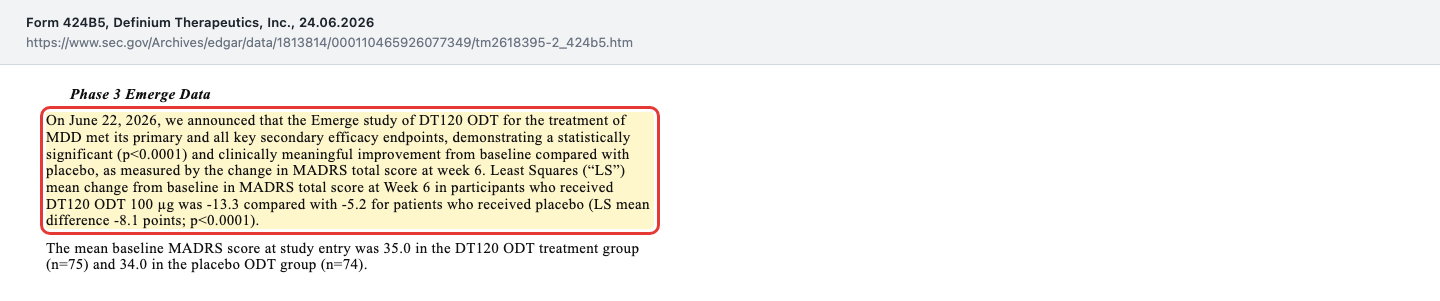
The figures behind it: at week 6 the MADRS score improved by 13.3 points on DT120 ODT versus 5.2 points on placebo — a placebo-adjusted difference of 8.1 points. At week 12 the difference was 7.3 points. 35 percent of treated participants responded by week 6, meaning they at least halved their MADRS score, against 7 percent on placebo. Remission, defined as a MADRS score of 12 or below, was reached by 24 percent versus 3 percent. All of these differences were clearly statistically significant. For context: a placebo-adjusted difference of 8.1 MADRS points after a single administration is a very large effect in psychiatry, where standard antidepressants taken daily typically land in the low single digits.
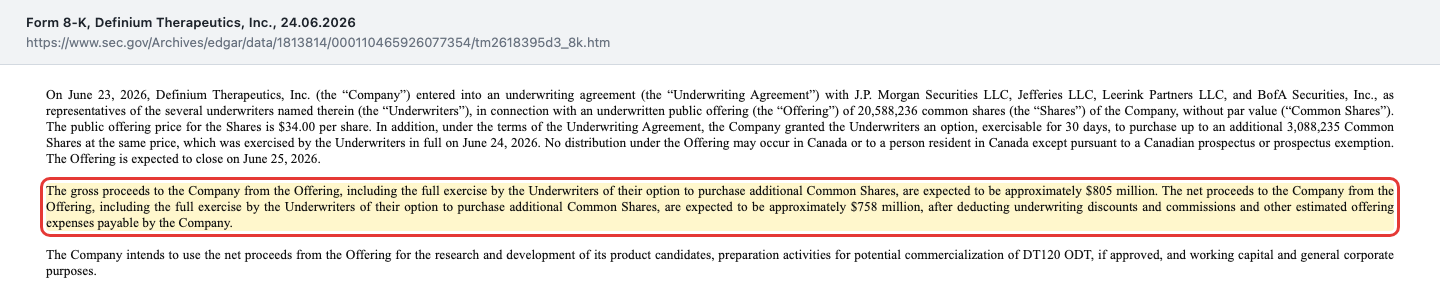
The financial firepower that followed is equally striking. On June 23, 2026 Definium signed an underwriting agreement with J.P. Morgan, Jefferies, Leerink Partners and BofA Securities covering 20,588,236 shares at $34.00 each. The option on a further 3,088,235 shares was exercised in full on June 24.
"The gross proceeds to the Company from the Offering, including the full exercise by the Underwriters of their option to purchase additional Common Shares, are expected to be approximately $805 million. The net proceeds to the Company from the Offering … are expected to be approximately $758 million …"
— Definium Therapeutics, Form 8-K dated June 24, 2026, Item 1.01
As of March 31, 2026, before that raise, the company held $373.4 million in cash, cash equivalents and investments and wrote in its quarterly report that this would fund operations "into 2028".

Add the net proceeds and the company had roughly $1.13 billion available after the offering, less whatever it consumed during the second quarter, which will only become visible with the next quarterly report. Against cash used in operations of $42.6 million in the first quarter of 2026, that is an unusually long leash for a company this size. That is real strength, and it deserves to be said out loud.
Uncomfortable truth no. 1: not a single dollar of revenue since 2010
Now the other side. The annual report for 2025 puts it in its very first risk factor with a clarity you rarely find.
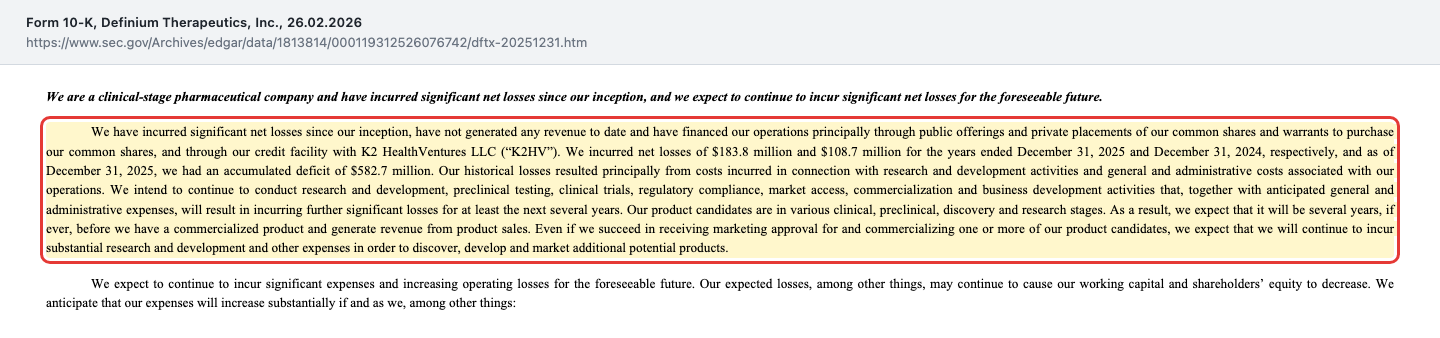
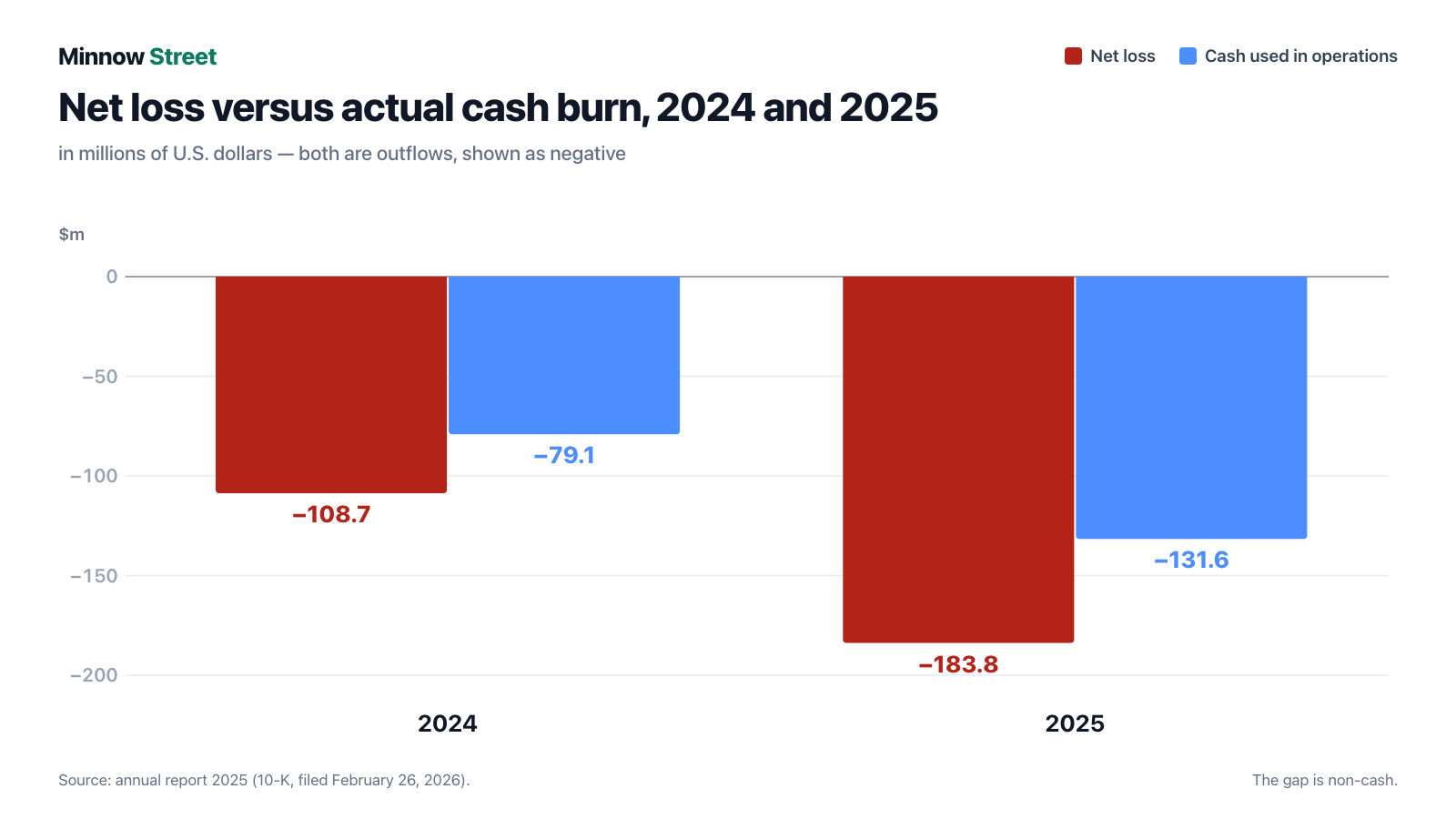
"We have incurred significant net losses since our inception, have not generated any revenue to date and have financed our operations principally through public offerings and private placements of our common shares and warrants to purchase our common shares, and through our credit facility with K2 HealthVentures LLC ("K2HV"). We incurred net losses of $183.8 million and $108.7 million for the years ended December 31, 2025 and December 31, 2024, respectively, and as of December 31, 2025, we had an accumulated deficit of $582.7 million."
— Definium Therapeutics, Form 10-K for 2025, Item 1A Risk Factors
The loss is also moving. In the first quarter of 2026 it reached $77.1 million against $23.3 million a year earlier. Research and development spending rose 78 percent to $41.5 million, and general and administrative expenses doubled to $17.7 million. Both follow logically from four pivotal trials running at once and from preparations for a possible commercial launch — but it is also money leaving the building with nothing coming back the other way.
It is worth separating the reported loss from the actual cash outflow, because the two are routinely confused:
Uncomfortable truth no. 2: the advantage shrinks week by week
The Emerge results are good — but they also tell a second story that rarely reaches a headline. The prospectus supplement lists the placebo-adjusted differences over time, and they get smaller: at week 1 the gap was 14.2 MADRS points (minus 17.6 versus minus 3.4), at week 6 it was 8.1 points, and at week 12 it was 7.3 points. The compound works very fast and very hard, but the placebo arm catches up over the weeks.
Why that matters: Emerge measures its primary endpoint at week 6. The two anxiety trials, Voyage and Panorama, measure theirs only at week 12, and on a different instrument, the HAM-A scale. An effect that loses definition between week 6 and week 12 has a harder job at a later measurement point. This is not a forecast — it is simply the reason why a good depression result is no free pass in anxiety. Remember: a trial success applies only to the trial in which it was achieved.
If you want to see how quickly a celebrated trial result can turn into a very different story, our analysis of Abivax offers the matching comparison: another clinical-stage biotech whose entire value hangs on one molecule and its next readouts.
Uncomfortable truth no. 3: the company itself questions the blinding
In a placebo-controlled trial nobody is supposed to know who received the active drug — neither the patient nor the investigator. That is blinding, and it is the reason such trials mean anything at all. With a compound that produces hallucinations, blinding is hard to maintain. The prospectus supplement itself lists the most common adverse events on dosing day: illusion, hallucinations, euphoric mood, anxiety, feeling of relaxation, abnormal thinking, headache, paresthesia, dizziness, nausea, crying, disorientation, emotional disorder, blood pressure increase. Anyone experiencing that will most likely know which arm they are in.
The company names the problem explicitly as a risk in its own annual report:
"… methodological challenges associated with clinical research of psychotropic compounds that could hinder the interpretability or regulatory acceptability of clinical trial results, such as the effects of functional unblinding, expectation biases and protocols for patient support and monitoring during dosing sessions …"
— Definium Therapeutics, Form 10-K for 2025, Item 1A Risk Factors
That does not make the Emerge data worthless. It means the FDA will look precisely here when it assesses them, and that part of the measured difference may rest on expectation. Put in everyday terms: someone who knows they received the expensive treatment already feels better for that reason alone. In a depression trial, that feeling is the endpoint.
Uncomfortable truth no. 4: the loss grows when the share price rises
The September 30, 2022 offering left behind warrants that are not equity on the balance sheet but a liability. Instruments like that are remeasured at every reporting date — and because their value tracks the share price, the rule is simple: when the price rises, the liability rises, and the difference lands in the income statement as an expense.
In the first quarter of 2026 that came to $20.0 million — roughly a quarter of the entire $77.1 million quarterly loss, without a single dollar changing hands. The warrant liability rose from $40.9 million at December 31, 2025 to $49.5 million at March 31, 2026. As of that date 3,298,154 of these warrants remained outstanding, exercisable at $4.25 and expiring on September 30, 2027. For the full year 2025 the same item added up to $22.8 million, and for 2024 to $15.9 million.
This matters when reading the next set of numbers: a much larger loss at this company need not say anything about the business. The informative figure sits not in the income statement but in the cash flow statement — where the first quarter of 2026 showed $42.6 million of actual cash used in operations.
Uncomfortable truth no. 5: every share casts a shadow
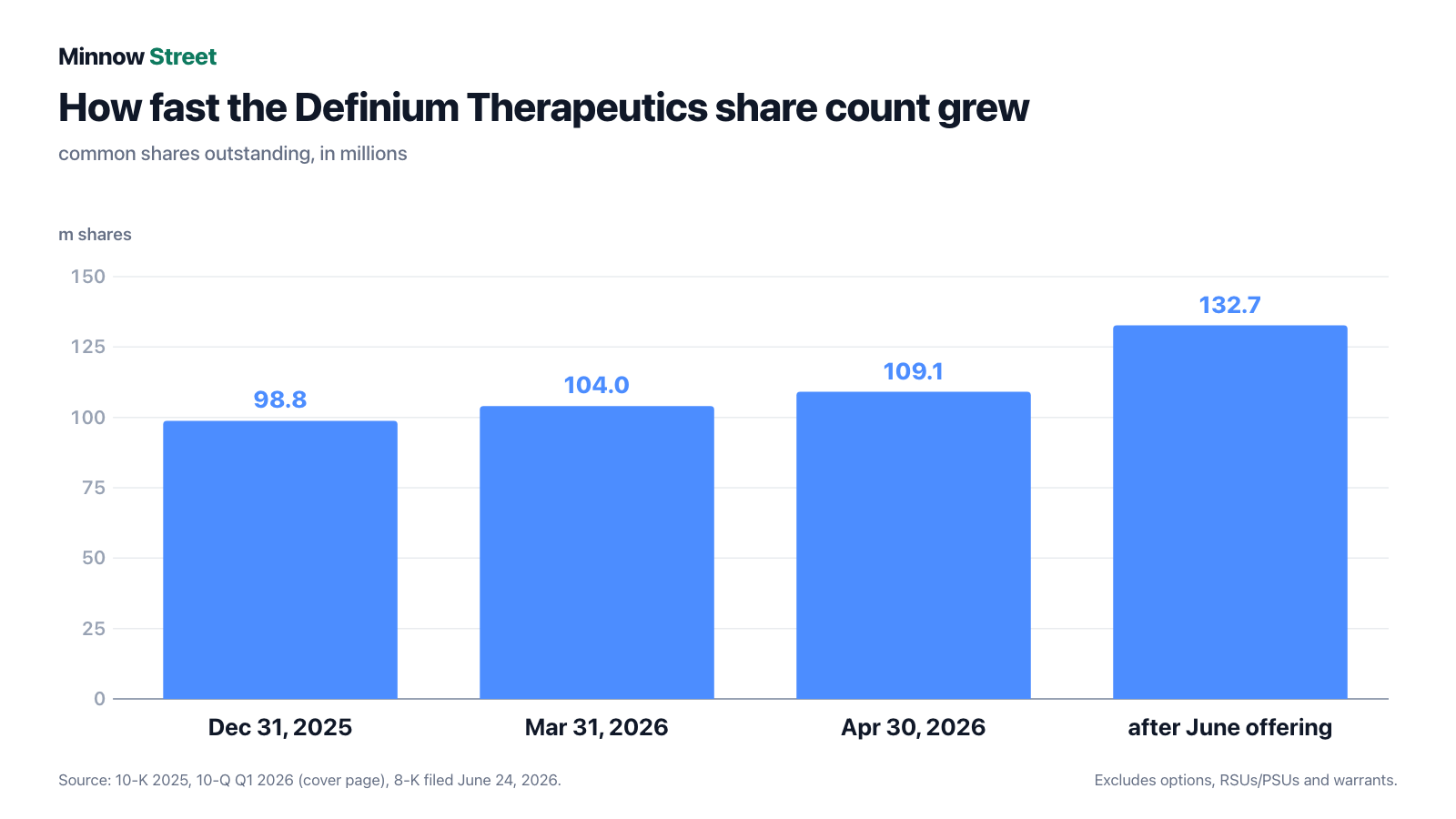
Dilution means your slice of the cake gets smaller because the cake is cut into more pieces. At Definium the process is well documented and unusually fast.
And the arithmetic does not end there. The prospectus supplement lists what stood in the shadows as of March 31, 2026: 6,195,400 stock options at a weighted average of $10.97, 8,175,499 shares under employee programmes (RSUs and PSUs), 3,298,154 warrants at $4.25, 5,428,775 pre-funded warrants, 2,300,845 reserved plan shares and 760,683 conversion shares tied to the K2 HealthVentures credit facility at $7.02 and $9.00. Together that is roughly 26.2 million shares. On June 11, 2026 shareholders approved a further 5.0 million shares for the equity incentive plan.
For scale: the quarterly report shows 18,469,980 potentially dilutive securities for the first quarter of 2026, up from 10,691,999 a year earlier — a 73 percent increase in twelve months. When you model a company like this, do not use today's share count; use the one from the day after tomorrow. Our analysis of Novavax shows the same pattern in a different corner of biotech.
Uncomfortable truth no. 6: even approval is not enough to start selling
One point is easy to miss: even if every trial succeeds and the FDA approves the drug, Definium may not sell it in the United States straight away. Lysergide and MDMA are classified there as Schedule I controlled substances, and that classification has to be changed by the Drug Enforcement Administration and, separately, by individual states. The annual report describes it plainly:
"Certain product candidates we are developing contain Schedule I controlled substances, like lysergide or MDMA, as defined in the Controlled Substances Act ("CSA"). Our product candidates must be approved by the FDA through the NDA process, and will need to be rescheduled by the Drug Enforcement Administration ("DEA") and states, before they may be legally marketed in the U.S."
— Definium Therapeutics, Form 10-K for 2025, Item 1 Business (Government Regulation)
There is also a detail in the credit facility that shows how tightly funding and market value are wired together here. The loan agreement with K2 HealthVentures, as amended in April 2025, imposes a minimum liquidity covenant beginning July 1, 2026 — but it is waived in any period in which the company's market capitalization exceeds $500 million. The interest rate is at least 10.25 percent, repayment starts in 2027 with $12.7 million and runs to maturity on April 1, 2029. The loan is secured by substantially all assets other than intellectual property. As of March 31, 2026 the company confirmed it was in compliance with all covenants.
What the stock costs — orders of magnitude instead of a daily quote
For a company with neither revenue nor earnings there is no price-to-earnings and no price-to-sales ratio. What remains are three comparisons.
First, market value. As of July 25, 2026 it stood at roughly $5.7 billion, calculated from 132,743,254 shares and the July 24, 2026 closing price of $43.17. As a cross-check, the last price documented in a filing was $36.18 on June 23, 2026, which would imply roughly $4.8 billion. The two orders of magnitude sit close together; the gap is the price move since the offering.
Second, cash. After the June offering the company had roughly $1.1 billion on hand. That is about one fifth of the market value. Put differently: four out of every five dollars in the price are pure expectation about trials that are still running.
Third, book value. The prospectus supplement puts as adjusted net tangible book value after the offering at $7.96 per share (with the option exercised in full, based on March 31, 2026). Measured against the July 24, 2026 close, the market is paying more than five times the accounting substance. For a development-stage drug company that is not unusual — but it describes precisely what the price rests on: not assets, but prospects.
One number from the metrics sheet should be ignored here: an Altman Z-score or a profit margin cannot be computed meaningfully for a company with no revenue. Such values do appear in databases, but they say nothing in this case.
Opportunities and risks at a glance
Opportunities
- Emerge, the first pivotal trial, met its primary and all key secondary endpoints — an 8.1-point MADRS difference at week 6 at p below 0.0001 (424B5 dated June 24, 2026).
- The FDA granted breakthrough therapy designation to the DT120 programme in generalized anxiety disorder in March 2024, which can accelerate the approval process (10-K 2025).
- After the offering the company had roughly $1.1 billion available — against $42.6 million of quarterly cash burn, an exceptionally long funding runway (10-Q as of March 31, 2026; 8-K dated June 24, 2026).
- Four major banks ran the offering and placed it in full at $34.00, including the option — a marker of institutional demand (8-K dated June 24, 2026).
- DT402 in autism spectrum disorder provides a second, independent programme, with first Phase 2a data guided for 2026 (10-K 2025).
Risks
- No revenue since inception in 2010, an accumulated deficit of $659.8 million as of March 31, 2026 and a quarterly loss that more than tripled within a year (10-Q as of March 31, 2026).
- Three of the four pivotal trials have no results yet; Voyage was guided to early third quarter 2026, Panorama to the second half of 2026 and Ascend to 2027 (10-K 2025).
- The placebo-adjusted advantage in Emerge fell from 14.2 points at week 1 to 7.3 points at week 12 — and the anxiety trials measure their primary endpoint only at week 12 (424B5 dated June 24, 2026).
- The company itself names functional unblinding and expectation bias as risks to the regulatory acceptability of its trial results (10-K 2025).
- Roughly 26.2 million additional shares sat in the dilution shadow as of March 31, 2026, plus 5.0 million plan shares approved on June 11, 2026 (424B5 dated June 24, 2026; 8-K dated June 12, 2026).
- Even after approval, rescheduling by the DEA and by individual states is required before the drug may be sold (10-K 2025).
- The stock is exceptionally volatile: a range of $6.49 to $24.19 between June 2025 and May 2026, followed by prices above $40 (424B5 dated June 24, 2026; data as of July 25, 2026).
A human conclusion
Back to the nameplate trap. Definium Therapeutics is not the new company it has presented itself as since January 2026 — it is the same business that reached the market out of a mining shell in 2020 and has burned through more than $650 million since. What actually changed sits not in the name but in a table inside a prospectus supplement: for the first time in sixteen years this company delivered in a pivotal trial. That is no small thing, and anyone holding the stock waited a long time for it.
At the same time the arithmetic is sober. A market value of roughly $5.7 billion faces zero dollars of revenue. Four out of five dollars in that price are expectation about three readouts nobody has seen, about a regulator that has never approved an LSD-based medicine, and about a second agency that would then have to reclassify the compound. Years lie in between — and in every one of those years the share count will keep growing.
What does that mean for you? This stock is not a stake in a business; it is a wager on probabilities. It can turn out very well, and it can halve on a single Tuesday morning if one readout disappoints. Both outcomes are in the price, and nobody knows the weighting. What you make of that is your decision. And that is exactly as it should be.
Sources
- Definium Therapeutics, Inc. — Form 10-K annual report for 2025 (filed February 26, 2026)
- Definium Therapeutics, Inc. — Form 10-Q quarterly report as of March 31, 2026 (filed May 7, 2026)
- Definium Therapeutics, Inc. — Form 424B5 prospectus supplement dated June 24, 2026 (Emerge data, offering terms, dilution)
- Definium Therapeutics, Inc. — Form 8-K dated June 24, 2026 (underwriting agreement, proceeds)
- Definium Therapeutics, Inc. — Form 8-K dated June 22, 2026 (Emerge topline)
- Definium Therapeutics, Inc. — Form 8-K dated June 12, 2026 (annual meeting, increase of the equity incentive plan)
- Definium Therapeutics, Inc. — Form 8-K dated May 12, 2026 (first patient dosed in the Ascend study)
- SEC EDGAR — submissions index for CIK 0001813814 (former names, exchange, filing history)
- Fundamental data (metrics, share count, price series), data as of July 25, 2026, closing price of July 24, 2026
This analysis is journalistic commentary based on publicly available documents and is not investment advice. It is neither a solicitation to buy or sell securities nor an individual recommendation. Shares in companies without revenue and without an approved product can lose their entire value; a total loss is possible. All figures carry the as-of date stated and may have changed since. The author held no position in the security discussed at the time of publication.
Our Bottom Line at a Glance
- Clinical evidence positive
- The pivotal Emerge study met its primary and all key secondary endpoints on June 22, 2026: an 8.1-point MADRS difference versus placebo at week 6 at p below 0.0001, a response rate of 35 versus 7 percent and remission of 24 versus 3 percent (424B5 dated June 24, 2026).
- Funding positive
- Roughly $758 million net from the June 2026 offering on top of $373.4 million as of March 31, 2026; against $42.6 million of quarterly cash burn that is a very long runway (10-Q as of March 31, 2026; 8-K dated June 24, 2026).
- Earnings position negative
- No revenue since inception in 2010; a net loss of $183.8 million in 2025 after $108.7 million in 2024, an accumulated deficit of $659.8 million as of March 31, 2026, and a quarterly loss that more than tripled within a year (10-K 2025; 10-Q as of March 31, 2026).
- Single-molecule dependence negative
- Three of the four pivotal DT120 ODT trials have no results yet — Voyage was guided to early third quarter 2026, Panorama to the second half of 2026 and Ascend to 2027. The second programme, DT402, is only in Phase 2a (10-K 2025).
- Dilution negative
- Shares outstanding went from 98,776,265 (December 31, 2025) to roughly 132.7 million after the June offering; add roughly 26.2 million securities in the dilution shadow as of March 31, 2026 and 5.0 million plan shares approved on June 11, 2026 (424B5 dated June 24, 2026; 8-K dated June 12, 2026).
- Regulatory path neutral
- Breakthrough therapy designation from the FDA in anxiety since March 2024, but lysergide remains a Schedule I controlled substance: after approval the DEA and individual states would have to reschedule it. The company also names functional unblinding as a risk to regulatory acceptability (10-K 2025).
Definium Therapeutics — MindMed until January 2026 — delivered in a pivotal trial for the first time in sixteen years on June 22, 2026 and raised roughly $805 million in gross proceeds three days later. The company is therefore better funded than it has ever been. At the same time, a market value of roughly $5.7 billion (data as of July 25, 2026) faces not one dollar of revenue, the accumulated deficit stands at $659.8 million, and three of the four pivotal trials have no results. Four out of every five dollars in the price are expectation. Not investment advice.
What Our Rating Means
Open questions
The business works in principle, but one material question is open. As long as it stays open, our findings do not carry a quality verdict.
For a research-stage company the substance here is unusually solid: $373.4 million in cash, cash equivalents and investments as of March 31, 2026, which the company itself says funds operations "into 2028", plus roughly $758 million net from the June 2026 offering — against $42.6 million of quarterly cash used in operations that reaches well beyond four quarters. Shareholders' equity stood at $278.8 million on the same date, compliance with the credit facility covenants was confirmed, and no going-concern warning appears in any of the filings we read. What is open is precisely the question everything here hangs on: not a dollar of revenue has been booked since inception in 2010, and three of the four pivotal trials have no data yet — Voyage was guided to early third quarter 2026, Panorama to the second half of 2026 and Ascend to 2027. Emerge met all of its endpoints on June 22, 2026, but a trial success applies only to the trial in which it was achieved. A company whose outcome rests on individual readouts therefore carries no threat to its substance, but no proven quality either — hence yellow. The decision is yours.
A journalistic assessment by our editorial team at the time of the deep dive, based on public sources — not investment advice and not a solicitation to buy or sell. Your personal circumstances (investment goals, risk capacity, taxes) cannot be taken into account. What our levels mean, how verdicts are formed, and what conflicts of interest exist →
Worth Noting
- DFTX reached our research list at rank 4 in our in-house stock scanner for the strongest one-week performers (U.S. selection, 28 hits, RS rating 98, data as of July 25, 2026); the scanner lists are recalculated daily.
- Identity verified against EDGAR: Definium Therapeutics, Inc., CIK 0001813814, Nasdaq Global Select Market. The submissions index lists Mind Medicine (MindMed) Inc. as a former name from June 8, 2020 to January 12, 2026. No successor CIK, U.S. domestic filer on Forms 10-K and 10-Q, fiscal year ending December 31.
- Easy to confuse: price and filing history before January 2026 run under the old ticker MNMD. Search only for DFTX and you will miss the first five and a half years of this company on the public market.
- No takeover, take-private or merger: all filings through June 26, 2026 were reviewed; there is no Form 25, no Form 15 and no Form 8-K disclosure under Item 2.01.
- Price and market value figures carry the data date July 25, 2026 (closing price of July 24, 2026: $43.17) and were cross-checked against 132,743,254 shares — 109,066,783 as of April 30, 2026 per the quarterly report cover page plus 23,676,471 new shares from the June 2026 offering.
Frequently Asked Questions
Yes. Mind Medicine (MindMed) Inc. changed its corporate name to Definium Therapeutics, Inc. on January 9, 2026 and has traded on Nasdaq under the ticker DFTX since January 15, 2026. The SEC identifier CIK 0001813814 is unchanged, as is the entire financial and filing history. Prices before January 2026 run under the old ticker MNMD.
DT120 ODT is a pharmaceutically optimized form of lysergide D-tartrate — chemically LSD — delivered as a tablet that dissolves on the tongue. The compound was called MM120 before the rebrand. It is being developed for generalized anxiety disorder, major depressive disorder and post-traumatic stress disorder, and it is approved nowhere (10-K 2025).
The study met its primary and all key secondary endpoints. At week 6 the MADRS depression score fell 13.3 points on DT120 ODT 100 µg versus 5.2 points on placebo, a difference of 8.1 points at p below 0.0001. Thirty-five percent of treated participants responded and 24 percent reached remission (424B5 dated June 24, 2026).
It held $373.4 million in cash, cash equivalents and investments as of March 31, 2026. Roughly $758 million in net proceeds from the equity offering arrived on June 25, 2026. That leaves roughly $1.1 billion on a pro forma basis, less whatever was consumed in the second quarter of 2026, which only becomes visible with the next quarterly report.
In its annual report for 2025 the company guided the Voyage anxiety trial to early third quarter 2026 and Panorama to the second half of 2026. Ascend, the second depression trial whose first patient was dosed in May 2026, is guided to 2027. Clinical timelines shift frequently; the company current reports are the authoritative source.
Because a large part of the loss is non-cash. Of the $77.1 million loss in the first quarter of 2026, $20.0 million came from remeasuring warrants issued in 2022 that are carried as a liability and rise with the share price. Actual cash used in operations during the quarter was $42.6 million (10-Q as of March 31, 2026).
No. Lysergide is a Schedule I controlled substance in the United States. After approval by the FDA, the Drug Enforcement Administration and individual states would have to reschedule the compound before it may be legally marketed. The annual report for 2025 describes this explicitly as a necessary intermediate step.
No. Nothing in the filings made with the SEC through June 26, 2026 points to a takeover, a take-private or a merger. There is neither a delisting notice (Form 25) nor a deregistration (Form 15). The most recent disclosures relate solely to trial results and the June 2026 equity offering.
Found an error?
Did you spot a factual error, an outdated number, or a typo in this deep dive? Let us know briefly — your report goes straight to the editorial team.