Cracker Barrel Stock: A New Logo, Eight Percent Fewer Guests — and 26 Properties Sold
For millions of Americans, Cracker Barrel is the restaurant of their childhood: rocking chairs on the porch, hash brown casserole, a gift shop full of knick-knacks. That is exactly why this company is so hard to read soberly. The stock ranks 25 of 28 U.S. hits in our Moglen weekly ranking (as of July 25, 2026) — so we read the filings instead: the annual report (10-K) for fiscal 2025, all three quarterly reports of fiscal 2026 and the current report of July 20, 2026. They spell out why guests are staying away, how a single $47.4 million settlement check rescued the profit line — and why 26 company-owned properties changed hands. Not a recommendation, just the honest arithmetic behind the porch.
 Thomas Mücke
Founder & Publisher
Thomas Mücke
Founder & Publisher
Chart
Interactive price chart (TradingView).
Note: pure fact-based analysis, not investment advice and not a solicitation to buy or sell. All figures without guarantee.
There is an investor trap that feels like a Sunday morning: the porch trap. It works like this — you have known a brand since childhood, you ate there, your father ate there, and the same rocking chairs still stand outside. Your brain quietly turns that into an argument: whatever lasted this long will last longer. Familiarity feels like safety. Cracker Barrel Old Country Store, Inc. (Nasdaq: CBRL) is the current teaching film on the subject. So let us make a deal: before the rocking chairs lull us to sleep, we read together what the company itself told the U.S. securities regulator, the SEC — the annual report (10-K) for fiscal 2025, all three quarterly reports (10-Q) of fiscal 2026 and the current report (8-K) of July 20, 2026. An SEC filing is honest under penalty of law. And this one tells the story of how a new logo became the most expensive graphics file in company history. Remember the line: a brand is not property, it is a lease agreement with your guests.
Contents
- What Cracker Barrel actually does — restaurant and general store in one
- How the stock landed on our desk
- The numbers over the years — fairly credited
- What the filings say — the uncomfortable truths
- What the company costs on the market
- Opportunities and risks at a glance
- A human conclusion
- Sources
What Cracker Barrel actually does — restaurant and general store in one
Cracker Barrel sells two things inside the same building. At the front, a gift shop with rocking chairs, holiday decorations, toys, apparel and candy; at the back, a restaurant serving breakfast, lunch and dinner — Southern home cooking, all day. Translated into an everyday image: it is a roadside inn with a general store attached, built near highway exits so travelers stop. The company is headquartered in Lebanon, Tennessee, has been named Cracker Barrel Old Country Store, Inc. again since December 10, 2008 (before that it filed as CBRL Group Inc) and trades on the Nasdaq.
The scale as of May 1, 2026: 657 Cracker Barrel stores in 43 states, plus 52 locations of the second brand Maple Street Biscuit Company (MSBC), a fast-casual breakfast and lunch concept, in ten states. As of August 1, 2025 the company employed roughly 76,730 people per its annual report, including 3,446 in store management positions — many of them part-time; there is no union representation. The company reports as a single reportable segment; revenue splits only into restaurant and retail.
Two quirks matter, or you will read the numbers wrong. First, the fiscal year ends in late July or early August. Fiscal 2025 ran through August 1, 2025; fiscal 2026 ends July 31, 2026. When this analysis says "first quarter of fiscal 2026," it means August through October 2025. Second, the 53rd week: fiscal 2024 contained one week more than usual, worth $62.8 million of extra revenue per the annual report — every comparison with 2024 has to account for that.
That brings us to the central tension of this analysis, which runs through every chapter: Cracker Barrel sells familiarity — and in fiscal 2026 it tinkered with the familiarity itself. It has been paying for that with substance ever since.
How the stock landed on our desk
We run roughly 3,500 stocks through our scanners every day. As of July 25, 2026, Cracker Barrel appears at rank 25 of 28 U.S. hits in the Moglen weekly ranking — a list that hunts for short-term price strength. To replicate it: open the scanner, set the country filter to U.S., scroll to rank 25. The list requires a gain of at least 15 percent over four trading days, average dollar volume of at least $10 million, and a relative strength rating of at least 70. Cracker Barrel sits there with an RS rating of 81, meaning it outperformed 81 percent of the comparison field. These lists are recalculated daily; today\'s rank is a different rank tomorrow.
What we measured ourselves puts that rank in context. The closing price on July 24, 2026 was $53.71. Three months earlier, on April 24, 2026, it was $29.36 — a gain of about 83 percent. On a one-year view the same stock looks different: on July 24, 2025 it closed at $66.86, roughly 20 percent higher than today. Average dollar volume over the last twenty trading sessions ran near $56 million a day, well above the $10 million hurdle. And one figure belongs in the picture that the chart does not show: as of July 25, 2026, roughly 5.7 million shares were sold short — against 22.35 million shares outstanding, that is about a quarter. Where that many bets ride on falling prices, any good headline can move the chart out of proportion to anything that changed in the business.
The fundamental lens on the same data set (as of July 25, 2026) is mixed: a Piotroski F-Score of 7 out of 9 — a nine-point test for the direction of the balance sheet, where 7 is decent and rock-solid starts at 8 — an Altman Z-Score of 2.24, sitting in the grey zone between unremarkable and strained, and an interest coverage ratio of 2.7 based on fiscal 2025: operating income covered net interest not quite three times. Remember the principle: a weekly ranking measures the chart, not the kitchen. Which is exactly why we now read the filings.
The numbers over the years — fairly credited
Start with what this company genuinely does well. Cracker Barrel books roughly $3.5 billion of revenue year after year, and remarkably steadily: $3,442.8 million in fiscal 2023, $3,470.8 million in fiscal 2024, $3,483.7 million in fiscal 2025. Revenue that moves barely one percent in three years is not growth, but it is proof: the stores are full enough to push billions through the registers. On top of that comes a dividend paid every quarter for years — $17.6 million flowed to shareholders in the first nine months of fiscal 2026.
Liquidity is also better than the thin cash balance suggests. On May 1, 2026 only $26.1 million sat in the accounts — little for a company this size. But: nothing was drawn on the revolving credit facility on that date, $541.3 million of borrowing availability remained, and the company reported compliance with all financial covenants. Operating cash flow for the nine months came to $92.5 million — this business is not burning cash, it is simply earning too little.
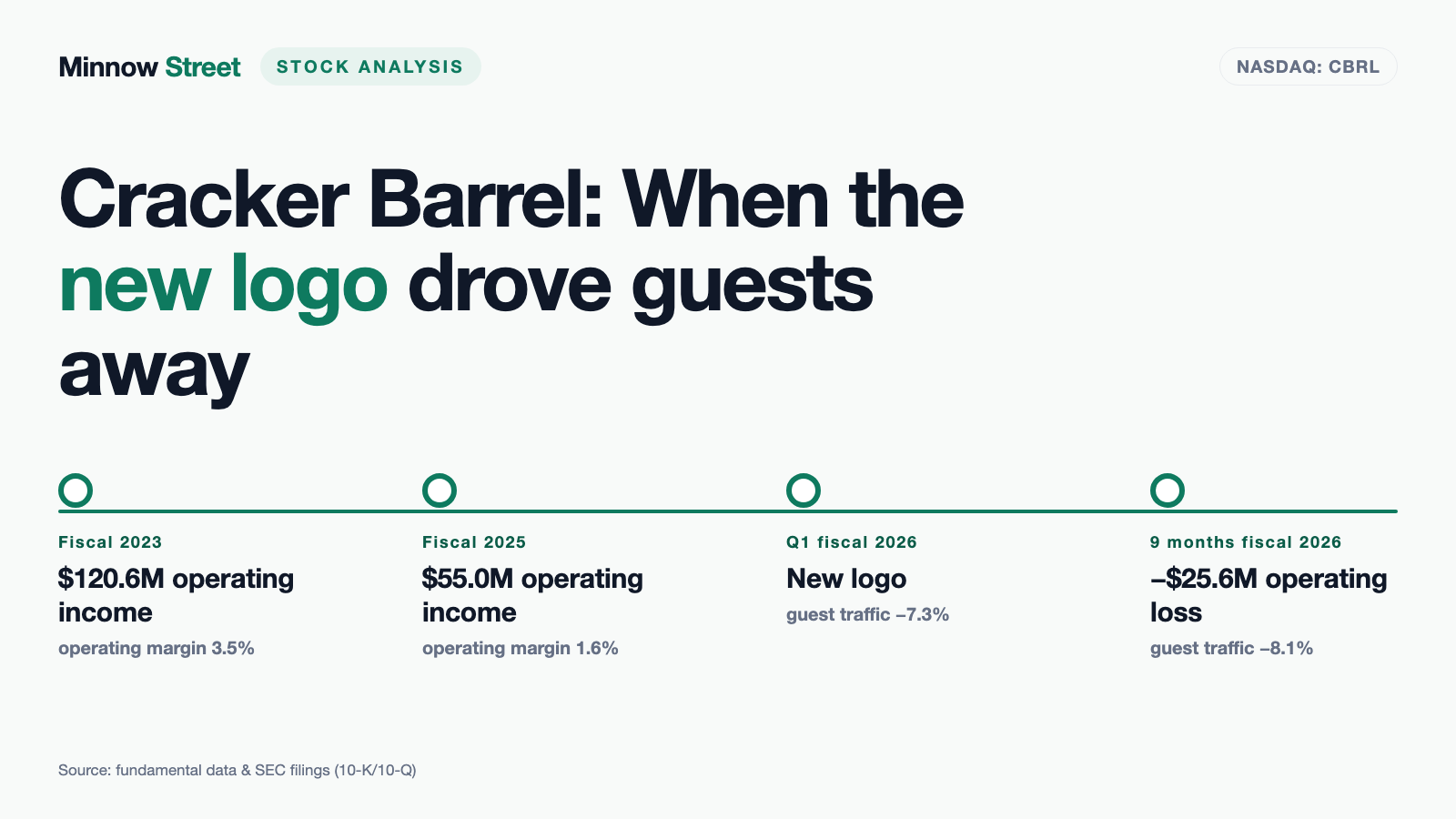
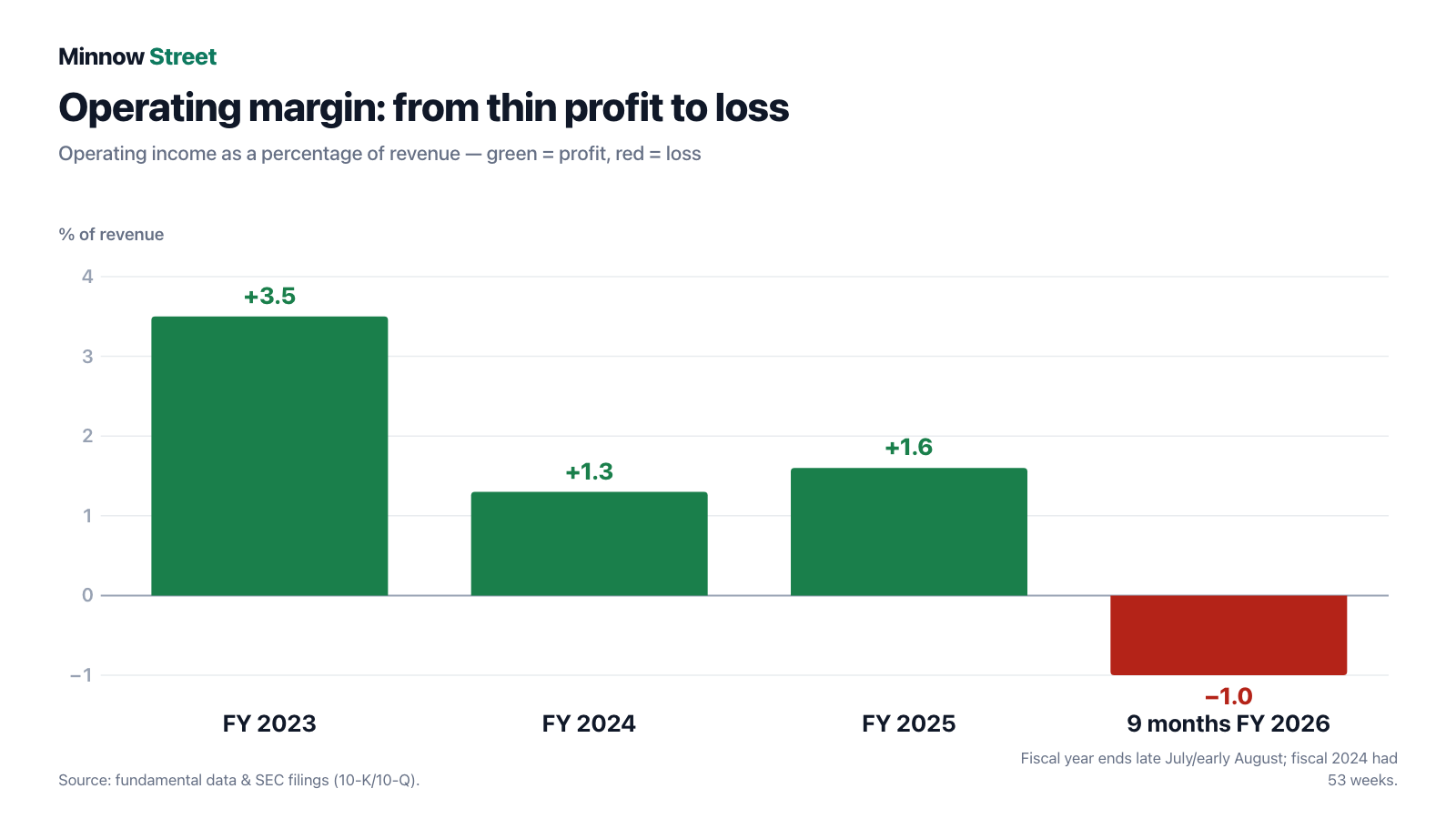
And here the other half of the story begins. Steady revenue hides the fact that less and less of it survives. Operating income fell from $120.6 million (fiscal 2023) through $45.1 million (fiscal 2024) to $55.0 million (fiscal 2025) — operating margins of 3.5, 1.3 and 1.6 percent. For scale: a 1.6 percent margin means $1.60 of operating income per $100 of revenue. A restaurant group with a healthy cost structure sits in the mid single digits. And in the first nine months of fiscal 2026 operating income dropped to negative $25.6 million, from positive $51.1 million a year earlier. Revenue over those nine months fell from $2,615.7 million to $2,469.4 million, down 5.6 percent.
What the filings say — the uncomfortable truths
Uncomfortable truth no. 1: the logo is in the quarterly report
It is rare for a company to name the cause of a business collapse this directly. In the quarterly report as of May 1, 2026, Cracker Barrel explains in its management discussion why guests are staying away:
"The decreases in guest traffic are primarily the result of negative publicity and customer reactions to certain recent brand initiatives, including the launch of a new logo and modern test store remodels in the first quarter of 2026, and lower consumer demand arising from multiple macroeconomic factors, including inflationary pressures, higher consumer debt levels and lower savings rates as well as the potential uncertainty associated with the geopolitical environment and global trade."
— Cracker Barrel Old Country Store, Inc., SEC quarterly report 10-Q as of May 1, 2026, Item 2 (Management\'s Discussion and Analysis)

The annual report for fiscal 2025, filed September 26, 2025, had already conceded the episode among its risk factors:
"In the first quarter of 2026, we introduced an updated logo, which received unfavorable consumer feedback and generated negative publicity."
— Cracker Barrel Old Country Store, Inc., SEC annual report 10-K for fiscal 2025, Item 1A (Risk Factors)
The quarterly numbers show what it cost. Comparable guest traffic — it counts entrees sold at stores open at least six full quarters, excluding MSBC — fell 7.3 percent in the first quarter of fiscal 2026, 10.1 percent in the second and 6.7 percent in the third. Across nine months that is negative 8.1 percent. A year earlier the same figures were negative 2.9, negative 2.7 and negative 5.6 percent — the trend existed before, but in the first quarter it more than doubled and in the second it nearly quadrupled.
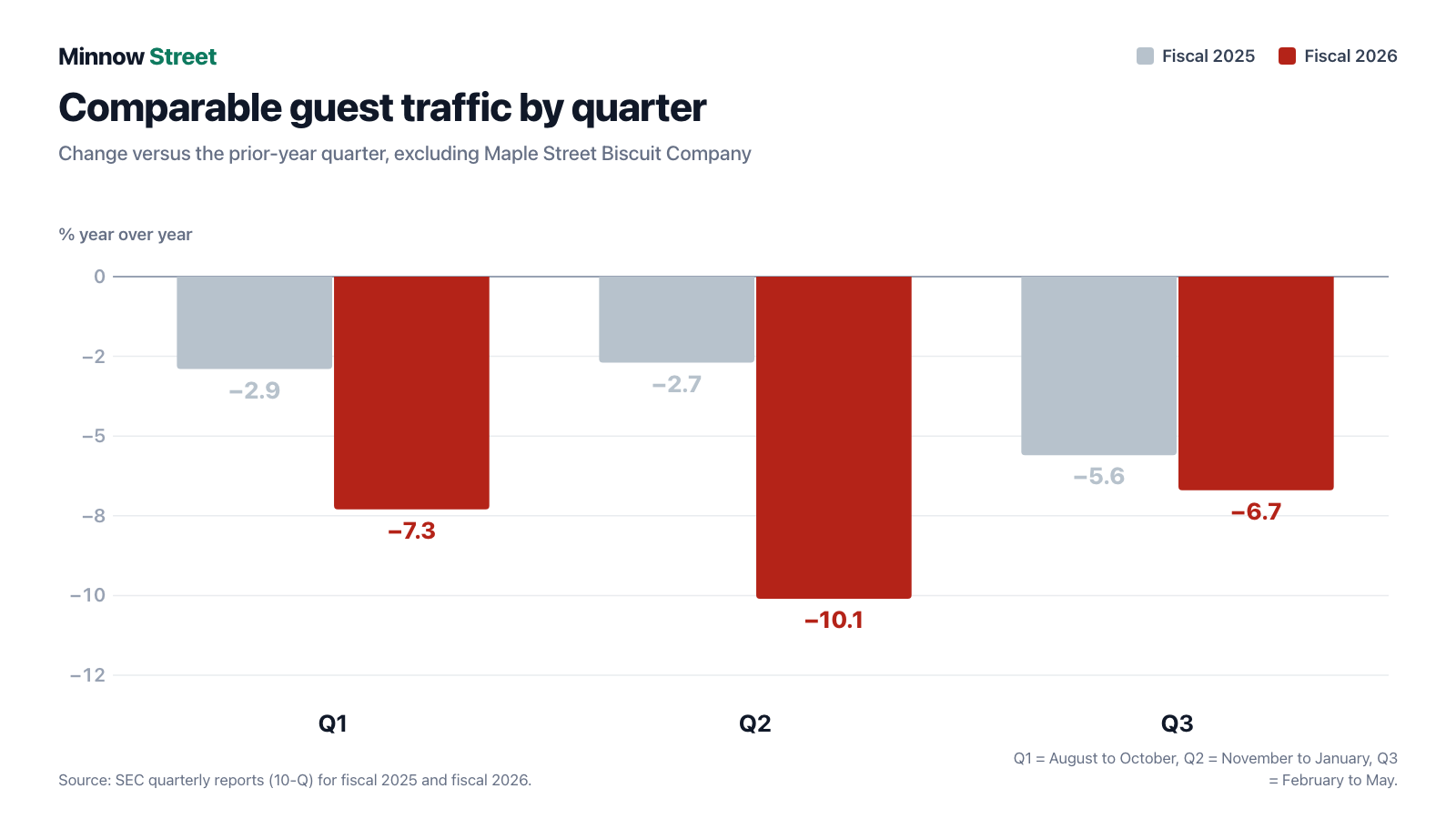
One detail makes the picture worse than the sales line suggests. Comparable restaurant sales fell only 2.6 percent in the third quarter — far less than the 6.7 percent drop in traffic. The reason sits right beside it: average check rose 4.3 percent, including an average menu price increase of 4.4 percent. Translated: the gap left by missing guests is being filled with price. That works for a while — until the price itself becomes the reason nobody pulls off the highway.
Uncomfortable truth no. 2: the profit came from a courtroom
For the first nine months of fiscal 2026, Cracker Barrel reports net income of $19.5 million, and $42.8 million in the third quarter alone versus $12.6 million a year earlier. That sounds like a recovery. Note 9 of the quarterly report explains what actually happened:
"In March 2026, the Company received $47,422, net of legal fees, pursuant to a settlement agreement resolving interchange fee litigation. This amount is recorded in the litigation settlement income line on the Consolidated Statement of Income."
— Cracker Barrel Old Country Store, Inc., SEC quarterly report 10-Q as of May 1, 2026, Note 9 (Litigation Settlement)

Interchange fees are what a merchant pays the card networks on every card transaction. Those fees have been litigated in the United States for years, and Cracker Barrel received a check from one such settlement. The math is quick: nine-month pre-tax income was $10.4 million. Remove the one-time item and a pre-tax loss of roughly $37.0 million remains. Remember: a profit that arrives from a courtroom does not come back next year.
Uncomfortable truth no. 3: $150 million came due — and 26 properties changed hands
Now the arithmetic gets tight, and two documents have to be laid side by side. The quarterly report as of May 1, 2026 states that the 0.625 percent convertible notes of $150 million matured on June 15, 2026 and that the company expected to settle them entirely in cash — the share price sat far below the conversion price of $152.98. On that same balance sheet date, $26.1 million was in the bank. The revolving credit facility was untouched on May 1, 2026.
Five weeks after the maturity date, in the current report of July 20, 2026, that facility reappears — this time with outstanding borrowings to be repaid. With what? With the sale of company-owned properties:
"Effective as of July 17, 2026, Cracker Barrel Old Country Store, Inc., a Tennessee corporation (the "Company"), and certain of its subsidiaries completed a sale-leaseback transaction (the "Sale-Leaseback"), pursuant to which the Company sold 26 properties (the "Subject Properties") at which the Company operates Cracker Barrel stores to an institutional real estate investor. The estimated net proceeds from the Sale-Leaseback, after payment of fees and expenses, are expected to be approximately $77 million."
— Cracker Barrel Old Country Store, Inc., SEC current report 8-K of July 20, 2026, Item 8.01 (Sale-Leaseback Transaction)

A sale-leaseback is the real estate version of a pawn shop: you sell your house and stay on as a tenant. It raises cash immediately but costs rent from day one. The filing names both sides: roughly $5.7 million of initial annual rent, with fixed annual escalators, as "absolute triple net" leases — taxes, insurance and maintenance remain with Cracker Barrel — and a maximum term of up to 40 years including renewal options. Do the math: $77 million divided by $5.7 million is about 13.5 years. After that the proceeds have flowed back out as rent, escalators not counted — and the properties belong to somebody else anyway.
In fairness: Cracker Barrel has done this three times before — in 2009 with 15 stores and its retail distribution center, in 2020 with 64 stores and in 2021 with 62. The tool is not new. What is new is the trigger: this time the chain does not start with a growth investment but with a maturing bond. What remains long term sits on the balance sheet: as of May 1, 2026, $465.5 million of shareholders\' equity faced $608.0 million of long-term operating lease liabilities — plus the 1.75 percent convertible notes of $345 million that do not mature until September 15, 2030.
Uncomfortable truth no. 4: the second brand is history
The same current report buries the second leg of the business. Maple Street Biscuit Company, acquired in 2019, had lately been mostly an impairment line: in fiscal 2025, seven Cracker Barrel locations and 25 MSBC locations were written down; in the first nine months of fiscal 2026, one Cracker Barrel store and sixteen MSBC locations were closed for poor operating performance. On July 20, 2026 came the final line:
"On July 20, 2026, the Company sold certain assets used in its Maple Street Biscuit Company ("MSBC") business, including the MSBC trademarks and other intellectual property and the assets used in 35 MSBC locations, to a third party. Simultaneously with such asset sale, the Company announced that the remaining 16 MSBC locations would be closed. […] the Company expects to record, in the financial results for its fourth quarter ending July 31, 2026, non-cash charges of approximately $37 million to $39 million."
— Cracker Barrel Old Country Store, Inc., SEC current report 8-K of July 20, 2026, Item 8.01 (MSBC Impairment Charge and Exit Costs)

The $37 million to $39 million consist of an impairment charge of $10 million to $11 million and a loss on sale of $27 million to $28 million. On top come $6 million to $8 million of cash charges for severance and lease terminations, partly in fiscal 2026 and partly in fiscal 2027. For scale: the non-cash charge alone is roughly twice the entire nine-month net income. "Non-cash" only means no money leaves now — the money left earlier, at acquisition and build-out. What is being written off here is the growth idea of the past several years.
Uncomfortable truth no. 5: the shareholders have already voted
On November 20, 2025, in the middle of the worst quarter, Cracker Barrel held its annual meeting. Of 22,268,694 shares entitled to vote, 17,543,266 were represented. The result, reported in the current report of November 24, 2025: director Gilbert Dávila received 6,716,130 votes in favor — against 9,570,461 votes opposed. He was not elected, resigned the same day, and the board shrank from ten members to nine. Chief executive Julie Masino drew 12,130,721 votes in favor and 4,116,283 against — roughly a quarter of the votes cast withheld their support.
The same chapter contains a quieter departure. The investment vehicles around Sardar Biglari, for years the loudest critic of management, reported on June 10, 2025 in their 59th amendment that as of June 9, 2025 they had fallen below the five percent threshold; their last reported holding was 1,042,577 shares, about 4.7 percent. Readers who want the story of that investor will find it in our analysis of Biglari Holdings. For Cracker Barrel the retreat means outside pressure has eased — in the very year management made a branding decision it later had to explain in its own risk factors.
What the company costs on the market
As of July 25, 2026, Cracker Barrel carries a market value of roughly $1.20 billion. The cross-check holds: 22,351,460 shares outstanding per the cover page of the quarterly report (as of June 1, 2026) times the July 24, 2026 closing price of $53.71 produces exactly that figure.
Measured against revenue, that is strikingly little: on a trailing twelve-month basis the price-to-sales ratio is about 0.36 — the market pays 36 cents for every dollar of annual revenue. A restaurant group with a healthy margin is rarely valued that low. Measured against earnings the picture inverts: the trailing price-to-earnings ratio sits near 47 — and even that is flattered, because the settlement income is inside the result. The price-to-book ratio is roughly 2.6 against a book value of $20.83 per share. On an enterprise value basis, market value plus debt including lease liabilities, the figure is about $2.27 billion — nearly 14 times operating earnings before depreciation and amortization.
The professional view is unusually split: of eight covered houses, two carry the highest buy rating, four say hold and two carry the sharpest sell rating; the average target price is $44.13, below the July 24, 2026 close. Put differently: the consensus considers the stock too expensive after the rebound — which is not a forecast but a snapshot (data as of July 25, 2026). The dividend of $1.00 per share a year works out to about 1.9 percent at that price level. Readers looking for a yardstick from the same industry will find one in our analysis of The Cheesecake Factory.
Opportunities and risks at a glance
What speaks for Cracker Barrel:
- A business that still works: 657 stores in 43 states, roughly $3.48 billion of revenue in fiscal 2025 and $92.5 million of operating cash flow over nine months — the company earns money from operations.
- Financial headroom: nothing drawn on the revolving credit facility as of May 1, 2026, $541.3 million available, confirmed compliance with all financial covenants, and no major maturity until September 15, 2030.
- Substance on the balance sheet: $956 million of net property and equipment as of May 1, 2026 — the July sale of 26 properties for about $77 million shows that substance can be converted to cash quickly.
- The price is low against revenue: a price-to-sales ratio near 0.36 leaves room if the margin recovers even part of the way to earlier levels.
- The cause is named and fixable: unlike a structural collapse in demand, a branding mistake is a decision — and decisions can be reversed.
What speaks against it:
- The loss of guests is real and accelerating: negative 8.1 percent over nine months after negative 3.7 percent a year earlier, and negative 10.1 percent in the second quarter of fiscal 2026.
- Earnings power has flipped: negative $25.6 million of operating income over nine months after positive $51.1 million; the operating margin was already only 1.3 and 1.6 percent in fiscal 2024 and 2025.
- Reported profit hangs on a $47.4 million one-time item from litigation — without it the books would show a pre-tax loss of roughly $37.0 million.
- The price of the traffic gap is paid on the menu: menu prices up 4.2 percent over nine months while guests stay away — a screw with a limited number of turns.
- Substance is leaving: 26 properties sold and leased back ($5.7 million of initial rent a year, up to 40 years), the MSBC second brand wound down entirely with $37 million to $39 million of non-cash and $6 million to $8 million of cash charges.
- Only $26.1 million of cash as of May 1, 2026 against $608.0 million of long-term lease liabilities and $345 million of convertible notes — the headroom sits in the credit line, not in the bank account.
A human conclusion
Back to the porch. The porch trap is treacherous because it runs on a genuine feeling: Cracker Barrel is a special brand, and 657 busy stores are no accident. But the fiscal 2026 filings describe what happens when you tinker with exactly that familiarity — and they describe it with unusual candor, because the company itself names the new logo as a cause. Eight guests in a hundred stopped coming over nine months. Operating income turned negative. Reported profit came from a courtroom. And in July the chain sold 26 of its own properties and wound down its second brand.
Here is the honest arithmetic: you get a household-name brand with billions in revenue, an untouched credit line and a price of 36 cents per dollar of sales — and you pay with the risk that damaged brand trust cannot be restored by resolution, and that the company trades substance for time in the meantime. Three lines to check in the fiscal 2026 annual report (10-K): comparable guest traffic (is it heading back toward zero?), operating income excluding one-time items — and rent expense, which now carries the $5.7 million from the July sale. What you make of that is your decision. And that is exactly as it should be.
Sources
Every original document used in this analysis — for you to read yourself:
- Cracker Barrel Old Country Store, Inc. — SEC annual report 10-K for fiscal 2025 (filed September 26, 2025)
- Cracker Barrel Old Country Store, Inc. — SEC quarterly report 10-Q as of May 1, 2026 (filed June 9, 2026)
- Cracker Barrel Old Country Store, Inc. — SEC quarterly report 10-Q as of January 30, 2026 (filed March 4, 2026)
- Cracker Barrel Old Country Store, Inc. — SEC quarterly report 10-Q as of October 31, 2025 (filed December 9, 2025)
- Cracker Barrel Old Country Store, Inc. — SEC current report 8-K of July 20, 2026 (sale-leaseback of 26 properties, exit from Maple Street Biscuit Company)
- Cracker Barrel Old Country Store, Inc. — SEC current report 8-K of November 24, 2025 (results of the annual meeting held November 20, 2025)
- Biglari Capital Corp. — SEC ownership filing SC 13D/A of June 10, 2025 (falling below the five percent threshold)
- Complete SEC filing history for Cracker Barrel: EDGAR overview (sec.gov)
- Fundamental data (metrics, quarterly series, valuation, price history; data as of July 25, 2026), reconciled with the SEC filings.
- Screener and rating data: our in-house stock scanner (data as of July 25, 2026), including the Moglen weekly ranking (U.S. selection, rank 25 of 28).
Transparency & disclaimer: This analysis is journalistic commentary on publicly available information. It is not investment advice, not a regulated financial analysis and not a solicitation to buy or sell securities. Equity investments carry substantial risk up to and including total loss. All information without warranty; the as-of date for each figure is stated in the text. The author holds no position in Cracker Barrel shares at the time of publication.
Our Bottom Line at a Glance
- Brand and guest traffic negative
- Comparable guest traffic fell 8.1 percent in the first nine months of fiscal 2026 (Q2 alone: −10.1 percent) after −3.7 percent a year earlier. The company itself names negative publicity and customer reactions to brand initiatives — "including the launch of a new logo" — as the primary cause (10-Q as of May 1, 2026, Item 2; 10-K fiscal 2025, Item 1A).
- Earnings power negative
- Operating income swung from +$51.051 million to −$25.614 million over nine months; the operating margin slid from 3.5 percent (fiscal 2023) through 1.3 and 1.6 percent to −1.0 percent. Revenue over the same nine months fell 5.6 percent to $2,469.372 million (10-Q as of May 1, 2026; 10-K fiscal 2025).
- Quality of earnings negative
- The $19.471 million of nine-month net income rests on a one-time item: $47.422 million net from an interchange fee settlement in March 2026. Strip it out and $10.383 million of pre-tax income becomes a pre-tax loss of roughly $37.0 million (10-Q as of May 1, 2026, Note 9).
- Balance sheet and liquidity neutral
- As of May 1, 2026, $465.470 million of shareholders' equity and $92.506 million of nine-month operating cash flow stand against a thin cash balance of $26.050 million. On the relief side: nothing drawn on the revolving credit facility, $541.297 million available, confirmed compliance with all financial covenants, and no major maturity until September 15, 2030 (10-Q as of May 1, 2026, Note 4).
- Asset sales negative
- Effective July 17, 2026, 26 company-owned properties were sold for roughly $77 million net and leased back (initial rent ~$5.7 million a year, absolute triple net, up to 40 years) — the proceeds are earmarked to repay borrowings under the credit facility. On July 20, 2026 the MSBC second brand was exited entirely, with expected non-cash charges of $37–39 million and cash charges of $6–8 million (8-K of July 20, 2026).
- Ownership and oversight neutral
- At the annual meeting on November 20, 2025, director Gilbert Dávila failed to win a majority (6,716,130 for versus 9,570,461 against) and resigned; the board shrank from ten members to nine. Long-time activist shareholder Biglari Capital Corp. reported on June 10, 2025 that it had fallen below the five percent threshold as of June 9, 2025 (last reported 1,042,577 shares, 4.7 percent).
Cracker Barrel is the rare case of a company putting the cause of its own crisis on the record: its quarterly report names negative publicity and reactions to brand initiatives, including a new logo, as the primary reason guest traffic fell 8.1 percent over nine months. The consequences sit in the same filings: negative $25.6 million of operating income, a bottom line that would be a loss without a $47.4 million settlement check, and, in July 2026, the sale of 26 company-owned properties plus the end of the second brand. Against that stand 657 stores, $3.48 billion of annual revenue, positive operating cash flow and an untouched $541.3 million credit line. Buying here is not buying the weekly rank; it is a bet that damaged brand trust returns before the substance runs out. Not investment advice.
What Our Rating Means
Open questions
The business works in principle, but one material question is open. As long as it stays open, our findings do not carry a quality verdict.
The business model still carries: 657 stores, roughly $3.48 billion of annual revenue, $92.5 million of operating cash flow over nine months, $465.5 million of shareholders' equity, an undrawn $541.3 million credit line as of May 1, 2026 and confirmed compliance with all financial covenants — no going concern language, no negative equity, no listing risk. What remains open is a material operating question: the turnaround is unproven. Guest traffic fell harder than the prior-year quarter in all three reported quarters of fiscal 2026, operating income for the first nine months of fiscal 2026 is negative $25.6 million, reported profit depends on a one-time item, and since July 2026 the company has partly funded itself by selling its own real estate. Until guest counts turn, this stays yellow — not because of the share price, but because of the unresolved question of whether the brand wins its audience back. The decision is yours.
A journalistic assessment by our editorial team at the time of the deep dive, based on public sources — not investment advice and not a solicitation to buy or sell. Your personal circumstances (investment goals, risk capacity, taxes) cannot be taken into account. What our levels mean, how verdicts are formed, and what conflicts of interest exist →
Worth Noting
- CBRL made the research list as rank 25 of 28 U.S. hits in our in-house Moglen weekly ranking (as of July 25, 2026, RS rating 81) — part of our series on the hits of this scanner. The lists are recalculated daily.
- Price and market value figures ($53.71 close on July 24, 2026, roughly $1.20 billion of market value) come from the July 25, 2026 feed and were computed against the 22,351,460 shares outstanding per the cover page of the 10-Q as of May 1, 2026 (stated as of June 1, 2026); analyses are evergreen and daily prices are not a buy argument.
- Risk of confusion: the ticker CBRL has belonged to Cracker Barrel Old Country Store, Inc. since December 10, 2008; before that the same entity (CIK 0001067294) filed as CBRL Group Inc. The Maple Street Biscuit Company second brand has not been part of the group since July 20, 2026.
- The figures for the first nine months of fiscal 2026 are unaudited quarterly numbers; the charges from the MSBC exit ($37–39 million non-cash, $6–8 million cash) are explicitly described by the company as preliminary estimates and will only hit the fourth quarter of fiscal 2026.
Frequently Asked Questions
The company states the reasons itself in its quarterly report as of May 1, 2026: negative publicity and customer reactions to brand initiatives, including the launch of a new logo and modern test store remodels in the first quarter of fiscal 2026, plus weaker consumer demand. Comparable guest traffic fell 8.1 percent over nine months and 10.1 percent in the second quarter.
The fiscal year ends in late July or early August. Fiscal 2025 ran through August 1, 2025; fiscal 2026 ends July 31, 2026. The first quarter of a fiscal year therefore covers August through October of the prior calendar year. Fiscal 2024 contained 53 weeks instead of 52, worth $62.8 million of extra revenue per the annual report.
Because a one-time item sits in between. In March 2026 the company received $47.4 million, net of legal fees, from an interchange fee settlement, booked on its own income line. Operating income for the first nine months was negative $25.6 million. Without the settlement, the $10.4 million of pre-tax income would be a pre-tax loss of roughly $37.0 million.
Two things. Effective July 17, 2026, 26 company-operated Cracker Barrel properties went to an institutional real estate investor and were leased straight back — net proceeds of about $77 million, initial rent of roughly $5.7 million a year. On July 20, 2026 the company also sold the brand and the assets of 35 Maple Street Biscuit Company locations and closed the remaining 16.
As of May 1, 2026 the balance sheet showed $149.9 million of current debt — the 0.625 percent convertible notes maturing June 15, 2026 — and $336.8 million long term for the 1.75 percent convertible notes of $345 million maturing September 15, 2030. On top come $608.0 million of long-term lease liabilities. The revolving credit facility was undrawn on that date.
A fast-casual breakfast and lunch chain acquired in 2019, meant to be a second leg alongside the Cracker Barrel stores. It stayed unprofitable: 25 locations were written down in fiscal 2025 and sixteen were closed in the first nine months of fiscal 2026. In July 2026 the business ended entirely — 35 locations sold, 16 closed.
Yes. As of July 25, 2026 the dividend runs at about $1.00 per share a year, roughly 1.9 percent at the July 24, 2026 price level. In the first nine months of fiscal 2026 that cost $17.6 million. The credit agreement limits distributions once certain leverage thresholds are exceeded.
Not according to the filings made with the U.S. securities regulator, the SEC. As of July 26, 2026 there is no tender offer and no merger documentation on file, the stock trades normally on the Nasdaq, and neither a Form 25 nor a Form 15 has been filed. The most recent Schedule 13D filing dates from June 10, 2025 and reports a drop below the five percent threshold.
Found an error?
Did you spot a factual error, an outdated number, or a typo in this deep dive? Let us know briefly — your report goes straight to the editorial team.