Corsair Stock: Four Loss Years After the Pandemic High — and a Third of Revenue Rides on the Price of a Memory Chip
Almost every PC gamer knows Corsair — keyboards, headsets, power supplies, Elgato streaming gear, and since 2024 Fanatec sim racing. The stock is popping up on Reddit again (4 mentions in 24 hours, ApeWisdom, as of July 23, 2026), and the comeback story sounds good: 2025 revenue grew 11.9 percent to $1,472.5 million, gross margin rose to 28.9 percent, operating cash flow swung to +$50.1 million. But the books Corsair files with the U.S. securities regulator, the SEC, also say: four consecutive loss years, an operating profit of a razor-thin $2.1 million in 2025, two-thirds of revenue from low-margin components (35 percent of it DRAM memory), a private-equity majority owner, and $358 million of goodwill on the balance sheet. Not investment advice — just the question of how much of the old Corsair is still inside the new one.
 Thomas Mücke
Founder & Publisher
Thomas Mücke
Founder & Publisher

Chart
Interactive price chart (TradingView).
Note: pure fact-based analysis, not investment advice and not a solicitation to buy or sell. All figures without guarantee.
There is an investor trap that loves to snap shut on familiar brands: the anchor trap. It works like this: you know a company from your everyday life, you remember its good years — and that memory quietly becomes the yardstick against which you measure everything new. Corsair Gaming (Nasdaq: CRSR) is exactly such a case. Almost anyone who has ever built a gaming PC has held a Corsair power supply, a Corsair keyboard or Corsair memory; anyone who streams knows the Elgato products. And the good years were spectacular: in the pandemic years of 2020 and 2021, when half the world was stuck at home upgrading their rigs, Corsair earned roughly $100 million in net income each year on nearly $2 billion in revenue. That anchor is exactly what makes today's stock dangerous: when the company now reports a recovery, it sounds as if the old, profitable Corsair is coming back. The stock is turning up on Reddit again — 4 mentions in 24 hours (ApeWisdom, as of July 23, 2026), a quiet signal, not a storm. So let's make a deal: before you buy the anchor, we read together what Corsair itself filed with the U.S. securities regulator, the SEC — the annual report (10-K) for 2025, the one for 2024, and the quarterly report (10-Q) as of March 31, 2026. A filing to the SEC is honest under penalty of law. And this one tells of four consecutive loss years, of a profit that belonged to the pandemic in 2020/2021, of a third of revenue riding on the price of a memory chip, and of a private-equity owner who holds the majority. In the end, you decide.
What Corsair actually does — more component reseller than brand factory
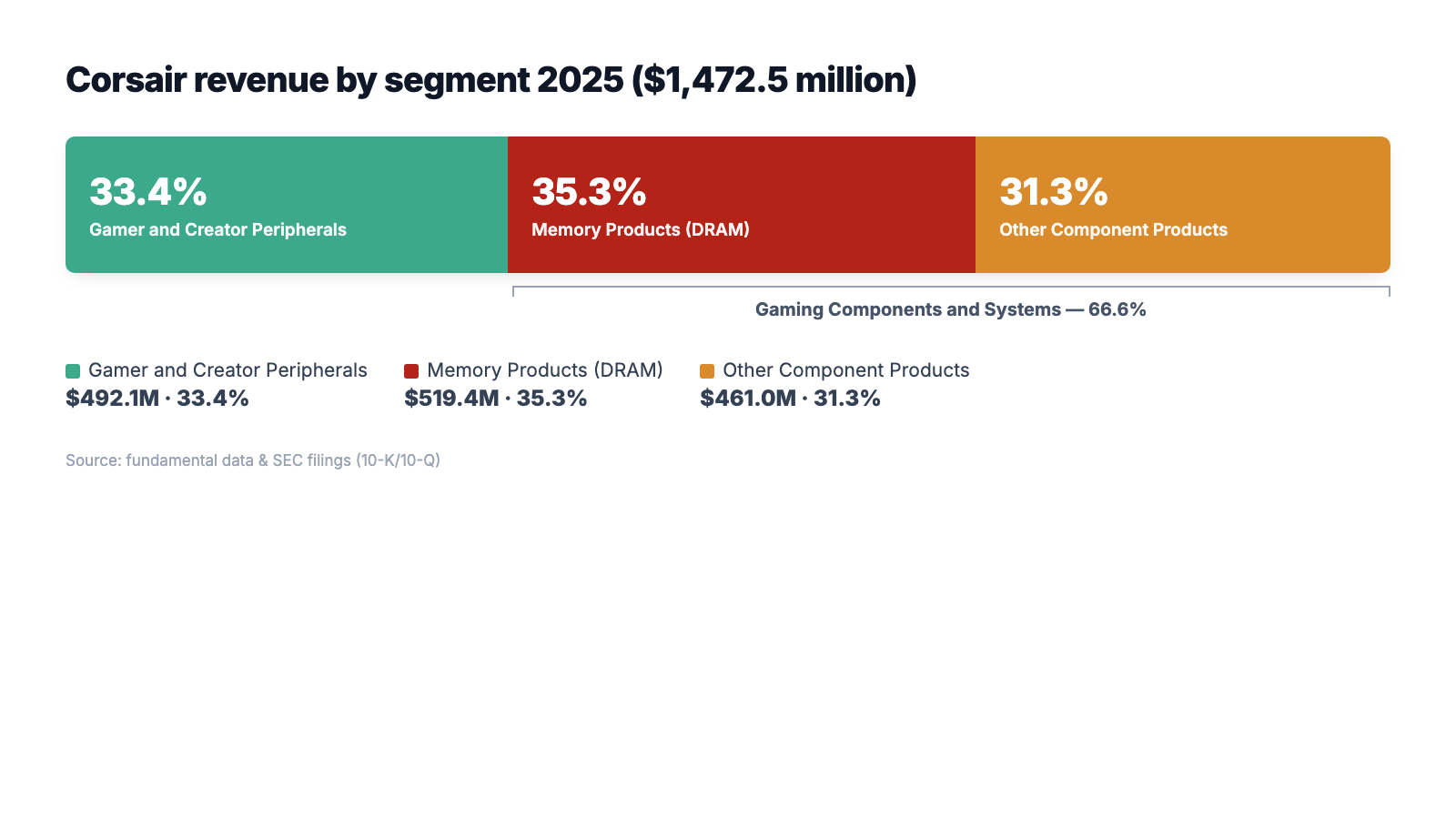
Corsair, founded in 1994 and based in Milpitas, California, sells hardware for gamers and content creators with about 2,355 employees (December 31, 2025). The company is organized into two segments. The first, Gamer and Creator Peripherals, is what most people think of as "Corsair": keyboards, mice, headsets, controllers (the SCUF brand), gaming furniture — and the streaming products of its Elgato unit (capture cards, Stream Decks, microphones). The second, Gaming Components and Systems, is the larger but quieter one: power supplies (PSUs), cases, cooling, memory (the Vengeance brand), plus prebuilt and custom gaming PCs and workstations (the Origin brand). Put into an everyday image: Corsair is half a brand shop with attractive, high-margin peripherals — and half, the larger half, a component reseller that buys memory chips and power-supply electronics, dresses them up and resells them. In 2025, 66.6 percent of revenue came from the components segment. Corsair has grown mostly by buying — by its own count, ten acquisitions since 2018, most recently in September 2024 the German sim-racing specialist Fanatec, which builds wheels and pedals for virtual racing. The current market story adds one more layer: Corsair now also sells "AI workstations" for specialized AI workloads, riding along on the AI wave. Sounds like the future? To a degree it is. But that names the central tension of this analysis, and it runs through every chapter: the stock is trading a comeback of the familiar gaming brand — the balance sheet shows a cyclical, private-equity-controlled hardware company whose razor-thin operating profit rides for a third on the price of memory chips it does not make itself.
Where the stock shows up — a quiet Reddit signal, not a momentum fireworks display
Unlike many stocks in this series, Corsair did not make our research list through a roaring momentum scanner but through the quietest of our signals: the Reddit hype scanner, which counts how often a ticker is named in the relevant stock forums. As of July 23, 2026, Corsair sat there with 4 mentions in 24 hours (data source ApeWisdom) — enough to notice, too little for a hype. That very setup is interesting: not a price rocket that needs explaining, but a familiar brand a few investors are talking about again, while the real story sits in the filings. A Reddit counter measures attention, not quality — it tells you someone is looking, not whether the looking is worth it. Remember the principle: attention is a starting point for research, not a result. So we leave the forums aside and read the numbers now — beginning with the curve that explains the anchor from the opening.
The numbers over the years — the pandemic hump and the return to the grind
First, what genuinely speaks for Corsair in 2025 — and it is real. Revenue recovered from $1,316.4 million (2024) to $1,472.5 million (2025, up 11.9 percent), the gross margin rose from 24.9 to 28.9 percent, and operating cash flow swung to +$50.1 million — the business is generating cash again. Operating income, too, climbed out of the red: from −$50.0 million (2024) to +$2.1 million (2025). That is a genuine improvement. But now the whole curve — and it explains why the anchor deceives:
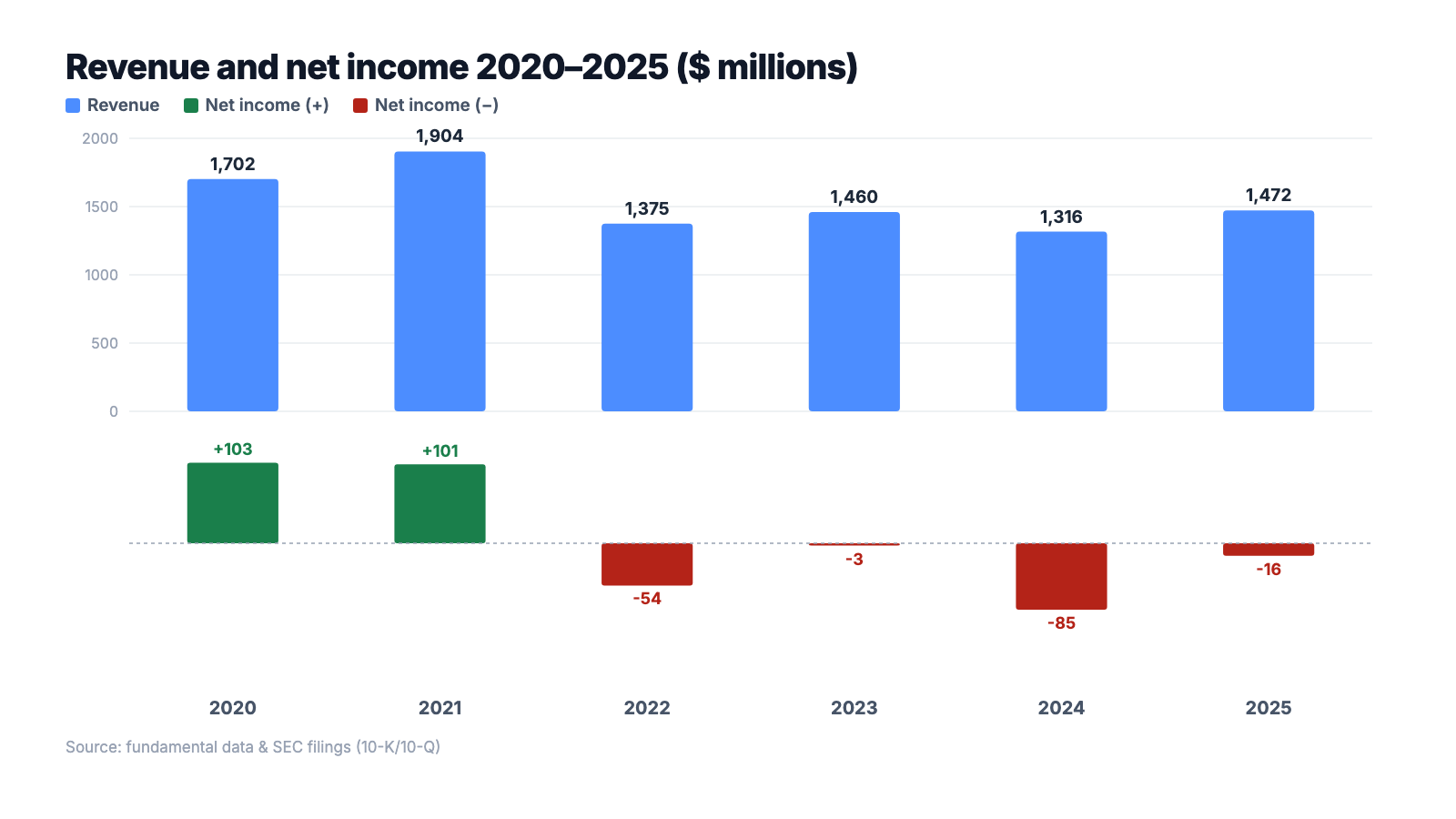
The curve tells two stories in one. The first is the pandemic hump: the record revenue of $1,904 million (2021) and the two $100 million profits (2020, 2021) fell precisely into the period when lockdowns made gaming demand explode. That was not a new Corsair — it was a special cycle. The second story starts in 2022, when demand normalized: revenue fell 28 percent to $1,375 million, and the net line showed a $54 million loss. Since then Corsair has not posted a profit in a single year: −$54.4 million (2022), −$2.6 million (2023), −$85.2 million (2024) and −$16.2 million (2025). The year 2025 is the best of these four grinding rounds — but it is a recovery within the loss zone, not a breakout above it. Remember the rhythm: 2025 revenue ($1,472 million) is still 23 percent below the pandemic high — and the bottom line stayed red. Which brings us to the uncomfortable truths.
What the filings say — the uncomfortable truths
Uncomfortable truth no. 1: the turnaround is razor-thin — and already red again in Q1 2026
Whoever reads the headline "Corsair back on track" should look one line lower. Yes, 2025 was marginally positive on the operating line — but only marginally: on $1,472.5 million of revenue, $2.1 million of operating income remained, an operating margin of 0.1 percent. One bad month, a dip in memory prices, a spike in freight costs — and the number tips. That showed up immediately in the new year: in the first quarter of 2026 revenue fell to $354.5 million (from $369.1 million a year earlier, down 3.9 percent), and the bottom line showed a net loss of $10.3 million again. And because Corsair carries roughly $115 million of long-term debt, interest expense eats the thin operating profit before it reaches the bottom line: in 2025, +$2.1 million of operating income became a $16.2 million net loss. Put into an everyday image: Corsair just barely got the engine to start in 2025 — but it is idling, and the first incline of the new year stalled it again. To be fair: operating cash flow, at +$50.1 million, is much friendlier than the net result, because depreciation of acquired brands and equipment does not consume cash. But cash flow is not profit — and Corsair has not crossed the profit line since 2021.
Uncomfortable truth no. 2: a third of revenue is a DRAM bet ticket — not a brand business
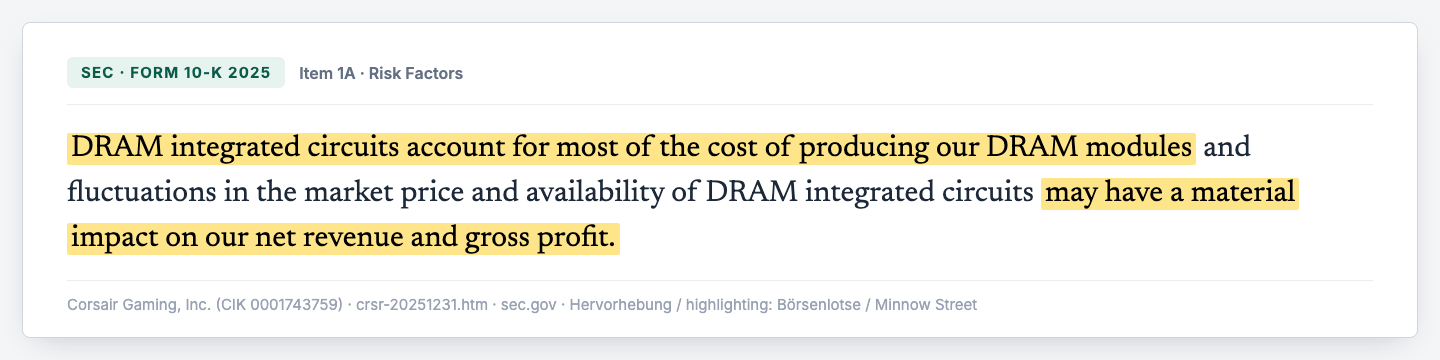
The biggest misunderstanding about Corsair is to treat it as a pure brand company. The segment note in the annual report corrects that soberly: the components segment produced $980.3 million in 2025 (66.6 percent of revenue), and the memory modules ("Memory Products") alone brought $519.4 million — 35.3 percent of total revenue. Corsair does not make these DRAM chips; it buys them, assembles modules and resells them. What that means for the stock, the risk section of the filing says itself:
"DRAM integrated circuits account for most of the cost of producing our DRAM modules and fluctuations in the market price and availability of DRAM integrated circuits may have a material impact on our net revenue and gross profit."
— Corsair Gaming, Inc., SEC annual report 10-K for 2025, Item 1A "Risk Factors"
Put into an everyday image: picture a baker who makes a third of his revenue reselling flour — if the flour price rises, his revenue in dollars rises, but whether more profit is left at the end depends on whether he can pass the higher purchase price on to customers. That is exactly Corsair's position in memory. And the cycle is turning right now: Corsair's own report describes how AI infrastructure is stoking demand for memory chips and tightening supply — which pushes DRAM prices. What this business looks like from the maker's side, our analysis of Micron, one of the large DRAM producers, shows — its quarterly numbers foreshadow the cycle that Corsair's memory revenue follows. Remember: a third of Corsair's revenue is less a brand bet than a bet on a commodity cycle the company does not control.
Uncomfortable truth no. 3: a private-equity owner holds the majority — Corsair is a "controlled company"
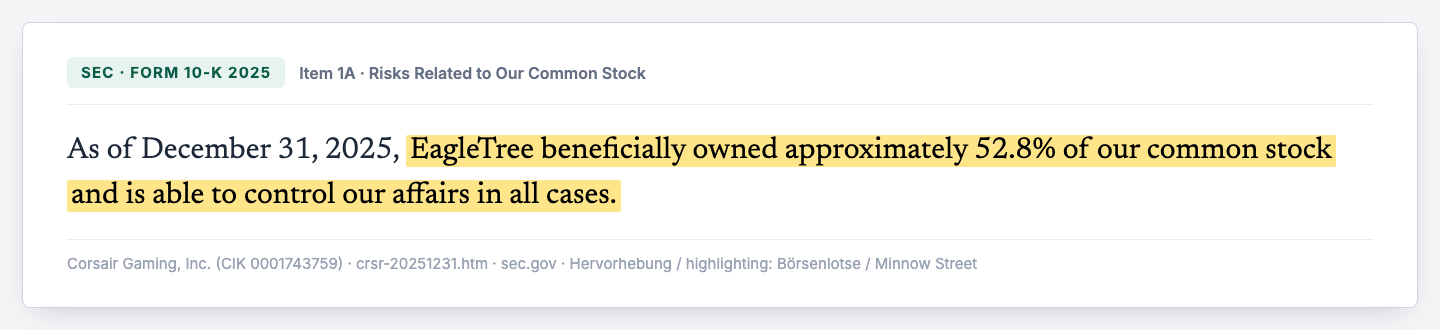
Whoever buys a Corsair share buys a minority stake alongside a very large majority owner. Corsair did not go public in 2020 as a classic family business but out of the hands of private-equity firm EagleTree Capital — the company was even incorporated in 2017 as "EagleTree-Carbide Acquisition Corp." in Delaware before being renamed Corsair Gaming in 2018. EagleTree remains the master of the house to this day, and the annual report says so with unusual clarity:
"As of December 31, 2025, EagleTree beneficially owned approximately 52.8% of our common stock and is able to control our affairs in all cases."
— Corsair Gaming, Inc., SEC annual report 10-K for 2025, Item 1A "Risks Related to Our Common Stock"
Because EagleTree holds more than 50 percent, Corsair is a "controlled company" under Nasdaq rules — and may forgo governance safeguards other listed companies must observe (such as a majority-independent board). As long as EagleTree holds the majority, it nominates five of eight directors and controls every shareholder vote. None of this is illegal — private-equity control is common at young IPOs, and an engaged owner can be good for a company. But it changes the math for you: in a takeover offer, a capital measure or a sale, what EagleTree wants counts first — and its interests (say, an exit at the right moment) need not align with those of public shareholders. The filing says so itself: in such matters, "the interests of EagleTree may differ from or conflict with your interests."
Uncomfortable truth no. 4: $358 million of goodwill from ten acquisitions — and thin tangible equity
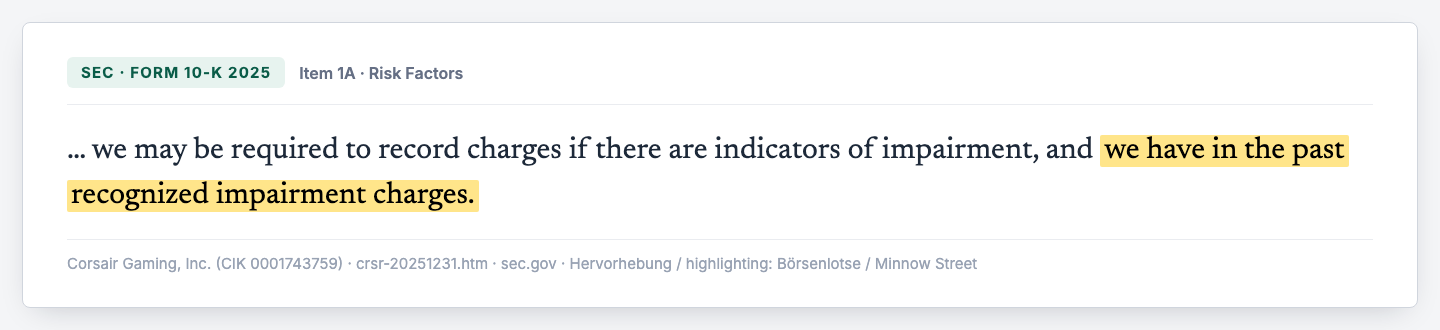
Corsair has grown largely by buying, not by organic growth — ten acquisitions since 2018, from Elgato to SCUF, Origin and Drop to Fanatec (September 2024). That leaves marks on the balance sheet: as of December 31, 2025, it carried $357.8 million of goodwill (the premium over the tangible value of the acquisitions) plus another $125.2 million of intangibles (brands, technology). Together that is roughly $483 million — about 76 percent of the entire $633.6 million of equity. Translated: strip out goodwill and intangibles and only about $150 million of tangible equity remains — with more than 106 million shares, roughly $1.40 per share of hard book value. The rest is the hope that the acquired brands stay worth the price paid. If they do not, an impairment charge looms, and Corsair says itself that this is not a theoretical risk:
"… we may be required to record charges if there are indicators of impairment, and we have in the past recognized impairment charges."
— Corsair Gaming, Inc., SEC annual report 10-K for 2025, Item 1A "Risk Factors" (goodwill)
To be fair: the impairment charges actually recorded in the years shown were "not material" per the report, and high goodwill is normal for acquisition-driven companies. But the link remains: $358 million of goodwill against a $16 million net loss and an operating profit near zero is a powder keg with a long fuse — if the earnings power of a large acquisition breaks away, a single write-down can melt the thin tangible equity in one stroke. Here is the revenue structure that balance sheet has to carry:
The AI card: a real product, but a small number
An AI label hangs over the whole story — as it does over so many stocks in this market phase — and it is fair to test it. Corsair has expanded its product lineup to include "AI workstations" — high-performance machines for specialized AI workloads — and also uses AI internally and in certain customer offerings (such as customer support). The annual report additionally describes how AI-driven demand for graphics cards and memory moves the entire hardware market — sometimes as a tailwind (more high-end upgrading), sometimes as a risk: the report warns that future GPU generations may increasingly cater to AI and data centers, stripping out "graphic-specific" features — which would hit the gaming customer base of all people. For scale: the AI workstations are a young product within the systems business, not a separately reported, large revenue source. What the seller's side of this AI hardware wave looks like, our Nvidia analysis shows — Corsair sits on the buyer's side of that counter, as an assembler of graphics cards and memory into finished systems. Remember: Corsair does not sell AI — it sells the hardware around it; the wave is borrowed tailwind, not its own engine.
Valuation: no earnings to compute, plenty of goodwill on the books
How do you value a company that has not posted a profit in four years? A price-to-earnings ratio cannot be formed for lack of earnings — that alone is a statement. That leaves a look at revenue and substance. On revenue, at roughly $1.47 billion Corsair is a heavyweight among the names in this series, and the stock trades (order of magnitude, deliberately without a daily price — analyses are evergreen) at the low single-digit multiple of revenue down to well below one times revenue, depending on the price level; for a cyclical, thin-margin hardware maker that is neither cheap nor expensive, but appropriately skeptical. More interesting is the substance side: the $633.6 million of book equity (roughly $5.94 per share) consists three-quarters of goodwill and intangibles — the tangible equity of about $150 million (roughly $1.40 per share) is the hard core you could count on in a pinch. What supports the valuation: a well-known brand, a broad product portfolio, a gross margin that is rising again, and positive operating cash flow (+$50.1 million in 2025). What restrains it: the absence of a profit since 2021, the memory-chip dependency, the private-equity control, and the high goodwill. The market is not pricing a growth story here but a bet on a durable turnaround — and the quarterly numbers decide whether the razor-thin operating profit of 2025 becomes a sustainable one.
Opportunities and risks at a glance
What speaks for Corsair:
- A well-known brand with breadth: leading positions in several gaming categories, a portfolio spanning Corsair, Elgato, SCUF, Origin, Drop and Fanatec (sim racing) — three decades of market experience and a growing direct-to-consumer business.
- A recovery with receipts: revenue up 11.9 percent (2025) to $1,472.5 million, gross margin from 24.9 to 28.9 percent, operating income from −$50.0 million to +$2.1 million, operating cash flow +$50.1 million.
- Solid liquidity: $97.2 million in cash, only $115.2 million of long-term debt, $633.6 million of equity (December 31, 2025) — no acute funding pressure.
- Optional tailwind: AI-driven upgrading of the high-end PC market, new AI workstations and a firming memory cycle can lift revenue and margin in the short term.
What speaks against it:
- Four consecutive loss years: net −$54.4 million (2022), −$2.6 million (2023), −$85.2 million (2024), −$16.2 million (2025); the 2025 operating profit was a razor-thin +$2.1 million (0.1 percent margin), and Q1 2026 posted another net loss of $10.3 million at revenue down 3.9 percent.
- Commodity dependency: 35.3 percent of revenue comes from purchased DRAM memory modules whose price Corsair does not control; memory-price swings hit revenue and margin "materially" (10-K 2025).
- Private-equity control: EagleTree holds 52.8 percent, nominates five of eight directors, a "controlled company" with reduced governance safeguards — conflicts of interest with public shareholders possible.
- A lumpy balance sheet: $357.8 million of goodwill plus $125.2 million of intangibles (about 76 percent of equity) from ten acquisitions; only about $150 million of tangible equity, with impairment risk explicitly named.
- Cyclicality, not growth: 2025 revenue is 23 percent below the 2021 pandemic high; the business is highly seasonal and cyclical, and the comeback story rests on a single recovered year-over-year comparison.
A human bottom line
Back to the anchor trap from the opening. Its core is not that Corsair is a bad company — the brand is real, the products are good, the 2025 recovery is documented in numbers, and the balance sheet is not overleveraged. Its core is that the memory of the pandemic profit sets you a yardstick the company today does not meet: the $100 million profits of 2020 and 2021 belonged to a special cycle, not to the business model. Whoever buys "Corsair" because they picture the profitable pandemic Corsair is really buying three very concrete bets: that a $2.1 million operating profit becomes a sustainable net profit; that the memory cycle a third of revenue rides on stays friendly; and that the private-equity owner who holds the majority shares its interests with yours. All of it is possible. So the honest question for you is not "Do I know Corsair?" but: would you buy this company even if you had never heard its name and never seen the pandemic peak — with only the four loss years and the balance sheet in front of you? If yes, you have a thesis. If no, you had an anchor. What you do with all this is your decision. And that is a good thing.
Sources
All original documents used in this analysis — for your own reading:
- Corsair Gaming, Inc. — SEC annual report 10-K for 2025 (filed February 25, 2026)
- Corsair Gaming, Inc. — SEC annual report 10-K for 2024 (filed February 26, 2025)
- Corsair Gaming, Inc. — SEC quarterly report 10-Q as of March 31, 2026 (filed May 7, 2026)
- Corsair Gaming's complete SEC filing history: EDGAR overview (sec.gov)
- Fundamental data (metrics, annual and quarterly series, valuation; data as of July 23, 2026), reconciled with the SEC filings and the SEC XBRL series.
- Attention signal: Reddit mentions per ApeWisdom (4 mentions in 24 hours, as of July 23, 2026); framing via our in-house stock scanner.
Transparency & disclaimer: This analysis is a journalistic assessment of publicly available information and is not investment advice, not a financial analysis in the regulatory sense, and not a solicitation to buy or sell securities. Stock investments carry substantial risks up to and including total loss. All information without guarantee; the data cut-off is noted in the text. The author holds no position in Corsair shares at the time of publication.
Our Bottom Line at a Glance
- Brand & portfolio positive
- A well-known gaming brand with leading positions in several categories and a broad brand fan (Corsair, Elgato, SCUF, Origin, Drop, Fanatec), three decades of market experience and a growing direct-to-consumer channel — a genuine asset the comeback story rightly emphasizes (10-K 2025, Item 1).
- Earnings negative
- Four consecutive loss years (net −$54.4M/−$2.6M/−$85.2M/−$16.2M for 2022–2025); the 2025 operating profit was a razor-thin +$2.1M on $1,472.5M of revenue (0.1 percent margin), and Q1 2026 was −$10.3M net again at revenue down 3.9 percent — the $100 million profits of 2020/2021 belonged to the pandemic special cycle.
- Business mix & DRAM dependency negative
- Two-thirds of revenue come from the low-margin components segment, 35.3 percent of it from purchased DRAM memory modules; per the 10-K 2025 the DRAM chips account for most of the production cost and their price swings hit revenue and margin "materially" — a commodity cycle Corsair does not control.
- Balance sheet & liquidity neutral
- $97.2M in cash, only $115.2M of long-term debt and +$50.1M of operating cash flow (2025) stand against $357.8M of goodwill plus $125.2M of intangibles (≈ 76 percent of equity); tangible equity of about $150M is thin, and the report explicitly names impairment risk.
- Owner & governance negative
- EagleTree (private equity) holds 52.8 percent, nominates five of eight directors and can control the company "in all cases" per the 10-K 2025; as a "controlled company" Corsair forgoes governance safeguards, and the majority owner's interests can differ from those of public shareholders.
Corsair is the anchor trap in pure form: a familiar gaming brand whose memory of the pandemic profit sets a yardstick the company today does not meet. In 2025 revenue recovered to $1,472.5 million (+11.9 percent), gross margin rose to 28.9 percent, operating cash flow swung to +$50.1 million — but the net line showed the fourth straight loss year (−$16.2 million), operating income was a razor-thin +$2.1 million, and Q1 2026 slid back into the red. On top of that, a third of revenue rides on the DRAM price, a private-equity owner holds the majority, and $358 million of goodwill weighs on thin tangible equity. Whoever invests is betting on a durable turnaround — carried by a brand, not by profits. Not investment advice.
What Our Rating Means
Open questions
The business works in principle, but one material question is open. As long as it stays open, our findings do not carry a quality verdict.
Whoever buys today is betting that the razor-thin $2.1 million operating profit becomes a sustainable net profit, that the memory cycle stays friendly, and that the private-equity owner shares its interests with those of public shareholders — at a company with no profit year since 2021 and $358 million of goodwill on the books. Whoever waits checks four things in every quarterly report (10-Q): does operating income turn durably and clearly positive? How does DRAM memory revenue track the chip-price cycle? Does the EagleTree stake shift through buybacks? And does the goodwill stay untouched? The decision is yours.
A journalistic assessment by our editorial team at the time of the deep dive, based on public sources — not investment advice and not a solicitation to buy or sell. Your personal circumstances (investment goals, risk capacity, taxes) cannot be taken into account. What our levels mean, how verdicts are formed, and what conflicts of interest exist →
Worth Noting
- CRSR made the research list via the Reddit hype scanner (4 mentions in 24 hours, ApeWisdom, as of July 23, 2026) — a quiet attention signal, not a momentum hype: attention here is the trigger for research, not its result.
- Metrics carry annual, quarterly or data-cut-off references; valuation figures are deliberately kept as an order of magnitude, without a daily price — analyses are evergreen, daily prices are not a buy argument. Operating cash flow (+$50.1 million) is friendlier than the net result (−$16.2 million) because depreciation of acquired brands does not consume cash.
- Identity verified against EDGAR: Corsair Gaming, Inc. (CIK 1743759), incorporated 2017 in Delaware as EagleTree-Carbide Acquisition Corp., renamed 2018, IPO September 2020; CEO change to Thi La effective July 1, 2025. Not to be confused with the like-named private-equity house EagleTree Capital, the majority owner.
Stock Watch
This analysis is as of July 23, 2026. Stock Watch will tell you what's changed at CRSR since then.
Later $1 a month per stock — signing up is free, and you'll be the first to know when it launches.
Frequently Asked Questions
Corsair Gaming, Inc. (Nasdaq: CRSR) of Milpitas, California, sells hardware for gamers and content creators in two segments: Gamer and Creator Peripherals (keyboards, mice, headsets, controllers, Elgato streaming gear; 2025: $492.1 million) and Gaming Components and Systems (power supplies, cases, cooling, DRAM memory, prebuilt PCs; $980.3 million). Its brands include Corsair, Elgato, SCUF, Origin, Drop and, since September 2024, sim-racing maker Fanatec. Total 2025 revenue: $1,472.5 million with 2,355 employees.
No — at least not on the bottom line since 2021. In the pandemic years of 2020 and 2021 Corsair earned roughly $100 million each, then posted a net loss four years running: −$54.4 million (2022), −$2.6 million (2023), −$85.2 million (2024) and −$16.2 million (2025). It turned marginally positive on the operating line in 2025 (+$2.1 million on $1,472.5 million of revenue, a 0.1 percent margin), but the first quarter of 2026 brought another net loss of $10.3 million. Operating cash flow was clearly positive in 2025 at +$50.1 million.
Because a large part of revenue comes from resold memory modules: the "Memory Products" (DRAM modules under the Vengeance brand) brought in roughly $519.4 million in 2025 — 35.3 percent of total revenue. Corsair does not make the DRAM chips itself; it buys them. Per the annual report (10-K 2025), the DRAM integrated circuits account for most of the cost of producing the modules, and swings in market price and availability have a "material impact" on revenue and gross profit. Memory revenue therefore tracks the DRAM price cycle.
The majority owner is private-equity firm EagleTree, which held roughly 52.8 percent of the common stock as of December 31, 2025. Corsair was incorporated in 2017 as "EagleTree-Carbide Acquisition Corp." in Delaware, renamed Corsair Gaming in 2018, and went public on Nasdaq in September 2020. Because EagleTree holds more than 50 percent, Corsair is a "controlled company," nominates up to five of eight directors, and can control the company "in all cases" per the annual report — with possible conflicts of interest against public shareholders.
As of December 31, 2025, the balance sheet carried $357.8 million of goodwill plus another $125.2 million of intangibles — the result of ten acquisitions since 2018 (most recently Fanatec, September 2024). Together that is roughly 76 percent of the $633.6 million of equity. Strip both out and only about $150 million of tangible equity remains (roughly $1.40 per share). Corsair explicitly notes it has recognized impairment charges in the past; the impairments recorded in recent years were "not material" per the report.
Corsair does not sell AI — it sells the hardware around it: it has expanded its lineup to include "AI workstations" for specialized AI workloads, and it uses AI internally and in certain customer offerings (such as support). AI-driven demand for graphics cards and memory also moves the entire hardware market — sometimes as a tailwind, sometimes as a risk, because future GPUs may increasingly target data centers. The AI workstations are so far a young product within the systems business, not a large, separately reported revenue source.
Corsair made our research list via the Reddit hype scanner: 4 mentions in 24 hours per ApeWisdom (as of July 23, 2026) — a quiet attention signal, not a hype. Such signals measure how often a ticker is named in stock forums, not the quality of the company. For Corsair it is more the return of a familiar brand to the conversation, while the real story — four loss years, DRAM dependency, private-equity control — sits in the SEC filings.
Found an error?
Did you spot a factual error, an outdated number, or a typo in this deep dive? Let us know briefly — your report goes straight to the editorial team.