Comstock Resources: $420 Million in Profit — and Four Years of Spending More Than It Earned
Comstock Resources posted its best result since the 2022 gas price boom in 2025: $420.2 million in net income on $2,220.3 million in revenue. That is why the stock screens cheap at a price-to-earnings ratio of roughly 6. The filings with the U.S. securities regulator, the SEC, also show the other side: since 2023 the drilling program has cost more every year than the business brought in, debt stands at $2,947.6 million — and 71 percent of the shares belong to one man. Not investment advice, just the question of who ends up owning the wells.
 Thomas Mücke
Founder & Publisher
Thomas Mücke
Founder & Publisher
Chart
Interactive price chart (TradingView).
Note: pure fact-based analysis, not investment advice and not a solicitation to buy or sell. All figures without guarantee.
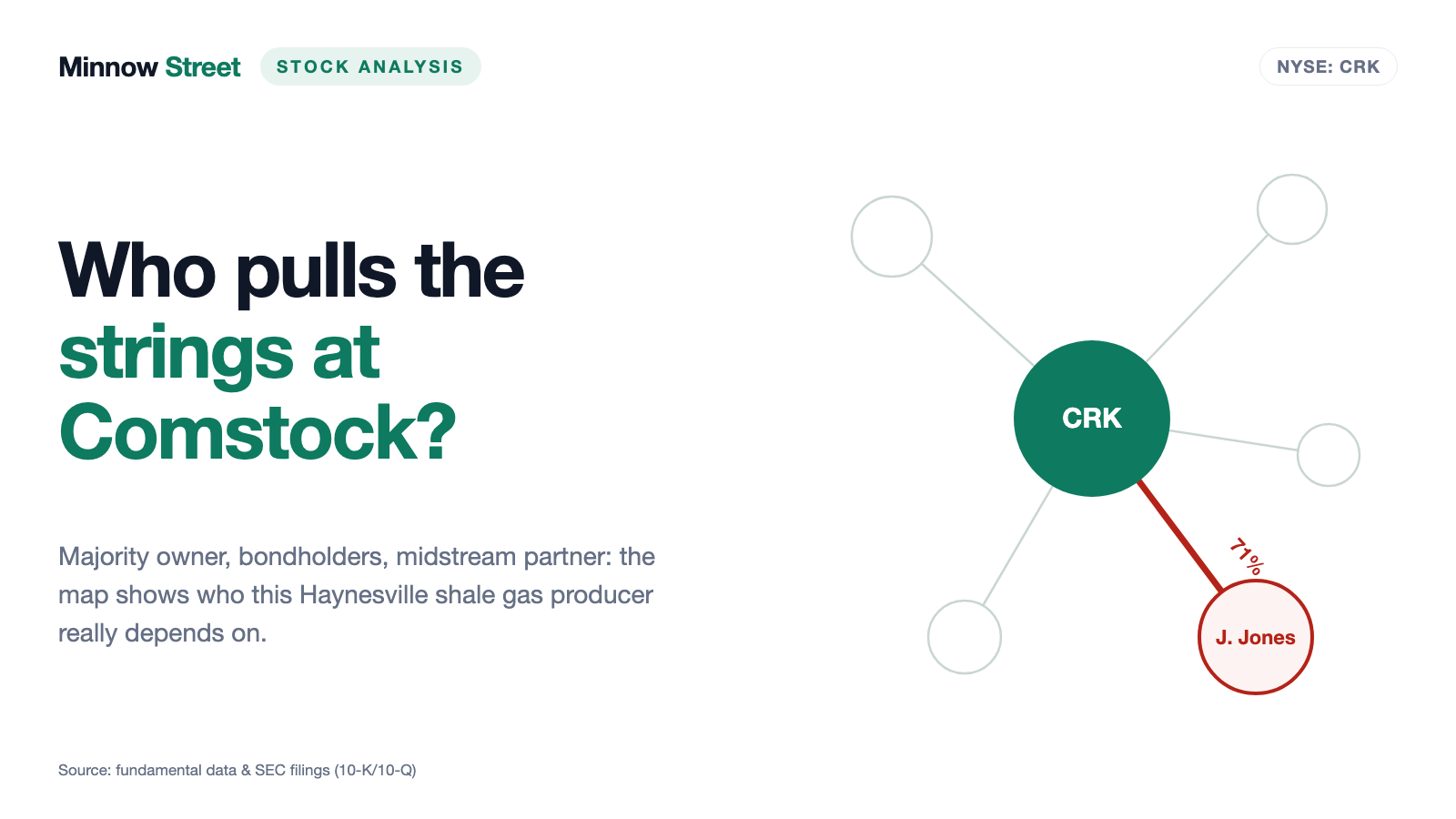
There is an investor trap that springs shut whenever a famous name appears on the share register: the passenger trap. You see that a billionaire owns 71 percent of a company and think: he knows more than I do, he is not getting out, I will just ride along. At Comstock Resources, Inc. (NYSE: CRK) that man is Jerral W. Jones — the businessman most people know as the owner of a football franchise. Except you are not sitting next to him. He designates five of nine board seats, he thinks in decades, and part of his stake was bought in a private placement. So let us make a deal: before we talk about the driver, we read together what the company itself filed with the U.S. securities regulator, the SEC — the annual report (10-K) for 2025, filed February 19, 2026, and the quarterly report (10-Q) as of March 31, 2026, filed May 6, 2026. A filing with the SEC is honest under penalty of law. And this one tells of 7.0 trillion cubic feet of natural gas in the ground — and of four years in which more money left the company than the business brought in.
What Comstock Resources actually does — a drilling company with 252 people
Comstock is an independent natural gas producer: it leases land, drills horizontally into shale rock, fractures it with water pressure and sells the gas that comes out. Headquarters are in Frisco, Texas, and the company is run by M. Jay Allison as chairman and chief executive and Roland O. Burns as president and chief financial officer. The payroll is remarkably small: 252 employees as of December 31, 2025, with contractors doing the rest. Oil is close to irrelevant — of $1,428.1 million in oil and gas sales in 2025, all of $2.3 million came from oil.
The acreage sits in the Haynesville and Bossier shales of North Louisiana and East Texas: 1,069,991 acres, 802,769 of them net to Comstock. The advantage of that region is geography. From here it is a short haul to the Gulf Coast, where LNG terminals load, chemical plants run and new power plants are being built. The annual report also describes a partnership with NextEra Energy Resources to supply gas for new power generation in the Western Haynesville — with an initial capacity of 2 gigawatts and potential expansion to 8 gigawatts for data centers.
Two things need keeping apart. First, several listed companies carry the Comstock name: Comstock Resources (ticker CRK), Comstock Inc. (LODE) and Comstock Holding Companies (CHCI) are three separate registrants filing their own reports. It is easy to land on the wrong one. Second, since 2023 Comstock has owned a pipeline subsidiary, Pinnacle Gas Services LLC, which gathers and treats gas in the Western Haynesville — two treating plants in Texas and 246 miles of high-pressure pipeline at the end of 2025. That subsidiary will matter later.
That names the central tension of this analysis, and it runs through every chapter: Comstock sits on one of the best gas resources in North America — but since 2023, developing that resource has cost more each year than the business itself brings in. How differently production and infrastructure earn inside the same industry is something we took apart in our Summit Midstream analysis; how violently commodity prices shake a producer's results shows up in our APA Corporation analysis.
Where the stock showed up in our scanner
The hook this time is not a price move but a balance-sheet list. Our in-house stock scanner carries Comstock on the U.S. side of its fundamental ranking — the list that sorts companies by the quality of their numbers rather than by their chart (as of July 26, 2026; the lists are recalculated daily). On the same date 38 U.S. names meet the criteria of that list, and the page shows the first 25 of them. You can repeat it in three clicks: open the stock scanner, choose the list Fundamental Rank (A / A+), set the market to the United States.
What makes the hit interesting is the company it keeps. On July 26, 2026 CRK appeared in eight lists at once, and the mix is unusual: alongside the fundamental ranking there were Power Trend, Professionals 80%, Big Earnings Surprise, Strong DCR 80, Narrow Weekly Range and the pure rankings by price-to-earnings and price-to-cash-flow. Translated: on the last reported numbers the stock looks cheap, it has beaten expectations recently, and technically it is not doing badly. That combination deserves a second look — because cheap is only a bargain if the earnings come back.
Two metrics from the July 24, 2026 data cut belong here, and both are rated, not merely listed. The price-to-earnings ratio stands at about 6, computed on trailing twelve-month earnings of $2.21 per share. Anything under 10 is generally called cheap; we will see in a moment why that number needs handling with care. And a debt-to-equity ratio of 1.1 means that for every dollar of equity there is a little more than a dollar of borrowed money. For a commodity producer that is not unusual, but it is no cushion either.
The numbers over the years — honestly appraised
First what genuinely impresses. Comstock turned the corner in 2025. Total revenue rose to $2,220.3 million from $1,254.5 million (2024) and $1,565.2 million (2023). An operating loss of $168.6 million became operating income of $645.9 million, and a net loss of $218.8 million became net income of $420.2 million, or $1.43 per diluted share. The first quarter of 2026 confirmed the direction: $587.4 million of revenue, $174.9 million of operating income, $112.5 million of net income and $0.38 per share — after a loss of $0.40 per share a year earlier.
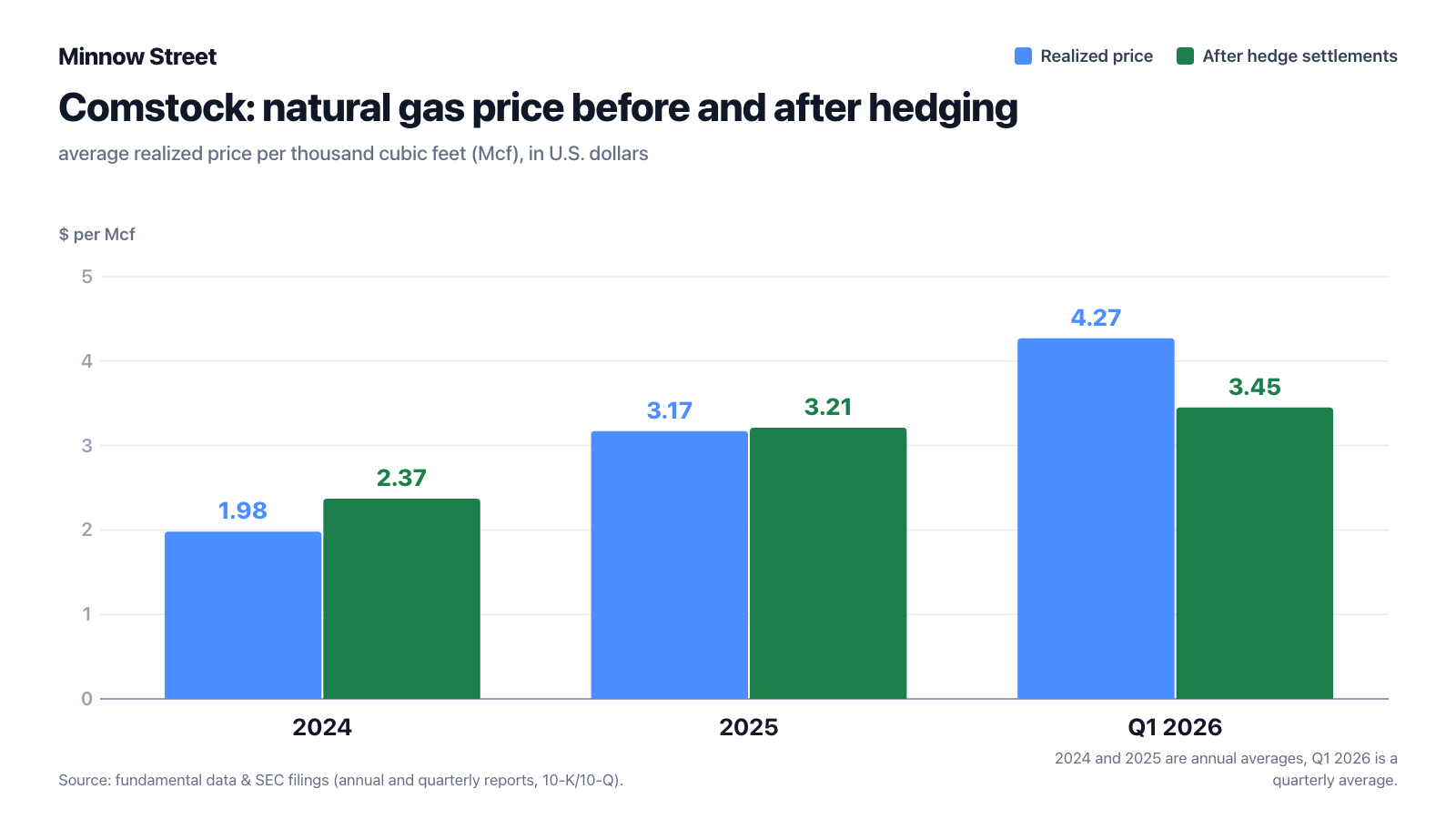
The reason sits in a single line: the gas price. In 2024 Comstock realized an average of $1.98 per thousand cubic feet — a price at which nobody in this basin makes money. In 2025 it was $3.17, and in the first quarter of 2026 $4.27. In everyday terms: Comstock always sells the same product, but somebody else sets the price for it every single day.
The cost side is impressive too. Lease operating expense in the first quarter of 2026 was $0.29 per thousand cubic feet equivalent, production and ad valorem taxes $0.10 and gathering and transportation $0.43. Selling at $4.27 while producing and moving the gas for $0.82 leaves a wide margin. And the drilling program replaces more than it consumes: in 2025 the 52 wells drilled (44.2 net) added new proved reserves equal to 830 percent of annual production — measured in the SEC price case, the pricing standard mandated by the regulator, which also underpins every other reserve and present-value figure in this analysis. The annual report additionally runs an "alternative price case" using the NYMEX futures prices as of December 31, 2025 ($3.23 per Mcf of gas, $56.82 per barrel of oil); on that basis the figure was 229 percent, which corresponds to a finding cost of $1.02 per thousand cubic feet equivalent.
What about the balance sheet? As of March 31, 2026 the books showed $2,757.5 million of stockholders' equity attributable to the company, a book value of $9.39 per share. The proved reserves of 7.0 trillion cubic feet equivalent carried a discounted present value (PV-10) of $4,463.3 million as of December 31, 2025. Remember the sentence: for a commodity producer the balance sheet is only half the truth — the other half lies underground and gets revalued every year.
What the filings say — the uncomfortable truths
Uncomfortable truth no. 1: since 2023, more goes out than comes in
Profit shows up in the income statement. Whether money is left over shows up in the cash flow statement — and there the picture changes. For three fiscal years in a row, capital spending exceeded cash from operations: $1,425.1 million against $1,016.8 million (2023), $1,097.5 million against $620.3 million (2024) and $1,349.3 million against $899.6 million (2025). The shortfalls were $408.2 million, $477.1 million and $449.7 million. The first quarter of 2026 went the same way: $415.8 million of capital spending against $272.0 million of cash generated.
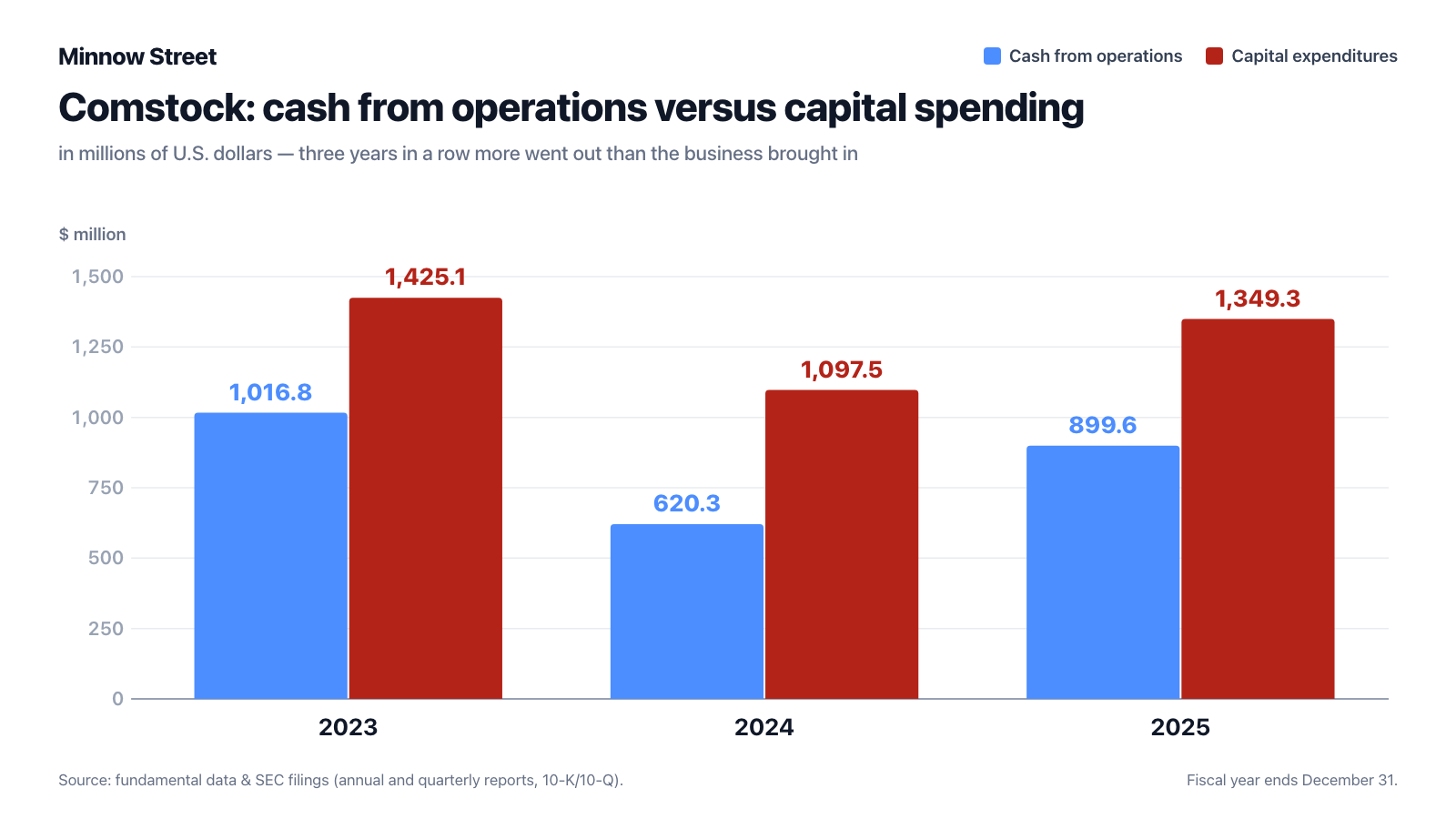
Where did the missing money come from? In 2025 mostly from sales: Comstock divested its Shelby Trough and Cotton Valley properties for $432.4 million net. The rest came from the credit facility. This is not a panic headline — a producer opening up a new play has to pre-fund it. But it is the decisive figure for shareholders: not one dollar of the $420.2 million earned in 2025 reached them, neither as a dividend nor as a buyback. For 2026, another $1.1 billion to $1.2 billion of spending was planned after the first quarter.
Fairness demands the other side. Comstock notes that the timing of most of its capital spending is discretionary because it has few long-term commitments — it can throttle the program. And liquidity of $1.27 billion as of March 31, 2026 is comfortable: $1.15 billion of unused borrowing capacity plus $14.8 million of cash.
Uncomfortable truth no. 2: hedging turned plus 19 percent into a minus
Comstock hedges part of its future production through derivatives. In everyday terms that is insurance: you pay a premium and in return you know what you will receive. In bad years it saves you — in 2024 the settlements lifted the realized price from $1.98 to $2.37 per thousand cubic feet. In good years it costs you. And the first quarter of 2026 was a good quarter.
The numbers from the quarterly report: the realized gas price rose 19 percent to $4.27 per thousand cubic feet. After cash settlements on the derivatives, $3.45 remained — less than the $3.52 of the prior-year quarter. Realized losses from the price risk management program came to $80.4 million in the quarter, against $8.0 million a year earlier. At the same time production fell 15 percent to 97.9 billion cubic feet. Higher price, lower volume, more expensive insurance — which is why oil and gas sales grew by only $6.0 million, or 1 percent, despite the price jump.
Comstock describes the risk in this construction with striking precision in its own annual report:
"Our hedging transactions could result in financial losses or could reduce our income. To the extent we have hedged a significant portion of our expected production and our actual production is lower than we expected or the costs of goods and services increase, our profitability would be adversely affected."
— Comstock Resources, Inc., SEC annual report 10-K for 2025, Item 1A Risk Factors

How far this reaches is in the quarterly report: as of March 31, 2026, 88.0 billion cubic feet of 2026 production was sold forward at an average $3.51 per MMBtu, plus 126.5 billion cubic feet in collars with a ceiling of $4.35 and a floor of $3.50. For 2027 another 146.0 billion cubic feet is covered with a ceiling of $4.44. Remember the image: the ceiling is already installed. If gas rises above $4.35, Comstock sees none of it on the hedged volumes.
Uncomfortable truth no. 3: $2,947.6 million of debt and $222.8 million of interest a year
As of March 31, 2026 the balance sheet carried $2,947.6 million of debt: $1,623.9 million of 6.75 percent notes due 2029, $965.0 million of 5.875 percent notes due 2030, $350.0 million drawn on the credit facility and $47.0 million at the Pinnacle subsidiary. Against that stood $14.8 million of cash. Interest expense in 2025 was $222.8 million — more than a third of the $645.9 million of operating income. In the weak year 2024, operating income of minus $168.6 million did not come close to covering $210.6 million of interest.
"We had $2.8 billion principal amount of debt as of December 31, 2025."
— Comstock Resources, Inc., SEC annual report 10-K for 2025, Item 1A Risk Factors, debt service section

There is relief in the details. The next major bond maturity is not until 2029; the credit facility runs to November 15, 2027, the $2.0 billion borrowing base is only one sixth drawn at $350.0 million, and the only financial covenants — a leverage ratio below 3.5 to 1.0 and an adjusted current ratio of at least 1.0 to 1.0 — were met as of March 31, 2026. The market looks similarly relaxed: on the same date the notes traded at roughly 96 and 98 percent of face value. Still, the simple arithmetic holds: at roughly $222 million of interest a year, a gas year has to go well before anything is left for the owners.
Uncomfortable truth no. 4: the float pays, other people decide
On April 7, 2026 — the record date for the annual meeting — three entities controlled by Jerral W. Jones together held 208,300,084 of the 293,695,832 shares: Arkoma Drilling with 146,950,577, Williston Drilling with 47,870,852 and JWJ BES with 13,478,655. That is 70.9 percent. Comstock therefore qualifies as a controlled company under New York Stock Exchange rules and could opt out of several independence requirements; it says it currently does not. The Jones partnerships may, however, designate five of the nine board seats — and as of the April 22, 2026 proxy statement, four seats were simply vacant.
The majority holder has not been trimming his stake but adding to it: in March 2024 Comstock issued 12,500,000 new shares in a private placement to two entities controlled by the majority stockholder and took in $100.5 million — an implied $8.04 per share. Beneficial ownership rose to 67 percent after the issue and to 71 percent after open-market purchases in the third quarter of 2024. There are also dealings between the two sides: Comstock operates wells owned by partnerships of the majority stockholder and received roughly $1.1 million in operating and marketing fees for that in 2025.
Everyone has to weigh this individually. An anchor shareholder with a long horizon can be a blessing — he does not press for quarterly results and would rather fund a ten-year drilling program. But the flip side is concrete: with a free float of roughly 63.5 million shares, or 21.6 percent, the public market never holds a majority in any vote. And because that float is so small, the short interest of roughly 30.5 percent of the float (data as of July 24, 2026) hits hard — the stock is tight, in both directions.
What happened after the last quarterly report
The most recent quarterly report is dated May 6, 2026 — and the biggest news of the year came afterwards. On June 15, 2026 Comstock sold a minority interest in its midstream subsidiary Pinnacle Gas Services to funds managed by Sixth Street:
"Sixth Street invested $600 million and acquired a 27% non-controlling common equity interest in Pinnacle with Comstock retaining a 73% controlling common equity interest. Comstock will continue to manage, operate and control Pinnacle under a management services agreement."
— Comstock Resources, Inc., SEC current report 8-K dated June 16, 2026, Item 8.01

That settles one item from the quarterly report: there, the redemption of the Pinnacle preferred equity for $440 million plus accrued distributions was still described as planned for the second quarter of 2026. The final figure was $445 million. And the filing carries a number that appears nowhere in the reports: paying $600 million for 27 percent values Pinnacle as a whole at roughly $2.2 billion. Comstock's remaining 73 percent would then be worth roughly $1.6 billion — against a total market value of about $4.0 billion (data as of July 24, 2026).
A second number is already in the quarterly report and is easy to skip. Comstock holds $1.5 billion of U.S. federal net operating loss carryforwards — tax credits from earlier loss years. Because of the change of control in August 2018 their use is limited, and the company itself estimates that $720.7 million of them will expire unused, along with $1.2 billion of the state carryforwards.

Valuation — what the market pays for gas in the ground
Let us work in orders of magnitude rather than daily prices. At a market value of roughly $4.0 billion (data as of July 24, 2026) and 293,695,832 shares, the implied price is $13.52 per share. Against trailing twelve-month earnings of $2.21 per share that is a price-to-earnings ratio of about 6; against fiscal 2025 earnings of $1.43 it is about 9. Price-to-book stands at roughly 1.4.
The 6 is the number that makes the scanner light up — and it needs handling with care. Those $2.21 of trailing earnings include the $291.9 million gain on the property sales and mark-to-market gains on derivatives. Without the disposal gain, 2025 operating income would be $353.9 million instead of $645.9 million. Remember the sentence: a low price-to-earnings ratio at a commodity producer often measures nothing but how good the last year was.
The fuller picture is more telling. Add the $2,947.6 million of debt and subtract the cash and you arrive at an enterprise value of roughly $6.9 billion. That is about 10.7 times 2025 operating income — and roughly 55 percent more than the discounted present value of proved reserves as of December 31, 2025 (PV-10: $4,463.3 million at SEC prices). That difference is not an error but a thesis: the market is additionally paying for drilling inventory not yet booked as reserves — 3,343 locations in the Western Haynesville, 2,561 of them net — plus the midstream subsidiary.
And the professionals' view? As of July 24, 2026 the average analyst price target stood at $15.58, about 15 percent above the implied share price. The mood is anything but euphoric: 2 strong buy ratings face 10 holds, 2 sells and 1 strong sell. Translated: the professionals think the stock is roughly fairly valued — and are waiting, like everyone else, on the gas price.
Opportunities and risks at a glance
What speaks for Comstock:
- A first-rate resource in a first-rate location: 7.0 trillion cubic feet equivalent of proved reserves as of December 31, 2025, 1,069,991 acres in the Haynesville and Bossier shales, short distances to Gulf Coast LNG and petrochemicals.
- The 2025 turnaround is documented: an operating loss of $168.6 million (2024) became $645.9 million of operating income, and a net loss of $218.8 million became $420.2 million of net income.
- Very low operating costs: $0.29 per thousand cubic feet equivalent of lease operating expense in the first quarter of 2026, $0.10 of production taxes and $0.43 of gathering and transportation.
- The drilling program replaces more than it consumes: 830 percent of 2025 production in the SEC price case and 229 percent in the annual report's alternative price case (NYMEX futures prices as of December 31, 2025) — on that basis equal to a finding cost of $1.02 per thousand cubic feet equivalent.
- A hard valuation mark for the midstream subsidiary: Sixth Street paid $600 million for 27 percent of Pinnacle on June 15, 2026, retiring preferred equity of $445 million and all Pinnacle debt.
- Solid funding position: $1.27 billion of liquidity as of March 31, 2026, covenants met, no major bond maturity before 2029.
What speaks against it:
- No free cash flow since 2023: capital spending exceeded cash from operations by $408.2 million (2023), $477.1 million (2024) and $449.7 million (2025) — and by another $143.8 million in the first quarter of 2026.
- $2,947.6 million of debt against $14.8 million of cash as of March 31, 2026, plus $222.8 million of interest expense in 2025 alone.
- Production is falling: down 15 percent to 450.2 billion cubic feet in 2025 and another 15 percent to 97.9 billion in the first quarter of 2026.
- Hedging caps the recovery: a $4.35 per MMBtu ceiling on 126.5 billion cubic feet of 2026 production, with realized losses of $80.4 million in the first quarter of 2026.
- The 2025 profit includes a $291.9 million disposal gain — without it, operating income would be $353.9 million instead of $645.9 million.
- The roughly 21.6 percent free float never holds a majority in a vote; five of the nine board seats belong to the Jones partnerships, and four seats were vacant as of April 22, 2026.
- No dividend since 2023 and no buybacks; the credit facility expressly restricts both.
A human conclusion
Back to the passenger trap. Its problem is not that it leads you to bad companies — Comstock is a decently run business with an enviable resource, low costs and a management that writes its risks into the filings so plainly you do not have to hunt for them. Its problem is that it assumes a common interest that does not exist. The majority holder can wait ten years, holds five of nine board seats and entered part of his position at $8.04 per share. You have no seat, no special entry price and usually no ten years.
What you do have is the same quarterly report he has. And it asks a single, very concrete question: when does the Western Haynesville drilling program turn into a business that sends money back rather than swallowing it? For four years the answer has been: not yet. In 2025 the gap was closed with property sales, in 2026 with the Sixth Street investment in Pinnacle. Those are good solutions — but they are solutions you cannot repeat indefinitely, because sooner or later you run out of pieces to sell.
So the honest question for you is not whether a price-to-earnings ratio of 6 is cheap. It is this: do you trust this drilling program to turn 3,343 Western Haynesville locations into free cash flow — and are you willing to sit through quarters of falling production and roughly $53 million of interest per quarter until it does, without losing your nerve? If yes, you have a thesis, and the filings hand you clear measuring points every quarter. If no, you have seen a famous name on a share register. What you make of it is your decision. And that is exactly as it should be.
Sources
Every original document used in this analysis — read them yourself:
- Comstock Resources, Inc. — SEC quarterly report 10-Q as of March 31, 2026 (filed May 6, 2026)
- Comstock Resources, Inc. — SEC annual report 10-K for 2025 (filed February 19, 2026)
- Comstock Resources, Inc. — SEC current report 8-K dated June 16, 2026 (Sixth Street investment in Pinnacle Gas Services)
- Comstock Resources, Inc. — Proxy statement DEF 14A dated April 22, 2026 (ownership as of April 7, 2026) plus the current report 8-K dated June 3, 2026 on the voting results
- All further filings: EDGAR overview for CIK 0000023194 (sec.gov)
- Fundamental data (metrics, valuation, analyst estimates; data as of July 24, 2026), reconciled against the SEC filings.
- Scanner lists: our in-house stock scanner, as of July 26, 2026; the lists are recalculated daily.
Transparency & disclaimer: this analysis is a journalistic contextualization of publicly available information. It is not investment advice, not a regulated financial analysis and not a solicitation to buy or sell securities. Equity investments carry substantial risk up to and including total loss. All information without warranty; the as-of date for each figure is noted in the text. The author holds no position in Comstock Resources shares at the time of publication.
Our Bottom Line at a Glance
- Asset base and location positive
- As of December 31, 2025 Comstock reported proved reserves of 7.0 trillion cubic feet equivalent with a PV-10 value of $4,463.3 million, spread across 1,069,991 acres in the Haynesville and Bossier shales. The location is the real asset: short distances to the Gulf Coast, where LNG terminals, petrochemicals and new power generation carry demand. Comstock operates 99 percent of that reserve base itself.
- Quality of earnings neutral
- The $420.2 million of net income in 2025 includes a $291.9 million gain on the sale of the Shelby Trough and Cotton Valley properties plus $82.5 million from derivatives. Without the disposal gain, operating income would be $353.9 million instead of $645.9 million. Anyone computing a price-to-earnings ratio of about 6 on the last twelve months is computing it on those one-time items.
- Free cash flow negative
- Three years running, capital spending exceeded cash from operations: $1,425.1 million against $1,016.8 million (2023), $1,097.5 million against $620.3 million (2024) and $1,349.3 million against $899.6 million (2025). The first quarter of 2026 continued at $415.8 million against $272.0 million, with a further $1.1 billion to $1.2 billion planned for the rest of the year. So far the gap has been closed with asset sales and borrowings.
- Balance sheet and interest burden negative
- Against $2,947.6 million of debt as of March 31, 2026 stood $14.8 million of cash; interest expense of $222.8 million in 2025 consumed more than a third of operating income. In 2024, operating income of minus $168.6 million did not cover interest at all. On the other side: $1.27 billion of liquidity, covenants met as of March 31, 2026, and no major maturity before 2029.
- Ownership and control neutral
- The Jones entities held 208,300,084 shares, or 70.9 percent, as of April 7, 2026 and may designate five of the nine board seats; four seats were vacant at that point. The majority holder has been buying, not selling — a March 2024 private placement of 12,500,000 shares raised $100.5 million. A patient anchor shareholder is an advantage; the flip side is that the roughly 21.6 percent free float decides nothing.
- Valuation neutral
- At roughly $4.0 billion of market value (data as of July 24, 2026) plus $2,947.6 million of debt, enterprise value comes to roughly $6.9 billion — about 10.7 times 2025 operating income and roughly 55 percent above the $4.5 billion PV-10 value of proved reserves. That premium is the price of the drilling inventory not yet booked as reserves in the Western Haynesville. The average analyst price target of $15.58 sits about 15 percent above the implied share price, and the consensus rating is hold.
Comstock Resources owns one of the best gas assets in North America and delivered its best result since 2022 in 2025, at $420.2 million of net income. The catch is in the cash flow statement: since 2023 the drilling program has cost $200 million to $500 million a year more than the business brought in, funded by asset sales and borrowings; interest of $222.8 million eats more than a third of operating income; and hedging turned a 19 percent higher gas price into a lower realized price in the first quarter of 2026. Buying here is not a bet on the reserves — those are not in dispute — but on the Western Haynesville eventually sending money back rather than only swallowing it. Not investment advice.
What Our Rating Means
Open questions
The business works in principle, but one material question is open. As long as it stays open, our findings do not carry a quality verdict.
The business works: 7.0 trillion cubic feet equivalent of proved reserves, 99 percent of them company-operated, lease operating expense of $0.29 per Mcfe in the first quarter of 2026, stockholders' equity of $2,757.5 million and $1.27 billion of liquidity with covenants met. There is no sign of a threat to the company itself, no accounting or governance break. What is open is a material operating question, and it is four years old: the company has generated no free cash flow since 2023, production has fallen two years in a row, and the Western Haynesville buildout still has to prove it returns more than it costs. On top sits an interest burden of $222.8 million a year, which in a weak gas year such as 2024 operating income could not cover. That is not an existential question, but it is considerably more than a formality. Hence yellow: documented substance, unproven return of capital. The decision is yours.
A journalistic assessment by our editorial team at the time of the deep dive, based on public sources — not investment advice and not a solicitation to buy or sell. Your personal circumstances (investment goals, risk capacity, taxes) cannot be taken into account. What our levels mean, how verdicts are formed, and what conflicts of interest exist →
Worth Noting
- Comstock reached our research list through our in-house stock scanner: the stock sits on the U.S. side of the list Fundamental Rank (A / A+), which sorts companies by the quality of their numbers (as of July 26, 2026; 38 U.S. names meet the criteria and the page shows the first 25). On the same date CRK appeared in eight lists at once, among them Power Trend, Professionals 80%, Big Earnings Surprise and the pure rankings by price-to-earnings and price-to-cash-flow. The lists are recalculated daily.
- Recency: this analysis works from the annual report 10-K for 2025 (February 19, 2026), the quarterly report 10-Q as of March 31, 2026 (May 6, 2026) and every filing submitted since — the proxy statement DEF 14A of April 22, 2026, the current report 8-K of June 3, 2026 (annual meeting) and the current report 8-K of June 16, 2026 (Sixth Street). One item in the quarterly report is therefore out of date: the redemption of the Pinnacle preferred equity, described there as planned for the second quarter of 2026, was completed on June 15, 2026.
- Name confusion: Comstock Resources (CRK, CIK 23194) is neither Comstock Inc. (LODE, CIK 1120970) nor Comstock Holding Companies (CHCI, CIK 1299969). Three separate registrants filing their own reports with the SEC.
- Valuation figures are dated and evergreen: the implied share price of $13.52 comes from the roughly $4.0 billion market value (data as of July 24, 2026) divided by the 293,695,832 shares the quarterly report shows as of March 31, 2026. Analyses are evergreen; daily prices are not a buy argument.
Frequently Asked Questions
Comstock Resources, Inc. (NYSE: CRK) of Frisco, Texas, is an independent natural gas producer. It drills and operates gas wells in the Haynesville and Bossier shales of North Louisiana and East Texas and sells the gas mostly into Gulf Coast markets. Oil is close to irrelevant: of $1,428.1 million in oil and gas sales in 2025, only $2.3 million came from oil.
Mostly the businessman Jerral W. Jones. His entities Arkoma Drilling, Williston Drilling and JWJ BES together held 208,300,084 of the 293,695,832 shares outstanding as of April 7, 2026 according to the proxy statement — 70.9 percent. Comstock therefore qualifies as a controlled company under New York Stock Exchange rules and may opt out of several independence requirements; it says it currently does not use those exemptions.
No. These are three separate listed companies. Comstock Resources (ticker CRK, SEC file number CIK 23194) produces natural gas in Texas and Louisiana. Comstock Inc. (ticker LODE, CIK 1120970) and Comstock Holding Companies (ticker CHCI, CIK 1299969) are independent registrants that file their own reports. Anyone comparing metrics needs to check the ticker first.
Because the drilling program costs more than the business brings in. In 2025, cash from operations of $899.6 million met capital spending of $1,349.3 million; in 2024 it was $620.3 million against $1,097.5 million and in 2023 $1,016.8 million against $1,425.1 million. The gap was closed in 2025 mainly through $428.9 million of asset sale proceeds and borrowings.
As of March 31, 2026 the total was $2,947.6 million: $1,623.9 million of 6.75 percent senior notes due 2029, $965.0 million of 5.875 percent notes due 2030, $350.0 million drawn on the Comstock bank credit facility (maturing November 15, 2027) and $47.0 million on the credit facility of its Pinnacle subsidiary. Interest expense was $222.8 million in 2025.
On June 15, 2026 Comstock sold 27 percent of the common equity in its midstream subsidiary Pinnacle Gas Services to funds managed by Sixth Street for $600 million; Comstock keeps 73 percent and control. The proceeds retired the Pinnacle preferred equity for $445 million plus accrued dividends and repaid all debt at Pinnacle. The transaction falls after the most recent quarterly report.
Two reasons. First, Comstock sold its Shelby Trough and Cotton Valley properties in 2025 for $432.4 million net and lost the producing volumes with them. Second, a large share of the capital goes into appraising the Western Haynesville, where only 30 wells had been turned to sales through the end of 2025. Production fell 15 percent to 450.2 billion cubic feet in 2025 and another 15 percent to 97.9 billion in the first quarter of 2026.
Not at present. The last payout was $0.50 per share for fiscal 2023; the annual report shows no dividend for 2024 or 2025, and the payout ratio stood at zero as of July 24, 2026. The bank credit facility expressly restricts cash dividends and share buybacks.
Found an error?
Did you spot a factual error, an outdated number, or a typo in this deep dive? Let us know briefly — your report goes straight to the editorial team.