Citizens Stock: Life Insurance Sold in Over 80 Countries — Licensed in Not a Single One of Them
The ticker sounds like an intelligence agency, the stock like a hidden gem: Citizens, Inc. (NYSE: CIA) registers just 2 mentions in 24 hours in our Reddit hype scanner (as of July 15, 2026) — and still gained about 70 percent over twelve months (data as of July 10, 2026). The Austin, Texas life insurer sells dollar policies to customers from Colombia to Taiwan. We read the annual reports (10-K) for 2024 and 2025 and the quarterly report (10-Q) as of March 31, 2026: not a cent of debt, two straight years of premium growth — but the company is not licensed as an insurer in a single one of its foreign markets, the highest wave of maturing endowment policies in its history is rolling through the books, and it has never paid a dividend in its entire life as a public company. Not investment advice — just the complete file on a stock that looks like a secret and reads like a disclosure.
 Thomas Mücke
Founder & Publisher
Thomas Mücke
Founder & Publisher
Chart
Interactive price chart (TradingView).
Note: pure fact-based analysis, not investment advice and not a solicitation to buy or sell. All figures without guarantee.
There is a reflex in the investor brain that feels like superiority: "Nobody knows this one. I found it before everyone else." Psychologists call it the hidden-gem trap — the more undiscovered a stock appears, the more valuable our own knowledge feels, and the less we check what we have actually found. Hardly any ticker serves that reflex in the summer of 2026 as perfectly as Citizens, Inc. (NYSE: CIA): a symbol straight out of a spy movie, a life insurer from Austin, Texas that sells dollar policies from Colombia to Taiwan, a share price up about 70 percent over twelve months (data as of July 10, 2026) — and just 2 mentions in 24 hours in our Reddit hype scanner (ApeWisdom, as of July 15, 2026). No crowd anywhere in sight, only you and an apparent treasure. Which is exactly why we make a deal: before you feel like a discoverer, we read together what the discovered company itself puts on the record — in the annual report (10-K) for 2025, its predecessor and the quarterly report (10-Q) as of March 31, 2026, all filed with the U.S. securities regulator, the SEC. An SEC filing is honest under penalty of law. And this one contains a sentence hardly any gem hunter has ever read. In the end, you decide for yourself.
What Citizens actually does — and why the customer in Bogotá pays in dollars
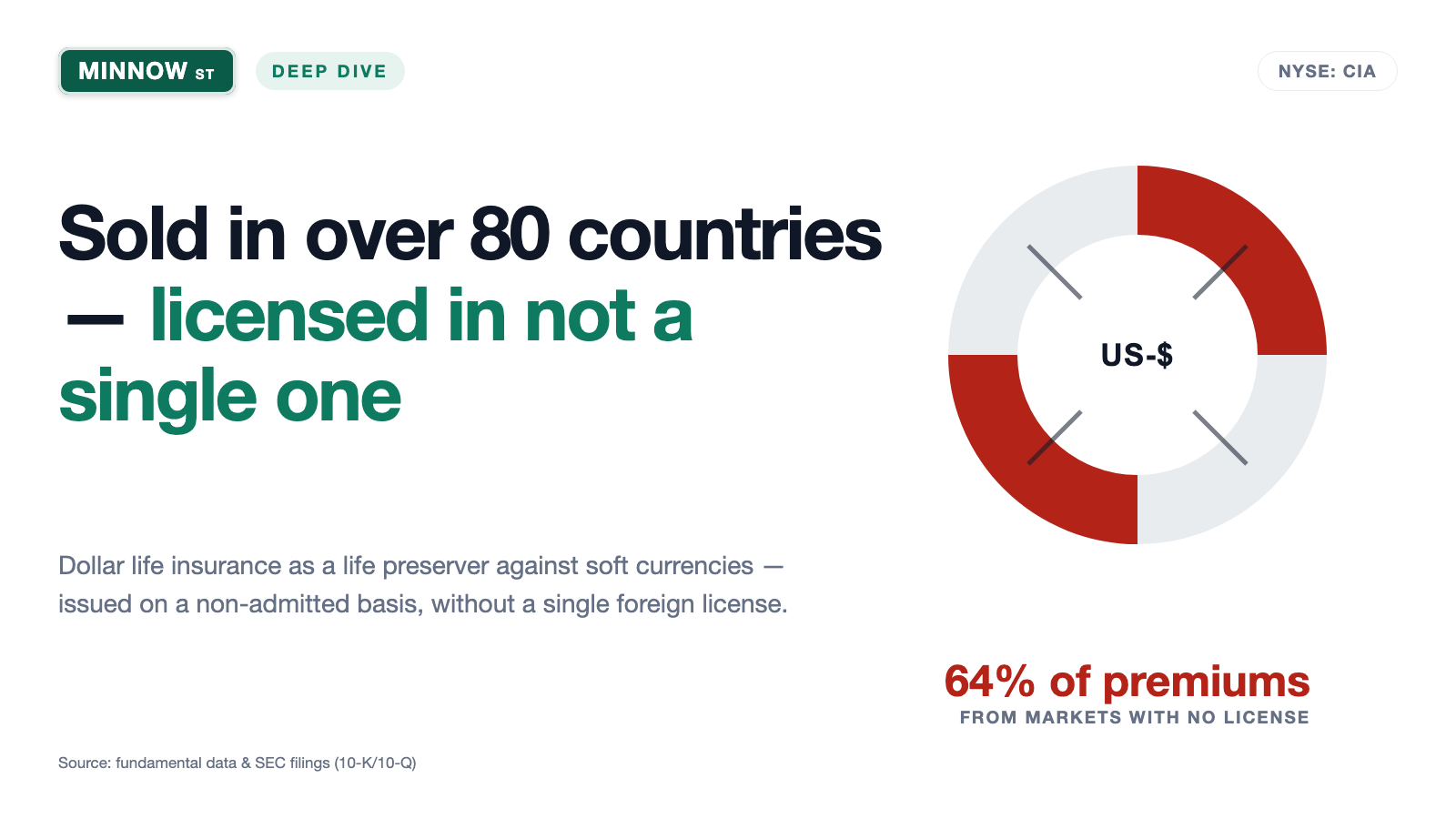
Citizens, Inc. is an insurance holding company, incorporated in Colorado, run from Austin, Texas, in business since 1969 — with just 246 employees, $1.8 billion in total assets and $5.4 billion of insurance in force (all as of December 31, 2025). The business spans two worlds. World one, the International Insurance segment (64 percent of 2025 direct premiums): the subsidiary CICA International, licensed in Puerto Rico, sells U.S. dollar-denominated whole life and endowment policies to people without U.S. residency — across more than 80 countries, with most premiums coming, per the annual report, from Colombia, Taiwan, Ecuador, Venezuela and Argentina. An endowment is a survival-benefit policy: whoever outlives the term gets the face amount paid out — a savings contract wrapped in insurance. Why would the middle class in Bogotá or Quito buy that from a small Texan of all companies? Because of the currency: premiums, cash values and payouts all run entirely in U.S. dollars — the contract is a life preserver against the holder's own home currency, against devaluation and the hyperinflation that has historically recurred in Latin America. Sales run through independent marketing agencies and consultants on the ground — no own employees, no own offices in those countries (remember that; it matters shortly). World two, the Domestic Insurance segment (36 percent of direct premiums): so-called final expense policies — small whole life contracts covering funeral and burial costs, averaging $7,500 in face amount at subsidiary CLOA and $13,200 at Louisiana-based SPLIC, sold through more than 5,000 independent agents in 43 U.S. states, partly as "white label" products under other brand names. Add a quirk that barely exists anywhere else: through the company's own Stock Investment Plan, policyholders can convert their policy dividends directly into Class A shares of the insurer — which is why Citizens counts almost 81,000 shareholders, many of them its own customers. And that brings us to the central tension of this analysis, which runs through every chapter: Citizens is a debt-free, profitable niche machine with 55 years of history — but its international business stands on a regulatory foundation the company itself describes as a gray zone, and its biggest earnings engine of yesterday is turning into its biggest payout wave of today. How quickly an attractive insurance niche can turn into a hard business is something we recently dissected at the insurance marketplace EverQuote.
Where the stock shows up in our scanner
Every day we run about 3,500 stocks through our scanners. Citizens reached our research list through the Reddit hype scanner — but as the mirror image of the usual pattern: 2 mentions in 24 hours (ApeWisdom, as of July 15, 2026) is not hype, it is radio silence. The silence only becomes interesting against what the price is doing: in our metrics scanners the stock lights up in 2 filters as of the July 10, 2026 data cut-off, and both measure trend strength. "Above the 50- and 200-day averages": the price trades above both its 50-day and its 200-day moving average — translated: the uptrend is not a twitch, it has carried for months. And "power trend": a combination of trend position and momentum that only fires when several trend conditions are met at once. Behind them stand these movement numbers: plus 34.9 percent in three months, plus 21.4 percent in six, about plus 70 percent over twelve months, plus 21.9 percent year to date (all data as of July 10, 2026). On the Citizens company profile you can inspect both hits and every metric yourself. But our scanner also shows the other half of the picture: a fundamental grade of C, a Piotroski F-Score of 5 of 9 (a nine-point test of balance-sheet quality — 5 is mediocre, not a distinction), a relative-strength rating of 67, and despite the rally the price still sits about 83 percent below its all-time high from better days. Above all: average trading volume of roughly $0.5 million a day — at some large caps, that much changes hands in a second. Thin trading amplifies every move: upward, as in the past twelve months, and eventually downward too.
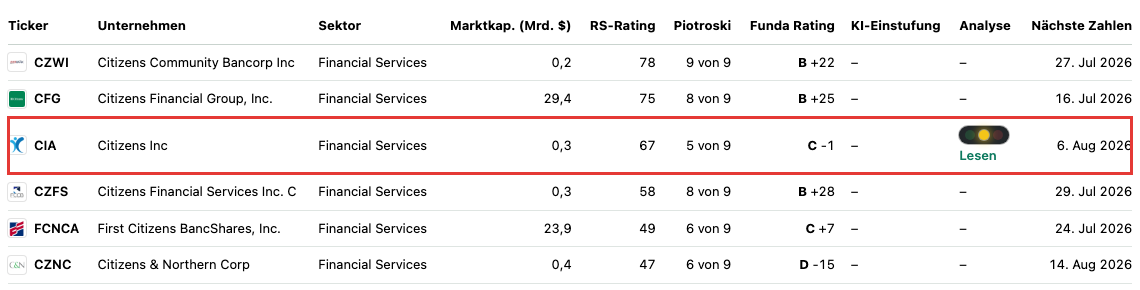
Two more readings belong on the table to keep the picture honest: the Altman Z-score, a classic insolvency early-warning built from several balance-sheet ratios, sits around 3.8 — clearly outside the danger zone that historically begins below 1.8. Citizens is no wobbling candidate; the company simply has no debt. And the valuation is no fantasy either despite the rally: a P/E around 18, price-to-book around 1.3 (data as of July 10, 2026). So the question for this stock is not "Is the crowd overdoing it?" — there is no crowd. It is: what exactly has the market been pricing in for twelve months — and does it know the sentence we are about to read?
The numbers over the years — honestly appraised
First, what genuinely impresses — and for a 55-year-old niche insurer, that is more than the name suggests. Citizens is growing again: revenues rose to $255.6 million in 2025 (2024: $245.0 million; 2023: $240.7 million) — the second straight year of growth, after premium revenue had not grown since 2017, per the annual report. The engine is first year premiums, freshly sold policies: plus 71 percent in 2024, then plus 16 percent to $38.3 million in 2025 — driven by the final expense business, which grew 23 percent domestically. In 2025 the company wrote $1.06 billion of new insurance — per the 10-K the second-highest amount in its history — and reached an all-time high of $5.4 billion of insurance in force. On top sits a balance sheet you rarely see: no debt, $1.4 billion of investments (89 percent fixed income, yielding 4.67 percent), $235.0 million of stockholders' equity. Pre-tax income rose from $15.0 million to $17.5 million in 2025. Whoever reads only these paragraphs understands the quiet 70 percent rally immediately. Now look at the second column of the ledger:
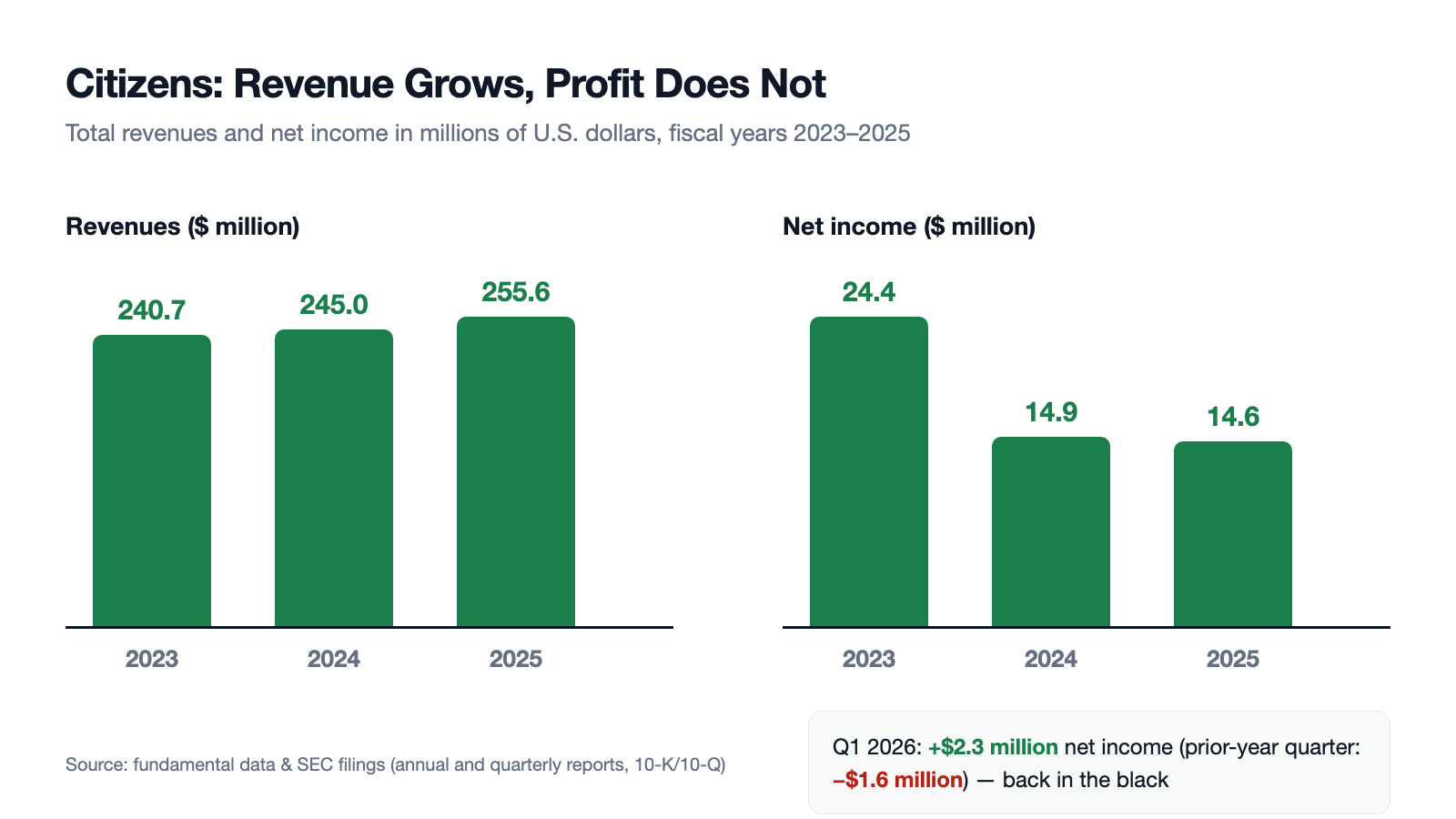
Net income fell from $24.4 million (2023) to $14.9 million (2024) and $14.6 million (2025) — a third less within two years, even though revenue grew. In 2024, among other things, a $3.5 million accrual for legal fees awarded to defendants in a partially lost lawsuit and the write-down of a BlackRock ESG fund (the Northvolt and SolarZero collapse; $8.5 million combined across 2024/2025) weighed on results; in 2025 it was the tax line of all things that ate the operating progress: $2.9 million of federal income tax after nearly zero the year before. The first quarter of 2026 at least brought the swing back into the black: $2.3 million of net income after a $1.6 million loss in the prior-year quarter — though the prior-year loss hung largely on that very BlackRock write-down, so the comparison flatters. Remember the finding: revenue is growing faster than profit here — and the reason lives in the uncomfortable truths.
What the filings say — the uncomfortable truths
Uncomfortable truth no. 1: sold in over 80 countries — licensed in not a single one
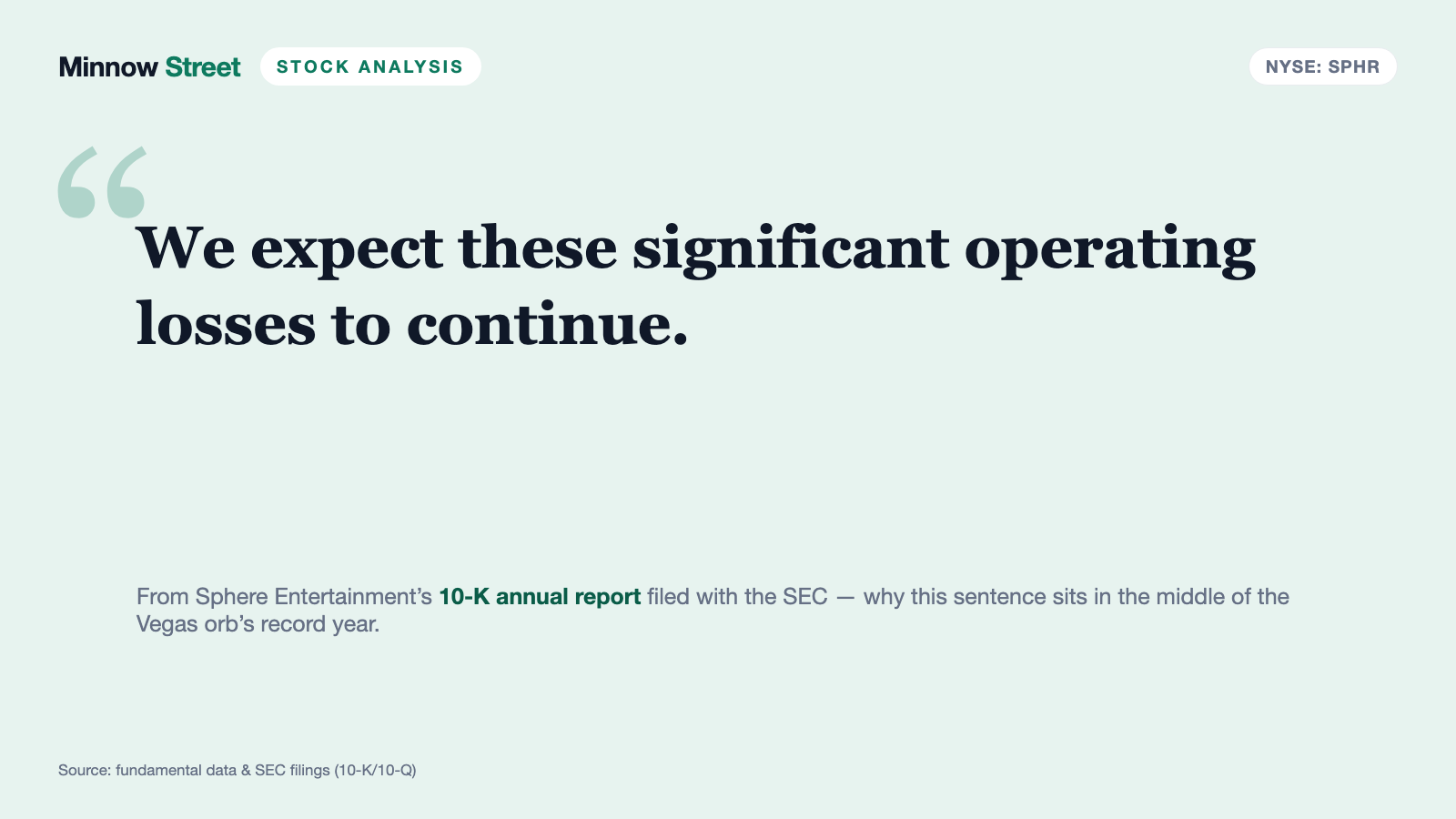
Now the sentence this analysis is built on. It does not come from an exposé; it sits in the "Regulation" chapter of the company's own annual report — sober, precise, honest under penalty of law:
"We operate on a non-admitted basis and are not licensed to do business in any foreign country, and we have never submitted our international insurance policies for approval to any regulatory agency."
— Citizens, Inc., SEC annual report 10-K 2025, Item 1 "Business — Regulation of our International Business"

Translate that into an everyday image: Citizens runs an insurance business in over 80 countries the way a food truck parks in front of foreign town halls every night — without ever having applied for a permit, trusting that nobody sends it away. The construction behind it is finely balanced: the policies are issued by the Puerto Rico subsidiary CICA International, which is licensed there as an "international insurer" — but for export only, not in the destination countries. Sales run through independent consultants who are not employees and who are contractually responsible for complying with the laws of their own countries. There are deliberately no offices or assets in the destination countries — which leaves foreign authorities little to seize; Citizens itself writes that any actions, including fines, "may be unenforceable" against the company. The risk section of the annual report speaks plainly: some countries expressly prohibit their residents from buying such policies, others allow it only when the purchase happens abroad — and there is a risk that governments become "more aggressive" in enforcement, with fines, criminal penalties or forced market exits among the possible consequences. Fairness requires saying: this model has run since 1975 — fifty years — and has survived regime changes, currency crises and sanction rounds; it is not fraud but a disclosed gray-zone model with built-in conflict potential. But hold on to the magnitude: 64 percent of direct premiums stand on a foundation that a single foreign parliament, a regulator or a U.S. sanctions round could shake at any time. That is the price of the niche — and the reason nobody who can afford to operate licensed has copied it for this long.
Uncomfortable truth no. 2: the endowment wave — yesterday's bestseller becomes today's record payout
For decades, Citizens sold mostly endowments internationally — survival-benefit policies that pay out the face amount after a fixed term. Those contracts are now reaching maturity in droves, and the annual report records a company record nobody is proud of:
"Over the past several years, many of our endowment policies have been reaching their contractual maturity dates and in 2025, we experienced our highest level of matured endowment benefits payments ever."
— Citizens, Inc., SEC annual report 10-K 2025, Item 7 MD&A "Claims and Surrenders"

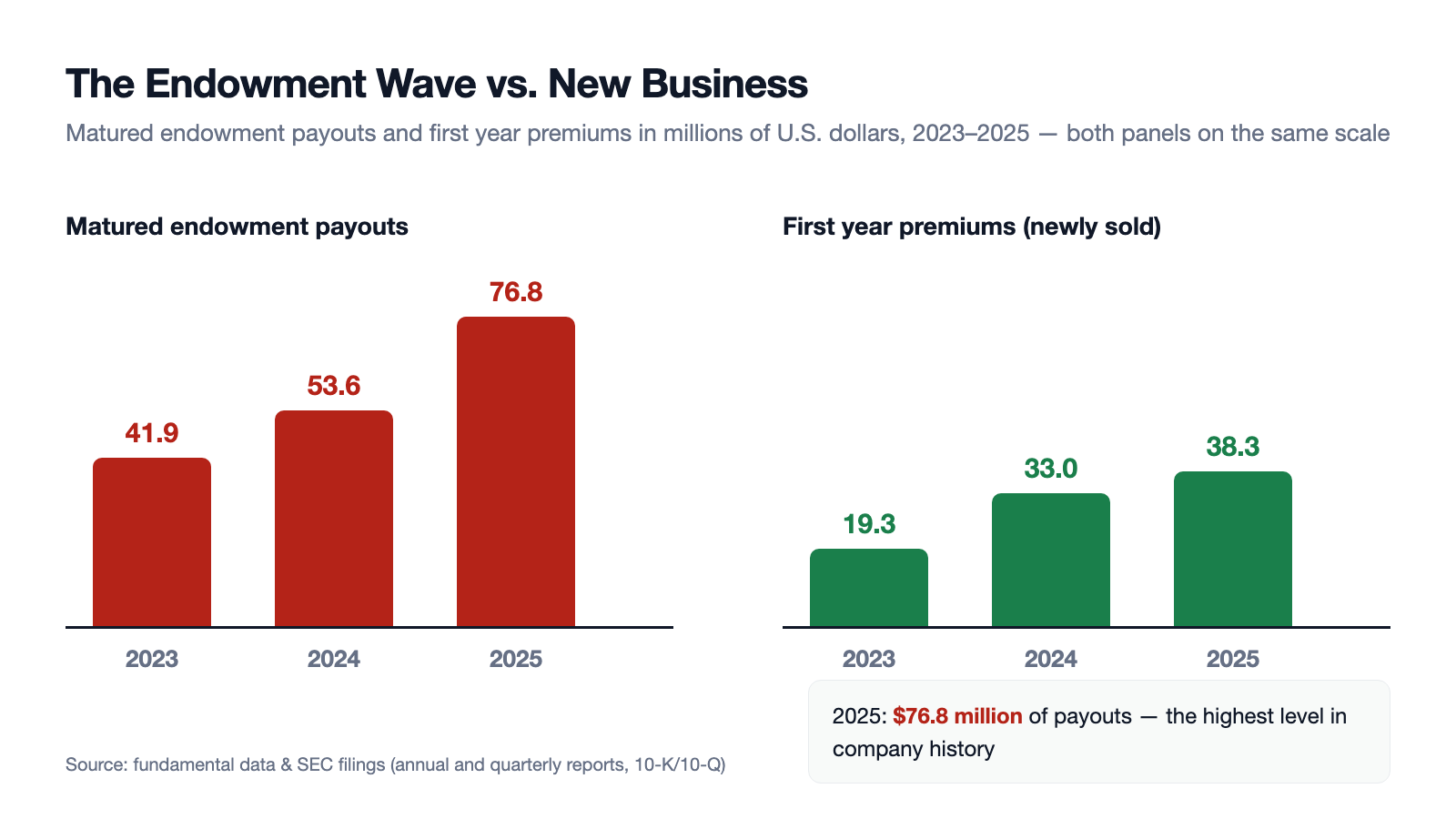
The numbers behind it: $41.9 million of matured endowment payouts in 2023, $53.6 million in 2024, $76.8 million in 2025 — up $23.3 million in the last year alone, and per the company the amounts will stay elevated, if slightly declining, for the next several years. Fairness first: this is not a catastrophe but a run-off schedule — reserves were built for every maturing policy over decades and are released on payout; the profit impact in the year of maturity is small. The real problem is quieter and longer-term: a policy that has paid out never pays another premium. Exactly that has been squeezing the international segment's renewal premiums for years — its pre-tax income fell from $23.5 million to $14.4 million in 2025 — and it forces the company into a race: new whole life products (64 percent of internationally issued face amounts in 2025) and the domestic final expense business must grow faster than the old book runs off. That customers often leave their matured money with the company via "supplemental contracts" (other income rose to $7.1 million in 2025) softens the outflow — but it does not replace a premium. Remember the image: Citizens is shoveling new business into a pool at the front while the largest drain in company history runs at the back. Two years of premium growth show the shovel works. Whether it stays permanently faster than the drain is the $255 million question of this stock.
Uncomfortable truth no. 3: Venezuela on the customer roll — politics, sanctions and money laundering risk included
Whoever sells to customers in over 80 countries imports their risks along with them. The annual report calls the child by its name:
"Some of our top international markets, such as Venezuela, are countries that have been identified by the U.S. Department of the Treasury as jurisdictions of high risk for money laundering."
— Citizens, Inc., SEC annual report 10-K 2025, Item 1A "Risk Factors — International Business Risks"

The risk has three floors. First, politics: Venezuela is, per the 10-K, "one of our biggest international markets" — a country with regime changes, uprisings and anti-U.S. policies in its recent history; the report expressly warns that U.S. sanctions against countries where policyholders live could stop new business and premium collections. Second, currency controls: Citizens sells dollar policies only, but if a state restricts its citizens' dollar transfers, the premiums simply stop arriving. Third, the money laundering flank: life insurance is a classic laundering instrument — overpay premiums, surrender early, file fictitious claims — and Citizens collects premiums precisely from countries the U.S. Treasury flags as high-risk zones. The company counters with its own anti-money-laundering and sanctions program including OFAC screening (per the report, further OFAC integrations were built into its systems in 2025) and concedes in the same breath that its controls "may not fully mitigate" the risk. For you as an investor this means: part of the premium machine runs through terrain where a single political decision — in Caracas or in Washington — can shut off the flow. It has not happened so far. Just do not rely on it staying that way without knowing it.
Uncomfortable truth no. 4: never a dividend — and trading as thin as the shareholder roll is wide
At a conservative insurer with 55 years of history you almost reflexively expect a dividend record. At Citizens, this sentence sits in the report instead:
"We have never paid cash dividends on our Class A or B common stock and do not expect to pay cash dividends in the foreseeable future, as it is our policy to retain earnings for use in the operation and expansion of our business."
— Citizens, Inc., SEC annual report 10-K 2025, Item 5 "Market for Registrant's Common Equity — Dividend Policy"

That is more consistent than it sounds — and it has structural reasons you should know. First, insurance subsidiaries may only pass profits upward with regulatory permission: the key domestic subsidiary CLOA actually posted a statutory net loss of $5.5 million in 2025 under the strict regulatory accounting (fast-growing new business costs money first and earns later) and may distribute nothing at all to the holding company in 2026 without special approval; on top, Citizens has committed to Colorado's insurance regulator to keep CLOA's risk-based capital ratio above 350 percent — with fresh capital from above if needed. Second, the valuation drag in the bond portfolio: stockholders' equity carries $88.4 million of negative accumulated other comprehensive income (as of December 31, 2025) — the 2022 rate shock still echoes, which is why reported book value per share stands at $4.67, or $6.43 excluding those valuation effects. And third, the share-class curiosity: should a dividend ever flow, Class A holders would receive twice as much per share as Class B — the super-voting class that may elect the board majority but has sat entirely in the company's own treasury for years (since 2021, Citizens has been a non-controlled company for the first time in over 20 years). So what is left for the shareholder? Only the price. And that price belongs to a peculiar audience: almost 81,000 shareholders, about 40 percent holding fewer than 100 shares — many of them policyholders converting policy dividends into stock — on trading volume of roughly $0.5 million a day and average daily swings around 6 percent. Remember: a stock with no dividend, no analyst stage and no liquidity pays you exclusively in price imagination — and in a book this thin, that imagination can materialize quickly in both directions.
Valuation: a $0.3 billion market value — the price of the gray zone
In early July 2026 the Citizens stock cost about $6, which at 50.3 million Class A shares makes roughly $0.3 billion in market value (data as of July 10, 2026). Against that stand $14.6 million of 2025 net income, $235.0 million of equity and $255.6 million of revenues: a P/E around 18, price-to-book around 1.3, price-to-sales around 1.2. For a growing, debt-free insurer a P/E of 18 does not sound expensive at first — until you put the context next to it: large, fully licensed life insurers often trade at single-digit P/Es and around book value. Citizens trades above book and above the earnings multiple of many industry giants — for a business whose larger segment stands on a disclosed regulatory gray zone, whose profit sits a third below its 2023 level and whose stock gets by with practically no institutional audience (about 28 percent institutional ownership; insiders hold about 11 percent, data as of July 10, 2026). The counter-argument is just as honest: adjusted for the bond portfolio's valuation losses, book value stands at $6.43 per share — on that basis you are paying roughly for substance, getting the 55-year niche business on top, and betting that first year premium growth of 16 to 71 percent a year outruns the endowment wave. After a roughly 70 percent price gain in twelve months, part of that bet has already been paid for, though — whoever buys today is no longer buying the undiscovered gem but the half-discovered one, still about 83 percent below an all-time high from a time when the market valued this company far higher. For a case study in how the market prices exotic niche businesses only after the numbers prove out, see our look at TRX Gold.
Opportunities and risks at a glance
What speaks for Citizens:
- A real, hard-to-copy niche: U.S. dollar policies for the emerging-market middle class as protection against devaluation and inflation — established since 1975, policies in force in over 80 countries, $5.4 billion of insurance in force (annual report 10-K for 2025).
- Growth is back: first year premiums up 71 percent (2024) and 16 percent (2025) to $38.3 million; $1.06 billion of new insurance written in 2025, the second-highest in company history; a second straight year of premium growth after seven lean years.
- A balance sheet without leverage: no debt, $1.4 billion of investments (89 percent bonds, yielding 4.67 percent), an Altman Z-score around 3.8, FHLB membership as a liquidity reserve; Q1 2026 back in the black ($2.3 million).
- Rates work for the insurer: new allocations to investment grade private placement credit and structured notes lift the portfolio yield; net investment income rose to $72.0 million in 2025.
- An intact price trend as a supporting finding: 2 hits in our in-house stock scanner ("above the 50- and 200-day averages", "power trend"), up about 70 percent over twelve months — entirely without Reddit attention (2 mentions in 24 hours, July 15, 2026).
What speaks against it:
- The regulatory foundation: 64 percent of direct premiums come from countries where Citizens is not licensed and has never submitted a policy for approval — the annual report itself warns of fines, criminal penalties and forced market exits (10-K 2025, Item 1A).
- The endowment wave: $76.8 million of maturity payouts in 2025 (an all-time high, after $53.6 million and $41.9 million in the prior years) squeeze renewal premiums; the international segment's pre-tax income fell from $23.5 million to $14.4 million.
- Profit in reverse despite revenue growth: net income down from $24.4 million (2023) via $14.9 million (2024) to $14.6 million (2025); plus one-off burdens such as $3.5 million of awarded legal fees (appeal pending) and an $8.5 million BlackRock ESG write-down (2024/2025).
- The politics and compliance flank: Venezuela, one of the biggest international markets, is a high-risk money laundering jurisdiction per the U.S. Treasury; currency controls and U.S. sanctions could disrupt premium flows at any time (10-K 2025, Item 1A).
- The shareholder's reality: never a dividend and none in sight, CLOA barred from distributions to the holding in 2026 without approval, $88.4 million of negative valuation reserve inside equity — and daily trading volume around $0.5 million that turns any larger entry or exit into its own price event (data as of July 10, 2026).
A human conclusion
Back to the hidden-gem trap from the opening. It has a true core that deserves acknowledgment: Citizens is undiscovered — no analyst conferences, barely any institutional money, two Reddit mentions a day, and yet a real niche that has worked for fifty years, with a debt-free balance sheet and growing new business. Whoever finds something like that may enjoy the moment. But the hidden-gem trap does not consist of buying the undiscovered — it consists of mistaking obscurity for undervaluation. The market has not overlooked this stock; it has priced it for years at a discount whose reasons the company itself records in its filings: an international business without a single foreign license, whose wellbeing depends on dozens of governments staying still; a contractually fixed payout wave eroding the old earnings base while the new one is still growing in; a profit a third below its 2023 level; and a stock that has never paid out a cent and moves in wafer-thin trading. None of it is hidden — it is all there, honest under penalty of law, you just have to read it. After a 70 percent price gain in twelve months, the honest question is therefore no longer "Why does nobody know this?" but: "What do I know about the durability of this gray zone that the price does not yet know?" If you have a solid answer to that, you are not a gem hunter — you are an investor. If not, the find was perhaps just a find. What you make of it is your decision. And that is exactly as it should be.
Sources
All original documents used in this analysis — to read for yourself:
- Citizens, Inc. — SEC annual report 10-K for 2025 (filed March 12, 2026)
- Citizens, Inc. — SEC annual report 10-K for 2024 (filed March 13, 2025)
- Citizens, Inc. — SEC quarterly report 10-Q as of March 31, 2026 (filed May 7, 2026)
- Citizens, Inc. — SEC quarterly report 10-Q as of September 30, 2025 (filed November 6, 2025)
- Citizens, Inc. — SEC quarterly report 10-Q as of June 30, 2025 (filed August 7, 2025)
- Citizens, Inc. — SEC quarterly report 10-Q as of March 31, 2025 (filed May 8, 2025)
- Citizens, Inc.'s complete SEC filing history: EDGAR overview (sec.gov)
- Fundamental data (metrics, valuation; data as of July 10, 2026), reconciled with the SEC filings.
- Screener and rating data: in-house stock scanner (data as of July 10, 2026); Reddit mentions: ApeWisdom (as of July 15, 2026).
Transparency & disclaimer: This analysis is a journalistic contextualization of publicly available information and is not investment advice, not a financial analysis in the regulatory sense, and not a solicitation to buy or sell securities. Stock investments carry substantial risks up to total loss — with thinly traded names like Citizens, liquidity risk comes on top. All information without guarantee; the data cut-off is noted in the text in each case. The author holds no position in Citizens stock at the time of publication.
Our Bottom Line at a Glance
- Business model & niche positive
- U.S. dollar life insurance for the emerging-market middle class as protection against devaluation and inflation — established since 1975, policies in over 80 countries, plus a growing final expense business in 43 U.S. states. First year premiums up 71 percent (2024) and 16 percent (2025) to $38.3 million; 2025 brought the second-highest amount of new insurance written in company history (annual report 10-K for 2025).
- Regulatory foundation negative
- The company is not licensed as an insurer in any of its foreign markets and has never submitted its international policies to a regulator for approval ("non-admitted", 10-K 2025, Item 1); 64 percent of direct premiums hang on this gray zone. The report itself warns of fines, criminal penalties and market exclusions — plus Venezuela as a top market and a high-risk money laundering jurisdiction per the U.S. Treasury.
- Endowment wave & earnings quality negative
- Maturity payouts rose to $76.8 million in 2025 (a company record; 2024: $53.6 million; 2023: $41.9 million) and squeeze renewal premiums; the international segment's pre-tax income fell from $23.5 million to $14.4 million. Consolidated net income of $14.6 million sits a third below its 2023 level ($24.4 million) even though revenue grew.
- Balance sheet & capital positive
- No debt, $1.4 billion of investments (89 percent bonds, yielding 4.67 percent), an Altman Z-score around 3.8, FHLB access as a liquidity reserve; Q1 2026 back in the black at $2.3 million. On the other side: $88.4 million of negative valuation reserve inside equity and a domestic subsidiary (CLOA) barred from distributions in 2026 without special approval (12/31/2025 and data as of July 10, 2026).
- Valuation & tradability neutral
- A P/E around 18 and price-to-book around 1.3 are no longer a bargain for a niche insurer standing on a gray-zone foundation — after a roughly 70 percent gain in twelve months, part of the rediscovery is already paid for; adjusted for valuation losses (book value $6.43 per share) it is roughly substance price. Also: no dividend, ever; trading volume around $0.5 million a day; 2 trend hits in our in-house stock scanner (data as of July 10, 2026).
Citizens is a genuine curiosity with substance: a debt-free niche machine, 55 years old, selling dollar policies into countries where it has never applied for a license — disclosed, profitable, growing again. Against that stand the contractually fixed endowment payout wave ($76.8 million in 2025, a company record), a profit a third below its 2023 level, political risk from Caracas to Washington, not one dividend in the company's entire history and wafer-thin trading. After a roughly 70 percent price gain in twelve months, this is no longer an undiscovered bargain but a paid-up bet on the durability of a gray zone. Not investment advice.
What Our Rating Means
- If you don't own the stock
- As long as the question raised in the bottom line stays open, we see no basis for an entry.
- If you hold it in your portfolio
- Our findings offer no acute reason to sell — the checkpoints named remain decisive.
A journalistic assessment by our editorial team at the time of the deep dive, based on public sources — not investment advice and not a solicitation to buy or sell. Your personal circumstances (investment goals, risk capacity, taxes) cannot be taken into account. What our categories mean, how verdicts are formed, and what conflicts of interest exist →
Worth Noting
- CIA reached our research list via the Reddit hype scanner (ApeWisdom, 2 mentions in 24 hours, as of July 15, 2026) — deliberately framed here as an anti-hype finding: despite a 70 percent twelve-month gain, the stock is practically unwatched. The 2 hits in our in-house stock scanner carry the July 10, 2026 data cut-off and rotate daily.
- Scanner metrics (P/E, P/B, relative strength, Piotroski, Altman Z) are computed from trailing twelve-month figures; the Q1 2026 return to profit and the further course of the endowment wave show up in them only with a lag.
- Price and valuation figures are dated to July 10, 2026 (about $6, market value roughly $0.3 billion); analyses are evergreen, daily prices are not a buy argument — and at roughly $0.5 million of daily volume, your own order is itself a price factor.
Frequently Asked Questions
Citizens, Inc. (NYSE: CIA) is an insurance holding company from Austin, Texas with two segments: internationally, its Puerto Rico subsidiary CICA International sells U.S. dollar-denominated whole life and endowment policies to non-U.S. residents in over 80 countries (64 percent of 2025 direct premiums); domestically it sells final expense policies covering funeral costs. Revenues in 2025: $255.6 million — $176.4 million of premiums plus $72.0 million of net investment income.
By its own account in the annual report 10-K for 2025, Citizens operates "non-admitted": the company holds no insurance license in any foreign country and has never submitted its international policies to any regulator for approval. Sales run through independent consultants on the ground who are themselves responsible for legal compliance; there are deliberately no offices or assets in the destination countries. The report warns of fines, criminal penalties and forced market exits should governments enforce their laws more aggressively.
No — and it never has: per the annual report 10-K for 2025, Citizens has never paid cash dividends on its Class A or Class B shares and does not expect to in the foreseeable future. Fittingly, the key domestic subsidiary CLOA may not distribute anything to the holding company in 2026 without special regulatory approval, because it posted a statutory net loss of $5.5 million in 2025.
Endowments are survival-benefit policies: whoever outlives the term receives the face amount — a savings contract wrapped in insurance. Citizens sold many of them internationally for decades; now they are maturing in droves: in 2025 the company paid out $76.8 million — per the annual report the highest level in company history (2024: $53.6 million; 2023: $41.9 million). A matured policy never pays another premium, which squeezes the international segment's renewal premiums.
Citizens has almost 81,000 shareholders — unusually many, because policyholders can convert their policy dividends into Class A shares through the company's own Stock Investment Plan; about 40 percent hold fewer than 100 shares. Institutional investors hold only about 28 percent, insiders about 11 percent (data as of July 10, 2026). The super-voting Class B (which elects the board majority) sits entirely in treasury; since 2021 Citizens has been a non-controlled company for the first time in over 20 years.
At a market value of roughly $0.3 billion (data as of July 10, 2026), the stock trades at a P/E around 18 and price-to-book around 1.3 — more than many large, fully licensed life insurers cost. Adjusted for the bond portfolio's valuation losses, book value stands at $6.43 per share (reported: $4.67). After a roughly 70 percent gain in twelve months, the stock is no longer an undiscovered bargain but a bet on the durability of the regulatory gray zone and on new business outrunning the endowment wave.
No intelligence agency — just the company name: CIA is the NYSE symbol of Citizens, Inc., a life insurer from Austin, Texas founded in 1969; its key U.S. subsidiary is fittingly named CICA Life Insurance Company of America. The resemblance occasionally draws a smile, but there is no substantive connection — the company insures lives and funeral costs, not state secrets.
Found an error?
Did you spot a factual error, an outdated number, or a typo in this deep dive? Let us know briefly — your report goes straight to the editorial team.