Byline Bancorp Stock: A Record $130 Million — and a Government Guarantee With a Clause
Byline Bank earns more than ever: net income of $130.1 million in 2025, a net interest margin of 4.22 percent that most regional banks can only dream of, and credit that simply refuses to crack. And yet the return on tangible equity has fallen for the second year running. We read the annual report (10-K) for 2025 and the quarterly report (10-Q) as of March 31, 2026 line by line: the popular story that this bank lives off selling government guaranteed loans does not survive the filings — the truth is both more boring and more interesting. Not investment advice — just a look behind the labels on a shop whose goods you can never see.
 Thomas Mücke
Founder & Publisher
Thomas Mücke
Founder & Publisher
Chart
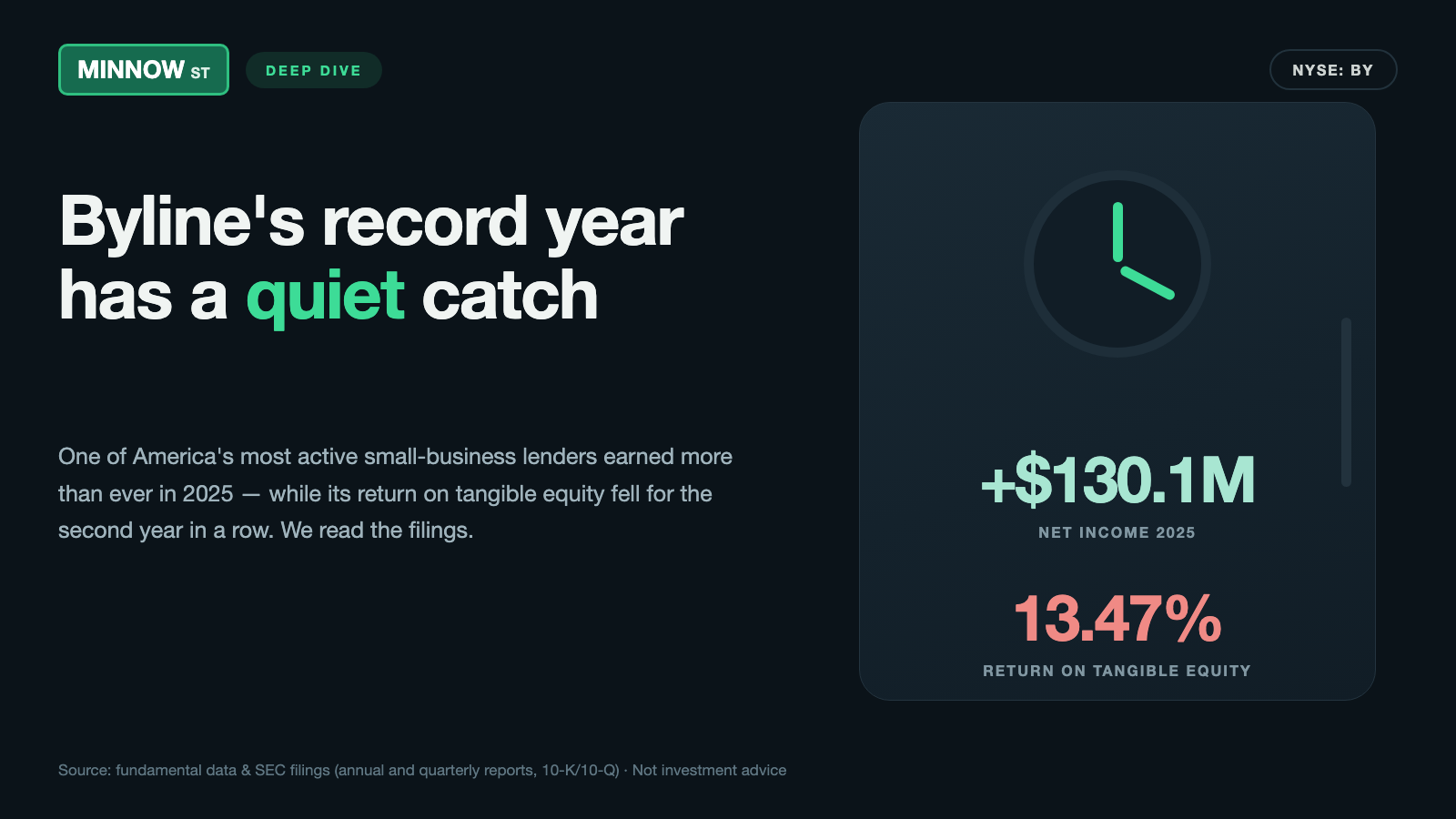
Interactive price chart (TradingView).
Note: pure fact-based analysis, not investment advice and not a solicitation to buy or sell. All figures without guarantee.
Every shop you have ever walked into sells something you can look at. You can squeeze the avocado, kick the tire, hold the handbag up to the light. A bank is the one shop where the goods are invisible. What Byline Bank sells is a promise written in a spreadsheet: someone in Chicago borrowed money and says they will pay it back. You cannot squeeze that. So what do you do instead? You read the labels. "Record profit." "Government guaranteed." "Well capitalized." And here is the quiet trap — psychologists would file it under processing fluency, but you can call it the label trap: a label that is easy to read feels like a fact you have checked. It is not. A label tells you what a thing is called, not what it is worth. Byline Bancorp (NYSE: BY) wears three very good labels right now, and all three are honestly earned — which is exactly what makes them worth turning over. Almost nobody is looking: our Reddit hype scanner counted 3 mentions in 24 hours (ApeWisdom, as of July 16, 2026). This stock has no forum, no meme, no drum. So let us make a deal: we ignore the labels and read only what Byline told the U.S. securities regulator, the SEC, under penalty of law — the annual report (10-K) for 2025 and the quarterly report (10-Q) as of March 31, 2026. At the end you will not get a verdict from us. You will get the findings.
What Byline actually does — a corner bank with a federal side door
Byline Bank is a commercial bank in Chicago: 45 branches (44 across the Chicago metropolitan area, one in Wauwatosa, Wisconsin), $9.65 billion of total assets, $7.65 billion of deposits and $7.51 billion of loans as of December 31, 2025. The everyday machine is the oldest one in finance: take deposits cheaply, lend them out dearly, keep the difference. That difference is called the net interest margin, and it is the number to watch — of every $100 of loans and securities on the books, Byline kept $4.22 as margin in 2025. If that sounds unremarkable, it is not: most regional banks live around $3.00, and the gap is the whole story of this company.
Where does the extra margin come from? Through a side door marked Small Business Administration. Byline is one of the most active SBA lenders in the country — an "SBA Preferred Lender", which means it can approve federally guaranteed small-business loans itself instead of queuing for Washington. The mechanics are worth understanding in plain language, because the rest of this analysis hangs on them. A small business borrows, say, $1 million. The federal government guarantees roughly three quarters of it. Byline then sells that guaranteed slice to investors at a premium, keeps the unguaranteed rest on its own books, and keeps servicing the whole loan for a fee. The annual report puts it in one sentence:
"We generally sell the government guaranteed portion of SBA and USDA loans into the secondary market while retaining the non-guaranteed portion of the loan and the servicing rights. This allows us to realize one time gain on sale income along with a recurring servicing and interest revenue stream."
— Byline Bancorp, Inc., SEC annual report 10-K 2025, Item 1 "Business" (Small Business Capital)
Three revenue streams from one loan, in other words. As of December 31, 2025 the bank held $533.0 million of SBA and USDA loans, of which only $97.8 million were still government guaranteed — and it was servicing another $1.6 billion of sold loans for other people. Alongside this sits the rest of an ordinary commercial bank: $1.4 billion of commercial real estate, a leasing arm, and — less ordinary — $805.9 million of "sponsor finance", senior secured loans to private-equity-owned companies with EBITDA between $2 and $10 million. Growth has come as much by takeover as by sweat: five bank acquisitions since 2016, most recently First Security on April 1, 2025. Which brings us to the central tension of this analysis, and it runs through every chapter: the two things that make Byline exceptional — a federally powered lending engine and an appetite for buying other banks — are precisely the two things that make its earnings hardest to read and its returns quietly shrink.
Where the stock shows up in our scanner — one hit, and an honest admission
Every day we run about 3,500 stocks through our scanners. Byline has a row in our database — its company profile sits in the stocks section — and as of the July 16, 2026 data cut-off it lit up in exactly one filter: the KCF ranking, which collects companies with positive operating cash flow trading at no more than ten times it. Byline sits at 9.9, near the edge of the gate, one of 1,326 names on a very broad list. That is the entire harvest.
Now the honest part, and we would rather say it than dress it up: our scanner is built for industrial companies, and a bank breaks it. On Byline's row, the price-to-earnings ratio, the price-to-book ratio and the debt-to-equity ratio all come back empty — no value at all. Some of that is a plain data gap on this row (peer banks in our database do carry those numbers). But the deeper problem is that for a bank those metrics are noise even when they are populated. Debt-to-equity is the clearest example: a bank's "debt" is mostly your savings account. Deposits are the raw material, not a warning sign — which is why the same filter reports 0.59 for Wintrust and 4.12 for JPMorgan — two healthy banks, sevenfold apart — and why the price-to-cash-flow that put Byline on our one list reads 6.4 for JPMorgan and 219.2 for Wells Fargo. Same industry, same quarter, numbers that cannot both mean something. A screen that ranks a bank by EV/EBITDA is measuring a fish by how well it climbs.
So we will not pretend the scanner has an opinion here. What it can measure honestly is price behavior, and there the reading is consistent: a relative-strength rating of 73, up about 45 percent over twelve months and 27 percent over six, trading above its 50-day and 200-day averages with an intact power trend, and within about 0.3 percent of its 52-week high (all data as of July 16, 2026). One more clean signal: 4 insider purchases against 2 sales in the past twelve months — the rarer direction, and the opposite of what we usually find. Everything else in this analysis has to come from the filings. Which is where we are going.
The numbers over the years — honestly appraised
Start with what genuinely impresses, because there is a lot of it. Net income has risen every single year: $107.9 million (2023) → $120.8 million (2024) → $130.1 million (2025), the last a record, up 7.7 percent, or $2.89 per diluted share. Revenue reached $446.2 million. The margin went the right way — the net interest margin climbed from 3.97 to 4.22 percent — and the cost machine got tighter: the efficiency ratio (what the bank spends to earn a dollar; below 55 percent is good, below 50 is excellent) improved to 51.83 percent. Credit, the thing that kills banks, simply refused to crack: non-performing loans held at 0.95 percent of the book (2024: 0.90), net charge-offs actually fell to 0.39 percent, and reserves cover 1.45 percent of loans. Return on assets of 1.36 percent is genuinely good — anything above 1.00 percent marks a bank that earns its keep. And the first quarter of 2026 was the best of the lot: net income of $37.6 million, up 33 percent, with the efficiency ratio breaking below 50 for the first time (49.78 percent) and the margin at 4.33 percent.
Now turn the page over. Here is the number nobody puts in a press release:
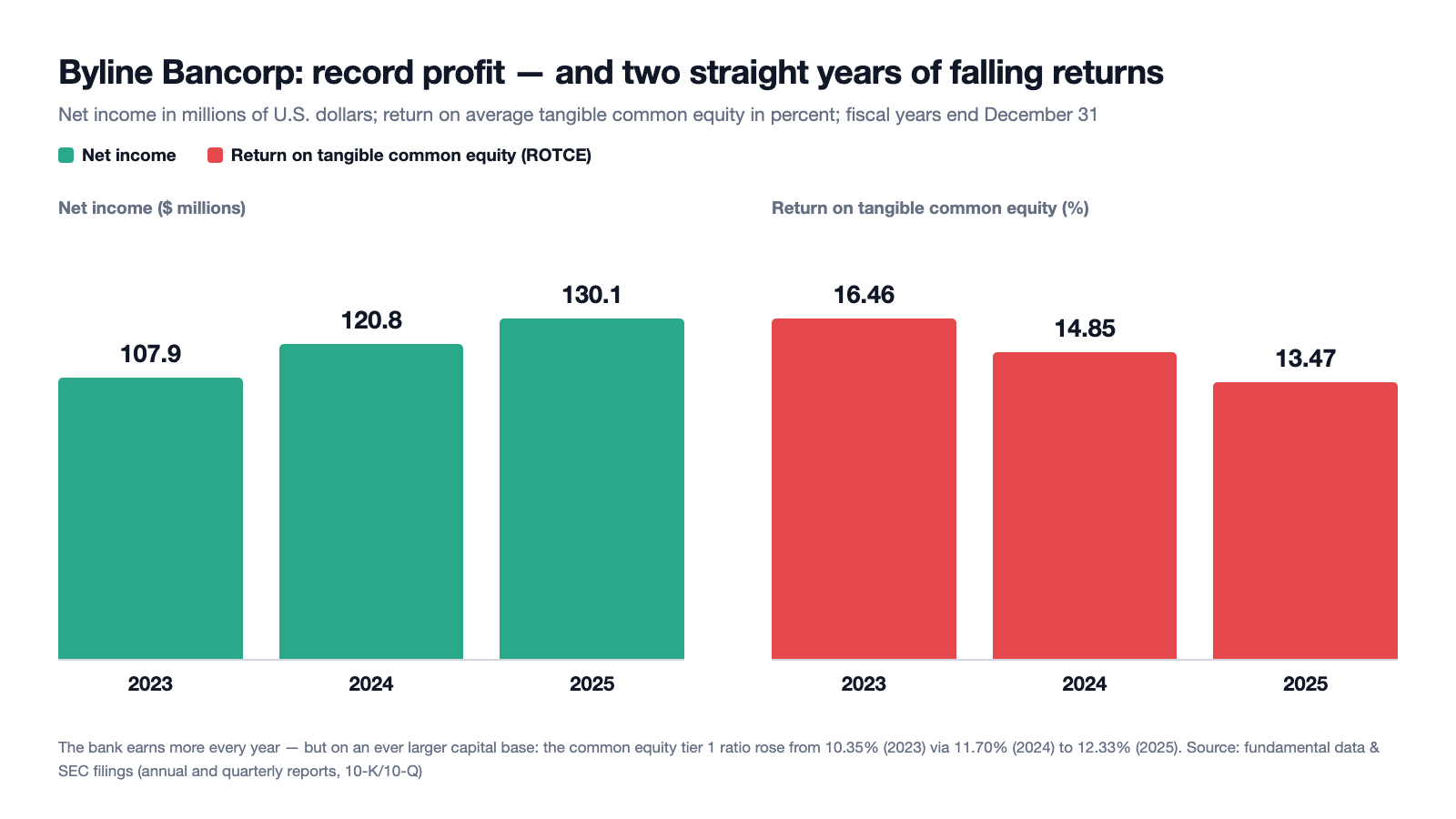
Return on average tangible common equity — the honest yardstick for a bank, because it asks what the owners' real money earned — has gone the wrong way for two straight years: 16.46 percent (2023) → 14.85 percent (2024) → 13.47 percent (2025). Return on equity slid the same way, 12.50 → 11.61 → 10.86 percent. Read that next to the rising profit and you have the whole puzzle of this stock in two lines. The explanation is not a scandal; it is arithmetic. Byline is stockpiling capital: the CET1 ratio (the regulator's core safety cushion) climbed from 10.35 percent (2023) to 12.33 percent (2025), and tangible common equity grew from 9.06 to 11.29 percent of assets. Profit grew about 21 percent over two years; the equity it sits on grew faster. Remember the mechanism: a bank that hoards capital gets safer and less profitable at the same time — and the second half of that sentence shows up in the ratio long before anyone explains the first half. Why hoard? Because capital is ammunition for the next acquisition. Which is a strategy, not an accident — but you are the one paying for the ammunition while it sits in the magazine. The first quarter of 2026 is the first evidence the drag may be ending: ROTCE back up to 13.77 percent from 12.92 percent a year earlier.
What the filings say — the uncomfortable truths
Uncomfortable truth no. 1: the government guarantee has a clause — and Byline holds no reserve against it
"Government guaranteed" is the most reassuring label in this whole business, and it is the one most worth turning over. The guarantee is real: when an SBA borrower defaults, Washington covers its share. But the guarantee is conditional on Byline's own paperwork — and if the SBA later decides the loan was written or serviced sloppily, it can come back for the money. The annual report says so in the flattest possible language, and then adds a sentence that should make you sit up:
"If the SBA establishes that a loss on an SBA guaranteed loan is attributable to significant technical deficiencies in the manner in which the loan was originated, funded, or serviced by us, the SBA may seek recovery of the principal loss related to the deficiency from us. Generally, we do not maintain reserves or loss allowances for such potential claims and any such claims could materially adversely affect our business, financial condition, or results of operations."
— Byline Bancorp, Inc., SEC annual report 10-K 2025, Item 1A "Risk Factors" (Guaranteed Loans Risks)

Sit with the second sentence. Not "we reserve conservatively for this"; not "we estimate the exposure at X". No reserve at all. That is a legitimate choice — such claims are rare, hard to estimate, and accounting rules do not force a number onto a risk you cannot measure. But it means the exposure is carried at zero on a balance sheet that services $1.6 billion of sold loans for others and holds $533.0 million more. And the dependency runs deeper than a clawback. The same risk factor spells out that Byline's whole SBA franchise sits on a permission slip: lose the Preferred Lender status and "we may lose some or all of our customers to lenders who are SBA Preferred Lenders"; and "any default by the U.S. government on its obligations or any prolonged government shutdown could impede our ability to originate SBA loans or other government guaranteed loans or sell such loans in the secondary market". Translated: Byline's best business has a silent partner it did not choose and cannot fire — one that writes the rules, sets the volume caps through Congress, and occasionally shuts down. What a dependency on a single counterparty does to an otherwise healthy business is something we took apart at EverQuote, where one insurance carrier pays 40 percent of revenue. Byline's version is less concentrated but harder to negotiate with.
Uncomfortable truth no. 2: the famous SBA premium is not actually where the money is
Now for the pleasant surprise — pleasant, but with a sting. Byline is known as an SBA machine, and the intuitive worry follows: those one-off gains from selling guaranteed loans must be propping up the profit, and they are cyclical, so the profit is fragile. It is a good hypothesis. The filings do not support it. Here is the actual split:
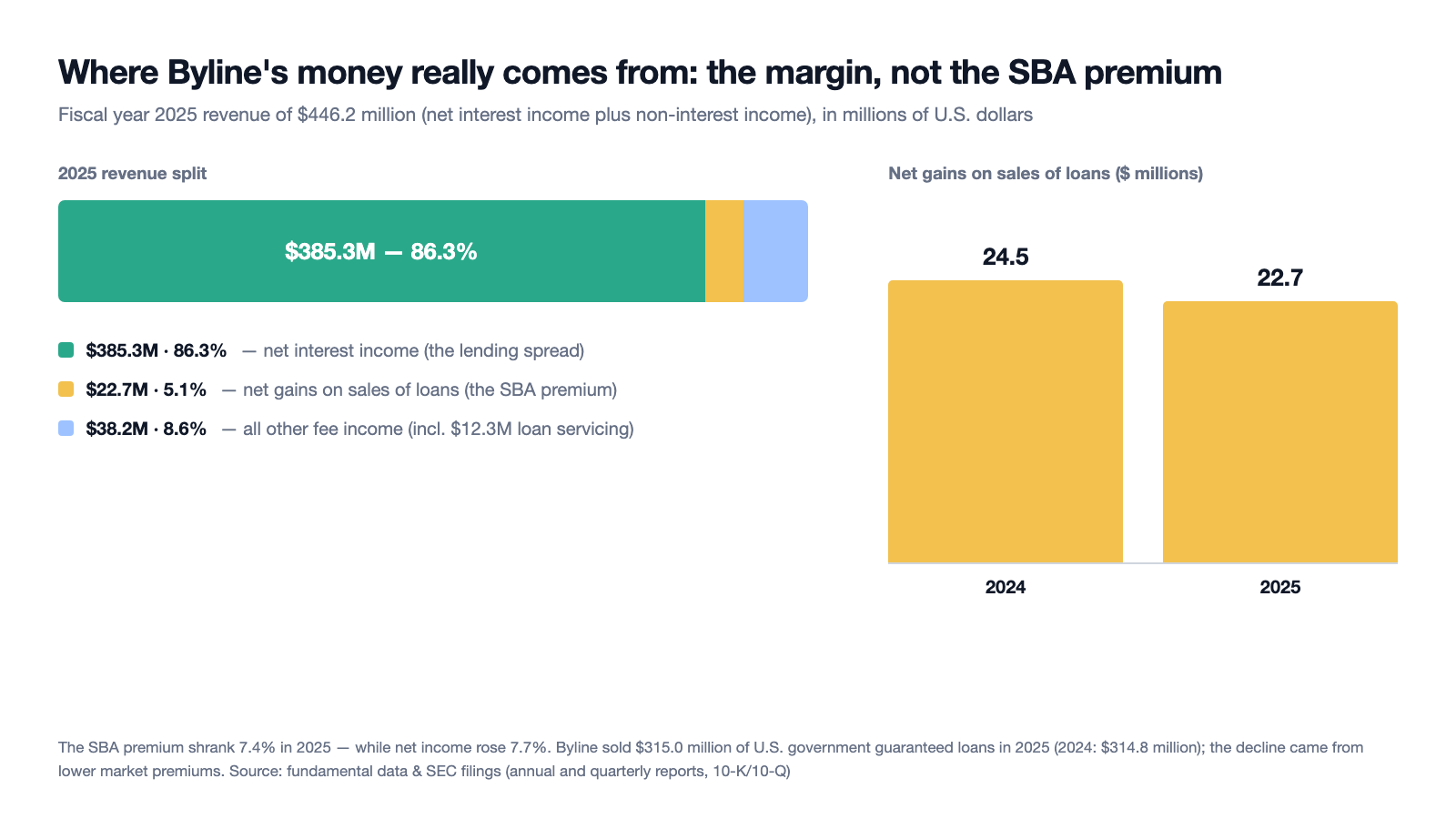
Of $446.2 million of 2025 revenue, $385.3 million — 86.3 percent — was net interest income: plain, recurring, spread. The famous gains on selling government guaranteed loans came to $22.7 million, about 5.1 percent of revenue. And they went down:
"Net gains on sales of loans were $22.7 million for the year ended December 31, 2025 compared to $24.5 million for the year ended December 31, 2024, a decrease of $1.8 million, or 7.4%. The decrease in net gains on sales was primarily driven by lower market premiums for U.S. government guaranteed loans."
— Byline Bancorp, Inc., SEC annual report 10-K 2025, Item 7 MD&A "Non-interest Income"

The premium shrank 7.4 percent and net income still rose 7.7 percent. So the cyclical-one-off worry is, on these numbers, largely wrong — and the share of income that comes from fees keeps falling, not rising: non-interest income was 14.55 percent of revenue in 2023, 13.65 percent in 2025, and just 11.15 percent in the first quarter of 2026. But now the sting, and this is the part the SBA story gets right for the wrong reason: the SBA does not show up in the fee line, it shows up in the margin. Byline's loan book yielded 7.07 percent in 2025 — a startling number when a typical regional bank earns somewhere near 5.5 to 6 percent — because SBA 7(a) loans float against the prime rate at a fat spread. That is why the margin is 4.22 percent instead of 3.00. So the dependency is real, and it is bigger than the fee line suggests, not smaller — it is just wearing different clothes. Remember the image: you were looking for the government's money in the tip jar; it is in the wages.
Uncomfortable truth no. 3: five takeovers have left $181.9 million of goodwill — 14.3 percent of the equity is air
Byline grows by buying: Ridgestone (2016), First Evanston (2018), Oak Park River Forest (2019), Inland Bancorp (2023) and First Security on April 1, 2025. Every one of those deals was paid at a premium over the net assets acquired, and the premium has a name and a home on the balance sheet:
"As of December 31, 2025, we had goodwill of $181.9 million, or 14.3% of our total stockholders' equity."
— Byline Bancorp, Inc., SEC annual report 10-K 2025, Item 1A "Risk Factors" (goodwill impairment)

Goodwill is not a fraud and not a fiction — it is what you paid for a business above the sum of its parts, and often it is worth every cent. But it is the one asset that cannot absorb a loss, pay a depositor, or be sold on a Tuesday. It is a receipt, not a resource. Which is why banks are judged on tangible book value, and why the gap matters here: book value per share is $27.84, but tangible book value per share is only $23.44 (December 31, 2025). Roughly every sixth dollar of book value is a receipt from an old deal. Counting all intangibles, $200.5 million of the $1.27 billion of equity is untouchable in a crisis. There is a second, subtler cost: goodwill is tested for impairment every year, and the test leans on the company's own market value and discounted cash flows — so a long slump in the share price can force a non-cash writedown, in the middle of a downturn, precisely when nobody needs more bad news. What that looks like when it goes wrong we watched at Grocery Outlet, where $307 million of goodwill was written off in one stroke. Byline has shown no sign of it — credit is clean, the deals have been small and local, and management has integrated four of them without visible damage. But the honest framing is this: each acquisition converts hard capital into a promise that the acquired bank keeps performing. Five promises are now on the books, and the capital hoard from truth no. 2 is being built to make a sixth.
Uncomfortable truth no. 4: the record margin was partly rented from the Fed — and the funding is getting tighter
The margin went from 3.97 to 4.22 percent in a single year, and that leap deserves an explanation rather than applause. It did not come from charging borrowers more — the loan yield actually fell, from 7.40 to 7.07 percent. It came from paying depositors less: the average cost of deposits dropped from 2.61 to 2.17 percent after the Federal Reserve cut rates by 75 basis points over 2025. In plain terms: the central bank cut what Byline pays for its raw material faster than it cut what Byline charges for the finished product, and the bank pocketed the difference. That is skillful, and it is also borrowed. The report is unusually candid about how narrow the ridge is:
"Accordingly, we continue to cautiously manage our deposit pricing strategies to seek to maintain our net interest margin. As the competition for funding among banks remains high, and customers continue to seek higher yields, we have adjusted our deposit pricing accordingly. To the extent we offer higher interest rates on targeted interest-bearing deposit products to maintain current customers or attract new customers, our interest expense may increase, perhaps materially. Furthermore, if we fail to offer interest rates at a sufficient level to keep these demand deposits, our core deposits may be reduced, which would require us to obtain funding in other ways or risk slowing our future asset growth."
— Byline Bancorp, Inc., SEC annual report 10-K 2025, Item 1A "Risk Factors" (deposit pricing and interest rate risk)

Pay more, and the margin goes. Pay less, and the deposits go. Byline has been threading that needle well, but three numbers show the thread pulling tight. First, the cheapest money is draining away: non-interest-bearing deposits — accounts that cost nothing — have fallen from 26.56 percent of all deposits (2023) to 23.78 percent (2025). Second, the bank is fully lent: loans as a share of deposits climbed from 92.64 to 98.37 percent in a year, meaning almost every deposited dollar is already out the door and further loan growth needs new funding rather than spare cash. Third, and worth knowing without panicking about it: estimated uninsured deposits were $2.7 billion at the end of 2025, up from $2.2 billion — roughly 35 percent of all deposits sit above the FDIC's $250,000 guarantee. That is not unusual for a business bank, and 2023 taught everyone that uninsured money is the money that moves first. Remember the yardstick: a margin built on cheap deposits is only as durable as the depositors' patience.
One truth we went looking for and did not find, because it belongs in the record: the office-tower disaster. Chicago commercial real estate has been a horror story for three years, and Byline is a Chicago CRE lender with $1.4 billion outstanding. But the exposure is smaller than the headline suggests: "CRE office represents 9.2% of our total CRE portfolio as of December 31, 2025, compared to 10.5% as of December 31, 2024" — a shrinking sliver of a diversified book, roughly 1.7 percent of total loans. Non-performing loans across the whole bank are 0.95 percent and charge-offs are falling. On the evidence in these filings, the office bomb is not ticking here. We looked; it is fair to say so.
Valuation: about $1.7 billion for a bank that earns 13 percent on its tangible money
In mid-July 2026 Byline stock cost about $37.48, for a market value of roughly $1.7 billion (price as of July 15, 2026; all valuation figures data as of July 16, 2026). Against 2025 earnings of $130.1 million, that is a price-to-earnings ratio around 12 — on the trailing twelve months, about 12.2. Bank investors usually reach for a different ruler, and it tells the more useful story: against tangible book value of $23.79 per share (March 31, 2026), the stock trades at about 1.6 times tangible book; against plain book value of $28.17, about 1.3 times. Is that expensive? The honest answer is: it is the price of the returns. A bank earning 13 to 14 percent on tangible equity conventionally deserves to trade above tangible book — roughly, a bank should be worth book value multiplied by how much better its returns are than what shareholders demand. At 1.6 times, the market is paying for the 13.47 percent to hold, and for the capital hoard to eventually be put to work. If ROTCE keeps sliding toward 12, that multiple is generous. If the first quarter of 2026 (13.77 percent, efficiency below 50) marks the turn, it is not.
The professionals' view is politely unexcited: six analysts cover the stock — two strong buys, one buy, three holds, no sells — with an average price target of $38.60, roughly three percent above the mid-July price. Read that honestly: the analyst consensus is not a catalyst, it is a shrug. Their estimates see $3.28 per share for 2026 and $3.39 for 2027, which puts the forward multiple near 9.6 — cheap-looking, but on single-digit growth. The dividend is real and small: $0.42 per share a year, lifted to $0.12 in the first quarter of 2026 from $0.10, a yield around 1.1 percent on a payout ratio of just 14.46 percent — this bank is not paying you to wait; it is keeping the money. Two closing notes for the complete picture: about 28.8 percent of the shares sit in insider hands, dominated by a single 26.15 percent holder (see our side finds), and the stock trades within about 0.3 percent of its 52-week high after a 45 percent twelve-month run. You can find more metrics in the Byline company profile of our scanner.
Opportunities and risks at a glance
What speaks for Byline Bancorp:
- A margin most regional banks cannot reach: net interest margin of 4.22 percent in 2025 (Q1 2026: 4.33 percent) on a loan yield of 7.07 percent, powered by a genuine specialty — one of the country's most active SBA lending franchises, with $1.6 billion of loans serviced for others (annual report 10-K 2025).
- Record earnings with real quality: net income of $130.1 million (+7.7 percent), return on assets of 1.36 percent, efficiency ratio of 51.83 percent — and 86.3 percent of revenue is recurring net interest income, not one-off gains.
- Credit is clean in a market where it was supposed to break: non-performing loans of 0.95 percent, net charge-offs falling to 0.39 percent, reserves at 1.45 percent of loans, and CRE office at just 9.2 percent of the CRE book and shrinking (December 31, 2025).
- A fortress balance sheet and ammunition: CET1 of 12.33 percent (2023: 10.35 percent), tangible common equity of 11.29 percent of assets, tangible book value per share up from $17.98 (2023) to $23.44 (2025) — plus a proven integration record of five bank acquisitions since 2016.
- The first quarter of 2026 turned the key ratio: net income of $37.6 million (+33 percent), efficiency below 50 percent for the first time (49.78), ROTCE back up to 13.77 percent — and 4 insider purchases against 2 sales in twelve months (data as of July 16, 2026).
What speaks against it:
- Returns have fallen for two straight years while profit rose: ROTCE from 16.46 percent (2023) via 14.85 to 13.47 percent (2025), return on equity from 12.50 to 10.86 percent — the capital is piling up faster than the earnings on it, and it is waiting on a deal that has not happened yet.
- The best business has a silent partner: the SBA can reclaim losses from "significant technical deficiencies", against which the bank keeps, in its own words, no reserves; the Preferred Lender status, the program rules and the funding caps all sit with the federal government, and a shutdown can stop originations and sales outright (10-K 2025, Item 1A).
- 14.3 percent of the equity is goodwill ($181.9 million): of $27.84 of book value per share, only $23.44 is tangible — the accumulated receipts of five takeovers, testable for impairment every year against the bank's own market value.
- The margin leap was rented: the cost of deposits fell from 2.61 to 2.17 percent only because the Fed cut 75 basis points, while the loan yield fell too (7.40 → 7.07 percent); meanwhile free deposits shrank from 26.56 to 23.78 percent of the total, loans reached 98.37 percent of deposits, and uninsured deposits grew to $2.7 billion.
- Concentration and quiet complexity: essentially one metropolitan market (44 of 45 branches in Chicagoland, 67.6 percent of CRE loans in Illinois), plus $805.9 million of sponsor finance — leveraged loans to private-equity-owned companies with $2 to $10 million of EBITDA — inside what looks like a community bank; our scanner finds it in only one list and cannot rate it on classic fundamentals (data as of July 16, 2026).
A human conclusion
Back to the labels from the opening — because with a bank, that is not a metaphor, it is the only method you have. Three labels, three findings. "Record profit" is true, and it is the least informative thing on the box. Byline earned $130.1 million, more than ever, and the number that actually tells you what the owners' money did — return on tangible equity — has fallen two years running, from 16.46 to 13.47 percent. Not because the bank got worse, but because it is quietly stacking capital for a purchase it has not made. That is a defensible strategy and a real cost, and you are paying it now for a benefit that arrives later, if it arrives. "Government guaranteed" is true, and it is conditional. Washington stands behind the loans — as long as Byline's paperwork holds, its Preferred Lender badge holds, Congress funds the program and the government stays open; against the clawback risk there is no reserve at all. And "SBA gain-on-sale story", the label the market has stuck on this bank, is simply wrong — those gains are 5.1 percent of revenue and falling, while 86.3 percent is plain lending spread. That is the good news; the sting is that the government's fingerprints are not in the tip jar but in the wages, in a 7.07 percent loan yield that no ordinary Chicago bank could earn.
So what is actually on the shelf? A well-run, unfashionable, genuinely profitable bank with clean credit, a rented margin, a fortress balance sheet, a quarter of its stock in one pair of hands and a strategy that requires it to keep buying rivals to justify the capital it is holding back from you. At about 1.6 times tangible book, the price says the market believes the returns will hold. The filings say the returns have been falling and only just stopped. Both of those are true at once, and the next few quarterly reports will tell you which one was the label and which one was the merchandise. What you make of it is your decision. And that is exactly as it should be.
Sources
All original documents used in this analysis — to read for yourself:
- Byline Bancorp, Inc. — SEC annual report 10-K for 2025 (filed February 27, 2026)
- Byline Bancorp, Inc. — SEC quarterly report 10-Q as of March 31, 2026 (filed May 1, 2026)
- Byline Bancorp, Inc. — SEC proxy statement DEF 14A 2026 (filed April 20, 2026; stock ownership as of April 8, 2026)
- Byline Bancorp, Inc.'s complete SEC filing history: EDGAR overview (sec.gov)
- Fundamental data (metrics, quarterly series, valuation; data as of July 16, 2026), reconciled with the SEC filings.
- Screener and rating data: in-house stock scanner (data as of July 16, 2026); Reddit mentions: ApeWisdom (as of July 16, 2026).
Transparency & disclaimer: This analysis is a journalistic contextualization of publicly available information and is not investment advice, not a financial analysis in the regulatory sense, and not a solicitation to buy or sell securities. Stock investments carry substantial risks up to total loss. All information without guarantee; the data cut-off is noted in the text in each case. The author holds no position in Byline Bancorp stock at the time of publication.
Our Bottom Line at a Glance
- Business model & market position positive
- A Chicago commercial bank with a genuine specialty: one of the most active SBA/USDA lenders in the U.S. ($533.0 million on balance sheet, $1.6 billion serviced for others), which lifts the loan yield to 7.07 percent and the net interest margin to 4.22 percent — far above the roughly 3 percent regional-bank norm. 86.3 percent of 2025 revenue is recurring net interest income, not one-off gains (annual report 10-K 2025).
- Earnings quality & efficiency positive
- Record net income of $130.1 million in 2025 (+7.7 percent), return on assets of 1.36 percent, efficiency ratio of 51.83 percent — and the first quarter of 2026 was better still: $37.6 million (+33 percent), efficiency below 50 percent for the first time (49.78), driven by $11.6 million more net interest income and a $3.6 million lower provision. The much-feared SBA premium dependency is not visible in the fee line: those gains fell 7.4 percent to $22.7 million while profit rose.
- Returns on capital negative
- Return on average tangible common equity has fallen for two straight years — 16.46 percent (2023), 14.85 percent (2024), 13.47 percent (2025) — and return on equity from 12.50 to 10.86 percent, because the CET1 ratio was pushed from 10.35 to 12.33 percent. The capital is being hoarded for acquisitions that have not yet happened; shareholders carry the cost now. Q1 2026 (ROTCE 13.77 percent) is the first sign of a turn, not yet proof of one.
- Credit & balance sheet positive
- Credit refuses to crack where it was supposed to: non-performing loans of 0.95 percent, net charge-offs falling to 0.39 percent, reserves at 1.45 percent of loans, CRE office at just 9.2 percent of the CRE book and shrinking (December 31, 2025). Capital is strong (CET1 12.33 percent, tangible common equity 11.29 percent of assets), tangible book value per share grew from $17.98 (2023) to $23.44 (2025).
- Structural risks negative
- The best business has a silent partner: the SBA can reclaim losses from "significant technical deficiencies", and the bank keeps no reserves for such claims; Preferred Lender status, program rules and funding caps sit with the federal government. On top: goodwill of $181.9 million (14.3 percent of equity) from five takeovers, free deposits shrinking from 26.56 to 23.78 percent, loans at 98.37 percent of deposits, uninsured deposits of $2.7 billion, one metropolitan market — and $805.9 million of leveraged sponsor-finance loans inside a community bank.
- Valuation & signals neutral
- About $1.7 billion of market value — roughly 12 times 2025 earnings, about 1.6 times tangible book value and 9.6 times the 2026 estimate — after a 45 percent twelve-month run that leaves the stock within 0.3 percent of its 52-week high. Six analysts average a $38.60 target, about three percent above the mid-July price: a shrug, not a catalyst. Against that: 4 insider purchases versus 2 sales, and a dividend yield of only about 1.1 percent on a 14.46 percent payout (data as of July 16, 2026).
Byline Bancorp is a well-run bank wearing three very good labels, and all three repay a second look. "Record profit" is true — $130.1 million in 2025, clean credit, a 4.22 percent margin most regional banks cannot reach — but the return on tangible equity behind it has fallen two years running, from 16.46 to 13.47 percent, because capital is being stockpiled for the next takeover. "Government guaranteed" is true and conditional: the SBA can claw back losses from technical deficiencies, and against that the bank holds no reserves. And the market's favorite label, the SBA gain-on-sale story, is simply wrong — those gains are 5.1 percent of revenue and shrinking, while the government's real contribution hides in a 7.07 percent loan yield. At about 1.6 times tangible book, the price says the returns will hold; the filings say they have been falling and only just stopped. Not investment advice.
What Our Rating Means
- If you don't own the stock
- As long as the question raised in the bottom line stays open, we see no basis for an entry.
- If you hold it in your portfolio
- Our findings offer no acute reason to sell — the checkpoints named remain decisive.
A journalistic assessment by our editorial team at the time of the deep dive, based on public sources — not investment advice and not a solicitation to buy or sell. Your personal circumstances (investment goals, risk capacity, taxes) cannot be taken into account. What our categories mean, how verdicts are formed, and what conflicts of interest exist →
Worth Noting
- BY reached our research list via the Reddit hype scanner (ApeWisdom, 3 mentions in 24 hours, as of July 16, 2026) — the silence is the point: a 45 percent twelve-month run with no forum interest at all.
- Our in-house stock scanner is calibrated for industrial companies and rates a bank poorly by construction: BY appears in exactly 1 of our lists (KCF ranking, price-to-cash-flow 9.9), while the price-to-earnings, price-to-book and debt-to-equity fields return no value for this row. For banks those metrics are noise anyway — deposits are raw material, not debt — which is why the same filters report debt-to-equity of 0.59 for Wintrust and 4.12 for JPMorgan. All bank-specific figures in this analysis come from the SEC filings, not the scanner.
- Price and valuation figures are dated (about $37.48 as of July 15, 2026; market value roughly $1.7 billion, scanner and estimate data as of July 16, 2026); analyses are evergreen, daily prices are not a buy argument.
Frequently Asked Questions
Byline Bank (NYSE: BY) is a commercial bank in Chicago with 45 branches. It earns 86.3 percent of its revenue as net interest income — the spread between what it pays depositors and what it charges borrowers: $385.3 million of $446.2 million in 2025. The rest is fee income, including $22.7 million of gains on selling government guaranteed loans and $12.3 million of loan servicing revenue.
Yes, and increasingly so. Net income rose from $107.9 million (2023) via $120.8 million (2024) to a record $130.1 million in 2025 — $2.89 per diluted share, a return on assets of 1.36 percent. The first quarter of 2026 brought $37.6 million, up 33 percent from the prior-year quarter, with an efficiency ratio below 50 percent for the first time (49.78 percent).
Because capital is growing faster than profit. Byline's return on average tangible common equity fell from 16.46 percent (2023) via 14.85 percent (2024) to 13.47 percent (2025), while its CET1 capital ratio climbed from 10.35 to 12.33 percent. The bank is stockpiling capital — ammunition for further bank acquisitions. The first quarter of 2026 broke the trend: ROTCE back at 13.77 percent.
Less than the fee line suggests, and more than it looks. Gains on selling government guaranteed loans were just $22.7 million in 2025 — 5.1 percent of revenue, and down 7.4 percent from 2024. But SBA lending is why the loan book yields 7.07 percent and the net interest margin is 4.22 percent instead of the roughly 3 percent typical for regional banks. The dependency sits in the margin, not the premium.
Byline would absorb it directly. The annual report 10-K 2025 states that if the SBA finds a loss stems from "significant technical deficiencies" in how a loan was originated, funded or serviced, it may seek recovery — and: "Generally, we do not maintain reserves or loss allowances for such potential claims." As of December 31, 2025 Byline held $533.0 million of SBA and USDA loans and serviced $1.6 billion more for others.
Less than its Chicago address implies. The annual report 10-K 2025 states: "CRE office represents 9.2% of our total CRE portfolio as of December 31, 2025, compared to 10.5% as of December 31, 2024" — on a $1.4 billion commercial real estate book, roughly 1.7 percent of total loans, and shrinking. Bank-wide non-performing loans stood at 0.95 percent and net charge-offs fell to 0.39 percent.
The largest shareholder by far is MBG Investors I, L.P., with 11,875,953 shares or 26.15 percent (proxy statement, as of April 8, 2026), a partnership registered in Toronto whose general partner Antonio del Valle Perochena holds voting power. BlackRock (5.06 percent) and Dimensional (5.11 percent) follow far behind. About 28.8 percent of the shares sit in insider hands (data as of July 16, 2026).
It is priced for its returns. In mid-July 2026 the stock cost about $37.48, a market value of roughly $1.7 billion — about 12 times 2025 earnings, roughly 1.6 times tangible book value of $23.79 per share (March 31, 2026) and 9.6 times the 2026 analyst estimate. Six analysts average a $38.60 target, about three percent above the mid-July price (data as of July 16, 2026).
Found an error?
Did you spot a factual error, an outdated number, or a typo in this deep dive? Let us know briefly — your report goes straight to the editorial team.